Água virtual, escassez e gestão: o Brasil como grande "exportador" de água
Roberto Luiz do CarmoI; Andréa Leda Ramos de Oliveira OjimaII; Ricardo OjimaIII; Thais Tartalha do NascimentoIV
IProfessor of the Department of Demography, IFCH/UNICAMP, and Researcher of the Center of Population Studies - NEPO/UNICAMP
IIResearcher of the Institute of Agricultural Economy - IEA/APTA, and Ph.D. student in Economical Development, IE/UNICAMP
IIICollaborator Researcher of the Department of Demography, IFCH/UNICAMP, and of the Center of Population Studies – NEPO/UNICAMP; Postdoctoratal scholar at the Center of Population Studies - NEPO/UNICAMP, sponsored by the Foundation of Research of the São Paulo State
IVGraduate student in Anthropology – IFCH/UNICAMP
Translated by Elizabeth Abdanur and Leonardo Brito.
Translation from Ambiente & sociedade, Campinas, v.10, n.2, p.83-96, July/Dec. 2007.
ABSTRACT
The economic valuation of water has recently been discussed in the Brazilian political scenario. Part of the proposed discussion is the incorporation of water in trade and commerce, especially in commodities, using the ‘virtual water' concept. In this article we search for the impact that the utilization of the ‘virtual water' concept may have on the Brazilian scenario and discuss, at the same time, the consequences of this exportation.
Keywords: Virtual water. Water resources. Commodities.
ABSTRACT
The economic valuation of water has recently been discussed in the Brazilian political scenario. Incorporation of water in trade and commerce, especially in commodities is part of the proposed discussion , using the "virtual water" concept. In this article we search for the impact that the utilization of the "virtual water" concept may have in the Brazilian scenario and discuss, at the same time, the consequences of this exportation.
]]> Keywords: Virtual water. Water resources. Commodities.
1 Introduction
Brazil occupies a very important place in the present international commodities market, as it is one of the most important exporters for soya, beef, and sugar. In economic terms, these products have been having a significant and rising importance in Brazilian trade, making these economic activities essential for the country. The great availability of fertile land and water resources, as well as the low production costs involved in these activities, place Brazil in a privileged position within the international commodities market. However, if one takes a broader view of environmental access, use and control, this means the transference of a resource that Brazil possesses in abundance, namely water, to countries that lack this indispensable resource. When considering the comparative advantages held by each country to trade in the international market, this becomes a reality. However, what are the implications of this process of water transference? How is this insertion into the international market impacting on the availability and quality of this fundamental resource that it is water?
In order to try to find possible answers to these questions, we have adopted the concept of "virtual water". The relationship between this concept and the current legislation on water management in Brazil is revealing, in terms of the risks that are configured concerning water. In this sense, we emphasize the creation of an extensive legal framework for the protection and rationalization of water usage. One of the main management principals of this framework is the gross use of water charging. However, we point out the difficulty for the agricultural and cattle ranching sectors to submit themselves to this legislation, especially what concerns to charging for the use of water. This is a relevant fact, and it is a source of potential conflict between the diverse consumers' sectors, particularly when considering that the agricultural sector is the main user of water in the country and is increasingly directing its production to supply the external market.
‘Virtual water' is a term created at the beginning of the 1990s, by Professor A. J. Allan, from the School of Oriental & African Studies of London University1. The same idea had been previously used by the author, but with the name ‘embedded water'. This expression, however, has had a much lesser impact than ‘virtual water', even though it is still found in literature. In a short, but very interesting text, Allan (1998) systematizes the main elements of his concept, highlighting the necessity of water due to the increase in the global population, and our food consumption behaviour, which carry direct implications on how we utilize water. The repercussion of the term ‘virtual water' became more significant when a group of scientists led by A. Y. Hoekstra from Twente (Enschede) University in Holland, and UNESCO – IHE (United Nations Educational, Scientific and Cultural Organization - Institute for Water Education), worked on the identification and quantification of ‘virtual water' trade flow between countries, making the concept operational (Hoekstra and Hung 2002).
In essence, virtual water is the indirect trade of water that is contained within certain products, especially agricultural commodities, whilst an intrinsic raw material of these products. In other words, any water involved in the production process of any industrial or agricultural goods is then referred to as virtual water. In this way, the meaning of virtual water rests on a relatively simple argument, even though there is great complexity to its empirical verification.
To estimate the volume of virtual water that is commercialized requires a set of complex calculations. In order to measure these values, one has to consider the water that is used in the whole production chain, but it is also necessary to know the specific characteristics of each production region, as well as the environmental and technological characteristics present in the production process. In this sense, the conception behind the term virtual water relates closely to the ‘ecological footprint' concept, as it is necessary to follow the steps and stages of the production process, evaluating in detail each element, the impacts, and the use of the natural resources involved in the process as a whole, from the basic raw material to the energy consumption. Chapagain et al. (2005) discuss the similarities that exist between virtual water and ecological footprint.
]]> In methodological terms we point out that research on the trade of virtual water makes use of diverse sources of data, especially those that help form international comparisons, and those that have an official character, such as the ones linked to the UN. The works of Hoekstra and Hung (2004), Chapagain, Hoekstra and Savenije (2005), and Chapagain et al. (2005) show the potential of these data compounds, through the analysis of specific situations or specific commodities, like cotton. The advantage of using information coming from these sorts of organizations to create a virtual water database also rests with their standardization of the units used in these sort of researches, as well as with the easier access to information that they enable. In this way, the estimations about the composition of the flows and intensity of this trade are more trustworthy (Hoekstra and Hung, 2004). Therefore, in order to identify the quantity of water used in plantations, we utilized the data obtained from the Food and Agriculture Organization (FAO); and to compose the information regarding the commerce between nations, as a way of establishing the amount of virtual water present in this commerce, we used the United Nations Commodities Trade Statistics Database (COMTRADE), as well as the database from the Geneva International Trade Center.In this article we are specifically concerned with the amount of virtual water contained in the major raw materials that compose the Brazilian export trade: soya, beef, and sugar. The aim is to highlight which are the environmental impacts involved in the increasing export growth of these products, and, at the same time, to evaluate Brazil's place on the international stage of water usage. Under this perspective, the text also looks at aspects such as charging for the use of water, the risk concept, and the water usage demands by the various production sectors in the country, especially the agricultural sector.
2 The estimates of virtual water exports: the Brazilian case
The virtual water concept is defined as the volume of water demanded for the production of a certain commodity. In other words, the cubic meter volume that is necessary for the production of x tons of soya, rice, sugar, etc. We can assume that, together with the trade surplus generated through the export of these products, there is an additional value that is not accounted for, and which, we argue, can represent much more than just the balance of trade of a country, but moreover, its environmental sustainability in the medium and long terms.
The analysis of research found under the UNESCO ‘Virtual Water Trade Research Programme' brings evidence of the relationship between the countries that are considered to be world ‘reservoirs' of fresh water and their capacity to generate trade surplus. However, the water resources that are involved in the production of goods for exports can end up becoming scarce, even in those regions where there is relative abundance. The Brazilian case is a good example, especially when we consider the production of primary products like soya and sugar, or even if we consider the semi-manufactured products like beef cuts.
Initially, it needs to be highlighted that there is an unequal distribution of the availability of water among the various areas on the planet, but also that there is an important seasonal variation that has to be considered – with the concentration of rain in certain periods during the year. Generally considered, the Americas are situated in a privileged position, as they have relative water abundance. Oppositely, the center, south, and southeast Asiatic regions are to be found in a critical situation, as they possess much more limited water resources, although they have been excelling themselves as important exporters on the international economic stage, mainly in the export of virtual water.
Following this line of thought, Hoekstra and Hung (2002) mapped the world flow of virtual water, dividing the planet between exporters and importers that relate to each other to form a balance of trade. Some of the countries and regions assume a central place and role in this balance of trade for being strong exporters. They are: Brazil, the United States, Central America, and the Southwest of Asia. Whereas the importers are composed by Europe, Africa, the Middle East, and a great part of Asia. The trade flows between exporters and importers happen as follows: Brazil has Europe and Asia (especially China) as its biggest market; the United States has Europe, Asia, Africa, and part of Central America as its major export market. There is still Latin America, with its main export market in the central and south parts of Asia, as well as the Southwest of Asia, also exporting to other Asiatic regions (mainly the central and south areas of the continent).
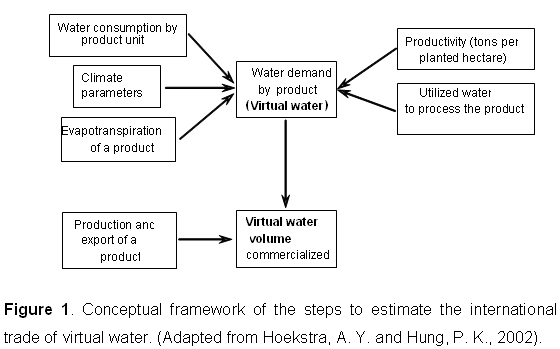
The estimation used to calculate the export and import volumes of virtual water were based on a vast list of products, found among the main ones responsible for the international trade transactions. Therefore, we considered the consumption demand for the production of each of these products, taking into account the specificities found on each of the products and each region in terms of water resources demands2. In order to find these specific demands, it was necessary to estimate the volume of water contained in each of these products, as well as in each of these regions, by pursuing the following criteria: the climate parameters of the given region; the characteristics of the product (evapotranspiration); the productivity (t/ha); and the international trade.
Therefore, the production of the same sort of goods can demand a different volume of water, depending on the local climate characteristics, the yield and the productivity of each region. In other words, the demand for water in the production of soya, for instance, will differ depending on the area where it was planted, due both to climate reasons and to the productivity, which involves specific characteristics in the mode of production of agricultural cultures developed in various places around the world. Figure 1 shows the aspects falling upon the estimates of virtual water trade.
]]>
Similarly, there are calculations for the demand of water for products such as beef and its derivatives. In this case we considered the demand for the production of grains (which would be used for feeding the cattle), the demands for direct consumption (water used as drinking water for the cattle), treatment (cleaning services, etc), and also the necessary volume of water needed to process the final products. Based on these calculations, it is possible to know the volumes of water per production ton of a great variety of important products commercialized in the international trade market3.
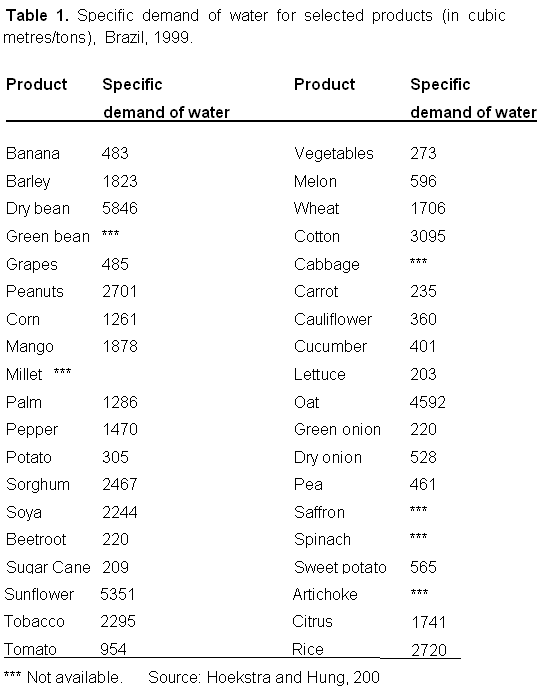
Table 1 presents the Food and Agricultural Organization (FAO) estimation for water demand for the production of a group of agricultural goods. We point out that those are estimates of the average demand, which can vary due to specific regional characteristics, such as land and climate. The FAO does these studies and estimations for all the countries in the world, including considering these variations at a country level. However, territorial extension and regional diversity can bring imprecision in the Brazilian case, although the use of FAO's database does not invalidate the calculations we present in this article.
]]> The results arrived at through the application of this methodology for the Brazilian case, with emphases given to the products of soya, beef and sugar, are presented in Table 2. We have used the export data of each product, in accordance with the Ministério do Desenvolvimento, Indústria e Comércio Exterior – MDIC (the Ministry of Development, Industry and Export Trade), and the volume of virtual water contained in each product based on the data produced by FAO. We have noted that the export of commodities has increased significantly, which is reflected in the volume of virtual water exported by the country. In less than ten years, the volume of virtual water being exported has more than tripled. In volume terms, soya is highlighted as the major product with more than 50 billion m3 being exported in 2005, with Brazil consolidating itself as the major exporter of this product. The relative weight of beef production has also grown considerably during the same period, with the increase of the Brazilian cattle herd signalling the interest of the country in establishing itself as the main world beef exporter.
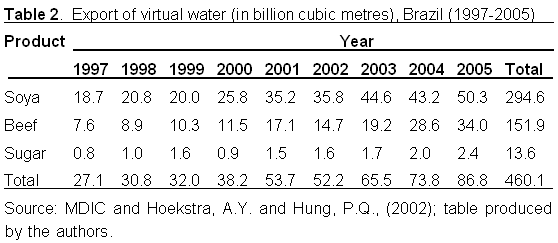
In accordance with the data produced in 2005 by the Ministry of Development, Industry and Export Trade (MDIC), soya was responsible for more than 58% of the exports of this group of commodities (soya, beef and sugar) by the country. The main buyer of soya was the Chinese market, securing 32% of the Brazilian export. In that country, this product is destined for the supply of the industrial sector, which possesses a processing capacity of approximately 30 million tons per year, representing 17% of the world processing for the year 2005.
Considering only soya, China was one of the main importers of virtual water from Brazil in the same year, having taken 16.1 billion m3. The data produced by Companhia de Saneamento Básico do Estado de São Paulo – SABESP (the Water Company of the State of São Paulo), shows that the volume of water exported corresponds to four times the average daily consumption of water for the entire Metropolitan Region of São Paulo. The intensive use of soya for industrial processing has bran as the end product, which is mainly used for animal feed. We have to consider that the usage of water to produce animal feed, which will be subsequently transformed into beef for human consumption, is not an efficient form of water usage, as we will show below.
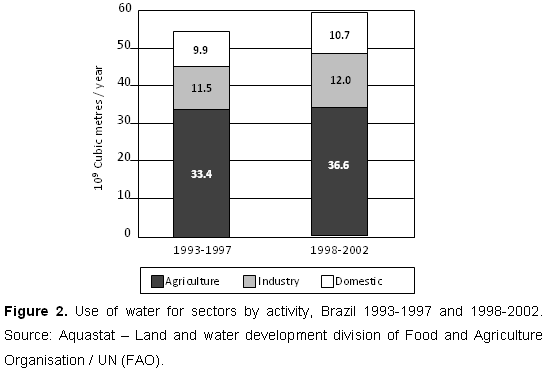
The importance of adequate management of water in the big urban centers is made necessary due to the existent pressure owing to the lack of treatment and to the relative water scarcity found in the majority of these areas, as has been pointed out by Carmo (2005). However, very little is discussed – be it in the media or in the more general public debate – in relation to the adequate use of water in agriculture. In Brazil, but also in the general world average, the water consumption in agriculture is the most extensive among the three biggest demanding groups, representing more than 60% of the total water consumption, as it is shown in Figure 2. The production and export growth has not always been followed by better efficiency in the use of water. In this respect, it is possible to verify that apart from being the sector that most consumes water in the country, agriculture is also the sector that has presented the highest absolute increase in the total volume consumed.
]]>
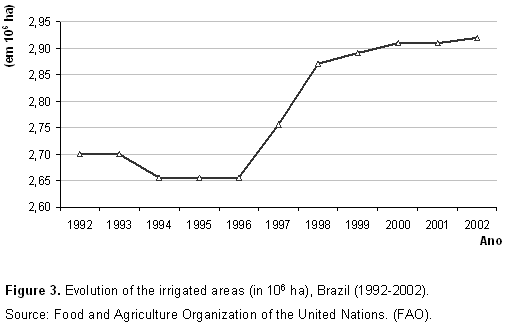
The strong participation of the agricultural sector in the consumption of water can mainly be explained by the use of water for irrigation. The intensification of irrigation practices and techniques as a strategic alternative to boosting the availability of agricultural products has increased Brazilian irrigated areas. During the period between 1992 and 2002, the irrigated area in the country has seen an increase in the order of 8%, as shown in Figure 3. However, it is necessary to have rational irrigation management, which entails considering not only the most advanced techniques, but also the application of the right amounts of water for each type of crop during the optimum periods. Nowadays, in not having a method of irrigation control, the rural producer ends up using excess water to guarantee that his crop will not suffer hydro stress, which could compromise the production. This excess has as a consequence, the waste of energy and water unnecessarily used.
Telles (1999) looks at this unnecessary use of water for irrigation and animal drinking. According to the author, the most conflictive issues at stake are the waste of water, as well as the poor standards of care regarding water quality. Another aspect to be mentioned is that the vast amount of water used by the agricultural sector does not return to its source of origin, or if it returns, it is compromised by the contamination of pesticides or by the cattle dung.
Telles (1999) elaborates an analysis of water usage in Brazil looking at the regional level, highlighting their specificities. He points out that in the South and Southeast regions of the country there is a high use of irrigation, but shows that the lack of care in the measurement of the necessary water volume to be used is a common reality. Whereas in other regions such as the Northeast, cattle raising and production are greatly affected by water availability; the "obligatory irrigation", as Telles argues, is an important aspect of differentiation of the Northeast to other regions within the country. While in the rest of the country irrigation is utilized as a necessary complement to production, making use of specific techniques and products, in the Northeast the use of irrigation becomes practically mandatory in order to produce. A worrying fact presented by Telles (1999), and shown up in Figure 3 above, is the increase of irrigation areas in the country, and which, according to the author, neither follow rational parameters of use nor adequate quantity, quality or technical improvement.
The elements and data presented so far show that the consequences produced by the increase in production and export of agricultural goods, such as soya and beef, have important aspects that have to be considered. They consolidate, on the one hand, the strategic position of Brazil within the international economy, and on the other, the reality in which the country has become a major water exporter. Even though Brazil has one of the biggest reservoirs of fresh water in the world, it is possible that this relative abundance of water will become a reason for important future negotiations and conflicts, ideas which we will develop further below, by looking at the discussions involving the Brazilian legislation on hydro resources.
]]>3 The international market of water and the hydro resources legislation
As an integral and inseparable element of the production of soya and beef commodities, water becomes part of an international commerce that explores the abundance (or the scarcity) of hydro resources, as one of the underpinnings of decisions of "what" and "where" to produce. The direct trade of water between countries should not be taken into account, as it is not something impacting international trade today. However, the water that is absorbed and commercialized between nations through their products is indeed a reality. More than a reality, this business identifies and divides what is being produced and where, according to the available and necessary water quantity for production. Therefore, this trade would bring a balance between nations, by providing a diversity of products to countries that are scarce in water resources and which otherwise could not be produced with their available water without damaging the population's water supply. The most important function of this mechanism would be to afford the different localities a type of production that does not harm their own resources, at the same time it endows the possibility of commerce between those who have abundance and those who have scarcity of water resources.
From the data, analysis, and understanding of the existence of virtual water commerce, we can initiate a debate on the role countries have in the international trade, and on the consequences of a trade oriented towards the abundance or scarcity of water, where the function delegated to commerce to establish what is going to be produced in each country, based on the amount of existent water in its territory, can generate discussions where it is possible to evidence new forms of conflicts affecting the local population of many different countries. In Brazil, specifically, water availability is much greater in the Northern region of the country than in areas that are already established as agricultural production regions, such as the South, Southeast, Northeast and Center-West regions. However, the expansion of soya production towards the Northern region is a close reality, as this is a place of water abundance and arable land, but is also the environment of important remaining forests and rich in biodiversity, apart from being a much less populated area.
The direction of soya production expansion in the country demonstrates how damaging the division of production determined only by the abundance or scarcity of hydro resources can be, especially if one considers the complexity and importance of areas like the Northern region, where current and encompassing debates categorically argue for the preservation of the region. The fact that the region has an abundance of water and land below the market price, cannot be the only factors to determine the substitution of forest areas into pasture for cattle or massive plantation fields. The central question is not about the soya crops or the cattle ranching production and expansion, which are important activities for the country's economy. The problem rests in the highly impacting development process held by these forms of activities, as they carry out successive movements of occupation of spaces, transforming, for instance, forest into pasture. In the case of soya for instance, it is only possible to attract and mobilize capital for its production if it is planted in great extensions of land, which implies a series of socioecological implications.
Therefore, before we think of trade as being the determining factor in the division of Brazilian production, other aspects concerning hydro politics and economy would have to be understood. Some authors argue for a more holistic approach to the study of hydro resources (Hoekstra and Hung, 2004), thinking of its economic, political, social and environmental faces, where water security for the population is counted for and respected, but also where there are the conditions for agricultural and industrial production to other sectors of society.
In the Brazilian case, that would mean applying the politics of water proposed by the hydro resources legislation (Law 9.433/1997). Some aspects of this legislation are essential, and represent important improvements in terms of water management. Among these aspects are: the democratization of decisions, with the implementation of basin committees, and the decentralization of decision making. The major instruments for the management process of practice are the granting of the right to use water, which possess great potential for the organization of demands, and the charging for the use of gross water as a management procedure. There are still few hydrographical basins that have approved charging for the use of water in the country. The state of Ceará has the oldest experience, and recently, in 2003, water charging was also implemented in the River Basin Paraíba do Sul, which encompasses the states of Minas Gerais, Rio de Janeiro and São Paulo, and which is further discussed by Pereira (2003).
Apart from the large debate that has been created around the charging issue, in all the experiences of water charging, a specific question is highlighted: the application of charges to the agricultural sector for their use of water. As it has been shown previously, agriculture is the sector that most consumes hydro resources in the country, configuring itself also as a major virtual water exporter. However, the agricultural sector is also the one that most resists being framed under the charging legislation. This debate has also been put forward clearly by Telles (1999), in a text that specifically considers the use of water in agriculture, and its interface with the politics of hydro resources. According to this author, it is the politics of hydro resources, and its sanctions through grants and charging, that will enable a greater rationality of water usage by the agricultural and cattle ranching sectors.
If we put together the existence of water charging with the production of grains that demand high quantities of water (as this is the type of production that theoretically would fit for Brazil), we have the coexistence of a commercial standard demanded for the country, and, oppositely, a legislation that, if effectively applied, could make maintaining this type of production difficult. From this perspective we can start the discussion of how to put together the fact that water is an indispensable resource for production with the issues of scarcity and preservation for the continuity of this same production, which is threatened by the excessive use and degradation of hydro resources. One of the main problems to be dealt with in order to accomplish water charging is to establish socially justifiable parameters that have differentiated tariffs for each category of consumption. The question that arises is: until when will dwellers and industrial consumers have to sustain a charging system without having the agricultural sector being incorporated into it?
From this discussion it is possible to envisage how complex the hydro resources management dynamics are. Especially for involving the various internal politics particular to each nation and the priorities, which are often contradictory, established for the use of hydro resources.
]]> It would be very simplistic to think that a liberal economic perspective for hydro resources would find a point of equilibrium for the dilemmas regarding the use of a resource becoming constantly scarcer as is water. Under this perspective, commerce would compensate for the large amounts of water used, having in mind the trade surplus made with exports; in other words, commerce would find equilibrium by itself. However, the abundance of hydro resources of a given nation will not necessarily satisfy the international demand, according to Wichelns (2004); if the world production begins to follow a division based on "abundant nation" and "scarce nation" it can make global hydro security unviable.Wichelns' point is taken in a lighter format in the considerations made by the World Water Council and the UNESCO's Institute for Water Education , where various prerogatives are given in order to study the concept of virtual water, and principally, for health trade practices when utilizing this concept. According to such organizations, virtual water has to be a political option, in other words it can alleviate the pressure on countries with small hydro resources supply, but it must be followed by a politics of awareness about the use of products that require a lesser amount of water.
4 Security and the international risk
Considering water as an indirect product of Brazilian exports takes us to the process of environmental risks dispersion on a global scale, as it shows who is paying the bill for the scarcity of hydro resources in other parts of the world. All the exported Brazilian products, especially the agricultural products, require a volume of water for them to be produced, and this water is "exported" together with these products (such as soya, beef or sugar cane) without being accounted for. Therefore, when the limits of modernization reach levels of scarcity, there is a change in the threat to which we are exposed to.
The dangers of the past cannot be compared to the ones we live today: they are neither bigger nor smaller; they change, losing and gaining relevance along the time. Technological improvements make old threats become extinct, but at the same time they create new ones exactly because of the innovations brought about to our present daily life. Even though facing dangers has always been part of our every day life, the contemporary threats overlap the limits of awareness of social agents. The possibility of risks calculation has always been the object of study for science and modern technology. Therefore, the development of our society has been based on the consideration of risks and in their potentiality to become effective in certain contexts.
The contemporary world seems to be anaesthetized by the development of complex systems that, in the anxiety of its own surpassing, end up creating non expected effects which eventually become more complex and many [more] times impossible to be solved. Thus, the Risk Society is marked by uncertainties; it is a society no longer based on the distribution of richness, but by the redistribution and the avoiding of risks. Ultimately, it is a society characterized by an intermediary state between security and destruction, where the threatening perception of risk determines thought and action (Beck, 2001).
It is in this context that we can observe, in the Brazilian case, as well as in Latin America as a whole, a particular scenario in the composition of modern society. Although the present situation is hybrid and multifaceted, due to the fact of its origin belonging to the same cultural factory, the process of cultural universalization and globalization, it is possible to realize the signals of this change in the bulk of social, economic, and political dynamics in the most different countries.
In this circumstance, science, technology and planning appear as promising and secure instruments to a true control over nature and society. However, this expectation is shaken by massive evidences: nuclear power, military technology and the advance in space research, genetic research and the intervention of biotechnology in the human body, the elaboration of information, data processing, and the new forms of communication are all techniques of ambivalent consequences that, the more complex they become, the bigger are the dysfunctional collateral effects (Habermas, 1987, p.105).
According to Ulrich Beck, the post war society is the risk society, ‘where there is no longer a proposal for the distribution of profit, but instead for the distribution of loss' (Beck, 1992, p. 3). In other words, the "democratization" of risks as an essential condition in the usufruct of modern advantages, which are as much visible as they are undeniable. For, in a globalized world, where commercial transactions reach immense proportions, the risks can be distributed with more ample easiness.
]]>5 Virtual Water: an agenda for investigation
The discussion on virtual water also opens space for deeper questioning. One of these questions, which still has found little repercussion in Brazil, relates to the production of food, discussing the amount of water used in the production and the meaning of this production in nutritional terms. One of the main references to this discussion is David Pimentel.
The central question defended by Pimentel (2004) is that the volume of water spent in some products is too high, and that there is the possibility of significant decrease on the water demand with the modification of the food diet of various populations. Pimentel (2004) reaffirms what is present in several of his texts, calling attention to the high volume of water that is spent to the production of food, with special consideration to the fact that beef production is one of the major consumers of water. This is the case when considering cattle fed with animal feed, remembering that it is produced mainly from grains, which in turn require great demands of water. The estimation produced by FAO about how much water is spent to the production of food is found in Table 1, pointing to the fact, however, that they are average numbers, having in mind the great variety existent in environmental terms, as well as products.
Pimentel (2004) argues for the need of rethinking the food menu, for it to become more "sustainable", giving privilege to products that require lesser water for their production. Therefore, a potato and chicken dish, for instance, requires much less water to be obtained than one with rice and beef. Another aspect to be highlighted is that the majority of soya being produced nowadays is destined to be transformed into cattle feed. This procedure, even though being economically profitable, is not the most adequate one in terms of hydro efficiency.
Cuisine is one of the cultural characteristics that most individualizes societies. Each culture has its own typical dishes, in which often there are specific rituals and cultural manifestations associated to it. In the last decades it is possible to observe a tendency in the expansion of a food pattern based on the "fast food" model, which prioritizes hamburgers composed of bread and beef. Apart from its poor nutritional qualities, this type of diet is highly water demanding, which means one more element to be considered when observing the diffusion of this sort of food consumption to all over the world.
When discussing the food issue, we almost immediately return to the Malthusian question: will we have enough food for a growing population? Gleick (2000) presents a very interesting summary of the discussions happening around this theme.
In the next 50 years we will still watch the growing of the world population, which will probably stabilize at around nine billion inhabitants. We cannot fall pray to the trap of Malthusian thought; however, an important question to be faced with is how to provide food for this population, especially if we consider that the food production is closely linked with water availability, and that some food requires much more water to be produced than others. With these processes in mind, and with a long term perspective, perhaps the idea of thoroughly discussing the actual food patterns and behaviours starts to make sense.
In the same way, the current economic globalization context, with the dispersion of environmental risks on a global scale, also brings the necessity to evaluate water consumption in this overreaching manner. Apart from the commodity perspective, the concept of virtual water can bring instruments to the analysis and understanding of how the water exchanges are being configured among the various parts of the world. From this knowledge, we can start to have deeper discussions about the consumption patterns of this fundamental natural element that is water.
]]> Bibliography
ALLAN, J. A. Virtual water: a strategic resource. Global solutions to regional deficits. Ground Water, v. 36, n. 4, p. 545-546, 1998.
AQUASTAT – FAO’s. Information System on Water and Agriculture. Aquastat country database. Disponível em: <http://www.fao.org/nr/water/aquastat/dbases/index.stm>. Acesso em: julho/2006.
BECK, U. Risk Society: towards a new modernity. London: Sage Publications, 1992.
______. World risk society. Cambridge: Blackwell Publications, 2001.
CARMO, R. L. Urbanização, metropolização e recursos hídricos no Brasil. In: DOWBOR L. e TAGNIN R. A. Administrando a água como se fosse importante. São Paulo: SENAC, 2005.
CHAPAGAIN, A. K.; HOEKSTRA, A. Y.; SAVENIJE, H. H. G. Saving water through global trade. Value of Water Research Report Series, Netherland: UNESCO/IHE, n. 17, Sept. 2005.
CHAPAGAIN, A. K. et al. The water footprint of cotton consumption. Value of Water Research Report Series, Netherland: UNESCO/IHE, n. 18, Sept. 2005.
FAOSTAT – Food and Agriculture Organization (United Nations). Agriculture database. Disponível em: <http://www.fao.org/waicent/portal/statistics_en.asp>. Acesso em: julho/2006.
GLEICK, P. H. The World’s Water 2000-2001. In: THE BIENNIAL REPORT ON FRESHWATER RESOURCES. Washington: Island Press, 2000. 315 p.
HABERMAS, J. A nova intransparência. In: NOVOS ESTUDOS CEBRAP, v. 18, p. 103-114, Set. 1987.
HOEKSTRA, A. Y.; HUNG, P. Q. Virtual Water Trade: A quantification of virtual water flows between nations in relation to international crop trade. Value of Water Research Report Series, Netherland: UNESCO/IHE, n. 11, p. 25-47, Sept. 2002.
______ .Globalization of water resources: international virtual water flows in relation to crop trade. Global Environmental Change(Part A), Netherland: Elsevier, v. 15, n. 1, p. 45-56, Apr. 2004.
PEREIRA, D. S. P. (Org). Governabilidade dos Recursos Hídricos no Brasil: a implementação dos instrumentos de gestão na Bacia do Rio Paraíba do Sul. Brasília: ANA, 2003.
PIMENTEL, D. et al. Water Resources: Agricultural and Environmental Issues. Bioscience, v. 54 n. 10, p. 909-918, Out. 2004.
TELLES, D. D’A. Água na agricultura e pecuária. In: REBOUÇAS, A; BRAGA, B; TUNDISI, J. G. (Orgs). Águas Doces no Brasil: Capital ecológico, uso e conservação. 2ª Edição, São Paulo: Escrituras, 1999. 703 p.
WICHELNS, D. The Policy Relevance of Virtual Water can be Enhanced by considering Comparative Advantages. Agricultural Water Management, Elsevier, v. 66, n. 1, p. 49-64, 2004.
WORLD WATER COUNCIL. E-Conference Synthesis: Virtual Water Trade - Conscious Choices. Marseille: World Water Council, WWC Publications, n. 2, 31 p., Mar. 2004.
Notes
1 In the World Water Council publication (2004: i), J. A. Allan introduces the origin of the term: ‘The concept of Virtual Water was coined in London in about late 1994 some years after finding that the term embedded water did not have much impact. The idea is derived from Israeli analysis by Gideon Fishelson et al in the late 1980s which pointed out that exporting Israeli water in water intensive crops did not make much sense. I decided to avoid putting a lot of effort into developing a quantified version of the concept. I had learned that an equivalent effort to quantify the energy content of commodities in the oil-shocked world of the 1970s ended in confusion. On the assumption that the oil/energy analysis would be based on tougher data than could ever be devised for water and agriculture as well as on the work of a much bigger community of better funded economists I left the concept as a metaphor, albeit a powerful metaphor'.
2 In the annexes of Hoekstra and Hung's article (2002), there are lists discriminating the average amount of water necessary in each country to produce a group of commodities. It is from this data that we have elaborated the estimates presented in this work.
3 Access through http://www.ihe.nl/vmp/articles/Projects/PRO-Virtual_Water_Trade.html
]]>
 Corresponding author:
Ricardo Ojima
Núcleo de Estudos de População – NEPO, Universidade Estadual de Campinas – UNICAMP
Av. Albert Einstein, 1300, CP 6166
CEP 13081-970, Campinas, SP, Brazil
Phone: (19) 3521-5910
E-mail: ojima@nepo.unicamp.br