Política e economia na ação coletiva: uma crítica etnográfica às premissas dicotômicas
Julieta Quirós
Julieta Quirós is a doctor in anthropology, with a PhD from PPGAS/ Museu Nacional/ UFRJ. E-mail:<juquiros@hotmail.com>
Translated by Thaddeus Blanchette
Translation from Mana, Rio de Janeiro, vol.15 no.1, p.127-153, Abr 2009
]]>
ABSTRACT
Distancing itself from the formal models that have served as an axis for studies of collective action and social movements, this article seeks to reinstate the lived dimension of political engagement. Based on ethnographic analysis of a set of neighborhoods in Greater Buenos Aires, it explores the multiple and heterogeneous ways in which people become involved in the so-called movimientos piqueteros. It indicates that these experiences become intelligible through their inscription in a wider plot of relationships and possibilities. Starting from a figurational perspective, the text discusses some of the assumptions of the literature regarding the piquetero organization in particular and social movements in general; it questions the dichotomy between material reason and politico-moral reason through which the question of the motive force of collective action has been addressed. Here, we question belief that a rigid opposition exists between the State and social movements, pointing to the creative (and not merely cooptive) character of state policies. Finally, we propose to sociologize the locus of the "the pleasure of doing" in the origin and continuity of political engagement.
Key words: Collective Action, Ethnography, Politics, Economy, Pleasure of doing, Piquetero Movements, Argentina
RESUMO
Este artigo procura, distanciando-se dos modelos formais que têm servido de eixo para os estudos sobre ação coletiva e movimentos sociais, restituir a dimensão vivida do engajamento político. Com base em análise etnográfica centrada num conjunto de bairros da Grande Buenos Aires, explora os modos - múltiplos e heterogêneos - como as pessoas se envolvem nos chamados movimentos piqueteros, e indica que essas experiências ganham inteligibilidade ao serem inscritas numa trama mais ampla de relações e possibilidades de vida. A partir de uma perspectiva figuracional, o texto discute alguns pressupostos da literatura sobre organizações piqueteras, em particular, e protestos sociais, em geral; questiona a dicotomia entre razão material e razão político-moral com que se tem abordado a questão das motivações da ação coletiva; desconfia de uma oposição rígida entre Estado e movimentos sociais, apontando para o papel criador - e não só cooptador - das políticas estatais; e, finalmente, propõe sociologizar o lugar do "prazer de fazer" na origem e na continuidade do engajamento político.
Palavras-chave: Ação Coletiva, Etnografia, Política, Economia, Prazer de fazer, Movimentos Piqueteros, Argentina
The transformation in the conditions of labor and eruption of persistent and structural unemployment in Argentina (cf. Beccaria & López 1996) has been accompanied by shifts along the axis of social conflict. Over the last decade, organizations of the unemployed have sprouted across the country. These associations have made access to work their primary demand and have made the piquete de ruta – the occupation and blocking of highways – their main protest tactic. Since their beginnings in 1996 (when road blockades began at several points in the country's interior), the so-called piqueteros+ have been the object of public debate. At first, discussion revolved around the legitimacy of a form of protest which could be understood as seditious and a form of "public intimidation" according to the Argentinean penal codes (Manzano 2007:267). However, from 2000 on, after the unemployed organizations consolidated themselves in the suburbs of the country's major cities, the piquete movement became generalized and discussion turned towards asking who the piqueteros were and why they were blocking highways. These questions became a heated political debate in the nation's principal media venues.1 Interest in the phenomena was sparked in the social sciences, which, in turn, generated a bibliographic explosion regarding what was labeled the "new forms of social protest" or the "new social movements".2
]]> When I began to research the theme in early 2005, beginning fieldwork in Florencio Varela,3 a municipality situated to the south of the Greater Buenos Aires metropolitan region, I quickly perceived that the piqueteros were already accustomed to receiving visits from anthropologists and other like species of social scientists. The first time I presented myself at the local headquarters of one of the district's piquetero movements, one of the people who greeted me commented that "some French people" had been there a few weeks earlier and had accompanied the activities of the organization for an extended period. "They took photos of us and everything," said the woman. "That's what you want to do, too, right?"4These sorts of commentaries, which associated my presence with that of "journalists" and "sociologists", would be constantly enunciated during my fieldwork. The fact that people associated me with the foreigners also indicated that they were aware of the fact that interest in the piquetero movementhad transcended national borders. The "French", the "Germans" and the "Danes" were groups of foreign intellectuals and anti-globalization militants who daily arrived in the region in order to take part in what they conceived of as a powerful mass movement or a new form of resistance to global capitalism. What was perhaps most significant in the way that people constantly associated my presence with that of these visitors is that it indicated the expectations that the piqueteros had regarding myself and my work. In a very short time, my interlocutors discovered that my wanderings through the neighborhoods of Florencio Varela included meetings with members of other unemployed movements, neighborhood associations and with the activists and local organizers of the Partido Justicialista (Justice Party - PJ).5 This seemed rather strange to many compañeros. Some asked why wasn't I visiting other movement centers. Others advised me that the Germans went to all the local meetings and assemblies. "Don't you want to interview Martino?" one woman asked me, referring to the movement's leader. "He can give you a general view of how we are organized."
My activities seemed strange, among other reasons, because many of my interlocutors had become accustomed to the way researchers would approach them. I refer here to the construction of an analytical cut that took the movement itself as a unit of analysis, seeking to describe its quotidian dynamics, its protest performances and its political definitions. Even though academic studies regarding the piqueteros were part of a heterogeneous field which encompassed different academic projects and preoccupations6, a common presumption resided at the base of all these studies regarding the nature of the object they studied: it was a movement or a set of movements. Because of this pre-notion, the piqueteros were studied as "piqueteros", a "new social identity" which was defined by what these people presumably did: organize pickets.7 Based on this presumption, researchers would thus employ a series of concepts and practices which sought to observe and describe "the movement", privileging such acts as highway blockings, assemblies, productive activities, interviews with leaders and organizers and the confection of "official" movement documents.
Because of this common view, the existing bibliography regarding the piqueteros is marked by a preoccupation with classifying the diverse organizations which participate in the movement. This, in turn, tends to reproduce the emic terms utilized by movements leaders and reifies the movements themselves, transforming them into subjects who think, plan, talk, demand, accept, complain and judge. As a result, with few exceptions (see, for example, Auyero 2002b, 2004; Manzano 2007), these works isolate the piquetero organizations from their surrounding social context and, above all, from the lives of their members as these are lived.8
If the sociology of the piquetero phenomenon has been dominated by its concern with movements, the present article seeks to open an alternative point of view. Here, I seek to emphasize the lived dimensions of collective action via an ethnographic approach, exploring a series of quotidian life experiences of those individuals who participate in the unemployed organizations.
I am not proposing to separate or substitute the "movement" subject from or with the "piqueteros" subject. What I wish to do is look at the topic from a relational perspective. I believe that we cannot comprehend how people live their engagement with a piqueteros organization or understand how they decide to participate in large protest actions without understanding what also goes on in their lives beyond the boundaries of the piquetero movement. The experience of being a movement member must be inscribed in a wider set of social relationships and life possibilities (cf. Quirós 2006).
In my ethnographic work, decentralizing research and shifting my eye away from the movement as subject meant considering the wider social universe in which said movement takes place. This is a field marked by structural unemployment, under employment and unstable employment, but which is also characterized by an omnipresent and very specific state presence: employment plans or social plans for the unemployed. 9 In Florencio Varela, the plan was revealed as a generalized way of life and also as a collective language: signing up for the plan, waiting for it, receiving it, demanding it and leaving it were all commonly used linguistic forms which revolved around the plan. The Plan also implied the use of photocopied identity documents which needed to be presented to the government and the filling out of forms which proved that one was present at the various work tasks which were established for each person benefitting from the plan. The piquetero organizations were a constitutive part of this world, for they were one of the actors which allowed people to sign up for a plan. In Florencio Varela, one could either obtain plan via a politician, or one could sign up through the lists maintained by the Mayor's Office. Alternatively, however, one could sign up through participation in a piquetero organization.10
I quickly came to see how the plan was one of the resources through which multiple networks of interdependence were formed or unformed. These networks would involve neighbors, relatives, state agents, municipal organs, electoral district managers, politicians and piquetero organizations. I also began to see how my interlocutors circulated through a series of distinct spaces via these relationships, crossing organizational boundaries and challenging sociological classifications. While the available literature was concerned with demarcating the differences between the diverse piquetero organizations, Florencio Varela showed me that people circulated between them and that the organizations themselves were not segmented in accordance with their participation in the movement. While the literature distanced the piqueteros from the punteros of the Partido Justicialista,11 even showing them as opposed to the Party, my informants in the field often found themselves and situations and relationships in which these two categories clearly had to be placed in parentheses.
One could claim that my empirical and analytical cut is territorial rather than corporativist: the neighborhood and not the movement. However, my research did not remain limited to one clearly defined socio-geographical area but crossed territorial borders following the kinship, neighborhood and other relationships that permitted my informants (and myself) to move through different (though not always exclusive) spaces. That which finally became my unit of analysis was not properly an object (a movement, a neighborhood, people) but relational – a figuration in Elias' sense of the word (1991): a set of reciprocal dependencies which connected people in multiple directions.
The present article deals with fragments of this figuration in action and, through these, discusses some epistemological habits which permeate piquetero studies in particular and studies regarding collective action and protest movements in general. In exploring a series of relationships that come together in objects and phenomena such as the plan, I question the gap between "economy" and "politics" which is presumed in the structure of most academic critiques of the piquetero phenomenon. I also question the rigid opposition between State and the movements which much of this academic production also seems to presume. I seek to show that state programs have a creative as well as a cooptative aspect and, in this way, I attempt to expose some of the limitations of the academic conceptualizations which see movements as "intermediaries" or "a mediating force" between the State and the population. Finally, I express the need to socialize other dimensions of collective action outside the sphere of "politics" and "economy". As a first step in this process, I propose that we incorporate the "pleasure of doing" as a key element in the genesis and dynamics of political engagement.
]]> More than offer new answers to old questions, I seek to point out new questions which may be used to better engage those phenomena which we identify in the fields of "collective action" and "social movements". I base my arguments on concrete ethnographic situations and it thus seems to me important to warn readers regarding the intrinsic linkages between conceptual reflection and ethnographic data presented below, given that the ideas which I will be defending cannot be easily separated from the case under study. It is, after all, the lives of my main interlocutors during fieldwork – the Aguirres and their seven children12 – which have given me a series of shared experiences that allow me to compose my theoretical arguments.
To be with the piqueteros: the pitfalls of a dichotomic consensus
During one of my first visits to Varela I had the opportunity to accompany an occupation of an abandoned site. The occupation was carried out by the Teresa Rodríguez Movement (Movimento Teresa Rodríguez, or MTR), one of the district's most important piquetero organizations. A day before the occupation, a meeting had been held to which residents of the neighboring communities were invited, whether or not they were movement members. Claudia, one of the MTR's leaders, announced that the occupation would take place and claimed that its goal was to transform the site into a cultural center which would organize workshops for youths aged 12-25, providing them with a monthly scholarship of 75 pesos which would be furnished by the national government. The meeting's leaders affirmed that a functioning cultural center would allow these scholarships to be released more quickly. On the first day of the occupation, I met Matilde Aguirre. She had been on the site since the early morning hours, together with three of her seven children, and had spent the morning cleaning the place and preparing lunch for the compañeros. Perhaps because of this intense involvement, it surprised me to learn that Matilde was not a member of the movement. "My dad's the one who's with the piqueteros," said Vero, at 15 the Aguirre's oldest daughter, "Because he's now doing some odd-jobs with his wheelbarrow, my mom came to help. But she's now on the UGL's plan."
The "UGL" was one of the acronyms I would hear with a certain frequency during my visits to Varela. A city government employee explained to me that the UGLs (Local Management Units) were part of the Participatory Management program and "were little extension offices of the city government, spread across the neighborhoods, which seek to improve communication between the community and the city government".
Meanwhile, out in the neighborhoods, people generally defined the UGLs using different terms. "They're the plans the government gives out," Vero Aguirre once explained to me. "People receive these plans, but without doing anything, while the piqueteros receive them for their protests".13 Many other informants said that the UGLs were "the city government plans". This response associated the UGLs and the plans with the fact that these local entities began to spring up in 2002, when the city governments (by national decree) became the privileged channel for the distribution of the recently-created Plan Jefas y Jefes de Hogar Desocupados (Plan for Men and Women Who are Unemployed Heads of Families). This employment plan was declared under the auspices of a "national employment emergency" and ended up benefiting over two million people nationwide. In Florencio Varela, the UGLs were tasked with executing this program, registering beneficiaries and determining what sorts of activities these could undertake for their neighborhood and community in exchange for aid.
Originally, Juan Aguirre, Matilde's husband, was the head of household enlisted in the UGL plan. When Juan became sick, however, Matilde began to substitute for him in his community service in order to keep the payments flowing. Some time later, the UGL legalized the family's situation and made Matilde the plan's beneficiary. As Juan once told me: "And since the UGL wasn't giving out any new plans, I went and signed up with the piqueteros".
Like every aspirant for a plan in the movement, by signing up with the piqueteros, Juan committed himself to participating in demonstrations and highway blockades. Matilde told me that when Juan "signed up with the piqueteros, was in the movement 24 hours a day. He went to encampments, blockades... sometimes he'd be three or four days out there without coming home. [I'd ask him] ‘What are you doing in this movement? Why do you have to go out there and make a scene with these piqueteros?'". Juan would answer "That's how you get on the plan".
Juan had assimilated the movement's logic, according to which the number of mobilizations in which one participates is directly proportionate to one's chance of gaining plan benefits. To join the piqueteros is to enter into a system of reciprocal relationships and obligations and participating in demonstrations is, in theory, the necessary condition for one to gain access to a plan, in the immediate or more distant future. Matilde Aguirre's initial mistrust with regards to the piqueteros reveals the belief and doubt, certainty and uncertainty, which characterize those who join the movement. Because of this uncertainty, some movement members drop out after participating in a few demonstrations and marches ("The piqueteros fooled me, promised me a plan which never appeared," as I heard one person in Varela complain). Other movement members stick it out and still others quit and then return to the movement once they've heard news that the plan has finally been liberated.
The way in which Juan Aguirre - and Matilde – talk about how and why they became involved with the movement was not new for me: what was surprising was how often this same sort of story was to be repeated. First of all, signing up with thepiqueteros and being with thepiqueteros were how the Aguirres and many others classified their relationship with and activities for the movement. During my first days of fieldwork, I made the mistake of asking my interlocutors if they were "of the movement". Over time, I began to see that what I called the movement could actually be seen as something else – the piqueteros – and that people saw themselves as being with the movement instead being of it ("estar con" instead of "ser de"). The prism of identity – which was so dominant in the literature regarding the piqueteros – not only seemed to impoverish the oscilating nature of the reality which I studied, but also constituted that which Florence Weber (1991:183) calls "interpretative violence" on my part towards my interlocutors. I thus became interested in recovering the native expression "to be with the piqueteros": my interlocutors were clearly indicating that this was not a singular identity or trajectory but a multitude of relationships and identities which were always partial in nature.
]]> Furthermore, the way in which Juan Aguirre narrates his connection to the piqueteros - "the UGL wasn't giving out any more plans" – demonstrated to me the importance of reflecting about how his decision to participate in the movement was something which only made sense in the context of and in relationship to other possibilities. As my fieldwork progressed, it became increasingly clear to me that the plan was what had made being with the piqueteros part of the "horizon of possibilities"14 of many of my interlocutors. "A neighbor told me that the piqueteros were giving out plans, so I came and signed up," was something I heard from many informants. "The piqueteros plan arrived for my sister, so I also came and signed up," was another common story, as was "My sister-in-law told me to go sign up with the piqueteros, but I don't like demonstrations".From the beginning, the importance which the plan had in people's narratives regarding their entering and also their leaving the movements was analytically problematic for me, probably because I was still enmeshed in a sociological and political debate that almost invariably tended to dissolve the question with normative premises. In the context of the dispute to define who the piqueteros are and why they participate in the pickets, the academic literature tends to position itself against that which Thompson (1998:150) calls a "spasmodic view" of popular action. This vision reduces collective mobilization to a mechanical reaction to need and, within this point of view, the practices and motivations of the masses are understood to be merely instrumental. In terms of the public and political debate regarding the piqueteros, I believe that this sort of understanding seeks to explain and invalidate the protests through appeals to "material reason" (Quirós 2006:28-ss). One thus goes to a demonstration seeking a plan, food aid, or in exchange for 20 pesos. Both the leaders of the organizations and the academic literature oppose this sort of materialist reasoning with an "ideological" or "political" reasoning. In their view, the demonstrations are motivated by a search for real work, social change, or a new institutional structure, and are not (merely) a struggle for handouts (for subsistence goods): they are a (real) political struggle (for a new social order).
Even though some authors (cf. Masseti 2004; Svampa & Pereyra 2004; Grimson et alii 2003) point to the piquetero movements' heterogeneous roots and to the diversity of meaning which their protagonists attribute to the protests, researchers and academics rarely seek to carefully understand the reasons behind why people engage with the movements. In general, they fuse movement members together in corporate groups defined by the movements' banners and slogans (social change, for instance) and by the struggles which the movements claim to be engaged in (against neoliberalism, for example). In so doing, they end up hiding the very actors who make up the body of the movements in plain sight. If the "subjective" dimensions of collective action are even contemplated, they are generally considered according to their "symbolic" and/or "moral" aspects, perhaps with a brief mention of the effects of identity affirmation and the reinforcement of dignity which are supposedly generated by an individual's participation in a movement. A certain moral order is also incorporated into this sort of analysis, not so much as an effect of movement participation but as a motivation for it. This order is revealed by biographical data which is presented in order to reconstitute the point of view of those who participate in the protests (see Auyero 2002b, 2004). "Social visibility", "recognition" and "dignity" are some of the reasons proposed as an alternative to both materialist (and spasmodic) explanations of the phenomenon and the political (and rationalist) understandings of it.
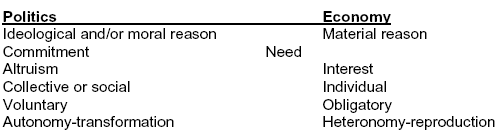
I believe that this break between "material reason" and what we might call "political-moral reason" has gradually forged – implicitly or explicitly – the classifying and normative matrix which serves as a base for academic analyses of the objectives of "collective actors" and the motivations of "individual actors". As Manzano (2007: 301) indicates, this dichotomic scheme is part of the foundational premises of the field of study of new social movements and it "still generates questions and interpretations regarding the political processes which ‘the masses' engage in". I would add that both the supporters of the "material reason" line of thought and their counterparts of the "political-moral reason" school share a series of implicit consensual premises. In the first place, both groups organize the motivations and/or objectives that are in play according to hierarchies and presume, for example, that the struggle for a plan or for a contribution of food and material goods is somehow "less political" and "collective" than the struggle for real work or for social change.
Secondly, both positions reflect a prescriptive division between what is understood as "economic" (a universe which is thought to be linked to subsistence and interest) and what is labeled as "political" (a domain which is presumably linked to vocation and disinterested action). Those who support material reason frown upon the admixture of both domains and will in fact denounce this (as when, for example, piqueteros protest the plans as a form of commercialized or clientele politics). Meanwhile, the defenders of moral-political reason criticize admixture of the two domains by declaring that the plans are (merely) a stop-gap demand which draws attention away from more authentic (and noble) demands. Finally, both positions share the normative premise that a political link should not be marked by exchange. This is a strange ideal of we consider the fact that the foundational theories of anthropology and sociology situate the exchange of tangible and intangible goods as both the genesis and maintenance of the social link (cf. Mauss 2003; Lévi-Strauss 1967; Malinowski 1935).
This dichotomic consensus which organizes the questions posed and answers constructed by piquetero studies in particular and studies of collective action and social and protest movements in general can be usefully apprehended according to the following scheme:
More specifically and in relation to the literature produced in and by Argentineans, I will risk saying that the inclination in favor of the first column is anchored in two phenomena. One is properly political and is founded upon the conviction that this is the correct way in which to give organizations legitimacy and support within the academic field. The other is more theoretical in nature and seems to be founded on a dual set of analytical axes. It is influenced by European theorists which seek to distance themselves from the more rationalist approach of North American theories (such as the resource mobilization or political opportunity theories of Charles Tilly and Sidney Tarrow) while proposing to incorporate "cultural factors" into the study of collective action, bringing in such expressive and cognitive dimensions as identity and recognition (cf. Melucci 1994, 1995). As some authors have noted (Polleta & Jasper 2001:284; Brubaker & Cooper 2000:6), "identity" operates as a counterpoint to "interest" in conceptualizing non-materialist and non-instrumentalist forms of political action. On the other hand, the trend towards the political-moral reason side of the scheme in the literature seems to come out of a certain reading of Thompson's theory of "moral economy", according to which every economic formulation has a moral dimension (in the sense that it transmits and carries values) which sociologists must reveal.15
]]> The political discussion of moral reductionism, the centrality of cultural and expressive dimensions to collective action and the obligation to contemplate what is called the "morality of economy" has reinforced the tacit presupposition that it is sociologically and politically dangerous to give a significant place to the material order in studies of collective action, both in terms of the subsistence needs of the "individual actors" and in terms of the revindicatory struggles of the "collective actor". In my initial approach to the piquetero question (Quirós 2006), I confronted this presupposition and emphasized the importance of not underestimated the impact of subsistence resources such as the plan. In my work, I sought to give pride of place to the ethnographic principle of privileging how people live and construct meaning regarding their own practices. Given this principle, it seems to me that to negate the centrality of the plan in the piquetero universe would be to perform a sort of interpretative violence.Secondly, as a political position, I believe that to underestimate the role and place of the plan is to negate the concrete social and economic conditions that my interlocutors deal creatively with on a daily basis. Based on this position, I argued that it was sterile to explain people's acts as based upon univocal "reasons" and I sought to demonstrate how, though people referred to the piquetero movement as a way of receiving a plan, to be with the piqueteros could mean much more than signing up for a plan. In another article, I have shown how these "reasons" and their tensions were not out of place in the social universe that I studied: commitment and necessity, solidarity and interest were also some native terms in which the set of oppositions described above expressed itself, as well as in the moral premises which regulated relationships and positions within the movements (Quirós 2007).
I now propose to advance on this problem from another direction. One of the ideas that I defend in this article is that the excluding and dichotomic terms which academics use to reflect upon these issues result in: a) a reduced notion of the importance of the "politics" in the strict sense of the word which contain the "economic" order – in other words, an inability to perceive that politics and economics do not exclude one another;16 b) an inability to take into account those dimensions of social life which are not clearly covered by these terms. Said dimensions are thus left out of the analysis. I will leave the second problem for my conclusions. In the pages below, I will take up the first problem and argue that in order to get beyond instrumentalist and reductionist views of political engagement, it is not necessary to emphasize ideology and/or morality, nor does one need to use great conceptual terms which are not linked to concrete experience. Finally, I will argue that "non-economic" motivations do not need to be presumed in order to transform movements into social movements or actions into collective actions.
Based on my experiences in Florencio Varela, I believe that if we take a close look at the space occupied by such "economic resources" as the plan in the daily lives of our interlocutors and seriously consider the ways in which these resources are used and reproduced in daily life, we will see how they result in practices, relationships and systems of rights and value which take on a sui generis political character. Taking this perspective as my point of reference, I defend the idea that when dealing with piqueteros, the plans cannot be seen as the main or even a secondary or apparent reason for why people join the movements. Rather, the plans are what bring these movements into peoples' horizon of possibilities and are – as I will demonstrate – the thing which transforms the piqueteros into something which is simultaneously "political" and "economic". In order to do this, however, I must first return to my ethnographic material.
Struggle as a criterion of worth: the movements as something which goes beyond "mediation"
According to Matilde Aguirre, she only began to "respect these piqueteros" when, six months after working as a volunteer in the MTR's demonstrations, Juan received his plan. Since then, she has participated in the marches as her husband's substitute on those occasions when he is involved doing one or another temporary job. The possibility of sending a substitute to a demonstration or march (a common practice in many movements) indicates not only the importance the movements attach to the mobilization of large numbers of demonstrators, it also shows the importance that the people who commit themselves to these protests attach to the events. This importance may indeed originate in the plan, but it also comes from the feeling of meeting those obligations that one feels are legitimate and from paying attention to other people's expectations. As I was to hear many times in Florencio Varela, "Here we get things by struggling for them".
Showing up at demonstrations – registering ones presence in the carefully maintained movement lists at the beginning and end of each protest – is also a criterion for the distribution of other benefits and goods, such as the baskets of food and household items which the organizations receive from the provincial and national governments. Once, in the center of the courtyard of one of the MTR's headquarters, I came across three lists of complete names taped to a bulletin board. Above them, a poster announced "Protests for baskets: 16/11 - 23/11 - 10/12 - 14/12 - 20/12". I saw that some 90 people were listed all together: 50 would receive the "big basket" and another 40 the "small basket". At first, the numbers seemed strange to me, but later I learned that the dates referred to the number of demonstrations which were compiled for the distribution of that month's baskets. As one movement compañero explained it to me, "Those who go to all of the demonstrations receive a big basket. If you miss two or more of the month's five demonstrations, you only get a small basket".
The size of the basket thus indicates the differing amounts of time and energy that individuals dedicate to the movement organization. More: it indicates who deserves what as a consequence of this dedication. The movement has thus constructed a space where rights and just desserts are expressed according to a dingle criterion: the struggle. This is quantified, among other manners, according to the number of protests a given individual attends. "No struggle, no rights", goes the saying in the MTR's ranks. "Don't thank us, compañero", say some of the movement's leaders (see Manzano 2005:14), "You won your plan with you struggle". The struggle is generally presented – and supported – in relation and opposition to other competing criteria, such as that of the UGLs or the Partido Justicialista.
There is not enough space in the present article to ethnographically explore how each of these spaces functions. However, it's worth mentioning the UGL's representatives generally publically salient need as a key criterion for the distribution of plans. Need is quantified by the number of children which each aspirant supports. In the Partido Justicialista's networks, on the other hand, plans and other resources circulate as favors which party militants and ward bosses do for neighbors, relatives, friends and, of course, their electoral base. These express thanks for other favors such as political support. Of course, struggle, need and personal connections of favor and thanks do not operate in an exclusive fashion in any of these three organizations. To the contrary: I would say that these principles daily converge in each organization with a certain degree of tension. What I am interested in, however, is that although the (State) resources which are in play are the same, different principles and values are empowered in each space in order to justify an individual's worthiness to receive resources.17
]]> The dichotomic divide between material reason and moral-political reason which I presented above includes a normative and "rupturist" view of the relationship (or non-relationship) between the movements and the State. This vision is expressed as heteronomy (economic) vs. autonomy (politics) and it springs from a conceptualization of collective action as Society taking action "against" the State, or working "around" the State or at its margin. This world-view laments the central role which assistance programs and resources have acquired in organizations, seeing this as a form of cooptation, dependence or institutionalization of social movements which, as a result, lose their autonomy and their transformative potential (cf. Svampa 2004; Grimson 2004; Massetti 2004:130; Svampa & Pereyra 2004:60 e 194; Mazzeo 2004:139; Campione & Rajland 2006:313-ss). Based on the information which I present in this section, I would like to look at another angle of this "dependency": struggle as a criterion of worthiness, reveals that through such resources as the plan, relationships and instituted systems of rights are created which escape the State's formulations. In the case of the movements, this escape appears to have been taken to an extreme, as Manzano's analysis seems to point out (2007): the blockades of highways and protest marches (actions against the State) have become means through which one claims and obtains resources from the State. By looking at struggle as a criterion of worthiness, I propose to revise the opposition between autonomy and heteronomy18 and suggest that public policies may indeed play a creative and not simply a cooptative role with regards to the management of political mobilization and engagement.This escape and this creative power also show up in another dimension, one which interests me in particular: that of the lived relationship between the movement and the people which participate in it. Though all my interlocutors in Florencio Varela knew full well that the plans were governmental programs, the plans themselves were daily referred to as being "of the UGL" or "of the piqueteros". Once I even met a young woman who was deeply concerned about the consequences of having taken a vacation from the MTR without having informed the officer in charge of the local movement headquarters.19 She told me that a "government worker" had come through the cafeteria and didn't find people at work:
"They could take away our plan," the woman said.
"Who?", I asked.
"I don't know," she responded, "The movement people, I think."
At that moment, her answer did nothing more than increase my doubts regarding the power that movements had regarding the plans. I concluded that I needed more information from "official" sources. I later perceived, however, that part of this woman's doubts stemmed from the fact that the plan is lived at a quotidian level as a resource that is given by the movement. It is the movement which gives out the plan, which gives out the baskets, which registers people, passes along benefits, fills out forms, recognizes the compañero who works and censures he who doesn't work. It is the movement – and not the State – which people complain about or question when expectations are not met. And it is the movement which attracts people's feelings of commitment and gratitude.
In the social sciences it is common to think of movements – and also ward bosses or organizations such as the UGLs – as "mediators" or "intermediates" between the State and the targets of public policy (cf. Auyero 2001:93-ss; Svampa 2004:8; Grimson et alii 2003:14, 33, 76). Based on what I've discussed above, I believe that the idea of mediation may indeed illuminates some aspects of this relationship, but that it also obscures others to which little attention has been given. In the first place, such a view tends to de-emphasize the linkage between the population and "mediators" in its lived dimension – a link which, as I have suggested above, can be seen from the point of view of those involved as situating the "mediators" as direct donors.
Secondly, following the warning laid out by Goldman (2006:275), we can say that, in the context of a relationship between three elements, when we qualify one of these as a "mediator" we presume that the most important relationship is, in fact, between the population and the State. In this movement, the "mediator" is reduced to an intermediary role as something of a channel between the State and the population. This, in turn, occludes the mediating power's fundamental characteristic: its creative power. The mediator may create, for example, the criteria and values by which members of the population may or may not receive the resources which it supposedly channels. In his study of what he understands to be "clientelist practices", Auyero (2001:157) argues that "the mediators are not simply intermediaries, but cardinal figures in the (re)production of a special manner of distributing goods, services and favors". In recovering this affirmation, I would like to add that the idea of mediation casts a shadow over the fact that these distinctive manners of distributing are also specific ways of being and becoming worthy. Additionally, they are differentiated systems of obligations and rights which distinguish those who give from those who receive, depending upon the situation.20
Being occupied: politics in economy
]]> When I first met Juan Aguirre, he had just finished the four hours of daily work stipulated by his plan as community service in exchange for aid, doing maintenance work at one of the Teresa Rodríguez Movement's headquarters. He was attending marches and went to the weekly assemblies at his local movement headquarters. During the first four weeks which I spent in Varela, I also saw that Juan and his whole family dedicated themselves almost full-time to the occupation of the site that was going to be used to establish a community center for future scholarship beneficiaries. I accompanied the Aguirre's comings and goings from their house to the occupation site in a nearby neighborhood. At least at the beginning of the occupation, the site could never be abandoned for fear that others would take it over or that it would be reclaimed by its owner. The occupation was thus truly a 24 hour a day affair and organizing and maintaining this was the central task from the first day on. The occupation demanded vigilance and said vigilance, in turn, created the need for watchmen, custodians, cooks, finance managers, classes and enrollment for children.Juan Aguirre headed up the night security force and he'd take mattresses and blankets with him every night to the site. During the day, he dedicated himself to improving the site's infrastructure, installing lights and water and sanitation systems. Matilde would go in the mornings for the shift change and to prepare lunch or the afternoon snack. Though these early days were troubled by many doubts – regarding the government's scholarships or the possibility of being forced out of the site - they were also of fundamental importance to setting up the occupation's structure. Vero – the oldest of the Aguirre's seven children – became a natural leader of the committee of teenagers who led the occupation. She began signing up the young people who arrived daily, saying that they'd come because of the possibility of getting scholarships. She also attended to the mothers who showed up with Xeroxes of their children's identity documents in hand in order to sign up their sons and daughters. Vero also organized the security shifts and managed the accounting of the supplies donated by the MTR to the site's cafeteria. She kept track of costs and contributions, jotting down who gave what and who stayed to eat. In her purse, she accumulated all these noted and receipts, which the movement would one day ask the occupiers for, just as the government would also ask for them from the movement. From the beginning of the occupation, the government was the third party towards which the protest was directed: the occupation's activities were sustained in an intrinsic relationship between having one's own place and the possibility of obtaining scholarships.
Two weeks after the occupation began, Claudia, one of the MTR's leaders, arrived on-site to convoke a protest march on the headquarters of the Social Development Ministry: "The scholarships exist," she said, "but they don't want to give them to us. We have to fight for them". Two days later, at a meeting attended by some 70 people, Vero Aguirre announced that the march would take place. "The march isn't obligatory," she said, "but it's important that you participate, especially the kids, because its a march by the youth to demand the scholarships".
Several days later, approximately 200 people followed a path well known to the MTR's compañeros: they met at 8 AM at the Varela station and took the train to Constitución Station in the capital. From there, they marched on the Ministry. There, while they waited at the gates, disrupting traffic, Claudia and a group of mothers met with Ministry functionaries. A half hour later, when they left the building, it didn't seem that much had been achieved. "They told me that they aren't giving out individual scholarships and that they won't be doing this in the future", Claudia told me while the demonstrators wended their way back home. "They say that they can only finance collective projects".
The next day, I went to Florencio Varela and passed by the Aguirre's residence before heading to the occupation site. The house was quieter than usual. Juan could barely talk: a few days earlier he had gone to the hospital and, in spite of being told by the doctors that he should be resting, he was still carrying out his nocturnal security duties at the site. "It's a shame," Juan said. "What am I going to tell the kids now? How can someone tell all those kids that there are no scholarships? With all that we've done... you see what's happened to my voice? My daughter Vero goes to the site every day. All that for nothing..." Matilde listened, looking lost, and finally cut in: "Now everything's lost," she said. "The kids were in the project because of the scholarships".
In their despair, Matilde and Juan had cast the occupation as a failure. This demonstrated once again the reciprocal nature of the obligations and expectations that were in play. The Aguirre's believed that they had given their all working for the occupation and now the movement had not come through on its promise. A few hours later, a meeting was called by Claudia at the site in order to announce the result of the previous day's march. Some 80 people attended the meeting and Claudia explained that although the government did not have a scholarship policy, the Minister had committed to sending some educators so that the young people could learn how to make projects. "If we present these projects," Claudia said, "they will subsidize the courses, no matter what they are".
I remember that the room got silent. Vero then complained, saying that during the day, several parents had shown up to retrieve their children's documents: "They told me that the movement was lying, promising things. Another told me that we made their kids work here and that the scholarships don't exist".
Claudia listened to this, demonstrating a certain degree of discomfort. At one of the windows, a woman stood with a list in her hands containing the names of the kids who needed to pick up the photocopies of their documents. These were kids from the neighborhood who had signed up for scholarships. "What I want to know is why you said there'd be scholarships when now the government says that they don't exist," she said. Silence followed her words. The woman then raised her voice and continued: "Because we're all here because we want a place where the kids can get off the streets and now you say there won't be scholarships".
Approving murmurs followed this sally. The woman who made it, like Juan and Matilde, situated the scholarships as a commitment that had been made by the movement and not the government. Claudia then responded: "I said that we needed to make the projects and I said this at the first meeting. But we're going to continue to fight for these scholarships. Those of us who are with the movement know that you don't get anything with one march alone".
Claudia then explained that the movement was thinking about a project which would "make tomato sauce" so that the youth could have some sort of income. She also talked about an English professor who they had arranged to give classes and a radio workshop which would function on the site under the administration of two journalism students. "New course are thus now open," she concluded, pausing in her discourse. I realized that her words didn't focus on the past but were geared towards motivating the crowd to look towards the future projects which, in spite of everything, the occupation had been working towards from the start. To my surprise, the interventions of the other parents and kids also followed this same general logic, expressing a shared concern regarding the continuation of the occupation. One woman wanted to know if the kids would still have to show up every day. "Will we still be serving lunch?" asked Vero. Matilde Aguirre herself asked about the crafts workshop which she was organizing: "Could that be shifted to Wednesday afternoons?"
]]> While the parents began filing out of the room, the kids lined up so that Vero could sign them up for the radio and English classes. The list ended up with 250 names on it. The other adolescents of the committee were gathered around the table, helping Vero. It was only at that moment that I realized that none of the committee members had said anything regarding the meeting with the Minister. These were the same faces I had seen the day before, carrying the movement's flag through the streets of Buenos Aires. Then, the young people had been laughing and appeared to be enjoying themselves. It was their march and they led it, being the visible face of the movement. Set next to the occupation of the site and all that they had done there, the result of the meeting with the Ministry seemed of secondary importance. And even though the government (and its scholarships) was a third party towards which the protest was directed, for some of those who participated in the meeting on the next day, the occupation itself had taken on its own meaning. The occupation had created lunches and snacks, the security schedules, the papers, the finances and the youth committee. If it was indeed an authentic act of occupation, it was that in the widest sense: the people physically occupied the space but were also occupied themselves. They were busy doing things.
The end: the "pleasure of doing" in political engagement
I thus return to the main points of my argument. First of all, just as struggle is a criterion of worthiness, the occupation demonstrates that the central role played by State resources (scholarships in this case) is not opposed to movement creativity. Opposing (economic) heteronomy and (political) autonomy obscures the fact that via such objects as plans and scholarships – by obtaining them, distributing them and defining the criteria of being worthy of them – the organizations do more than simply mediate. They produce relationships and actions which have specific and sui generis effects. Secondly, in light of what the occupation has shown us, I once again must salient the sterility of the opposition between (economic) interest and (political) commitment with regards to the motives which conduct and sustain engagement in a movement. Originally, it was the possibility of obtaining State resources which gave impetus to the occupation. When the scholarships didn't arrive, however, there was no going back for the people who had generated the act. Generating the occupation generated as well a space, a set of relationship and a set of routines and meanings. The situations which I observed in the context of the occupation showed that what the unemployed movements produce and circulate are not only survival resources (plans, scholarships, baskets of goods) but also ways of living. In a world where work is highly valued and where laziness is an oft-brandished accusation, being with the piqueteros can mean to be occupied: it can be that thing which gives meaning to one's life.
The activities generated in obtaining subsistence resources, the commitments produced in this form of doing and its ways of subsistence (which are also modes of social existence) make the piquetero movements something which is simultaneously "economic" and "political". The occupation of the site, taken as a set of events, invites us to not only conjugate the categories of dichotomic consensus that I describes at the beginning of this article, but to go beyond them. This implies, for example, understanding that part of the conditions which made the occupation possible were the energies and satisfaction invested in "being occupied" with this activity. If I have been able to transmit to the reader something of the spirit that motivated the occupiers during those weeks, it should be possible to now understand that for the Aguirres, for Vero and for the kids involved in the committee, the security details, cafeteria, course and scholarship sign-up lists, the meetings, and the accounting were all undertaken with pleasure and passion. This pleasure is that thing which does not fit in the economic/political schemata and it is something that (for reasons which would be interesting to map out theoretically) we have encountered a certain difficulty in analyzing in sociological terms.
Max Weber (1989:74-ss) refers to "passion" as a decisive quality for those people who have a vocation for politics. He immediately clarifies that "one is not a politician because one is impassioned, unless one's passion is in service of a ‘cause'". Some recent work which proposes to incorporate "emotions" into the study of social movements indicates that attraction and enthusiasm, among other things, can be generated by belief in a cause, by the expectation of changing the order of things, or by the empowerment which comes from participating in protest actions (Jasper 1998:406).21 Even when devotion to a "cause" or the feeling of "taking power" is present in situations like the occupation described above, however, I believe that we need to look at another, perhaps more primary power, which Florence Weber (1989) calls "the pleasure of doing": in other words, the taste which is awakened in and by doing itself.
The dichotomic scheme which is generally used to understand the field of collective action (and also, more generally, popular or mass politics) supposes that engagement can be explained by that which the people seek and/or obtain (material, political, or moral resources for subsistence, recognition, belonging, empowerment, resistance, or identity). In its attack on material reason, political-moral reason ends up substituting one teleological explanation for another. I believe that our challenge is to escape from these and other reductionisms and that ethnography is a privileged tool in this task, given that it allows us to up social worlds in their doings and their contradictions.
The occupation which I describe above is an example of this. Anyone who accompanies these sorts of experiences in their lived dimensions will find them hard to reduce to terms such as (economic) necessity and/or (political) commitment. The language of our interlocutors is another key form of ethnographic knowledge which should restrain us from stereotyping social play. At the beginning of this article, I pointed out how the expectations of receiving a plan were pre-eminent in the reasons people cited for their approximation to the piquetero movement. Need was indeed the native term used by many to refer to that which the literature, in another context, disdains as an economicist explanation. "I came here because I needed to", is what several of my interlocutors told me. "The main thing that brings us here is necessity", said others. It's interesting that, immediately after saying this, these same people would then talk about when they started to go with the marches. They'd tell me everything they'd done with the movement since the beginning, describing the activities and routines which followed in succession and, synthesizing their story in a single phrase, they would conclude "And so I started getting involved..."
I believe that it is time to give this "getting involved" its own analytical space (which, once again, cannot be understood neither as simply "political" nor as "economic") in both the study of collective action and also in a wider sense. Paying attention to the power of the pleasure of doing is one step in this direction. The pleasure of doing is at the heart of the conditions which made the occupation possible. It is found in the way in which the Aguirre family could abandon everything else during those weeks and in how Juan could live "day and night" in the pickets when he first became involved with the movement. The pleasure of doing is found, in conclusion, in the daily lives of people when they involve and occupy themselves, beyond the bounds of necessity and commitment, in "protest activities", in "social movements", in "parties" and in "politics" itself.
]]>
Notes
1 In 1997, there were 140 highway blockades throughout the nation while in 2002 this number had grown to 2,336 (Manzano 2007:2). Regarding the shifting of the picket and the unemployed organizations from Argentina's interior to the region of Greater Buenos Aires, see Svampa & Pereyra 2004; Masseti 2004.
2 This explosion was also linked to a context of high mobilization which forces the country's elected president to resign in December 2001 and which increased the political instability and public outcry that was prolonged throughout 2002 and which was expressed in various ways: through pickets, neighborhood assemblies, banking client demonstrations, factory occupations and etc.
3 Florencio Varela has a population of 348,767 and is situated some 24 km from the City of Buenos Aires. According to the Instituto Nacional de Estatísticas e Censos, the city is part of "Conurbano IV", Greater Buenos Aires' poorest region with the highest levels of unemployment.
4 Throughout this article, native or emic terms are in italics when used outside of specific contexts of situation.
5 The Partido Justicialista – the institutional expression of the political movement known as Peronism or justicialism – has governed the Florencio Varela region since the return of democracy in 1983 and has also governed the province of Buenos Aires since 1987.
6 These include: historicizing the origins and development of the picket movement as a form of protest (Isman 2004; Svampa & Pereyra 2004; Oviedo 2001); analizing the political potential of the organizations of the unemployed and their relationship – or non-relationship – with the State (Lenguita 2002; Grimson 2004; Svampa & Pereyra 2004.; Svampa 2004; Negri & Cocco 2003; Colectivo Situaciones 2003; Hopstein 2003; Dinerstein 2001); studying new identities, new forms of sociability and new ways of making politics as created in the movements (Cross & Cató 2002; Masseti 2004; Svampa & Pereyra 2004; Delamata 2004); inscribing the phenomenon in wider processes of social protest (Auyero 2002a; Schuster & Pereyra 2001; Scribano & Schuster 2001; Campione & Rajland 2006); inscribing organizations activities in other neighborhood-based associative experiences and traditions (Grimson et alii 2003; Svampa & Pereyra 2004; Delamata 2004).
7 Cross and Cató (2002:88) state that "what was produced was a passage from a negative definition (‘I don't have work') to a positive definition (‘I'm a piquetero')". Lenguita (2002:61) believes that, "for the movement's protagonists, being a piquetero means that their identity has ceased to be associated with work and is now designated by what they do: blocking highways". Regarding the picket as an example of the construction of a new collective identity, see also Massetti (2004:52-94); Svampa & Pereyra (2004:168-ss.); Grimson et alii (2003:74); Barbetta & Lapegna (2001:238-ss).
8 Though Auyero uses theories of collective action as a conceptual reference, in his work he also proposes a biographic cut that seeks to take into account the motivations and perceptions of those who participate in the protests. Taking an anthropologiocal position, Manzano distances herself from the focus on protest and collective action. She links diverse scales in the political process as well as associative traditions and the daily lives of her interlocutors in the field in order to account for the socio-historic conditions through which the picket became recognized as a way of announcing social conflict before the eyes of the State. Other, more recent works, also explore aspects of daily life inside the piquetero organizations (see, for example, Ferraudi Curto 2006) and in these the "collective actor" appears incorporated in concrete subjects. It is also worth pointing out that although the subject and cut present in the works of Svampa & Pereyra (2004) and Grimson et alii (2003) are "organizations", these authors at least seek to connect the piquetero experience to other neighborhood-based associative traditions and conditions.
]]> 9 Since 1996, the national and provincial governments have launched several different employment plans: generally, these involve subsidies of 150 pesos (50 dollars) a month which require the beneficiary to give four hours of community, productive, or educational services a day.10 In 2000, the national government determined that the management of the plans – which was up until then concentrated in the hands of municipal entities and the networks of the Partido Justicialista – could also be taken over by "civil society organizations". The majority of the piquetero organizations thus constituted themselves as non-governmental organizations and began to generate their own patterns of social plans, as well as organize community and other services in movement activities.
11 Puntero is the common term used to refer to local militants who work for a given candidate or party, mobilizing and recruiting the electorate (basically the equivalent, in general terms, to ward bosses in the U.S.). Some authors believe that their is a puntero/piquetero opposition which expressed opposite modes of political connection: a "do-it-yourself" logic of the piquetero movements versus the "clientelist" of the Peronist network (Delamata 2004:25). Another favored oppositional duo is "verticality spaces" and the "logic of favors" in the case of the punteros, versus "horizontality spaces" and the "logic of rights" in the case of the piqueteros (Mazzeo 2004:76-77). Other authors emphasize the possible influence of a "clientelist culture" (Grimson et alii 2003:74-76) established by peronism and supposedly exercised over the piquetero organizations. Still others, highlight opposition as a result of the daily experiences of confrontation between Peronist networks and the organizations of the unemployed (Svampa & Pereyra 2004:53). I believe that this confrontation operates in specific levels and contexts – in the competition to obtain resources, for example, and to pull the people who receive them to one's side. In any case, codifying all relationships according to these labels can result in the obfuscation of a complex and shifting reality, leading us to lose the perspective of those people who are labeled punteros and piqueteros – and oftentimes labeled in this fashion by other people.
12 With the exception of public figures, all names presented here are fictitious.
13 While picket refers to the act of occupying and blocking highways, streets and bridges, marches indicate a protest mode in which a mobilized column follows a predetermined path until it arrives at a specific destination, generally the headquarters of a government organ. In the last few years, the piquetero movements have resorted more to marches that to pickets, partially because of the public relations harm the latter tactic has caused. In the present work, I will thus speak more often of marches than pickets.
14 I take up this expression which Sigaud (2004:16-ss) presents in her study of land occupations in Brasil in analyzing the creation of dispositions to participate in occupations among rural workers (see also Sigaud 2005).
15 Thompson (1998:203-ss) warns about the impoverishment of the term "moral economy" based on this reading. He also warns about the dangers of extending the term to other socio-historical contexts and transforming it into "theory".
16 I use the terms "politics" and "political" in the same fashion as my interlocutor in this conceptual discussion, the intellectual and academic field which studies collective action and social movements and for whom "politics" is above all action and transformation of the established order. On this point, social scientists are in harmony with the organizations' leaders. It's not the goal of the present article to explore the meaning of "politics" from the point of view of my fieldwork interlocutors, who use the term in various ways, including the definition above, and for whom not every moment spent participating in the piquetero movement is necessarily considered to be "political" (cf. Quirós 2006:123).
17 It's worth pointing out, on the other hand, that each of these criteria of worthiness morally qualifies the resources that are in play: if it is true – as I said at the beginning of this article – that people circulate through spaces that are not necessarily excluding or contradictory, it is also true that these spaces are not undifferentiated nor indifferent. In Varela, many people believe that it is legitimate to receive a UGL plan, but not a piquetero plan. "I prefer to look for dignified work instead of going that route", say some. "These marches are for bums", say others. By the same token, to be with the piqueteros is a way of receiving a plan or a basket of goods without feeling ashamed: "No one ever gave anything to me", as Juan Aguirre is wont to say. "I got it fighting."
18 I base this revision of the autonomy/heteronomy opposition on the work of Sigaud (2004, 2005), Rosa (2004) and Ernandez (2006), who have analyzed the relationship between the Brazilian state and the land occupation movements as an interdependent relationship.
]]> 19 The quotidian relationships inside the piquetero organizations are marked by formalized systems of duties and rights that contain, in many cases, elements of work relationships. Thus, for example, in the attendance lists at marches and community services which are stipulated by the plan, the movements generally accept absences due to other work, maternity leave, illness and holidays. As I've pointed out elsewhere (Quirós 2007), these elements, as well as the term to be with the piqueteros when used to indicate work, constitute one of the vertices between politics and economy which are analyzed in the present article.20 Other discussions regarding the concept of "mediators" can be found in Rosa (2004:249-ss).
21 This and other more recent work (Goodwin et alii 2001; Goodwin & Jasper 2004) has the merit of questioning the academic tradition which transforms the protagonists of collective action into one-dimensional creatures. But given that they are largely programmatic proposals, they tend to fall into a certain formalism when they speak about "emotions". Everything is presented as if "emotions" – which are in some cases laid out and enumerated – can be incorporated as another empirically delimitated "variable" into a given conceptual field – "political opportunities", "structural mobilization", "resources", "frames", "networks", "collective identities" – of social movement studies.
Bibliography
ALMEYRA, Guillermo. 2004. La protesta social en la Argentina (1990-2004). Buenos Aires: Peña Lillo, Ediciones Continente.
AUYERO, Javier. 2001. La política de los pobres. Las prácticas clientelistas del peronismo. Buenos Aires: Prometeo.
]]>___. 2002a. La protesta. Retratos de la beligerancia popular en la Argentina democrática. Buenos Aires: Libros del Rojas
___. 2002b. "La vida en un piquete. Bio-grafía y protesta en el sur argentino". Revista Apuntes - CECyp, 18. Available at http://www.apuntes-cecyp-org/N8-Auyero.htm. Acessed on 20/07/2005.
___. 2004. Vidas beligerantes: dos mujeres argentinas, dos protestas y la búsqueda de reconocimiento. Buenos Aires: Universidad Nacional de Quilmes.
BARBETTA, Pablo & LAPEGNA, Pablo. 2001. "Cuando la protesta toma forma: los cortes de ruta en el norte salteño". In: N. Giarraca (org.), La protesta social en la Argentina: transformaciones económicas y crisis social en el interior del país. Buenos Aires: Alianza Editorial. pp. 231-257.
BECCARIA, Luis & LÓPEZ, Néstor. 1996. Sin trabajo. Las características del desempleo y sus efectos en la sociedad argentina. Buenos Aires: Losada.
BRUBAKER, Rogers & COOPER, Frederik. 2000. "Beyond 'identity'". Theory and Society, 29:1-47.
]]>CAMPIONE, Daniel & RAJLAND, Beatriz. 2006. "Piqueteros y trabajadores ocupados en la Argentina de 2001 en adelante: novedades y continuidades en su participación y organización en los conflictos" In: G. Caetano (org.), Sujetos sociales y nuevas formas de protesta en la historia reciente de América Latina. Buenos Aires: CLACSO. pp. 297-330.
COLECTIVO SITUACIONES. 2003. Hipótesis 891. Más allá de los piquetes. Buenos Aires: Ediciones de Mano en Mano.
CROSS, Cecilia & MONTES CATÓ, Juan. 2002. "Crisis de representación y identidades colectivas en los sectores populares. Acerca de las experiencias de las organizaciones piqueteras". In: O. Battistini (org.), La atmósfera incandescente. Escritos sobre la Argentina movilizada. Buenos Aires: Asociación Trabajo y Sociedad. pp. 85-100.
DELAMATA, Gabriela. 2004. Los barrios desbordados. Las organizaciones de desocupados del Gran Buenos Aires. Buenos Aires: Libros del Rojas, Eudeba.
DINERSTEIN, Ana. 2001. "El poder de lo irrealizado: el corte de ruta en la Argentina y el potencial subversivo de la mundialización". Revista del Observatorio de América Latina / OSAL, 5:11-16.
]]>ELIAS, Norbert. 1991. Qu'est-ce que la sociologie? Paris: Editions de L'Aube.
ERNANDEZ, Marcelo. 2006. Sementes sem trincheiras: sócio-gênese das ocupações de terra no Rio de Janeiro. Research report, Rio de Janeiro, Museu Nacional. 96 pp.
FERRAUDI CURTO, Cecilia. 2006. Mientras tanto: política y modo de vida en una organización piquetero. Masters dissertation, IDES-UNSAM.
GOLDMAN, Marcio. 2006. Como funciona a democracia. Uma teoria etnográfica da política. Rio de Janeiro: 7 Letras
GOODWIN, Jeff; JASPER, James & POLLETA, Francesca (orgs.). 2001. Passionate politics. Emotions and social movements. Chicago-Londres: The University of Chicago Press.
GOODWIN, Jeff & JASPER, James (orgs.). 2004. Rethinking social movements. Structure, meaning and emotion. Lanham, MD: Rowman & Littlefield.
GRIMSON, Alejandro. 2004. "Piquetes en la ciénaga. Los bloqueos políticos de los cortes de ruta". El Rodaballo. Revista de Política y Cultura, 15:9-13.
___. LAPEGNA, Pablo et alii. 2003. "La vida organizacional en zonas populares de Buenos Aires". The Center for Migration and Development, Workins Series Paper, Princeton University, CMD Working Paper 03-15-e. Available at:http://www.prc.utexas.edu/urbancenter/documents/wp0315e.pdf. Acessed on 17/01/2005.
HOPSTEIN, Graciela. 2003. "Piqueteros: limites e potencialités". Revista Multitudes, 14:155-163.
ISMAN, Raúl. 2004. Los piquetes de la Matanza. De la aparición del movimiento social a la construcción de la unidad popular. Buenos Aires: Nuevos Tiempos.
JASPER, James. 1998. "The emotions of protest: affective and reactive emotions in and around social movements". Sociological Forum, 13(3):397-424.
LENGUITA, Paula. 2002. "El poder del desempleo. Reflexiones críticas sobre la relevancia política del movimiento piquetero". In: O. Battistini (org.), La atmósfera incandescente. Escritos sobre la Argentina movilizada. Buenos Aires: Asociación Trabajo y Sociedad. pp. 51-67.
]]>LÉVI-STRAUSS, Claude. 1967. Les structures élémentaires de la parenté. Paris: Mouton.
MALINOWSKI, Bronislaw. 1935. Coral gardens and their magic. A study of the methods of tilling the soil and of agricultural rites in the Trobriand Islands. London: George Allen & Unwin Ltd.
MANZANO, Virginia. 2005. "Desempleo, 'piquetes' y acción estatal en Argentina: Análisis antropológico de la configuración de un campo de relaciones sociales y políticas". Published in the Anales de la VI Reunión de Antropología del MERCOSUR (digital).
___. 2007. De la Matanza Obrera a Capital Nacional del Piquete: etnografía de procesos políticos y cotidianos en contextos de transformación social. Doctoral Thesis, Facultad de Filosofía y Letras, UBA.
MASSETTI, Astor. 2004. Piqueteros: protesta social e identidad colectiva. Buenos Aires: Coedición Ed. de las Ciencias-FLACSO
MAUSS, Marcel. 2003. "Ensaio sobre a dádiva. Forma e razão da troca nas sociedades arcaicas". In: Sociologia e Antropologia. São Paulo: Cosac & Naify. pp. 183-314
MAZZEO, Miguel. 2004. Piqueteros: notas para una tipología. Buenos Aires: Manuel Suárez Editor.
]]>MELUCCI, Alberto. 1994. "Asumir un compromiso: identidad y movilización en los movimientos sociales". Zona Abierta, 69:153-180.
___. 1995. "The process of collective identity". In: H. Jonson & B. Kalndermans (orgs.), Social movements and culture. London: University College London Press. pp. 41-63.
NEGRI, Antonio & COCCO, Giuseppe. 2003. Diálogo sobre la globalización, la multitud y la experiencia argentina. Buenos Aires: Paidós.
OVIEDO, Luis. 2001. De las primeras coordinadoras al Argentinazo. Una historia del movimiento piquetero. Buenos Aires: Rumbos
POLLETA, Francesca & JASPER, James. 2001. "Collective identity and social movements". Annual Review of Sociology, 27:283-305.
QUIRÓS, Julieta. 2006. Cruzando la Sarmiento. Una etnografía sobre piqueteros en la trama social del sur del Gran Buenos Aires. Buenos Aires: Antropofagia.
___. 2007. "Movimientos piqueteros, formas de trabajo y circulación de valor en el sur del Gran Buenos Aires". Anuario de Estudios en Antropología Social 2006:151-160.
ROSA, Marcelo. 2004. O engenho dos movimentos. Reforma agrária e signifi-cação social na zona canavieira de Pernam-buco. Doctoral thesis, IUPERJ.
SCHUSTER, Federico & PEREYRA, Sebastián. 2001. "La protesta social en la Argentina democrática: balance y perspectivas de una forma de acción política". In: N. Giarraca (org.), La protesta social en la Argentina: transformaciones económicas y crisis social en el interior del país. Buenos Aires: Alianza. pp. 41-63.
SCRIBANO, Adrián & SCHUSTER, Federico. 2001. "Protesta social en la Argentina de 2001: entre la normalidad y la ruptura". OSAL, 5:17-22.
SIGAUD, Lygia. 2004. "Ocupações de terra, Estado e movimentos sociais no Brasil". Cuadernos de Antropología Social, 20:11-23.
]]>___. 2005. "As condições de possibilidade das ocupações de terra". Tempo Social, 17(1):255-280.
SVAMPA, Maristella. 2004. "Relaciones peligrosas. Sobre las clases medias, gobierno peronista y movimientos piqueteros". El Rodaballo. Revista de Política y Cultura, 15:3-9.
___. & PEREYRA, Sebastián. 2004. Entre la ruta y el barrio. La experiencia de las organizaciones piqueteras. Buenos Aires: Biblos.
THOMPSON, Edward P. 1998. Costumes em comum. Estudos sobre a cultura popular tradicional. São Paulo: Companhia das Letras.
WEBER, Florence. 1989. Le travail à côté. Étude d'ethnographie ouvrière. Paris: EHESS/Ed. INRA.
]]>___. 1991. "Nouvelles lectures du monde ouvrier: de la classe aux personnes". Genèses, 6:179-189.
WEBER, Max. 1989. "La política como profesión". In: Política y Ciencia. Buenos Aires: Leviatán. pp. 7-95.
Received on December 3rd, 2007
Approved on June 10th, 2008
]]> * The present article develops some points of my master's dissertation, defended at the PPGAS, Museu Nacional, in Fedruary 2006 and published in book form in Argentina in the Serie Etnográfica collection. I would like to thank Guillermo Quirós, Lygia Sigaud, Rosana Guber and the anonymous readers of Mana's editorial board for the careful and valuable commentaries which they made regarding the first version of this work. I'd also like to thank Federico Neiburg, Moacir Palmeira, Fernando Balbi, Mauricio Boivin, Ana Rosato, Marco Fernandes, Marcelo Ernandez, Marcelo Rosa, Virginia Manzano and María Inés Fernández Álvarez who, in various ways and moments, nurtured the arguements which I present here. Translation by Thaddeus Gregory Blanchette.