Children, death, and the dead: the Mebengokré-Xikrin case
A criança, a morte e os mortos: o caso mebengokré-xikrin
Clarice Cohn1
Translated by Letícia Cesarino
Translated from Horizontes Antropológicos, Porto Alegre, v.16, n.34, p. 93-115, dez. 2010.
]]>
ABSTRACT
This article approaches the relations children entertain with the dead, as well as with their own death risk, among the Mebenkogré-Xikrin, an indigenous Jê-speaking Indigenous group living in the North of Brazil. These themes are developed by analyzing the fabrication of the body, the formation of the self and the person, and the relations with the dead, with a special focus on children. Mebengokré-Xikrin notions of childhood are therefore discussed in an innovative manner through the formation of the self and the child's relations with the cosmos and the dead, by looking at the eventuality of caputre by the spirits of the dead, their adoption in the after-life, the mourning of children, their bodily adornments and painting, how they should be taken care of in life in order to prevent death, and their bodies and social interactions.
Keywords: anthropology of childhood, ethnology of indigenous peoples of Amazon, indigenous children, Mebengokré.
RESUMO
Este texto analisa a relação das crianças com os mortos, e o risco de sua própria morte, para os Mebengokré-Xikrin, grupo indígena do Norte do Brasil falante de uma língua jê. Desenvolve-se o tema a partir da análise da fabricação do corpo e da pessoa e da relação com os mortos, com especial atenção às crianças. Assim, a formação da pessoa e a relação das crianças com o cosmos e os mortos - seu risco de serem capturadas pelos espíritos dos mortos, sua adoção post mortem, sua ornamentação corporal, o luto, os cuidados com o corpo e as interações sociais - são discutidas, permitindo que se entenda de modo inovador a concepção mebengokré-xikrin de infância e de sua condição de existência no mundo.
Palavras-chave: antropologia da criança, crianças indígenas, etnologia indígena, Mebengokré.
The day in the village of Bacajá is of mourning: a one-year old boy just passed away. His death saddens everyone, plunges many into grief, and challenges the comprehension of all. In the event of such an unfortunate fatality - the death of a child -, it is necessary to debate its causes and risks. A series of reflections is thus triggered on death itself - its inevitability and arbitrariness -, and on the destiny of the dead.2
]]> The boy's death had taken place in a quite special condition, something that further enhanced the challenge. Son of a single mother, he was being raised by his classificatory grandparents (the mother's classificatory parents). The mother had moved along with her older children into a new village, where she got married. The grandparents would affirm that they raised him less as a grandson than as a son, and that they had a special reason for being so attached to him: the fact that, of their eight children, only one had been a boy. At the time, the couple had a daughter, not much older than the deceased boy, who was being nursed by her mother. The little one was taken care of on a daily basis by one of the couple's single daughters - who carried him around, bathed him - and was nursed by his grandmother.When the boy got sick, the nurse based on the village diagnosed dehydration caused by infectious diarrhea and a serious verminosis. The women, on the other hand, diagnosed tapir disease (kukrut kanê), caused by his mother's consumption of tapir meat at the village where she lived. They went to one of the elders to solicit some medicine. They also wondered about the possibility that the boy's mother be pregnant again, an event that could cause great harm to a child that is still being nursed by "spoiling the milk".3
To the best of my knowledge, the medicine against tapir disease was never administered. The boy was treated in the clinic for two days with sterile saline solution and medicine to fight infection. On the third day, the nurse declared that the boy needed to be transferred to town, where health care provided to the region' indigenous population allows for admission to a hospital. The family was informed of the transfer to the hospital, as well as of the need to indicate one companion to go along with the boy. This issue was particularly delicate, as normally it is the parents who accompany children that age. The nurse suggested that the grandmother accompany the child, so she could nurse him during his recovery period in town. She was however reluctant to leave her children behind in the village. The couple was also reluctant to send their single daughter who took care of the boy, because she was too young. Before a decision was made on, the child died in time for cancelling the flight that would remove him.
When the word spread about the child's death, the older women went to the house where the adopted parents/classificatory grandparents prepared the funeral and set around the grandfather, who kept him on his lap. His wife and the single daughter who took care of the boy prepared the cotton strings with which he would be buried. The young woman wept quietly, affectionately mourning his death. One of the older women (mother of the man who had adopted the child) voiced a few times the ritual weeping, while the others wept in silence. While caressing the boy's body, they would made comments on the disease, on how the boy was weak and thin, but also how he was already recovering. The other women came to watch, and would go in and out of the house lamenting the event.4
The boy was adorned with the cotton strings, beaded bracelets, red cotton below the knee, beaded lip adornment, and new cotton shorts. His head was shaven and smeared with ultramarine grosbeak (azulão) egg shells. The hair was decorated with white hawk feathers. The body was painted while he was still sick, something which was not done as this is a moment when people remain free of paint or body ornaments. When the boy was ready, the grandmother who raised him stood up in order to weep over his death, as one does while mourning death and remembering a loved one who has deceased. This also includes hurting oneself on the head and arms with sharp instruments such as machetes or stones. Other women who had lost loved ones and still mourned their death fought over the machete and cried along with her. The machete was then taken away by yet other women, who also cried and hurt themselves.
The boy was taken to the cemetery by his grandfather, followed by all the women who were in his house. During the burial, the grandmother who raised him cried again, while her mother-in-law was dedicated to the ritual weeping. Other women cried for their own relatives, while cleaning up the cemetery.5 The boy was buried with a bottle containing the saline solution he was taking for dehydration. When they all returned to the village, the women remained inside their homes, refraining from going to the gardens or the forest, because "everyone is sad" (me kuni-na kaprire).
The parents and spouse of a deceased are supposed to shave their heads as a sign of mourning, or, if the deceased is a child, they cut their hair short. In this case, the grandparents, who already wore their hair short due to the death of another grandchild, just cut the tips. In the following days, they went to the cemetery every afternoon in order to light up a fire for the boy. Five days later, they painted themselves in mourning fashion. When this painting fades away (within around eight days), they are able to resume their regular daily activities. They declared to be mourning as parents, not grandparents. Still, they were criticized by several women for their hurry in painting themselves; they would say that "they have barely buried the child and are already painted". The mother, who was in the other village, was not informed.
Comments such as these, and conversations about this young boy's death, made explicit and put at stake conceptions about the death of a child and how to deal with it by interpreting the causes of death, preparing the body, burial, and mourning. These are better understood from the point of view of the relations the child entertains with death and with the dead, including the risk of dying. It is thus necessary to evoke the Mebengokré-Xikrin notions of conception and fabrication of bodies, which unveil on the one hand a connection between the genitors and their children, and on the other a bodily development able to reduce the risk of death. In this respect, it is also necessary to review the ornamentation of the child in daily routine, ritual, disease and death, as well as the ornamentation of the dead and of those who mourn, which are different when the deceased is a child. Finally, it is necessary to go over the Xikrin conceptions on death and the dead, which are also deployed in particular ways when the deceased, or the person who is risking death, is a child. This would allow for understanding the differences that mark the death and mourning of children and adults. Finally, this leads to an appreciation of the differences between children and adults among the Mebengokré-Xikrin.
Body, Corporeality, and Personhood
]]> For the Mebengokré-Xikrin, the child is formed within the mother's womb by the semen of various sexual relations. Therefore, several men may contribute to the formation of the child. The relation between the child and his father(s) is made explicit when the former is born, because all men who contributed to its formation undergo a period of reclusion, thus making explicit to everyone their paternity. This reclusion, to be followed by all genitors, guarantees the baby's well-being, since its physical connection with the parents does not end with birth. Rather, this physical connection between parents and child (and among siblings) lasts for life. It is especially important when the child is young, because its body is still fragile and demands greater care. The parents therefore refrain from eating some items such as game meat; only when the child is "hard" enough and with a strong skin will they gradually add to the diet some foodstuffs that would be otherwise dangerous for the baby. There is then the assumption of a lifelong bond between these people, who should always watch out for one's own feeding habits and behaviors when a family member is in need of care - that is, when one's body is still fragile or when one is ill. The child's body is thus gradually formed, even after birth, and should be strengthened. Care taken by the parents is crucial to this process.When a child is born, it has a body (î) and karon - at times translated as "soul", at times as "double". If the child is already born with karon, its skin needs to be strong in order to protect it from danger.6 Anyone's karon may be absent for some time; this is what allows, for instance, dreaming. But it should always return to the body, or the person will die. When someone dies, the karon remains and the body deteriorates. Thus, a child should be prevented from crying too much or being upset with the parents for too long, at the risk of its karon leaving and not returning. A child karon needs to be taken care of by other karon in the event of death.
This shows that, if a person is formed by body and karon, it is the presence of both that constitutes her and keeps her alive, interacting with the living. The fragility of a young child is manifested in these two components of her person. If the child is too young, its karon may be more easily lost, finding it more difficult to return to the body. Therefore, care should be taken not to let it be exposed to the presence of the dead, who miss their living relatives and are always trying to bring them closer by stealing or capturing their karon. That is why one should always talk to the children, so that they are kept in the world of the living. When a child cries too much, or is upset, it is especially vulnerable and may let her karon fly away. More than calm her down, one should talk to her, interact with her, keep the communication, the relation going, in order to maintain the karon around.
The skin (kà), enclosure which envelops the body and contains the karon, is the indicator of a child's development. As it grows harder and stronger, the child needs less and less care. It is also imbued with meaning. Turner (1995, p. 149) has emphasized the Kayapó conception of the skin as a dividing line between energies internal to the body and the outside world, and, in his terms, much like the interface between individual and society. That is also why Turner emphasizes the importance of personal hygiene; by removing from the skin the remains of natural elements that people are constantly manipulating, it provides the necessary step for socializing this boundary between individual and society (to be dirty, he affirms, is anti-social). Giannini (1991) remarked how the skin is also a sign of well-being and a means for securing it. She shows how, for the Mebengokré-Xikrin, skin diseases are signs of unbalance or weak connection between the elements that constitute the person. Conversely, a "hard" skin, as the Xikrin put it, is a sign that these elements are balanced and well-connected: "It is not the skin […] that secures the individual's physical integrity, but the internal elements. In this sense, the skin is the site where the individual's internal (material and immaterial) aspects are expressed" (Giannini 1991, f. 153).
Skin diseases are not regarded as dangerous in themselves, but as signs of a person's internal disintegration. Similarly, body painting over the skin highlights, emphasizes and complements this sign; it becomes the "social skin" of which Turner speaks (1966) - a reflection of the person's condition, as will be seen below, but also a means of "shaping" and directing internal, natural and non-socialized energies which acquire social form through painting (Turner, 1995; Vidal, 1992).
Given the strong connection between the karon and the body, in order to minimize risks the latter should be strengthened and well formed so as to better support the karon. It is therefore vital to strengthen the child's body and, in the meantime, take special care so the child is protected and safe.
The mebengokré-xikrin person is not only body and karon; it also needs to receive a name. As other Jê-speaking peoples (Melatti, 1976), for the Mebengokré-Xikrin the person who makes the child's body and those who give her the name (her nominators) are and should be different. In the formation of the person, there are therefore two important kinds of relations. Those who give her the body can never give her the name, and these relations are differently manifested in different arenas - the construction of the body is something to be done at home, while the name, which may be accompanied by ritual prescriptions, grants the person her participation in rituals and is manifested at certain moments in the village courtyard. The nominators are therefore not those who should (predominantly) take care of the child's body and karon, but those who make room for them in rituals and in the networks whereby social identities are transmitted. The names survive the person, and circulate by being transmitted - one of the risks associated with nomination is precisely during ritual moments, when the dead return to the village and tend to get closer to their nominees in order to dance with them and share their ritual role. Thus, additional care should be taken during these periods, so that the proximity with the spirits of the dead will not cause more deaths, especially among young children; that is why they are taken from their homes during the rituals - when the dead occupy them -, and are never left alone.7
The life period that we would call childhood8 is marked by various stages, and is definitely closed when people generate their own children. So, for the Mebengokré-Xikrin, maternity and paternity define what we call maturity. There are also different degrees of maturity, which are marked by the number of children; this defines people's inclusion in age categories (Vidal, 1977a, 1977b). This is also true for old age, to which the Mebengokré-Xikrin refer as that life stage when the person can no longer generate children, thus passing such responsibility on to their own children. Â
The Ornamentation of Children
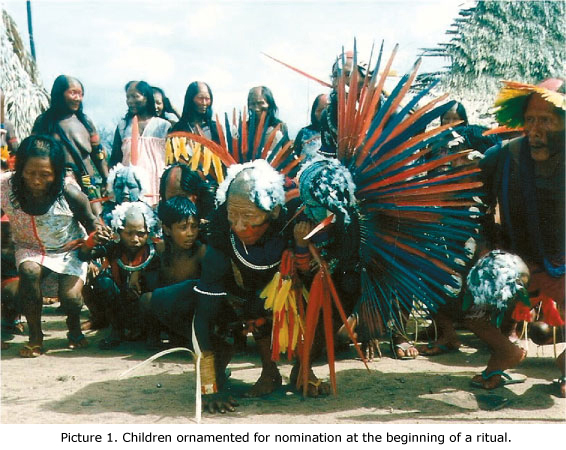
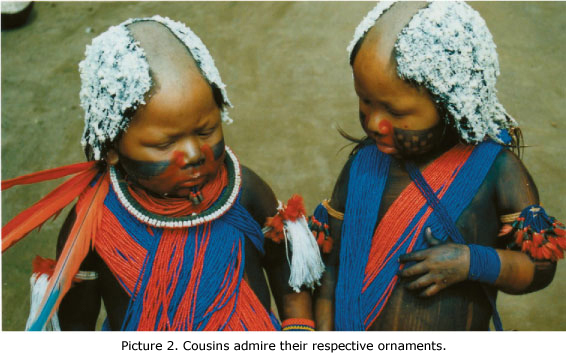
]]> Brazilian ethnology has long shown that the fabrication of the body is fundamental for the constitution of the person and the social among Amerindian peoples (Coelho de Souza, 2001, 2002, 2004; Lima, 1996, 2005; Seeger; DaMatta; Viveiros de Castro, 1979; Viveiros de Castro, 2002). A great deal of their efforts, rituals, and techniques aim at the continual and continuous fabrication of the body, thus constructing the indigenous person herself as well as her humanity. This is especially salient and relevant among the Mebengokré, for whom bodily painting and ornamentation are means for expressing both one's personhood and one's constitution. Since birth, the body of the mebengokré baby is taken care of and decorated following a logic that is at once aesthetic, communicative and therapeutic. Body painting and ornamentation, as various studies have shown, make use of a variety of materials - of many colors, smells, and origins -, graphic motifs and application techniques in order to promote health and well-being, as well as to communicate people's conditions. This is true for all ages, during the entire lifespan, and in death. It is so important and significant that it is also a powerful way of communicating the specificity of the child's experiences, her life stages and transition to adult life.As soon as a baby is born, it gets painted with achiote (urucu), the red color of which lends it the mark of life and interaction (Turner 1977, 1995). Its smell connects the child with the living, because it is as pleasant to the latter as unpleasant to the dead (Vidal, 1992). Ornamentation is made with cotton, which is tied around the wrists, waist, and ankles. Their ears (for both genders) and lips (for boys) are pierced and marked with cotton. As soon as the umbilical cord falls out, the navel is painted for the first time with black paint from the jenipapo fruit, initially by the grandmother's fingers and then, when the skin is hardened, by a brush made of buriti palm. Children's paintings are done with a special freedom of graphic motifs relatively to that of the adults, who have their bodies covered with motifs marked by gender and age groups. Mothers excel at covering their children's bodies with intricate motifs according to their own creativity and virtuosity. Particularly revealing is the habit of covering the children's face painting, made with intricate motifs of fine lines of jenipapo, with layers of urucu paste which makes the fine black lines invisible to the eyes. As Turner (1995) has pointed out, this should be understood as a mark of interaction, which is on the face, around the eyes and mouth, and on the limbs - hands and feed. Covered by urucu, they encompass the black, which contains the drives (which are, by the way, named just as the dead and the village margins, tuk).
While an infant, the child's body is painted more extensively from the neck to wrists and ankles. As the skin is hardened, as the Xikrin say, their adornments become more abundant and incorporate new materials such as bird feathers and seeds. The autonomy of the mebengokré child vis-à-vis its parents is gradually constructed as its body is strengthen and it becomes less fragile and dependent of bodily care by the parents. This is acknowledged when the child shows enough autonomy for moving around and communicating, that is, when it learns to walk and to talk. At this moment, the mother paints for the first time without using the infant motifs, applying instead the motifs also used for adults. The latter no longer covers the entire body; it is cut at the lower neck, forearms and calves, leaving the ankles, wrists and neck paintless. The hair is cut over the forehead, which is careful and sumptuously painted and adorned, thus indicating to everyone that the child is growing (Cohn, 2000a; Vidal, 1992).
The Mebengokré-Xikrin emphasize seeing and hearing as senses for perceiving and understanding the world. Correspondingly, the eyes and ears are organs for learning and acquiring knowledge. As noted by Seeger (1980) in a comparison of bodily ornaments among Jê-speaking peoples, these organs are marked and intervened upon by means of ear lobe plugs, labrets (akokakore) and lip disks or plugs (bàridjua). For the Mebengokré, this translates, for both genders, into enlarging the pierced ear lobe, something which is done in the early infancy by means of wooden cylindrical plugs which may be plain or adorned with small coconuts and feathers. Such ear adornments are worn by children until they are able to walk on their own. This moment is marked by body paintings following a new motif, a new haircut, new adornments, and removal of the lip plug.9
]]> The labret, on the other hand, is a male adornment par excellence, and is directly related with a stress on oratory capacity. Piercing directly below the lower lip is performed days after birth. A cotton string threaded through the small opening is eventually replaced by small strings adorned with beads, seeds and small coconuts, and then feathers. Today, in the villages by the Bacajá river, boys use these labrets until they are around ten. After that, they dispose of them; the lip hole remains for life, but it is small. The large wooden or stone plugs worn by men are no longer in use. Labrets are signs of male oratory capacity, and their maximum size can only be reached when a man is able to fully realize his oratory, that is, when he is mature.10 It is interesting to note that, if the labret is no longer used by adults, it is still used by children, as lip piercing is still performed. It is as if the Xikrin have abandoned the lip disk, but kept its minimal version - a minimalist version, but still full of meaning. It keeps the same logic of ear markers - that of being a marker of childhood by intervening in the organs of perception and communicative interaction with the world, something which is crucial in the process of socialization and humanization of the person. Other objects perform the passage from childhood to adulthood, marked by a social acknowledgement of the reproductive capacity of girls and boys and thus preparing them for marriage and parenthood. This is a condition not only for the consolidation of marriage, but for their inclusion in the female and male groups around which part of the productive and ritual activities as well as female body painting are organized (Fisher, 2001). From a certain point of view, penis cases mark the passage from childhood to adulthood, and are not therefore "children's" objects. But it is interesting to think of them, as Seeger (1980) and Turner (1981, 1995) have done, as part of the complex of body intervention and ornamentation that marks the passage from birth to the first steps, and then to marriage. The penis case is given to the boy when he is initiated - it marks, as these authors have noted, his reproductive capacity and sexual potency. In Turner's words (1995, p. 158-159), it is "simultaneously a public acknowledgement of the young man's mature sexuality, and an instrumental as well as symbolic imposition of a social limit on its expression".11
If the passage to adult life finds its highest marker in the birth of the first child, which makes marriage effective, includes the parents in the age categories appropriate to their condition as well as in production and reciprocity, the penis case is the recognition of such possibility. Correspondingly, for the girls there is the arapê, a shoulder belt made up of red cotton which marks their reproductive capacity (Turner, 1995, p. 155). When she becomes a mother, it is replaced by the tipoia (a'i). The ampredjô belt can also play this role in this system; it is used by girls who are old enough to get married, and is often made up of red cotton.
There is a logic behind the appropriateness of using and producing adornments for the children, especially during their early years. It runs across all objects mentioned here, and is founded in the symbolic value feathers have for the Mebengokré-Xikrin. This is associated on the one hand with ritual transformation into a bird and, on the other, with risk. Giannini (1991, f. 173) shows that, as part of this transformation, during rituals there is a transition from plant adornments to adornments made of feathers and other bird materials such as the azulão egg. She also notes that the manipulation or use of feathers bring danger, and should be performed while following admonitions and interdictions such as those referring to children or sick people. There is here an analogy with the ornamentation of children, who should begin by using ornaments made of plant materials (cotton, vegetable fibers, small coconuts, seeds), then pass on to feathers considered as being less dangerous, and only later on may they wear large feather sets. For the same reason, armbands mark the growth of a child according to the material with which it is made. The first armbands worn by a child, after it has used exclusively strings around the wrists and ankles, are made of red cotton and small coconuts (i'i) and are worn abundantly around the arms, not only in the forearm. Armbands (padjiê aby) are commonly used by children at a stage immediately following the use of red cotton armbands. These are made of cotton and macaw feathers, or weaved in straw and adorned with feathers.
Bodily adornment is a complex that should be understood in its entirety, encompassing the body painting patterns, ornaments, and materials applied to the body. The passages effected in one aspect of this system are thus analogous to those that take place in another. Not by chance, the first material to be applied on the child's head before it is able to walk is of vegetable origin: a white resin (ngore kaka) which, in the first ornamentation after the child is able to take its first steps, may be replaced by feathers of the king vulture (àk kaka). The azulão egg, whose shell is blue and should be pounded before being applied to the face, is exclusively used during rituals or the ornamentation of the dead. During rituals, it is prohibited for infants as well as for their mothers, for the dangers it may bring.
This logic explains why children's adornments are so particular during their early years. After a child is able to walk, and its new condition is marked and displayed precisely by the complex body painting, haircut and ornamentation, it will use adornments of the same kind as the adults (Cohn, 2002, p. 154-157) - armbands, headdresses, shell necklaces, beads, seeds, shoulder belts, chest belts, and so forth. These objects are worn by the children according to their own ritual prerogatives; therefore, they belong both to adults and children.
It is interesting to note that among the Mebengokré-Xikrin the children may be ornamented on a regular basis, whenever new painting is applied. This way, they assemble adornments which are their ritual prerogative, that is, an object whose use is a prerogative transmitted along the same line that bestows them a personal name and contributes to the formation of their social identity. As I have emphasized elsewhere (Cohn, 2000a), these objects are worn by adults only during rituals, while the children wear them whenever they receive a new jenipapo painting, in order to make explicit their social identity and thus gradually constitute it.
But a child's body painting and adornments for burial purposes do not differ from that of adults. The preparation of the dead body includes its hygiene and ornamentation with body painting and adornments. The ornamentation of the deceased makes use of materials prescribed for early childhood such as the azulão egg, and of cuts and motifs appropriate to aged persons. The story told above shows this in a quite striking manner. The deceased child could not yet walk, so his upper head was unshaved (thus not having shaved as the pattern iokó). This is done for the first time as part of the special ornamentation that a child receives when it is able to take its first steps, and is redone at each ritual.12 In life, he was painted as an infant. But as he was being prepared for the funeral, he underwent the transformation that occurs with all children during their lifetime as they become adults. He was taken to the cemetery adorned and painted as an adult during a ritual - or, as a deceased person.
Death and the Dead
As we have seen, for the Mebengokré-Xikrin the karon may be temporarily absent from the sleeping body in order to wander around, something that makes possible both dreaming and shamanic activity. Death, on the other hand, is an irreversible separation of one's karon (commonly glossed as soul, or double) from one's body. Without delving much deeper into reflections on escathology, the Mebengokré-Xikrin do not have a single version of the dead's destiny. If they are described as wandering solitarily about, they are also regarded as a collective that welcomes the recently deceased and lives, much as the living, in "villages of the dead". In fact, as Vidal (1983, p. 321) has shown, it is less the destiny of the dead than a rupture with the world of the living which is emphasized in mebengokré-xikrin conceptions of death.
]]> After the flesh of the buried body is consumed by the earth, what is left are the bones - and until not too long ago, they were treated and kept by the living relatives for the second obsequies13 -- and the karon, besides, as Lea (1986, 1992, 1995) has remarked, the names which are transmitted along the generations. Before the flesh is entirely consumed by the earth and the karon is entirely detached from the body, the deceased is the object of great care. The dead person's objects of daily and ritual use are kept next to the grave, along with water (in case he gets thirsty) and a fire that is lit in the early evening so that he does not feel cold. When the karon detaches definitely from the body, it will leave and meet the other dead. Its journey is long and dangerous. Once it gets there, it is welcomed by ritual weeping - as seen above, much as the living welcome their relatives when they return from a long journey - and tells the news about the living relatives (Vidal, 1983, p. 321). There, they continue the life-cycle: they get married; the children, raised by older relatives, grow up. But the dead also suffer one of the living's plus common ills: they miss their loved ones. This is why they ask for news about the living, in order to know when they will meet again. They thus move closer to the gardens - which occupy an intermediary space between the village and the forest in which they inhabit, a sort of domesticated outside (Giannini, 1991) - in order to see their living relatives again. That is why the latter are always spitting when they go to the gardens; it is a habit that keeps the spirits of the dead at a distance, so they are not vulnerable to the mekaron. Similarly, the dead return to the village in order to watch the rituals performed by the living. For that reason, those who watch the ritual abandon their homes and camp on the courtyard, between the space of the dances and the houses - the latter are left for the dead. In sum, the dead are always seeking to get closer to the living, in order to take them away with them. The Mebengokré-Xikrin fear the approximation of a karon. In fact, much of shamanic activity is about negotiating with the dead over the souls they have captured in order to rescue them and thus avoid death. Thus, the main difficulty faced by the Mebengokré-Xikrin with respect to death is the separation, the rupture with the world of the living. This separation should be realized fully, so that the living will face minimal risk of being captured and brought over to the world of the dead - a risk that, as I have emphasized, is higher for children.Thus the emphasis of mebengokré escathology is on the passage from the world of the living to the world of the dead, since "what comes next does not interest the living and lies beyond any possibility of control" (Vidal, 1983, p. 321). This passage is irreversible but never a real rupture, as the dead remain connected to the living by consanguinity ties, and always long for the moment of reunion.
For the children, this poses especial problems, as they are always at greater risk of being captured by the dead. As seen above, this is due to the greater vulnerability of their karon, which is weakly attached to the bodies that contain them. Their karon may be absent from the body for longer and get easily lost; as children know little, their karon may find it more difficult to return to the path towards the body that contains them. The mekaron14 - the spirit of the dead, always missing their relatives and wandering about the villages, gardens and rituals - are constantly in search of new karon to keep them company; and the children karon are an easy prey.
Children however continue to run significant risks even after death - or even after their karon have irreversibly left their bodies. If the karon journey is always dangerous, this is especially true of children. They need a companion, an adult relative, to show them the way, to protect it from being eaten by the jaguar (Cohn, 2000a; Vidal, 1983). That is why, in the story I told, the thunder heard during the night was perceived as a sign that the dead, the thunder, were coming to get "someone's child" (me'õ nhõ kra) - that is, a child15 that would depend on an older relative to show the way for meeting with the other dead.
The Death of Adults and Children
I claimed that a foray into the mebengokré escathology and the way they construct the body and the person could help us better understand the particularities of child vulnerability, the mourning of a child's death, and the relations between the children and the dead and their destiny. I will thus conclude by comparing some elements in order to unveil differences between adults and children with respect to death and relations with the dead.
The vulnerability of children stems from the fragile connection between their body and karon. This is manifest in the treatment of the body and in concerns about treating their skin so that it becomes "hard" and "strong". It is also manifest in the concern with keeping the child's karon interacting with the living, present in the world of the living especially during moments of greater risk such as when the child is angry or wishing to remain at a distance. Lower vulnerability to being attracted by the dead is achieved by better connecting the child's constitutive elements, and by strengthening its relations with the living. This vulnerability will be restored when the person is older, that is, when one carries the weight of the relations which were taken away during one's lifetime - therefore, one is more vulnerable to the dead's quest for reunion. The importance of speech and mastery over the language of the living fully mebengokré (Cohn, 2000b, 2006) is manifested in the practice of speaking to the child, of keeping communication with her whenever there is a risk. This is done in order to keep it interacting with the living, present in this world, and therefore less vulnerable to being taken to the other world by the dead.
Especially at this stage, in which the skin is not "strong" enough, the constitutive elements are not yet connected. The karon is therefore more vulnerable to capture, and relations of substance become especially important. As has been known for long, it is at this moment of restrictions by the parents - the couvade - that interdictions are most strict. The literature has debated its consequences for the constitution of mebengokré social relations and social structure. The story told above indicates its importance for the construction of the person and its formation. The dead boy was being nursed by his grandmother, and everyone agreed that she was taking all precautions that were necessary. This could be attested by the good condition of her own young daughter, whom she was also nursing. It became clear, in the debate that followed his death, that it was his mother who must have disrespected the interdictions. But it was not her who was nursing. When asked about whether it was the nursing woman who should take the necessary care for the good quality of the milk given to the child, the women were clear: who should take such care is the mother, who had made, fabricated the child. In a sense, this statement is not surprising, as the "relation of substance" connecting those who made the child and her well-being for the entire life is common to all Jê-speaking societies. It has been well described and commented on by scholarship on these indigenous groups. What is interesting and revealing in this case is the emphasis in this relation even when the mother is absent, and the child is being nursed by another woman. The extensive care to be taken with the mother's milk is still up to the mother, even when she is not nursing the child.
There are also differences between mourning an adult and a child: the haircut, as mentioned above; the period of mourning, which lasts longer for a deceased adult; the markers of the end of mourning (for a deceased adult, they include the consumption of banana and meat by their remaining relatives after their full activities are reassumed; but this is not the case for the children, who are fed only mother's milk). There are also contrasts in terms of what is left at the cemetery for the deceased.16 When an adult is buried, pieces of hair, water and personal belongings are left on the ground or hanging. For the child, one leaves only water - or, in the story narrated here, the saline solution for curing dehydration. When an adult or a child who can already walk and speak dies, they can be felt for some time at those sites where they used to wander about: the kitchen, the bedroom, the garden, the kupex djà (to move/work - place). For an infant, this permanence is shorter, and may be felt by hearing its cry for the breast, kà djàx - that is, its wishes to nurse. But the infant never travels alone to the world of the dead; it should always be fetched by a relative. There were a lot of comments on this during the storm that occurred the day the boy died, from late night until shortly after the burial. It was considered a sign that the dead had come to fetch the boy. They recalled that one of the elders had said, during the night storm, that the dead would come to take someone's child. In the world of the dead, the infant child does not remain as such; it is taken care of by someone, and grows up. In the world of the living, the separation takes place precisely at the moment of burial. Just as with the adults, rupture and separation is also necessary; the dead child is felt in the places it had been, its departure is lamented and wept over by those who stay. The elders cry for all their dead, and include among them the children they have lost. Thus, they also add to that ensemble of losses that weight on their shoulders and make them especially vulnerable to the dead, due to the amount of loved ones that wait for them on the other side and long for their reunion.
]]> From a certain point of view, the death of a child is more likely because of her greater vulnerability to the power of attraction by the dead, to being captured by the spirits of the dead. On the other hand, its death seems to be a weakened version of the death of an adult; the mourning is shorter, and the care of the body is less laborious. But the clue from body ornamentation seems, again, more revealing and fruitful to account for the similarities and differences between the adults' and children's deaths, for their post-mortem fate and mourning.If the differences in mourning, burial, and treatment of the dead body of children and adults follow a broader logic which pertains to the difference between children and adults in terms of physical constitution, care for their well-being and formation, relations which they establish and emphasize, ornamentation, and so forth, these differences have a clear limit; this limit is revealed during the preparation of the body for burial. As seen above, body ornamentation is, in life, one of the most powerful means for promoting and communicating differences and transformations in both children and adults. It is precisely this means that is affected with death - when the differences are erased. Indeed, the risk, the care, and the treatment of the body in order to avoid death, or when death arrives, are different for children and adults. These differences should not only be highlighted and taken into account, but can only be fully understood when the conception of personhood and its formation is linked to that of death, within this system which operates differently for children and adults. But death operates a transformation which makes children and adults equivalent in opposition to the living. Thus, the body of the child is treated as that of an adult; it receives the ornamentation of an adult for the burial. This reveals the pressing need for rupture with the dead which is also true for the children. In other words, as stressed above, it is treated as the body of a deceased, even when it pertains to a life cycle yet to be accomplished in the world of the dead; from the point of view of the living, this body is therefore ageless.
REFERENCES
CARNEIRO DA CUNHA, Manuela. Os mortos e ou outros. Uma análise do sistema funerário e da noção de pessoa entre os Krahó. São Paulo: Hucitec, 1978.
COELHO DE SOUZA, Marcela. Nós os Vivos: "construção do parentesco" e "construção da pessoa" entre alguns Jê. Revista Brasileira de Ciências Sociais, São Paulo, v. 46, p. 69-96, 2001.
COELHO DE SOUZA, Marcela. O traço e o círculo. O conceito de parentesco entre os Jê e seus antropólogos. Tese de doutorado. Rio de Janeiro: Museu Nacional/UFRJ, 2002.
COELHO DE SOUZA, Marcela. Parentes de sangue: incesto, substância e relação no pensamento timbira. Mana (Rio de Janeiro), v. 10, n. 1, p. 25-60, 2004.
COHN, Clarice. A Criança Indígena. A concepção xikrin de infância e aprendizado. Master Dissertation. PPGAS. Universidade de São Paulo. São Paulo, 2000a.
COHN, Clarice. Crescendo como um Xikrin: uma análise da infância e do desenvolvimento infantil entre os Kayapó-xikrin do Bacajá. Revista de Antropologia, São Paulo, v. 43 nº 2. p. 195-222, 2000b.
]]> COHN, Clarice. Índios missionários: cultos protestantes entre os Xikrin do Bacajá. Campos (UFPR), Curitiba - PR, v. 1, n. 1, 2001.COHN, Clarice. A experiência da infância e o aprendizado entre os Xikrin. In: LOPES DA SILVA, Aracy; MACEDO, Ana Vera Lopes da Silva; NUNES, Ângela (eds.). Crianças Indígenas. Ensaios Antropológicos. São Paulo, Global/MARI, p. 117-149, 2002.
COHN, Clarice. Relações de diferença no Brasil Central: os Mebengokré e seus Outros. PhD Thesis. São Paulo: Universidade de São Paulo, 2006.
GIANNINI, Isabelle Vidal. A Ave Resgatada: "A impossibilidade da Leveza do Ser". Master Dissertation. PPGAS, Universidade de São Paulo, São Paulo, 1991.
FISHER, William H. Age-based genders among the Kayapo. In: GREGOR, Thomas A.; TUZIN, Donald. Gender in Amazonia and Melanesia: an exploration of the comparative method. Berkeley: University of California Press, 115-140, 2001.
LEA, Vanessa. Nomes e Nekrets Kayapó: uma concepção de riqueza. PhD Thesis. PPGAS, Museu Nacional - UFRJ, Rio de Janeiro,1986.
LEA, Vanessa. Mébengokre (Kayapó) Onomastics: a Facet of Houses as Total Social Facts in Brazil. in: Man 27, 1, march 1992.
LEA, Vanessa. The Houses of Mĕbengokre (Kayapó) of Central Brazil - a new door to their social organization. In: CARSTEN, Janet & HUGH-JONES, Stephen Hugh-Jones. About the House - Lévi-Strauss and beyond, Cambridge, Cambridge University Press, 1995.
LEA, Vanessa. Mebengokre ritual wailing and flagellation: a performative outlet for emotional self-expression . Indiana, Berlim, v. 21, p. 113-125, 2005.
LIMA, Tania Stolze. O Dois e seu Multiplo: Reflexões sobre o Perspectivismo em uma Cosmologia Tupi. Mana, Rio de Janeiro, v. 2, n. 2, p. 21-47, 1996.
]]> LIMA, Tania Stolze. Um peixe olhou para mim: o povo Yudjá e a perspectiva. 1ª. ed. São Paulo/Rio de Janeiro: ISA/Editora Unesp/NuTI, 2005.MELATTI, Júlio Cezar. Nominadores e genitores: um aspecto do dualismo krahó. In: SCHADEN, Egon. Leituras de Etnologia Brasileira. São Paulo: Companhia Editora Nacional, p . 139-148, 1976.
SEEGER, Anthony. O significado dos ornamentos corporais. Os índios e nós. Rio de Janeiro: Editora Campus, 1980.
SEEGER, Anthony; DA MATTA, Roberto; VIVEIROS de CASTRO, Eduardo. A construção da pessoa nas sociedades indígenas brasileiras. Boletim do Museu Nacional, Rio de Janeiro, nº 32: 2-19, 1979.
TASSINARI, Antonella M. I. Concepções indígenas de infância no Brasil. Tellus (Campo Grande), ano 7, n. 13, p. 11-25, out. 2007.
TURNER, Terence. Social structure and political organization among the Northern Kayapo. PhD Thesis. Harvard University, Cambridge/USA, 1966.
TURNER, Terence. Cosmetics: the language of bodily adornment. In: James Spratley; McCURBY, David W. Conformity and Conflict Readings in Cultural Anthropology. Boston: Little, Brown & Co. 1977.
TURNER, Terence. The Social Skin. in: Chefas, J; Lewin, R. Not Work Alone. Survey of activities superfluous to survival. London: Temple Smith. 1981.
TURNER, Terence. Social Body and Embodied Subject: Bodiliness, Subjectivity, and Sociality among the Kayapo". Cultural Anthropology, vol. 10, nº 2, 1995.
VIDAL, Lux. "A morte entre os índios Kayapó". In: MARTINS, José de Souza (ed.)A morte e os mortos na sociedade brasileira. São Paulo: Hucitec. 1983.
]]> VIDAL, Lux. A Pintura Corporal e a Arte Gráfica entre os Kayapó-Xikrin do Cateté. Grafismo Indígena. São Paulo: Nobel/EDUSP/FAPESP. 1992.VIVEIROS DE CASTRO, Eduardo. A inconstância da alma selvagem - e outros
1 Social Sciences Department, Graduate Program on Social Anthropology, Federal University of São Carlos (UFSCar), São Carlos, Brazil. The author researches among the Mebengokré-Xikrin of the Bacajá River since 1993, and would like to acknowledge for the grants by FAPESP, CAPES and CNPq, without which fieldwork would not be possible. Mailing address: Departamento de Ciências Sociais, Programa de Pós-Graduação em Antropologia Social, Universidade Federal de São Carlos. Via Washington Luís, Km 235 - Caixa Postal 676, CEP 13.565-905 - São Carlos - SP - Brasil. Tel: 55 16 33518369 & 55 11 32010108. clacohn@ufscar.br
2 This piece synthesizes and elaborates on a case discussed previously in my M.A. thesis (Cohn, 2000a) and in a paper presented at the 53rd International Americanist Conference in 2009. I would like to thank my supervisor Lux Vidal, who introduced me to the acquaintanceship and debates on the Xikrin and their children, as well as Aracy Lopes da Silva (in memoriam), Beatriz Perrone-Moisés, Vanessa Lea, William Fisher, Antonella Tassinari and Andrea Szulc, as well as the participants in the Symposyum "Niños y niñas indígenas de Americas", for the dialogue and discussion of previous versions of this text.
3 It should be remarked that the mother married into another village and no longer nursed the child. The interpretation that what she ate (with a possible breach of food interdictions) and the fact that she got married (with a possible new pregnancy) had caused the boy's disease is related to the conception of a bodily connection between the genitors and their children, which does not go away neither with absence nor with distance. In fact, diseases in small children are commonly communicated to their absent parents and close relatives by radio or telephone, so they may respect the corresponding restrictions and thus secure the child's recovery wherever they are. This point will be resumed below.
4 Few men, and only young ones, came closer. When a child is born, it is also the women who visit the mother and the newborn, while men keep at a distance.
5 Ritual weeping is performed by older women during mournings, the departure and return from long journeys, and when an absent person is recalled. Through this, persons are remembered, as well as their achievements and the relations that connected them to the others. Lea (1986, 2005) suggests that it be treated like an oratory - the female, private and domestic equivalent of the male, public and political oratory. When a death occurs, it unleashes memories of other deaths, and it is always the women who cry together, each for her own deceased.
6 Check also Giannini (1991) for the constitution of Xikrin personhood and its constitutive elements. ]]>