Representação de classe do empresariado financeiro na América Latina: a rede transassociativa no ano 2006
Structure de la représentation de la classe de l'entrepreneur financier en amerique latine: le réseau transassociatif en l'an 2006
Ary Cesar Minella
Universidade Federal de Santa Catarina
]]> Translated by Meryl Adelman
ABSTRACT
This paper analyzes the structure of class representation in the financial entrepreneurial sector in Latin América. Our goal is to identify the connections established between bank associations through the common presence of conglomerates or financial groups that act simultaneously in the directorship of several entities in different countries, taking the year 2006 as our reference. We work with a hypothesis on the building of trans-associative networks. For our purposes, we studied 24 associations in 17 different countries, providing a total of 229 positions. Data was collected from the websites of the entities and through e-mail and telephone contacts. We adopted the methodology of Social Network Analysis and a part of our results were compared with data available for the year 2000. Among other things, we were able to confirm: a) a high number of connections between associations; b) centrality within the network of 10 conglomerates or financial groups that act within banking associations in three or more countries; among them, Citibank and the Spanish banks Santander and Bilbao Vizcaya stand out; d) the associations that present highest degrees of connection are located in Argentina, Chile, Brasil, Costa Rica, México, Nicarágua, Panamá, Paraguai and Peru. We conclude that a large portion of the structure of class representation among the financial entrepreneurial sector in Latin América has been "transnationalized". This reinforces our hypothesis on the building of trans-associative networks, from which we go on to discuss the scope and meaning of this network as illuminated by international literature on the issue.
Keywords: finance sector entrepreneurs; trans-associative networks; bankers´ associations; class structure; financial groups and conglomerates; structural analysis; social networks analysis.
RESUMO
O trabalho analisa a estrutura de representação de classe do empresariado financeiro na América Latina com o objetivo de identificar as conexões que se estabelecem entre as associações de bancos a partir da presença comum de conglomerados ou grupos financeiros que atuam, simultaneamente, na diretoria de várias entidades, em diferentes países, tomando como referência o ano de 2006. Trabalha-se com a hipótese da formação de redes transassociativas, adotando-se a metodologia de Análise de Redes Sociais; parte dos resultados foi comparada com dados disponíveis para o ano de 2000. Entre outros aspectos, constatou-se: a) um número elevado de conexões entre as associações; b) a centralidade na rede de dez conglomerados ou grupos financeiros que atuam em associações de bancos em três ou mais países e c) as associações que apresentam maior grau de conexão estão localizadas na Argentina, Chile, Brasil, Costa Rica, México, Nicarágua, Panamá, Paraguai e Peru. Concluiu-se que grande parte da estrutura de representação de classe do empresariado financeiro na América Latina encontra-se transnacionalizada, reforçando nossa hipótese. Discute-se o alcance e o significado dessa rede à luz da literatura internacional, destacando-se, entre outros aspectos, o potencial de intercâmbio de informação, a possibilidade de articular e coordenar posicionamentos e ações corporativas e políticas, a vinculação com outras instâncias de organização e defesa dos interesses de classe do setor financeiro.
Palavras-chave: empresariado financeiro; redes transassociativas; associações de bancos; estrutura de classe; conglomerados e grupos financeiros; sistema financeiro.
RÉSUMÉS
Ce travail analyse la structure de la représentation de la classe de l'entrepreneur financier en Amérique latine et a pour objectif d'identifier, au long de l'année 2006, les connexions qui naissent entre les associations des banques à partir de la présence partagée des conglomérats ou des groupes financiers travaillant simultanément dans l'administration de plusieurs organisations, dans plusieurs pays. Notre hypothèse est la formation de réseaux transassociatifs. Il a été pris en compte 24 associations, dans 17 pays, et 229 postes au total. Les données ont été collectées dans les pages web des organisations, sur le courrier électronique et par contact téléphonique. Il a été adopté la méthodologie de l'Analyse de Réseaux Sociaux et une part des résultats ont été comparés aux données disponibles pour l'année 2000. Constats: a) un grand nombre de connexions entre les organisations; b) centralisation sur le réseau de dix conglomérats ou groupes financiers travaillant dans des associations de banques dans trois pays ou plus, surtout Citibank et les espagnols Santander et Bilbao Vizcaya; d) les associations présentant le plus grand nombre de connexions se trouvent en Argentine, au Chili, au Brésil, au Costa Rica, au Mexique, au Nicaragua, au Panama, au Paraguay et au Pérou. Nous avons conclu qu'une grande part de la structure de représentation de la classe de l'entrepreneur financier en Amérique latine est transnationale, ce qui renforce l'hypothèse de la formations de réseaux transassociatifs, d'où naît la discussion sur la portée et la raison de ce réseau à la lumière de la littérature internationale.
Mots-clés: entrepreneur financier; réseaux transassociatifs; associations de banques; structure de classe; conglomérats et groupes financiers; système financier.
I. INTRODUCTION
Over the last few years my research has dealt with analysis of the financial system from a socio-political perspective, looking particularly at the organization and political and corporative behavior of finance entrepreneurs through the structure of their class representation in Latin America, Brazil in particular. More recently, I have explored the possibility of using the methodology of Social Network Analysis for the study of this universe, convinced of the possibilities it offers for the study of dominant social sectors in contemporary capitalist society. In this text I will present some of the preliminary results of my endeavor1.
My impulse to use this methodology came from the findings and limitations of an earlier study which analyzed the implications of the process of financial globalization on the structure and dynamics of class representation among financial entrepreneurs, focusing on the presence of foreign financial institutions in the composition of the directorship of 19 banking associations in 13 Latin American countries and examining a total of 212 executive positions, during the year 2000 (MINELLA, 2003).
My results showed an active presence of foreign banks, since I was able to verify that the latter held control of almost half of all executive positions. Particularly salient were eleven groups or financial conglomerates from the U.S. and Europe that held almost one-third of all positions. Three cases were the most significant: the U.S. Citibank (Citigroup) and the Spanish groups Santander and Bilbao Vizcaya, each of which participated in bank associations in seven countries. I observed that the spontaneous participation of same institution, group or financial conglomerate in a variety of assocations establishes a connection between them, creating what I have denominated as "trans-associative networks" which have a fundamental role in the configuration of a structure of class representation made up of the continent's banking associations.
]]> In this paper I present the first results from new research on this network that I carried out, in reference to the year 2006, but now using a universe that has been expanded to include 24 associations in 17 countries and a total of 229 members in executive positions (cf. Chart 1, in appendix)2. In addition to this wider scope, the fundamental difference in relation to earlier research is the use of Social Network Analysis, a methodology that enables us to identify the outreach and the characteristics of networks with greater precision, thus permitting considerable progress in our comprehension of the phenomena we are studying. In my evaluation these procedures contribute in illuminating the nature and the dynamics of relationships established between class entities that act in defense of the corporate and political interests of the financial sector in Latin America.Before presenting and analyzing data on this trans-associative network as it took shape in 2006, we should make the broader analytical context in which our work is situated clearer. I would like to emphasize that entrepreneurial class representation, which manifests itself in the form of banking associations, is interpreted as one among many other elements that make up the analytical field seeking comprehend the characteristics and power of the financial institutions of contemporary capitalism. And it is within this context, therefore, that I place trans-associative networks. In order to present this wider picture, I will first provide a brief sketch of the considerations that I developed in earlier work (Minella, 2005a; 2005b; 2007).
II. THE TRANS-ASSOCIATIVE NETWORK IN ITS CONTEXT: EVALUATING THE POWER OF FINANCIAL INSTITUTIONS IN CONTEMPORARY CAPITALISM
The current moment of contemporary capitalism is characterized by the preponderance of financial accumulation (CHESNAIS, 2003), supported by a process of liberalization and de-regulation of markets. Through diverse mechanisms and financial innovation, this has led to renewed levels of debt (of families, firms and governments) and to the large scale movement of capital, especially that of the speculative sort, around the globe. It also seems clear that this accumulation only becomes viable within the context of the restructuring of capitalist production, which has imposed greater levels of precariousness within the world of work through the combination of old and new forms of exploitation, through the appropriation of wages generated by workers and other social categories, through consumer credit and financial services credit, and through fiscal appropriation via public debt.
My analysis takes into consideration the financial re-structuring that, in a variety of moments and paces, has been taking place in America over the last few decades, and in the Brazilian case, especially as of the mid-1990s. Within the context of macro-economic policies and institutional reforms, which for the most part have been aligned according to parameters defined by the so-called Washington Consensus and the crises that affected the economics of the continent, the financial system in most countries underwent an opening, leading to increased foreign control over local assets, greater centralization and concentration and an accelerated process of privatization3. The re-structuring of bank has labor accompanied this process. (LARANGEIRA & FERREIRA, 2000; GRISCI, 2002; JINKINGS, 2002; JUNCKES, 2004; RODRIGUES, 2004).
Keeping all these general aspects in mind, it is necessary to analyze the finance system and its institutions, related to the broad context of the power of finance institutions and their agents under capitalism. Given the impossibility of analyzing the entire range of dimensions that this issue has, I gave salience to the following aspects, in addition to the structure and dynamics of class representation within the sector: a) the control over capital flows and their meaning in terms of financial hegemony; b) the making of economic or financial groups, expanding its action over the non-financial sector; c) participation in the political process and in State decision-making apparatuses; d) the participation and financing of political and ideological entities; e) connections with mass media and f)connection to the cultural and entertainment world through the financing and coordination of activities in this field, especially through its own cultural foundations. With the exception of the latter two, I have broadened the references on each of the aspects mentioned above, and have included the structure of class representation as my central theme.
II.1. Control over capital flows and financial hegemony
One of the fundamental bases of banking and financial institutions' power is the control they exercise over a substantive part of the resources and capital flows in the economy. This control allows them, under certain circumstances, to create constraints on government policy decision-making processes and firms' strategic decisions, which characterizes a situation of "financial hegemony" as Mintz and Schwartz have termed it (1985). Financial institutions – including institutional investors –, having control over a significant flow of capital, are endowed with the capacity to define some general economic lines within which non-financial corporations operate, since they are able to propell development in particular areas in detriment of others as well as restricting commitments with a particular sector, firm or country.
The exercise of hegemony is, nonetheless, somewhat problematic, since it is played out within different economic (and political) conjunctures and regional contexts. In critical periods, when the availability of capitals wanes, this hegemonic power makes itself felt more evidently. Countries and firms that are suffering from high debt and that have an urgent need to renew their credit are submitted most intensely to the constraints of these financial institutions (which includes here, in the case of countries, actions of financial organs such as the International Monetary Fund (IMF) and the World Bank). Thus, the possibility of imposing constraints on the decision-making processes of firms and governments is conditioned by the different conditions of the economic cycle, by firms' ability for self-financing, by the degree of development of the capitals market, the possibility of finding credit alternatives, degree of concentration of credit offer and the general condition of indebtedness of firms and governments.
]]> One of the most important aspects to be emphasized here is the great concentration of resources in a small number of institutions, a characteristic that appears in greater or lesser degree in the majority of Latin American countries and that has been reinforced by the privatization occurring within the finance sector. This degree of concentration of resources in few hands has not only generated economic power, given the management of a gigantic flow of capital, but also political interest in the definition of the macro-economic policies that can affect this universe. The global result is that a reduced number of financing institutions and, therefore, those who control them, come to exercise an influence over the entrepreneurial and governmental world that goes far beyond that which is exercised by other social forces, including business sectors.A particular element of this hegemony refers to the relationship that finance institutions maintain with the State via public debt, which in addition to contributing to the profitability of banks favors their potential to exercise constraint over the process of strategic decision-making in the realm of economic policy. (Ferreira, 2005).
II.2. Economic Groups
The second aspect to be considered here is the existence of economic groups that, although constituting a very broad and central process in contemporary capitalism, have received still insufficient attention on the part of Social Sciences (GONÇALVES, 1991; GRANOVETTER, 1994)4. As of the 1990s, interest in the topic has seemed to grow, with the publication in Latin America of several empirical studies and theoretical discussions. (p. ex.: ALCORTA, 1992; STOLOVICH, 1995; COMIN et alii, 1994; PORTUGAL JÚNIOR, 1994; SCHVARZER, 1995; BASUALDO, 2002; COSTA, 2002). Although some conceptual differences and operational difficulties do exist, in general terms there are two aspects that stand out in studies of economic groups: first, their importance, both as privileged agents of economic operations in the global sphere and for their influence or potential direct and indirect influence on government policy; second, their role in the world of entertainment and culture, becoming major artifices of world culture at the end of the 20th century (ORTIZ, 1994, p. 147-182).
An economic group may be defined as a "set of firms that, while juridically independent from one another, are interconnected, whether by contractual relations or by capital, and whose property (of specific assets and particularly of capital) belong to individuals or institutions that exercise effective control over this set of firms" (GONÇALVES, 1991, p. 494). Thus, "the economic group expresses relations of force and of power, around which individuals, classes, and social groups in general move, forming networks of solidarity and fields of conflict" that involve stockholders, managers and workers (PORTUGAL JÚNIOR, 1994, p. 17). We thus consider the economic group as a locus for capital accumulation and a locus of power (GONÇALVES, 1991, p. 494).
It is necessary to recognize that there is a wide variety of economic groups that are characterized by different types of property. Some are controlled by individuals, by a family or by a group of families that maintain direct or indirect relations. In other cases, these groups may be maintained indirectly, through "a series of companies that hold the stock of other companies at successive levels, or through one or more holding companies". (Granovetter, 1994, 461-461). As Granovetter suggests, agreements and crossholdings may take on a quite complex structure, involving several firms that are articulated through networks of intertwined directorates (ibid).
There are many aspects involved in the relationship between government policies and economic groups, such as regulation and de-regulation, anti-trust policies, Statization, industrial and technological policies, forms of financing the State, and regulation and control of the labor force (GONÇALVES, 1991, p. 494). Thus, their relation with the State deserves sincere attention, not only in the interests of our understanding of problems of power and public policies, but also for the analysis of the forms, characteristics and behavior that these groups assume. Therefore, as Granovetter (1994) and Gonçalves (1991) suggest, the issue of the organization and configuration of economic groups not only depends on economic factors, but also on the interaction of political and social cultural ones. At the same time, we should recognize the power that groups have over markets and society in general, their ability to institute values, transform themselves into a public instrument and control substantive capital flows that guarantee them the power to veto decision on public regulation, relativize State power and have effects on the economy of a diversity of countries (PORTUGAL JÚNIOR, 1994, p. 55-56). Many banks that act in Latin America and make up part of the executive directorship of class associations belong to or constitute the central nucleus of economic groups; in this case, we shall refer to them here as finance groups. The specific identification of such groups and their position in the trans-associative network will be the object of future analyses.
II.3. Participation in the political process and in State decision-making apparatuses
The analysis of the relations that are established between the State and the financial system constitute a fundamental challenge for our understanding of the dynamics of contemporary capitalism. In Brazil, the connections and interests that are established through public debt represent a fundamental characteristic of this relationship. Furthermore, the centrality that the decisions and actions of the Central Bank have taken on for economic policy have turned it into a strategic institution for the maintenance of financial hegemony, therefore essential for the interests of the country's financial entrepreurs. The existence of presidents and directors of the Central Bank who maintain connections to the universe of private banks constitutes one expression of this relationship. At the same time, the new role that Legislative power has gone on to assume after political democratization has garnered the financial system's attention; electoral financing represents only one indicator of the sector's interest in the political process5. In the Brazilian case, of the ten largest private banks, at least five are important in election financing and two stand out in terms of relationships with the Central Bank (MINELLA, 2007).
II.4. Banks and political-ideological organizations
]]> In addition to trade union, associative and political party structure, entrepreneurs or the finance and banking bourgeiosie also articulate their interests through a set of organizations of a political and ideological nature. In the Brazilian case, an important example are the Liberal Institutes, constituted as civil entities by a group of large entrepreneurs during the early 1980s, focused on the dissemination of neo-liberal doctrines, in particular as the basis for public policies (GROS, 2003b, p. 275). Maintained by large national and foreign economic groups that operate within the country, these Institutes are part of a worldwide network that includes "intellectuals, academics, politicians, research institutes, liberal and media publications, particularly in the United States and in Great Britain" (idem, p. 275-276). Tied to an international network of think tanks, these institutes carried out a series of actions during the 1990s (see GROS, 2003b; for the 1980s, see GROS, 2003a)6. More recently, the Institute for the Study of Economic Policy (Instituto de Estudos de Política Econômica, known also as the "Casa das Garças" or "House of the Storks"), based in Rio de Janeiro, constitutes an important group of researchers in which economists and entrepreneurs with connections to the financial system participate. The Institute develops and proposes liberal policies.II.5. Structure and dynamics of class representation
From a socio-political perspective, the analysis of the power of financial institutions should take the structure and dynamics of class representation into consideration, as expressed through bank associations and other financial institutions that exist in advanced capitalist countries as well as in Latin América7. We may consider that the process of internationalization of the financial system in Latin América is also manifested in the significant presence of foreign financial institutions, at executive levels within the organs of class representation in many countries, in which large international groups from the United States and Europe stand out. Citibank (Citigroup), Banco Bilbao Vizcaya Argentaria (BBVA) and the Banco Santander Central Hispânico (BSCH) are the most significant examples, as we shall soon see. The data that we present suggests the formation of what have been called "trans-associative networks", interpreted as networks that are formed through the simultaneous participation of the same firm or the same economic group – in our case, an institution, a conglomerate or a financial group – in several class associations in different countries. Thus we are able to speak of a trans-associative network within the financial system and of the possibility of an articulated action on the part of these groups seeking to define common strategies for banking associations in Latin America. The formation and meaning of this network is our next topic.
III. CONFIGURATION AND ANALYSIS OF TRANS-ASSOCIATIVE NETWORKS: CLARIFICATIONS REGARDING THE ADOPTED METHODOLOGICAL PROCEDURES
My central research interest was the identification of possible connections established between banking associations in Latin America through the presence of a same finance institution among the directorate of these entities that constitute one of the channels of organization and of corporate and political action in defense of entrepreneurial and/or finance and banking bourgeoisie class interests. The methodology for the analysis of social networks is an adequate procedure for the study of social relations. There is currently an abundant international literature on the analysis of social networks which has recently become of more common use among Brazilian researchers8. I resort to this literature, limiting myself here to a presentation of essential elements for the comprehension of specific procedures adopted in this study9.
My point of departure is the identification of the financial institutions that make up the directorate of banking associations. The initial step involved consulting the web pages of these associations. Where data on the websites was incomplete, outdated or non-existent, direct consultation with the entities was conducted through e-mail or by telephone10.
It is important to consider that a financial institution that holds a position within a directorate can basically be constituted in three ways: as a singular firm, operating for example only as a commercial bank; as an enterprise integrated into a financial conglomerate or as a firm related to a financial group, as previously defined. A "financial conglomerate" is understood here as a series of firms that under centralized control act within different segments of the financial sector. Several publications and regulating organs of the sector frequently refer to this set of firms as a financial group, therefore using a notion that is distinguishable from the concept that I adopt here. Conglomerates and financial groups are the main actors in the constitution of the network I analyze.
In many cases, the condition of conglomerate or financial group is easily recognized, but in others more detailed research has been required, as was the case for institutions operating in Central America. Furthermore, in the process of financial centralization, conglomerates and international financial groups incorporated national and state entities and certain patrimonial arrangements did not always make stockholding control explicit. Thus, informations on ties with conglomerates or financial groups, where they were not evident, were sought through specialized publications (particularly those that were available through the internet), within the regulatory organs of each country and within the pages of the institutions themselves11. This made it possible to group and identify financial institutions according to the conglomerate to which they belong. Chart 2, appendix, presents a synthesis of the results that were reached, identifying the position that institutions, groups or conglomerates held within banking associations.
The data was systematized through matrixes12 using the Ucinet 6 program (BORGATTI, EVERETT & FREEMAN, 2002) that enables us to evaluate the properties of the network and create sociograms for a graphic visualization of phenomenon that is being studied (in this case, using the Netdraw program which is incorporated into Usinet 6). The base matrix was generated through Chart 2, appendix, which basically identifies the presence or absence of an institution, group or conglomerate within class entities. Through this matrix, an "affiliation matrix"13 is generated, identifying the affiliation network as is central to our analysis.
]]> Thus, a clarification about the matrix and its usage is necessary. I resort here to the detailed explanation that is provided in the text by Wasserman and Faust (1994, ch. 8), from which I reproduce several observations, enough for an understanding of the procedures adopted. Basically this matrix represents the relationship of a set of actors with a set of social occasions, events or organizations14. According to these authors, there is a long tradition in the Social Sciences, and within Sociology in particular, in the study of how individuals participate in collectivities. The importance of the study of affiliation networks derives therein. Earliest insights come from Simmel (what he referred to as "social circles") and were later developed by other researchers. A common conception to be found in this view is the ideas that actors are linked through their associative participation in social events.Joint participation in events not only provides the opportunity for actors to interact, but also increases the probability that direct pairwise ties (such as acquaintanceship) will develop between the actors". Similarly, when a person or group of persons participates in more than one event, a connection is established between the two events. Put in other words: overlap in group participation offers greater opportunity for the flow of information between groups and the possibility to coordinate group actions (ibid, p.293) "The fact that events can be described as collections of actors affiliated with them and actors can be described as collections of events with which they are affiliated is a distinctive feature of affiliation networks" (ibid p. 294).
Affiliation networks thus offer a perspective "by which actors are linked to one another by their affiliation with events, and at the same time events are linked by the actors who are their members". Therefore there are two complementary routes to observing an affiliation network: on the one hand, as actors connected through events; on the other, events connected through actors. "Analytically, the duality of affiliation networks means that we can study the ties between the actors or the ties between events, or both" (ibid p. 295).
According to Pizarro (2005b, p. 14), from a methodological point of view the study of groups is identified with relations of belonging: "person I belongs (or does not belong) to group G. The methods developed for the study of this type of relation are of enormous theoretical and methodological importance, since they place the question [...] of homogeneity between entities and relations within this type of analysis".
The data that we have analyzed – finance institutions that are at the head of banking associations in Latin America – are relations of belonging, that is, the relationship that individuals – in this case, finance institutions – maintain with well-defined collectives, that is, banking associations. Therefore, through this procedure, we are able to identify the possible relationships established between finance institutions through their common belonging to banking associations, as well as the connections that are established between the 24 associations, in 17 countries, through the presence of financial institutions in the directorate of these entities of class representation. The focus of the present analysis is this second type of connection.
IV. CONFIGURATION AND ANALYSIS OF TRANS-ASSOCIATIVE NETWORKS
Through these matrixes it becomes possible to calculate the degree of centrality that institutions have within the network. In this case, we are dealing with the outdegree, which expresses the number of banking association directorates to which they belong. Most of the institutions participate in the directorate of just one association (degree 1), and thus relationships between associations are not established. For this reason, they will not be included in the present analysis. In Table 1 I present the finance institutions (normally financial groups or comglomerates) that belong to two associations (16 cases) and to three or more associations (17 cases). Together, they are in control of 110 directorships which represent 49% of the total; thus, these 33 institutions make up the basis for the formation of the trans-associative network of banking associations in Latin America.
]]>
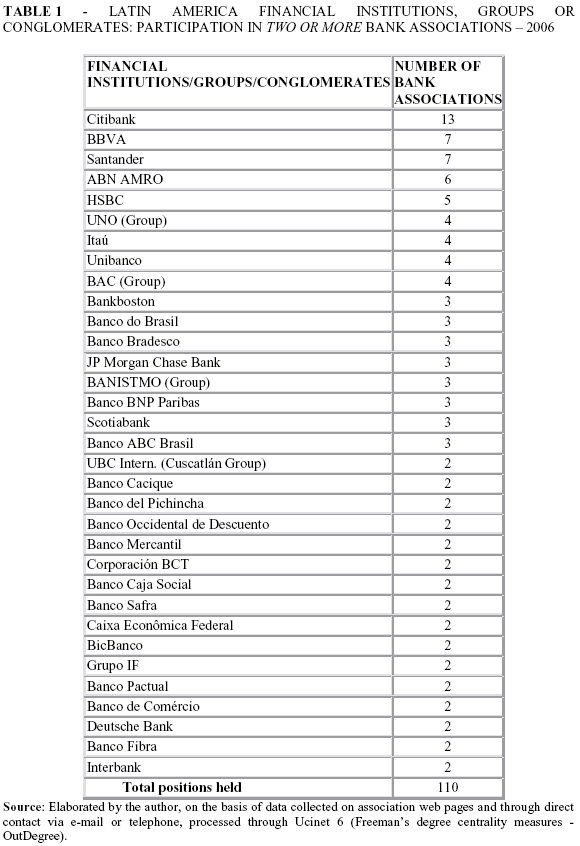
In stricter conceptual terms, I have considered the participation of a finance institution, group or conglomerate most significant for the constitution of a Latin American trans-associative network in the cases in which the former participates in at least three entities, in different countries. In broader terms, presence in at least two countries could be considered, although at this point, I will focus my analysis on the first alternative.
Among the 17 cases that fulfill the stated criteria for analysis (participation in three associations), not all meet up with the further requirement of acting on the directorate of class entities in three countries. Some circumscribe their action to associations within only one country, as is the case of the Banco ABC Brasil, Bradesco and Unibanco, participating only in Brazilian entities; others participate within two countries (Argentina and Brazil), such as HSBC, Banco BNP Paribas and Itaú, whereas the state-controlled Banco do Brasil is present in Brazil and Bolivia.
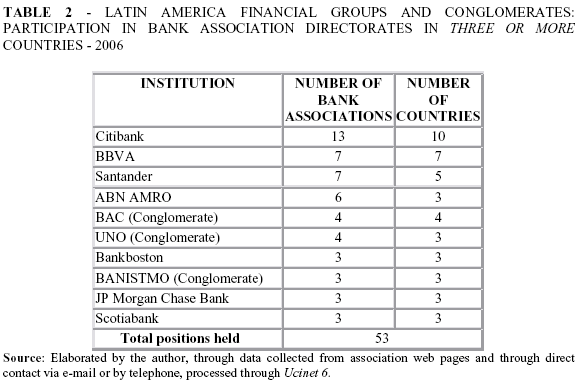
Thus, we see that there are 10 financial groups or conglomerates that take part in directing associations that are present in three or more countries. They hold a total of 53 positions, representing 24% of the total, and make up the central nucleus of "actors" responsible for the structuring of connections between associations (Table 2).
The following sociogram (Figure 1) enables us to visualize the participation of these groups and conglomerates within bank association directorates. In the sociograms that we will present throughout this paper, the geometric position of the associations and financial institutions is arbitrary, as is the length of lines, which are meant to do no more than indicate the existence of a relationship.
]]>
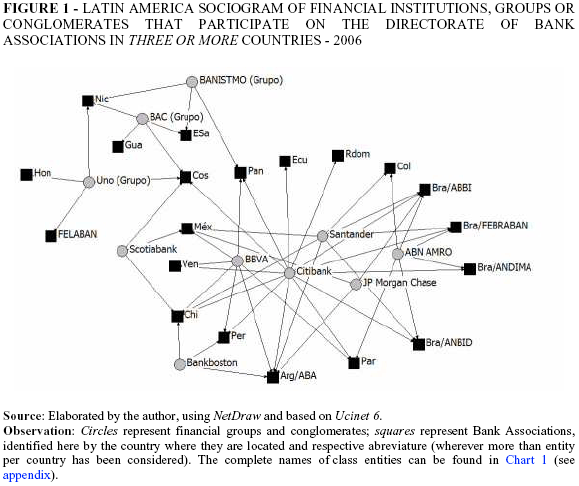
The above sociogram reveals the existence of two sub-groups among the institutions that structure the trans-associative network. One of them, made up of three conglomerates or groups with operations located particularly in Central America: UNO, BAC and Banistmo. The other one is made up of international financial groups or conglomerates, especially those with headquarters in the United States (Citibank, JP Morgan and BankBoston), Canada (Scotiabank) and Europe (Santander, BBVA and ABN-AMRO).
The first group apparently plays an important role in directorship and building connections between Central American associations, whereas the connections between the latter and the others occurs primarily through Citibank and BBVA (in the Panamanian case) and through Citibank connections with the Scotiabank (in the case of the Costa Rican association).
Three groups or conglomerates show the highest outdegree, that is, participate in directorship of the greatest number of associations: the U.S Citibank, which integrates the command of 13 class entities in 10 different countries, with intense participation of Brazilian associations (four cases); the Spanish groups Santander and BBVA(Banco Bilbao Vizcaya Argentaria), both of which maintain a presence in seven countries, in the same number of class entities, including the Argentine Asociación de Bancos de la Argentina (ABA) and the Mexican Asociación de Bancos de México; the former also participates in two Brazilian entities while the latter is not present in Brazil. It is important to keep in mind that the three groups also showed greatest outdegree for the year 2000.
The ABN-AMRO conglomerate concentrates its action within four Brazilian class associations and is also present within entities in Colombia and Paraguay. Groups that maintain a presence within associations in three different countries, are, as follows: BankBoston (Argentina, Chile and Peru), Scotiabank (México, Chile and Costa Rica) and JP Morgan Chase (México, Argentina and Brasil).
It is important to keep in mind that recent movements (late 2006 and early 2007) in the process of banking centralization may have an effect on the patrimonial control of several of the finance institutions mencioned in Table 1, with repercussions in participation within class entities. In 2006, Bankboston handed a portion of its activities in the Southern Cone to the Brazilian group, Itaú, which was thus able to widen its range of participation in associative directorates to three or more countries. At the end of that same year, control over the Banistmo group, with headquarters in Panamá and holding positions within the directorate of three associations, was taken over by the conglomerate HSBC (at the moment of our research, the operation had yet to be confirmed by regulating authorities, which was supposed to happen during 2007), thus widening the possibility for this European conglomerate to act within bank associations in Latin America (it already holds positions within four associations in Brazil and one in Argentina). In turn, at the end of 2006, the Citibank group expanded its presence in Central America through the purchase of the UNO group which takes part in the directorates of three class entities within the region and also takes part in the Felaban directorate. This U.S. group also acquired the Banco Cuscatlán, an important finance institution with headquarters in El Salvador that participates in the directorate of two class associations (in El Salvador and Costa Rica). This seems indicative of the expanding position of international finance groups within the trans-associative network.
In the Table below, I identify the extent to which banking associations have incorporated the participation of the ten groups or conglomerates with greatest outdegree (Table 3)15.
]]>
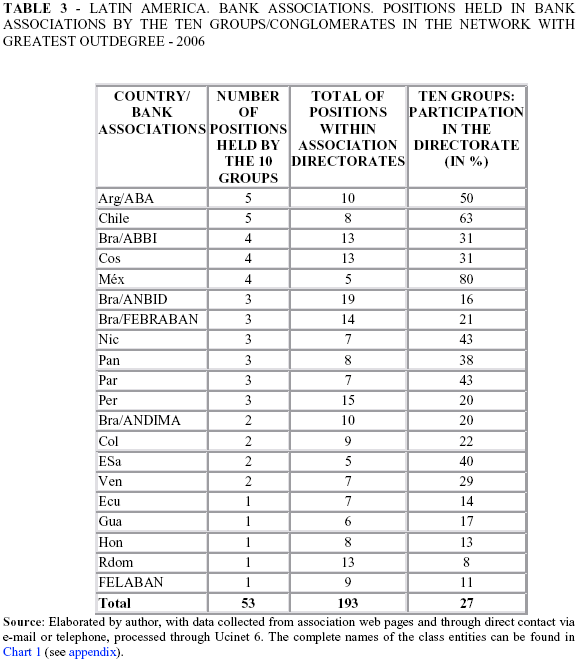
The data on some associations show a strong presence of groups and conglomerates with greater outdegree in the network, as is the case for Argentine (ABA) and Chilean class entities, within which five of them are present. These are followed closely by associations in Brazil (ABBI), Costa Rica and Mexico, in which there are four groups or conglomerates with a marked presence; in the Costa Rica case, regional groups prevail. Six other associations, of which two are Brazilian (Febraban and Anbid), two are in Central America and the others in Paraguay or Peru, accomodate three groups or conglomerates of those who have the greatest outdegree.
In order to better evaluate the relevance of the connection established between two associations, the total number of members who make up the directorate of each one of them should be taken into consideration. In principle, the common presence of one or two institutions in directorates made up of few members may be more relevant that those cases in which the directorate is made up of many members16.
Thus, in considering the possible influence of the ten groups that are in command of the continent's class associations, it becomes necessary to take into account, from this quantitative perspective, their relative participation in the composition of the directorate of class entities. According to data in Table 3, within the entities of three countries (Argentina, Mexico and Chile), this presence is equal to or greater than 50%; in the outers, it is weaker, remaining at less than 30%.
It is important to mention that the presence of these groups or conglomerates extends to 20 of the 24 associations that we have researched and 16 of the 17 countries we have considered. Nonetheless, they have scant participation in the Latin American Banking Federation (Federación Latinoamericana de Bancos or Felaban), the top entity of the formal system of bank representation on the continent, with only one of them (Grupo UNO) participating in the directorate of the latter federation.
Although this may not be possible to develop within the limits of this text, it is important to add that several associations should be considered in a differentiated manner, for the meaning that they have as entities that aggregate others, as is the case of the Federación Latinoamericana de Bancos (Felaban). The brings together almost the entirety of associations that we have mentioned here and formally represents banks and other finance institutions from the continent. The same can be said for the National Confederation of Finance Institutions (Confederação Nacional das Instituições Financeiras or CNF), the highest organ of class representation for the various segments of the Brazilian financial system17.
]]> V. CONNECTIONS BETWEEN BANK ASSOCIATIONS
The data and the analyses that we have developed up to this point have centered around finance institutions, indicating to what extent they are present within the directorships of class entities. I have verified a relatively significant number of institutions that occupy directing positions within at least two entities and a set of institutions that stand out for integrating associative command in three or more countries and including 10 groups/financial conglomerates – the majority of which have headquarters in the United States or Europe.
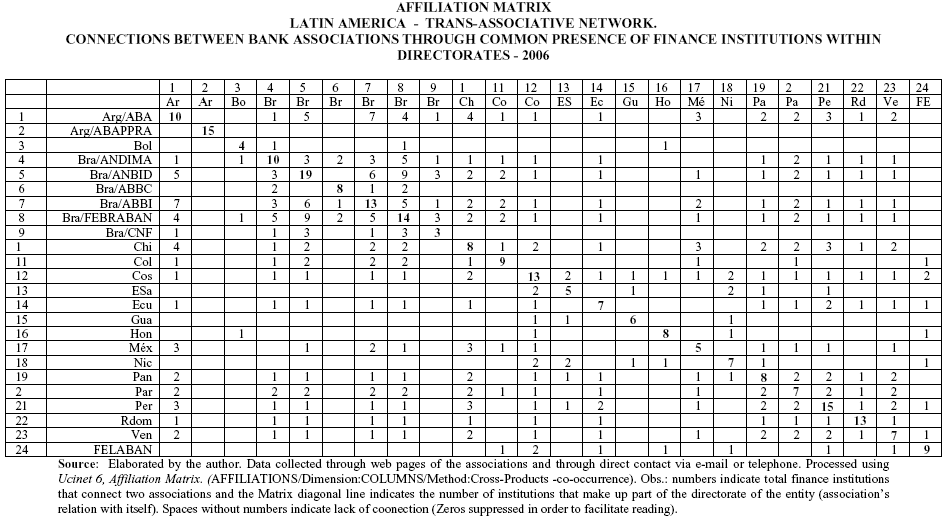
The next step, central to our analysis, identifies the connections that are established betwen class entities throught the common presence of their directorates within one or more financial institutions. Our analysis is developed through an affiliation matrix, whose meaning and relevance have been indicated. This procedure has enabled identification of the associations that are connected, what their scope is in terms of the number of associations that each one is connected to and the density of the ties, considering the number of financial institutions that establish a relationship with each pair of associations18. Results can be found in the affiliation matrix, appendix; for its use, some clarifications are necessary.
The numbers represent the finance institutions that connect two associations that overlap in lines and columns; the matrix' diagonal shows the number of institutions present in the directorate of each class entity, that is, the total number of positions. Examining line 1, we can see that the Argentine Bank Association (Asociación de Bancos de Argentina - ABA) is intensely connected, particularly to the associations that exist in Brazil: seven finance institutions belonging to its directorate are also present within the directorate of the Brazilian Association of International Banks (Associação de Brasileira de Bancos Internacionais - ABBI); it has 5 members in common with the Brazilian Association of Investment and Development Banks (Associação Brasileira de Bancos de Investimento e Desenvolvimento – Anbid) and four with the Brazilian Federation of Banks (Federação Brasileira de Bancos – Febraban). At the same time, four institutions that are in the ABA are also at the command of the Association of Banks and Finance Entities of Chile (Asociación de Bancos y Entidades Financieras de Chile - Abefc), and three share the directorate of the Association of Banks of Peru (Asociación de Bancos de Perú - Asbanc) and the Association of Mexican Banks (Asociación de Bancos de México - ABM).
The data suggest that the ABA occupies a significant position in the structure of the trans-associative network, since it is connected to several associations with a high degree of connection in its directorate (three or more finance institutions) and seems to exercise an important role in the interconnections between the class entities of the Brazilian finance sector with its congeners in other countries of major economic relevance, particularly Mexico and Chile. We can see that the directorates of the associations of these two countries (ABM and Abefc) are interconnected through three finance institutions.
At the next step, (Table 4) I bring together some data contained within the affiliation matrix and I aggregate others derived from the latter through procedures used by social networks analysis.
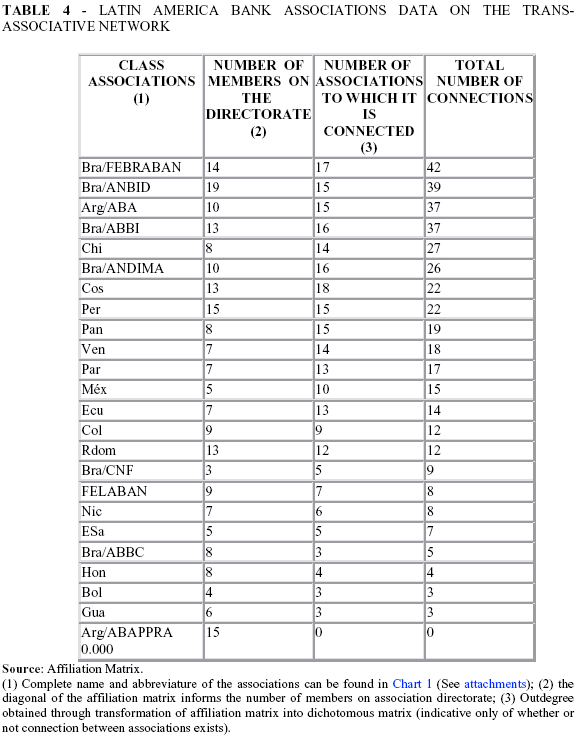
]]> The transformation of the matrix in a dichotomous matrix, that is, one that only indicates whether or not there is a connection between two associations (therefore, not referring to the number of institutions that are a part of this connection) allows us to verify the total number of associations with which each one is connected (outdegree, according to column three of the table). As we can see, some class entities present a high degree of connection, considering the total number of associations (24). For example, the Costa Rican Bank Association (Asociación Bancaria Costarricense - ABC) is linked to another 18, signalling its important role as intermediary between the Central American and other associations on the continent; the Brazilian Bank Federation (Federação Brasileira de Bancos - Febraban), one of the central entities that articulates the interests of the Brazilian finance entrepreneurship, is connected to another 17 associations, 13 of which are located outside the country; the Association of Argentine Banks (Asociación de Bancos de Argentina -ABA), an entity that basically represents the interests of international finance groups that operate in that country, is linked to 15 other associations.
The majority of the 24 associations we have studied are connected to ten or more class entities, which should provide an idea of the density that the network has developed. The only entity that in our analysis does not appear to be connected to the others is the Association of Public and Private Banks of the Argentine Republic (Asociación de Bancos Públicos y Privados de la República Argentina - Abapra), which basically aggregates state-controlled banks and some small private ones.
The data reveal a high level of connection among class entities in Brazil, with the expressive example of two of them, Anbid and Febraban, sharing nine institutions that appear in both directorates. With regard to the diversity of class associations in the Brazilian case, they are largely commanded by a reduced number of national and international conglomerates and financial groups.
In considering the total number of connections, four associations stand out insofar as each one establishes more than 35 ties within the network: Febraban, Anbid and ABBI, in Brazil, and ABA, in Argentina. The greater outdegree among these (42 connections) pertains to the Febraban, which, in addition to dense ties with Brazilian entities and the ABA, presents a diversified web of interconnections, including associations from Paraguay, Chile,Venezuela, Dominican Republic, Bolivia, Ecuador, Costa Rica, Panamá, Peru and Mexico.
The following sociogram (Figure 2) presents all the existing connections between associations, through the common presence in the directorate of one or more finance institutions, providing a general idea of the density of the network.
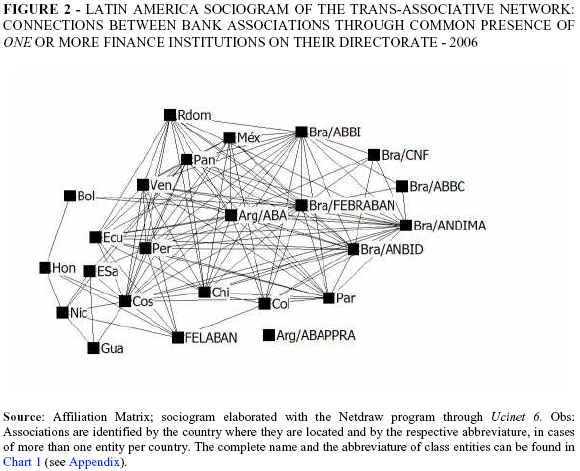
The number of associations that each one is interconnected with is a relevant piece of data, but it is also possible to verify the degree of intensity that the ties involve. In this regard, interpretation would suggest that the greater the number of institutions, groups or financial conglomerates with common participation in two associations, the greater the ties that are established between them (Table 5). In quantitative terms, I have considered low intensity connections as those maintained with only one institution (level 1 intensity), although in qualitative terms this may be significant, if established by one of the groups or conglomerates in the network with greater outdegree (for example, Citibank, Santander, or Bilbao Vizcaya). Following this interpretive vein, I think of the link that is constituted through the presence of at least two groups, conglomerates or financial institutions as significant (level 2 connection intensity) (cf. Table 5 and Figure 3).
]]>
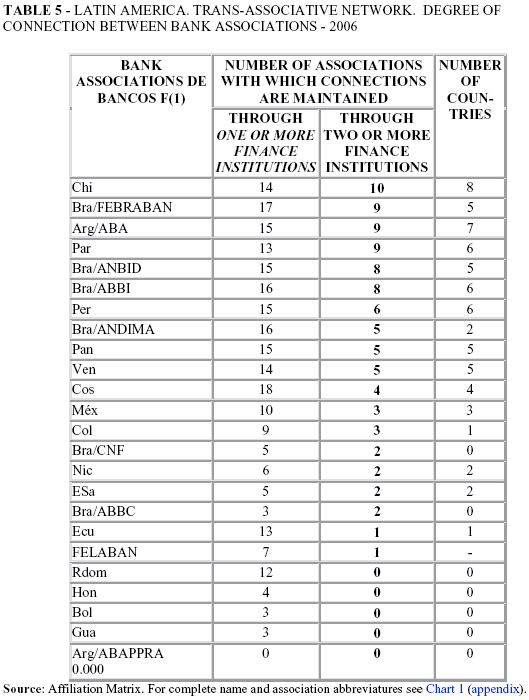
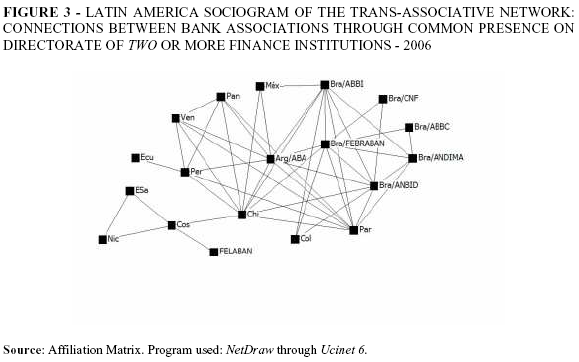
As we can observe, the number of associations that are connected through the presence, within their directorates, of two or more associations is expressive. In many cases, the connections at that particular level of intensity extend over various associations, arriving at more than five, with the Association of Banks and Financial Entities of Chile (Asociación de Bancos y Entidades Financieras de Chile - Abefc), Febraban and ABA as the most expressive examples.
In terms of the Latin American meaning of the network, we should take the diversity of the countries participating in the connected associations into account. Many of them are tied to entities in five or more countries, such as the Abefc (8 countries) and the ABA (7 countries), while others are national in scope, such as the Association of Private Banks of Ecuador (Asociación de Bancos Privados de Ecuador -ABPE) and the ASsociation of Banking and Finance Entities of Colômbia ( Asociación Bancaria y de Entidades Financieras de Colombia – Asobancaria) , that is tied to three associations in Brazil) while others restrict their intensity level 2 connections to entities within their own country, as in the ABBC and CNF cases (Brazil).
]]> Associating the criteria of intensity level connections to that of regional scope (meaning at least two countries) I was able to identify 14 bank associations that can be considered most expressive in the formation of the Latin American network. They are listed as follows (identified by country): Chile, Argentina (ABA), Brazil (Febraban, Anbid, Andima and ABBI), Peru, Paraguay, Panamá, Venezuela, Costa Rica, México, Nicarágua and El Salvador.Next, I proceed with network analysis through a more rigorous criteria of inter-association connection: the existence of at least three common links (level 3 intensity or greater). The results are presented in Table 6 and can be seen Figure 4.
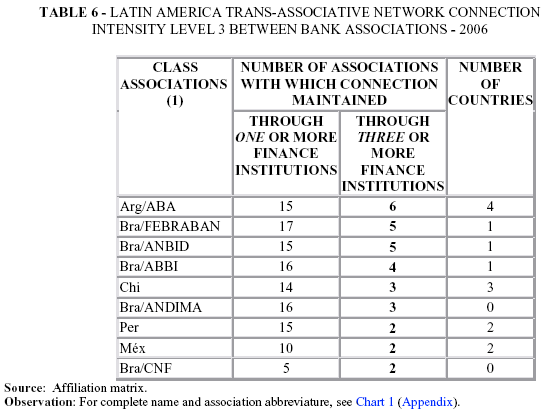
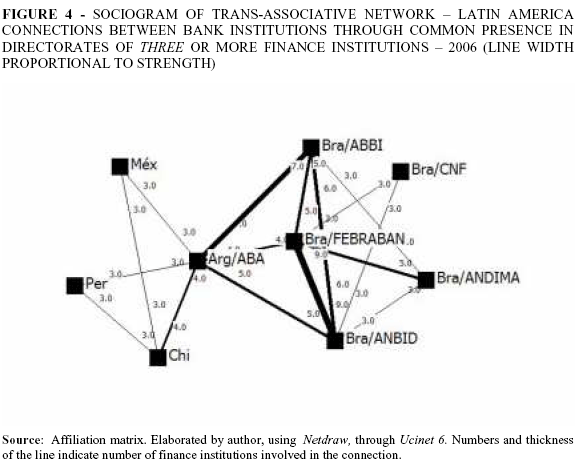
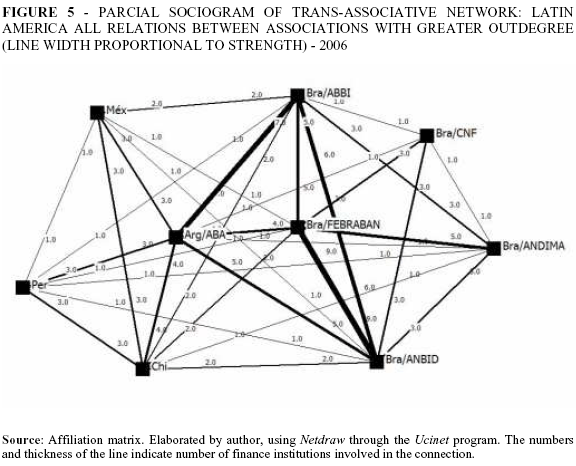
]]> This view of the network presents the most intensely connected associations in quantitative terms, that is, according to the common presence of three to nine groups or financial conglomerates in their directorates. They make up the central nucleus of the network, made up of associations located in Brazil (particularly, the Febraban, ABBI and Anbid) and of associations from Argentina (ABA), Chile, Peru and Mexico. Through this sociogram our visualization has been broadened, with the inclusion of all the connections between these associations of greater outdegree, in other words, including as well those that are established with one or two finance institutions (Figure 5)19. The result is indicative of the intensity of connections within this central nucleus.
VI. FINAL COMMENTS
The analysis that I have carried out indicates the formation of what I have called the trans-associative network of bank associations in Latin America, which is configured through the simultaneous participation of one group, conglomerate or finance institution within these class entities in different countries. In the year 2000, as well as in 2006, this network was sustained particularly due to the presence of some international finance groups or conglomerates and several regional ones, especially within Central America, as we have been able to observe for the latter year.
The data provided through social network analysis have enabled us to observe that, beyond the apparent formal lack of connection between regional (national) class associations or their strict formal ties through the existence of an aggregating federation (in the Felaban case), there is a non-institutionalized or non-formalized connection between these associations, in varying degrees, that is established by the common presence of the same finance group por conglomerate within their directorates. We were able to verify a central nucleus within the network, constituted by the class associations with a greater degree of connections (three or more common links), and that include class entities in Brazil, Argentina, Mexico, Chile and Peru. This is followed by a group of class associations with a lesser degree of interconnection (two common links), which includes eight coutnries (Panama, El Salvador, Nicaragua, and Costa Rica making up a network sub-group, and the South American countries of Venezuela, Colombia, Ecuador and Paraguay). Lastly, we are able to identify a peripheral group of associations that are positioned within the network with only one common link between them.
The scope and significance of this network can be discussed in light of international literature that analyzes social networks, particularly those of a corporate nature20 , as well as those power networks that link political and entrepreneurial bureaucratic elites, following the example provided by Pizarro's (2005a) study of the Spanish political transition.
1. Studies on interlocking directorates within the entrepreneurial universe emphasize networks as an important component of communications systems within the corporate world, as such directorates offer high potential for information exchange. In our case, one group, conglomerate or financial institution that acts simultaneously in several associations in different countries increases its level of information on the dynamics of relationships and the organization of class interests in each country and the relationship that they establish with the respective governments and other entrepreneurial sectors, while at the same stimulating the exchange of information among the associations in which they participate. From this perspective, I consider there to be major potential for the exchange of information within the structure of class representation within the finance sector in Latin America, which would provide a broader vantage point to aid in analyses of corporate and political action. International financial groups and a few local ones play a central role in this process, as the data presented above show.
]]> 2. I believe that the coordinated action of these groups in the definition of common strategies for banking associations in Latin America is possible. At the same time, the trans-associative network creates the possibility for articulating positions and actions of several associations, even in the absence of formal relations between them. Through the connections that have been established, associations are able to mobilize at the continental level around finance sector interests, even within specific national circumstances. Furthermore, they may act in a coordinated fashion with other organizations of an ideological or political nature that are under the direct or indirect influence of the groups, conglomerates or financial institutions within the network that possess greater outdegree. For the analysis of the structure and dynamics of finance sector class associations and their possible role in discussions and implementation of financial reform and other economic policies in Latin America, it seems to be necessary to take the trans-associative network that we have discussed here into consideration. To what extent this potential for articulation and coordination is made effective and associations mobilize according to the tactical and strategic interests of groups and conglomerates of greater outdegree are matters for further exploration, demanding specific research.3. The possibility of establishing networks of this type is one element that is both indicative of and reinforces the power assymetries that exist within the finance system, benefitting a small number of groups and conglomerates. Some of them are regional but most significant are those with headquarters in the United States and Europe. The process of finance centralization currently underway does not seem to be promoting much change in this regard, to the extent that if some international institutions have lost ground, this has been compensated by the expansion and consolidation of others; furthermore, there are few Latin American finance groups or conglomerates that have managed a significant expansion of their operations on the continent, although special attention should be given to those that have (Banco Itaú is a case in point). Although international finance groups or conglomerates have occupied a key position in the trans-associative network, Latin American financial institutions do not seem to get anywhere near occupying a similar position within the structure of class representation in this sector in dominant capitalist countries.
4. The data that we have put together further suggest that the space for the class representation of the sector in Latin America has to a large extent been transnationalized and within it, international groups enjoy an additional route toward the internalization of their interests, through regional (national) class associations – interests that thus gain representativity and legitimacy in their domestic negotiations with government and other social and entrepreneurial sectors.
5. Although it may not be possible, for the reasons stated above, to fully compare data from 2006 research with that which we carried out in the year 2000, it is important to note that the fact that the trans-associative network, in the terms in which it has been defined, appears in both periods, and therefore shows some stability. Furthermore, although we have verified changes in the position held by some groups or conglomerates, those that have greater centrality in their connection with bank associations are the same during both periods (Citibank, Santander and Bilbao Vizcaya). The verification of the presence of three Central American conglomerates in the year 2006 is important, but I do not have elements that can be safely compared with the research from the year 2000, since in that year it was not possible to include all the countries of the region nor more detailed information on finance institutions.
I am aware that it is possible to broaden our analysis and further explore the possibilities offered by the methodology that I have employed, included visualization resources, and especially the qualitative dimensions of the historic context within which the trans-associative network is incorporated. From this vantage point, this paper is part of a larger project that aims at the use of these methodological procedures for the analysis of the structure and dynamics of class representation for dominant social sectors, in this case represented by entrepreneurs and banking and finance bourgeiosie in Latin America, connected to the other analytical dimensions that were mentioned at the beginning of this text paper.
Finally, I would like to emphasize that the analysis that I have carried out here can be considered a point of departure for the comprehension of the dynamics and structure of class representation for entrepreneurs and the bank and finance bourgeiosie in Latin America. These associations make up part of a relatively dense network of connections, a large part of which unfold through the presence of just a few international finance groups, and their action must be analyzed considering such interconnections and their implications. Nonetheless, I believe it is fundamental to consider the wider context in which an entity acts, at the continental and regional level. The formation of a network is linked to the processes of financial opening and de-regulation that, at distinct paces and to different degrees were adopted by the region's governments, within the context of the neoliberal policies that were carried out throughout the 1980s and 1990s. The trans-associative network structures class representation transnationally21, its key positions held by just a few financial groups or conglomerates. Historical elements that also include the roles that are played by other social classes and forces are fundamental for a greater understanding of the question.
REFERENCES
ALCORTA, L. 1992. El nuevo capital financie-ro: grupos financieros y ganancias sistémicas en el Perú. Lima: Fundación Friedrich Ebert.
BAENA, M.; GARRIDO, L. & PIZARRO, N. 1984. La elite española y la presencia en ella de los burócratas. Estudios, Madrid, n. 200, p.73-131.
BASUALDO, E. 2002. Concentración y centralización del capital en la Argentina durante la década del noventa. Quilmas: Universidad de Quilmes.
BORGATTI, S. P.; EVERETT, M. G. & FREEMAN, L. C. 2002. Ucinet for Windows: Software for Social Network Analysis. Harvard: Analytic Technologies.
CARDENAS H. J. 2006. La visualización de los interlocks globales. In : RODRÍGUEZ, J. A. (ed.). Sociología para el futuro. Barcelona: Icaria.
CARDENAS, J.; OLTRA, C. & RODRIGUEZ, J. A. 2002. El poder económico nacional y transnacional en Europa. Barcelona : Programa Sectorial de Promoción General de Conocimiento, 2002. Available at: http://www.dste.ua.es/nagar/textos/ El%20poder%20econ%F3mico....pdf. Acessed: April 14.2007.
CHESNAIS, F. 2003. A "nova economia": uma conjuntura própria à potência econômica estadunidense. In: _____. (org.). Uma nova fase do capitalismo? São Paulo: Xamã.
COMIN, A.; OLIVEIRA, F.; SARAIVA, F. & LINO, H. 1994. Crise e concentração: quem é quem na indústria de São Paulo. Novos Estudos Cebrap, São Paulo, n. 39, p. 149-171, jul.
COSTA, F. N. 2002. Origem do capital bancário no Brasil: o caso RUBI. Texto para discussão n. 106. Campinas: Instituto de Economia.
DIAS, L. C. D. 2005. Os sentidos das redes. In: DIAS, L. C. D. & SILVEIRA, R. L. L. (orgs.). Redes, sociedades e territórios. Santa Cruz do Sul: UNISC.
DIAS, L. C. D. & SILVEIRA, R. L. L. (orgs.). 2005. Redes, sociedades e territórios. Santa Cruz do Sul: UNISC.
EMYRBAYER, M. & GOODWIN, J. 1994. Network Analysis, Culture and the Problem of Agency. American Journal of Sociology, Chicago, v. 99, n. 6, p. 1411-1454.
EMYRBAYER, M. 1997. Manifesto for a Relational Sociology. American Journal of Sociology, Chicago, v. 103, n. 2, 281-317, Sept. Available at: http://www.chssp. columbia.edu/ events/documents/Emirbayer.pdf. Acessed on April 14, 2007.
FERREIRA, A. C. 2005. Os donos da dívida. Um enfoque sociopolítico da dívida pública interna durante o governo FHC. Florianópolis. Dissertação (Mestrado em Sociologia Política). Universidade Federal de Santa Catarina.
FREEMAN, L. 2002. The Development of Social Network Analysis: A Study in Sociology of Science. North Charleston: Booksurge.
GIL-MENDIETA, J.; CASTRO, J. & RUIZ, A. 2001. Sistema experto para el análisis de redes sociales grandes. Redes, v. 1, n. 1, abr. Available at:http://revista-redes. rediris.es/webredes/red_tematica/ Acessed: April 14.2005.
GONÇALVES, R. 1991. Grupos econômicos: uma análise conceitual e teórica. Revista Brasileira de Economia, Rio de Janeiro, v. 4, n. 4, p. 491-518, Oct-Dec.
GRANOVETTER, M. 1994. Business Groups. In: SMELSER, N. J. & SWEDBERG, R. (eds.). The Handbook of Economic Sociology. Princeton : Princeton University.
GRISCI, C. L. I. 2002. Tempos modernos, tempos mutantes: produção de subjetividade na reestruturação do trabalho bancário. Socius Working Papers, Lisboa, n. 3, p. 1-19.
GROS, D. B. 2003a. Organizações empresariais e ação política no Brasil a partir dos anos 80. Civitas, Porto Alegre, v. 3, n. 2, p. 273-300, July-Dec.
_____ . 2003b. Institutos Liberais e o neolibe-ralismo no Brasil da Nova República. Teses FEE n. 6. Porto Alegre: Fundação de Economia e Estatística Siegfried Emanuel Heuser.
GRÜN, R. 2003. A promessa da "inserção profissional instigante" da sociedade em rede : a imposição de sentido e a sua sociologia. Dados, Rio de Janeiro, v. 46, n. 1, p. 5-38. Available at: http://www.scielo.br/pdf/ dados/v46n1/a01v46n1.pdf Acessed on April 14.2007.
_____ . 2004. A evolução recente do espaço financeiro no Brasil e alguns reflexos na cena política. Dados, Rio de Janeiro, v. 47, n. 1, p. 5-47.
HANNEMAN, R. A. 2001. Introduction to Social Network Methods. On-line textbook, Sociology n. 157. Riverside: University of California. Available at: http:// revista-redes.rediris.es/webredes/text.htm. Acessed on April 14, 2007.
HANNEMAN, R. A. & RIDDLE, M. 2005. Introduction to Social Network Methods. Riverside: University of California. Available at: http://faculty.ucr.edu/~ hanneman/. Acessed on Nov 10, 2005.
JINKINGS, N. 2002. Trabalho e resistência na "fonte misteriosa": os bancários no mundo da eletrônica e do dinheiro. Campinas: Unicamp.
JUNCKES, I. J. 2004. O sindicalismo novo dos bancários na reestruturação financeira dos anos noventa no Brasil. Florianópolis. Tese (Doutorado em Sociologia Política). Universidade Federal de Santa Catarina.
LARANGEIRA, S. & FERREIRA, V. 2000. Excluídos e beneficiários dos processos de reestruturação: estudo comparativo da regulação do emprego no sector bancário em Portugal e no Brasil. Revista Crítica de Ciências Sociais, Lisboa, n. 57-58, p. 53- 85, June – Nov.
LAVALLE, A. G.; CASTELLO, G. & BICHIR, R. M. 2006. Os bastidores da sociedade civil. Protagonismos, redes e afinidades no seio das organizações civis. São Paulo: Centro Brasileiro de Análise e Planejamento.
LISTA REDES. 2001. Glosario de análisis de redes sociales. Sunbelt XXI, Budapest, Apr.25-28. Available at: http://revista-redes.rediris.es/glosario.pdf. Acessed on: 14.abr.2007.
LOZARES COLINA, C. 1996. La teoria de redes sociales. Papers n. 48, 1996. Disponível em: http://seneca.uab.es/antropologia/ars/ paperscarlos.rtf. Acesso em: 14.abr.2007.
_____ . 2005. Bases metodológicas para el Análisis de Redes Sociales, ARS. Empiria, n. 10, p. 9-35, jul.-dic. Disponível em: http://dialnet.unirioja.es/ servlet/ fichero_ articulo?articulo= 1374915&orden=72939. Acesso em: 14.abr.2007.
MARQUES, E. C. 2000. Estado e redes sociais: permeabilidade e coesão nas políticas urbanas no Rio de Janeiro. Rio de Janeiro: Revan.
_____ . 2003. Redes sociais, instituições e atores políticos no governo da cidade de São Paulo. São Paulo: Annablume, 2003.
_____ . 2006. Redes sociais e poder no Estado brasileiro a partir das políticas urbanas. Revista Brasileira de Ciências Sociais, São Paulo, v.21, n. 60, p. 15-41, fev. Disponível em: http://www.scielo.br/pdf/ rbcsoc/v21n60/29759.pdf. Acesso em: 14.abr.2007.
MATO, D. 2005. Redes de "think tanks", fundaciones, empresarios, dirigentes sociales, economistas, periodistas y otros profisionales en la promoción de ideas (neo)liberales a escala mundial. In : _____. (coord). Políticas de economia, ambiente y sociedad en tiempos de globalización. Caracas: Universidad Central de Venezuela.
MINELLA, A. C. 2003. Globalização financeira e as associações de bancos na América Latina. Civitas, Porto Alegre, v. 3, n. 2, p. 245-272, jul.-dez.
_____ . 2005a. Reestruturação do sistema financeiro brasileiro e a representação de classe do empresariado – 1994-2004. In: GROS, D.; DELGADO, I. G.; CAPELLIN, P. & DULCI, O. (orgs.). Empresas e grupos empresariais: atores sociais em transformação. Juiz de Fo-ra : UFJF.
_____ . 2005b. Grupos financeiros e associações de classe do sistema financeiro. In: MENDONÇA, S. R. (org.). O Estado brasileiro: agências e agentes. Niterói: UFF.
_____ . 2007. Maiores bancos privados no Brasil: perfil econômico e sociopolítico. Sociologias, Porto Alegre, v. 18, p. 100-125.
MINELLA, A. C. & FERREIRA, A. C. 2006. Bancos no Brasil: muito mais que operações de crédito (poucas) no final do século XX. Texto para discussão. Florianópolis: Programa de Pós-Graduação em Sociologia Política da Universidade Federal de Santa Catarina.
MINTZ, B. & SCHWARTZ, M. 1985. The Power Structure of American Business. Chicago: University of Chicago.
MIZRUCHI, M. S. & STEARNS, L. B. 2002. Social Networks, CEO Background, and Corporate Financing : A Dyadic Analysis of Similarity of Borrowing by Large U. S. Firms, 1973-1993. Ann Arbor: Michigan University. Available at: http://www-personal.umich.edu/~mizruchi/dyad.pdf. Acessed: 14.abr.2007.
MOLINA, J. L. 2001. El análisis de redes sociales. Una introducción. Barcelona: Bellaterra.
_____ . 2004. La ciencia de las redes. Apuntes de Ciencia y Tecnologia, Bellaterra, n. 11, p. 36-42, jun. Available: http://seneca.uab.es/ antropologia/jlm/public _archivos/ciencia.pdf. Acessed: 15.abr.2007.
NAZARENO, L. R. 2005. Redes sociais e coalizão de governo em Curitiba (1985-2004). São Paulo. Dissertação (Mestrado em Ciência Política). Universidade de São Paulo.
OLIVEIRA, F. 2006. A dominação globalizada: estrutura e dinâmica da dominação burguesa no Brasil. In : BASUALDO, E. & ARCEO, E. (orgs.). Neoliberalismo y sectores dominantes. Tendencias globales y experiencias nacionales. Buenos Aires: Consejo Latinoamericano de Ciencias Sociales.
ORTIZ, R. 1994. Mundialização e cultura. 2ª ed. São Paulo: Brasiliense.
PIZARRO, N. 1998. Tratado de metodología de las Ciencias Sociales. Madrid: Siglo XXI.
_____ . 2005a. Solidaridad estructural y cohesión en las elites del poder en la transición españo-la: Estado y economía. Ponencia presentada en el Cuarto Seminario Internacional sobre Gobierno y Políticas Públicas, realizada en Culiacán (México), en 30 de junio. Available at: http://www.sinaloa.gob.mx/NR/ rdonlyres/ 4D84B938-D240-4F3E-B225-63E0B82120F9/ 0/NarcisoPizarro.pdf. Acessed: April 14.2007.
_____ . 2005b. Un nuevo enfoque sobre la equivalencia estructural : lugares y redes de lugares como herramientas para la teoría sociológica. REDES, v. 5, n. 2, ene-feb. Disponível em: http://revista-redes. rediris.es/pdf-vol5/vol5_2.pdf. Acessed: Oct 11 2005.
PORTUGAL JÚNIOR, J. G. (org.). 1994. Grupos econômicos: expressão institucional da unidade empresarial contemporânea. São Paulo: Fundação do Desenvolvimento Administrativo.
RODRIGUES, L. 2004. Metáforas do Brasil: demissões voluntárias, crise e rupturas no Banco do Brasil. São Paulo: Annablume.
RODRIGUEZ, J. A. 2002. Revisiting the Power: Changes in the Spanish Structure of Economic Power (1991-2000). Paper prepared for SUNBELT XXII International Social Network Conference. New Orleans, February 13-17. Available at: http://www.dste.ua.es/nagar/textos/revpowentero.PDF. Acessed on 14.abr.2007.
RODRIGUEZ, J. A.; CARDENAS, J. & OLTRA, C. 2006. Redes de poder económico en Europa. Revista Sistema, Madrid, n. 194, p. 3-43, Sept. Separata.
SANTOS, M. J. 2002. Processos de modernização empresarial : o papel das redes locais. In: SCHERER-WARREN, I. & FERREIRA, J. M. C. (orgs.). Transformações sociais e dilemas da globalização: um diálogo Brasil/Portugal. São Paulo: Cortez.
SCHERER-WARREN, I. 2005a. Redes sociais: trajetórias e fronteiras. In: DIAS, L. C. & Silveira, R. L. L. (orgs.). Redes, sociedades e territórios. Santa Cruz do Sul: UNISC.
_____ . 2005b. Redes de movimentos sociais. 3ª ed. São Paulo: Loyola.
SCHVARZER, J. 1995. Grandes grupos económicos en Argentina. Formas de propiedad y lógicas de expansión. Revista Mexicana de Sociología, Ciudad de México, v. 57, n. 4, p. 191-210, Oct –Dec.
SCOTT, J. 1988. Social Network Analysis and Intercorporate Relations. Hitotsubashi Journal of Commerce and Management, n. 23, p. 53-68.
_____ . 1997. Corporate Business and Capitalist Classes. New York: Oxford University.
_____ . 2005. Social Network Analysis. A Handbook. 2nd ed. London: Sage.
STOLOVICH, L. 1995. Los grupos económicos de Argentina, Brasil y Uruguay. Revista Mexicana de Sociología, Ciudad de México, v. 57, n. 4, p. 173-189, Oct-Dec.
SWEDBERG, R. 1990. International Financial Networks and Institutions. Current Sociology, London, v. 38, n. 2-3, p. 259-325.
THOMPSON, G. F. 2003. Between Markets and Hierarchy. The Logic and Limits of Network Forms of Organization. New York: Oxford University.
WASSERMAN, S. & FAUST, K. 1994. Social Network Analysis: Methods and Applications. Cambridge: Cambridge University.
WELLMAN, B. 1988. Structural Analysis: From Method and Metaphor to Theory and Substance. In: WELLMAN, B. & BERKOWITZ, S. D. (eds.). Social Structure: A Network Approach. Cambridge: Cambridge University. Available at: http://www.chass.utoronto.ca/~wellman/vita/index.html. Acessed on: April 14.2007.
_____ . 2000. El análisis estructural: del método y la metáfora a la teoría y la sustancia. Política y Sociedad, Madrid, n. 33, p. 11-40, ene-mayo. Available at: http ://www.ucm.es/info/pecar/Revis.htm. Acessed on : April 14.2007.
OTHER SOURCES
Moneda El Periódico Financiero, 2006, edición especial ranking de grupos financieros, n. 83, 27. nov-1.dic. Available at: http://moneda.terra.com.ni/moneda/ noticias/mnd28800.htm. Acessed on: Jan 4.2007.
RAE – Revista de Administração de Empresas. 2006. São Paulo, v. 46, n. 3, jul-set. Fórum Redes sociais e interorganizacionais.
Received on March 3, 2007.
Approved for publication on July 1, 2007.
Ary Cesar Minella (minella@matrix.com.br) is Doctor in Latin American Studies (Universidad Nacional Autónoma de México -UNAM) and Professor of the Department of Sociology and Political Science, Universidade Federal de Santa Catarina (UFSC).
APPENDIXES – CLASS REPRESENTATION OF FINANCIAL ENTREPREURS IN LATIN AMERICA: THE TRANS-ASSOCIATIVE NETWORK DURING THE YEAR 2006
]]>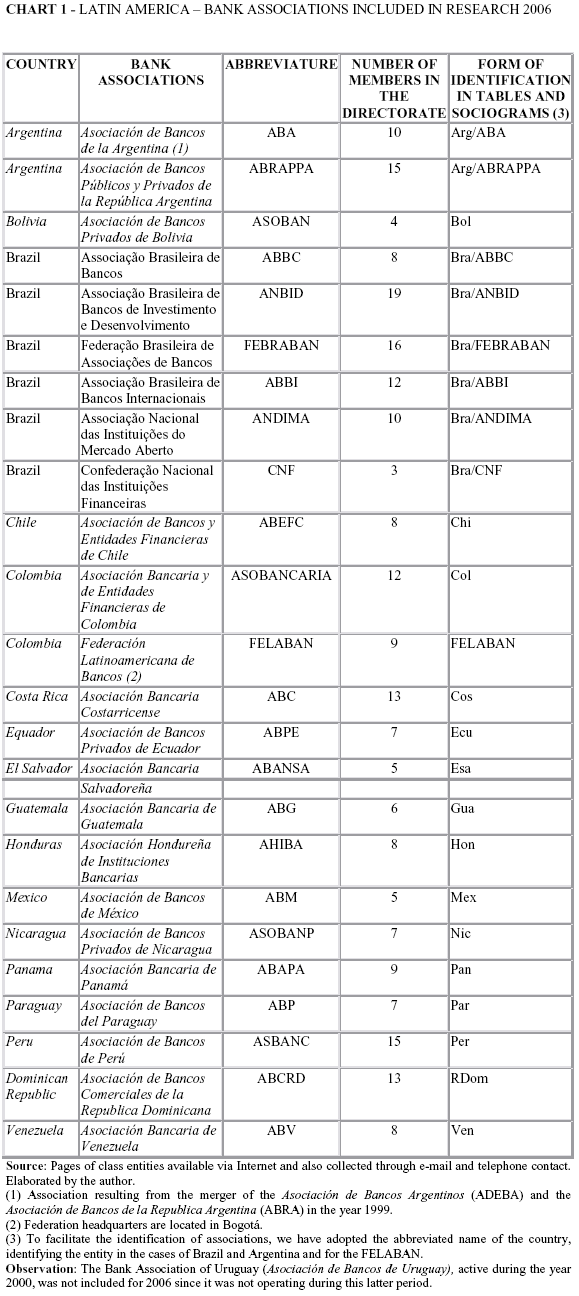
CHART 1 - click here to enlarge
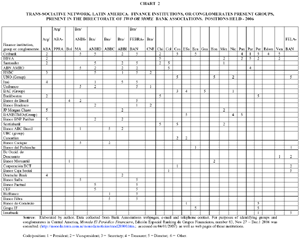
CHART 2 - click here to enlarge
1 This issue was the central object of my post-doctoral research, carried out at the Center for Studies on Citizenship Rights (Centro de Estudos dos Direitos da Cidadania -Cenedic), of the Sociology Department at the University of São Paulo, where I worked under the supervision of Francisco de Oliveira, during the May 2006-April 2007 period. I am very grateful for the warm welcome I received there, the stimulating environment for discussion and debate and the research infra-structure that I was provided. The more theoretical and conceptual discussion on the topic will be presented in the report that is will be discussed at the Center. My study on methodology took me to the Universidad Autónoma de Barcelona at the beginning of 2007, where I was received and engaged in dialog by José Luiz Molina and other members of the research group that he coordinates. I am immensely grateful to all of them. I was also benefitted by the opportune technical assistance on the use of the Ucinet program provided by Josep A. Rodriguez and Julián Cardenas, at the Universidad de Barcelona. My special recognition and thanks to Narciso Pizarro, from the Universidad Complutense de Madrid, for my reception and for the decisive dialogs we engaged in during my brief stay in Madrid, and in which Reyes Herrero and Delio Lucena Piquero also participated. This research was carried out through support from the National Council for Scientific and Technological Development (Conselho Nacional de Desenvolvimento Científico e Tecnológico -CNPq).
2 The number of directorships that will be considered in my analysis is slightly less, since it considers as only one participation the cases in which the same group or conglomerate occupied more than one position within the same association. This is the case of the Grupo AVAL, that had 4 top level positions within the Asociación Bancaria y de Entidades Financieras de Colombia (through the following institutions: Avillas, Banco de Bogotá, Banco de Occidente and Banco Popular), the Brazilian group Bradesco, holding two directorate positions in the Brazilian Federation of Banks, (Febraban) and the Deutsche Bank, in a similar situation within the Brazilian Association of International Banks (Associação Brasileira de Bancos Internacionais - ABBI).
3 For a more extensive analysis of this process of financial restructuring, dealing with the characteristics mentioned here for the Brazilian case, see Minella (2005a).
4 This phenomenon has received different names: "economic group" (Latin America); "Zaibatsu" and later, "keiretsu" (Japan); "Chaebol" (South Korea); "Twenty-two families" (Paquistan); "Indian Business House" (India); "Business Group" (Inglaterra) (GRANOVETTER, 1994, p. 455).
5 An interesting analysis on the re-configuration of the Brazilian financial space and its relationship with the political scenario, through a Sociology of Finances, is developed by Grün (2004).
6 In Brazil, six of the tem largest private banks (2006 classification) were or are connected in some way to the Liberal Institutes. An interesting analysis on this theme as it pertains to the Latin American universe can be found in Mato (2005).
7 In Latin América, the major formal expression of bank representation is the Federación Latinoamericana de Bancos (Felaban), with headquarters in Bogotá (Colômbia), bringing together the majority of the bank associations on the continent. In Brazil, in addition to the associations, there are also bank syndicates, responsible for establishing negotiations with bank workers; their most expressive institution is the National Federation of Banks (Federação Nacional dos Bancos-Fenaban) which in practice is fused with Brazilian Federation of Banks (Federação Brasileira de Bancos -Febraban), which aggregates the associations.
8 Particularly significant are the works by Marques (2000; 2003; 2006); cf. Grün (2003), Dias and Silveira (2005), Lavalle, Castello e Bichir (2005), Nazareno (2005), Scherer-Warren (2005) and RAE – Revista de Administração de Empresas (2006). ]]>
9 Several authors have made a significant contribution to may trajectory toward social network analysis, particularly as it relates to the political and entrepreneurial world. I could mention, for example, Mintz e Schuartz (1985), Scott (1988; 1997; 2005), Swedberg (1990) and more recently, contact with the works of Emirbayer (1997), Wellman (2000), Molina (2001), Lozares Colina (2005), Rodríguez (2006), Cardenas (2006) e especialmente Pizarro (1998; 2005a; 2005b).
10 More intense data collection was carried out in October, November and December of 2006 and during the first week of January of 2007. For the purposes of the present analysis, the financial institution is more important than the person who represents it on the association's board of directors.
11 For identification of Latin American groups and conglomerates, I made particular use of the publication Moneda – El Periódico Financiero (2006).
12 In a very summarized way, and according to the Glossary of Social Network Analysis (Glosario de análisis de redes sociales, LISTA REDES, 2001), matrix names and characteristics are as follows: the matrix of incidence is a "binary matrix resulting from a matrix of actors X actors that shows actors in the lines and in relations to the columns, indicating the presence or absence of a relationship for each actor; a matrix in which the series of actors is the same in the lines and the columns is called mode matrix 1; in the case wherein series of actors in the lines and columns is different, we call it mode matrix 2". An affiliation matrix, is a special type of matrix that will be explained in greater detail further ahead.
13 In technical terms, a bipartite matrix is generated from the base matrix, which is a mode 1 matrix, which in turn is dichotomized, that is, transformed in a matrix that only indicates presence or absence of a financial institution, group or conglomerate within the directorate of bank associations. From this matrix, the affiliation matrix is generated.
14 According to Wasserman and Faust (1994, p. 291), this type of network is also referred to as membership network or hypernetwork.
15 From the matrix that contains the data on the whole network, a specific matrix for the 10 selected groups was put together in which the centrality of finance institutions and associations (outdegree e indegree, respectively) is observed.
16 As examples of the first case, we can mention the number of members on the directorate of associations in Mexico (5), El Salvador (5) and Bolívia (4). In the second, entities with headquarters in Brazil such as the Anbid (19), Febraban (14) and ABBI (13); in Peru (15), Costa Rica and the Dominican Republic (13 members each).
17 In addition to bank representation (Febraban), the CNF aggregates associations that respond for the interests of investment banking (Anbid), open market firms (Andima), brokers and distributors and financing agencies.
18 The procedure adopted transforms the original matrix in mode matrix 1 (same actors in lines and columns – in this case, bank associations) and identifies in the crossing of lines and columns the number of finance institutions that connect them. ]]>
19 Through this sociogram it is also possible to visualize the existence of "cliques", that is, subgroups that are made up of associations in which all parties are connected with one another. In this text I am not able to explore the analytic possibilities provided by the existence of cliques within the network.
20 Inspired primarily in Mintz' and Schwartz' (1985) observations on corporate networks.
21 This discussion can be deepened according to Oliveira's (2006) insights.