Imitação da ordem: as pesquisas sobre televisão no Brasil
Alexandre Bergamo
Translated by Renato Rezende
Translation from Tempo Social, São Paulo, v.18, n.1, p. 303-328, June 2006.
Studies of television in Brazil reveal a significant change over time in their criteria of analysis and legitimation. Television has shifted to being studied and represented in terms of independent genres – soaps, news programs and live audience shows – distinctions that were practically non-existent in the first research studies conducted in Brazil. This separation into genres indicates that the change observed in these studies takes a specific direction. They not only start to legitimize television; through their analyses, they also reproduce in the same terms, the power relations observed within the field of television as a whole.
Keywords: Television; Legitimation; Power relations; Language.
RESUMO
As pesquisas sobre televisão no Brasil apresentam, ao longo do tempo, uma mudança significativa nos seus critérios de análise e de legitimação. A televisão passou a ser estudada e representada como se fosse constituída por gêneros independentes – a telenovela, o telejornal e os programas de auditório –, distinção praticamente inexistente nas primeiras pesquisas realizadas no Brasil. Essa divisão em gêneros indica que a mudança observada nas pesquisas seguiu uma direção específica. Elas passaram não só a legitimar a televisão, mas também a reproduzir, nos mesmos termos, por meio de suas análises, as relações de poder observadas no interior do campo da televisão.
Palavras-chave: Televisão; Legitimação; Relações de poder; Linguagem.
Other works have indicated the growing interest in research on television in Brazil1. Part of this interest lies in the economic value acquired by this medium, and especially by the fact that its main product, the soap opera, understood as a creative genre having an eminently Brazilian quality, shares a considerable portion of the Brazilian export market2. Another reason for this interest also lies in the questioning of probable roles and effects of soap operas on society, since they mobilize a large portion of the population, according to audience studies. However, despite the growing interest in the area of research, there is little that can be affirmed about the relationships established by various social groups with television. Looking at the bigger picture, the affirmations and studies originated from them have become increasingly fragmented. At least this is what the reference bibliography on the theme demonstrates.
]]> This is exactly the point that interests us here. Television became a relevant focus of research in Brazil in the early 1970's, and since then significant changes have occurred in the approach of the theme. One of these changes is the fragmentation indicated in the bibliography, part of which lies in the fact that television has come to be approached, represented and analyzed as if it were composed of independent genres3 – soap operas, news programs, and live audience shows – a practically nonexistent distinction in the first studies conducted in Brazil. The change in the way the theme is approached, as independent and distinct genres, indicates alterations in research validity criteria, as well as in research configuration. While studies are representative of the internal disputes in the field and universities in general, they have come to possess a validity previously unattained: to display and renovate instruments of validation and criteria of value, although present in the first works, they were strangers to the field of research. In some cases, discourses previously considered important references to analysis have lost their validity. In others, maintaining validation represents the raising of new barriers along with the limits that separate research groups and their studies. In any case, fragmentation of the studies, far from indicating randomness, shows that they follow a specific direction, outlined by very different validation criteria than previously expressed in studies. The following discussion will focus on the actual television as an object. Therefore, studies based on reception will not be considered. The analyses on television may be divided into two large blocks of interest or "objects" of interest: the question of language and the forms of thought it can provoke; including case studies, which basically consist of some analyses on the news programs, live audience shows and soap operas. To mark the changes that occur in the approach to the theme, we will make a comparison of the three pioneer studies on television in Brazil, dating from the early 1970's, and the most recent studies published in the 1990's.
Language and Thought
The spectator loses, especially in imagination, since the image is a contrived reality – not necessarily objective, but concrete – which is given to consumption, with no great appeal to the intellect. […] by being replete with meaning, the images emerge much more than the simple verbal flow, directly reaching the part of the psyche least guarded by the intellect. In front of the imposing simulation of reality on TV, the spectator abandons himself, vulnerable. […] In the iconoshpere (universe of images), sensation tends to predominate over consciousness appealing to all the senses, but weakening them (Sodré, 1972, p. 59-60).
[...] little effort is needed to understand how [television's] massive presence in the life of a child, continually being presented with images that satisfy his wants (and so hindering the child from experiencing unsatisfied wants), and although it does not prohibit thought, it becomes unnecessary. […] television does not allow a child to symbolize its discourse (Kehl, 1991, p. 70).
Although separated by nearly twenty years, these formulations in respect to the impact of television present certain continuity, at least in regard to their main conclusion: television interferes negatively on the development of consciousness and language. Both interpretations have the same origin, the notion of cultural industry, as articulated by Horkheimer and Adorno (1982), and the notion of the TV ghost figure, a concept elaborated by Günther Anders (1973). It is not here addressed whether these formulations should or should not present greater divergences over time, or whether such an interpretation of the impacts of television is true. The point is the apparent fact that if such an interpretation persists, it is because its validity still remains current. But what validity is this and what conditions keep it current?
The diverse interpretations elaborated on television are, in Bourdieu's terms (1998), disputes over the power to impose a view of the social world by monopolizing a legitimate form of making see and believe in social divisions. So such interpretations chiefly derive from the anxiety of submitting routine elements to this valid form of making see and from a random cut making the desired view become possible and the social division understood through that view. But what specifically are the social divisions employed by the two examples cited above, and what world view intends to impose itself as valid?
The universe described in both citations is presented, both in relation to space and to time, as extremely restricted: it is limited to the moment that someone is in front of the television and, therefore, a space no bigger than a living room. Cultural, social, political, and economic differences are ignored. Other aspects are also ignored: which possible links people have with television, the degree of importance that television assumes in the lives of people (probably differing for each individual), and the cultural or political character that television can have within a wide range of contexts. Consequently, there is a rather marked, deliberate indifference to the differences.
Nonetheless, although this universe is restricted, the conclusion regarding negative impacts of television transcends it and is presented as valid in a range of much greater events and contexts in the lives of people, since the supposed effects of television and the social destiny of its spectators are presented as coincidental. This is because such formulations express a cultural intention or a form of making one see and believe in a social division assuming the character of absolute truth, demanding cultural, social, and political submission. The universe described does not permit cultural, social, political, and economic differences because the only relevance they can have is in the expected submission to the cultural posture adopted before television. The analysis deprives television of any social meaning, other than what is presumed as coincidence between the effects of television and social destiny.
It is precisely herein that the validity of such formulations lies. In adopting a manner of thinking which is also an act of social division, establishing a cultural distance in relation to television and representing nothing more than a social distance before it and everything that can be identified by it, since these formulations institute an act of cultural authority assuming the form of an act of knowledge. The social distance established by this point of view expresses remoteness and a division of social destinies, among those which supposedly are and are not the effect of language on television.
]]> The actual manner in which the discourse is structured enables this social division. On one hand, the language used is structured so that a connection between the individual and a social experience understood as cultural, with all the associated baggage, can be made: conscience, reflection, taste, etc. And, on the other hand, it is also structured to establish a connection among the remaining individuals, who are the effect of television and a social experience deprived of conscious, reflection, and taste. The fundamental role of the discourse is to enable and prove these connections.This social division becomes possible, partly because such interpretations remove the political figure from his discourse. Since the described universe does not permit cultural, social, political, and economic differences, the discourse is also supposedly presented without political agenda, leaving only an apparently neutral and objective agenda – the greater the search for support of psychoanalysis, the more neutral it is.
In this sense, there is an important difference between the two formulations cited. The first, by Sodré (1972), which is closer to an apocalyptic view of the communication of the masses, is also the most criticized as time passes: being considered a simplistic classification based much more on a distinction of place than on the form of language5; treating reality as a means of fetish-categories consoles the reader by causing him to feel as though he is part of an elected community above average banality, which represent the main obstacle to an analysis of such phenomena6; treating reality so as to disregard the possibility of interference from the lower classes, treating them as an inert mass7; ignoring the differences of possible interpretations of the televised content itself8. The second, by Kehl (1991)9, although it resembles the apocalyptic view, it is supported by a psychoanalysis-based theory of knowledge, capable of conferring greater validity to this posture, since it substitutes criticism of the place with criticism of the form, as well as exchanging the fetish-category with an analysis of the so-called universal symbolic10.
It is fitting here to point out that the adoption of criteria from psychoanalysis was gradual and can also be observed in works following Sodré (1977;1990). The fact is that a discourse regarding a communication medium solely based on apocalyptic criteria has increasingly lost validity. However, the discourse capable of making see and believe in a division between social destinies, supposedly operated through the language of television, remains current. Since such formulations ignore cultural, social, political, and economic differences, their validity is not in their explicative value, but in their distinctive character of division between social destinies.
Live Audience Shows
In the case of studies on live audience shows, two paths were followed, in which validity criteria may be identified from the first works undertaken as the object of analysis:
]]> Two significantly opposite postures are noted. On one hand, in Sodré's analysis (1972), the main characteristic lies in the fact that its aesthetic intension expresses an absolute demand of cultural truth. The participation of groups who are not part of the cultural elite is viewed as something that should be condemned and rejected, and the aesthetic of "bad taste" lacks any social value. It does not intend to be an aesthetic possibility but the only true one, destined to dominate. Constantly, throughout the text, the contrast between the high degree of corruption of "popular taste" and the virtues of a "cultivated taste" is achieved in a violent manner because the language used to point out this "corruption" is also violent. On the other hand, Miceli's analysis (1972), whose main characteristic is not in the imposition of a true aesthetic, but in the identification of "mixed standards of symbolic codification." Nevertheless, the universe represented is quite simple and limited to an opposition between dominators and dominated, which causes the symbolic dispute to be understood as the equivalent to social and political disputes. The economic declaration is understood as a synonym to social and political affirmation, which causes the "mixed standards of symbolic codification" to be understood as existing merely by the fact that one of the classes, the dominating one, is not completely asserted over the dominated one. In this universe, economic, social, political, and aesthetic affirmation are annulled, homogenized and reduced to a dual conflict between two antagonistic poles, dominating and dominated. Although the text makes reference to this conflict repeatedly and alerts to the existence of two classes, at times there is only the dominating class. This is what can occur when the dominant class fully imposes its hegemony and annuls the dominated class, leaving only one unit: the economic, aesthetic, social, and political affirmation of the dominating class.[...] the grotesque of Brazilian TV shows is configured as a social and artistic dysfunction of a particularly special type, which we could call eschatological grotesque. Here, the ethos is of pure bad taste. Why? Because the aesthetic value of criticism and distance is annulled by a mask constructed with false contextual organic quality. The grotesque (in all senses: the action, the individual-aberration, the deformed, the social marginal) is presented as a sign of the exceptional, as a phenomenon disconnected from the structure of our society – it is seen as a sign of the other (Sodré, 1972, p. 73).
In sum, the following points must be made: a) the heterogeneous character of the symbolic properties diffused by mass communication media, an effect of the present state of precarious integration of the material and symbolic market; b) such character makes the existence of messages responding in part to the symbolic demands of the dominated classes viable next to messages that reproduce the habitus of the predominating class more closely, according to the logic of distinction and vulgarization that expresses the system of classes at the level of consumption; c) the tendency of accelerating, at least in the area of the vitalized "financial market heavy-weights", the unification process of the symbolic market, so as to submit the reproductive messages of the cultural arbitrariness "dominated" by the criteria of evaluating the dominating pedagogical authority, whose central resource consists of making the "dominated" agents see their cultural indignity. [...] The question is complex precisely owing to the mixture of meanings that characterize such programs: they transmit the image of a fully formed consumer society to the "excluded" spectator, but the symbolic composition of this image complies with the standards of a symbolic stock that the "excluded" brings from his first socialization. In other terms, these live audience shows offer the "excluded" spectator an image of a consumer society made plausible by mixed standards of symbolic codification (Miceli, 1972, p. 217, 218, 226).
The validity of these works is precisely in the contradiction that marks them: on one hand, the imposition of an aesthetic and cultural truth that is intended to dominate; on the other hand, the indication that the dominated aesthetic is authentic, legitimate – even though the researcher does not identify himself with it – and because of this, he must be alerted to the danger that may befall him, of the supremacy and imposition of the dominating class' values. Such opposition expresses an evident political dispute by two contrary forms of making see and believe in the social world and by the the authority and validity that they may represent. Contrary to the previous topic, in which concern is centered on a generic theme – the language of television – and the indifference towards the differences is one of the marked traits, here the difference becomes relevant, whether to validate the virtues of a "cultivated taste," or whether to corroborate the authenticity of a "popular taste."
However, although the "popular taste" gains prominence and validity, a very high price is paid by the "low-income classes" – and continues to be paid in present studies by way of the theoretical instruments used. This is because in both analyses, the symbolic disputes are reduced to two terms and points of view, not as the result of a broader social process, but as the expression of distinct "social natures." In the analysis by Sodré, this can be observed through the violent language used to indicate the contrast between a "cultivated taste" and a "popular taste," which must be rejected with the same violence used in the language. Then in Miceli's analysis, the use of expressions like "cultural stock" and "first socialization" or habitus, as an answer to the demands of the dominating class, require a naturalization of expressive traits. With this, the price paid by the "low-income classes" to have their symbolic expressions recognized as authentic is the annulment of differences and their internal social inequalities, as well as the reduction of social conflicts to the economic dispute, since the economic, social, cultural, and political affirmations are seen as synonyms. The greater the imposition a form of making see and believe in a social division, the greater the annulment of the analysis, operated equally by both works, between elite and popular classes, based on a distinction between an elevated taste and a vulgar taste, and supposing that both express distinct social natures. The authenticity that the popular classes could have is reduced to a common denominator: all forms of expression are defined as starting with privation and viewed as lacking or vulgar imitations of the elite's values and elevated taste. The "mixed standards of symbolic decodification" are nothing more than the supposition that a social dispute operates between distinct symbolic natures. Thus, the social differences become irreconcilable due to their actual nature.
This particular form of conferring validity to the study, derived from the presumed authenticity of the popular classes, can be observed in much later works:
The popular producers identify with their public because they are not very different from it. They share the same cultural and symbolic universe. Many times, they seem to express exactly the same point of view as low-income classes. […] We are very close here to the notion of "habitus" developed by Bourdieu. […] The idea of habitus seeks to capture the conditions in which the creator is constituted as a social subject (basically the family) and considered to be the producer, the school, professional contacts, etc. These experiences strongly influence the formation of taste: the preferences for determined styles of art, life, and consumption. In other words, "habitus" leaves its impression on the "aesthetic dispositions" of the creator and this is a reflection of his original social class and a determining factor on the different levels of distribution of cultural wealth (Mira, undated, p. 99-100).
Here, the aesthetics are lacking in social meaning much more pronouncedly by understanding that they are accomplished through the notion of habitus, and they are marked with a "natural" meaning, or their social meanings are understood as a manifestation of their "nature"11. This confers a rather particular method to the studies, not only in the adoption of concepts that may confer autheniticity or "nature" on the popular classes, but also in the choice of TV shows studied: always those considered "popular," whose host may be identified as a "natural" representative of the low-income classes12. TV hosts native to classes not identified as low-income and who have an educational level capable of impressing different aesthetic dispositions are practically ignored in the studies13. The reason for this is the fact that the validity of such studies lies in the struggle to maintain the monopoly imposing a division of the founded social world tied to the supposition of a dual society, in the dispute between "natures" belonging to this duality, and in the belief that in order to emphasize the authenticity of these aesthetic dispositions, it becomes necessary to underline how "natural" they are. The act of instituting this view makes see, believe in and maintain a social division that is primarily the distance established between the researcher and the aesthetic dispositions with which he does not identify. With this, the studies come to acquire an ambiguous tone: they recognize the authenticity of the popular manifestations, but reduce them to the common denominator of imitation of an elevated taste or a vulgar manifestation. Additionally, in recent years the number of educated communication professionals is an ignored fact, not to say that this represents a significant change in the expressive strategies used by television, which are only sufficient enough to be identified by such studies. The studies also ignore so-called variety shows, generally aimed at women, also in a similar format to live audience shows, although lacking the audience, and whose presentation is generally carried out by journalists.
Another important aspect, deriving from such an analytic posture is the use of what has been done with the notion of habitus, to which there are no possible links between the past and the future, except for those that can be found in the naturalization assumed by the present economic dispositions and divergences. Thus, past, present, and future are reduced to one unit14. As mentioned earlier, it is employed here as a way of making see and believe in a division between social destinies using the different social natures as a starting point, instead of the effects of television. Due to this posture, the studies on live audience shows bring characteristics that have lasted in studies since their beginning: the television, as a social field, lacks its own logic, in which social factors operate specifically in their context. With this, it simulates or enacts a logic that is foreign. Its only reason for existence is the materialization of conflicts that are foreign to it.
Still, although this characteristic is maintained constant, significant changes in validity criteria have occurred. Let us return to Miceli's text (1972) to compare it with another, more recent one later:
]]> But which is the system of proofs that the participants [of the debates held on live audience shows] in fact use to found their opinions? In general, the proofs obtained from more immediate individual experience, personal background and the routine are provided […]. The maximum proof of what is said is the presumption that what is said has actually occurred. The validity of personal opinion comes from a condition of unchallenged moral reference, whose foundations are God, the spirit, the family, the common good, humanity, etc. Or then, from a given concept of human nature, which aspires to universality and coincides with the participant's experience. The last horizon of the debates is provided by "good manners" and "good feelings," and simulating conflicting positions aims to restore the feeling of unity and consensus on more solid foundations. Finally, the debate is engaged within the limits of the system of respected norms (Miceli, 1972, p. 110).While television corresponds to an ideal cultivated by the dominant groups, it does not present risk; however, when it seems to act against this ideal, it becomes a threat to society. The cause for such anguish is precisely because television has not corresponded to the role of civilization agent. To the contrary, it increasingly opens more space for manifestations that aggravate these ideals. This is because the televised production responds to a tension belonging to its own nature of cultural wealth subjugated to the logic of capital. […] The power that [the TV host, Ratinho] has achieved through the media enabled this communicator to appear as an exponent of a group lacking the symbolic and material capital essential to entering the social game, which not only defines his position on a scale of value, but the actual system of values, which is shared by all in a determined society and confers the perceptions from which the individual evaluates himself and others. In a game where the necessary qualifications for accumulating more value are lacking or the change of social classification is annulled, the only possibility other than the destruction of the actual game is the inversion of values. Ratinho acts out this possibility, seeks to attribute a positive value to his own negative qualifications in the present configuration (Sampaio, 2003, p. 136-138).
In Miceli's analysis (1972), the unity established between the economic, social, political, and cultural factors rejects any other representation of the world that is not supposed to be part of a dual and antagonistic perspective. In this context there are no conflicts between individuals, only between classes. The conflicts expressed by the individuals are solely representative of the conflicts of classes. The universe perceived and represented by live audience shows is forcefully rejected for expressing the world from a moral perspective that ignores social, cultural, economic, and political distinctions and for assuming that the social differences are individual differences.
Also in Sampaio's work (2003) the analysis is centered on an idea of dual conflict: on one hand, a "civilized" aesthetic, which corresponds to the desires of the cultural elite, and on the other hand, an esthetic that aggravates the pretension of "civilization." However, a substantial change occurs in research validity criteria. The dual and antagonistic character acquires a validity not yet expressed, although it is a constant in the analyses on live audience shows. In previous analyses, the social conflict was considered the expression of distinct social natures at the limit, irreconcilable. The affirmation, "in a game in which […] the change of social classification is annulled, the only possibility aside from the destruction of the actual game is the inversion of values," presupposes the existence of conflicts between individuals, and not just between the classes. The social conflict does not only begin to be represented by antagonistic classes by means of manifesting their "natures," but also begins to be operated by individuals through the manifestation of their "individual natures," expressed in the values brought with them, revealing their "being," their individual essence. Therefore, to attribute "a positive value to present negative qualifications" is a social operation that can only be considered on the individual level, in which the strategy is to deal less with social inequality, the result of long social processes, and deal more with the differences between human qualities expressed as essentially individual. In addition to establishing relations between evident class differences, the analysis also begins to make associations between individuals and virtues, such as wisdom, strength, courage or justice, and express the world from a moral perspective. This is not a simple inversion of signs, in which the negative becomes positive, but rather an inversion that cannot be considered among social, cultural, and political inequalities, except on the individual level, and on which the evaluation of social success expresses the possible evaluation of its individual quality. In this way, social destiny becomes individual destiny.
Soap Operas
The changes operated in research validation criteria on television are far more marked and evident in studies regarding soap operas. We see, for example, an excerpt from the first thesis on Brazilian soap operas and another from a recently published thesis:
]]> First in Barros' thesis (1974), the analysis contructs and represents a reality that is based on economic, social, and cultural differences. The universe represented is full of social inequalities and the political expression of these differences. Much like the studies on live audience shows, reality is also understood as dual and antagonistic. In this universe, the only obstacles in life are economic and social differences; there are no impediments in the individual sphere. Nevertheless, the individual only has value when representative of one of the two classes. There can be no conflicts between individuals, only between classes. In the researcher's view, the actual political context at the time, which was repressive and used censorship, explains the inexistence of a reality understood on these terms in soap operas and is proof of the impossibility, as expressed in the text, of political representation of social differences. Although there are two classes in the soap opera, Manichaeism obscures this fact, and covers the realism that the analysis expects and demands, transforming it into a conflict between good and evil. Thus the soap opera is stripped of validity, since the study looks with profound displeasure on the reality represented in these Manichaeistic terms.[...] the social, economic, and cultural inequalities are placed [in the plots of the soap operas] only to have their importance minimized, since the personal characteristics pertinent to the man and the woman are decisive to the success of the relationship. […] The social problem [in the soap opera "The Man Who Must Die"] was thrown into the relationship between two parties in a large family, one defending the poor (evidently the good one), and the other usurping the rights of and exploiting the workers, so that the conflict will be resolved with an extremely paternal attitude, in which the "good" sector of the rich family donates their material wealth to the workers of their own mine. Raising the question of immediacy accuses the inclusion of class confrontation considered a relationship between two groups of impossibility, in order to necessarily reduce it to a conflict within an extensive family containing "good" and "bad" elements. […] These soap operas all have one edifying character, based on the presupposition that social, economic, and cultural determinisms are secondary insomuchas, in principle, they all have possibilities of conquering the obstacles that hinder the constitution of the family, the only shelter to happiness and joy; soon, the destiny that all should choose (Barros, 1974, p. 57-60).
[...] [the soap opera] It's All Worth It is a commentary-register about this phase [of moral reconstruction] of national life. The basis of the soap opera, as the author states, includes the typical "I Love Yous" of melodrama, but the ethical questions are interwoven throughout the whole plot. It is a test of wills, in which the melodrama cedes space to discussion, although in a simplified form, from the socio-political moment. The hook for inserting the ethical discussion is social mobility: it was necessary to focus the mode of acting with people to "win in life" in moral turbulence of collective amplitude. The premises of It's All Worth It and The King of the World follow similarly. The first of them asks, Is it worth being honest in Brazil? and the latter questions the elite class, Does the dominating class consider the people? [...] In It's All Worth It the author brands his text as extreme realism. He takes advantage of a characteristic of melodrama, exaggeration, and also adds it to the hyper-realism distinguishing the soap opera. The Manichaeism seems evident when a mother (honest) is placed in confrontation with a daughter (dishonest). But it does not develop in its usual conservative interpretation. This is because all the villains in the soap opera are favored; they end up victorious (Nogueira, 2002, p. 49, 50, 53).
An obvious difference in relation to the second case, Nogueira's work (2002), is that all displeasing aspects in the previous analysis, seen as representative of the lack of the soap opera's validity, are what validate and structure not only soap operas, but their analysis as well. In the Nogueira text, social inequalities are reduced to moral inequalities. There are no conflicts between "classes', but rather between "individuals" of different moral qualities, which may in fact be part of the same social class. The analysis' perspective is moral; it does not perceive social, cultural, economic or political factors, but addictions, virtues, rights and wrongs instead. Social mobility emerges as the expression of "ambition." This is because moralism is irreconcilable with comprehension based on social factors. Thus, what is observed is a materialization of "individual" successes and conflicts. "Extreme realism" and "hyper-realism" are terms that express reality well as it is being represented: a universe of moral conflicts.
The change of the theme's treatment can not be credited only to a difference of political context or the presence or absence of repression. Validity criteria changed and individual virtues became a central point in the social analysis. Social differences are presented only to strengthen individual differences. In this moral universe, the meanings of distinctions between the personal "qualities" develop, which organize the analysis itself; creator and creation are confronted from an individualist perspective, and obstacles to creation are understood as impediments to free individual expression. Although this had also been present in Barros' analysis, it was not understood in the same way. The obstacles to creation were seen as socio-political, the prohibition of censorship, and not moral, the conservative misunderstanding of the public. Thus, the moral overtone substitutes the socio-political overtone because the moral analysis, based on individual virtues, substitutes the socio-political analysis.
We see another example of this posture in another recent text:
Because it is closer to the poetic function than other fictional formats, and diversely integral to the genre, the mini-series is the least associated with the "aesthetic of repetition" or "Neo-barroque," which characterizes the majority of these television fictional series. [...] The structural closure of the mini-series frees it from frequent invasions to the fictional text characteristic to soap operas, such as political and social merchandising or the commercial itself. [...] Like revered poets, script writers have transformed into the new "bards" of their people, and criticism emphasizes the "bardic" function of television. The poet-script writer has the task of revealing our being, our identity (Balogh, 2002, p. 129, 197).
The creation is seen as an exclusively individual product, in which there are external, commercial forces, but in a restricted space. There is also a "free" space of external pressures. Thus, the analysis conceives the space and the soap opera as indelible records of individual action, and not social factors. The actual social and historical factors are annulled, either by the individual creative strength, or the timeless link with other forms of expression15. The possible connections between the spectator and the soap opera, or mini-series, are the same as those with its creator, meaning the identification of standards more or less free from commercial interferences:
[...] contrary to what elitist or pedantic minds may think, the spectator, when confronted with a quality product, knows how to recognize and appreciate it. With all the criticism that may be made from the coexistence of determined broadcasts with the dictatorship and others for not having presented the quality that does justice to the obtained concession, the fact is that the ancient "art of storytelling" under new garments was always present. We are competent in the "art of narration" including, or above all, on TV (Idem, p. 196).
The express connection in this passage that the spectator knows how to recognize and appreciate a quality product when he sees one, within a moral perspective centered on virtues in individual successes and failures, creates a different unit of what was observed in previous research, between cultural, social, and political factors. The unit here is between the created product and the virtue of its creator and spectators. Social ties are dissolved here and others are formed, based on individual or super-individual qualities. Therefore, the interest that the soap opera triggered before by being a profitable commercial product of international expression or by its supposed power of social and political influence was substituted by the interest in "quality" understood as expression of the national creative virtue.
]]> Besides these changes observed in the validity criteria of soap opera analyses, there are those that speak about the political validity criteria, equally profound. To accompany these changes, let us appeal once more to the work of Barros (1974) and another more recent one:If the symbolic wealth of the Cultural [Industry] is characterized by being those that are not aimed at a specific public, but the largest possible market, the soap opera, despite being the genre that best describes this definition, owing in part to the precarious unification of symbolic wealth and in part with the transformations that have occurred given the dependence on TV in relation to the field of power, in determined moments demands a cultural competence that part of the public cannot possess (Barros, 1974, p. 45-46, author's inquiries).
Television offers the diffusion of accessible information to all without distinction of social belonging, social class or geographic region. By doing this, previous repertoires of the elevated privileged of certain traditional socializing institutions become available, such as the school, the family, the Church, the political party, and the state agency. Television disseminates advertising and orients consumption inspiring the formation of identities. In this sense, television, and the soap opera in particular, is the emblem of the emergence of a new public space, in which the control of formation and available repertoires has changed hands, ceasing to be a monopoly of intellectuals, politicians, and governing leaders in diverse state institutions (Hamburger, 1998, p. 442).
The soap opera, confronted at one moment as the product best describing the definition of a unified market, touches on the question of the inexistence of this unit in Brazil and the demand for cultural competency also disunified, issuing from the school banks from which a substantial part of the population was excluded at the time. Therefore, in Barros' work (1974), the predominating vision of a dual and antagonistic society in which economic, social, cultural, and political affirmations are seen as equivalent and constitute a unit. The political affirmation is understood as a manifestation of the economic situation, and its validity lies herein. Decisions and individual participation are considered null because the individual is not seen as an acting force. Individual actions are reflections of external factors to the individual, such as the class to which he belongs or the political interference of another class, so making it doubly external. This may lie in both the individual action of the validity and the analysis of the validity.
In Hamburger's analysis (1998) the supposition of a unit also transpires, however, no further confronted from the point of view of economic and social inequality. The social, political, and cultural affirmation ceases to be considered once homogeneity represented by the notion of class is established. In its place, a new unit emerges, now seated in the homogeneity of the notion of cultural industry. However, this unit touches on a great obstable: the variations not ignored by the researcher of interpretation and the use of products from this same industry. The fact that the analysis at times concludes based on the cultural unit, promoted by the cultural industry, and at other times based on the fragmentation, promoted by variations of use and interpretation, is expressive of the attempt to find validity in two irreconcilable forms of viewing and analyzing society with differing validity criteria. The possible path to harmonizing these differing validity criteria generates an analysis in which the bonds created by a reasoned unity between political, cultural, and social factors were dissolved and substituted by bonds of individual and particular character. Variations of interpretation and use of the products of the cultural industry are not based on the management of individual or super-individual dispositions, but on local character. The view of the dual and antagonistic society was substituted by another, fragmented, and with this the reasoned homogeneity of class was substituted by another, reasoned from groups or communities. The political validity of television, or the political analysis of television, before this fragmentation, is in the supposition, on one hand that "the control of the formation and available repertoires has changed hands," and on the other hand from an active understanding of these repertoires.
However, the fragmented character of the analysis expresses a significant change in the political validity criteria: organized or institutionalized action, which is intended to be expressive of class interests, has ceased to be understood as the only form of political participation. Political conflicts ceased to be considered class conflicts and have begun to be thought of as conflicts between individual or group interests. Political participation considered from the individual's perspective has so become a valid form that analysis on the political influences of television began to center its focus on the destinies of soap opera characters and its public interference, creating a unit between the possible trajectories of the "soap opera characters" and those of the "social characters." The connections created by the analysis no longer occur between social, economic, and political factors, but between a reality of individuals and a similarity of the characters. The language used is structured so as to permit these connections be created, since it is through them that the similarity established is proved in the relations of identification between the individual that understands it and the understood character16. Thus the description of the characters begins to substitute social analysis, as if the simple description of the individual actions themselves were to satisfy all the validity necessary17. As a result of this relationship, which the used language seeks to prove, politics begins to be seen as the work of individual actions18.
The Field of Television and the Field of Research
Two things can be observed in the studies on television; first there is an evident change in their validity criteria; second, television is taken as a materialization of factors that are external to it, and not understood as a specific social field in which social, economic, cultural, and power relationship factors operate. In this light, two new questions can be raised: what are these specific power relationships to the field of television and what are the express relationships between the field of television and the changes observed in research validity criteria?
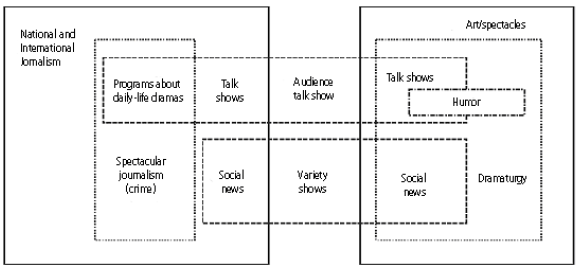
]]> The field of television is presently configured based on two distinct poles of validity: on one hand, journalism; on the other, dramaturgy19. Each of these poles has a specific power structure. In the case of journalism, although the television networks have a central team, which broadcasts the news on a national level, as there are also several affiliates to broadcast regionally, with their own teams responsible for generating and transmitting local news20. Each one of these affiliates produces, on a smaller scale, the typical hierarchy of the area with clear distinctions between the anchors and the regional news reporters and those of sports news, or even between local, national, and international journalism. A centralized hierarchy is also established around the national network news, to which the regional stations must be submitted. This hierarchy is more visible in negotiations that the affiliated stations establish with the central news in order to circulate an event on the national level21. In the case of dramaturgy, power relations are very different. Historically, dramaturgy was concentrated in only one broadcast station, Rede Globo, and although the other stations have always invested in this sector, the Rede Globo soap operas are seen as the model to be followed, a standard copied by the other stations. Contrary to news programs, which allow the emergence of small elite groups in the affiliates, the concentration of dramaturgy in the hands of the central stations and mainly Rede Globo does not allow for the development of local investments and small groups of power. Consequently, each one of these poles developed their own relations of power and validity criteria.Live audience and variety shows are situated half way between journalism and dramaturgy, or art in general. In other words, they seek validation through attempts to approach journalism and dramaturgy, as well as other artistic expressions. This approach can be observed in the choice of TV hosts, decreasing the number of personnel with no journalistic education and increasing the number that has had previous education in the artistic field, as well as the choice in subjects: on one hand, TV journalism had begun to be included as a live audience show; on the other hand, the number of dramaturgy subjects developed on television has also grown. The regional affiliated stations also develop local live audience and variety shows, reproducing the hierarchy existing between TV journalism professionals and those from such TV shows. In addition, one of the themes that permeates the debates, both nationally and internationally is the question of social responsibility. Each one of the two poles sought out a specific form, based on their own validity criteria to deal with this theme. In the case of live audience and variety shows, this social responsibility at times assumes the appearance of a service, ranging from clearing doubts with a lawyer by phone to the solution of matrimonial dramas by performing expensive exams that are unaccessible to the majority of the population, at other times it appears to be a pedagogical activity, for example, learning to cook or making artisan baskets to earn a living.
A specific validity for each one of these poles implies not only distinct power relations, but also the use of specific language that can only be understood within these power relations. The fact that live audience shows are situated between the poles confers a specific character to its intermediary position. TV hosts are not recognized as TV journalists in the same terms as the rest, not like artists, ostenting the generic term "communicators." The greater similarities they establish with TV journalism or art in general may be momentary and are the main determinants of the forms of expression used in their TV shows and the subject matter chosen to be broadcast. Since the resemblance is not total, they are not fully accepted in either of the poles. The language used by these TV shows tends to exaggeration, as if at the same time expressing the impotence and struggle of these professionals in identifying with one of the two poles. Another important detail is that since they are not fully recognized by TV journalists on one hand, nor by artists on the other, many times the validity of such TV shows needs to be acheived by imitating activities that do not belong to either of the main two poles, causing it to be sought out by economic viability, which is, the number of commercial announcements a determined program can maintain. Differing from TV journalism or dramaturgy, which is economically viable because they find their own forms of social and cultural validation, live audience and variety shows many times must first demonstrate economic advantage, so that in time they can seek their own validity, either by approaching TV journalism, or artistic manifestation.
The following situation is a rather schematic rough draft of the (open) television field. The margins established between the types of programs correspond to relations of power, approximation and distancing between professionals and symbolic relations of approximation and distancing between the poles of TV journalism and dramaturgy, including their respective mechanisms of expression.
We return now to the question presented in the beginning. What exactly do the changes observed in the research validity criteria mean? The greatest change, or perhaps the most prominent, is found in the studies on soap operas. The work of Barros (1974) – although it was not his intention – points out forms of world views present at the time that did not find validity "within the university" or at least within social sciences. The obvious difference in relation to the work of Nogueira (2002) is only in the fact that the morally characterized world view observed on television begins to acquire validity within the university, or validity criteria within television itself begins to be incorporated into the study. This incorporation occurs in a rather particular manner; the world, such as is created by the soap operas or by debates on live audience shows, represented from a moral perspective, begins to be the same one represented in studies.
Moralism, as mentioned before, is irreconcilable with an analysis of social, political, and cultural factors, and finds distinct forms of expression. The emphasis of the discourse can fall on the discrimination of individual, extra-individual qualities, or simply on individual actions, while in the latter it is less perceptible since it does not center the analysis on human virtue. The social bonds are broken to give place to an analysis that is founded on an individualistic perspective and presents the individual, his successes and failures, as a synonym to the social universe. Therefore, an equivalence or reduction is supposed between "social destiny" and "individual destiny."
The maintaining a posture such as that observed in the works of Sodré (1972; 1977;1990) and Kehl (1991;2000), derived from an apocalyptic discourse around the cultural industry is possible to a degree due to the fact that it is perfectly adjusted to this new order of validity in the field of research, having a moral basis and reference, since its tone is also moral: it is founded on the defense of determined values and their application. This discourse maintains current because it has always been, since the beginning, a moral discourse.
]]> However, the changes observed in research validity criteria cannot be evidently reduced to a moral drama. They demonstrate a general alteration in the configuration of studies because they are expressive of the changes in the forms of struggle and in the actual "social order" of the research field. Each one of these discourses, through the fragmentation that became their main characteristic, expresses possible forms of interpretation and insertion into the social fabric, so that the validity they find expresses the variable power relationships within the contexts of research of which they are a part. The validity of social affirmation based on the creation cannot be confused with social, political, cultural or economic validity. Each one of these forms of affirmation implicates forms of making see and believe in the divisions of the social world that are diluted not only in the analyses of television, but also in the concentration of themes, or world views, by disciplines or departments within the university.These changes, however, demonstrate that the disputes between studies bring polemic issues to light between interest groups that are articulated through political, cultural, moral, and artistic commitments, and in the university they find not only the possibility of expression, but also the possibility of conferring certain validity to the world views they try to impose. This does not mean that such studies do not point to important factors connected to television. Evidently they indicate and make room for new studies, but also facilitate another kind of struggle observed precisely in the fragmentation they have come to express, a path that was already defined from the beginning. The more television is seen as the expression of external factors, the more elements involved that need to be sought out independently from television itself, and therefore, the greater the competition among presumed universal world views that accept television as a mere illustration of such forms of seeing and making believe in social division.
Therefore, articulation in the research field between interest groups and commitments to determined world views and social affirmation does not occur in such a generic and random manner. If we were to situate research within the setting proposed for the television field, we would see that they occupy the same precise and restricted spaces: they range from international and national TV journalism to sensationalist TV journalism, whose main theme is crime; to dramaturgy and art in general; to live audience shows, but not variety shows, nor the remaining types of shows or relations they establish with the poles of validity. This distribution reproduces the hierarchy of the television field in the same terms it is instituted. Thus, the works on TV journalism reproduce, through the validity criteria with which they are included in the discussions, the hierarchy existing between national and international "elevated TV journalism" and "low TV journalism," which specializes in crime, usually treated with much more sensationalism22. The discussions on ethics in this area can be extended to disputes by the monopoly of authority to define elevated or low TV journalism validity, the standards of conduct to be adopted by these types of TV journalism and the themes that they should consider relevant23. Similarly, studies on soap operas reproduce a hierarchy existing between "art free from commercial pressures" and "commercial art" belonging to television, searching or ways to be socially validated by affirming characteristics that may only be found in the artistic field. Thus, the discussions return to the liberty of creation, classifications between free art (mini-series) and commercial art (soap operas), universal aspects of the work of art, art presented as the irradiating center of social transformations, as well as moral and pedagogical value of the soap opera, etc. And lastly, studies on live audience shows reproduce the prestige they do not share with the main poles of television validity, being treated as an inferior product, both artistically (kitsch) and journalistically or culturally (sensationalist), or seeking their validity through the affirmation of moral and universal values.
The theme of power, central to comprehending affirmation mechanisms of validity of such TV shows, has begun to be sought out equally from outside television as in the competition between shows and in the homogeneity promoted by this competition24. Competition and homogenization can evidently be verified, but the dispute for power cannot be reduced to commercial relations of competition, since a reduction of this type does not explain the aesthetic alternatives or the discourse found by these TV shows. In addition, the discussion presented by the studies has not begun to casually express an understandingof the world based on moral criteria. Since such studies reproduce the struggles for power within television, the validity criteria adopted by them reproduce the valid forms and instruments of social affirmation used in these disputes. Among TV journalists, social struggle and affirmation are articulated and find expression through terms such as culture, transparency, justice, and especially truth25. Among dramaturgy professionals, the dispute is manifest through terms such as liberty, creativity, and talent. And among professionals connected to variety and live audience shows, the dispute is manifest through such terms as courage, struggle, and solidarity, which simultaneously express the lack of recognition from the other two poles, the inferior prestige that is reserved for them, and a superficial understanding of the power relations, such as dispute or connection between natural talent or between the values traced by them. These terms are the same ones used by such studies and express a representation of a moral world, the form in which this struggle is understood within the power relationships of television, as are the specific contours that this moral understanding of the world gains according to the contexts in which it is introduced.
The fact that television has a past to be reflected on, represented and analyzed as if it were constituted by independent genres – the soap opera, news programs, and live audience shows – a nonexisting distinction in the first works, and the fact that these studies have begun to be expressed in the same terms used within the power relations of television indicate that the research field has been increasingly characterized by heteronomy. In other words, whether by interest or failure, some of these studies have begun to seek out consecrations in television itself, to accept demands whose meaning can only be found among the television professionals, and so achieve validation within the field of research. It is significant that the cited works, whose language is explicitely patronizing26, have found their channel of dispersion and expression in one of the most important university publishers in the country. While heteronomy is not the present mark in all the studies, since visibly several of them do not seek a possible consecration among television professionals, constituting a field of research including heteronomous criteria evidently in their validation have considerable weight in the definition of new studies to be undertaken. Thus, the actual configuration of the field, constituted by independent genres and the increasingly heteronomous criteria that marks it imposes the paths to be followed by the analyses, the terms in which they should be guided and the forms of consecration that are reserved for them.
Bibliographic References
AMARAL, Luiz. (1996), A objetividade jornalística. Porto Alegre, Sagra/DC Luzzatto.
ANDERS, Gunther. (1973), "O mundo fantasmático da TV." In: Rosenberg, Bernard & White, David M. (orgs.). Cultura de massa. São Paulo, Cultrix, p. 415-425.
ANDRADE, Roberta M. Barros de. (2000), O fim do mundo: imaginário e teledramaturgia. São Paulo/Fortaleza, Annablume/Secretaria de Cultura e Desporto do Governo do Estado do Ceará.
ARBEX JR., José. (2001), Showrnalismo: a notícia como espetáculo. São Paulo, Casa Amarela.
ARRIVÉ, Michel. (1994), Lingüística e psicanálise: Freud, Saussure, Hjelmslev, Lacan e os outros. São Paulo, Edusp.
BALOGH, Anna Maria. (2002), O discurso ficcional na TV: sedução e sonho em doses homeopáticas. São Paulo, Edusp.
BARROS, Sonia Miceli Pessôa de. (1974), Imitação da vida: pesquisa exploratória sobre a telenovela no Brasil. Master's Thesis. São Paulo, Department of Social Sciences, FFLCH, USP.
BARROS FILHO, Clóvis de & MARTINO, Luís Mauro Sá. (2003), O habitus na comunicação. São Paulo, Paulus.
BOSI, Ecléa. (1972), Cultura de massa e cultura popular: leituras de operárias. Petrópolis, Vozes.
BOURDIEU, Pierre. (1997), Sobre a televisão. Rio de Janeiro, Zahar.
_____. (1998), A economia das trocas lingüísticas. São Paulo, Edusp.
CANCLINI, Néstor Garcia. (2000), Culturas híbridas. São Paulo, Edusp.
COSTA, Cristina. (2000), A milésima segunda noite. São Paulo, Annablume.
DANTAS, Audálio et al. (1998), Repórteres. São Paulo, Senac.
ECO, Humberto. (2001), Apocalípticos e integrados. 6 ed. São Paulo, Perspectiva.
FERNANDES, Ana Cláudia. (2002), Namoro e família na televisão: análise do programa de auditório "Em Nome do Amor." Master's Dissertation. São Paulo, Department of Sociology, FFLCH-USP.
GHIVELDER, Zevi. (1994), "Telejornal em rede." In: Kaplan, Sheila & REZENDE, Sidney (orgs.). Jornalismo eletrônico ao vivo. Petrópolis, Vozes, p. 149-160.
GOMES, Mayra Rodrigues. (2003), Poder no jornalismo: discorrer, disciplinar, controlar. São Paulo, Hacker Editores/Edusp.
HAMBURGER, Esther. (1998), "Diluindo fronteiras: a televisão e as novelas no cotidiano." In: SCHWARCZ, Lilia Moritz (org.). História da vida privada no Brasil: contrastes da intimidade contemporânea. São Paulo, Companhia das Letras, p. 439-487.
_____. (2000), "Política e novella." In: BUCCI, Eugênio (org.). A TV aos 50: criticando a televisão brasileira no seu cinqüentenário. São Paulo, Fundação Perseu Abramo, p. 25-47.
_____. (2002), "Indústria cultural brasileira (vista daqui e de for a)." In: Miceli, Sérgio (org.). O que ler na ciência social brasileira 1970-2002. São Paulo/Brasília, Anpocs/Editora Sumaré/Capes, p. 53-84.
HORKHEIMER, Max & ADORNO, Theodor. (1982), "A indústria cultural: o iluminismo como mistificação." In: Lima, Luiz Costa. (org.). Teoria da cultura de massa. 3 ed. Rio de Janeiro, Paz e Terra, p. 159-204.
KEHL, Maria Rita. (1991), "Imaginar e pensar." In: NOVAES, Adauto (org.). Rede imaginária: televisão e democracia. São Paulo, Companhia das Letras/Secretaria Municipal de Cultura, p. 60-72.
_____. (2000), "Televisão e violência do imaginário." In: BUCCI, Eugênio (org.). A TV aos 50: criticando a televisão brasileira no seu cinqüentenário. São Paulo, Fundação Perseu Abramo, p. 133-151.
LEAL, Ondina Fachel. (1986), A leitura social da novela das oito. Petrópolis, Vozes.
LOPES, Dirceu Fernandes & PROENÇA, José Luiz. (2003), Jornalismo investigativo. São Paulo, Publisher Brasil.
MALCHER, Maria Ataíde. (2001), A legitimação da telenovela e o gerenciamento de sua memória: o Núcleo de Pesquisa de Telenovela da ECA-USP. Master's Dissertation. São Paulo, Department of Communication and Arts, ECA-USP.
MARTÍN-BARBERO, Jesús. (2001), Dos meios às mediações: comunicação, cultura e hegemonia. Rio de Janeiro, Editora UFRJ.
MEMÓRIA GLOBO. (2004), Jornal Nacional: a notícia faz história. Rio de Janeiro, Zahar.
MEYERSOHN, Rolf B. (1973), "Pesquisa social na televisão." In: ROSENBERG, Bernard & WHITE, David Manning (orgs.). Cultura de massa: as artes populares nos Estados Unidos. São Paulo, Cultrix, p. 399-414.
MICELI, Sérgio. (1972), A noite da madrinha. São Paulo, Perspectiva.
MIRA, Maria Celeste. (s/d), Circo eletrônico: Silvio Santos e o SBT. São Paulo, Edições Loyola.
NOGUEIRA, Lisandro. (2002), O autor na televisão. Goiânia/São Paulo, Editora da UFG/Edusp.
ORTIZ, Renato; BORELLI, Silvia Helena Simões & Ramos, José Mário Ortiz. (1989), Telenovela: história e produção. São Paulo, Brasiliense.
RAMOS, José Mário Ortiz. (1995), Televisão, publicidade e cultura de massa. Petrópolis, Vozes.
SAMPAIO, Lílian Alves. (2003), O riso e a náusea: a disputa simbólica encenada em um programa de televisão. Master's Dissertation. São Paulo, Department of Sociology, FFLCH-USP.
SILVA, Carlos Eduardo Lins da. (1985), Muito além do Jardim Botânico. São Paulo, Summus.
SODRÉ, Muniz. (1972), A comunicação do grotesco: introdução à cultura de massa brasileira. Petrópolis, Vozes.
_____. (1977), O monopólio da fala: função e linguagem da televisão no Brasil. Petrópolis, Vozes.
_____. (1990), A máquina de Narciso: televisão, indivíduo e poder no Brasil. São Paulo, Cortez.
SOUSA, Mauro Wilton de et al. (1994), Sujeito, o lado oculto do receptor. São Paulo, Brasiliense.
SOUSA, Florentina das Neves. (2000), Alguns momentos dos 50 anos do telejornalismo no Brasil. Master's Dissertation. São Paulo, Post-graduation Program of the Course of Sciences and Communication, ECA-USP.
TORRES, Carmem Lígia César Lopes. (2004), O que o povo vê na TV: programas de auditório e universo popular. Master's Dissertation. São Paulo, Post-graduation Program of the Course of Sciences and Communication, ECA-USP.
TRAVANCAS, Isabel Siqueira. (1993), O mundo dos jornalistas. São Paulo, Summus.
YORKE, Ivor. (1998), Jornalismo diante das câmeras. São Paulo, Summus.
Endnotes
1. Cf. Hamburger (2002).
2. Cf. the work of Ortiz, Borelli and Ramos (1989) and Ramos (1995). For a general overview of the number of grants given to research on soap operas in Brazil, see Malcher (2001).
3. Esther Hamburger first called my attention to this fact.
4. That of Sodré (1972), on mass culture and Brazilian television, that of Miceli (1972), about the Hebe Camargo Show, and that of Barros (1974), about soap operas.
5. For example, see Meyersohn (1973).
6. See Eco (2001).
]]> 7. In this sense, see the criticism by Martín-Barbero (2001) and Canclini (2000).8. Criticism made by the reception work conducted in Brasil starting in the 1980's. The first important work in this sense is that of Leal (1986).
9. The argument of Maria Rita Kehl finds a development in a later article. See Kehl (2000).
10. While about this universality and this form of treating the symbolic may cause a series of questions and criticism due to the impropriety with which the theme is treated: May language acquisition, cognition and symbolization be taken as identical, coincidental, complementary or distinct processes? Is the symbol in language equivalent to the thought symbol? Is the sign of discourse equivalent to the symbol? In this sense, see the work of Arrivé (1994).
11. Similar use of the notion of habitus can be found in Barros (1974). Although it does not refer to live audience programs, the notion of habitus as the naturalization of social traits can also be observed in Barros Filho and Martino (2003).
12. Among the more recent studies that express this perspective, see Torres (2004).
13. Current clearer examples may perhaps be Serginho Groisman and Jô Soares, both on Rede Globo, with greater intended distinction to the second, since the program is presented as a talk show instead of a live audience show. In addition, the time in which both programs are aired, late night, is considered more "select".
14. In this sense, see the interpretations made regarding popular culture by Bosi (1972) and regarding the grotesque by Mira (undated).
15. In this sense, see Andrade (2000) and Costa (2000). Among the works about live audience shows, see Fernandes (2002).
16. For example, see Hamburger (2000).
]]> 17. A very clear example, although it does not refer specifically to soap operas, may be seen in Arbex Jr. (2001).18. Although studies on reception are not part of the theme of this article, similar changes can be found in them. For example, what is observed in the comparison of one of the pioneer works on reception (Silva, 1985), whose main theme was the political issue, with other more recent ones. Silva's study focused on the reception of Jornal Nacional (National News), on Rede Globo. However, the work represented much more of an attempt to measure the distance between the "political conscience" of the workers and a "political conscience" that was idealized, organized and representative of – or capable of identifying – "class" interests. The first works about reception of soap operas by Leal (1986) reveals the same characteristics observed in Barros (1974): an analysis based on a dual and antagonistic society, which presents economic and cultural aspects as synonymous. In more recent studies, the main reference in analysis of reception is the question of "subject," as in the collection organized by Sousa (1994).
19. This description is based on the field study I have developed since 2002 together with the networks Globo, Bandeirantes, SBT and RedeTV!, in which I was able to accompany the recording of various programs, as well as establish a dialogue with their professionals. The specific configuration of the television field, however, will be treated in a more detailed future work. The intention here is to trace the general guidelines that help establish a comparison between the validity criteria in the television field and those of the research field.
20. About the differences in routine of radio, newspaper and television professionals, see Travancas (1993).
21. In this sense, see the statement by Ghivelder (1994) and about the trajectory of the National News, Jornal Nacional, the Globo Memoire (2004).
22. The forum where such discussions are concentrated is the press itself and the manuals dedicated to journalism and TV journalism, and not necessarily the theses. In this sense, see Amaral (1996), Yorke (1998) and Arbex Jr. (2001). Among the theses, see the work of Souza (2000).
23. Evidently this is not the only observed tendency. Among the works about journalism, an attempt to establish a relationship with explanations of a more universal and independent character of journalism itself or television can also be observed. For example, see the work of Gomes (2003).
24. See Bourdieu (1997).
25. For example, see the collections organized by Dantas (1994) and Lopes and Proença (2003).
26. See Nogueira (2002) and Balogh (2002).
]]>
* I am very grateful to Leopoldo Waizbort (FFLCH/USP) and Esther Hamburger (ECA/USP) for their criticism and suggestions, without which this text would not have been finished.
]]>