Mario Napoleón Pacheco Torrico*
Translated by Jeremy Jordan
Translation from Revista de Humanidades y Ciencias Sociales (Santa Cruz de la Sierra), Santa Cruz de la Sierra, v.12, n.1-2, p. 133-184, June/Dec. 2006.
SUMMARY
The objective of this essay is to examine the foundation process of the Central Bank of Bolivia in the context of the banking reforms recommended by the American expert Edwin W. Kemmerer, and applied since 1929. This essay is divided into three parts: the first presents a global vision of the Bolivian economy in the decade of the 1920s; the second one analyzes the foundation of the Central Bank of Bolivia, and the third one studies the effect of the Great Depression on the Central Bank regarding the monetary and exchange policies, as well as the relationship between this great crisis and the Chaco War.
I. THE BOLIVIAN ECONOMY AT THE END OF THE 1920s
1. The tin mining industry
After the crisis of the silver mining industry at the end of the 19th century, Bolivia entered the 20th century with a thrust of the tin mining industry. The tin mining industry, stimulated by the expansion of consumption and worldwide prices (in 1899 a long ton of tin was valued in London at £112.4, and in 1920 at £296.1)1, and taking advantage of the facilities handed down by the former silver mining cycle (like the availability of technicians, qualified workers, trains built in the last ten years of the 19th century between the mining areas and the Pacific coast)2 and the richness of mines3, became the foundation of the Bolivian economy.
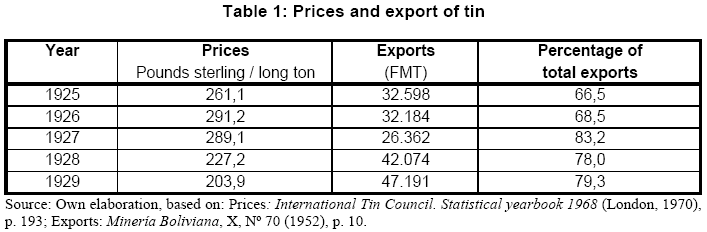
Despite the price drop since 1927, exports increased by 44.8% from 1925 to 1929, and it was precisely in this last year that the highest export level in the economic history of the country was achieved. It is also noticeable that this mineral was acquiring increasing importance in total exports, representing on average 75.1%, between 1925-1929 (see table 1).
It is important to note that the main recipient of the tin ore exports was England, in 1929 77.2% of the total4, where it was smelted, converted into metal and shipped to the United States. In this way, there was a strong concentration of the tin exported regarding its final destination, the United States, so there was a powerful bond that linked the national economy with the principal cyclical center of the world.
The increase of tin exports propelled the total exports, which between 1925 and 1929 rose by 20%, from £8.7 million to £10.5 million, while imports grew at a lesser rate, 8%, from £5 million to £5.4 million. This growing trend wasn't free of sudden fluctuations caused by drops in the prices of tin. The result of the higher growth in exports was the register of permanent surpluses in the trade balance. However, taking into account commercial expenses [gastos de realización] and utilities remission of the mining industry, as well as, basically, the external debt service, surely the balance of payments in the current account was negative5.
2. The cycle of external indebtedness6
Bolivia took part in the cycle of external indebtedness that began in Latin America in the 1920s, and contracted important credits with the American Bank as mediator7. These had important repercussions in the economic policy prior to the Great Depression, likewise in the initial phase of it. Its contracting began in 1909, and grew in the 1920s. In 1920, the external debt balance reached US$2.2 million, and in 1929, US$62.7 million.
]]> These loans were used for the building of railways (mostly anti-economical), in the financing of the fiscal deficit, and the re-financing of the same external debt; also, important parts of the internal and floating debt turned into external debt. In other words, the external credit was not used in the expansion of exportable productive capacity, that would have helped to fulfill the debt service, and it wasn't used to impulse a process that could modify the export profile of the Bolivian economy (see table 2).On the other hand, creditors were placing strong conditions on the country, like the mortgage of the main sources of revenues, whose control was taken over by the creditors; in this aspect, the outstanding case is the Nicolaus' loan of 1922. The law of authorization of this loan determined the creation of the Permanent Fiscal Commission, an institution in charge of controlling the state revenues that served as security for this loan8. Yet, new credits contracted after 1922, had higher interest rates compared to those acquired previously.
3. Public finances and public debt
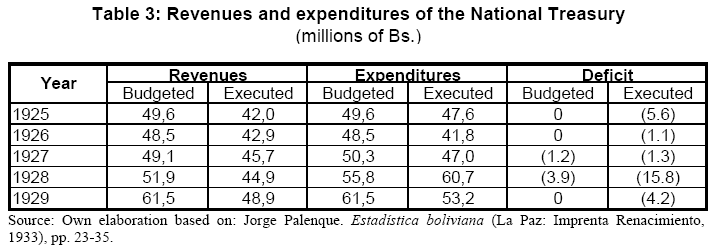
The resources of the Treasury, that depended by a proportion of 60% on the revenues from foreign trade, grew at an average rate of 3.3% between 1925 and 1929, while expenditures (where public debt and defense reached 64% of total expenses), increased by an average of 2.3%. However higher the growth rate of executed revenues, these where constantly lower compared to those budgeted, with the resulting existence of recurrent fiscal deficits (see table 3).
The macroeconomic consequences of the constant fiscal deficit were expressed in their financing, first through the floating debt, and then through the creation of internal debt that was paid off later with external debt; in other words, the governments stopped paying the commercial banks, from which they took loans; then they got into debt with the public and the bank, originating floating and internal debt9, and finally they turned these debts into external loans.
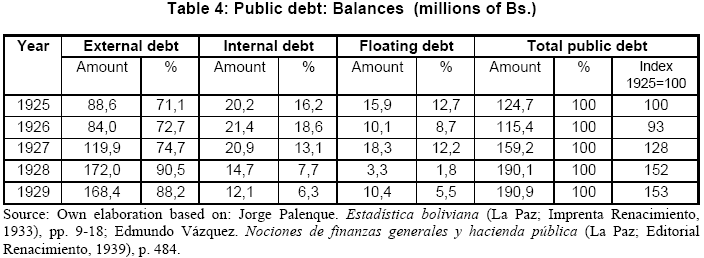
From 1925 to 1929 the external debt increased by 90.1%, while the internal and floating debts decreased by 40.0% and 34.6%, respectively. The additions of the external, internal and floating debts made up the total public debt, which increased by 53.1% (see table 4).
The increase of the public debt, mainly the external one, affected of the punctual repayment of the debt that weighed down enormously on fiscal expenditures. In 1929 the amount budgeted for the service of public debt reached 36% of the budgeted expenses. These numbers, because of their projected character, don't show the real amounts that, without doubt, were larger.
4. The gold standard and the monetary and exchange policies
4.1 Background
The monetary system of the (then recently founded) Republic of Bolivia in 1825, was the same as the one of the colony, it was bi-metallic. Even though gold coins were minted between 1831 and 1857, they barely reached 8% of the total minted, in the year of largest issue. In this sense, despite the consecutive monetary laws (1848, 1863, 1869, 1871 and 1872) which determined the minting and fine content of gold and silver coins, in practice, since 1858, no more gold coins were issued, so that the valid monetary standard was based on silver10.
]]> Due to the permanent depreciation of silver, because of the international process of changing the bi-metallic standard gold-silver to the gold standard, which began in the1870's11, there was a debate in Bolivia to adopt the gold standard in 1890. Nonetheless, the silver standard was changed for the gold standard only by 1895. Through the Law of November 26th, 1895, it was recognized "... means of payment character of the pound sterling, for amounts exceeding two thousand bolivianos, at the valid exchange rate in London, in respect of the value of silver in the same market "12. Subsequently, through the law of November 30th of 1904, the exchange value of the pound sterling was determined at Bs. 12.50, the payment of 50% of customs duties in gold at the previous exchange rate, free export of silver coins, and the prohibition of their import. Finally, through the law of December 5th of 1908, it was acknowledged that English and Peruvian pounds sterling fulfilled two functions of money: unity of account and means of payment, at an exchange rate of 12.50 Bs/£, although it was also arranged to mint smaller coins of silver and nickel. The silver coins were minted until 1909, but in decreasing quantities13. With the purpose of financing the definitive introduction of the gold standard, the external credit from J. P. Morgan for £500,000 was used to constitute the necessary reserves.4.2 Monetary and exchange policies
Theoretically, the main characteristics of the gold standard were: i) the national monetary unit was defined by its weight in gold, and the Central Bank bought and sold gold at a fixed price; ii) banknotes were convertible to gold; iii) exchange rates were set based on the fine content of gold in the national currency; and iv) free import and export of gold. Therefore, the means of circulation in each country depended on the international movements of gold, in other words, on the international reserves in each country14. However, there were differences with respect to the composition of the reserves and the domestic circulation. Only England, Germany, France, and the United States had gold reserves and gold coins. Other countries had reserves in gold, and the domestic means of payment were made of gold, silver, fiduciary coins and paper. There were countries with reserves mainly in foreign currencies, and a monetary supply made of gold and silver coins, and banknotes. In Latin America there were reserves only in foreign currencies, and the domestic circulation was divided among gold, silver and banknotes15.
In the case of Bolivia, the adopted gold standard worked in respect of the link between the monetary supply and the level of reserves of the Bank of the Bolivian Nation [Banco de la Nación Boliviana], an institution created in 1911, and to which in 1914 was granted the exclusivity of issuing money. This monetary system had other deficiencies. First, the laws of 1904 and 1908 did not define the national monetary unit, the boliviano, in terms of its fine content of gold. Second, therefore, the currency rate fixed, at Bs. 12.50, was not based on its fine content of gold, because it did not exist. The effect was a permanent fluctuation of the exchange rate, although until 1912 the variations were not significant. Third, as we shall study later on, the free exchange rate was suspended in 1914.
The information in table 5 allows us to see that there were two factors that influenced the monetary system: the negative external shocks of the prices of tin, and the contracting of external credit, both impacted on the level of reserves and on the exchange rate.
The sudden decreases of tin prices caused recession due to the contraction of income in foreign currency and, therefore, in the monetary reserves of the Bank of the Bolivian Nation, this was the case in 1908-1909, 1914-1915 and 1921-1922. While external credit influenced the increase of monetary reserves, the means of circulation and the revaluation of the exchange rate.
Between 1907 and 1908 tin prices decreased by 22.9%. The immediate effect was the drop of their export value by 11.4% from 1908 to 1909, and a drop of the import value by 3.3%. This affected the revenue of the National Treasury that fell by 12.1% between 1907 and 1908. The reduction of this revenue resulting from exports probably implied a decrease in bank reserves that forced a devaluation of the boliviano from 12.27 Bs/£, in 1907, to 13.52 Bs/£, in 1908. In 1908 a loan from Morgan was contracted for £500,000. This allowed a revaluation, in 1909, of the boliviano to 12.80 Bs/£.
The crisis in 1914-1915 was a consequence of the First World War. At the beginning of the conflict metallic tin exports from England to the United States were suspended, and the Metals Market in London was closed. Immediately a negative shock occurred to the price of tin, which dropped from 201.7 £/long ton in 1913 to 164.2 £/long ton in 1915. As the war was prolonged, it appears that tin exporters assumed that the price decrease was permanent, so they adjusted their production to a lower level. The initial impact on the value of exports was deep due to this decrease by 36.9% between 1913 and 1914. Having decreased the availability of foreign currencies, the external purchases were also reduced. Both phenomena damaged revenues of the National Treasury by 41.8% between 1913 and 1915. The shortage of foreign exchange caused the decrease of foreign reserves in 1914 and increases of prices of the pound in 1914 and 1915.
These events caused a public reaction that demanded the banking system convert their banknotes into gold. At the same time, importers were opposed to devaluation because it increased their costs. In front of them, the mining entrepreneurs had an opposite position because the devaluation increased their incomes in bolivianos, and this allowed them to cover their local costs.16 The response of the authorities was active. It was arranged for a transitory suspension of the exchange of banknotes for gold, that is to say an interruption of the free exchange of national money for gold or other foreign currencies17. On the other hand, to increase the supply of foreign currencies and to stop the losses of reserves, exporters were obliged to hand over to the Bank of the Bolivian Nation 10% of the value of their exports. This measure remained valid until 192218
On the fiscal level, the reduction of income caused the Ministry of Finance to resort to open market operations, issuing Customs promissory notes and turning to loans from the commercial banks.
]]> Between 1915 and 1916, the price of tin had a strong recovery that positively impacted on the value of exports and imports, even though the quantity of exports was still low in relation to that in 1913. On the other hand, the monetary restriction was overcome through a new external loan in 1913 (Credit Mobilier) worth £1.5 million. In this way, reserves grew from 1915, as did the monetary supply. In 1916 the pound sterling was newly revalued.The measures that obligated exporters to hand over a percentage of their foreign exchange became the motive of a debate that confronted the supporters of intervention with those liberals who believed in the automatic functioning of the mechanism of adjustment between the levels of reserves and the exchange rates and that, as a result, considered it to be unnecessary to have any intervention at all.19
During the crisis of 1920-1922 the price of tin fell by 46.1%, the value of tin exports dropped by 73.8% and fiscal income was reduced by 24.3%. The reserves fell between 1920 and 1921 by 10.7%, the means of circulation dropped by 3.9% and the exchange rate, which was revalued in 1920, as a result of the Ulen Contracting loan in 1922 for US$2.2 million, depreciated by 35.0% between 1920 and 1922.
Observe that reserves grew significantly in 1922, increasing their relation to M1 to 80.1%, an absolute record until then. As a consequence, there was a revaluation of the exchange rate in 1923. The origin of this chain of events was once more a contract for a new external debt, the Nicolaus loan for US$33.0 million, which also allowed the suspension of the obligatory hand over of 10% in foreign currency.
In spite of successive contracts of external credit that brought about growth in monetary reserves and in the means of circulation, as well as revaluations of the exchange rate, the suspension of the convertibility of banknotes, in force since 1914, was not annulled, but maintained until 1922 and, after a brief interruption, was re-established the same year and lasted until 1928. As a consequence, one of the basic principles of the gold standard, free convertibility, did not function in Bolivia; nevertheless, in practice, economic brokers could acquire foreign exchange with national currency, which constituted the monetary reserves Only in this way can we understand the persistence in the obligatory handing over of foreign currency. Precisely, in 1925 the percentage of such hand over rose to 25%.
These noted aspects permit the inference that the gold standard in Bolivia, as in France and other countries, was a "limping along" one; in other words, that was unstable as a result of not being complete and functioned with difficulty20. From the perspective of validity of free convertibility, the gold standard only functioned from its total adoption in 1909, until the suspension of the convertibility in 191421.
With respect to monetary policy, if one understands it as the management by the authorities of the supply of means of payment or issue of money, it is over the level of the reserves that the authorities operate when contracting external credit and, therefore, they have an indirect influence on the money supply. As a consequence, the flow of foreign exchange coming from external debt was the relevant instrument for increasing the reserves that in 1914 were increased by up to 40%, and were raised to 50% at an annual rate of 2%22. Information permits the verification that between 1914 and 1928 the average value for the reserves with respect to the monetary supply was 48.7%, that is to say that there was registered a good level of back up. Another mechanism of management was the establishment of the obligatory hand over of foreign currency earned by exporters, which allowed the leveling of the foreign exchange supply with the reserves in times of external crisis. Taking into account the noted factors, one can see that the radius of action of the monetary policy was not so tight.
As for the independence of the Bank of the Bolivian Nation with respect to the government, evidence exists that the government tried to increase its influence on the board of directors and in the decisions of the bank, through the law of January 8th of 1924 that changed the composition of the General Administration Council of the Bank, and increased the government's representation from two to three seats while reducing from three to two seats the representation of the private shareholders. The Board of Directors informed, in 1927, that in executing the decision of the Supreme Court of Justice against the law of January 8th of 1924, it was established that the board of directors should consist of seven members, three appointed by the government and four by private shareholders23.
5. Factors of vulnerability
The preponderance of tin in the structure of exports, the importance of revenue provided by foreign commerce on the whole of the fiscal revenue and the elevated foreign debt, expressed a high level of vulnerability in the Bolivian economy to the negative external shocks on the price of tin and in the world market of capital. Indeed, all the movement of the Bolivian economy depended on one product for export: tin. Provided that this mineral generated 75% of the foreign exchange, contributed, directly or indirectly, to 60% of the fiscal income, it was the product that permitted the punctual servicing of the foreign debt. In other words, the economy functioned based on the impulse of tin. The crises of 1907-1908, 1914-1915 and 1920-1921, originated in negative shocks to tin prices, showed the enormous harmful impact on the whole of the economy24. Not without reason, Margarita A. Marsh, in 1928, sustained that "...the country operates on a margin far too stretched and the dependence on one single resource with fluctuation and a value fixed overseas results much too precarious to formulate a judgment overly optimistic to consider the future of the nation"25.
]]>II) THE FOUNDATION OF THE CENTRAL BANK OF BOLIVIA
1. The work of Edwin W. Kemmerer in other countries of Latin America.
In the Andes region of South America, central banks were created following the recommendations of Edwin W. Kemmerer, professor of Princeton University of the United States, who was hired by the governments of Colombia (1923), Chile (1925), Ecuador (1926), Bolivia (1927) and Peru (1931), in order to reconstruct their monetary, banking and fiscal systems. His activities were not restricted to the Andean countries; he also worked in Mexico, Guatemala, the Philippines and in other countries of Africa and Europe, also in Turkey and China. The whole of Kemmerer's recommendations were directed towards the re-establishment of the gold standard, the creation of central banks and governing organisms of the banking system. He also carried out important proposals in the fiscal area26.
In the interpretation of Paul W. Drake, a researcher of Kemmerer´s missions, in the Andean countries existed a demand for the establishment of institutional frameworks similar to the Federal Reserve System of the United States, due to the fact that it was considered as a model of an advanced finance system, even though in various Andean countries there already existed similar projects to those of Kemmerer. The appeal of this assessor was found to be not only in his technical knowledge and his academic profile, but also in the consideration that he was already bound to the financial circles of the United States. Such hypothetical relationship with the center of world finances opened the possibility not only to provide a new image of the Andean countries to North American banks, but also to facilitate access to credits and investments coming from the United States.
Kemmerer's projects had the support of important social groups aligned against inflation and abrupt fluctuations of exchange rates, who thought that this way they could have access to imports at lower prices and receive foreign credits. Governments required foreign loans in order to finance development projects27 and their fiscal deficits.
1.1 The content of Kemmerer's bank reforms
The foundation of the reforms was the re-establishment of the gold standard, conforming to what was taking place in the world. This system, which had been suspended since the First World War, was re-adopted beginning with the Geneva Conference of 1922, where it was recommended to implement the gold exchange standard with the aim of stabilizing exchange rates.
The characteristics of the new gold standard were the following28:
]]> i) the definition of the national monetary unit as a determined weight of gold. The central bank bought and sold gold at a fixed price;ii) banknotes were convertible into gold and gold coins could be minted;
iii) exchange rates were fixed according to the weight of gold in each coin. These exchange rates were maintained fixed within the limits of the points of gold;
iv) there existed free import and export of gold. That is why the monetary mass in each country was linked to international movements of gold.
The mechanism of adjustment determined that whenever there existed a deficit in the balance of payments, that required taking gold out of the reserves of the central bank, the monetary supply was reduced and the interest rates were increased, in such a way that the aggregate demand was reduced, a factor that pushed prices and costs of production downwards. The result should be an increase of exports and the elimination of the deficit in the balance of payments. The existence of a surplus in the balance of payments determined a different scenario. As a result of gold entering the country, the reserves of the central bank go up, obliging the authorities to expand the monetary supply and lower the interest rates, which cause an increase of aggregate demand, and also, in the prices and costs of exports. As a consequence, exports are reduced and the surplus in the balance of payments is eliminated29.
It is important to point out that the monetary system adopted in the second half of the 1920s was not, in reality, the old gold standard, it was better said to be a gold exchange standard (which we shall simply denominate as the gold standard) that was backed by reserves made of the main currencies of the world linked to gold30. The shortage of gold in the period of re-adoption of the gold standard was a factor that obliged to economize the precious metal. The system introduced in the United States in 1919, was adopted by Germany in 1924, Great Britain in 1925 and France in 192631. In 1926 the gold standard was valid again in thirty nine countries and by 1927 its reintroduction to the world was coming to an end32.
Returning to the recommendations of Edwin W. Kemmerer for the Andean countries, it is noted that he proposed to establish high legal reserves with respect to the means of circulation, strong restrictions to the government to carry out loans from the central bank, and a decisive presence from the private sector on the board of directors, with the aim of assigning to the issuing institution an important independence with relation to the government. The management of the gold standard, in charge of the central banks, was too closely attached to the "rules" of this monetary system. In some cases, the authorities over-ruled Kemmerer's recommendations in that they established higher levels of reserves and deposited significant proportions of these in banks in New York and London.
The Kemmererian approaches, converted into laws, were practiced until the effects of the Great Depression and the validity of the gold standard caused significant losses of reserves to the central banks. With the suspension of foreign credit it became impossible to enforce this system and service the external debt. The abandonment of the gold standard by Great Britain in 1931, forced financial authorities to suspend this monetary scheme and to practice policies that contradicted Kemmerer's recommendations. The level of reserves and their relation with money supply dropped, loans to the government increased, exchange rates began to be fixed, and controls on foreign exchange started33.
2. The hiring of the Kemmerer Mission
President Hernando Siles (1926-1930), being forced by the need to finance public works projects and to cover the recurring fiscal deficit34, was interested in the Kemmererian reforms that were being applied in Chile and sent two people to examine such work. Then invited Kemmerer to Bolivia to study and modernize the monetary, financial, budget, and customs systems. The intention of the President was to adopt the reforms of Kemmerer with the aim of reinforcing "...his capacity to negotiate additional foreign loans with or without the approval of moneylenders represented in the Permanent Fiscal Commission"35. He also expected that the measures would allow the stabilization of the exchange rate, the increase of revenues and the improvement of the fiscal administration36.
]]> According to Drake it was agreed to pay the Mission US$80,000 plus expenses for travel and stay. The government would also provide administrative help37 by means of the creation of a commission and special secretaries. The Informative Commission and the Bolivian Secretariat were established by Supreme Decree on April 7th of 1927, they were presided over by Casto Rojas who had as members known specialists of economic affairs. The Bolivian Secretariat was composed of representatives of the Permanent Fiscal Commission, of the Ministries of Finance, Development, Industry, Communications, and Colonies, as well as other state officials. Also, there existed various appointed delegates coming from different public services. For exceptional consultation, the president of the Chamber of Commerce, the president of the Association of Mining Industrialists and the managers of the existing banking institutions were all summoned. Also summoned were the well known economists José Luis Tejada Sorzano and Rafael Taborga38. Once Kemmerer was set up in La Paz (he had arrived on March 29th of 1927), he met with representatives of different economic sectors, received complaints and advice and traveled throughout the country39.The hiring of Kemmerer counted on the support of the principal political parties and important groups of the La Paz elite, even though some maintained doubts over the difficulties in applying the recommendations in a country like Bolivia. Later, on July 30th of 1927, once the work of the Mission had been finished, through another supreme decree, various commissions were designated to study the projects that the Kemmerer Mission had presented40.
3. Recommendations of the Kemmerer mission
On finishing his mission, he presented nine projects and laws relative to41:
i) monetary reform;
ii) banking reform;
iii) the reorganization of the Bank of the Bolivian Nation and the creation of the Central Bank of Bolivia;
iv) real estate taxation;
v) replacement of income tax;
]]> vi) fares, prices and other regulations for agencies of transport and communications;vii) organization of the budget;
viii) the creation of the Bolivian Office of the Treasury
ix) the reorganization of fiscal accounting and intervention of the government and the creation of an office of fiscal accounting and control to be named General Comptrollership.
Concluding his mission, Edwin W. Kemmerer left the country early in July of 1927. On arrival to the United States he sent copies of his recommendations to the State Department, including an evaluation of Bolivia, a country to which he attributed a reduced economic potential, with a mining activity overcharged with taxes, an elevated external debt, besides having a government characterized as being weak and corrupt. He affirmed "...that he is as pessimistic about Bolivia as he is optimistic about Ecuador"42.
Of all the projects of law presented and converted into law it corresponds to analyze those regarding to monetary affairs. In this sense, let us examine the essential aspects of the Law of the Reorganization of the Bank of the Bolivian Nation and creation of the Central Bank, the Monetary Law and the General Law of Banks43.
3.1. Law No. 632, July 11th of 1928, of the creation of the Central Bank of the Bolivian Nation. (Promulgated by Law 633, July 20th of 1928)44.
The historical records of the creation of the Central Bank of Bolivia go back to the Mint House of Potosí, founded in 1572, which had the monopoly of issuing silver coins during the colonial period45, a right that was preserved until 1867, when it was authorized to issue banknotes for the Bolivian Bank46. In 1911 the Bank of the Bolivian Nation was established, as a mixed bank with a state participation of 78.4%, while the private shares, both national and foreign, reached 21.6%. This bank was organized on the base of the Bank of Bolivia and London, which was a bank of private capital. The banking reform of 1913 granted the Bank of the Bolivian Nation the monopoly of issuing, ratified by the Law of January 1st of 1914, and the right to issue up to 150% of its capital47.
The Bank of the Bolivian Nation already existed and had the exclusive right of issuing, so how did Kemmerer justify the creation of the Central Bank of Bolivia? Holding that the Bank of the Bolivian Nation "did not offer facilities of rediscount to the other banks ... it cannot serve as the central deposit for the reserves of money of the country and does not keep the talon [records] of gold; and its assets are not sufficiently liquid to enable it to perform satisfactorily the functions of regulating and conserving the local market of commercial credit and foreign exchange"48. In other words, the expert held that it was necessary to create a bank of banks and that, founded on the gold standard, it be able to keep the exchange rate. But at the same time affirmed that the country did not agree to create a new bank, only transform the Bank of the Bolivian Nation into a central bank, as the demand for credit was small, a factor that caused the reduction of the commercial banks. Holding that as the Bank of the Bolivian Nation had the monopoly of issuing for 25 years, the government lacked legal arguments to suspend this right, also that the exclusive right of issuing was affected by the foreign loan contract of 1922, by virtue of which the State shares in the Bank of the Bolivian Nation were pledged. Finally, he affirmed that it had acted in some operations as "...a true central bank"49.
3.1.1. Attributions
]]> According to Law No.632, July 11th of 1928, the Central Bank was born with the following faculties:i) make loans and rediscounts to commercial banks;
ii) receive deposits from the public, associated banks and the state;
iii) officiate as a clearing house for checks;
iv) buy and sell minted gold and gold bars, transfers by cable and telegraph, money orders and checks payable at sight;
v) buy, sell and discount money orders paid overseas and letters of foreign exchange proceeding from transactions of imports and exports;
vi) buy, sell and discount bank acceptances, money orders and commercial payments;
vii) obtain money from loans within the country or from overseas;
viii) officiate as the financial broker of the state;
]]> ix) maintain the monopoly of money issuing.
The mandatory bank reserves of metal were fixed at 50%. If such reserves fell lower than this level, the Central Bank of Bolivia would then be liable to pay fines (article 71).
3.2 The Monetary Law No. 609, July 11th of 192850
The Mission justified this reform arguing that the Monetary Law of December 31st of 1908, that had established the definitive validity of the gold standard, had not determined the equivalent in grams of gold of the national currency. After abandoning this monetary system in August of 1914, violent fluctuations of exchange rates occurred. The inconvertibility of the banknote brought the country to a "... regime of paper money", in that the tendency had been to increase the means of circulation due to the permanent demand of exporters, with the danger of devaluation of the national currency51.
With respect to the fine content of gold in the national currency, Kemmerer suggested to return to the existing parity before abandoning the gold standard in 1914, for "...the country would gain the reputation of having returned to the parity prior to the war –referring to the First World War–, that from the point of view of credit and national pride it is a point that deserves to be considered; it would facilitate the payment of servicing the external debt; would permit foreign enterprises who had invested before the war, to the moneylenders, to receive their retributions and payments in the same currency; and would reduce the price of imported products"52.
This argumentation was the same used in Englandwhen she readopted the gold standard in 1925 with the parity that was valid before the First World War. "...to return to the gold standard in all ways as before the war symbolized the complete return to ‘normality' after which everything would go back to be in equilibrium"53. The events that followed showed that such exchange rate represented a factor of vulnerability in the system due to the overvaluation of the pound sterling54. In the case of Bolivia it remained clear that Kemmerer had not taken into account the overvaluation of the Bolivian currency, as a result of massive income of capital emanating from external debt, at the moment of fixing the exchange rates with respect to the pound sterling and the dollar. Remember that the exchange rate with respect to the British currency that in 1922 had been Bs. 15.24, was gaining value since 1923, reaching Bs. 13.33 in 1928. In this sense, the maintenance of the exchange rate depended on new external credits and on a growing income of foreign exchange provided by the exports of tin.
Law 609 re-established the gold standard, which Kemmerer had understood principally since the unrestricted validity of convertibility. The law defined the monetary unit of the country as the boliviano, with a fine gold content of 0.54917grams, and determined to produce gold, silver and nickel coins at the Mint House of Potosí55. Exchange rates were established in relation to the pound sterling at Bs. 13.33 and at Bs. 2.73 to the gold dollar of the United States. Likewise, the English pound sterling and the Peruvian pound were recognized as currencies with the capacity of functioning as means of payment, value deposit, unity of account and as a standard of time payments. Finally, as corresponded to the gold standard, laws were revoked on taxes, prohibitions and restrictions over the export of gold coins, of gold bars and over the export of silver coins.
3.3 The General Law of Banks No. 608 June 11th of 192856
In justifying the new General Law of Banks, Kemmerer held that the current legal framework (the law of 1890 that had been modified in 1891), had various deficiencies, that had brought the banks to work with their particular norms. Affirmed, on the other hand, that there was not an efficient and necessary fiscal control, because bank activities are of public interest57.
The Law included the creation of the Superintendency of Banks, resolutions relative to the organization of the banks, requirements of capital, amounts of reserves, and a classification of banks into commercial, savings and mortgages, besides authorizing the creation of mortgage sections in the commercial banks.
]]> The Superintendency of Banks, who replaced the General Inspector of Banks58, had as his objectives the control of the finance system, by means of vigilance in order to accomplish the legal framework, controlling the destruction of banknotes, and the issuing and incineration of mortgage letters from mortgage banks and the mortgage sections of commercial banks.4. Foundation of the Central Bank of Bolivia
The Kemmererian package of laws was approved by the middle of 1928, but the inauguration of the Central Bank of Bolivia was delayed until July of 1929. Meanwhile a certain number of people from the Central Bank of Bolivia travelled to Chile to observe the organization of the issuing institution of Chile59. The Central Bank of Bolivia initiated its activities on July1st of 1929. Attending the inauguration were the President Hernando Siles, ministers and authorities of the newly born Central Bank. The first Superintendent of Banks was in charge of the inauguration, Mr. E.O. Detlefsen60, recommended by Kemmerer to occupy such functions.
4.1 Capital and composition of shareholdings61
The authorized capital was Bs. 30 million, while the subscribed capital reached to Bs. 25,809,900, and that paid Bs. 22,939,700. As was already established, the Central Bank of Bolivia assumed the assets and liabilities of the Bank of the Bolivian Nation.
The shares were divided into three kinds: A, B, C. Their distribution was as follows.
| 62.5% |
]]> - Class B shares belonging to associate banks62: | 8.4% |
| 29.1% |
4.2 Composition of the Board of Directors63
The Board of Directors was formed by 9 titular members and 9 substitutes. The titular members were distributed in the following manner:
- two directors named by the government
]]> - two directors named by the associate banks- two directors named by the public
- one member named by the mining industrialists
- one member named by the National Chambers of Commerce
- one member named by agricultural proprietors and farmers
The first Board of Directors was composed by:
- President (Director for associated banks): Daniel Sánchez Bustamante
- Vice-President (Director for agricultural propietors and farmers): Juan Pérou
- Directors for the government: Víctor Muñoz Reyes and Hugo Ernest
]]> - Director for associate banks: Rafael de Ugarte- Directors for public shareholders: Arturo Loayza and William A. Pickwoad
- Director for mining industrialists: Manuel Carrasco
- Director for Chambers of Commerce: Moisés Ormachea
- General Manager: Alberto Palacios
5. External context
5.1 The Great Depression and its principal characteristics
Only three months after the inauguration of the Central Bank came the shock of the New York Stock Market, which meant the beginning of the Great Depression, and, as previously mentioned, the abandoning of the Kemmerer reforms.
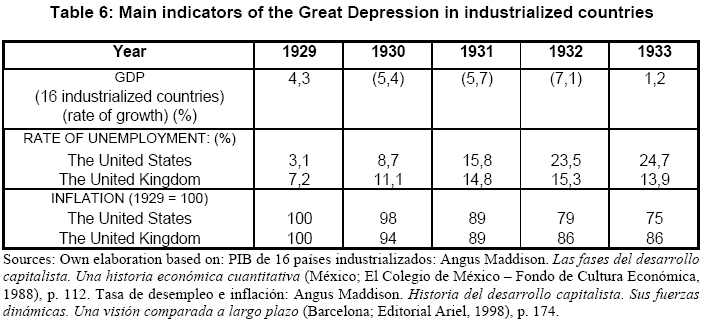
The crisis was characterized, between 1929 and 1933, mainly, by the profound and persistent decline of economic activity, elevated rates of unemployment and deflation. The GDP of the 16 most industrialized countries was profoundly reduced between 1930 and 1932. Only in 1933 the average rate of growth showed the beginnings of recuperation that was quite unequal. When the Great Depression began, the rate of unemployment in the United States was even lower than the United Kingdom; later on much higher rates were registered, reaching a peak in 1933. In the United Kingdom, unemployment grew until 1932, but never reached those levels registered in the United States. The reduction of price levels not only in the United States and the United Kingdom, but also in the rest of the industrialized nations, constituted another important factor that expressed the effect of an overproduction and a fall in the aggregated demand (see table 6).
5.2. The moratorium of the external debt in Latin America and the abandoning of the gold standard
]]> The global deflation brought about a reduction of export prices. The index of export prices from Latin America fell, from 1929 to 1933, by 70.7%, and the immediate effect was the strong contraction of the terms of trade by 48.2% between 1928 and 193364.As was affirmed earlier, Latin America was the receptor of a great flow of external resources, fundamentally provided by the United States in the 1920s, and with more intensity from 192465. The resources provided by external credits were obtained by means of corruption; for example, the granting of bribes to authorities in different governments, and were generally poorly utilized, as had occurred in Bolivia. They were destined to finance fiscal deficits, to refinance the external debt and to pay for infrastructure, such as public services in urban areas and railways66.
This cycle of external indebtedness, was characterized by Thorp, as "the dance of the millions". "A decade in which American salesmen gave loans and American products to governments of apparent confidence, who, overwhelmed by this sudden access to credit and goods, asked for loans in a most careless way that only equaled that of the 1970's"67.
The deterioration of income provided by exports, the restrictions of external credit flows and finally their suspension, put the region in a difficult situation in order to honor their external obligations. The payments for the debt servicing deepened the balance of payments problems while diminishing dangerously the international reserves. These factors drove Latin America to produce a wave of declarations of default. Between January 1931 and 1934, 15 Latin American nations declared default in their external obligations68. The suspension of servicing the external debt permitted a relief from the pressures over the requirements of foreign exchange and, in this way, conditions were generated for the re-establishment of external equilibrium. In the same way, it permitted lowering the pressure over fiscal spending69.
The abandoning of the gold standard, propelled by its suspension in England in September of 1931, allowed devaluation of the national currencies in Latin America and initiated the exchange rate management, which turned into a source of fiscal income; likewise, systems of foreign exchange controls and rationing began to be applied. On the other hand, the breaking of the national currency to gold connection permitted the expansion of fiscal spending.
The fiscal policy was gradually acquiring an active orientation as a result of the fall of income from exports caused by the reduction of both taxes on exports and income provided by customs. The fiscal restrictions to confront the obligations of paying salaries to the public administration and other types of expenses obliged the government to run deficits that meant an impulse to reactivation70.
III) IMPACT OF THE GREAT DEPRESSION ON BOLIVIA: MONETARY AND EXCHANGE POLICIES AND THE PROBLEM OF INDEPENDENCE OF THE CENTRAL BANK OF BOLIVIA
1. Effects of the Great Depression on Bolivia
The Great Depression impacted on Bolivia by way of two mechanisms: commercial and financial. The first was expressed through the sharp contraction in the prices of tin and the second through the suspension of external credit.
]]> From 1929 to 1932 the prices of tin fell by a proportion of more than 50% and, as the volume of exports also fell, the impact on the value of exports was brutal. The consequences on international reserves at the Central Bank of Bolivia were devastating, even more so considering that initially the government was able to comply with servicing the external debt. However, it should be noted that from the second half of 1932, the emerging requirements from the Chaco War were also pressuring the reserves downwards. In the system of the gold standard, the fall of the reserves dragged down monetary supply and prices; as a consequence, deflation constituted another critical factor of the conjuncture. Finally, the fall of exports and imports deprived the government of a significant portion of their revenue and brought down together the government's spending (see Table 7).The prices of tin, which had continued to fall since 1927 as a result of the marked imbalance between world production and consumption, dropped strongly from the beginning of the Great Depression. In this context, the Tin International Committee (TIC)71, was created in February of 1931 in London, with the support of Simón I. Patiño and his English associates72, with the purpose of re-establishing the equilibrium between production and consumption. The first action of the TIC was to establish quotas of exports for its members, a restriction that should have been accomplished voluntarily; however, the agreement failed due to the lack of a coercive mechanism. The following step was the establishment of the First International Agreement of Tin, between 1931 and 1933, with the support of the signatory governments. The presence of the governments lent to the TIC sufficient coerciveness that permitted the mechanism to accomplish export restrictions. In the case of Bolivia the authorities were charged with fixing the export quotas and distributing them between the producers and controlling their accomplishment.
The acceleration of the crisis obliged the TIC to stipulate the prohibition of exporting tin during July and August of 1932, which caused the paralysis of productive activities. Since the end of August the country was only able to complete 40% of the assigned quotas. From the second half of 1932, the external situation produced a reversal because of the draconian policy determined by the TIC and as a result of the incipient recuperation, soft and fluctuating, in the industrialized nations.
2. The default in servicing the external debt.
The reduction in the availability of foreign exchange provided by exports combined with the suspension of external credit, forced the government of President Hernando Siles, at the end of April 1930, to sign a contract with the Unión Allumetiere S.A. of Brussels to obtain a loan of US$2 million. The objective of this new loan was to reinforce the extraordinary budget of 1930, taking into consideration the drop of fiscal income.
The Military Junta headed up by General Carlos Blanco Galindo (1930-1931), following the overthrow of President Hernando Siles, immediately declared their intention to continue servicing the external debt and made a remittance of US$1.05 million to New York corresponding to the second half of 192973.
However, the shortages of foreign exchange implied great difficulties for the government to continually accomplish servicing the external debt in dollars. In order to study ways to confront the crisis, the Military Junta stipulated the creation of a Supreme Council of the National Economy integrated by representatives of the government, the Central Bank of Bolivia, industrial and commercial associations, railway enterprises, and a representative of the Workers Federation of La Paz74. This Council presented a report to the government in August of 1930. They had calculated that Bs. 24.0 million was required to accomplish servicing the public debt in the second half of 1930, however, the estimated income of the Treasury only reached Bs. 17.2 million.75. Then, to comply with servicing the external debt, signified that the State should leave aside unavoidable obligations regarding internal and external security and the functioning of the administration that, according to calculations of the Commission, had reached (for the second half of 1930) Bs. 18.7 million. Paradoxically, the recommendations of the Council sustained "that the obligations of the external debt should be rigorously and totally attended, conforming to their respective contracts"76. The report did not consider the dangerous reduction of foreign exchange reserves.
The deepening of the fiscal deterioration obliged the government to urgently seek solutions that implicated strong reductions in public spending. Some analysts maintained that servicing the external debt should be suspended in consideration of the accelerated reduction of fiscal income77. Others affirmed that the external debt should continue to be serviced in order to maintain the nation's financial trustworthiness78. The debate over the maintenance of the external debt had commenced, which showed an increasing awareness over the problem.
Later on the Military Junta formed a commission that should have reached an agreement with the New York bankers, "...with the aim of preventing the heavy servicing of external debt from pulling down the gold reserves, at least for some time"79. The commission journeyed to New York at the end of November of 1930 to negotiate with the North American bankers a new credit to accomplish servicing the debt; however, the critical situation of the financial market made it impossible to reach any pact. The result was, according to the Commission, "...that the only advice was to harmonize the payments that Bolivia could do now and in the near future with its economic capacity to pay until the plentiful recuperation of economic forces would permit total payments"80. In other words, the failure of negotiations signified the green light to declare default in servicing the external debt.
In effect, the President of the Military Junta at the inauguration of the National Congress, on February 27th of 1931, made it known that the servicing of the external debt had been completed up to November of 1930, "...in order to make the last payments it was necessary to take funds destined for the most urgent expenses of the administration and finally to resort to internal credit. It was presented in this way to the country the material situation of not being able to continue payment of our external obligations"81.
]]> Therefore, from December of 1930 the country stopped servicing the external debt with the North American banks. In August of 1931, President Daniel Salamanca (1931-1934), only ratified such suspension82. Equally, the Law of October 9th of 1931, which established the prohibition of exporting gold (minted coins, bars or powder), determined the rescheduling of the suspension of the debt service that should be paid in foreign currency83. In comparison to other Latin American countries, Bolivia was the first to adopt such a decision, marking an important path of anti-crisis economic policy in Latin America84. After various failed attempts to reach agreement with bond holders (in 1948, 1950, 1957, 1968 and 1969) and with the making of partial payments, only in 1998, through a special agreement, this episode could be finally closed85.3. The abandoning of the gold standard and the monetary and exchange policies
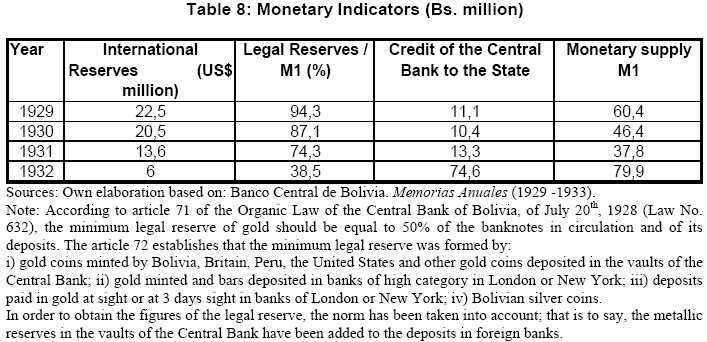
The reserves fell dangerously until December of 1930 as the flow of foreign exchange provided by exports slowed down, the external credit ceased, the servicing of the external debt continued, and the free convertibility of bolivianos to pounds sterling and dollars was maintained. The authorities of the Central Bank let the gold standard established mechanisms perform automatically and the monetary supply contracted till 1931. The legal reserves fell to 38.5% in 1932; in practice, therefore, the minimum reserve of 50% established in the organic law of the issuing institute was disregarded. The beginning of the Chaco War, in June 1932, accelerated the reduction of the reserves of the Central Bank (see table 8).
In this framework, in 1930, the authorities of the recently founded Central Bank, maintained that "... the convertibility of the banknote is guaranteed by an ample and adequate reserve of gold, located part in Bolivia and part overseas..."86. They recommended "...level out as soon as possible our trade balance, reduce imports, enact real fiscal budgets, without deficit, and, favor our industries and markets..."87. However, they acknowledged the existence of certain problems like the strong demand for foreign exchange "...in order to settle our unfavorable balance of payments", and, on the other hand, informed that in 1930, the sales of foreign exchange were superior to the purchases by 90.3%. But expressed their orthodox optimism when they affirmed that in front of the critics "the Central Bank can perfectly maintain stable the value of the boliviano, in a natural manner, and therefore, the exchange rate can be sustained fluctuating around the parity and within the extreme points of entering and exiting [of gold]"88.
In observance of the automatic adjustment mechanisms, the Central Bank stipulated the increase of all rates of discount. These, for example, for the associate banks and at 90 days, rose from 8% to 9% between July 1929 and March of 1930. The problems that followed obliged for their reduction to 7% in August of 193089.
The deterioration of the price of tin, the retraction in the volumes of export, principally in 1931, the news of the default of the debt and the crisis of liquidity in foreign exchange, appeared to be what propelled a speculative attack against foreign exchange of the banking system. The persistence of the attack forced the Central Bank, from a moment on, to confront "...alone, the whole demand made by the government, commerce and the public"90.
As can be observed, the cost was an accelerated loss of reserves from the Central Bank. In this situation, the abandoning by England of the gold standard, on September 21st of 1931, was a factor that obliged the authorities to assume the same measure on September 23rd. However, that decision did not imply that the loss of reserves be stopped, but instead continued until 1933. But, as noted previously, it happened under wartime circumstances.
The abandoning of the monetary system based on gold was produced in1932, through a law of emergency, which approved the moratorium and the suspension of payments of gold. The same disposition authorized the Central Bank of Bolivia to concede loans of emergency to the mining enterprises and exporters91. In practice, the suspension continued indefinitely.
Following the suspension of the gold standard, the Central Bank confronted two problems: fixing the exchange rate and assuring a flow of foreign exchange that would permit the established rate to be maintained. From that moment began an exchange policy, which included the fixing of the exchange rate and the obligatory hand over of foreign currency to the issuing entity.
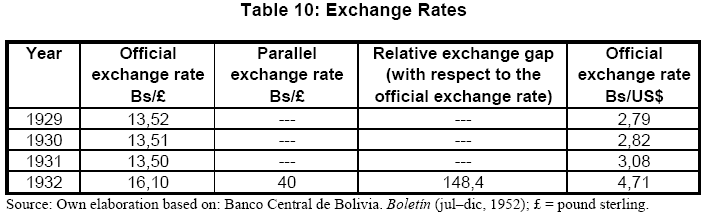
Considering the shareholders structure of the Central Bank, there should have been searched a consensus between buyers and sellers of foreign exchange in order to agree on an exchange rate. With that aim, and violating what was stipulated by article 39 of the organic law, that prohibited the realization of general assemblies of shareholders, a financial assembly was held, where it was agreed to maintain the link with the pound sterling, at a buying exchange rate of 12.97 Bs/pound sterling and at a selling exchange rate of 13.03 Bs/pound sterling. Likewise, the mining industry promised to sell their available foreign exchange to the Central Bank. The immediate results were not positive because the Bank did not have the promised foreign exchange. The losses of reserves continued and the Bank was urged to establish a new exchange rate even without reaching an agreement between buyers and sellers of foreign currency. This situation obliged the Central Bank to assume the responsibility to fix the price of the pound sterling and the dollar. The enactment of a new law permitted the Central Bank to fix a floating exchange rate within maximum and minimum limits of 13.46 Bs/pound sterling and 13.15 Bs/pound sterling92, thus assuming a system of exchange with narrow limits.
]]> In this way, the Central Bank renounced the fundamental objective of the gold standard, which was to support a fixed exchange rate. In this sense, from October of 1931, the exchange rate took on the category of an active instrument of economic policy.Initially, exchange rate management was based on agreements that could be reached between the exporters of tin, represented by the Association of Mining Industrialists, and the buyers of foreign exchange, whose interests were in charge of the National Chamber of Commerce. The Bank had the aim of harmonizing both interests. A later agreement of fixing the exchange rate took into account the behavior of tin prices93:
Price of tin: 80 pounds sterling/ton. – 1 pound sterling 20 Bs.: maximum limit
Price of tin: 149 pounds sterling/ton. – 1 pound sterling 15 Bs.: maximum limit
3.1 Control of exchange rates: the obligation of handing over foreign exchange
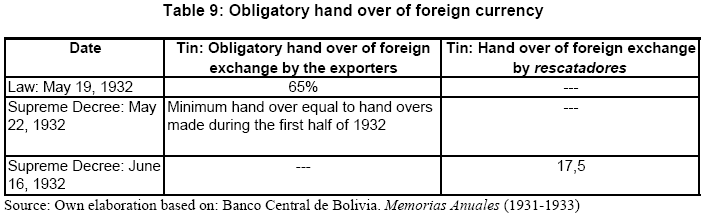
The obligation of handing over foreign exchange was the second mechanism that assured the Central Bank the necessary amount for its management. It emerged on May 19th of 1932 with the Law of Exchange Rate Control. This disposition established two essential aspects. First, it concentrated in the Central Bank the obligatory sales of 65% of the exchange generated by the exporters. Second, it gave the Bank authority to fix the exchange rate but removed its function as exchange distributor, by creating the Board of Control of Money Transfers, through which foreign exchange was distributed (see table 9). On this Board were representatives of mining entrepreneurs, importers, industrialists, and the Bank94.
However, a later regulation changed the content of the law, suspending the obligatory handing over of exchange, and determining that the exporters should hand over their exchange to the Central Bank after deducting their expenses overseas95.
Although, the measure was revised, the important thing was that a definitive change was initiated in the orientation of economic policy in the government of President Daniel Salamanca, who was one of the most noted liberals in Bolivia. "...The great theorist of political and economic liberalism, who challenged, in 1915, the project of obligatory sale of overseas drafts [to the government]"96, abandoned liberal orthodoxy and gave way to interventionism.
The growing necessity of foreign exchange pressured the government to implement more active dispositions. In effect, in December of 1932, the government expropriated a part of the reserves of gold of the Central Bank, the Mercantile Bank, the National Bank of Bolivia and, also of the Association of the Mining Industrialists, to a total value of £470,58897, a measure that motivated protests and execution of legal actions on behalf of those affected, including the Central Bank, to impede the measure but without any success. However, the Central Bank in protest resolved to suspend advances of loans conceded to the government98.
It is important to note that the fixing of the exchange rate and the shortage of foreign exchange determined the appearance of a parallel exchange rate in 1932 (see table 10).
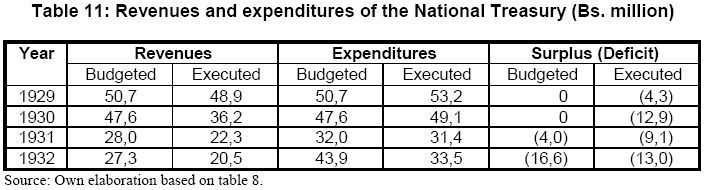
]]> 4. Credits granted to the StateThe fiscal situation, which was worrisome before the Great Depression, turned critical after 1930: the executed revenue fell by 58.1% from 1929 to 1932, while the executed expenses fell by only 37.0%. As a consequence, the deficit had to rise, as well as the necessities of financing it (see table 11).
Confronted by the accelerated reduction of fiscal revenue, the answer was the reduction of expenses, through a group of measures which included the suppression of positions, firing of personnel, reductions of salaries, and cutbacks of items related to acquisitions of supplies and rents for use of private real estate.
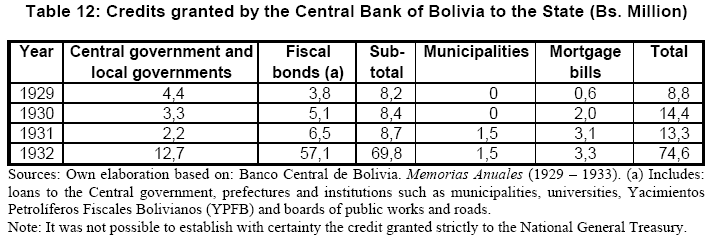
After initiating the war with Paraguay, the pressures to obtain credit at the Central Bank rose appreciably. Simultaneously, on September 30th of 1932, the Government stipulated the creation of emergency taxes, for five years, in order to finance war expenses99. However, as a result of growing necessities, the authorities resorted to financing by the Central Bank, through which were granted two emergency loans to the government, which totaled Bs. 50.0 million. Altogether, from 1929 to 1932, the Central Bank granted the government credits for Bs. 111.1 million (see table 12).
The major deteriorations of revenue and the low amounts obtained from the public obligated the Government to demand a major quantity of credits from the Central Bank. The issuing institution that had complete independence from the government, and that also practiced a policy of reduction of M1 in harmony with the rules of the gold standard, resisted to grant the loans demanded by the Government, arguing their subjection to the Organic Law. As has already been examined, it was stipulated that the legal reserve over M1 should come from a minimum of 50%, a limit that did not permit the Central Bank to issue more than the stipulated reserves. There had been an attempt to resolve the problem on September 14th of 1931, when the Government presented to the Chamber of Deputies a project of law that reduced the minimum amount of legal reserve to 35%, with the aim of raising the value of credit to the State; the proposal was rejected.
As will be seen later on, the immediate consequence of applying an expansive fiscal policy induced the adoption of a similar monetary policy; that is to say, that the fiscal deficit was covered simply by issuing banknotes; therefore, M1 expanded increasingly from 1932.
5. From deflation to inflation
The preceding analysis shows that the monetary and fiscal policies were, from 1932, gradually expansive. The financial necessities required to support the recuperation and those that emerged from the Chaco War obliged to finance the fiscal deficits with loans from the Central Bank and by the collocation of government bonds in the issuing institution. These factors determined the increase in means of payment in the economy, with the exception of the period 1929- 1931, when M1 was reduced by Bs. 22.6 million. The impact of the growing liquidity, in a general context of reduction of production, had to be the impulse of the inflationary pressures also with the exception of the period 1929-1931.
In the three mentioned years, the reduction of M1 caused a deflation that reached its maximum level in 1931, when prices dropped by 17% compared to the previous year and in 1932 the inflation attained 26% (see table 13).
6. The independence of the Central Bank
]]> If we understand for independence of the Central Bank, first that "...it has the freedom to choose how to pursue its objectives, in second place, that its decisions are very difficult to revoke for whatever other political request"100, so it was born with these attributes established in the legal framework that ruled its objectives and attributions. In this sense, the Kemmererian design had managed to provide a high level of independence.As has been commented, article 6 of the Law No. 632 which created the Central Bank, established three kinds of shares: classes A, B, and C. The first corresponded to the government and had no right to vote. In article 9, it was defined that class B corresponded to the associated banks and class C, according to article 19, to the public.
Despite the capital contributed by the State, for the constitution of the Central Bank, reached 62.5%, the representatives of the State on the Board of Directors were only two out of a total of nine, according to articles 22 and 24, meanwhile the associated banks and the public together, according to articles 25, 26, 27, 28, and 29, had a representation of seven members, that is to say 78%.
On the other hand, article 8 also established that the Class A shares, of the government, "...did not give the right to vote"101. Although article 26 determined that class C shares, which were owned by the associated banks, would not have a right to vote, this structure and the rights of voting or not in the Board of Directors showed that the government could participate in the discussions, but as the government could not vote, it had no possibilities to influence the decisions of the Board of Directors. Article 53 established that the buying of bonds, letters, etc., and the concession of loans, discounts and advances to the government, associated banks, the public, departmental governments, municipalities and other enterprises administered directly by the government, were subject to the following conditions:
i) loans should not be for longer than 90 days;
ii) loans, discounts and advances were not to be made for any associated bank;
iii) loans, discounts and advances were to be made to government entities and associated banks that had an account of more than Bs. 500,000 up to Bs. 1,500,000, with the votes, of at least, six members of the Board of Directors.
In chapter IX, article 76, titled "Contractual relations with the government", a group of obligations by the government in favor of the Central Bank were determined, which could not be changed within the following fifty years, the term specified for the concession the government had made to the Bank. The obligations determined were:
]]> i) to permit the Central Bank, the free trade of gold inside and outside of the country without restrictions;ii) not to carry out the issue of banknotes as no other private entities could;
iii) to comply with the determinations of the Board of Directors with respect to new issues of banknotes;
iv) to receive banknotes of the Central Bank, for the covering of payments of taxes, interests and debts;
v) not to reduce the rights of the shareholders to take part in the utilities of the Central Bank;
vi) the government should reduce its debt to the Central Bank, according to article 53, "...and not to request loans from the Bank in the future that exceed the prescribed limits of that section of the article indicated";
vii) not to levy the Central Bank with taxes from which it is exempt (taxes that are national, municipal, created or to be created, with the exception of taxes such as stamp duty, stamped paper, taxes on telegraphs, cables and post, taxes on real estate and buildings and imports and exports).
As a consequence, the Central Bank was granted independence by an appropriate legal framework in order to fix its objectives and the government had no possibilities of influencing or modifying the decisions taken by the Board of Directors.
Now, as the impact of the Great Depression was diminishing the availability of foreign exchange, the government and monetary authorities aligned themselves to maintain the monetary scheme; that is to say, continuing to service the external debt and restricting credits and the monetary supply. Then came the moment, as has been examined previously, when it was impossible to maintain the monetary system, and the government, especially after the start of the Chaco War, exerted strong pressure on the Central Bank for loans. The independence of the Central Bank gradually deteriorated.
7. The relationship between the impact of the Great Depression and the beginning of the Chaco War
]]> The Great Depression impacted on almost all the sectors of the Bolivian economy, especially between 1930 and 1932. The mining industry reduced its activities, industry and commerce experienced a fall in their sales, the railways had a contraction in the volumes of cargo and the government had to make adjustments to its administrative apparatus, firing functionaries and reducing salaries. The result was a sudden contraction of economic activity that became the origin of a growing unemployment. From 1930 to 1932 approximately, the mining industry fired 20,000 people, the railways, industry, commerce and other sectors 5,800 and the government fired 800; summing up, 26,600 workers had been fired. Also returning to the country were those Bolivians who had been working in the Chilean saltpeter industry and had been fired, approximately 1,800 workers in number. In total, by the end of 1932 there existed approximately 28,000 people without work102.In this scenario, the social discontent aggravated, as a result of continuous protests by the unemployed who demanded the provision of foodstuffs, rents dafaults and an ample program of public works. The workers movement, the middle class and the non-traditional political organizations joined the protests and formed a radical movement "...of an ample base, influenced by the resurgence of left wing currents among the students"103. This movement began to question the established order and manifestations took place continually in Oruro, Potosí, La Paz and Cochabamba104.
Such a conflictive social scenario caused worry and fear among the authorities and legislators. In the reserved sessions of the Extraordinary Congress of November 30th and 31st of 1931, various deputies showed their concern. One of them maintained that the country was living under a "...revolutionary effervescence which originated in communist propaganda", another affirmed that there had been found among the indigenous of the highland, pamphletsinstigating subversion105. In answer to the disorder, the government of President Daniel Salamanca (1931-1934) ordered the capture and confinement of union leadersand left wing politicians in Chapare. In his message to the National Congress of 1932, the President justified the measures of force arguing that they were necessary "...to silence the communist movement that had ostensibly been working against the Nation... [and that]...had brandished the flag of social revolution..."106. However, the repression did not signify the end of the protests.
Clearly, the effect of the Great Depression had gone beyond the economic domain and had penetrated the social and political spheres, allowing the voicing of several unresolved problems. In this sense, the role of the economic crisis had been to impulse discontent and social agitation that had appeared to head towards the rupture of the social order. The social and political scenarios showed that the government of President Daniel Salamanca had been overcome by the events. In this situation, the question for the government was: How to overcome the political-social crisis that had threatened the legal order? The hypothesis that was suggested is that President Daniel Salamanca found in the military conflict with Paraguay an "escape valve" that not only permitted to repress the left, but also, and fundamentally, to overcome the conflicts and revive patriotic sentiment that would unify the nation. In this sense, the government took advantage of the armed confrontation in July of 1932 between detachments of the armies of Bolivia and Paraguay to expand the war, under the assumption of an economic and military superiority of Bolivia over Paraguay, which would give the possibility of resolving the war quickly. When the war began, President Salamanca decreed a state of siege and arrested a great part of the leftist intellectuals, as well as agitators, workers, Marxists, pacifists, etc.107.
When the citizenship learned of the reality of war in July of 1932, massive demonstrations in support of the government took place in all cities of the country. The mobilization of troops was produced amidst a hullabaloo of the inhabitants of the cities. A newspaper reported that the "...enthusiasm of the people continues in delirium. The reservists insist on their immediate incorporation in the ranks of the army"108.
In summary, the detonation of the Chaco War was in the impact of the Great Depression on a very vulnerable economy, with a conflicting society and with old problems of sovereignty with Paraguay. The incapacity of the State, evidenced by the negative effect of the crisis, contributed to exacerbate the problems. The solution, conceived as transitory in order to dissipate the strong social tensions, was none other than to initiate the war with Paraguay.
2. Conclusions
The years of the 1920s were characterized by the presence of the first cycle of external debt, the growth of exports of tin and the construction of railway lines. Public finances demonstrated a structural tendency towards a deficit because of the growing expenses that could not be financed by current revenue. However, this did not represent a problem for the authorities, who became indebted internally, debt that then became converted into external debt; therefore, the public debt tended to grow constantly.
Although convertibility was abandoned in 1914 and the exchange rate fluctuated in the first half of the 1920s, in practice the means of circulation followed the course that emanated from the availability of reserves, which at the same time responded not only to the incoming foreign exchange from exports, but also to the flows of external credit. In different situations of negative external shocks a depreciation of the exchange rate happened, which sometimes was reverted by the foreign exchange coming from the external indebtedness. However, the extreme vulnerability of the Bolivian economy was visible, because of exports, fiscal revenues and the public debt service, principally foreign, depended on the behavior of tin, a mineral whose price responded to the economic situation of the world.
The Kemmerer Mission was hired not only in order to modernize the monetary, financial and fiscal systems, but also to allow the contracting of new external loans. It was considered that the reforms of the so called "money doctor" would maintain open the external credit from the United States. The work of the expert was intense because he presented nine projects of law which were approved without major discussion. There were three groups of measures relative to the monetary-financial field: the monetary reform, which implied the adoption of the gold standard; the creation of the Central Bank of Bolivia reorganizing the Bank of the Bolivian Nation, with the mission of administering the new monetary scheme; and the General Law of Banking.
]]> The Kemmererian reforms granted the Central Bank an independence from the government through different resolutions of its Organic Law. The application of the recommendations was made four months before the beginning of the Great Depression, which totally changed the external situation and was a factor of destabilization of the reforms. The impact of this crisis was devastating and sank the Bolivian economy in a contractive process that covered the whole society. In this adverse context, those responsible for the monetary management and the government authorities firstly adopted an orthodox attitude and tried to maintain "the rules of the game", later, forced by reality, abandoned the gold standard. The Chaco War accelerated this process, in such a way that by the end of 1932, the monetary policy scheme responded to the demands and pressures of the government. The foreign exchange management became another instrument of action that permitted adjustments to exchange rates, and forced the exporters to hand over foreign exchange and distribute them according to the requirements of the State and the private sector. The result of these actions was the gradual loss of independence of the Central Bank, the adoption of expansive policies and the resurgence of inflationary pressures.Of Kemmerer's reforms, the Central Bank endured and became one of the important leverages for the reactivation, ordering and control of the financial system. The gold standard was abandoned, but the institutions were maintained. The recommendations of the expert were not completely abandoned.
Bibliography
Aldcroft, Dereck H. De Versalles a Wall Street, 1919-1929 (Barcelona; Editorial Crítica 1985). [ Links ]
Aponte, Enrique. "La transformación del Banco de la Nación Boliviana". El Republicano (La Paz) (20, enero, 1929). [ Links ]
Arce Quiroga, Eduardo. "Las Leyes impositivas de la Misión Kemmerer en Bolivia". El Republicano (La Paz) (5, octubre, 1928). [ Links ]
Ashworth, William. Breve historia de la economía internacional (desde 1850) (Madrid: Fondo de Cultura Económica, 1978). [ Links ]
Avilés, Hermógenes. "Cambios bancarios bajo el nuevo sistema monetario del patrón-oro". La Razón (La Paz) (7, julio, 1929). [ Links ]
Ballivián, Manuel y Bautista Saavedra. Monografías de la industria minera III. El estaño en Bolivia. Seguido de un apéndice y de apuntes sobre el bismuto (La Paz: Oficina Nacional de Inmigración, Estadística y Propaganda Geográfica, 1900). [ Links ]
Banco Central de Bolivia. El Banco Central de Bolivia durante la Guerra del Chaco (La Paz; Editorial América, 1936). [ Links ]
Banco Central de Bolivia. Memoria Anual (1929). [ Links ]
Banco Central de Bolivia. Memoria Anual (1930). [ Links ]
Banco Central de Bolivia. Memoria Anual (1931). [ Links ]
Banco Central de Bolivia. Memoria Anual (1932). [ Links ]
República de Bolivia. Anuario Administrativo de 1932 (La Paz; Litografías e Imprentas Unidas, 1932). [ Links ]
Banco Central de Bolivia. Boletín No. 28 (marzo-mayo, 1932). [ Links ]
Banco Central de Bolivia. Acta de la sesión ordinaria del día lunes, 26 de diciembre de 1932. No 371. [ Links ]
Banco de la Nación Boliviana. Vigésima Segunda Memoria Semestral. Presentada por el Consejo General de Administración a los señores accionistas, en la Junta General Ordinaria de 9 de agosto de 1927 (La Paz; Imprenta Renacimiento, 1927). [ Links ]
Benavides, Julio. Historia bancaria de Bolivia (La Paz; Ediciones Arrieta, 1955). [ Links ]
Benavides, Julio. Historia de la moneda en Bolivia (La Paz; Ediciones Puerta del Sol, 1972). [ Links ]
Blanco Galindo, Carlos. "Mensaje del Presidente de la Junta Militar de Gobierno, General Carlos Blanco Galindo". En: El Diario (La Paz) (28, febrero, 1930). [ Links ]
Blinder, Alan S. El banco central: teoría y práctica (Barcelona; Antoni Bosch Editor, 1999). [ Links ]
Consejo Supremo de Economía Nacional, "Informe del Consejo Supremo de Economía Nacional". En: Bolivia Económica. Revista de Economía Nacional. No 1 (1931). [ Links ]
Contreras, Manuel. "La minería estañífera boliviana en la Primera Guerra Mundial". En: Minería y economía en Bolivia (La Paz; Asociación Nacional de Mineros Medianos, 1984). [ Links ]
Contreras, Manuel. "La minería del estaño en la primera mitad del siglo XX", En: Manuel Contreras. Tecnología moderna en los Andes. Minería e ingeniería en Bolivia en el siglo XX (La Paz: Biblioteca Minera Boliviana-ILDIS, 1994). [ Links ]
Contreras, Manuel. Impuestos, deuda y guerra: La economía política de Bolivia, 1920-1935. (1990) (mimeo). [ Links ]
Díaz Alejandro, Carlos F. "América Latina en los años treinta". En Rosemary Thorp (compiladora). América Latina en los años treinta. El papel de la periferia en la crisis mundial, op. cit. [ Links ]
Drake, Paul W. "La creación de los bancos centrales en los países andinos". En: Pedro Tedde y Carlos Marichal (coordinadores). La formación de los bancos centrales en España y América Latina (Siglos XIX y XX) Vol. II. Suramérica y el Caribe (Madrid; Banco de España, 1994). [ Links ]
Drake, Paul W. Kemmerer en los Andes. La Misión Kemmerer 1923-1933 (Quito; Banco Central del Ecuador, 1995). [ Links ]
Dunkerley, James. Orígenes del poder militar en Bolivia, 1879-1935 (La Paz; Plural Editores, 2003) [1987]. [ Links ]
Eichengreen, Barry. La globalización del capital. Historia del sistema monetario internacional (Barcelona; Antoni Bosch Editor, 2000). [ Links ]
Elío, Tomás Manuel. "Bolivia debe suspender el servicio de su deuda externa". En: El Diario (La Paz) (12, diciembre, 1930), p. 8. [ Links ]
Glade, William. "América Latina y la economía internacional, 1870-1914". En: Tulio Halperín. Historia económica de América Latina. Desde la independencia a nuestros días (Barcelona; Editorial Crítica 2002). [ Links ]
Ground, Richard L. "La génesis de la sustitución de importaciones en América Latina". En: Revista de la CEPAL. No 36 (diciembre, 1988). [ Links ]
Gutiérrez Guerra, René. La organización financiera de Bolivia (Oruro: Imprenta Noticias Oruro, 1936). [ Links ]
Hillman, John. "Los orígenes de la industria del estaño en Bolivia". En: Historia Boliviana, v. II, No. 1-2 (1987). [ Links ]
Huber, Hans. La deuda externa de Bolivia: 125 años de renegociaciones y ¿cuántos más? Desde la operación secreta del gobierno y los Meiggs hasta la iniciativa HIPC (La Paz: CEDLA-OXFAM, 2001). [ Links ]
Kenwood, A. G. y A. L. Lougheed. Historia del desarrollo económico internacional. Desde 1820 hasta la Primera Guerra Mundial (Madrid; Ediciones Istmo, 1973). [ Links ]
Kindleberger, Charles P. Historia financiera de Europa (Barcelona; Editorial Crítica, 1988). [ Links ]
Klein, Herbert S. Orígenes de la Revolución Nacional. La crisis de la generación del Chaco (La Paz; Editorial Juventud, 1968). [ Links ]
Lora, Guillermo. Historia del movimiento obrero en Bolivia, 1929-1933. (La Paz-Cochabamba; Editorial Los Amigos del Libro, 1970). [ Links ]
Marichal, Carlos. Historia de la deuda externa de América Latina (Madrid: Alianza Editorial, 1988). [ Links ]
Marsh, Margarita A. Nuestros banqueros en Bolivia (La Paz; Librería Editorial Juventud, 1980) [1928]. [ Links ]
Mendoza, Francisco. La Misión Kemmerer en Bolivia. Proyectos e informes presentados al Supremo Gobierno (La Paz; Imprenta Arno Hermanos, 1927). [ Links ]
Mitre, Antonio. Bajo un cielo de estaño. Fulgor y ocaso del metal en Bolivia (La Paz; Asociación Nacional de Mineros Medianos-ILDIS, 1993). [ Links ]
Morales, Juan Antonio y Napoleón Pacheco. "El retorno de los liberales". En: Fernando Campero, Bolivia en el siglo XX. La formación de la Bolivia contemporánea (La Paz; Harvard Club de Bolivia, 1999). [ Links ]
Niveau, Maurice. Historia de los hechos económicos contemporáneos (Barcelona; Editorial Ariel, 1979). [ Links ]
Pacheco, Mario Napoleón. "La deuda externa boliviana entre 1950 y 1970: La resolución de las obligaciones antiguas". En: Hans Huber, La deuda externa de Bolivia: 125 años de renegociaciones y ¿cuántos más?, op. cit. [ Links ]
Pacheco, Mario Napoleón. "La Gran Depresión y la dinámica de la crisis en Bolivia (1929-1939)" (manuscrito inédito) 2004. [ Links ]
Palenque, Jorge. Estadística boliviana. (La Paz; Editorial Renacimiento, 1933). [ Links ]
Paz Estenssoro, Víctor. "Mensaje del Poder Ejecutivo a la H. Convención Nacional, enviando el Proyecto de Ley de Reorganización del Banco Central de Bolivia" (31 de octubre de 1945). En: Bolivia. Ley de reorganización del Banco Central de Bolivia. 20 de diciembre de 1945 (La Paz; Escuela Tipográfica Salesiana, 1946). [ Links ]
Paz Estenssoro, Víctor. "Bolivia". En: Luis Roque et al., El pensamiento económico latinoamericano (México; Fondo de Cultura Económica, 1945). [ Links ]
Peñaloza, Luis. Nueva historia económica de Bolivia. Comercio, moneda y bancos (La Paz-Cochabamba, 1984). [ Links ]
Prudencio Bustillo, Ignacio. "La Reforma bancaria propuesta por la Misión Kemmerer y los bancos comerciales". El Republicano (La Paz) (27, noviembre, 1928). [ Links ]
Querejazu, Roberto. Llallagua. Historia de una montaña (La Paz-Cochabamba: Editorial Los Amigos del Libro, 1978). [ Links ]
República de Bolivia. Anuario Administrativo de 1927. [ Links ]
República de Bolivia. Anuario Administrativo de 1928 (La Paz; Litografías e Imprentas Unidas, s/f). [ Links ]
República de Bolivia. Anuario Administrativo de 1929. [ Links ]
República de Bolivia. Anuario Administrativo de 1930 (La Paz; Litografías e Imprentas Unidas, 1932). [ Links ]
República de Bolivia. Anuario Administrativo de 1930-1931 (La Paz: Litografía e Impresores Unidos, 1932-1933). [ Links ]
República de Bolivia. Mensaje del presidente Constitucional de la república [Daniel Salamanca] al H. Congreso Nacional de 1932 (La Paz; Lit. e Imp. Unidas, s/f). [ Links ]
República de Bolivia. Redactor de la H. Cámara de Diputados. Congreso Extraordinario 1931 (sesiones reservadas) (La Paz; Escuela Tip. Salesiana, 1944). [ Links ]
Rojas, Casto. Historia financiera de Bolivia (La Paz; UMSA, 1977) [1915]. [ Links ]
Salamanca, Daniel. "Mensaje S.E. el Presidente de la República al Congreso Nacional de Bolivia, 6 de agosto de 1931". En: Bolivia Económica. Revista de Economía Nacional. No 5 (1931). [ Links ]
Tejada Sorzano, José Luis. "El problema bancario y la creación del Banco Central". El Diario (La Paz) (8, febrero, 1929). [ Links ]
Thomas, Victor B. "Las economías latinoamericanas, 1929-1929". En: Tulio Halperín, Historia económica de América Latina. Desde la independencia a nuestros días (Barcelona; Editorial Crítica 2002). [ Links ]
Thorp, Rosemary. "El efecto de la Gran Depresión de 1929 en las economías de Perú y Colombia". En: Rosemary Thorp (compiladora), América Latina en los años treinta. El papel de la periferia en la crisis mundial (México; Fondo de Cultura Económica, 1988). [ Links ]
Thorp, Rosemary. "América Latina y la economía internacional desde la primera Guerra Mundial hasta la Depresión mundial". En: Tulio Halperín, Historia económica de América Latina. Desde la independencia a nuestros días (Barcelona: Editorial Crítica, 2002). [ Links ]
Vásquez, Edmundo. "La conveniencia de mantener el crédito externo de Bolivia". En: La Razón ( La Paz) (15, octubre, 1930). [ Links ]
Vásquez, Edmundo. Nociones de finanzas generales y hacienda pública de Bolivia (La Paz; Editorial Renacimiento, 1939). [ Links ]
* The author is a Professor Emeritus at the Universidad Mayor de San Andrés (UMSA), and Executive Director of the Fundación Milenio (e-mail: fmilenio@entelnet.bo).
1 John Hillman. "Los orígenes de la industria del estaño en Bolivia". In Historia Boliviana, v. II, Nº 1-2 (1987).
2 Manuel Contreras. "La minería del estaño en la primera mitad del siglo XX". In Manuel Contreras. Tecnología moderna en los Andes. Minería e ingeniería en el siglo XX (La Paz: Biblioteca Minera Boliviana - ILDIS, 1994), p. 7.
3 In many deposits the tin content reached 60%, so that the ore extracted was directly packed for export. Manuel Ballivián and Bautista Saavedra. Monografías de la industria minera III. El estaño en Bolivia. Seguido de un apéndice y de apuntes sobre el bismuto (La Paz: Oficina Nacional de Inmigración, Estadística y Propaganda Geográfica, 1900), p. 25.
4 Jorge Palenque. Estadística boliviana (La Paz, Editorial Renacimiento, 1933), pp. 92-95.
5 This was the appraisal of René Gutiérrez Guerra, La organización financiera de Bolivia (Oruro: Imprenta Noticias Oruro, 1936), pp. 52-53.
6 A good study about the evolution of the external debt in Bolivia exists, that includes essays covering the 19th and 20th centuries. See: Hans Huber et al. La deuda externa de Bolivia: 125 años de renegociaciones, y ¿cuántos más? Desde la operación secreta del gobierno y los Meiggs hasta la iniciativa HIPC (La Paz, CEDLA - OXFAM, 2001). ]]>
7 From 1924 to 1928, 24% of the new capital issued by the US for foreign countries was directed to Latin America. William Glade. "América Latina y la economía internacional, 1870-1914". In: Tulio Halperin. Historia económica de América Latina. Desde la independencia a nuestros días (Barcelona; Editorial Crítica 2002), p. 105.
8 Was created through the Law of March 27th, 1922.
9 The domestic debt was caused by sales of government bonds within the country, operations generally known as "empréstitos" and could be bought by banks and individuals. Their purpose was to cover the extraordinary obligations of the Treasury and the fiscal deficit or raising resources for extraordinary payments, for example, those made to veterans of the Pacific and Acre wars. The floating debt had its origin in state debts with commercial banks and individuals, which were not paid in the same fiscal year but passed on to the following year as such floating debt. Edmundo Vázquez. Nociones de finanzas generales y hacienda pública de Bolivia (La Paz; Editorial Renacimiento, 1939), pp. 485, 491-499.
10 Casto Rojas. Historia financiera de Bolivia (La Paz, UMSA, 1977) [1915], pp. 62-63, 106-107, 136-137, 196-197, 218-219, 269. The national monetary unit named Boliviano was introduced in 1863, together with the decimal system, that allowed the Boliviano to be divided into 100 centavos.
11 A. G. Kenwood and A. L. Lougheed. Historia del desarrollo económico internacional. Desde 1820 hasta la Primera Guerra Mundial (Madrid; Ediciones Istmo, 1973), v. I, pp. 188-189.
12 Julio Benavides. Historia de la moneda en Bolivia (La Paz; Ediciones Puerta del Sol, 1972), pp. 80-82.
13 Ibid., pp. 83-84, 97-99, 107.
14 Maurice Niveau. Historia de los hechos económicos contemporáneos (Barcelona; Editorial Ariel, 1979), p. 218.
15 Barry Eichengreen. La globalización del capital. Historia del sistema monetario internacional (Barcelona; Antoni Bosch Editor, 2000), pp. 28.-29.
16 El análisis de esta crisis se encuentra en: Manuel Contreras. "La minería estañífera boliviana en la Primera Guerra Mundial". In: Minería y economía en Bolivia. (La Paz; Asociación Nacional de Mineros Medianos, 1984). ]]>
17 Víctor Paz Estenssoro. "Mensaje del Poder Ejecutivo a la H. Convención Nacional, enviando el Proyecto de Ley de Reorganización del Banco Central de Bolivia" (31 de octubre de 1945). In: Bolivia. Ley de Reorganización del Banco Central de Bolivia. 20 de diciembre de 1945 (La Paz; Escuela Tipográfica Salesiana, 1946), p. 26.
18 Exporters of copper and antimony were obliged to hand over 5% of the value of their exports. Luis Peñaloza. Nueva historia económica de Bolivia. Comercio, moneda y bancos (La Paz - Cochabamba, 1984), pp. 128-129.
19 The examination of this debate, which requires analyzing the tendencies of the economic theory in Bolivia, was made by Víctor Paz Estenssoro. See: Víctor Paz. "Bolivia". In: Luis Roque et al. El pensamiento económico latinoamericano (México; Fondo de Cultura Económica, 1945), pp. 59-62.
20 Characterization made by Eichengreen, which means an incomplete gold standard with problems. See La globalización del capital, p. 29.
21 That was the viewpoint of Víctor Paz Estenssoro. "Mensaje del Poder Ejecutivo a la H. Convención Nacional, enviando el Proyecto de Ley de Reorganización del Banco Central de Bolivia", op. cit., p. 31.
22 Julio Benavides. Historia bancaria de Bolivia (La Paz; Ediciones Arrieta, 1955), p. 100.
23 Banco de la Nación Boliviana. Vigésima Segunda Memoria Semestral. Presentada por el Consejo General de Administración a los señores accionistas, en la junta general ordinaria del 9 de agosto de 1927 (La Paz; Imprenta Renacimiento, 1927).
24 Juan Antonio Morales and Napoleón Pacheco. "El retorno de los liberales". In: Fernando Campero. Bolivia en el siglo XX. La formación de la Bolivia contemporánea. (La Paz. Harvard Club de Bolivia, 1999), p. 162.
25 Margarita A. Marsh. Nuestros banqueros en Bolivia (La Paz; Librería Editorial Juventud, 1980) [1928], p. 17.
26 Paul W. Drake. "La creación de los bancos centrales en los países andinos". In: Pedro Tedde and Carlos Marichal (coordinators). La formación de los bancos centrales en España y América Latina (Siglos XIX y XX) vol. 11. Suramérica y el Caribe (Madrid; Banco de España, 1994), p. 85. ]]>
27 Paul W. Drake. "La creación de los bancos centrales en los países andinos", op. cit., pp. 86-88
28 Maurice Niveau. Historia de los hechos económicos contemporáneos, op. cit., pp. 218-219.
29 For a wider explanation of the mechanism of settlement see also: Barry Eichengreen. La globalización del capital, pp. 36-39.
30 William Ashworth. Breve historia de la economía internacional (desde 1850) (Madrid: Fondo de Cultura Económica, 1978), p. 271.
31 A. G. Kenwood and A. L. Lougheed. Historia del desarrollo económico internacional, vol. II, pp. 40-41.
32 Barry Eichengreen. La globalización del capital, p. 86.
33 Paul W. Drake. "La creación de los bancos centrales en los países andinos", op. cit., pp. 88-91
34 For example, on December 6th of 1927, through Supreme Decree, the Government authorized the contract of a small internal loan by means of the printing of State Bonds, for Bs. 12.0 million, with the purpose of "... covering the deficit of public services, accumulated since previous administrations"; on December 22nd it was agreed with Patiño a payment in advance of taxes over exports for £34,000. República de Bolivia, Anuario Administrativo de 1927, pp. 1664-1666; 1726-1727.
35 Paul W. Drake. Kemmerer en los Andes. La Misión Kemmerer 1923-1933. (Quito; Banco Central del Ecuador, 1995), p. 295
36 Ibid., p. 282. ]]>
37 Ibid., p. 295.
38 República de Bolivia. Anuario Administrativo de 1927, pp. 475.
39 Paul W. Drake. Kemmerer en los Andes, pp. 297-298.
40 República de Bolivia. Anuario Administrativo de 1927, pp. 1041-1947
41 Francisco Mendoza. La Misión Kemmerer en Bolivia. Proyectos e informes presentados al Supremo Gobierno. (La Paz; Imprenta Arno Hermanos, 1927).
42 Paul W. Drake. Kemmerer en los Andes, p. 298.
43 If the arrival of Kemmerer created reactions, the presentation of the projects of monetary reform initiated a fiery debate amongst authorities, economists, businessmen and politicians. For example, it is possible to refer to: Eduardo Arce Quiroga. "Las leyes impositivas de la Misión Kemmerer en Bolivia". El Republicano (La Paz) (5, octubre, 1928); Ignacio Prudencio Bustillo. "La Reforma bancaria propuesta por la Misión Kemmerer y los bancos comerciales". El Republicano (La Paz) (27, noviembre, 1928); José Luis Tejada Sorzano. "El problema bancario y la creación del Banco Central". El Diario (La Paz) (8, febrero, 1929); Enrique Aponte. "La transformación del Banco de la Nación Boliviana". El Republicano (La Paz) (20, enero, 1929); Hermógenes Avilés. "Cambios bancarios bajo el nuevo sistema monetario del patrón-oro". La Razón (La Paz) (7, julio, 1929).
44 República de Bolivia. Anuario Administrativo de 1928 (La Paz; Litografías e Imprentas Unidas, s.f.), p. 889. Law No. 793, of April 20, 1929, determined the change of the name of the Banco Central de la Nación Boliviana to Banco Central de Bolivia. República de Bolivia. Anuario Administrativo de 1929, pp. 380-381. On the other hand, through the Law Decree of October 23, 1930, the Military Junta presided over by General Carlos Blanco Galindo, made a modification of lesser importance in the Organic Law of the Central Bank of Bolivia. República de Bolivia. Anuario Administrativo de 1930, Tomo I, pp. 1750-1754.
45 Casto Rojas. Historia financiera de Bolivia, p. 18.
46 Julio Benavides. Historia bancaria de Bolivia. (La Paz, Ediciones Arrieta, 1955), p. 39. ]]>
47 Luis Peñaloza. Nueva historia económica de Bolivia. Comercio, moneda y bancos, pp. 93-100.
48 Francisco Mendoza. La Misión Kemmerer en Bolivia, p. 138.
49 Ibid., p. 138.
50 República de Bolivia. Anuario Administrativo de 1928, pp. 958-962.
51 Francisco Mendoza. La Misión Kemmerer en Bolivia, pp. 4-5.
52 Opinion expressed in: Francisco Mendoza. La Misión Kemmerer en Bolivia, p. 7.
53 Dereck H. Aldcroft. De Versalles a Wall Street, 1919-1929. (Barcelona; Editorial Crítica 1985), p. 154 (within quotation marks in the original).
54 Ibid., pp. 203-204; Charles P. Kindleberger. Historia financiera de Europa (Barcelona; Editorial Crítica, 1988), p. 458.
55 According to Julio Benavides, coins of gold and silver were not minted. Historia de la moneda en Bolivia, op. cit., p. 127.
56 República de Bolivia. Anuario Administrativo de 1928. ]]>
57 Francisco Mendoza. La Misión Kemmerer en Bolivia, pp. 29-30.
58 Julio Benavides. Historia bancaria de Bolivia, p. 109.
59 Paul W. Drake. Kemmerer en los Andes, p. 302.
60 El Banco Central de Bolivia durante la Guerra del Chaco (La Paz; Editorial América, 1936), pp. 25-27.
61 Banco Central de Bolivia. Memoria Anual (1929), pp. 16-18.
62 The associated banks were the National Bank of Bolivia and the Mercantile Bank. Through the Supreme Resolution of May 24, 1930, the payment of the third and fourth quotas were postponed for two years, and could be prolonged until the government honored their debt to the National Bank of Bolivia for Bs. 2,700.000.- República de Bolivia. Anuario Administrativo de 1930, tomo I (La Paz; Litografías e Imprentas Unidas, 1932), pp. 1215-1216.
63 Banco Central de Bolivia, Memoria Anual (1929), pp. 17-18.
64 Richard Lynn Ground. "La génesis de la sustitución de importaciones en América Latina". In: Revista de la CEPAL, No 36 (diciembre, 1988), p. 185.
65 Rosemary Thorp. "América Latina y la economía internacional desde la primera Guerra Mundial hasta la Depresión mundial". In: Tulio Halperín. Historia económica de América Latina. Desde la independencia a nuestros días (Barcelona: Editorial Crítica, 2002), p. 105.
66 Carlos Marichal. Historia de la deuda externa de América Latina (Madrid: Alianza Editorial, 1988), pp. 214-217. ]]>
67 Rosemary Thorp. "El efecto de la Gran Depresión de 1929 en las economías de Perú y Colombia". In: Rosemary Thorp (compiladora). América Latina en los años treinta. El papel de la periferia en la crisis mundial. (México; Fondo de Cultura Económica, 1988), p. 104.
68 Carlos Marichal. Historia de la deuda externa de América Latina, pp. 236-248.
69 Victor Bulmer Thomas. "Las economías latinoamericanas, 1929-1929". In: Tulio Halperín. Historia económica de América Latina. Desde la independencia a nuestros días, pp. 262.
70 Carlos F. Díaz Alejandro. "América Latina en los años treinta". In: Rosemary Thorp. (compiladora). América Latina en los años treinta. El papel de la periferia en la crisis mundial, p. 66.
71 Roberto Querejazu. Llallagua. Historia de una montaña (La Paz-Cochabamba: Editorial Los Amigos del Libro, 1978), pp. 161-162.
72 Antonio Mitre. Bajo un cielo de estaño. Fulgor y ocaso del metal en Bolivia (La Paz; Asociación Nacional de Mineros Medianos - ILDIS, 1993), pp. 49-50.
73 The Military Junta began to govern on June 28, 1930, and on July 2, publicly declared their intention to maintain the external debt service. El Diario (La Paz), July 2, 1930, p. 7. On July 3, the relevant amount was remitted. El Diario (La Paz), July 3, 1930, p. 6. Manuel Contreras made reference to cables sent by the Central Bank and the Comptrollership to the US bankers announcing the continuation of servicing the external debt. See: Impuestos, deuda y guerra: La economía política de Bolivia, 1920-1935. (1990) (mimeo.), p. 32 (nota 59).
74 Banco Central de Bolivia. Memoria Anual (1930), pp. 54-56.
75 "Informe del Consejo Supremo de Economía Nacional". In: Bolivia Económica. Revista de Economía Nacional. No 1 (1931), p. 18.
76 Ibid., p. 11. ]]>
77 Tomás Manuel Elío. "Bolivia debe suspender el servicio de su deuda externa". In: El Diario (La Paz) (12, diciembre, 1930), p. 8.
78 Edmundo Vásquez. "La conveniencia de mantener el crédito externo de Bolivia". In: La Razón ( La Paz) (15, octubre, 1930), p. 8.
79 Banco Central de Bolivia. Memoria Anual (1930), pp. 54-56.
80 Banco Central de Bolivia. Memoria Anual (1930), p. 65.
81 "Mensaje del Presidente de la Junta Militar de Gobierno, General Carlos Blanco Galindo". In: El Diario (La Paz) (February 28, 1930). Manuel Contreras. Impuestos, deuda..., p. 32. The research of Contreras revealed that in New York the Bolivian government requested a meeting with the bankers and a representative of the US government, which was rejected by the State Department.
82 "Mensaje de S.E. el Presidente de la República al Congreso Nacional de Bolivia, 6 de agosto de 1931". In: Bolivia Económica. Revista de Economía Nacional. No 5 (1931), p. 307.
83 República de Bolivia. Anuario Administrativo de 1930-1931 (La Paz: Litografía e Impresores Unidas, 1932-1933), pp. 1007-1008.
84 Carlos Marichal. Historia de la deuda externa de América Latina, p. 247 (table III). This writer sustains that Bolivia declared the moratorium in January of 1931.
85 For view of this chapter of the external debt, see: Mario Napoleón Pacheco. "La deuda externa boliviana entre 1950 y 1970: La resolución de las obligaciones antiguas". In: Hans Huber. La Deuda externa de Bolivia: 125 años de renegociaciones y ¿cuántos más?
86 Banco Central de Bolivia. Memoria Anual (1930), p. 12. ]]>
87 Ibid., p. 35.
88 Ibid., p. 32.
89 Ibid., p. 36.
90 Banco Central de Bolivia. Memoria Anual (1930), p. 12.
91 Banco Central de Bolivia. Memoria Anual (1931), p. 34.
92 Banco Central de Bolivia. Memoria Anual (1931), pp. 36-38.
93 Banco Central de Bolivia. Memoria Anual (1932), pp. 28-29.
94 República de Bolivia. Anuario Administrativo de 1932 (La Paz: Litografías e Imprentas Unidas, 1932), pp. 395-397.
95 Banco Central de Bolivia. Boletín Nº 28 (Marzo - Mayo, 1932), pp. 10-11.
96 Víctor Paz Estenssoro. "Bolivia". In: E. Gondra et al. El pensamiento económico latinoamericano (México: Fondo de Cultura Económica, 1945), p. 65. ]]>
97 Banco Central de Bolivia. Memoria Anual (1932), p. 51.
98 Banco Central de Bolivia. Acta de la sesión ordinaria del día lunes, 26 de diciembre de 1932. Nº 371.
99 República de Bolivia. Anuario Administrativo de 1932, pp. 725-727.
100 Alan S. Blinder. El banco central: teoría y práctica (Barcelona; Antoni Bosch Editor, 1999), pp. 51-52.
101 República de Bolivia. Anuario Administrativo de 1928, p. 891.
102 Mario Napoleón Pacheco. "La Gran Depresión y la dinámica de la crisis en Bolivia (1929-1939)" (unedited manuscript) 2004.
103 A more in depth study of this theme was made by Mario Napoleón Pacheco. "La Gran Depresión y la dinámica de la crisis en Bolivia (1929-1939)"; and James Dunkerley. Orígenes del poder militar en Bolivia, 1879-1935 (La Paz; Plural Editores, 2003) [1987], p. 136.
104 James Dunkerley. Orígenes del poder militar en Bolivia, p. 136; Guillermo Lora. Historia del movimiento obrero en Bolivia, 1929-1933 (La Paz-Cochabamba; Editorial Los Amigos del Libro, 1970), p. 269; Herbert S. Klein. Orígenes de la Revolución Nacional. La crisis de la generación del Chaco (La Paz; Editorial Juventud, 1968), pp. 164, 169-170.
105 República de Bolivia. Redactor de la H. Cámara de Diputados. Congreso Extraordinario 1931 (sesiones reservadas) (La Paz; Escuela Tip. Salesiana, 1944), p. 8.
106 República de Bolivia. Mensaje del Presidente Constitucional de la República al H. Congreso Nacional de 1932 (La Paz; Lit. e Imp. Unidas, s.f.), pp. 9, 13. ]]>
107 Herbert S. Klein. Orígenes de la Revolución Nacional, p. 175.
108 La Razón (La Paz) (22 de julio 1932).