Lila Emilse García
Student of Master's degree in Internacional Relations (IRI – UNLP)
Translated by Maria Eugenia Sardina
Translated from Relaciones Internacionales, Buenos Aires, Año 17 - Nº 35 junio/ noviembre 2008.
"The determination of who has a right to be a national", states the Court, "continues to fall within a State's domestic jurisdiction. However, its discretional authority in this regard is gradually being restricted with the evolution of international law, in order to ensure a better protection of the individual in the face of arbitrary acts of States. Thus, at the current stage of the development of international human rights law, this authority of the States is limited, on the one hand, by their obligation to provide individuals with the equal and effective protection of the law and, on the other hand, by their obligation to prevent, avoid and reduce statelessness" (IACtHR, Yean and Bosico girls, 2005, paragraph 140)
]]>1. The ecuation: more state discretionality=less legality
September 11 2001 meant, without a doubt, a coup to the international situation and organization. To some, it signaled the beginning of the end of American hegemony (Galbraith) or the beginning of its decline (Wallerstein) but at the same time, it was the starting point for a new use of its unilateral power, even as regards International law with its rhetoric "you are either with us or against us". Among its most visible consequences, this has put the (already questioned) role of the United Nations in check and has reinstated a conception of security at the top of the international agenda that would weaken the other questions and represent a backward step in the situation of the person as a subject of international law. In this respect, it should be noticed that 9/11 marked an inflection point in foreigner policies, migrants in particular. In the first place, by making the reality of the world asymmetry palpable (even in the way that hostilities are conducted) and showing a diffuse 'public enemy', that in a short time was successively given a face in different countries and figures in the Middle East. In the second place, by the fact that, as could be verified, the 19 terrorists were foreigners, though with student visas (most of them Saudi Arabian). As if that weren't enough, the world context of capitalism consolidation, in its broader spectrum called globalization, has made a considerable impact on the so called migratory phenomenon1. These factors have made a deep impact on foreigner protection.
On the other hand, the same American military undertaking and its costs (economical but mainly political) have put the economy in check, an insecurity that, translated into each one's domestic sphere, allows the permeability and appropriation of the discourse of the foreigner (the enemy) that comes to "steal, kill and destroy" (Juan 10:10).
This securitization of the international agenda together with the abandonment of the multilateral strategy in favor of a unilateral attitude (Simonoff, 2007: 74)2 implies a treatment of migration and foreign issues as a question of internal and international security that, together, have led to unilateral action with strong 'police regime' features; global interdependence is co-opted.
To confront this foreigner = terrorist identification, several measures have been adopted, which not only challenged the achievements of previous laws or policies but also dashed the most basic fundamentals on the protection of people in general and foreigners in particular. The United States – to account only for the beginning – adopted several measures on the subject of migration: Green light for INS (Immigration and Naturalization Service) agents discretionality, starting as a "zero-tolerancy policy" to reach a "denial without RFE policy", which finally had to be put aside3. Faced with the failure of these measures, the fastest (and most "cosmetic" –Dobkin, 2006) solution was to dissolve the INS in 2002, and to distribute its functions among some new institutions: the Department of Homeland Security (DHS), whose primary mission is precisely to combat terrorism, the Citizenship and Immigration Service (CIS), the Immigration and Customs Enforcement (ICE), and the Border and Customs Protection (BCP).
For its part, the USA Patriot Act 4 (October 2001) contains a package of measures basically aimed at controlling aliens classified as terrorists as well as limiting the possibilities of judicial review. According to it, a "terrorist immigrant" is any foreigner who has taken part, is taking part or who, at any time after being admitted in the United States, takes part in any terrorist activity. In order to make 'identification' easier, a terrorist organization is any one that has been so designated by the Secretary of State: for example, Cuba ("state sponsor of terrorism", a designation that dates from the year 1982 and remains to this day5). In the following years several 'rule of hard law' immigration acts were passed: in 2005 the Real ID Act of 2005 and the Border Protection, Antiterrorism and Illegal Immigration Control Act of 2005 (BPAIICA6) were passed. These and the following laws (of 2006 and 2007) keep an eye on Latins, Caribbeans and Arabs equally.
This is merely one panorama, among many, to show how the participation of foreigners in the attacks served as a springboard to reawaken the ghost of the foreign enemy and to allow the rise and institutionalization of racist trends (Italy, France, Spain, the European Union policy approved some weeks ago) and even to reawaken right-wing Nazism(Austria).
Among all the rights that the foreigner is denied, this work concentrates on those which can be discussed within a juridical framework and not within that of the actions of the unilateral policy of the States.
In particular, the topic of physical liberty of persons in foreign territory or jurisdiction has some special features. As early as 1990, when Haitians and Cubans were arrested in the American military base in Guantánamo, it was even maintained that prohibiting the arrest for indefinite time would create a "back door into the United States" for dangerous aliens; requiring the release of these detainnees, would create 'an obvious gap in border security that could be exploited by hostile governments or organizations' that 'seek to place persons in the United States for their own purposes7'.
]]> Ever since foreigners and particularly migrants are a privileged object of imprisonment (as a result of being a criminal policies scapegoat, of the sanction that results from the illegality administrative infraction, of "sanitary quarantine"), the different aspects of this right deserve special attention: (i) the right to free circulation (understood as the right to enter, circulate, reside in and leave a state, including their own), (ii) to physical liberty and detention conditions both of criminal and especially administrative nature and finally, (iii) the right not to be expelled from a state.
2. Outlining territories: the scope for action of a state vs. the challenged rights
2.1. The scope for action of a state
The subject of 'margin of appreciation' of the states or of the limits to its sovereign authority is one of the most fascinating in public law. Outlined between the classical principle of state sovereignty –according to which it is the guardian of the elements that form the triad government-territory-population- and the relatively new contribution of human rights –according to which we refer to rights which are guaranteed to every human being under a state jurisdiction regardless of social, economical conditions, etc., including nationality-,
The question for the matter of a person under foreign jurisdiction can be formulated as 'to what extent a state can make a valid non-discriminatory differentiation based on foreign or migratory conditions'.
This lack of distinction in the universality (of Human Rights) as regards nationality doesn't mean that a state cannot make differences in the treatment given to its nationals as opposed to aliens, even though the general principle is that (all) rights must be guaranteed to foreigners and citizens equally8. In fact, the conventions themselves recognize foreignness and legality of residence in a state as factors that have an influence on the recognition or enjoyment of certain rights: political (citizen's) rights, the right to free circulation ("Every person lawfully in the territory of a State", art. 22 of the American Convention on Human Rights, AC). Even more modern conventions such as the International Convention on the Protection of the Rights of all Migrant Workers and the Members of their Families (IMC) gives an exclusive set of rights to workers in a "regular situation".
However, there are many things that the sources of international law do not say explicitly and remain under the valid definition possibilities of a State. In the first place, when the Inter-American Court examines "The implications of the differentiated treatment that some norms may give to the persons they affect" (OC-18/03, par. 89)9, it refers to two indubitable cases: (i) when the differentiation is an instrument for the protection of those in a situation of weakness or helplessness, that is, when even differentiation is established to remedy factual inequalities; (ii) when the inequalities are limitations in the exercise of certain political rights on account of nationality or citizenship. Both extremes make great allowances for other distinctions based on the condition of foreigner and, even more so, for those people who are subject to the jurisdiction of a state "against its will" ("unwanted" or undesired migrants). The State has obligations towards all persons subject to its jurisdiction, but the state itself, in the increasingly globalized/localized world (fragmegrated, as Rosenau would say), controls its frontiers –although within the national-territorial logic, which determines great failures in migratory policies10-, defines who is national and who is foreign and specifically, those regulations which, for "national security reasons" determine that the condition of regularity or, to a lesser degree, nationality, are necessary for the enjoyment of certain rights.
2.2. The challenged rights.
The list of foreigner and migrant rights has been frequently summarized with the statement that they should enjoy all rights. Its broadness and the verification that certain rights are reserved only to citizens or subject to the legal authority of a certain state ends up distorting its good intentions. Unless it is a merely lege ferenda statement, the degree of recognition of Human Rights for this group is far from it (more so in practice than in law); on the other hand, if this 'all' means all the rights that are recognized to foreigners and migrants – as in the United Nations General Assembly statement: States must protect "migrants' human rights11"- it is tautological and doesn't (all things considered) answer the question of what those rights would be.
]]> An interpretation that I have included in another work (García, 2005) allows us to edge towards those foreigners' rights which can be discussed within a states' margin of appreciation. Two categories of indisputable rights can be found: some called 'irresistible' and those 'of citizenship'. The exclusion of foreigners from the last category is obvious, at least, from its name, both in AC (art.23) and in the International Covenant on Civil and Political rights (ICCPR or 'The Covenant', art. 25). At the other end of the scale (total recognition), would be those that belong to the hard core (life, slavery, equality, etc.), mainly of the realm of ius cogens12. Those rights are listed in the suspension clause of the obligations13 of States (art. 4 of the ICCPR; 27.2 of the AC), long with the judicial protection and the due guarantees of those rights (IACtHR, OC-8/87 y 9/8714), the right to equality and non-discrimination (IACtHR, OC-18/03), this last aspect being of utmost importance for foreigners and migrants (art. 7 IMC).As a consequence, it can be seen that the right to life, the prohibition of torture, the protection of personal integrity, the prohibition of slavery, of imprisonment for debt, the principle of legality and retroactivity, the recognition of judicial personality, freedom of thought, conscience and religion (so far, the list is the same in the Covenant and in the Convention), children's rights, family protection and the right to a nationality cannot be suspended under any emergency; therefore, they could hardly be suspended with regard to certain people, either in exception or in normal situations. Within these non-suspendible rights there is a sub-category: those which, furthermore, admit no restriction15; that is, all of them, with the exception of the right to freedom of thought, conscience and religion. Because they admit no limitation (or restriction or suspension), these rights constitute the category of irresistible rights: the factual suspension or restriction on the part of a State Party of the Convention falls within the field of illegality and, consequently, international responsibility.
Apart from these, we have a group of rights whose restriction can be authorized in accordance with broad formulas such as 'public order', 'public security', etc., as can be seen in the table on the next page.
The question is, then, about the possibility of States to validly restrict the rights listed in A-H, filling the authorizations from 1 to 6 (limitations clauses) with reasons such as foreignness or irregular residence. This presents two different situations.
On the one hand, the most important Human Rights conventions do not prohibit, as we said, the possibility that States make a difference between its nationals and foreigners. On the other hand, those same instruments do not refer, in the most part, to illegal migration (probably because it is a phenomenon that has taken up the attention of Human Rights in the last years) and in the cases when they do, they express an opinion on legal migration. Both leave, then, the power of decision to the States16.
For these cases, the analysis parameter lies in evaluating when a distinction is reasonable or, on the contrary, constitutes discrimination. In its case, the question 'To what extent can foreignness constitute a differentiation criterion without being discriminatory?' or 'Can it be the grounds of a restriction or suspension? allows us to clear, (i) in the first place, which the content of equality and non-discrimination is and, (ii) in the second place, the margin a State has to determine when a distinction is one of the allowed ones for reasons of (national) interest, security, etc. We should remember that 'the States may not subordinate or condition the observance of the principle of equality before the law and non-discrimination to achieving the goals of its public policies, whatever these may be' (OC-18/03, par. 172).
3. Building the States' scope for action
3.1. People subject to its jurisdiction
Article 1.1 in the AC (2.1 in the Covenant) has been mainly used to establish the obligations that the State parties commit themselves to fulfill without discrimination. The nub of the matter is that, for foreigners, it requires to clear, in the first place, the scope of this 'jurisdiction'. According to the AC, commitments are assumed with regard to 'all persons subject to the jurisdiction of a State', regardless of whether they are in their territory or not. In the Covenant, (art. 2.1), these circumstances must be concomitant (subsection 1). The IMC is even more modern, since it clarifies that the obligations of a State arise in both situations, either because they are in its territory or under its jurisdiction (art. 7). There is not an order of priority nor are these cumulative circumstances: the most appropriate interpretation of the principle of protection of human beings indicates that, in the case of two or more different states, they are all equally bound. Another question is whether this subjection requires the 'will' of a State. This would indicate that persons under the said jurisdiction but against its explicit or implicit will would not be able to benefit from the obligations assumed by that State.
]]> From an ex principis point of view, it could be argued that those 'inhabitants subject to its jurisdiction' are legitimately repelled from the trinity Government-Population-Territory, an argument the IACHR has answered that even though the national courts may consider that, for internal legislation purposes, the 'excludable foreigners' never entered the USA territory, this cannot justify the failure to fulfill the obligation to guarantee the rights established in the American declaration, even for those 'excludable foreigners', if they are under jurisdiction of the state17. On the other hand, an interpretation in the usual sense of the words (in accordance with the Vienna Convention on the Law of Treaties – VCLT) should not make a distinction in the State will ( expressed through its migration or foreignness policy ) to have some or other people under its jurisdiction; consequently, all of them (and this could only mean absolutely all of them) must have all the rights that conventions, constitutions and laws award to all persons, either national or alien, undocumented or not.When the art. 1.1 AC recognizes and guarantees the enjoyment and exercise by all persons subject to the jurisdiction of a State to be treated 'without any discrimination' for reasons such as national origin, this would seem to mean that it allows the possibility of that enjoyment being conditional to differentiations that are not discriminatory. It constitutes a general rule applicable to all the regulations in the treaty (IACtHR, OC-4/84), to any distinction and, consequently, to any suspension or restriction in the exercise of rights, that is why even the limitations clauses must respect that prohibition. How do we know, then, whether a difference in treatment based on the condition of foreignness is an authorized distinction or, on the contrary, constitutes discrimination? Let us see which the sense of discrimination is in the two analyzed instruments.
3.2. To guarantee rights 'without any discrimination'
The second and more fundamental argument refers to the second part of the sentence in art. 1.1 AC (2.1. in the Covenant), in which it states that obligations are assumed 'without any discrimination18…' Before going further into this subject, we must clarify that by 'discrimination' a prohibited differentiation is to be understood; 'distinction, on the other hand, refers to a permitted differentiation19.
The prohibition of discrimination is a founding principle in the protection system of human rights; it is asserted, for the person, in the 'right to equality'; for the State, it is the power to make differentiations in treatment, within its 'margin of appreciation'.
In particular, the prohibition of discrimination is the normal initial approach stage of the foreigners problem, since the problem complex (cultural, economical, social, etc.) has as a common cause the more or less institutionalized discrimination they suffer.
If we acknowledge that discrimination is frequently the product of inequalities that are deeply rooted in the structure of a society and that express social rules and common understandings, it is necessary to be alert when faced with "arguments justifying a distinction as <<reasonable>> because it corresponds to the prevailing views in society…" (Choudhury, 2003).
How can we build a universal concept that goes beyond each society's readings?
In this regard, we will follow this order of analysis: what discrimination is and, having done that, what, then, a valid (non discriminatory) distinction is.
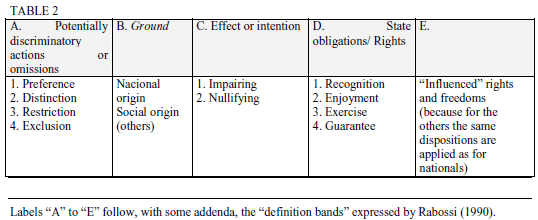
3.2.1 Definition of discrimination. The definition of discrimination is recognized as one of the most difficult questions; in fact, neither the Covenant nor the Convention define what discrimination is or give any examples in this regard. According to the Human Rights Committee20, the term discrimination should be understood in the sense that implicates any distinction, exclusion, restriction or preference which, based on motives such as race, colour, sex, language, national or social origin, etc., has the purpose or effect of 'impairing or nullifying the recognition, enjoyment or exercise by all persons, on an equal footing, of rights and freedoms (par. 7)
]]> The committee makes clear: (i) that the prohibition of discrimination is not only for conventional rights, but also for those recognized constitutionally or legally or in other international instruments21; (ii) that not all differences in treatment constitute discrimination, if the criteria for that differentiation are reasonable and objective and if the aim is to achieve a purpose which is legitimate under the Covenant (par. 13)The inclusion of the term 'distinction' (A.2) is interesting to clear the question concerning whether it is possible to make a valid differentiation (distinction) based on national, racial or even religious origin; i.e., whether the mention 'without any discrimination for reasons of…' means: (i) not to discriminate on the basis of those reasons or on the basis of the long list of etc. but (ii) to 'distinguish' using such grounds, to fill, for example, the limitations clauses (race as an argument to limit a right for reasons of national security). Let us see.
Art. 7 on the International Migration Convention (a modern specificity) states:
State parties undertake, in accordance with the international instruments concerning human rights, to respect and to ensure to all migrant workers and members of their families within their territory or subject to their jurisdiction the rights provided for in the present convention without distinction of any kind such as sex, race, colour, language, religion or conviction, political or other opinion, national, ethnic or social origin, nationality, age, economic position, property, marital status, birth or other status.
Note the emphasized difference: whereas the AC establishes that rights will be guaranteed 'without any discrimination', the IMC states 'without distinction', the same as Comment nº 18 of the Committee. In case such orientation was not clear enough, that difference is ratified in the Fact Sheet elaborated by the United Nations High Commissioner for Human Rights for the International Migration Convention: "… States parties should respect and ensure the rights contained in the Convention without distinction of any kind22..." . Moreover, this enumeration broadens those which can be found in any other Human Rights instrument, by including economic position, marital status or property.
In the integrated interpretation, it is possible to conclude that, by using the term 'distinction', it indicates that to make a differentiation on any of the pointed out grounds is discriminatory; with the only exception, of course, of those suppositions pointed out by the IACtHR in its OC-18/03 (differentiation to remedy factual inequalities; limitations in the exercise of certain political rights).
Art. 1.1. must, therefore, be read as follows:
State Parties … undertake to respect the rights and freedoms recognized in the present Convention and to guarantee its free and full exercise to every person subject to its jurisdiction, without any discrimination, distinction, preference or exclusion for reasons of race, colour, sex, language, religion, political opinions or of any other kind, national or social origin, economic position, birth or any other social condition such as marital status or property with the intention or effect of impairing or nullifying the recognition, enjoyment, exercise and guarantee of the rights recognized in this convention, in any other international instrument (art. 29.b AC) or in the Internal law of State parties (OC-4/84, par. 53-54).
3.2.2. The "distinction" and its elements.
Given that not all the distinctions in treatment (understood, according to the parameters established in OC 18/03, as what is admissible by virtue of being reasonable, proportionate and objective23) can be considered offensive of such human dignity, 'a distinction is only discriminatory when it has no objective and reasonable justification'. How can we evaluate if such justification is 'objective' and 'reasonable'? All in all, in such evaluation lies a state's authorization to carry out differentiations based in the condition of foreignness or, another example, in the migration situation.
]]> The existence of such justification must be evaluated with regard to the intention and the effects (definition band 'C' in table 2); moreover, it must be 'adequate': it could be objective and reasonable but, in virtue of the context, not be adequate. The effects of the measure in consideration are evaluated, then, taking into account, for all these characteristics, the principles that normally prevail in democratic societies. In this regard, the European Court of Human Rights (ECtHR) has said that not only must it pursue a legitimate end: the principle is equally violated when it is established in a clear way that there is no relation of reasonable proportionality between the means that are used and the end that is pursued24.
The case law of the Human Rights Committee (GC-18) and the consultative opinion nº 4/84 of the IACtHR allows us to point out other elements that an integrative interpretation in accordance with art. 30 of the American Convention point out for consideration. Not only must it (i) be reasonable; (ii) be objective and (iii) pursue a legitimate end but also it must be (iv) proportionate (which includes the administrative and judicial application on the part of authorities) and (v) adequate, it must take into consideration (vi) the prevailing principles of a democratic society (which makes this principle a parameter and not an autonomous ground for restriction); (vii) and also those which derive from respect for human rights (pointed out also in the OC-18/03, paragraph 105): it must not diminish the essence of the right or other recognized rights ('principle of consistency'). Lastly, it must fulfill the requirements of (viii) necessity, because it is not enough that it serves the permitted purposes, it must also be necessary to protect them and (ix) lesser harm, according to which it must be the less intrusive instrument among those which could achieve the desired result. These limitations, dispersed in different instruments and the case law of the organs, are cumulative.
3.3. The margin of appreciation of states.
The theory of the 'margin of appreciation', emerging from the ECtHR, does not have a precise formulation; in fact, it was not originated in the text of the convention but it has been developed by different organs of the system. According to Benvenisti (1999), it is based "on the notion that each society is entitled to certain latitude in resolving the inherent conflicts between individual rights and national interests or among different moral convictions". This is one of the aspects implicated in the notion of doctrine, identified by Letsas (2006) as the substantive concept as opposed to what is called the structural concept, which is related with a kind of judiciality in favor of the states, on the part of the European Court. The former, which interests us more, emphasizes the interrelationship between individual liberties and collective goals. According to the same author, the margin of appreciation is usually linked to two ideas: (i) the adoption of measures, prescribed by law and by state authorities, with a view to achieve the collective objectives, is justified; (ii) although such measures may interfere with the fundamental liberties of individuals, such interference does not constitute a violation of the Human Rights.
The situation in which this is most clearly exposed is, precisely, the so called limitation or accommodation clauses, which give states a power or margin of appreciation to interfere with the fundamental liberties. In this respect, the author summarizes the steps taken by the Strasburgh organs to know whether a limitation is permissible: (i) first, to determine whether there has been an interference with a liberty recognized in the Convention; (ii) to establish whether such interference is prescribed by law; (iii) whether the aim of the interference falls within the list of legitimate aims mentioned in the limitation clauses; (iv) whether the interference is proportionate or 'necessary' in a democratic society. In the American Convention we find examples of these clauses, some under the shape of exercise 'in accordance with law' (and only subject to what art. 30 in the same convention establishes, that is, law coming from Congress, passed for the general interest and with the aim for which they were established, OC-6/86), others including that they must also be necessary for certain legitimate objectives, such as guaranteeing public security, the rights and freedoms of others, etc. These have been summarized in table 1.
]]>
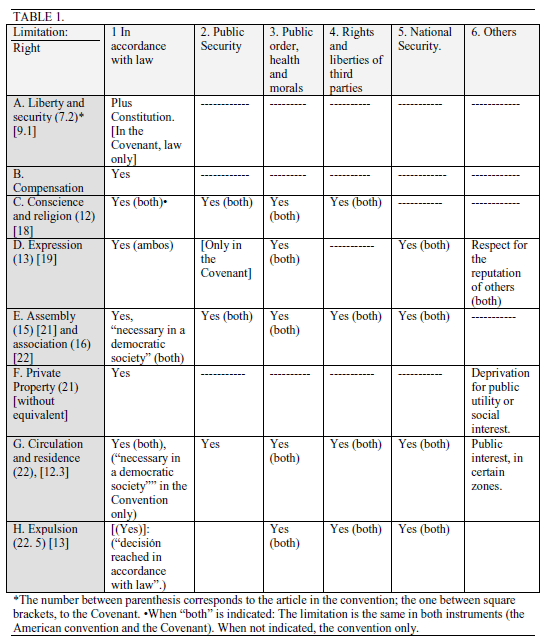
Of the rights listed therein, those included in art. 13 and 21 in the AC, along with the prohibition of arbitrary interference in private life (art. 14 IMC) cannot be restricted on the grounds of migration or foreignness condition. In the same way, the right to freedom and personal security (art. 16 and 17 IMC), but not to freedom of circulation (art. 39 IMC) must be guaranteed regardless of the migration situation contrary to what happens with the right of assembly and association (art. 26 and 40 IMC). In conclusion, bearing in mind those suppositions in which the restriction is based on the condition of alien or on the migration situation (which implies a distinction with regard to nations or a differentiation between legals and illegals), to know whether a limitation of this kind is permissible, not only do we verify the existence of steps (i) to (iv) mentioned in this section (interference in a recognized freedom, prescribed by law, according to a clause or legitimate intention, etc.), but also that point (iv) also includes the mentioned requirements such as (i) to (ix) in the previous section (reasonability, objectivity, adequacy, etc.)
The key point in the recognition of rights has two central cores: economic, social and cultural rights, on the one hand, and those connected to physical liberty, on the other; we will deal with this last aspect in the next section.
4. The right to personal liberty and expulsion25.
4.1. The right to personal liberty
Does the detention of a foreigner admit the same condtions as that of a national or is there a reasonable distinction that could be grounded on foreignness? And on the condition of illegality? How is the margin of appreciation of a state constructed in its case, when only illegal migrants can break these administrative laws?
We should remember that (the exercise of) the right to physical liberty may be suspended in exceptional situations, for example, when 'the life of a nation is in danger'.
]]> Art 7 in the AC itemizes certain components of personal liberty that are recognized to 'every person', so that no legal distinctions are possible on the basis of any categorization as a foreigner: the right to freedom and personal security (7.1), to be informed about the grounds of detention (7.4), to be taken without delay before the pertinent judicial authority (7.5), to habeas corpus (7.6), along with the prohibitions of arbitrary arrest (7.3) or for debt (7.7). The only exception refers to the causes and conditions of deprivation of physical liberty (7.2), which must be established in advance (principle of legality) by the constitutions or by the laws passed in accordance with them. In the absence of specific regulation, such restriction must be: (i) in accordance with the law, (ii) dictated for reasons of general interest, (iii) with the purpose for which they have been established (art. 30 AC).For its part, article 16 in the International Convention on the Protection of the Rights of all Migrant Workers and Members of their Families recognizes the right to personal liberty regardless of the migration status, only subject to what the laws stipulate. These laws are clearly not those on migration matters (because, otherwise, we would be faced with a circular question), which implies, likewise, that the mere condition of alien or illegal cannot be used to specify, in a specific case and for this right, the requirement of general interest that art. 30 in the AC establishes.
The IMC devotes two sections specifically to administrative detention to provide different accommodation for criminal offenders (17.3) and make it clear that the expenses for the proceeding that originated in the infraction of migration rules shall not be born by the worker (17.8). For the other suppositions that lead to a detention, the Convention makes it clear that they must have the same rights as nationals who find themselves in that situation (17.5, 17.7). Administrative detention, understood as the deprivation of freedom of a person ordered by administrative authorities – not the judicial ones -, without any criminal charge on the imprisoned or detained person, must only take place in the cases when it is strictly necessary and for the shortest time possible but a revision of the situation also means that, if the application of another measure other than detention is possible, the former must be considered rather than the latter26.
Even though the IMC says nothing about the reasons for detention or the laws that regulate them (it refers only to the consequences), we must bear in mind some more premises. In the first place, requirements (i) to (ix) explained in section 3.2 must be fulfilled. All that, on account of the detention being due to the simple circumstance of being an irregular migrant (and under no circumstances for those in a regular situation) and, in any case, it is necessary to analyze case by case whether the detention in particular is in accordance with reasons of general interest, because it is not enough that the law is: discrimination also takes place when the concrete application results in impairing the enjoyment of a right – and with the purpose for which such detention has been established (art. 30 AC). Once done, the remaining parameters come into play because it may normally happen that the detention of an irregular migrant is in keeping with reasons of general interest or with the purpose of guaranteeing the fulfillment of an expulsion or deportation sentence (such is the purpose of the detention; different cases would be those in which public health is at stake, because such reason would be regardless of status of national or foreigner, regular or irregular) but not be reasonable in virtue of, for example, the situation of the person on which the regulation is intended to be imposed (the support of the family). And even then, it remains to analyze, according to the same requirements, the pertinence of such expulsion or deportation.
In the second place, we must remember that detention is just a measure to guarantee the implementation of another such as expulsion or deportation. The principles that regulate the administrative detention are similar in the case of refugees. Pejic (2005) also indicates, that (i) administrative detention is not an alternative to criminal action, but 'a measure of control that may be ordered for security reasons in armed conflict', 'or for the purpose of protecting state security or public order in non-conflict situations' (p.361); (ii) it can only be ordered on an individual case-by-case basis and without discrimination (since 'a State's en bloc, non-individual detention of a whole category of persons could in no way be considered a proportional response, regardless of what the circumstances of the emergency concerned might be'); (iii) it must stop as soon as the motives that originated it disappear; (iv) it must be in accordance with the principle of legality. It has guarantees, for example, to be registered and remain in an officially recognized place.
In short, this is the reasoning that backs the statement that the right to freedom and the protection against the deprivation of liberty must be guaranteed to every person under jurisdiction of a State without discrimination. The juridical classifications according to migration status cannot create fictions such as that of 'excludable foreigners': we know that internal law cannot be invoked as justification for the failure to perform a treaty (art. 27 VCLT). Precisely for the case of the USA and the detainees in the Guantanamo Bay Naval Base, the US Supreme Court rejected the argument of 'legal loophole' (by which they did not even have the right to habeas corpus) and expressed the view that people imprisoned in the Bay have a right to defense and to appeal the lawfulness of their detention27.
4.2. Expulsion: art. 22 in the AC.
The American Convention deals with the right of foreigners not to be expelled in sections 6, 8 and 9 in art. 22:
(…) 6. An alien lawfully in the territory of a State Party to this Convention may be expelled from it only pursuant to a decision reached in accordance with law.
8. In no case may an alien be deported or returned to a country, regardless of whether or not it is his country of origin, if in that country his right to life or personal freedom is in danger of being violated because of his race, nationality, religion, social status, or political opinions.
]]> 9. The collective expulsion of aliens is prohibited.These regulations leave out aliens in an illegal situation again and, taken literally, would they allow the expulsion of a migrant in an irregular situation to be executed not in compliance with the law? (section 6). The covenant devotes a specific article (number 13), which reproduces section 6 but is more favourable insofar as it adds 'except where compelling reasons of national security otherwise require, be allowed to submit the reasons against his expulsion and to have his case reviewed by, and be represented for the purpose before, the competent authority or a person or persons especially designated by the competent authority'.
The correct interpretation indicates that even for persons subject to the jurisdiction or the territory of a state party of the American Convention, and even when this last instrument does not expressly envisage it, under the Inter-American system aliens in an irregular situation must be allowed to express the reasons against their expulsion (art. 29.b AC).
Likewise, until such time as the said revision is done, they shall have the right to request that the execution of the decision of expulsion is suspended (art. 22.4 IMC): in this case the right to information on this right (art. 33 IMC) in a language they understand (art. 18.3 IMC) is vital and in any case, they shall always be given the necessary time to settle 'any claims for wages and other entitlements due to him or her and any pending liabilities' (art. 22.6 IMC), a most pertinent specification given the abuses they are subject to, both on the part of those who employ or hire them and state authorities.
On the other hand, it is clear that in the light of the said articles, the expulsion of aliens, either regular or irregular, is forbidden: (i) if it is collective, since 'each case of expulsion shall be examined and decided individually' (art. 22.1 IMC); (ii) if their right to life or personal liberty is in danger of being violated in case of expulsion or deportation to any country.
Moreover, the fact that this principle (of non-refoulement) belongs to the domain of ius cogens allows us to expand the protection envisaged in these instruments to the extent that they become erga omnes obligations regardless of the fact that the obligated states are party to the Covenant or to any of the conventions: (iii) to the motives that originate the risk of violation (race, nationality, religion, social status or political opinions) is added the membership of a certain social group (art. 33 in the Convention relating to the status of refugees of 1951), (iii) the prohibition of rejection in the borders when such risk exists; (iv) the prohibition of expulsion or deportation in any case, and even in the borders, when there are strong reasons to believe that the alien would be in danger of being subject to torture (art. 3 Cartagena Declaration on Refugees28).
All this plexus of rights and guarantees that complement the principles coming from international humanitarian law establish the correct interpretation of the prohibition of expulsion of any foreigner even under the Inter-American system and even if the state in question is not party to the Migrant Convention, since such guidelines specify the content of the said right (stated in the American Convention as a simple prohibition) for these cases: the corpus iuris of protection.
5. By way of conclusion.
Dealing with imagined and felt human lives, one will accept no figures of starvation as all right, no statistics of passenger safety as low enough.
]]> Nussbaum.In migration as a 'phenomenon'
and the migrant as a subject converge the fundamental crises from a transition time towards a goal not yet determined; mainly the blurriness of the sense of national borders and its satellite concepts (nationality, citizenship, etc.) cause the designation of foreigner to lose its point of reference;
the majority of migrant workers who are attracted by volatile capitals like a lighthouse – even if they get burnt, even if they die in the journey, even if the economic order receives them whereas the juridical and social order expels them- are a postmodern reproduction of a homo sapiens who also migrates to survive. As if that was not enough, fortifying the borders and auscultating aliens has become a question of 'national security', in which there are plenty of statements, referring to the margin of appreciation of States, such as "where the aim is protection of national security, the margin will normally be a wide one" (Leander v Sweden (Ser. A) 116, 43). As the IACtHR has stated, 'it is possible to identify circumstances in which considerations of public welfare may justify departures to a greater or lesser degree' but they must not stray away from considerations of reasonability, objectivity and legitimate purpose (OC-4/84, par. 56-58) or from the integral protection of a person's rights.
The transition from an international system into a world system must be born in mind when interpreting the margin a state has to distinguish or restrict, not the recognition, but the exercise of a right to aliens present in its territory or under its jurisdiction, if they used to be an isolated case or, we should say, temporary (at least as part of the theoretical framework of national states), today the assiduity, number and animus quedandi must enlighten a perception and a juridical order in keeping with it where there are few elements missing for them to be The Other or Our Dark Object of Fear. Moreover, this supports our position extremely in keeping with the requirements that the State must fulfill in order to validly give a different treatment to aliens in relation to its nationals: an interpretation 'according to the times' of the 'living' instruments of Human Rights (IACtHR, OC-16/99). Finally, the most favourable regulations in the International Migration Convention, in the pertinent agreements of the International Labour Organization (Numbers 97, 143, 118, 157), the related recommendations and other international instruments, constitute interpretation guidelines (or its corpus iuris of protection) for the precision of migrants rights under the American Convention29.
As we have mentioned, the IACHR specifies that even though states have a wide margin of discretionality over migration matters, this does not imply that this power is not subject to international obligation with regard to Human Rights30 or that they must stray away from the previous considerations (OC-4/84, par. 58). The said guideline is clear and does not admit reservations for some rights: state discretionality over immigration matters has limits, inasmuch as a State cannot, for example, implement policies based on racial discrimination31.
Bibliography
Benvenisti, Eyal (1999), "Margin of appreciation, consensus, and universal standards", International Law and Politics, Volume 31:843. Available at: http://www.law.nyu.edu/journals/jilp/issues/31/pdf/31v.pdf
Bustamante, Jorge (2003), A virtual contradiction between migration and human rights. Serie población y desarrollo number 36. CELADE-CEPAl, Santiago de Chile.
Carbonell, Miguel (2003), "La igualdad y los derechos humanos" in Miguel Carbonell (comp.), El principio constitucional de igualdad, Mexico: Comisión nacional de Derechos Humanos, p. 9-30.
castles, Stephen (2004), "The factors that make and unmake migration policies", International Migration Review, October 1, 2004. Volume 38, Issue 3.
Choudhury, Tufyal (2003), "INTERPRETING THE RIGHT TO EQUALITY UNDER ARTICLE 26 OF THE INTERNATIONAL COVENANT ON CIVIL AND POLITICAL RIGHTS", European Human Rights Law Review, 1, 24-52.
Cornelius, Wayne (2005), "Controlling 'unwanted' immigration: lessons from the United States, 1993-2004", Journal of Ethnic and Migration Studies, July 1, 2005. Volume 31, Issue 4.
De Zayas, Alfred (2005), "Derechos humanos y detención por tiempo indeterminado", Revista Internacional de la Cruz Roja", March 2005, Number. 857, p. 17-42.
Dobkin (2006), "The diminishing prospects for legal immigration: Clinton through Bush". Saint Thomas Law Review, Winter 2006.
Donovan, Thomas (2005), "The American Immigration System: a structural change with a different emphasis", International Journal of Refugee Law, September, 2005,
THE AUTHOR, (2005) "En las fronteras. Migración y derechos humanos en el nuevo orden jurídico internacional", in Migración y Derechos humanos, Mexico: Comisión Nacional de Derechos Humanos del Estado de México, p. 9-40.
Feller, Erika (2006), "Asylum, migration and refugee protection: realities, myths and the promises of things come", 18 International Journal of refugee Law, 509.
Galbraith, John (2004), Estados Unidos y el fin de la hegemonía, Conversaciones con Jorge Halperín. Capital Intelectual, Buenos Aires.
Jus, Satvinder (2004), "Free movement and the new world", 16 International Journal of refugee Law, 289.
Kerwin, Donald (2005), "The use and misuse of `national security` in crafting U.S. refugee and immigration policies", 17 International Journal of refugee Law, 749.
Lacomba, Joan (2001), "Teorías y prácticas de la inmigración. De los modelos explicativos a los relatos y proyectos migratorios", Revista Electrónica de Geografía y Ciencias Sociales, Universidad de Barcelona number. 94, August 1, 2001. Available at: http://www.ub.es/geocrit/sn-94-3.htm.
Letsas, George (2006), "Two Concepts of the margin of appreciation", 26 Oxford Legal Studies, 705.
Mitchell, Christopher (2002), "The significance of the September 11, 2001 terrorist attacks for United States-bound migration in the Western Hemisphere", INTERNATIONAL MIGRATION REVIEW, June 30, 2002, Volume 36; Issue 1
Pejic, Jeleana (2005), "Principios y garantías procesales relativos al internamiento o detención administrativa en conflictos armados y otras situaciones de violencia interna", Revista internacional de la Cruz Roja, selección de artículos en Español, pp. 355-376.
Peñas, Francisco Javier (1997), "Liberalismo y relaciones internacionales: la tesis de la paz democrática y sus críticos", in Isegoría. Revista de Filosofía Moral y Política, number. May 16, 1997, p. 119-140
Perez Luño, Antonio Enrique (2002), La universalidad de los derechos humanos y el Estado constitucional, Number. 23, Serie de Teoría Jurídica y Filosofía del Derecho. Bogotá: Universidad del Externado de Colombia.
Raffin, Marcelo (2006), "La modernidad como problema" in Marcelo Raffin (comp.), El tiempo mundo contemporáneo en la teoría social y la filosofía, Buenos Aires: Proyecto Editorial, p. 11-20.
Rogers, Nicola (2003), "Inmigration and the European Convention on Human Rights: are new principles emerging?", European Human Rights Law Review, 1, 53-64.
Rosenau, James (1997). "Demasiadas cosas a la vez. La teoría de la complejidad y los asuntos mundiales", Nueva Sociedad, number. 148. p. 70-83.
Ruiz Miguel, Alfonso (2003), "Sobre el concepto de igualdad" in Miguel Carbonell (comp.), El principio constitucional de igualdad, México: Comisión nacional de Derechos Humanos, p. 31-68.
Santillo, Mario, "Balance de las migraciones actuales en América Latina". Available at www.cemla.org.ar
Simonoff, Alejandro (2006), "La política exterior argentina reciente, con especial énfasis en la relación con Brasil y Estados Unidos", in Transitando los inicios del siglo XXI. Las relaciones internacionales de Argentina, Chile y México, Nuevo Hacer, Buenos Aires, p. 69-95.
Teitelbaum, Michel (2001), "The role of state in international migration", The Brown Journal of World Affairs, Winter 2002 – Volume VIII, Issue 2.
Tello, Ängel (2006), "Repensando la estrategia: defensa y seguridad en el Cono Sur", in Transitando los inicios del siglo XXI. Las relaciones internacionales de Argentina, Chile y México, Nuevo Hacer, Buenos Aires, p. 23-34.
]]>Tulchin, Joseph, (2004), "América Latina en el sistema internacional", Agenda internacional number. 2, p. 32-43. Year 1, Number 2, September/October/November 2004.
Wallerstein, Immanuel (2006), La decadencia del poder estadounidense, Capital Intelectual: Buenos Aires.
Wolfrum, Rüdiger (1998), "Discrimination, Xenophobia and Racism", in Janusz Symonides (ed.), Human Rights: New Dimensions and Challenges, UNESCO: Paris.
Abbreviations.
"AC" or "the Convention" American Convention on Human Rights. ]]>
"HRC" Human Rights Comittee (an organ of the ICCPR).
"IACHR" Inter-American Comission on Human Rights
"IACtHR" Inter-American Court of Human Rights.
"ECtHR" European Court of Human Rights.
"AD" American Declaration of the Rights and Duties of Man.
"IHRL" International Human Rights Law.
"UDHR" Universal Declaration of Human Rights.
"GC", General comment, jurisprudence of the organs of protection of instruments issued under the auspices of the United Nations
"IMC" or "International Migration Convention" International Convention on the Protection of the Rights of all Migrant Workers and Members of their Families.
"OC-18/03" Advisory opinion OC-18/03 of September 17th 2003, "The juridical condition and rights of undocumented" (issued by IACtHR). ]]>
"OC-16/99" Advisory opinion OC-16/99 of October 1st 1999. Series A No. 16. "The Right to Information on Consular asístanse in the framework of the guarantees of the Due Process of Law" (issued by IACtHR).
"ICCPR" or "The Covenant" International Covenant on Civil and Political rights.
1 As acknowledged by Profesor Lacomba (2001), 'significant changes have taken place in the last three decades as regards the conceptualization of the frameworks and theoretical models of the migration phenomenon'.
2 Tulchin (2004), for its part, maintains that the attacks in 2001 are not responsible for the unilateralization and isolation of the Bush agenda: the administration was already unilateral and isolated and so it remained alter the attacks.
3 The zero-tolerancy policy was aimed at the employees of the National Immigration Service after a rather confused episode in which four Pakistanis obtained visas from a migration officer who later disappeared. This caused the extension of the practice, among officers, of requesting RFEs (Requests for evidence), that is, requests for further documentation and proof of the assertions made in the application form, which in the end made the INS collapse. As a result, the director stipulated that officers were allowed to reject applications without further procedures and, especially, without requesting any RFEs, which resulted in the acknowledgement, faced with an avalanche of appeals, that all that was not working and both dispositions were annulled (see Dobkin, 2006).
4 The official title of the 2001 USAPA is: Uniting and Strengthening America by Providing Appropriate Tools Required to Intercept and Obstruct Terrorism (USA Patriot Act) Act of 2001
5 Information provided by the Government of the United Status Web site: http://www.state.gov/p/wha/rls/fs/22905.htm
6 Broadly speaking, the former includes: (i) severe descriptions for those who looked for the 'United States Relief'; (ii) the establishment of federal standards for the issuing of drivers' licenses; (iii) providing the authorities of the United States Department of Homeland Security with what is necessary for the construction of physical barriers along the American frontiers. The latter is devoted exclusively to measures to strengthen the protection of 'border and interior enforcement', including a significant strengthening of sanctions against employers; it orders the electronic verification of social security and of foreign registry numbers for all hired workers within five years of the enactment of the law. ]]>
7 Quoted by De Zayas (2005).
8 Human Rights Committee, General Comment No. 15 (1986), "The position of aliens under the Convenant", paragraph 2.
9 Inter-american Court of Human Rights, OC-18/03 September 17, 2003, requested by the United Sates of Mexico "Condición Jurídica y derechos de los migrantes indocumentados".
10 Cornelius (2005) and Castles (2004) present a panorama, for the United States and the general design of migration policies respectively, on the reasons for the failures of such policies, placing them on certain misunderstandings ("migration mainly determined by market forces", "state migration control efforts still follow[ing] a national logic, while many of the forces driving migration follow a transnational logic", Castles).
11 United Nations General Assembly, Res. A/RES/54/166, "Protection of migrants", 24/01/00.
12 In this sense, the IACtHR has stated, for example, that the prohibition of torture in all its forms is absolute, complete and unrepealable: it is part of ius cogens (Corte IDH, Caso de los Hermanos Gómez Paquiyauri. Sentence of July 8, 2004. Series C No. 110, paragraph 112; Caso Maritza Urrutia. Sentence of November 27, 2003. Series C No. 103, paragraph. 92).
13 The "suspension of rights", as it is generally known, takes place under state of exception (only 'war, public danger or other emergency that threatens the independence or security of a State Party' –art. 27.1 AC- or, in general and according to the Covenant, exceptional situations 'which threaten the life of a nation', art. 4) and it is, actually, a suspension of the obligations by the state, which means, in short, a suspension of the exercise of the rights that the state of exception determines and not, a suspension 'of rights' (which has important implications when it comes to authorize the judicial proceedings to evaluate the suspension). This possibility of suspension is limited by two fundamental dispositions: (i) Art. 27.1 final (similar to Art. 4 in the Covenant), limitation to the requirements of the situation, they must not be incompatible with the other obligations imposed by International Law and they must not involve discrimination on the ground of race, colour, sex, language, religion, or social origin; (ii) it establishes a set of rights whose exerciswe is not suspendible and ergo, the States may not abandon their obligations as regards them, not even in an exception situation duly notified: these are the rights listed in art. 27.2 AC (concordant with 4.2. in the Covenant).
14 It must be noticed, with regard to this point, that according to the Covenant, the guarantees would be susceptible of suspension, a question we will deal with later.
15 When we say restriction we refer to that limitation which operates on a 'normal' situation.
16 In this telesis, the modern production has emphasized the equality of legal and illegal migrants (IACtHR, OC-18/03, for example) and has limited the list of rights in which a State may limit those recognized to undocumented workers (Part IV, IMC), facing two important obstacles: the reluctant attitude of States to bind themselves to the International Migration Convention, the proportion of discretionality to establish 'laws' that use one or the other parameter (foreignness, legality) to establish valid distinctions or fill the contents of the limitation clauses. ]]>
17 IACHR, Report 51/01, Case 9903.
18 It could be assumed that not much can be said after OC-18/03 of IACtHR; in fact, what the Inter-American Court acknowledged in the said Opinion is the ius cogens nature of the principle of equality and non-discrimination (paragraph 101), and it referred exclusively to the (administrative) migration situation: the implementation of equality does not depend on migratory status (paragraph 118) and does not hinder, all in all, granting a different treatment to documented as opposed to undocumented or 'between migrants and nationals' (paragraph 119), if it does not infringe on that principle.
19 The difference between 'discrimination' and 'distinction' is a criterion that the IACtHR includes in the OC-18/03, according to which "the term distinction will be used to indicate what is admissible, because it is reasonable, proportionate and objective. Discrimination will be used to refer to what is inadmissible, because it violates human rights' (paragraph 84).
20 General Comment No. 18, "Non discrimination", 10/11/89.
21 See Choudhury (2003).
22 Office of the United Nations, High Commissioner for Human Rights, "The International Convention on Migrant Workers and its Committee", Fact Sheet No. 24 (Rev.1).
23 IACtHR, Consultative Opinion OC-18/03, paragraph 84.
24 ECtHR, Case Relating to certain aspects of the laws on the use of languages in education in Belgium, Judment of 23rd July 1968, Series A 1968, paragraph 10.
25 In its original version, this work also included guidelines regarding freedom to enter, leave, circulate and reside in a territory, as well as judicial guarantees for the cases of alien detention. They have been eliminated for space reasons.
26 Working group on arbitrary detention, Report E/CN.4/1999/63/Add.3. ]]>
27 Al Odah et. Al. C. United Status (No. 3-343), 2004. Quoted by De Zayas (2005), p. 17.
28 In the American sphere, the Cartagena Declaration in 1984 and the Declaration of San José in 1994, though adopted verbally, are recognized both as fundamental interpretation guidelines for the implementation of the rule and as pillars of the protection of refugees in Latin America.
29 This arises from the leading case "Villagrán Morales c. Guatemala", better known as Niños de la Calle, sentence of the American Court of Human Rights of the year 1999, paragraphs 190-191.
30 IACHR, Report 51/01, case 9903.
31 European Convention on Human Rights, case Abdulaziz, Cabales and Balkandali v. United Kingdom(1985).