Segregação social como externalização de conflitos ambientais: a elitização do meio ambiente na APA-Sul, Região Metropolitana de Belo Horizonte
Klemens LaschefskiI; Heloisa Soares de Moura CostaII
IProfessor of Geography at the Department of Geography and the Graduate Course of Rural Extension at Federal University of Viçosa (UFV) in Brazil
IIProfessor at the Graduate Course of Geography at Federal University of Minas Gerais (IGC/UFMG) and a CNPq researcher
Translated by Elizabeth Abdanur and Leonardo Brito. ]]> Translation from Ambiente & sociedade, Campinas, vol.11, no.2, p.307-322, 2008.
ABSTRACT
This paper deals with power relations within the consultative council of APA-Sul, a conservation area situated in the Metropolitan Region of Belo Horizonte. About this council, it has been observed that the popular sectors are underrepresented and the higher middle class representatives are concerned about the "slumization" of the region. Consequently, an environmental conflict arises around the loss of environmental quality in the area which is partly associated with the emergence of low income settlements. This equation creates opportunities for discourses that try to justify social segregation in the area and the elitization of the landscape at stake.
Keywords: Environmental conflict. Production of space. Conservation area. Urbanization. Social segregation.
RESUMO
Este trabalho trata das relações de poder no conselho consultivo da APA-Sul, uma unidade de conservação localizada na Região Metropolitana de Belo Horizonte. Observa-se uma sub-representação dos setores populares, e os representantes de renda média-alta temem a favelização da região. Conseqüentemente, o conflito ambiental surge em torno da perda da qualidade ambiental nas referidas áreas, em parte associada às alternativas de habitação popular, abrindo oportunidade para discursos que justifiquem a segregação social no espaço e a elitização da paisagem em questão.
Palavras-chave: Conflito ambiental. Produção do espaço. Unidade de conservação. Urbanização descontrolada. Segregação social.
1 Introduction
From the beginning of the 1990s, the term ‘sustainable development' has become a paradigm for public policies trying to interweave together environmental, social and economic issues. In this context new forms of territorial planning and management have emerged, which involve the mobilization of local knowledge, the creation of dialog structures, and negotiation. An example of this type of planning is the category, belonging to the National System of Conservation Units (Sistema Nacional de Unidades de Conservação – SNUC), denominated Environmental Protection Area (Área de Proteção Ambiental – APA)1. This is a unit of sustainable use that has as its aim the protection of the biodiversity in the face of economic development, maintaining the social and environmental equilibrium. The implementation of APAs requires the creation of a consultative council, formed by representatives of the public and private sectors, and the civil society, with the purpose of conciliating the diverse necessities and interests. In this way, solutions to the socio-environmental conflicts are hoped to be found through the construction of a consensus on certain issues.
Without questioning the necessity of participation in general, what we observe, however, is that such initiatives face great difficulties in their achievement due to existent divergences between the rationalities and interests of the parts involved. The results frequently reflect the priorities of certain influential groups, who are often contradictory among themselves, but which, at the same time, reveal the power relations surrounding this field.
In this article, we intend to analyse these aspects from the example provided by the implementation of the Área de Proteção Ambiental Sul - APA-Sul (environmental protection area in the south of the metropolitan region of Belo Horizonte). We have mainly focused on the social segments represented in the council to investigate how this council influences in the territorial planning of the APA, which conceptions of space have become dominant, and finally, what the environmental conflicts are and how they have been treated in the region. We have based our analysis on the theoretical discussions that take place in the field of political ecology, combined with the concept of the 'production of space' by the philosopher Henri Lefebvre, and the concept of 'field' developed by the sociologist and anthropologist Pierre Bourdieu.
2 Theoretical Considerations
The emergence of trans-boundary environmental problems, during the 1960s, was followed by various social movements that questioned the rising alienation of modern industrial society in relation to nature. The environmental critique has not only gained strength in the international political context, as for instance, during the United Nations Conferences on Environment and Development in Stockholm in 1972 and in Rio de Janeiro in 1992, but it has also influenced epistemological debates within the scientific community. Among the many discussions in various academic disciplines which have been trying to shed new light on the ways we look at the relation between nature and culture, we would like to highlight the discipline of political ecology (Zhouri et al., 2005, p13). The authors who belong to this line of thought disregard the idea of nature as a neutral environment. According to them, the environmental degradation, as a result of the interaction between various actors and the physical environment, is a political process that, apart from influencing the economic situation in a positive or negative way, also reflects changes in the power relations of those involved.
An attempt to systematize the basic elements found in the diverse lines of thought of political ecology has been presented by Bryant and Bailey (1997). According to these authors, political ecology highlights the politicised environment, where the actors exercise power not only through the rights of property over the environment or the transference of environmental impacts to other actors, but also through the access and control over human and financial capital, the influence in the planning of environmental projects, and through discourse means. Within this context, the authors argue that weaker actors also have the opportunity to exercise power, mainly through local knowledge and the creation of networks, as well as through the elaboration of a counter discourse which questions the legitimacy of more powerful actors (Bryant and Bailey, 1997, p. 39-46).
]]> In this way, political ecology is preoccupied with the analysis of environmental problems within the socio-political context, focusing on the identification of environmental actors and their specific interests. The analysis includes the interdependency and divergences between the actors at different levels on the local-global axis, as well as the different rationalities that orient their actions and, finally, the impacts of such actions in the construction of the local environment. The changes are reflected in the environmental history of the region under investigation, so that the winners and losers of resource use conflicts can be identified. Acselrad (2004, p. 26) defined such environmental conflicts more precisely as being"…those involving social groups with different modes of territorial appropriation, use and signification, occurring when at least one of the groups has the continuity of the social forms of the environment they develop, threatened by undesirable impacts – transmitted through the soil, water, air or live systems – that come as a consequence of practices done by other groups."
Within this definition, it is clear that the territorial or spatial argument is the result of the relation between power and environment.
From this point on, it is possible to associate political ecology to Lefebvre's concept of production of space (Lefebvre 1991). In analogy to the environmental interpretation provided by political ecology, the author refuses to view space as something given, neutral, immutable, or an empty space in which things and objects are scattered around. On the contrary, the space is socially and politically constructed. Each society produces its own space, however, according to Lefebvre, the pre-industrial societies are submitted to be transformed by the capitalist system, which would finally be overcome by socialism. Differently from Karl Marx, at the peak of the process in which the Fordist industries restructured the productive process and made it more flexible, Lefebvre saw the revolutionary potential of social struggles not only in the social relations between the capitalists and industrial workers but, also in the post-industrial urban space.
Lefebvre differentiates, mainly in relation to the production of space in capitalism, between the abstract space, which is hierarchic, as a result of actions from those who intend to organize and control society (the political agents, the economic interest groups and the planners) and the concrete space, as a result of spatial praxis or everyday life. The latter materializes itself through actions coming from all members of society, including from those dominant actors.
The abstract space is the result of the advance of capitalism, which can be seen, on the one hand, in the tendency of making the space homogenised by subordinating it to the exchange value, making it as replaceable as any other commodity. On the other hand, and as a consequence of commercialisation, there is a fragmentation of space on the local level with the creation of plots of land or areas of private property, which are negotiated based on the rules of land rent, private property rights, and real estate speculation.
Although, even in the so called capitalist societies, the use of space is far from being a product of the invisible hand of the market. It is also constituted through the superposition of knowledge and power of the dominant sectors or, in other words, by the economic actors and by the State in its function of facilitating economic development. This happens because space, besides being a product or a commodity, is also a means of production, constituting an inherent contradiction of capitalism which results in the necessity of planning of this same space by the public hand The latter determines the areas for agricultural production or for urban expansion, for public areas or for cultural or environmental preservation, etc. Such decisions are not only based on the physical configuration of space, but also on the availability of technology and means of control (legislation, management plans, etc.). Finally, the market itself contradicts the tendency of the capitalist space to be homogenised, when the exchange value of a certain area depends on specific characteristics, or - in other words - on the use value, as for instance, in areas destined for tourism (Lefebvre, 1991).
Consequently, it is not possible to integrate in the abstract space, quantifiable, plannable and substitutable – which is the ideal result of capitalist industrialization – the qualitative aspects, or, in other words, the non-capitalist aspects, based on the use values. In the concrete social space, characterized by the ongoing transformation, there is always the tendency to surpass the formal limits and regulations of the abstract space conceived by the dominant actors. This occurs, for instance, when citizens fight against the construction of a motorway or claim more open areas destined for leisure or any other community activities, which creates contra-spaces to the system of capitalist production and to the unlimited expansion of the private.
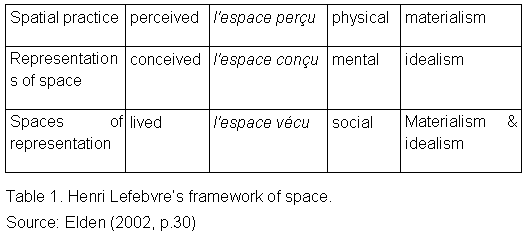
From these reflections, Lefebvre presented a conceptual triad as the base of social and political production of space (ELDEN, 2002, p. 30): the space in practice (the real, used space); the representation of space (the planned space, bureaucratic, abstract and represented in maps); and finally, the space of representation (the space produced and modified through time, through use, bearing symbols and meanings, the real and imagined space) (Table 1).
]]>
In this context, it's important to highlight the central role of planners and their conceptions of space represented in texts and maps, which, in general, are an abstraction of everyday life. When implementing these plans, such conceptions are projected in the lived space, turning the abstraction into something concrete, then there is a ‘double substitution, double negation which establishes an illusory affirmation: the return to real life' (Lefebvre, 1999, p. 167).
In the capitalist States in general, planning serves to conceive the abstract space in order to neutralize the heterogeneity of concrete space, through the absorption of non-capitalist means of production. Consequently, according to Lefebvre, the only possibility of reintegrating pluralism in a centralized State is the challenge posed by local actors, which are able to bring together local and regional powers to create, strengthen and, up to a certain degree, administrate territorial units (Lefebvre, 1991, p. 381-82). Under this context, social urban movements, fighting for counter-spaces, represent a revolutionary potential.
However, many authors argue that the political constellations today are more heterogeneous, and that this is due to the changes that have been happening in the last three decades under the decline of Fordism, which has been marked by the shift from liberal-progressive towards neoliberal-conservative political trends, and by the orientation of national and urban politics towards global processes. Apart from that, it is possible to observe the increasing relevance of social movements as actors within the rise of "global cities", where urban governments are transformed into urban governance structures, as so within the restructuring process of the State, whose role switched from its focus on processes within its national boundaries to a intermediary political and administrative position between the local and the global (Keil and Brenner, 2003). These processes have been accompanied by the creation of new forms of participation of civil society, with the consequence of an approximation of public institutions and social movements or Non-Governmental Organizations (NGOs), traditionally marked by opposed positions. Thus, the State and the so-called civil society need to be analysed not as fixed adversaries, but as actors whose relationships are subject to change (Magnussen, 1997; Keil and Brenner, 2003).
The tendency to experiment with forms of participation of the civil society in the elaboration of public policies has been intensified, especially, since the United Nations Conference on Environment and Development held in Rio de Janeiro in 1992 (UNCED 1992), when the notion of sustainable development was internationally recognized. The aim of this policy agreement is to conciliate the divergent interests (economic, social and environmental), seeking a consensus on the path towards the creation of a sustainable society. The most well known examples under this context are the initiatives for the elaboration of Agenda 21. However, the Brazilian SNUC (National System of Conservation Units) can also be seen in the same perspective, as it presupposes the creation of consultative councils for the formation of the conservation units of sustainable use, under which APA-Sul, analyzed in this paper, is inserted. We can understand these councils as new forms of space management, in which, at least in theory, there is the possibility of defending non-capitalist means of production within counter-spaces under a formalized political arena. Therefore, participative institutions might allow a certain relativism of the State as the dominant power determining the political, social and economic conditions of the production of space. However, new arenas in the power struggle arise, and they become theoretical challenges, particularly with respect to environmental and social problems which are transformed into negotiable interests, the representation of the latter, the discourses and strategies of the actors involved, and also the creation of new hierarchies. The relationships and alliances between actors frequently result in overlapping positions, which makes it increasingly difficult to identify distinct discourses in relation to their respective representatives.
The participative councils, however, configure social fields, which are defined by the French sociologist Pierre Bourdieu as loci where ‘…arises a competitive struggle between actors around specific interests that characterize the area in question' (quoted from Ortiz, 1983, p.19) It is in these social fields that power relations manifest themselves based on or starting from the social capital, which determines the reputation and position of those involved2. In this way, it is possible to differentiate dominant actors, or those who possess a maximum of social capital, and dominated actors, or those characterized by the lack or scarcity of specific social capital.
However, the social field is a dynamic structure in which the participants can win or loose their social capital and, consequently, go up or down in the hierarchy pyramid. Each social field produces specific social capital attributed differently to its members determining their hierarchic position and a habitus. The latter should be understood as a system of durable dispositions that configure the matrix of perceptions, appreciations and actions, which occur under the social conditions being established within the field. The habitus is a certain way by which actors present and behave themselves, and how they relate between them, functioning as
]]>‘…as principles of the generation and structuring of practices and representations which can be objectively "regulated" and "regular" without in anyway being the product of obedience to rules, objectively adapted to their goals without presupposing a conscious aiming at ends, or an express mastery of the operations necessary to attain them, and being all this, collectively orchestrated without being the product of the orchestrating action of a conductor.' (Bourdieu, 1977, p.72).
In this way, the habitus determines, partially unconsciously, the actions of agents and the modus operandi in the social field. Therefore, the field delimits a conflictive arena, where the agents struggle for power and position under its hierarchy, even though everyone shares certain common presuppositions, which order its functioning. The agents belonging to the dominant side, through their orthodox practices, intend to preserve intact its accumulated social capital, while the dominated agents try, through their heterodox practices and subversion strategies, to discredit the real possessors of legitimate capital, although, without contesting the principles orientating the structuring of the field. Bourdieu introduced the doxa notion to this group of presuppositions, which is tacitly shared and accepted by the orthodoxy and heterodoxy antagonists. It relates to the necessary premise for the functioning of the field in which the dominant and dominated actors behave as adversaries and at the same time as accomplices, so that through the permanent confrontation they delimitate the legitimate field of discussion. In this context, the heretic orthodox strategy functions as a reinforcement of the field's order ‘…because its opposition implicates the recognition of the contested interests' (Bourdieu, 1976, p. 32).
From the concepts discussed above, the new participative institutions can be understood as the artificial creation of conflicting fields, in which the diverse groups of interests struggle for power, for the domination of doxa, and for the hegemonic opinion divulged by the referred field. In the case of territorial planning, as predicted in the creation of APA-Sul, what is interesting above all is which representations of space by the different agents constitute the doxa for the conception of space, therefore influencing the production of space in APA-Sul. On the other hand, it is important to evaluate whether all the segments of society are really represented, or whether there are any that cannot enter the field. In the latter case, what the consequences are when the conception of space, elaborated by the council, is implemented, in other words, what the consequences in the lived space are.
Therefore, we hope that an analysis based on the concept of space by Lefebvre, and the concept of field by Bourdieu, can enrich the theoretical frameworks in political ecology, which focus the question of power in relation to environmental conflicts.
3 Environmental conflicts in APA-Sul
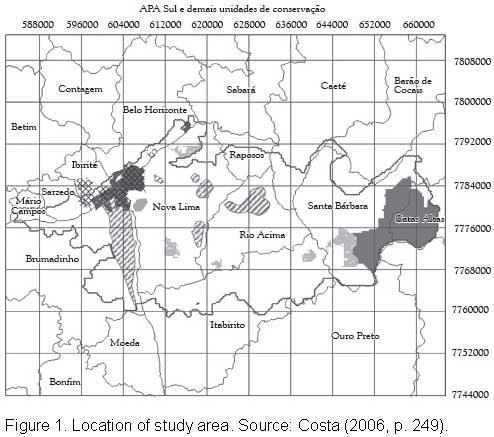
APA-Sul has an area of approximately 170,000 hectares, found in the hydrographical basins of River São Francisco and River Doce, in the south metropolitan region of Belo Horizonte. The thirteen municipalities with participation in the APA are: Barão de Cocais, Belo Horizonte, Brumadinho, Caeté, Catas Altas, Ibirité, Itabirito, Mário Campos, Nova Lima, Raposos, Rio Acima, Santa Bárbara and Sarzedo (Figure 1).
]]>
The region is of fundamental importance for water supply of approximately 70% of Belo Horizonte's population, and 50% of the metropolitan population. According to the Secretaria do Meio Ambiente e Desenvolvimento Sustentável do Estado de Minas Gerais – SEMAD (Secretary of Environment and Sustainable Development of Minas Gerais State), APA-Sul possesses one of the biggest continuous extensions of native vegetation coverage of Minas Gerais state (SEMAD 2006). A great variety of biotopes can be observed, including the rainforests of valley bottoms, forests of altitude, and large rock formations.
Around the eighteenth century, the first settlements appeared due to the mining exploitation, initially of gold, and later replaced by the extraction of iron. Up to now, the low population density in an area so close to Belo Horizonte is partially explained by the difficult access due to the rough terrain, especially in the Serra do Curral, a natural heritage of the city. Paradoxically the existence of preserved areas is explained by the presence of the mining companies, as they concentrated large properties of land in their hands, preventing them from urban occupation (Costa, 2003, p. 169). However, for the mining companies, the investments they have been making in real estate in the form of enterprises of individual home units in enclosed properties, generically known as condomínios (condominiums) (FOOTNOTE3), located in areas of great scenic beauty, are a new economic alternative in the face of the predicted exhaustion of minerals.
The proliferation of enclosed plots of land from private initiatives has, however, generated new conflicts besides the divergences between mining and the traditional dwellers of the old villages, which also involves issues such as the preservation of nature. Therefore, APA-Sul has had, as its challenge, the regulation and conciliation of divergent demands in relation to its territory.
4 The political field surrounding APA-Sul's creation
There are two institutions which are responsible for APA-Sul's management: the Conselho de Política Ambiental do Estado de Minas Gerais – COPAM (Council for Environmental Political Affairs of Minas Gerais state), which is a deliberative government body for issues related to the environment in general, and the consultative council of APA-Sul, which elaborates proposals for the planning and administration of this conservation unit. Both councils have a formal structure that predicts the participation of the state, the private sector and the so-called civil society. However, when considering the composition of the councils, one observes a strong representation of the state. In COPAM's plenary, there are fifteen representatives belonging to the public sector, four belonging to the private sector, eight from the technical and professional environmental sector, four from non-governmental environmental organizations (NGOs), and one from the trade unions. Whereas in the consultative council of APA-Sul, there are six representatives from the public sector (three representatives belonging to the State of Minas Gerais, and three from municipal governments), three representatives from business associations, and three members representing environmental NGOs. The concentration of power in the councils exercised by the state is even bigger when considering that some of the companies are state owned, and also that some of the NGOs have partnerships with companies in the private sector and with the state. Under this perspective, there is a strong approximation between the actors representing formally distinctive segments within society.
The creation of councils was the result of conflicts between the actors mentioned above, especially when environmentalists, during the 1970s and 1980s, radicalized the resistance against the advance of the economic sector in areas considered important to biodiversity or of high environmental quality. However, according to Carneiro (2005), in the case of COPAM it is possible to observe the successive disappearance of confrontations between the participant actors, explained by the establishment of a doxa, which constituted the tendency to consensual resolution of the cases under discussion. As a consequence,
]]> ‘…the game is transformed into a monotonous technical and "juridical" dispute about the degree of rigor to be applied in each case… Therefore, the development in almost all forums is repeated following the same pattern: after an initial period, in which the conflicts are more intensely disputed and questions about basic principles come to the surface, it is possible to witness the progressive routinization of procedures, the conversion of conflicts into an automatized functioning of a systematic judgment of cases.' (Carneiro, 2005, p. 77)
In relation to the creation of APA-Sul, a similar process has been observed. According to Freitas (2004), at the beginning of the 1990s various associations in the Macacos region4 were formed to denounce the ecological degradation caused by the implementation of infrastructure for and by the new real estate investments and mining activities. After the success in some of the denounced cases, a dialog was established between them, the environmental state bodies and the mining companies. As a consequence, movements got together to create the Conselho Comunitário de São Sebastião das Águas Claras (São Sebastião das Águas Claras Community Council), with the aim to elaborate proposals for land use planning in the region. The result was the presentation of the first proposal for the creation of an area of environmental protection to state agencies responsible for environmental policy, as the FEAM (Fundação Estadual do Meio Ambiente, the foundation for the environment of the State of Minas Gerais) and COPAM. In its turn, FEAM produced an enhanced proposal for the creation of the APA-Sul5. While at first the proposal was accepted by all the groups involved, the representatives of the mining sector and some local government leaders were concerned that the demarcation of the APA's limits would bring restrictions to the economic development of the region. In order to ease tension, the ‘First Seminar on the South Environmental Protection Area in the Metropolitan Region of Belo Horizonte' (‘1º Seminário sobre a Área de Proteção Ambiental Sul da Região Metropolitana de Belo Horizonte - APA Sul RMBH') was carried out in March 1993 with the participation of representatives from the business sector around the area, NGOs6, and from public institutions and local governments (FEAM, 1992 quoted from Freitas, 2004, p 101).
The environmental organizations evaluated the process positively, as ‘the main agents acting in the region had been identified and participated in the discussion'7. Although the discussion has reaffirmed the positions and conflict lines between the actors involved, the participants appeared to be open to continue the dialog in search of a consensus. Therefore, the seminar was the first step towards the consolidation of the field and its participants, having contributed to the acceptance of the APA proposal, however, without resolving the main conflict: the creation of the APA before or after the elaboration of the Ecological-Economic Zoning (EEZ, Zoneamento Ecológico-Econômico)8, which would be the basis for the organization of the space. The Brazilian Institute for Mining (Instituto Brasileiro de Mineração – IBRAM), together with other organizations representing the mining sector and some of the mayors of municipalities within the area were concerned that the approval of the APA, without first having a EEZ, could hinder the economic development of the region. However, the FEAM favoured the approval of the decree before the demarcation, in order to avoid a rapid degradation of the region. It is important to highlight that the Minas Gerais Association for Environmental Defence (Associação Mineira de Defesa do Meio Ambiente – AMDA), a NGO that has partnerships with the mining companies, had defended the first position, provoking quarrel and the rupture with the rest of the environmentalists.
After a long consultation process and the elaboration of preliminary studies, the APA-Sul was approved by COPAM in July 1994 (state decree no. 35.624). However, the impasse between the two positions was not resolved, because the decision had been conditioned to a timeframe of ‘…eighteen months, extendable from the publication of the decree for the macro-zoning' (FEAM, 1992 quoted from Freitas, 2004, p. 108). With this vague formulation, COPAM managed to consolidate the fields' doxa, as all the actors with their divergences could do their own reading of the decision to maintain their positions. In this way, there was a strategic freezing of the APA-Sul's implementation, while the mining and real estate sectors continued with their activity (Freitas, 2004, p. 122).
The APA's consultative council, with the participatory composition cited above, was finally constituted in July 1996 by the decree 38.1829. At the time, its main responsibility was to provide FEAM and COPAM with pre-evaluations that could give them the necessary support in the environmental licensing process for economic enterprises in the area. From then on, the conflicts between the representatives of the economic sector and environmentalists shifted from principal questions to the specific content and scope of the evaluation reports elaborated by the council. The environmentalist representatives managed to impose their positions, as the reports were not consensual within the council. As a consequence, COPAM, attending to a constellation of powers for the benefit of the economic interests, opted for not considering the evaluations of the consultative council in the processes of licensing within the APA-Sul.
After various claims of the environmental movements, the competencies of the consultative council were formalized by the resolution 027/1998 and by the normative deliberation number 45(07/2001). It was determined that the role of the council is ‘…to propose, examine, follow up and produce previous manifestation in relation to licensing and other acts of environmental resources intervention procedures, in the area of APA-Sul/RMBH, and according to current legislation'.
From then on, the consultative council adopted, in practice, a similar posture in relation to the licensing process from that of COPAM, which resulted in the approval of almost all licences, although, with a list of conditions referring to the unresolved issues10. In this way, as well as in the EEZ (Zoneamento Ecológico Econômico - Ecological Economic Zoning) issue, there is a tendency to transfer the conflicts to the subsequent steps in the mentioned administrative processes, which frequently results in these issues being never solved. (Zhouri et al., 2005)
It has been observed along the years, a certain habitus practiced by the agents of the field of environmental policies, which consists of not putting at risk the specific advances generated during the field consolidation. This is reflected in a propensity to exclude the radical positions and to promote consensual decisions, avoiding contradicting the interests of the orthodoxy, which includes the mining companies, some sectors of the government and environmental organizations linked to the previous two. On the other hand, the council promotes strategies of environmental adequation and demonstrates a certain care with ecological issues, for instance, the EEZ matter. Therefore, the environmental field managed to create an image that embodies a ‘…serious and responsible game, where the care with ‘the defense of the environment ', as a ‘common good', does not curve itself mechanically to ‘economic interests', but at the same time does not create ‘irresponsible' obstacles' (Carneiro, 2005, p.78).
Within the context of this article, it is important to remember the ones who have been excluded from the game. According to Freitas (2004, p.150), since the beginning of the discussions around the creation of APA-Sul, a certain localism, particularism and elitism from the APA-Sul ecological movements has been noticed. The efforts to include the native population were timid and primarily directed to environmental education. The work centred in the elaboration of norms for APA-Sul and the creation of the consultative council. In order to participate in the discussions in this new political field of APA-Sul, a minimum of social capital in the form of technical, juridical and political knowledge is necessary to understand the administrative processes and the diverse strategies of the actors involved. Apart from that, we can observe that the pioneers in the field have accumulated some specific capital through personal relations established along the years, facilitating, for instance, their performance within the rules of the game. The lack of this social capital impedes the participation of social segments with different priorities from those of the field.
]]> 5 Consensus and Conflicts about the Conception of Space within the APA-Sul
After discussing, with regards to APA-Sul, the power relations in the environmental political field in Minas Gerais, it is time to analyse the divergent perceptions in the field in relation to the production of space, in order to identify the main environmental conflicts.
The initial idea behind the creation of APA-Sul came from ecological movements and some environmental technicians from FEAM, which can be considered the heterodoxy of the field, as they had tried to limit the economic activities in the area. Such actors represent an eco-centred view, when defending the halt of human activities in certain areas considered as being important for the protection of biodiversity (untouched nature) and water. However, ecological movements formed by residents of the region had also realized the impacts caused by the mining and real estate activities, such as the threat for the quality of life, understood as the harmony between preserved nature, landscape aesthetics, and social peace.
The ecological movements have not managed to increase its support base through the inclusion of local people, who frequently see natural conservation as synonym for land use restrictions, as well as an obstacle for development that threatens industries and, as a consequence, the job market. In a way, the ecological movements have a paternalist attitude towards the local population, as the traditional dwellers are not seen as partners in the struggle, but rather as targets of environmental education, specially, in relation to the necessity of the protection of nature. Contradictorily, the native people of the area have often been ‘naturalized', in other words, seen as bearers of natural values, exotic and traditional, therefore, they have also been considered as ‘objects of protection' (Camargos, 2004, p.138).
This view is partially shared by the orthodoxy of the field, which have included such residents in strategies created to stimulate local development through the promotion of ecological and rural tourism. Under this context, architecture, handicrafts, local cuisine and the way of life of the first inhabitants are considered to be, together with the waterfalls and the green landscape of the region, characteristics that increase the economic potential of the region (Camargos, 2004, p. 138; Costa, 2003, p. 177).
The new real estate enterprises present themselves as compatible with the above conceptions of space. The Alphaville Lagoa dos Ingleses (a condominium by Alphaville implemented besides an artificially made lake called English lake) is presented as ‘Economically viable, ecologically correct and urbanistically perfect'. Besides, according to the entrepreneurs ‘…The conception of Alphaville is coherent with the occupation of space in Nova Lima, the potentiality of its vegetation, the regional climate and the cultural vocation of the Mineiro (the people from Minas Gerais state)' (Alphaville, 2006). On the one hand, the term ‘ecologically correct' refers to the proximity with nature, moreover, to the scenic landscape as the attribute of quality of life, and on the other hand, to the systems of water and sewerage treatment, and the selective collection of waste. In this way, ecology and nature have become part of the ‘urbanized land' as a product, adding economic value to it, materialized in the real estate prices. Therefore, there is, apparently, no conflict in this formulation.
Nevertheless, the biggest conflict in the field started between the ecological movements of APA-Sul and the mining companies. In this context, the proposal for the creation of a conservation unit with the aim to stop the mining activity in certain areas can be read, according to Lefebvre, as the creation of a counter-space limiting the advance of capitalist production. This view, however, has been partially corrected through formulations by the environmental associations, according to which it is possible to exercise mining or any other activity in the area as long as the environmental legislation is respected. The environmental impacts are accepted when there are technical proposals for their mitigation or compensation, for instance, through the planting and recuperation of native vegetation in areas that have already been exploited. There is an inversion of argument: ‘the natural richness of the region and the stage of conservation of its woodlands and forests would be the result of the previous management, developed by the mining companies, simultaneously to the mining extraction activities' (Camargos, 2004, p. 139).
The creation of private reserves of natural heritage (Reservas Particulares de Patrimônio Natural – RPPN)11 is another element in the strategies for environmental adequation. The mining companies and entrepreneurs see the implementation of this type of conservation unit, particularly in areas with low economic potential, as a great way of guaranteeing environmental visibility, which adds value to the product and helps in the environmental marketing of the companies. It is valid to point out that the areas transformed into RPPNs are free from paying land taxes (Imposto Territorial Rural – ITR) (Freitas, 2004, p. 210). Therefore, the RPPNs become a non-commercialized space though compatible with the economic activities of the mining companies. In this way, IBRAM has accepted the proposal to elaborate a previous management plan and, finally, the EEZ.
From this short characterization of the different conceptions within the political field of APA-Sul, a consensus about the necessity of nature's protection can be observed, which apparently means the overcoming of a deep conflict between the field actors. The protection of nature, however, is only accepted when the adopted measure: 1) offers direct economical benefits; 2) offers indirect benefits through an ecological discourse that contributes to aggregate exchange value to an economic activity; and 3) is sustained by a techno-scientific discourse, justifying the protection of certain areas.
The latter point clearly refers to the qualitative characteristics of the areas under scrutiny, which can be considered under Lefebvre's terminology, as non-capitalist spaces. It is exactly here that the most intense conflicts within the field appear. This fact is easily seen in the political fight surrounding EEZ, which is considered the base of the sustainable development strategies in APA-Sul. Practically, this instrument has to guarantee the territorial planning corresponding to all the demands of the field members, constituting, therefore, the consensus about the conception of space. Nevertheless, the EEZ permits the transference of conflicts within the field to the techno-administrative level, and because research and administrative processes are slow, it offers opportunities for the creation of consummated facts through the mining companies and real estate enterprises in the concrete space12.
]]>6 The "Environmentalized" Conflict: social segregation
The understanding of the sustainable development concept under the political field of APA-Sul, seems to reduce itself to questions relating to space distribution, with the aim of satisfying the territorial demands, especially, of each group of interest represented within it. The consensus on the conception of space was well summarized in a proposal for the Master Plan (Plano Diretor) of Nova Lima, under the paradigm of ‘urban development on an environmentally sustainable foundation'. It highlights the necessity of the ‘…maintenance of quality of life indices, which make Nova Lima attractive for investments in housing…' because ‘…at least at the moment, these interests are predominantly related to a population with higher purchasing power, who have the capacity … to contribute to the expansion of consumption of goods and services in the municipality too.' (PMNL, 2002, p.9)
Such affirmation shows positive effects in relation to the economy of the municipality, which exceeds the limits of the newly created urban spaces in the condominiums. Nevertheless, the proposal of the master plan also says that ‘…we need to be aware, however, that this expansion of demand for goods and services … can induce the formation of irregular and predatory urban agglomeration' (PMNL, 2002, p. 9). However, instead of presenting concrete measures to face this problem, the study understands that ‘…the requirements of urbanisation could make the urban plot unviable for the lower income population, as the urbanized plot of land today is an expensive product, out of reach for the majority of the Brazilian population' (PMNL, 2002, p.75).
This theme was a point of conflict in the public audience that happened during the environmental licensing process for the second phase of the implementation of the Alphaville real estate enterprise – Lagoa dos Ingleses – located at the APA-Sul, close to the junction to Ouro Preto, on the BR 040 road, which links Belo Horizonte to Rio de Janeiro. Alphaville, which had its first phase approved in 1999, was the first large scale enterprise in the interior of APA-Sul. At the end of the implementation of the second phase, the project intends to offer all the necessary infrastructure of a town of around 27,000 inhabitants (residents from neighbouring areas included)13. During the public audience, environmentalists pointed out the possibility of an uncontrolled urbanization around the Alphaville complex – Lagoa dos Ingleses . In the last two decades, this process has been intensified in the region with the implementation of other real estate enterprises, as could be seen in the case of the informal settlement called Jardim Canadá, located next to the BR 040 highway, one of the few spaces in the region where spontaneous urbanization is still possible. Nevertheless, it should be noticed that the real estate activity of this and other enterprises has contributed significantly to the development of commerce and services activities in Jardim Canadá (building, gardening, furniture and decorative objects), attending to the demands of residents living in these real estate enterprises, as well as the south region of Belo Horizonte city. Therefore, condominiums and popular areas coexist as one socio-spatial system.
With respect to these effects, in Alphaville's case, an aggravation is the commercial center within the condominium designed to attend local residents and also customers from neighbouring towns situated within a radius of approximately fifteen kilometers. The business center will attract – in addition to the workforce offering services in the residencies (gardeners, cooks, housekeepers, nannies) – a large amount of employees, intensifying the daily movement of commuters coming in and out of the condominium. The complexity of such a process in the daily practice of lived space will reveal many conflicts, making the merit of the environmentalists claim above totally justifiable.
On the other hand, it is important to analyse here the discourse of the environmental movements that have initiated this discussion. The AMDA (Minas Gerais Association for Environmental Defence) affirms in its website that Alphaville II is being implemented in an area which already suffers from impacts of other real estate development projects and from the predatory tourism, which ‘[…] cannot be quantified, are irreversible, and in their great majority are not possible to mitigate, being infinitely bigger than the impacts of mining activity' (AMDA, 2004, quoted from Costa; Peixoto, 2005, p.22). During the public audience, the argument was reinforced by representatives of higher income groups from neighbouring villages and towns, who showed concern with the loss of quality of life as a result of the impacts on the landscape surrounding their area. This is the case, for instance, of Piedade do Paraopeba, a district of the municipality of Brumadinho, which is located nine kilometers from Alphaville. In other words, the residents of these villages presented themselves as victims of an environmental conflict caused by the uncontrolled urbanization. When social processes were turned into environmental conflicts, the residents, in a way, reaffirmed the doxa in the political field of APA-Sul, in which social segregation in space, consciously or unconsciously, is accepted as orientating the principle of territorial planning. Obviously, planners of Alphaville share this view, as the aesthetics of landscape and the quality of life are not only use values of their residents, but they are also patrimonial exchange values. In this way, what we can see is a conflict over the localization of undesirable processes, among which, not only the explicit informal occupation such as the slums, but also the formal areas of habitation for the low income population are subsumed.
In relation to this new environmental conflict, we can highlight that a great part of the landscape in Eixo Sul (South Axis) is not characterized by a ‘natural' nature. Alphaville is located in an area greatly transformed by eucalyptus plantations, which today has been devastated and abandoned by the mining companies; a factor that has facilitated the approval of the enterprises' licensing process. The Lagoa dos Ingleses (literally English Lake) is, in reality, a former reservoir of an hydroelectric dam. The scenic beauty of the landscape, therefore, configures a second nature, created by the production process of space and by industrialization.
In this way, even when it is assumed that the construction of private condominiums is a desirable process for the region, there are no environmental arguments against the implementation of popular condominiums, assuming that they are going to be planned with the same environmental care as the first one. Nevertheless, this would involve public investments rarely destined to such aims. The residents of Jardim Canadá, for instance, have unsuccessfully demanded, for many years solutions for the uncountable problems found in the infrastructure of the area from the city council of Nova Lima (Freitas, 2004, p. 117). Therefore, the elitist landscape of APA-Sul is confirmed, where even the solutions of the environmental problems are reserved for the privileged social segments. We can conclude that the conception of APA-Sul, accepting or reinforcing social segregation in the space, will cause a double environmental conflict: besides the threat to nature by the uncontrolled urbanization, which bears the symbol of quality of life, there is also the tendency to reproduce barriers to the access and use of the area by the lower income population.
]]> 7 Final Considerations
By looking at the example of participative structure of the consultative councils for the creation of the APA-Sul, we have shown in this article that new forms of space management, involving the so-called civil society, do not necessarily contribute to the avoidance of social asymmetries and environmental conflicts. The conception of space, which so far has been accorded in the new political field of APA-Sul, considers the interests of important economic actors, as those from the mining sector, the real estate enterprises for the higher income population, as well as the necessity of protecting nature. The conflict in the field refers to the territorial planning which differentiates between economic interests and social classes. However, we have verified that the consequences of the socio-spatial processes involving the localization of lower income segments, which have also been attracted by the new real estate endeavours, were neglected. The social problems originated with this process were treated as a threat to the aesthetics and quality of life in the area and, therefore, interpreted as environmental conflicts, meanwhile this discourse might be a means to conceal social segregation in space. In this context, we question the meaning given to the term sustainable development as the main objective behind the creation of APA-Sul, as it has not been considered one of the most important aspects of this concept: social justice.
Notes
1 SNUC has been formalized by the legislation No. 9,985 from 18 July 2000.
2 Bourdieu understands as capital the accumulation of work, which encompasses, the economic capital (all the material richness), the cultural capital (what can be materialized in books, art works, technical instruments, or incorporated through various forms of knowledge and cultural skills, and also institutionalised in the forms of degrees, academic titles, etc.) and the social capital (the use of a network of relations of knowledge and recognition more or less institutionalised). From these forms, the specific or symbolic capital is composed, recognized as legitimate (prestige, renommee), and necessary for acquiring the right to enter and to position oneself within the hierarchy of the referred field.
3 The majority is constituted by projects of separation of the common land, apart from the condominium property, and usually with access to the public areas restricted to the owners of plots of land in it. Although illegal, such a procedure counts, most of the time, with the acceptance of public power and constitutes an element of differentiation in the enterprise.
4 Popular denomination of the village of São Sebastião das Águas Claras, in the municipality of Nova Lima.
5 The name APA-Sul refers to its localization in relation to the city of Belo Horizonte. The APA stretches over areas of preserved vegetation, which are necessary for the protection of zones of water retention for Belo Horizonte.
6 AMA Macacos, AMA Morro do Chapéu, Mingu Association for Environmental Preservation, AMDA, PROMUTUCA, and Aldeia Community Association were the NGOs that participated in the seminar.
]]> 7 Source: Folha de Casa Branca, April 1993, p. 06. As ONG's avaliam o seminário da APASUL/RMBH.8 According to IBAMA, the environmental demarcation has three phases: 1) surveying the biodiversity of the area; 2) the evaluation of conflicts and main problems; 3) the mapping of opportunities and potentialities of biodiversity conservation.
9 This decree instituted the Sistema de Gestão Colegiado for the APAs in Minas Gerais.
10 The council approved fifteen projects under several conditions to be fulfilled (nine projects from the mining companies, and six from the real estate business). Only in relation to a project on solid residues, it was provided a contrary opinion (Freitas, 2004, p. 136).
11 The RPPNs were instituted in 1990 by the decree No. 98,914. Initially, they were destined to integral protection, having very restrictive rights of use. From 1996, after being actualized by the decree No. 1922, ‘the development of activities with scientific, cultural, educational, and leisure interests' was allowed.
12 An example is the conflict surrounding the Capão Xavier mine, located in an area that includes four water sources belonging to the Sanitation Company of Minas Gerais (Companhia de Saneamento de Minas Gerais – COPASA) – Fechos, Catarina, Mutuca and Barreiro – which supplies the southern part of Belo Horizonte and the town of Nova Lima. In this case, anti-doxa movements with no access to the field, such as the Capão Xavier Vivo Movement, fight against the activities of the company Minerações Brasileiras Reunidas S/A - MBR. This type of mobilization, receives the support from the heterodoxy, in the expectation of winning more political weight in the field, so that it can reintroduce core questions in relation to the conflict between economy and ecology, or between the private and public property.
13 Numbers presented by AMDA during the ‘Public Audience Alphaville – Lagoa dos Ingles, Second Phase'. Nova Lima, 06 May 2004.
Bibliography
ACSELRAD, H. As práticas espaciais e o campo dos conflitos ambientais. In: ACSELRAD, H. (Org.). Conflitos ambientais no Brasil. Rio de Janeiro: Relume Dumará, 2004. [ Links ]
ALPHAVILLE. Bem-vindo ao Alphaville Lagoa dos Ingleses. Disponível em: <http://www.alphavillemg.com.br/index.asp>. Acesso em: 15 fev. 2006. [ Links ]
AMDA. Assessoria de Imprensa. Disponível em: <http://www.amda.org.br>. Acesso em: 21 maio 2004. [ Links ]
BOURDIEU, P. Le champ scientifique. In: ORTIZ, R.(org.). Actes De La Recherche En Sciences Sociales, n. 2/3, jun. 1976. São Paulo: Ática, 1983. p. 122-156. [ Links ]
BRYANT, R. L.; BAILEY, S. Third World political ecology. London, New York: Routledge, 1997. [ Links ]
CAMARGOS, R. Nascimento da APA Sul-RMBH: o poder da polêmica. In: ACSELRAD, H. (Org.). Conflitos ambientais no Brasil. Rio de Janeiro: Fundação Heinrich Böll, Relume Dumará, 2004. [ Links ]
CARNEIRO, E. J. A oligarquização da ,política ambiental' mineira. In: ZHOURI, A.; LASCHEFSKI, K.; BARROS, D. P. (Org.). A insustentável leveza da política ambiental: desenvolvimento e conflitos socioambientais. Belo Horizonte: Autêntica, 2005. [ Links ]
COSTA, S. M. (Org.). Novas periferias urbanas - A expansão metropolitana em Belo Horizonte: dinâmica e espicifidades no Eixo Sul. Belo Horizonte: C/arte, 2006. [ Links ]
COSTA, S. M. Natureza, mercado e cultura: caminhos da expansão metropolitana de Belo Horizonte. In: MENDONÇA, J.; GODINHO, M. H. L. População, espaço e gestão na metrópole - novas configurações, velhas desigualdades. Belo Horizonte: PUC Minas, 2003. [ Links ]
COSTA, H. S. M.; PEIXOTO, M. C. D. Dinâmica imobiliária e regulação ambiental: uma discussão a partir do eixo-sul da RMBH. In: Encontro Anual da ANPOCS, 29, 2005, 25 a 29 de outubro, Caxambu. Anais... Caxambu, 2005. [ Links ]
ELDEN, S. Es gibt eine Politik des Raumes weil Raum politisch ist. Henri Lefebvre und die Produktion des Raumes. In: AN-ARCHITEKTUR, 2002, 01, p. 27-35. Disponível em: <http://www.anarchitektur.com/aa01-lefebvre/elden.html>. Acesso em: maio de 2005. [ Links ]
FEAM - Fundação Estadual do Meio Ambiente. APA SUL RMBH - São Sebastião das Águas Claras/Nova Lima/Belo Horizonte/MG. Belo Horizonte, 1992. (processo 096/92/01/92). [ Links ]
FREITAS, E. S. M. A reprodução social da metrópole em Belo Horizonte: APA Sul RMBH, mapeando novas raridades. Belo Horizonte, 2004. Dissertação - (Mestrado em Geografia), UFMG. [ Links ]
KEIL, R.; BRENNER, N. Globalisierung, Stadt und Politik. In: Scharenberg, A.; Schmidtke, O. (Eds). Das Ende der Politik? Globalisierung und der Strukturwandel des Politischen. Münster: Westfälisches Dampfboot, 2003. [ Links ]
LEFEBVRE, H. A Revolução Urbana. Belo Horizonte: Ed. UFMG, 1999. [ Links ]
LEFEBVRE, H. The Production of Space. Oxford: Blackwell, 1991. [ Links ]
MAGNUSSEN, W. Globalization, Movements, and the Decentered State. In: CAROLL, W. (Ed.). Organizing Dissent. Toronto: Garamond Press, 1997. [ Links ]
PMNL - PREFEITURA MUNICIPAL DE NOVA LIMA. Plano Diretor de Nova Lima. Nova Lima, 2002. (Proposta não submetida à aprovação da Câmara Municipal) [ Links ]
SEMAD. Disponível em: <http://www.semad.mg.gov.br> . Acesso: 22 jan. 2006. [ Links ]
ZHOURI, A.; LASCHEFSKI, K.; BARROS, D. P. Introdução: Desenvolvimento, Sustentabilidade e Conflitos Socioambientais. In: ZHOURI, A.; LASCHEFSKI, K.; BARROS, D. P. (Org.). A insustentável leveza da política ambiental: desenvolvimento e conflitos socioambientais. Belo Horizonte: Autêntica, 2005. [ Links ]
]]>
 Corresponding author:
* This article is part of researches done for the project ‘A expansão metropolitana de Belo Horizonte: dinâmica e especificidades no Eixo Sul' (‘The metropolitan expansion of Belo Horizonte: dynamics and specificities in the South Axis'). It had the financial support of PRPq/UFMG, FAPEMIG and CNPQ) and by the Group of Studies on Environmental Themes (Grupo de Estudos em Temáticas Ambientais – GESTA, FAFICH/UFMG). A previous version of this work was presented in the Third Meeting of ANPPAS.
]]>