Young people and drug consumption: workshops to provide tools for workers in social institutions, from a collective health perspective
Juventude e consumo de drogas: oficinas de instrumentalização de trabalhadores de instituições sociais, na perspectiva da saúde coletiva
Juventud y consumo de drogas: talleres de instrumentalización de trabajadores de instituciones sociales en la perspectiva de la salud colectiva
Cássia Baldini SoaresI,i; Célia Maria Sivalli CamposII; Adriana de Souza LeiteII; Cristina Lourdes Leite de SouzaIII
IEnfermeira.Departamento de Enfermagem em Saúde Coletiva, Universidade de São Paulo. Av. Dr. Enéas de Carvalho Aguiar, 419, sala 233, 2º andar. Cerqueira César, São Paulo, SP, Brasil. 05.403-000. <cassiaso@usp.br> ]]>
IIEnfermeira. Escola de Enfermagem, Universidade de São Paulo
ABSTRACT
The objective of this study was, through workshops, to provide tools for workers in social institutions who work with young people, so that they could understand present-day drug consumption. It started from the presupposition that approaching this topic from a collective health perspective, i.e. from understanding the structure of the production, distribution and consumption of drugs today, the work of these institutions might be improved. The aim was to investigate the effectiveness of workshops as tools in the educational process. The methodology consisted of systematically conducting workshops within a theoretical-methodological framework of historical-critical theory. The workers' participation evolved qualitatively, thereby showing that the knowledge identified, along with the common sense initially brought in, evolved into comprehension of the roots of harmful drug consumption and into surmounting reiterative practices that fed back into myths, prejudice and stereotypes regarding users, as well as gaining respect for the power and effects of drugs.
Key words: Young people. Drug consumption. Education. Collective health.
RESUMO
O objeto deste estudo é a oficina de instrumentalização de trabalhadores de instituições sociais que trabalham com jovens, para compreender o consumo contemporâneo de drogas. Partiu-se do pressuposto de que a abordagem da temática na perspectiva da Saúde Coletiva, ou seja, a partir da compreensão estrutural da produção, distribuição e consumo contemporâneo de drogas, poderia aperfeiçoar o trabalho nessas instituições. O objetivo foi verificar a efetividade da oficina como instrumento do processo educativo. A metodologia consistiu na realização sistemática de oficinas com base no arcabouço teórico-metodológico da teoria histórico-crítica. A participação evoluiu qualitativamente, mostrando que os saberes identificados com os do senso comum inicialmente trazidos pelos trabalhadores evoluíram para uma compreensão das raízes do consumo prejudicial de drogas e para a superação de práticas reiterativas que retroalimentam mitos, preconceitos e estereótipos a respeito do usuário, bem como a respeito do poder e dos efeitos das drogas.
]]> Palavras-chave: Juventude. Consumo de drogas. Educação. Saúde coletiva.RESUMEN
El objeto de este estudio es el taller de instrumentalización de trabajadores de instituciones sociales que trabajan con jóvenes, para comprender el consumo contemporáneo de drogas. Se parte del presupuesto de que la aproximación de la temática en la perspectiva de la Salud Colectiva, o sea, a partir de la comprensión estructural de la producción, distribución y consumo contemporáneo de drogas, podría perfeccionar el trabajo en tales instituciones. El propósito ha sido verificar la efectividad del taller como instrumento del proceso educativo. La metodología consiste en la realización sistemática de talleres a partir de la estructura teórico-metodológica de la teoría histórico-crítica. La participación evolucionó cualitativamente, mostrando que los saberes identificados con los del sentido común inicialmente traidos por los trabajadores evolucionaron para una comprensión de las raíces del consumo perjudicial de drogas y para la superación de prácticas reiterativas que retro-alimentan mitos, preconceptos y estereotipos respecto al usuario, así como respecto al poder y a los efectos de las drogas.
Palabras clave: Juventud. Consumo de drogas. Educación. Salud Colectiva.
INTRODUCTION
The object of this study is a workshop that provides tools for workers in social institutions whose target population is youths, in order to understand present-day drug consumption - in the perspective of Public Health - in the catchment area of one Unidade Básica de Saúde (UBS - Primary Care Unit) located in the municipality of São Paulo.
Results of previous research conducted in the catchment area of this UBS (Campos, 2004) showed the neighborhood inhabitants' concern about youths' involvement with drugs, licit and illicit, in terms of consumption and traffic. Such involvement is attributed to lack of perspective of insertion in the labor market and to the impossibility of accessing the consumption of products that raise them to the condition of some belonging, and it is characteristic of the social tissues of the peripheries of large cities.
In light of these results and in the perspective of strengthening interinstitutional cooperation between the Nursing in Public Health Department of the School of Nursing of Universidade de São Paulo (EEUSP) and UBS Vila Dalva, a proposal for a cycle of educational workshops was made.
]]> Historically, youths hardly go to the UBS to vocalize their health needs and, when they do it, it is to solve specific vaccination problems, some diseases, or to demand resources that have been traditionally offered, like pregnancy tests and contraceptive methods (condoms and birth control pills).Despite the fact that, from 1990 onwards, Sistema Único de Saúde (SUS - Brazil's National Health System) and Estatuto da Criança e do Adolescente (ECA - Statute of the Child and Adolescent) have placed the adolescent as subject of the right to health, the health policies that guide the UBS practices are still scarce and restrictive, and leave aside a significant set of youths who have already reached the age of majority (Amarante, 2007).
This picture is no different in the municipality of São Paulo. Among the few guidelines available at the Municipal Health Department, it is possible to observe, in a guiding document, that the focus is on healthcare provided for youths in vulnerable situations - difficulties in family relationships, use of licit and/or illicit drugs, onset of sexual life, STD/AIDS, pregnancy, abortion and its consequences, social exclusion, risk of suicide, traffic accidents, domestic and sexual violence (Amarante, 2007).
However, the approach to these vulnerabilities is supposedly complex, which requires of the worker a broader education that goes beyond the establishment of flowcharts of receptiveness and/or of development of programs or practices centered on attention to specific problems which have been historically recognized as needs in the UBS.
Nevertheless, the primary care workers who, in the majority of times on their own initiative, develop activities targeted at youths complain about their lack of qualification for the job (Amarante, 2007), mainly when the theme in question is drug consumption.
A study developed by Canoletti and Soares (2005) attests that the harmful drug consumption prevention projects in Brazil - which, up to the 1980s used to be based on an occasional and discontinuous policy -, from the 1990s onwards, start to undergo modifications, impelled by the policies related to Aids prevention. Criticism against the terrifying approaches that composed the arsenal of the war on drugs, brought from the United States, is observed, together with a concern for youths' education. Although it is not recent, it is a movement that is still incipient and in transition, whose focus moves from the drug to the individual who consumes the drug, and also, in some measure, to the social context; however, without discussing the structural roots of the individuals' involvement with drugs.
Thus, the presupposition is that social institution workers who participate in the workshops, at least the majority of them, feel unprepared to approach this theme with youths, and when they do it, they tend to lean on a perspective that puts on the youth the responsibility for the involvement with drugs and for the damages that may derive from this, attributing to them, also, the responsibility for change.
In this direction, the proposed workshops were based on the theoretical framework formed by the concepts of youth and drug consumption in the perspective of Public Health and education as the provider of tools for creative praxis.
Youth was understood beyond age classification, and adolescence as the first stage of youth, taking care not to view it as an identitary group - "[…]adolescents differ from one another through their life history, according to their socioeconomic insertion and their particular psychological development in a given historical and cultural context"1 (Soares, 1997, p.37). In this direction, Abramo (2005) warns us about the occurrence of several youths, emphasizing the social differences and inequalities that cross this condition and are in the root of the different experiences in this phase of life in different social groups.
Regarding psychoactive substances (licit and illicit drugs), the health area's approach focuses on the characteristics of the substance (pharmacology) or on the dependent subject (psychiatry). The causes that are in the roots of drug consumption, production and distribution are rarely discussed and approached (Soares, Campos, 2004).
]]> From the viewpoint of Public Health, drug consumption is defined historically, socially and culturally. With the establishment of the capitalist mode of production, drugs started to be a commodity; therefore, they started to be produced to respond to one of the primordial purposes of this mode of production: profit generation (Soares, 1997).Hence, to analyze present-day consumption of drugs - a commodity - in the perspective of Public Health, it is indispensable to take, as point-of-departure, the consequences of the capitalist mode of production, both in drug consumption and in drug production and distribution.
The capitalist mode of production in contemporary times - reorganized by the strategy of neoliberalism - promotes values connected with the development of individual competences, to reach success and fame, which generate competition and development of individual projects. The individuals who do not achieve this goal and who have had difficulties in accessing socially produced goods - material and immaterial - carry the weight of individual guilt, without an analysis of the structural conjuncture.
To the neoliberal thought, individuals have competences to search for the path of success. Therefore, they are responsible for concretizing the aspirations and idealized projects, and they are to be blamed for not achieving the required success; the individuals are to be blamed for failure and are responsible for searching for individual solutions to problems.
It is undeniable that there is a complex relationship between individuals and drugs in the contemporary world, in which the drug is understood as an adaptive response, both to the individuals who are involved in drug trafficking - which has been seen as labor market, in a context in which contemporary life is directed by the search for insertion in and access to the labor and consumption market - and to the drug consumer, who searches, in the commodity "drug", an answer to the distress, to the need of fast pleasure and relief to his anguish (Soares, 1997).
Aiming to understand the dominant ideology regarding drug users and being supported by many sociology and anthropology authors, Soares (1997) concludes that the illicit drug user is morally judged for infringing the social rules as an inferior being, a criminal or, in the best of cases, as a sick person. Such understanding stigmatizes the user, imposing, beyond prejudice, marginalization and, many times, to the poor, the last push towards social exclusion.
Thus, it is postulated that the prevention projects should take this understanding of drug consumption based on the concepts of Public Health, which considers that the involvement with these substances has, in its roots, determinants that are beyond characteristics related to the phase of life or to individual characteristics.
As regards prevention projects whose theme is drugs, a synthesis drawn by Soares (1997) shows that many experts in the area discuss the importance of providing correct information on psychoactive substances, since the information subsidizes the critical reflection on the theme, enabling an open and reliable dialog among the subjects of prevention. Efficient information is the one that allows an analysis in relation to the possible options, which are: the rational and responsible use of drugs or the benefits of abstinence. Carlini-Cotrim (1992) argues that one should not interfere in the citizen's right over his body, and that drug use not necessarily interferes negatively in society. Therefore, the State's competence over drug consumption should be circumscribed to the actions that interfere directly in society, that is, those connected with the damage related to health and, above all, to violence. Therefore, drug use prevention policies should focus on these damages, and not on the citizens' decision about themselves. This would configure realistic, efficient, ethically correct and credible programs.
To Acserald (2005), the dialogic educational approach enables the collective educational construction, in which the subjects involved in the process assume political commitments to democracy and to the expansion of the subject's freedom.
Education, according to Paro (2001), can be defined as the appropriation of the historically produced knowledge, and it is the resource societies have for culture to be passed from one generation to the other.
]]> In this perspective, it is possible to configure a critical education that, being articulated with the emerging forces of society, aims to become an instrument in the service of the establishment of an equalitarian society. Although determined, it also influences the determining element. Although secondary, it continues to be an important instrument which is sometimes decisive in the process of society's transformation (Saviani, 2003).The educational process is a work process that only unfolds in the presence of subjects - teachers and learners - who coproduce the process, and of an object - the state of knowledge - to be transformed by means of methods and techniques (Freire, 2002). It should also be emphasized, according to Freire (1997), the guideline according to which teaching is not the transfer of knowledge, but the creation of possibilities for its own production, based on learners' experience.
The object of the educational process is the praxis, which refers to the man's action that transforms nature based on a theory that guides action. A properly human activity is composed of actions that are directed at an object with the purpose of transforming it, aiming at a result that is as close as possible to what was idealized (Pereira, 2005). The form in which conscience is present in the subject's practical activity configures different levels of praxis, which can be creative or reiterative (Vázquez, 1977).
Therefore, based on this theoretical understanding of youths' involvement with drugs in contemporary times, as well as on educational processes in the emancipatory perspective, workshop was defined, in this study, as: an instrument that provides a space for reflection on praxis, in which the subjects - agents and coproducers of the educational process - participate with the aim of transforming reiterative praxis into creative praxis.
The objective of this study was to report and analyze an educational experience, having the workshop as the instrument of the educational process.
Methodology
Based on the theoretical framework presented above, this study considered the workshop as the instrument of the process of improvement in the practices of social institution workers, focusing on institutions targeted at youths, in order to understand these youths' involvement with psychoactive drugs (licit and illicit drugs), in the sphere of distribution (drug trafficking) or in that of consumption. The workshop is a powerful instrument to enable a process of dialogic education, which is very appropriate in the approach to the theme in question.
The expression "workshop" is scarcely used in the scientific production of the area of health education. We highlight the pioneer study conducted by Chiesa and Westphal (1995).
The aims of the workshops were: to raise the awareness of the social institution workers to the theme of drugs, and to enhance these workers' knowledge about the contemporary distribution and consumption of psychoactive drugs, especially among youths, in the perspective of Public Health.
]]> This study used a methodology inspired by Freire (1997, 2002), and took into account the methodological proposal of Saviani (2003), which is expressed in the following stages: 1. Social practice: teacher and student, social agents, are in different levels of understanding (knowledge and experience) of the social practice: the teacher has an understanding that is called precarious synthesis and the student's understanding is characterized by syncrisis; 2. problematization: identification of the main problems of the social practice; 3. provision of tools: appropriation, by the popular classes, of the cultural tools that are necessary to the social struggle they undertake on a daily basis to free themselves from the exploitation conditions in which they live; 4. catharsis: effective incorporation of the cultural tools, now transformed into active elements of social transformation. The cathartic moment is the culmination of the educational process - the passage from syncrisis (the chaotic view of the whole) to synthesis (a rich totality of determinations and numerous relations), mediated by analysis (the simpler abstractions and determinations); 5. point of arrival: perception of the qualitative alteration of the social practice from the beginning to the end of the process.The historical-critical pedagogy proposed by Saviani (2003) stimulates the participants' initiative and creativity - without losing sight of the historically produced knowledge. In the same way, Freire proposed dialogic education as a form of retrieving the knowledge and experience deriving from social practice.
This emancipatory perspective of education is coherent with the need to look for a dialectical principle - which articulates theory and practice - to analyze the social and health reality of the youths they work with and, at the same time, to propose collective and solidarity actions, in a perspective of overcoming those preponderantly based on common sense knowledge.
To hold the workshops, each one of the ten social institutions of Vila Dalva (a neighborhood in the West region of the municipality of São Paulo) that worked with youths were contacted, in order to know which ones had already approached the theme of drugs in their lectures, groups or meetings, and it was verified that there was no specific work in none of them. Each institution was invited to send two workers to participate in the process.
Five workshops were held at UBS V. Dalva, to 28 participants divided into two classes, in distinct days and hours, according to availability. The participants were Elementary and High School teachers, the coordinator of one of the daycare centers, workers from two NGOs (Instituto Stefanini and Espaço dos Sonhos), community health agents and nurses from the UBS, a worker from the region's Center for Conviviality and Cooperative, and a worker from Associação Criança Brasil Núcleo Sócio Educacional.
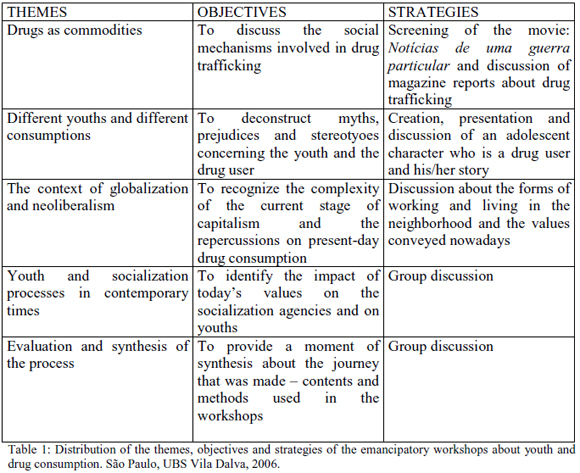
The workshops' themes were defined at each encounter, based on the development of the discussion, which can be visualized in Table 1.
All the discussions were recorded with the group's previous authorization. The tapes' content was transcribed and the testimonies were analyzed through the thematic analysis method (Bardin, 2000).
Results
The educational process, viewed in the emancipatory perspective, does not allow a visualization of the didactically described stages in a gradual and linear sequence of knowledge appropriation and complexification.
]]> Thus, in the same workshop, many of the stages proposed by Saviani were observed. Due to this, the analysis presented here will refer to the process as a whole.With the stages of the educational process, the participants, when they brought their provisional experiences and knowledge to the space of the workshop, contributed to guide the subsequent discussions, as the testimony below shows:
It's this because it came from us here, you didn't bring it. I even talked to the teacher, I found it so different from what I was thinking, I thought I was going to come here and everything would be explained to me. (P1)
Table 1 presents the themes elected by the group of participants.
]]> In the first encounter, each one was asked to say why they were participating in the workshop, their expectations, and they were requested to answer the question: why do people use drugs?
Initially, it was verified that the participants associated the reasons why people use drugs with common sense knowledge:
(...) It's many things, (...) it depends on the person, each one will have a reason (...) for some [people] (…) it's the organism's necessity, as it's already in need of the drug, for others the reason is mental, as it will relieve the pain they feel due to some problem, or to the fact of being accepted in a community, (…) people get involved in this way. And I think that the cause (…) has many factors. (…) Some children (…) don't have the parents' guidance, but the involvement also occurs due to lack of dialog (…), and there's the cultural factor and the social factors too, (…) for some, it's (…) weakness, (…) they feel weak and get involved, (…) it's an escape valve in this case. There are many factors and I still don't understand it well, I'd like to understand why (…) I'm scared to death to go through this. (P2)
In the following encounter, the participants created and described, in groups, stories of yound drug users that contained: age, sex, if s/he studies and/or works; activities that compose his/her daily routine; characteristics of his/her personality; drug(s) s/he is using and with what frequency; how s/he started using drugs and his/her initial motivations; relationship with family, school, work, group of friends and with other people; with whom s/he identifies and what s/he likes.
In all the groups the drug consumer was described in a caricatural way, and his/her life, inexorably associated with physical and moral decadence, having an always tragic ending, as suggested in the fragment below:
She's fourteen years old, (...) she studies (…), she has food, clothes, earrings (…), but what she doesn't have is her parents' (…) tenderness (…). They live in the slum and in her way to school she passes by the boys who sell drugs, they talk to her, (…) she's even interested in one boy who works there (…). She started smoking to be in his and in the group's (…) level, she follows the ideas of others. (…) She started passing there, they started talking to her: do you sell marijuana? How much is it? (…) He doesn't sell to her at the beginning, he gives it (…) and she (…) started to get involved. I think that (…) he was her idol, she even changed her way of being to win him. (…) She [got involved] with alcohol and (…) in a house of prostitution (…), even the guys she dates, she prostitutes herself, she dates (…) those who have money (…), I think she adheres to that. (P3)
In the third encounter, after watching a movie that deals with the theme of drug trafficking in Rio de Janeiro in the perspective of the police, of the traffickers and of the inhabitants of the slum that houses the selling spot, the participants drew comparisons to the neighborhood's problems, and discussed similarities and differences concerning the context of life of the inhabitants and youths of the movie and those of Vila Dalva.
In the following encounter, the text "Tráfico nada tem de revolucionário" (Drug trafficking is not revolutionary), written by Marcelo Freixo and extracted from the newspaper Folha de São Paulo on March 26, 2006, was read and discussed in groups. The guiding question was: what is the importance of the capitalist mode of production to drug consumption (a market commodity)? With the synthesis made by the coordinators, the group established relations between the process of drug production, distribution and consumption and the work and life characteristics of the inhabitants of Vila Dalva, especially the youths.
]]> The workshops enabled the participants to relate the daily problems (microcontexts) of the represented social institutions to aspects of the structure and social dynamics of capitalism (macrocontexts), as shown by the fragments below:The television shows everything you want [to have] and sometimes you don't, [but] you'll be bombarded. (…) A youth (…) from the periphery, even more so (…), everybody uses those tennis shoes, everybody uses that T-shirt, it's the question of group insertion. So, that [group] I want to belong to, [if] people smoke, I want to belong too. (P4)
If [the youth] wakes up, goes to the street, what's the problem? There's nothing to do, nothing, there's no stimulation for you to practice sports, no events to attend. So (…) [the youth] will be, like, in the desert, there's nothing to do, he'll look for drugs. I'm going to try, it's good. The sensation must be really good, otherwise they wouldn't use it, would they? I think it's like this, the youth goes out of his home and there's nothing to do, nowhere to go, no park, (…) no friends, no work. Mainly work (…). (P5)
The workshops also enabled to perform an analysis of reality that interprets the involvement with drugs in a less prejudiced way, less identified with common sense, which allows proximity to youths and users.
]]> The participants overcame naïve conceptions and practices, not only by means of discursive changes regarding the approached contents, but also through attitudes and actions in their daily routine, as expressed by the fragment below.(...) Why does it have to end always like this, tragically? (...) the person can stop drinking and continue having a drink once in a while (...). (P6)
What is the meaning of ending badly, is it the person continue using drugs? And ending well, is it the person stop using drugs? (…) The person can't have a good life, a normal life, live according to the rules using drugs once in a while? Some people have a normal life, they work. (P7)
At the beginning we were very confused, we couldn't find (...) the culprit, it's the parents who went out to work and left him at home, it's the school, because the teachers don't care anymore, (…) or it's himself. But now (…) I'd answer (…) poor drug user (…) because I think it's not his fault, it's not his family's fault and it's not the school's fault, I think they're getting involved with drugs today because of this entire situation, (…) the lack of jobs, all this (…). We understood better (…) why they end up being discriminated, for a reason that has no sense because, one way or the other, who doesn't use drugs? (…) (P6)
I had the habit of judging, right? Now we try to know first what made the person arrive at this point, (…) we try to know the person's history. As wrong as we may think that attitude is, we even (…) understand why that is happening, right? (P8)
In the last encounter we had here an open discussion about how to give an answer, a solution [to the problem]. (…). Yesterday I walked into a classroom to teach (…) and then I was talking to the boys about a life project. (…) I opened a space for discussion, you'll design a project, you'll write an essay [about] what you want, [in life](…) how you will achieve this and the values you need to perform this activity (…). Then everybody stopped [and] asked me: but what is value? (…). Then (…) I said: the elections are near; we're talking (…) so much about the politicians who are corrupt (…). Is he honest? No. Is honesty a value? (...) Then (...) when I taught the 11th year I did differently, (...) I took another path. (…) Instead of asking each student, [I asked] them to form groups to reflect (…), then I got something. (…) if we keep saying that only what I earned, what I bought, has value, then I will even run to the drugs. Why? Because there'll be a space in there that no one will occupy, no knowledge will be able to occupy. (P9)
At the end of the process, the workers from the different social institutions proposed, as a continuation of this stage, the creation of discussion spaces at the workplace and the elaboration of intersectoral projects for prevention of harmful drug consumption, especially involving the health sector and the education sector.
[The solution] is to create moments like this, (...) now I learned to think, to reason (…). We may be bringing people who are lost too or who are in the dark. If we're able to open our minds a little, if these four or five people open the minds of two more, it's already good (…). (P6)
And why don't we put these families together with us, healthcare unit professionals, and with the school's professionals and do something together, which I think makes sense. We're there, having contact with the families, the teachers have contact with the students, the parents' presence is important, right? I think it would be very good, (…) it's hard, but when they start seeing that it's producing results… (P8)
It was verified that the workshop is a powerful transformation instrument of the object of the educational process. This method's potential to access knowledge was also shown by Andrade, Barbosa and Soares (2004), when they developed and analyzed a set of workshops whose participants were parents and educators from a kindergarten. Thus, the workshop - viewed as an instrument to enhance concepts and practices - provides space: for the expression of the participants' different points of view and perceptions; for discussion of beliefs and values; for the stimulation of the use of notions that have already been learned in new situations (Moreno et al., 2005); and it favors, through the systematization of rationalization processes, the collective construction of knowledge as the result of the problematizing reflection on the participants' social and concrete reality (Andrade, Barbosa, Soares, 2004; Moreira, Barreto, 2004).
A similar result was described by Jeolás and Ferrari (2003), when they showed that the exercises and themes that were approached stimulated questionings and enabled to reveal possible external determinants - social class, gender, age - that impose real limits to personal autonomy. The authors stated that this process of collective construction is in keeping with a kind of rupture of daily alienation.
In the same direction, Patrício (1994) described the effectiveness of workshops, concluding that the process enables that naïve or prejudiced concepts are overcome, which allows a critical reading of reality.
]]> Moreira and Barreto (2004), analyzing the process of workshops held with rural zone inhabitants, described proposals, made by the participants, for intervention in order to improve the life conditions of the inhabitants of that territory, besides the possibilities of overcoming and constructing concepts.As regards specifically the theme of drug consumption by youths, we highlight the experience of use of an educational game in Rio de Janeiro, which shows the power of a moment of playful reflection to discuss reality, getting away from a perspective of transmission of information, previously defined and distant from the subjects' reality. The adolescents evaluate positively the use of Jogo da Onda (Wave Game); they explain that the game facilitates the approach to themes that are little discussed among the adolescents themselves and that, if they could play with their families, it would be easier to discuss these matters at home (Rebello, Monteiro, Vargas, 2001).
Conclusion
We believe that the workshop is a powerful instrument so that the subjects - agents and co-producers of the educational process - participate with the purpose of transforming reiterative praxis into creative praxis.
It was possible to assess the effectiveness of the process conducted by the workshops, evaluating it through the stages of the methodology proposed by Saviani (2003).
It is possible to state that the workshops are configured as a social practice; in the process described in this paper, the participants, initially, had different understandings concerning drug consumption and consumer, although the common sense identified with ideas commonly disseminated by the media prevailed. These ideas are different from the knowledge produced by the concrete experiences of these workers' daily routine.
Although these workshops did not result from a request made by these participants, the theme had been characterized as worrisome by inhabitants of the neighborhood in a previous research (Campos, 2004). In this way, the presentation of the proposal of workshops motivated the workers of the neighborhood's social institutions, who, at that very moment, verbalized some problems concerning the social practice and the interest in participating.
While the workshops were being held, it was possible to verify, by means of the transcribed fragments of the participants' discourses, the process of instrumentalization that took place, since the participants gradually appropriated concepts, and the possibilities of critical analysis of the situation in which youths find themselves nowadays increased little by little - especially as regards the reality of these workers' daily routine, denoting a development of their conscience in relation to the situation, even though it is not possible to ensure the passage, according to Saviani (2003), of syncrisis (the chaotic view of the whole) to synthesis (a rich totality of determinations and numerous relations), mediated by analysis (the simpler abstractions and determinations).
The participants' concept of drug consumption evolved qualitatively, showing that the knowledge identified with the common sense concepts that had been initially brought by the workers - the individual and the family should be blamed - became more complex, achieving an understanding of the roots of harmful drug consumption and the proposition of the overcoming of reiterative reproduction practices of the dominant ideology. In addition, myths, prejudices and stereotypes regarding the user were demystified - a user that was seen as fragile, easy to influence, unmotivated and excluded -, as well as regarding the power and effects of drugs.
]]> Thus, the qualitative alteration of the social practice - the point of arrival of this journey - will be accomplished when the participants implement harmful drug consumption prevention projects in an emancipatory perspective with the youths, enabling solidarity works towards the strengthening of the social groups, so as to face the conditions of exploitation in which they live.
COLLABORATORS
Cássia Baldini Soares and Célia Maria Sivalli Campos wrote the final version of the paper, articulating the results of the end-of-course essays, supervised by them, of the undergraduate nursing students Adriana de Souza Leite and Cristina Lourdes Leite de Sousa.
REFERENCES
ABRAMO, H.W. Condição juvenil no Brasil contemporâneo. In: ABRAMO, H.W.; BRANCO, P.P.M. (org). Retratos da Juventude Brasileira: análises de uma pesquisa nacional. São Paulo: Fundação Perseu Abramo, 2.005. p. 37-72.
ACSERALD, G. A Educação para a autonomia: construindo um discurso democrático sobre as drogas. In: ACSERALD, G. (org). Avessos do Prazer: drogas, AIDS e direitos humanos. 2.ed. Rio de Janeiro: Editora Fiocruz, 2005. p. 183 - 212.
AMARANTE, A.G.M. Juventude no SUS: as práticas de atenção à saúde no Butantã. 2007. Dissertação (Mestrado) - Escola de Enfermagem, Universidade de São Paulo, São Paulo. Disponível em: <http://www.teses.usp.br> (2005). Acesso em: 25 jun. 2007).
ANDRADE, S.C.; BARBOSA, R.C.; SOARES, C.B. Oficinas de discussão: uma proposta educativa em saúde como instrumento para a intersetorialidade. In: Comissão de Graduação da Escola de Enfermagem da USP. (org). VII Mostra de Monografias de Conclusão de Curso da EEUSP/2003. São Paulo: EEUSP, 2004. p. 75-7.
BARDIN, L. Análise de conteúdo. Lisboa: Edições 70, 2000.
CAMPOS, C.M.S. Necessidades de saúde pela voz da sociedade civil (os moradores) e do Estado (os trabalhadores de saúde). 2004. Tese (Doutorado) - Escola de Enfermagem, Universidade de São Paulo, São Paulo. Disponível em: <http://www.teses.usp.br> (2004). Acesso em: 08 jun. 2007).
CANOLETTI, B.; SOARES, C.B. Programas de prevenção ao consumo de drogas no Brasil: uma análise da produção científica de 1.991 a 2.001. Interface - Comunic, Saúde, Educ., v.9, n.16, p.115-29, 2.005.
CARLINI-COTRIM, B. H. A escola e as drogas: realidade brasileira e contexto internacional. 1992. Tese (Doutorado) - Departamento de Psicologia Social, Pontifícia Universidade Católica, São Paulo.
CHIESA, A.M.; WESTPHAL, M. A sistematização de oficinas educativas problematizadoras no contexto dos serviços públicos de saúde. Saúde Deb. 1995; (46):19-22.
CORCIONE D. Fazendo oficina. Disponível em: <http://www.redepopsaude.com.br/Varal/MetodosTecnicas/fazendooficina.htm> (s.d.). Acesso em: 08 jun. 2007).
FREIRE, P. Pedagogia do Oprimido. Rio de Janeiro: Paz e Terra, 2002.
]]>FREIRE, P. Pedagogia da Autonomia. Saberes necessários à pratica educativa. Rio de Janeiro: Paz e Terra, 1997.
JEOLÁS, L.S.; FERRARI, R.A.P. Oficinas de prevenção em um serviço de saúde para adolescentes: espaço de reflexão e de conhecimento compartilhado. Ciênc. Saúde Coletiva, v.8, n. 2, p. 611 - 20, 2003.
MOREIRA, L.M.C.; BARRETO, O. Saber é poder: relato de uma experiência de educação popular na busca da melhoria da qualidade de vida. Divulg Saúde Debate, v.31, p. 44 - 52, 2004.
MORENO, L.R.; ROMAÑA, M.A.; BATISTA, S.H.; MARTINS, M.A. Jornal Vivo: relato de uma experiência de ensino-aprendizagem na área da saúde. Interface - Comunic., Saúde, Educ., v.9, n.16, p. 195-204, 2005.
PARO, V. H. Escritos sobre educação. São Paulo: Xamã, 2001.
PATRÍCIO, Z.M. Nem talco nem diamante: a riqueza de um processo de ensino-aprendizagem participante na área da sexualidade-adolescência. Texto Contexto Enf, v.3, n.2, p. 93 - 109, 1994.
PEREIRA, E.G. A participação da enfermagem no trabalho educativo em Saúde Coletiva: um estudo dos relatos de experiência produzidos por enfermeiros brasileiros no período 1988-2003. 2005. Dissertação(Mestrado) - Escola de Enfermagem, Universidade de São Paulo, São Paulo. Disponível em: <http://www.teses.usp.br> (2005). Acesso em: 08 jun. 2007.
SAVIANI, D. Escola e democracia: teorias da educação, curvatura da vara, onze teses sobre a educação política. vol.5. 36.ed. Campinas: Autores Associados, 2003.
]]> SOARES, C.B. Adolescentes drogas e AIDS: avaliando a prevenção e levantando necessidades. 1.997. Tese (Doutorado) - Faculdade de Educação, Universidade de São Paulo, São Paulo. Disponível em: <http://www.teses.usp.br> (2005). Acesso em: 02 jun. 2007).SOARES, C.B.; CAMPOS, C.M.S. A responsabilidade da universidade pública no ensino da prevenção do uso prejudicial de drogas. Mundo da Saúde, v.28, n.1, p. 110-5, 2004.
VÀZQUEZ, A.S. Filosofia da práxis. Rio de Janeiro: Paz e Terra; 1977.
i Address: Av. Dr. Enéas de Carvalho Aguiar, 419, sala 233, 2º andar. Cerqueira César, São Paulo, SP, Brasil. 05.403-000.