Avaliação do conhecimento em práticas de higiene: uma abordagem qualitativa
Evaluación del conocimiento en prácticas de higiene: un análisis cualitativo
Paula TavolaroI; Carlos Augusto Fernandes OliveiraII,1; Fernando LefèvreIII
IGraduate Studies Program in Experimental Epidemiology and Epidemiology Applied to Zoonoses at the Veterinary School (Faculdade de Medicina Veterinária e Zootecnia), Universidade de São Paulo, São Paulo, SP. <ptavolaro@yahoo.com>
IIAnimal Husbandry and Food Engeneering School (Faculdade de Zootecnia e Engenharia de Alimentos), Universidade de São Paulo, Pirassununga, SP. <carlosaf@usp.br> ]]>
IIIPublic Health School (Faculdade de Saúde Pública), Universidade de São Paulo, São Paulo, SP. <flefevre@usp.br>
Translated by Paula Tavolaro
Translation from Interface - Comunicação, Saúde, Educação, Botucatu, v.10, n.19, p. 243-254, Jan./June 2006.
ABSTRACT
The knowledge of goat milkers on milking hygiene was investigated, by means of a qualitative approach, before and after a Good Manufacturing Practices (GMP) training course. Milkers from three goat dairy farms in the state of São Paulo, Brazil, were interviewed using a semi-structured questionnaire. Responses to the questions were recorded, transcribed and analyzed by means of the Discourse of the Collective Subject. Milkers were then trained in a one-hour content and dialogue-based lecture on "GPP principles" and "recommended hygienic procedures for milking". Two months after the training course, milkers were interviewed again with the same questionnaire used before the training course. No difference was found between discourses obtained before and after the training course. Individual analysis of the discourses showed that milkers had previous experience milking of animals, liked their jobs and were willing to learn more about it. However, they had no clear suggestions on how to improve their work routine.
Key words: discourse of the collective subject. food handlers. milkers. in-service training. occupational health.
RESUMO
Investigou-se o conhecimento de ordenhadores de cabra sobre higiene nas operações de ordenha, antes e após uma capacitação em Boas Práticas de Fabricação (BPF), por meio de uma abordagem qualitativa. Para isto, foram realizadas entrevistas com ordenhadores de três propriedades rurais do Estado de São Paulo, baseadas em um formulário semi-estruturado, cujas respostas foram gravadas, transcritas e analisadas de acordo com a metodologia do Discurso do Sujeito Coletivo. Após a entrevista inicial dos ordenhadores, em cada propriedade, realizou-se a capacitação em BPF por intermédio de aula expositiva dialogada, de uma hora de duração, sobre os temas "princípios gerais de BPF" e "cuidados higiênicos recomendados para ordenha". Após dois meses da capacitação, realizou-se nova entrevista com os ordenhadores. Não foram identificadas diferenças nos discursos obtidos antes e após a capacitação. A análise individual dos discursos mostrou que os ordenhadores apresentavam prévia experiência em ordenha de animais, gostavam do que faziam no trabalho e desejavam aprender mais sobre o ofício, mas não tinham sugestões claras em relação à melhoria do seu fluxo de trabalho.
]]> Palavras-chave: discurso do sujeito coletivo. manipuladores. ordenhadores. capacitação em serviço. saúde ocupacional.RESUMEN
En este trabajo se evaluó cualitativamente el conocimiento de ordeñadores de cabra acerca de higiene en las operaciones de ordeño antes y después de ser entrenados en Buenas Prácticas de Fabricación (BPF). Con este fin se realizaron entrevistas con ordeñadores de tres establecimientos rurales en el estado de São Paulo, Brasil. Las entrevistas se basaron en un cuestionario semiestructurado y las respuestas fueron gravadas, transcriptas y analizadas usando el método del Discurso del Sujeto Colectivo. Después de la entrevista inicial de los ordeñadores de cada establecimiento se realizó la capacitación en BPF mediante una clase expositiva de una hora de duración sobre los temas "Principios generales de BPF" y "Cuidados higiénicos recomendados para el ordeño". Entre 1 y 2 meses después del entrenamiento los ordeñadores fueron entrevistados nuevamente. No encontramos diferencias entre los discursos obtenidos antes y después del entrenamiento, y un análisis individual de los mismos mostró que los ordeñadores tenían experiencia previa de ordeño, les gustaba su trabajo y les gustaría aprender mas sobre el oficio, pero que no tenían sugerencias claras sobre cómo mejorar su flujo de trabajo.
Palabras clave: discurso del sujeto colectivo. manipuladores. ordeñadore. capacitación en servicio. salud ocupacional.
Introduction
Training of food handlers is essential for the control of undesirable microorganisms in raw food ingredients. This is of particular importance in relation to milk because the product is subject to contamination of several different sources, and it is especially true for goat milk, which is generally indicated for specific populations, such as children, elderly and debilitated adults. Besides, goat milk production occurs mainly in developing countries, under rudimentary conditions (Camacho & Sierra, 1988), in small farms, which are normally not involved in extension programs on hygiene and improvement of production conditions. These factors negatively affect the microbiological quality of goat milk and consequently, increase human health risks in consuming contaminated goat milk.
The expression "Good Manufacturing Practices" (GMP) is used to indicate a group of actions applied to the production of food, pharmaceutical products and medical instruments in order to guarantee their quality and prevent risks to consumer health. Although GMP started to be used in food production in the 70s, they were only made compulsory after 1995 in several countries (Hooten, 1996). In Brazil, GMP became mandatory in food production in 1997, when regulation # 326/97 from the Ministry of Health and regulation # 368/97, from the Ministry of Agriculture (Brazil, 1997) were issued. However, the use of GMP is not mandatory for the milking procedure in dairy farms.
Extension programs applied to small farms may be highly influenced by the ideology of the technicians involved in it. These professionals are not trained to deal with educational issues, and the refusal to accept the technological offers they made are blamed on three main agents: the farmers and their ignorance; other technicians, for their unpreparedness and their unethical attitudes; the institutions and their power (Oliveira, 1993). Therefore, the target of extension programs should be deeply known in order to overcome these limitations. Food handlers should be continuously trained, and any attempts to change hygienic habits should be based on the study of beliefs and attitudes related to food safety, using qualitative methods (Costa et al., 2002; Coleman et al., 2000; Cleary, 1988; Mergler, 1987).
]]> The objective of the present study was to carry out a qualitative evaluation using the Discourse of the Collective Subject (Lefèvre & Lefèvre, 2003), on the knowledge about milking hygiene in small dairy goat farms located in the state of São Paulo, Brazil, before and after a GMP training course.
Methods
The study was carried out in three dairy goat farms in the state of Sao Paulo. In two of them, goats were manually milked, and in one of them, there was a milking machine. The procedure followed for milking the goats was carefully analyzed in each farm, based on the GMP evaluation sheet determined by Brazilian regulations (Brazil, 2002). This analysis enabled the identification of the most important problems in the milking procedure that were approached during the GMP training session.
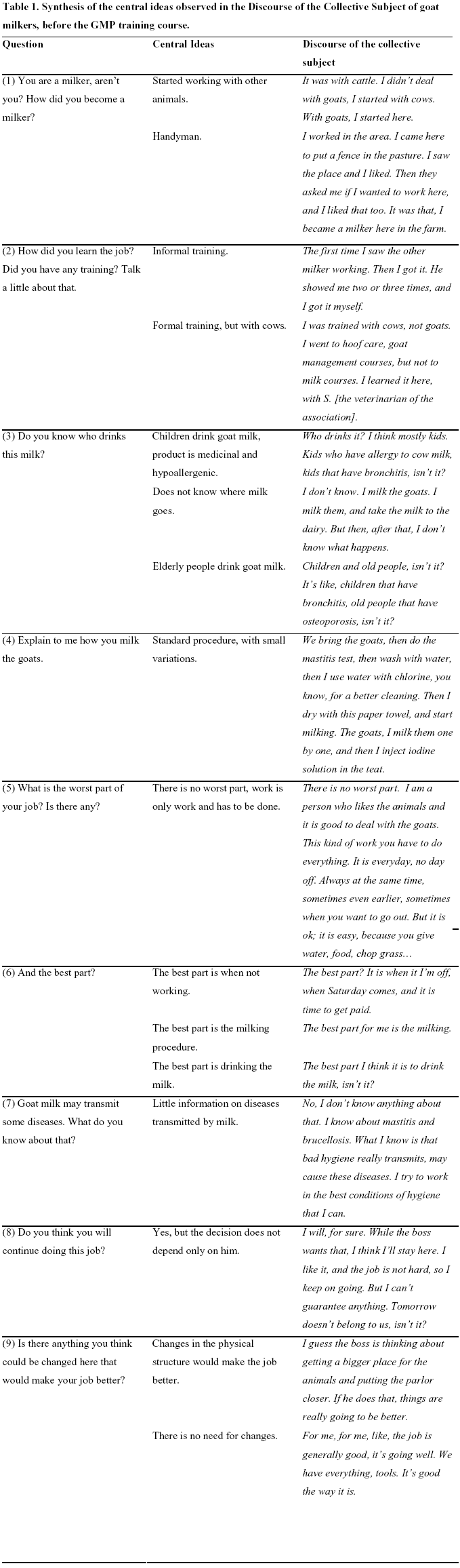
Before the analysis of milking procedure and the GMP training course, milkers were individually interviewed, and their responses to the questionnaire were recorded and transcribed. A semi-structured questionnaire, previously tested and adjusted to the objectives of the study, was used in this interview. It contained the following questions: 1 You are a milker, aren't you? How did you become a milker? 2 How did you learn the job? Did you have any training? Talk a little about that. 3 Do you know who drinks this milk? 4 Explain to me how you milk the goats. 5 What is the worst part of your job? Is there any? 6 And the best part? 7 Goat milk may transmit some diseases. What do you know about that? 8 Do you think you will continue doing this job? 9 Is there anything you think could be changed here that would make your job better?
GMP training was carried out in the three farms by the same veterinarian, using flashcards with figures and simple sentences in font size 30. Flashcards were made based on the data collected in the interviews and with problems pointed out during the observation of the milking procedure. The Freirian (Freire, 1977) concept of communication, not extension, was used. Two main subjects were approached in a one-hour lecture: main GMP principles and hygienic procedures during milking. After the material was presented and discussed, possible technical solutions were offered to correct the deficiencies observed in relation to the GMP. A consensus was reached in relation to the changes to be implemented, which varied from farm to farm.
After two months of the training course, situation on the farms was analyzed once more. At that moment, each milker was interviewed again, in order to assess any differences in the discourses obtained before and after the training course. Qualitative data collected in the interviews of five milkers before the training course, and three milkers after it, were analyzed according to the Discourse of the Collective Subject (Lefèvre & Lefèvre, 2003).
Results
Responses obtained in questions one to nine of the questionnaire applied before and after GMP training course are presented in Tables 1 and 2, respectively.
]]> In question 1, two basic situations were observed: either the individual worked with other animals, or he was a handyman, doing a little of everything in the farm. No great changes in central ideas were observed before and after the training course. In question 2, the notion of milking as a solitary job shows up. It is a job that you learn by yourself, on a daily basis, and milkers do not think there are differences in milking animals of different species. In most cases, the procedure was taught by another milker, and in only one case, by a veterinarian. It seems here that veterinarians may consider training of milkers as something of lesser importance, for the milking procedure is one of the smallest problems these professionals may face in the daily routine in dairy goat farms. In this case, a chance for improving milk quality is missed, as well as a chance for showing the differences in management of diverse dairy animal species.As for question 3, only one of the milkers did not know who consumed the milk, and the others knew that it as preferentially consumed by children. Two of them talked about milk being consumed by sick or allergic children, and one of them, by elderly people. It was observed that milkers knew that goat milk is a product used for medicinal purposes, an idea that was repeated after the training course. As for question 4, all milkers performed the standard milking procedure, with some modifications: two of them carried out the strip cup test; all of them washed the teats with cold, not warm water; two of them disinfected the teats with chlorine solution before milking, but they did not know how much chlorine they used; all of them dried the teats with disposable paper towels, but they used the same towel for both teats, and then started milking the animals; two of them supplied feed for the animals during the milking procedure, but only one used specific feed for dairy animals; all the others used only corn meal for the animal to be quiet during the procedure; after milking, all of them used iodine solution for mastitis prevention.
In question 5, three milkers said that working with goats was a pleasant job, and two of them said that work was only work. Two milkers showed that some activities were more difficult to be performed, such as removing manure. However, they considered that their overall routine with the animals was not a hard job and that they were rarely tired at the end of the day. Responses to question 6 led to different central ideas in the discourses before and after the training course: the best moment was when not working (one discourse); or when the wage was received (one discourse); or the moment of milking (one discourse); or the milk itself (two discourses). After the training course, two kinds of answers were observed: the best moment was the day off (two discourses), or when the milk was ready to be consumed (one discourse).
Central ideas for question 7, before the training course, indicated that the knowledge of the milkers involved diseases that affected milk production (mastites) or brucellosis, showing workers may have previously dealt with cows, once Brucella mellitensis, transmitted by goats, is an exotic, unreported disease in Brazil (Astudillo, 2004). Only one of the milkers talked about the hygiene of the procedure as something important for the transmission of diseases by milk, but the relationship between milk and diseases seemed to be more frequently associated to animal health than to hygienic procedures during milking. Another milker showed that he wanted to lean more about diseases, because he understood that this was an important issue for him to progress in his job and life.
In question 8, most of the milkers answered that continuing in the job did not depend only on them, but on conditions external to them, what was repeated in the responses obtained after the training course. However, mikers stated before training that because they liked to work with animals, they would possibly continue to do so. As for question 9, discourses varied: two of them would like to see changes in the physical structure of the milking parlor, which would improve the workflow, idea that was repeated in the end of the study. Two of them thought changes were not necessary and only one talked about better wages.
Discussion
The World Health Organization recommends that educational programs should be culturally appropriate for food handlers of different countries, and should take into account feeding habits and beliefs of the population in a way that changes in habits and attitudes may be achieved (Ehiri & Morris, 1994). In order to do that, sociological and anthropological methods should be used when food safety programs are structured. The objective of interviewing food handlers is to explore and describe the specter of attitudes and experiences in a certain field, more than to quantify the opinions collected (Vaarst et al., 2002). This was based on the fact that, in order to implement good hygienic practices in food handling, all the factors that affect these practices (individual and collective, behavioral and environmental) should be investigated (Costa et al., 2002).
The analysis of the discourses obtained in question 1, "you are a milker, aren't you? How did you become a milker?", shows that, for milkers interviewed, working with animals was something that do not differ much, no matter the animal species they may be dealing with, with no need for specialization. Although they may have been trained (question 2), the job was learned in a daily basis, by following the work routine. On the other hand, the idea of the handyman, the worker that does all the tasks in the farm, as seen in the discourses before and after the training course, may only reflect the job opportunity that showed up for these workers. They were milkers, but they could be working in any other low-specialization job.
In question 2, "How did you learn the job? Did you have any training? Talk a little about that", no differences were observed before and after the GMP training course. Formal training occurred only in farm 2, where they had a milking machine, and milk was part of the income of the farm; the other farms were only leisure places where their owners spent their weekends. In the discourse obtained after the training course, it was clear that the worker in farm 2 had gone beyond the others interviewed here, being trained on animal management and health, showing that the financial commitment of the owner with goat breeding and milk production may lead to greater interest in training milkers.
]]> In question 3 "Do you know who drinks this milk?", the milker who did not know what happened to the milk after it was obtained seemed to feel that he did not control his workflow. This may be one factor influencing the outcome of the training, once not knowing the workflow does not stimulate participation or involvement. Workers may have a fragmented notion of the best form to perform a task. They are generally technically qualified in their small area of expertise, are disciplined, politically submissive, isolated and non-organized, because the content of their jobs was emptied and mechanized (Kuenzer, 1995). Worker participation and initiative tends to be weak if they are not well represented (Mergler, 1987), which is true for milkers, who are not organized as a class. Participation, therefore, would be based on the individual attitude of the milker, in the trust he has in the technician, on his interest in the job he is performing. The lack of commitment with the job, visible in the analysis of both discourses of the group was possibly one of the greatest barriers to the success of the GMP training course.As for question 4, "Explain to me how you milk the goats", only one of the milkers talked about the hygiene necessary for the procedure, mainly clean hands and trimmed nails, and disinfecting hands before milking. Another milker said that cleaning the milking parlor was important. However, washing hands before milking was never described as part of the process. Some milkers were also responsible for bringing the goats to the parlor, and after doing so, they milked the animals without washing their hands, both before and after the training course. Two of the farms had sinks and soap in the milking parlor, but they were only used to wash utensils before milking, and not the hands, either before or during milking. When the milking parlor was open, there was no sink, and soap was not available. In the farm where they had a milking machine, workers that brought the goats sometimes washed their hands before milking, but this may be due to the Hawthorne effect (Goldehar & Schulte, 1994), according to which workers may change their behavior simply because researchers are in their worksite. Therefore, the milking procedure was the same in the discourses obtained before and after the training course, which could be confirmed by the observation of the milking routine.
As for question 5, "What is the worst part of your job? Is there any?", in general, milkers considered that the activities they had to perform were not tiresome. On the other hand, it has already been demonstrated that the impact of physical load may affect work ability and health status of milkers in the milking of cows (Shenkman & Badken, 1989), as well as in other kinds of activities (Sell, 2002). In the response obtained for the same question after the training course, they repeated the observation that work is only work, with no worst part. This kind of attitude observed in this discourse is not exclusive of this category of worker, and it makes it very difficult to involve these men in educational programs. The responses show the low level of commitment with the job, not only in this question, but also in the following one in the questionnaire.
Answers obtained in question 6, "And the best part?", again indicated the idea that, because it is not a highly qualified job, these workers had accepted it, as they would have accepted another kind of job inside or outside the farms, in order to survive. However, one response was different from the others: the worker that believed that the best part was "when we are pasteurizing the milk, when milk is there, being bottled, ready to go, very nice ", was the same person who was formally trained. This fact suggests that when farmers invest in the technical training of their workers, they may improve their self-esteem and consequently, make them more involved and open to the educational process.
In the discourse presented for question 7, "Goat milk may transmit some diseases. What do you know about that?", after the GMP training course, greater knowledge on the foodborne diseases was observed, which was expected in these interviews. One of the workers talked about the issues approached in the training course, saying that utensils used during milking and the hygiene of the procedure were important in the transmission of diseases by the milk. This may have occurred due to the fact that the interval between the training course and the second interview of this worker was the shortest one in the study, due to arrangements in the chronogram. The milker that was previously submitted to formal training talked about tuberculosis, an issue probably approached in other courses on milk technology he may have attended. Another milker apologized for not remembering any information given in the training, because he was facing some personal problems. The form of the training used in this study – a lecture, which does not motivates participation (Bernardo, 2003), – may be criticized here, reinforcing the need for the technician to be better trained in his role as an educator.
As for question 8, "Do you think you will continue doing this job?", one of the milkers said that it was not a difficult or tough job, but also said that it was always the same, what may be little challenging or motivating for him, leading him to be uninterested in his work routine or changes in it. This was the same milker who did not know the final destination of the milk. In the answer obtained after the training course, survival and breadwinning were issues approached, which were not so clearly stated in the first interview. All answers indicate the little commitment these workers had with their jobs, what may have made it difficult to have good results in the GMP training course.
For the discourses presented in question 9 after the training course, "Is there anything you think could be changed here that would make your job better?", the one that was obtained from the worker that had the shortest interval between the two interviews should be emphasized. He clearly talked about the issues approached in the training course on hygiene and GMP applied to goat milking.
The overall analysis of central ideas obtained in the interviews with milkers of three farms demonstrates that these workers understood the need for a clean milking, but they ignored the existence of disinfection step. These concepts were approached and the difference between them was emphasized in the GMP training course. Another aspect that was observed in the farms studied, which is very common in other small farms, is the fact that labor is based on one only worker, or on a small family who carries out all the activities in the farm. This multitasking observed in the study may have contributed for the absence of special attention to the moment of milking (wearing a different uniform, constant washing of hands during the procedure), due to the large load of activities these workers have to handle. Thus, although milkers thought that what they had learned was important, even repeating some of the information in the post-training interview, there was a huge difficulty in changing the procedures that had already been crystallized by their habits.
Veterinarians that are normally involved in this kind of educational effort in dairy farms find it difficult to teach these workers, due to the limitations they have in their own professional training. The central ideas observed in the discourses of the milkers interviewed in the present study should be taken into account by veterinarians in their educational efforts in goat breeding farms. Besides, the veterinary undergraduate curriculum should be greatly changed, in a way that besides technical knowledge, a more humanistic and holistic training was achieved (Goodger, 1982). This kind of change would enormously benefit both the general population and the workers that are in direct contact with veterinarians.
]]> Conclusions
Results of the present study evidenced the difficulties in educational approaches aiming at the change of behaviors in goat milkers. Although workers may know that the issues discussed are important, changes in routine may be affected by a series of technical barriers to the implementation of quality systems, besides anthropological and sociological obstacles that should at least be known and studied by professionals responsible for training labor in rural areas. This approach should be better analyzed in educational programs focusing on the improvement of goat milk quality, in a way to increase the range and efficacy of extension actions directed to farmers.
References
ASTUDILLO, V. Brucelose. Available in: <http://www.cda.sp.gov.br/Programas/BruTb/doencas/BRU/d_doebru1.htm>. Accessed on: May 25th, 2004.
BERNARDO, T. New technologies imperative to medical education. J. Vet. Med. Educ., v.30, p.318-25, 2003.
BRAZIL. Ministério da Agricultura, Pecuária e Abastecimento. Portaria 368, Sept. 8th, 1997. Aprova o regulamento técnico sobre as condições higiênico-sanitárias e de boas práticas de fabricação para estabelecimentos elaboradores / industrializadores de alimentos. Available in: <http://oc4j.agricultura.gov.br/agrolegis/do/consultaLei?op=viewTextual&codigo=3015>. Accessed on: Sept. 10th, 2004.
BRAZIL. Ministério da Saúde. Resolução RDC 275, Oct. 21st, 2002. Aprova o regulamento técnico de procedimentos operacionais padronizados aplicados aos estabelecimentos produtores / industrializadores de alimentos e a lista de verificação das boas práticas de fabricação. Available in: <http://e-legis.bvs.br/leisref/public/showAct.php?id=8134>. Accessed on: Sept. 10th, 2004.
CAMACHO, L.; SIERRA, C. Diagnostico sanitario y tecnologico del proceso artesanal del queso fresco de cabra en Chile. Arch. Latinoam. Nutr., v.38, p.935-45, 1988.
CLEARY, H. P. Health education: the role and functions of the specialist and generalist. Rev. Saude Publica, v.22, p.64-72, 1988.
COLEMAN, P.; GRIFFITH, C.; BOTTERILL, D. Welsh caterers: an exploratory study of attitudes towards safe food handling in hospitality industry. Int. J. Hosp. Manag., v.19, p.145-57, 2000.
COSTA, E. Q.; LIMA, E. S.; RIBEIRO, V. M. B. O treinamento de merendeiras: análise do material instrucional do Instituto de Nutrição Annes Dias - Rio de Janeiro (1956-94). Hist. Ciênc. Saúde Manguinhos, v.9, p.535-60, 2002.
EHIRI, J. E.; MORRIS, G. P. Food safety control strategies: a critical review of traditional approaches. Int. J. Environ. Health Res., v.4, p.254-63, 1994.
FREIRE, P. Extensão ou comunicação. São Paulo: Paz e Terra, 1977.
GOLDEHAR, L. M.; SCHULTE, P. A. Intervention research in occupational health and safety. J. Occup. Environ. Med., v.36, p.763-75, 1994.
GOODGER, W. J.; RUPPANNER, R. Why the dairy industry does not make greater use of veterinarians? J. Am. Vet. Med. Assoc., v.181, p.706-10, 1982.
HOOTEN, F. W. A brief history of FDA good manufacturing practices. Available in: <http://www.devicelink.com/mddi/archive/96/05/015.html>. Accessed on: April 2nd, 2004.
KUENZER, A. Z. Pedagogia da fábrica: as relações de produção e a educação do trabalhador. São Paulo: Cortez, 1995.
LEFÈVRE, F.; LEFÈVRE, A. M. C. O discurso do sujeito coletivo: um novo enfoque em pesquisa qualitativa (Desdobramentos). Caxias do Sul: EDUCS, 2003.
MERGLER, D. Worker participation in occupational health research: theory and practice. Int. J. Health Serv., v.17, p.151-67, 1987.
OLIVEIRA, M.T. B. A ambigüidade da extensão rural universitária e as acusações de técnicos. Rev. Econ. Sociol. Rural, v.31, p.103-24, 1993.
SELL, I. Projeto do trabalho humano: melhorando as condições de trabalho. Florianópolis: Ed. UFSC, 2002.
SHENKMAN, G. S.; BADKEN, V. V. Physiologic and hygienic evaluation of the work of operators of mechanical milking. Gig. Tr. Prof. Zabol., v.5, p.14-6, 1989.
VAARST, M.; PAARUP-LAURSEN, B.; HOUE, H.; FOSSING, C. Farmer's choice of medical treatment of mastitis in Danish dairy herds based on qualitative research interviews. J. Dairy Sci., v.85, p.992-1001, 2002.
Recebido em: 19/04/05. Aprovado em: 04/10/05.
1 Departamento de Engenharia de Alimentos, Faculdade de Zootecnia e Engenharia de Alimentos, USP ]]>
Av. Duque de Caxias Norte, 225
Pirassununga, SP
Brasil - 13.635-900