Autores: Tatiane SchioschetI; Nilson de PaulaII
IGraduated in Economics from the Federal University of Paraná
IIProfessor at the Federal University of Paraná (nilson@ufpr.br)
Translated by Leticia Cesarino
Translation from Estudos Sociedade e Agricultura, Rio de Janeiro, vol. 16 no. 1, p. 27-53, Abril 2008.
The emergence of GM soy has been at the core of an intense debate, revolving around the advantages and disadvantages of its adoption as well as the behaviour of those institutions involved in the regulatory framework of such a phenomenon. This paper aims at assessing the dissemination of genetically modified soy in Brazilian agriculture in the period between 1998 and 2005, from the standpoint of the institutional framework related to GMO technology. Thus, attention is given to the strategy adopted by the Monsanto company in the light of the difficulties emerging throughout the process that led to the authorization to the production and marketing of soybean in Brazil. The main actors in this process are identified as also the institutional framework involved in the marketing relations between innovator and users.
Key words: technological dissemination, GM soyb, complementary assets, Monsanto company.
Introduction
Since the Green Revolution started in the 1960's, agriculture has progressively modernized through intensive application of capital in research and development of new technologies for large scale agriculture. From this process, a new wave of innovation emerged around genetic engineering, in which various crops were modified for the incorporation of specific traits – such is the case of genetically modified organisms, or GMOs.
Biotechnology applied to soy production resulted in new seed varieties. The most extensively planted and traded worldwide is Monsanto's Roundup Ready.1 Even though the commercial use of this seed started in the U.S. in the 1990's, in Brazil the commercial license for this genetically modified soy was only granted after a long period of conflict and uncertainty, which involved an aggressive strategy by that company, regulatory indeterminacies, and resistance in the national market from producers and their organizations. Ultimately, the passing of a new Biosafety Bill in March 2005 paved the way to clearing the cultivation and commercialization of transgenic soy varieties in Brazil.
The absence of an institutional apparatus establishing clear parameters for the introduction and diffusion of genetic innovation left unanswered persistent questions regarding the risks of harmful effects to the environment and to human health, technological dependency, and production costs. According to Pelaez, "this kind of regulatory practice intensified from the 60's on in the developed world (U.S., France, Japan, Germany, United Kingdom, Canada), with important impacts on the rhythm and direction of technical progress" (PELAEZ, 2000: 2). The regulatory process therefore affects significantly the speed with which a technology spreads.
In this context, although rural producers' interests define Brazil's competitive position in the world soy market, the propagation pace of this innovation is strongly conditioned by the action of regulatory bodies intervening between the relations of innovator and user by means of rules and procedures established in the midst of political and institutional conflicts. The introduction of transgenic soy thus involves a power struggle between a leading corporation, strongly supported by the federal government, and social movements whose actions may influence the speed of RR soy spread in Brazil.
]]> The first part of this article presents a review of the concepts of innovation and diffusion in the evolutionist school, particularly Teece's work on large companies' strategies for building up complementary assets. From this perspective, the institutional framework and its relation to Monsanto are focused on our discussion of the diffusion process of transgenic soy in Brazilian agriculture. Finally, based on the institutional context, the chief social actors opposing the diffusion of GMOs in the country and their influence on the institutional reorganization from which this innovation and diffusion process stemmed are discussed.
1 Technological diffusion: a brief bibliographic review
Schumpeterian theory is a mandatory reference for any analysis of technical progress and its implications for the competition environment. In it, innovation is seen as a discontinuous, even if initially perfect, process whose subsequent diffusion is difficult to improve. Thus, the innovator tends to reap larger profits than the imitators, since the diffusion of a new product or process is regarded as mere imitation in the absence of technological change or improvement along this process. In other words, because they occur at different moments, innovation and diffusion are regarded as independent.
Schumpeterian analyses on the role of innovation in economic dynamics came to emphasize information asymmetries in the market, as well as the ways products change over time. One of the main novelties was to relate the processes of innovation and diffusion through which firms accumulate experience enabling them to improve existing technology. From this perspective, diffusion is seen as integral to innovation not only through its use, but through the incorporation of cumulative experience which feeds back into the innovation process itself.
A significant step in this regard was taken by evolutionist theoreticians such as Rosenberg, Nelson, Winter, Freeman and Teece, who connected scientific advances to market processes. From their perspective, the adoption of a technology depends on competitiveness and rate of profit and investment, in addition to the institutional conditions constraining agents participating in the diffusion process. According to Machado (1998), evolutionists highlight the institutional environment establishing the parameters guiding economic agents in their strategies of technological change. This includes regulation, the political conditions in which it emerges, dominant values and behaviors, as well as the establishment of cooperation versus competition practices among the agents forming this institutional environment.
For these theorists, particularly Rosenberg, the critique to the Neoclassic school gains new breath as innovation and diffusion are regarded as close concepts (FURTADO, 2006). While innovation is a unique creative moment, the diffusion process may extend over time, therefore underscoring the continuous nature of the innovation process and its feedback capacity. This author shows that diffusion is continuously influenced by movements of adaptation and accommodation after its release in the market; this is typical of so-called incremental innovation. Besides increments to the original innovation before its introduction in the market, there is innovation suggested or introduced by users which is important to the diffusion process of a given innovation.
However, other factors have direct influence on the speed of creation and propagation of new technology which relate to differences between societies in terms of the extension and intensity of innovation processes (ROSENBERG, 2006). Firstly, the process of technological diffusion is made up not only of major innovations but of incremental ones which continuously improve or readapt new technologies. Secondly, the adoption of a new technology and its diffusion speed depend on expectations linked to the moment when it is introduced, as well as on perspectives of future adaptations. The latter may result either in obsolescence or in complementary innovations of the product or process. It often happens that a technology is replaced even before its adoption costs are paid for. Thirdly, users collectively develop learning-by-using skills. That is, the innovation process is not defined exclusively by an agent, but by a set of factors and agents to which the economic environment as well as the regional and market context in which the technology is being introduced are fundamental. Fourthly, during the production process, improvements to the product or process are introduced through the identification and redressing of flaws in learning-by-doing. Fifthly, the emergence of a new technology does not imply the elimination of previous ones; it may even foster the development of improvement technologies, even when the new technology is cheaper and profitable. Finally, and particularly relevant to this analysis, Rosenberg points to the importance of political, institutional and legal structures for the invigoration and smooth functioning of private enterprises, therefore fostering innovation.
The regulation of new technology and management of complementary assets
]]> A crucial factor for the diffusion process which is not approached by the abovementioned authors concerns the regulation of new technologies and the ways companies are articulated with the institutional environment. Since the 1960's, there has been burgeoning interest on the direct or indirect impacts of regulation on technological diffusion, and on companies' reactions to this trend. A good example is the chemical industry, due to the artificiality of its products and their harmful effects on human health and on the environment. Institutional regulation's grasp on the commercial release of the new products from this sector has been historically prominent.Lower production costs or higher returns are not enough for the diffusion of a new product. Consumer acceptance is not limited by users' rational preferences; the degree and effectiveness of national institutional regulations play a role (SILVEIRA, 2005). In this context, industry came to develop complementary competences in order to tackle potential regulatory constraints, besides networking in order to influence legislation designs more favorable to its productive investments. The introduction of a new technology always faces conflict with groups that will not necessarily reap the benefits of a certain innovation. Usually these groups are organizations advocating the enforcement, by official bodies, of regulatory procedures able to shape the strategies of innovative firms according to a more socially acceptable frame (PELAEZ, 2003).
Institutional particularities associated with the concept of social networks – seen as the continuous interaction among individuals, institutions and organizations – are therefore deeply related to the diffusion process of a new technology. Its capillarity forms the foundation of a given market. According to Castro (2006), social linkages between the systemic elements may have consequences for the diffusion of a technology, inasmuch as institutions sanction people's actions and determine how things should, or can, be done.
According to Teece (1986), the innovation process involves the deployment of complementary assets by firms in order to distribute goods and services. This author highlights the importance, for large companies, of the administration of complementary assets beyond investments in new technology research and development (R&D). According to Grassi (2006), such complementary assets cannot be acquired overnight; they need to be built up by the innovative firm in order to allow for the management of opportunities and relationships which predate market competition. In other words, each firm seeks to trace and manage its own innovation process by developing intangible competences which are harder to copy. Soon, companies managing these assets are capable of sharpening their competitive advantages and obtaining increasing return through the management of their intellectual capital, by raising obstacles to entry through investments in R&D as well as accumulated experience. Therefore, for a firm to introduce new technology in the market, the requirements of capitalist competition alone (i.e., differentiated product, price, timeframe deadlines, quality, and so forth) are not enough. Its active participation in the institutional context in order to tip regulatory processes to its favor is needed. To this end, it should stand on a strong foundation of knowledge and experience enabling it to exert significant influence.
Another relevant aspect according to this author is the maintenance of patents and their influence in the process of technological diffusion. In this regard, knowledge and the various degrees of appropriation are fundamental. According to Pasqual and Menegaz (2004), for some companies innovative opportunities are directly related to R&D, as well as to conditions of appropriability. These are, on their turn, directly related to the timeframe within which the company owning such knowledge will reap the profits stemming from the monopoly it had on its innovation. Towards this end, it is paramount that the innovation be legally protected by patent or by copyright. They remark however that, depending on the economic sector at stake, due to the speed and vigor of innovation, such legal protection mechanisms may become innocuous in face of the emergence of new technologies. Possas (1999) further asserts that situations in which the new technology is protected by legal mechanisms or by strong knowledge appropriability subordinate technologically the acquiring company to the conditions of the supplier company.
Empirical evidence of Complementary Assets Management are the lobbying practices of large companies such as Nestlé, Coca-Cola, Unilever and Monsanto, which finance influential research bodies in their fields. This financial "generosity" is aimed at stimulating the generation of scientific results potentially positive and legitimating of their technologies vis-à-vis regulatory bodies (PELAEZ, 2003).
According to Pelaez and Schmidt (2000), Complementary Asset Management underpins the knowledge strategies of companies producing transgenic seeds. This relates specially to their ability to influence assessments by the scientific community and decision-making by official regulatory bodies. The acceptance and diffusion of Roundup Ready soy therefore came to rely on the influence of actors involved in institutional change, as well as on the capacity of the innovative firm to build up complementary assets and shape a favorable social network before the public at large and the regulatory bodies. This, on the other hand, is conditioned by the strength of actors attempting to exert opposite influence within the same network.
Monsanto's build-up of complementary assets
Since the 1960's, Monsanto has allocated resources for the dissemination of transgenic technology worldwide. Starting in the 1990's, it acquired shareholding participation in chief companies in the seed business, therefore pioneering a line of transgenic seeds in this market segment whose brightest star was a soy variety resistant to the herbicide Roundup (also produced by Monsanto).
]]> The diversification of Monsanto's activities since the 60's, when it entered the genetic engineering segment, may be regarded as a strategy for appreciating the value of its investments in its chief commercial product, the herbicide Roundup. The company thus hired scientists linked to academia and to government research institutions, and started to promote research through cooperation agreements with universities and genetic engineering companies. By introducing in the market a seed resistant to this herbicide, Monsanto planned to extend the maturity period of its product. On the other hand, in face of the actions by environmental organizations advocating the reduction of agrochemicals in agriculture, the company hoped to spread the idea that its transgenic seed would reduce the use of herbicide – therefore incorporating to its discourse some environmental responsibility. More than that, Monsanto would sustain its growth based on knowledge of its own, that of industrial chemistry (PELAEZ, 2003).The process of commercial release of certain technologies may be complex, often involving regulatory issues concerning health and environmental hazards. This is typically the case in food, pharmaceutical, and chemical products. Monsanto therefore designed a strategy seeking to shore up its participation in the regulatory process. Pelaez and Poncet (1999) broke this history down into three stages:
i. scientific and technological effort (1960's): exchange with governmental and academic research institutions in order to acquire biological knowledge by hiring scientists and researchers
ii. cooperation agreements (1980's): partnership with universities and genetic engineering companies in order to reproduce and experiment in vivo with a genetically modified organism capable of resisting to the herbicide Roundup; and
iii. commercial deals and corporate M&As - mergers and acquisitions (1990's): getting commercial release for its GMOs, and acquisition of the world's chief seed companies
The commercial release of Monsanto's products, particularly transgenic soy, is to a great extent ballasted by the U.S. Food and Drug Administration's (FDA) guidelines based on the Principle of Substantial Equivalence.2 Transgenic soy's technological diffusion therefore stemmed from huge science and technology investments on a commercially-viable product. As Rosenberg (2006) has highlighted, a nation's institutional characteristics are made manifest in technological diffusion – such is the case of the commercial release of transgenic soy in the U.S., made easier by a strong legal framework and the robustness and world credibility of the FDA.
In the three years that followed the commercial release of its products, Monsanto sought to expand its distribution channels by acquiring shareholding participation in or control of major seed companies, such as Calgene, Asgrow Seed Co, Delta & Pine Land Co, Dekalb Genetics, Cargill, and Anglo Dutch Unilever. Based on its interest in the global spread of genetically modified seeds, the company organized a strategy for expanding its areas of influence (PELAEZ and PONCET, 1999).
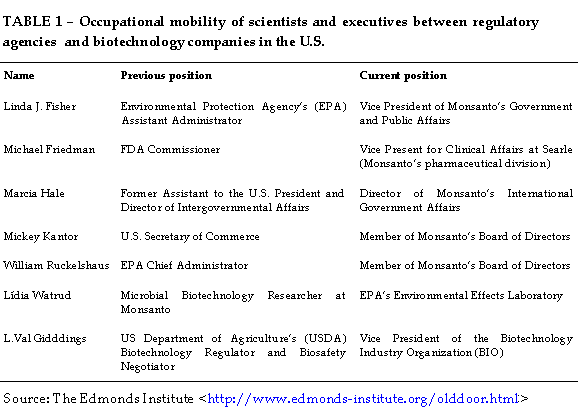
Monsanto's strategy may be regarded as an adaptation of Teece's (1986) complementary assets concept through its action in the regulatory process, accumulation of experience, and building up networks for favorable decisions regarding the commercial release of its products, whose capillarity reaches regulatory bodies in various countries. In Brazil, Monsanto began its campaign for the commercial release of Roundup Ready in 1998, when the first favorable decision took place. Since then, it has become a target of civil organizations and institutions opposing this technology. Given its commercial purpose, the company was as pungent in its action within the regulatory process as it had been in the U.S. in 1995 (PELAEZ and SCHMIDT, 2000). Monsanto's combativeness towards the government and regulatory bodies becomes evident in the migration of FDA professionals towards the company, as shown in the table below:
The relationship between Monsanto and regulatory bodies went beyond technology regulation issues -- not by chance, some of the latter's representatives would take up important positions within Monsanto or its partners. Simultaneously, the participation of Monsanto's personnel in committees responsible for the commercial release of transgenics no doubt influenced decision making. Experts on the techniques and knowledge grounding the company's scientific path, these professionals advanced a positive view of GMOs' qualities and benefits, especially given the paucity of research demonstrating harmful effects.
Besides acting directly within regulatory institutions, Monsanto has continuously influenced the scientific environment by means of financial incentives to genetic engineering research. Its ultimate purpose is to use these scientists' reports to bolster the credibility of its products and its claims for commercial release. Therefore, the company's networks also include not only those directly engaged with regulation, but those in charge of delivering technical opinions and scientific appraisals of the new technologies.
In Brazil, the release of Monsanto's transgenic soy encountered significant resistance in the aftermath of a troubled process involving repeated court decisions against CTNBIO's first decision in 1998. Even with lobbying in regulatory bodies, there was significant negative social reaction to the licensing of this technology. This, however, did not alter Monsanto's strategy vis-à-vis the regulatory agencies; it kept pursuing greater interaction and, of course, the lowering of commercial obstacles in its chief consumer markets. Additionally, the National Biosafety Association (Associação Nacional de Biossegurança, ANIO) 3, created in 1999 by a group of pro-GMO scientists, has been a pivotal source of information, by disseminating knowledge about transgenics through scientific forums and specialized journals. Among its corporate and institutional partners are Monsanto, Cargill, Brazil's Du Pont, and other companies interested in the diffusion of technologies based on genetic engineering subordinated to biosafety rules.
Other channels were also used by Monsanto. In 2003, the company launched its pro-GMO marketing campaign aimed at convincing the public of the technology's benefits. The goal was to attract sympathy from consumers and assuage the ideological conflict hitherto troubling the acceptance of its products.
Monsanto's strategy was pursued by means of considerable investment in genetic engineering, thereby building up the means for knowledge transfer to the company from the various research institutions with which it partnered. This strategy of progressive build-up of complementary assets started around 30 years ago, thus even before the first commercial release of genetically modified products. During this long process – from technological development to commercial release – the company left marks in the institutions with which it was directly or indirectly "associated", already with an eye toward the commercial release of its products.
In sum, the innovative firm can no longer limit itself to managing its competitive environment by considering new products and commercial strategies – rather, it should participate actively in regulatory processes predating the market dynamics itself (TEECE, 1986).
The formation of the institutional framework and conflicts of interest around the GM soy
Since the Green Revolution, various actors in the agricultural sector have opposed ongoing innovation, questioning the effects of technologies applied to agriculture's productive processes. Some have challenged the dependency of small producers on inputs provided by large companies, while others have stood in defense of the environment and consumers rights with regards to the quality of the products to be consumed.
]]> Actions by these multiple organizations and institutions have influenced the emergence of regulatory processes overseeing the market entry of these new products. This regulatory arrangement, on its turn, began to interfere with the diffusion process of these technologies. In the case of transgenic soy in Brazil, action by groups such as the Greenpeace, the Brazilian Institute for Consumer Defense (Instituto de Defesa do Consumidor, Idec), rural smallholders associations and state governments (for instance, of Rio Grande do Sul and Paraná) have impinged on its conditions of diffusion and use.According to Silveira and Borges (apud CASTRO, 2006), the institutional framework at place in Brazil allowed the introduction of the transgenic soy even before its effective commercial release, by permitting in advance Monsanto to charge for the use of its inventions. This was because biotechnological development implies the establishment of connections between different firms and institutions in order to bring together the bits of relevant knowledge. Moreover, laws had created the necessary conditions for the construction of such cooperative networks, especially because of the establishment of rules presiding over the sharing of innovations' results among the various agents involved in the process.
In 1998, a temporary court injunction rejected CTNBIO's commercial release decision until the Brazilian federal government issued commercial regulation pertaining to the labeling and segregation of transgenic foods, and carried out preliminary environmental impact assessment (EIA-RIMA). From then on, various temporary injunctions followed. In 1999, the "Campaign for a GMO-Free Brazil" was created. 4 It aimed at broadening the scope of the social debate on transgenics, as well as disseminating information on the technology's effects, especially among producers and consumers. Counterpoising the creation of the ANBIO in that same year, this Campaign sought to stop the diffusion of transgenics in Brazil by teaming up with entities such as ACTIONAID BRASIL, AGORA, AS-PTA, the Centro Ecológico Ipê, ESPLAR, FASE, Fórum Brasileiro de Segurança Alimentar e Nutricional, Greenpeace, IBASE, IDEC, INESC e SINPAF (National Union of Agriculture and Livestock Research and Development Institutions). The latter was entrusted with overall Campaign coordination.
State governments played a major role in restraining the diffusion process, both for its representative clout and for its more effective local action in deterring seed smuggling and illegal trade of transgenic products (CASTRO, 2006). During this period of ongoing legal battle between the contending interest groups, some state governments were salient in the movement opposing the transgenic soy. In 1999, the Mato Grosso do Sul state government established the "Clean Soy" program. In 2000, the Paraná state government began surveiling crops in search of clandestine transgenic seeds. Santa Catarina state interdicted the crops, while the state of Rio de Janeiro prohibited the planting of transgenics.
Large retail chains, such as Pão-de-Açucar, Carrefour, Wal-Mart and Sé, added clout to the opposing network, by refusing to expose in their shelves unlabeled transgenic products. This attitude affected the commercialization of products believed to be transgenics. However, due to illegal planting and to lack of rules for identifying and segregating the grain, unidentified transgenic products were circulating, therefore deeming labeling an unreliable basis for judgment.
Organizations opposing the diffusion of transgenic soy were successful for a while, as long as they could demonstrate that the legal framework did not support the entry of the new technology in the country. The ongoing controversies around legal decisions notwithstanding, on March 24th, 2005 Roundup Ready was cleared for planting and commercialization by the new Biosafety Law, number 11.105.
Based on Rosenberg's observations, indeed both regulatory forms and political conditions are important for the diffusion process. In the Brazilian case, initially the diffusion process was blocked by conflicts of interest related to the technology. Later on, such conflicts were legally sustained thanks to Brazil's institutional frailty. But this would reach its limit in the rearrangement of the institutional framework towards rendering less questionable the decisions by regulatory bodies. This has finally allowed for the institutionalization of the technology use. When the process came to a close, the continuity and acceleration of diffusion came to be much more conditioned by consumers' decisions and market relations.
The capture of official institutions by Monsanto
Since 1998, when battles over the release of transgenic soy began to be waged judicially, the Federal Government has supported Monsanto by standing by CTNBIO's commercial release decision. This stance was in fact remarkable, as it seemed to run counter to other official strategies related to the defense of the environment and to consumer rights which were backed by institutions contrary to the global diffusion of GMOs.
]]> Similarly to the FDA in the U.S., in Brazil issues were also raised about the ethics of CTNBIO. This resulted in the strengthening of its network with the institution directly connected to its interests. In 2000, the Federal District's 6th Federal Court mandated that the Federal Government demand the EIA-RIMA5 from Monsanto before any transgenic variety were released. A few days later, CTNBIO, claiming that it had not been notified about that court decision, approved the release of a transgenic corn. Ignoring the court order, the government supported CTNBIO's decision and signed a note authorizing the unloading of transgenic corn in the Northeastern state of Pernambuco. Meanwhile, representatives from important Federal Ministries began to voice their support for the adoption of GMOs in Brazil (CASTRO, 2006).In 1999, Monsanto announced a U$500 million investment in the construction of a glyphosate production facility in Brazil, which was completed in 2001. This was of interest to the government, as it created jobs and steered up the economy. The loan advanced to Monsanto for this project (R$285.9 million) represented more than 60% of the annual budget of the Superintendency for the Development of the Brazilian Northeast (SUDENE). As long as the transgenic-soy legal deadlock lasted, this unit's production was exported to Latin America. Monsanto consistently complained that its poor financial performance was caused by the delay in the commercial release of its products in Brazil.6
In this context, it is worth recalling the polemic ensuing from the 2003 decision to clear GMO planting and commercialization. In that year, some state governments began questioning the federal government's decision. Paraná state, for instance, decided to close its major Seaport of Paranaguá to exports and imports of transgenic products. In reaction, the federal government allocated investments to nearby ports in Rio Grande do Sul and Santa Catarina states, so they could take the transgenic soy and absorb the demand unmet by Paranaguá (CASTRO, 2006).
Towards the end of 2004, the federal government buttressed incentives to soy planting without distinguishing between the types of seeds, in order to sustain its Biodiesel Program. In order to reduce dependency on imported oil and save on foreign exchange reserves, Law 11.097-2005 would prescribe the addition of biodiesel to the common diesel sold to consumers. This rule was to become mandatory three years after the Law was enacted; the initial biodiesel-addition ratio was 2%, to be raised to 5% after the eight year.7 With this, the government expected to foster increases in soy production in the following years.
The federal government's supportive stance towards soy reflects Monsanto's political-economic persuasive power, based on its investments in the country and alignment with the government. In 2005, after the commercial release of Roundup Ready, President Luis Inácio Lula da Silva reignited the polemic when he said, at an event in Rio Grande do Sul, that "Instead of eating transgenic soy, let's make biodiesel. The car won't reject it, and we will eat the good soy".8 This Presidential hint that transgenic soy was not good enough for human consumption sparked a controversy, even though President Lula was corroborating the existence of a domestic market for Rio Grande do Sul's transgenic crops (this state is Brazil's number one producer of Roundup Ready). The government incited the polemic while showing a contradictory discourse. The suggestion of potential hazards to health and environment was especially troubling, given the fact that the rules for labeling and traceability had not yet been defined. The federal government thus played a significant role in the diffusion process of transgenic soy in Brazil. Besides campaigning for the domestic absorption of production, it was responsible for designing biosafety legislation.
The rural producer as user of the new technology
Market introduction of the transgenic soy resulted therefore from Monsanto's commercial strategy – even if at first disconnected from the producers' interests. In order to draw users towards its new technologies, the company had to persuade them of the benefits of adopting it. Transgenic soy is not a new product which creates a new market; it just replaces conventional soy. For the producer, however, the possibility of reducing production costs while improving pest control and reducing the use of herbicides effectively meant the introduction of something new to the production process. In other words, the introduction of transgenic soy in Brazil was driven by the perspective of higher profits. After noticing the good results reaped by American and Argentinean soy producers, Brazilian planters began to make use of transgenic soy, hoping to enjoy the product's commercial promises. However, critical issues followed – both the legal questions regarding its commercial release, and those pertaining to the adoption of a technological path. In the case of soy, there are two possibilities: to plant conventional soy in tandem with the collective opposition by major consumer markets, or to plant transgenic soy in the hope of reaping supposedly higher returns.
When a producer opts for planting transgenics, he takes on risks related to the emergence of new rules for traceability and labeling, technological dependency and increase in royalties, higher production costs in the future, barriers to the product in some consumer markets, and so forth. Thus, from the producer perspective, the use of such technology is ultimately determined by the innovator, inasmuch as Monsanto acts in the process of persuasion, adoption, and confirmation of these results.
The existence of illegal transgenic soy crops sparked immediate interest of Brazilian producers in the new technology's supposed benefits, even with the risk of crops being impounded and burnt, as well as impediments to their transportation and trading. Moreover, the illegal production of transgenic grain ended up inflating the topic into a national polemic, thus favoring the dissemination of the product throughout the country. The major Congressional caucus representing rural producers (Bancada Ruralista) maintained constant pressure on the government to keep the theme in the legislative agenda. In 2003, the government allowed producers to legally plant transgenic soy for the 2003-2004 harvest. Since then, transgenic soy crops have all but increased, even if backed only by Executive Provisional Measures. In 2004, these producers turned from users of illegal seeds smuggled from Argentina into legal producers paying royalties to Monsanto for the use of its transgenic technology – made legal exclusively for these crops. Once again, the federal government favored the transgenic grain's diffusion process, besides lending a hand to Monsanto by allowing it to collect royalties from producers (CASTRO, 2006).
]]> The passing of the Biosafety Act in March 2005 paved the way to the clearing of planting and commercialization of transgenic soy varieties in Brazil. Of the 52.7 million hectares of soy in the country, about 40% are transgenic varieties, according to Agroconsult's (2006) estimates. In 2007, transgenic soy was planted in about 11.7 million hectares – an absolute increase by 6 million hectares between the 2004-2005 and 2006-2007 harvests. After only four years, Brazil now ranks third among the world producers of transgenics.9The illegal production of transgenic soy and the growth that followed its effective commercial release make evident the interest, by Brazilian producers, on the new grain, in spite of the controversial stance by NGOs or by social movements. When Brazilian producers chose the new technological package, they intensified the diffusion process of transgenic soy in Brazil – especially by pushing for a favorable regulatory decision through their political representatives. In other words, Monsanto's commercial strategy ended up convincing producers that the benefits promised by transgenic soy outweigh the risks involved in this technological path.
Conclusion
Monsanto pushes for its transgenic technology in opposition to the activism of certain economic, social and political groups involved in the soy productive chain. Since this new technology brings benefits to one group and costs to another, whatever they are, its diffusion becomes more complex. It therefore oversteps the analytical boundaries of the firm, to include elements of a broader conflict of interests within the market and institutional environment. In this sense, the Brazilian economy's institutional feebleness to absorb and to process issues related to the introduction of biotechnological innovations such as GMOs ended up nourishing intense conflict, while becoming hostage to interests already crystallized internationally. On the other hand, it made possible the action of organizations opposing the commercial release of GMOs. These entities, spearheaded by the Greenpeace, Idec, state governments and private companies, were able, for seven years, to breed legal debates in which they advocated stricter rules for the product, as well as the development of research on its likely harmful effects to the environment and human health. During this period, the diffusion of the technology was officially stalled.
Monsanto had previously built competences for influencing decisions regarding the acceptance of its innovation. Already counting on some structure securing the collecting of royalties, it also turned its efforts to direct action in the federal instances in charge of granting licenses to GMOs. The company's presence in the institutional environment became fundamental for the market success of its product. This could have only happened through management of complementary assets – among which stand out Monsanto's influence not only in the market, but at the social and political levels.
The federal government, even though fractured by oppositional stances within its own structure (especially state governments), was nonetheless the pivotal actor in the diffusion process of transgenic soy. First, it had the power to enact legislation legalizing its production in Brazil. Second, official institutions acted, even if episodically, directly in tandem with Monsanto's strategy. Soy producers, on their turn, mimicked Europeans and Argentineans by adopting the transgenic seed, even if illegally. In order to make their crops legal and stave off threats of harvest impoundment and monetary fines, these producers put pressure on the government through its political representatives in Congress. They sought to profit in the short term, especially through cost reduction. The increase in transgenic crops following commercial release indicates that many Brazilian producers have thoroughly accepted the transgenic seed's economic benefits, in spite of market uncertainties.
It can be therefore concluded that, on the one hand, the diffusion process of transgenic soy was led by the innovator firm's strategies for conquering the market of Brazilian soy producers; on the other, it ultimately depended on the direction taken by institutions – both official and those emerging from the social environment and the market itself. These aspects have determined the future direction of soy planting and commercialization, for instance, profitability, access to seeds, payment of royalties, and acceptance of the new technology by consumers. Finally, even though the diffusion process has already been ballasted by the learning process resulting from the use of the new technology and the reduction of regulatory uncertainty, nonetheless further uncertitudes remain, pertaining to both production and the market.
Bibliographic References
]]>ALBERGONI, L.; PELAEZ, V. Da revolução verde à transgenia: ruptura e continuidade de paradigmas tecnológicos. Disponível em www.pet-economia.ufpr.br/textos/relatorio_evinci_leide.htm - 17k. Acesso em 24 de maio de 2007.
AGROCONSUL. Agroconsult confirma safra maior de soja transgênica. Publicado em 2006. Disponível em www.agroconsult.com.br/culturas/?cultura=soja . Acesso em 24 de outubro de 2006.
CASTRO, Bianca. O processo de institucionalização da soja transgênica no Brasil nos anos de 2003 e 2005: A partir da perspectiva das redes sociais. Dissertação de Mestrado, CPDA/UFRRJ. 2006.
__________. Um panorama da biotecnologia moderna. In:CASTRO, Bianca; DAL POZ, M. E.; ASSAD, A. L. D. Biotecnologia e recursos genéticos: desafios e oportunidades para o Brasil. Campinas: I. E. - Unicamp-FINEP, 2004.
CRIBB, A. Y. Inovação e difusão: considerações teóricas sobre a mudança tecnológica. Essência Científica, v. 1, n. 1, março de 2002. Disponível em www.gifad.org.br/publicacoes/escient/ec_01010102.htm. Acesso em: 19 de agosto de 2007.
]]>EMBRAPA SOJA. Encontro Tecnológico discute a cultura da soja. Publicado em 2006. Disponível em www.embrapa.br/noticias. Acesso em outubro de 2006.
EMBRAPA. A insustentabilidade da revolução verde. In: Informativo Meio Ambiente e Agricultura, n. 26, ano VII, abr/mai/jun/1999. Disponível www.cnpma.embrapa.br/informativo/mostra_informativo.php . Acesso em 16 de janeiro de 2007.
FAGUNDES, Ana C. Reportagem Visão da Monsanto, 2002 Disponível em http://revistagloborural.globo.com/GloboRural/0,6993,EEC354965-1641,00.html. Acesso em setembro de 2007
FURTADO, A. Difusão tecnológica: um debate superado? In: PELAEZ, V; TAMAS, S. Economia da inovação tecnológica. São Paulo: Huctec, 2006.
GRASSI, R. A. Capacitações dinâmicas, cooperação e coordenação interfirmas: as visões Freeman-Lundvall e Teece_Pisano. Estudos Econômicos, São Paulo, v. 36, n. 3, julho-setembro de 2006.
IBA,S. K; et al. Um panorama da Ratreabilidade dos Produtos Agropecuários do Brasil Destinados à Exportação CIRAD Projeto ProsER. São Paulo, 2003. Disponível em www.cendotec.org.br/dossier/cirad/produitsbrpr. pdf. Acesso em setembro de 2006
LEITE, M. Folha explica os alimentos transgênicos. In: Folha Online,outubro de 2007. Disponível em http://www1.folha.uol.com.br/folha/ciencia/ult306u15938.shtml . Acesso em 24 de abril de 2007.
JORGE, P. C. A. de. Resenha da obra Managing Intellectual Capital: Organ-izational, Strategic, and Policy Dimensions. Disponível em www.finep. gov.br/revista_brasileira_inovacao/segunda_edicao/resenha_teece.pdf.Acesso em 6 de julho de 2007.
MACHADO, R. M. Fundamentos sobre o estudo da dinâmica das inovações no Agrobusiness. RAC, v. 2, n. 2, maio-Agosto de 1998. Disponível em anpad. org.br/periodicos/arq_pdf/493.pdf. Acesso em setembro de 2007.
MONSANTO. O que é soja RR Disponível em. www.monsanto.com.br/sementes/soja_rr/oque/oque.asp. Acesso em 24 de abril de 2007.
NOGUEIRA, S. Soja transgênica: o impasse continua. In: Instituto de Economia Agrícola. Publicado em out. 2003. Disponível em: www.iea.sp.gov. br/out/verTexto.php?codTexto=861. Acesso em 25 de maio de 2007.
]]>PASQUAL, C; MENEGAZ, E. A Inovação Tecnológica como uma Estratégia para atingir novas oportunidades de mercado: O queijo Gran Formaggio Tipo Grana da Randon Agropecuária Ltda. Disponível em www.upf.br/cepeac/download/td_09_2004.pdf. Acesso em 3 de junho de 2007
PELAEZ, Vitor. A firma em face de regulação da tecnologia: a experiência da Monsanto. Publicado em 2003. Disponível em: <www.abphe. org.br/congresso2003/Textos/Abphe_2003_110.pdf >. Anais do Congresso de Economia. Acesso em 14 de julho de 2007.
PELAEZ, V.; PONCET, C. Estratégias industriais e mudança técnica: uma análise do processo de diversificação da Monsanto. In: História Econômica & História de Empresas, v. II, n. 2, 1999.
PELAEZ, V e SCHMIDT, W., Difusão dos OGM no Brasil: imposição e resistências. Publicado em 2000. Disponível em: www.economia.ufpr.br/publica/textos/2000/txt0700pelaezeshimidt%2 0OGM.doc. Acesso em março de 2006.
PENROSE, E. A economia da diversificação. In: Revista de Administração de empresas, Rio de Janeiro, v.19, n.14, 1979.
PROGRAMA NACIONAL DE PRODUÇÃO E USO DE BIODIESEL. Disponível em www.biodiesel.gov.br/programa.html . Acesso em setembro de 2007.
ROSENBERG, N. Por Dentro da Caixa Preta: Tecnologia e economia. Campinas: Editora da Unicamp, 2006.
SCHUMPETER, J. A teoria do desenvolvimento econômico. São Paulo: Abril Cultural, São Paulo, 1982.
SILVEIRA. J. V. F. Estratégias de Segmentação de Mercado no Agronegócio: o caso da inserção da soja transgênica no estado do Paraná, Dissertação do Programa de Pós-Graduação em Engenharia de Produção. Ponta Grossa,2005. Disponível em www.pg.cefetpr.br/ppgep/dissertacoes/diss_2005 . Acesso em janeiro de 2007.
TEECE, D.J. Profiting from technological innovation, Research Policy, n. 15, 1986
WILKINSON, J. Iniciativa de segregação e preservação de identidade das empresas agroalimentares. Publicado em 2002. Disponível em www.eco.unicamp.br/neit/cadeiasintegradas/sintesepreliminar.pdf. Acesso em outubro de 2006.
]]>
1 Soy receiving a gene from the soil bacterium Agrobacterium, tolerant to glyphosate-based herbicide (MONSANTO, 2006).
2 This principle states that a transgenic food is acceptable for consumption when it is characterized as substantially equivalent to its "natural" predecessor; it is thus assumed that it poses no health risks. This concept emerged in the 1990's as a tool in regulatory bodies assessing transgenics in the absence of specific competences for regulating these new technologies (MILLSTONE, BRUNNER and MAYER, 1999).
3 See ANBIO, http://www.anbio.org.br.
4 The Campaign for a GMO-Free Brazil's bulletins can be found in the following websites: <http://www.agrisustentavel.com/trans/campanha.htm>,<http://www.aspta.org.br/publique/cgi/cgilua.exe/sys/start.htm?sid=8>.
5 The Environmental Impact Study (Estudo de Impacto Ambiental, EIA) and the Environmental Impact Report (Relatório de Impacto Ambiental, RIMA) are requirements for the environmental licensing of enterprises and activities carrying effective or potential risk to the environment (cf. Resolução CONAMA n. 01/86. Available at http://www.mma.gov.br/conama. Last access, August, 2007.
6 See Revista Globo Rural. "Visão da Monsanto". Available at http://revistagloborural.globo.com/GloboRural/0,6993,EEC354965-1641,00.html. Last access, September 2007.
7 See the National Program for Production and Use of Biodiesel. Available at http://www.biodiesel.gov.br/programa.html . Last access, September 2007.
8 "Soja boa a gente come, a transgênica fazemos biodiesel" Source: Ambiente Brasil, 2005. Available at http://www.agrisustentavel.com/ogm/t300705.htm. Last access, September 2007. ]]>
9 Agência Brasil, May 8th, 2007. "Comissão da Câmara discute resultados da Lei de Biossegurança". Available at http://www.agenciabrasil.gov.br/noticias/2007/05/08/materia.2007-05-08.9594702810/view. Last access, September 2007.