A política dos movimentos sociais para o mundo rural
Ilse Scherer-Warren*
Translated by Pedro Stoeckli Pires
Translation from Estudos Sociedade e Agricultura, Rio de Janeiro, v.15, n.1, p. 5-24, Apr. 2007.
The starting point of this paper is that the political reach of a network-structured movement is related to its capacity to articulate several organizational scales (from local to regional, national and transnational), and to develop various forms of political action (at the levels of collective organizations, political articulations and mobilizations in the public sphere). From this, the paper then examines which rural collective actors are the most expressive at each level, the strategic political actors in the formation of interorganizational networks, the rural social movement's demands, struggles and political challenges, and, finally, the mode of development of the difficult and contradictory relationship between some of these social movement networks, the State and rural elites in the present political conjunture.
Key words: rural social movements, networks, rural politics.
RESUMO
Nesta análise, partiu-se do pressuposto de que o alcance político de um movimento estruturado em rede relaciona-se com sua capacidade de articular as diversas escalas organizacionais (do local ao regional, ao nacional e ao transnacional) e com as diversas formas de atuação política (nos níveis das organizações coletivas, das articulações políticas e das mobilizações na esfera pública). A partir desse pressuposto, buscou-se examinar quais atores coletivos do mundo rural são, atualmente, os mais expressivos em cada um desses níveis; quais os atores políticos estratégicos na formação de redes interorganizacionais; quais as demandas, lutas e desafios políticos enfrentados pelos movimentos sociais no campo e, finalmente, como se desenvolve a difícil e contraditória relação entre algumas dessas redes de movimentos sociais com o Estado e elites rurais na atual conjuntura política.
Palavras-chave: movimentos sociais rurais, redes, políticas no campo.
Social movements that are the most expressive and broadest in political scope have increasingly been acting as interorganizational networks with a plurality of themes. Rural social movements are no different. It is from a perspective of social networks analysis that we organize this debate. Thus, we begin with the classification of the main analytical categories of the networks of collective actors that organize themselves to face the rural problems in Brazil and we follow to discuss how the most strategic actors network. Further, we examine different levels of social and political demands that emerge from these movements' networks, the tensions and challenges that they face in the search for answers to the diversity of their demands. Finally, we discuss the difficult and contradictory relation of these movements' networks with the State and with other branches of society.
]]> Organizational format of the social movements in the country
The political range and the mobilizing capacity of a network structured movement is connected to its ability and creativity to discuss/network various organizational scales – from local to regional, national and transnational – and to develop a variety of forms that can be represented in the following synthesis:
Format of the organized civil society: 1
ORGANIZATIONAL LEVEL:
Specific social entities and movements (Associations and rural syndicates, encampments and settlements, CEBs, church unities/pastorals, NGOs, local movements centers etc).
NETWORKING POLITICAL LEVEL:
Forums, interorganizational networks (FNRA, Via Campesina do Brasil, National Popular Assembly etc.)
MOBILIZING LEVEL in the public sphere:
]]> Marches (of the Land Reform, of the Daisies2 and others), campaigns, "weeks", "cry of the excluded", "communal assistance" etc.;
SOCIAL MOVEMENTS NETWORK:
The group of practices and politics formed by the three previous levels (Landless Rural Workers' Movement (MST), indigenous movements, quilombolas3, people affected by the construction of dams, rural women etc.)
The organizational level is constituted by formal or semiformal entities or associative forms, situated at defined territories and with continuous acting regarding the daily life of its targeted population. It refers to the so called "base movements or organizations" and to direct mediators (NGOs, pastorals) that act together with these bases.
The networking political level refers to a variety of intercommunication ways, dialogue and networks developed by interorganizational collectives regarding common objectives and struggles, for instance, as in The National Forum for Land Reform and Justice in Rural Areas (FNRA, in Portuguese), that defends the limiting of the size of rural properties, the distribution of territory through land reform and the delimitation and entitling of quilombolas and indigenous people, along with demands from other sectors (women, youngsters etc.). Amongst their strategies there is also the formulation of social politics proposals and the participation in the public policies.
The actors in the mobilizing level act directly on the public sphere. Through this kind of action the movements seek visibility and recognizing to their demands from the civil society, governments and the media. Thus, they tend to take up ways of pressure and petition from the state. Rural social movements have especially been using the marches of their member to Brasilia as a strategy of this organizational level, as well as manifestations and protests in many regions of the country.
Finally, the social movements network is defined as the group of political practices formed by the three mentioned levels (organizational, networking and mobilizing), transcending the merely empirical expressions of these levels towards the formation of a movement logic that includes the construction of the identity of the struggle, the definition of antagonists or social and systemic opposers, in the name of a project or utopia of social, cultural, political or systemic transformation.4
The strategic political actors and the relation between movements
The networking political level – as in the civil society's forums, in the Via Campesina do Brasil,5 in the National People's Assembly,6 amongst others – is especially relevant for the formulation of public policies and the construction of the movements' ideals. It is also an important opportunity of exchanges with movements of other natures (urban, human rights etc.) and negotiations of political matters. We take as an example the case of The National Forum for Land Reform and Justice in Rural Areas (FNRA) to elucidate this strategic political role.7
]]> The FNRA was created in 1995 with the objective of transcending the social movements struggles of stronger corporative nature through a national networking of the collection of rural social movements, entities and people related to land reform and the matter of land democratization. The Forum is not a formal organization in the strict sense, but a strategic debate space for the formulation of common struggle objectives, for the elaboration of principles and the conduction of concrete actions of public impact. It supports a guiding action principle: that the unit of movement is formed based on what is consensual to the group of members, but, when there is no unit, the diversity most be respected in the sense that each organization deals with its non-consensual demands in their own struggle field. For instance, the majority of the Forum members are against the transposition of the São Francisco River, while Contag is favorable to it. The entity is free to choose not signing the contrary manifestations. Naturally these controversies create tension, conflict and ambiguities inside the Forum, but its mediators in the network seek possible conciliations for the practices that are often contradictory.8 In this way, the struggle guidelines are broadened and include diverse branches in the Forum but, in regard to irreconcilable matters, each entity shapes its own path, as seen in the manifestation of an interviewed FNRA member:9We only act in the Forum when unit exists. In the diversity and in the comprehension of differences. When there is none, there is no fighting. Each one acts on its own way, still respecting the differences. Then we do all that is possible inside the Forum that has unity, common action. But the effort of our coordinators, of the people that arrange the Forum and conduct the Forum, is so that increasingly we form a unit, based on ideas, concerning objectives, principles and concrete actions. This has been our effort since 1994… In 2001 we felt the need of creating a minimum structure so that this Forum could deal with the group demands that the entities would have in relation to the matters of land, water and family agriculture. For when I speak of land, some matters become clear, such as the land reform and the delimitation of the lands of indigenous people, quilombolas, ribeirinhos and fundos de pastos10, and of fishermen. And everything else that is included in the land matter, as the struggle for the environment, natural resources, and biodiversity. When I am referring to family agriculture, I am not only talking about the general concept of family agriculture, the one that Contag defends, that FETRAF defends. I am talking about a broader and more complex peasant agriculture than the one that the MST and the Via Campesina defend, one that has another perspective about it. We try to unify these many thoughts around some concrete actions. (Representative of the FNRA coordination, 2005).
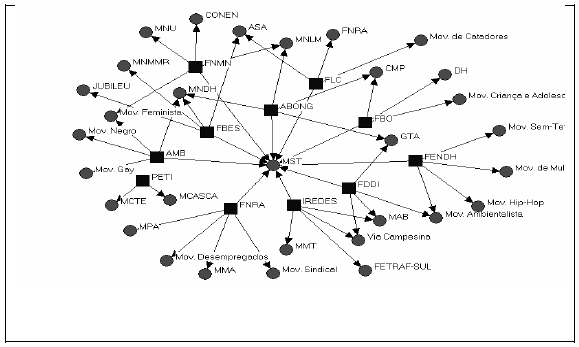
As in every networked political organization, there are strategic links, regardless of the defended horizontal principle. However, these links are not defined by a bureaucratic hierarchy, but by its function of political legitimacy that it has inside the organization. In the case of FNRA some strategic political actors were pointed out, known as "mass movements"11: the MST (Landless Rural Workers' Movement), the MMA (Rural Women Movement), the MPA (Small Agriculture Workers), the Contag (National Confederation of Agricultural Workers), the MTL (Movement for the Land, Work and Liberty), the MAB (People Affected by Dams' Movement), amongst others. There is also a tendency of the most strategic political actors to act in other popular civil society's forums. In this way, the MST was politically recognized as the most expressive social movement by almost the totality of the researched national forums.12
The most important social movements in Brazil, according to civil society forums13
MST's relevance is not only due to its participation as a member of these forums, but for its capacity of leadership (strategic link) in the broader organizations of which the forums are part of, by its visibility in the public mobilizing networks and for the political continuity and coherence of its daily activities in the local organizational level. Hence, the three constitutional levels of a network movement (organizational, networking and mobilizing) as well as the elements of the political construction of a movement (principles of identity, conflict definition and project of change) have been developed in all the levels of this movement.
]]> Demands, struggles and political challengesThree main kinds of struggle occur inside rural social movements: the material/emergency demands of the daily life of the movement's bases, the praxis of revaluation of symbolic and political meaning inside the movement and inside the society, and the elaboration and the recognition of a new project of society. These three aspects of the struggle complement each other, but are, at the same time, producers of tension and conflicts inside the movements themselves and inside broader network organizations.
Firstly, the material/emergency demands of the daily life are the major mobilizing factor of the movement's bases or of the formation of the so-called "mass movement". It is the capacity of answer to the emergency shortages of the rural populations (or of rural origins), socially excluded, that attracts such social groups to join collective organizations. Thus, the search for concrete answers (conquest or legalization of land, resources for production, retirement rights, public health, rural education etc.) requires the direct negotiation with the State and governments. The movement is characterized in this stage by its petitionary profile and the politic negotiations prevail. It faces the challenge of creating pressure without being co-opt, what, under the Lula government, has become more difficult due to the strong ideological identity that the movement had with the former candidate. During the president's first mandate, certain struggle guidelines were suspended in order not to harm the electoral process of reelection, though nowadays this is being reviewed, as it can be seen in the evaluation we present next.
In the beginning of the second mandate, the social movements' bases started to see that the land was becoming even further from their dreams. The reality became the encampment. The explanations of the leaders started to be questioned… Consequently, The National Forum for Land Reform and Justice in Rural Areas (FNRA) will launch once again the campaign for the limiting of properties. This campaign was suspended in 2003 in order to carry out the request of the then president of the Republic, Luis Inácio Lula da Silva. As means not to bring electoral constraints to the rural and urban elites, the FNRA accepted the request (Vigna, INESC, 2007).
Secondly, the praxis of revaluation of symbolic and political meaning inside the movement and inside society occurs in a fundamental moment of political formation and the search of recognition as legitimate actor. In this level there is a transition from a petitionary movement to a proper political movement. The political and symbolic nexus established in the three levels of the movement's network are fundamental in this process:
• In the organizational level of the bases there are educational practices focused on symbolic deconstructions and reconstructions related to politics of identity and according to the founding principles of the movement; the construction of new identities; the formation of autonomous subjects and the role of actors in the process of social change.14
• In the networking political level the collective political identification and the solidarity between the forums' and networks' entities are built; the prior national politics for the movements are discussed; the convergences and possibilities of network units construction are sought; one learns to live together with the divergences and to respect the differences of political and ideological options, regional, ethnical, age, and gender differences, etc.15
• In the mobilizing level in the public sphere there is the search of political visibility and the public recognition of the movement; the enlisting of sympathizers and supporters of the movements objectives; the aim of demonstrating political power and opening negotiation channels in the public sphere. It is a relevant moment of what is being called "protest movement" in the public sphere by the sociological literature.
Thirdly, the elaboration and the politic of recognition of a new project of society and/or indicators of change in the hegemonic project of society. This is the most political level of the social movement and it runs the risk of being also the most partisan and of serving as an instrument for parties' rivalry. The networking political level has a relevant role in this political act, whether it is through the debate forums, or through the action of the Via Campesina do Brasil, the National People's Assembly, Brazilian Social Week, the World Social Forum or through other events that bring the social movement networks together.
]]> The major current debate concerning the construction of a "New National Project" contemplates the following aspects related to the rural matter:1. In relation to the modernizing model in agriculture: there is the proposal of combat against the commercialization of the land reform, the agrobusiness, the transnational companies that want to control seeds, agrarian production and commerce, as well as slavery and other kinds of subordination in the country. There is also the proposal of an agriculture focused on the internal market, of the respect towards the environment that stimulates agrarian cooperation and labors' autonomy.16
2. In relation to the land property: there is the proposal of a limited size of property, as mentioned in the document "Earth Charter", which, according to the FNRA, is what brings "total unity to the movement: even Contag signed and helped building it. The Earth Charter is nowadays our main document".17 There is the proposal of expropriation of all large estates, of foreign properties and of banks and those who practice slavery. There is the struggle for land delimitation of all indigenous and remaining quilombolas communities.18
3. Regarding the social movement: it proposes to build new relations of political power with the society and with the urban social movements, seeking the expansion of a "mass movement".19 In order to do so, it is also considered necessary "to make the connectivity of the rural social movements stronger in the Via Campesina do Brasil, in all the states and regions. To build, with all social movements, the Popular Assembly in the cities, regions and states".20 In the world scenario, the more organic networks are done with the Transnational Via Campesina, the Continental Cry of Excluded, the ALBA - Bolivarian Alternative for the Americas, the International Caritas, the International FIAN - Food First Information and Action Network, and through the actions in the World Social Forum in its Brazilian editions, and in other Latin American countries and continents. These international or transnational bonds, mentioned by the FNRA and by MST, are references of broader networks. However, each specific movement has its own organic networks as, for instance, the MAB, which, apart from being member of the Via Campesina,21 is connected to the International Commission of Large Dams and the Committee on Dams, Rivers and People, amongst others.22 Another example is the recent III March of the Daisies that, as well as the support of many national networks of urban and rural women, counted on the stimulation and participation of transnational networks, such as the World March of Women (WMW), the Latin American and Caribbean Rural Women Network (REDELAC) and the Coordination of the Organizations of Familial Productions of the Mercosur (COOPROFAM).23 Women, as well as the ethnical groups (indigenous and quilombolas in special), enlarge the field of political struggles beyond the "production" field towards the recognition of the social segment and respective empowerment of the rural political participation.24
The Difficult relation between movements, State and other social groups
The need that the rural social movements have of maintaining a constant negotiation with the State and governments in order to fulfill the demands of the daily life of the movement's bases has been causing, especially during the Lula government, a relation full of ambiguities. On one hand there is a relation of political reciprocity, participation of peasant leaderships in the public administration of the State, the search of new participation spaces, such as in the conferences, councils and in the Pluriannual Plan (PPA 2008/2011).25 On the other hand, it imposes the necessity of developing a critical consciousness over the neoliberal paths that the government has been taking and the maintenance of the social movements' autonomy, an idea that has currently been growing in the rural social movements.
Besides, there is the obligation of dealing with multiple agendas, which can vary from the demands of the daily life of the excluded population to the defense of long lasting projects of social change, with a socialist bias (or republican, according to the current Stédile's speech).26 This characteristic frequently creates an ambivalent relation between the movements and the State and/or governments in its various scales or institutions, somewhat receptive to the diversity of movements. The more pragmatic demands are better received, but the more political referential are more commonly rejected.27
The confrontation with the politics of the rural elites is increasingly becoming more complex: from one view the struggle is against the traditional latifundium, unproductive and of vast properties; from the other one it is the struggle against the rural elites, agrobusiness, biotechnology, and production associated to capital. Lastly, there is also the struggle for the recognition of colonized ethnic groups, socially and politically excluded (indigenous and quilombolas that claim the right of keeping their territory), that advocate the conquer of new collective, social, cultural, environmental and political participation rights (for women, youngsters, poor rural workers, people affected by the construction of dams, amongst others). In this dimension the social movements also face the challenge of fighting against their own criminalization by the political elites and the media, seeking to obtain recognition and public legitimacy for their struggles and specific organizations.
]]> Finally, the participation of the movements' networks in the construction of a new project of nation faces even broader challenges, including: seeking a minimum unity based on common struggles and a way petitioning, considering the heterogeneity of collective actors, historical roots and referential political fields (religious, political-partisan, classical and renewed socialist left-wings and other outspreads). They need to expand their political networks with political actors from other referential territories (urban, Latin American, globalized). The tension is present between the fractions that seek unity at any costs, with the objective of building a unified front or political counterforce against the system, and the ones that disseminate the construction of movement networks with guiding principles for common actions, but with large room to respect the differences and diversities of specific struggles. The first stream advances towards a movement conceived as a political organization, whereas the second one tends to keep itself as a movement in an open process, in other words, as a networking movement.
Final Considerations
The informational society, with the mechanisms of worldwide structures and interorganizational relations, including the counter-hegemonic ones from the civil society, has more than ever brought the collective actors closer and created possibilities of social, political and communicative connections between them. All the same, this proximity exposes and strains the divergence of demands of political practices from different movements. Such straining becomes negatively clear in the history of the many meetings of the World Social Forum (WSF), but represents, at the same time, an expression of the base movements, especially of the most strategic ones, amongst which are included the rural social movements with important expression in the Brazilian reality. The controversy was built around the disjunctive: the belief in the need of the unit of masses for the construction of a counter-hegemony to the system or the belief in the possibility of the system deterioration due to the diversity and multiple fronts of social struggle, dialoguing and empowering themselves through their networks.
However, the assembly of diversity, which is expressed in the WSF as a typical case, reproduces itself in the many civil society's forums created in the last few years, as well as in other collectivities and networks as previously referred. In these network exchanges, collective actors are modified and the divergences not always impede common action strategies, as observed in the FNRA, a tendency that is also expressed in the process of the WSF, as shown in Bello's analysis, one of their intellectual activists:28
El desarrollo de una estrategia de contra-poder o de contra-hegemonía no tiene que significar que se vuelva a caer en viejos modos jerárquicos y centralizados de organización característicos de la antigua izquierda. Una estrategia semejante puede, en realidad, ser fomentada mejor mediante la formación de redes de múltiples niveles y horizontal en la que los movimientos y organizaciones representadas en el FSM se han distinguido en el fomento de sus luchas en particular.
In the same way, Immanuel Wallerstein (2007), one of the WSF's exponents, concludes that such controversy does not threat the WSF anymore, for it creates possibilities for two action strategies: one centered on mobilization and direct action, using the WSF as a connective moment for unified actions; and another one conceiving the WSF as an open space to multiple initiatives and identity networks that wish to transform the existing "world system". From the particularities of the different forums and movements or from the continued processes developed inside their networks, broader practices and consensual mobilizations are made possible due to common universal ideals. In the words of Wallerstein (op. cit.):
]]> As they act in many dimensions (organizational, networking and mobilizing), as said in the previous pages, in the case of the Brazilian rural social movements, the networks have been, actually, presenting an enlargement of political action spaces. This becomes concrete through a collection of petitionary politics based on the daily and pressing demands of the rural populations (developed especially by the continuous work of their local organizations), through proposal politics to the formulation of social policies; through the participation in the public policies debates that take place in their forums and interorganizational networks; and, finally, through politics of recognition in the public sphere concerning their legitimacy and the construction of counter hegemonies to the system through their mass mobilizations and protests.The key-idea is the creation of networks, and the WSF is particularly equipped to construct it on a global level. There is currently an efficient feminist's network. For the first time, in Nairobi, a network of labor struggles was instituted (defining the concept of "worker" on a very broad sense). A network of intellectual activists is being formed. The rural/peasant movement network has been reinforced. There is a promising network of those who defend alternative sexualities… And there are networks working on specific struggle fields – water rights, struggle against the HIV, human rights.
Bibliographic References
BELLO, Walden. El Foro Social Mundial en la encrucijada. www.forumsocialmundial.org.br/dinamic.php?pagina=balanco_fsm2007_por [ Links ]
CARTA DO 5º CONGRESSO NACIONAL DO MST. www.mst.org.br. Acesso em 15/06/2007. [ Links ]
CASTELLS, Manuel. The information age: economy, society and culture – v. II: The power of identity. Oxford: Blackwell Publishers, 1997. [ Links ]
DEERE, Carmen Diana. Diferenças regionais na reforma agrária brasileira: gênero, direitos à terra e movimentos sociais rurais. Estudos Sociedade e Agricultura, 18, abril, 2002. [ Links ]
MELUCCI, Alberto. Challenging codes: collective action in the information age. Cambridge: Cambridge University Press, 1996. 441p. [ Links ]
NIEMEYER, Carolina Burle de. Via Campesina: Uma análise sobre sua gênese e processo de consolidação. Anais do II Seminário Nacional Movimentos Sociais, Participação e Democracia. www.npms. ufsc.br, Florianópolis, 2007. [ Links ]
NIEMEYER, Carolina Burle de. Contestando a governança global: a rede transnacional de movimentos sociais Via Campesina e suas relações com a FAO e OMC. 2006. Dissertação (Mestrado)-Instituto de Relações Internacionais. Pontifícia Universidade Católica do Rio de Janeiro, Rio de Janeiro, 2006. [ Links ]
SCHERER-WARREN, Ilse; REIS, Maria José. Do local ao global: a trajetória do movimento dos atingidos por barragens (MAB) e sua articulação em redes. In: Franklin Frothman, Ricardo Ribeiro e Andréa Zhouri (orgs.). Vidas Alagadas: Conflitos Socioambientais, Licenciamento e Barragens. Editora da UFV, Viçosa, 2007. [ Links ]
SCHERER-WARREN, Ilse. Fóruns e redes da sociedade civil: percepções sobre exclusão social e cidadania. Revista Política & Sociedade. Florianópolis: UFSC/PPGSP, n. 11, out. 2007. [ Links ]
SCHERER-WARREN, Ilse. Das mobilizações às redes de movimentos sociais. Sociedade e Estado, UNB, v. 21, n. 1, 2006a. [ Links ]
SCHERER-WARREN, Ilse. Inclusão social e cidadania: a perspectiva das organizações, redes e movimentos. In: A Amaral e J. Burity (orgs.). Inclusão social, identidade e diferença. São Paulo: Annablume, 2006b. [ Links ]
SCHERER-WARREN, Ilse. Movimentos em cena... as teorias por onde andam? In: Ilse Scherer-Warren et. ali. Cidadania e multiculturalismo: a teoria social no Brasil contemporâneo. Lisboa/Florianópolis: Socius/Editora da UFSC, 2000. [ Links ]
SCHERER-WARREN, Ilse. Cidadania sem fronteiras: ações coletivas na era da globalização. São Paulo: Hucitec,1999. [ Links ]
SCHERER-WARREN, Ilse; SILVEIRA, Suzana Maria Pozzer; TEIXEIRA, Viviani. Redes de Combate às Múltiplas Faces da Exclusão Social. 58º Reunião da SBPC, 2006. [ Links ]
SILVEIRA, Suzana Maria Pozzer. A construção do sujeito no MST: Assentamento Eldorado dos Carajás. Dissertação apresentada ao Mestrado em Sociologia Política da UFSC, março de 2007. [ Links ]
STEDILE, João Pedro. Entrevista à revista Época. www.portalpopular .org.br. Acesso em 8/2007. [ Links ]
TOURAINE, Alain. ?Podremos vivir juntos? La discusión pendiente: el destino del hombre en la aldea global. Tradução de Horário Pons. Buenos Aires, Fondo de Cultura Económica, 1997. [ Links ]
VIGNA, Edélcio. Governo responde às propostas do FNRA. www. inesc.org.br. Acesso em 30/07/2007. [ Links ]
WALLERSTEIN, Immanuel. FSM 2007. www.forumsocialmundial. org.br/dinamic.php?pagina=balanco_fsm2007_por [ Links ]
Lecture given in the II Meeting of Rural Studies Network, Table III: Rural and political question, which took place at the IFCS/UFRJ, Rio de Janeiro, from 09/11 to 09/14/2007.
* Ilse Scherer-Warren is the coordinator of the Social Movements Research Nucleus and professor of the Sociology and Political Science Department of the UFSC (ilse@manezinho.com.br).
1 See Scherer-Warren, 2006a and 2006b for a broader explanation of these categories.
2 The III March of the Daisies occurred in August 2007 in Brasilia was the most recent event of this nature, organized by the Contag, around 50 thousand rural women took part of it. Its demands ranged from daily matters to denunciations of the country life conditions, poverty, inequality, violence and exclusion of women from the developmental politics.
3 Slave descendents.
4 Regarding this definition of social movements, see Touraine, 1997; Melucci, 1996 and Castels, 1997. See also further ideas in my previous works from 1999, 2000 e 2006a. ]]>
5 It is a branch of the International Peasant Movement that has the objectives of struggle for the food sovereignty, land reform, biodiversity and a healthy environment, women's participation, amongst others.
6 It is a branch of the Popular Consultation, gathered for the fist in 1997 in Itaici (SP), it was born as a space for altercation and mystique, with the objective of rescue and build a Popular Project for Brazil. In 2005 the II Assembly took place and, in 2007 in Belo Horizonte, the III National Assembly of the Popular Consultation occurred, already with the objective of becoming a political organization.
7 The FNRA is one of the civil society's forums that is being studied in our ongoing research project "The multiple faces of social exclusion" (AMFES Project), UFSC/CNPq.
8 As we could see in our research for the previously cited project.
9 For the AMFES Project, op. cit.
10 Small rural communities.
11 Interview a representative of the FNRA coordination for the AMFES project.
12 Manifestation seen in 10 of the 11 researched forums in the project mentioned: AMB – Articulação das Mulheres Brasileiras; FBO – Fórum Brasil do Orçamento; FLC – Fórum do Lixo e Cidadania; FBES – Fórum Brasileiro de Economia Solidária; FNRA – Fórum Nacional de Reforma Agrária; FENDH – Fórum de Entidades Nacionais de Direitos Humanos; FNMN – Fórum Nacional de Mulheres Negras; Fórum-PETI – F. Nacional de Prevenção e Erradicação do Trabalho Infantil; FDDI – Fórum em Defesa dos Direitos Indígenas; Inter-redes Direitos e Política; ABONG – Associação Brasileira de ONGs.
13 AMFES Project, according to the NPMS/UFSC banner by the authors Ilse Scherer-Warren, Suzana Maria Pozzer da Silveira and Viviani Teixeira. Networks of Combat to the Multiple Aspects of Social Exclusion. 58th Reunion of the SBPC, 2006.
14 Many researches have indicated such political role in the local bases of the rural movements. In relation to the autonomy of the MST subjects, read, especially, Silveira, 2007. ]]>
15 Concerning the organizational principles in the civil society's forums, see Scherer-Warren, 2007.
16 See the Letter from the 5th National MST Congress: http://www.mst.org.br, 06/15/2007.
17 Cf. the interview of a representative of the FNRA coordination for the AMFES project, 2005.
18 See the Letter from the 5th National MST Congress, op. cit.
19 It is actually the broadening of existing relations, such as in the forums, interorganizational networks, in the Popular Assembly and Consult, amongst others.
20 See the Letter from the 5th National MST Congress, op. cit.
21 In relation to the Transnational Via Campesina, see Niemeyer, 2006 and 2007.
22 See further reading in Scherer-Warren; Reis, 2007.
23 See CUT's website.
24 More on this topic on Deere, 2002. ]]>
25 For more details see Vigna, 2007.
26 In an interview to the Época magazine, Stédile says: "In order to make a new land reform able, it is first necessary to defeat neoliberalism. The first foundation of this new kind of land reform is the democratization of the land property, which is not a socialist principle, but a republican one", in: www.portalpopular.org.br.
27 By the governmental sphere, the academy and the greater media, in special.
28 Cf. Walden Bello's evaluation, 2007 (executive director of Focus on the Global South and professor of Sociology in the University of the Philippines).