"Juntos pero no casados": los efectos de la reforma constitucional al interior de los partidos
Daniela Vairo**
Translated by Lucía Tiscornia y Mateo Porciúncula.
Translation from Revista Uruguaya de Ciência Política, Montevideo, v.17 n.1, December, 2008.
In the year 1996 Uruguay carried out a constitutional reform that introduced substantial changes in the previous electoral system. From an institutionalism perspective, it could be expected that those changes affected the actors' incentives and strategies. Within this logic, this article inquires into the possible effects that modifications of some electoral rules may produce in the patterns of intraparty cooperation and competition. The aim is to register the change in the incentives of the actors at the local level, in order to cooperate with the actors at the national level in legislative and presidential elections. This analysis is done through a case study: the leaders and local groups from Partido Nacional in the district of Maldonado (1994-2005).
Key words: Electoral System, Reform, Parties, Cooperation
RESUMEN
En el año 1996 asistimos en Uruguay a una reforma de la Constitución que significó cambios muy profundos en el viejo sistema electoral. Este artículo indaga acerca de los posibles efectos que el cambio de algunas reglas electorales tendría sobre los patrones de competencia y cooperación intrapartidarios. La propuesta es registrar el cambio en los estímulos de los actores departamentales para cooperar con los actores del nivel nacional en las elecciones legislativas y presidenciales. Este análisis se desarrolla a través de un estudio de caso: los dirigentes y grupos departamentales del Partido Nacional en Maldonado (1994-2005). Se constata que en la mayoría de los casos los dirigentes se orientan claramente hacia uno de los dos niveles, el nacional o el departamental, con consecuencias importantes para el tipo de articulación entre los dos niveles al interior del partido.
Palabras clave: Sistema Electoral, Reforma, Partidos, Cooperación
Introduction
]]> The electoral reform of the year 1996 in Uruguay was not an isolated event in the region. The last decade of the XXth century was characterized by reforms in electoral systems of several Latin American countries. Basically, these reforms were centered in the system of presidential election, legislative elections, the timing between those two elections and the possibility or not of immediate re-election of presidents.In the Uruguayan case, in 1996, the Parliament followed the process for Constitutional laws, which gave place to a reform Project which was later confirmed by the citizenship through a plebiscite. As will be developed next, this reform implied separation of national and local elections and the creation of mandatory primary elections for all political parties. In addition to this, the presidential election system is modified, from a simple majority setting to a absolute majority one. Finally, one of the features of the former legislative election system is eliminated, the possibility of aggregation of votes among sublemas1 and ballot identity for the Representatives election.
After two electoral periods after the reform it seems relevant to analyze some of the possible effects these modifications might have in intraparty cooperation and competition patterns.
Most particularly, this article aims to shed light on the impact of the 1996 electoral reform in the coordination between the local and national level in political parties. Thus, the goal is to describe and explain the changes in the workings of the electoral machine in Uruguayan parties, albeit preliminary and for a restricted universe,. This is a case study and as such it is limited in its capacity for broad generalizations – however, it offers an approach to rarely studied issues.
A first notice to be made is that this study is carried out from a neoinstitutionalist approach, and so it takes as a given that institutions (in this case electoral rules) generate incentives and restrictions to political actors (in this case parties, in their leaders and groups). Consequently, those rational agents that are trying to maximize their benefits will choose the course of action outlined by said incentives and restraints. In this work only formal institutions are considered (North, 1990), even though undoubtedly traditions, past behavior and leadership –as informal institutions- have a strong impact on the actors strategies. In this way, despite the analysis of informal institutions will not be carried out thoroughly here, throughout the article there will be case-by-case references to them.
Likewise, this work is framed in previous studies that mark important connections between the electoral system and the party system. Most of the analysis about this topic is originated in the so-called "Duverger laws" (1957), which have been argued by multiple authors since2. Those works have addressed, among other subjects, the link between electoral system and the number of parties, fractionalization and representativeness of the system. However, there was no available compared or theoretical literature about the links between electoral system and national-local coordination in counties with a unitary state.
The aim of this paper is to record the change in incentives for local actors to cooperate with the actors of the national level of their party in legislative and presidential elections. It is stated that there are strong incentives for them not to participate actively in the national elections in October and do it only in the local elections in May.
This research is devoted to analyzing the behavior of the Partido Nacional in Maldonado during the electoral cycles of 1994, 1999-2000 and 2004-2005. Strictu-sensu this study presents multiple observation units, the different leaders and local (departmental) groups acting in several elections.
Maldonado presents some peculiarities that make it relevant for the analysis.
Firstly, it is a a competitive department, presenting party alternance in the departmental government. Since 1985 to the present day the three major parties have held office, and electoral results were even in many elections. Additionally, the department has a very important economical significance in the country: when HDI is considered, Maldonado is located in the third place of the country, only bested by Montevideo and Colonia3. Finally, Maldonado has about 4% of the total population of the country, which makes it the third department when considered by demographic weight (behind Montevideo and Canelones).
]]>1. The Uruguayan electoral system, and its effects on political parties
The Uruguayan electoral system
The main features of the electoral system before the 1996 reform were4: a) simultaneous national and local elections, linked to political parties; b) closed and blocked ballots for all positions; c) single circumscription for all positions (although the House of Representatives considers representation in the 19 circumscriptions); d) for the allocation of seats, proportional representation (PR) with the D'Hont allocation system; e) double simultaneous vote (DSV) for single person organs and multiple simultaneous vote for plural organisms. (this means: the elector votes for a party or lema, a faction inside it or sublema and a list of candidates, all at the same time); f) simple majority (SM) for the election of single person organs; and g) a majoritary and subsidiarily proportional criteria for the allocation of seats at Juntas Departamentales (local legislative).
In this framework, the actors of the national level of politics, parties, coexisted with second level actors like factions, normally corresponding to sublemas- and different presidential formulas for each party. In a inferior level there are departmental groups of the different political parties that are "not necessarily concentric with the second level" (Botinelli 2000:25-26). This electoral system and that particular way of party function were questioned by political actors and the academia. The main arguments used in the discussion prior to the reform of the constitution in 1996 were "…the existence of a political deadlock (lack of parliamentary majorities and thus low possibilities to fulfill campaign programs); […] substantial lack of satisfaction on the electoral system (a system not quite transparent, in which the voter do not know the effect of his vote); lack of satisfaction with the electoral system derived of the change in the party system (the system was functional to the survival of bipartidism); and […] a need to minimize the randomness of the presidential election, diminishing the risks of undesired electoral decisions […]" (because of the parity on the 1994 elections, which were virtually a triple draw) (Botinelli 1995).
Taking into account some of the critiques to the system, the 1996 reform introduced changes in three of the rules described above. Firstly, it separated the national and departmental elections and, consequently, the party level competition was unlinked from the local one. From a single electoral act, it was changed to three or four electoral instances that, together, comprise a process which lasts approximately one year.
Secondly, mandatory primaries were established in the beginning of each electoral cicle. Those are open, simultaneous and non mandatory for the voter. This election defines a single presidential candidate for each political party and defines a National Convention –Convención Nacional- (the national deliberative body for each party) with 500 members and a Convención Departamental (the deliberative body at the department level) which varies from 50 to 250 members. The National Convention primordial function is to choose the presidential vice-presidential candidate, although eventually it has the power to choose a presidential candidate. The Convención Departamental selects the candidate or candidates for Intendente (local major and governor).
Thirdly, the reform eliminated both ballot identity and sublema aggregation for the house of Representatives election. This ended the electoral behaviors known as the formation of "electoral cooperatives": "using a sublema that includes different lists just in order to aggregate votes as a means to improve electoral chances. This happens particularly when groups are aspiring to win a single seat" (Buquet et al., 1998:13).
Finally, the reform of 1996 modified the presidential election formula, establishing absolute majority, but keeping the election formula for local governments (SM with DSV).
Effects of the electoral system in Uruguay before the reform
]]> The Uruguayan party system presents important levels of institutionalization, a feature that has been pointed out by several authors. (Mainwaring and Scully, 1997:4)5. The impact of the electoral system as an independent variable related to behavior of the party system is linked to the level of institutionalization that the system presents, as this provides actors with a greater degree of predictability of their opponents' moves.The effects of electoral rules will be more noticeable if the institutionalization conditions regarding party legitimacy and democratic rules.
Focusing on the Uruguayan case, apparently there is an important connection between the electoral system and the party system, this indicates some degrees of functionality between the features of one and the other (Buquet et al., 1998). In this way, there are two types of main effects of the electoral system on the party system, those that impact on the fragmentation and those that operate on the fractionalization of the system..
Thus, Buquet points out that "the Uruguayan electoral system was functional to a bipartidist fractionalized system. On one hand the SM on the presidential election discouraged the formation of new parties or the growth of minor parties, and, on the other hand, PR and DSV allowed for the coexistence of differenciated fractions within the major parties" (2003: 170). However, Buquet et al. (1998) argue that there is some pressure to maintain "bifractional subsystems" at the intraparty level, akin to what happened at the system level.
Now, since the beginnings of the seventies, most specialists agree that the Uruguayan system became a system of moderate pluralism, following Sartori's classification (1992). This variation took place without mediation of changes in the electoral rules.
Effects of the electoral system after the reform
When the electoral reform was carried out in 1996, its posible effects on the party system were analyzed. In this brief section, a special reference is made to some authors' declarations on these effects, focusing especially on those that are related to the topic of this paper. Regarding the role of the primaries, Laurnaga argues that "primaries are a key momento to measure the strength (an actor) could count on when configuring lists for the House of Representatives, the Senate and local governments" (2001:16).
In addition to this, some mention must be made to perceptions of the effect of reform on the behavior of parties in the departmental scenario, particularly the consequences of the norm that separates the national elections from the local ones. Regarding this, Botinelli argues that "local leadership not only has its own scenario, chronologically and geographically different, but also they have their own rules, interests and strategies that can even lead to their exit in national elections. Particularly, groups and candidates with catch-all pretensions are tempted to dilute their party connection, not participate in the national campaigns of October and November and focus their effort in the electoral competition in May" (2000:25-26). Complementarily, Yaffé points out that "the troublesome local politics, acquiring special relevance in the electoral competition may lead to relationships and political alignments different to the national party lines, giving place to situations of indiscipline within political parties" (2000:35).
Unfortunately, there are no studies that analyze or take into account empirical evidence of the changes in the coordination of the national and local level of parties after the constitutional reform of 1996. Therefore, this article tries to be a first approach to the matter, with the goal that future research confirm or dispute its main arguments.
]]> 2. Two models of coordination between the national and local level
Specifications
Three amendments of the aforementioned reform have an incidence in the relationship between the different levels of a party (national and department-level). First, the incorporation of mandatory primary elections as an instance separated from the national and local elections. Of special note is the selection instance of conventional for the Departmental Deliberative Body -Órgano Deliberativo Departamental- (DDB), as this would choose candidates for Intendente. This disposition leads to the situation that list-making for that instance is packed with incentives at the local level, shadowing the national level.
Secondly, there is a separation in time of national and local elections, which unlink the vote. This rule implies a greater level of autonomy for local elites, who will develop the strategies they consider convenient for each instance, particularly the local election. As will be pointed out later, some actors at the department level have less incentives to cooperate with the presidential election campaign, which will deteriorate the patterns of cooperation at the two party levels.
Finally, the removal of the Multiple Simultaneous Vote for the Representatives election. On one hand this rule would strengthen the national level because local actors will have fewer possibilities to present a variety of local options and must align behind the presidential candidate of the whole party. However, this reduction in the electoral offer brings about incentives to some actors to not cooperate in the national election and "reserve" for the local competition, as will be explained next.
Thus, the guiding hypotheses in this work is that the previous system favored cooperation between the national level (NL) and the local, department, level (DL) of political parties, establishing a pattern of coordination between them. On the contrary, the modifications introduced in 1996 drastically reduce the incentives for cooperation between said levels in the national elections of October and November, what leads to the deterioration of the previously existing pattern and to an increase in the autonomy of the local actors.
Particularly, in the primaries, the actors "test the waters" to later design strategies for the NL competition (national elections in October) and for the DL competition (local elections in May) An important number of actors device its strategy for the latter and do not cooperate with their party in the NL scenario.
The NL is made of the competition stages refering both to the selection of the presidential position and the legislative seats. This includes senators, who are actors strictly belonging to the national level and Representatives, who, despite having a departmental origin, basically operate at the national level in the legislative.
In turn, the DL is composed by local competition stages, either the competition for the position of Intendente, or the competition for seats at the Junta Departamental (local legislative).
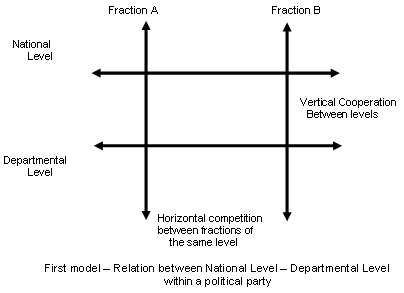
First model of coordination
]]> With the aim of proving the hypotheses of this paper, two models of coordination between the NL and the DL will be presented, corresponding to the electoral scenarios previous to the reform and after the reform. For each model there is a specific pattern of intraparty competition, as well as differential incentives to cooperate with the other level (NL or DL).The first model corresponds to the intraparty competition between the NL and the DL up to the introduction of the electoral reform in 1996. Up to that reform all positions were elected on the same day. Therefore, there was only one election were said positions were at stake. In a certain way, the primaries of each party were resolved that day, (primary election simultaneous to the presidential election itself). Access to the House of Senators and Representatives, Intendente (department governor and city major) and seats at the local legislatives were also disputed that day. Ballots were cast through two sheets that included different candidate lists. One sheet contained the lists of contenders to national positions: President, Vice-President, Senators and Representatives, the other had the list of aspirants to local positions (Intendente and local legislators –ediles-). Candidate lists were closed and blocked, and the vote linked the positions in the executive with the ones in the legislative. In addition to that, legislation forced electors to vote for the same party at both levels, generating in this way the possibility of a joint vote to the party to all positions or the possibility of abstention in one of the two levels or both. There were no limits to the number of candidatures presented for different positions. This legal framework made rational the formation of electoral "cooperatives" in the dispute for legislative positions with the goal of improving winning chances or preventing a favorite candidate from getting his or her Representative seat.
This is to say that incentives were directed towards a common goal: getting the most votes and, therefore, positions for them and their party. As vote was linked and there was multiple simultaneous vote, actors had strong incentives to cooperate at all party levels. More specifically and following the terminology proposed in this paper, electoral rules provided incentives to NL actors and DL actors to cooperate with each other to get a greater benefit the day of the election.
However, it must be pointed out that incentives for competition were also strong, there was a competition scenario between fractions and sectors within each party. Vertical competition between the NL and the DL was complemented with a strong horizontal competition at all levels. This is a structural factor and is derived from the interaction of multiple simultaneous vote and a fractionalized party model.
Within each political party there was competition for the Presidency of the Republic and for parliamentary and local positions. However, if we observe the coordination between the two levels, object of this study (NL and DL), the incentives are set for cooperation because, for example, a candidate to the House of Representatives does not compete with a candidate to the local government.Intraparty competition was developed between actors at the same level: among candidates to the Presidency and Legislator (NL), and candidates to the local government -Intendente- and to the local legislative –edil- (DL).
To sum up, before the reform the system presented a specific pattern of intraparty competition, which was characterized basically by cooperation between the NL and the DL. Electoral rules generated incentives that strongly affected the behavior of political actors.
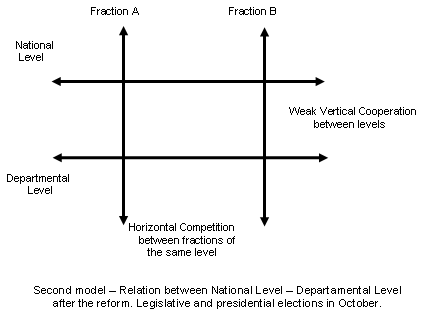
Second model of cooperation
]]> The second model corresponds to the intraparty competition pattern of the NL and the DL after the 1996 constitutional reform. With that reform it is possible to observe significant changes in the patterns of competition. It is no longer the case of a single election, the new system installs up to four different electoral instances, which have different rules and, therefore, call for different strategies. The intraparty competition pattern changes and the "electoral machine" of parties is affected.Primaries. The reformed electoral system established, first of all, primary or internal elections in which it is possible to vote for a national ballot, a departmental ballot or both, as long as they belong to the same party or lema. Thus, in that election there is a differentiated offer between the national and the departmental. A group can withdraw its support to a presidential pre-candidate by presenting only a list for the Department's Deliberative Body (DDB). Also, it has the possibility to support more than one presidential candidate, by presenting more than one list for the National Convention (NDB).
The basic incentives operating on actors are three:
a)The election of convention members which will derive in the ulterior selection of candidates for local authorities (DL incentive).
b)The election of a presidential candidate that the whole party will have to support in the first round of national elections in October (NL incentive).
c)The "testing of the waters" before preparing the electoral offer for the Legislative elections in October (NL incentive). The fact that the primaries serve as a "test of the waters" and that it is possible for different fractions to aggregate votes in sub-groups –sublemas-, leads to a high numbers of lists presented.
Taking into account the first incentive, it is likely that many significant actors who covet the Intendente position or perhaps a local legislative seat, modify their traditional behavior of intraparty cooperation, by not participating actively in the national election in October.
On the other hand, those who are oriented towards the NL –future candidates to the House of Representatives and eventually to the Senate- will actively participate in the primaries, prepare their lists for the national elections in October, and many of them will not present themselves to the local elections in May.
As it was prior to the reform, in the primaries there is a strong incentive to cooperate between levels, because "everyone counts" in that election.
]]> National Elections: In October and November of the same year, presidential and legislative elections are carried out. In the first round, when legislators and president are elected by absolute majority, citizens vote for a single ballot with the presidential formula and lists for the Senate and Representatives. It is likely that in that instance the number of sheets is inferior to the number of variations presented in the primaries because the possibility of sub-group aggregation is not present for the House of Representatives. Local groups supporting a Senate candidate are no longer present –a phenomenon present before 1996- and participating actors compete behind a single party presidential candidate. This is a powerful restriction determined by the reform.In the national election, incentives are two: supporting the party's presidential candidate and the candidates to the legislative. Both incentives work at the NL, so DL agents have little incentive to actively cooperate, particularly so when it is considered that they still have to participate in the local election the following year, when they will be the main protagonists. In the same sense operates the elimination to the vote aggregation by sublema for the House of Representatives. By reducing the number of lists with a chance of electoral success, the norm excludes numerous actors from participating in that competition. Benefits of not participating in that election and campaign might as well be greater than the loses it may entail in terms of time, economical resources and public image wear and tear, etc. Additionally, for an actor with aspirations of winning the Intendente position, it can be more convenient not to support a national candidate of his or her party, because a few months later, he or she will "ask" for their vote to all the citizens living in his or her department. This behavior will depend mainly if the presidential candidate belongs or not to the same fraction of the party that the departmental candidate.
Local elections. Finally, local elections are a net DL competition scenario. In that instance, the elector chooses one single ballot which has a candidate to the position of Intendente and a list of members to the local legislative –Junta Departamental-. It constitutes a markedly different scenario than the national elections in October because for the local election the rules existing before the reform are still in place: SM, SDV and the possibility of multiple candidates for the executive position for each party. Another feature distinct of that election is the possibility of immediate reelection of Intendente.
Election incentives are strongly related to the DL dynamics: the election of the local executive office and the members of the local legislative. Following the hypotheses of this work, in this instance, DL actors who did not cooperate with the NL in the national election should "reappear" now.
In addition to this, it is expected to observe a new rise in the number of lists offered, back to the levels present in the internal election due to the dissapearance of restrictions generated by some of the electoral norms of the national election in October. As was pointed out earlier, this instance returns to a scenario where sub-group aggregation -sublema-, SM and DSV are present.
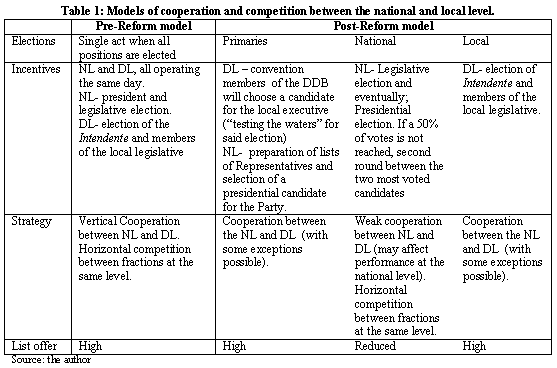
The local election closes an electoral cycle a year in length. During that cycle different incentives operate on actors' behavior. Globally, it is observed that the intraparty competition model active after the reform has differentiated incentives for each party level. DL actors see their incentives to cooperate in the national election reduced, which leads to a deterioration of the pattern of cooperation between the two levels recorded in the period prior 1996.
The following table presents a summary of the main features of the two models of interaction between the national and local (departmental) level.
]]>
3. Evidence: the behavior of the Partido Nacional in Maldonado
1994 Elections
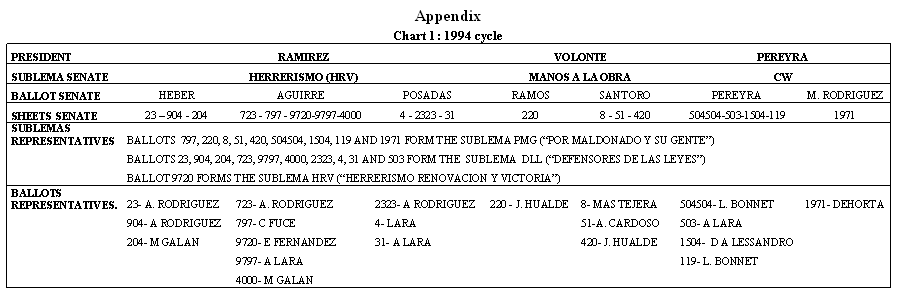
When observing the "map"6 of sub-groups –sublemas- and lists presented to the Representatives election and its coordination with the sublemas, Senate lists and presidential candidates, it is possible to notice the presence of local actors who support more than one presidential candidate. For example, Alfredo Lara is the head of three lists to the House of Representatives, two of them support the herrerista presidential candidate, Juan Andrés Ramírez with different candidates to the Senate, one of them with Gonzalo Aguirre (list 9797), and the other with Ignacio de Posadas (lists 4 and 31) The third list supports the presidential candidate of the Movimiento Nacional de Rocha7, Carlos Julio Pereyra (list 503). A similar case is the sublema presented to the House of representatives "For Maldonado and its people", which aggregates fractions who support the party's three different presidential candidate. This was possible thanks to the electoral system that was in place before 1996, particularly, simultaneous multiple vote.
Applying the first model presented, it is possible to say that the incentives for departmental groups were oriented towards cooperation with the national level. The competition takes place, therefore, among actors at the same level: candidates to the Senate, the House of Representatives, Intendente and members of the local legislative. Particularly, the candidates at the DL (intendente and edil) have incentives to cooperate with the NL, although they might support one candidate or the other to the Senate, the House of Representatives and for President. The fate of the party is linked to the aggregation of votes provided by its different lists at all levels, giving place to a pattern of competition characterized by cooperation and conflict among actors.
1999 - 2000 Electoral Cycle
Primaries. The 22 lists presented by the Partido Nacional in Maldonado for the election of members of the local convention (DDB) achieve 10% more votes than the lists for the NDB. This implies that, at least one out of every ten voters for the party in the primaries chose to pick convention members for their department (who will later choose a candidate for the Intendente position) and also decided not to vote for a presidential candidate.
Additionally, national leaders listed in the first place in ballots to the National Convention are, generally not present. These facts points to the conclusion that local elites are strong enough to impose their candidates to the NDB (which in the case of the Partido Nacional is a very important body). This conclusion must be underscored because that is not the case for the other parties of the system, in which the national leaders prevail in lists to the NDB.
]]> It is worthy of note as well that the three sublemas with greater electoral weight in the department are headed by those who will become candidates to Intendente the following year (Antía, Alcorta y Rodríguez).On the other hand, it is possible to observe in this election a behavior similar to the national elections before the reform. Thus, there are major local actors that support more than one presidential candidate (Antía, for example). Accordingly, these are the declarations of a distinguished leader of the Partido Nacional of Maldonado8: "It is the case in many Departments that, as it happened in the primaries of 1999, and later as well, that there were local groups who joined two, three, or all of the many national lines, but from a local force. This was not seen in a positive light by the national candidates who expected that one were obedient. […] There are crossovers and especially in Maldonado, although this happens elsewhere as well […] all this lists have a common departmental axis".
National Elections. It is observed that the number of lists offered is significantly reduced. Regarding this situation, the elimination of vote aggregation by sublemas reduces the incentives to present a high number of ballots because now these do not add votes with each other. It would seem more rational to reach agreements among different groups and leaders in order to make a more reduced offer.
This is particularly important for those leaders who do not have "votes of their own" as to get a seat. They face a dilemma: either they form part of another list with greater possibilities or they do not show for national elections and choose to do so only in the local ones. As per the hypotheses, both who are in the mentioned situation as well as those who are oriented to the local stage as a political career choice will see a reduction to their incentives to campaign actively and cooperate with the NL in the elections in October, Choosing to "preserve themselves" for the local elections in May the following year. In fact, in the national elections of 1999 it is remarkable the absence of list to the House of Representatives for candidates of the stature of Enrique Antía and Ricardo Alcorta. Antía, for example, does not carry out an important campaign for the national elections in October. He shows up in some occasions at the end of the campaign, but as a supporter of his party and not behind any presidential candidate or Representative in particular. His intention to bet on the local election seems clear, he would later win that election.
Local Elections. The Partido Nacional returns to its behaviour of deploying an offer of lists similar to the one observed in the primaries (22 lists). This is the case due to the return to the old SM and DSV rules. Additionally, it is observed that the only candidate to the local executive office who shows up for the 3 instances is Ambrosio Rodríguez.
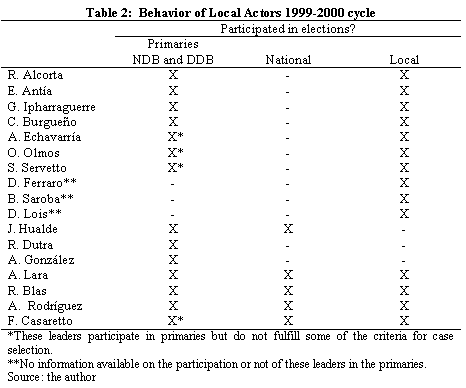
Analysis of the actors' behavior. In order to conclude the analysis of the 1999-2000 electoral cycle and with the aim of model the behavior of the actors in the three instances, the following table is presented. The leaders selected were those who were head of lists to the DDB, NDB, House of Representatives, Local Legislative and/or were later candidates to the Intendente office, and whose ballots got more than 5% of the votes for their party in any of the elections of the electoral cycle. In the ballots which got more than 10% in the local elections the second name in the list is also taken into account, as these are usually relevant actors in the competition. From these criteria a list of 17 leaders was selected. They could show up in one, many and all elections carried out in that this cycle.
In order to test the validity of the hypotheses it would be necessary to find actors who follow one of the following patterns of behavior:
]]>a) Participate in primaries and local elections; actors oriented to the DL. In this case they are: R. Alcorta, E. Antía, C. Burgueño and G. Ipharraguerre. Also, A. Echavarría, O. Olmos and S. Servetto, are considered, because, even though they do not fulfill all our criteria for selection, it is possible to establish their participation in ballots in the primaries as well as their absence in national elections. On the other hand, there are three leaders about whom there is no information about their participation in the primaries. In any case, they are oriented towards the DL, as their absence in national elections was verified.
b) Show up in primaries and national elections, i.e. actors oriented towards the NL, that is the case of José Hualde.
Yet, two actors, R. Dutra and A. González only participated in the primaries, so it is not possible to assign them any orientation towards any of the two levels. It is posible to assume that those two actors did not fare well in said primaries, and so they were not placed in important positions in the ballots for the subsequent elections.
Finally, a few cases of leaders who participated in the three instances were observed, as well as of leaders who showed up for national and local elections, implying they do not lean towards any of the two settings of the competition exclusively. Those cases are Ambrosio Rodríguez, Rodrigo Blas, Federico Casaretto and Alfredo Lara.
2004-2005 electoral cycle
Primaries: Researching the local press the months prior to the primaries, a few declarations of political actors were found that may become relevant when explaining the phenomena studied in this paper. For example, the current Representative Nelson Rodríguez in May 2004 already supported Antía's re-election to the position of Intendente. As Rodríguez himself pointed out: "In this instance the Representative's candidacy is not at stake, what is at stake are national and departmental primaries. We choose the members of the departmental convention and we already give our support to Antía's candidacy."9.
In this cycle, the argument that the election of the presidential candidate (NL incentive) is not a determining factor when making lists to the DDB in some local groups is confirmed again. Those groups, following the hypotheses of this work, would be oriented towards the DL, and therefore present greater levels of autonomy in their decisions and political strategies. Regarding this matter, when the ballots to the DDB are analyzed it is noticeable that –in most of them – there are no references to any presidential candidate. Additionally, in some cases the head of the list is announced as a future candidate for the Intendente position. Some examples are: list 1 for the DDB for Alfredo Lara, which proclaim "Lara intendente"; and list 101 for Echavarría for the same body, saying "Echavarría intendente".
The aforementioned leader, (Representative in the local legislative and former president of the Junta Departamental de Maldonado) declares:
]]> "with this departmental sector we are aiming for different candidates or different representatives in the primaries. The candidate to the Intendente position of this group is not going to depend on any national actor. Or, to say it in other words, he might depend on all of them, but he will not be married to any candidate […] It happens that, from an strategic perspective, our pre-candidate for Intendente will have all the options that the people require. He will have to get along well with Gallinal, with Larrañaga, with Lacalle, with Abreu, with Cristina Maeso if she also runs for President. It is neither convenient nor a good thing for a candidate to depend on anyone because after the primaries are over we are all going to stand behind whoever wins at the national level"10.
National Elections. Four months after the primaries are held the national level election takes place, in which Legislators and eventually (if any candidate reaches absolute majority) the President are elected.
As seen in the previous cycle, the offer of different ballots is reduced. This circumstance is related with the argument that in the primaries groups and individuals are "testing the waters" to later prepare a basic offer for the Representative's election in the National instance. In this process, many local leaders will be excluded because they choose not to –or it is their only alternative not to- participate nor cooperate until the moment of the local election, when a wider variety of options is required.
Antía's case in this election is part of a wider phenomenon of former intendentes and Intendentes who have an important position in Senate lists. For example: Eduardo Malaquina and Juan Justo Amaro in the Colorado Party and Eber Da Rosa and the very Antía in the Partido Nacional. After a process initiated in the Primaries, Antía joins a Senate ballot for the Correntada Wilsonista, taking the second place. However, said leader has expressed in many occasions his preference for the Intendente position. Below another reference to Antía's behavior in this election will be made.
Local elections. The Partido Nacional presented a number of lists similar to the number presented in the Primaries. This shows, again, that for both the Primaries and local elections which have strong DL incentives and sub-group aggregation, the Partido Nacional deploys a wide electoral offer. Whereas in the elections with NL competition and no sub-group aggregation, the offer is reduced to a few actors.
Thus, as in the previous cycle it is possible to observe the phenomenon of political actors who, after an year of inactivity, re-appear for local elections. However, in this case this happens mainly with leaders who are not the "major players" of the department.
Analysis of the actors' behavior. Finally, and following the same procedure than for the 1999-2000 cycle, a comparative chart is presented with the behavior of the main political actors of the Partido Nacional in the department of Maldonado. The selection criteria used are the same that those used in the previous cycle, emerging in this instance 15 leaders to study.
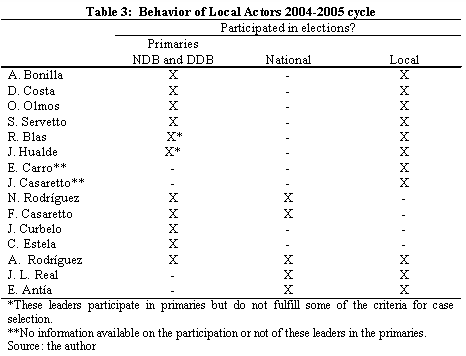
]]> NL-oriented actors in this cycle are:: Federico Casaretto and Nelson Rodríguez who both participate in primaries and national election and abstain from the local ones.
DL-oriented actors are Alejandro Bonilla, Daniel Costa, Oscar Olmos and Sergio Servetto who participate in the Primaries and local elections, To this group should be added José Hualde and Rodrigo Blas who entered the primaries without having a relevant position but acquired significance in the local elections. Additionally, there is no information available about the participation of Jorge Casaretto and Eduardo Carro in the Primaries, but it appears they both were mainly oriented towards the DL stage.
On the other hand, Jorge Curbelo and Cristian Estela only had relevant positions in the primaries and did not participate in any of the following elections. For this reason, they were not included in any of the categories mentioned.
Finally, Ambrosio Rodríguez, José Luis Real and Enrique Antía act outside the model because they participate in national and local elections or in the three instances. In the next section a tentative explanation for the behavior of these authors and those who acted in a similar way in the previous cycle will be presented.
Approaching an explanation for outliers
Some explanations could be pointed out to analyze the case of those whose behavior lied outside the model predicted in the hypotheses.
There are at least two different types of deviation: those that participate in national elections and then in local elections (combining thus an orientation for the two levels of competition) and the case of those who participated in the three electoral instances (this is group has the most cases).
Additionally, two sub-variants are observed that apply for both cases. On one hand are those who participate in the National elections in October, get the seat and then compete for the Intendente position (case of Ambrosio Rodríguez in 1999). On the other hand are those who lose in the Legislative election and look for a "rematch" in the local elections by presenting their candidacy (that could be the case of Casaretto in 1999) or through the negotiation of a good position in the local ballot (case of Ambrosio Rodríguez in the local elections of 2005).
The motivation to participate after a candidacy in October is related with the perceived value of the Intendente position. As was pointed out earlier, the political significance of that position has recently increased in the Uruguayan political system, surely because the local executive chiefs manage ample resources and thus open important career opportunities for the actors. It is reasonable to believe that it is more profitable from a political point of view to be an Intendente than a Legislator, and this fact affects the strategies chosen by political actors.
But yet another variable might strongly incide in the behavior of certain actors: their political commitments with the NL. Evidently, there are leaders who "owe it to their fraction" and, being representatives of a national sector at the department level, they must "show up" in all electoral instances (and especially NL ones), even if that is not the most profitable strategy from a personal point of view. Those leaders are the ones who have least autonomy from the national fractions. Such is the case of Ambrosio Rodríguez, who, closely connected with the Herrerismo, participates in the 6 elections studied.
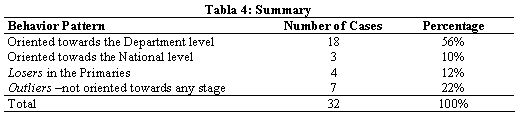
]]> On the other hand it is possible that specific agreements are made between NL and DL groups regarding the conditions for political participation of local actors. Such is the case of the negotiation between Alianza Nacional and José L. Real. The sector was able to count on a local leader for the Legislative elections in October and Real got support in May from the winning group in the Primaries, On the same note, it is possible to underscore the case of the agreement between Antía and the fraction Correntada Wilsonista in 2004. The group was able to "decorate" their Senate list with the participation of a respected Intendente, and Antía "got his assurance" in his political career, because, in case he would lose the local competition–as finally was the case –he could rely on a seat on the Senate.To sum up, out of 32 cases studied, 7 deviated from the patterns of behavior expected. Those cases respond to different reasons connected to individual ambition, the relationship between the NL and the DL and strategic calculations performed by the actors. It is fundamental that in following works a focus in political careers is included, making the model here presented more complex and more accurate.
4. Conclusions
This work aimed at accounting for the impact of the 1996 electoral reformo n the behavior of political parties. More specifically, the cooperation patterns between the national level and the departmental level of political parties was studied. For that reason, the case of the Partido Nacional in Maldonado was selected, comparing patterns of behavior before and after the reform (1994, 1999-2000 and 2004-2005 electoral cycles).
The hypotheses states that the electoral system prior the reform of 1996 favored the cooperation between the national level (NL) and the Departmental level (DL)of political parties, establishing a specific pattern of coordination between them. The second part of the hypotheses points out that, conversely, the new regime offers few incentives for cooperation in the national elections in October and November, which leads to a deterioration of the previous pattern. In Primaries, diverse local actors "test the waters", and later orient themselves towards one of the two stages, either participation in national elections (NL), or participation in Departmental elections (DL). From these initial premises two models of coordination were presented, corresponding to the behavior of the diverse actors in the periods before and after the reform.
After the two models were presented, the analysis itself was carried out. Due to the fact that a case study was carried out11, this work is in no conditions to establish a general rule of behavior, however it is possible to assess that the hypotheses is confirmed for the most part of the observation units (political leaders). More specifically, after the empirical evidence available was analyzed (ballot contents and electoral results, a review of local press and interviews to qualified sources) it is possible to affirm that most of the actors of the Partido Nacional in Maldonado show strategies oriented towards one of the two levels, and very few of them develop an activity in all stages of political competition.
A deterioration of old patterns of cooperation is verified due to the fact that in the national elections there are leaders of the party who do not work in the campaign, preserving their participation for the local campaign where they will play a determining role. The electoral rules that operate more strongly in this sense are: the incorporation of primaries, the separation of national and local elections and the removal of multiple simultaneous vote for the Representatives election.
By observing the behavior of the actor selected for this analysis, four patterns of basic behavior can be acknowledged. Firstly, the actors oriented towards the local level, who participate in the Primaries and in local elections but do not intervene in the National elections. In addition to the mentioned actors, those who participated in the primaries –even if without an important role in them-, did not join the national campaign and later "re-emerge" for the local elections. To this first pattern belong 18 out of 32 cases studied (56% of the total).
A second pattern of behavior refers to those who participate in the primaries and in national elections, but do not appear in the local instance. Those actors are marginal, are oriented towards the national level and represent only 3 of the 32 cases studied (10%).
]]> Thirdly, there are those that only participate in the primaries and fail after "testing the waters" among the rest of the participants in the competition. According to their initial result they would decide not to participate in any of the following elections. Four cases belong in this category (12%).Finally, there are 7 cases may be considered "outliers", understanding that their behavior does not follow the predictions of the hypotheses. These actors participate in the three elections or participate in both the national and local competitions, without a clear orientation towards any of the two levels. These cases were the subject of a specific explanation. However, 7 cases out of 32 represent a 22%, which forces to continue in this line of research in order to find other variables that may be having a strong incidence in this behavior. Without doubt, the political careers approach could be very useful as a complement to the model presented.
Finally, it is worthy of note that some specific phenomena were found and deserve deeper research. When analyzing the behavior of the diverse actors it was noticed that for the Primaries strategies similar to those applied before the reform were implemented. The rules operating in the Primaries have incentives for the actors to present lists supporting many leaders and fractions at the national level. That was evident in the elections before 1996 through the possibility of vote aggregation by fraction groups or –sublemas- and the existence of simultaneous multiple vote. Nowadays this is the case of the Primaries as well, when actors have strong incentives to support different presidential candidates and group according to their local preferences. That pattern of cooperation is broken in the national elections when rules do not allow for the development of such electoral engineering nor the aggregation of votes for Representatives under the same sublema.
This research hopes to serve as an incentive to work on the issue of the effects of the change in electoral system on the behavior of political parties. The case study carried out shows some lines and trends to be confirmed through the incorporation of new units and categories of analysis.
References
Albornoz, Alfredo (1999). Elecciones del 27 de noviembre de 1994. Montevideo: Cámara de Representantes. [ Links ]
Bottinelli, Oscar (1991). El sistema electoral uruguayo. Descripción y análisis. Working Paper 3. Heildelberg. [ Links ]
Bottinelli, Oscar (1995). La reforma electoral y sus efectos. Disponible en www.factum.com.uy [ Links ]
Bottinelli, Oscar (2000). "El ciclo electoral 1999-2000 y el sistema de partidos", en Elecciones 1999/2000. Montevideo: EBO-ICP. [ Links ]
Buquet, Daniel (1997). "Reforma política y gobernabilidad democrática en Uruguay: la reforma constitucional de 1996", en Revista Uruguaya de Ciencia Política N° 10. Montevideo: ICP-FCS. [ Links ]
Buquet, Daniel (2000). "Fragmentación y fraccionalización política: de la oferta electoral a la conformación del gobierno" en Lanzaro, Jorge (coord), La segunda transición en el Uruguay. Montevideo: Fundación de Cultura Universitaria – ICP. [ Links ]
]]>Buquet, Daniel, Daniel Chasquetti y Juan Andrés Moraes (1998). Fragmentación política y gobierno en Uruguay ¿un enfermo imaginario? Montevideo: ICP-FCS. [ Links ]
Constitución de la República Oriental del Uruguay (1997). Montevideo: Editorial Técnica. [ Links ]
Cox, Gary (2004). La coordinación estratégica de los sistemas electorales del mundo. Hacer que los vos cuenten. Buenos Aires: Gedisa Editores. [ Links ]
Duverger, Maurice (1957). Los partidos políticos. México: Fundación de Cultura Económica. [ Links ]
Gonzalez, Luis Eduardo (1993). Estructuras políticas y democracia en Uruguay. Montevideo: Fundación de Cultura Universitaria - ICP. [ Links ]
]]>Jones, Mark P. (1995). Electoral laws and the survival of presidential democracies. University of Notre Dame Press [ Links ]
Laurnaga, María Elena (coord) (2001). La geografía de un cambio. Política, gobierno y gestión municipal en Uruguay. Montevideo: EBO. [ Links ]
Magri, Altair (2000). "La llave del triunfo electoral en mayo 2000: reelección, continuidad y ‘por la vuelta'", en Elecciones 1999/2000. Montevideo: EBO-ICP. [ Links ]
Nohlen, Dieter (1981). Sistemas electorales del mundo. Madrid: Centro de Estudios Constitucionales. Madrid. [ Links ]
North, Douglass (1990). Institutions, Institutional Change and Economic Performance. Cambridge: Cambridge University Press [ Links ]
Rae, Douglas (1967). The political consequences of electoral laws. New Heaven: Yale University Press. [ Links ]
]]>Riker, William (1986). "Duverger laws revisited" en Electoral laws and their political consequences. New York: Agathon Press Inc. [ Links ]
Sartori, Giovanni (1994)- Ingeniería constitucional comparada: una investigación de incentivos y resultados. México: Fundación de Cultura Económica [ Links ]
Shugart, Matthew y John Carey (1992). Presidents and assemblies: constitutional design and electoral dynamics. Cambridge: Cambridge University Press. [ Links ]
Taagepera, Rein y Matthew Shugart (1989). Seats and votes: the effects and determinants of electoral systems. New Heaven: Yale University Press. [ Links ]
Yaffé, Jaime (1999). "Reforma constitucional 1997: efectos esperados por los actores". Documento de Trabajo N° 19. Montevideo: ICP. [ Links ]
Yaffé, Jaime (2000). "Nuevas reglas, viejos actors, ¿nuevos comportamientos?, en Elecciones 1999/2000. Montevideo: EBO-ICP. [ Links ]
Press reviewed
-Realidad de Maldonado Weekly. At www.realidad.com.uy. Issus from March 2004 to May 2005 [ Links ]
- Correo de Punta del Este Daily. At www.diariocorreo.com Issues from Marzo de 2004 to May 2005. [ Links ]
® Artículo recibido el 25 de mayo de 2007 y aceptado para su publicación el 20 de noviembre de 2008
]]>
* This article is a summary of the final essay of the Political Science BA at the Universidad de la República "The effects of the 1996 reform on political parties: Deterioration of the cooperation patterns between the local and national levels? The case of Partido Nacional in Maldonado (1994-2005)". I would like to thank Daniel Chasquetti for his substantial contributions as an essay tutor and to two anonymous referees for their valuable comments during the evaluation process
** Political Science BA of the Universidad de la República.
1 Fraction inside each political party. (translator's note)
2 For example see Rae (1967), Nohlen (1981), Riker (1986) and Sartori (1994).
3 The HDI for Maldonado in 2002 was 0.841 and the GNP was 0.711 (UNDP, 2003).
4 This description of the Uruguayan electoral system was taken from Botinelli (1991) and Buquet et al. (1998).
5 Fulfills the four conditions set by Mainwaring and Scully: "stability of rules and nature of pary competition […]; important parties have […] stable roots in society […] important political actors […] award legitimacy to the electoral process and political parties […]; and finally, "[…] party organizations are relevant …".
6 Find in the annex the composition of the diverse sublemas to the Senate and Representatives, as well as their articulation with the presidential candidates (chart 1).
7 Herrerismo and Movimiento Nacional de Rocha are two fractions of the Partido Nacional (translator's note) ]]>
8 In the course of this study, some interviews to qualified sources were conducted; these sources requested that their names were not revealed.
9 Realidad Weekly. Issue of 29th April – 6th May 2004, available at www.realidad.com.uy
10 Realidad weekly, at www.realidad.com.uy, march 2005.
11 Escogimos 1 de los 57 casos que se nos presentaban (es decir, podíamos elegir a cualquiera de los tres partidos principales actuando en alguno de los 19 departamentos).
]]>