Constanza Moreira
Ph.D. in Political Science from Instituto Universitario de Pesquisas de Río de Janeiro, IUPERJ. Director of Instituto de Ciencia Política of Facultad de Ciencias Sociales at Universidad de la República, Uruguay
Translated by Rafael Piñeiro
Translation from Revista Uruguaya de Ciencia Política, Montevideo, n.15, p.31-56, 2006.
ABSTRACT
]]> The aim of this article is to analyze the alternation of political parties in government, which has taken place in Argentina, Brazil, Chile and Uruguay since the democratic transition and until now. This paper takes into account the hypotheses that link changes in party systems with the dynamic of ideological competition among them. This paper is also aimed at shedding light on the impact of the government processes on the ideological dynamics of the party system, particularly, the impact produced on the polarization level of the system since leftist ideological parties came to power.Key words: Democracy – Political Parties – Latin America
1. Ideology, political parties and alternation in government: a review of recent literature
As the UNDP Report for Latin America points out, (UNDP, 1994) less than two decades ago only three of the countries in the region were democratic regimes. Today, out of seventeen countries analyzed in the report, all the countries in the region can be considered full democracies, with different degrees of progress. The "third wave" of democracy (Huntington, 1990) has expanded in the countries of the region. The Southern Cone is no exception in this sense, even though the countries that belong to this region share a special feature; three out of four of the countries analyzed (Argentina, Uruguay and Chile) started their democratic processes in the first wave of democracy. In comparative terms, the sub-region is one of the earliest democratic developments in Latin America
In these four countries it is possible to verify the presence of the so called "progressist" governments, left wing governments. Even though we will review this statement throughout this paper, it is possible to ask, in view of both phenomena, if there exists any kind of interconnection between them. Namely, if for countries that consolidated their democracies earlier on, the "third wave" –with the triumph of left-wing parties- is the occasion to transit from a pragmatic party alternation process to an ideological one, in Sartori’s terms. (Sartori: 1982) Before that, let us examine the relationships that political theory has established between party systems, alternation and ideology.
The relationship between ideology and party systems has been complex and changing over time.
The rise of the modern party system and ideology are inextricably linked, at least in European history, with the inception of socialist parties. If the origin of political parties can be situated in the mid-nineteenth century as the result of divisions within Parliament, the first extra parliamentary parties that arise are the socialist parties of the last third of the nineteenth century. Many analysts consider these parties as the first modern political parties, with homogeneous political agendas, widespread organizations and a permanent management system. Thus, ideology, parties and the rise of left-wing parties are linked phenomena. De Vega (1977) –quoted by Bravo (1997:18)- affirms that "los partidos nacieron y se consolidaron como una necesidad de las izquierdas"1, whereas Panebianco (1990) holds that political parties and party systems were mostly a result of the mobilization of subordinated classes with the advent of the industrial society.
The relationship between parties and ideology has been established in many different ways. Maybe one of the most important references is the now classical distinction made by Max Weber of patronage parties, class parties and ideological parties However, without any doubt, the key reference to understand the relationship between political parties and ideology from a theoretical perspective of political change is the passage from "party of notables" to "mass parties". So, for authors like Duverger, the "future of politics" were the mass parties. The relationship of mass parties with ideology is not so simple, though.
]]> When mass parties develop into mass "electoral" parties, the connection between parties and ideology seems to weaken. The same notion of catch-all parties from Kirchheimer (1966) goes hand- in- hand with the degradation of ideologies.The implicit theory on party system evolution shows two clearly differentiable moments in the relationship between party systems and ideology.
The evolution from elite parties to mass parties, verified with the expansion of suffrage and the advent of industrial society, gives place to a close association between political parties and ideology. Later, the transformation of mass parties into electoral "catch all" parties with lesser ideological consistency will come together with the theory of degradation of ideology. Lately the theory of "cartel parties" (Katz y Mair, 1995) has appeared to designate structures organized basically around the functions that parties have in a State of parties
Change in ideology and party systems has always been characterized by complex discussions about its evolution. The concept of catch all parties brings about the idea of a basic consensus around issues and problems: the political parties are "political machines" strongly homogeneous and organized, destined to control the access and distribution of the resources of power, mainly through the structure of the State. This history illustrates basically the party evolution in the most consolidated European democracies. However, Latin America follows another itinerary. Its very delay in the consolidation of the State itself and its lack of a "long" and stable democratic history have made of the history of political parties in Latin America a specific phenomenon.
Of the four countries analyzed, Chile and Uruguay are the countries whose political itinerary is closest to the most consolidated European democracies mostly because, out of the four countries, these two are the ones that have lived longer democratic periods. Brazil has had a notorious delay in the installation of its democracy compared to the other three countries, and Argentina lives in a sort of "spasmodic" democracy, plagued by authoritarian inter-regnum and coups-de-etat. The emergence of left-wing parties with "mass vocation" in the second democratic wave in Chile and Uruguay has pointed out a different path from those of the populist democracies in Brazil and Argentina and their corporative experiments of unions’ subjugation by the State. Later, Brazil starts following a path that is more convergent with Uruguay and Chile’s, particularly since the inception of the PT and de CUT in 1979.
Since the beginning of the nineties until now, the four countries analyzed have gone through stable democratic processes, in a party framework that has had a tendency to consolidate. It is possible to verify the presence of competitive party systems in the four countries. Besides, the process of ideological competition is shown in terms of "lefts" and "rights" closely related to the process of party competition. The analysis of such processes leads us to a process that is vital to party change and transcends each party as a unit but refers to the parties as a party system. That is, the process of ideological differentiation. The main input here has been the work of Sartori (1982), although its background is La Palombara and Weiner (1972); namely, the differentiation between competitive and non-competitive party systems. For La Palombara and Weiner, competitive party systems can be distinguished according to whether alternation is ideological or pragmatical (in opposition to hegemonic which can also be classified into pragmatical or ideological). Sartori classifies parties according to the degree of polarization among them and places this polarization in the already known "left-right" axis. In this way, he makes a distinction using the width of the competitive political space (narrow or of low polarization and wide or of high polarization) and the direction of that polarization (centripetal o centrifugal).
Albeit Sartori does not propose a hypothesis about the political development of party systems, in this paper we certainly do. Following Dahl’s hypothesis on the transit from hegemony to poliarchy, in the understanding that a greater degree of pluralism reflects a more "developed" stage of the political process, we affirm that the development of party systems is connected with two processes a) the existence of party alternation in government (political pluralism); b) the passage from pragmatic alternation systems to ideological alternation systems (ideological pluralism).
2. Democratic Consolidation, ideological polarization and the advent of the left to government in southern cone countries.
Brazil, Argentina, Chile and Uruguay constitute, in the Latin American context, a political region with relatively high party institutionalization. In fact, according to the Party System Institutionalization Index (IDB, 2006), Uruguay, Chile and Argentina are quite above the average, and Brazil slightly below.
]]> With different degrees of political maturation, these dour countries have shared relatively analogous political paths in the last century: political radicalization in the sixties (with the appearance of armed "lefts" and "rights"), coups-de-état between the mid-sixties and the mid-seventies and democratic openings nearly in chain from the beginning of the eighties decade. Nowadays, the four countries seem to show "left wing governments", and the quotation marks in the text are placed there precisely to relativize that statement. Placing all these processes in the same argument, one could risk a hypothesis that the degrees of progress in the process of democratic consolidation, together with a greater institutionalization of the party system have made possible the alternation of parties in government. This has resulted lately in the victory of alternatives to the left of the system. In favor of this hypothesis is the historical fact that military coups in the four countries were staged –among other objectives – to dismantle the political, social and armed left (Frente Popular in Chile; Frente Amplio in Uruguay, Partido Justicialista in Argentina, Partido Trabalhista Brasileiro in Brasil). In fact, a great proportion of the political and ideological re-alignment that has occurred in the four countries’ political systems had actually started in the seventies and the eighties, before the respective military coups took place. Those coups came to stop the rise to power of the "forces of change" associated with the left. However, in many cases, they just delayed a process (Uruguay) and in others, forced those very forces to switch strategies (most clearly Chile). Thus, the political phenomena evidenced today in those countries can be interpreted under the light of their own past. Could they also be interpreted through a more general statement about the evolution modes of party systems?We could analyze these processes using two hypotheses that link the grade of democratic consolidation and party system institutionalization with the development of a pluralist competition system where a dynamic of alternation of different-ideological-sign-parties in government is consolidating.
First, we associate the grade of party system institutionalization with the predominance of a kind of "politics" in which ideology has a strong role in differentiating public opinion, political behavior and the leaders’ attitudes regarding different issues.
Second, we associate the grade of democratic consolidation with the presence of alternation in government of parties with different ideological orientation. Let us look more thoroughly into both statements.
It could be said that a greater grade of institutionalization of political life and of parties in the Southern Cone has come hand in hand with a greater importance of the left-right axis in the political positioning of leaders and electorate. (In this latter case, this observation is relatively supported by permanent public opinion surveys). Consequently, a certain kind of "ideological politics", different to what is happening in the rest of Latin America is starting to take a hold in the South Cone. This statement is valid for Brazil and, partially for Uruguay and Chile, because in these two countries ideological polarization was already evident before the military regimes.
In Brazil, party identification in the left-right axis occurred later given that the political parties themselves are in the midst of a process of consolidation. However, without any doubt, the Brazilian political situation that took the PT to government is much more ideological (in a left-right axis) than what it has been in the nineties. In Argentina, ideological politics with parties clearly aligned in the left-right spectrum is yet to be seen: in fact, if one observes the way in which Argentinean legislators self-identify themselves, one could see that the justicialista party covers most of the ideological spectrum. Namely, it covers eight points out of the ten that are measured by the variable ideological self-identification, being 1 the extreme left and 10 the extreme right. (IDB, 2006:.36). However, the ideological shift that represents the transit from menemismo to kirchnerismo inside the very Justicialista party, is an indicator of change.
Given the growing significance of the ideological variable in order to understand differences among parties and their identity before the electors, it follows that, in a context of consolidated democracy, ideological alternation in government is a predictable result. The most representative case is the transit from pragmatic alternation to an ideological one is Uruguay, which is also, in the group of Latin American countries, the one with greater relative institutionalization (IBD, 2006:35)
Ulteriorly, this hypothesis affirms that in these countries the arrival of the left to government will change the strength of party polarization and will make of ideological alternation a "European" phenomenon, where certain consensus will underlie any alternation. Thus, "peaceful" political alternation between governments of different political signs will be one more consequence of the institutionalization of the party system and democratic consolidation.
In this way, Brazil would experiment a process analogous to Chile’s and Uruguay’s, whereas Argentina would take a different path. The analogy among the three first processes would be given by peaceful political alternation supported by basic underlying consensus that scaffolds the whole political system. In Argentina, the "Justicialista" Party seems to have absorbed all ideological conflicts into itself, disabling the creation of a left-wing party with a "mass vocation" alternative to the traditional parties (like in the Uruguayan case, with which Argentina shares a long bi-partidist tradition) The transit from a menemista peronism to a kirchnerista peronism would constitute a clear manifestation of the way this conflict is handled, within the same political party.
In Chile this partidary and ideological re-alignment comes to fruition in the process before democratic restoration, which formed the two political and electoral blocks (Unión por Chile and Concertación) that characterize the bipolar dynamics of Chilean politics. The same than in Argentina, a shift to the left seems to be happening inside government and not necessarily because of the rise of left-wing parties that arrive to challenge power from the historical or traditional parties (situation that equals Brazil with Uruguay).
]]> The second hypothesis tells us about the impact of a left-wing government on the party system Does the ideological stress in the system increase or decrease? Does competition become centrifugal or centripetal?First, the idea of left-wing governments does not hold true for the four countries. In this paper I qualify a government for its ideological orientation according to its party composition and not its agenda. A left government is such that is led by left-wing parties, no matter what agenda it is carrying out. The rationale behind this choice is relatively simple: it is easier to determine a party’s ideological orientation by its composition (for what we have more or less reliable instruments) than for the agendas that they are carrying out. Second, I qualify as a "left–wing government" those that according to their party composition can be placed, on average, between the center and the left of the spectrum. With these precisions, Chile, Brazil and Uruguay have "left wing governments". But it is not possible to classify Kirchner’s government as a left-wing government, given the ideological spread of the ruling party. (In fact, the Justicialista Party is rather to the right of the spectrum than to the left, according the latest available measurements).
However, the so advertised idea of the "progressist" South Cone is connected to the idea that, no matter what coalitions hold government (coalitions that in some cases, like Brazil’s cover a good share of the ideological spectrum), the Presidents are left-wing politicians, and this is no minor detail in presidentialist countries like ours. So, Kirchner, Bachelet or Lula would be more leftist than the parties or coalitions that support them. Considering that presidential regimes predominant in Latin America have given considerable powers to their presidents (particularly in Brazil and Argentina), a leftist ruler would be able to impose a left agenda regardless the ideological configuration of its parties.
This is very important because it would have a direct impact on the party system itself. Without questions, highly legitimate left-wing president could drag his own party to the left (such is the Argentinean case), and considering that parties work as a system, such event would re-ideologize the whole system, shifting it, of course, to the left or more to the center. This could be what is happening in Argentina (as shown by the tendency towards the left in the last elections) also in Chile, as shown by the easy Bachelet victory after the Lagos-Lavín near-draw in the former period. Thus, we could provisionally state that the ideological orientation of the head of the Executive will be determinant in the dynamics of the party system, including the re-alignment of its own.
Second, we could say that the arrival of the left to office, far from raising the level of polarization, leads to a centripetal dynamics, because the left-wing parties themselves (who are mainly responsible in the first place of that level of polarization) shift towards the center. This shift to the center of the left is at the same time, a result of the switch in their relative position within the system –from opposition to government-, of their need to establish alliances with others (when they are the minority like in Chile and Brazil), and of the obligations inherent to the direction of a state that demand a certain continuity of old government policies, (particularly in economic matters) lest they would not be able to establish a credible and solid government. Therefore, the rise to power of the left will promote a centripetal electoral competition.
It is necessary that the party systems have a relative degree of ideological differentiation. That means that there should be "mid-sized" left-wing parties – not merely testimonial ones- able to steer the dynamics of the system. This is not valid for the majority of Latin American countries, where there is low party institutionalization and ideology is just one more of the many cleavages that make political or party life. (Including ethnical or regional cleavages, which determine greatly the political dynamics of Andean countries, for instance).
This analysis could be discussed from another standpoint, that of the "shift towards the center" of the left, prior to their arrival to government. Thus, the settlement of a centripetal competition would take place before the left’s arrival to government, not after. An analysis that claims that the electoral success of the left is basically due to its moderation is quite controversial. For a great deal of the electorate, left wing parties do not come to government because they are "more of the same thing" but precisely because they represent the alternative, a promise of change. That this change happens in a moderate key does not alter the fact that their intention of changing the political status quo is what has taken the majority of left-wing options in our countries to government office.
Considering the settlement of a centripetal competition with the arrival of the left to government, a new hypothesis could be ventured for the future. In the moment that competition becomes too centripetal, people will have the tendency to say: "everyone is the same" and the right will again have the chance to win (as shown by the cases of left-to-right alternation in Europe). But such is not the current scenario of ideological and party competition in none of the four countries reviewed.
What follow is a review of each of these statements in the light of the four national cases.
]]> 3. Recent electoral processes in South Cone countries
After the military regimes, these countries had their first "free" elections in 1984 (Uruguay), 1985 (Brazil), 1983 (Argentina) and 1989 ( Chile). It is worth to remember that Brazil and Uruguay celebrated these elections with several restrictions: in Uruguay the most important leaders of two out of the four competing parties were proscripted. In Brazil, the first direct presidential elections were celebrated four years later.
From their democratic transition up to now, Uruguay. Argentina and Brazil had five elections and Chile four. Let’s remember that the electoral periods are different in the four countries: Argentina and Brazil elect a President every four years, Chile every six (now reformed), Uruguay every five. Argentina and Brazil have immediate re-election, Chile and Uruguay do not. The four countries presently have ballotage. The replacement in the House of Representatives happens every four years in Argentina, Brazil and Chile, and every five years in Uruguay. Only in Argentina there is partial renewal of the Chamber (half the Representatives are replaced every two years). In the four systems representation is proportional according to the size of the electoral district, even though in Chile there is an important majoritary tilt, due to their bi-nominal system (only two representatives are elected for each electoral constituency). In the Senate, the replacement of senators is partial in Argentina, Brazil and Chile and total in Uruguay.
The most recent presidential elections were in 2005 (Chile); 2004 (Uruguay); 2002 (Brazil) and 2003 (Argentina).
The Argentinean electoral process
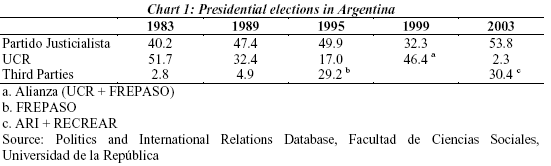
The first democratic elections post-military regime in Argentina were celebrated in 1983. The "Unión Cívica Radical" (UCR) won in the first round with 52% of the votes, and Alfonsín was elected the first President in the longest democratic period the country has ever lived (1983 up to now). The fact that the UCR and not the peronist were victorious was a show of the discredit that the "peronismo" had suffered after the death of Perón and the awful government of his widow, Isabel Perón, which ended in the coup de état of 1976. So, Argentina comes back to democratic life with party alternation, if we compare this period with the period just before the coup.
In 1989, in the midst of hyperinflation, the "worn out" President Alfonsín had to anticipate elections and the winner was the peronist Carlos Menem, with 47% of votes. Between 1983 and 1989 the UCR had lost almost 20% of their electorate, an omen of what would be a longer process, one that would affect this party’s quality as the main political alternative to peronism in this country. On the contrary, since 1983 the "Partido Justicialista" (peronism) never gets less than 40% of the Representative seats, configuring itself as the most stable of all political parties according to their electoral performance.
Menem ruled for two consecutive presidential periods (1989-95; 1995-99). In the second period he was re-elected thanks to a constitutional reform born from an agreement between radicals and peronists. He won with 45% of the votes. The power of the president and of his party would allow Argentina to tackle the most important social and economical transformation in the last decades of this country, implanting a liberal modernizing model which is considered as the most "orthodox" of all economic models in the region.
In the 1995 elections appears a new political actor, the FREPASO (Frente País Solidario); a center-left party, formed by leader who were disappointed with the peronism and radicalism (but more with the latter). Without connections with the Unions who were still closely linked to peronism, (even though it had already appeared an independent Union central) the Frepaso has a very good performance in the media, focusing their critic to the old clientelistic ways of the traditional parties and claiming for a new republicansim able to re-found argentinean politics in a "modern" key (not patrimonial, not clientelistic, and with a consistent program). Although this party could not oppose to convertibility (base of the Argentinean economic agenda), it got 30% of the votes in 1995 elections, overcoming the UCR who just had 17%.
In 1997, FREPASO and the UCR form the "Alianza"(Alliance), with the goal of stopping a third consecutive victory of the Partido Justicialista. In this occasion they got a sound victory in the partial parliamentary elections. Two years later, the coalition candidate, Fernando de la Rúa wins with 48.5% of the total votes, showing the second party alternation in government since democratic transition. However, it wasn’t an ideological alternation in the strict sense because the basis of the economic "convertibility" model was not questioned. When that very model crumbles, it will drag in its fall the Alliance government. This will happen in the last days of 2001, when De la Rúa was forced to resign surrounded by popular protests and a violent atmosphere caused by a financial crisis that forced the freezing of bank deposits and a virtual default to international financial institutions. This is the opening act of the deepest legitimacy crisis of the party system in the Argentinean "third wave" history, shown by the motto Que se vayan todos, (they all must go!) referred to politicians. It was the second time that a UCR president had to resign before finishing his term, confirming the popular Argentinean intuition that only the peronists would be able to rule the country. The following period is managed by Eduardo Duhalde, the defeated candidate for the Justicialismo in the elections that had given the Alliance its victory. Duhalde ruled until April 2003, moment in which the most atypical elections in Argentinean history take place.
]]> The collapse of UCR as a consequence of the De la Rúa’s bad management, gave its place to a couple "alternative" leaderships of candidates who had belonged to the UCR: a center right candidate, Ricardo López Murphy (RECREAR) and a center left one, Lilita Carrió (ARI). In 2003, for the first time the peronist voted divided and no one presented under the Justicialism name because it was impossible to settle the party intern divisions before elections. The three justicialist candidates who ran did so under different party names (Frente por la Lealtad, Frente por la Victoria, Frente Movimiento Popular), this made those year elections resemble a sort of "open internal election" of peronism. In fact only two candidates made it to the second round, Kirchner, with 22% of the votes and Menem with 27%. Faced with the eventual addition of all electorate and parties "against Menem", the Argentinean former president stepped down from his candidacy and Kirchner took office as the fourth Argentinean president in the post-authoritarian period.Kirchner’s power was consolidated with extraordinary celerity. With only 22% of the votes, less than three months after his arrival to office his popularity had risen to around 80%. In the parliamentary elections of 2005 the power of the president was felt. The "Justicialismo" strengthened again by getting 51.3% of the votes: most of those (40.1%) of the fraction allied with the government and an 11.2% of non-government aligned justicialist. The "third parties" to the right got, as a group, 7.9% of the votes (votes for PRO plus Recrear plus regional allies), whereas "third parties" to the left (Ari+left+socialist) got 17.5%. This in a certain way is an evidence of what was said before about the impact of presidents on the party dynamics: the "leftward bent" of Kirchner fed a good vote of the left-wing parties of the system (something similar had happened with Menem and the parties to the right of the system).
Results are shown on Chart 1.
As shown in chart one, the Justicialista party and the UCR are still the two major parties in Argentinean politics, despite the slow fall of the latter and the appearance of third parties "to the left" that show that, even being small, they could become attractive coalition partners for the two majors. As also shown in this chart, since 1989 the PJ is the most relevant party in the House of Representatives.
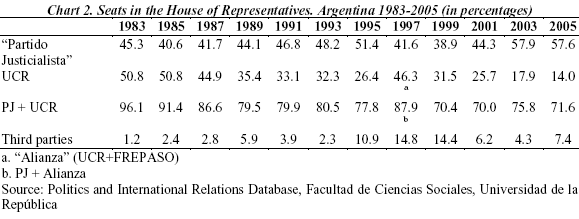
The current scenario is the dominance of the Partido Justicialista in both chambers, despite being divided between those party members who are allied to the government and those who are not. The Justicialismo dominance since the 2003 elections is superior to the one it had during the "third wave" of democracy. In senate, the kirchnnerismo holds 40 out of 72 seats, and in the House of Representatives 123 out of 257 Representative seats. The UCR is still the major opposition caucus. Third parties in the system, to the left and to the right of the spectrum, continue gaining support as it has already been said.
To sum up: the process of ideological pluralization of Argentinean party system does not seem to be thoroughly complete, although, of the four countries, this is the one that has greater alternation of parties in government ("political pluralism"). There has been a significant "ideological shift" in the passage from Menem to De la Rúa first, and finally to Kirchner, but this process does not fulfill the previously defined conditions of an "ideological pluralism": that is, the existence of clearly differentiable parties in the ideological axis.
Therefore, the Argentinean electoral process shows that this country still has a basically bipartidist system, with a "third space" of center-left and center-right options which show high volatility from election to election (Torre, 2003). The "strategic vote" in a scenario like Argentina causes that this third choices work mostly as alternatives for the elector who is disappointed with both parties or as possible partners of a troubled government and not as real government options. The political left is fragmented into a group of parties: there is a left element in the UCR and in peronism, besides ARI and the left-wing parties themselves, which are very small. Both Menem and Kirchner were presidents who did not have a strong support in their own party initially, but consolidated it with their arrival to office. This is evidence of the previously noted dynamics; from the president to his own party, and from the party towards the rest of the system. So, it is the government process itself that has a definite impact on the party system. Consequently, the "shift to the left " in Argentinean politics, not only shown in the ample support to Kirchner in the elections of 2005 but also by the important percentage of the votes for the options to the left of the system, (ARI + Socialism + left) is the direct result of the "shift to the left " of government in the hands of a left-wing president, but does not necessarily strengthen the position of the political left itself. In addition to this, whereas the peronism becomes stronger, it seems that there is not enough space in Argentina for the appearance of an independent left-wing party.
Thus, Argentina constitutes a counter-fact of the hypothesis that to a greater development of the party system corresponds the consolidation of a competitive scenario with ideological differentiation of parties. Argentina has not been able to install a competitive pluralism system with ideological differentiation of parties. The major party in the system, the PJ, covers the whole ideological spectrum. Meanwhile, this party has a tendency to consolidate as a sort of "predominant party", since its first victory in 1989. Despite the UCR has won two of the five elections post democratic transition, it did not manage to finish neither of the two terms, being the second, the Alianza government, shared "de facto" with the PJ. This, and the anticipated victory of peronism in the next presidential elections help consolidate even more this idea, common to any "one party" regime, that Argentina can only be ruled by a peronist.
The Brazilian electoral process.
Brazil has celebrated since the establishment of the direct election of the president in 1989, four presidential elections. The transition to democracy can be dated to 1985, year in which the president Tancredo Neves comes to office as President. However, it is not until Fernando Collor de Mello’s election in 1989, that Brazilian democracy can be considered a full democracy.
The presidential election in Brazil was defined in the second round in two opportunities: in 1989 when Color de Mello defeated Lula, and in 2002, when Lula defeated the sociodemocrat Serra. Fernando Henrique Cardoso, was elected president in the first electoral round in two occasions. Lula has been, up to now, the elected president with the greater percentage of votes and Fernando Collor and Fernando H. Cardoso were elected with similar percentages (53% in 1989 and 1998; and 54% in 1994). Lula presented himself as a candidate for all the elections and, despite having lost in the three first; he has systematically grown in electoral preferences. (17% in 1989; 27% in 1994; 32% in 1998; and 46% in 2002).
The lack of party allegiance in the population and the predominance of the candidate over the party in Brazilian electoral legislation have been the cause of a marked asymmetry between the candidate’s votes and those attained by their respective parties. Subsequently, despite FHC and Lula have been very popular presidents, their respective parties have not passed for more than "third parties" in Congress who depended to rule of the coalition with the "two majors" (PMDB and PFL: the so called "physiological" parties of the system. This fact is evident in graph 1, which shows the evolution of electoral preferences for Lula and for his party separately.
]]>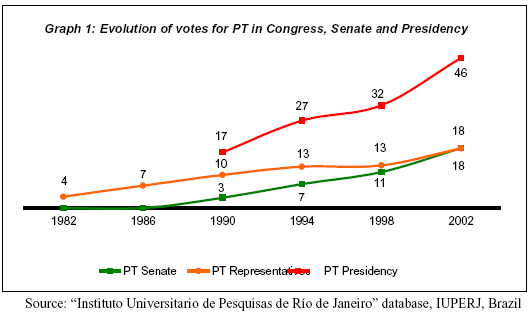
As observed in the graph, when the PT vote hardly reached 12% of the electorate, Lula the candidate had already conquered the preferences of more than 25%. This characteristic has been facilitated by two mechanisms that operate concomitantly: electoral legislation that foster voting for the candidate and not for the party and a political process that has not allowed to generate stable party allegiance in the population.
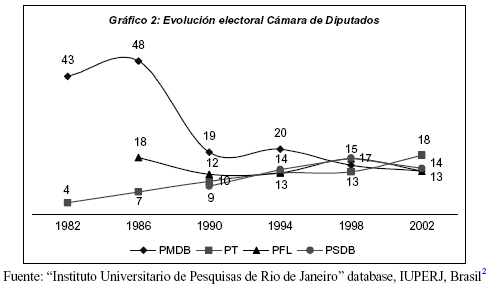
As far as legislative elections are concerned, there are a few characteristics that allow us to identify the parties’ evolution in the electoral arena. First, it is possible to notice an important change in the map of parties relevant to the system since 1982, with some defining moments. Up to 1986 Brazil was a bipartidary system, since the PDS and the PMDB got, together, more than 80% of votes. In 1986, the PDS became fragmented and experienced a very important electoral descent, while the PFL, one of its offshoots, emerged as the most attractive alternative to the right of the system. In 1990 the PMDB lost strength and fell from 48% of the votes to less than half (19.3%), in spite of still being the most important party of the system. Between 1990 and 1994 a system with four relevant parties was under configuration, each with more than 10% of votes: the PDT, the PT, the PMDB and the PFL, well aligned in the ideological spectrum (the first two to the left, the other two to the right).
The 1994-2002 scenario presents some news. The first is the growth of the newer parties: the PT and PSDB, competing with the so-called "physiological" parties, PMDB and PFL. The second news is the stagnation of PDT and the consolidation of the PT as the most important party in the Brazilian left wing. Finally the 2002 election shows a House of Representatives with four relevant parties: PMDB, PT, PFL, PSDB, each with a very similar vote in Congress and which can be identified in the left-right continuum. Graph 2 shows this clearly:
]]> The Senate structure is slightly different. Even though the relevant parties are the same, they hold 76% of the total votes, while in the House of Representatives they can count with just 59.5%. The "physiological" parties are over-represented in the Senate, at least when compared to their representation in the House of Representatives. The PFL, with 13.4% of the Representatives’ seats controls 25.9% of the Senate. The PMDB has 13.4% of the seats in the House of Representatives and 16.7% in the Senate. The PSDB and the PT, on the other hand, have a more or less symmetrical representation in both Chambers.
Of all parties, the only one that grows systematically is the PT. The PMDB has a tendency to stagnate, even though it is still one of the parties that hold the "key" to Congress, as shown by its participation in coalitions in the last democratic governments. The PFL has a Senate share that oscillates between a fourth and a sixth part of it. The PSDB, is experiencing a fall and is left with 15% of the seats, although it has transformed into the main opposition party. Considering its origin as a center-left party, the government-opposition dynamics is today located more from the center to the left of the spectrum than it had been in the past.
Lula’s government confirmed the ideological party competition map and the consolidation of the party framework. The four major parties continue to steer Brazilian politics: PMDB, PFL, PSDB, PT. The two eldest –PMDB and PFL- still behave as physiological, whereas the competition for the presidential seat is today in the hands of the two more modern parties in the system (PT and PSDB).
Contrasting with what Mainwaring, Meneguello and Power (2000:9) have stated about conservative parties and their hold on Brazilian democracy, Brazil seems to be set on a route towards a left-wing social democracy (if the party who holds the actual "social democratic" name –the PSDB- could be considered nowadays a "right wing" social democratic offshoot); with ideological competition between parties and ideological alternation between coalitions.
Anyway, Lula’s presidency has generated a phenomenon that appear to be general when a left wing party or coalition comes to power: the phenomenon of bipolar opposition, from the left and from the right, taking into consideration the secessions "to the left" that almost inevitably happen to left-wing parties once they reach government. Even though this situation of double opposition has been studied by Sartori in the framework of centrifugal competition, it is at least noteworthy the fact that the dispute from both sides of the ideological spectrum has happened not to governments located in the center of the ideological spectrum but to governments on the left. The exit of some PT leaders and the creation of a new party (PSOL), together with some the departure from the coalition of some of PT’s left-wing partners (for instance, PDT), generated a significant left-wing opposition to this government. At the same time, the government always faced the right’s opposition and particularly, one from a center party, as is the PSDB. However, such scenario has not been catastrophic for Lula, mainly because the opposition to the government did not cause a centrifugal competition. With the corruption scandals that shook his term, the highly likely outcome of Lula’s re-election in 2004 show that a bipolar opposition scenario (something any left-wing government might expect) does not necessarily generate instability.
To sum up, the Brazilian case confirms the hypothesis that a greater consolidation of party life corresponds to a greater importance of ideology as a differentiating element among parties. Subsequently, this dynamics is linked to a greater consolidation of the "modern" parties (PT and PSDB) compared to historical parties that have a clientelistic base clientelística (The so called "physiological" parties). Brazil is an "example" of political modernization, consolidation of ideological politics, and different ideological sign party alternation in government.
The recent Chilean electoral process.
The political dynamics in Chile after Pinochet’s regime presents a fundamental difference in relation to the period before the coup d’etat. In the new stage of democracy initiated since 1990, the main center party, Christian Democracy and the main left party, the Socialist Party, which had been strongly opposed in the 70s during Allende and Unidad Popular government, formed an electoral and government coalition. This coalition, the "Concertación para la Democracia" rules Chile since the democratic restauration in 1990. This alliance was born as a political strategy to defeat Pinochet’s government continuity in the plebiscite of the year 1988 and meant a division in the left wing because it "isolated" the Communist Party, the other large party in the Chilean left.
The fact that this coalition between socialist and demo Christians has arisen already in opposition to the military regime explain partially it’s cohesion and it’s continuity in government for more than one decade Besides the Socialist Party and the Christian Democracy, the government coalition is formed by the "Partido Por la Democracia" (PPD), founded by the (former) president Lagos for the 1989 elections, due to the political proscription of the Socialist Party, and also two minor parties: the "Partido Radical" and the "Partido Social Demócrata", lately joined in one party.
In 1989 the "Concertación" candidate was elected, Patricio Aylwin, with more than 55% of the votes. Four years later, the coalition is re-elected with 58% of the votes and Eduardo Frei becomes the second president of the post-authoritarian period. Both Aylwin and Frei were candidates for the Christian Democracy, the major partner in the coalition. For 1999, the "Concertación" held primary elections to determine its presidential candidate, giving victory to Ricardo Lagos, candidate for the PS and PPD, defeating the CD candidate. Lagos was elected president in the second round, as well as Bachelet more recently. This is a sign that the "left turn" of the "Concertación" was more difficult to manage in key of an electoral majority than a Christian Democracy president, on the other hand, the "shift to the left" of the "Concertación" (the Christian Democracy moved from 32.5% of the seats in the House of Representatives to 20%, and the other three members of the coalition kept their share or increased it).
]]> The Chilean right, became a coalition for the first time as "Unión por Chile" and later as "Alianza por Chile", experienced a significant electoral growth in the presidential elections of 1999-00, as a product of its –quite slow- shift to the center. In this situation the appearance of a candidate more representative of the center-right as was Lavin also had some incidence. In the last electoral contest, this growth was confirmed, because if the votes for Piñeyra and Lavín are added-up it’s possible to notice that they are more than Bachelet’s (48.6% against 45.9%). Chart 3 illustrates the electoral tendencies in the House of Representatives. As shown, the center-right coalition still controls significant political power, even though it has decreased in the last election.
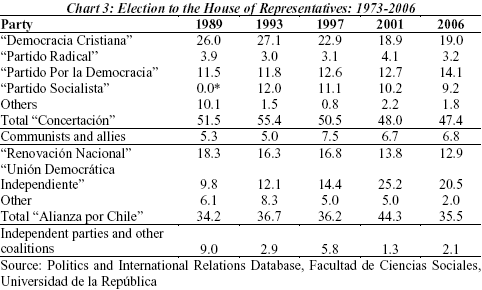
The seats in the Chambers of Representatives do not reflect, however, that electoral result, given the influence of majoritary electoral formulas that are used in Chile for seat allocation. The Chilean electoral system establishes two representatives for each electoral constituency: the party or coalition that gets the majority of the votes can only control the two seats if it duplicates the number of votes of the runner up. Thus, with only two positions, "third parties" as the Communist party get no parliament representation.
As shown in Chart 3, the forces to the left in the party system ("Concertación" + Communist Party) are the majority in the House of Representatives since the first post-transition government. The Communist Party, that in 1973 had achieved 20% of the votes, has oscillated during the whole period reviewed between 7% and 5%, never managing to get parliamentary representation. The "Concertación" has had the majority in this Chamber, with the exception of one period.
The evolution of the composition of the House of Representatives shows the continuity of the multi-partidary system, with well-defined left, right and center. The bipolarity shown by Chile’s political dynamics is the result of the establishment of big coalitions, favored by current legislation. It is likely that without this majority bent the multi-party system had evolved differently. The Christian Democracy, the party that forces the coalition "towards the centre" was the favorite for two periods, after which it showed a reduction in its electorate, consequently with its loss of the condition of "president’s party".
The center-right coalition "Unión por Chile" has oscillated between 34% and 44% of the seats, having seen an asystematic growth until the last election, when it fell significantly. Even so, it still has a higher electoral result than the one achieved in the years before the military coup (aprox. 25%). After the democratic transition the right managed to re-organize into two parties: the Pinochetean "Unión Democrática Independiente" (UDI) and the more moderate "Renovación Nacional" (RN).
The Chilean case, differently from the Brazilian one, does not represent an "example" of political modernization. Chile is an example of ideological alignment of its party system. However, as happens to the Brazilian PT, a part of the left-wing (PC) is outside the "Concertación", and consequently, inhibits a simple ideological alignment with two bipolar coalitions: center-right and center-left. Besides, Chile is the only country of the four reviewed which has not yet experienced a process of political alternation in government. Like in Argentina, alternation takes place inside the government party (it is easier to perceive in the Chilean case because fractions are differentiated). Inner competition has a (weak) tendency to become more centripetal, Since the "Concertación" is in the government there has been a process of aggiornamiento of the right wing, which had been before strongly identified with Pinochetism. Concurrently, the "proper" left wing parties have grown the period –taking into account the added votes for the Socialst Party, the Communist Party and the PPD - from a 16,8% in the first election to a 32,8% in the last.
]]> The Uruguayan electoral processThe Uruguayan electoral system has always been a case study in the area of comparative electoral law. Before the constitutional reform of 1996, simultaneous elections took place every five years, including all levels of government. (Parliament, Executive, Regional), and the elector had to vote for a list of candidates inside one party (party label linked vote). The outcome of the presidential election was sorted out by simple majority. Ballots were closed and blocked and political parties worked as coalitions, the elector should vote for a party and, inside that party’s label, for a specific fraction (double simultaneous vote or more commonly know as ley de lemas –party label law -), each fraction would even have their own candidate to the Presidency. The two traditional parties Partido Colorado and Partido Nacional, which come from the time of the countries’ independence, developed fractions with well defined identities, this allowed them to be catch-all parties to all intents and purposes of the concept.
The arrivalof oo of a coalition of left wing parties with the style of the Chilean "Frente Popular", the Frente Amplio in the beginning of the 70s, radically altered the party framework, even though decades should pass before the real depth of the changes this arrival would bring about could really be appreciated. In fact, two years from the appearance of the Frente Amplio was the start of the authoritarian regime and only ten years after the beginning of the new democratic period it was evident that the left had come to get to government. Its voting during the first twenty years (1973-1994), had never surpassed the threshold of 20%, leaving the traditional parties, ruling in coalition, in charge of government. The growth of Frente Amplio "pushed" traditional parties to the right of the ideological spectrum, because those leaders and fractions in the traditional parties who identified themselves with the left decided to move to the new party. Also, the loss of votes in the traditional parties forced them to rule under different of agreement, practically since the first post-authoritarian government. That made the traditional parties relatively undifferentiated before the public opinion, fact that was aggravated by the installation of ballotage in 1997. For the public opinion, the only "real" opposition was the Frente Amplio.
Ever since the reinstauration of democracy in 1985, the Partido Colorado got the presidency three times: in 1984 and 1994 with Julio Maria Sanguinetti and in 1999 with Jorge Batlle. The Partido Colorado’s votes fell from 41,2% of the total in 1984 to 32,8% in 1999. The Partido Nacional obtained government in the elections of 1989, with Luis A. Lacalle, with 38.9% of votes. Both parties lost a significant amount of their votes, which were obtained by the Frente Amplio as shown in Chart 4.
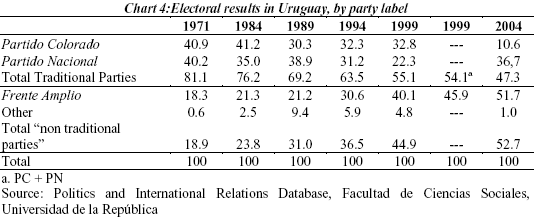
The 2002 crisis unleashed after the Argentinean crisis of 2001 affected the Uruguayan financial system severely Its impact restricted even more the electorate who used to vote for both traditional parties (Nacional and Colorado), but manifested mainly on the allegiance to the Partido Colorado, which was at the time in government. Thus, when the Frente Amplio won the elections with a 51.7% of the valid votes (a majority that no party had ever obtained after the democratic transition), the Partido Colorado barely managed to get a 10%. In this way, the bipartidist system that had worked for over a century was evolutioning until it turned into a moderate multi partidism, with not only political but also ideological alternation in government. In fact, the coalition essays between the two large parties, and the growth of the FA made that the last decade of Uruguayan politics worked under a bipolar dynamics, Chilean style, between a center-right coalition (government) and Frente Amplio, which was actually a center-left coalition, with many relevant factions inside.
Chart 4 shows the electoral results in the period.
]]> As can be seen on this chart, the Uruguayan electoral behavior throughout the period shows a consistent tendency; the traditional parties lose votes in the same amount that the left wing obtains them. The two traditional parties, which had more than 80% of the Representative seats in 1971, today control 47%.So, the Uruguayan case is the most paradigmatic of the hypotheses stated above. There is an ideological polarization between large "coalitions" to the center-left and center-right, there is alternation between those in the exercise of government and the political system shows a tendency towards a "shift to the left" of the entire party framework.
4. The evolution of party systems in the four countries
Political systems in the four countries have likenesses and differences, despite, obviously, their peculiarities. The stable and deeply rooted bipartidism that once characterized Argentina and Uruguay does not define any more the political systems of both countries. The transformation has been total in the Uruguayan case as well as partial, or better, still in process of transformation, in the Argentinean case.
Chile and Brazil still have, as they did in their "second wave" democratic periods, multi party systems. In Chile’s case, this is a system strongly consolidated around five large parties. In Brazil’s case, where there is a noticeably greater party fragmentation, around 8 or 9 effective political parties, the Partido dos Trabalhadores (PT) and Brazilian Social Democracy Party (PSDB) have a tendency to consolidate as the main parties and the two major labels of the initial democratic transition period the Partido del Movimiento Democrático Brasilero (PMDB) and the Partido del Frente Liberal (PFL), even though remain among the top four parties, are losing their power to appeal to the masses.
One peculiarity of the Chilean case is that, albeit keeping the multi party system that existed before, with parties clearly aligned on the left/right axis, there has been innovation with the consolidation of an electoral dynamics between to large political coalitions which were formed initially according to their positions favoring or criticizing Pinochet’s military regime, but now have their own autonomy regarding the "historical narration" of the authoritarian regime. It is still unknown if the Uruguayan system will eventually evolve into a political competition profile similar to the Chilean.
One of the similarities between Brazil and Uruguay is the presence of highly structured and institutionalized left-wing parties. (PT in Brazil and EP-FA in Uruguay) These parties have both strong Union ties, have grown consistently since the democratic transition and have recently won elections. Although Chile has got structured left-wing parties (PPD and PS), its permanency in a coalition with the Christian Democracy, makes their situation different to the one of the left in Brazil and Uruguay, besides, they do not have the same relationship with the Union sectors.
Argentina and Brazil, have had similar histories Both had parties that shared the "populist pattern" in the post-war period: "peronismo" and "varguismo", and also their legacy of a strong State, assimilation of the social movements, especially of the Unions.
However, Brazil developed an autonomous Union (the CUT), which allowed them to consolidate a left-wing party with its own unionist base (PT). This did not happen in Argentina, where peronism continued to be the main referent of the Union movement. In this case, Brazil’s path would have started to evolve into a form analogous to the Uruguayan case (due to the presence of independent left-wing parties and with a strong electoral weight) or to the Chilean case (for the presence of large coalitions).
]]> The following chart shows a synopsis of the evolution of left-wing parties in the reviewed countries:
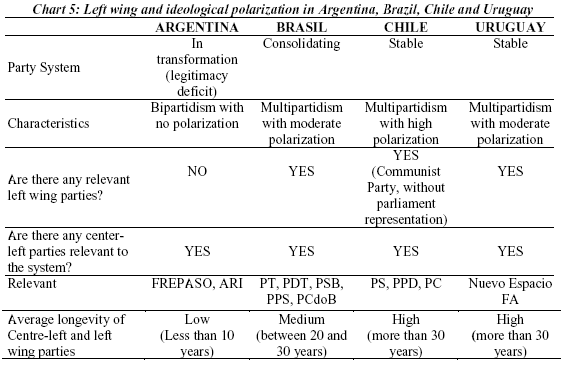
As shown in the Chart, the South Cone party system panorama is quite complex. One of the reasons for this complexity is that these parties are going through different situations, from the point of view of their institutionalization. Thus, the Brazilian case is that of a system with growing institutionalization that in its current format is just more than a decade and a half old, but has developed an important degree of ideological polarization between its right wing and left wing parties.
Among the relevant parties to the right of the system we can count the PFL and to the left with the PT. Besides center parties like the PMDB, we can also find there today the PSDB, nowadays located more to the right wing than it had been in its origins3. Brazil would not have managed to reach a multiparty system with the current degree of ideological definition if this process had not started in the "second wave" of democracy, in the democratic period that went from 1945 to 1964. At that time, despite the proscription of the Communist Party, it was possible to perceive the beginning of a bi polar dynamics between a center-right coalition (UDN y PSD) and a center-left one (led by the PTB) as it’s explained by Dos Santos (1986) in his Sessenta e quatro: anatomia da crise. The ideological realignment experience of the party system during the authoritarian regime is also relevant for this phenomenon, with two parties polarized in the government/opposition axis (Arena y PMDB). This is one of the explanations why this ideological polarization appears in such a recent system
In Argentina, Uruguay and Chile, on the other hand, we are facing party systems, which were already consolidated in the "second wave" of democracy. Argentina has undergone a very significant political wear and tear, a consequence of the crisis which started in the year 2000 and that practically caused the "crack" of the national economic system, but this has not meant the creation of new political parties able to contest the hegemony of the two historical parties (PJ y UCR). Both parties have not differentiated in the left/right axis significantly, especially because the Peronism itself has suffered this division in its core, as it has already been pointed out. In Chile and Uruguay, conversely, this differentiation is very important, however it works in a different sense. Whereas in Chile the competition distinguishes a center-left government coalition which is challenged by a right wing coalition, in Uruguay the direction of political competition has been, up to the recent left wing victory, exactly the opposite: a center-right coalition in power challenged by a left wing party.
The four countries have relevant center-left parties, but not all of them have relevant left parties. Chile (Partido Socialista, Partido Comunista), Uruguay (Encuentro Progresista-Frente Amplio) and Brazil (Partido de los Trabajadores), have relevant left-wing parties, but Argentina lacks a relevant left wing party. The average longevity of these parties is relatively high in the three reviewed countries; the Socialist and the Communist parties in Chile have their origins in the first decades of the XX century (1922 and 1933 respectively); the FA en Uruguay was born in 1971 and the PT in Brazil in 1979.
The four countries have got relevant center-left parties, and in Brazil those include the PDT and the PSB, if only the major parties are taken into account. In Uruguay it is possible to include, at least during two government terms the Nuevo Espacio (actually transformed into the Partido Independiente, a very minor party without representation in the Senate) which had been a splinter group of the FA. In Argentina, the Frepaso ended up being, as some had foretold, a "flash party", and after the Alianza crisis, the ARI was born. The historical ideological parties still survive in Argentina, albeit their extremely low electoral weight. The average longevity of relevant left and center-left parties is low in Argentina, medium in Brazil and high in Chile and Uruguay
Summarizing: a) Argentina is the only country without a relevant left wing party; b) Brazil, Uruguay and Chile have relevant left wing parties and in the three cases one or many of them are in the government; c) Uruguay is the only country where government is held by a left wing party. In Chile and Brazil these parties rule in coalition with center parties; d) While in Brazil and in Uruguay there has been alternation from a center-right coalition to a center-left one, in Chile there has been no alternation; e) Chile and Argentina have shown ideological shifts in government, without the occurrence of party alternation.
]]>5 The hypotheses in review
The statement that in the Southern Cone the left wing is stabilizing in government must be strongly relativized. We have shown that the statement "progressist governments" is politologically amorphous and that it groups together very different phenomena.
First, we have shown that the reasons why left wing governments have been victorious in these four countries seem to follow these countries’ history and their own political dynamics, more than some inevitable tendency to processes of democratic consolidation that would lead to the transit from pragmatic to ideological competition. Therefore, it is possible to provisionally accept the hypothesis that the ideological realignment processes that had been taking place in these countries before the coups have strengthened with democratic consolidation. However, the hypotheses that associate the degree of democratic consolidation with the parties’ ability to absorb the ideological dynamics are still weak, as shown by the Argentinean "counter fact". In spite of the fact that Argentinean politics have –sort of- managed to "routinize" in the reviewed period, this has not led to an ideological party competition dynamics.
Second, we have shown that democratic consolidation does not necessarily come together with party alternation: there wasn’t any in Chile in the whole period. Regardless, ideological shifts do happen, even without party alternation. In some cases, these occur in the midst of a coalition or party in government. This can be stated about Argentina and also about Chile. Unlike Europe, alternation from the left to the right is a phenomenon that has not yet happened in these countries. On the contrary, the experience of the Concertación in Chile shows that left wing or center-left parties or coalitions, once they have reached government, can be re-elected for several periods. In fact, if we take into consideration Lula’s victory in the past 2006 election, despite the corruption scandals in his government, we could see that the consolidation of these parties in government could reflect a longer lasting process. The Uruguayan government is a "recent release" so there is no way to venture a hypothesis in this case.
Finally, what is the common factor in those four countries government agendas, so that they could be called "left wing"? The experiences of the Concertación in Chile, the PT in Brazil and of the EP-FA in Uruguay show that, once in government, these left wing governments have systematically "shifted to the center" in economic matters, showing significant continuity with the legacy of previous governments. Considering that the struggle of left and right during the "second wave" of democracy took place in the cold war context; the "capitalism-socialism" debate was the focus of the whole ideological conflict. The present convergence in economic matter (the most important issue for the left) shows that the left wing of the third wave will be "left", but not because its opposition to capitalism (quite the opposite, Chile and Brazil have proven that the left could be great managers for capitalism). This is the framework for "basic consensus" that underlie party alternation and, at the same time, for the "shift to the center" of the left wing.
Regarding centripetal competition: the aggiornamiento of the Brazilian and Chilean right wings has shown that left wing governments have a deep impact over the ideological realignment of parties and voters. (And even before becoming government, because of the tremendous empathy that the mobilized left usually has on public opinion)
The retreat of authoritarianism in the Chilean right wing and the need to form modern political parties set apart of the patrimonial and clientelistic practices that used to characterize Brazilian conservative parties, are good examples of this. Even so, Piñera is not the same as Lavin, or the PSDB as the PFL. Whereas the left wing has grown struggling against an authoritarian, conservative right wing, now they would have other struggles against a more modern, liberal right. The shift towards the center of the left wing instills an analogous movement in the right wing: if this consolidates we will have regimes with a strong centripetal competition and "basic consensus" among the elites, and Chile will eventually show that it fits the the famous quote: "eu sou você amanhá4".
References
]]>Alcántara, Manuel y Flavia Freidenberg (coord.) (2003). Partidos políticos en América Latina: Cono Sur, Fondo de Cultura Económica, México
Alcántara, Manuel (1999). Sistemas políticos de América Latina, Vol I. América del Sur, Editorial Tecnos, Madrid.
Banco Interamericano de Desarrollo (2006). La política de las políticas: Progreso económico y social en América Latina. Informe 2006, Editorial Planeta, México.
Dos Santos, Wanderley G. (1986). Sessenta y quatro: anatomia da crisis. Editorial Vertice, São Paulo.
Duverger, Maurice (1957).Los partidos políticos, Fondo de Cultura Económica, México, D.F.
Hernández Bravo, Juan (1997), "La delimitación del concepto de partido político. Las teorías sobre el origen y la evolución de los partidos" en Mella Márquez, Manuel (editor) Curso de Partidos Políticos, Editorial Akal, Barcelona.
Hungtington, Samuel P. (1994). A Terceira Onda: A Democratizacao no final do Século XX, Ed. ATICA, São Paulo.
Katz, Richard S. y Mair, Peter (1995), "Changing models of party organization and party democracy. The emergence of the cartel party" en Party Politics, Vol. 1, 1
Kirchmeimer, Otto (1972). "The Transformation of the Western European Party Systems", en Joseph LaPalombara y Myron Weiner, Political Parties and Political Development. Princeton University, Princeton, NJ.
LaPalombara, J.G. y Weiner, M (1972). Political Parties and Political Developtment, Princeton Universy Press, Princeton.
Mainwaring Scott, Raquel Meneguello y Timothy Power (2000). Partidos conservadores no Brasil contemporaneo. Editorial Paz e Terra, São Paulo
Mainwaring, Scott & Scully, Timothy (1995). Building Democratic Institutions: Party Systems in Latin America. Stanford University Press, Stanford California
Panebianco, Angelo (1990). Modelos de partido, Alianza Editorial, Madrid.
Programa de las Naciones Unidas para el Desarrollo (2004). La democracia en América Latina: Hacia una democracia de ciudadanas y ciudadanos. Alfaguara, S.A.
Sartori, Giovanni (1982). Partidos e Sistemas Partidários, Ed. Zahar, Rio de Janeiro.
Torre, Juan Carlo (2003). "Los huérfanos de la política de partidos. Sobre los alcances y la naturaleza de la crisis de representación partidaria", en Desarrollo Económico, vol. 421, No. 168. IDES, Buenos Aires.
Weber, Max (1977), Economía y Sociedad. Fondo de Cultura Económica, México.
Artículo recibido el 10 de junio de 2006 y aceptado para su publicación el 18 de setiembre de 2006
]]>
1 parties were born and consolidated as a need of the left(s) (translator’s note)
2 Graph 2: Electoral evolution in the House of Representatives
3 According to Alcántara’s data, (Alcántara, 2005), this party self identifies in the 5.23 on the left/right scale but is identified in the 6.84, differently with what happens to the PMDB witch "self locates" in the 6.47 and is located in 5.67.
4 I am yourself tomorrow (translator’s note)