<?xml version="1.0" encoding="ISO-8859-1"?><article xmlns:mml="http://www.w3.org/1998/Math/MathML" xmlns:xlink="http://www.w3.org/1999/xlink" xmlns:xsi="http://www.w3.org/2001/XMLSchema-instance">
<front>
<journal-meta>
<journal-id>0121-5051</journal-id>
<journal-title><![CDATA[Innovar : Revista de Ciencias Administrativas y Sociales]]></journal-title>
<abbrev-journal-title><![CDATA[Innovar]]></abbrev-journal-title>
<issn>0121-5051</issn>
<publisher>
<publisher-name><![CDATA[Escuela de Administración de Empresas y Contaduría Pública, Facultad de Ciencias Económicas, Universidad Nacional de Colombia]]></publisher-name>
</publisher>
</journal-meta>
<article-meta>
<article-id>S0121-50512008000100004</article-id>
<title-group>
<article-title xml:lang="en"><![CDATA[Environmental uncertainty: the side object of perception]]></article-title>
<article-title xml:lang="es"><![CDATA[La incertidumbre ambiental: el oscuro objeto de la percepción]]></article-title>
<article-title xml:lang="fr"><![CDATA[L?incertitude environneentale: cet obscur objet de perception]]></article-title>
<article-title xml:lang="pt"><![CDATA[A incerteza ambiental: o escuro objeto da percepção]]></article-title>
</title-group>
<contrib-group>
<contrib contrib-type="author">
<name>
<surname><![CDATA[Santos Álvarez]]></surname>
<given-names><![CDATA[María del Valle]]></given-names>
</name>
<xref ref-type="aff" rid="A01"/>
</contrib>
<contrib contrib-type="author">
<name>
<surname><![CDATA[García Merino]]></surname>
<given-names><![CDATA[María Teresa]]></given-names>
</name>
<xref ref-type="aff" rid="A02"/>
</contrib>
</contrib-group>
<aff id="A01">
<institution><![CDATA[,Universidad de Valladolid Departamento de Organización de Empresas y C. I. M. ]]></institution>
<addr-line><![CDATA[ ]]></addr-line>
</aff>
<aff id="A02">
<institution><![CDATA[,Universidad de Valladolid Departamento de Organización de Empresas y C. I. M. ]]></institution>
<addr-line><![CDATA[ ]]></addr-line>
</aff>
<pub-date pub-type="pub">
<day>00</day>
<month>00</month>
<year>2008</year>
</pub-date>
<pub-date pub-type="epub">
<day>00</day>
<month>00</month>
<year>2008</year>
</pub-date>
<volume>1</volume>
<numero>se</numero>
<fpage>0</fpage>
<lpage>0</lpage>
<copyright-statement/>
<copyright-year/>
<self-uri xlink:href="http://socialsciences.scielo.org/scielo.php?script=sci_arttext&amp;pid=S0121-50512008000100004&amp;lng=en&amp;nrm=iso"></self-uri><self-uri xlink:href="http://socialsciences.scielo.org/scielo.php?script=sci_abstract&amp;pid=S0121-50512008000100004&amp;lng=en&amp;nrm=iso"></self-uri><self-uri xlink:href="http://socialsciences.scielo.org/scielo.php?script=sci_pdf&amp;pid=S0121-50512008000100004&amp;lng=en&amp;nrm=iso"></self-uri><abstract abstract-type="short" xml:lang="en"><p><![CDATA[This research was aimed at gaining a deeper insight into perception linked to environmental uncertainty and the strategic significance of perceptual diversity. Factors intervening in perception were characterised. It is specifically shown that an individual?s cognitive limitations and their beliefs? affective influence gave rise to cognitive bias distorting individual perception. This model was applied to both management (perceived uncertainty) and outside observers (objective uncertainty) perceiving environmental uncertainty. The idiosyncratic nature of perceiving uncertainty and the interrelationships between various individuals? perception was thus considered (stress-management and outside observers). The significance of the heterogeneity of perception of managers working at a single company was analysed and compared to that of those working in different companies. It was found that inter-company perception of diversity enabled selective access to competitive advantages. Diversity of perception at intra-company level enhanced assessment of the background of strategy management and reduced organisational coordination]]></p></abstract>
<abstract abstract-type="short" xml:lang="es"><p><![CDATA[El objetivo de esta investigación es profundizar en el proceso de percepción de la incertidumbre ambiental y la trascendencia estratégica de diversidad perceptual. Con ese propósito se caracterizan los factores que intervienen en el proceso de percepción. En concreto se reconoce que las limitaciones cognitivas del individuo y la influencia afectiva de sus creencias dan lugar a sesgos cognitivos que deforman la percepción individual. Este modelo se aplica a la percepción de la incertidumbre ambiental tanto para directivos -incertidumbre percibida- como para observadores externos -incertidumbre objetiva-. Se reconoce así el carácter idiosincrásico de la percepción de incertidumbre y las interrelaciones que se producen entre los procesos de percepción de los distintos individuos considerados -directivos y observadores externos-. Con este punto se partida se analiza la trascendencia de la heterogeneidad de percepciones tanto entre directivos de una misma empresa como entre los directivos de distintas empresas. Se comprueba entonces que es la diversidad de percepciones entre-empresas la que permite el acceso selectivo a ventajas competitivas. En el nivel intra-empresa la diversidad de percepciones enriquece la valoración de los antecedentes del proceso estratégico a la vez que reduce la coordinación organizativa]]></p></abstract>
<abstract abstract-type="short" xml:lang="fr"><p><![CDATA[L?objectif de cette recherche est d?explorer le processus de perception de l?incertitude environnementale et la transcendance stratégique de diversité perceptuelle. À cet effet, les facteurs qui interviennent dans le processus de perception sont caractérisés. Il est concrètement reconnu que les limites cognitives de l?individu et l?influence affective de ses croyances donnent lieu à des dérives cognitives qui déforment la perception individuelle. Ce modèle s?applique à la perception de l?incertitude environnementale pour les cadres - incertitude perçue - comme pour les observateurs externes - incertitude objective -. De cette façon, on reconnaît le caractère idiosyncrasique de la perception de l?incertitude et les interrelations qui se produisent entre les processus de perception des différents individus considérés - cadres et observateurs externes -. Dès lors, la transcendance de l?hétérogénéité des perceptions est analysée entre les cadres d?une même entreprise tout comme entre les cadres d?entreprises différentes. Il est alors démontré que la diversité de perceptions entre entreprises permet l?accès sélectif à des avantages concurrentiels. Dans le niveau intra entreprise la diversité de perceptions enrichit la valorisation des antécédents du processus stratégique tout en réduisant la coordination organisationnelle]]></p></abstract>
<abstract abstract-type="short" xml:lang="pt"><p><![CDATA[O objetivo desta pesquisa é se aprofundar no processo de percepção da incerteza ambiental e a transcendência estratégica de diversidade perceptual. Com esse propósito caracterizam-se os fatores que intervêm no processo de percepção. Em concreto reconhece-se que as limitações cognitivas do indivíduo e a influência afetiva de suas crenças dão lugar a distorções cognitivos que deformam a percepção individual. Este modelo se aplica à percepção da incerteza ambiental tanto para diretores -incerteza percebida- como para observadores externos -incerteza objetiva-. Reconhece-se assim o caráter idiossincrásico da percepção de incerteza e as inter-relações que se produzem entre os processos de percepção dos distintos indivíduos considerados -diretores e observadores externos-. Com este ponto de partida analisa-se a transcendência da heterogeneidade de percepções tanto entre diretores de uma mesma empresa como entre os diretores de distintas empresas. Comprova-se então que é a diversidade de percepções entre empresas a que permite o acesso seletivo a vantagens competitivas. No nível intra-empresa a diversidade de percepções enriquece a valoração dos antecedentes do processo estratégico ao mesmo tempo que reduz a coordenação organizativa]]></p></abstract>
<kwd-group>
<kwd lng="en"><![CDATA[strategic uncertainty]]></kwd>
<kwd lng="en"><![CDATA[cognitive bias]]></kwd>
<kwd lng="en"><![CDATA[perception]]></kwd>
<kwd lng="en"><![CDATA[diversity]]></kwd>
<kwd lng="es"><![CDATA[incertidumbre estratégica]]></kwd>
<kwd lng="es"><![CDATA[sesgos cognitivos]]></kwd>
<kwd lng="es"><![CDATA[percepción]]></kwd>
<kwd lng="es"><![CDATA[diversidad]]></kwd>
<kwd lng="fr"><![CDATA[incertitude stratégique]]></kwd>
<kwd lng="fr"><![CDATA[dérives cognitives]]></kwd>
<kwd lng="fr"><![CDATA[perception]]></kwd>
<kwd lng="fr"><![CDATA[diversité]]></kwd>
<kwd lng="pt"><![CDATA[incerteza estratégica]]></kwd>
<kwd lng="pt"><![CDATA[distorções cognitivas]]></kwd>
<kwd lng="pt"><![CDATA[percepção]]></kwd>
<kwd lng="pt"><![CDATA[diversidade]]></kwd>
</kwd-group>
</article-meta>
</front><body><![CDATA[ <p><font face="Verdana, Arial, Helvetica, sans-serif" size="4"><b>Environmental    uncertainty : the side object of perception </b></font></p>     <p>&nbsp;</p>     <p> <font face="Verdana, Arial, Helvetica, sans-serif" size="3"><b> La incertidumbre    ambiental : el oscuro objeto de la percepci&oacute;n </b></font></p>     <p>&nbsp; </p>     <p> <font face="Verdana, Arial, Helvetica, sans-serif" size="3"><b>L'incertitude    environneentale: cet obscur objet de perception </b></font></p>     <p>&nbsp;</p>     <p> <font face="Verdana, Arial, Helvetica, sans-serif" size="3"><b> A incerteza    ambiental: o es curo objeto da percep&ccedil;&atilde;o </b> </font></p>     <p>&nbsp;</p>     <p>&nbsp;</p>     <p> <font face="Verdana, Arial, Helvetica, sans-serif" size="2"><b>Mar&iacute;a    del Valle Santos &Aacute;lvarezI; Mar&iacute;a Teresa Garc&iacute;a MerinoII</b></font></p>     ]]></body>
<body><![CDATA[<p><font face="Verdana, Arial, Helvetica, sans-serif" size="2"><sup>I</sup>Universidad    de Valladolid, Departamento de Organizaci&oacute;n de Empresas y C. I. M. Correo    electr&oacute;nico: <a href="mailto:mvalle@eco.uva.es">mvalle@eco.uva.es</a>    <br>   <sup>II</sup>Universidad de Valladolid, Departamento de Organizaci&oacute;n    de Empresas y C. I. M. Correo electr&oacute;nico: <a href="mailto:temerino@eco.uva.es">temerino@eco.uva.es</a></font></p>     <p><font face="Verdana, Arial, Helvetica, sans-serif" size="2">Replicated from    <b>Innovar</b>, Gogot&aacute;, vol.18 n.32, p.65-74, July/Dec. 2008.</font></p>     <p>&nbsp;</p>     <p>&nbsp;</p> <hr size="1" noshade>     <p><font face="Verdana, Arial, Helvetica, sans-serif" size="2"><b>ASTRACT</b>    </font></p>     <p><font face="Verdana, Arial, Helvetica, sans-serif" size="2"> This research    was aimed at gaining a deeper insight into perception linked to environmental    uncertainty and the strategic significance of perceptual diversity. Factors    intervening in perception were characterised. It is specifically shown that    an individual's cognitive limitations and their beliefs' affective influence    gave rise to cognitive bias distorting individual perception. This model was    applied to both management (perceived uncertainty) and outside observers (objective    uncertainty) perceiving environmental uncertainty. The idiosyncratic nature    of perceiving uncertainty and the interrelationships between various individuals'    perception was thus considered (stress-management and outside observers). The    significance of the heterogeneity of perception of managers working at a single    company was analysed and compared to that of those working in different companies.    It was found that inter-company perception of diversity enabled selective access    to competitive advantages. Diversity of perception at intra-company level enhanced    assessment of the background of strategy management and reduced organisational    coordination.</font></p>     <p><font face="Verdana, Arial, Helvetica, sans-serif" size="2"><b>Key words: </b>strategic    uncertainty, cognitive bias, perception, diversity.</font></p> <hr size="1" noshade>     <p><font face="Verdana, Arial, Helvetica, sans-serif" size="2"><b>RESUMEN</b></font></p>     <p><font face="Verdana, Arial, Helvetica, sans-serif" size="2"> El objetivo de    esta investigaci&oacute;n es profundizar en el proceso de percepci&oacute;n    de la incertidumbre ambiental y la trascendencia estrat&eacute;gica de diversidad    perceptual. Con ese prop&oacute;sito se caracterizan los factores que intervienen    en el proceso de percepci&oacute;n. En concreto se reconoce que las limitaciones    cognitivas del individuo y la influencia afectiva de sus creencias dan lugar    a sesgos cognitivos que deforman la percepci&oacute;n individual. Este modelo    se aplica a la percepci&oacute;n de la incertidumbre ambiental tanto para directivos    -incertidumbre percibida- como para observadores externos -incertidumbre objetiva-.    Se reconoce as&iacute; el car&aacute;cter idiosincr&aacute;sico de la percepci&oacute;n    de incertidumbre y las interrelaciones que se producen entre los procesos de    percepci&oacute;n de los distintos individuos considerados -directivos y observadores    externos-. Con este punto se partida se analiza la trascendencia de la heterogeneidad    de percepciones tanto entre directivos de una misma empresa como entre los directivos    de distintas empresas. Se comprueba entonces que es la diversidad de percepciones    entre-empresas la que permite el acceso selectivo a ventajas competitivas. En    el nivel intra-empresa la diversidad de percepciones enriquece la valoraci&oacute;n    de los antecedentes del proceso estrat&eacute;gico a la vez que reduce la coordinaci&oacute;n    organizativa.</font></p>     ]]></body>
<body><![CDATA[<p><font face="Verdana, Arial, Helvetica, sans-serif" size="2"><b> PALABRAS CLAVE:    </b>incertidumbre estrat&eacute;gica, sesgos cognitivos, percepci&oacute;n,    diversidad.</font></p> <hr size="1" noshade>     <p><font face="Verdana, Arial, Helvetica, sans-serif" size="2"><b>R&Eacute;SUM&Eacute;</b></font></p>     <p><font face="Verdana, Arial, Helvetica, sans-serif" size="2"> L'objectif de    cette recherche est d'explorer le processus de perception de l'incertitude environnementale    et la transcendance strat&eacute;gique de diversit&eacute; perceptuelle. &Agrave;    cet effet, les facteurs qui interviennent dans le processus de perception sont    caract&eacute;ris&eacute;s. Il est concr&egrave;tement reconnu que les limites    cognitives de l'individu et l'influence affective de ses croyances donnent lieu    &agrave; des d&eacute;rives cognitives qui d&eacute;forment la perception individuelle.    Ce mod&egrave;le s'applique &agrave; la perception de l'incertitude environnementale    pour les cadres - incertitude per&ccedil;ue - comme pour les observateurs externes    - incertitude objective -. De cette fa&ccedil;on, on reconna&icirc;t le caract&egrave;re    idiosyncrasique de la perception de l'incertitude et les interrelations qui    se produisent entre les processus de perception des diff&eacute;rents individus    consid&eacute;r&eacute;s - cadres et observateurs externes -. D&egrave;s lors,    la transcendance de l'h&eacute;t&eacute;rog&eacute;n&eacute;it&eacute; des perceptions    est analys&eacute;e entre les cadres d'une m&ecirc;me entreprise tout comme    entre les cadres d'entreprises diff&eacute;rentes. Il est alors d&eacute;montr&eacute;    que la diversit&eacute; de perceptions entre entreprises permet l'acc&egrave;s    s&eacute;lectif &agrave; des avantages concurrentiels. Dans le niveau intra    entreprise la diversit&eacute; de perceptions enrichit la valorisation des ant&eacute;c&eacute;dents    du processus strat&eacute;gique tout en r&eacute;duisant la coordination organisationnelle.</font></p>     <p><font face="Verdana, Arial, Helvetica, sans-serif" size="2"><b> MOTS CL&Eacute;:    </b>incertitude strat&eacute;gique, d&eacute;rives cognitives, perception, diversit&eacute;.</font></p> <hr size="1" noshade>     <p><font face="Verdana, Arial, Helvetica, sans-serif" size="2"><b>RESUMO</b></font></p>     <p><font face="Verdana, Arial, Helvetica, sans-serif" size="2"> O objetivo desta    pesquisa &eacute; se aprofundar no processo de percep&ccedil;&atilde;o da incerteza    ambiental e a transcend&ecirc;ncia estrat&eacute;gica de diversidade perceptual.    Com esse prop&oacute;sito caracterizam-se os fatores que interv&ecirc;m no processo    de percep&ccedil;&atilde;o. Em concreto reconhece-se que as limita&ccedil;&otilde;es    cognitivas do indiv&iacute;duo e a influ&ecirc;ncia afetiva de suas cren&ccedil;as    d&atilde;o lugar a distor&ccedil;&otilde;es cognitivos que deformam a percep&ccedil;&atilde;o    individual. Este modelo se aplica &agrave; percep&ccedil;&atilde;o da incerteza    ambiental tanto para diretores -incerteza percebida- como para observadores    externos -incerteza objetiva-. Reconhece-se assim o car&aacute;ter idiossincr&aacute;sico    da percep&ccedil;&atilde;o de incerteza e as inter-rela&ccedil;&otilde;es que    se produzem entre os processos de percep&ccedil;&atilde;o dos distintos indiv&iacute;duos    considerados -diretores e observadores externos-. Com este ponto de partida    analisa-se a transcend&ecirc;ncia da heterogeneidade de percep&ccedil;&otilde;es    tanto entre diretores de uma mesma empresa como entre os diretores de distintas    empresas. Comprova-se ent&atilde;o que &eacute; a diversidade de percep&ccedil;&otilde;es    entre empresas a que permite o acesso seletivo a vantagens competitivas. No    n&iacute;vel intra-empresa a diversidade de percep&ccedil;&otilde;es enriquece    a valora&ccedil;&atilde;o dos antecedentes do processo estrat&eacute;gico ao    mesmo tempo que reduz a coordena&ccedil;&atilde;o organizativa.</font></p>     <p><font face="Verdana, Arial, Helvetica, sans-serif" size="2"><b> PALAVRAS -CHAVE:    </b>incerteza estrat&eacute;gica, distor&ccedil;&otilde;es cognitivas, percep&ccedil;&atilde;o,    diversidade.</font></p> <hr size="1" noshade>     <p>&nbsp;</p>     <p>&nbsp;</p>     <p><font face="Verdana, Arial, Helvetica, sans-serif" size="3"><b>I.- Introduction</b></font></p>     ]]></body>
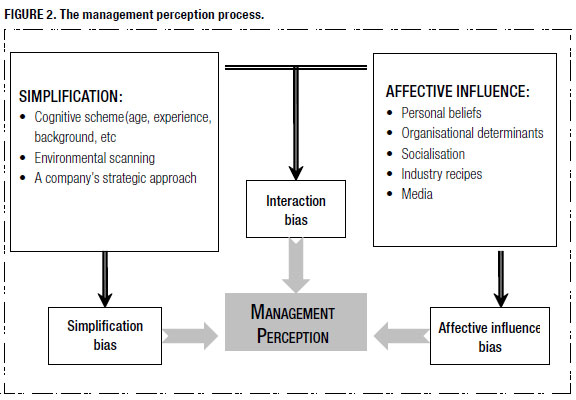
<body><![CDATA[<p><font face="Verdana, Arial, Helvetica, sans-serif" size="2"> Research into    companies' strategic management has adopted a rational-mechanical perspective    and a deterministic approach. Strategic management research has thus paid insufficient    attention to differences in individual perceptions in important stakeholder    groups. This has meant that analysing strategic processes' background has been    centred on a more or less objective representation of factors such as uncertainty,    dynamism or complexity. Some researchers had already warned of the need to take    individuals' perception of the environment into account rather than objective    reality when analysing strategic formulation (Weick, 1979). However, sufficient    attention has only been given to these proposals with the advent of the cognitive    approach, with management perception (being idiosyncratic in each case) becoming    the focal point for research into strategic company planning. Whereas conventional    approaches have assumed that all managers think and perceive alike (Stubbart,    1989), modern- day interpretation of individual perception has revealed that    a single reality may lead each manager to draw his/her own image, which may    in turn form the basis for their decision-making. This fresh outlook brings    a new element to the fore: diversity.</font></p>     <p><font face="Verdana, Arial, Helvetica, sans-serif" size="2"> Research has also    highlighted the significance of environmental uncertainty when designing and    formulating company strategy. Uncertainty refers to management's difficulty    in predicting environmental or organisational variables which may have an impact    on a company, particularly strategic choices (Miller, 1993). In other words,    uncertainty reflects management's lack of information when anticipating future    competitive conditions. A company's close links to other economic actors safeguarding    its access to resources and the instability inherent in such relationships bears    out the significance of environmental uncertainty in any company's strategic    management. Researchers have thus addressed different aspects of uncertainty:    its impact on strategic formulation and subsequent implementation, how it is    perceived by management and, mainly, the lack of agreement between management    perception (perceived uncertainty) and uncertainty as viewed by outside observers    and construed using archival measurement (objective uncertainty). The measurements    used for determining perceived and objective uncertainty and the cognitive bias    inherent in perception are the main reason behind such discrepancy (Boyd <i>et    al</i>., 1993). What has not been taken into account, however, is that objective    uncertainty also emerges as a result of individual perception and, consequently,    involves an element of subjectivity. This paper has used the term "outside observers"    to refer to researchers, experts, analysts or other individuals who (having    knowledge of or having analysed the economic and business environment) are not    directly involved in company management.</font></p>     <p><font face="Verdana, Arial, Helvetica, sans-serif" size="2"> This research    explored perception of uncertainty in detail with a twofold aim in mind: highlighting    existing differences between management perception and that of outside observers    while stressing the caution required when using the term "objective uncertainty"    and analysing the heterogeneity of perceptions among the various individuals    involved in competitive dynamics, together with the strategic significance of    such diversity.</font></p>     <p>&nbsp;</p>     <p><font face="Verdana, Arial, Helvetica, sans-serif" size="3"><b> II.- An individual    perception model</b></font></p>     <p><font face="Verdana, Arial, Helvetica, sans-serif" size="2"> Perception is    defined as being, "an inner feeling arising from a material impression made    on our senses," "the act or fact of perceiving," or put another way, "receiving    external images, impressions or sensations through one of our senses." Information    does not therefore reach the receiver in a pure form, but rather through the    filter of perception. However, human systems are not perfect and are subject    to bias (so-called cognitive bias). Such cognitive bias may be viewed as shortcuts    enabling us to cope with difficulties in such information, whether as a result    of receiving too much or too little information concerning many decisions which    need to be taken. They therefore entail incorrect hypotheses or inferences (Forbes,    2005). We may thus state that perception provides a <b>more or less imperfect    view</b> of reality (Mezias and Starbuck, 2003). Such is the case that different    individuals' perception may vary significantly when faced with the same event.    This leads us to what is termed, "perceptual relativity" (Bourgeois, 1985).</font></p>     <p><font face="Verdana, Arial, Helvetica, sans-serif" size="2"> Perception distances    itself from reality for two reasons (Santos and Garc&iacute;a, 2006): the cognitive    complexity facing individuals when confronted by the reality surrounding them    and the beliefs predisposing them to approximate objective reality to preconceived    ideas (<a href="/img/revistas/inno/v18n32/32a04f1.jpg" target="_blank">Figure    1</a>). In the former case it is the decisionmakers' cognitive limitations (Simon,    1957; Cyert and March, 1963) that put them in a position of inferiority vis-&agrave;-vis    the business world's cognitive complexity. Moreover, individuals tend to be    straightforward in their search for explanations in cause-effect relationships    (Downey and Brief, 1986). Thus, individuals opt to simplify when receiving complex    stimuli, causing perception to be inaccurate and lapse into cognitive bias.    The system of individual beliefs filters individual perception in the second    instance (Schwenk, 1984; Tikkannen <i>et al</i>., 2005). These beliefs therefore    predispose an individual to distort her/his perception in one direction or another    when questioned about certain issues on which preconceived beliefs are held.    For instance, it has been found that some managers will interpret certain events    as opportunities whereas others will view them as threats (Kuvaas and Kaufman,    2004: 254; Lant <i>et al</i>., 1992). It should also be pointed out that interactions    may occur between cognitive complexity and affective influence. It can thus    be concluded that individual perception does not accurately reflect reality,    but may encompass three types of bias:</font></p>     <p><a name="f1"></a></p>     <p>&nbsp;</p>     <p align="center"><img src="/img/revistas/s_inn/v1nse/a04fig01.jpg"></p>     ]]></body>
<body><![CDATA[<p>&nbsp;</p> <ol>       <p>        <li><font face="Verdana, Arial, Helvetica, sans-serif" size="2"><i>Simplification      bias</i> (SB): bias arising from the simplification required by the complexity      of objective reality;</font></li>          <p>        <li><font face="Verdana, Arial, Helvetica, sans-serif" size="2"><i>Affective      influence bias</i> (AIB): bias stemming from the affective influence emerging      from individual belief; and</font></li>          <p>        <li><font face="Verdana, Arial, Helvetica, sans-serif" size="2"><i>Interaction      bias</i> (IB): bias springing from the interaction between the complexity      of objective reality and affective influence.</font></li>        </ol>     <p><font face="Verdana, Arial, Helvetica, sans-serif" size="2"> Nevertheless,    the various types of bias do not appear in all perception processes, nor does    all bias reach the same level of intensity. Quite the opposite is true since    the "strength of the situation" moderates the degree to which a receiver's personality    has an impact on perception (Waller <i>et al</i>., 1995; Entrialgo <i>et al</i>.,    2001). The force of the situation basically refers to the clarity of the stimulus    (Fiske and Taylor, 1991), such that the clearer the stimulus, the less important    the receiver's personal interpretation. Depending on the strength of the situation,    a distinction may be drawn between "<i>weak nature</i>" and "<i>strong nature</i>"    situations; in the former, the lack of clarity in the stimulus gives rise to    quite different perceptions among different subjects. By contrast, intense situations    are characterised by a clearer definition of the stimulus leaving less room    for an individual receiver's personal appraisal (Sutcliffe and Huber, 1998).    The strength of the situation thus mitigates the link between the stimulus and    the appearance of bias, weak situations being more likely to be susceptible    to cognitive bias.</font></p>     <p><font face="Verdana, Arial, Helvetica, sans-serif" size="2"><b> III.- Perceiving    environmental uncertainty</b></font></p>     ]]></body>
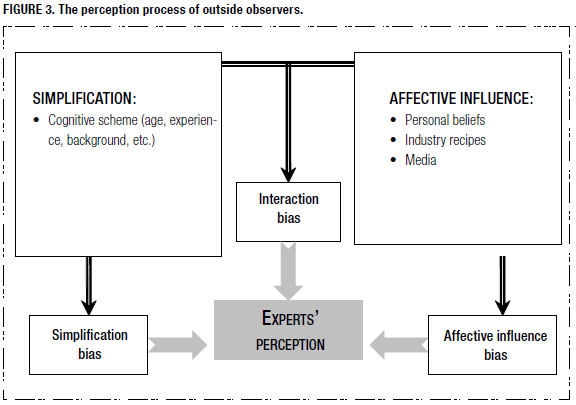
<body><![CDATA[<p><font face="Verdana, Arial, Helvetica, sans-serif" size="2"> Uncertainty refers    to a sense of doubt arising from potentially unpredictable variation (Priem    <i>et al</i>., 2002). Change does not produce uncertainty but rather changes    which are difficult to predict (Milliken, 1987). In the world of company management,    environmental uncertainty refers to the doubts managers experience when faced    with the difficulty of foreseeing future competitive conditions (McMullen and    Shepherd, 2006). Three kinds of uncertainty may be distinguished (Milliken,    1987): state uncertainty (difficulty knowing in which direction the environment    may change), uncertainty of effect (difficulty assessing the possible impact    of these changes on a particular company) and response uncertainty (difficulty    knowing which type of response may prove successful). Uncertainty is also regarded    as the result of combining two features: the complexity inherent in the external    factors surrounding business activity and the variation these factors may undergo    (Duncan, 1972).</font></p>     <p><font face="Verdana, Arial, Helvetica, sans-serif" size="2"> It is also worth    noting that uncertainty shows two sides in the literature: uncertainty as a    perceptual phenomenon (referring to the uncertainty perceived by managers making    business decisions) and the uncertainty describing the business environment    (linked to experts or analysts' assessment on the basis of certain indicators).    The latter kind of uncertainty is often referred to as "objective uncertainty"    as these indicators are fashioned on quantitative variables through statistical    procedures which may be easily generalised (Dess and Beard, 1984). These two    sides of uncertainty are therefore founded on the basis of the complexity and    variability of the external conditions surrounding business activity, but from    quite different perspectives. Perceived uncertainty refers to a manager's direct    evaluation (insiders' perceived uncertainty) whereas objective uncertainty is    based on an external observer's assessment regarding difficulties faced by management    when anticipating future competitive conditions (outsiders' perceived uncertainty).</font></p>     <p><font face="Verdana, Arial, Helvetica, sans-serif" size="2"> Having analysed    the essence of uncertainty, it is clear that a <i>weak nature</i> concept is    being dealt with as it does not appear in a totally clear and distinct manner.    This means that individual perception has a determining effect on its evaluation.    Different individuals from the same competitive environment will thus experience    a different sense of doubt (i.e. identify differing levels of uncertainty) (Lipshitz    and Strauss, 1997: 150). It can thus be said that uncertainty is subjective,    as has been recognised for some decades now (Duncan, 1972; Milliken, 1987 and    1990) not only from the management perspective but also in a broader sense.    Whoever may be assessing uncertainty (manager or outside observer), their interpretation    will have a decisive impact on the ultimate evaluation.</font></p>     <p><font face="Verdana, Arial, Helvetica, sans-serif" size="2"><b><i>III.1.- Insiders'    perceived uncertainty</i></b></font></p>     <p><font face="Verdana, Arial, Helvetica, sans-serif" size="2"> Following on from    the model of perception presented in the previous section, environmental uncertainty    is now assessed from the manager or company decision- maker's standpoint. When    assessing uncertainty, managers choose a <i>simplification or approximation    procedure</i> while at the same time remaining subject to the <i>affective influence    of their beliefs</i> (<a href="/img/revistas/inno/v18n32/32a04f2.jpg" target="_blank">Figure-2</a>).    The <i>simplification procedure</i> involves determining the sources of information    and indicators used by managers as a reference point for knowing the degree    of uncertainty in the surrounding competitive environment. This includes all    the activities related to "environmental scanning" (i.e. those activities aimed    at acquiring, interpreting and using such information) (Choo, 2001; Garg <i>et    al</i>., 2003) which will aid them in the task of managing (strategic process    design and decision-making). Managers may engage in several types of "environmental    scanning" activities, ranging from the most formal procedures and standard sources    of information to the most informal procedures and the most casual and opportunist    sources of information. This process is specific to each manager, in that it    depends on their cognitive scheme (i.e. experience, background or training)    (Fiske and Taylor, 1991; Greve and Taylor, 2000). However, it is not only a    manager's personal factors which intervene but organisational context-linked    factors too. It has been seen that company managers adopting differing strategic    approaches focus on differing aspects of the environment and thus make different    appraisals of uncertainty (Daft <i>et al</i>., 1988; Kumar and Strandholm, 2002).</font></p>     <p><a name="f2"></a></p>     <p>&nbsp;</p>     <p align="center"><img src="/img/revistas/s_inn/v1nse/a04fig02.jpg"></p>     <p>&nbsp;</p>     <p><font face="Verdana, Arial, Helvetica, sans-serif" size="2"> As regards the    <i>affective influence</i> exerted by beliefs, these derive from various determinants    which may be grouped into two categories: those linked to individuals and those    emerging from their surroundings. The former refers to an individual's preconceived    ideas, overconfidence, or the illusion of control (Schwenk, 1986; Huff and Schwenk,    1990 and Hodgkinson <i>et al</i>., 1999). It has been concluded that when faced    with the same level of information regarding the environment, certain managers    will perceive certainty whereas others, even within the same company, will feel    that they are immersed in an uncertain environment. Likewise, beliefs are also    linked to factors emerging from a management context, such as the company's    previous results (Khatri and D'Netto, 1997) and other individuals' opinions.    Some research has pointed to the fact that managers from successful companies    are more confident and display a greater feeling of control over the environment    than managers from companies performing poorly (Starbuck, 1985; Milliken, 1990    and Milliken and Lant, 1991). In other words, company success leads managers    to perceive that an uncertain environment is in fact predictable (Koberg and    Ungson, 1987; Milliken and Lant, 1991; Khatri and D'Netto, 1997).</font></p>     ]]></body>
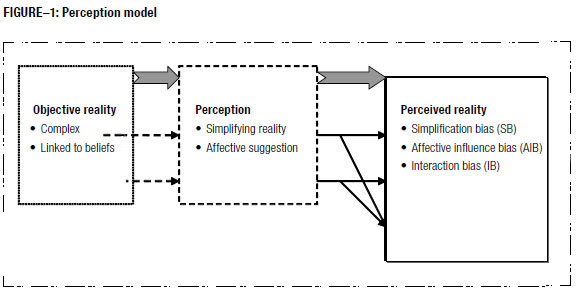
<body><![CDATA[<p><font face="Verdana, Arial, Helvetica, sans-serif" size="2"> Speaking of the    opinions of others refers to companies' stakeholders, other managers in the    sector and even analysts and experts. Regarding the former, it should be pointed    out that a socialisation emerges throughout a company's history resulting from    the interaction of those involved, producing converging interpretations amongst    the various individuals (Sutcliffe and Huber, 1998; Michel and Hambrick, 1992;    Wiersema and Bantel, 1992: 112; Kilduff <i>et al</i>., 2000). Company stakeholders'    perceptions and opinions vis-&agrave;-vis environmental uncertainty have thus    had an impact on management perception. Management within a single industry    will tend to formulate a series of shared beliefs (industry recipes) (Spender,    1989; Grinyer and Spender, 1979; Johnson and Hoopes, 2003; Dimaggio and Powell,    1983; Porac, <i>et al</i>., 1989), the result of accessing the same sources    of information and messages distributed in the media. These beliefs also constitute    one determinant of affective influence on management perception in that they    direct managers' assessment as far as environmental uncertainty is concerned.    Management beliefs are also affected by the opinions of outside analysts in    the media. It has specifically been found that journalists' appraisals of certain    issues and factors concerning the competitive environment have a decisive influence    on how management perceives such factors (Ebrahimi, 2000: 75; Hayward <i>et    al</i>., 2004).</font></p>     <p><font face="Verdana, Arial, Helvetica, sans-serif" size="2"><b><i> III.2.-    Outsiders' perceived uncertainty</i></b></font></p>     <p><font face="Verdana, Arial, Helvetica, sans-serif" size="2"> Uncertainty will    now be explored from a viewpoint removed from that of the manager, namely that    offered by outside observers (researchers, experts or analysts); uncertainty    has been used up to this point as a variable for describing the environment,    applying certain easily-generalised quantitative indicators. A variable such    as the volatility of some representative parameter within the sector has been    used or some indicator has been formulated based on a combination of measurements    of complexity (heterogeneity) and dynamism (variability). Nevertheless, such    evaluation of uncertainty has also been founded on an individual's perception    and is also likely to be subject to bias. Following the previously proposed    model of perception, simplification and affective influence provide the foundation    for the process. An outside observer (like any other individual) will thus opt    for <i>simplification</i> as a solution to the cognitive complexity inherent    in the concept of uncertainty. Designing and developing the variables used and    the choice of information sources from which the data is drawn reflect the simplification    adopted by an individual. <i>Affective influence</i> is linked to an individual's    personal beliefs (preconceived ideas, overconfidence or illusion of control)    and features from the surrounding environment (shared beliefs among sector management    and expert opinion). As was the case with insiders' perceived uncertainty, an    outside observer's perception therefore harbours bias derived from both simplification    and affective influence. The link between them will also give rise to interaction    bias (<a href="/img/revistas/inno/v18n32/32a04f3.jpg" target="_blank">Figure    3</a>).</font></p>     <p><a name="f3"></a></p>     <p>&nbsp;</p>     <p align="center"><img src="/img/revistas/s_inn/v1nse/a04fig03.jpg"></p>     <p>&nbsp;</p>     <p><font face="Verdana, Arial, Helvetica, sans-serif" size="2"><b><i> III.3.-    The relationship between insiders' and outsiders' perceived uncertainty</i></b></font></p>     <p><font face="Verdana, Arial, Helvetica, sans-serif" size="2"> A look at the    perception of uncertainty by the various subjects considered provides an idea    of how little they concur. It is worth noting that only the influence of industry    recipes and opinions published in the media had an impact on both subjects.    Research has broadly reflected the distance separating management perception    from outsiders' perceived uncertainty (Downey, Hellriefel and Slocum, 1975;    Tosi <i>et al</i>., 1973; Sawyerr, 1993; Boyd and Fulk, 1996:3; Boyd <i>et al</i>.,    1993; Doty <i>et al</i>., 2006) and has outlined the various arguments vindicating    such discrepancy. Arguments accounting for these discrepancies are linked to    using differing measurements, the existence of filter variables between objective    measurements and perception measurements (Boyd <i>et al</i>., 1993) and the    environment's differing size for managers and experts (Doty <i>et al</i>., 2006).</font></p>     <p><font face="Verdana, Arial, Helvetica, sans-serif" size="2"> However, research    has overlooked the existing link between the two processes of perception. As    has been seen with management perception, analysts or experts' assessment becomes    a determinant of affective influence for managers from the moment that assessment    appears in the media. It should also be remembered that experts' evaluation    is usually aimed at analysing or preparing reports for publication. One might    also think, however, that management opinion could have an impact on expert    perception as an element of affective influence. It should be borne in mind    that sectors encompass a wide range of companies and that an individual manager's    opinion goes largely unnoticed; only a few opinions from the most eminent managers    appear in the media. It may therefore be assumed that management opinion scarcely    intervenes in analysts' perception and that only when managers' opinions give    rise to industry recipes do we see that these opinions have any affective influence    on experts.</font></p>     ]]></body>
<body><![CDATA[<p>&nbsp;</p>     <p><font face="Verdana, Arial, Helvetica, sans-serif" size="3"><b class=""> IV.-    The strategic significance of diversity in perceiving uncertainty</b></font></p>     <p><font face="Verdana, Arial, Helvetica, sans-serif" size="2"> The range of factors    intervening in individual perception leads to specific and individual opinions    being held by each person. This forces us to consider <i>diversity</i> of perception    as a key factor in analysis. This raises two questions: What are the main elements    affecting such diversity? What is the strategic significance of diversity? A    distinction can be drawn between two levels of analysis: company management    (intra-company level) and management in the sector or industry (intercompany    level). The difference between management perception and that of experts is    only significant in strategic terms in that it highlights that expert evaluation    is merely one element of affective influence on management perception.</font></p>     <p><font face="Verdana, Arial, Helvetica, sans-serif" size="2"> The diversity    of perceptions found between managers in the same company only arises from each    individual's personal characteristics, i.e. their cognitive scheme (and, therefore,    their process of simplification) and their own personal beliefs (their affective    influence). These elements denote the difference between individuals as they    are led to adopt a particular view of the environment (Bunderson and Sutcliffe,    1995; Sutcliffe and Huber, 1998) - in this case environmental uncertainty. The    remaining elements intervening in management perception (company strategy, organisational    conditions, internal socialisation, industry recipes and expert opinion) exert    a similar influence on managers, favouring agreement in perceiving uncertainty.    Intracompany diversity of perception affects strategic management, particularly    during the formulation stage. Diversity reflects multiple viewpoints when assessing    the background to a strategic approach (Knight <i>et al</i>., 1999; Kilduff    <i>et al</i>., 2000) thus aiding consideration of potential competitive threats    (Bourgeois, 1985). However, it undermines organisational coordination (Priem,    1990; Kallermanns <i>et al</i>., 2005). Therefore, while multiple viewpoints    may strengthen strategic formulation, a move should be made towards strategic    consensus to ensure unified formulation of company strategy. Strategic consensus    refers to the agreement between company decision-makers as to priorities and    strategic goals (Ambrosini and Bowman, 2003; Mark&oacute;czy, 2001; Floyd and    Wooldridge, 1992: 28). The level of consensus required by strategic formulation    is most likely to be achieved by environmental scanning (Dess and Origer, 1987,    West and Schwenk, 1996; Knight <i>et al</i>., 1999: 446). Should certain agreement    be reached regarding perceived uncertainty and the latter be considered too    high or linked to strategic aspects, further scanning will be undertaken to    enhance available knowledge and provide a solid base on which to ground strategic    formulation (Choo, 2001; Murphy, 1987; Daft <i>et al</i>., 1988; Kefalas and    Schoderbek, 1973; Sawyerr, 1993). The existence of uncertainty is necessary    but not in itself sufficient to justify scanning, since management must also    feel that uncertainty is linked to a company's strategic aspects (Pfeffer and    Salancik, 1978; Daft <i>et al</i>., 1988; Ebrahimi, 2000). However, it should    also be remembered that consensus in management perception vis-&agrave;-vis    uncertainty does not guarantee that this perception reflects reality. Proving    whether management evaluation is coherent with reality may be an extremely difficult    task, given the weak nature of the concept of uncertainty. Each individual's    knowledge of the factors making up the environment together with any possible    variation will determine management assessment of the level of environmental    uncertainty. Should managers perceive greater uncertainty than may be warranted    by external circumstances, they will <i>unnecessarily</i> waste resources on    scanning. By contrast, should managers feel over-confident, the company's capacity    to adapt quickly to any changes which may emerge in the competitive environment    will no doubt be impaired (Bourgeois, 1985; Bukszar, 1999).</font></p>     <p><font face="Verdana, Arial, Helvetica, sans-serif" size="2"> Regarding inter-company    diversity, individual simplification and affective influence linked to each    manager in all the companies making up a particular sector make for the overall    diversity of perceptions prevailing in the industry. Affective influence emerging    from industry recipes, together with the messages appearing in the media, have    a uniform effect on management in the sector leading to concurring evaluations.    Such like-mindedness regarding the level of strategic uncertainty consolidates    industry recipes and leads to cooperation agreements amongst companies involved    in the sector (alliances, coordination in strategic movements or a collective    act) (Abrahamson and Fombrun, 1992; Hirsch, 1975; Merchant and Schendel, 2000;    Pehrsson, 2006). By contrast, convergence of perceptions may prove hazardous    if it blinds the industry to significant competitive threats (Zajac and Bazerman,    1991). Thus, moving away from convergence, and as diverging perceptions begin    to emerge, the possibility of reaching cooperation agreements among companies    becomes lessened. Such discrepancy may give rise to differences in the expectations    linked to various strategic alternatives (Barney, 1986), meaning that companies    may adopt differing strategies (Starbuck, 1986; Bourgeois, 1985) and, therefore,    some companies may reap extraordinary profits. If perceptions within a sector    or sub-population concur, no company will be at an advantage through perceiving    better than any other (Barney, 1986; Sutcliffe and Huber, 1998).</font></p>     <p><font face="Verdana, Arial, Helvetica, sans-serif" size="2"> Divergence of    inter-company opinions may provide some companies with a competitive edge arising    from the information advantage gained from knowledge of the environment (Barney,    1986: 1238). It has often been pointed out analysing the environment offers    little chance to gain any competitive advantage since the methods used by the    various companies for gathering information are very similar. Thus, using the    media as a reference point for gathering information on the environment yields    no informative advantage in that it is equally accessible to all companies alike.    It may therefore be concluded that access to informative advantages is linked    to using certain approximations and simplification removed from the usual procedures    and interpretation of available information.</font></p>     <p>&nbsp;</p>     <p><font face="Verdana, Arial, Helvetica, sans-serif" size="3"><b>Discussion and    conclusions</b></font></p>     <p><font face="Verdana, Arial, Helvetica, sans-serif" size="2"> Environmental    uncertainty reflects the sense of doubt experienced by managers when facing    the problem of predicting future competitive conditions. For decades the concept    of environmental uncertainty has drawn the attention of researchers who have    particularly focused on how it affects corporate strategy. The relationships    companies maintain with other economic actors to ensure access to resources    and the prevailing instability in such relationships accounts for the significance    of environmental uncertainty in corporate strategy. The impact of uncertainty    in strategic processes does not come about impersonally, nor does it emerge    from complex dependence relationships, but rather through management perception.    This has led to abundant research addressing management perception of uncertainty,    research which has highlighted this variable's subjective nature. Uncertainty    has also been used as a variable to describe the environment, applying certain    easily-generalised quantitative indicators. Despite this kind of uncertainty    being described as objective, it should be remembered that it also derives from    perception developed by an outside observer (whether a researcher, expert or    analyst). It may therefore be concluded that in both cases evaluation of uncertainty    depends on individual perception which aims to mirror the difficulties individuals    face when anticipating future conditions in a business environment.</font></p>     <p><font face="Verdana, Arial, Helvetica, sans-serif" size="2"> However, human    perception is by no means flawless due to certain bias and distortions and merely    provides an approximate reflection of the reality prompting it. Such distortion    falls into two groups: simplification arising from individuals' cognitive limitations    and the affective influence emerging from a variety of factors ranging from    personal beliefs to the opinions of others. Perception may thus be viewed as    being flawed and specific for each individual to such an extent that the diversity    of perception emerges as the focal point for any research addressing perceiving    environmental uncertainty.</font></p>     ]]></body>
<body><![CDATA[<p><font face="Verdana, Arial, Helvetica, sans-serif" size="2"> The existing literature    has merely served to highlight the lack of any apparent convergence between    management perception and outsiders' perceived uncertainty. However, formulating    the proposed perception model allowed us to go further as it enabled us to account    for discrepancies in individual perception and served to underline interrelationships    in individuals' (inside and outside observers) perception.</font></p>     <p><font face="Verdana, Arial, Helvetica, sans-serif" size="2"> Competitive dynamics    concern the diversity of intracompany and inter-company perception. Intra-company    diversity of perception enriches evaluating the background for a company adopting    a particular strategy yet hinders the strategic consensus required when formulating    strategy. Diversity of inter-company perceptions allows selective access to    competitive advantages while handicapping cross-company agreements and cooperation.</font></p>     <p><font face="Verdana, Arial, Helvetica, sans-serif" size="2"> Certain implications    for future research and managers should be highlighted. From the research standpoint,    the study has reflected the need to explore perception in greater detail when    analysing uncertainty's impact on corporate strategy. The work also pointed    to the interest in recognising the diversity of perception as a key element    from which to explore the strategic significance of uncertainty for competitive    dynamics. From a managers' viewpoint, the study may enlighten managers as to    which elements influence their perception of environmental uncertainty and,    particularly, alert them as to which of these elements may guide their perception    in line with that of other managers, both within their own company and the competitive    sector they operate in.</font></p>     <p>&nbsp;</p>     <p><font face="Verdana, Arial, Helvetica, sans-serif" size="3"><b> Acknowledgements</b></font></p>     <p><font face="Verdana, Arial, Helvetica, sans-serif" size="2"> The authors wish    to thank the anonymous reviewers for their detailed and insightful remarks on    this paper.</font></p>     <p>&nbsp;</p>     <p><font face="Verdana, Arial, Helvetica, sans-serif" size="3"><b>References</b></font></p>     <!-- ref --><p><font face="Verdana, Arial, Helvetica, sans-serif" size="2"> Abrahamson, E.    &amp; Fombrun, C. J. (1992). Forging the iron cage: interorganizational networks    and the production of macro-culture. <i>Journal of Management Studies, 29</i>(2),    175-94.    </font></p>     ]]></body>
<body><![CDATA[<!-- ref --><p><font face="Verdana, Arial, Helvetica, sans-serif" size="2"> Ambrosini, V.    &amp; Bowman, C. (2003). Managerial consensus and corporate strategy: why do    executives agree or disagree about corporate strategy? <i>European Management    Journal, 21</i>(2), 213-221.    </font></p>     <!-- ref --><p><font face="Verdana, Arial, Helvetica, sans-serif" size="2"> Barney, J. B.    (1986). Strategic Factor markets: expectations, luck, and business strategy.    <i>Management Science, 36</i>(10), 1231-1241.    </font></p>     <!-- ref --><p><font face="Verdana, Arial, Helvetica, sans-serif" size="2"> Bourgeois, L.    J. (1985). Strategic goals, perceived uncertainty and economic performance in    volatile environments. <i>Academy of Management Journal, 28</i>(3), 548-573.    </font></p>     <!-- ref --><p><font face="Verdana, Arial, Helvetica, sans-serif" size="2"> Boyd, B. K., Dess,    G. C. &amp; Rasheed, A. M. (1993). Divergence between archival and perceptual    measures of the environment: causes and consequences. <i>The Academy of Management    Review, 18</i>(2), 204-227.    </font></p>     <!-- ref --><p><font face="Verdana, Arial, Helvetica, sans-serif" size="2"> Boyd, B. K. &amp;    Fulk, J. (1996). Executive scanning and perceived uncertainty: a multidimensional    model. <i>Journal of Management, 22</i>(1), 1-21.    </font></p>     ]]></body>
<body><![CDATA[<!-- ref --><p><font face="Verdana, Arial, Helvetica, sans-serif" size="2"> Bukszar, E. Jr.    (1999). Strategic bias: The impact of cognitive biases on strategy. <i>Canadian    Journal of Administrative Sciences, 16</i>, 105-117.    </font></p>     <!-- ref --><p><font face="Verdana, Arial, Helvetica, sans-serif" size="2"> Bunderson, J.    S. &amp; Sutcliffe, K. M. (1995). Work history and selective perception: fine-tuning    what we know. <i>Academy of Management Journal, Best Papers Proceeding</i>,    459-463.    </font></p>     <!-- ref --><p><font face="Verdana, Arial, Helvetica, sans-serif" size="2"> Choo, Ch. W. (2001).    Environmental scanning as information seeking and organizational learning. <i>Information    Research, 7</i>(1).    </font></p>     <!-- ref --><p><font face="Verdana, Arial, Helvetica, sans-serif" size="2"> Cyert, R. M. &amp;    March, J. G. (1963). <i>A behavioural theory of the firm</i>. Englewood Cliffs,    NJ: Prentice-Hall.    </font></p>     <!-- ref --><p><font face="Verdana, Arial, Helvetica, sans-serif" size="2"> Daft, R. L., Sormunen,    J. &amp; Parks, D. (1988). Chief executive scanning, environmental characteristics,    and company performance: An empirical study. <i>Strategic Management Journal,    9</i>, 123-139.    </font></p>     ]]></body>
<body><![CDATA[<!-- ref --><p><font face="Verdana, Arial, Helvetica, sans-serif" size="2"> Dess, G. G. &amp;    Beard, D. W. (1984). Dimensions of organizational task environments. <i>Administrative    Science Quarterly, 29</i>(1), 52-73.    </font></p>     <!-- ref --><p><font face="Verdana, Arial, Helvetica, sans-serif" size="2"> Dess, G. G. &amp;    Origer, N. K. (1987). Environment, structure, and consensus in strategy formulation:    A conceptual integration. <i>Academy of Management Review, 12</i>(2), 313- 330.    </font></p>     <!-- ref --><p><font face="Verdana, Arial, Helvetica, sans-serif" size="2"> DiMaggio, P. J.    &amp; Powell, W. W. (1983). The iron cage revisited: institutional isomorphism    and collective rationality in organizational fields. <i>American Sociological    Review, 48</i>, 147-160.    </font></p>     <!-- ref --><p><font face="Verdana, Arial, Helvetica, sans-serif" size="2"> Doty, D. H., Bhattacharya,    M., Wheatley, K. K. &amp; Sutcliffe, K. M. (2006). Divergence between informant    and archival measures of the environment: real differences, artefact, or perceptual    error? <i>Journal of Business Research, 59</i>, 268-277.    </font></p>     <!-- ref --><p><font face="Verdana, Arial, Helvetica, sans-serif" size="2"> Downey, H. &amp;    Brief, A. (1986). How cognitive structures affect organizational design. En    H. Jr. Sims and D. Gioia (Eds), <i>The Thinking Organization </i>(pp.165-190).    San Francisco, CA : Jossey-Bass.    </font></p>     ]]></body>
<body><![CDATA[<!-- ref --><p><font face="Verdana, Arial, Helvetica, sans-serif" size="2"> Downey, H. K.,    Hellriegel, D. &amp; Slocum, J. W. Jr. (1975). Environmental uncertainty: the    construct and its application. <i>Administrative Science Quarterly, 20</i>,    613-629.    </font></p>     <!-- ref --><p><font face="Verdana, Arial, Helvetica, sans-serif" size="2"> Duncan, R. (1972).    Organizational structure, environment, and performances-the role of strategic    choice. <i>Sociology, 6</i>, 1-22.    </font></p>     <!-- ref --><p><font face="Verdana, Arial, Helvetica, sans-serif" size="2"> Ebrahimi, B. P.    (2000). Perceived strategic uncertainty and environmental scanning. Behavior    of Hong Kong Chinese executives. <i>Journal of Business Research, 49</i>, 67-77.    </font></p>     <!-- ref --><p><font face="Verdana, Arial, Helvetica, sans-serif" size="2"> Entrialgo, M.,    Fern&aacute;ndez, E. &amp; V&aacute;zquez, C. J. (2001). Los efectos de la turbulencia    del entorno y del grado de discrecionalidad percibido en el comportamiento del    emprendedor. <i>Revista Europea de Direcci&oacute;n y Econom&iacute;a de la    Empresa, 10</i>(1), 21-36.    </font></p>     <!-- ref --><p><font face="Verdana, Arial, Helvetica, sans-serif" size="2"> Fiske, S. T. &amp;    Taylor, S. E. (1991). <i>Social cognition</i> (2nd ed.). New York: McGraw Hill.    </font></p>     ]]></body>
<body><![CDATA[<!-- ref --><p><font face="Verdana, Arial, Helvetica, sans-serif" size="2"> Floyd, W. S. &amp;    Wooldridge, B. (1992). Middle management involvement in strategy and its association    with strategic type. <i>Strategic Management Journal, 7</i>, 313-327.    </font></p>     <!-- ref --><p><font face="Verdana, Arial, Helvetica, sans-serif" size="2"> Forbes, D. P.    (2005). Are some entrepreneurs more overconfident than other? <i>Journal of    Business Venturing, 20</i>(5), 623-640.    </font></p>     <!-- ref --><p><font face="Verdana, Arial, Helvetica, sans-serif" size="2"> Garg, V. K., Walters,    B. A. &amp; Priem, R. L. (2003). Chief executive scanning emphases, environmental    dynamism, and manufacturing company performance. <i>Strategic Management Journal</i>,    24, 725-744.    </font></p>     <!-- ref --><p><font face="Verdana, Arial, Helvetica, sans-serif" size="2"> Greve, H. R. &amp;    Taylor, A. (2000). Innovations as catalysts for organizational change: shifts    in organizational cognition and search. <i>Administrative Science Quarterly,    45</i>, 54-80.    </font></p>     <!-- ref --><p><font face="Verdana, Arial, Helvetica, sans-serif" size="2"> Grinyer, P. &amp;    Spender, J. (1979). Recipes, crises, and adaptation in mature businesses. <i>International    Studies of Management and Organisation, 9</i>, 113-133.    </font></p>     ]]></body>
<body><![CDATA[<!-- ref --><p><font face="Verdana, Arial, Helvetica, sans-serif" size="2"> Hayward, M. L.,    Rindova, V. P. &amp; Pollock, T. G. (2004). Believing one's own press: the causes    and consequences of CEO celebrity. <i>Strategic Management Journal, 25</i>(7),    637- 653.    </font></p>     <!-- ref --><p><font face="Verdana, Arial, Helvetica, sans-serif" size="2"> Hirsch, P. M (1975).    Organizational effectiveness and the institutional environment. <i>Administrative    Science Quarterly, 20</i>, 327-344.    </font></p>     <!-- ref --><p><font face="Verdana, Arial, Helvetica, sans-serif" size="2"> Hodgkinson, G.    P., Bown, N. J., Maule, A. J., Glaister, K. W. &amp; Rearman, A. D. (1999).    Breaking the frame: an analysis of strategic cognition and decision making under    uncertainty. <i>Strategic Management Journal, 20</i>, 977-985.    </font></p>     <!-- ref --><p><font face="Verdana, Arial, Helvetica, sans-serif" size="2"> Huff, A. S. &amp;    Schwenk, C. R. (1990). Bias and sensemaking in good times and bad. In A. Huff    (Eds.), <i>Mapping Strategic Thought</i> (pp.89-108). Chichester: Wiley.    </font></p>     <!-- ref --><p><font face="Verdana, Arial, Helvetica, sans-serif" size="2"> Johnson, R. and    Hoopes, D. G. (2003). Managerial cognition, sunk costs, and evolution of industry    structure. <i>Strategic Management Journal, 24</i>(10), 1057-1068.    </font></p>     ]]></body>
<body><![CDATA[<!-- ref --><p><font face="Verdana, Arial, Helvetica, sans-serif" size="2"> Kefalas, A. G.    &amp; Schoderbeck, P. P (1973). Scanning the business environment: some empirical    results. <i>Decision Sciences, 4</i>(1), 63- 74.    </font></p>     <!-- ref --><p><font face="Verdana, Arial, Helvetica, sans-serif" size="2"> Kellermanns, F.    W., Walter, J., Lechner, Ch. &amp; Floyd, S. W. (2005). The lack of consensus    about strategic consensus: advancing theory and research. <i>Journal of Management,    31</i>(5), 719-737.    </font></p>     <!-- ref --><p><font face="Verdana, Arial, Helvetica, sans-serif" size="2"> Khatri, N. &amp;    D'Netto, B. (1997). Perceived uncertainty and performance: the causal direction.    <i>Journal of Applied Management Studies, 6</i>(2), 219-233.    </font></p>     <!-- ref --><p><font face="Verdana, Arial, Helvetica, sans-serif" size="2"> Kilduff, M., Angelmar,    R. &amp; Mehra, A. (2000). Top management-team diversity and firms performance:    examining the role of cognitions. <i>Organization Science, 11</i>(1), 21-34.    </font></p>     <!-- ref --><p><font face="Verdana, Arial, Helvetica, sans-serif" size="2"> Knight, D., Pearce,    C. L., Smith, K.G., Olian, J. O., Sims, H., Smith, K. A. &amp; Flood, P. (1999).    Top management team diversity, group process, and strategic consensus. <i>Strategic    Management Journal, 20</i>, 445-465.    </font></p>     ]]></body>
<body><![CDATA[<!-- ref --><p><font face="Verdana, Arial, Helvetica, sans-serif" size="2"> Koberg, C. S.    &amp; Ungson, G. R. (1987). The effects of environmental uncertainty and dependence    on organizational structure and performance: a comparative study. <i>Journal    of Management, 13</i>(4), 725-737.    </font></p>     <!-- ref --><p><font face="Verdana, Arial, Helvetica, sans-serif" size="2"> Kumar, K. &amp;    Strandholm, K. (2002). Perceived uncertainty: how different environmental sectors    moderate strategy-performance relationships. <i>Journal of American Academy    of Business, 1</i>(2), 289-295.    </font></p>     <!-- ref --><p><font face="Verdana, Arial, Helvetica, sans-serif" size="2"> Kuvaas, B. &amp;    Kaufman, G. (2004). Individual and organizational antecedents to strategic-issue    interpretation. <i>Scandinavian Journal of Management, 20</i>, 245-275.    </font></p>     <!-- ref --><p><font face="Verdana, Arial, Helvetica, sans-serif" size="2"> Lant, T. K., Milliken,    F. J. &amp; Batra, B. (1992). The role of managerial learning and interpretation    in strategic persistence and reorientation: An empirical exploration. <i>Strategic    Management Journal, 13</i>(8), 585-608.    </font></p>     <!-- ref --><p><font face="Verdana, Arial, Helvetica, sans-serif" size="2"> Lipshitz, R. &amp;    Strauss, O. (1997). Coping with uncertainty: a naturalistic decision-making    analysis. <i>Organizational Behavior and Human Decision Processes, 69</i>(2),    149-163.    </font></p>     ]]></body>
<body><![CDATA[<!-- ref --><p><font face="Verdana, Arial, Helvetica, sans-serif" size="2"> McMullen, J. S.    &amp; Shepherd, D. A. (2006). Entrepreneurial action and the role of uncertainty    in the theory of the entrepreneur. <i>Academy of Management Review, 31</i>(1),    132-152.    </font></p>     <!-- ref --><p><font face="Verdana, Arial, Helvetica, sans-serif" size="2"> Merchant, H. &amp;    Schendel, D. (2000). How do international joint ventures create shareholder    value? <i>Strategic Management Journal</i>, <i>21</i>(7), 723-737.    </font></p>     <!-- ref --><p><font face="Verdana, Arial, Helvetica, sans-serif" size="2">Mezias, J. M. &amp;    Starbuck, W. H. (2003). Studying the accuracy of managers' perceptions: A Research    Odyssey. <i>British Journal of Management, 14</i>(1), 3-17.    </font></p>     <!-- ref --><p><font face="Verdana, Arial, Helvetica, sans-serif" size="2"> Michel, J. &amp;    Hambrick, D. (1992). Diversification posture and top management team characteristics.    <i>Academy of Management Journal, 35</i>, 9-37.    </font></p>     <!-- ref --><p><font face="Verdana, Arial, Helvetica, sans-serif" size="2"> Milliken, F. J.    (1987). Three types of perceived uncertainty about the environment: state, effect,    and response uncertainty. <i>The Academy of Management Review, 12</i>(1), 133-    143.    </font></p>     ]]></body>
<body><![CDATA[<!-- ref --><p><font face="Verdana, Arial, Helvetica, sans-serif" size="2"> Milliken, F. J.    (1990). Perceiving and interpreting environmental change: An examination of    college administrators' interpretation of changing demographics. <i>Academy    of Management Journal, 33</i>(1), 42-63.    </font></p>     <!-- ref --><p><font face="Verdana, Arial, Helvetica, sans-serif" size="2"> Milliken, F. J.    &amp; Lant, T. K. (1991). The impact of an organization's recent performance    history on strategic persistence and change: The role of managerial interpretations.    In J. Dutton, A. Huff and P. Shrivastava (Eds.), <i>Advances in Strategic Management</i>    (pp. 129-156). Greenwich, CT : JAI Press.    </font></p>     <!-- ref --><p><font face="Verdana, Arial, Helvetica, sans-serif" size="2"> Miller, K. D.    (1993). Industry and country effects on manager's perceptions of environmental    uncertainties. <i>Journal of International Business Studies, 24</i>(3), 693-714.    </font></p>     <!-- ref --><p><font face="Verdana, Arial, Helvetica, sans-serif" size="2"> Murphy, M. F.    (1987). <i>Environmental scanning: a case study in higher education</i>. Athens,    GA: University of Georgia.    </font></p>     <!-- ref --><p><font face="Verdana, Arial, Helvetica, sans-serif" size="2"> Pehrsson, A. (2006).    Business relatedness and performance: a study of managerial perceptions. <i>Strategic    Management Journal, 27</i>, 265-282.    </font></p>     ]]></body>
<body><![CDATA[<!-- ref --><p><font face="Verdana, Arial, Helvetica, sans-serif" size="2"> Pfeffer, J. &amp;    Salancik, G.R. (1978). <i>The external control of organizations</i>. New York:    Harper and Row.    </font></p>     <!-- ref --><p><font face="Verdana, Arial, Helvetica, sans-serif" size="2"> Porac, J., Thomas,    H. &amp; Baden-Fuller, C. (1989). Competitive groups as cognitive communities:    The case of Scottish Knitwear manufactures. <i>Journal of Management Studies,    26</i>, 397-415.    </font></p>     <!-- ref --><p><font face="Verdana, Arial, Helvetica, sans-serif" size="2"> Priem, R. L. (1990).    Top management team group factors, consensus, and company performance. <i>Strategic    Management Journal, 11</i>, 469-478.    </font></p>     <!-- ref --><p><font face="Verdana, Arial, Helvetica, sans-serif" size="2"> Priem, R. L.,    Love, L. G. &amp; Shaffer, M. A. (2002). Executives' perceptions of uncertainty    sources: a numerical taxonomy and underlying dimensions. <i>Journal of Management,    28</i>(6), 725-746.    </font></p>     <!-- ref --><p><font face="Verdana, Arial, Helvetica, sans-serif" size="2"> Santos, M. V.    &amp; Garc&iacute;a, M. T. (2006). Managers' opinion: reality or fiction. A    narrative approach.<i> Management Decision, 44</i>(6), 752-770.    </font></p>     ]]></body>
<body><![CDATA[<!-- ref --><p><font face="Verdana, Arial, Helvetica, sans-serif" size="2"> Sawyerr, O. O.    (1993). Environmental uncertainty and environmental scanning activities of Nigerian    manufacturing executives: a comparative analysis. <i>Strategic Management Journal,    14</i>(4), 287-299.    </font></p>     <!-- ref --><p><font face="Verdana, Arial, Helvetica, sans-serif" size="2"> Schwenk, C. R.    (1984), Cognitive Simplification in strategic decision making, <i>Strategic    Management Journal, 5</i>(2), 111-128.    </font></p>     <!-- ref --><p><font face="Verdana, Arial, Helvetica, sans-serif" size="2"> Schwenk, C. (1986),    Information, cognitive biases, and commitment to a course of action. <i>Academy    of Management Review, 11</i>, 298-310.    </font></p>     <!-- ref --><p><font face="Verdana, Arial, Helvetica, sans-serif" size="2"> Simon, H. (1957).    <i>Administrative Behaviour</i>. New York: The Free Press.    </font></p>     <!-- ref --><p><font face="Verdana, Arial, Helvetica, sans-serif" size="2"> Spender, J. C.    (1989). <i>Industry recipes: the nature and sources of managerial judgement</i>.    Oxford: Blackwell.    </font></p>     ]]></body>
<body><![CDATA[<!-- ref --><p><font face="Verdana, Arial, Helvetica, sans-serif" size="2"> Starbuck, W. H.    (1966). The efficiency of British and American retail employees. <i>Administrative    Science Quarterly, 11</i>, 345-385.    </font></p>     <!-- ref --><p><font face="Verdana, Arial, Helvetica, sans-serif" size="2"> Starbuck, W. H.    (1985). Acting first and thinking later: theory versus reality in strategic    change. En J. M. Penning and Associates (eds.), <i>Organizational Strategy and    Change</i> (pp. 336-372). San Francisco: Bass.    </font></p>     <!-- ref --><p><font face="Verdana, Arial, Helvetica, sans-serif" size="2"> Sutcliffe, K.    &amp; Huber, G. P. (1998). Company and industry as determinants of executive    perceptions of the environment, <i>Strategic Management Journal, 9</i>, 793-807.    </font></p>     <!-- ref --><p><font face="Verdana, Arial, Helvetica, sans-serif" size="2"> Stubbart, C. I.    (1989). Managerial cognition: a missing link in strategic management research.    <i>Journal of Management Studies, 26</i>, 325-48.    </font></p>     <!-- ref --><p><font face="Verdana, Arial, Helvetica, sans-serif" size="2"> Tikkanen, H.,    Lamberg, J., Parvinen, P. &amp; Kallunki, J-P. (2005). Managerial cognition,    action and the business model of the firm. <i>Management Decision, 43</i>(6),    789-809.    </font></p>     ]]></body>
<body><![CDATA[<!-- ref --><p><font face="Verdana, Arial, Helvetica, sans-serif" size="2"> Tosi, H., Aldag,    R. &amp; Storey, R. (1973). On the measurement of the environment: an assessment    of the Lawrence and Lorch environmental uncertainty subscale. <i>Administrative    Science Quarterly, 18</i>, 27-36.    </font></p>     <!-- ref --><p><font face="Verdana, Arial, Helvetica, sans-serif" size="2"> Waller, M. J.,    Huber, G. P. &amp; Glick, W. H. (1995). Functional background as a determinant    of executives' selective perception. <i>Academy of Management Journal, 8</i>(4),    943-974.    </font></p>     <!-- ref --><p><font face="Verdana, Arial, Helvetica, sans-serif" size="2"> Weick, K. (1979).    <i>The social Psychology of organizing</i>. Reading: Addison-Wesley.    </font></p>     <!-- ref --><p><font face="Verdana, Arial, Helvetica, sans-serif" size="2"> West, C. L. Jr.    &amp; Schwenk, C. R. (1996). Top management team strategic consensus and company    performance: a report of resounding nonfindings. <i>Strategic Management Journal,    17</i>(7), 571-576.    </font></p>     <!-- ref --><p><font face="Verdana, Arial, Helvetica, sans-serif" size="2"> Wiersema, M. F.    &amp; Bantel, K. (1992). Top management team demography and corporate strategic    change. <i>Academy of Management Journal, 35</i>, 91-121.    </font></p>     ]]></body>
<body><![CDATA[<!-- ref --><p><font face="Verdana, Arial, Helvetica, sans-serif" size="2"> Zajac, E. &amp;    Bazerman, M. (1991). Blind spots in industry and competitor analysis: implications    of intercompany (mis)perceptions for strategic decisions. <i>Academy of Management    Review, 16</i>, 37-57.</font> ]]></body><back>
<ref-list>
<ref id="B1">
<nlm-citation citation-type="journal">
<person-group person-group-type="author">
<name>
<surname><![CDATA[Abrahamson]]></surname>
<given-names><![CDATA[E.]]></given-names>
</name>
<name>
<surname><![CDATA[Fombrun]]></surname>
<given-names><![CDATA[C. J]]></given-names>
</name>
</person-group>
<article-title xml:lang="en"><![CDATA[Forging the iron cage: interorganizational networks and the production of macro-culture]]></article-title>
<source><![CDATA[/Journal of Management Studies/]]></source>
<year>1992</year>
<volume>/29/</volume>
<numero>2</numero>
<issue>2</issue>
<page-range>175-94</page-range></nlm-citation>
</ref>
<ref id="B2">
<nlm-citation citation-type="journal">
<person-group person-group-type="author">
<name>
<surname><![CDATA[Ambrosini]]></surname>
<given-names><![CDATA[V]]></given-names>
</name>
<name>
<surname><![CDATA[Bowman]]></surname>
<given-names><![CDATA[C]]></given-names>
</name>
</person-group>
<article-title xml:lang="en"><![CDATA[Managerial consensus and corporate strategy: why do executives agree or disagree about corporate strategy?]]></article-title>
<source><![CDATA[/European Management Journal/]]></source>
<year>2003</year>
<volume>/21/</volume>
<numero>2</numero>
<issue>2</issue>
<page-range>213-221</page-range></nlm-citation>
</ref>
<ref id="B3">
<nlm-citation citation-type="journal">
<person-group person-group-type="author">
<name>
<surname><![CDATA[Barney]]></surname>
<given-names><![CDATA[J. B]]></given-names>
</name>
</person-group>
<article-title xml:lang="en"><![CDATA[Strategic Factor markets: expectations, luck, and business strategy]]></article-title>
<source><![CDATA[/Management Science/]]></source>
<year>1986</year>
<volume>/36/</volume>
<numero>10</numero>
<issue>10</issue>
<page-range>1231-1241</page-range></nlm-citation>
</ref>
<ref id="B4">
<nlm-citation citation-type="journal">
<person-group person-group-type="author">
<name>
<surname><![CDATA[Bourgeois]]></surname>
<given-names><![CDATA[L. J]]></given-names>
</name>
</person-group>
<article-title xml:lang="en"><![CDATA[Strategic goals, perceived uncertainty and economic performance in volatile environments]]></article-title>
<source><![CDATA[/Academy of Management Journal/]]></source>
<year>1985</year>
<volume>/28/</volume>
<numero>3</numero>
<issue>3</issue>
<page-range>548-573</page-range></nlm-citation>
</ref>
<ref id="B5">
<nlm-citation citation-type="journal">
<person-group person-group-type="author">
<name>
<surname><![CDATA[Boyd]]></surname>
<given-names><![CDATA[B. K]]></given-names>
</name>
<name>
<surname><![CDATA[Dess]]></surname>
<given-names><![CDATA[G. C.]]></given-names>
</name>
<name>
<surname><![CDATA[Rasheed]]></surname>
<given-names><![CDATA[A. M]]></given-names>
</name>
</person-group>
<article-title xml:lang="en"><![CDATA[Divergence between archival and perceptual measures of the environment: causes and consequences]]></article-title>
<source><![CDATA[/The Academy of Management Review/]]></source>
<year>1993</year>
<volume>/18/</volume>
<numero>2</numero>
<issue>2</issue>
<page-range>204-227</page-range></nlm-citation>
</ref>
<ref id="B6">
<nlm-citation citation-type="journal">
<person-group person-group-type="author">
<name>
<surname><![CDATA[Boyd]]></surname>
<given-names><![CDATA[B. K.]]></given-names>
</name>
<name>
<surname><![CDATA[Fulk]]></surname>
<given-names><![CDATA[J]]></given-names>
</name>
</person-group>
<article-title xml:lang="en"><![CDATA[Executive scanning and perceived uncertainty: a multidimensional model]]></article-title>
<source><![CDATA[/Journal of Management/]]></source>
<year>1996</year>
<volume>/22/</volume>
<numero>1</numero>
<issue>1</issue>
<page-range>1-21</page-range></nlm-citation>
</ref>
<ref id="B7">
<nlm-citation citation-type="journal">
<person-group person-group-type="author">
<name>
<surname><![CDATA[Bukszar]]></surname>
<given-names><![CDATA[E. Jr]]></given-names>
</name>
</person-group>
<article-title xml:lang="en"><![CDATA[Strategic bias: The impact of cognitive biases on strategy]]></article-title>
<source><![CDATA[/Canadian Journal of Administrative Sciences/]]></source>
<year>1999</year>
<volume>/16/</volume>
<page-range>105-117</page-range></nlm-citation>
</ref>
<ref id="B8">
<nlm-citation citation-type="journal">
<person-group person-group-type="author">
<name>
<surname><![CDATA[Bunderson]]></surname>
<given-names><![CDATA[J. S]]></given-names>
</name>
<name>
<surname><![CDATA[Sutcliffe]]></surname>
<given-names><![CDATA[K. M]]></given-names>
</name>
</person-group>
<article-title xml:lang="en"><![CDATA[Work history and selective perception: fine-tuning what we know]]></article-title>
<source><![CDATA[/Academy of Management Journal, Best Papers Proceeding/]]></source>
<year>1995</year>
<page-range>459-463</page-range></nlm-citation>
</ref>
<ref id="B9">
<nlm-citation citation-type="journal">
<person-group person-group-type="author">
<name>
<surname><![CDATA[Choo]]></surname>
<given-names><![CDATA[Ch. W]]></given-names>
</name>
</person-group>
<article-title xml:lang="en"><![CDATA[Environmental scanning as information seeking and organizational learning]]></article-title>
<source><![CDATA[/Information Research/]]></source>
<year>2001</year>
<volume>/7/</volume>
<numero>1</numero>
<issue>1</issue>
</nlm-citation>
</ref>
<ref id="B10">
<nlm-citation citation-type="book">
<person-group person-group-type="author">
<name>
<surname><![CDATA[Cyert]]></surname>
<given-names><![CDATA[R. M]]></given-names>
</name>
<name>
<surname><![CDATA[March]]></surname>
<given-names><![CDATA[J. G]]></given-names>
</name>
</person-group>
<source><![CDATA[/A behavioural theory of the firm/]]></source>
<year>1963</year>
<publisher-loc><![CDATA[NJ ]]></publisher-loc>
<publisher-name><![CDATA[Englewood Cliffs]]></publisher-name>
</nlm-citation>
</ref>
<ref id="B11">
<nlm-citation citation-type="journal">
<person-group person-group-type="author">
<name>
<surname><![CDATA[Daft]]></surname>
<given-names><![CDATA[R. L]]></given-names>
</name>
<name>
<surname><![CDATA[Sormunen]]></surname>
<given-names><![CDATA[J.]]></given-names>
</name>
<name>
<surname><![CDATA[Parks]]></surname>
<given-names><![CDATA[D]]></given-names>
</name>
</person-group>
<article-title xml:lang="en"><![CDATA[Chief executive scanning, environmental characteristics, and company performance: An empirical study]]></article-title>
<source><![CDATA[/Strategic Management Journal/]]></source>
<year>1988</year>
<volume>/9/</volume>
<page-range>123-139</page-range></nlm-citation>
</ref>
<ref id="B12">
<nlm-citation citation-type="journal">
<person-group person-group-type="author">
<name>
<surname><![CDATA[Dess]]></surname>
<given-names><![CDATA[G. G.]]></given-names>
</name>
<name>
<surname><![CDATA[Beard]]></surname>
<given-names><![CDATA[D. W]]></given-names>
</name>
</person-group>
<article-title xml:lang="en"><![CDATA[Dimensions of organizational task environments]]></article-title>
<source><![CDATA[/Administrative Science Quarterly/]]></source>
<year>1984</year>
<volume>/29/</volume>
<numero>1</numero>
<issue>1</issue>
<page-range>52-73</page-range></nlm-citation>
</ref>
<ref id="B13">
<nlm-citation citation-type="journal">
<person-group person-group-type="author">
<name>
<surname><![CDATA[Dess]]></surname>
<given-names><![CDATA[G. G.]]></given-names>
</name>
<name>
<surname><![CDATA[Origer]]></surname>
<given-names><![CDATA[N. K]]></given-names>
</name>
</person-group>
<article-title xml:lang="en"><![CDATA[Environment, structure, and consensus in strategy formulation: A conceptual integration]]></article-title>
<source><![CDATA[/Academy of Management Review/]]></source>
<year>1987</year>
<volume>/12/</volume>
<numero>2</numero>
<issue>2</issue>
<page-range>313- 330</page-range></nlm-citation>
</ref>
<ref id="B14">
<nlm-citation citation-type="journal">
<person-group person-group-type="author">
<name>
<surname><![CDATA[DiMaggio]]></surname>
<given-names><![CDATA[P. J.]]></given-names>
</name>
<name>
<surname><![CDATA[Powell]]></surname>
<given-names><![CDATA[W. W]]></given-names>
</name>
</person-group>
<article-title xml:lang="en"><![CDATA[The iron cage revisited: institutional isomorphism and collective rationality in organizational fields]]></article-title>
<source><![CDATA[/American Sociological Review/]]></source>
<year>1983</year>
<volume>/48/</volume>
<page-range>147-160</page-range></nlm-citation>
</ref>
<ref id="B15">
<nlm-citation citation-type="journal">
<person-group person-group-type="author">
<name>
<surname><![CDATA[Doty]]></surname>
<given-names><![CDATA[D. H]]></given-names>
</name>
<name>
<surname><![CDATA[Bhattacharya]]></surname>
<given-names><![CDATA[M]]></given-names>
</name>
<name>
<surname><![CDATA[Wheatley]]></surname>
<given-names><![CDATA[K. K]]></given-names>
</name>
<name>
<surname><![CDATA[Sutcliffe]]></surname>
<given-names><![CDATA[K. M]]></given-names>
</name>
</person-group>
<article-title xml:lang="en"><![CDATA[Divergence between informant and archival measures of the environment: real differences, artefact, or perceptual error?]]></article-title>
<source><![CDATA[/Journal of Business Research/]]></source>
<year>2006</year>
<volume>/59/</volume>
<page-range>268-277</page-range></nlm-citation>
</ref>
<ref id="B16">
<nlm-citation citation-type="book">
<person-group person-group-type="author">
<name>
<surname><![CDATA[Downey]]></surname>
<given-names><![CDATA[H]]></given-names>
</name>
<name>
<surname><![CDATA[Brief]]></surname>
<given-names><![CDATA[A]]></given-names>
</name>
</person-group>
<article-title xml:lang="en"><![CDATA[How cognitive structures affect organizational design]]></article-title>
<person-group person-group-type="editor">
<name>
<surname><![CDATA[Sims]]></surname>
<given-names><![CDATA[H. Jr]]></given-names>
</name>
<name>
<surname><![CDATA[Gioia]]></surname>
<given-names><![CDATA[D]]></given-names>
</name>
</person-group>
<source><![CDATA[/The Thinking Organization/]]></source>
<year>1986</year>
<page-range>165-190</page-range><publisher-loc><![CDATA[San Francisco, CA ]]></publisher-loc>
<publisher-name><![CDATA[Jossey-Bass]]></publisher-name>
</nlm-citation>
</ref>
<ref id="B17">
<nlm-citation citation-type="journal">
<person-group person-group-type="author">
<name>
<surname><![CDATA[Downey]]></surname>
<given-names><![CDATA[H. K]]></given-names>
</name>
<name>
<surname><![CDATA[Hellriegel]]></surname>
<given-names><![CDATA[D.]]></given-names>
</name>
<name>
<surname><![CDATA[Slocum]]></surname>
<given-names><![CDATA[J. W. Jr]]></given-names>
</name>
</person-group>
<article-title xml:lang="en"><![CDATA[Environmental uncertainty: the construct and its application]]></article-title>
<source><![CDATA[/Administrative Science Quarterly/]]></source>
<year>1975</year>
<volume>/20/</volume>
<page-range>613-629</page-range></nlm-citation>
</ref>
<ref id="B18">
<nlm-citation citation-type="journal">
<person-group person-group-type="author">
<name>
<surname><![CDATA[Duncan]]></surname>
<given-names><![CDATA[R]]></given-names>
</name>
</person-group>
<article-title xml:lang="en"><![CDATA[Organizational structure, environment, and performances-the role of strategic choice]]></article-title>
<source><![CDATA[/Sociology/]]></source>
<year>1972</year>
<volume>/6/</volume>
<page-range>1-22</page-range></nlm-citation>
</ref>
<ref id="B19">
<nlm-citation citation-type="journal">
<person-group person-group-type="author">
<name>
<surname><![CDATA[Ebrahimi]]></surname>
<given-names><![CDATA[B. P]]></given-names>
</name>
</person-group>
<article-title xml:lang="en"><![CDATA[Perceived strategic uncertainty and environmental scanning]]></article-title>
<source><![CDATA[Behavior of Hong Kong Chinese executives. /Journal of Business Research/]]></source>
<year>2000</year>
<volume>/49/</volume>
<page-range>67-77</page-range></nlm-citation>
</ref>
<ref id="B20">
<nlm-citation citation-type="journal">
<person-group person-group-type="author">
<name>
<surname><![CDATA[Entrialgo]]></surname>
<given-names><![CDATA[M]]></given-names>
</name>
<name>
<surname><![CDATA[Fernández]]></surname>
<given-names><![CDATA[E.]]></given-names>
</name>
<name>
<surname><![CDATA[Vázquez]]></surname>
<given-names><![CDATA[C. J]]></given-names>
</name>
</person-group>
<article-title xml:lang="es"><![CDATA[Los efectos de la turbulencia del entorno y del grado de discrecionalidad percibido en el comportamiento del emprendedor]]></article-title>
<source><![CDATA[/Revista Europea de Dirección y Economía de la Empresa/]]></source>
<year>2001</year>
<volume>/10/</volume>
<numero>1</numero>
<issue>1</issue>
<page-range>21-36</page-range></nlm-citation>
</ref>
<ref id="B21">
<nlm-citation citation-type="book">
<person-group person-group-type="author">
<name>
<surname><![CDATA[Fiske]]></surname>
<given-names><![CDATA[S. T]]></given-names>
</name>
<name>
<surname><![CDATA[Taylor]]></surname>
<given-names><![CDATA[S. E]]></given-names>
</name>
</person-group>
<source><![CDATA[/Social cognition/]]></source>
<year>1991</year>
<publisher-loc><![CDATA[New York ]]></publisher-loc>
<publisher-name><![CDATA[McGraw Hill]]></publisher-name>
</nlm-citation>
</ref>
<ref id="B22">
<nlm-citation citation-type="journal">
<person-group person-group-type="author">
<name>
<surname><![CDATA[Floyd]]></surname>
<given-names><![CDATA[W. S.]]></given-names>
</name>
<name>
<surname><![CDATA[Wooldridge]]></surname>
<given-names><![CDATA[B]]></given-names>
</name>
</person-group>
<article-title xml:lang="en"><![CDATA[Middle management involvement in strategy and its association with strategic type]]></article-title>
<source><![CDATA[/Strategic Management Journal/]]></source>
<year>1992</year>
<volume>/7/</volume>
<page-range>313-327</page-range></nlm-citation>
</ref>
<ref id="B23">
<nlm-citation citation-type="journal">
<person-group person-group-type="author">
<name>
<surname><![CDATA[Forbes]]></surname>
<given-names><![CDATA[D. P]]></given-names>
</name>
</person-group>
<article-title xml:lang="en"><![CDATA[Are some entrepreneurs more overconfident than other?]]></article-title>
<source><![CDATA[/Journal of Business Venturing/]]></source>
<year>2005</year>
<volume>/20/</volume>
<numero>5</numero>
<issue>5</issue>
<page-range>623-640</page-range></nlm-citation>
</ref>
<ref id="B24">
<nlm-citation citation-type="journal">
<person-group person-group-type="author">
<name>
<surname><![CDATA[Garg]]></surname>
<given-names><![CDATA[V. K]]></given-names>
</name>
<name>
<surname><![CDATA[Walters]]></surname>
<given-names><![CDATA[B. A.]]></given-names>
</name>
<name>
<surname><![CDATA[Priem]]></surname>
<given-names><![CDATA[R. L]]></given-names>
</name>
</person-group>
<article-title xml:lang="en"><![CDATA[Chief executive scanning emphases, environmental dynamism, and manufacturing company performance]]></article-title>
<source><![CDATA[/Strategic Management Journal/]]></source>
<year>2003</year>
<volume>24</volume>
<page-range>725-744</page-range></nlm-citation>
</ref>
<ref id="B25">
<nlm-citation citation-type="journal">
<person-group person-group-type="author">
<name>
<surname><![CDATA[Greve]]></surname>
<given-names><![CDATA[H. R.]]></given-names>
</name>
<name>
<surname><![CDATA[Taylor]]></surname>
<given-names><![CDATA[A]]></given-names>
</name>
</person-group>
<article-title xml:lang="en"><![CDATA[Innovations as catalysts for organizational change: shifts in organizational cognition and search]]></article-title>
<source><![CDATA[/Administrative Science Quarterly/]]></source>
<year>2000</year>
<volume>/45/</volume>
<page-range>54-80</page-range></nlm-citation>
</ref>
<ref id="B26">
<nlm-citation citation-type="journal">
<person-group person-group-type="author">
<name>
<surname><![CDATA[Grinyer]]></surname>
<given-names><![CDATA[P.]]></given-names>
</name>
<name>
<surname><![CDATA[Spender]]></surname>
<given-names><![CDATA[J]]></given-names>
</name>
</person-group>
<article-title xml:lang="en"><![CDATA[Recipes, crises, and adaptation in mature businesses]]></article-title>
<source><![CDATA[/International Studies of Management and Organisation/]]></source>
<year>1979</year>
<volume>/9/</volume>
<page-range>113-133</page-range></nlm-citation>
</ref>
<ref id="B27">
<nlm-citation citation-type="journal">
<person-group person-group-type="author">
<name>
<surname><![CDATA[Hayward]]></surname>
<given-names><![CDATA[M. L]]></given-names>
</name>
<name>
<surname><![CDATA[Rindova]]></surname>
<given-names><![CDATA[V. P.]]></given-names>
</name>
<name>
<surname><![CDATA[Pollock]]></surname>
<given-names><![CDATA[T. G]]></given-names>
</name>
</person-group>
<article-title xml:lang="en"><![CDATA[Believing one?s own press: the causes and consequences of CEO celebrity]]></article-title>
<source><![CDATA[/Strategic Management Journal/]]></source>
<year>2004</year>
<volume>/25/</volume>
<numero>7</numero>
<issue>7</issue>
<page-range>637- 653</page-range></nlm-citation>
</ref>
<ref id="B28">
<nlm-citation citation-type="journal">
<collab>Hirsch^dP. M</collab>
<article-title xml:lang="en"><![CDATA[Organizational effectiveness and the institutional environment]]></article-title>
<source><![CDATA[/Administrative Science Quarterly/]]></source>
<year>1975</year>
<volume>/20/</volume>
<page-range>327-344</page-range></nlm-citation>
</ref>
<ref id="B29">
<nlm-citation citation-type="journal">
<person-group person-group-type="author">
<name>
<surname><![CDATA[Hodgkinson]]></surname>
<given-names><![CDATA[G. P]]></given-names>
</name>
<name>
<surname><![CDATA[Bown]]></surname>
<given-names><![CDATA[N. J]]></given-names>
</name>
<name>
<surname><![CDATA[Maule]]></surname>
<given-names><![CDATA[A. J]]></given-names>
</name>
<name>
<surname><![CDATA[Glaister]]></surname>
<given-names><![CDATA[K. W.]]></given-names>
</name>
<name>
<surname><![CDATA[Rearman]]></surname>
<given-names><![CDATA[A. D]]></given-names>
</name>
</person-group>
<article-title xml:lang="en"><![CDATA[Breaking the frame: an analysis of strategic cognition and decision making under uncertainty]]></article-title>
<source><![CDATA[/Strategic Management Journal/]]></source>
<year>1999</year>
<volume>/20/</volume>
<page-range>977-985</page-range></nlm-citation>
</ref>
<ref id="B30">
<nlm-citation citation-type="">
<person-group person-group-type="author">
<name>
<surname><![CDATA[Huff]]></surname>
<given-names><![CDATA[A. S]]></given-names>
</name>
<name>
<surname><![CDATA[Schwenk]]></surname>
<given-names><![CDATA[C. R]]></given-names>
</name>
</person-group>
<article-title xml:lang="en"><![CDATA[Bias and sensemaking in good times and bad]]></article-title>
<person-group person-group-type="editor">
<name>
<surname><![CDATA[Huff]]></surname>
<given-names><![CDATA[A]]></given-names>
</name>
</person-group>
<source><![CDATA[/Mapping Strategic Thought/]]></source>
<year>1990</year>
<page-range>89-108</page-range></nlm-citation>
</ref>
<ref id="B31">
<nlm-citation citation-type="journal">
<person-group person-group-type="author">
<name>
<surname><![CDATA[Johnson]]></surname>
<given-names><![CDATA[R]]></given-names>
</name>
<name>
<surname><![CDATA[Hoopes]]></surname>
<given-names><![CDATA[D. G]]></given-names>
</name>
</person-group>
<article-title xml:lang="en"><![CDATA[Managerial cognition, sunk costs, and evolution of industry structure]]></article-title>
<source><![CDATA[/Strategic Management Journal/]]></source>
<year>2003</year>
<volume>/24/</volume>
<numero>10</numero>
<issue>10</issue>
<page-range>1057-1068</page-range></nlm-citation>
</ref>
<ref id="B32">
<nlm-citation citation-type="journal">
<person-group person-group-type="author">
<name>
<surname><![CDATA[Kefalas]]></surname>
<given-names><![CDATA[A. G]]></given-names>
</name>
<name>
<surname><![CDATA[Schoderbeck]]></surname>
<given-names><![CDATA[P. P]]></given-names>
</name>
</person-group>
<article-title xml:lang="en"><![CDATA[Scanning the business environment: some empirical results]]></article-title>
<source><![CDATA[/Decision Sciences/]]></source>
<year>1973</year>
<volume>/4/</volume>
<numero>1</numero>
<issue>1</issue>
<page-range>63- 74</page-range></nlm-citation>
</ref>
<ref id="B33">
<nlm-citation citation-type="journal">
<person-group person-group-type="author">
<name>
<surname><![CDATA[Kellermanns]]></surname>
<given-names><![CDATA[F. W]]></given-names>
</name>
<name>
<surname><![CDATA[Walter]]></surname>
<given-names><![CDATA[J]]></given-names>
</name>
<name>
<surname><![CDATA[Lechner]]></surname>
<given-names><![CDATA[Ch.]]></given-names>
</name>
<name>
<surname><![CDATA[Floyd]]></surname>
<given-names><![CDATA[S. W]]></given-names>
</name>
</person-group>
<article-title xml:lang="en"><![CDATA[The lack of consensus about strategic consensus: advancing theory and research]]></article-title>
<source><![CDATA[/Journal of Management/]]></source>
<year>2005</year>
<volume>/31/</volume>
<numero>5</numero>
<issue>5</issue>
<page-range>719-737</page-range></nlm-citation>
</ref>
<ref id="B34">
<nlm-citation citation-type="journal">
<person-group person-group-type="author">
<name>
<surname><![CDATA[Khatri]]></surname>
<given-names><![CDATA[N.]]></given-names>
</name>
<name>
<surname><![CDATA[D?Netto]]></surname>
<given-names><![CDATA[B]]></given-names>
</name>
</person-group>
<article-title xml:lang="en"><![CDATA[Perceived uncertainty and performance: the causal direction]]></article-title>
<source><![CDATA[/Journal of Applied Management Studies/]]></source>
<year>1997</year>
<volume>/6/</volume>
<numero>2</numero>
<issue>2</issue>
<page-range>219-233</page-range></nlm-citation>
</ref>
<ref id="B35">
<nlm-citation citation-type="journal">
<person-group person-group-type="author">
<name>
<surname><![CDATA[Kilduff]]></surname>
<given-names><![CDATA[M]]></given-names>
</name>
<name>
<surname><![CDATA[Angelmar]]></surname>
<given-names><![CDATA[R.]]></given-names>
</name>
<name>
<surname><![CDATA[Mehra]]></surname>
<given-names><![CDATA[A]]></given-names>
</name>
</person-group>
<article-title xml:lang="en"><![CDATA[Top management-team diversity and firms performance: examining the role of cognitions]]></article-title>
<source><![CDATA[/Organization Science/]]></source>
<year>2000</year>
<volume>/11/</volume>
<numero>1</numero>
<issue>1</issue>
<page-range>21-34</page-range></nlm-citation>
</ref>
<ref id="B36">
<nlm-citation citation-type="journal">
<person-group person-group-type="author">
<name>
<surname><![CDATA[Knight]]></surname>
<given-names><![CDATA[D]]></given-names>
</name>
<name>
<surname><![CDATA[Pearce]]></surname>
<given-names><![CDATA[C. L]]></given-names>
</name>
<name>
<surname><![CDATA[Smith]]></surname>
<given-names><![CDATA[K.G]]></given-names>
</name>
<name>
<surname><![CDATA[Olian]]></surname>
<given-names><![CDATA[J. O]]></given-names>
</name>
<name>
<surname><![CDATA[Sims]]></surname>
<given-names><![CDATA[H]]></given-names>
</name>
<name>
<surname><![CDATA[Smith]]></surname>
<given-names><![CDATA[K. A.]]></given-names>
</name>
<name>
<surname><![CDATA[Flood]]></surname>
<given-names><![CDATA[P]]></given-names>
</name>
</person-group>
<article-title xml:lang="en"><![CDATA[Top management team diversity, group process, and strategic consensus]]></article-title>
<source><![CDATA[/Strategic Management Journal/]]></source>
<year>1999</year>
<volume>/20/</volume>
<page-range>445-465</page-range></nlm-citation>
</ref>
<ref id="B37">
<nlm-citation citation-type="journal">
<person-group person-group-type="author">
<name>
<surname><![CDATA[Koberg]]></surname>
<given-names><![CDATA[C. S.]]></given-names>
</name>
<name>
<surname><![CDATA[Ungson]]></surname>
<given-names><![CDATA[G. R]]></given-names>
</name>
</person-group>
<article-title xml:lang="en"><![CDATA[The effects of environmental uncertainty and dependence on organizational structure and performance: a comparative study]]></article-title>
<source><![CDATA[/Journal of Management/]]></source>
<year>1987</year>
<volume>/13/</volume>
<numero>4</numero>
<issue>4</issue>
<page-range>725-737</page-range></nlm-citation>
</ref>
<ref id="B38">
<nlm-citation citation-type="journal">
<person-group person-group-type="author">
<name>
<surname><![CDATA[Kumar]]></surname>
<given-names><![CDATA[K.]]></given-names>
</name>
<name>
<surname><![CDATA[Strandholm]]></surname>
<given-names><![CDATA[K]]></given-names>
</name>
</person-group>
<article-title xml:lang="en"><![CDATA[Perceived uncertainty: how different environmental sectors moderate strategy-performance relationships]]></article-title>
<source><![CDATA[/Journal of American Academy of Business/]]></source>
<year>2002</year>
<volume>/1/</volume>
<numero>2</numero>
<issue>2</issue>
<page-range>289-295</page-range></nlm-citation>
</ref>
<ref id="B39">
<nlm-citation citation-type="journal">
<person-group person-group-type="author">
<name>
<surname><![CDATA[Kuvaas]]></surname>
<given-names><![CDATA[B.]]></given-names>
</name>
<name>
<surname><![CDATA[Kaufman]]></surname>
<given-names><![CDATA[G]]></given-names>
</name>
</person-group>
<article-title xml:lang="en"><![CDATA[Individual and organizational antecedents to strategic-issue interpretation]]></article-title>
<source><![CDATA[/Scandinavian Journal of Management/]]></source>
<year>2004</year>
<volume>/20/</volume>
<page-range>245-275</page-range></nlm-citation>
</ref>
<ref id="B40">
<nlm-citation citation-type="journal">
<person-group person-group-type="author">
<name>
<surname><![CDATA[Lant]]></surname>
<given-names><![CDATA[T. K]]></given-names>
</name>
<name>
<surname><![CDATA[Milliken]]></surname>
<given-names><![CDATA[F. J.]]></given-names>
</name>
<name>
<surname><![CDATA[Batra]]></surname>
<given-names><![CDATA[B]]></given-names>
</name>
</person-group>
<article-title xml:lang="en"><![CDATA[The role of managerial learning and interpretation in strategic persistence and reorientation: An empirical exploration]]></article-title>
<source><![CDATA[/Strategic Management Journal/]]></source>
<year>1992</year>
<volume>/13/</volume>
<numero>8</numero>
<issue>8</issue>
<page-range>585-608</page-range></nlm-citation>
</ref>
<ref id="B41">
<nlm-citation citation-type="journal">
<person-group person-group-type="author">
<name>
<surname><![CDATA[Lipshitz]]></surname>
<given-names><![CDATA[R.]]></given-names>
</name>
<name>
<surname><![CDATA[Strauss]]></surname>
<given-names><![CDATA[O]]></given-names>
</name>
</person-group>
<article-title xml:lang="en"><![CDATA[Coping with uncertainty: a naturalistic decision-making analysis]]></article-title>
<source><![CDATA[/Organizational Behavior and Human Decision Processes/]]></source>
<year>1997</year>
<volume>/69/</volume>
<numero>2</numero>
<issue>2</issue>
<page-range>149-163</page-range></nlm-citation>
</ref>
<ref id="B42">
<nlm-citation citation-type="journal">
<person-group person-group-type="author">
<name>
<surname><![CDATA[McMullen]]></surname>
<given-names><![CDATA[J. S.]]></given-names>
</name>
<name>
<surname><![CDATA[Shepherd]]></surname>
<given-names><![CDATA[D. A]]></given-names>
</name>
</person-group>
<article-title xml:lang="en"><![CDATA[Entrepreneurial action and the role of uncertainty in the theory of the entrepreneur]]></article-title>
<source><![CDATA[/Academy of Management Review/]]></source>
<year>2006</year>
<volume>/31/</volume>
<numero>1</numero>
<issue>1</issue>
<page-range>132-152</page-range></nlm-citation>
</ref>
<ref id="B43">
<nlm-citation citation-type="journal">
<person-group person-group-type="author">
<name>
<surname><![CDATA[Merchant]]></surname>
<given-names><![CDATA[H]]></given-names>
</name>
<name>
<surname><![CDATA[Schendel]]></surname>
<given-names><![CDATA[D]]></given-names>
</name>
</person-group>
<article-title xml:lang="en"><![CDATA[How do international joint ventures create shareholder value]]></article-title>
<source><![CDATA[/Strategic Management Journal/]]></source>
<year>2000</year>
<volume>/21/</volume>
<numero>7</numero>
<issue>7</issue>
<page-range>723-737</page-range></nlm-citation>
</ref>
<ref id="B44">
<nlm-citation citation-type="journal">
<person-group person-group-type="author">
<name>
<surname><![CDATA[Mezias]]></surname>
<given-names><![CDATA[J. M.]]></given-names>
</name>
<name>
<surname><![CDATA[Starbuck]]></surname>
<given-names><![CDATA[W. H]]></given-names>
</name>
</person-group>
<article-title xml:lang="en"><![CDATA[Studying the accuracy of managers? perceptions: A Research Odyssey]]></article-title>
<source><![CDATA[/British Journal of Management/]]></source>
<year>2003</year>
<volume>/14/</volume>
<numero>1</numero>
<issue>1</issue>
<page-range>3-17</page-range></nlm-citation>
</ref>
<ref id="B45">
<nlm-citation citation-type="journal">
<person-group person-group-type="author">
<name>
<surname><![CDATA[Michel]]></surname>
<given-names><![CDATA[J.]]></given-names>
</name>
<name>
<surname><![CDATA[Hambrick]]></surname>
<given-names><![CDATA[D]]></given-names>
</name>
</person-group>
<article-title xml:lang="en"><![CDATA[Diversification posture and top management team characteristics]]></article-title>
<source><![CDATA[/Academy of Management Journal/]]></source>
<year>1992</year>
<volume>/35/</volume>
<page-range>9-37</page-range></nlm-citation>
</ref>
<ref id="B46">
<nlm-citation citation-type="journal">
<person-group person-group-type="author">
<name>
<surname><![CDATA[Milliken]]></surname>
<given-names><![CDATA[F. J]]></given-names>
</name>
</person-group>
<article-title xml:lang="en"><![CDATA[Three types of perceived uncertainty about the environment: state, effect, and response uncertainty]]></article-title>
<source><![CDATA[/The Academy of Management Review/]]></source>
<year>1987</year>
<volume>/12/</volume>
<numero>1</numero>
<issue>1</issue>
<page-range>133- 143</page-range></nlm-citation>
</ref>
<ref id="B47">
<nlm-citation citation-type="journal">
<person-group person-group-type="author">
<name>
<surname><![CDATA[Milliken]]></surname>
<given-names><![CDATA[F. J]]></given-names>
</name>
</person-group>
<article-title xml:lang="en"><![CDATA[Perceiving and interpreting environmental change: An examination of college administrators? interpretation of changing demographics]]></article-title>
<source><![CDATA[/Academy of Management Journal/]]></source>
<year>1990</year>
<volume>/33/</volume>
<numero>1</numero>
<issue>1</issue>
<page-range>42-63</page-range></nlm-citation>
</ref>
<ref id="B48">
<nlm-citation citation-type="book">
<person-group person-group-type="author">
<name>
<surname><![CDATA[Milliken]]></surname>
<given-names><![CDATA[F. J]]></given-names>
</name>
<name>
<surname><![CDATA[Lant]]></surname>
<given-names><![CDATA[T. K]]></given-names>
</name>
</person-group>
<article-title xml:lang="en"><![CDATA[The impact of an organization?s recent performance history on strategic persistence and change: The role of managerial interpretations]]></article-title>
<person-group person-group-type="editor">
<name>
<surname><![CDATA[Dutton]]></surname>
<given-names><![CDATA[J]]></given-names>
</name>
<name>
<surname><![CDATA[Huff]]></surname>
<given-names><![CDATA[A]]></given-names>
</name>
<name>
<surname><![CDATA[Shrivastava]]></surname>
<given-names><![CDATA[P]]></given-names>
</name>
</person-group>
<source><![CDATA[/Advances in Strategic Management/]]></source>
<year>1991</year>
<page-range>129-156</page-range><publisher-loc><![CDATA[Greenwich, CT ]]></publisher-loc>
<publisher-name><![CDATA[JAI Press]]></publisher-name>
</nlm-citation>
</ref>
<ref id="B49">
<nlm-citation citation-type="journal">
<person-group person-group-type="author">
<name>
<surname><![CDATA[Miller]]></surname>
<given-names><![CDATA[K. D]]></given-names>
</name>
</person-group>
<article-title xml:lang="en"><![CDATA[Industry and country effects on manager?s perceptions of environmental uncertainties]]></article-title>
<source><![CDATA[/Journal of International Business Studies/]]></source>
<year>1993</year>
<volume>/24/</volume>
<numero>3</numero>
<issue>3</issue>
<page-range>693-714</page-range></nlm-citation>
</ref>
<ref id="B50">
<nlm-citation citation-type="book">
<person-group person-group-type="author">
<name>
<surname><![CDATA[Murphy]]></surname>
<given-names><![CDATA[M. F]]></given-names>
</name>
</person-group>
<source><![CDATA[/Environmental scanning/: /a case study in higher education/]]></source>
<year>1987</year>
<publisher-loc><![CDATA[Athens, GA ]]></publisher-loc>
<publisher-name><![CDATA[University of Georgia]]></publisher-name>
</nlm-citation>
</ref>
<ref id="B51">
<nlm-citation citation-type="journal">
<person-group person-group-type="author">
<name>
<surname><![CDATA[Pehrsson]]></surname>
<given-names><![CDATA[A]]></given-names>
</name>
</person-group>
<article-title xml:lang="en"><![CDATA[Business relatedness and performance: a study of managerial perceptions]]></article-title>
<source><![CDATA[/Strategic Management Journal/]]></source>
<year>2006</year>
<volume>/27/</volume>
<page-range>265-282</page-range></nlm-citation>
</ref>
<ref id="B52">
<nlm-citation citation-type="book">
<person-group person-group-type="author">
<name>
<surname><![CDATA[Pfeffer]]></surname>
<given-names><![CDATA[J.]]></given-names>
</name>
<name>
<surname><![CDATA[Salancik]]></surname>
<given-names><![CDATA[G.R]]></given-names>
</name>
</person-group>
<source><![CDATA[/The external control of organizations/]]></source>
<year>1978</year>
<publisher-loc><![CDATA[New York ]]></publisher-loc>
<publisher-name><![CDATA[Harper and Row]]></publisher-name>
</nlm-citation>
</ref>
<ref id="B53">
<nlm-citation citation-type="journal">
<person-group person-group-type="author">
<name>
<surname><![CDATA[Porac]]></surname>
<given-names><![CDATA[J]]></given-names>
</name>
<name>
<surname><![CDATA[Thomas]]></surname>
<given-names><![CDATA[H.]]></given-names>
</name>
<name>
<surname><![CDATA[Baden-Fuller]]></surname>
<given-names><![CDATA[C]]></given-names>
</name>
</person-group>
<article-title xml:lang="en"><![CDATA[Competitive groups as cognitive communities: The case of Scottish Knitwear manufactures]]></article-title>
<source><![CDATA[/Journal of Management Studies/]]></source>
<year>1989</year>
<volume>/26/</volume>
<page-range>397-415</page-range></nlm-citation>
</ref>
<ref id="B54">
<nlm-citation citation-type="journal">
<person-group person-group-type="author">
<name>
<surname><![CDATA[Priem]]></surname>
<given-names><![CDATA[R. L]]></given-names>
</name>
</person-group>
<article-title xml:lang="en"><![CDATA[Top management team group factors, consensus, and company performance]]></article-title>
<source><![CDATA[/Strategic Management Journal/]]></source>
<year>1990</year>
<volume>/11/</volume>
<page-range>469-478</page-range></nlm-citation>
</ref>
<ref id="B55">
<nlm-citation citation-type="journal">
<person-group person-group-type="author">
<name>
<surname><![CDATA[Priem]]></surname>
<given-names><![CDATA[R. L]]></given-names>
</name>
<name>
<surname><![CDATA[Love]]></surname>
<given-names><![CDATA[L. G.]]></given-names>
</name>
<name>
<surname><![CDATA[Shaffer]]></surname>
<given-names><![CDATA[M. A]]></given-names>
</name>
</person-group>
<article-title xml:lang="en"><![CDATA[Executives? perceptions of uncertainty sources: a numerical taxonomy and underlying dimensions]]></article-title>
<source><![CDATA[/Journal of Management/]]></source>
<year>2002</year>
<volume>/28/</volume>
<numero>6</numero>
<issue>6</issue>
<page-range>725-746</page-range></nlm-citation>
</ref>
<ref id="B56">
<nlm-citation citation-type="journal">
<person-group person-group-type="author">
<name>
<surname><![CDATA[Santos]]></surname>
<given-names><![CDATA[M. V.]]></given-names>
</name>
<name>
<surname><![CDATA[García]]></surname>
<given-names><![CDATA[M. T]]></given-names>
</name>
</person-group>
<article-title xml:lang="en"><![CDATA[Managers? opinion: reality or fiction]]></article-title>
<source><![CDATA[A narrative approach./ Management Decision/]]></source>
<year>2006</year>
<volume>/44/</volume>
<numero>6</numero>
<issue>6</issue>
<page-range>752-770</page-range></nlm-citation>
</ref>
<ref id="B57">
<nlm-citation citation-type="journal">
<person-group person-group-type="author">
<name>
<surname><![CDATA[Sawyerr]]></surname>
<given-names><![CDATA[O. O]]></given-names>
</name>
</person-group>
<article-title xml:lang="en"><![CDATA[Environmental uncertainty and environmental scanning activities of Nigerian manufacturing executives: a comparative analysis]]></article-title>
<source><![CDATA[/Strategic Management Journal/]]></source>
<year>1993</year>
<volume>/14/</volume>
<numero>4</numero>
<issue>4</issue>
<page-range>287-299</page-range></nlm-citation>
</ref>
<ref id="B58">
<nlm-citation citation-type="journal">
<person-group person-group-type="author">
<name>
<surname><![CDATA[Schwenk]]></surname>
<given-names><![CDATA[C. R]]></given-names>
</name>
</person-group>
<article-title xml:lang="en"><![CDATA[Cognitive Simplification in strategic decision making]]></article-title>
<source><![CDATA[/Strategic Management Journal/]]></source>
<year>1984</year>
<volume>/5/</volume>
<numero>2</numero>
<issue>2</issue>
<page-range>111-128</page-range></nlm-citation>
</ref>
<ref id="B59">
<nlm-citation citation-type="journal">
<person-group person-group-type="author">
<name>
<surname><![CDATA[Schwenk]]></surname>
<given-names><![CDATA[C]]></given-names>
</name>
</person-group>
<article-title xml:lang="en"><![CDATA[Information, cognitive biases, and commitment to a course of action]]></article-title>
<source><![CDATA[/Academy of Management Review/]]></source>
<year>1986</year>
<volume>/11/</volume>
<page-range>298-310</page-range></nlm-citation>
</ref>
<ref id="B60">
<nlm-citation citation-type="book">
<person-group person-group-type="author">
<name>
<surname><![CDATA[Simon]]></surname>
<given-names><![CDATA[H]]></given-names>
</name>
</person-group>
<source><![CDATA[/Administrative Behaviour/]]></source>
<year>1957</year>
<publisher-loc><![CDATA[New York ]]></publisher-loc>
<publisher-name><![CDATA[The Free Press]]></publisher-name>
</nlm-citation>
</ref>
<ref id="B61">
<nlm-citation citation-type="book">
<person-group person-group-type="author">
<name>
<surname><![CDATA[Spender]]></surname>
<given-names><![CDATA[J. C]]></given-names>
</name>
</person-group>
<source><![CDATA[/Industry recipes/: /the nature and sources of managerial judgement/]]></source>
<year>1989</year>
<publisher-loc><![CDATA[Oxford ]]></publisher-loc>
<publisher-name><![CDATA[Blackwell]]></publisher-name>
</nlm-citation>
</ref>
<ref id="B62">
<nlm-citation citation-type="journal">
<person-group person-group-type="author">
<name>
<surname><![CDATA[Starbuck]]></surname>
<given-names><![CDATA[W. H]]></given-names>
</name>
</person-group>
<article-title xml:lang="en"><![CDATA[The efficiency of British and American retail employees]]></article-title>
<source><![CDATA[/Administrative Science Quarterly/]]></source>
<year>1966</year>
<volume>/11/</volume>
<page-range>345-385</page-range></nlm-citation>
</ref>
<ref id="B63">
<nlm-citation citation-type="book">
<person-group person-group-type="author">
<name>
<surname><![CDATA[Starbuck]]></surname>
<given-names><![CDATA[W. H]]></given-names>
</name>
</person-group>
<article-title xml:lang="en"><![CDATA[Acting first and thinking later: theory versus reality in strategic change]]></article-title>
<person-group person-group-type="editor">
<name>
<surname><![CDATA[Penning]]></surname>
<given-names><![CDATA[J. M]]></given-names>
</name>
</person-group>
<source><![CDATA[/Organizational Strategy and Change/]]></source>
<year>1985</year>
<page-range>336-372</page-range><publisher-loc><![CDATA[San Francisco ]]></publisher-loc>
<publisher-name><![CDATA[Bass]]></publisher-name>
</nlm-citation>
</ref>
<ref id="B64">
<nlm-citation citation-type="journal">
<person-group person-group-type="author">
<name>
<surname><![CDATA[Sutcliffe]]></surname>
<given-names><![CDATA[K]]></given-names>
</name>
<name>
<surname><![CDATA[Huber]]></surname>
<given-names><![CDATA[G. P]]></given-names>
</name>
</person-group>
<article-title xml:lang="en"><![CDATA[Company and industry as determinants of executive perceptions of the environment]]></article-title>
<source><![CDATA[/Strategic Management Journal/]]></source>
<year>1998</year>
<volume>/9/</volume>
<page-range>793-807</page-range></nlm-citation>
</ref>
<ref id="B65">
<nlm-citation citation-type="journal">
<person-group person-group-type="author">
<name>
<surname><![CDATA[Stubbart]]></surname>
<given-names><![CDATA[C. I]]></given-names>
</name>
</person-group>
<article-title xml:lang="en"><![CDATA[Managerial cognition: a missing link in strategic management research]]></article-title>
<source><![CDATA[/Journal of Management Studies/]]></source>
<year>1989</year>
<volume>/26/</volume>
<page-range>325-48</page-range></nlm-citation>
</ref>
<ref id="B66">
<nlm-citation citation-type="journal">
<person-group person-group-type="author">
<name>
<surname><![CDATA[Tikkanen]]></surname>
<given-names><![CDATA[H]]></given-names>
</name>
<name>
<surname><![CDATA[Lamberg]]></surname>
<given-names><![CDATA[J]]></given-names>
</name>
<name>
<surname><![CDATA[Parvinen]]></surname>
<given-names><![CDATA[P.]]></given-names>
</name>
<name>
<surname><![CDATA[Kallunki]]></surname>
<given-names><![CDATA[J-P]]></given-names>
</name>
</person-group>
<article-title xml:lang="en"><![CDATA[Managerial cognition, action and the business model of the firm]]></article-title>
<source><![CDATA[/Management Decision/]]></source>
<year>2005</year>
<volume>/43/</volume>
<numero>6</numero>
<issue>6</issue>
<page-range>789-809</page-range></nlm-citation>
</ref>
<ref id="B67">
<nlm-citation citation-type="journal">
<person-group person-group-type="author">
<name>
<surname><![CDATA[Tosi]]></surname>
<given-names><![CDATA[H]]></given-names>
</name>
<name>
<surname><![CDATA[Aldag]]></surname>
<given-names><![CDATA[R.]]></given-names>
</name>
<name>
<surname><![CDATA[Storey]]></surname>
<given-names><![CDATA[R]]></given-names>
</name>
</person-group>
<article-title xml:lang="en"><![CDATA[On the measurement of the environment: an assessment of the Lawrence and Lorch environmental uncertainty subscale]]></article-title>
<source><![CDATA[/Administrative Science Quarterly/]]></source>
<year>1973</year>
<volume>/18/</volume>
<page-range>27-36</page-range></nlm-citation>
</ref>
<ref id="B68">
<nlm-citation citation-type="journal">
<person-group person-group-type="author">
<name>
<surname><![CDATA[Waller]]></surname>
<given-names><![CDATA[M. J]]></given-names>
</name>
<name>
<surname><![CDATA[Huber]]></surname>
<given-names><![CDATA[G. P.]]></given-names>
</name>
<name>
<surname><![CDATA[Glick]]></surname>
<given-names><![CDATA[W. H]]></given-names>
</name>
</person-group>
<article-title xml:lang="en"><![CDATA[Functional background as a determinant of executives? selective perception]]></article-title>
<source><![CDATA[/Academy of Management Journal/]]></source>
<year>1995</year>
<volume>/8/</volume>
<numero>4</numero>
<issue>4</issue>
<page-range>943-974</page-range></nlm-citation>
</ref>
<ref id="B69">
<nlm-citation citation-type="">
<person-group person-group-type="author">
<name>
<surname><![CDATA[Weick]]></surname>
<given-names><![CDATA[K]]></given-names>
</name>
</person-group>
<source><![CDATA[/The social Psychology of organizing/]]></source>
<year>1979</year>
</nlm-citation>
</ref>
<ref id="B70">
<nlm-citation citation-type="journal">
<person-group person-group-type="author">
<name>
<surname><![CDATA[West]]></surname>
<given-names><![CDATA[C. L. Jr.]]></given-names>
</name>
<name>
<surname><![CDATA[Schwenk]]></surname>
<given-names><![CDATA[C. R]]></given-names>
</name>
</person-group>
<article-title xml:lang="en"><![CDATA[Top management team strategic consensus and company performance: a report of resounding nonfindings]]></article-title>
<source><![CDATA[/Strategic Management Journal/]]></source>
<year>1996</year>
<volume>/17/</volume>
<numero>7</numero>
<issue>7</issue>
<page-range>571-576</page-range></nlm-citation>
</ref>
<ref id="B71">
<nlm-citation citation-type="journal">
<person-group person-group-type="author">
<name>
<surname><![CDATA[Wiersema]]></surname>
<given-names><![CDATA[M. F.]]></given-names>
</name>
<name>
<surname><![CDATA[Bantel]]></surname>
<given-names><![CDATA[K]]></given-names>
</name>
</person-group>
<article-title xml:lang="en"><![CDATA[Top management team demography and corporate strategic change]]></article-title>
<source><![CDATA[/Academy of Management Journal/]]></source>
<year>1992</year>
<volume>/35/</volume>
<page-range>91-121</page-range></nlm-citation>
</ref>
<ref id="B72">
<nlm-citation citation-type="journal">
<person-group person-group-type="author">
<name>
<surname><![CDATA[Zajac]]></surname>
<given-names><![CDATA[E]]></given-names>
</name>
<name>
<surname><![CDATA[Bazerman]]></surname>
<given-names><![CDATA[M]]></given-names>
</name>
</person-group>
<article-title xml:lang="en"><![CDATA[Blind spots in industry and competitor analysis: implications of intercompany (mis) perceptions for strategic decisions]]></article-title>
<source><![CDATA[/Academy of Management Review/]]></source>
<year>1991</year>
<volume>/16/</volume>
<page-range>37-57</page-range></nlm-citation>
</ref>
</ref-list>
</back>
</article>