<?xml version="1.0" encoding="ISO-8859-1"?><article xmlns:mml="http://www.w3.org/1998/Math/MathML" xmlns:xlink="http://www.w3.org/1999/xlink" xmlns:xsi="http://www.w3.org/2001/XMLSchema-instance">
<front>
<journal-meta>
<journal-id>0104-7183</journal-id>
<journal-title><![CDATA[Horizontes Antropológicos]]></journal-title>
<abbrev-journal-title><![CDATA[Horiz.antropol.]]></abbrev-journal-title>
<issn>0104-7183</issn>
<publisher>
<publisher-name><![CDATA[Programa de Pós-graduação em Antropologia Social - IFCH-UFRGS]]></publisher-name>
</publisher>
</journal-meta>
<article-meta>
<article-id>S0104-71832008000100009</article-id>
<title-group>
<article-title xml:lang="en"><![CDATA[The paradox of IDs: an account of an ethnographic experience in the US]]></article-title>
</title-group>
<contrib-group>
<contrib contrib-type="author">
<name>
<surname><![CDATA[Peirano]]></surname>
<given-names><![CDATA[Mariza]]></given-names>
</name>
<xref ref-type="aff" rid="A01"/>
</contrib>
<contrib contrib-type="author">
<name>
<surname><![CDATA[Peirano]]></surname>
<given-names><![CDATA[Mariza]]></given-names>
</name>
<xref ref-type="aff" rid="A01"/>
</contrib>
</contrib-group>
<aff id="A01">
<institution><![CDATA[,Universidade de Brasília  ]]></institution>
<addr-line><![CDATA[ ]]></addr-line>
<country>Brasil</country>
</aff>
<pub-date pub-type="pub">
<day>00</day>
<month>00</month>
<year>2008</year>
</pub-date>
<pub-date pub-type="epub">
<day>00</day>
<month>00</month>
<year>2008</year>
</pub-date>
<volume>4</volume>
<numero>se</numero>
<fpage>0</fpage>
<lpage>0</lpage>
<copyright-statement/>
<copyright-year/>
<self-uri xlink:href="http://socialsciences.scielo.org/scielo.php?script=sci_arttext&amp;pid=S0104-71832008000100009&amp;lng=en&amp;nrm=iso"></self-uri><self-uri xlink:href="http://socialsciences.scielo.org/scielo.php?script=sci_abstract&amp;pid=S0104-71832008000100009&amp;lng=en&amp;nrm=iso"></self-uri><self-uri xlink:href="http://socialsciences.scielo.org/scielo.php?script=sci_pdf&amp;pid=S0104-71832008000100009&amp;lng=en&amp;nrm=iso"></self-uri><abstract abstract-type="short" xml:lang="pt"><p><![CDATA[No mundo moderno, documentos são objetos indispensáveis, sem os quais não conseguimos demonstrar que somos quem dizemos que somos. Precisamos de provas materiais que atestem a veracidade da nossa autoidentificação. Este artigo relata a experiência de pesquisa sobre documentos de identidade nos Estados Unidos, por meio de dois eventos em que Eliot Spitzer, governador do estado de Nova Iorque de janeiro de 2007 a março de 2008, foi figura central, e nos quais os documentos foram um subtexto importante. Uma comparação com o caso brasileiro está presente ao longo do artigo, que termina examinando o fenômeno conhecido como ID theft.]]></p></abstract>
<abstract abstract-type="short" xml:lang="en"><p><![CDATA[In the modern world, IDs are indispensable objects, without which we cannot prove that we are who we say we are. We need material substantiation that attests to the authenticity of our self-identification. This paper is an account of an ethnographic experience about IDs and identification processes in the US, based on the examination of two events in which Eliot Spitzer, the New York State governor from January 2007 to March 2008, was a central figure. A comparison with the Brazilian scenario is present throughout the paper, and it ends by focusing on the ID theft phenomenon.]]></p></abstract>
<kwd-group>
<kwd lng="pt"><![CDATA[Eliot Spitzer]]></kwd>
<kwd lng="pt"><![CDATA[Estados Unidos]]></kwd>
<kwd lng="pt"><![CDATA[etnografia]]></kwd>
<kwd lng="pt"><![CDATA[ID theft]]></kwd>
<kwd lng="en"><![CDATA[Eliot Spitzer]]></kwd>
<kwd lng="en"><![CDATA[ethnography]]></kwd>
<kwd lng="en"><![CDATA[ID theft]]></kwd>
<kwd lng="en"><![CDATA[United States]]></kwd>
</kwd-group>
</article-meta>
</front><body><![CDATA[ <p><font face="Verdana" size="4"><b>The paradox of IDs: an account of an ethnographic    experience in the US<a href="#_ftn1" name="_ftnref1" title=""><sup>1</sup></a></b></font></p>     <p>&nbsp;</p>     <p>&nbsp;</p>     <p><font face="Verdana" size="2"><b>Mariza Peirano</b></font></p>     <p><font face="Verdana" size="2">Universidade de Brasília – Brasil</font></p>     <p><font face="Verdana" size="2">Translated by Mariza Peirano    <br>   Translated from <a href="http://www.scielo.br/scielo.php?script=sci_arttext&pid=S0104-71832009000200003&lng=en&nrm=iso" target="_blank"><b>Horizontes    Antropológicos</b>, Porto Alegre, v.15, n.32, p. 53-80, July/Dec. 2009</a>.</font></p>     <p>&nbsp;</p>     <p>&nbsp;</p> <hr size="1" noshade>     <p><font face="Verdana" size="2"><b>ABSTRACT</b></font></p>     ]]></body>
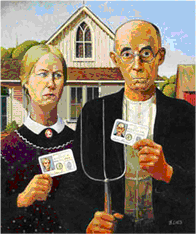
<body><![CDATA[<p><font face="Verdana" size="2">In the modern world, IDs are indispensable objects,    without which we cannot prove that we are who we say we are. We need material    substantiation that attests to the authenticity of our self-identification.    This paper is an account of an ethnographic experience about IDs and&nbsp;identification    processes&nbsp;in the US, based on the examination of two events in which Eliot    Spitzer, the New York State governor from January 2007 to March 2008, was a    central figure. A comparison with the Brazilian scenario is present throughout    the paper, and it ends by focusing on the ID theft phenomenon. </font></p>     <p><font face="Verdana" size="2"><b>Keywords:</b> Eliot Spitzer, ethnography,    ID theft, United States.</font></p> <hr size="1" noshade>     <p><font face="Verdana" size="2"><b>RESUMO</b></font></p>     <p><font face="Verdana" size="2">No mundo moderno, documentos s&atilde;o objetos    indispens&aacute;veis, sem os quais n&atilde;o conseguimos demonstrar que somos    quem dizemos que somos. Precisamos de provas materiais que atestem a veracidade    da nossa autoidentifica&ccedil;&atilde;o. Este artigo relata a experi&ecirc;ncia    de pesquisa sobre documentos de identidade nos Estados Unidos, por meio de dois    eventos em que Eliot Spitzer, governador do estado de Nova Iorque de janeiro    de 2007 a mar&ccedil;o de 2008, foi figura central, e nos quais os documentos    foram um subtexto importante. Uma compara&ccedil;&atilde;o com o caso brasileiro    est&aacute; presente ao longo do artigo, que termina examinando o fen&ocirc;meno    conhecido como ID theft.</font></p>     <p><font face="Verdana" size="2"><b>Palavras-chave:</b> Eliot Spitzer, Estados    Unidos, etnografia, ID theft.</font></p> <hr size="1" noshade>     <p>&nbsp;</p>     <p>&nbsp;</p>     <p><font face="Verdana" size="2">As we all know, fieldwork does not begin in a    chosen place or at a particular moment; it takes place within us, when we mobilize    a specific sensibility &#8213; that "jeweler's eye", as Fischer (2009) would    term it. A daily event becomes a native expression, revealing that ethnography    is not defined according to the means of communication, but rather by the purpose    to which the observation is submitted.</font></p>     <p>&nbsp;</p>     <p align=center><img src="/img/revistas/s_ha/v4nse/a09img01.gif"><a href="#_ftn2" name="_ftnref2" title=""><font face="Verdana" size="2"><sup>2</sup></font></a></p>     ]]></body>
<body><![CDATA[<p>&nbsp;</p>     <p><font face="Verdana" size="2">When I thought I could    leave for the United States at the end of 2007, I received an email from the    officer of the Institute of Social and Economic Research, Columbia University,    to which I would be affiliated for the following six months, in which she apologized    for asking me for another document to complete all the necessary paperwork.    She explained to me that Columbia had separated ("un-attached" was her    term) all personal information from the respective    social security numbers,. So,  as a way of "matching" a person to his/her documents,    the International Office then required a copy of my passport with the application.    This new regulation had just come out to her.</font></p>     <p><font face="Verdana" size="2">This was truly the beginning    of my fieldwork about documents and processes of identification in the US. Sufficiently    familiarized with the country's immigration bureaucracy after many years of    to-ing and fro-ing, this simple email revealed new, relevant dimensions I was not aware of &#8213; I    was dealing with an "ethnographic fact" even before arriving in the "field".    After all, identification procedures change, they are dynamic, despite the invariable    and immutable character with which we tend to view    them. This was a singular change since a passport is far more complex in semiotic terms    than a social security card. A passport includes name, photo, number, filiation,    birth date, signature, issue date in the country of origin, and the American    visa. On the contrary, the social security number, although part of a national    database, is simply a card with a name and a number (similar to the Brazilian    CPF).</font></p>     <p><font face="Verdana" size="2">My interest in processes of identification began    in the 1980s, in the context of a research on the impact of the governmental    "program of debureaucratization" of the time in small towns (Peirano 1986).    A second phase expanded it to the universe of official papers in Brazil, in    which I tried to unravel the semantics of ID documents and the role of redundancy    in these objects (Peirano 2006). This was when I realized that some aspects    of the American case were in sharp contrast to those in Brazil.<a href="#_ftn3" name="_ftnref3" title=""><sup>3</sup></a>    </font></p>     <p><font face="Verdana" size="2">In the absence of a national ID card in the US,    the driver's license fully takes on this role &#8213; but this is a state-issued    ID and not compulsory, although one can apply for a non-driver's license.<a href="#_ftn4" name="_ftnref4" title=""><sup>4</sup></a>    As in Brazil, the birth certificate serves as the origin of all other papers,    among which is the social security number. But this number, contrary to our    CPF, which we make public all the time, must be kept secret, given the danger    of fraud and "ID theft" (more on this below). Compared to Brazilians, Americans    are born, live and die with few documents.<a href="#_ftn5" name="_ftnref5" title=""><sup>5</sup></a>    After the World Trade Center terrorist attack, new legislation established that,    by 2013, a sort of national ID known as the Real ID will be mandatory for several    activities, such as boarding a plane, entering federal buildings, crossing particular    borders. But this legislation faces great reaction from the states that should    implement them, and from the population who retort to it in the name of civil    rights and liberties. So, while in Brazil, we complain of the excesses of bureaucracy    and of the oppression of IDs´ redundancy, in the US, the configuration of existing    documents indicates the opposite pole. And if the social security number is    the main identification of a person, kept in secret and protected from foreign    eyes, this is the context in which the values of the "modern fact", with its    emphasis on numbers as neutral and apolitical, have caught on in exemplary terms.<a href="#_ftn6" name="_ftnref6" title=""><sup>6</sup></a></font></p>     <p><font face="Verdana" size="2">Latour (2007: 204-13) indicates that IDs are    kinds of <i>plug-ins. </i>Using computer terminology and analogy, IDs are like    software that allow us to see an image, listen to music, watch a DVD. They make    visible what was just virtual and help eliminate the local/global dichotomy.    They could be called <i>subjectifiers, personnalizers, </i>or <i> individualisers,    </i>but he prefers the more neutral term of <i>plug-ins.</i><a href="#_ftn7" name="_ftnref7" title=""><sup>7</sup></a> My general orientation    follows a somewhat different path: it is because I believe that form and content    are inseparable, there is no impartial, neutral or meaningless technology; they    always belong to cosmologies.<a href="#_ftn8" name="_ftnref8" title=""><sup>8</sup></a> This is the challenge of this essay, and, with this    objective in mind, I examine two events in which Eliot Spitzer, the governor    of the state of New York during the period January 2007 to March 2008, was a    central figure. Considered one of the most brilliant politicians of his generation,    in two crucial moments his career was shattered by events that had their subtext    in identification processes. First, however, I will make a brief digression    to say something about the place of ethnography in contemporary anthropological    research.  </font></p>     <p>&nbsp;</p>     <p><font face="Verdana" size="3"><b>Ethnography    today</b></font></p>     <p><font face="Verdana" size="2"> Nowadays, ethnography has been receiving renewed    interest in a context in which anthropology has apparently lost its appeal.    In the centers of intellectual production, ethnography preempts the idea of    an anthropology lately denounced by "incorrect" power relations between researchers    and natives, which were the hallmark of its beginnings. In the former research    sites too, ethnography is also now adopted while anthropology remains impure,    thus eliminating the moral weight due to having had their population scrutinized    by western ethnologists. But, more often than not, it is its methodological    aspects that are considered proper, correct and untainted regarding the anthropological    past and, so, it is exported to other areas of investigation, such as sociology,    history, human geography, philosophy.<a href="#_ftn9" name="_ftnref9" title=""><sup>9</sup></a></font></p>     <p><font face="Verdana" size="2">A sui generis phenomenon occurs &#8213; at the    same time that the "Traditional Model of Ethnography" is under attack in the    emblematic figure of Malinowski, it is his own invention, fieldwork and/or ethnography,    that are now being established as the great legacy of anthropology. But emphasis    on the method &#8213; be it in its critique or renewed version &#8213; leaves    aside precisely the great lesson Malinowski left us, i.e., that it is not possible    to separate the ethnographic perspective from its implicit theoretical dimension.    Malinowski was adamant in searching for the <i>Trobriand theories </i>of magic,    language, myths etc., which would eventually be translated into a native cosmology    populated by common men, witches, chiefs, canoes, bracelets, rocks, magic spells,    all of them moving on the sea, flying in the air and anchoring on earth. Ethnographic    description with theoretical ambitions contrasted with sociological analysis,    which Malinowski considered subsidiary, because, for him, sociology &#8213;    as "the view from outside" &#8213; dismissed the search for the "native's point    of view," which was the hallmark of anthropology.<a href="#_ftn10" name="_ftnref10" title=""><sup>10</sup></a></font></p>     ]]></body>
<body><![CDATA[<p><font face="Verdana" size="2">It is this ethnographic    perspective of finding pieces of evidence in the sayings, facts and behavior    (which eventually lead us to a cosmology) that I see as the very theory in action.    A theoretical reference does not only inform a field research, but is ethnography's    inseparable companion, by which both transform and improve themselves, creating    new "ethnographic facts" (Evans-Pritchard's expression). The moment we turn    the investigation to our own world, we should register a multiplicity of microevents    everywhere, always attuned to great and small    surprises. It is in this context that a newspaper became an exceptional "informant"    in my research: <i>The New York Times. </i>I could then combine, contextualize    and confer the news in my daily life in New York &#8213; in the conversations    I had in the university, in my time spent shopping in supermarkets, in ads in    the subway, in informal academic meetings, in the details of students' lives,    in comments I heard in coffee shops and, not least, in the email messages from    the university officers asking for new documentation.   </font></p>     <p>&nbsp;</p>     <p><font face="Verdana" size="3"><b>The first Spitzer's    controversy: IDs for immigrants</b></font></p>     <p><font face="Verdana" size="2">Due to the daily reading of <i>The New York Times</i>    via Internet, when, on March 2008,  Eliot Spitzer shocked New Yorkers with his    sudden resignation as governor of the state, his name and a bit of his career    were not totally strange to me: in late 2007, the young, brilliant, faultless    Democrat governor of the state issued an executive order directing state offices    to allow illegal immigrants to be issued driver's licenses, effective as of    December 2007. Applicants for driver's licenses would not be required to prove    legal immigration status and would be allowed to present a foreign passport    as identification. Proof of residence would also be required. The door was opened    to make illegal immigrants, legal. Without a national ID card, the driver's    license is in fact its substitute. </font></p>     <p><font face="Verdana" size="2">Spitzer's executive order    stressed other aspects. In a state with more than    500,000 foreigners, Spitzer said that the new policy would help all New    Yorkers by improving traffic safety &#8213; unlicensed drivers are nearly five    times as likely to be in fatal car crashes compared to licensed drivers. At    the same time, by allowing an immigrant a driver's license, this would bring    him or her out of the shadows,  indirectly helping the country's security. Proof    of residence would prevent a flood of requests from outside the state, and the    use of high technology to compare photos would make it impossible for a driver    to have more than one license.</font></p>     <p><font face="Verdana" size="2">The proposal was unusual. After  9/11, many states    oriented themselves in the opposite direction, increasing the requirements to    hamper illegal immigrants applying for a driver's license, which, as we remember,    made it possible for terrorists to embark on the planes. But Spitzer argued    that the Department of Motor Vehicles was not an immigration and naturalization    service. He also reminded that the social security card and the birth certificate    &#8213; the IDs generally required to create others &#8213; do not include a    photo and, for this reason, easily become objects of fraud. Giving a false social    security number is one of the easiest ways for an illegal immigrant to get a    job.<a href="#_ftn11" name="_ftnref11" title=""><sup>11</sup></a></font></p>     <p><font face="Verdana" size="2"><b><i>Immediate reactions</i></b></font></p>     <p><font face="Verdana" size="2">Reactions were immediate, despite the fact that    the public was used to Spitzer's proposals.<a href="#_ftn12" name="_ftnref12" title=""><sup>12</sup></a> Jubilant immigrants    from community organizations waved banners and shouted their approval as soon    as Spitzer delivered the news, but other organizations such as the 9/11 Families    for a Secure America considered it insane and threatened to make the governor    responsible in the event of a new terrorist attack. During the seven weeks after    the governor had issued the bill on September 21, 2007, the proposal was judged,    debated, discussed, and finally removed on November 13. </font></p>     <p><font face="Verdana" size="2">During those weeks, the Catholic conference of    the state of New York, which represents the state's Catholic bishops on matters    of public policy, released a statement supporting Spitzer's plan to allow illegal    immigrants to obtain New York driver's licenses. Spitzer also had a good number    of unions and other organizations lining up behind him. Some days later, some    terrorism and security experts also voiced their support, saying it would help    bring a hidden population into the open and ultimately make the system more    secure, not to mention getting more drivers on the roads licensed and insured.<a href="#_ftn13" name="_ftnref13" title=""><sup>13</sup></a> Meanwhile, opponents decried Spitzer's    move as a "passport to terror" since the technology to compare faces could not    be relied on for verifying people's true identity. Republican officials threatened    to boycott the bill, while Republican legislators threatened to block the policy,    saying the governor did not have the statutory authority to act on his own.    Spitzer called the reactions hysterical: "We are not talking about letting more    people into this country; we are talking about being practical about those who    are already here".<a href="#_ftn14" name="_ftnref14" title=""><sup>14</sup></a></font></p>     <p><font face="Verdana" size="2">Senator Hillary Clinton, at the time the candidate    with more chance to become the Democrat nominee for the presidential election,    on being asked about what she thought of Spitzer's policy to allow illegal immigrants    to get driver's licenses, was at a loss as to how to reply. She said the policy    "makes a lot of sense", but did not quite say she approved Spitzer's plan, acknowledging    that sometimes a state must do what the federal government fails to do. The    situation got no better in terms of a host of pros and cons: approved by the    instances of security and counter-terrorism &#8213; which always prefer identification    over anonymity, criticized by Republicans and then Democrats alike, threatened    by the officers of the administration who said they would not implement it,    by the end of October the bill was considered the single most unpopular decision    since Spitzer took office: in October 23, eight Democrat state senators voted    against it,  in a vote result that was 39 to 19 against the motion.<a href="#_ftn15" name="_ftnref15" title=""><sup>15</sup></a> </font></p>     ]]></body>
<body><![CDATA[<p><font face="Verdana" size="2"><b><i>Changing the plan</i></b></font></p>     <p><font face="Verdana" size="2">Spitzer did not give up. To save the central    idea, he changed the proposal twice. First, he accepted that the license for    illegal immigrants would have a different appearance from the others, and would    be restricted to the purpose of driving vehicles, i.e., not valid for federal    purposes. Besides, the cost would be less than for the standard one.<a href="#_ftn16" name="_ftnref16" title=""><sup>16</sup></a>    The usual driver's license, in turn, would be upgraded in anticipation of the    Real ID legislation.<a href="#_ftn17" name="_ftnref17" title=""><sup>17</sup></a></font></p>     <p><font face="Verdana" size="2">But the new proposal continued to displease Democrats    and Republicans, as well as lawyers representing immigrants. For the latter,    the new license would stigmatize those who carry it and could potentially make    the police suspicious. Meanwhile, the Real ID federal identification system    had faced intense opposition from civil libertarians, immigration advocates    and many lawmakers. The basic concerns focused on privacy protection and the    costs to states of implementing it.<a href="#_ftn18" name="_ftnref18" title=""><sup>18</sup></a> A third attempt consisted    of an alternative kind of license, restricted to New Yorkers and which would    allow residents to cross the border to Canada. In this version of the plan,    licenses for foreigners would have the visa expiration date stamped on them.    But, in this case, the lawyers said, illegal immigrants would be unlikely to    apply for licenses, defeating Spitzer's original purpose. </font></p>     <p><font face="Verdana" size="2">The following two weeks were crucial for the    destiny of the proposal. Republicans criticized the arrogance of the governor's    insistence on giving driver's licenses to illegal aliens, thus entwining the    driver's license issue with the debate over immigration.<a href="#_ftn19" name="_ftnref19" title=""><sup>19</sup></a>    For their turn, Democrats questioned if Spitzer's proposal had not given the    Bush administration a political victory by supporting the Real ID proposal.    The plan was crushed when those who had initially supported it felt betrayed    by the inclusion of expiry dates for foreigners' visas.<a href="#_ftn20" name="_ftnref20" title=""><sup>20</sup></a></font></p>     <p><font face="Verdana" size="2"><b><i>A national controversy</i></b></font></p>     <p><font face="Verdana" size="2">Initially a question of impact on the residents    of New York, by the beginning of November, the proposal had become a national    issue, especially due to the spread of the antagonical positions of known radio    and cable TV commentators, including those who considered themselves politically    independent.<a href="#_ftn21" name="_ftnref21" title=""><sup>21</sup></a> When the discussion    reached the debate for the presidential succession, Democrat congressmen tried    to convince Spitzer to shelve the idea; at the same time, a top aide to the    secretary of Homeland Security showed concern that the Spitzer plan would undermine    the federal initiative to roll out a new, highly secure, nationally recognized    license. The plan was upsetting everybody and became hugely unpopular. A rising    national star just a year before, Spitzer had become isolated within his own    party.<a href="#_ftn22" name="_ftnref22" title=""><sup>22</sup></a> On November    13, a poll showed that 70% of the New York residents were opposed to the plan,    and, on this same day, Spitzer announced that he was dropping it. But he was    still showing his reluctance: "You have perhaps seen me struggle with it because    I thought we had a principled decision, and it's not necessarily easy to back    away from trying to move a debate forward."<a href="#_ftn23" name="_ftnref23" title=""><sup>23</sup></a></font></p>     <p>&nbsp;</p>     <p><font face="Verdana" size="3"><b>Who is Eliot Spitzer? </b></font></p>     <p><font face="Verdana" size="2">At this point, a twofold clarification is necessary:    first, why the driver's license was such an issue at the end of 2007; and second,    who is Eliot Spitzer. </font></p>     <p><font face="Verdana" size="2">In the modern world, IDs are indispensable items,    without which we cannot prove that we are who we say we are. We need material    substantiation that attests to the authenticity of our self-identification because    we cannot, by ourselves, prove it. Our word is not enough.<a href="#_ftn24" name="_ftnref24" title=""><sup>24</sup></a>    The American driver's license acquires its importance in this context. Among    the documents available in the US &#8213; and in the absence of a national ID    card ( to some extent represented by the Real ID project, cf. footnote 17) &#8213;    the driver's license is the document that most approximates to the ideal redundancy    of an ID card. This redundancy should include the three different kinds of signs    defined by Charles Peirce as the icon, the index and the symbol.<a href="#_ftn25" name="_ftnref25" title=""><sup>25</sup></a> The idea that an ID refers to a single    person means that the process of matching the person and the document must<i>     </i>be carried out with a maximum guarantee of success. For this reason, redundancy    is essential. This explains why, we now realize, Columbia International Office    detached ("un-attached<i>") </i>the personal information from the social security    number, and, in its place, required the passport, a "more redundant" ID (as    redundant as the driver's license, for instance).<a href="#_ftn26" name="_ftnref26" title=""><sup>26</sup></a></font></p>     ]]></body>
<body><![CDATA[<p><font face="Verdana" size="2">Central to this discussion is the photograph.    The majority of the mandatory documentation in use in the US does not include    a photo, as Spitzer himself indicated in his proposal.<a href="#_ftn27" name="_ftnref27" title=""><sup>27</sup></a> Missing then is the iconic element,    which helps in the immediate recognition of <i>one </i>person via <i>each </i>ID.    In this sense, the birth certificate and the social security number do not identify,    <i>beyond any doubt</i>, the person and are therefore easily copied or frauded.<a href="#_ftn28" name="_ftnref28" title=""><sup>28</sup></a> It is also in this context that the Real ID proposal,    despite its rejection by the population at large, will try to remedy this problem    &#8213; the Real ID will produce an ID photo with federal validity requirements.    If redundancy is an element with a negative value in the modern world, identification    documents are dependent on it <i>precisely </i>to eliminate the ambiguity in    matching the document with its bearer. Americans seem to experience this paradox    in a radical way, trying to simply eliminate the ID, sometimes treating it as    the source of all evil, sometimes rejecting the photo but accepting the number    &#8213; to which they continue to cling. </font></p>     <p><font face="Verdana" size="2">This is the context in which we can understand    Spitzer's role in the driver's license controversy. A rising star in the national    political scene, he was considered by many as potentially the first Jewish president    of the US, his victory as a governor of New York having been obtained by the    largest margin of any other candidate to the state, 69% of the votes. Born in    1959, son of a real state tycoon, he attended Princeton University for his undergraduate    studies and Harvard to study Law. As a state Attorney General before the election,    Spitzer prosecuted cases relating to corporate white collar crime, securities    fraud, Internet fraud and environmental protection. He pursued cases against    companies involved in computer chip price fixing, predatory lending practices    by mortgage lenders, and became known as the "sheriff of Wall Street" for revealing    business conflicts involving stock analysts at Merrill Lynch. In 2004, he oversaw    a task force to arrest 18 people involved in a prostitution ring on Staten Island,    and, in 2005, filed a civil complaint against the chief executive of the AIG    for violations of insurance and securities laws. When he was elected the 58<sup>th</sup>    governor of New York, he promised to "change the ethics of Albany", and pledged    reforms "substantial in size and historic in scope".<a href="#_ftn29" name="_ftnref29" title=""><sup>29</sup></a>    </font></p>     <p><font face="Verdana" size="2">Considered arrogant by many, when criticized    by Michael Bloomberg, the mayor of New York, on the issue of the immigrants'    driver's licenses, he was emphatic in saying that the mayor was "factually wrong,    legally wrong, morally wrong, and ethically wrong". When he finally announced    that he had dropped his bid to offer licenses more widely, even then he said    his was a good idea.<a href="#_ftn30" name="_ftnref30" title=""><sup>30</sup></a> </font></p>     <p><font face="Verdana" size="2">This good idea was hindered, first by the antagonism    between the federal regulation and the state legislation in the American system,    in this particular case reinforced by the bi-partidarism between the Bush administration    federal law on the Real ID and the Democrat idea that national IDs penalized    the poor and the elderly.<a href="#_ftn31" name="_ftnref31" title=""><sup>31</sup></a> Second, it made clear    how identification has two paradoxically complementary aspects: on the one hand,    they allow their holders several privileges in relation to those who are undocumented;    on the other, they submit the holders to constant external control, taking from    them several private rights.<a href="#_ftn32" name="_ftnref32" title=""><sup>32</sup></a>    Spitzer emphasized the first aspect: by granting illegal immigrants driver's    licenses he was in fact allowing them to hold some sort of legal status, and    in this sense he felt factually, legally, morally and ethically correct: by    putting their picture in a legal card, he was giving immigrants a "face". On    the other hand, the Federal Department of Homeland Security, initially also    approved the proposal exactly because it increased its control over the population:    for government identification is always better than anonymity. These two sides    of identification papers were constantly present in the weeks during which the    debate took place, represented by opposed political parties and debated, first,    within the context of the large problem of immigration, and second, within the    cultural values of freedom and individual rights. But there is another paradox    related to identification, and it refers to its dynamic aspect: we tend to consider    that documents are papers frozen in time, but actually they are constantly changing    both individually &#8213; for instance, in the process of inclusion of new data    by means of new technologies, as everywhere the new passports confirm &#8213;    and in the historical configuration of the available sorts of documentation    in a particular country, including their hierarchy &#8213; for instance, the    social security number is substituted by the passport as a requirement for foreigners    to become affiliated to Columbia University, the driver's license gives way    to the Real ID in official terms. </font></p>     <p>&nbsp;</p>     <p><font face="Verdana" size="3"><b>Spitzer's true error: the photo in the media</b></font></p>     <p><font face="Verdana" size="2">The second episode, with a tragic Shakespearean    aspect (as often mentioned), occurred in the afternoon of March 10, 2008, when,    in a "breaking news" edition, The New York Times announced that governor Eliot    Spitzer was linked to a high-priced prostitution ring, a piece of news that    spread rapidly throughout the city.<a href="#_ftn33" name="_ftnref33" title=""><sup>33</sup></a> </font></p>     <p><font face="Verdana" size="2">The revelation shocked New Yorkers who considered    it more than unforgivable &#8213; it was incomprehensible. If Eliot Spitzer    had been caught on a federal wiretap arranging to meet with a high-priced prostitute    at a Washington hotel, <i>nobody </i>could be trusted. Eliot Spitzer was <i>the    </i>example of a public figure among politicians. For the next two days, headlines    of printed and electronic news centered on this unique scandal, which could    eventually even affect the presidential dispute then in course. Open television    had constant updates and cable television saw the number of viewers increasing,    Wall Street was said to be celebrating (as an attorney, Spitzer had denounced    speculators), there was discussion about if it was a private or a public matter,    if the payments involved campaign funds, whether Spitzer would resign or be    impeached &#8213; everybody wanted to know why this young, serious, ambitious    politician, with an exemplary marriage and family, had committed such a mistake.<a href="#_ftn34" name="_ftnref34" title=""><sup>34</sup></a> On March 12, after    two long days in which the news was focused on the affair, Eliot Spitzer announced    his resignation with his wife at his side saying: "I cannot allow my private    failings to disrupt the people's work. Over the course of my public life, I    have insisted&nbsp;&#8213; I believe correctly&nbsp;&#8213; that people take    responsibility for their conduct. I can and will ask no less of myself. For    this reason, I am resigning from the office of governor." New Yorkers remained    stunned for several weeks, with the help of the media, which discussed not only    the case but also topics like lying in politics, the "fashion" of public apologies,    infidelity in marriage and so on. <a href="#_ftn35" name="_ftnref35" title=""><sup>35</sup></a></font></p>     <p><font face="Verdana" size="2">The revelation that Spitzer was linked to a prostitution    ring began in a routine examination of suspicious financial transactions reported    to the Internal Revenue Service by banks, which found several unusual movements    of cash involving the governor of New York. Because the focus of the investigation    involved a high-ranking government official, prosecutors were required to seek    the approval of the United States Attorney General to proceed. That was when    the investigators learned that the money was not related to political corruption,    which was a possibility that the IRS considered, but was being used to pay for    prostitution, manipulated in a way so as to conceal Spitzer's connection. Spitzer    was Client 9, recognized as the governor by a young woman who had worked previously    as a prostitute for the Emperor's Club. A judge approved wiretaps on the cell    phone of some of those suspected of involvement in the escort service. Though    this was hardly a criminal case, this possibility could not be ruled out given    the fact that he could be charged with human trafficking (from New York to Washington)    with the purpose of prostitution, an argument used by Spitzer himself when he    prosecuted illicit rings.<a href="#_ftn36" name="_ftnref36" title=""><sup>3</sup>6</a>    In 2007, the governor had signed one of the most rigorous and comprehensive    laws against sexual trafficking. Now the human rights groups that had applauded    him before began to accuse him of becoming one of those his own law was destined    to punish.<a href="#_ftn37" name="_ftnref37" title=""><sup>37</sup></a></font></p>     <p><font face="Verdana" size="2">Client 9 had spent thousands of dollars in uncommon    transactions, generally in cash or as deposits in a shell company, indicating    the aim of hiding the source, the destination and the purpose of the money.    Instead of his own name, Spitzer used a  friend's, George Fox &#8213; who, later    on, was surprised to find out the governor had used it. In the files of the    Mayflower Hotel, on the night that incriminated him when he was already a suspect    and being monitored, Spitzer gave his true address, in New York's Fifth Avenue.    But, during the months of transactions with the Emperor's Club, he had never    revealed his identity.<a href="#_ftn38" name="_ftnref38" title=""><sup>38</sup></a>    The payment of almost 5,000 dollars for the February date was made to the girl    in cash. Avoiding being recognized was a clear concern in his behavior during    the contacts with the Club. </font></p>     ]]></body>
<body><![CDATA[<p><font face="Verdana" size="2">Having struggled to give    "a face" to immigrants by means of a legal driver's license, Spitzer now concealed    his own. But that is when he made his true mistake. If for New Yorkers the interest    in this case was related to its moral implications, in the context of this paper's    discussion, it matters to grasp his semiotic miscalculation &#8213; Spitzer    does not take into account that he does not need a name or a photo to be recognized.    Unlike most people, he does not need an ID that matches his person &#8213; he    was, and continues to be, beyond any doubt, Eliot Spitzer. </font></p>     <p><font face="Verdana" size="2">Identification and recognition are not the same.<a href="#_ftn39" name="_ftnref39" title=""><sup>39</sup></a>    We all need identification to prove who we are &#8213; papers, documents, IDs,    some legal material sign that points to us. But Spitzer needs no identification,    he is <i>recognized </i>because his is a familiar face in the crowd. The usual    photo that we have in our IDs, in wallets and pockets, in his case was as if    magically <i>dislocated,</i> ending up in the media, in the newspapers and television.    His image has a place in the public domain. He is thus <i>recognized</i> as    the governor of New York by some of the girls from the Emperor's Club,<a href="#_ftn40" name="_ftnref40" title=""><sup>40</sup></a> though it is not his involvement with prostitutes and    their recognition of whom he actually is that make it a public scandal. For    that to take place, recognition <i>had to be translated into </i>identification.    His name, address, bank account, all had to be checked to prove who he really    is. From then on, had been <i>identified </i>as Eliot Spitzer, then it was a    case of inquiring whether his was a case of political corruption or criminal    indictment for transporting a woman across states for the purpose of prostitution.    </font></p>     <p><font face="Verdana" size="2">In terms of the American rules of identification,    of all the elements (name, signature, photo), here again the photo seems to    have been the key and marked one &#8213; in the two episodes involving Spitzer,    the first focused on the driver's license (<i>with a photo</i>), which he had    proposed and had been rejected both by the political instances and by the residents    of New York; the second episode developed around <i>the absence of the photo,    </i>by which he believed he would escape identification. Even if Spitzer may    have emotionally (even though not intellectually) felt that he was "above the    law," in semiotic terms his real mistake was to believe that, outside the context    of legal principles, i.e., without a document that proved who he was, the process    of identification would not operate.<a href="#_ftn41" name="_ftnref41" title=""><sup>41</sup></a>  He gives a friend's name, pays in    cash, albeit offers his own address, and is is given a number (Client 9), instead    of a name, by the prostitution ring. Curiously, in the first episode, Spitzer    reveals himself as an innovator trying to legitimize those who live, with or    without legal papers, in the US; in the second episode, he clings to common    sense values about the <i>de facto</i> correlation between the documents and    the person, as if what exists in the world is only what is registered on paper.    In this context, Eliot Spitzer becomes the good example of the contemporary    ambiguity towards an ID, including its dynamic and historical aspects.</font></p>     <p>&nbsp;</p>     <p align=center><img src="/img/revistas/s_ha/v4nse/a09img02.gif"><a href="#_ftn42" name="_ftnref42" title=""><font face="Verdana" size="2"><sup>42</sup></font></a></p>     <p>&nbsp;</p>     <p><font face="Verdana" size="2">Six months after his resignation, an article    in <i>NYT </i>described the new daily life of the former governor, as someone    trying to rehabilitate his image. The newspaper reminded the readers of the    "breathtaking quick exodus from office" saying how, one day he was a national    figure some had seen destined for the White House; the next he was a target    of ridicule. He now dedicated himself to work at his father's real estate firm,    to jogging in Central Park , buying his own cup of coffee after dropping his    daughters at the school bus stop.<a href="#_ftn43" name="_ftnref43" title=""><sup>43</sup></a> The article mentions how the glare    of the cameras outside his apartment had been replaced with moments of recognition    in the Upper East Side neighborhood, where some people now ask for his autograph    or offer him supportive words or smiles, and cabdrivers take pictures of him    on their cell phones. He still does not need a "photo ID" to tell who he is.     </font></p>     <p>&nbsp;</p>     <p><font face="Verdana" size="3"><b>ID theft</b></font></p>     <p><font face="Verdana" size="2">The absence of a federal photo ID may be one    important source for the expansion of a phenomenon known as ID theft.<a href="#_ftn44" name="_ftnref44" title=""><sup>44</sup></a>    Since the formal identity is basically predicated</font></p>     ]]></body>
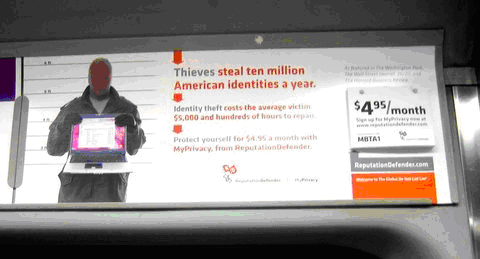
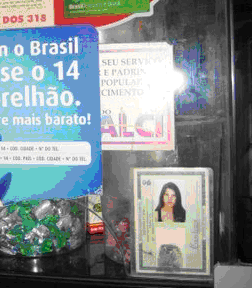
<body><![CDATA[<p><font face="Verdana" size="2">only on names and numbers  &#8213; the social    security number as a central ID and the birth certificate as the mother of all    others, the official documents do not guarantee the credibility deposited in    them (Rule et al. 1983).<a href="#_ftn45" name="_ftnref45" title=""><sup>45</sup></a>    Lacking in this sort of documentation is the "security of redundancy" that the    photograph offers (together with all the other information), and which allowed    the emergence both of medieval characters, such as Arnaud du Tilh/Martin Guèrre    (Davis 1983) and, today, Eliot Spitzer/George Fox. <a href="#_ftn46" name="_ftnref46" title=""><sup>46</sup></a> In the two events discussed    in this paper, the elements of identity, in particular the photograph, were    the main subtexts.</font></p>     <p><font face="Verdana" size="2">Identity theft occurs when someone uses someone    else's personal identifying information, like name, social security number,    credit card number, without the victim's permission, to commit fraud or other    crimes.<a href="#_ftn47" name="_ftnref47" title=""><sup>47</sup></a> The Federal Trade Commission estimates    that as many as 9 million people have their identities "stolen" each year in    the US. With some of the victims' information, "identity thieves" may rent a    house, obtain a credit card, obtain telephone lines, open bank accounts or take    a loan in the victim's name, obtain government benefits, medical services, give    the victim's personal information to police during an arrest, clone an ATM card.</font></p>     <p>&nbsp;</p>     <p align=center><img src="/img/revistas/s_ha/v4nse/a09img03.gif"><a href="#_ftn48" name="_ftnref48" title=""><font face="Verdana" size="2"><sup>48</sup></font></a></p>     <p>&nbsp;</p>     <p><font face="Verdana" size="2">Among the possible crimes listed by the Federal    Trade Commission, one has grave consequences, when the thief obtains a driver's    license or any other official ID, uses the name of the victim and replaces the    photograph. This "doubles" the person, which makes ID theft one of the most    feared cases of fraud. Some consumers victimized by identity theft may lose    job opportunities, or be denied loans for education, housing or cars because    of negative information on their credit reports. In large cities, Americans    in general zealously guard their social security numbers, birth certificates    and driver's licenses, and are even obsessed with the destination of their domestic    garbage, the Internet, the change of billing addresses &#8213; all possible    routes for ID theft. Many people thus contract private firms that offer protection.    For the approximate price of 100 dollars a year, they keep alerts in the companies    that control the credit history of consumers.<a href="#_ftn49" name="_ftnref49" title=""><sup>49</sup></a></font></p>     <p><font face="Verdana" size="2">A contrast may help clarify ID theft: while in    Brazil the <i>cards </i>are the doubles of people, which may be confirmed by    looking at bakery cash desks and betting shops, which post missing ID cards    on the glass, as if claiming their true owners, in the US this ordinary scene    is unimaginable &#8213; the documents are not people's doubles; the fact is    that, in the US, there would be multiple cloning of the victim.<a href="#_ftn50" name="_ftnref50" title=""><sup>50</sup></a> </font></p>     <p>&nbsp;</p>     <p align=center><img src="/img/revistas/s_ha/v4nse/a09img04.gif"><a href="#_ftn51" name="_ftnref51" title=""><font face="Verdana" size="2"><sup>51</sup></font></a></p>     <p>&nbsp;</p>     ]]></body>
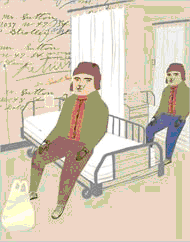
<body><![CDATA[<p><font face="Verdana" size="2"><b><i>Two brief stories</i></b></font></p>     <p><font face="Verdana" size="2">Once in a while, the <i>NYT </i>publishes some    accounts about the anguish of those who become victims of ID theft. I'll provide    two examples. The first was written by a psychiatrist and tells the story of    a homeless man she meets in a shelter clinic, who describes the worry that is    causing him insomnia. It all started when he pulled a muscle in his shoulder    and went to a hospital emergency room. As usual, first a nurse came, and, after    taking his vital signs, wrote them down on a chart with his name on it. When    the doctor came, she mentioned the overdose detected on his last visit. The    patient denied it; he had never had been in that hospital before; he does not    "do"drugs. He is corrected by her because his chart says he had been transported    in a stupor from a shelter across town. In the entry in his chart were his name,    birth date and an accurate social security number. The doctor read them out    loud to him. All were right, he admitted, but he had not been in that hospital    before. Since he had actually been in that shelter, maybe someone had copied    his information, though not stolen his wallet.</font></p>     <p><font face="Verdana" size="2">The doctor refuses to show    him his medical information and the chart because she is in the surreal position    of being asked to share privileged information about one patient with another    patient who might or might not have been the same person. The homeless man is    finally discharged without seeing the chart. When later on he asks for help    to fight his insomnia, he gets the prescription but, before leaving, reflects    on the nature of things: "Before my shoulder started hurting, life was easier."    And he adds: "There was only one of me then." The account was written by the    psychiatrist who saw him for his sleeping problem (Ely 2008). </font></p>     <p>&nbsp;</p>     <p align=center><img src="/img/revistas/s_ha/v4nse/a09img05.gif"><a href="#_ftn52" name="_ftnref52" title=""><font face="Verdana" size="2"><sup>52</sup></font></a></p>     <p>&nbsp;</p>     <p><font face="Verdana" size="2">This feature of ID theft    &#8213; that the problem is not the forging of documents, but the duplication    of the person, in the old Martin Guèrre style &#8213; reappears in the second    short story, described by the victim herself, Laura Dave. Finding herself in    California for a friend's wedding, she calls her bank in New York to be sure    that she can clear an important check. At this moment, the bank associate tells    her that it would be impossible because her account is almost $10,000 overdrawn.    She adds that the bank had received a call from her saying she was in Mexico,    and asks: "Who are you?" She is a victim of ID theft.</font></p>     <p><font face="Verdana" size="2">Innocently, she thinks    that some calls will solve the problem, but hears from a police officer: "Get    ready, kid. Once someone gets a hold of your identity, you have to fight the    good fight to get it back. This is just the beginning". From then on, she starts    living in a situation in which she has to prove, by phone, to skeptical strangers    at the other end of credit hot lines that she is who she says she is. In one    of these epic calls, she discovers that the new Laura had not only emptied her    bank account, but opened at least seven new credit card accounts in her name.</font></p>     <p><font face="Verdana" size="2">In a roadside coffee shop,    upon hanging up her cell phone, a woman at a nearby table gives her a kind smile,    and, having overheard her conversation, says that her sister-in-law had also    gotten her identity stolen.""And it all turned out alright?", she asks. "Not really. It was a nightmare that went on for    years". It is then that Laura gets back into her car and, on her way to Los    Angeles, decides to go to Big Sur, where she remembers how happy she was there    as a child on a trip with her father. She is also reminded of Henry Miller,    who loved Big Sur and made it his home, who said: "Until we lose ourselves,    there is no hope of finding ourselves." She is somehow peaceful at last. But    before this happens, she imagines the other Laura walking around in Mexico,    spending her money and even speaking to officials at her bank, all in an apparently    convincing performance, and she, the real Laura, unable to tell a convincing    story about who she is. Maybe the other is not a better candidate to be her...?    (Dave 2008).</font></p>     <p>&nbsp;</p>     ]]></body>
<body><![CDATA[<p><font face="Verdana" size="3"><b>The end of the experience</b></font></p>     <p><font face="Verdana" size="2">In the last week of the six months that I spent    in the US, three people I know received letters related to a threat of ID theft    to which they could be subjected due to loss of sensitive data: two letters    were from a large bank and the third, from an important university. The bank    had lost one of several boxes of data back-up tapes that were being transported    to an off-site storage facility, containing name, postal address, social security    number and share ownership information about the clients; the university had    one archival database file containing the housing information of approximately    5,000 current and former undergraduate students, with names and social security    numbers, found on a Google-hosted website &#8213; which was immediately removed    as soon as the fact was discovered. The letters notifying the bank clients and    the university student offered them a free two-year subscription to a credit    monitoring service that would notify them if certain suspicious activities could    indicate identity theft.  </font></p>     <p><font face="Verdana" size="2">I close this essay noting    that comparison, whether explicit or implicit, has been present throughout.    The previous investigation into the Brazilian case made the US case, as often    happens, not be the "model" to be emulated everywhere. On the contrary, the    contrast exposed the vulnerability of its identification processes. The comparative    aspects also revealed that to call IDs <i>plug-ins,    </i>as does Latour, is quite   illuminating as long as we link them to cosmologies.    They are these special amulets, wished-for items by some, restrictive    and undesirable objects for others, our "doubles" of which we cannot lose sight.    They have meaning, value, and life. The reaction to all types of centralized    database is a feature of American cosmology, and it has consequences that not    only affect American citizens, but, within today's financial context, for example,    reach the rest of the world. I remember an offer that I received for a credit    card from a large American bank. To apply for it I was expected to fill a    simple detachable form and return it by mail with the following information:    social security number, birth date, home phone and mother's maiden name. My    name and address, the bank probably got from some other database. There was    no requirement for a "photo ID". </font></p>     <p>&nbsp;</p>     <p><font face="Verdana" size="3"><b>References cited</b></font></p>     <!-- ref --><p><font face="Verdana" size="2">CAPLAN, JANE. 2001. "This or that particular    person": Protocols of identification in nineteenth-century Europe. In J. Caplan    and J. Torpey (eds.) <i>Documenting Individual Identity. </i>Princeton: Princeton    University Press, pp. 49-66.    </font></p>     <!-- ref --><p><font face="Verdana" size="2">CHATTERJEE, PARTHA. 2002. <i>A Princely Impostor?    The strange and universal history of the Kumar of Bhawal. </i>Princeton: Princeton    University Press.    </font></p>     <!-- ref --><p><font face="Verdana" size="2">DAMATTA, ROBERTO. 2002. A mão visível do Estado.    Notas sobre o significado cultural dos documentos na sociedade brasileira. <i>Anuário    Antropológico/99</i>: 37-64.     </font></p>     <!-- ref --><p><font face="Verdana" size="2">DANIEL, ERNESTINE VALENTINE. 1996. <i>Charred    Lullabies. Chapters in an anthropography of violence. </i>Princeton: Princeton    University Press.    </font></p>     <!-- ref --><p><font face="Verdana" size="2">DAVE, LAURA. 2008. G.P.S. for my lost identity.    <i>The New York Times</i>. January 20.    </font></p>     <!-- ref --><p><font face="Verdana" size="2">DAVIS, NATALIE ZEMON. 1983. <i>The Return of    Martin Guerre. </i>Cambridge, MA.: Harvard University Press.    </font></p>     <!-- ref --><p><font face="Verdana" size="2">DERSHOWITZ, ALAN. 2001. Why fear national ID    cards? <i>The New York Times</i>, October 13.    </font></p>     <!-- ref --><p><font face="Verdana" size="2">ELY, ELISSA. 2008. Homeless, with a new loss:    identity. <i>The New York Times</i>, January 8, <a href="http://www.nytimes.com/2008/01/08/health/views/08case.html" target="_blank">http://www.nytimes.com/2008/01/08/health/views/08case.html</a></font><!-- ref --><p><font face="Verdana" size="2">FERRARI, MERCEDES GARC&Iacute;A. 2007. "Una marca    peor que el fuego". Los cocheros de la ciudad de Buenos Aires y la resistencia    al retrato de identificación. In Caimari, Lila. <i>La Ley de los Profanos. Delito,    justicia y cultura em Buenos Aires (1870-1940). </i>Buenos Aires: Fondo de Cultura    Económica, pp. 99-134.    </font></p>     <!-- ref --><p><font face="Verdana" size="2">FISCHER, MICHAEL M.J. 2009. <i>Anthropological    Futures. </i>Duke University Press.    </font></p>     <!-- ref --><p><font face="Verdana" size="2">FRAENKEL, B&Eacute;ATRICE. 1992. <i>La Signature.    Genèse d'un signe. </i>Paris: Éditions Gallimard.    </font></p>     <!-- ref --><p><font face="Verdana" size="2">FRAENKEL, B&Eacute;ATRICE. 2002. <i>Les Écrits    de Septembre. New York 2001</i>. Paris: Éditions Textuel.    </font></p>     <!-- ref --><p><font face="Verdana" size="2">GROEBNER, VALENTIN. 2007. <i>Who Are You? Identification,    deception, and surveillance in Early Modern Europe</i>. New York: Zone Books.    </font></p>     ]]></body>
<body><![CDATA[<!-- ref --><p><font face="Verdana" size="2">LATOUR, BRUNO. 2007. <i>Reassembling the Social.    An introduction to actor-network-theory. </i>Oxford: Oxford University Press.    </font></p>     <!-- ref --><p><font face="Verdana" size="2">LEACH, EDMUND. 1957. The epistemological background    to Malinowski´s empiricism. In R. Firth (ed.) <i>Man and Culture. Na evaluation    of the work of Bronislaw Malinowski. </i>London: Routledge &amp; Kegan Paul,    pp. 119-137.    </font></p>     <!-- ref --><p><font face="Verdana" size="2">NUNES, ELISA B. 2009. Socorro! Roubaram todos    os meus dados. <i>O Globo, </i>July 3, p. 7.     </font></p>     <!-- ref --><p><font face="Verdana" size="2">OLIVEN, RUBEN. 2001. De olho no dinheiro nos    Estados Unidos. <i>Estudos Históricos </i>27: 206-35.    </font></p>     <!-- ref --><p><font face="Verdana" size="2">PEIRANO, MARIZA. 1986. "Sem lenço, sem documento".    <i>Sociedade e Estado</i>, 1 (:1), revised and published in Peirano (2006).    </font></p>     ]]></body>
<body><![CDATA[<!-- ref --><p><font face="Verdana" size="2">PEIRANO, MARIZA. 2002. "This horrible time of    papers:" documents and national values. <i>Série Antropologia </i>312, 63 pp,    <a href="http://www.unb.br/ics/dan/Serie312empdf.pdf" target="_blank">http://www.unb.br/ics/dan/Serie312empdf.pdf</a>.    </font></p>     <!-- ref --><p><font face="Verdana" size="2">PEIRANO, MARIZA. 2006. <i>A Teoria Vivida e Outros    Ensaios de Antropologia. </i>Rio de Janeiro: J. Zahar.    </font></p>     <!-- ref --><p><font face="Verdana" size="2">PEIRCE, CHARLES. 1955. <i>Philosophical Writings    of Peirce</i> (selected and edited with an introduction by Justus Buchler).    New York: Dover.    </font></p>     <!-- ref --><p><font face="Verdana" size="2">POOVEY, MARY. 1998. <i>A History of the Modern    Fact. Problems of knowledge in the sciences of wealth and society. </i>Chicago:    The University of Chicago Press.    </font></p>     <!-- ref --><p><font face="Verdana" size="2">RULE, JAMES, DOUGLAS MCADAM, LINDA STEARNS and    DAVID UGLOW. 1983. Documentary identification and mass surveillance in the United    States. <i>Social Problems</i> 31: 222-234.    </font></p>     ]]></body>
<body><![CDATA[<!-- ref --><p><font face="Verdana" size="2">SCOTT, JAMES. 1998. <i>Seeing Like a State. How    certain schemes to improve the human condition have failed. </i>New Haven: Yale    University Press.    </font></p>     <!-- ref --><p><font face="Verdana" size="2">SCOTT, JAMES, JOHN TEHRANIAN and JEREMY MATHIAS.    2002. The production of legal identities proper to states: the case of the permanent    family surname. <i>Comparative Studies in Society and History</i> 44: 4-44.    </font></p>     <!-- ref --><p><font face="Verdana" size="2">TAMBIAH, STANLEY. 1985. <i>Culture, Thought,    and Social Action.</i> Cambridge, MA.: Harvard University Press.    </font></p>     <!-- ref --><p><font face="Verdana" size="2">TAMBIAH, STANLEY. 1996. <i>Leveling Crowds. Ethnonationalist    conflicts and collective violence in South Asia. </i>Berkeley: University of    California Press.    </font></p>     <!-- ref --><p><font face="Verdana" size="2">TRAJANO FILHO, WILSON. 2001. A nação na <i>web</i>:    rumores de identidade na Guiné-Bissau. In Mariza Peirano (ed.) <i>O Dito e o    Feito. Ensaios de Antropologia dos rituais. </i>Rio de Janeiro: Relume Dumará,    pp. 85-112.    </font></p>     ]]></body>
<body><![CDATA[<!-- ref --><p><font face="Verdana" size="2">TORPEY, JOHN. 2000. <i>The Invention of the Passport.    Surveillance, citizenship and the state. </i>Cambridge: Cambridge University    Press.    </font></p>     <!-- ref --><p><font face="Verdana" size="2">WAKIN, D. 2001. National ID cards: one size fits    all. <i>The New York Times</i>, October 7.    &nbsp;</font></p>     <p>&nbsp;</p>     <p>&nbsp;</p>     <p><font face="verdana" size="2">Received 02/26/2009    <br>   Approved 03/25/2009</font></p>     <p>&nbsp;</p>     <p>&nbsp;</p>     ]]></body>
<body><![CDATA[<p><font face="Verdana" size="2"><a href="#_ftnref1" name="_ftn1" title="">1</a> I am thankful to Cornelia Eckert    for the invitation to contribute to the volume on "Ethnographies" in the journal    <i>Horizontes Antropológicos,</i> and to Brian Hazlehurst for the proofreading    of my translation into English. The research for this paper was carried out    at the Center on Organizational Innovation, Columbia University, with a research    grant from CNPq, from February to July 2008. I am thankful to David Stark, Monique    Girard and Daniel Beunza for their friendly hospitality and the excellent work    conditions at Columbia. David Stark raised important questions, which I have    tried to answer, albeit briefly, in this version.    <br>   <a href="#_ftnref2" name="_ftn2" title="">2</a> This image was published in the <i>Hartford    Courant </i>from Connecticut, October 30, 2001, then copied from the site <a href="http://www.UnRealID.com" target="_blank">www.UnRealID.com</a>    (February 2, 2009). It is based on the painting, American Gothic, by Grant Wood.    <br>   <a href="#_ftnref3" name="_ftn3" title="">3</a> In Brazil, Oliven (2001) and DaMatta    (2002) also decided to look at IDs as a subject of investigation, the first    in the context of the cultural value of money in the US, and the second, as    the invisible hand of the State in Brazil. ID documentation is a topic seldom    encountered in the American or European social scientific literature, except    among historians (Davis 1983, Fraenkel 1992, Torpey 2000). However, during the    last decade, the number of studies increased considerably (Caplan e Torpey 2001,    Chatterjee 2002, Fraenkel 2002, Groebner 2007).    <br>   <a href="#_ftnref4" name="_ftn4" title="">4</a> Oliven (2001) recounts his experience    in the US between 1993 and 1995, and considers that three papers are indispensable    in the American context: the driver's license, the credit card, and the social    security number. The first has the function of a national ID card, the second    is  proof of credit, and the third corresponds to a national database of all    citizens. The three represent mobility, consumerism and rights, respectively.    <br>   <a href="#_ftnref5" name="_ftn5" title="">5</a> There is no generic term in the US    for our "documento". A "photo ID" is used for a document with a photo, which    implies that an ID <i>may not have a photo.    <br>   </i><a href="#_ftnref6" name="_ftn6" title="">6</a> Isn't simplification what all modern    nation-states look for (Scott 1998)? And isn't the number the simplest of the    mechanisms of identification (Poovey 1998)? Cf. Scott et al. (2002: 27): "Bureaucratically    speaking, the simplest system of identification is the serial number. Anything    else is second best. Given half a chance, administrators are drawn to the arithmetic    beauty of a potentially endless series of consecutive numbers. It eliminates,    at a stroke, all the ambiguity and discretion which plague any &#091;other&#093;    system." But, as we are about to see, this elimination is illusory.    <br>   <a href="#_ftnref7" name="_ftn7" title="">7</a> Latour (2007: 208) on documents:    "If you doubt the ability of those humble paper techniques to generate <i>quasi-subjects</i>,    try living in a large European city as an 'undocumented alien' or extricating    yourself out of the FBI's grip because of a misspelling of your name". <i>Plug-ins    </i>help to eliminate the local/global dichotomy as much as the action/system    repertoire.    <br>   <a href="#_ftnref8" name="_ftn8" title="">8</a> See Tambiah (1985, Chap. 4) for the    relation between structural form and cultural content. See Daniel (1996) for    a brilliant analysis in which the consequences of the adoption of universal    systems of measures and conceptions of history play a fundamental role in the    tea plantations of Sri Lanka. As I write this essay (February 2009) I see the    implications of the present financial crisis and the breaches in the American    identification processes, whether for access to mortgages, obtaining a job,    or acquiring a house. But this is a topic for another paper.    <br>   <a href="#_ftnref9" name="_ftn9" title="">9</a> The launching of <i>Ethnography </i>in    2000, a journal published by Sage, is an indication of this new interdisciplinary    tendency (see <a href="http://eth.sagepub.com" target="_blank">http://eth.sagepub.com</a>);    another is the international meetings called <i>Ethnografeasts</i>. In the last    decade, meetings were held in Berkeley, Paris, Lisbon and Taipei. The next one    will be in Venice, in August 2009, under the title "Practice, Politics and Ethics    in Ethnographic Research".    <br>   <a href="#_ftnref10" name="_ftn10" title="">10</a> See Leach (1957:120) for a reference    to Malinowski as a "fanatical theoretical empiricist"; Tambiah (1985, Chaps.    1 and 8 ) for a reanalysis of the Trobriand cosmology; Fischer (2009) for the    "Traditional Model of Ethnography."    ]]></body>
<body><![CDATA[<br>   <a href="#_ftnref11" name="_ftn11" title="">11</a> See, in <i>The New York Times    </i>(hereinafter, <i>NYT</i>), September 22, 2007, the article "Spitzer grants    illegal immigrants easier access to driver's licenses".    <br>   <a href="#_ftnref12" name="_ftn12" title="">12</a> In April 2007, Spitzer issued    a bill to legalize same sex marrige, which the state assembly passed in June,    but which later died in the Senate.    <br>   <a href="#_ftnref13" name="_ftn13" title="">13</a> All this news may be accessed    on the <i>NYT</i> site (<a href="http://www.nytimes.com" target="_blank">www.nytimes.com</a>),    by typing "spitzer" in the search engine.    <br>   <a href="#_ftnref14" name="_ftn14" title="">14</a> <i>NYT</i>, October 9, 2007, "Licenses for immigrants    finds support".    <br>   <a href="#_ftnref15" name="_ftn15" title="">15</a> The state senate comprised 33    Republican senators and 29 Democrats; 2 senators from each party decided to    abstain. See <i>NYT</i>, October 23, 2007, "Why some democrats defected on Spitzer    driver's license plan".    <br>   <a href="#_ftnref16" name="_ftn16" title="">16</a> See <i>NYT, </i> October 28, 2007,    "Spitzer tries new tack on immigrant licenses".    <br>   <a href="#_ftnref17" name="_ftn17" title="">17</a> The Real ID proposal originated    in the "9/11 Commission" after the attack on the World Trade Center, and would    have to be issued in all states by 2013. The Real ID will be required for several    activities, including boarding a plane and entering a federal building. It is    considered a super driver's license with security features that would deter    terrorists and illegal immigrants. The Real ID will be valid for eight years.    The applicant for a Real ID must provide the following documentation: (i) a    photo ID, or a non-photo ID that includes full legal name and birthdate; (ii)    documentation of birthdate; (iii) documentation of legal status and social security    number; (iv) documentation showing name and principal residence address. Digital    images of each identity document will be stored in each state's Department of    Motor Vehicles database. Despite the fact that the maintenance of databases    will be in state hands, organizations such as <a href="http://no2RealID.org" target="_blank">no2RealID.org</a>,    <a href="http://unRealID.com" target="_blank">unRealID.com</a> and <a href="http://realnightmare.org" target="_blank">realnightmare.org</a>    claim it will in fact be a national identification card, given the uniform national    standards and, in particular, the possibility of linked databases. Real ID apart,    American citizens are already classified and catalogued in several databases:    social security, health, commercial, bank and political databases are in widespread    use (see <i>NYT</i>, April 12, 2008, "Clinton aide's databank venture breaks    ground in politicking").    <br>   <a href="#_ftnref18" name="_ftn18" title="">18</a> For an appraisal of the costs,    see <i>NYT</i>, October 29, 2007, "Real ID that Spitzer now embraces has been    widely criticized".    <br>   <a href="#_ftnref19" name="_ftn19" title="">19</a> See <i>NYT,</i> October 29, 2007,    "Some support, but still furor over new plan for licenses". The executive direction    of the New York Immigration Coalition, which organized a protest at Spitzer's    Manhattan office said: "First the governor told us, 'You will get apples'. And    then he's saying, 'Now you'll get rotten apples, And you won't even get your    rotten apples now &#8213; you'll get them later".    <br>   <a href="#_ftnref20" name="_ftn20" title="">20</a> See <i>NYT, </i>October 30, 2007, "Governor Spitzer    retreats".    ]]></body>
<body><![CDATA[<br>   <a href="#_ftnref21" name="_ftn21" title="">21</a> The CNN anchor Lou Dobbs led an    almost nightly crusade against Spitzer's policy. See <i>NYT</i>, October 31,    2007, "Chertoff pushed Spitzer to bend on license idea".    <br>   <a href="#_ftnref22" name="_ftn22" title="">22</a> See <i>NYT</i>, November 8, 2007,    "Congressional Democrats grow wary of Spitzer license plan".    <br>   <a href="#_ftnref23" name="_ftn23" title="">23</a> See <i>NYT, </i>Breaking News,    November 13, 2007, 19:27: "Spitzer to drop his license plan for illegal immigrants".    <br>   <a href="#_ftnref24" name="_ftn24" title="">24</a> In a short fieldwork in the small    town of Rio Paranaíba, Minas Gerais, in 1982, the residents did not believe    much in the debureaucratization program of the time, considering it unnecessary    given that "everybody knew everybody". See Peirano (1986; 2006, Chapter 9).    <br>   <a href="#_ftnref25" name="_ftn25" title="">25</a> See Peirano (2002) for the proposition    that the national ID is the reference among all legal papers in Brazil because,    according to Charles Peirce, it is a combination of an icon (a photo), an index    (fingerprint, signature), and a symbol (name). Actually, this coincides with    Fraenkes's (1992) suggestion that the elementary signs of modern identity are    the name, the photo and the fingerprint, which, later, Caplan (2001) noted,    are exactly the elements of Peirce's trichotomy. For Peirce, icons are signs    that represent an object by <i>similarity</i>; its images stimulate its idea    mentally (the photograph, for instance); indexes are signs that refer to its    object due to <i>a dynamic connection</i> and to a contiguity between the individual    object and the senses (the fingerprint and the signature); symbols are in principle    <i>more abstract</i> and more independent of the immediate context, characterized    by generality and by law (name, filiation etc.) Cf. Peirce 1955. Since for Peirce    all signs generally carry elements that are simultaneously iconic, indexical    and symbolic, ID cards as objects gather information of various kinds &#8213;    they are predominantly indexical icons, in that, in ideal terms, they point    to only one person. (See Peirano 2006, Chap. 10 for an expansion of this idea.)     <br>   <a href="#_ftnref26" name="_ftn26" title="">26</a> To identify someone we have never    seen before, "we compare their description with individual features: gender,    height, age, the color of eyes and hair. We match one with the other, and when    we have made out a sufficient number of correspondences, we have good reason    to assume that this is the person in question." (Groebner 2007:17). This actually    means that there is no unique sign for identifying someone and that the dreams    of immediate identification by just one feature is doomed. Redundancy is a fundamental    feature of identification. Groebner reminds us that modern identity papers,    the result of techniques developed between the thirteenth and sixteenth centuries    (such as marks, seals, pictures) are "medieval echoes" that we carry in our    pockets.    <br>   <a href="#_ftnref27" name="_ftn27" title="">27</a> England has a system in many ways    similar to the US, but it plans to have ID cards for foreigners and airport    staff in 2009, as a way of eventually requiring them for all the population.    Although it is recognized that they would help to prevent fraud, reduce illegal    immigration, avoid terrorist acts and facilitate obtaining public services,    civil rights groups and opposition parties regard the cards as unnecessary,    expensive and intrusive. See NO2ID.net for the movement against the national    identity. (A national ID card was compulsory in England only during the Second    World War.)    <br>   <a href="#_ftnref28" name="_ftn28" title="">28</a> Rule et al. (1983) is an excellent    source to examine the role of the six kinds of documents most used in the US:    birth certificates, driver's licenses, social security cards, passports, bank    credit cards, and bank books. Though it is a 25-year-old paper, the basis for    the discussion of documents are well explained. One of the central arguments    for the paper refers to the fact that the American system of identification    is based on self-identification, with the birth certificate being the one that    generates the others. Since they cannot be matched to the holder, frauds are    easy. Long before 9/11 then, Rule et al. made explicit the fragility of the    system in terms of security.    <br>   <a href="#_ftnref29" name="_ftn29" title="">29</a> See <i>NYT </i>March 10, 2008,    "Milestones in an ambitious career".    <br>   <a href="#_ftnref30" name="_ftn30" title="">30</a> See <i>NYT, </i>November 27, 2007,    "After a rough start, Spitzer rethinks his ways".    ]]></body>
<body><![CDATA[<br>   <a href="#_ftnref31" name="_ftn31" title="">31</a> See the dispute over voter identification,    especially the Indiana case, which reached the Supreme Court in April 2008.    See <i>NYT</i>, April 29, 2008, "Supreme Court upholds voter identification    law in Indiana".    <br>   <a href="#_ftnref32" name="_ftn32" title="">32</a> Many authors have identified this    double aspect: Fraenkel (1992); Torpey (2000); Scott et al. (2002). The reaction    to the inclusion of photos in social security cards is an example of these values.    <br>   <a href="#_ftnref33" name="_ftn33" title="">33</a> I followed the driver's license    controversy by reading the <i>NYT</i>  via Internet.    <br>   <a href="#_ftnref34" name="_ftn34" title="">34</a> See <i>NYT, </i>March 11, 2008,    "Revelations Began in Routine Tax Inquiry". Possible political motivations for    the news were examined, including the criminalization of the governor by his    political enemies, action by Washington Republicans, or banks that, collaborating    with the investigation, had been previously involved in cases heard by Spitzer    as Attorney General. One year later, a former tax specialist, who ran the Emperor's    Club, was sentenced to two years and a half in prison, on prostitution and money    laundering conspiracy charges. See <i>NYT,</i> February 8, 2009, "Prostitutes'    boss in Spitzer case is sentenced".    <br>   <a href="#_ftnref35" name="_ftn35" title="">35</a> In an interview to PBS (see <a href="http://www.pbs.org/newshour/%ADbb/law/jan-june08/%ADspitzer_%AD03-12.html" target="_blank">http://www.pbs.org/newshour/­bb/law/jan-june08/­spitzer_­03-12.html</a>),    David Boies, who had acted in the Al Gore case in the Supreme Court after the    2000 election, said that "I think that one of the problems with power is it    can make you think that you are above the law, not intellectually. Intellectually,    you know you're not above the law, but emotionally you think you can get away    with things that "ordinary people," in quotes, can't get away with. And I think    that's one of the great dangers of power. Power not only tends to corrupt, but    power tends to delude you into believing that you can get away with things that    you can't." Several experts were invited to contribute to the article "Politics,    and scandal, as usual" (<i>NYT</i>, March 11, 2008), among them Paul Apostolidis,    political scientist at the Whitman College, who said: "I don't see why we would    expect politics to be more free of the psychological contradictions of other    human beings. People do self-destructive things that are not rational". Maureen    Dowd, from the <i>NYT, </i>asked: "Why, if you are a frugal governor, do you    really need to shell out $4,300 to a shell company for two hours with a shady    lady &#091;who works for&#093; a  prostitution ring that has hourly rates based    on rating its girls on a diamond scale of 1 to 7, with 7 being $3,100, and above    7 in a special club for $5,500 and up?" (<i>NYT</i>, March 12, 2008, "Ways of    the wayward"). See also <i>NYT, </i>March 16, 2008, "Public infidelity, private    debate: not my husband (right?)"; March 17, 2008, "Just the fashion of public    apology"; March 21, 2008, "After the end of the affair".    <br>   <a href="#_ftnref36" name="_ftn36" title="">36</a> Federal prosecutors could accuse him as a transgressor of the    "Mann Act", an obscure and controversial law from 1910, which tried to deal    with interstate prostitution trafficking.    <br>   <a href="#_ftnref37" name="_ftn37" title="">37</a> The outpouring of news can be    seen by their frequency on the pages of <i>NYT. </i>On  March 11, 2008, see    "Mr. Spitzer's 'private matter'", an editorial that accuses the governor of    being caught in his own arrogance, besides another five articles: "Revelations    began in routine tax inquiry", "Affidavit: client 9 and room 871", "A fall from    white knight to client 9", "Officials process news of scandal and ponder future",    "Politics, and scandal, as usual". On the following day, open-ed articles, letters    to the editor, blogs and other articles: "Ways of the wayward", "Foes of sex    trade are stung by the fall of an ally", "Mars and Venus dissect the Spitzer    scandal on the TV talk shows", "The reports that drew federal eyes to Spitzer",    "Lieutenant governor has a history of defying the public's expectations", "Despite    constant security, politicians still find trouble", "Spitzer resigns, citing    personal failings", "Full text of Spitzer resignation", "The myth of the victimless    crime", "Stand by yourself", "Really dangerous liaisons" and "Waiting for Mr.    Spitzer". In the following weeks, the articles continue with a miscellaneous    viewpoints, letters, the role of women in politicians' marriages, the structure    of the Emperor's Club ring.    <br>   <a href="#_ftnref38" name="_ftn38" title="">38</a> It is possible to argue that,    in Washington, Spitzer would have had less chance to be recognized than in New    York, considering the number, variety and turnover of politicians in the capital.    (Monique Girard drew my attention to this point.). Spitzer had never arranged    a date in New York, though there could be many other reasons for this.    <br>   <a href="#_ftnref39" name="_ftn39" title="">39</a>  See Groebner (2007:17) for the    difference between recognition and identification: "We recognize a familiar    face in a crowd despite the bad light, picking up on the smallest of details,    be it posture, a gesture, a single word &#8213; and sometimes even against our    own will."  Identifying someone we have never seen before, however, is a different    procedure, and it is based on the comparison between the description and the    person´s individual features.    <br>   <a href="#_ftnref40" name="_ftn40" title="">40</a> See <i>NYT, </i>March 11, 2008,    "Affidavit: Client 9 and room 871": "Room 871 had been booked under the name    of George Fox, a pseudonym that Client 9 had been using, and one by which several    people in the ring knew him, according to a law enforcement official. However,    a few of the prostitutes had recently come to realize who the man really was,    the official said"<i>.    ]]></body>
<body><![CDATA[<br>   </i><a href="#_ftnref41" name="_ftn41" title="">41</a> All signs include an iconic, an    indexical and a symbolic element, but generally only one of them dominates,    its character being defined by the circumstances of each event. Peirce says    that "it is a nice problem to say to what class a given sign belongs; since    all the circumstances of the case have to be considered. But it is seldom required    to be very accurate; for if one does not locate the sign precisely, one will    easily come near enough to its character for any ordinary purpose of logic"    (1955 :119)    <br>   <a href="#_ftnref42" name="_ftn42" title="">42</a> This image is from a poster in    Lowell's cinema, Boston.    <br>   <a href="#_ftnref43" name="_ftn43" title="">43</a> See <i>NYT, </i>September 28,    2008, "6 months later, Spitzer is contrite, yes, but sometimes still angry".    <br>   <a href="#_ftnref44" name="_ftn44" title="">44</a> A common phenomenon in the US, for a citizen from    Brazil "identity theft" is as strange and curious as to be clearly seen as an    "ethnographic fact." Thieves in Brazil steal "documents", not whole identities.    A recent case of <i>identity theft</i>-American style in Brazil receivee prime    space in the popular newspaper <i>O Globo </i>(Nunes 2009)<i>.    <br>   </i><a href="#_ftnref45" name="_ftn45" title="">45</a> The social security number was    first issued in 1936 as part of the New Deal Social Security program. Initially,    they were used for income tracking purposes. In 1986, American taxation law    was altered so that individuals over 5 years old without social security numbers    could not be claimed as dependents on tax returns; by 1990 the threshold was    lowered to 1 year old. Since then, parents have often applied for social security    numbers for their children soon after birth. The social security number is a    9-digit number in the format "123-45-6789". The first three digits are assigned    by the geographical region; the middle two digits are the "group number", merely    serving to break the number into sized blocks for orderly issuance; the last    four digits are the "serial number". They represent a straight numerical sequence    of digits from 0001-9999 within the group. For further information, see <a href="http://www.socialsecurity.gov" target="_blank">www.socialsecurity.gov</a>.    <br>   <a href="#_ftnref46" name="_ftn46" title="">46</a> At the end of the XIX century,    Buenos Aires horsedrawn coach drivers also reacted to the inclusion of the photo    in their identity cards (Ferrari 2007). For the historical process of individualization    and the emphasis on the photograph, see Fraenkel (1992). For an analysis of    the post 9/11 graffiti and other iconic manifestations in t New York City, see    Fraenkel (2002).    <br>   <a href="#_ftnref47" name="_ftn47" title="">47</a> This is a definition provided    by the Federal Trade Commission on its site, which includes how identity theft    works, what to do in case you are a victim of such, and what to do to avoid    it. See ftc.gov/bcp/edu/microsites/idtheft.    <br>   <a href="#_ftnref48" name="_ftn48" title="">48</a> This image was taken in a New    York subway, offering a protection service against "ID theft". The face of the    robber is covered, the only identifying element being the height.    <br>   <a href="#_ftnref49" name="_ftn49" title="">49</a> Among the several firms see, for    example, <a href="http://idsafety.net" target="_blank">idsafety.net</a>; <a href="http://4idsafety.com" target="_blank">4idsafety.com</a>;    <a href="http://www.security-int.com" target="_blank">www.security-int.com</a>;    <a href="http://www.idranksecurity.com" target="_blank">www.idranksecurity.com</a>;    <a href="http://www.identityguard.com" target="_blank">www.identityguard.com</a>.    Information on ID theft can also be accessed on <a href="http://www.ftd.com%20and%20idtheftcenter.org" target="_blank">www.ftd.com    and idtheftcenter.org</a>.    <br>   <a href="#_ftnref50" name="_ftn50" title="">50</a> In principle, the Real ID    should change this scenario because it will work as a kind of national ID. But    this is exactly why it is so contested. See <a href="http://www.UnRealID.com" target="_blank">www.UnRealID.com</a>,    which alerts in a sort of dramatic tone: "Once you do go through the trouble    of getting your documents together, the Department of Motor Vehicles will make    high-resolution digital copies and put them onto a computer network that can    be accessed by any DMV worker, anywhere in the country.&nbsp; The data on your    license or ID card will be able to be called up by any federal or state agency,    anywhere.&nbsp;And your information will be put in either a chip or an unencrypted    barcode on the back, making it easy for anyone to skim your personal information.    With so many databases sharing your information, all it takes is for one breach,    anywhere in this massive data collection sharing system, and your information    is out in the open, forever." However, the adoption of a national ID has its    advocates: just after 9/11, Harvard professor Alan Dershowitz (2001) argued:    "From a civil liberties perspective, I prefer a system that takes a little bit    of freedom from all to one that takes a great deal of freedom and dignity from    the few &#8213; especially since those few are usually from a racially or ethnically    disfavored group. A national ID card would be much more effective in preventing    terrorism than profiling millions of men simply because of their appearance."    However, American citizens are actually in many databases today: social security,    health databases, commercial and bank databases, and even political databases    (see <i>NYT,</i> April<i> </i>13, 2008).    ]]></body>
<body><![CDATA[<br>   <a href="#_ftnref51" name="_ftn51" title="">51</a> This photo was taken by Fernando Firmo in 2007.    <br>   <a href="#_ftnref52" name="_ftn52" title="">52</a> By Camilla Engman, published in    <i>NYT, </i>January 8, 2008, "Homeless, with a new loss: identity".</font></p>      ]]></body><back>
<ref-list>
<ref id="B1">
<nlm-citation citation-type="book">
<person-group person-group-type="author">
<name>
<surname><![CDATA[CAPLAN]]></surname>
<given-names><![CDATA[JANE.]]></given-names>
</name>
</person-group>
<article-title xml:lang="en"><![CDATA["This or that particular person": Protocols of identification in nineteenth-century Europe]]></article-title>
<person-group person-group-type="editor">
<name>
<surname><![CDATA[Caplan]]></surname>
<given-names><![CDATA[J.]]></given-names>
</name>
<name>
<surname><![CDATA[Torpey]]></surname>
<given-names><![CDATA[J.]]></given-names>
</name>
</person-group>
<source><![CDATA[Documenting Individual Identity]]></source>
<year>2001</year>
<page-range>49-66</page-range><publisher-loc><![CDATA[Princeton ]]></publisher-loc>
<publisher-name><![CDATA[Princeton University Press]]></publisher-name>
</nlm-citation>
</ref>
<ref id="B2">
<nlm-citation citation-type="book">
<person-group person-group-type="author">
<name>
<surname><![CDATA[CHATTERJEE]]></surname>
<given-names><![CDATA[PARTHA.]]></given-names>
</name>
</person-group>
<source><![CDATA[A Princely Impostor?: The strange and universal history of the Kumar of Bhawal]]></source>
<year>2002</year>
<publisher-loc><![CDATA[Princeton ]]></publisher-loc>
<publisher-name><![CDATA[Princeton University Press]]></publisher-name>
</nlm-citation>
</ref>
<ref id="B3">
<nlm-citation citation-type="book">
<person-group person-group-type="author">
<name>
<surname><![CDATA[DAMATTA]]></surname>
<given-names><![CDATA[ROBERTO.]]></given-names>
</name>
</person-group>
<source><![CDATA[A mão visível do Estado: Notas sobre o significado cultural dos documentos na sociedade brasileira]]></source>
<year>2002</year>
<page-range>37-64</page-range><publisher-name><![CDATA[Anuário Antropológico/99]]></publisher-name>
</nlm-citation>
</ref>
<ref id="B4">
<nlm-citation citation-type="book">
<person-group person-group-type="author">
<name>
<surname><![CDATA[DANIEL]]></surname>
<given-names><![CDATA[ERNESTINE VALENTINE.]]></given-names>
</name>
</person-group>
<source><![CDATA[Charred Lullabies: Chapters in an anthropography of violence]]></source>
<year>1996</year>
<publisher-loc><![CDATA[Princeton ]]></publisher-loc>
<publisher-name><![CDATA[Princeton University Press]]></publisher-name>
</nlm-citation>
</ref>
<ref id="B5">
<nlm-citation citation-type="book">
<person-group person-group-type="author">
<name>
<surname><![CDATA[DAVE]]></surname>
<given-names><![CDATA[LAURA.]]></given-names>
</name>
</person-group>
<source><![CDATA[G.P.S. for my lost identity]]></source>
<year>2008</year>
<publisher-name><![CDATA[The New York Times]]></publisher-name>
</nlm-citation>
</ref>
<ref id="B6">
<nlm-citation citation-type="book">
<person-group person-group-type="author">
<name>
<surname><![CDATA[DAVIS]]></surname>
<given-names><![CDATA[NATALIE ZEMON.]]></given-names>
</name>
</person-group>
<source><![CDATA[The Return of Martin Guerre]]></source>
<year>1983</year>
<publisher-loc><![CDATA[Cambridge^eMA. MA.]]></publisher-loc>
<publisher-name><![CDATA[Harvard University Press]]></publisher-name>
</nlm-citation>
</ref>
<ref id="B7">
<nlm-citation citation-type="book">
<person-group person-group-type="author">
<name>
<surname><![CDATA[DERSHOWITZ]]></surname>
<given-names><![CDATA[ALAN.]]></given-names>
</name>
</person-group>
<source><![CDATA[Why fear national ID cards?]]></source>
<year>2001</year>
<publisher-name><![CDATA[The New York Times]]></publisher-name>
</nlm-citation>
</ref>
<ref id="B8">
<nlm-citation citation-type="book">
<person-group person-group-type="author">
<name>
<surname><![CDATA[ELY]]></surname>
<given-names><![CDATA[ELISSA.]]></given-names>
</name>
</person-group>
<source><![CDATA[Homeless, with a new loss: identity]]></source>
<year>2008</year>
<publisher-name><![CDATA[The New York Times]]></publisher-name>
</nlm-citation>
</ref>
<ref id="B9">
<nlm-citation citation-type="book">
<person-group person-group-type="author">
<name>
<surname><![CDATA[FERRARI]]></surname>
<given-names><![CDATA[MERCEDES GARCÍA.]]></given-names>
</name>
</person-group>
<article-title xml:lang="es"><![CDATA["Una marca peor que el fuego": Los cocheros de la ciudad de Buenos Aires y la resistencia al retrato de identificación]]></article-title>
<person-group person-group-type="editor">
<name>
<surname><![CDATA[Caimari]]></surname>
<given-names><![CDATA[Lila]]></given-names>
</name>
</person-group>
<source><![CDATA[La Ley de los Profanos: Delito, justicia y cultura em Buenos Aires (1870-1940)]]></source>
<year>2007</year>
<page-range>99-134</page-range><publisher-loc><![CDATA[Buenos Aires ]]></publisher-loc>
<publisher-name><![CDATA[Fondo de Cultura Económica]]></publisher-name>
</nlm-citation>
</ref>
<ref id="B10">
<nlm-citation citation-type="book">
<person-group person-group-type="author">
<name>
<surname><![CDATA[FISCHER]]></surname>
<given-names><![CDATA[MICHAEL M.J.]]></given-names>
</name>
</person-group>
<source><![CDATA[Anthropological Futures]]></source>
<year>2009</year>
<publisher-name><![CDATA[Duke University Press]]></publisher-name>
</nlm-citation>
</ref>
<ref id="B11">
<nlm-citation citation-type="book">
<person-group person-group-type="author">
<name>
<surname><![CDATA[FRAENKEL]]></surname>
<given-names><![CDATA[BÉATRICE.]]></given-names>
</name>
</person-group>
<source><![CDATA[La Signature: Genèse d'un signe]]></source>
<year>1992</year>
<publisher-loc><![CDATA[Paris ]]></publisher-loc>
<publisher-name><![CDATA[Éditions Gallimard]]></publisher-name>
</nlm-citation>
</ref>
<ref id="B12">
<nlm-citation citation-type="book">
<person-group person-group-type="author">
<name>
<surname><![CDATA[FRAENKEL]]></surname>
<given-names><![CDATA[BÉATRICE.]]></given-names>
</name>
</person-group>
<source><![CDATA[Les Écrits de Septembre: New York 2001]]></source>
<year>2002</year>
<publisher-loc><![CDATA[Paris ]]></publisher-loc>
<publisher-name><![CDATA[Éditions Textuel]]></publisher-name>
</nlm-citation>
</ref>
<ref id="B13">
<nlm-citation citation-type="book">
<person-group person-group-type="author">
<name>
<surname><![CDATA[GROEBNER]]></surname>
<given-names><![CDATA[VALENTIN.]]></given-names>
</name>
</person-group>
<source><![CDATA[Who Are You?: Identification, deception, and surveillance in Early Modern Europe]]></source>
<year>2007</year>
<publisher-loc><![CDATA[New York ]]></publisher-loc>
<publisher-name><![CDATA[Zone Books]]></publisher-name>
</nlm-citation>
</ref>
<ref id="B14">
<nlm-citation citation-type="book">
<person-group person-group-type="author">
<name>
<surname><![CDATA[LATOUR]]></surname>
<given-names><![CDATA[BRUNO.]]></given-names>
</name>
</person-group>
<source><![CDATA[Reassembling the Social: An introduction to actor-network-theory]]></source>
<year>2007</year>
<publisher-loc><![CDATA[Oxford ]]></publisher-loc>
<publisher-name><![CDATA[Oxford University Press]]></publisher-name>
</nlm-citation>
</ref>
<ref id="B15">
<nlm-citation citation-type="book">
<person-group person-group-type="author">
<name>
<surname><![CDATA[LEACH]]></surname>
<given-names><![CDATA[EDMUND.]]></given-names>
</name>
</person-group>
<article-title xml:lang="en"><![CDATA[The epistemological background to Malinowski´s empiricism]]></article-title>
<person-group person-group-type="editor">
<name>
<surname><![CDATA[Firth]]></surname>
<given-names><![CDATA[R.]]></given-names>
</name>
</person-group>
<source><![CDATA[Man and Culture: Na evaluation of the work of Bronislaw Malinowski]]></source>
<year>1957</year>
<page-range>119-137</page-range><publisher-loc><![CDATA[London ]]></publisher-loc>
<publisher-name><![CDATA[Routledge & Kegan Paul]]></publisher-name>
</nlm-citation>
</ref>
<ref id="B16">
<nlm-citation citation-type="book">
<person-group person-group-type="author">
<name>
<surname><![CDATA[NUNES]]></surname>
<given-names><![CDATA[ELISA B.]]></given-names>
</name>
</person-group>
<source><![CDATA[Socorro!: Roubaram todos os meus dados]]></source>
<year>2009</year>
<page-range>7</page-range><publisher-name><![CDATA[O Globo]]></publisher-name>
</nlm-citation>
</ref>
<ref id="B17">
<nlm-citation citation-type="journal">
<person-group person-group-type="author">
<name>
<surname><![CDATA[OLIVEN]]></surname>
<given-names><![CDATA[RUBEN.]]></given-names>
</name>
</person-group>
<article-title xml:lang="pt"><![CDATA[De olho no dinheiro nos Estados Unidos]]></article-title>
<source><![CDATA[Estudos Históricos]]></source>
<year>2001</year>
<volume>27</volume>
<page-range>206-35</page-range></nlm-citation>
</ref>
<ref id="B18">
<nlm-citation citation-type="journal">
<person-group person-group-type="author">
<name>
<surname><![CDATA[PEIRANO]]></surname>
<given-names><![CDATA[MARIZA.]]></given-names>
</name>
</person-group>
<article-title xml:lang="pt"><![CDATA["Sem lenço, sem documento"]]></article-title>
<source><![CDATA[Sociedade e Estado]]></source>
<year>1986</year>
<month>20</month>
<day>06</day>
<volume>1</volume>
<numero>:1</numero>
<issue>:1</issue>
</nlm-citation>
</ref>
<ref id="B19">
<nlm-citation citation-type="">
<person-group person-group-type="author">
<name>
<surname><![CDATA[PEIRANO]]></surname>
<given-names><![CDATA[MARIZA.]]></given-names>
</name>
</person-group>
<source><![CDATA["This horrible time of papers: " documents and national values]]></source>
<year>2002</year>
<volume>312</volume>
</nlm-citation>
</ref>
<ref id="B20">
<nlm-citation citation-type="book">
<person-group person-group-type="author">
<name>
<surname><![CDATA[PEIRANO]]></surname>
<given-names><![CDATA[MARIZA.]]></given-names>
</name>
</person-group>
<source><![CDATA[A Teoria Vivida e Outros Ensaios de Antropologia]]></source>
<year>2006</year>
<publisher-loc><![CDATA[Rio de Janeiro ]]></publisher-loc>
<publisher-name><![CDATA[J. Zahar]]></publisher-name>
</nlm-citation>
</ref>
<ref id="B21">
<nlm-citation citation-type="book">
<person-group person-group-type="author">
<name>
<surname><![CDATA[PEIRCE]]></surname>
<given-names><![CDATA[CHARLES.]]></given-names>
</name>
</person-group>
<source><![CDATA[Philosophical Writings of Peirce]]></source>
<year>1955</year>
<publisher-loc><![CDATA[New York ]]></publisher-loc>
<publisher-name><![CDATA[Dover]]></publisher-name>
</nlm-citation>
</ref>
<ref id="B22">
<nlm-citation citation-type="book">
<person-group person-group-type="author">
<name>
<surname><![CDATA[POOVEY]]></surname>
<given-names><![CDATA[MARY.]]></given-names>
</name>
</person-group>
<source><![CDATA[A History of the Modern Fact: Problems of knowledge in the sciences of wealth and society]]></source>
<year>1998</year>
<publisher-loc><![CDATA[Chicago ]]></publisher-loc>
<publisher-name><![CDATA[The University of Chicago Press]]></publisher-name>
</nlm-citation>
</ref>
<ref id="B23">
<nlm-citation citation-type="journal">
<person-group person-group-type="author">
<name>
<surname><![CDATA[RULE]]></surname>
<given-names><![CDATA[JAMES]]></given-names>
</name>
<name>
<surname><![CDATA[MCADAM]]></surname>
<given-names><![CDATA[DOUGLAS]]></given-names>
</name>
<name>
<surname><![CDATA[STEARNS]]></surname>
<given-names><![CDATA[LINDA]]></given-names>
</name>
<name>
<surname><![CDATA[UGLOW]]></surname>
<given-names><![CDATA[DAVID]]></given-names>
</name>
</person-group>
<article-title xml:lang="en"><![CDATA[Documentary identification and mass surveillance in the United States]]></article-title>
<source><![CDATA[Social Problems]]></source>
<year>1983</year>
<volume>31</volume>
<page-range>222-234</page-range></nlm-citation>
</ref>
<ref id="B24">
<nlm-citation citation-type="book">
<person-group person-group-type="author">
<name>
<surname><![CDATA[SCOTT]]></surname>
<given-names><![CDATA[JAMES.]]></given-names>
</name>
</person-group>
<source><![CDATA[Seeing Like a State: How certain schemes to improve the human condition have failed]]></source>
<year>1998</year>
<publisher-loc><![CDATA[New Haven ]]></publisher-loc>
<publisher-name><![CDATA[Yale University Press]]></publisher-name>
</nlm-citation>
</ref>
<ref id="B25">
<nlm-citation citation-type="journal">
<person-group person-group-type="author">
<name>
<surname><![CDATA[SCOTT]]></surname>
<given-names><![CDATA[JAMES]]></given-names>
</name>
<name>
<surname><![CDATA[TEHRANIAN]]></surname>
<given-names><![CDATA[JOHN]]></given-names>
</name>
<name>
<surname><![CDATA[MATHIAS]]></surname>
<given-names><![CDATA[JEREMY]]></given-names>
</name>
</person-group>
<article-title xml:lang="en"><![CDATA[The production of legal identities proper to states: the case of the permanent family surname]]></article-title>
<source><![CDATA[Comparative Studies in Society and History]]></source>
<year>2002</year>
<volume>44</volume>
<page-range>4-44</page-range></nlm-citation>
</ref>
<ref id="B26">
<nlm-citation citation-type="book">
<person-group person-group-type="author">
<name>
<surname><![CDATA[TAMBIAH]]></surname>
<given-names><![CDATA[STANLEY.]]></given-names>
</name>
</person-group>
<source><![CDATA[Culture, Thought, and Social Action]]></source>
<year>1985</year>
<publisher-loc><![CDATA[Cambridge^eMA. MA.]]></publisher-loc>
<publisher-name><![CDATA[Harvard University Press]]></publisher-name>
</nlm-citation>
</ref>
<ref id="B27">
<nlm-citation citation-type="book">
<person-group person-group-type="author">
<name>
<surname><![CDATA[TAMBIAH]]></surname>
<given-names><![CDATA[STANLEY.]]></given-names>
</name>
</person-group>
<source><![CDATA[Leveling Crowds: Ethnonationalist conflicts and collective violence in South Asia]]></source>
<year>1996</year>
<publisher-loc><![CDATA[Berkeley ]]></publisher-loc>
<publisher-name><![CDATA[University of California Press]]></publisher-name>
</nlm-citation>
</ref>
<ref id="B28">
<nlm-citation citation-type="book">
<person-group person-group-type="author">
<name>
<surname><![CDATA[TRAJANO FILHO]]></surname>
<given-names><![CDATA[WILSON.]]></given-names>
</name>
</person-group>
<article-title xml:lang="pt"><![CDATA[A nação na web: rumores de identidade na Guiné-Bissau]]></article-title>
<person-group person-group-type="editor">
<name>
<surname><![CDATA[Peirano]]></surname>
<given-names><![CDATA[Mariza]]></given-names>
</name>
</person-group>
<source><![CDATA[O Dito e o Feito: Ensaios de Antropologia dos rituais]]></source>
<year>2001</year>
<page-range>85-112</page-range><publisher-loc><![CDATA[Rio de Janeiro ]]></publisher-loc>
<publisher-name><![CDATA[Relume Dumará]]></publisher-name>
</nlm-citation>
</ref>
<ref id="B29">
<nlm-citation citation-type="book">
<person-group person-group-type="author">
<name>
<surname><![CDATA[TORPEY]]></surname>
<given-names><![CDATA[JOHN.]]></given-names>
</name>
</person-group>
<source><![CDATA[The Invention of the Passport: Surveillance, citizenship and the state]]></source>
<year>2000</year>
<publisher-loc><![CDATA[Cambridge ]]></publisher-loc>
<publisher-name><![CDATA[Cambridge University Press]]></publisher-name>
</nlm-citation>
</ref>
<ref id="B30">
<nlm-citation citation-type="book">
<person-group person-group-type="author">
<name>
<surname><![CDATA[WAKIN]]></surname>
<given-names><![CDATA[D.]]></given-names>
</name>
</person-group>
<source><![CDATA[National ID cards: one size fits all]]></source>
<year>2001</year>
<publisher-name><![CDATA[The New York Times]]></publisher-name>
</nlm-citation>
</ref>
</ref-list>
</back>
</article>