A formação do campo político profissional no Brasil: uma hipótese a partir do caso de São Paulo
La formation de l'espace politique professionnel au Brésil : une hypothèse à partir du cas de São Paulo
Adriano Codato
Adriano Codato (adriano@ufpr.br) is PhD in Political Science from the State University of Campinas (Universidade Estadual de Campinas (Unicamp), Brazil) and is Professor of Political Science at the Federal University of Paraná (Universidade Federal do Paraná (UFPR), Brazil).
]]> Translated by Míriam Adelman
ABSTRACT
Through examination of the political properties and the socio-occupational characteristics of São Paulo state representatives at the 1946 National Constituent Assembly, this article provides evidence of three types. With regard to those who were in control of key positions within the State throughout the period of the República Velha (1889-1930) there was: i) an important change in the social origin of the elite; ii) at the same time, a greater professionalization of the political class and iii) these two processes were not simultaneous, yet a "political renovation" did occur, identifiable for example through the change in the age groups that made up the elite and the marginalization of the old party oligarchies from which leaders were recruited. Data suggest that the variation of attributes within the São Paulo state political class occurred during the Estado Novo period (1937-1945) and – hypothesis to be confirmed – was in fact brought about by the Estado Novo. At a first glance the changing profile of the elite is a result of two successive transformations: first, in conditions of political competition, a fact that has a direct impact on recruitment criteria and second, on selection structure and recruitment mechanisms, thanks to the rearrangements in the bureaucratic apparatuses of the dictatorial State. Yet these institutional variables (the change in regime form in 1937 and the change in the form of the State from 1937 onward) do not fully explain how the bacharel (college graduate) came to substitute both the coronel (rural political boss) and the oligarca (oligarch) as the dominant figure in state politics. We conclude that a hypothesis meant to explain the peculiarities of the reformed profile of political elites cannot dispense with an historical analysis within which contextual variables play a decisive role.
Keywords: political elites; political professionalization; Estado Novo; São Paulo; Getúlio Vargas.
RESUMO
A partir do exame das propriedades sociais e das características políticas ocupacionais dos representantes da bancada de São Paulo na Assembléia Nacional Constituinte de 1946, o artigo constata que houve uma mudança importante no perfil dessa elite. Os dados sugerem que a variação dos atributos da classe política paulista ocorre durante o Estado Novo (1937-1945) e, hipótese a ser confirmada, por causa do Estado Novo. À primeira vista, a alteração do perfil da elite é resultado de duas transformações sucessivas: primeiramente, nas condições de competição política, fato que tem impacto direto sobre os critérios de recrutamento; em seguida, na estrutura e nos mecanismos de recrutamento, graças ao rearranjo dos aparelhos burocráticos do Estado. Essas variáveis institucionais não esclarecem, contudo, como o 'bacharel' substituiu tanto o 'coronel' quanto o 'oligarca' como figura dominante na política estadual. Conclui-se que uma hipótese para explicar a peculiaridade da reforma dos contornos da elite não pode prescindir de uma análise histórica, onde variáveis contextuais jogam um papel decisivo.
Palavras-chave: elite política; profissionalização política; Estado Novo; São Paulo; Getúlio Vargas.
A partir de l'analyse des propriétés politiques et des caractéristiques socio-occupationnelles des représentants du groupe politique de São Paulo à l'Assemblée Nationale Constituante de 1946, l'article souligne trois choses. En ce qui concerne ceux qui controlaient les positions-clés dans l'Etat sous la « Vieille République » (1889-1930), il s'est produit: i) un changement important de l'origine sociale de cette élite ; ii) la classe politique est devenue plus professionnelle et iii) même si ces deux processus n'ont pas eu lieu en même temps, il s'y est pourtant produit un « renouveau », identifiable, par exemple, au changement de la tranche d'âge de l'élite et à la marginalisation subie par des anciens partis oligarchiques comme source de recrutement de cadres. Les données suggèrent que la variation des attibuts de la classe politique de São Paulo a eu lieu pendant l'Etat Nouveau (1937-1945) et, l'hypothèse à être confirmée, à cause de l'Etat Nouveau. De prime abord la transformation du profil de l'élite est le résultat de deux transformations successives : d'abord, dans les conditions de compétition politique, ce qui a des conséquences immédiates sur les critères de recrutement ; ensuite, dans la structure de sélection et dans les mécanismes de recrutement, grâce à l'agencement des apareils bureaucratiques de l'État dictatorial. Ces variantes institutionnelles (le changement de la forme de régime en 1937 e le changement dans la forme de l'État dès 1937) n'expliquent pourtant pas comment « le diplômé » a remplacé aussi bien « le colonel » que le représentant de l'oligarchie comme figure dominante de la politique de État de São Paulo. Nous avons conclu qu'une hypothèse en vue d'expliquer la particularité de la réforme des contours de l'élite politique ne peut se passer d'une analyse historique, dont les variantes contextuelles jouent un rôle important.
Mots-clés: élite politique ; politique professionnel ; État Nouveau ; São Paulo ; Getúlio Vargas.
I. INTRODUCTION1
If we take two moments in Brazilian national history for purposes of comparison – 1930 and 1950, for example – it would be hard to deny that there has been a broad renovation of the Brazilian political elites, in generational and social, economic and ideological terms.
The interval between the two dates, and the various sub-periods over this twenty year span during which political freedoms were either suspended or curtailed, along with all the other important events of the period – a revolution (1930), a counter-revolution (1932), six elections (1933, 1934, 1936, 1945, 1947, 1950), two Constitutions (1934, 1946), a coup d' Etat (1937), a counter-coup (1945), and the respective crises that accompanied these events – accelerated a turnover that would have taken longer had it occurred naturally or spontaneously: through death, voluntary leave, or loss of prestige resulting from a loss of social (status-based) or economic (income-based) capital.
Similarly, capitalist modernization (which here refers to accelerated industrialization plus urbanization) led to the country's political class to start being recruited from other social groups as well, as Conniff (1989) has shown: from the middle classes, for example. "Struggles for national development", to use the terminology of the period, in turn meant that that interests that had to be legitimated and/or sanctioned by the State were now different ones, as the endless disputes of the type "domestic versus foreign market", "industry versus agriculture", "bureacracy versus bourgeoisie" etc., demonstrate. This most certainly contributed to the political decadence of "traditional oligarchies" (the old regional ruling classes). Equally important as the opposition between competing ideological projects that attempted to define and direct economic change in the country (cf. BIELSCHOWSKY, 2000), legal and/or political restrictions acting on the political scene and consequently, on rights to participation in political elites, produced a definite effect as to whom could participate in the political game, how to participate in it, in whose name and in whose interests, etc.
]]> Although these political movements/processes had a decisive and determining impact on the universe of state-level political elites immediately before, during and after the Estado Novo (1937-1945), in order to suggest decisive dates, we should be more specific here.São Paulo political representation at the 1946 National Constituent Assembly had some peculiarities in relation to those who controlled key state positions throughout the Old Republic (República Velha, 1889-1930). Although a vast majority of the 38 members of the bench had sprung from the ranks of the old oligarchic parties, the social and occupational profile of the São Paulo political elite changed in two important ways: while there was a rise of and prevalence of people coming from the traditional middle classes (liberal professionals, university professors, etc.) there was also a greater professionalization of political personnel: the emerging monopoly of legislative posts by this new social type, the "bacharéis", or "college graduates", displaced both the "coronéis" (or rural political bosses) and the "oligarchs". The latter were, for the most part, large landowners who were also bosses of state-level political machines.
How, when and why did this happen? Or more exactly, what can explain the dissociation between the economically dominant classes and the class of political leaders, in particular in São Paulo around the middle of the 20th century?
The goal of this article is to compare the positions taken by the São Paulo state political class at two distinct moments – before the Estado Novo (1889-1937) and immediately thereafter (1946-1951) – as well as formulate an explanatory hypothesis for the changing social origins and, more specifically, the professional attributes of political agents within this historical context. Against all ideological expectations, a professionalization of the São Paulo political class had occurred.
"Political professionalization" can be understood in two ways, one that is more descriptive and the other, more analytical.
In the first case, the notion designates the rise and predominance, within the political apparatus, of an agent – the professional politician – who has four distinctive traits: a premature/precocious vocation for political activity, an extensive political career, resources gained exclusively from the political positions held and ordinary political attributes: a good image, mastery of rhetoric, ability to negotiate, etc. (DOGAN, 1999, p. 171-172)2. In the second sense, there are fewer adjectives and more nouns: political professionalization must be seen as a program of change from one social type (the notable) to another (the specialist) and the changing nature of legitimate political resources in a given society.
Following this line of argumentation, Angelo Panebianco has established a useful distinction between the varying contents of the formula "professional politician" and a very reasonable classification of the different common types of political leaders. According to Panebianco, the professionalization of political activity tends to go beyond the classical Weberian definition of one who makes a living through politics (WEBER, 1994), moving in two directions: on the one hand, there is an unfolding process of substitution of a party of "the noteworthy" with well-staffed, mass parties (the professionalization of politics, per se), in itself an effect of the democratization of the political market or the widening of suffrage; on the other- as is our case here – a process in which parliament members of bourgeois, aristocratic or working class origin (that is, class origin) are substituted with "middle class" politicians, with high levels of education (intellectual professionalization), which, according to him, are both requirement and effect of the "technicalization" of polítical decisions (cf. PANEBIANCO, 2005, p. 438-439).
The traditional difference between notables and professionals, a process that, in the Brazilian case, includes both pushing the "coronéis" down and promoting the "bacharéis" (a term used to designate those who are liberal professionals rather than those holding university degrees in general) to the highest rungs of state-level politics should however be seen less as an abstract opposition between two ideal types and more as a transformation that was induced by the Estado Novo regime precisely in order to distance itself from the notion of a regular progression marked by the disinterested professionalization of practices and the abstract rationalization of state organization throughout the dictatorial period.
Looking at all the discrepancies of the São Paulo political class during the two democratic periods (the regimes that sprung from the 1891 and the 1946 constitutions), it seems promising to consider that the change in their profiles took place between the decade of the 1930s and 1940s and, more exactly, during the Estado Novo ("New State"). This perception is not really a novelty, primarily if we take the 1930 Revolution into account (not the episode itself but the process of transformation that followed). Where then does the novelty lie?
The "Estado Novo" (that is, the political regime and its political institutions) obviously does not constitute the entire class of professional politicians in Brazil but does, to a certain extent, provide incentives for the professionalization of political personnel linked to the dictatorship. One of the peculiarities we come across here is that the regime does this, yet under the guise of a political ideology that not only dissimulates but in fact explicitly denies this. Thus, even in an environment where political functions are treated through derogatory rhetoric, in which ideological accusations of the failings of liberal institutions and the social stigmatization of the oligarchies prevail (as an example of the spirit of the times: VARGAS, 1938, passim), certain elite groups were promoted to the detriment of others, thanks to the sanctions provided by the new institutional spaces of the State (federal controllers, administrative departments, economic councils, etc.) and the legitimation of political resources (or "capitals", to use Pierre Bourdieu's formula) of a new variety.
]]> The point that should be given salience, however, is not just this one, but also another that is equally meaningful: insofar as the passage from the "notable" person – the political man who enjoys prestige, property and credentials – to the "professional politician" arose traditionally within the context of the universalization of suffrage and the advancement of political democracy, as Max Weber (1999) observed3, what happens here is exactly the opposite: this exchange takes place within the context of dictatorship and – in my argument – is due to dictatorship.The general assumption, then, is that the changing social profile of the political elite (from São Paulo state, in this case) derives from two combined institutional causes: i) successive changes in political competition over the course of the 1930s (which implies new political and ideological criteria for recruitment and promotion, particularly before 1937) and ii) modifications in the organization and functioning of the Brazilian state apparatus from 1937 onwards (which in turn implies new recruitment forms and the demand for different professional profiles)4.
The process of the circulation of political elites unfolds and can be verified by taking a look at the São Paulo political class during the first post-1937 legislature, which is an effect of the Estado Novo (or more precisely, of the changes in State form and regime form) and not the automatic consequence of the general process of renovating the cadre of leaders that the 1930 Revolution promoted and sponsored.
The present article seeks to develop this hypothesis. However, my sole purpose is to explain this process of "professional and social renewal" of the elite. In the terms proposed by Wright Mills, a "sociology of institutional positions" (and, therefore, a sociology of the political personnel who occupy these positions) should explain "what type of person" is simultaneously required and produced by such positions (GERTH & WRIGHT MILLS, 1970, p. 88).
In the second section, I sketch out a theoretical alternative in order to stipulate some general parameters for the study of professional politicians themselves (that is, as an object of study in and of itself) and as field of action of its own (that is, with the goal of understanding it "in terms of its own rules").
This methodological precaution derives from a particularity of this historical context (that is, as I see it, more than a temporal convergence). The fading profile of the old political representatives of the São Paulo ruling class (intellectual professionalization, in Panebianco's terms) was, although simultaneous with the process of capitalist transformation of the Brazilian economy ("industrialization"), nonetheless, not determined by it. An understanding of this fundamental political change (which to a certain extent was what made the very change from an agricultural export model to an urban industrial model possible) first necessitates comprehension of the rearranging of the rules and the procedures that characterized political negotiation (or in a broader sense, the political world) and its forms of institutionalization during the Estado Novo.
In the third section, I build a contrast between the properties of the São Paulo state political elite of the First and Second Republics (1889-1930 e 1930-1937) and the Fourth Republic (1946-1964), according to Edgard Carone's periodization, in order to better define my empirical problem. This enables me to deal more explicitly with what happened within this universe over this long span of time and to indicate where, in principle, the answer should be sought.
In the fourth section, I seek to expound on and explain the combination of three contextual variables – institutionalization (of political power), autonomization (of the political sphere) and professionalization (of agents and political practices) – that come together in defining and directing this particular process of the circulation of elites and to definitively consecrate the separation of the governing and the dominant Thus it becomes possible for the São Paulo case to serve, to a certain extent, as a parameter for putting together an explanation of the metamorphosis of the Brazilian political class starting the second half of the 20th century.
II. POLITICAL AUTONOMY AND THE AUTONOMY OF POLITICIANS
]]> Simon Schwartzman came to the conclusion that in the decade of 1920 politics, for those from São Paulo, "was a way of improving their business: for almost all the others [political agents], politics was [the] their business" (SCHWARTZMAN, 1975, p. 123).When did political activity become, for the São Paulo elite, a business like any other, in the sense that it was traditionally suggested by J. Schumpeter? The answer to this question depends on the way the political world is thought of: its autonomy or its heteronomy in relation to the social world determines the objectives of the research; the heteronomy or autonomy of political agents and the interests to which they are linked (in numerous ways) – and which, theoretically, they "represent" – defines the object to be researched.
In the case that the political world is seen as a "reflex" of extra-political factors, this then determines, right from the start, the object of inquiry (that can only seek an understanding of the "effects of the social world over the political world"), as well as the object of study, which can never be "politicians" and their world – unless both are seen as a translation of a more important (social, economic) dynamic that precedes and prevails over them. In this way, the practice of politicians (or its traits) is not studied in and of itself –precisely because it is not seen as being determined from within.
Nonetheless, our point of departure here is another one. The "political endeavor", to speak as Max Weber does, is in the first place an effect of the internal laws of the political field. What exactly does this principle mean?
The political field (just as the bureaucratic field, the ideological field, etc). should be understood, with all the caution that a declaration of principles of this sort demands, as a micro-cosm, as a "small and relatively autonomous social world within a larger one", as suggested by Pierre Bourdieu. This autonomy, when taken very literally, that is, etymologically, indicates that –more frequently than what one imagines or is willing to accept, this field works "according to its own law, its own nomos"; in other words, it " holds within itself the principle and rules of its workings" (BOURDIEU, 2000, p. 52). Bourdieu goes even further on this matter and argues that, in any event, "it would be a mistake to underestimate the autonomy and the specific efficiency of all that goes on the political field, reducing what political history is to a sort of epiphenomenal manifestation of social and economic forces" (BOURDIEU, 1998, p. 175).
It was not necessary to wait until Political Science initiated its discoveries during the second half of the 20th century in order to be able to assert that "political interests" do not – always and every case – represent the conversion of social interests arising in another sphere. Just as there is a political profession, with its own codes, there are specifically political interests, and both of these render proof of the autonomy of the political (i.e. the social space), the autonomy of politics (the social practice) and of the specific socio-logic that prevails over and guides this practice. Joseph Schumpeter ironically chastised the naiveté of analysts who stubbornly insisted on not taking seriously enough the truth contained in the phrase that was pronounced by an eminent politician: "What entrepreneurs do not understand is that, exactly as they negotiate in oil, I negotiate in votes". Weber himself (1993, p. 119-120) had already observed that politicians are fundamentally "speculators" of votes and positions. These judgments in fact make explicit what Schumpeter referred to as "particular professional interest" underlying the actions of professional politicians, as the "particular group interest in the political profession in and of itself" (SCHUMPETER, 1984, p. 356). He actually seems annoyed with having to remind those who believe in heteronomy of such an evident truth: the legislation that is fabricated through the legislative sector and the administration that is carried out through the Executive are not in fact more than "by-products" of this " incessant battle" that occurs "within and outside parliament" over jobs in politics and public offices (idem, p. 355-356).
This hermetic quality that characterizes and defines the political universe necessitates consideration of both the political and ideological processes that produce professional politicians, historically different in different social formations, and the actual procedures, that is, the "game of politics" with its techniques of action and expression (rules, positions, beliefs, values, hierarchies, etc.) that are the essence of any field and the pre-requisite for participating in it. In allusion to Weber's famous phrase, in which he acknowledges that one can live off of politics or live for them, Bourdieu makes a correction and adds on another idea: it would be more exact to think that it is possible to "live off of politics under the condition that one lives for politics" (BOURDIEU, 1998, p. 176), that is, insofar as one knows and adheres to the rules of the fame, rather than according to an imagined vocation. I would add that the opposite is also true: only he that lives off of politics truly lives for them. Professionalization is the necessary condition for full-time devotion to the function of representing interests that are external to the political field (social interests), whether this means the function of representing one's own interests or even the interests of the political field itself: its existence, persistence, rules, codes, principles of selection and exclusion, etc.
There are at least three issues that flow from this interpretation of the political world and its relationship to the social world. I mention them in passing, taking the restricted focus of our objectives here into account.
The first issue refers to the actual relationship between the sphere of political practices and that of social interests. The autonomy of political representatives can only be considered insofar as the autonomy of the field of political representation ("representation" understood in several ways: as delegation, as figuration, etc.) is assumed as a logical and historical premise. Resorting to an image that can help to illustrate the premise, we may think in the following terms – the players and the game do not exist without their game board.
The second issue refers to the nature of the relationship between all the players occupying the social space or, in simpler terms, between the "social elite" and the "political elite". This relationship may be reflected on in subjective terms (the social origin of the political elite) or in objective terms (the social function of the political elite). One's enthusiasm for one or another of these ideas is, in the end, the prime point of contention in the Miliband-Poulantzas debate5.
]]> The third issue refers to the social conditions of production of the players themselves. The autonomy of the political field (and game) is the pre-condition for the production of the political profession and its specialists: political professionals. The less amateur are those involved, the more they tend to develop their "corporatist" interests – or, to use Weber's terms, to seek "power for power itself". The more interested in themselves, the more they try to reinforce and broaden their autonomy. According to such reasoning, the fundamental issue would be to understand and explain the rules of the game (politics), that is, their underlying socio-logic. This is what determines the properties of the field, fixes the pre-requisites for taking part in the game (the social background) and determines the ideal group of belonging (who they are) and the margin for maneuvering that the players have (what they can or cannot do.)Coming down from sky to earth again, the two most important devices linked to this rule (in the historical case considered here) are: i) the institutional configuration of the dictatorial State – the form and function of authoritarian political institutions and ii) selection criteria, or strict admission norms stipulated by the current political regime. These institutional variables – in short: State forms and regime forms – condition and constitute "players'" characteristics6. Yet not only these. Their action depends, in truth, on three more general ("structural", as it were) processes that make them possible. I will enumerate these conditions and explain them further below, in Section IV. According to the contextual perspective that I have adopted here, the historical variables that come together to transform the universe of the elite (this specific elite, since we it is clear that we are not advocating a "model") are: the institutionalization of state power; the autonomizing of the political field and the professionalization of political agents.
For the period that we are analyzing here, the empirical characterization of "players" would have to include the process of transforming the (stereotyped) figure of the coronel, from the rural world, into the bacharel, within the urban world, in a political environment in which a socially (and ideologically) characteristic type, the oligarch, prevails.
These three expressions, notwithstanding their lack of conceptual precision, provide us, above all, with a sort of shorthand. They are meant to supply us with a reference to three different types of social existence; thus, they are not a complete sociological description. Nonetheless, they are useful here to the extent that they connect these "types" to specific social origins and to a set of values and distinct historical practices that are intuitively recognizable.
Underlying this ad hoc and impressionistic typology is, as we will see later, a more general program of social differentiation that brings the dissociation of governing and dominant class (the object of discussion in Section III) and the construction of an autonomous political field (object of discussion in Section IV) together in creating a new social role: the professional politician.
III. POLITICAL ELITE AND ECONOMIC ELITE
It would be quite reasonable to raise the objection that in historical conditions like those that reigned in the Brazil of the first half of the 20th century, the separation of a group of individuals made up of professional politicians and the economically dominant class is a distinction that is, at best, scholastic.
Joseph Love and Bert Barickman have shown, in comparing the São Paulo political elite ("rulers") and its economic elite ("owners"), that, between the Proclamation of the Republic and the Estado Novo, the former and the latter practically overlap. During the period spanning 1889-1937, "56% of the São Paulo state elite had occupations for which income took the form of profits, interests or rent, rather than salaries or wages". According to these authors, in 1932 the level of overlap between political and entrepreneurial leaders reached an admirable 60%. The scenario observed in São Paulo should therefore suggest the existence of a "power elite" – to use Wright Mills' classic term (cf. LOVE & BARICKMAN, 1986, p. 753, Tab. I, p. 747, 764).
These data are all the more relevant when we realize that, during the same period, the proportion of "owners" in the São Paulo political class was greater than that of the states of Minas Gerais or Pernambuco.
]]> For the variable "rural landowner", for example, while in Pernambuco 19% of the elite were rural property owners and 17% in Minas Gerais, in the São Paulo state elite 38% were "owners of landed estates producing agricultural goods or livestock"7. Compared to other countries, more or less of the same period, the nation's motor force is even more outstanding: compared to the 56% of owners in the São Paulo political class, in the United States at the end of the 19th and beginning of the 20th century the corresponding figures were 15%; for México, a modest 7% and for Argentina, with its agro-export based economy, 31% (cf. LOVE, 1983, p. 72, Tab. 8)8.Nonetheless, this juxtaposition, which reached its high point immediately after the "República Velha" – possibly due to the political rise of the aristocratic Partido Democrático de São Paulo – can not even be considered a Brazilian tendency demonstrating a noticeable increase over time, nor an "essence" ("historical pattern") within national politics. José Murilo de Carvalho's study has shown that within the Brazilian imperial elite, the total of landowners and merchants in State ministries (cabinet members) together did not even reach 5%. In compensation, professions linked to the imperial bureaucracy (politicians, the military, civil servants, magistrates and diplomats) came to exactly 60% (cf. CARVALHO, 1996, p. 91, Quadro 11).
Following the trajectory from past to present, the dictatorship seems to have had a significant effect on parliamentary representation in São Paulo. A look at the social and professional properties of the group in the first federal legislature after the 1937 regime suggests that the Estado Novo, that is, its criteria of ideological selection, methods of political recruitment and modes of bureaucratic operation functioned as a gearshift that had two unexpected (or better put, unintended) consequences on the universe of the elites: it separated the economically dominant class from the politically governing one and constituted, within the latter, a political class in the sense that Panebianco has argued, a result, initially, of the "complexification" of political management (what he has referred to "intellectual professionalization"). Thanks to the relative separation of rulers and owners, the São Paulo constituency at the 1946 Constituent Assembly was made up of at least 24% of owners, an average that, furthermore, is identical to the social profile of the representatives of all the other states in the House of Representatives throughout the entire "populist" period (1946-1964)9.
Yet the relevant matter here is not whether São Paulo political leadership moved closer to national Standards after the 1945 "re-democratization" but rather to explain when, why and how this change took place.
Table 1 presents some information that is relevant to our discussion. For our purposes here, it is enough to take stock of the main profession of the 38 constituents, including the five substitutes who took office. Sérgio Braga (1998) has listed secondary occupations, since during this period it was common to be involved in more than one sphere of activity.
There were only nine individuals listed as "owners" (of several varieties), which is less than a fourth of all constituents10. Landowners were not absolutely under-represented, yet were not the major segment of the capitalist contingent. These large landowners, furthermore, appeared here both as "representatives of their class" and professional politicians: the PSD party faction – César Costa; Martins Filho; Sampaio Vidal – together with members of the UD (Toledo Piza) was made up by an ex-PRP member (the former) and the traditional members of the PD-PC (the third and fourth mentioned above) and all three politicians from the São Paulo PSD11 got to the Constituent Assembly after initial experiences in the Estado Novo: César Costa had been a member of the Administrative Department for the state of São Paulo (Daesp), Martins Filho had held leadership positions within entrepreneurial class syndicate federations and Sampaio Vida had been "a member of the CME – Coordenação da Mobilização Econômica (Coordinating Committee forEconomic Mobilization), linked to the São Paulo Council on Economic Expansion (Conselho de Expansão Econômica de São Paulo) and the "Consultant Council" of the DNC – Departamento Nacional do Café [National Department of Coffee] from 1942-1945" (BRAGA, 1998, p. 683).
Individuals devoted to "intellectual professions" (in general, liberal professional activities) made up 73% of this population (28 people). Of this latter group, lawyers who were liberal professionals made up 42%. Looking exclusively at this segment and adding up all individuals who exercised law as secondary or occasional professional activity, we arrive at 65.5%. If we include "lawyers who are civil servants" in this category, we end up with no less than 76.6% of the total of the entire contingent12.
These figures are not surprising. In general, political careers tend to be easier for people in brokerage occupations: university professors, trade unionists, journalists and lawyers. In addition to enjoying conditions that are more favorable to dedication or even exclusive devotion to political life (time available, long vacation periods, discontinuous professional careers, professional independence, financial security, social networks, status and technical abilities that are useful in public life, good rhetorical abilities, knowledge of legislation, etc.) these professionals also demonstrated a greater subjective willingness to assume the risks and costs of taking on a position within legislative or executive power (cf. Ranney apud NORRIS & LOVENDUSKI, 1997, p. 165-166). Schumpeter summarized this idea in one expression: there is "a social strata" which rather "naturally ties itself to politics" (SCHUMPETER, 1984, p. 362).
To get away from the idea of a republic of lawyers that this classification could lead to, all we have to do is include the category of "professional politician" in our tabulations. The majority of the 38 representatives from this state could certainly be included in the latter, even those who were taking on a legislative post for the first time. The trajectories that had unfolded outside institutional politics were quite rare and, for the PSD-PTB, hardly unfolded outside the political jobs awarded by the Estado Novo, cases of lateral recruitment, even for the Brazilian Communist Party Partido Comunista Brasileiro (PCB), were equally rare.
One could object that, with the Estado Novo coming to a conclusion, this process of re-locating social positions within the elite, albeit not natural, was what was to be expected, since an important generational renovation had occurred: new politicians (that is, younger ones), housed within new parties that were first created in 1945, exactly in defiance of the oligarchic political machines dominated by old state-level elites and in the aftermath of a long institutional hiatus.
]]> Nonetheless, when these propositions are put to the test, what we see, in the first place, is that the "seniority" rate for the São Paulo PSD-PTB group (the largest group of all representatives, consisting of 25 people) added to UDN-SP politicians (6 representatives) is not so low: 40% of the constituents of the largest parties are over 51 years of age13. The UDN alone had the oldest average age for São Paulo state representatives: 52.5 years. This is the story that Table 2 tells us.These figures are all the more significant when we consider that the majority of the constituents of other states for all parties together was still younger (although only slightly) than this sample from São Paulo, situated within the 41-50 year age group: 36% as constrasted to the 30% of São Paulo elected officers in this category.
This data on age distribution suggests another issue: the previous political experience of this elite. One indicator is party affiliation; another, the political offices that are occupied. Of this subgroup of 12 politicians that during the 1930 Revolution were less than 36, almost all had already begun their political careers (7) or would do so immediately thereafter (3).
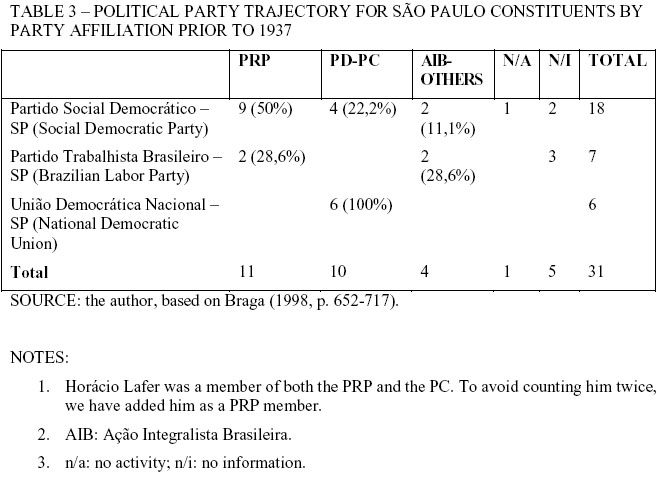
The second piece of evidence that militates against the hypothesis of the "renovation" of the São Paulo state political contingent is that almost 70% of the block of 31 politicians from the PSD + the PTB + the UDN were recruited from parties of the oligarchy.
To the extent that we have been able to determine and considering information available for the period spanning 1910-1937, of the 18 PSD-SP representatives, at least 72% began their careers in the Partido RepublicanoPaulista or the PD-PC; of the seven members of the PTB-SP contingent (whose average age was the lowest) at least two had been in the PRP, and within the aristocratic União Democrática Nacional de São Paulo, or National Democratic Union of São Paulo, all six federal representatives had been in Democratic Party and/or in the Constitutionalist Party, which was its successor14.
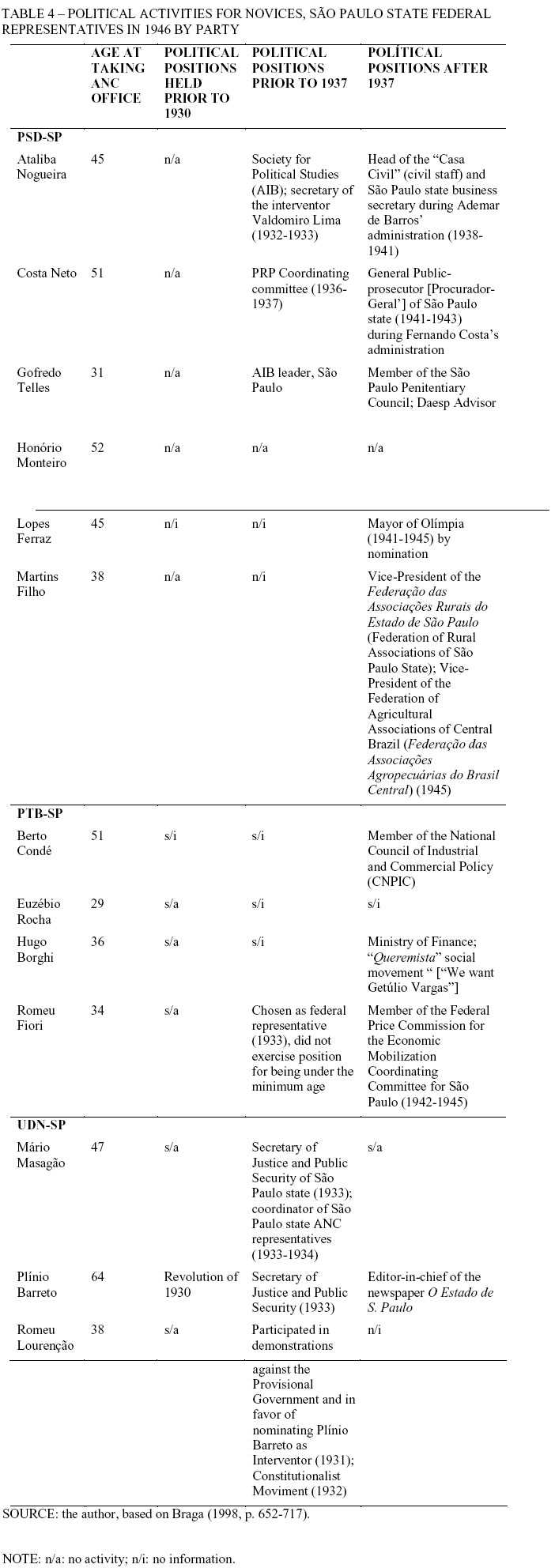
Nonetheless, within our universe of 38 people, there was a reasonable number who were serving their first legislature (almost half, or 18 of them) yet this figure is more revealing of the renovation of cadre at the federal level than of the entrance of novices into the world of elite politics.
Of the 18 novice federal representatives, only one had no previous political or party experience15. All the others had been, at some point in their career, mayors (elected or nominated), state secretaries, leaders of class associations or political parties, political activists, publicity men, members of government institutes, of economic councils, etc.
]]> Table 4 list the political jobs and movements in which PTB-SP, PSD-SP and UDN-had participated or been involved in before or during the Estado Novo.The political trajectory of these 13 men who were taking up a parliamentary mandate for the first time was quite varied, but nonetheless have some similarities.
PSD party members may have begun their careers even before 1937, but what was most fundamental was that for all those on whom information is available (five), the last relevant post immediately before assuming their office as federal representative was a position in the Vargas regime, whether this meant a juridical position in the State apparatus, or political office during the dictatorship (as mayor) or official trade union or syndicate positions.
The PTB follows the same patterns – bureaucratic function within important institutions – and these novices in São Paulo state parliamentary politics are precisely the youngest of the entire contingent. Their difference in relation to the PSD is that the former held state-level political positions while the former held positions in federal apparatuses (National Commission of Industrial and Commercial Politics, or Comissão Nacional de Política Industrial e Comercial (Cnpic) and Economic Mobilization Commission, Comissão de MobilizaçãoEconômica (CME)).
Precisely half of the UDN contingent– Mário Masagão, Plínio Barreto e Romeu Lourenção – were newcomers to the Legistlature. Nonetheless, this information may be rather deceptive. Masagão was Secretary of Justice and Public Security during Armando de Sales Oliveira's period as interventor (in 1933); "from this position", Braga emphasizes, "he was given the task of organizing São Paulo state representatives participation within the National Constituent Assembly (1933-1934)" (BRAGA, 1998, p. 705). Plínio Barreto, in turn, had had a career that was equally active: he was "Secretary of Justice and Public Security after the movement [of 1930] triumphed". "Provisional Governor of the State of São Paulo for a short period (the 6th to 25th of November of 1930). He participated actively and was one of the main civil leaders of the constitutionalist movement which took place in São Paulo, after having been head of the Censorship Services during the rebellion (1932)" (BRAGA, 1998, p. 711). Romeu Lourenção was yet too young to have held party or governmental positions.
In short, without really having had a process of circulation of elites (to come back to Pareto's formula: the substitution of an elite with a counter-elite), a change did occur – which did not amount to a complete renewal, as is demonstrated by the fact that several names remain – in the social and occupational profiles of the political representatives of the São Paulo state political class. This process enabled the rise of the "bacharéis", that is, of a very large group (the largest of the whole contingent) that was separated by its social position and situation from the oligarchy that was in power during the First Republic, thus creating a path for the "intellectual professionalization" of the elite.
It may be that in the São Paulo case, as a result of the specific issues involved, cannot be considered (statistically) representative of the political logic reigning within each state of the federation in the period following 1930 and even with regard to the period that follows 1945. Yet our interest in studying it – despite our awareness of the difficulties involved in testing for validity of hypotheses, causal inferences and reliable generalizations in research in which n=1 (cf. KING, KEOHANE & VERBA, 1994, p. 209) – derives from the fact that it can be seen as an outstanding case (in which the problem we are dealing with is demonstrated in a more intense way) rather than a "crucial case, to use Eckenstein's (1975), term, that is, one that is unique and decisive for the integral definition of the problem we are considering.
In any event, political circumstances in São Paulo accompany and respond to a set of more general historical transformations that are symbolized by the Estado Novo, which qualify and make the influence of the institutional variables stated above more complex: changes in regime form and their impact on principles of political selection; changes in State form and the bureaucratization of political activity, a phenomenon that demands a specific type of political agent.
In order to explain the most salient characteristics of the São Paulo political class in the period that followed 1945 – individuals who did not come from the traditional oligarchies of rural landowners, but were still a product of traditional political machines; politicians who were older than the national average yet not for that reason having the same professional traits as Old Republic politicians – we must keep the structural processes of reconfiguration of the political field in mind. They are indicative of the fact that contextual variables are just as or perhaps even more decisive than strictly institutional ones.
]]> IV. INSTITUTIONALIZATION, AUTONOMIZATION AND PROFESSIONALIZATION
Political professionalization is not a phenomenon to which an exact date can be attached, given the fact that its evolution (in general terms) is unconstant and its chronology, imprecise.
It depends on a wide range of factors, both internal and external to the political field. Thus it becomes difficult to propose an abstract model that can predict the results of the majority of historical situations. Nonetheless, given this particular context, it is possible to identify the special variables that come together in our attempt to explain the issue we are looking at here. All of these contextual variables speak to the transformations that are specific to the political world (given its characteristic autonomy), although we may still be able to establish a relationship of general correspondence between the institutionalization of national State power and changes in the economic base since 1930, or between the professionalization of the political class and the social decadence of state-level oligarchies, since 1937.
With regard to the Estado Novo and these issues, there is a three-fold phenomenon that I think is also interesting in three particular ways, since it points to and expresses, at least initially, three paradoxes. I refer here to three variables constructed inductively: institutionalization, autonomization and professionalization.
First paradox: the season that begins in 1937, with the coup d' etat, is a period of institutionalization of power in its particularly political mode (separate from "economic power") without a de facto or de jureinstitutional politics (parties, parliaments, elections) that institute and legitimate this power. The second paradox refers to this process of the institutionalization of power, which is best witnessed through the constitution of a nationalState side by side with the nationalization of Brazilian political activity (a phenomenon that can be verified only after 1945, thanks to the formation of national political parties which substitute and oppose state-level parties) which occurs together, not with the complete autonomization of the political field but the submission of the logic and values of the political field to those of the bureaucratic field16.
This becomes particularly clear when we analyze even the discourses of Fourth Republic political agents. They incorporate the administrative language of efficiency, efficacy, objectivity, neutrality, etc. which they have inherited from the Third Republic, will all the symbolic benefits (or rather – political and ideological ones) that flow from it and from which they believe they may obtain a living. It is in this context that a specific type of professionalization of political agents occurs: "intellectual professional" in the sense that A. Panebianco (2005) has proposed. Its most salient and disconcerting trait, our third paradox, is that this process is not accompanied by a rhetoric of a set of political convictions that justify or validate it on its own terms, but by a harangue that condemns or negates it explicitly: it is enough to look at the entire political doctrine of this period in which professional intellectuals imagine they can substitute the political class is a process of re-organizing the Nation (cf. PÉCAUT, 1990, p. 22ss.).
Authoritarian rhetoric has, in this case, a two-fold function: while on the one hand it celebrates the despolitization of politics, presenting agents of the State apparatus as technicians in public administration, it at the same time masks the transformations of the social and professional attributes of the political class. Therefore a "new elite" appears in 1946 as if emerging from a process of institutional modernization or national development, or of changing economic bases etc. – but not from the two requirements emerging from the Estado Novo: i) a relatively autonomous political universe which defines its own selection criteria, and legitimate beliefs and attributes specific roles and ii) a complex, extensive and relatively institutionalized ("bureaucratized") administrative apparatus that demands, precisely, an expert's – or someone who can pass himself as such – intervention.
The political world (the state and its power apparatuses are included here as well) may hold an extensive network of formal political institutions and networks, or even contain its own practices, protocols and procedures – that is, be "institutionalized" or be undergoing an institutionalization process) without being (completely) autonomous. In this case, it is (still) guided by an external logical that is derived from another field that is larger, more extensive and more powerful or more legitimated, more prestigious and having more power to impose, through a diversity of mechanisms, its particular norms and rules, inherent values, modes of perception and expression. Therefore, institutionalization does not require complete autonomization.
Furthermore, heteronomy and autonomy are not fixed states, and can within themselves – just as institutionalization itself – incorporate a gradated scale. Ideally, one field can be contained within another, that incorporates and dominates it: two fields can overlap partially, and the intersecting area may be an object of dispute, though it may also be that one cannot be reduced to the other, since they (no longer) share resources, behaviors and values ("capitals" and habitus, to use Pierre Bourdieu's terminology.)
Professionalization, in turn – that is, the process through which specifically political agents are constituted – requires the existence of a relatively autonomous political universe; yet since it is also gradually-emerging (and historically determined by a wide range of variables), it is most likely that these three phenomena – institutionalization, autonomization and professionalization – occur simultaneously and are mutually determining.
]]> There is a perceivable difference between these three conjugated phenomena that, in general, do not have to occur in any particular sequence, although one "logically" presupposes the other: institutionalization (of political power), autonomization (of the political universe) and professionalization (of political agents and practices). It may be possible to draw some parallels, rather than a relationship of causal determination, between the history of the building of the national Brazilian state – and its correlates: institutional differentiation, political centralization, coordination of functions, as C. Tilly (1975) has defined the bureaucratization of its routines and its cadre – its progressive institutionalization as a (real, formal) power that is "separate from society", the process of autonomization of the professional political field and the professionalization of its agents. Or more specifically: that hidden synchrony of causal relationsMy basic contention is that within the environment of the transformations that have been produced, planned or simply inspired by the Estado Novo, a political figure has tended to emerge, even in the midst of the ideology of the rationalization of administrative practices, who lies between the old "notable" (or "oligarch") and the specialist (to whom I have heretofore referred as "professional"). Panebianco has defined this type as the political "semi-professional". He "has economic independence, due to extra-political professional income, as the notable did, and enjoys "a considerable amount of free time" to devote to political activity, as does the professional. Semi-professional politicians are educated and well trained and exhibit specific abilities as experts (they are most frequently lawyers, professors, journalists and doctors) yet are still without great technical ability or experience in highly specialized matters (cf. PANEBIANCO, 2005, p. 460-461).
This figure of transition – just like essayists, writers and scientists, also very popular within the intellectual context of the 1930s – which is at the root of this political class which then went on to made up in its majority by professional politicians and separated from the oligarchy is the result of several basic processes: the concrete process that provided new dimensions to the political universe (through a numeric reduction of political class); the redefinition of who has the right to enter this universe and the subsequent political and ideological filtering of the elite that it made possible (thanks to new systems of control over political nomination) and the bureaucratization of political roles (which lead, ipso facto, to the re-modeling of the social functions of representatives of the "agrarian classes").
One point that should be given salience in this discussion and that has not always been well-situated within analyses yet has in fact had a decisive role in reducing the overlap between the ruling and governing classes was the drastic reduction in the amount of political jobs.
The Estado Novo significantly trimmed down the political class because it significantly limited the positions that were available to politicians. The parameters can be gleaned from Love's (1982) study of 263 individuals who were part of the São Paulo political elite between 1889 and 1937. If we were to continue this research through 1945 adopting identical criteria, the group to be studied would not even amound to 30 people17. If we were to include the 14 members of the Administrative Department of São Paulo state, but subtracting overlapping positions, the total would not amount to even 20% of Love's group. According to (optimistic) estimates, the São Paulo state elite during the Estado Novo period would sum up to a modest 40 people. And perhaps even less. Amaral, adopting criteria similar to those of Love, detected 31 individuals in the Rio Grande elite (cf. AMARAL, 2006, p. 147).
The historical pre-requisite that made all these phenomena possible – elite "purification, numerical limitation of representatives and new forms and new mechanisms of political representation – was the "strengthening" of the federal "state", that is, the increase of state capacities (SCKOPOL, 1985) and, consequently, the growth in the political autonomy and power of the elite that controlled it.
This State – autonomous, strong and bureaucratized – was from this moment on able to reconfigure the nation's political universe, to institutionalize, based on its power, a new form of doing politics. At the same time that it circumscribed and re-oriented the power of the state political elites, it was able to give definitive rise to a political class with the virtues and attributes that the dictatorial regime demanded, further justified with the alibi of the "bureaucratization" of the State and the complexity of its routines. This political class, with its necessary adjustments and broadening, and whose most distinctive attributes are its social origins (in the "middle classes") and its professional profile (men who make a living from politics) then became the reigning group during the Constitution of 1946 regime.
In short: these three "structural" processes of the transformation of the national political universe during the Estado Novo period (which I refer to here as the autonomization of the political field, the institutionalization of State power and the professionalization of political practices) are thus the beginning of the making of a very particular sort of "counter-elite" through a process in which the human resources of the elite itself are recycled.
Contextual (or historical) variables do not deny institutional explanations, but make the latter more complex and complete.
]]> V. CONCLUSIONS
These phenomena, as can be intuited, are relevant for the whole without necessarily studying every and every one of its aspects. São Paulo before and after Vargas is thus a point of departure to go on to better circumscribe the problem of this type of research (historical research on elites), to provide examples of the rules used to define the boundaries of and construct the issue we are dealing with here (how the São Paulo political elite transformsitself) or even to outline what the most relevant problems for this type of theme are (political professionalism). This point of departure allows us, in the end, not only to produce some findings but also to generate some explanatory hypotheses that can be tested in other historical contexts (cf. RUESCHEMEYER, 2003).
In less precise but more descriptive terms: the Estado Novo separated three groups that had earlier on been fused – wealthy men, men of status, and men of power.
As we remember, Love and Barickman's calculations indicated rates of overlap between rulers and owners at an incredibly high 60% at the beginning of the 1930s (cf. LOVE & BARICKMAN, 1986, p. 764), a standard that is quite high even for Latin America (cf. LOVE, 1983).
When we look at the São Paulo state contingent in the 1946 Constituent Assembly, the most relevant characteristic is not generational renewal, of which there is virtually none (40% of the representatives of the the three major parties are 51 years old or more). Rather, it is the fact that the majority of São Paulo's political representation is made up of professional politicians, that is, people whose main activity is politics and who have university (Law) degrees (i. e. the "bacharéis") In the Legislature of the immediate aftermath of the Estado Novo (1946-1951), of the 38 from São Paulo who were elected, only 7 individuals (less than 24%) could be classified as "owners" – and even for this group, almost all had had a political career that ran parallel to this status.
The social, political and professional attributes of the groups defined by the dictatorial regime and sanctioned by the mechanisms and appartuses that were responsible for their recruitment were, in fact, less "elitist" than those which had been typical of the Old Republic, although this did not make them more popular: both in the period spanning 1937-1945 and afterward, there was a rise into the political class of individuals who have come from the middle classes and have Law degrees ("bacharéis") make up 76% of São Paulo state representatives in the ANC) and the near disappearance of landowners from the ranks of political personnel (the "coronéis" make up less than 11%). Yet these factors do not make the political career "meritocratic". The latter stops being "democratic" (that is, formally based on the electoral principle, the golden rule of the Old Republic) to become – during the Estado Novo – "bureaucratic", a fact that paradoxically promotes the rise of political professionals who are now able to introduce themselves, to whomever chooses to believe them, as technicians and specialists in public administration. This, it should be said, is due to the way they have been portrayed through the authoritarian ideology that prevails, particularly after 1945.
This transformation, and controlled and based on strict criteria, articulated by the Estado Novo but not necessarily planned by it, happens this way because it changes the way recruitment is carried out (bureaucratic nomination substitutes "democratic" election) without this promoting radical change in the source of recruitment: that is, the very oligarchic parties that had polarized the political scenario of the end of the II Empire until 1937 (PRP, PD, PC). Thus, the renewal of representatives at the federal level (there were no less than 18 individuals, almost half of the whole contingent, serving their first legislature) did not reflect the substitution of political groups at the state level.
Thus, the central idea is that, rather than being the result of a large program of federal "cooptation", the political elite that reigned during the Estado Novo and through which the political class of the "1946 democracy" is constituted was, to a certain extent, produced by and for the regime. Therefore, it does not only refer to the transposing of members of the elite – individuals – from an oligarchic political field to another (authoritarian) one, in one moment and later, after 1945, the passage of these very individuals from an authoritarian to a democratic one, but rather the domination, decapitating and assimilation of the old elites in order to produce a new governing class: a process which fuses with what Gramsci designated as transformism (GRAMSCI, 2002, p. 63).
REFERENCES
]]>AMARAL, S. M. 2006. O teatro do poder: as elites políticas no Rio Grande do Sul na vigência do Estado Novo. Porto Alegre. Tese (Doutorado em História). Pontifícia Universidade Católica do Rio Grande do Sul. [ Links ]
ARTOUS, A. 1999. Marx, l'Etat et la politique. Paris: Syllepse. [ Links ]
BEST, H. &COTTA, M. (eds.). 2000. Parliamentary Representatives in Europe, 1848-2000: Legislative Recruitment and Careers in Eleven European Countries. Oxford: Oxford University. [ Links ]
BIELSCHOWSKY, R. 2000. Pensamento econômico brasileiro. O ciclo ideológico do desenvolvimento. 4ª ed. Rio de Janeiro: Contraponto. [ Links ]
BLACK, G. S. 1970. A Theory of Professionalization in Politics. American Political Science Review, Washington, D. C., v. 64, n. 3, p. 865-878, Sep. [ Links ]
]]>BOURDIEU, P. 1989. La noblesse d'État: grandes écoles et esprit de corps. Paris: Minuit. [ Links ]
_____. 1998. A representação política. Elementos para uma teoria do campo político. In: _____. O poder simbólico. 2ª. ed. Rio de Janeiro: B. Brasil. [ Links ]
_____. 2000. Conference: le champ politique. In: _____. Propos sur le champ politique. Lyon: Presses Universitaires de Lyon. [ Links ]
BRAGA, S. S. 1998. Quem foi quem na Assembléia Constituinte de 1946: um perfil socioeconômico e regional da Constituinte de 1946. V. II. Brasília: Câmara dos Deputados. [ Links ]
CARVALHO, J. M. 1996. A construção da ordem: a elite política imperial. Teatro de sombras: a política imperial. 2ª ed. Rio de Janeiro: Relume-Dumará. [ Links ]
]]>CONNIFF, M. L. 1989. The National Elite. In: CONNIFF, M. L. & MCCANN, F. D. (eds.). Modern Brazil: Elites and Masses in Historical Perspective. Lincoln: University of Nebraska. [ Links ]
DOGAN, M. 1999. Les professions propices à la carrière politique. Osmoses, filières et viviers. In: OFFERLE, M. (dir.). La profession politique: XIXe-XXe siècles. Paris: Belin. [ Links ]
EAGLETON, T. 1997. Ideologia. São Paulo: UNESP. [ Links ]
ECKSTEIN, H. 1975. Case Study and Theory in Political Science. In: GREENSTEIN, F. I. & POLSBY, N. (eds.). Handbook of Political Science. V. 7: Strategies of Inquiry. Readding: Addison-Wesley. [ Links ]
FREYRE, G. 1943. A propósito do Presidente. In: ANDRADE, A. (org.). O pensamento político do Presidente. Separata de artigos e editoriais dos primeiros 25 números da revista Cultura Política comemorativa do 60º aniversário do Presidente Getúlio Vargas. Rio de Janeiro: Imprensa Nacional. [ Links ]
]]>GERTH, H. &WRIGHT MILLS, C. 1970. Caráter e estrutura social. In: Amorim, M. S. (org.). Sociologia Política. Rio de Janeiro: J. Zahar. [ Links ]
GRAMSCI, A. 2002. Cadernos do cárcere. V. 5: O Risorgimento. Notas sobre a história da Itália. Rio de Janeiro: Civilização Brasileira. [ Links ]
KING, G.; KEOHANE, R. O. &VERBA, S. 1994. Designing Social Inquiry: Scientific Inference in Qualitative Research. Princeton: Princeton University. [ Links ]
LOVE, J. 1982. A locomotiva: São Paulo na federação brasileira (1889-1937). Rio de Janeiro: Paz e Terra. [ Links ]
_____. 1983. Um segmento da elite política brasileira em perspectiva comparativa. In: A revolução de 1930: seminário internacional. Brasília: UNB. [ Links ]
]]>LOVE, J. L. &BARICKMAN, B. J. 1986. Rulers and Owners: A Brazilian Case Study in Comparative Perspective. The Hispanic American Historical Review, Durham, v. 66, n. 4, p. 743-765, Nov. [ Links ]
_____. 1991. Regional Elites. In: CONNIFF, M. & MCCANN, F. (eds.). Modern Brazil: Elites and Masses in Historical Perspective. Lincoln: University of Nebraska. [ Links ]
MILIBAND, R. 1970. The Capitalist State – Reply to N. Poulantzas. New Left Review, London, n. 59, p. 53-60, Jan.-Feb. [ Links ]
NORRIS, P. &LOVENDUSKI, J. 1997. United Kingdom. In: NORRIS, P. (ed.). Passages to Power: Legislative Recruitment in Advanced Democracies. Cambridge, UK: Cambridge University. [ Links ]
PANEBIANCO, A. 2005. Modelos de partido: organização e poder nos partidos políticos. São Paulo: M. Fontes. [ Links ]
]]>PÉCAUT, D. 1990. Os intelectuais e a política no Brasil: entre o povo e a nação. São Paulo: Ática. [ Links ]
POULANTZAS, N. 1969. The Problem of the Capitalist State. New Left Review, London, n. 58, p. 67-78, Nov.-Dec. [ Links ]
RANNEY, A. 1965. Pathways to Parliament: Candidate Selection in Britain. Madison: University of Wisconsin. [ Links ]
RODRIGUES, L. 2006. Mudanças na classe política brasileira. São Paulo: Publifolha. [ Links ]
RUESCHEMEYER, D. 2003. Can One or a Few Cases Yield Theoretical Gains? In: MAHONEY, J. & RUESCHEMEYER, D. (eds.). Comparative Historical Analysis in the Social Sciences. Cambridge, UK: Cambridge University. [ Links ]
]]>SANTOS, A. M. 2000. Não se fazem mais oligarquias como antigamente: recrutamento parlamentar, experiência política e vínculos partidários entre deputados brasileiros (1946-1998). Porto Alegre. Tese (Doutorado em Ciência Política). Universidade Federal do Rio Grande do Sul. [ Links ]
SCHUMPETER, J. A. 1984. Capitalismo, socialismo e democracia. Rio de Janeiro: J. Zahar. [ Links ]
SCHWARTZMAN, S. 1975. São Paulo e o Estado nacional. São Paulo: Difel. [ Links ]
SKOCPOL, T. 1985. Bringing the State Back In: Strategies of Analysis in Current Research. In: EVANS, P. E.; RUESCHEMEYER, D. & SKOCPOL, T. (eds.). Bringing the State Back In. Cambridge, UK: Cambridge University. [ Links ]
SOUZA, M. C. C. 1990. Estado e partidos políticos no Brasil (1930 a 1964). 3ª ed. São Paulo: Alfa-Ômega. [ Links ]
]]>TILLY, C. 1975. Reflections on the History of European State Making. In: _____ (ed.). The Formation of National States in Western Europe (Studies in Political Development). Princeton: Princeton University. [ Links ]
VARGAS, G. 1938. Proclamação ao povo brasileiro ("À Nação"). Lida no Palácio Guanabara e irradiada para todo país na noite de 10 de novembro de 1937). In: _____. A nova política do Brasil. Vol. V: O Estado Novo (10 de novembro de 1937 a 25 de julho de 1938). Rio de Janeiro: J. Olympio. [ Links ]
WEBER, M. 1993. Conferência sobre o socialismo. In: FRIDMAN, L. C. (org.). Socialismo: Emile Durkheim, Max Weber. Rio de Janeiro: Relume-Dumará. [ Links ]
_____. 1994. The Profession and Vocation of Politics. In: LASSMAN, P. & SPEIRS, R. (eds.). Weber: Political Writings. Cambridge: Cambridge University. [ Links ]
_____. 1999. Economia e sociedade. Fundamentos da Sociologia Compreensiva. V. 2. Brasília: UNB. [ Links ]
]]>WRIGHTMILLS, C. 1981. A elite do poder. 4ª ed. Rio de Janeiro: J. Zahar. [ Links ]
1 I extend my gratitude to Sérgio Braga (Universidade Federal do Paraná (UFPR)), Luiz Domingos (Facinter) and Bruno Bolognesi (UFSCar), members of the Research Group on Brazilian Political Sociology at the Federal University of Paraná (Núcleo de Pesquisa em Sociologia Política Brasileira, UFPR) for reading and providing suggestions on this paper.
2 A classic reference on this issue is Black (1970).
3 See Weber (1999, p. 544-560). For an empirical test of this hypothesis, see Best and Cotta's study (2000). It analyzes the relationship between social origin and political career in 11 European countries, during the period that spans 1848 to 2000.
4 Which is to say: changes in the ruling class cannot only be explained as a reflection of changes in social structure. For a well-thought out discussion on this matter, see Rodrigues (2006, p. 165-174).
5 In particular, see Poulantzas (1969) and Miliband (1970).
6 Thus, when I write that the transformation of the social profiles of state political elites is equally the effect of restrictions imposed on the political scene and institutions imposed by the state system, what in fact I want to say is that it is an effect of both things. There is here neither a logical priority nor a fixed causal hierarchy, although "historically" (this is to say, within this specific context) the first (1930-1937) has chronologically precede the second (from 1937 onwards).
]]> 7 For purposes of comparison, see Love and Barickman (1991, p. 7). This data can be found in Love (1983, p. 88-89).8 Data on Argentina refer to a average of several moments between 1889-1946; data on the USA cover the years 1877-1934; Mexican data cover the 1917-1940 period.
9 Santos has demonstrated that between 1946 and 1998 the total of agricultural property owners summed up to that of urban entrepreneurs varied from a minimum of 10,2% (1978) to a maximum of 37,2% (1990). During the "populist" period, the average was 23,1% (see Santos, 2000, p. 84, Graph. 5). I have put the percentages together myself, using data supplied by the author.
10 They were: Hugo Borghi (Partido Trabalhista Brasileiro (PTB)) (banker); Horácio Lafer (Partido Social-Democrático (PSD)); João Abdala (PSD); Machado Coelho (PSD); Paulo Nogueira Filho (União Democrática Nacional (UDN)) (industrialist); César Costa (PSD); Martins Filho (PSD); Sampaio Vidal (PSD); Toledo Piza (UDN) (large landowners).
11 Party acronyms and complete names as follows: PRP: Partido Republicano Paulista (São Paulo Republican Party); PD: Partido Democrático (Democratic Party); PC: Partido Constitucionalista (Constitutionalist Party).
12 The complete list of all representatives who have university degrees in Law, as follows: Altino Arantes (PR); Alves Palma (PSD); Antônio Feliciano (PSD); Ataliba Nogueira (PSD); Aureliano Leite (UDN); Batista Pereira (PSD); Berto Condé (PTB); César Costa (PSD); Cirilo Júnior (PSD); Costa Neto (PSD); Euzébio Rocha (PTB); Gofredo Telles Jr. (PSD); Honório Monteiro (PSD); Horácio Lafer (PSD); José Armando (PSD); Machado Coelho (PSD); Manuel Vítor (PDC); Marcondes Filho (PTB); Mário Masagão (UDN); Martins Filho (PSD); Novelli Júnior (PSD); Paulo Nogueira Filho (UDN); Plínio Barreto (UDN); Romeu Fiori (PTB); Romeu Lourenção (UDN); Sampaio Vidal (PSD); Sílvio de Campos (PSD); Toledo Piza (UDN).
13 Regarding the age groups of constituents by party in the National Constituent Assembly (Assembléia Nacional Constituinte (ANC), see Braga (1998, v. I, p. 66, Tab. 9, p. 66). However, the aggregates and age groups I have set up here on my own are different from those of the authors.
14 Of these 31 constituints, we are lacking reliable information on the previous party affiliation of five of them: Lopes Ferraz e Martins Filho (do PSD-SP); Berto Condé, Euzébio Rocha e Hugo Borghi (do PTB-SP). The latter two, in addition to Martins Filho, were when they took their ANC seats too young to have previously belonged to the oligarchy's institutions (see Table 4).
15 From the PSD, Honório Monteiro (substitute; he took his mandate by substituting Gastão Vidigal when the latter became Finance Minister. He had been a university professor (chair in Commercial Law at the Faculdade de Direito de São Paulo) and headed only administrative positions in state university institutions during the Estado Novo period (BRAGA, 1998, p. 671-672).
16 Souza has presented a very similar version on this theme through a well-known hypothesis: Brazilian politics, during the 1946-1964 period, and in particular, the configuration of the party system, was conditioned by two variables inherited from an earlier period: the authoritarian ideology of an authoritarian state elite (antiliberal, antidemocratic, anti-political party, antiparliament, etc.) and the institutional structure of the Estado Novo (centralized decision-making, hypertrophied executive power, etc.) (see Souza, 1990, p. 63-136).
]]> 17 I arrived at this figure by adding all the secretaries of state for all three interventors (there were seven secretariats: Justice, Internal Revenue and Treasury, Transport and Public Works, Health and Education, Agriculture, Industry and Commerce, Public Security and Political Government (Secretaria de Governo), the chiefs of the state-level Executive and the capital city's mayor, plus Department of Municipalities heads (nominated by the Interventor). ]]>