Recentralizando a federação?
Recentralisation de la federation?
Maria Hermínia Tavares de Almeida
University of São Paulo
Translated by Meryl Adelman ]]>
Translation from Revista de Sociologia e Política, Curitiba, n.24, p.29-40, June 2005.
ABSTRACT
This paper discusses the contradictory impulses towards decentralization and centralization in Brazil during the 1990s and early 2000s. After discussing the analytical issues related to the specific nature of decentralization in federal systems, the paper examines two sets of policy issues: those regulating the fiscal relations between national and sub-national governments and those redefining responsibilities for social services provision (basic education, health care, social assistance). Against conventional academic wisdom, it sustains that although there has been some re-centralization of fiscal decisions and of targeted income transfer programs, a clear re-centralization tendency cannot be siad to exist. Decentralization and centralization trends coexist propelled by different forces, with different motives and different outcomes.
Keywords: centralization; de-centralization; democratization; fiscal relations; social welfares.
RESUMO
Este trabalho discute os movimentos contraditórios no sentido da descentralização e da centralização examinando dois conjuntos de políticas: as que trataram de regular as relações fiscais entre os governos nacional e subnacionais e aquelas que redefiniram as responsabilidades no tocante à provisão de alguns serviços sociais. Sustenta-se aqui que, do ponto de vista das relações intergovernamentais, a federação brasileira é um arranjo complexo em que convivem tendências centralizadoras e descentralizadoras, impulsionadas por diferentes forças, com motivações diversas, produzindo resultados variados.
Palavras-chave: centralização; descentralização; democratização; relações fiscais; serviços sociais.
RÉSUMÉ
]]>Ce travail discute des mouvements contradictoires concernant la décentralisation et la centralisation et examine deux ensembles de politiques: celles qui ont tâché de réglementer les relations fiscales entre les gouvernements national et sousnationaux et celles qui ont redéfini les responsabilités en ce qui concerne la provision de certains services sociaux. On prône ici que, du point de vue des relations entre les gouvernements, la fédération brésilienne est un arrangement complexe où cohabitent des tendances centralisatrices et décentralisatrices, poussées par différents forces, aux motivations diverses et qui produisent des résultats variés.Mots-cles: centralisation; décentralisation; démocratisation; relations fiscales; services sociaux.
After a decade of steadfast decentralization is Brazilian federation undergoing a process of re-centralization? Academic conventional wisdom, both within and outside Brazil, seems to say that indeed it is.
Decentralization was a major issue of the Brazilian democratization agenda, during the 80s. The bureaucratic-authoritarian regime (1964-1984) concentrated decisions, financial resources and administrative capacities at federal level. The country became an extreme case of centralized federalism1, almost undistinguishable from a unitary polity.
Therefore, it was only too natural that democratic opposition to military rule took decentralization as one of its most cherished aims, together with social justice, rule of law and citizens participation. Decentralization to the local level was argued for in the name of democracy as much as in the name of governmental efficiency and efficacy. It would supposedly allow for citizens' influence in decision-making, as well as for citizens' control over government actions, reducing red tape, clientelism and corruption.
At the dawn of the democratic regime, decentralizing fiscal resources and governmental responsibilities was an almost consensual aspiration in public opinion and social movements, as well as among state governors and thousands of local politicians who sought to retrieve the power lost under authoritarian rule.
Nevertheless, decentralization has been neither a smooth nor a straightforward process. Quite to the contrary, powerful centralizing trends have also been in operation in recent Brazilian democratic experience.
This paper discusses these contradictory impulses towards decentralization and centralization, examining two sets of policy issues: those regulating the fiscal relations between national and sub national governments and those redefining responsibilities for social services provision. I sustain that there is no unambiguous re-centralization going on. In reality, decentralization and centralization trends coexist, propelled by different forces, responding to different motivations and producing a variety of results.
]]>These two sets of policies provide a privileged vantage point for observing the simultaneous and conflicting movements of decentralization and centralization, over the last two decades.Concentration of fiscal resources at the federal level was a hallmark of bureaucratic authoritarianism in Brazil. On the other hand, since 1930, the widening of governmental action in the social domain has paralleled political centralization as well as the concentration of power at the Federal Executive. Moreover, the Brazilian social protection system was created, expanded and featured during two authoritarian cycles – that of Vargas (1930/1945) and that of the military (1964/1984). Therefore, not only were social policies associated to the growing activity of the federal administration which occurred in almost all federal democracies around the world. They also exhibited the marks of authoritarian conceptions that took on material form in the predominance of federal Executive agencies, of closed decision-making procedures and administration by huge and insulated central bureaucracies.
Thus, in post-authoritarian Brazil, the redefinition of competences among governmental spheres dealt mainly – even if not exclusively – with social policies and programs. Therefore, it is here that the dilemmas involved in that process can be clearly seen.
On the other hand, fiscal federalism is the backbone of intergovernmental relations. The way fiscal and para-fiscal resources are generated and distributed among different levels of government defines, to a large extent, the actual features of the Brazilian federation.
In the first part of this paper, I review some analytical issues regarding centralization/decentralization processes in federal systems. In the second section, I analyze decentralization and re-centralization trends regarding fiscal relations between national and sub national governments. In the third, I examine the same trends in the process of changing governmental responsibilities regarding education, health care and social assistance. Finally, some conclusions are presented.
FEDERALISM AND DECENTRALIZATION
By decentralization I mean the “transfer of authority and responsibility for public functions from the central government to intermediate and local governments or quasi-independent government organizations and/or the private sector”(THE WORLD BANK, 2002).
Nevertheless, decentralization is an elusive term. It has been used indistinctively to describe various degrees and forms of changing national government' s role through: a) conveying decision-making capacity regarding policies and fiscal capacities to sub national authorities; b) transferring responsibilities for the implementation and administration of policies and programs defined at federal level to other spheres of government; or c) shifting national government's attributions to the private or non-governmental sectors.
In other words, the term has been applied to processes of political and fiscal decentralization or relocation, where functions and corresponding resources are transferred to sub-national spheres; to administrative decentralization or consolidation, when centralized resources are used to finance decentralized functions; to market decentralization or devolution, when the governmental functions are discontinued and, consequently, their resources are terminated (BEER, 1988: XV).
]]>However, each of these forms has very different consequences on intergovernmental relations. Consolidation is perfectly compatible with a high degree of activism and concentration of decision-making capacities at the federal level. Actually, they co-exist even in centralized federations, especially as far as social policies are concerned. On the other hand, relocation and devolution suppose either a broader redefinition of the central government's scope of action or, in the second case, a reduction in the activity of all governmental spheres.In addition to the conceptual fuzziness of the centralization-decentralization issue, it remains true that governmental growth has nowhere been a zero-sum game. On the contrary, centralization and decentralization have been concomitant rather than mutually exclusive2. Thus, there is no reason to think that decentralization inexorably implies the decrease in importance of the national government. It can result either in the creation of new fields for action, or in the definition of new, normative, regulative and re-distributive roles that coexist with the expansion of sub-national governments responsibilities.
Decentralization/centralization issues also have different meanings and different consequences when they refer either to unitary states or to federal systems.
The relationship between federalism and decentralization, in conceptual and empirical terms, is far from being simple and uncontroversial.
William Riker (1975) describes the making of federal systems as a process of political centralization. Rational actors – individual and/or political units – form alliances and agree upon creating a central government, which will absorb some of the political assignments which previously belonged to its constituent units3. And, as Riker goes on to say, the only meaningful classification of federations is one that is based on the degree to which the “actual locus of decision making is changed from the governments of the constituent units to the central government” (Riker, 1975:132).
In turn, Daniel Elazar (1987) points out that federations constitute non-centralized structures, emphasizing how they differ from decentralized states structures4: According to him, in its original form, as well as in its normative definition, federalism is characterized by non-centralization, i.e., by the diffusion of governmental powers among many centers, whose authority does not derive from the delegation of a central power, but is conferred by popular suffrage. In the same vein, Vincent Ostrom (1994: 225) has suggested that policentricity is — and should be — the proper organizational form for a federal and democratic polity5.
Elazar and Ostrom have tried to capture the specific traits of federal political organization in contrast to a unitary polity. In this sense, their concept is more precise than Riker's. But Elazar and Ostrom's definitions seem to match a type of federal arrangement usually called dual federalism. It corresponds to the original - and North American — federal model, simultaneously descriptive and prescriptive, in which “the powers of the general and state government, even if they exist and are wielded within the same territorial limits, constitute distinct and separate sovereignties that act separately and independently, in their own spheres” (ACIR, 1981:3).
Nevertheless, contemporary federations do not fit into the dual federalism model. They are best described by one of the two other types that capture the transformation of the dual arrangement, due to the universal expansion of the scope of the federal government, i.e. due to a more or less accentuated centralization process. The first one is centralized federalism, when state and local governments almost become administrative agents of a national government with strong involvement in sub-national matters, priority in decision-making and in the control of financial resources6. The second type is cooperative federalism, characterized by forms of joint action among government echelons, where sub-national units maintain significant decision- making autonomy and capacity for self-financing7. This is a very complex arrangement since it may combine relocation and consolidation procedures.
Last but not least, it is important to consider that, in spite of the fact that some degree of centralization characterizes the existing forms of federal arrangements, all have built-in mechanisms that prevent them from becoming unitary states. In other words, federations have an institutional design that multiply veto points8 and pushes towards some degree of decentralization.
In short, neither Elazar nor Riker's definition nor typology criteria seem fully adequate, especially as far as contemporary cooperative federalism is concerned. There is more to it than non-centralization. On the other hand, using degrees of centralization as a criterion for classification oversimplifies the range of institutional possibilities that stem from cooperation between levels of government.
]]>FISCAL FEDERALISM IN DEMOCRATIC BRAZIL9
The new democratic Constitution (1988) translated Brazilian society's thrust towards decentralization into a set of rules. Federal system was thus reshaped, in favor of states and municipalities (Selcher, 1989; Leme, 1994, Souza, 1997). These were formally recognized as federative entities ("entes federativos") with the same legal status as states and the federal government.
Although governors' and mayors' political strength grew significantly during transition from authoritarianism to democracy, constitutional rules favoring decentralization cannot be explained only by their direct influence. State governors certainly were active during the Constitutional Assembly sessions, in 1988, as were mayors and their associations. On the other hand, approximately half of the representatives had previously served in sub-national governments or sub-national assemblies10. But support for decentralization was wide, and encompassed very significant political forces, with or without links to sub-national interests. Democracy plus decentralization was a dominant political idea and as such had a power of its own.
Due to constitutional rules, states' taxation powers grew as they were granted the right to tax oil, minerals, transportation and telecommunications. Fiscal resources were redistributed in detriment of federal government, due to the increase of federal revenues shared with sub-national governments. Revenues transferred from states to municipalities also increased. In 1985, the State Participation Fund (FPE) and the Municipal Participation Fund (FPM) amounted to 14 percent and 16 percent of federal tax revenues, respectively. In 1993, they peaked at 21.5 percent and 22.5 percent of federal tax revenues. Furthermore, 10 percent of the federal Industrial Production Tax (IPI) went to a special compensation fund to reimburse the states for not taxing exports of manufactured goods. And 3 percent of both the Income Tax and the IPI went to a regional development fund for supporting projects in the North, Northeast and Center-West regions.of the country.
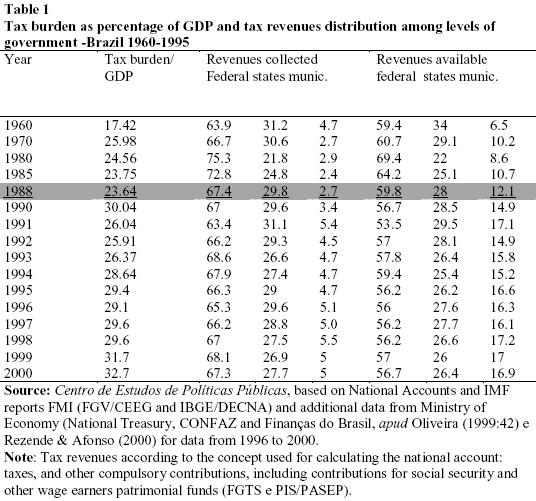
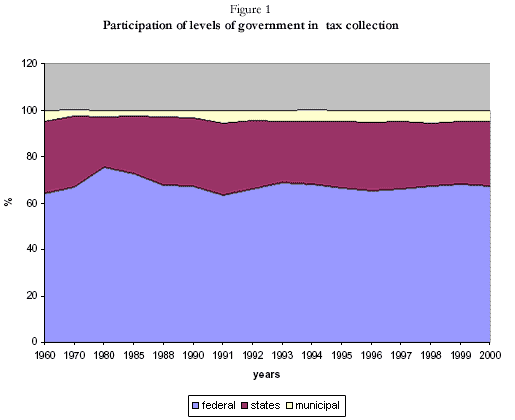
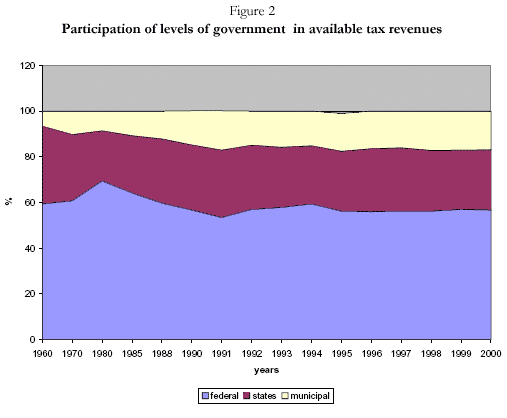
After 1988, a stable pattern of decentralization of tax resources benefited states and, above all, municipalities. The turning point was undoubtedly the new Constitution. Table 1 and Figures 1 and 2 show these changes in different ways. Besides, as Afonso and Lobo (1996) have pointed out, decentralization also meant redistribution in regional terms, benefiting the poorer and less developed states and municipalities11.
]]>
However, the 1988 Constitution, while increasing the portion of federal revenues shared with sub-national governments, gave new fiscal breadth to federal administration, allowing for the expansion of fiscal-fiscal resources – social contributions — specifically meant to fund social policies. Besides, during the 90s a non-shared provisional contribution — Provisional Contribution on Financial Operations (CPMF) – was created to fund federal expenditures. According to Rezende & Afonso (2000:11) a “dual fiscal regime” was thus put in place. Throughout the 90s, social contributions have been an important mechanism used by the federal government to compensate revenues loss due to fiscal decentralization, as shown in Figure 3. Social contributions that in 1980 amounted to 4.9 percent of total federal revenues grew to 20 percent in 2000.
]]>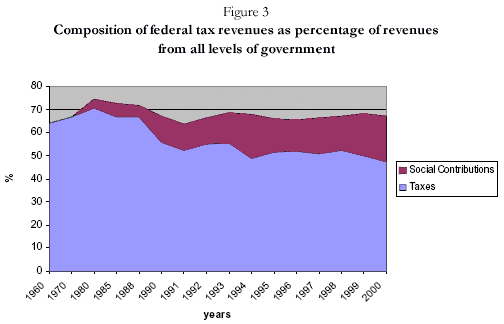
The increase of social contributions does not provide evidence of re-centralization, as some analysts have supposed Rather, it is an expression of the obstacles that lie in the way of change of in the established pattern of fiscal decentralization through tax revenue sharing. These contributions had to increase because the distribution of shared revenues among the three spheres of government could not be changed to benefit the national government.
However, trends towards restricting sub-national governments' actual capacity to fully exercise their constitutional fiscal autonomy did show up12. They appeared in two types. The first resulted from the way federal government tried to cope with macroeconomic constraints related to anti-inflationary and stabilization policies, especially after the Real Plan (1994). The second was a consequence of the very efforts that were made to guarantee resources to social programs.
Negotiating state debts has been a crucial part of successful anti-inflationary strategy.. In the 1980s and early 1990s, while inflation was steadily rising, state governments practiced soft budget policies, increasing their indebtedness towards federal financing institutions. Although three rounds of renegotiation of state debts with the federal government took place between 1989 and 199313, the financial situation of most of states, when the Real Plan brought stabilization, was dreadful14. This included state-owned banks, which had been used by governors to increase their expending capacities for political and electoral purposes15.
The conviction that states and municipalities tended to free-ride federal government efforts towards stabilization and economic adjustment fed a conventional wisdom about the supposed incompatibility of having a decentralized federation and maintaining fiscal austerity. The idea that sub-national governments' autonomy – especially the autonomy to define expenditures and allocate revenues — should be put in some way under control captured the hearts and minds of significant groups of the Brazilian elite16. The previous consensus on the virtues of decentralization somehow dwindled under the pressure for monetary stabilization and economic adjustment.
After the Real Plan and under the Fernando Henrique Cardoso administration (1994-2000), the terms of renegotiation of state debts changed dramatically. In three new rounds, the federal government eventually came to impose very stringent conditions aiming at adjusting state fiscal accounts, establishing “targets for the total debt, primary surplus, wage costs, tax collections and privatization” (Rezende & Afonso, 2000:15)17. An important result of this process was the loss of states' control over their banks, which were put under federal administration and then privatized, liquidated or transformed in other kinds of financial agencies. Very few of them remained in state hands.
Following state debts renegotiations came the Fiscal Responsibility Law (LRF), proposed by the federal Executive and approved by the national Congress in 2000. The Fiscal Responsibility Law was a specific – and centralized — response to the challenge of coordinating fiscal behavior in a federation and controlling free riding at sub-national level. It aimed at assuring fiscal discipline at all levels of government, but the constraints it laid on states and municipalities' autonomy were unyielding18. Although new law also concerned the national government, it undoubtedly meant limiting, by way of federal rule, the actual freedom of states and municipalities to allocate their revenues. International experience shows that there were other alternatives, such as having the states issue their own fiscal responsibility rules, coaxed by federal incentives (Webb, 2003).
The second way of imposing limits on sub-national governments' fiscal autonomy was related to provisions meant to assure either the regularity and stability of resources to social programs or their proper usage.
]]>Under soaring inflation and acute economic instability, the urgency of reducing poverty and extreme social inequalities gave birth to the idea of earmarking governmental revenues for specific social expenditures. Even before the new Constitution had been promulgated, Congress approved spending 18 percent of federal net tax revenues and 25 percent of states and municipal net tax revenues on education. In 2000, Congress decreed that 12 percent of the net tax revenues of federal, state and municipal governments should be spent on health care.Nonetheless, federal resources transferred to sub-national units in order to fund social policies are usually categorial grants-in-aid for specific purposes and entail stringent spending requirements. They hold the complex web of intergovernmental relations through which basic social services are provided together. This is my next subject.
SOCIAL POLICIES IN THE NEW FEDERATION
The redefinition of competences and attributions in the social sphere in Brazil, focused in this paper, is part of a wider process of change from an extreme form of centralized federalism, build up under the authoritarian regime, to some sort of cooperative federalism. Thus, it is a decentralizing process different from those occurring in unitary states. It involved reshaping federal government functions and implied simultaneous processes of relocation, consolidation and even devolution of functions previously situated within the orbit of central power.
For the political forces that guided Brazil's extrication from the authoritarian regime, decentralization was another name for democratization. And decentralization essentially meant empowering local governments. Whose responsibility was it to providing the basic social services at stake? The democratic movement answered that municipalities should account for them as much as possible.
The first civilian federal administration (José Sarney, 1985-1989) took the initial steps to decentralize social policies, redefining federal, state and local governments' responsibilities. Thus began, f or instance, the reform of health policy.
The 1988 Constitution redrew the Brazilian federal system according to the democratic political mood of the times: a decentralized cooperative federalist model should prevail in the domain of social policy. The Constitution established shared competences between the union, states and municipalities regarding the provision of health care, social assistance, education, culture, housing and sanitation provision; environment, cultural and historical heritage protection; poverty alleviation and the protection of disabled and vulnerable social groups. Complementary laws should define forms for cooperation among the three levels of government (1988 Constitution, article 23).
On the other hand, rival legislative competencies19 were granted to federal and state levels on a broad range of issues, among them: natural resources and environment protection; cultural, artistic and historical heritage conservation; education, culture and sports; petty claims courts; health and social security; legal aid; protection of children, youths and the disabled; and the organization of the civil police force (Constitution, article 24).
In addition to these general provisions and an extensive list of social rights, the new Brazilian Constitution contained a whole chapter on the social order, with guidelines for social security, education, culture, ports and science and technology20. Guidelines regarding health care were particularly detailed to include the blueprint for a unified21 and decentralized system called the Unified Health System (SUS) that embodied a clear conception of cooperation among different governmental levels.
]]>During the 1990s, extensive legislation and administrative rules gave real content to the Constitution's clauses. Rather than a coherent and one-shot policy, decentralization has been a long and spasmodic process. Its success rested on the federal government willingness to relinquish decision-making power and resources, on its ability to design incentives that are sufficient to coax municipalities into accepting new responsibilities, and on actual local administrative capacities.Although there was a general trend toward increasing local governments responsibilities from within a cooperative federalism framework, decentralization meant different things and had different rhythms and results, according to each specific policy design and to the previous distribution of competencies and financial control among the three levels of government.
Successful municipalization of basic health care, of the first four years of basic education and of social welfare programs was contingent upon the macroeconomic environment, federal government willingness to give up powers and responsibilities and its ability to issue laws or administrative rules that gave adequate incentives to municipalities otherwise reluctant to take on new responsibilities22. The exception was public housing, which experienced a kind of decentralization by default. The collapse of federal housing programs in the 80s led to new initiatives in some states and metropolitan areas.
Although every federal administration since the end of military rule gave the municipalization of social services high priority on its public policy agenda and local authorities publicly clamored for it, actual initiatives prior to 1994 were hindered by monetary disorder and failed economic adjustment efforts as much as by ill-designed decentralization policies.
Economic instability and initiatives to control federal deficit turned the transfer of resources that should follow relocation of responsibilities into a hazardous process. Under extremely high rates of inflation, the federal government benefited from delaying due transfers to municipalities. Furthermore, cumbersome efforts to reduce fiscal deficit sometimes resulted in actual reduction of categorial grants-in-aid sent to local governments. Uncertainty about funds available made municipalities cautious or even averse to accepting new functions.
However, decentralization, especially in federal states, entangles governmental capacity for institutional innovation and political ability to negotiate with sub-national authorities. Neither are easy to acquire nor can be taken for granted. In Brazil it took time before federal government could generate the appropriate institutions for assuring municipalization and inter -governmental cooperation23.
Table 2 synthesizes information on the decentralization of basicl education, primary health care, public housing and social welfare services.
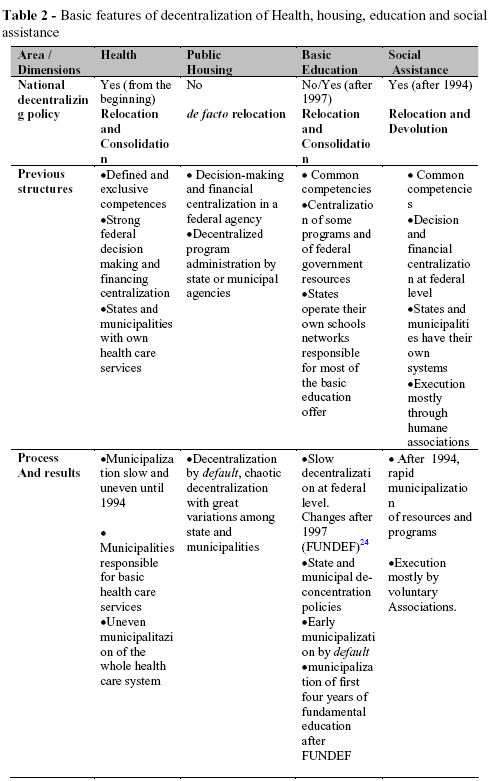
Despite its shortcomings, a decentralized cooperative arrangement eventually imposed itself on major and traditional arenas of social policy.
At the same time, starting the 90s, a new generation of social policies – targeted conditional cash transfer programs – were put in place. They were initially a result of local government initiatives in a few cities and state capitals25.. In time, a few state governments came to develop their own targeted programs, whether articulated or not with municipal efforts. Nevertheless, after 1998, the Cardoso administration created six different targeted conditional cash transfer programs, all of which were centralized at the federal level, although managed by different ministries. All programs delivered monthly payments directly to poor persons that had been previously enrolled in them, through a special account at a federal bank agency. The rationale for centralization, according to federal authorities, was the need for efficient forms of coping with extreme poverty, avoiding their instrumentalization by pork-barrel politics at local level. At present, the Lula da Silva administration is discussing the unification of the six existing programs under centralized federal government control.
In short, while decentralized arrangements and intergovernmental cooperation has prevailed in traditional areas, such as health care, basic education and social welfare, new social policies aimed at reducing poverty have reintroduced the centralization of decision-making power, financial resources and task implementation at the federal level.
CONCLUSIONS
Nowadays, the Brazilian federation is much more decentralized than it had been under authoritarian rule. Democracy stimulated strong interests and ideas on decentralization. Parties and politicians who opposed the military rule considered decentralization as part and parcel of the construction of a democratic polity. Furthermore, sub-national interests proved to be a powerful force during transition from authoritarianism and democratization. Governors had played a crucial part in undermining the military rule after 1982. Mayors and local politicians were also important in the political changes of this period.
Trends towards decentralization crystallized in institutions that reshaped the federal system as a complex cooperative arrangement in which municipalities expanded their fiscal resources, competencies and responsibilities in providing social services. During the 17 years after the promulgation of the 1988 Brazilian Constitution, important responsibilities for the provision of health care, basic education and social welfare have been slowly transferred to municipal governments while the role of states and especially of federal government has been redefined. Federal government has been particularly important in crafting decentralization and inter- governmental cooperation in providing social services.
Federal government has also been crucial in achieving monetary stabilization and in the search for fiscal balance, however fragile it may be. The particular policies with which it has attempted to tackle both challenges has undoubtedly placed constraints on the autonomy of states and municipalities. Yet the latter are not enough to merit the claim that a re-centralization process is in course. Inside the framework of Brazilian cooperative federal structures, the tension between decentralizing and re-centralizing forces makes itself felt, producing different results according to the specific issues that are at stake.
]]>REFERENCES
ABRUCIO, Fernando & COSTA, Valeriano. 1998. Reforma do estado e o contexto federativo brasileiro. Série Pesquisa n. 2, Rio de Janeiro, Fundação Konrad Adenauer-Stiftung.
ABRUCIO, Fernando. 2001. A reconstrução das funções governamentais no federalismo brasileiro. In Wilhelm Hofmeister, & José Mário Brasiliense Carneiro (ed.) Federalismo na Alemanha e no Brasil, Rio de Janeiro, Fundação Konrad Adenauer Stiftung, p. 95-108.
ACIR - Advisory Commission on Intergovernmental relations. 1981. The condition of contemporary federalism: conflicting theories and collapsing constraints. Washington.
AFONSO, J. R. & LOBO, T. 1996. Fiscal Decentralization and Participation in Delayed Democratic Experiences. Santiago de Chile: Comisión Económica para América Latina y el Caribe.
AFONSO, José Roberto & MELO, Luiz. Brazil an evolving federation (paper presented at IMF/FAD Seminaron decentralization, november 2000). Digit.
ALMEIDA, Maria Hermínia Tavares. 2002. Federalism and social policies, Brazilian Review of Social Sciences, São Paulo: Edusc/Anpocs, n 2, p.83-8.
ARRETCHE, Marta. Estado Federativo e Políticas Sociais: determinantes da Descentralização. Rio de Janeiro: Revan/Fapesp, 2000.
BEER, Samuel. 1998. Introduction. In: CONLAN, T. New Federalism – Intergovernmental Reform from Nixon to Reagan. Washington, D. C.: The Brookings Institution.
ELAZAR, Daniel. 1987. Exploring federalism, Alabama, University of Alabama Press.
Goldsmith, Michael & Newton, Kenneth. Centralization and decentralization: changing patterns of intergovernmental relations in advanced Western societies - an introduction by the authors. European Journal of Political Research, n. 16, Dordrecht: Kluwer Academic Publ, 1988, p. 359-363.
IMMERGUT, Ellen. 1995. As regras do jogo: a lógica da política de saúde na França, na Suíça e na Suécia. In: Revista Brasileira de Ciências Sociais, n.11, v. 30, São Paulo: Anpocs, pp. 139-166.
LEME, Heládio José de C. O federalismo na Constituição de 1988: representação política e distribuição de recursos tributários (M.A. diss. Universidade de Campinas, 1994).
MORA, Mônica & VARSANO, Ricardo. Fiscal decentralization and sub-national fiscal authonomy in Brazil: some facts of the nineties, Texto para discussão n. 854. Rio de Janeiro: IPEA, 2001.
OSTROM, Vincent. The meaning of American federalism. San Francisco: Institute for Contemporary Studies, 1994.
REZENDE, Fernando & AFONSO, José Roberto. 2002. The Brazilian federation: facts, challenges and prospects, Working paper 149. Palo Alto: Center for Research on Economic Policy and Policy Reform, Stanford University.
RIGOLON, Francisco & GIAMBIAGI, Fábio. 1999. A renegociação das dívidas estaduais e o regime fiscal dos estados. In: Giambiagi, F. & Moreira, M. M. (ed.). A economia brasileira nos anos 90. Rio de Janeiro, BNDES.
RIKER, William. Federalism. In: POLSBY, Nelson (ed). Handbook of Political Science, Berkeley: University of California Press, 1975, p. 93-172.
RODRIGUES, Leôncio Martins. Quem é quem na Constituinte. São Paulo: OESP-Maltese, 1987.
SELCHER, Wayne. 1989. A new start toward a more decentralized federalism in Brazil? Publius: The Journal of Federalism, v. 19, Summer, p 167-183.
SOUZA, Celina. 1997. Constitutional engineering in Brazil: the politics of federalism and decentralization, London/New York, MacMillan/St Martin's Press.
______, 2002. The prospects of a center-constraining federation in a fragmented polity. Publius: The Journal of Federalism, v. 32, Spring.
STEPAN, Alfred. 1999. Para uma nova análise comparativa do federalismo e da democracia: federações que restringem o ampliam o poder do demos. Dados, v. 42, n. 2. Rio de Janeiro: Iuperj.
TSEBELIS, George. Decision making in political systems: veto players in presidentialism, parliamentarism, multicameralism and mulipartyism, British Journal of Political Science, 25, 1995, p. 289-326.
_____________. Veto players: how political institutions work. Princeton: Princeton University Press/Russel Sage Foundation, 2002.
WEBB, Steven. Laws of fiscal responsibility for sub-national discipline. Paper presented at the 99th annual meeting of the American Political Science Association, Philadelphia, August 2003. Digit.
Maria Hermínia Tavares de Almeida (mhbtdalm@usp.br) is professor of comparative public policy at the Department of Political Science, University of São Paulo, Brazil. Most recent publications include articles on federalism, social policies and decentralization of social services in Brazil. She is presently conducting a research project on Democracy and local government.
* This paper presents partial results from the research project “Democracy and local government”, FAPESP grant 2001/13773-0. ]]>
“ a) Limits for personnel spending – remuneration of public employees shall not exceed sixty percent of net current revenues;
“b) Indebtedness limits – the Federal Senate may approve revision of present limits as proposed by the President of the Republic;
]]>“c) Yearly fiscal targets – budgetary planning must look ahead, setting fiscal targets for three future consecutive years;“d) Provision for recurrent expenditures – public authorities cannot take actions that create future expenses lasting for more than two years without indicating a source of financing or a compensating cut in other expenses;
“e) Special provision for electoral years – the law prohibits outgoing governors and mayors (last year in office) to anticipate tax revenues through short-term loans, give wage increases or contract new public employees.”
19 The Union has competency to establish general rules that can be complemented by state laws. The first prevails over the former. Where there is no federal law, the states assume full legislative competencies.
20 A broad and generous concept of social security was established that included social insurance properly speaking, health care and social welfare, with its own budget funded by federal government, states and municipalities budgetary resources; compulsory contributions of firms, workers and employees; and lotteries revenues.
21 Previously, health care services were provided by federal, state and municipal public services that were not related to each other, constituting three different and independent systems. The SUS created a unified system defining different responsibilities for each governmental level. Basic health care and more complex health care should progressively become responsibility of local governments while states would supervise the municipal systems, foster decentralization and provide health services in those municipalities were still without full capacity to provide them on their own, and federal government would assure funding and enforce general regulation.
22 In 2001, 99,5 percent of the Brazilian municipalities were fully responsible for the basic health care system, which include the management of health care centers. In the same year, 80 million people were assisted by 170 thousand community health agents from the Familiy Health Program run by the local authorities with funds provided by both states and municipalities. In 1994, public state schools enrolled around 9,44 million children in the first four years of basic education against 8,58 million enrolled by public municipal schools, In 2000, those figures were 6,07 million and 12,47 million respectively. In the same period, all social assistance programs were transferred to municipalities.
23 They have been, Health Organic Law (1990) and specially Basic Operational Norm n. 1 (NOB 01/1996) and Health Assistance Operational Norm n.1 (NOAS 01/2001); the Fund for development of basic education (FUNDEF), established by constitutional amendment and federal law in 1997;and the Social Assistance Organic Law (1993). See Almeida, 2002 and federal law in 1997;and the Social Assistance Organic Law (1993). See Almeida, 2002 and Arretche, 2000.
24 Fund for the development of basic education.
25 The first program was created in Campinas, SP under PSDB local administration. Nevertheless, the expansion of income transfer programs can be credited to PT (Worker's Party) administrations.