<?xml version="1.0" encoding="ISO-8859-1"?><article xmlns:mml="http://www.w3.org/1998/Math/MathML" xmlns:xlink="http://www.w3.org/1999/xlink" xmlns:xsi="http://www.w3.org/2001/XMLSchema-instance">
<front>
<journal-meta>
<journal-id>0102-6909</journal-id>
<journal-title><![CDATA[Revista Brasileira de Ciências Sociais]]></journal-title>
<abbrev-journal-title><![CDATA[Rev. bras. ciênc. soc.]]></abbrev-journal-title>
<issn>0102-6909</issn>
<publisher>
<publisher-name><![CDATA[Associação Nacional de Pós-Graduação e Pesquisa em Ciências Sociais - ANPOCS]]></publisher-name>
</publisher>
</journal-meta>
<article-meta>
<article-id>S0102-69092008000100009</article-id>
<title-group>
<article-title xml:lang="en"><![CDATA[Legitimacy, democracy, and accountability within Mercosur]]></article-title>
<article-title xml:lang="pt"><![CDATA[Legitimidade, democracia e accountability no Mercosul]]></article-title>
<article-title xml:lang="fr"><![CDATA[Légitimité, démocratie et accountability dans le Mercosur]]></article-title>
</title-group>
<contrib-group>
<contrib contrib-type="author">
<name>
<surname><![CDATA[Medeiros]]></surname>
<given-names><![CDATA[Marcelo de Almeida]]></given-names>
</name>
</contrib>
<contrib contrib-type="author">
<name>
<surname><![CDATA[Dialetachi]]></surname>
<given-names><![CDATA[Arlete]]></given-names>
</name>
</contrib>
</contrib-group>
<aff id="A">
<institution><![CDATA[,  ]]></institution>
<addr-line><![CDATA[ ]]></addr-line>
</aff>
<pub-date pub-type="pub">
<day>00</day>
<month>00</month>
<year>2008</year>
</pub-date>
<pub-date pub-type="epub">
<day>00</day>
<month>00</month>
<year>2008</year>
</pub-date>
<volume>4</volume>
<numero>se</numero>
<fpage>0</fpage>
<lpage>0</lpage>
<copyright-statement/>
<copyright-year/>
<self-uri xlink:href="http://socialsciences.scielo.org/scielo.php?script=sci_arttext&amp;pid=S0102-69092008000100009&amp;lng=en&amp;nrm=iso"></self-uri><self-uri xlink:href="http://socialsciences.scielo.org/scielo.php?script=sci_abstract&amp;pid=S0102-69092008000100009&amp;lng=en&amp;nrm=iso"></self-uri><self-uri xlink:href="http://socialsciences.scielo.org/scielo.php?script=sci_pdf&amp;pid=S0102-69092008000100009&amp;lng=en&amp;nrm=iso"></self-uri><abstract abstract-type="short" xml:lang="en"><p><![CDATA[Mercosur reflects, as many other Regional Integration Processes do, the consequences of a process of Nation-State mutation, as this Nation-State seems incapable of keeping acting as the vital regulator of social life. Nevertheless, the perception of this mutation persists anchored on Nation-State interpretations' patterns. The institutional cartography that emerges from this situation encloses some inconsistencies and incompatibilities between: on the one hand, the real demands of social actors and economic agents; and, on the other hand, the de facto political institutions shaped. This article proposes to investigate how governance has been transformed within Mercosur. It focus on the intricate and complex relations between regional, national and, particularly, sub-national levels. It is composed by two parts: the first seeks to situate the problem of the relationship between legitimacy, democracy, and accountability in the sphere of regional governance and the action of sub-national actors; the second, under this prism, inquires, empirically, about the Brazilian-Argentinean connections and about the institutional design and relationship networks in Mercosur.]]></p></abstract>
<abstract abstract-type="short" xml:lang="pt"><p><![CDATA[O Mercosul reflete, ao lado de inúmeros outros processos de organização regional internacional, as conseqüências de um processo de mutação do Estado-nação, que parece não mais conseguir atuar como primo regulador da vida social. A percepção dessa mudança, no entanto, persiste ancorada em padrões interpretativos ainda por demais tributários da lógica estato-cêntrica. A cartografia institucional que daí deriva encerra incoerências e incompatibilidades entre de um lado, a demanda real dos atores sociais e agentes econômicos e, de outro, as instituições políticas de fato concebidas e implementadas. Este artigo propõe-se a investigar como o fenômeno da governança tem se transformado no seio do Mercosul. O autor detém-se nas complexas e imbricadas relações entre os níveis regional, nacional e, sobretudo, subnacional, privilegiando os nexos institucionais que daí derivam.]]></p></abstract>
<abstract abstract-type="short" xml:lang="fr"><p><![CDATA[Le Mercosur reflète, aux côtés d'autres processus d'organisation régionale internationale (ORI), les conséquences d'un processus de mutation de l'État-nation, qui semble ne plus être capable de jouer le rôle de principal régulateur de la vie sociale. La perception de cette mutation demeure, néanmoins, ancrée à des paramètres d'interprétation tributaires d'une logique régalienne. La cartographie institutionnelle qui en découle abrite, de ce fait, des incohérences et des incompatibilités entre, d'une part, la demande réelle des acteurs sociaux et des agents économiques et, d'autre part, les institutions politiques concrètement conçues et mises en place. Cet article propose une analyse sur le développement du phénomène de la gouvernance au sein du Mercosur. L'auteur concentre son attention dans les rapports entre les niveaux régional, national et, surtout, sous-national, en privilégiant les liens institutionnels qui en découlent.]]></p></abstract>
<kwd-group>
<kwd lng="en"><![CDATA[Legitimacy]]></kwd>
<kwd lng="en"><![CDATA[Democracy]]></kwd>
<kwd lng="en"><![CDATA[Accountability]]></kwd>
<kwd lng="en"><![CDATA[Governance]]></kwd>
<kwd lng="en"><![CDATA[Mercosur]]></kwd>
<kwd lng="pt"><![CDATA[Legitimidade]]></kwd>
<kwd lng="pt"><![CDATA[Democracia]]></kwd>
<kwd lng="pt"><![CDATA[Responsabilidade]]></kwd>
<kwd lng="pt"><![CDATA[Governança]]></kwd>
<kwd lng="pt"><![CDATA[Mercosul]]></kwd>
<kwd lng="fr"><![CDATA[Légitimité]]></kwd>
<kwd lng="fr"><![CDATA[Démocratie]]></kwd>
<kwd lng="fr"><![CDATA[Responsabilité]]></kwd>
<kwd lng="fr"><![CDATA[Gouvernance]]></kwd>
<kwd lng="fr"><![CDATA[Mercosur]]></kwd>
</kwd-group>
</article-meta>
</front><body><![CDATA[ <p><font face="Verdana, Arial, Helvetica, sans-serif" size="4"><b><a name="top"></a>Legitimacy,    democracy, and <i>accountability</i> within Mercosur<a href="#back"><sup>*</sup></a></b></font></p>     <p>&nbsp;</p>     <p><font face="Verdana, Arial, Helvetica, sans-serif" size="3"><b>Legitimidade,    democracia e <i>accountability</i> no Mercosul</b></font></p>     <p>&nbsp;</p>     <p><font face="Verdana, Arial, Helvetica, sans-serif" size="3"><b>L&eacute;gitimit&eacute;,    d&eacute;mocratie et <i>accountability</i> dans le Mercosur</b></font></p>     <p>&nbsp;</p>     <p>&nbsp;</p>     <p><font face="Verdana, Arial, Helvetica, sans-serif" size="2"><b>Marcelo de Almeida    Medeiros</b></font></p>     <p>&nbsp;</p>     <p>&nbsp;</p>     ]]></body>
<body><![CDATA[<p><font face="Verdana, Arial, Helvetica, sans-serif" size="2">Translation by    Arlete Dialetachi.    <br>   Translation from <a href="http://www.scielo.br/scielo.php?script=sci_arttext&pid=S0102-69092008000200005&lng=en&nrm=iso" target="_blank"><b>Revista    Brasileira de Ciências Sociais</b>, São Paulo, vol.23, no. 67, p.51-69, Jun    2008</a>. </font></p>     <p>&nbsp;</p>     <p>&nbsp;</p> <hr size="1" noshade>     <p><font face="Verdana, Arial, Helvetica, sans-serif" size="2"><b>ABSTRACT</b></font></p>     <p><font face="Verdana, Arial, Helvetica, sans-serif" size="2">Mercosur reflects,    as many other Regional Integration Processes do, the consequences of a process    of Nation-State mutation, as this Nation-State seems incapable of keeping acting    as the vital regulator of social life. Nevertheless, the perception of this    mutation persists anchored on Nation-State interpretations' patterns. The institutional    cartography that emerges from this situation encloses some inconsistencies and    incompatibilities between: on the one hand, the real demands of social actors    and economic agents; and, on the other hand, the de facto political institutions    shaped. This article proposes to investigate how governance has been transformed    within Mercosur. It focus on the intricate and complex relations between regional,    national and, particularly, sub-national levels. It is composed by two parts:    the first seeks to situate the problem of the relationship between legitimacy,    democracy, and accountability in the sphere of regional governance and the action    of sub-national actors; the second, under this prism, inquires, empirically,    about the Brazilian-Argentinean connections and about the institutional design    and relationship networks in Mercosur.</font></p>     <p><font face="Verdana, Arial, Helvetica, sans-serif" size="2"><b>Keywords:</b>    Legitimacy; Democracy; Accountability; Governance; Mercosur.</font></p> <hr size="1" noshade>  <font face="Verdana, Arial, Helvetica, sans-serif" size="2"><b>RESUMO </b> </font>      <p><font face="Verdana, Arial, Helvetica, sans-serif" size="2">O Mercosul reflete,    ao lado de in&uacute;meros outros processos de organiza&ccedil;&atilde;o regional    internacional, as conseq&uuml;&ecirc;ncias de um processo de muta&ccedil;&atilde;o    do Estado-na&ccedil;&atilde;o, que parece n&atilde;o mais conseguir atuar como    primo regulador da vida social. A percep&ccedil;&atilde;o dessa mudan&ccedil;a,    no entanto, persiste ancorada em padr&otilde;es interpretativos ainda por demais    tribut&aacute;rios da l&oacute;gica estato-c&ecirc;ntrica. A cartografia institucional    que da&iacute; deriva encerra incoer&ecirc;ncias e incompatibilidades entre    de um lado, a demanda real dos atores sociais e agentes econ&ocirc;micos e,    de outro, as institui&ccedil;&otilde;es pol&iacute;ticas de fato concebidas    e implementadas. Este artigo prop&otilde;e-se a investigar como o fen&ocirc;meno    da governan&ccedil;a tem se transformado no seio do Mercosul. O autor det&eacute;m-se    nas complexas e imbricadas rela&ccedil;&otilde;es entre os n&iacute;veis regional,    nacional e, sobretudo, subnacional, privilegiando os nexos institucionais que    da&iacute; derivam.</font></p>     <p><font face="Verdana, Arial, Helvetica, sans-serif" size="2"><b>Palavras-chave:</b>    Legitimidade; Democracia; Responsabilidade; Governan&ccedil;a; Mercosul.</font></p> <hr size="1" noshade>  <font face="Verdana, Arial, Helvetica, sans-serif" size="2"><b>RESUM&Eacute; </b>  </font>      <p><font face="Verdana, Arial, Helvetica, sans-serif" size="2">Le Mercosur refl&egrave;te,    aux c&ocirc;t&eacute;s d'autres processus d'organisation r&eacute;gionale internationale    (ORI), les cons&eacute;quences d'un processus de mutation de l'&Eacute;tat-nation,    qui semble ne plus &ecirc;tre capable de jouer le r&ocirc;le de principal r&eacute;gulateur    de la vie sociale. La perception de cette mutation demeure, n&eacute;anmoins,    ancr&eacute;e &agrave; des param&egrave;tres d'interpr&eacute;tation tributaires    d'une logique r&eacute;galienne. La cartographie institutionnelle qui en d&eacute;coule    abrite, de ce fait, des incoh&eacute;rences et des incompatibilit&eacute;s entre,    d'une part, la demande r&eacute;elle des acteurs sociaux et des agents &eacute;conomiques    et, d'autre part, les institutions politiques concr&egrave;tement con&ccedil;ues    et mises en place. Cet article propose une analyse sur le d&eacute;veloppement    du ph&eacute;nom&egrave;ne de la gouvernance au sein du Mercosur. L'auteur concentre    son attention dans les rapports entre les niveaux r&eacute;gional, national    et, surtout, sous-national, en privil&eacute;giant les liens institutionnels    qui en d&eacute;coulent.</font></p>     ]]></body>
<body><![CDATA[<p><font face="Verdana, Arial, Helvetica, sans-serif" size="2"><b>Mots-cl&eacute;s</b>:    L&eacute;gitimit&eacute;; D&eacute;mocratie; Responsabilit&eacute;; Gouvernance;    Mercosur.</font></p> <hr size="1" noshade>     <p>&nbsp;</p>     <p>&nbsp;</p>     <p align=right><font face="Verdana, Arial, Helvetica, sans-serif" size="2"><i>Neighboring    states are obliged not only to treat one another according to the rules of justice    and good faith, but must also, both for the sake of their own security and the    common interest, create for themselves a kind of society and general republic.</i></font></p>     <p align=right><font face="Verdana, Arial, Helvetica, sans-serif" size="2">FRANÇOIS    DE SALLIGNAC DE LA MOTHE FÉNELON<a name=tx01></a><a href="#nt01"><sup>1</sup></a></font></p>     <p>&nbsp;</p>     <p><font face="Verdana, Arial, Helvetica, sans-serif" size="3"><b>Introduction</b></font></p>     <p><font face="Verdana, Arial, Helvetica, sans-serif" size="2">The Southern Common    Market, Mercosur, completed fifteen years in March 2006. It reflects, along    with many other processes of international regional organization (IRO), the    result of a process of mutation of the Nation-states, which seems no longer    able to act as a prime regulator of social life. As Deutsch states:</font></p>     <blockquote>        <p><font face="Verdana, Arial, Helvetica, sans-serif" size="2">In this present-day      world, the State - and this is typically the more or less sovereign national      state - is both indispensable and inadequate. It is indispensable instrument      to get many things done, to provide many needed services and to deal with      many real problems. But it is inadequate to cope with an increasing number      of other problems of life and death for many of its inhabitants (1981, p.      331).<a   href="#nt02"><sup>2</sup></a><a name="tx02"></a></font></p> </blockquote>     ]]></body>
<body><![CDATA[<p><font face="Verdana, Arial, Helvetica, sans-serif" size="2">This mutation,    however, remains anchored in interpretative standards still too tributaries    of the State-centered logic. Such has been the case, for instance, of the attempts    to understand the evolution of the political system of the European Union, a    contemporary pioneer reference on what concerns to integrationist innovation    (Hoffmann and Van der Vleuten, 2007). Therefore, the resulting institutional    cartography<a href="#nt03"><sup>3</sup></a><a name="tx03"></a> contains inconsistencies and    incompatibilities between, on one hand, the actual demand of the social actors    and economic agents, and, on the other hand, the actually conceived and implemented    political institutions. The teleological effort waged by both sides aims, however,    at finding a mode of governance capable of reconciling efficiency and legitimate    control of power.</font></p>     <p><font face="Verdana, Arial, Helvetica, sans-serif" size="2">In this context,    this paper intends to investigate how the phenomenon of governance has been    changing in the Mercosur sphere. We focus on the complex and intertwined relationships    between the regional, national and especially subnational levels, privileging    the institutional links that follow from this. The first part, more theoretical,    seeks to place the issue of the relationship between legitimacy, democracy and    accountability in the field of regional governance and the action of the subnational    state actors.We will privilege the political framework of the European Union    (EU), since this process, for being the deepest, has been the subject of most    theoretical analyses available in the specialized literature. These assessments,    in most cases, are seminal and compelling as benchmarks for comparison.<a href="#nt04"><sup>4</sup></a><a name="tx04"></a> The second part focuses, in this    light, on the empirical analysis of the relationship of the Argentinean-Brazilian    <i>tandem</i> and on the study of the institutional cartography and the social    networks in the core of the Southern Common Market. Here, the EU emerges only    as a yardstick, an exogenous benchmark, an element of passage, through which    one transits in order to execute a better process of endogenous knowledge of    Mercosur.</font></p>     <p>&nbsp;</p>     <p><font face="Verdana, Arial, Helvetica, sans-serif" size="3"><b>Legitimacy,    democracy and accountability versus regional governance</b></font></p>     <p><font face="Verdana, Arial, Helvetica, sans-serif" size="2">One criticism that    has been depredating more intensely the regional and international organizations    points to the so-called democratic deficit. However, not infrequently, they    are based on a comparative exercise that takes as reference the classic Nation-states:</font></p>     <blockquote>        <p><font face="Verdana, Arial, Helvetica, sans-serif" size="2">Comparisons are      drawn between EU and an ancient, Westminster-style, or frankly utopian form      of deliberative democracy. While perhaps useful for philosophical purposes,      the use of idealistic standards no modern governments can meet obscures the      social context of contemporary European policy-making (Moravcsik, 2002, p.      605).<a name=tx05></a><a   href="#nt05"><sup>5</sup></a></font></p> </blockquote>     <p><font face="Verdana, Arial, Helvetica, sans-serif" size="2">Nevertheless, this    comparative fallacy has been also characterizing the analysis of other processes    of regional integration - including the Mercosur. It is true that for the processes    of regional integration after the Treaty of Rome the comparative reference is    no longer solely the Nation-state, but also the very political system of the    European Union, with all the complexity of the institutional mimicry that this    implies (Meny, 1993, pp. 7-38). Thus we must consider, in the analysis of the    concepts of legitimacy, democracy and accountability in the Mercosur context,    the reference of the contemporary Nation state, of an increasingly managing    kind (Bresser Pereira and Cunill Grau, 1999, pp. 15-50), and also that of the    EU, essential for its ability of intellectual co-optation and empiricism - successes    and failures, a real laboratory. The question that arises then is: so that there    may be a legitimate control of the power established by the international regional    organizations, is the existence of a democratic participation imperative?</font></p>     <p><font face="Verdana, Arial, Helvetica, sans-serif" size="2"><i>Conceptual aspects</i></font></p>     <p><font face="Verdana, Arial, Helvetica, sans-serif" size="2">One of the most    striking features of the contemporary Nation-state is the fact that the Legislative    Power has lost a great deal of its ability to legislate. The Executive Powers    have increasingly made use of rapid legal institutions to mark not only the    actions that are historically situated within its area of competence, such as    the trade, monetary and fiscal policies, but also to make incursions into other    areas more typically associated with the parliamentary control, such as the    ones of social security, employment and education, which most closely affect    the daily lives of citizens. Two examples, one in the Mercosur and the other    in the European Union, explain this trend: Brazil and France.</font></p>     ]]></body>
<body><![CDATA[<p><font face="Verdana, Arial, Helvetica, sans-serif" size="2">In Brazil, the    1988 Constitution, in its Article 62, marks the legislative power of the Executive    by means of the institution of the Provisional Measure (PM), which, in principle,    should only be used in case of relevance and urgency. Now, what is observed    is that the executive has been making systematic use of this instrument,<a href="#nt06"><sup>6</sup></a><a name="tx06"></a> -, and that despite the attempts    of the Legislative Power to limit the abuses - for example, with the Constitutional    Amendment no.32 of September 11, 2001, which seeks to restrict the field of    use of such measures and to link them to the ordinary legislative procedure,    and may even block it (Art. 62, Paragraph 6).<a href="#nt07"><sup>7</sup></a><a name="tx07"></a> According to the "justification"    of the Proposed Constitutional Amendment by the Congressman Carlos Souza (PP-AM),<a href="#nt08"><sup>8</sup></a><a name="tx08"></a> which proposes that the President    of the Republic may adopt up to three Provisional Measures per month,</font></p>     <blockquote>        <p><font face="Verdana, Arial, Helvetica, sans-serif" size="2">&#91;&#133;&#93; after the      reform in 2001, along a period of 15 months of the second term of Fernando      Henrique Cardoso and three years of Lula (until December 2005), the average      number of PMs increased from three to five. On the other hand, the average      number of bills remained stable. Before the reform, of all legislative proposals      based on a simple majority, 28% were PMs. After the reform, that percentage      increased to 52%. If we consider that, of all PMs sent to Congress, 79% were      approved by the plenary sitting, this indicates that the Executive is still      ruling on the basis of extraordinary acts, in total disregard to the Legislative.      </font></p> </blockquote>     <p><font face="Verdana, Arial, Helvetica, sans-serif" size="2">Perhaps, more refined    statistical studies could identify phenomena not properly perceived by the view    of the aforementioned congressman. The national literature lacks them. However,    such studies would very hardly contradict the general tendency of higher legislative    expression of the Brazilian Executive. As noted by Limongi, "The fact is    that the Brazilian president is powerful from the legislative point of view    not because he usurps the legislative power, but because the Constitution of    1988 thus established" (2006, p. 27).<a name=tx09></a><a href="#nt09"><sup>9</sup></a></font></p>     <p><font face="Verdana, Arial, Helvetica, sans-serif" size="2">However, this is    not a unique phenomenon in Brazil or South America. The France of the Fifth    Republic also brings, in its Constitution (1958), a legislative instrument,    the <i>ordonnance</i>, which guides the action of the Executive as a producer    of law. This is Article 38, which states that: "The Government may, for    the execution of its program, request to the Parliament an authorization to    take, by means of <i>ordonnances</i>, for a limited period, measures which are    normally in the purview of law." What happens in practice, however, is    that between 1984 and 2005, 290 <i>ordonnances</i> were issued, of which more    than two-thirds since 2000. In 2004, the number of edited <i>ordonnances</i>    reaches 52 and in 2005, 83, or more than one third of the total number of <i>ordonnances</i>    edited since 1984. Thus, along the year 2005, approximately two thirds of the    produced legislation were established by means of this instrument of the Executive.<a href="#nt10"><sup>10</sup></a><a name="tx10"></a> Recently, French politicians    linked to many different ideological hues - the former prime minister Dominique    de Villepin, of the same party of President Sarkozy, the Socialist Ségolène    Royal, defeated by him in May last year, the centrist leader François Bayrou,    and Pierre Lefranc, former Chief-of-office of President De Gaulle - launched    a warning manifesto against the pro-monarchy trend in the style and policies    of President Nicolas Sarkozy. This manifesto warns against "a form of personal    power that resembles that of an elected monarch," crystallizing, therefore,    this historical tendency of hypertrophy of the Executive of the French presidential    system of the Fifth Republic.<a href="#nt11"><sup>11</sup></a><a name="tx11"></a></font></p>     <p><font face="Verdana, Arial, Helvetica, sans-serif" size="2">We can observe,    both in the French case and in the Brazilian one, a bias that is less of a supporting    and ideological kind and more of a bureaucratic and administrative character,    based, among others, on the criterion of urgency, which reaffirms the hypertrophy    of the Executive.</font></p>     <p><font face="Verdana, Arial, Helvetica, sans-serif" size="2">To counteract this    hypertrophy of the Executive Power in face of the Legislative Power, we are    seeing an increasing rise and politicization of the Judiciary Power. As pointed    out by Carvalho: "The expansion of the judicial power is a phenomenon that    has gripped the end of last century. The vast majority of the democratic western    countries adopted the Constitutional Court as a mechanism for controlling the    other powers" (2004, p. 115). However, because it is essentially a political    court whose members are appointed by the Head of State / Government, it has    often manifested itself in line with its original loyalty. Hence the question    whether it is a real counterweight or a degeneration of the harmony between    the three powers.</font></p>     <p><font face="Verdana, Arial, Helvetica, sans-serif" size="2">Beyond the borders    of the Nation-state, what we observe is not different. That is, the exclusive    supranational competencies are rare and almost always confined to specific domains,    historically situated in spheres of exercise of the Executive Power. These are    the cases of the Common Commercial Policy and Monetary Policy within the European    Union. In both, the Nation-state is driven out of its sovereignty. Berlin, Paris    or London do not decide individually in those domains of public policies. Decisions    are made at the level of the Council of Ministers by means of votings by qualified    majority. Brussels is to decide. As noted by Françoise de la Serre in relation    to the integration project proposed by the Treaty of Maastricht - which was    actually the base for the subsequent Treaties of Amsterdam and Nice (still in    force) - "The originality of the project &#91;of the European Union&#93; is to    establish the existence, at least for some time, of an economic integration    possessing a federal essence and a &#91;political&#93; cooperation possessing a confederal    inspiration" (1992, p. 7).<a name=tx12></a><a href="#nt12"><sup>12</sup></a></font></p>     <p><font face="Verdana, Arial, Helvetica, sans-serif" size="2">That does not mean,    however, that there is no spillover and that there is not also a control by    the national executive instances. The European Union and, <i>a fortiori</i>,    the latest international regional organizations still limited, at a great extent,    its actions and themes of a more economic than political nature. They still    exist more for the consumer than for the individual. Nevertheless, it is true    that the cross-sector contamination gradually begins to take shape and that    some domains related to social issues, such as police and justice, begin to    be processed by fledgling supranational public policies. This is the case, for    example, of the visa policy of the European Union. The Treaty of Amsterdam (1999,    p. 88), in its Article 62, provides that, for the visas with a maximum duration    of ninety days, there should be a common list containing the names of the countries    that require them and those who do not to allow the traveler to cross the Union    borders. In fact, this communitarian device was the one that has led France    to abolish, in the last decade of last century, the visa for Brazilians, as    no other country of the European Union required this procedure. France has lined    up, voluntarily, before it was constrained to do so by an imposing decision    by qualified majority within the Council of Ministers of the Union.</font></p>     <p><font face="Verdana, Arial, Helvetica, sans-serif" size="2">In some international    regional organizations the Judiciary Power has been performing as a capital    actor, even when restricted to specific arenas. It has proved to be an indispensable    agent of the credibility of the institutions and the communitarian public policies.    Moreover, contrary to what happens with the supreme courts of Nation-states    such as Brazil or the United States, where the loyalty of the magistrate to    the Executive Power is very clear, the supranational courts - for instance,    the Court of Justice of the European Community &#150; seem to be less permeable to    this process of co-optation by the Executive Power (Legal, 2001).</font></p>     ]]></body>
<body><![CDATA[<p><font face="Verdana, Arial, Helvetica, sans-serif" size="2">Behind national    borders, we must emphasize a movement of mobilization by subnational entities.    It comes up with the aim of better controlling the decision-making at the national    and supranational levels, but also in order to defend its own interests in the    international arena. Thus, the Committee of Regions was created by the Treaty    of Maastricht. Although playing a merely advisory role, it reveals itself as    a major <i>locus</i> of contestation, with the potential to support new forms    of legitimacy. This contestation, as will be seen below, also occurs by the    exercise of constitution of the national diplomacy and / or of a paradiplomacy.</font></p>     <p><font face="Verdana, Arial, Helvetica, sans-serif" size="2">The interweaving    of these three competency levels results in the concept of multilevel governance    as defined by Banchoff and Smith: "the EU as a fluid polity outside the    statist mold, a constellation of institutions embedded in a dense and evolving    network of informal interactions that brings together supranational, national    and subnational actors" (1999, p. 12).<a name=tx13></a><a href="#nt13"><sup>13</sup></a> Despite the fact that the definition is tied to    the European Union and its idiosyncrasies, it can, as long as the due precautions    of relativity are taken, be used for the interpretation of other international    regional organizations like Mercosur.</font></p>     <p><font face="Verdana, Arial, Helvetica, sans-serif" size="2">The technical complexity    and the need for swift decisions seem to stimulate other forms of legitimacy    than just the one modeled exclusively on the direct (via referendum) or semi-direct    (via representation) democratic control. One of these forms is what Scharpf    (2000, p. 192) calls legitimation by inputs, that is, what has, in fact, provided    legitimacy to the use of power has not necessarily been the existence of the    <i>de jure</i> democratic control, but multiple and indirect mechanisms of accountability.    Or what Scharpf calls legitimation by outputs, for in his view, in terms of    democratic self-determination, what matters is the institutional ability of    effective resolution of the public problems and the presence of institutional    safeguards against the abuses of the public power.</font></p>     <p><font face="Verdana, Arial, Helvetica, sans-serif" size="2">If we assume that    legitimacy is grounded solely in the binomial recognition and representativeness,    the international regional organizations, indeed, can not be identified as legitimate.    The most advanced of these, the European Union, shows very low rates of identification    of the citizen with it, this citizen whose manifest loyalty is undoubtedly with    the Nation-state, where in fact there is a historically constructed and recognized    <i>demos</i>. Similarly, in spite of the systematical advances of the European    Parliament (EP) and the creation of advisory bodies like the Economic and Social    Committee and the Committee of Regions, the representation is limited by the    minor role of these institutions in the process of <i>stricto sensu</i> decision-making,    little legitimized by the scarce citizen participation in the electoral process    of the European Parliament. The situation is further complicated in international    regional organizations that are less politically active and operating with less    representative elements, such as Mercosur.</font></p>     <p><font face="Verdana, Arial, Helvetica, sans-serif" size="2">However, we realize    that, although this binomial pattern - recognition and representativeness -    is not covered, the international regional organizations present themselves    as a significant alternative space of dispute. For the social actors and economic    agents, whatever their nature and relationship, the supranational arena emerges,    gradually, as a place to demonstrate and exercise the wishes connected with    themes often marginalized in the national and / or subnational scenario. Such    is the case, for example, of the themes related to ecology, human rights or    respect for the democratic principles. The communal <i>acquis</i> is, in this    regard, illustrative within the European Union, since it ensures to the new    members minimum standards of conduct and new opportunities for handling interests    with the most diverse kinds of authority. Also in the case of Mercosur, the    Protocol of Ushuaia, stating that "the full validity of the democratic    institutions is an essential prerequisite for the development of the processes    of integration between the States Parties,"<a href="#nt14"><sup>14</sup></a><a name="tx14"></a> works as an exogenous stay that    is relevant for the consolidation of democracy in the Southern Cone. In fact,    one can mention the adoption of regional regimes, which are stricter than the    international ones, but keeping their main conceptual parameters: "Regimes    can be defined as sets of implicit or explicit principles, norms, rules and    decision-making procedures around which actors' expectations converge in a given    area of international relations " (Krasner, 1988, p. 2).<a name=tx15></a><a href="#nt15"><sup>15</sup></a></font></p>     <p><font face="Verdana, Arial, Helvetica, sans-serif" size="2">That is, the potential    for contestation supports the intertwining of the three levels of governance    and, in some ways, forges a legitimacy of the seminal kind between the formal    and informal channels that permeate them. The multiple regional regimes are    built according to the expectations of social and political actors, as well    as of subnational, national and supranational economic agents. As Banchoff and    Smith stated: "These more informal, fluid forms of representation do not    meet the standards of popular sovereignty set by traditional democratic theory.    Nonetheless, they reflect the reality of the EU as polity composed of multiple    identities embedded at multiple levels of governance" (1999, p. 15)<a name=tx16></a>.<a href="#nt16"><sup>16</sup></a></font></p>     <p><font face="Verdana, Arial, Helvetica, sans-serif" size="2">Thus, in the same    line as Scharpf, Grant and Keohane affirm: "If governance above the level    of the nation-state is to be legitimate in a democratic era, mechanisms for    appropriate accountability need to be institutionalized. Yet these mechanisms    cannot simply replicate, on a larger scale, the familiar procedures and practices    of democratic states" (2005, p. 29)<a name=tx17></a>.<a href="#nt17"><sup>17</sup></a></font></p>     <p><font face="Verdana, Arial, Helvetica, sans-serif" size="2">Assuming that there    are two basic types of accountability<a href="#nt18"><sup>18</sup></a><a name=tx18></a>- delegation and representation    - each conceived within a different parameter of legitimacy,<a href="#nt19"><sup>19</sup></a><a name="tx19"></a> these authors identify seven    mechanisms of accountability that can be detected in the international regional    organizations and that, in fact, correspond, <i>grosso modo</i>, to the regional    regimes mentioned above.<a href="#nt20"><sup>20</sup></a><a name="tx20"></a> The idea is that these mechanisms    generate a mesh for protection against abuses of power in a regional system    characterized by an intense variety of power-wielders and by a lack of centralized    power. However, as suggested by Majone (1996), in the international regional    organizations the accountability has been increasingly practiced not in its    form of direct participation in processes of decision-making based on the majority,    but by means of complex systems of representation, selection of delegates, professional    socialization, ex post review and balances between governmental spheres. This    is because we see the gradual need for greater attention, efficiency and expertise    in areas where most citizens remain rationally ignorant or scarcely participant    (Moravcsik, 2002, p. 614). Or yet, as Nicolaidis and Howse state: " Surely,    the sources of legitimacy are diverse: some are technocratic, and relate to    presume expertise to manage the complexities of policies " (2001, p. 4).<a name=tx21></a><a href="#nt21"><sup>21</sup></a></font></p>     <p><font face="Verdana, Arial, Helvetica, sans-serif" size="2">Anyway, if one    is capable, in principle, of setting free from the analytical shackles inspired    in the Nation-state and conceives the international regional organizations as    possible genuine <i>units of survival</i> (Elias, 1987), one can consider a    real likelihood that there is a legitimate control of the power radiated by    the international regional organizations without, necessarily, the occurrence    of democratic participation. In this context of search for legitimacy, among    others, the political actors that have shown more interest in participation    are the subnational entities.</font></p>     <p><font face="Verdana, Arial, Helvetica, sans-serif" size="2"><i>Subnational    state actors</i></font></p>     ]]></body>
<body><![CDATA[<p><font face="Verdana, Arial, Helvetica, sans-serif" size="2">In the search for    legitimacy, one of the most basic principles that have guided the action of    the European Union is that of subsidiarity.<a href="#nt22"><sup>22</sup></a><a name="tx22"></a> This principle advocates, <i>latu    sensu</i>, that decisions should be made as close as possible to the citizens.    In that sense, and considering the subnational, national and supranational levels    of governance involved, it can be inferred that the sub-governmental entities    assume an outstanding role. The creation of the Committee of Regions by the    Treaty of Maastricht illustrates the institutional galvanization of this legitimist    effort (Medeiros, p. 2004). But it is just the tip of an iceberg. In fact, the    subnational state actors are mobilizing on other fronts, perhaps less formal,    within the Nation-state, as well as directly in the supranational sphere,<a href="#nt23"><sup>23</sup></a><a name="tx23"></a> which is a function of the intrinsic    characteristics of each actor, as follows: GDP, population and territory. This    <i>démarche</i> generates new kinds of control and, therefore, raises the level    of accountability of the system as a whole. It is in this conjunction that the    concepts of paradiplomacy and constituent diplomacy emerge.</font></p>     <p><font face="Verdana, Arial, Helvetica, sans-serif" size="2">As Keating points    out: "Globalization and the rise of transnational regimes, especially regional    trading areas, have eroded the distinction between domestic and foreign affairs    and by the same token have transformed the division of responsibilities between    state and subnational governments" (1999, p. 1).<a name=tx24></a><a href="#nt24"><sup>24</sup></a> The increased permeability of national borders    exposes more strongly the subnational entities to the external reality. And    even if one can not discern (yet) the "end of the territory" (Badie,    1995), one can not deny that its conception is metamorphosed. It no longer appears,    as before, necessarily associated with the Nation-state and with the concept    of a hermetic and unambiguous sovereignty. The territory now assumes the role    of a catalyst between society and the global market, at the same time in which    it provides a <i>locus</i> for political debate and collective actions. Its    ties with power takes place in multiple forms and, essentially, according to    a functional logic. The subnational state actors are expressed, therefore, as    territorial alternatives in this functional logic. They act as a third level    of power and, given the decrease in the Nation-state's capacity of mediation,    the prerogatives of a public character dispute with it, both on the endogenous    and the exogenous sphere. The action of the subnational state actors in the    latter sphere is called paradiplomacy.</font></p>     <p><font face="Verdana, Arial, Helvetica, sans-serif" size="2">For Keating,</font></p>     <blockquote>        <p><font face="Verdana, Arial, Helvetica, sans-serif" size="2">Paradiplomacy      is not the same as conventional state diplomacy, which is about pursuing a      defined state interest in the international arena. It is more functionally      specific and targeted, often opportunistic and experimental. &#91;&#133;&#93; Paradiplomacy      is also characterized by a high degree of involvement of civil society and      the private sector (<i>Idem</i>, p. 11).<a name=tx25></a><a   href="#nt25"><sup>25</sup></a> </font></p> </blockquote>     <p><font face="Verdana, Arial, Helvetica, sans-serif" size="2">Therefore, it is    a concept that embraces, <i>pari passu</i>, distinct teleological aspirations    with regard to the external action and the ability of association of local actors    - an ability that promotes an increase in accountability and, consequently,    in legitimacy. Paradiplomacy is not incompatible with diplomacy. In fact, it    also acts internally trying to shape it to the specific interests of each subnational    state actor.</font></p>     <p><font face="Verdana, Arial, Helvetica, sans-serif" size="2">In this sense,    the conflict of the <i>papeleras</i> between Argentina and Uruguay is illustrative.    As pointed out by Saraiva and Medeiros:</font></p>     <blockquote>        <p><font face="Verdana, Arial, Helvetica, sans-serif" size="2">In the dispute      of the <i>papeleras</i> the conflict is established between, on one hand,      the Uruguayan State, which holds a greater power of decision in the case and,      on the other, an amalgam formed by the national government of Argentina, the      government of Entre Ríos and sectors of the civil society. Considering paradiplomacy      as an epiphenomenon within the Uruguayan scenario and focusing on the problem      of the subnational issue in Argentina, the rationale of this amalgam seems      to rest on three basic factors: 1) the consistent use of the international      regime governing the environmental issues, 2) the ability of Entre Ríos to      file a parochial collective lawsuit combining governmental and non-governmental      interests, 3) the ability of the federal government to take advantage of the      flag of the sub-governmental movement, subscribing it (2007, p. 177).<a name=tx26></a><a   href="#nt26"><sup>26</sup></a></font></p> </blockquote>     <p><font face="Verdana, Arial, Helvetica, sans-serif" size="2">This reflects a    complex relationship between central and subnational power, alerting, at the    same time, to the fact that the Nation-state still has a decisive influence    over the management of foreign affairs (understood here as an intertwining between    diplomacy and paradiplomacy).</font></p>     ]]></body>
<body><![CDATA[<p><font face="Verdana, Arial, Helvetica, sans-serif" size="2">Considering this    latter aspect as essential and remembering that the prefix <i>para</i> refers    to the idea of hierarchy, Kincaid suggests the use of the terminology <i>constituent    diplomacy</i>:</font></p>     <blockquote>        <p><font face="Verdana, Arial, Helvetica, sans-serif" size="2">The term constituent      diplomacy is intended to be a neutral descriptor, one that avoids the implication      that the activities of constituent governments are necessarily inferior, ancillary,      or supplemental to the high politics of nation-state diplomacy. What is high      or low politics depends on one's perspective (2001, p. 74).<a name=tx27></a><a   href="#nt27"><sup>27</sup></a> </font></p> </blockquote>     <p><font face="Verdana, Arial, Helvetica, sans-serif" size="2">This original equity    is often based on the very federative pact.<a href="#nt28"><sup>28</sup></a><a name="tx28"></a> Innovative is the fact that,    if in the past that pact established a reserve of action in the international    scenario for the central authorities, now the relevance of the extent of this    activity for the subnational state actors is under discussion. Conflict and    competition are intrinsic characteristics of the domestic policy. So why can    not they be present in the foreign policy? Why should they be suppressed? What    seems to remain is the myth of the already mentioned hermetic and unambiguous    sovereignty used by national governments to give legitimacy to such suppression.    As Kincaid notes, "whatever competition may exist, and exist legitimately,    within other policy fields, in foreign affairs the seemingly instinctual reaction    of national élites is to try to suppress competition and shield foreign-policy-making    behind a veil of state secrecy. The nation, it is said, must speak with a single    voice" (<i>Idem</i>, p. 61).<a href="#nt29"><sup>29</sup></a><a name="tx29"></a> It is argued that the subnational    state actors would not act, necessarily, under the veil of ignorance,<a href="#nt30"><sup>30</sup></a><a name="tx30"></a> which would lead to the protection    of individual interests and not of the public interest, thus reducing the degree    of legitimacy of the action. However, the <i>temps mondial</i> of the market    democracy (Laïdi, 1993), established in the late twentieth century, reveals    itself as distinct from the one that guided the Westphalian design of the international    scenario. There, the power control devices try to fit within the complex interdependence    (Keohane and Nye, 1987) providing new mechanisms of external accountability    by means of the constituent diplomacy.</font></p>     <p><font face="Verdana, Arial, Helvetica, sans-serif" size="2">However, we must    not forget to point out that, in a seminal article published in <i>International    Organization</i> in 1988, Putnam already signaled to this internal dimension    of the constituent diplomacy, imagining the relationship between diplomacy and    domestic politics according to a game logic in two levels:</font></p>     <blockquote>        <p><font face="Verdana, Arial, Helvetica, sans-serif" size="2">The politics      of many international negotiations can usefully be conceived as a two-level      game. At national level, domestic groups pursue their interests by pressuring      the government to adopt favorable policies, and politicians seek power by      constructing coalitions among those groups. At the international level, national      governments seek to maximize their own ability to satisfy domestic pressures,      while minimizing the adverse consequences of foreign developments. Neither      of the two games can be ignored by central decision-makers, so long as their      countries remain interdependent, yet sovereign (1988, p. 434).<a name=tx31></a><a   href="#nt31"><sup>31</sup></a> </font></p> </blockquote>     <p><font face="Verdana, Arial, Helvetica, sans-serif" size="2">This logic, however,    did not focus, <i>stricto sensu</i>, on the action of the subnational state    actors, as the concept of constituent diplomacy did subsequently.</font></p>     <p><font face="Verdana, Arial, Helvetica, sans-serif" size="2">In summary, one    detects that: (1) some international regional organizations are equipped with    instruments of power control that ensure a kind of legitimacy resting primarily    on a mesh of accountability of the supranational public policies. Standards,    sanctions and information constitute the tripod that ensures the legitimacy    of these public policies, (2) the international regional organizations are working    as an alternative space for opposition and thus can be considered, in a sense,    a vector that is a propeller of legitimacy; and (3) in the spirit of subsidiarity    revisited by the European Union,<a href="#nt32"><sup>32</sup></a><a name="tx32"></a> the subnational state actors    turn out to be an important link between the citizen and the national and supranational    powers. They act, in regard to their exogenous interests, by means of the constituent    diplomacy, which, in spite of being incipient, reinforces the parameters of    legitimacy of the system.</font></p>     <p>&nbsp;</p>     ]]></body>
<body><![CDATA[<p><font face="Verdana, Arial, Helvetica, sans-serif" size="3"><b>The Mercosur    experience</b></font></p>     <p><font face="Verdana, Arial, Helvetica, sans-serif" size="2">The Southern Common    Market comes at a time of re-democratization of Latin America (Campbell, 2006).    It could not, therefore, fail to reflect on its core a primary interest for    the validity of democratic principles. Given the unsuccessful experience of    the Andean Pact, whose institutions have antedated the Nation-states' <i>de    facto</i> ability of subordination, Mercosur hesitates to embark on institutional    projects not corresponding to the actual capacity of commitment of its member    States. Nevertheless, the Southern Common Market is home to an authentic political    dynamics that blends, formally and informally, a multitude of networks and actors.    Among them, the subnational state actors begin, gradually, to take up more space    and weave their own networks by means of a constituent diplomacy favored by    constitutional reforms that took place in Argentina and Brazil (Vigevani <i>et    al</i>., 2004). However, as elsewhere, the relationship of these actors with    the central power within Mercosur is not simple. According to Kulgemas and Branco:</font></p>     <blockquote>        <p><font face="Verdana, Arial, Helvetica, sans-serif" size="2">Two forces act      side by side and tighten up in the relationship between central government      and the provinces: a centripetal tendency, which seeks to retain power for      the central government, not preventing autonomous actions of the subnational      units, but regulating and controlling them; and the centrifugal tendency,      which shows the action of subnational units that seek a greater political      and economic autonomy for their own interests, facilitated by the growing      asymmetries in the distribution of domestic resources and the business opportunities      open due to the effects of globalization (2005, p. 169). </font></p> </blockquote>     <p><font face="Verdana, Arial, Helvetica, sans-serif" size="2">This relation of    forces and its assumptions of legitimacy are mainly anchored on the relation    of the Argentine-Brazilian <i>tandem</i>, and are also a function of the institutional    cartography and the social networking.</font></p>     <p><font face="Verdana, Arial, Helvetica, sans-serif" size="2"><i>The Argentinean-Brazilian</i>    tandem</font></p>     <p><font face="Verdana, Arial, Helvetica, sans-serif" size="2">First of all, we    must emphasize that Argentina and Brazil account, <i>grosso modo</i>, for 95%    of the GDP of the territory and population of the Common Market.<a name=tx33></a><a href="#nt33"><sup>33</sup></a> And that Brazil alone represents, <i>grosso modo</i>,    two thirds of those variables. In addition to this abyssal heterogeneity of    an exogenous nature, one can also identify a not less considerable endogenous    heterogeneity. The Argentinean Patagonia, the Brazilian Northeast or the Paraguayan    Chaco, in contrast to far more developed regions in those same countries, such    as, respectively, Buenos Aires, São Paulo or yet Asunción. Thus, we identify    in Mercosur a center-periphery logic at multiple levels (Medeiros, 2003, p.    155), which generates huge difficulties for the functioning of the Mercosur    institutions, so far characterized by intergovernmental mechanisms of consensual    decision-making. Moreover, contrary to the European Union, the Southern Common    Market does not have its own budget, which prevents it, in part, of promoting    positive integration (Scharpf, 1996, p. 15) and acting as a vector of redistribution    &#150; something that, obviously, erodes the foundations of its legitimacy.</font></p>     <p><font face="Verdana, Arial, Helvetica, sans-serif" size="2">Hence the fact    that the institutional transformations of Mercosur have been tributary of the    convergence within the existing Brazilian-Argentinean <i>tandem</i>. When this    convergence occurs, there is an effect of attraction in relation to the other    partners, which recognize a cost too high in adopting an opting-out-of stance.    They are almost commercially aspirated. This is especially the case of Paraguay    and Uruguay, both economically quite dependent on the decisions of Brasília    and Buenos Aires. As indicated by Cervo and Bueno: "Since the early 1990s, Brazil    outlined a regional strategy that would remain unchanged: the strengthening    of the Mercosur with a political convergence between Brazil and Argentina, and    the organization of the South American space with autonomy in face of the United    States"; (2002, p. 486). Of course, not always this strategy is shared by the    Buenos Aires foreign policy, which has, obviously, influenced in the evolution    of the Southern Common Market. As pointed out by Paulo Nogueira Batista Jr.:</font></p>     <blockquote>        <p><font face="Verdana, Arial, Helvetica, sans-serif" size="2">During the period      of Carlos Menem and Domingo Cavallo, in the 1990s, my main concern was that      the Argentineans could be dragged into the total dollarization and complete      subordination to the United States, infecting in some extent the Brazil's      position and undermining, once and for all, the South American integration.      Then came the terrible crisis of 1999-2002, one of the worst we have ever      heard about (2007, s/p). </font></p> </blockquote>     ]]></body>
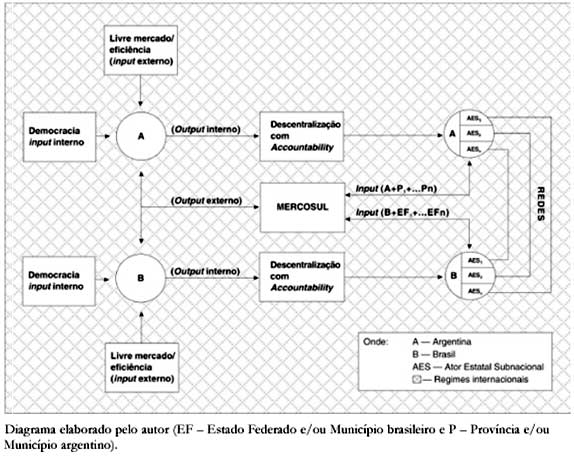
<body><![CDATA[<p><font face="Verdana, Arial, Helvetica, sans-serif" size="2">This crisis, which    can not be overlooked, was caused, among other things, by the devaluation of    the Real made unilaterally by the Brazilian monetary authorities. On the other    hand, the dynamics of the Brazilian-Argentinean <i>tandem</i> proved very significant    in the negotiations of the Free Trade Area of the Americas - FTAA - before the    United States. As Tulchin notes, "More significant in the long run were the    painfully slow negotiation to include Argentina and the rest of Mercosur in    the free trade area contemplated by the United States in its treaty with Mexico    and Canada" (1998, p. 187).<a name=tx34></a><a href="#nt34"><sup>34</sup></a></font></p>     <p><font face="Verdana, Arial, Helvetica, sans-serif" size="2">Under a neo-institutional    perspective, Mercosur seems to be understood within a vision of said second    movement,<a href="#nt35"><sup>35</sup></a><a name="tx35"></a> that is, as a phenomenon simultaneously    indebted to a path dependence, to a rational choice and to cognitive elements    that permeate the civil society's understanding. The exacerbated intergovernmentalism    is due to a historic attachment, albeit recent, to the exercise of sovereignty    achieved after the processes of decolonization in the first quarter of the nineteenth    century, and the near absence of significant belligerent conflicts that might    have prompted the Nation-states of the Southern Cone, as was the case in Europe,    to admit with less reluctance the limitations of sovereignty.<a href="#nt36"><sup>36</sup></a><a name=tx36></a> The South American Nation-state    is, even now, deeply rooted in its formula founder of centrality, <a href="#nt37"><sup>37</sup></a><a name="tx37"></a> in which the subnational state    actors have a limited room for maneuver. On the other hand, there is no denying    that this centralized power has been acting in accordance with a fine analysis    of the cost-benefit relation. Despite the fact that the Mercosur integration    is asymmetric, and, in the short term, concentrates the gains and socializes    the losses, it is carried out for being perceived by its components, in the    long term, as a rewarding project from the political and / or economic point    of view. Yet, despite the drawbacks of legitimacy that the centrality may create,    the civil societies of the States-parties do not perceive the Mercosur in a    negative way, unlike, for example, what occurs with the view of the Free Trade    Area of the Americas - FTAA. It is as if the pragmatic phase of the integration    of South America (Barbosa, 1996, p. 135), which began in the mid 1980s, also    contained a romantic stale in the imagination of the peoples and decision-makers    - the Bolivarian dream still remaining.<a href="#nt38"><sup>38</sup></a><a name="tx38"></a> This widespread recognition    in the minds of the South-American people acts as a potential substrate for    the legitimate development of the integrationist construction.</font></p>     <p><font face="Verdana, Arial, Helvetica, sans-serif" size="2">The return of the    democratic regimes to the Southern Cone and the constitutional reforms in Argentina    and Brazil are crucial for changing the settings of governance. Internally,    the authoritarian regime had exhausted its capacity to legitimacy via economic    growth, in fact, a pseudo-legitimation by outputs, since the presence of institutional    safeguards against abuse of public power did not exist. Externally, immune to    the intrinsic hermetism that marks the warlordships, Argentina and Brazil get    closer, inaugurating pragmatically an unprecedented partnership (Almeida, 1998).    The goal is to think a re-foundation of the Nation-state on democratic foundations    and due to the new international competitive reality (Vaz, 1999). The Southern    Common Market, then, emerges as an intermediate set of outline conditions, an    educational catalyst that contributes to a new institutional arrangement (Medeiros,    2000).</font></p>     <p><font face="Verdana, Arial, Helvetica, sans-serif" size="2">The Brazilian Constitution    of 1988 presents itself as a decentralizator - a natural tendency after two    decades of centralism, in which the units of the federation, as well as the    municipalities, had a very little leeway. In his Article 18, the Constitution    establishes: "The political and administrative organization of the Federative    Republic of Brazil comprises the Union, the States, the Federal District and    the Municipalities, all of them autonomous, under this Constitution". As noted    by Frazão: "The Constitution of 1988 extends, to some extent, the legislative    competence of the states. It also benefits the municipal authorities of this    extension" (1994, p. 318).<a name="tx39"></a><a href="#nt39"><sup>39</sup></a> Thus, the Brazilian subnational state actors acquire    the possibility of a greater action in the national politics, and, at least    in principle, in the international one as well, as the Constitution of 1988    also attests, in his Article 4: "The Federative Republic of Brazil shall seek    the economic, political, social, and cultural integration of the peoples of    Latin America, aiming at the formation of a Latin American community of nations".    This way, the elements for the practice of a constituent diplomacy are launched    and, in fact, in 1997, Fernando Henrique Cardoso creates the Advisory Office    of Federative Relations (ARF &#150; <i>Assessoria de Relações Federativas</i>) in    the office of the Minister of Foreign Affairs in order to encourage an approach    to states and municipalities by means of regional offices.<a href="#nt40"><sup>40</sup></a><a name="tx40"></a> In the Lula government, the    ARF is transmuted into the Special Advisory Office of Federative and Parliamentary    Affairs (AFEPA - <i>Assessoria Especial de Assuntos Federativos e Parlamentares</i>)    and a Deputy Headship of Federative Affairs (<i>Subchefia de Assuntos Federativos</i>)    in order to coordinate the actions of the Executive with those of the states    and municipalities. The latter, then, take a proactive role in foreign relations    within their respective constitutional competencies and may, in such a way,    include public policies in the areas of health care, education, culture, environment,    transportation, among others. It is precisely this Deputy Headship, linked to    the Secretariat of Institutional Relations, that co-organizes with its Argentinean    counterpart, in May 2007, the Seminar of Tucumán, bringing together the governors    of the Brazilian Northeast and the Argentinean Northwest to discuss partnerships    in several areas.<a href="#nt41"><sup>41</sup></a><a name="tx41"></a></font></p>     <p><font face="Verdana, Arial, Helvetica, sans-serif" size="2">The Argentinean    Republic, a genuine federal Nation-state, <a href="#nt42"><sup>42</sup></a><a name=tx42></a> executes, in 1994, a constitutional reform that will both internally    and externally have relevant implications. The Article 24 of the new Constitution    allows the approval of treaties of integration "that delegate powers and jurisdiction    to supranational organizations under reciprocal and equal conditions, and that    respect the democratic order and human rights. The norms derived from this have    a hierarchy that stands above the law".<a href="#nt43"><sup>43</sup></a><a name="tx43"></a> This innovation makes clear    the possibility of predominance of the Community law over the national law within    a classical approach envisioned by the monist theory (Kelsen, 1992, p. 352).    On the other hand, the Article 124 provides that the provinces will be allowed    to "enter into international agreements, as long as they are not inconsistent    with the foreign policy of the Nation and do not affect the powers delegated    to the federal government or the public credit of the Nation, with knowledge    of the National Congress"<a href="#nt44"><sup>44</sup></a><a name="tx44"></a> &#150; something that, as in the    case of Brazil, provides a range of action of the Argentinean subnational state    actors that is far more consistent than in the past.</font></p>     <p><font face="Verdana, Arial, Helvetica, sans-serif" size="2">As such, the views    of Argentina and Brazil combine democracy and decentralization, at the same    time in which they associate them to the idea of efficiency. The management    has not been simple. The strong patronage still present in the local spheres    and the lack of knowledge of its bureaucracies have been greatly hampering the    mechanisms of governance. Internally, some devices of accountability had to    be designed to stop private appropriations of public goods and acts of corruption,    such as the Law of Fiscal Responsibility in Brazil.<a href="#nt45"><sup>45</sup></a><a name="tx45"></a> The enlargement of the participatory    capacity of the subnational state actors would thus start to contribute to the    legitimacy of the national political process in a limited fashion if, and only    if, coupled with rigorous mechanisms of control. The legitimacy would therefore    be forged by a mixed accountability, combining, <i>pari passu</i>, participation    and delegation. The dynamics of Mercosur offers an alternative channel for the    movement of the subnational state actors and acts as a complementary support    to the national accountability.</font></p>     <p><font face="Verdana, Arial, Helvetica, sans-serif" size="2"><i>Institutional    cartography and social networking</i></font></p>     <p><font face="Verdana, Arial, Helvetica, sans-serif" size="2">Mercosur, since    its inception, has stimulated discussions about the re-foundation of the federative    pacts of Argentina and Brazil, allowing the dialogue between their subnational    state actors to intensify. This intensification has come about in two main forms:    the first is an attempt for greater participation in the formal institutions    of Mercosur; the second occurs through the articulation of networks. This is    how the subnational state actors operate in the governance of the Southern Common    Market.</font></p>     <p><font face="Verdana, Arial, Helvetica, sans-serif" size="2">This is a two-way    road with a feedback, as illustrated by the diagram on the next page: Democracy    and free market in the Nation-states (internal input) promoting decentralization    with accountability internally (internal output) and regional integration externally    (external output); this regional integration, in its turn, contributes: (i)    for the consolidation of decentralization as a <i>locus</i> for the action of    the subnational units &#91;input (A + P1 +&#133;+ Pn) + (B + P1 +&#133;+ Pn)&#93; and (ii)    to increase the accountability of the multilevel governance of the system as    a whole. This whole is inserted into the international regimes (represented,    in the diagram, by the white background circumscribed by the rectangular framework).    The constituent diplomacy is represented in the expressions input (A + P1 +&#133;+    Pn) and (B + P1 +&#133;+ Pn), that is, the action on Mercosur by an Argentinean    and / or Brazilian foreign policy made up by the federal and subnational components.    The paradiplomacy, in its turn, proves to be more connected to the relationships    between the Subnational State Actors (AES &#150; <i>Atores Estatais Subnacionais</i>)    &#150; states and municipalities in Brazil and provinces and municipalities in Argentina    -, represented in the diagram by the networks, namely: AES1, AES2, AESn.</font></p>     <p><font face="Verdana, Arial, Helvetica, sans-serif" size="2">Within the formal    institutions of Mercosur, only in 2004 the subnational state actors obtained,    <i>de jure</i>, a prerogative of participation, when, in Belo Horizonte, the    Common Market Council (CMC &#150; <i>Conselho Mercado Comum</i>) decided: "To create    the Advisory Forum of Municipalities, Federated States, Provinces and Departments    of Mercosur, in order to stimulate dialogue and cooperation between the authorities    of the local, state, provincial, and departmental levels of the States Parties    of MERCOSUR".<a href="#nt46"><sup>46</sup></a><a name="tx46"></a> This forum<a href="#nt47"><sup>47</sup></a><a name="tx47"></a> supersedes, in fact, the Specialized    Meeting of Municipalities and Stewardships (REMI - <i>Reunião Especializada    de Municípios e Intendências</i>), created in 2000 by resolution of the Common    Market Group (GMC &#150; <i>Grupo Mercado Comum</i>).<a href="#nt48"><sup>48</sup></a><a name="tx48"></a> It is, however, more comprehensive,    encompassing not only the municipalities and stewardships, but also provinces,    federated states and departments, levels of power generally more developed within    a federal system. Nor is anodyne the fact that REMI has been created by a resolution    of the GMC, and the forum has been established by a decision of the CMC. The    political content of the decision is much stronger than that of the resolution,    since it expresses the direct will of the heads of State. Still, it may be noted    that the forum has the status of a full institution of Mercosur and, therefore,    is more permanent, while the REMI, being just a meeting, presents a more ephemeral    character. Given the problems of heterogeneity faced by the singleness of the    Committee of Regions in the European Union, the FUES is formed by a municipal    committee and a committee of federated states, provinces and departments - with    which a greater fluidity is expected in the dialogue and manifestations of interests.    The forum may propose to the GMC measures to coordinate policies in order to    promote the citizens' welfare and improve their quality of life.</font></p>     ]]></body>
<body><![CDATA[<p>&nbsp;</p>     <p>&nbsp;</p>     <p align="center"><img src="/img/revistas/s_rbcsoc/v4nse/a09img01.jpg"></p>     <p>&nbsp;</p>     <p>&nbsp;</p> <table border=1 cellspacing=0 cellpadding=2 width=579 align="center" bordercolor="#000000">   <tr>      <td width=289 valign=top>            <p><font face="Verdana, Arial, Helvetica, sans-serif" size="2">Livre Mercado          / eficiência (<i>input</i> externo)</font></p>     </td>     <td width=289 valign=top>            <p><font face="Verdana, Arial, Helvetica, sans-serif" size="2">Free Market          / efficiency (external input)</font></p>     </td>   </tr>   <tr>      <td width=289 valign=top>            <p><font face="Verdana, Arial, Helvetica, sans-serif" size="2">Democracia          <i>input</i> interno</font></p>     </td>     <td width=289 valign=top>            <p><font face="Verdana, Arial, Helvetica, sans-serif" size="2">Democracy          internal input</font></p>     </td>   </tr>   <tr>      <td width=289 valign=top>            <p><font face="Verdana, Arial, Helvetica, sans-serif" size="2">(<i>Output</i>          interno)</font></p>     </td>     <td width=289 valign=top>            ]]></body>
<body><![CDATA[<p><font face="Verdana, Arial, Helvetica, sans-serif" size="2">(Internal          output)</font></p>     </td>   </tr>   <tr>      <td width=289 valign=top>            <p><font face="Verdana, Arial, Helvetica, sans-serif" size="2">Descentralização          com <i>accountability</i></font></p>     </td>     <td width=289 valign=top>            <p><font face="Verdana, Arial, Helvetica, sans-serif" size="2">Decentralization          with accountability</font></p>     </td>   </tr>   <tr>      <td width=289 valign=top>            <p><font face="Verdana, Arial, Helvetica, sans-serif" size="2">AES</font></p>     </td>     <td width=289 valign=top>            <p><font face="Verdana, Arial, Helvetica, sans-serif" size="2">SSA</font></p>     </td>   </tr>   <tr>      <td width=289 valign=top>            <p><font face="Verdana, Arial, Helvetica, sans-serif" size="2">(<i>Output</i>          externo)</font></p>     </td>     <td width=289 valign=top>            <p><font face="Verdana, Arial, Helvetica, sans-serif" size="2">(External          output)</font></p>     </td>   </tr>   <tr>      <td width=289 valign=top>            <p><font face="Verdana, Arial, Helvetica, sans-serif" size="2">MERCOSUL</font></p>     </td>     <td width=289 valign=top>            <p><font face="Verdana, Arial, Helvetica, sans-serif" size="2">MERCOSUR</font></p>     </td>   </tr>   <tr>      <td width=289 valign=top>            <p><font face="Verdana, Arial, Helvetica, sans-serif" size="2">REDES</font></p>     </td>     <td width=289 valign=top>            ]]></body>
<body><![CDATA[<p><font face="Verdana, Arial, Helvetica, sans-serif" size="2">NETWORKS</font></p>     </td>   </tr>   <tr>      <td width=289 valign=top>            <p><font face="Verdana, Arial, Helvetica, sans-serif" size="2">Democracia          <i>input</i> interno</font></p>     </td>     <td width=289 valign=top>            <p><font face="Verdana, Arial, Helvetica, sans-serif" size="2">Democracy          internal input</font></p>     </td>   </tr>   <tr>      <td width=289 valign=top>            <p><font face="Verdana, Arial, Helvetica, sans-serif" size="2">(<i>Output</i>          interno)</font></p>     </td>     <td width=289 valign=top>            <p><font face="Verdana, Arial, Helvetica, sans-serif" size="2">(Internal          output)</font></p>     </td>   </tr>   <tr>      <td width=289 valign=top>            <p><font face="Verdana, Arial, Helvetica, sans-serif" size="2">Descentralização          com <i>accountability</i></font></p>     </td>     <td width=289 valign=top>            <p><font face="Verdana, Arial, Helvetica, sans-serif" size="2">Decentralization          with accountability</font></p>     </td>   </tr>   <tr>      <td width=289 valign=top>            <p><font face="Verdana, Arial, Helvetica, sans-serif" size="2">Livre Mercado          / eficiência (<i>input</i> externo)</font></p>     </td>     <td width=289 valign=top>            <p><font face="Verdana, Arial, Helvetica, sans-serif" size="2">Free Market          / efficiency (external input)</font></p>     </td>   </tr>   <tr>      <td width=289 valign=top>            <p><font face="Verdana, Arial, Helvetica, sans-serif" size="2">Onde:</font></p>           ]]></body>
<body><![CDATA[<p><font face="Verdana, Arial, Helvetica, sans-serif" size="2">A &#150; Argentina</font></p>           <p><font face="Verdana, Arial, Helvetica, sans-serif" size="2">B &#150; Brasil</font></p>           <p><font face="Verdana, Arial, Helvetica, sans-serif" size="2">AES &#150; Ator          Estatal Subnacional</font></p>           <p><font face="Verdana, Arial, Helvetica, sans-serif" size="2">&#91;Símbolo&#93;          &#150; Regimes internacionais</font></p>     </td>     <td width=289 valign=top>            <p><font face="Verdana, Arial, Helvetica, sans-serif" size="2">Where:</font></p>           <p><font face="Verdana, Arial, Helvetica, sans-serif" size="2">A &#150; Argentina</font></p>           <p><font face="Verdana, Arial, Helvetica, sans-serif" size="2">B &#150; Brazil</font></p>           <p><font face="Verdana, Arial, Helvetica, sans-serif" size="2">AES &#150; Subnational          State Actor</font></p>           <p><font face="Verdana, Arial, Helvetica, sans-serif" size="2">&#91;Symbol&#93;          &#150; International regimes</font></p>     </td>   </tr>   <tr>      <td width=289 valign=top>            <p><font face="Verdana, Arial, Helvetica, sans-serif" size="2">Diagrama          elaborado pelo autor (EF &#150; Estado Federado e / ou Município brasileiro          e P &#150; Província e / ou Município Angentino)</font></p>     </td>     <td width=289 valign=top>            ]]></body>
<body><![CDATA[<p><font face="Verdana, Arial, Helvetica, sans-serif" size="2">Diagram prepared          by the author (EF - Federated State and / or Brazilian Municipality and          P - Province and / or Argentinean Municipality)</font></p>     </td>   </tr> </table>     <p>&nbsp;</p>     <p><font face="Verdana, Arial, Helvetica, sans-serif" size="2">However, this more    direct participation of the subnational state actors in the institutional framework    of Mercosur was preceded by activities of relationship within two networks:    Crecenea / Codesul and Mercocidades. The network comprising the Regional Commission    of Foreign Trade of Northeastern Argentina (Crecenea - <i>Comissão Regional    de Comércio Exterior do Nordeste Argentino</i>) and the Council for Southern    Development and Integration (Codesul - <i>Conselho de Desenvolvimento e Integração    Sul</i>) gathers in a summit twice a year, since June 1995, the governors of    the northeastern provinces of Argentina and the southern and central-western    states of Brazil. This summit goes well beyond the strictly administrative challenges    and is a political act in which the subnational state actors proclaim the importance    of their roles in the process of regional governance. They claim to be the main    link in the chain of public policies and holders, next to the central power,    of competencies, as referenced above, in areas of integration such as education,    culture, environment, and transport. Moreover, the <i>mercocidades</i> (mercocities)    network was established in November 1995 by nineteen cities of Mercosur and    Chile. Not much differently from the perception of Crecenea / Codesul, this    network believes that the primary objective of the integration resides in the    citizens' participation and that, consequently, the cities should, in issues    within their competence, join the process of decision-making of the institutions    of Mercosur. To this end, the <i>mercocidades</i> created nine thematic committees    seeking to develop collaborative projects that encourage a micro-location of    industrial and commercial activities and services (local productive arrangements,    clusters, etc.) within the Southern Common Market.</font></p>     <p><font face="Verdana, Arial, Helvetica, sans-serif" size="2">An important tool    that could strengthen the role of the subnational state actors is the Fund for    the Structural Convergence of Mercosur (Focem - <i>Fondo para la Convergencia    Estructural del Mercosur</i>). Created by the CMC Decision No. 45/04, it aims    at funding programs to promote the structural convergence, develop the competitiveness,    promote the social cohesion of smaller economies and less developed regions,    and support the operation of the institutional structure and the strengthening    of the integration process. This fund consists of annual contributions of one    hundred million dollars by the States Parties; Argentina contributes with 27%,    Brazil with 70%, Paraguay with 1%, and Uruguay with 2%. Unlike the European    Union's structural funds, the Focem is subject to the contributive discretion    of the States-parties, which reduces the degree of independence of the supranational    structure. However, it points to a possible effective participation of subnational    state actors in its management, as it touches powers constitutionally assigned    to them. In addition, the Focem, by means of its redistributive action, may    also contribute to an increased legitimacy that would grow on what concerns    both to its participating bias and that related to an increase in the level    of accountability.</font></p>     <p>&nbsp;</p>     <p><font face="Verdana, Arial, Helvetica, sans-serif" size="3"><b>Closing remarks</b></font></p>     <p><font face="Verdana, Arial, Helvetica, sans-serif" size="2">We can observe,    so, either formally or by means of networks, that the subnational state actors    have been sharing the regional governance of Mercosur. They are recognized by    the national States themselves as capital entities for the attainment of the    democratic practice - at least when it happens behind their borders. Beyond    those borders, the position is much more mitigated and the central power is    reluctant to discard its original competences. As Keating writes: "opportunities    for regions to act in Europe remain limited and states are still the dominant    actors" (1999, p. 7).<a name=tx49></a><a href="#nt49"><sup>49</sup></a> Even the Treaty of Lisbon, currently under ratification    by Member States, brings evidence that the Nation-state insists on keeping itself    as major actor in the community arena: the "Protocol on the role of National    Parliaments in the European Union." This protocol aims at "encouraging a greater    involvement of the national Parliaments in the activities of the European Union    and strengthening their ability to express their views on the drafts of legislative    acts of the European Union and other issues that may be of particular interest    for them".<a href="#nt50"><sup>50</sup></a><a name=tx50></a> Thus, in the institutional gears    of the Union, another state actor is introduced, beside the already bloated    power of the Council, strengthening, therefore, the intergovernmental logic    in detriment of the supranational one - even if, as alleged by the Commission,    this happens in parallel with an increase in power of the European Parliament<a href="#nt51"><sup>51</sup></a><a name="tx51"></a> and with the goal to "enhance    democracy and increase legitimacy in the functioning of the Union".<a href="#nt52"><sup>52</sup></a><a name="tx52"></a></font></p>     <p><font face="Verdana, Arial, Helvetica, sans-serif" size="2">In Mercosur the    situation is even more limited. The influence of subnational state actors occurs    by a constituent diplomacy restricted to its internal action on the federal    Executive (federative diplomacy for the Ministry of Foreign Relations). Nevertheless,    one can not deny the existence of a growing interconnection between the different    political levels, creating, in effect, a multilevel governance, in which, in    one way or another, the subnational state actors operate (see Diagram above),    even if one cannot yet speak of supporting levels of governance. Nor can one    disprove that the Southern Common Market has emerged as an alternative space    for opposition, becoming, from that point of view, a bastion of legitimation,    as demonstrated by the creation of the Advisory Forum of Municipalities, Federated    States, Provinces and Departments of the Mercosur.</font></p>     <p><font face="Verdana, Arial, Helvetica, sans-serif" size="2">Salomón and Nunes,    by studying the case of the action of the state of Rio Grande do Sul and the    city of Porto Alegre in the Mercosur sphere, and revisiting the studies of Hocking    (2004), Paquin (2004) and Rosenau (1990), conclude</font></p>     <blockquote>        ]]></body>
<body><![CDATA[<p><font face="Verdana, Arial, Helvetica, sans-serif" size="2">&#91;&#133;&#93; that both      the regional and the local governments may be considered mixed international      actors, partly driven by the sovereignty they share with other governments      in the territory under their administration, but also freer than the central      governments on what concerns to their options of foreign policy, with some      norms of performance similar to non-state actors (2007, p. 139).</font></p> </blockquote>     <p><font face="Verdana, Arial, Helvetica, sans-serif" size="2">This condition    makes of the subnational actor a relevant link in the chain of the public policies    related to the regional and / or international arena - and both as regards the    process of democratization of actions and with regard to the procedures of legitimation    and accountability.</font></p>     <p><font face="Verdana, Arial, Helvetica, sans-serif" size="2">Nevertheless, as    Jenkins notes, "one of the most contentious questions of our era &#91;is&#93; whether    globalization is draining away the political lifeblood of the nation-state,    its sovereignty" (2003, p. 63).<a name=tx53></a><a href="#nt53"><sup>53</sup></a> The peculiar thing is that both the tradition of    transnationalism and the realistic one, both in the hope of answering this question,    point out and recognize the emergence of subnational actors in the international    arena as a factor relevant to this debate, although for different reasons. As    the first notes this emergency as a loss of sovereignty by Nation-states with    respect to foreign business (Ohmae, 1995), the second sees the phenomenon as    a mere reconfiguration of the national state in order to better respond to the    new demands of globalization (Shipman, 2002), that is, as suggested by Slaughter:    "The State is not disappearing; it is disaggregating into its component institutions"    (1999, p. 178).<a name=tx54></a><a href="#nt54"><sup>54</sup></a></font></p>     <p><font face="Verdana, Arial, Helvetica, sans-serif" size="2">However, what is    observed, in both views, is that the Nation-state does not present itself anymore    as the sole trustee of the regulatory elements of society. In this sense, Held    notes that:</font></p>     <blockquote>        <p><font face="Verdana, Arial, Helvetica, sans-serif" size="2">New demands are      made for regional and local autonomy as groups find themselves buffeted by      global forces and by inappropriate or ineffective political regimes. &#91;&#133;&#93;      They portend a political order of democratic associations, cities and nations      as well as of regions and global networks. In such an order, the principle      of autonomy would be entrenched in diverse sites of power and across diverse      spatial domains (1996, p. 357).<a name=tx55></a><a   href="#nt55"><sup>55</sup></a> </font></p> </blockquote>     <p><font face="Verdana, Arial, Helvetica, sans-serif" size="2">Causing these other    levels of governance - the supra and the subnational ones &#150; to operate as genuine    and additional <i>loci</i> of legitimacy and accountability.</font></p>     <p><font face="Verdana, Arial, Helvetica, sans-serif" size="2">It is what we can    observe in the evolution of Mercosur. This evolution, as a whole, demonstrates    a concern for reconciliation between institutional efficiency and democratic    practice. The formula seems to go through a nanoaccountability, that is, a multipoint    accountability that merges participation and delegation in an ideal measure.    As Félix Pena said, referring to the idea of a new stage in the integration    of Mercosur, marked by the establishment of Parlasur and the Permanent Court    of Review, "the path has begun of a necessary institutional improvement of the    integration process" (2005,s/p).<a name=tx56></a><a href="#nt56"><sup>56</sup></a></font></p>     <p>&nbsp;</p>     <p><font face="Verdana, Arial, Helvetica, sans-serif" size="3"><b>Notes</b></font></p>     ]]></body>
<body><![CDATA[<p><font face="Verdana, Arial, Helvetica, sans-serif" size="2"><a name=nt01></a><a href="#tx01">1</a> <i>Apud</i> Brown, Nardin and Rengger (2002, p. 301).     <br>   <a name=nt02></a><a href="#tx02">2</a> "In this present-day world, the State - and this is typically    more or less the sovereign national state - is both indispensable and inadequate.    It is indispensable instrument to get many things done, to provide many needed    services and to deal with many real problems. But it is inadequate to cope with    an increasing number of other problems of life and death for many of its inhabitants".        <br>   <a name=nt03></a><a href="#tx03">3</a> We construe the institutional cartography not only as the set    of formal and informal institutions, but also the modes of relationship existing    between them. This dynamic set has a reticulated nature, consisting in a mesh    of regimes of power.     <br>   <a name=nt04></a><a href="#tx04">4</a> In terms of literature review, we tried to focus on the matrix    ideas related to the examined issues. It was found that most of the pertinent    literature is not Brazilian. That does not mean that the national authors were    not used, but only that they were when presenting arguments that were innovative    or applied to the reality of Mercosur.     <br>   <a name=nt05></a><a href="#tx05">5</a> "Comparisons are drawn between EU and an ancient, Westminster-style,    or frankly utopian form of deliberative democracy. While perhaps useful for    philosophical purposes, the use of idealistic standards no modern governments    can meet obscures the social context of contemporary European policy-making".        <br>   <a name=nt06></a><a href="#tx06">6</a> The total list of all Provisional Measures is available in    the website <a href="http://www.planalto.gov.br/ccivil/MPV/Quadro/_QuadroGeral.htm#posteriorec" target="_blank">http://www.planalto.gov.br/ccivil/MPV/Quadro/_QuadroGeral.htm#posteriorec</a>    (visited in 2/14/2008).     <br>   <a name=nt07></a><a href="#tx07">7</a> This amendment is available in the website <a href="http://www.planalto.gov.br/ccivil_03/Constituicao/Emendas/Emc/emc32.htm" target="_blank">http://www. planalto.gov.br/ccivil_03/Constituicao/Emendas/Emc/emc32.htm</a>    (visited in 2/14/2008).     <br>   <a name=nt08></a><a href="#tx08">8</a> Available in the website <a href="http://www.camara.gov.br/sileg/integras/456085.pdf" target="_blank">http://www.camara.gov.br/sileg/integras/456085.pdf</a>    (visited in 2/14/2008).     <br>   <a name=nt09></a><a href="#tx09">9</a> Limongi also states: "I purposely left for last the most powerful    weapon on which the president counts, the power to decree, the provisional measure,    to show that it is one among many other resources available to the president.    The most powerful of them, no doubt about it, since it changes the <i>status    quo</i> unilaterally" (2006, p. 27).     <br>   <a name=nt10></a><a href="#tx10">10</a> The French Senate held in February 10, 2006, a historical    analysis of the use of <i>ordonnances</i> during the Fifth Republic. Information    available in the website <a href="http://www.agoravox.fr/article.php3?id_article=7600.php3?id_article=61" target="_blank">http://www.agoravox.fr/article.php3? id_article=7600. php3?id_article=61</a>    (visited in 2/14/2008).     ]]></body>
<body><![CDATA[<br>   <a name=nt11></a><a href="#tx11">11</a> Cf. <i>Folha de São Paulo</i>, "<i>Manifesto dá a Sarkozy    estilo monárquico</i>" ("Manifesto provides Sarkozy with a monarchical    style"), in the website <a href="http://www1.folha.uol.com.br/fsp/mundo/ft1802200820.htm" target="_blank">http://www1.folha.uol.com.br/fsp/mundo/ft1802200820.htm</a>    (visited in 2/18/2008).     <br>   <a name=nt12></a><a href="#tx12">12</a> "L'originalité du projet &#91;de l'Union Européenne&#93; consiste    à faire coexister, au moins pour un temps, une intégration économique d'essence    fédérale et une coopération &#91;politique&#93; d'inspiration confédérale".     <br>   <a name=nt13></a><a href="#tx13">13</a> "&#91;&#133;&#93; the EU as a fluid polity outside the statist mold,    a constellation of institutions embedded in a dense and evolving network of    informal interactions that brings together supranational, national and subnational    actors".     <br>   <a name=nt14></a><a href="#tx14">14</a> Article 1 of the Protocol of Ushuaia on Democratic Commitment    in Mercosur, Bolivia and Chile (cf. website <a href="http://www2.mre.gov.br/dai/ushuaia.htm" target="_blank">http://www2.mre.gov.br/dai/ushuaia.htm</a>    &#91;visited in 4/25/2006&#93;).     <br>   <a name=nt15></a><a href="#tx15">15</a> "Regimes can be defined as sets of implicit or explicit    principles, norms, rules and decision-making procedures around which actors'    expectations converge in a given area of international relations".     <br>   <a name=nt16></a><a href="#tx16">16</a> "These more informal, fluid forms of representation do    not meet the standards of popular sovereignty set by traditional democratic    theory. Nonetheless, they reflect the reality of the EU as polity composed of    multiple identities embedded at multiple levels of governance".     <br>   <a name=nt17></a><a href="#tx17">17</a> "If governance above the level of the nation-state is    to be legitimate in a democratic era, mechanisms for appropriate accountability    need to be institutionalized. Yet these mechanisms cannot simply replicate,    on a larger scale, the familiar procedures and practices of democratic states".        <br>   <a name=nt18></a><a href="#tx18">18</a> We have used the definition of Grant and Keohane for accountability:    "as we use the term, implies that some actors have the right to hold other    actors to a set of standards, to judge whether they have fulfilled their responsibilities    in light of these standards, and to impose sanctions if they determine that    these responsibilities have not been met" (2005, p. 1).     <br>   <a name=nt19></a><a href="#tx19">19</a> "In the participation model, those affected hold power-wielders    accountable directly through participation, whereas in the delegation model,    those delegating power hold power-wielders accountable through a variety of    mechanisms for judgment after fact" (Grant and Keohane, 2005, pp. 32-33).        <br>   <a name=nt20></a><a href="#tx20">20</a> They are: Hierarchical, Supervisory, Fiscal, Legal, Market,    Peer and Public reputational (Grant and Keohane, 2005, p. 36)     ]]></body>
<body><![CDATA[<br>   <a name=nt21></a><a href="#tx21">21</a> "Surely, the sources of legitimacy are diverse: some    are technocratic, and relate to presume expertise to manage the complexities    of policies".     <br>   <a name=nt22></a><a href="#tx22">22</a> Preamble of the Treaty of the European Union and Article 5    of the Treaty of the European Community consolidated in Nice in 2002. Title    III, Article I-11 of the Treaty establishing a Constitution for Europe (this    Treaty was not approved by the <i>referenda</i> held in France and the Netherlands    in 2005).     <br>   <a name=nt23></a><a href="#tx23">23</a> There is a considerable number of offices of representation    and regional missions in Brussels. Their work on publicity and lobbying has    assumed relevant proportions. It is also worth remembering that the Treaty of    Maastricht established not only the possibility, in specific circumstances,    of subnational entities assuming the chair of the Nation-state within the Council    of Ministers - which has been practiced by the German Länder, Austrians and    Belgian regions -- but also the possibility of frequent involvement of regional    officials in the management of structural funds and also the constant sectorial    networking among the subnational state actors.     <br>   <a name=nt24></a><a href="#tx24">24</a> "Globalization and the rise of transnational regimes,    especially regional trading areas, have eroded the distinction between domestic    and foreign affairs and by the same token have transformed the division of responsibilities    between state and subnational governments".     <br>   <a name=nt25></a><a href="#tx25">25</a> "Paradiplomacy is not the same as conventional state    diplomacy, which is about pursuing a defined state interest in the international    arena. It is more functionally specific and targeted, often opportunistic and    experimental. &#91;&#133;&#93; Paradiplomacy is also characterized by a high degree of    involvement of civil society and the private sector".     <br>   <a name=nt26></a><a href="#tx26">26</a> "En la disputa de las papeleras la contienda se establece    entre, por um lado, el Estado uruguayo, que concentra um mayor poder de decisión    en el caso, y, por outro, uma elusiva amalgama formada por el gobierno nacional    argentino, el gobierno de Entre Rios y sectores de la sociedad civil. Considerando    la paradiplomacia como un epifenómeno em el cuadro uruguayo y enfocando en la    problemática de la cuestión subnacional en la Argentina, la rationale de esa    amalgama parece repousar sobre tres factores basilares: 1. la utilización coherente    del régimen internacional que rige lãs cuestiones ecológicas; 2. la capacidad    de Entre Rios de mover uma acción colectiva parroquial conjugando intereses    gubernamentales y no gubernamentales; 3. la habilidad del gobierno federal de    apropriarse de la bandera del movimiento infraestatal, subscribiéndolo internacionalmente".        <br>   <a name=nt27></a><a href="#tx27">27</a> "The term constituent diplomacy is intended to be a neutral    descriptor, one that avoids the implication that the activities of constituent    governments are necessarily inferior, ancillary, or supplemental to the high    politics of nation-state diplomacy. What is high or low politics depends on    one's perspective".     <br>   <a name=nt28></a><a href="#tx28">28</a> Although not specific of the Democratic federal nation states    or their counterparts, the constituent diplomacy has been widely practiced by    them.     <br>   <a name=nt29></a><a href="#tx29">29</a> "&#91;&#133;&#93; whatever competition may exist, and exist legitimately,    within other policy fields, in foreign affairs the seemingly instinctual reaction    of national élites is to try to suppress competition and shield foreign-policy-making    behind a veil of state secrecy. The nation, it is said, must speak with a single    voice".     <br>   <a name=nt30></a><a href="#tx30">30</a> This concept is explored by Rawls: "Somehow we must nullify    the effects of specific contingencies which put men at odds and tempt them to    exploit social and natural circumstances to their own advantage. Now in order    to do this I assume that the parties are situated behind a veil of ignorance.    They do not know how the various alternatives will affect their own particular    case and they are obliged to evaluate principles solely on the basis of general    considerations" (1999, p. 118).     ]]></body>
<body><![CDATA[<br>   <a name=nt31></a><a href="#tx31">31</a> "The politics of many international negotiations can    usefully be conceived as a two-level game. At national level, domestic groups    pursue their interests by pressuring the government to adopt favorable policies,    and politicians seek power by constructing coalitions among those groups. At    the international level, national governments seek to maximize their own ability    to satisfy domestic pressures, while minimizing the adverse consequences of    foreign developments. Neither of the two games can be ignored by central decision-makers,    so long as their countries remain interdependent, yet sovereign".     <br>   <a name=nt32></a><a href="#tx32">32</a> One of the possible sources of inspiration for the principle    of subsidiarity is the Encyclical Letter <i>Quadragesimo Anno</i>, written by    Pius XI in 1931. In it the Pope says: "Truth is, and is amply demonstrated by    history, that, due to changing conditions, only large societies can now accomplish    which previously even the small ones could; however, remains unchanged that    solemn principle of social philosophy: just as it is unfair to deprive people    of what they can make with their own initiative and industry and assign it to    the community, in the same way, assigning to a larger and higher society what    the smaller and lower ones could accomplish is an injustice, a serious damage    and a disruption of the good social order. The natural purpose of society and    its action is to assist its members, not to destroy them or absorb them" (Pius    XI, 1969, p. 36).     <br>   <a name=nt33></a><a href="#tx33">33</a> We are considering the Mercosur without its associate members,    that is, formed only by Argentina, Brazil, Paraguay and Uruguay. It is only    those countries that participate fully in the institutional dynamics.     <br>   <a name=nt34></a><a href="#tx34">34</a> "More significant in the long run were the painfully    slow negotiation to include Argentina and the rest of Mercosur in the free trade    area contemplated by the United States in its treaty with México and Canada".        <br>   <a name=nt35></a><a href="#tx35">35</a> "&#91;&#133;&#93; "in the late 1990s scholars began calling    for a second movement in institutional analysis, that is, a more constructive    dialogue that explores the ways in which these paradigms &#91;rational choice, historical    and organizational&#93; might complement and connect to each other favor (Campbell,    2004, p. 4).     <br>   <a name=nt36></a><a href="#tx36">36</a> It is worth mentioning the so-called Paraguayan War and its    disastrous consequences especially for the Guarani people (Chiavenatto, 1979).    For a literary-philosophical reflection on the dictatorial regime in Latin America    and the controversial figure of José Gaspar de Francia and its importance for    the development of Paraguay, see Roa Bastos (1974).     <br>   <a name=nt37></a><a href="#tx37">37</a> It is true that the United Provinces of Río de la Plata, Argentina    today, had an important confederative experience until 1860. But, since then,    the Bonarens hegemony is constitutionally felt in a systematic fashion. That    will change somewhat, as we shall see, with the constitutional reform of 1994.        <br>   <a name=nt38></a><a href="#tx38">38</a> See, for example, the Republic of Venezuela, which, following    the arrival of Hugo Chavez to power, was renamed as Bolivarian Republic of Venezuela.    Chavez asked the Mercosur the adhesion of his country. Decision No. 29/05 of    Mercosur states that the Common Market Council decides: "Acoger com satisfacción    la solicitud de la República Bolivariana de Venezuela de incorporarse al Mercosur    como Estado Parte" (Art. 1). The classic populism of Chavez is anchored    on the positive pre-disposition that the popular perception has of the integrationist    and anti-imperialist ideas of Bolivar.     <br>   <a name=nt39></a><a href="#tx39">39</a> "La Constitution de 1988 étend jusqu'à un certain point    la compétence législative des États. Elle fait également bénéficier les autorités    municipales de cette extension".     <br>   <a name=nt40></a><a href="#tx40">40</a> In 1996 the then Brazilian Chancellor Luiz Felipe Lampreia,    already stated: "New issues, new forms of interaction between the chancelleries    and between these and other agencies of the government and of the civil society,    the imperatives of the public and federative diplomacy, the imperatives of the    diplomacy of Heads of State and Government, exponential mark of our time, the    computerization, the pursuit of efficiency and economy in the management of    the federal administrative machinery &#150; this is a complex reality that points    to the need for continuous upgrading of the Ministry of Foreign Affairs, the    diplomatic service and our working methods". Speech by Minister of Foreign Affairs,    Ambassador Luiz Felipe Lampreia, during the graduation ceremony of the class    "Florestan Fernandes" of the Rio Branco Institute on April 30, 1996.     ]]></body>
<body><![CDATA[<br>   <a name=nt41></a><a href="#tx41">41</a> We were invited by Mr. Vicente Trevas, head of the Deputy    Headship of Federative Affairs and National Coordinator of the Advisory Forum    of Municipalities, Federated States, Provinces and Departments of Mercosur,    to participate in preliminary discussions aiming at holding the Seminar of Tucumán,    with the function of academic expert. The main objective was to try to arrange    a technical seminar before the meeting of the governors. This technical seminar    had two purposes: to grant visibility to the two regions involved, and suggest    recommendations to the governors. On the other hand, it had three spheres: Academia,    Public Management, and Businesses.     <br>   <a name=nt42></a><a href="#tx42">42</a> Contrary to Argentina or the United States, which result from    the union between sovereign entities, Brazil is federalized, in 1889, from a    centralized monarchy. This is an inverted federalism, in which the central power    transfers competencies to its parties, rather than a traditional federalism,    in which the parties waive jurisdiction in favor of the center (Abrucio, 1998).        <br>   <a name=nt43></a><a href="#tx43">43</a> "&#91;&#133;&#93; que deleguen competencias y jurisdicción a organizaciones    supraestatales em condiciones de reciprocidad e igualdad, y que respeten el    orden democrático y los derechos humanos. Las normas dictadas en su consecuencia    tienen jerarquía superior a las leys".     <br>   <a name=nt44></a><a href="#tx44">44</a> "&#91;&#133;&#93; celebrar convênios internacionales en tanto no    sean incompatibles con la política exterior de la Nación y no afecten las facultades    delegadas al Gobierno federal o el crédito público de la Nación; con conocimiento    del Congreso Nacional".     <br>   <a name=nt45></a><a href="#tx45">45</a> "The Law of Fiscal Responsibility &#150; LRF &#150; <i>Lei de Responsabilidade    Fiscal</i> (Complementary Law no. 101, of May 4, 2000) sets norms of public    finances focused on responsibility in fiscal management, by means of actions    that prevent risks and correct the deviations that may impact the balance of    public accounts, highlighting the planning, control, transparency, and accountability    as basic assumptions". Definition caught on 4/30/06 on the official website    of the Ministry of Finance of the Brazilian government (<a href="http://www.tesouro.fazenda.gov.br/hp/lei_responsabilidade_fiscal.asp" target="_blank">http://www.tesouro.fazenda. gov.br/hp/lei_responsabilidade_fiscal.asp</a>).        <br>   <a name=nt46></a><a href="#tx46">46</a> "Crear el Foro Consultivo de Municípios, Estados Federados,    Provincias y Departamentos del Mercosur, con la finalidad de estimular el diálogo    y la cooperación entre las autoridades de nível municipal, estadual, provincial    y departamental dos Estados Partes del Mercosur". Mercosur/CMC/DEC. no.    41/04, art. 1 (website <a href="http://www.mercosur.int/msweb/" target="_blank">http://www.mercosur.int/msweb/</a>,    visited in 2/14/2005).     <br>   <a name=nt47></a><a href="#tx47">47</a> Due to the length of the name of the forum, from now on, for    the sake of vocabulary convenience, we will mention it as <i>Fórum das Unidades    Estatais Subnacionais</i> - FUES (Forum of State-owned Subnational Units &#150; FUES).        <br>   <a name=nt48></a><a href="#tx48">48</a> Mercosur /GMC/RES. No. 90/00 (website <a href="http://www.mercosur.int/msweb/" target="_blank">http://www. mercosur.int/msweb/</a>,    visited in 5/1/2006).     <br>   <a name=nt49></a><a href="#tx49">49</a> "&#91;&#133;&#93; opportunities for regions to act in Europe remain    limited and states are still the dominant actors".     <br>   <a name=nt50></a><a href="#tx50">50</a> Protocol on the role of national parliaments in the European    Union - Treaty of Lisbon.     ]]></body>
<body><![CDATA[<br>   <a name=nt51></a><a href="#tx51">51</a> Treaty of Lisbon (Article 9A).     <br>   <a name=nt52></a><a href="#tx52">52</a> "&#91;&#133;&#93; enhance democracy and increase legitimacy in the    functioning of the Union". Information available in the official website    of the European Union, <a href="http://europa.eu/lisbon_treaty/glance/index_en.htm" target="_blank">http://europa.eu/lisbon_treaty/glance/index_en.htm</a>    (visited in 2/21/2008).     <br>   <a name=nt53></a><a href="#tx53">53</a> "&#91;&#133;&#93; one of the most contentious questions of our era    &#91;is&#93; whether globalization is draining away the political lifeblood of the nation-state,    its sovereignty".     <br>   <a name=nt54></a><a href="#tx54">54</a> "The State is not disappearing; it is disaggregating    into its component institutions".     <br>   <a name=nt55></a><a href="#tx55">55</a> "New demands are made for regional and local autonomy    as groups find themselves buffeted by global forces and by inappropriate or    ineffective political regimes. &#91;&#133;&#93; They portend a political order of democratic    associations, cities and nations as well as of regions and global networks.    In such an order, the principle of autonomy would be entrenched in diverse sites    of power and across diverse spatial domains".     <br>   <a name=nt56></a><a href="#tx56">56</a> "&#91;&#133;&#93; se inició el camino de un necesario perfeccionamiento    institucional del proceso de integración". </font></p>     <p>&nbsp;</p>     <p><font face="Verdana, Arial, Helvetica, sans-serif" size="3"><b>BIBLIOGRAPHIC    REFERENCES</b></font></p>     <!-- ref --><p><font face="Verdana, Arial, Helvetica, sans-serif" size="2">ABRUCIO, F. L.    (1998), <i>Os bar&otilde;es da Federa&ccedil;&atilde;o</i>. S&atilde;o Paulo,    Usp/Hucitec.    </font></p>     ]]></body>
<body><![CDATA[<!-- ref --><p><font face="Verdana, Arial, Helvetica, sans-serif" size="2">ALMEIDA, Paulo    R. (1998), <i>Mercosul: fundamentos e perspectivas</i>. S&atilde;o Paulo, LTr.    </font></p>     <!-- ref --><p><font face="Verdana, Arial, Helvetica, sans-serif" size="2">ALMOND, G. &amp;    VERBA, S. (1963), <i>The civic culture</i>. Boston, Little Brown.    </font></p>     <!-- ref --><p><font face="Verdana, Arial, Helvetica, sans-serif" size="2">BADIE, Bertrand.    (1995), <i>La fin des territories: essai sur le d&eacute;sordre international    et sur l'utilit&eacute; social du respect</i>. Paris, Fayard.    </font></p>     <!-- ref --><p><font face="Verdana, Arial, Helvetica, sans-serif" size="2">BANCHOFF, Thomas    &amp; SMITH, Mitchell P. (1999), <i>Legitimacy and the European Union</i>. Londres,    Routledge.    </font></p>     <!-- ref --><p><font face="Verdana, Arial, Helvetica, sans-serif" size="2">BARBOSA, Rubens    A. (1996), "O Brasil e a integra&ccedil;&atilde;o regional: a Alalc e a Aladi    (1960-1990)", <i>in</i> Jos&eacute; A. G. Albuquerque, <i>Sessenta anos de pol&iacute;tica    externa brasileira (1930-1990): diplomacia para o desenvolvimento</i>. S&atilde;o    Paulo, Cultura Editores Associados/Nupri-USP/Fapesp.    </font></p>     ]]></body>
<body><![CDATA[<!-- ref --><p><font face="Verdana, Arial, Helvetica, sans-serif" size="2">BATISTA JR., Paulo    Nobueira. (2007), "A Argentina em apuros". <i>Folha de S&atilde;o Paulo</i>,    <i>site</i> <a href="http://www1.folha.uol.com.br/fsp/dinheiro/fi2102200806.htm" target="_blank">http://www1.folha.uol.com.br/fsp/dinheiro/fi2102200806.htm</a>    (acessado em 21/2/2008).    </font></p>     <!-- ref --><p><font face="Verdana, Arial, Helvetica, sans-serif" size="2">BRESSER PEREIRA,    Luiz Carlos &amp; CUNILL GRAU, Nuria. (1999), <i>O p&uacute;blico n&atilde;o-estatal    na reforma do Estado</i>. Rio de Janeiro, Funda&ccedil;&atilde;o Get&uacute;lio    Vargas, Rio de Janeiro.    </font></p>     <!-- ref --><p><font face="Verdana, Arial, Helvetica, sans-serif" size="2">BROWN, Chris; NARDIN,    Terry &amp; RENGGER, Nicholas. (2002), <i>International relations in political    thought</i>. Cambridge, Cambridge University Press.    </font></p>     <!-- ref --><p><font face="Verdana, Arial, Helvetica, sans-serif" size="2">CAMARGO, S&ocirc;nia.    (2006), "Mercosul: crise de crescimento ou crise de terminal". <i>Lua Nova</i>,    68: 57-90.    </font></p>     <!-- ref --><p><font face="Verdana, Arial, Helvetica, sans-serif" size="2">CAMPBELL, John    L. (2004), <i>Institutional change and globalization</i>. Princeton, Princeton    University Press.    </font></p>     ]]></body>
<body><![CDATA[<!-- ref --><p><font face="Verdana, Arial, Helvetica, sans-serif" size="2">CARVALHO, Ernani    Rodrigues de. (2004), "Em busca da judicializa&ccedil;&atilde;o da pol&iacute;tcia    no Brasil: apontamentos para uma nova abordagem". <i>Revista de Sociologia e    Pol&iacute;tica</i>, 23: 115-126.    </font></p>     <!-- ref --><p><font face="Verdana, Arial, Helvetica, sans-serif" size="2">CERVO, Amado Luiz    &amp; BUENO, Clodoaldo. (2002), <i>Hist&oacute;ria da pol&iacute;tica exterior    do Brasil</i>. Bras&iacute;lia, Editora da UnB.    </font></p>     <!-- ref --><p><font face="Verdana, Arial, Helvetica, sans-serif" size="2">CHIAVENTATO, Julio    Jos&eacute;. (1979), <i>Genoc&iacute;dio americano: a Guerra do Paraguai</i>.    S&atilde;o Paulo, Brasiliense.    </font></p>     <!-- ref --><p><font face="Verdana, Arial, Helvetica, sans-serif" size="2">DAHL, Robert. (1989),    <i>Democracy and its critics</i>. New Haven, Yale University Press.    </font></p>     <!-- ref --><p><font face="Verdana, Arial, Helvetica, sans-serif" size="2">DE LA SERE, Fran&ccedil;oise.    (1992), "Le Trait&eacute; de l'Union Europ&eacute;enne". <i>Regards sur l'Actualit&eacute;</i>,    180: 3-22.    </font></p>     ]]></body>
<body><![CDATA[<!-- ref --><p><font face="Verdana, Arial, Helvetica, sans-serif" size="2">DEUTSCH, Karl W.    (1981), "The crisis of the State". <i>Government and Opposition</i>, 16 (3):    331-343.    </font></p>     <!-- ref --><p><font face="Verdana, Arial, Helvetica, sans-serif" size="2">ELIAS, Norbert.    (1987), <i>La soci&eacute;t&eacute; des individus</i>. Paris, Fayard.    </font></p>     <!-- ref --><p><font face="Verdana, Arial, Helvetica, sans-serif" size="2"><i>FOLHA DE S&Atilde;O    PAULO</i>. (2008), "Manifesto d&aacute; a Sarkozy estilo mon&aacute;rquico",    <i>site</i> <a href="http://www1.folha.uol.com.br/fsp/mundo/ft1802200820.htm" target="_blank">http://www1.folha.uol.com.br/fsp/mundo/ft1802200820.htm</a>    (acessado em 18/2/2008).    </font></p>     <!-- ref --><p><font face="Verdana, Arial, Helvetica, sans-serif" size="2">FRAZ&Atilde;O,    Armando S. (1994), "Br&eacute;sil", <i>in</i> Denis Rougemont, <i>Dictionnaire    international du f&eacute;d&eacute;ralisme</i>. Bruxelles, Bruylant.    </font></p>     <!-- ref --><p><font face="Verdana, Arial, Helvetica, sans-serif" size="2">GRANT, Ruth W.    &amp; KEOHANE, Robert O. (2005), "Accountability and abuses of power in world    politics". <i>American Political Science Review</i>, 99 (1): 29-43, fev.    </font></p>     ]]></body>
<body><![CDATA[<!-- ref --><p><font face="Verdana, Arial, Helvetica, sans-serif" size="2">HABERMAS, J&uuml;rgen.    (1991), <i>The structural transformation of the public sphere</i>. Cambridge,    MIT Press.    </font></p>     <!-- ref --><p><font face="Verdana, Arial, Helvetica, sans-serif" size="2">HELD, David. (1996),    <i>Models of democracy</i>. Stanford, Stanford University Press.    </font></p>     <!-- ref --><p><font face="Verdana, Arial, Helvetica, sans-serif" size="2">HOCKING, Brian.    (2004), "Regionalismo: uma perspectiva das rela&ccedil;&otilde;es internacionais",    <i>in</i> Tullo Vigevani <i>et al</i>. (orgs.). <i>A dimens&atilde;o subnacional    e as rela&ccedil;&otilde;es internacionais</i>, S&atilde;o Paulo, Educ/Unesp/Edusc,    pp. 77-107.    </font></p>     <!-- ref --><p><font face="Verdana, Arial, Helvetica, sans-serif" size="2">HOFFMANN, Andrea    Ribeiro &amp; VAN DER VLEUTEN, Anna. (2007), <i>Closing or widening the gap</i>?    England, Ashgate.    </font></p>     <!-- ref --><p><font face="Verdana, Arial, Helvetica, sans-serif" size="2">JENKINS, Rob. (2003),    "India's States and the makilg of foreign economic policy: the limit of the    constituent diplomacy paradigm". <i>Publius: The Journal of Federalism</i>,    33 (4): 63-82, Fall.    </font></p>     ]]></body>
<body><![CDATA[<!-- ref --><p><font face="Verdana, Arial, Helvetica, sans-serif" size="2">KEATING, Michael.    (1999), "Regions and international affairs: motives, opportunities and strategies",    <i>in</i> Francisco Aldecoa e Michael Keating, <i>Paradiplomacy in action: the    foreign relations of subnational governments</i>. Londres, Frank Cass.    </font></p>     <!-- ref --><p><font face="Verdana, Arial, Helvetica, sans-serif" size="2">KELSEN, Hans. (1992),    <i>Teoria geral do direito e do Estado</i>. S&atilde;o Paulo, Martins Fontes.    </font></p>     <!-- ref --><p><font face="Verdana, Arial, Helvetica, sans-serif" size="2">KEOHANE, Robert    &amp; NYE, Joseph. (1987), "Power and interdependence reviseted". <i>International    Organization</i>, 41: 725-753.    </font></p>     <!-- ref --><p><font face="Verdana, Arial, Helvetica, sans-serif" size="2">KINCAID, John.    (2001), "Constituent diplomacy in federal polities and the Nation-state: conflict    and co-operation", <i>in</i> Hans J. Michelmann e Panayotis Soldatos, <i>Federalism    and international relations: the role of subnational units</i>. Oxford, OUP.    </font></p>     <!-- ref --><p><font face="Verdana, Arial, Helvetica, sans-serif" size="2">KRASNER, Stephen.    (1988), "Sovereignity: an institutional perspective", <i>Comparative Political    Studies</i>, 21: 66-94.    </font></p>     ]]></body>
<body><![CDATA[<!-- ref --><p><font face="Verdana, Arial, Helvetica, sans-serif" size="2">KULGEMAS, Eduardo    &amp; BRANCO, Marcello S. (2005), "Os governos subnacionais e a nova realidade    do federalismo", <i>in</i> Tullo Vigevani <i>et al</i>., <i>Governos subnacionais    e sociedade civil: integra&ccedil;&atilde;o regional e Mercosul</i>. S&atilde;o    Paulo, PUC-SP/Unesp/Fapesp.    </font></p>     <!-- ref --><p><font face="Verdana, Arial, Helvetica, sans-serif" size="2">LA&Iuml;DI, Zaki.    (1993), "Sens et puissance dans le sist&egrave;me international", <i>in</i>    Zaki La&iuml;di, <i>L'ordre mondial rel&acirc;ch&eacute;: sens et puissance    apr&egrave;s la Guerre Froide</i>. Paris, Presses de la Fondation Nationale    de Sciences Politiques.    </font></p>     <!-- ref --><p><font face="Verdana, Arial, Helvetica, sans-serif" size="2">LEGAL, Hubert.    (2001), "Composition et fonctionnement des Cours Europ&eacute;ennes". <i>Pouvoirs</i>,    96: 65-84.    </font></p>     <!-- ref --><p><font face="Verdana, Arial, Helvetica, sans-serif" size="2">LIMONGI, Fernando.    (2006), "Presidencialismo, coaliz&atilde;o partid&aacute;ria e processo decis&oacute;rio".    <i>Novos Estudos do Cebrap</i>, 76: 17-41, nov.    </font></p>     <!-- ref --><p><font face="Verdana, Arial, Helvetica, sans-serif" size="2">MAJONE, Giandomenico.    (1996), <i>Regulating Europe</i>. Londres, Routledge.    </font></p>     ]]></body>
<body><![CDATA[<!-- ref --><p><font face="Verdana, Arial, Helvetica, sans-serif" size="2">MEDEIROS, Marcelo    A. (2000), <i>La gen&egrave;se du Mercosud</i>. Paris, L'Harmattan.    </font></p>     <!-- ref --><p><font face="Verdana, Arial, Helvetica, sans-serif" size="2">_________. (2003),    "Prerrogativas estatais, integra&ccedil;&atilde;o regional e l&oacute;gica distributiva".    <i>Lua Nova</i>, 58: 141-168.    </font></p>     <!-- ref --><p><font face="Verdana, Arial, Helvetica, sans-serif" size="2">_________. (2004),    "Unidades subnacionais e integra&ccedil;&atilde;o europ&eacute;ia: o caso do    comit&ecirc; das regi&otilde;es", <i>in</i> Tullo Vigevani <i>et al</i>., <i>A    dimens&atilde;o subnacional e as rela&ccedil;&otilde;es internacionais</i>.    S&atilde;o Paulo, Educ/Unesp/Edusc.    </font></p>     <!-- ref --><p><font face="Verdana, Arial, Helvetica, sans-serif" size="2">MENY, Yves. (1993),    <i>Les politiques du mim&eacute;tisme institutionnel: la greffe et le rejet</i>.    Paris, L'Harmattan.    </font></p>     <!-- ref --><p><font face="Verdana, Arial, Helvetica, sans-serif" size="2">MOE, T. (1984),    "The new economics of organization". <i>American Journal of Political Science</i>,    28: 739-777.    </font></p>     ]]></body>
<body><![CDATA[<!-- ref --><p><font face="Verdana, Arial, Helvetica, sans-serif" size="2">MORAVCSIK, Andrew.    (2002), "In defense of the democratic deficit: reassessing legitimacy in the    European Union". <i>Journal of Common Market Studies</i>, 40 (44): 603-624.    </font></p>     <!-- ref --><p><font face="Verdana, Arial, Helvetica, sans-serif" size="2">NICOLAIDIS, Kalypso    &amp; HOWSE, Robert. (2001), "The federal vision, levels of governance and legitimacy",    <i>in</i> Kalypso Nicoladis e Robert Howse, <i>The federal vision</i>. Oxford,    OUP.    </font></p>     <!-- ref --><p><font face="Verdana, Arial, Helvetica, sans-serif" size="2">O'DONNELL, Guillermo.    (1999), "Teoria democr&aacute;tica e pol&iacute;tica comparada". <i>Dados</i>,    42 (4): 655-690, Rio de Janeiro.    </font></p>     <!-- ref --><p><font face="Verdana, Arial, Helvetica, sans-serif" size="2">OHMAE, Kenichi.    (1995), <i>The end of the Nation State: the rise of regional economies</i>.    Nova York, Haper Collins.    </font></p>     <!-- ref --><p><font face="Verdana, Arial, Helvetica, sans-serif" size="2">PAQUIN, St&eacute;phane.    (2004), <i>Paradiplomatie et relations internationales</i>. Bruxelles, Peter    Lang.    </font></p>     ]]></body>
<body><![CDATA[<!-- ref --><p><font face="Verdana, Arial, Helvetica, sans-serif" size="2">PENA, F&eacute;lix.    (2005), "Assimetrias e medidas de converg&ecirc;ncia estructural: enfoques y    propuestas para un Mercosur solidario". <i>Site</i> <a href="http://www.sice.oas.org/agreements/Mercin_s.asp#MERCOSUR" target="_blank">http://www.    sice.oas.org/agreements/Mercin_s. asp# MERCOSUR</a> (acessado em 23/1/2006).    </font></p>     <!-- ref --><p><font face="Verdana, Arial, Helvetica, sans-serif" size="2">PIO XI. (1969),    <i>Carta Enc&iacute;clica de Sua Santidade Pio XI: sobre a restaura&ccedil;&atilde;o    e aperfei&ccedil;oamento da ordem social em conformidade com a lei evang&eacute;lica</i>.    S&atilde;o Paulo, Edi&ccedil;&otilde;es Paulinas.    </font></p>     <!-- ref --><p><font face="Verdana, Arial, Helvetica, sans-serif" size="2">PRZERWOSKI, Adam.    (1985), <i>Capitalism and social democracy</i>. Cambridge, Cambridge University    Press.    </font></p>     <!-- ref --><p><font face="Verdana, Arial, Helvetica, sans-serif" size="2">PUTNAM, Robert.    (1988), "Diplomacy and domestic politics: the logic of two-level games". <i>International    Organization</i>, 42: 427-560.    </font></p>     <!-- ref --><p><font face="Verdana, Arial, Helvetica, sans-serif" size="2">RAWLS, John. (1999),    <i>A theory of justice</i>. Massachusetts, Belknap.    </font></p>     ]]></body>
<body><![CDATA[<!-- ref --><p><font face="Verdana, Arial, Helvetica, sans-serif" size="2">ROA BASTOS, Augusto.    (1974), <i>Yo el supremo</i>. Buenos Aires, Siglo XXI.    </font></p>     <!-- ref --><p><font face="Verdana, Arial, Helvetica, sans-serif" size="2">ROSENAU, James.    (1990), <i>Turbulence in world politics</i>. Princeton, Princeton University    Press.    </font></p>     <!-- ref --><p><font face="Verdana, Arial, Helvetica, sans-serif" size="2">SALOM&Oacute;N,    M&ocirc;nica &amp; NUNES, Carmen. (2007), "A a&ccedil;&atilde;o externa dos    governos subnacionais no Brasil &#151; os casos do Rio Grande do Sul e de Porto    Alegre: um estudo comparativo de dois tipos de atores mistos". <i>Contexto Internacional</i>,    29 (1): 99-146.    </font></p>     <!-- ref --><p><font face="Verdana, Arial, Helvetica, sans-serif" size="2">SARAIVA, Miriam    Gomes &amp; MEDEIROS, Marcelo de Almeida. (2007), "La crisis de las papeleras    y los actores subnacionales en el Mercosur", <i>in</i> Vicente Palermo e Carlos    Reboratti, <i>Del otro lado del r&iacute;o</i>. Buenos Aires, Edhasa.    </font></p>     <!-- ref --><p><font face="Verdana, Arial, Helvetica, sans-serif" size="2">SARTORI, Giovanni.    (1965), <i>Teoria democr&aacute;tica</i>. Lisboa, Editora Fundo de Cultura.    </font></p>     ]]></body>
<body><![CDATA[<!-- ref --><p><font face="Verdana, Arial, Helvetica, sans-serif" size="2">_________. (1987),    <i>The theory of democracy revisited</i>. Chatham, Chatham House Publishers.    </font></p>     <!-- ref --><p><font face="Verdana, Arial, Helvetica, sans-serif" size="2">SCHARPF, Fritz.    (1996), "Negative and positive integration in the political economy of European    Welfare States", <i>in</i> Gary Marks <i>et al</i>., <i>Governance in the European    Union</i>. Londres, Sage.    </font></p>     <!-- ref --><p><font face="Verdana, Arial, Helvetica, sans-serif" size="2">_________. (2000),    <i>Gouverner l'Europe</i>. Paris, Presses de Sciences Po.    </font></p>     <!-- ref --><p><font face="Verdana, Arial, Helvetica, sans-serif" size="2">SCHUMPETER, Joseph    A. (1975), <i>Capitalism, socialism and democracy</i>. Nova York, HarperPerennial.    </font></p>     <!-- ref --><p><font face="Verdana, Arial, Helvetica, sans-serif" size="2">SCHMITTER, Philippe.    (2000), <i>How to democratize the European Union... And why bother?</i> Boulder,    Rowman &amp; Littlefield.    </font></p>     ]]></body>
<body><![CDATA[<!-- ref --><p><font face="Verdana, Arial, Helvetica, sans-serif" size="2">SCHMITTER, Philippe    &amp; KARL, Terry Lynn. (1993), "What democracy is..<i>.</i> and is not", <i>in</i>    L. Diamond e M. F. Plattner (eds.), <i>The global resurgence of democracy</i>.    Londres, The Johns Hopkins University Press, pp. 39-52.    </font></p>     <!-- ref --><p><font face="Verdana, Arial, Helvetica, sans-serif" size="2">SHIPMAN, Alan.    (2002), <i>The globalization myth</i>. Cambridge, Icon Books.    </font></p>     <!-- ref --><p><font face="Verdana, Arial, Helvetica, sans-serif" size="2">SLAUGHTER, Anne-Marie.    (1999), <i>The role of law in international politics</i>. Oxford, OUP.    </font></p>     <!-- ref --><p><font face="Verdana, Arial, Helvetica, sans-serif" size="2">TRAIT&Eacute;S    DE ROME, MAASTRICHT ET AMSTERDAM. (1999), <i>Textes compares</i>. Paris, La    Documentation Fran&ccedil;aise.    </font></p>     <!-- ref --><p><font face="Verdana, Arial, Helvetica, sans-serif" size="2">TRATADO DE LISBOA.    (2007), <i>Jornal oficial da Uni&atilde;o Europ&eacute;ia</i>, C 306/148 PT,    17/12/2007.    </font></p>     ]]></body>
<body><![CDATA[<!-- ref --><p><font face="Verdana, Arial, Helvetica, sans-serif" size="2">TULCHIN, Joseph    S. (1998), "Continuity and change in Argentine foreign policy", <i>in</i> Joseph    S. Tulchin e Allison M. Garland, <i>Argentina: the challenges of modernization</i>.    Washington, SR Books.    </font></p>     <!-- ref --><p><font face="Verdana, Arial, Helvetica, sans-serif" size="2">VAZ, Alcides C.    (1999), "Parcerias estrat&eacute;gicas no contexto da pol&iacute;tica externa    brasileira: implica&ccedil;&otilde;es para o Mercosul". <i>Revista Brasileira    de Pol&iacute;tica Internacional</i>, 42 (2): 52-80, Bras&iacute;lia.    </font></p>     <!-- ref --><p><font face="Verdana, Arial, Helvetica, sans-serif" size="2">VIGEVANI, Tullo    <i>et al.</i> (2004), <i>A dimens&atilde;o subnacional e as rela&ccedil;&otilde;es    internacionais</i>. S&atilde;o Paulo, Educ/Unesp/Edusc.    </font></p>     <p>&nbsp;</p>     <p>&nbsp;</p>     <p><font face="Verdana, Arial, Helvetica, sans-serif" size="2">Article received    in February 2007     <br>   Approved in April 2008</font></p>     ]]></body>
<body><![CDATA[<p>&nbsp;</p>     <p>&nbsp;</p>     <p><font face="Verdana, Arial, Helvetica, sans-serif" size="2"><a name=back></a><a href="#top"><sup>*</sup></a> This text is a revised version of a paper presented    at the Anpocs XXX Annual Meeting, October 24-28, 2006, GT-13 (Workgroup 13):    "Hegemonic order, multilateralism and foreign policy." I thank my    colleagues of GT-13, as well as the anonymous reviewers of RBCS, for their criticisms    and suggestions. Such contributions, in fact, have made the ideas in this text    more consistent and accurate.</font></p>      ]]></body><back>
<ref-list>
<ref id="B1">
<nlm-citation citation-type="book">
<person-group person-group-type="author">
<name>
<surname><![CDATA[ABRUCIO]]></surname>
<given-names><![CDATA[F. L.]]></given-names>
</name>
</person-group>
<source><![CDATA[Os barões da Federação]]></source>
<year>1998</year>
<publisher-loc><![CDATA[São Paulo ]]></publisher-loc>
<publisher-name><![CDATA[UspHucitec]]></publisher-name>
</nlm-citation>
</ref>
<ref id="B2">
<nlm-citation citation-type="book">
<person-group person-group-type="author">
<name>
<surname><![CDATA[ALMEIDA]]></surname>
<given-names><![CDATA[Paulo R.]]></given-names>
</name>
</person-group>
<source><![CDATA[Mercosul: fundamentos e perspectivas]]></source>
<year>1998</year>
<publisher-loc><![CDATA[São Paulo ]]></publisher-loc>
<publisher-name><![CDATA[LTr]]></publisher-name>
</nlm-citation>
</ref>
<ref id="B3">
<nlm-citation citation-type="book">
<person-group person-group-type="author">
<name>
<surname><![CDATA[ALMOND]]></surname>
<given-names><![CDATA[G.]]></given-names>
</name>
<name>
<surname><![CDATA[VERBA]]></surname>
<given-names><![CDATA[S.]]></given-names>
</name>
</person-group>
<source><![CDATA[The civic culture]]></source>
<year>1963</year>
<publisher-loc><![CDATA[Boston ]]></publisher-loc>
<publisher-name><![CDATA[Little Brown]]></publisher-name>
</nlm-citation>
</ref>
<ref id="B4">
<nlm-citation citation-type="book">
<person-group person-group-type="author">
<name>
<surname><![CDATA[BADIE]]></surname>
<given-names><![CDATA[Bertrand]]></given-names>
</name>
</person-group>
<source><![CDATA[La fin des territories: essai sur le désordre international et sur l'utilité social du respect]]></source>
<year>1995</year>
<publisher-loc><![CDATA[Paris ]]></publisher-loc>
<publisher-name><![CDATA[Fayard]]></publisher-name>
</nlm-citation>
</ref>
<ref id="B5">
<nlm-citation citation-type="book">
<person-group person-group-type="author">
<name>
<surname><![CDATA[BANCHOFF]]></surname>
<given-names><![CDATA[Thomas]]></given-names>
</name>
<name>
<surname><![CDATA[SMITH]]></surname>
<given-names><![CDATA[Mitchell P.]]></given-names>
</name>
</person-group>
<source><![CDATA[Legitimacy and the European Union]]></source>
<year>1999</year>
<publisher-loc><![CDATA[Londres ]]></publisher-loc>
<publisher-name><![CDATA[Routledge]]></publisher-name>
</nlm-citation>
</ref>
<ref id="B6">
<nlm-citation citation-type="book">
<person-group person-group-type="author">
<name>
<surname><![CDATA[BARBOSA]]></surname>
<given-names><![CDATA[Rubens A.]]></given-names>
</name>
</person-group>
<article-title xml:lang="pt"><![CDATA[O Brasil e a integração regional: a Alalc e a Aladi (1960-1990)]]></article-title>
<person-group person-group-type="editor">
<name>
<surname><![CDATA[Albuquerque]]></surname>
<given-names><![CDATA[José A. G.]]></given-names>
</name>
</person-group>
<source><![CDATA[Sessenta anos de política externa brasileira (1930-1990): diplomacia para o desenvolvimento]]></source>
<year>1996</year>
<publisher-loc><![CDATA[São Paulo ]]></publisher-loc>
<publisher-name><![CDATA[Cultura Editores AssociadosNupri-USPFapesp]]></publisher-name>
</nlm-citation>
</ref>
<ref id="B7">
<nlm-citation citation-type="journal">
<person-group person-group-type="author">
<name>
<surname><![CDATA[BATISTA JR]]></surname>
<given-names><![CDATA[Paulo Nobueira]]></given-names>
</name>
</person-group>
<article-title xml:lang="pt"><![CDATA[A Argentina em apuros]]></article-title>
<source><![CDATA[Folha de São Paulo]]></source>
<year>2007</year>
</nlm-citation>
</ref>
<ref id="B8">
<nlm-citation citation-type="book">
<person-group person-group-type="author">
<name>
<surname><![CDATA[BRESSER PEREIRA]]></surname>
<given-names><![CDATA[Luiz Carlos]]></given-names>
</name>
<name>
<surname><![CDATA[CUNILL GRAU]]></surname>
<given-names><![CDATA[Nuria]]></given-names>
</name>
</person-group>
<source><![CDATA[O público não-estatal na reforma do Estado]]></source>
<year>1999</year>
<publisher-loc><![CDATA[Rio de Janeiro ]]></publisher-loc>
<publisher-name><![CDATA[Fundação Getúlio Vargas, Rio de Janeiro]]></publisher-name>
</nlm-citation>
</ref>
<ref id="B9">
<nlm-citation citation-type="book">
<person-group person-group-type="author">
<name>
<surname><![CDATA[BROWN]]></surname>
<given-names><![CDATA[Chris]]></given-names>
</name>
<name>
<surname><![CDATA[NARDIN]]></surname>
<given-names><![CDATA[Terry]]></given-names>
</name>
<name>
<surname><![CDATA[RENGGER]]></surname>
<given-names><![CDATA[Nicholas]]></given-names>
</name>
</person-group>
<source><![CDATA[International relations in political thought]]></source>
<year>2002</year>
<publisher-loc><![CDATA[Cambridge ]]></publisher-loc>
<publisher-name><![CDATA[Cambridge University Press]]></publisher-name>
</nlm-citation>
</ref>
<ref id="B10">
<nlm-citation citation-type="journal">
<person-group person-group-type="author">
<name>
<surname><![CDATA[CAMARGO]]></surname>
<given-names><![CDATA[Sônia]]></given-names>
</name>
</person-group>
<article-title xml:lang="pt"><![CDATA[Mercosul: crise de crescimento ou crise de terminal]]></article-title>
<source><![CDATA[Lua Nova]]></source>
<year>2006</year>
<volume>68</volume>
<page-range>57-90</page-range></nlm-citation>
</ref>
<ref id="B11">
<nlm-citation citation-type="book">
<person-group person-group-type="author">
<name>
<surname><![CDATA[CAMPBELL]]></surname>
<given-names><![CDATA[John L.]]></given-names>
</name>
</person-group>
<source><![CDATA[Institutional change and globalization]]></source>
<year>2004</year>
<publisher-loc><![CDATA[Princeton ]]></publisher-loc>
<publisher-name><![CDATA[Princeton University Press]]></publisher-name>
</nlm-citation>
</ref>
<ref id="B12">
<nlm-citation citation-type="journal">
<person-group person-group-type="author">
<name>
<surname><![CDATA[CARVALHO]]></surname>
<given-names><![CDATA[Ernani Rodrigues de]]></given-names>
</name>
</person-group>
<article-title xml:lang="pt"><![CDATA[Em busca da judicialização da polítcia no Brasil: apontamentos para uma nova abordagem]]></article-title>
<source><![CDATA[Revista de Sociologia e Política]]></source>
<year>2004</year>
<volume>23</volume>
<page-range>115-126</page-range></nlm-citation>
</ref>
<ref id="B13">
<nlm-citation citation-type="book">
<person-group person-group-type="author">
<name>
<surname><![CDATA[CERVO]]></surname>
<given-names><![CDATA[Amado Luiz]]></given-names>
</name>
<name>
<surname><![CDATA[BUENO]]></surname>
<given-names><![CDATA[Clodoaldo]]></given-names>
</name>
</person-group>
<source><![CDATA[História da política exterior do Brasil]]></source>
<year>2002</year>
<publisher-loc><![CDATA[Brasília ]]></publisher-loc>
<publisher-name><![CDATA[Editora da UnB]]></publisher-name>
</nlm-citation>
</ref>
<ref id="B14">
<nlm-citation citation-type="book">
<person-group person-group-type="author">
<name>
<surname><![CDATA[CHIAVENTATO]]></surname>
<given-names><![CDATA[Julio José]]></given-names>
</name>
</person-group>
<source><![CDATA[Genocídio americano: a Guerra do Paraguai]]></source>
<year>1979</year>
<publisher-loc><![CDATA[São Paulo ]]></publisher-loc>
<publisher-name><![CDATA[Brasiliense]]></publisher-name>
</nlm-citation>
</ref>
<ref id="B15">
<nlm-citation citation-type="book">
<person-group person-group-type="author">
<name>
<surname><![CDATA[DAHL]]></surname>
<given-names><![CDATA[Robert]]></given-names>
</name>
</person-group>
<source><![CDATA[Democracy and its critics]]></source>
<year>1989</year>
<publisher-loc><![CDATA[New Haven ]]></publisher-loc>
<publisher-name><![CDATA[Yale University Press]]></publisher-name>
</nlm-citation>
</ref>
<ref id="B16">
<nlm-citation citation-type="journal">
<person-group person-group-type="author">
<name>
<surname><![CDATA[DE LA SERE]]></surname>
<given-names><![CDATA[Françoise]]></given-names>
</name>
</person-group>
<article-title xml:lang="fr"><![CDATA[Le Traité de l'Union Européenne]]></article-title>
<source><![CDATA[Regards sur l'Actualité]]></source>
<year>1992</year>
<volume>180</volume>
<page-range>3-22</page-range></nlm-citation>
</ref>
<ref id="B17">
<nlm-citation citation-type="journal">
<person-group person-group-type="author">
<name>
<surname><![CDATA[DEUTSCH]]></surname>
<given-names><![CDATA[Karl W.]]></given-names>
</name>
</person-group>
<article-title xml:lang="en"><![CDATA[The crisis of the State]]></article-title>
<source><![CDATA[Government and Opposition]]></source>
<year>1981</year>
<volume>16</volume>
<numero>3</numero>
<issue>3</issue>
<page-range>331-343</page-range></nlm-citation>
</ref>
<ref id="B18">
<nlm-citation citation-type="book">
<person-group person-group-type="author">
<name>
<surname><![CDATA[ELIAS]]></surname>
<given-names><![CDATA[Norbert]]></given-names>
</name>
</person-group>
<source><![CDATA[La société des individus]]></source>
<year>1987</year>
<publisher-loc><![CDATA[Paris ]]></publisher-loc>
<publisher-name><![CDATA[Fayard]]></publisher-name>
</nlm-citation>
</ref>
<ref id="B19">
<nlm-citation citation-type="journal">
<source><![CDATA[FOLHA DE SÃO PAULO]]></source>
<year>2008</year>
</nlm-citation>
</ref>
<ref id="B20">
<nlm-citation citation-type="book">
<person-group person-group-type="author">
<name>
<surname><![CDATA[FRAZÃO]]></surname>
<given-names><![CDATA[Armando S.]]></given-names>
</name>
</person-group>
<article-title xml:lang="fr"><![CDATA[Brésil]]></article-title>
<person-group person-group-type="editor">
<name>
<surname><![CDATA[Rougemont]]></surname>
<given-names><![CDATA[Denis]]></given-names>
</name>
</person-group>
<source><![CDATA[Dictionnaire international du fédéralisme]]></source>
<year>1994</year>
<publisher-loc><![CDATA[Bruxelles ]]></publisher-loc>
<publisher-name><![CDATA[Bruylant]]></publisher-name>
</nlm-citation>
</ref>
<ref id="B21">
<nlm-citation citation-type="journal">
<person-group person-group-type="author">
<name>
<surname><![CDATA[GRANT]]></surname>
<given-names><![CDATA[Ruth W.]]></given-names>
</name>
<name>
<surname><![CDATA[KEOHANE]]></surname>
<given-names><![CDATA[Robert O.]]></given-names>
</name>
</person-group>
<article-title xml:lang="en"><![CDATA[Accountability and abuses of power in world politics]]></article-title>
<source><![CDATA[American Political Science Review]]></source>
<year>2005</year>
<volume>99</volume>
<numero>1</numero>
<issue>1</issue>
<page-range>29-43</page-range></nlm-citation>
</ref>
<ref id="B22">
<nlm-citation citation-type="book">
<person-group person-group-type="author">
<name>
<surname><![CDATA[HABERMAS]]></surname>
<given-names><![CDATA[Jürgen]]></given-names>
</name>
</person-group>
<source><![CDATA[The structural transformation of the public sphere]]></source>
<year>1991</year>
<publisher-loc><![CDATA[Cambridge ]]></publisher-loc>
<publisher-name><![CDATA[MIT Press]]></publisher-name>
</nlm-citation>
</ref>
<ref id="B23">
<nlm-citation citation-type="book">
<person-group person-group-type="author">
<name>
<surname><![CDATA[HELD]]></surname>
<given-names><![CDATA[David]]></given-names>
</name>
</person-group>
<source><![CDATA[Models of democracy]]></source>
<year>1996</year>
<publisher-loc><![CDATA[Stanford ]]></publisher-loc>
<publisher-name><![CDATA[Stanford University Press]]></publisher-name>
</nlm-citation>
</ref>
<ref id="B24">
<nlm-citation citation-type="book">
<person-group person-group-type="author">
<name>
<surname><![CDATA[HOCKING]]></surname>
<given-names><![CDATA[Brian]]></given-names>
</name>
</person-group>
<article-title xml:lang="pt"><![CDATA[Regionalismo: uma perspectiva das relações internacionais]]></article-title>
<person-group person-group-type="editor">
<name>
<surname><![CDATA[Vigevani]]></surname>
<given-names><![CDATA[Tullo]]></given-names>
</name>
</person-group>
<source><![CDATA[A dimensão subnacional e as relações internacionais]]></source>
<year>2004</year>
<page-range>77-107</page-range><publisher-loc><![CDATA[São Paulo ]]></publisher-loc>
<publisher-name><![CDATA[EducUnespEdusc]]></publisher-name>
</nlm-citation>
</ref>
<ref id="B25">
<nlm-citation citation-type="book">
<person-group person-group-type="author">
<name>
<surname><![CDATA[HOFFMANN]]></surname>
<given-names><![CDATA[Andrea Ribeiro]]></given-names>
</name>
<name>
<surname><![CDATA[VAN DER VLEUTEN]]></surname>
<given-names><![CDATA[Anna]]></given-names>
</name>
</person-group>
<source><![CDATA[Closing or widening the gap?]]></source>
<year>2007</year>
<publisher-name><![CDATA[Ashgate]]></publisher-name>
</nlm-citation>
</ref>
<ref id="B26">
<nlm-citation citation-type="journal">
<person-group person-group-type="author">
<name>
<surname><![CDATA[JENKINS]]></surname>
<given-names><![CDATA[Rob]]></given-names>
</name>
</person-group>
<article-title xml:lang="en"><![CDATA[India's States and the makilg of foreign economic policy: the limit of the constituent diplomacy paradigm]]></article-title>
<source><![CDATA[Publius: The Journal of Federalism]]></source>
<year>2003</year>
<volume>33</volume>
<numero>4</numero>
<issue>4</issue>
<page-range>63-82</page-range></nlm-citation>
</ref>
<ref id="B27">
<nlm-citation citation-type="book">
<person-group person-group-type="author">
<name>
<surname><![CDATA[KEATING]]></surname>
<given-names><![CDATA[Michael]]></given-names>
</name>
</person-group>
<article-title xml:lang="en"><![CDATA[Regions and international affairs: motives, opportunities and strategies]]></article-title>
<person-group person-group-type="editor">
<name>
<surname><![CDATA[Aldecoa]]></surname>
<given-names><![CDATA[Francisco]]></given-names>
</name>
<name>
<surname><![CDATA[Keating]]></surname>
<given-names><![CDATA[Michael]]></given-names>
</name>
</person-group>
<source><![CDATA[Paradiplomacy in action: the foreign relations of subnational governments]]></source>
<year>1999</year>
<publisher-loc><![CDATA[Londres ]]></publisher-loc>
<publisher-name><![CDATA[Frank Cass]]></publisher-name>
</nlm-citation>
</ref>
<ref id="B28">
<nlm-citation citation-type="book">
<person-group person-group-type="author">
<name>
<surname><![CDATA[KELSEN]]></surname>
<given-names><![CDATA[Hans]]></given-names>
</name>
</person-group>
<source><![CDATA[Teoria geral do direito e do Estado]]></source>
<year>1992</year>
<publisher-loc><![CDATA[São Paulo ]]></publisher-loc>
<publisher-name><![CDATA[Martins Fontes]]></publisher-name>
</nlm-citation>
</ref>
<ref id="B29">
<nlm-citation citation-type="journal">
<person-group person-group-type="author">
<name>
<surname><![CDATA[KEOHANE]]></surname>
<given-names><![CDATA[Robert]]></given-names>
</name>
<name>
<surname><![CDATA[NYE]]></surname>
<given-names><![CDATA[Joseph]]></given-names>
</name>
</person-group>
<article-title xml:lang="en"><![CDATA[Power and interdependence reviseted]]></article-title>
<source><![CDATA[International Organization]]></source>
<year>1987</year>
<volume>41</volume>
<page-range>725-753</page-range></nlm-citation>
</ref>
<ref id="B30">
<nlm-citation citation-type="book">
<person-group person-group-type="author">
<name>
<surname><![CDATA[KINCAID]]></surname>
<given-names><![CDATA[John]]></given-names>
</name>
</person-group>
<article-title xml:lang="en"><![CDATA[Constituent diplomacy in federal polities and the Nation-state: conflict and co-operation]]></article-title>
<person-group person-group-type="editor">
<name>
<surname><![CDATA[Michelmann]]></surname>
<given-names><![CDATA[Hans J.]]></given-names>
</name>
<name>
<surname><![CDATA[Soldatos]]></surname>
<given-names><![CDATA[Panayotis]]></given-names>
</name>
</person-group>
<source><![CDATA[Federalism and international relations: the role of subnational units]]></source>
<year>2001</year>
<publisher-loc><![CDATA[Oxford ]]></publisher-loc>
<publisher-name><![CDATA[OUP]]></publisher-name>
</nlm-citation>
</ref>
<ref id="B31">
<nlm-citation citation-type="journal">
<person-group person-group-type="author">
<name>
<surname><![CDATA[KRASNER]]></surname>
<given-names><![CDATA[Stephen]]></given-names>
</name>
</person-group>
<article-title xml:lang="en"><![CDATA[Sovereignity: an institutional perspective]]></article-title>
<source><![CDATA[Comparative Political Studies]]></source>
<year>1988</year>
<volume>21</volume>
<page-range>66-94</page-range></nlm-citation>
</ref>
<ref id="B32">
<nlm-citation citation-type="book">
<person-group person-group-type="author">
<name>
<surname><![CDATA[KULGEMAS]]></surname>
<given-names><![CDATA[Eduardo]]></given-names>
</name>
<name>
<surname><![CDATA[BRANCO]]></surname>
<given-names><![CDATA[Marcello S.]]></given-names>
</name>
</person-group>
<article-title xml:lang="pt"><![CDATA[Os governos subnacionais e a nova realidade do federalismo]]></article-title>
<person-group person-group-type="editor">
<name>
<surname><![CDATA[Vigevani]]></surname>
<given-names><![CDATA[Tullo]]></given-names>
</name>
</person-group>
<source><![CDATA[Governos subnacionais e sociedade civil: integração regional e Mercosul]]></source>
<year>2005</year>
<publisher-loc><![CDATA[São Paulo ]]></publisher-loc>
<publisher-name><![CDATA[PUC-SPUnespFapesp]]></publisher-name>
</nlm-citation>
</ref>
<ref id="B33">
<nlm-citation citation-type="book">
<person-group person-group-type="author">
<name>
<surname><![CDATA[LAÏDI]]></surname>
<given-names><![CDATA[Zaki]]></given-names>
</name>
</person-group>
<article-title xml:lang="fr"><![CDATA[Sens et puissance dans le sistème international]]></article-title>
<source><![CDATA[Zaki Laïdi, L'ordre mondial relâché: sens et puissance après la Guerre Froide]]></source>
<year>1993</year>
<publisher-loc><![CDATA[Paris ]]></publisher-loc>
<publisher-name><![CDATA[Presses de la Fondation Nationale de Sciences Politiques]]></publisher-name>
</nlm-citation>
</ref>
<ref id="B34">
<nlm-citation citation-type="journal">
<person-group person-group-type="author">
<name>
<surname><![CDATA[LEGAL]]></surname>
<given-names><![CDATA[Hubert]]></given-names>
</name>
</person-group>
<article-title xml:lang="fr"><![CDATA[Composition et fonctionnement des Cours Européennes]]></article-title>
<source><![CDATA[Pouvoirs]]></source>
<year>2001</year>
<volume>96</volume>
<page-range>65-84</page-range></nlm-citation>
</ref>
<ref id="B35">
<nlm-citation citation-type="journal">
<person-group person-group-type="author">
<name>
<surname><![CDATA[LIMONGI]]></surname>
<given-names><![CDATA[Fernando]]></given-names>
</name>
</person-group>
<article-title xml:lang="pt"><![CDATA[Presidencialismo, coalizão partidária e processo decisório]]></article-title>
<source><![CDATA[Novos Estudos do Cebrap]]></source>
<year>2006</year>
<volume>76</volume>
<page-range>17-41</page-range></nlm-citation>
</ref>
<ref id="B36">
<nlm-citation citation-type="book">
<person-group person-group-type="author">
<name>
<surname><![CDATA[MAJONE]]></surname>
<given-names><![CDATA[Giandomenico]]></given-names>
</name>
</person-group>
<source><![CDATA[Regulating Europe]]></source>
<year></year>
<publisher-loc><![CDATA[Londres ]]></publisher-loc>
<publisher-name><![CDATA[Routledge]]></publisher-name>
</nlm-citation>
</ref>
<ref id="B37">
<nlm-citation citation-type="book">
<person-group person-group-type="author">
<name>
<surname><![CDATA[MEDEIROS]]></surname>
<given-names><![CDATA[Marcelo A.]]></given-names>
</name>
</person-group>
<source><![CDATA[La genèse du Mercosud]]></source>
<year></year>
<publisher-loc><![CDATA[Paris ]]></publisher-loc>
<publisher-name><![CDATA[L'Harmattan]]></publisher-name>
</nlm-citation>
</ref>
<ref id="B38">
<nlm-citation citation-type="journal">
<person-group person-group-type="author">
<name>
<surname><![CDATA[MEDEIROS]]></surname>
<given-names><![CDATA[Marcelo A.]]></given-names>
</name>
</person-group>
<article-title xml:lang="pt"><![CDATA[Prerrogativas estatais, integração regional e lógica distributiva]]></article-title>
<source><![CDATA[Lua Nova]]></source>
<year>2003</year>
<volume>58</volume>
<page-range>141-168</page-range></nlm-citation>
</ref>
<ref id="B39">
<nlm-citation citation-type="book">
<person-group person-group-type="author">
<name>
<surname><![CDATA[MEDEIROS]]></surname>
<given-names><![CDATA[Marcelo A.]]></given-names>
</name>
</person-group>
<article-title xml:lang="pt"><![CDATA[Unidades subnacionais e integração européia: o caso do comitê das regiões]]></article-title>
<person-group person-group-type="editor">
<name>
<surname><![CDATA[Vigevani]]></surname>
<given-names><![CDATA[Tullo]]></given-names>
</name>
</person-group>
<source><![CDATA[A dimensão subnacional e as relações internacionais]]></source>
<year>2004</year>
<publisher-loc><![CDATA[São Paulo ]]></publisher-loc>
<publisher-name><![CDATA[EducUnespEdusc]]></publisher-name>
</nlm-citation>
</ref>
<ref id="B40">
<nlm-citation citation-type="book">
<person-group person-group-type="author">
<name>
<surname><![CDATA[MENY]]></surname>
<given-names><![CDATA[Yves]]></given-names>
</name>
</person-group>
<source><![CDATA[Les politiques du mimétisme institutionnel: la greffe et le rejet]]></source>
<year>1993</year>
<publisher-loc><![CDATA[Paris ]]></publisher-loc>
<publisher-name><![CDATA[L'Harmattan]]></publisher-name>
</nlm-citation>
</ref>
<ref id="B41">
<nlm-citation citation-type="journal">
<person-group person-group-type="author">
<name>
<surname><![CDATA[MOE]]></surname>
<given-names><![CDATA[T.]]></given-names>
</name>
</person-group>
<article-title xml:lang="en"><![CDATA[The new economics of organization]]></article-title>
<source><![CDATA[American Journal of Political Science]]></source>
<year>1984</year>
<volume>28</volume>
<page-range>739-777</page-range></nlm-citation>
</ref>
<ref id="B42">
<nlm-citation citation-type="journal">
<person-group person-group-type="author">
<name>
<surname><![CDATA[MORAVCSIK]]></surname>
<given-names><![CDATA[Andrew]]></given-names>
</name>
</person-group>
<article-title xml:lang="en"><![CDATA[In defense of the democratic deficit: reassessing legitimacy in the European Union]]></article-title>
<source><![CDATA[Journal of Common Market Studies]]></source>
<year>2002</year>
<volume>40</volume>
<numero>44</numero>
<issue>44</issue>
<page-range>603-624</page-range></nlm-citation>
</ref>
<ref id="B43">
<nlm-citation citation-type="book">
<person-group person-group-type="author">
<name>
<surname><![CDATA[NICOLAIDIS]]></surname>
<given-names><![CDATA[Kalypso]]></given-names>
</name>
<name>
<surname><![CDATA[HOWSE]]></surname>
<given-names><![CDATA[Robert]]></given-names>
</name>
</person-group>
<article-title xml:lang="en"><![CDATA[The federal vision, levels of governance and legitimacy]]></article-title>
<person-group person-group-type="editor">
<name>
<surname><![CDATA[Nicoladis]]></surname>
<given-names><![CDATA[Kalypso]]></given-names>
</name>
<name>
<surname><![CDATA[Howse]]></surname>
<given-names><![CDATA[Robert]]></given-names>
</name>
</person-group>
<source><![CDATA[The federal vision]]></source>
<year>2001</year>
<publisher-loc><![CDATA[Oxford ]]></publisher-loc>
<publisher-name><![CDATA[OUP]]></publisher-name>
</nlm-citation>
</ref>
<ref id="B44">
<nlm-citation citation-type="journal">
<person-group person-group-type="author">
<name>
<surname><![CDATA[O'DONNELL]]></surname>
<given-names><![CDATA[Guillermo]]></given-names>
</name>
</person-group>
<article-title xml:lang="pt"><![CDATA[Teoria democrática e política comparada]]></article-title>
<source><![CDATA[Dados]]></source>
<year></year>
<volume>42</volume>
<numero>4</numero>
<issue>4</issue>
<page-range>655-690</page-range><publisher-loc><![CDATA[Rio de Janeiro ]]></publisher-loc>
</nlm-citation>
</ref>
<ref id="B45">
<nlm-citation citation-type="book">
<person-group person-group-type="author">
<name>
<surname><![CDATA[OHMAE]]></surname>
<given-names><![CDATA[Kenichi]]></given-names>
</name>
</person-group>
<source><![CDATA[The end of the Nation State: the rise of regional economies]]></source>
<year>1995</year>
<publisher-loc><![CDATA[Nova York ]]></publisher-loc>
<publisher-name><![CDATA[Haper Collins]]></publisher-name>
</nlm-citation>
</ref>
<ref id="B46">
<nlm-citation citation-type="book">
<person-group person-group-type="author">
<name>
<surname><![CDATA[PAQUIN]]></surname>
<given-names><![CDATA[Stéphane]]></given-names>
</name>
</person-group>
<source><![CDATA[Paradiplomatie et relations internationales]]></source>
<year>2004</year>
<publisher-loc><![CDATA[Bruxelles ]]></publisher-loc>
<publisher-name><![CDATA[Peter Lang]]></publisher-name>
</nlm-citation>
</ref>
<ref id="B47">
<nlm-citation citation-type="">
<person-group person-group-type="author">
<name>
<surname><![CDATA[PENA]]></surname>
<given-names><![CDATA[Félix.]]></given-names>
</name>
</person-group>
<source><![CDATA[Assimetrias e medidas de convergência estructural: enfoques y propuestas para un Mercosur solidario]]></source>
<year>2005</year>
</nlm-citation>
</ref>
<ref id="B48">
<nlm-citation citation-type="book">
<person-group person-group-type="author">
<name>
<surname><![CDATA[PIO XI]]></surname>
</name>
</person-group>
<source><![CDATA[Carta Encíclica de Sua Santidade Pio XI: sobre a restauração e aperfeiçoamento da ordem social em conformidade com a lei evangélica]]></source>
<year>1969</year>
<publisher-loc><![CDATA[São Paulo ]]></publisher-loc>
<publisher-name><![CDATA[Edições Paulinas]]></publisher-name>
</nlm-citation>
</ref>
<ref id="B49">
<nlm-citation citation-type="book">
<person-group person-group-type="author">
<name>
<surname><![CDATA[PRZERWOSKI]]></surname>
<given-names><![CDATA[Adam]]></given-names>
</name>
</person-group>
<source><![CDATA[Capitalism and social democracy]]></source>
<year>1985</year>
<publisher-loc><![CDATA[Cambridge ]]></publisher-loc>
<publisher-name><![CDATA[Cambridge University Press]]></publisher-name>
</nlm-citation>
</ref>
<ref id="B50">
<nlm-citation citation-type="journal">
<person-group person-group-type="author">
<name>
<surname><![CDATA[PUTNAM]]></surname>
<given-names><![CDATA[Robert]]></given-names>
</name>
</person-group>
<article-title xml:lang="en"><![CDATA[Diplomacy and domestic politics: the logic of two-level games]]></article-title>
<source><![CDATA[International Organization]]></source>
<year>1988</year>
<volume>42</volume>
<page-range>427-560</page-range></nlm-citation>
</ref>
<ref id="B51">
<nlm-citation citation-type="book">
<person-group person-group-type="author">
<name>
<surname><![CDATA[RAWLS]]></surname>
<given-names><![CDATA[John]]></given-names>
</name>
</person-group>
<source><![CDATA[A theory of justice]]></source>
<year>1999</year>
<publisher-loc><![CDATA[Massachusetts ]]></publisher-loc>
<publisher-name><![CDATA[Belknap]]></publisher-name>
</nlm-citation>
</ref>
<ref id="B52">
<nlm-citation citation-type="book">
<person-group person-group-type="author">
<name>
<surname><![CDATA[ROA BASTOS]]></surname>
<given-names><![CDATA[Augusto]]></given-names>
</name>
</person-group>
<source><![CDATA[Yo el supremo]]></source>
<year>1974</year>
<publisher-loc><![CDATA[Buenos Aires ]]></publisher-loc>
<publisher-name><![CDATA[Siglo XXI]]></publisher-name>
</nlm-citation>
</ref>
<ref id="B53">
<nlm-citation citation-type="book">
<person-group person-group-type="author">
<name>
<surname><![CDATA[ROSENAU]]></surname>
<given-names><![CDATA[James]]></given-names>
</name>
</person-group>
<source><![CDATA[Turbulence in world politics]]></source>
<year>1990</year>
<publisher-loc><![CDATA[Princeton ]]></publisher-loc>
<publisher-name><![CDATA[Princeton University Press]]></publisher-name>
</nlm-citation>
</ref>
<ref id="B54">
<nlm-citation citation-type="journal">
<person-group person-group-type="author">
<name>
<surname><![CDATA[SALOMÓN]]></surname>
<given-names><![CDATA[Mônica]]></given-names>
</name>
<name>
<surname><![CDATA[NUNES]]></surname>
<given-names><![CDATA[Carmen]]></given-names>
</name>
</person-group>
<article-title xml:lang="pt"><![CDATA[A ação externa dos governos subnacionais no Brasil: os casos do Rio Grande do Sul e de Porto Alegre: um estudo comparativo de dois tipos de atores mistos]]></article-title>
<source><![CDATA[Contexto Internacional]]></source>
<year>2007</year>
<volume>29</volume>
<numero>1</numero>
<issue>1</issue>
<page-range>99-146</page-range></nlm-citation>
</ref>
<ref id="B55">
<nlm-citation citation-type="book">
<person-group person-group-type="author">
<name>
<surname><![CDATA[SARAIVA]]></surname>
<given-names><![CDATA[Miriam Gomes]]></given-names>
</name>
<name>
<surname><![CDATA[MEDEIROS]]></surname>
<given-names><![CDATA[Marcelo de Almeida]]></given-names>
</name>
</person-group>
<article-title xml:lang="es"><![CDATA[La crisis de las papeleras y los actores subnacionales en el Mercosur]]></article-title>
<person-group person-group-type="editor">
<name>
<surname><![CDATA[Palermo]]></surname>
<given-names><![CDATA[Vicente]]></given-names>
</name>
<name>
<surname><![CDATA[Reboratti]]></surname>
<given-names><![CDATA[Carlos]]></given-names>
</name>
</person-group>
<source><![CDATA[Del otro lado del río]]></source>
<year>2007</year>
<publisher-loc><![CDATA[Buenos Aires ]]></publisher-loc>
<publisher-name><![CDATA[Edhasa]]></publisher-name>
</nlm-citation>
</ref>
<ref id="B56">
<nlm-citation citation-type="book">
<person-group person-group-type="author">
<name>
<surname><![CDATA[SARTORI]]></surname>
<given-names><![CDATA[Giovanni]]></given-names>
</name>
</person-group>
<source><![CDATA[Teoria democrática]]></source>
<year>1965</year>
<publisher-loc><![CDATA[Lisboa ]]></publisher-loc>
<publisher-name><![CDATA[Editora Fundo de Cultura]]></publisher-name>
</nlm-citation>
</ref>
<ref id="B57">
<nlm-citation citation-type="book">
<person-group person-group-type="author">
<name>
<surname><![CDATA[SARTORI]]></surname>
<given-names><![CDATA[Giovanni]]></given-names>
</name>
</person-group>
<person-group person-group-type="editor">
<name>
</name>
</person-group>
<source><![CDATA[The theory of democracy revisited]]></source>
<year>1987</year>
<publisher-loc><![CDATA[Chatham ]]></publisher-loc>
<publisher-name><![CDATA[Chatham House Publishers]]></publisher-name>
</nlm-citation>
</ref>
<ref id="B58">
<nlm-citation citation-type="book">
<person-group person-group-type="author">
<name>
<surname><![CDATA[SCHARPF]]></surname>
<given-names><![CDATA[Fritz]]></given-names>
</name>
</person-group>
<article-title xml:lang="en"><![CDATA[Negative and positive integration in the political economy of European Welfare States]]></article-title>
<person-group person-group-type="editor">
<name>
<surname><![CDATA[Marks]]></surname>
<given-names><![CDATA[Gary]]></given-names>
</name>
</person-group>
<source><![CDATA[Governance in the European Union]]></source>
<year>1996</year>
<publisher-loc><![CDATA[Londres ]]></publisher-loc>
<publisher-name><![CDATA[Sage]]></publisher-name>
</nlm-citation>
</ref>
<ref id="B59">
<nlm-citation citation-type="book">
<person-group person-group-type="author">
<name>
<surname><![CDATA[SCHARPF]]></surname>
<given-names><![CDATA[Fritz]]></given-names>
</name>
</person-group>
<person-group person-group-type="editor">
<name>
</name>
</person-group>
<source><![CDATA[Gouverner l'Europe]]></source>
<year>2000</year>
<publisher-loc><![CDATA[Paris ]]></publisher-loc>
<publisher-name><![CDATA[Presses de Sciences Po.]]></publisher-name>
</nlm-citation>
</ref>
<ref id="B60">
<nlm-citation citation-type="book">
<person-group person-group-type="author">
<name>
<surname><![CDATA[SCHUMPETER]]></surname>
<given-names><![CDATA[Joseph A.]]></given-names>
</name>
</person-group>
<source><![CDATA[Capitalism, socialism and democracy]]></source>
<year>1975</year>
<publisher-loc><![CDATA[Nova York ]]></publisher-loc>
<publisher-name><![CDATA[HarperPerennial]]></publisher-name>
</nlm-citation>
</ref>
<ref id="B61">
<nlm-citation citation-type="book">
<person-group person-group-type="author">
<name>
<surname><![CDATA[SCHMITTER]]></surname>
<given-names><![CDATA[Philippe]]></given-names>
</name>
</person-group>
<source><![CDATA[How to democratize the European Union... And why bother?]]></source>
<year>2000</year>
<publisher-name><![CDATA[Boulder, Rowman & Littlefield]]></publisher-name>
</nlm-citation>
</ref>
<ref id="B62">
<nlm-citation citation-type="book">
<person-group person-group-type="author">
<name>
<surname><![CDATA[SCHMITTER]]></surname>
<given-names><![CDATA[Philippe]]></given-names>
</name>
<name>
<surname><![CDATA[KARL]]></surname>
<given-names><![CDATA[Terry Lynn]]></given-names>
</name>
</person-group>
<article-title xml:lang="en"><![CDATA[What democracy is... and is not]]></article-title>
<person-group person-group-type="editor">
<name>
<surname><![CDATA[Diamond]]></surname>
<given-names><![CDATA[L]]></given-names>
</name>
<name>
<surname><![CDATA[Plattner]]></surname>
<given-names><![CDATA[M. F.]]></given-names>
</name>
</person-group>
<source><![CDATA[The global resurgence of democracy]]></source>
<year>1993</year>
<page-range>39-52</page-range><publisher-loc><![CDATA[Londres ]]></publisher-loc>
<publisher-name><![CDATA[The Johns Hopkins University Press]]></publisher-name>
</nlm-citation>
</ref>
<ref id="B63">
<nlm-citation citation-type="book">
<person-group person-group-type="author">
<name>
<surname><![CDATA[SHIPMAN]]></surname>
<given-names><![CDATA[Alan]]></given-names>
</name>
</person-group>
<source><![CDATA[The globalization myth]]></source>
<year>2002</year>
<publisher-loc><![CDATA[Cambridge ]]></publisher-loc>
<publisher-name><![CDATA[Icon Books]]></publisher-name>
</nlm-citation>
</ref>
<ref id="B64">
<nlm-citation citation-type="book">
<person-group person-group-type="author">
<name>
<surname><![CDATA[SLAUGHTER]]></surname>
<given-names><![CDATA[Anne-Marie]]></given-names>
</name>
</person-group>
<source><![CDATA[The role of law in international politics]]></source>
<year>1999</year>
<publisher-loc><![CDATA[Oxford ]]></publisher-loc>
<publisher-name><![CDATA[OUP]]></publisher-name>
</nlm-citation>
</ref>
<ref id="B65">
<nlm-citation citation-type="book">
<source><![CDATA[TRAITÉS DE ROME, MAASTRICHT ET AMSTERDAM]]></source>
<year>1999</year>
<publisher-loc><![CDATA[Paris ]]></publisher-loc>
<publisher-name><![CDATA[La Documentation Française]]></publisher-name>
</nlm-citation>
</ref>
<ref id="B66">
<nlm-citation citation-type="journal">
<article-title xml:lang="pt"><![CDATA[TRATADO DE LISBOA]]></article-title>
<source><![CDATA[Jornal oficial da União Européia]]></source>
<year>2007</year>
<month>17</month>
<day>/1</day>
</nlm-citation>
</ref>
<ref id="B67">
<nlm-citation citation-type="book">
<person-group person-group-type="author">
<name>
<surname><![CDATA[TULCHIN]]></surname>
<given-names><![CDATA[Joseph S.]]></given-names>
</name>
</person-group>
<article-title xml:lang="en"><![CDATA[Continuity and change in Argentine foreign policy]]></article-title>
<person-group person-group-type="editor">
<name>
<surname><![CDATA[Tulchin]]></surname>
<given-names><![CDATA[Joseph S.]]></given-names>
</name>
<name>
<surname><![CDATA[Garland]]></surname>
<given-names><![CDATA[Allison M.]]></given-names>
</name>
</person-group>
<source><![CDATA[Argentina: the challenges of modernization]]></source>
<year>1998</year>
<publisher-loc><![CDATA[Washington ]]></publisher-loc>
<publisher-name><![CDATA[SR Books]]></publisher-name>
</nlm-citation>
</ref>
<ref id="B68">
<nlm-citation citation-type="journal">
<person-group person-group-type="author">
<name>
<surname><![CDATA[VAZ]]></surname>
<given-names><![CDATA[Alcides C.]]></given-names>
</name>
</person-group>
<article-title xml:lang="pt"><![CDATA[Parcerias estratégicas no contexto da política externa brasileira: implicações para o Mercosul]]></article-title>
<source><![CDATA[Revista Brasileira de Política Internacional]]></source>
<year>1999</year>
<volume>42</volume>
<numero>2</numero>
<issue>2</issue>
<page-range>52-80</page-range><publisher-loc><![CDATA[Brasília ]]></publisher-loc>
</nlm-citation>
</ref>
<ref id="B69">
<nlm-citation citation-type="book">
<person-group person-group-type="author">
<name>
<surname><![CDATA[VIGEVANI]]></surname>
<given-names><![CDATA[Tullo]]></given-names>
</name>
</person-group>
<source><![CDATA[A dimensão subnacional e as relações internacionais]]></source>
<year>2004</year>
<publisher-loc><![CDATA[São Paulo ]]></publisher-loc>
<publisher-name><![CDATA[EducUnespEdusc]]></publisher-name>
</nlm-citation>
</ref>
</ref-list>
</back>
</article>
