
Retrato policial: um perfil da praça de polícia em São Paulo (1868-1896)
André Rosemberg
Master and Ph.D. in History by the Graduate Program in Social History of USP. Postgraduate Student of the Graduate Program in Social Sciences – Faculdade de Ciências- UNESP - Marília - Hygino Muzzi Filho Av., 737, zipcode: 17525-900, Marília, SP, Brazil. FAPESP Colleger. E-mail: andrerosemberg@usp.br
Translated by Aline Camargo
Translation from História, Franca, v. 29, n. 2, pp. 95-115, dez. 2010
]]>
ABSTRACT
This article presents a profile of the policemen who served the police force of São Paulo between 1868 and 1896. Through biographical data - height, age, place of birth, color of skin, prior occupation, family situation - we aimed to identify, on the basis of the hierarchical pyramid, hints about the formation process of São Paulo's police apparatus; to the same one in which we intend to draw a picture of São Paulo's population - poor and male - during a period of crisis on the slavery system, changes in the work force, incorporation of an important foreign contingent and the substitution of the political paradigm in the country.
Keywords: Police. São Paulo. Militarism. Formation of the State.
RESUMO
O objetivo deste artigo é apresentar um perfil das praças que cerraram fileira na polícia de São Paulo entre 1868 e 1896. A partir de dados biográficos - altura, idade, local de nascimento, cor da pele, ofício anterior, situação familiar - buscamos identificar, na base da pirâmide hierárquica, pistas sobre o processo de formação do aparato policial paulista; ao mesmo tempo em que pretendemos traçar um recorte da população - pobre e masculina - num período de crise do escravismo, de inflexão do sistema de mão-de-obra, de incorporação de um importante contingente estrangeiro, e de mudança do paradigma político no país.
Palavras-chave: Polícia. São Paulo. Militarismo. Formação do Estado.
This article aims to present a profile of the policemen who served the police force of São Paulo between 1868 and 1896. Through biographical data - height, age, place of birth, skin color, prior occupation, marital status - found in São Paulo's File (AESP), we aimed to identify, on the basis of hierarchical pyramid, hints about the formation process of São Paulo's police apparatus, during an expressive temporal lapse; at the same time we intend to draw a picture of São Paulo's population - poor and male - during a period of crisis on the slavery system, changes in the work force, incorporation of an important foreign contingent and the substitution of the political paradigm in the country. Likewise, the study of the biography of those who served the police force serves as a mirror projection of the process of engendering Brazil as a State, concerning to the development of its set of bureaucracies, and with regard to dynamic - always intermittent- that was characterized by the appropriation and legitimacy of the use of coercive force and the interdict of their job by private hands (WEBER, 1947). In São Paulo, this movement was sharper, considering the social position that the State had in the new economical arrangement which emerges from the second half of the nineteenth century.
]]> The factual and symbolic results that emerged from this context permeate firstly by the formation of agencies of social control and by their missions. Among them, the police, mainly in its ostensibly separation, militarized and uniformed (nowadays represented by the Military Police in the state of São Paulo) make a prominent role (CRUZ, 1987; BRETAS, 1998; DALLARI, 1977; FERNANDES, 1974; HOLLOWAY, 1997; ROSEMBERG, 2010; SANTOS, 2004; SOUZA, 2009).The organization of the police force in São Paulo was characterized by the institutional complexity. Generally, three distinct institutions answered by the policing function, from 1868, initial mark of this job, to 1896: a militarized police, provincially and stately organized; a local police, municipally organized; and an urban police, capitally organized, in Santos and Campinas. In this study, we privileged the data collected over the first type of police that, in the throes of Paraguay's war, is called Permanent police force (PPF). From 1891, the public force is called Military police force (MPF), when eight companies from PPF added to the Urban Company were reunited under a unique command in five battalions (one of them was maintained to the capital policing), and one more cavalry regiment. In 1892 MPF is named Police Force (PF), with the suppression of the Urban Company, whose structure resists until December of 1896, when there is a deep reorganization process of the police in the state (FERNANDES, 1974; MORAES,2003).
The sources
The police organizations, in their genetic greed of dominating information, as well as their greed in controlling, ruling, being involved in all the intricacies of public and private life (DENIS; MILLIOT, 2004; FOUCAULT, 2008; NAPOLI, 2001) are lavish document producers (BÉRLIERE, 1998). The sources we used to take the recruits' biographical information are the books Sample Lists, a sort of monthly list of the internal movement of MPF, PPF and PF. In those textbooks they took notes about salary, disciplinary problems, places of detachment, the passing through the ward, deaths, decrease and, at the end of the volume, there was a list of recruits who were enrolled in each month. Next to the name of the recruit, they added some personal data, such as filiation (father's name), place of birth, date of birth, height, eye color, hair color, skin color, marital status, occupation, prior residence, place of detachment and date of the oath in the corporation.
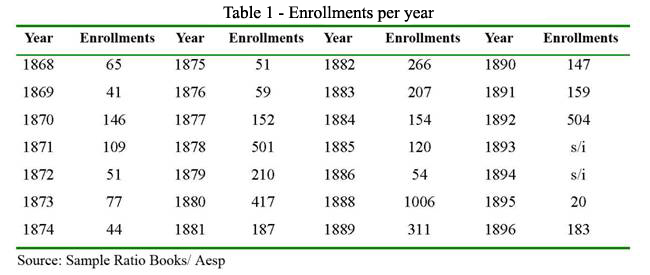
Concerning to the objectives of this article, we divided documentation into two parts. Between 1868 and 1889 the series is almost completed, except for the books from the second semester of 1886, to the year 1887 and the first semester of 1889. To this period they were accounted 4228 enrollments, of which there are 260 repeated enrolments, i.e, people who entered to the police force in different moments, in addition to 15 guards who accounted three raids. They are, effectively, 3953 unprecedented engagements1. Between 1890 and 1896 the documentary gaps are more patents. They are counted 103 enrollments, all unprecedented, in a period that the police contingent sensibly raised. But the oscillation of the new enrollments, unlike the previous period, did not follow the rise of the effective (Table 1 and 2)2.
That said, we decided to present the data as follows: an aggregation with the sum of information taken from 5241 enrollments; one related to the first period (1868-1889) and the other related to the second period (1890 and 1896). There are some points of reflection in these dates that would indicate tendencies that could impact over the data analysis: the end of slavery in 1888 , the impact of the massive influx of foreign people, from 1887, and the regime change, in 1889. A portion of the analysis concerning to the first period was published in Rosemberg (2010). The portion related to republican period is result of an unprecedented research.
A biography
Age
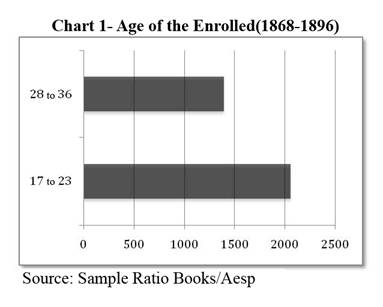
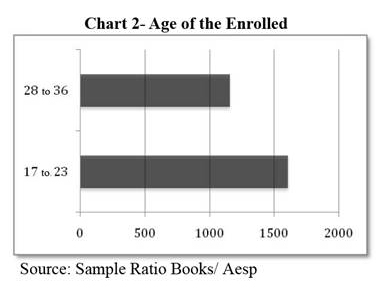
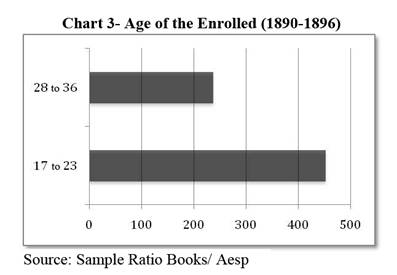
]]> The criterion of selection of recruits to the public force of São Paulo was very simple. Basically, the only regimental and objective restriction that riddled the entrance of the volunteer was the age. Regulation from PPF that lasted during the studied period, published in 1875, imposed the age between 18 and 35 years old. However, age limit was not respected, once it was common to see young aged 15, 16 and, mainly, 17 years old enrolling to the Force. On the other hand, there were guards who exceeded this limit. In 1896, when a new rule became effective, the age permitted was between 18 and 40.In all the periods analyzed, the average of age in the enrollments, excluding the extremes, i.e., those ones who were 17 or over 50 years old, was of 26,4 years old (26,7 years old between 1868-1889 and 25,9 between 1890 and 1896). However, the youth between 17 and 23, i.e., at the lower limit of the regimental age, is much higher than men between 28 and 36 years old, permeating and even exceeding legal superior limit. At the first average, fit 39,28% of recruits; at the second, 26,61% of total. Comparing both periods, we notice that youth of recruits deepens after 1890: 37,98 were between 17 and 23 years old (1868-1889), versus 44,71% (1890-1896); and 27,38 of the entrants were between 28 and 36 years old (1868-1889), versus 23,39% (1890-1896) (Chart 1, 2, 3).
]]>
Apparently, being a guard of the police force was the most attractive occupation for the youth. The enrolled were those who had not reached a solid and safe lifestyle. In search of a less unstable situation, the police could give a considerable effort, especially to single men with no children.
It is known that in São Paulo, police's apparatus served as an alternative of provisory occupation to poor male population accurate by emergency contingencies (ROSEMBERG, 2009). Comparing both studied periods, we can infer that a higher youth participation in the Republic may indicate that, at the beginning of this regime, the entrance of ex-slavers to the formal world and the cliff of immigrants increased competition for a place in a compressed business world (PINTO, 1994). To these people with reduced perspectives, at least temporally, police could serve as providential den that would provide cloth (uniform), home (quarter) and food (ranch), as well as a salary at the end of the month.
Occupation
The majority of volunteers for the job in the police declared not having a worthy craft to be specified. From 5241 engagements, 3971 were classified under the item "no craft (75,76% of total). Therefore, it is possible to suppose that they were newsboys or workers who lived agency', without demonstrating any specific skill that highlighted them among a universe of free and poor men.
Among the declared occupations, it can be highlighted skills in country services, such as carpenter (198), builder (177), forger (55), joiner (49), saddler (31), Rocket seller (25), that make up the declared occupations.
Among the most "sophisticated "declared occupations, associated to a still incipient urban context, stand out cobblers (90), tailors (96), painters (43), printers (40), bakers (36), musicians (23). There are still Goldsmith (15), milliners (12), Barbers (12). In complement, it is mentioned dozen of assorted occupations: artist, postman, cigar maker, baker, chef, dentist, gilder, finisher, pharmacist, bookkeeper, lithographer, machinist, potter, teacher, Dyer, etc.
Comparing both periods, we notice there is a constant percentage among the occupations, i.e., builders, carpenters and tailors were the most mentioned occupations, reversing the positions of carpenters and builders. At the first period that occupation was the most mentioned (182 carpenters versus 139 builders); while between 1890-1896, there was prevalence of builders (38 builders versus 16 carpenters). It was not possible to see, in almost 30 years, neither a signifying change in the nature of the declared occupations (rising of the number of "more urban" occupations) nor an inflection in the rhythm of absorption of an occupation over another. It is worth noticing, although, the amount of printers, that had 14 references between the years 1890-1896 (26 at the first period), percentage one of the most present occupations. Musicians also have a signifying rising percentage (from 3 it goes to 21, if we count a recruit who declared himself a music teacher). It can be explained by the high institutional and public esteem the police's band had. The band that was formed in 1851 was the police's business card. With the entrance of a higher number of musicians, the force might intend to qualify it by adding "professional" manpower.
It is difficult to identify an enrollment policy aimed to select the optimal attributes for the ideal volunteer. Although it can be suggested that in some circumstances the recruitment were directed to support specifically institutional needs, hypothesis that is clarified when we notice the enrollment concentration of enabled in a craft in a short period of time, like the 23 enrolled carpenters in 1880, the five tailors also recruited in November 1880 or the aforementioned 21 musicians.
]]> HeightAnother individual register verified at the moment of the enrollment was the height. Until 1871, references were based on the English standard, replaced by the reform of weights and measures set in 1862 and ruled in 1872. Our analysis starts from the validity of metric standard.
Unlike what happened with the European police forces, being short was not a restrictive criterion. Until 1890 there were not references about minimum height to the volunteers in police regulations. The recruits' minimum height was 1.65m, without alteration between both studied periods. Curiously, between 1871 and 1874, the average of the 227 enrolled was 1.49m. As it is not possible to have had an alteration in the enrollment policy or at the minimum height of the population, we can suggest that the rulers could have exceeded the minimum height of the enrolled guards in 1874. An example is that the references to recruits who were less than 1.50m tall (relatively common until then) disappeared. Another trace of this fact are the regimental references related to minimum height of the recruits in the Regulation of the Urban Company of 1890 and the Civic Guard of the Capital, in 1897. It is important to remind that both institutions wanted to represent a more "sophisticated" character than their military counterparts. They were urban police forces which aimed to enforce standards of morality and civility without appealing to physical strength. Polite and slimmer of a certain haughty aura presence was enough, in a mimicked standard of European urban police, specially London police, founded in 1829, and example of modern police (ROSEMBERG, 2010). So one of the parameters of authority emanating from the urban police should come from their physical size, stand out from the average population, like in the Old Continent (SHPAYER-MAKOV, 2002). Instead of the brief mention to the recruits' robustness, frequent in other regulations of police authorities, both mentioned regiments ruled a minimum height to the volunteer. In 1890, it was established a minimum height of 1.60m, but, seven years later, the requirement dropped to 1.50 m, perhaps reflecting the difficulty of recruits to perform the requirement.
Nationality
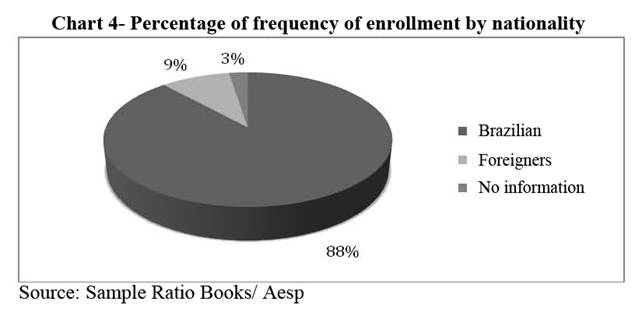
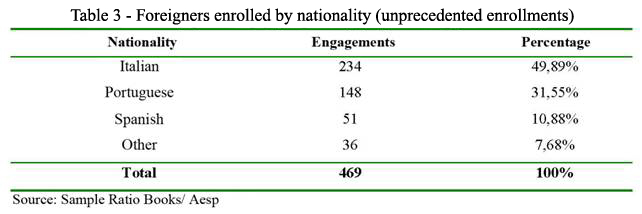
From the 4966 of unprecedented enrollments, 4394 were Brazilians and 457 were foreigners (Chart 4). Among the foreigners, 234 were Italian,148 were Portuguese, followed by the Spanish, 51 guards, eight Austrians, seven Germans and six Paraguayans. France, five, Argentina, four, England and Prussia, each with two officers, Chile and Africa, one enrolled each, completed the list (Table 03).
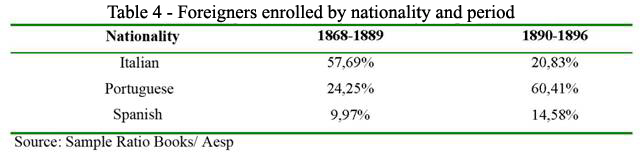
In general, foreigners amounted to less than 10% of enrolled. Comparing the Republican and Imperial period, the percentage does not change, remaining slightly above 9%. This data shows that even with the increase in the influx of immigrants from 1887 the trend in average foreign enrollments changes once the population constitution of São Paulo displays a significant percentage of foreigners (HOLLOWAY, 1984). With regard to the nationality of foreign-police, it is possible to notice a decrease in the number of Italians, who goes from 57.69% to 20.83% of total foreign volunteers; while the Portuguese and Spanish saw theirs measures becoming higher (24,25% versus 60,41% and 9,97%, respectively) (Table 4).
The modest incorporation of foreigners, widely Italian, from republican period, goes against the majority speech praising the cliff of Europeans, mainly peninsular as an appreciation of the Brazilian population, which incorporates civilized values from the oversea (SANTOS, 1998). Miscegenation was reputedly one of the ills afflicting the country; the presence of European immigrants was part of a strategy of bleaching population. Moreover, it is known that European immigrants were industrial and entrepreneurs' preference to fit available positions, mainly those which requested some capacity (ANDREWS, 1991). Differently, São Paulo's police force seems not to have adhered to this praising discourse. In Regiment, public force established a limit of 10% of foreigners in the Continent. However, it was in the police correspondence that the aversion to foreigners, especially the Italian, is more apparent. At least during the Empire, some occasions, police administrators explicitly rejected the enrollment of Italians, when they did not circulated diatribes about the character and behavior of the Peninsular, whether in internal occupations or published in reports.
Obviously, the police administration's preference was to recruit the "national element", despite the rejection of his "character" suffered in other areas. Nor the racially biased discourse that spread around the country - of the Agriculture Congress in 1878 to anthropologists of the early twentieth century - that made the Brazilian workers ascribed the taint of miscreant, lazy and Sorna (SCHWARCZ, 1993), demoted the police to prefer regional manpower. On the other hand, it is also true that the police officer image - with no distinction of nationality- did not enjoy good reputation with the dome of the corporation. The responsibility of the contingent endemic indiscipline and inefficiency of the service was reflected to the subject-police officer. Following a deterministic reasoning, that rang in the dome of police force, the inaccurate source and lack of education and decorum inherent to the poorest people undertook an indelible mark that poor socialization offered by the institution was unable to recover.
Home State
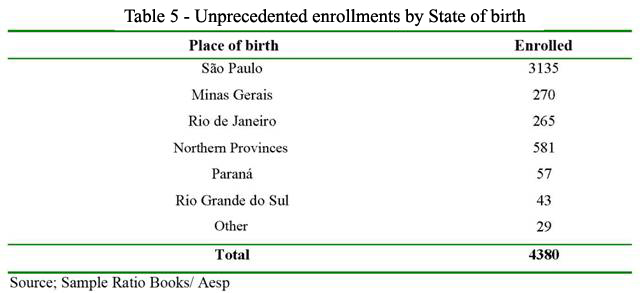
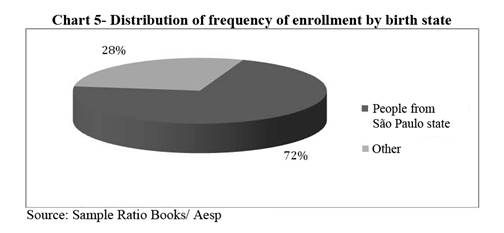
Counting the unprecedented enrollments, there was clear predominance of volunteers from São Paulo - 3135. 270 guards came from Minas Gerais and 265 from Rio de Janeiro, and these two provinces provided more guards followed by São Paulo. United, "the northern provinces" (Bahia, Sergipe, Alagoas, Paraiba, Pernambuco, Rio Grande do Norte, Ceará, Maranhão, Piauí and Pará) provided 581 guards. The provinces of Santa Catarina, Goias, Mato Grosso and Espírito Santo contributed with 29 police-officers. Paraná, with 57 and Rio Grande do Sul, with 43, round out the data. (Table 5, Chart 5).
]]>
With a sharp increase in the republican period, the presence of people who were not from São Paulo in the police hosts meets socioeconomic dynamics that reflect the province of São Paulo from the second half of the nineteenth century. The development of the agricultural frontier in the New West fostered, during the rales of the slavery system and the beginning of the Republic, not merely the movement of captive manpower, but also a great traffic of poor freemen, who accompanied the advance coffee growth. Moreover, the stagnation of the Northeastern economy and the drought between 1876 and 1879 were important factors that caused the migration to the South. According to data from D. Graham and Sérgio Buarque de Holanda, between 1872 and 1890, the total migration to Sao Paulo was of 119,959, and internal migration of natives was 72,649, i.e., more than 60% of the total (GRAHAM, HOLLAND, 1984) . Similarly, Warren Dean, in his classic text about the coffee economy in Rio Claro, stressed that "the internal migration of free workers from other provinces was a constant factor of growth of farms so that is surprisingly it has received little attention" (DEAN, 1977, p.119).
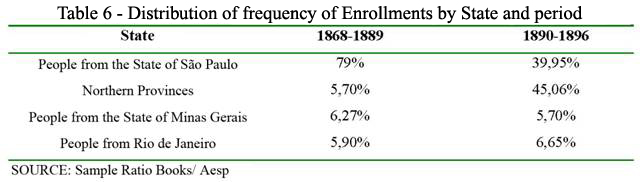
Comparing both periods, the increase of migrants in the police ranks comes out. If in the Imperial period people from the State of São Paulo constitutes 79% of unprecedented enrollments among Brazilian people and 70% of the total unprecedented enrollments (including foreigners); in the subsequent period the percentage decreased to 39,95% among national (33,16 of all engagements)3. The biggest impact of the presence of people who are not from São Paulo, no doubt, relates to the increase of the 'Northerners' recruits. Between 1868 until 1889 they numbered no more than 5.70% of total unprecedented enrollments among national (202 volunteers); in the subsequent period they represent 45.06% of the aspirants (379 enrollments), and, for that period, the police from Ceará contributed with 222 (Alagoas, 7, Bahia, 27, Maranhão, 2; Pará, 2; Paraíba, 29, Pernambuco, 50, Piauí, 8, Rio Grande do Norte, 26 and Sergipe,6, close the list). At the same time, people from Minas Gerais and Rio de Janeiro see their contingent to remain virtually unchanged (from 6.27% to 5.70% and 5.90% to 6.65%, respectively) (Table 6). The massive presence of Ceará confirms the trend started in the last decades of the Empire when the coffee planters from the west of São Paulo, in search of manpower, signed an agreement with bookies that rallied workers in that state that they intended to migrate to the south (MOURA, 1998).
Another situation that becomes common in the republican period is the novel expedient of seeking volunteers outside the state of Sao Paulo, a practice almost non-existent during the Empire. To get an idea, between 1868 and 1889 only 19 guards were enrolled outside the province, nine of them came from Rio de Janeiro, and none came from the Northern provinces. In the Republican period they were 234, or 23.9% of all enrolled, and 196 enlisted in the North, 193 of them in Ceará. This movement of receiving elsewhere volunteers seems to have increased during the republican regime. In some cases, the Public Force took advantage of the military campaigns and brought in tow new people to the corporation (GREGORY, 2009; SANTOS, 1948).
Skin color
In addition to opening the doors to national workers, the police conjured the prevention of any hue of the skin, since in these nearly thirty years there were a notably large number of enrollments of non-whites compared to whites. In all, they were 2137 white enrollments (45.60%) and 2454 enrollments of non-whites (52.36%) (Chart 6). If we consider just Brazilian people, the ratio is 57.62% (2388) non-white to white 40.38 (1695), as indicated in Chart 7.
]]>
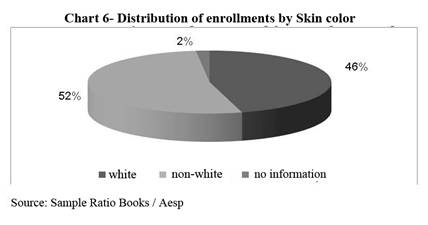
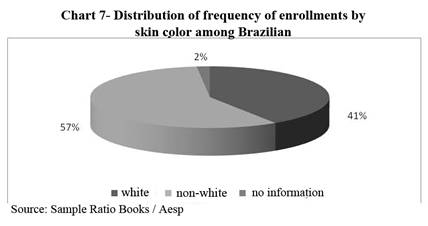
The comparison between the two periods studied is particularly interesting, since the inauguration of the Republican regime meant the formal extension of individual rights to the entire spectrum of the population. And the police documents give a good clue to follow the path of those that had not enjoyed the networks of citizenship at a time of acute inflection. This is possible just because the books of Sample Ratio provide information about the skin color of the volunteers in nominal list, contrary to what was seen in other documentary sources in which information about skin color thinned - especially in legal proceedings - from the mid-nineteenth century. This is the moment that the recognition of freedom/ slavery condition would relieve the immediate association with skin color. The entry of a significant non-white population (brown or black, according to official designations) in the free world, tarnishing an immediate differentiation, outlines a different character to freedom status, which gained more symbolic contours than purely ethnic
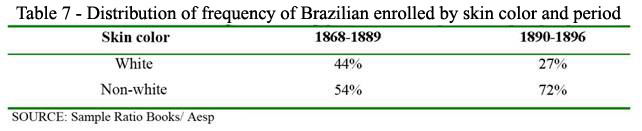
So, if in the imperial period, among the Brazilian police, the proportion of non-whites for whites was from 54% to 44%; in the Republican period, the percentage rose to 72% of non-whites Table 7).
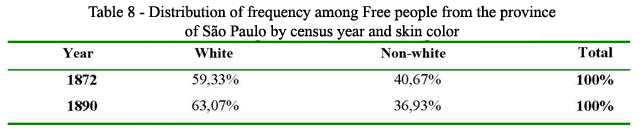
These data suggests an overrepresentation of non-white people in relation to the number of free Brazilian people, when we consider the data from the census organized in 1872 and 1890, as it is showed in Table 8.
Designation for skin color
]]> The designations used in reference to skin color of the recruits followed a particular criteria developed by the police and that does not follow the criteria stipulated by the official census. The main descriptions in the books of Sample Ratio were white, black and brown. Fula and caboclo appear with some regularity. Other designations such as mulatto, clear, goat, Fureta and dark are rarer (Table 9).It is interesting to notice that the skin hue of the enrolled was not just an indication of, the designation had an important ideological role in the classification of the volunteer once he was enrolled to the police. This obligation is noticed at first through the tawny designation and, in the Republican period, by the use of Fula as a new term. Both attributes were ascribed almost exclusively to Brazilians.
The tawny designation, for example, was replaced in the identification of stratum, by descriptions such as brown, black and white, whose original meaning - a differentiation of freedom state in relation to slavery - lost power as the slavery languished, and they were replaced by a new representation - tawniness '- that marked a whole new social category: free and poor Brazilians4.
In other words, the tawny designation and, later, fula, were bound to social status, and especially to nationality. The expressed political effort to engage the country in a sort of population bleaching process, embodied in subsidized immigration program inaugurated in the mid-1880s, reflected in the increasing rarity of the white designation on the qualifications held by the police, and in its counterpart, the extension of the tawny qualifier in enrollment after the abolition. Between 1888 and 1889, 534 of 1167 Brazilian were tawny (45.75%) versus 402 white (34.47%), in contrast to 253 tawny enrolled between the years 1871 and 1887. In the Republican period, this trend persists, once 229 white people were enrolled (22.60%) versus 313 tawny and fulas (30.89%) - 237 tawny and 76 Fulas.
The Fula designation also needs special attention. Almost absent during the empire (only seven mentions), it appears 76 times during the republican period. Between these, the most frequent association is with volunteers from the Northern provinces (Ceará, 64; Bahia, 1; Paraiba, 1; Pernambuco, 3; Piauí, 2, Rio Grande do Norte, 1); two were born in the state of Rio de Janeiro and two in São Paulo, in cities around Vale do Paraíba. That explicit association of skin color to their geographical origin also features patent ideological reasons, as long as the majority of "Northeast"-fulas were recruited out of São Paulo (47 in Ceará, and five in Federal Capital). There are still 19 recruits without information about the place of enrollment, but whose date of entry (August 1892) is the same as the great entry of people from Ceará enrolled "from the source."
It seems clear that the word "fula" has lost its original connotation of Islamised slave from Portuguese Guinea but whose Gentile was incorporated into current language to describe black with dull, pale complexion, supposedly inherent to the first fulas who arrived in Brazil (CARNEIRO, 1985, p. 47). The individual of "fula" skin color identified in the police books can be confused with the "goat" skin color, a term which use was widespread during the nineteenth century in the Northern provinces, as it was mentioned by Clovis Moura (2004, p. 75), "figuratively speaking, this word means valiant, bold man, similar to outlaw and bandit [...], mestizos in whose low' blood dosage is greater."
Thus, there is the attempt to infuse to the white skin color a more "aristocratic" characteristic, by assigning it to an ever narrower and perhaps more selected individuals, or foreigners, who had an unwavering seal of "whiteness", while "tawny" and "fula" terms were spread as generalized declassified population, nondescript and out of control of administrative authorities.
Another important point is the comparison of both periods in which we can notice an increase in the number of black and dingy people enrolled during the republican period. They were 161 black and 156 dingy, and that is equivalent to 15,89% and 15,39% of all the enrolled recruits. If the percentage of dingy was remained constant (16,29% in the imperial period), concerning to the black people, it tripled (5,32% between 1875 and 1889).This growing can suggest that the "black" name, many times associated to captive condition, at the end of slavery, could have lost the "shameful feature". So perhaps police administrators did not refuse to appoint as "black" the new recruits, since the previous former regime was forbidden to slaves, even though this event has been trivial (ROSEMBERG, 2010); it can also mean that the police in time with the expansion of the police contingent has surrendered to former slaves and freemen that detached from the tutelage slavery tutelage and sought other employers at a time of unfair competition. Deprecated by foreigner's arms in a competition for more stable jobs, they found an open door at the police force.
Family situation
Unlike the rule of the majority military institution, the police from São Paulo, especially during the imperial period, received several individuals who claimed to be married. From 5241 enrollments, 40.43% were registered as married (2119), 54.37% single (2850) and 2.13% were widowed (91) (Chart 8).
]]>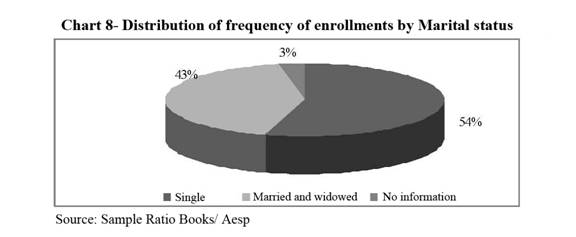
Interesting to compare this data with data of the entire province, according to the census of 1872, there were 70% single, 26% married and 4% widowed; although according to the census of 1886 they were 63% single, 33% married and 4% widowed (BASSANEZI, 2001). In a quick comparison, it is noticed that there was an overrepresentation of married couples in the police force.
This is because the presence of family and marriage could counteract the context of instability that characterized police routine. Unlike the Army, which hindered the marriage of soldiers, requiring consent of the officer, the police never officially opposed to the regular married life (KRAAY, 2004).
A stable family life could indicate temperate lifestyle, discipline and obedience, the essential attributes to the ideal worker, and, by extension, the ideal police officer. The large entry of those who declared themselves married may mean that there was a deliberate policy, an official inclination privileging them in relation to singles. And as soon as the volunteers were presented, they confirmed their marital status, even if they were not officially married. In such cases, the marital status was recognized by the stability of links and advertising, even outside the normative standard of the traditional patriarchal family (CORRÊA, 1983; DAYS, 1984, SÂMARA, 1981). The recognition of marital relationship featured as a mark of honesty, even with regard to community recognition, once marriage suggests honesty.
In the institutional discourse, the image of the good police officer is often linked to marriage and family, a clear homology to the representation of the good citizen, into compliance with the rules accepted by society: temperate lifestyle, love of work, Orthodoxy in family life, modesty and discretion attribute were most desired attributes. The hallowed things in a marital union would reproduce the bonds in corporate headquarters that the cop demonstrated in broader social relations; the social temperate lifestyle would spill to the corporation and so that would minimize the disruptive tendencies and facilitate the hierarchical supervision.
Perhaps the overrepresented numbers among married indicate a slight, very subtle, social stratification, but this hypothesis should be taken with some caution. Those outcasts individuals, alienated by solid community ties, were the primary victims of social control of the state and community, either through recruitment to the line troops, either by police hands, mobilized by the process of stigmatization of poverty and loitering in a moment of crisis and transition, or even by the anathema Community (in case of a rapist, for example) (MEZNAR, 1992). Those who "escaped" from the control were available and able to enlist in the ranks of the police.
Although very weak and precarious, the police administration tried to take a certain moral filtering of individuals before they were subjected to medical examination and oath. This cleavage becomes official requirement in the subsequent police regulations (in the texts that became vigorous in 1896), at a time that the volunteers were forced to join a certificate of good conduct signed by the local authority.
]]> Comparing data from both periods, we find a marked alteration in the ratio of single and married / widowed, who indicated 52% and 45% between 1868-1889. For the subsequent period singles make up 62.00% and the married / widowed 31.00%, a figure that approaches to the national standard indicated by the census of 1890, which for the first time estimates marital status by sex - 66.08% single men;31.13% married men; 2.69% widowed and 0.10% divorced (BASSANEZI, 2001) (Table 10).If the ratio is still high compared to other military institutions, the decline in the number of married police officers can be a sort of purification of relational traditions that prevailed during the Empire. In this case, the institution's relationship with its partners frays apart and the control over the audience, able to be enrolled, is also vanished. The police force is required to open its doors to a contingent which was enrolled in paternal relations of social control that was hierarchical and deference of a slave society, remaining unavailable to enrollments.
In addition, an imprint pragmatic argument can be hypothesized to explain the decline of married police officers in the early Republican period. The increase of public force contingent generates a consequent increase in expenses of the state treasury in what concerns to its maintenance. The concentration of married cops meant additional expenses with wives and families - housing, transport - which could greatly burden public coffers. The option to enrollments of single men without bond could fill the gaps of recruits, and even an important economic calculation5.
Conclusion
Given the analysis of police volunteers' biography, we propose that these nearly thirty years, joining the police did not depend on a specific administrative policy vis-à-vis the formation of a stable and professional situation. If the police has become an organization that hosted a reasonable fraction of skilled national workforce - male and poor - between 1868 and 1896 it was through the work of the contingent pressures, a temporary tightening of the individual impulse, much more than an official enrollment policy which aimed to forming a standard force, which fulfilled the expectations of government and institutional dome. The police officer from São Paulo, who had a significant portion of state authority, missionary of the designs of well-thinking, champion of the monopoly of legitimate violence, was at the end, a carved figure in the likeness of those upon whom should fall the burden of civilization, a reflection of that undistinguished and characterless portion, at the snapshot outlined by the dominant discourse. A poor, insignificant, frail, Brazilian man and a person with a mixture of fulo and tawny skin color.
Moreover, isolating the both periods, it is possible to notice that there is a process of "disqualification" of basic regimented manpower to serve the police. The increase in the number of single and migrants from North denotes this movement; in spite of the first concrete steps to "professionalize" the police officer job is seen at these periods, with the creation of a School of Recruits and the imposition of formal requirements to the corporation enrollment. We see, however, that, on the other hand of these decisions, the police administration is not able to select the volunteers, so it is required from the force to maintain a highly permissive policy of enlistment. The minimum control they could keep over the number of recruits during the imperial period is dissolved at the subsequent period - with the prevalence of a high number of married recruits and people from São Paulo, a sign, at least on the surface of temperate lifestyle, of rooting and community acceptance.
In short, the government failed in its plan to transform the police into citizens, i.e., when they tried to turn them rehabilitated individuals, who dressed as catechists and detached from the "ignorant mass" they came from, they would be able to contribute at least modestly in the search of moral regeneration of unwilling "people"6 to bend the law and authority, whose achievement depended on the helper's work, education and religion. A faded image of the State that they represented and should be mirror.
Acknowledgment
]]> I appreciate the contribution of Gabriele Cristine Barbosa dos Santos at the collection of the republican period data.
References
ANDREWS, Negros e brancos em São Paulo (1888-1988). Bauru: EDUSC, 1991.
BASSANEZI, M. S. C. B. (org.). São Paulo do Passado - dados demográficos. Campinas: Unicamp/NEPO, 2001.
BÉRLIÈRE, J-M. Archives de police: du fantasme au mirage, in: PETIT, J.G. e CHAUVAUD, F. (dir.). L'histoire contemporaine et les usages des archives judiciaires 1800-1939. Paris: H. Champion, Collection Archives et Histoire, 1998.
BRETAS, M. L. A polícia carioca no Império. Estudos Históricos, n. 22, Rio de Janeiro: Fundação Getúlio Vargas Editora, 1998.
]]>CARNEIRO, Edison. Perfil do negro brasileiro. Princípios, n. 11, agosto 1985, pp. 45-50.
CORRÊA, M. Morte em família - representações jurídicas de papéis sexuais. Rio de Janeiro: Graal, 1983.
CRUZ, H. Mercado e polícia - São Paulo 1890-1915. Revista Brasileira de História, São Paulo, v. 7, n. 14, mar./ago., 1987.
DALLARI, D. de A. O pequeno exército paulista. São Paulo: Perspectiva, 1977.
DEAN, W.. Rio Claro - um sistema brasileiro de grande lavoura 1820-1920. Rio de Janeiro: Paz e Terra, 1977.
]]>DENIS, V. e MILLIOT, V. Police et identification dans la France des Lumières. Genèses, n. 54, março de 2004.
DIAS, M. O. S. Quotidiano e poder em São Paulo no século XIX. São Paulo: Brasiliense, 1984.
FERNANDES, H. Política e segurança. São Paulo: Editora Alfa-ômega, 1974.
FOUCAULT, M. Segurança, território, população. São Paulo : Martins Fontes, 2008.
GRAHAM, D. e HOLANDA, S. B. de. Migrações internas no Brasil, 1872-1970. São Paulo: IPÊ, 1984.
]]>GREGÓRIO, V. M. A Força Pública como ideal nordestino na cidade grande, in: CARNEIRO, M. L. T. C. (org.). São Paulo metrópole das utopias - histórias de repressão e resistência no arquivo Deops. São Paulo: Lazuli-Companhia Editora Nacional, 2009.
HOFBAUER, A. Uma história de branqueamento ou o negro em questão. São Paulo: Editora UNESP/FAPESP, 2006.
HOLLOWAY, T. Polícia no Rio de Janeiro: repressão e resistência numa cidade do século XIX. Rio de Janeiro: Fundação Getúlio Vargas Editora, 1997.
______. Imigrantes para o café: café e sociedade em São Paulo, 1886-1934. Rio de Janeiro: Paz e Terra, 1984.
HOUTE, A.-D. Le métier du gendarme national au XIXe siècle - pratiques professionelles, esprit de corps et insertion sociale de la Monarchie de Juillet à la Grande Guerre. Tese de Doutorado. Paris: Université Paris IV - Sorbonne, 2006.
]]>KRAAY, H. O cotidiano dos soldados na guarnição da Bahia (1850-1889), in: CASTRO, C. C., IZECKOSOHN, V. e KRAAY, H. (orgs). Nova História Militar Brasileira. Rio de Janeiro: FGV/Bom Texto, 2004.
MATTOS, H. Das cores do silêncio: os significados da liberdade no sudeste escravista. Rio de Janeiro : Nova Fronteira, 1998.
MEZNAR, J. E. The ranks of the poor: military service and social differentiation in Northeast Brazil, 1830-1875. Hispanic American Historical Review, vol. 72, n. 3, agosto, 1992.
MONTOIA, A. O ideal de cidade: a reforma dos costumes e a gênese do cidadão em São Paulo no século XIX, in: PORTA, P. (org.). História da cidade de São Paulo - a cidade no Império 1823-1889, volume 2. São Paulo: Paz e Terra, 2004.
MORAES, W. R. de. Milícia Paulista - história da polícia militar paulista. São Paulo: Museu da Polícia Militar, 2003, 3 vol. (mimeo).
]]>MOURA, C. Dicionário da Escravidão Negra no Brasil. São Paulo: Edusp, 2004.
MOURA, D. A. S. de. Saindo das sombras: homens livres no declínio do escravismo. Campinas: Unicamp, 1998.
NAPOLI, P. Naissance de la police moderne - pouvoir, normes, sociétés. Paris: Éditions La Découverte, 2001.
PINTO, M. I. M. B. Cotidiano e sobrevivência - a vida do trabalhador pobre na cidade de São Paulo (1890 - 1914). São Paulo:Edusp, 1994.
ROSEMBERG, A. De chumbo e festim - uma história da polícia paulista no final do Império. São Paulo: Edusp, 2010.
]]>______. Para quando o calo aperta - os trabalhadores-policiais do Corpo Policial Permanente de São Paulo no final do Império. Locus - revista de História, v. 15, n. 1, pp. 77-90.
SÂMARA, E. M. Casamento e papéis familiares em São Paulo no séc. XIX. Caderno de Pesquisa. São Paulo, n. 37, maio de 1981.
SANTOS, D. F. dos. A Marcha Vermelha. São Paulo: Editora Saraiva, 1948.
SANTOS, C. J. F. dos, Nem tudo era italiano - São Paulo e pobreza (1890-1915). São Paulo: Annablume, 1998.
SANTOS, M. A. C. dos. Paladinos da ordem - polícia e sociedade em São Paulo na virada do século XIX ao XX. Tese de Doutorado. São Paulo: USP, 2004.
]]>SCHWARCZ, L. O espetáculo das raças: cientistas, instituições e pensamento racial no Brasil: 1870-1930. São Paulo: Companhia das Letras, 1993.
SOUZA, L. A. F. de. Lei, cotidiano e cidade - Polícia Civil e Práticas Policiais na São Paulo republicana (1889-1930). São Paulo: IBCCRIM, 2009.
SHPAYER-MAKOV, H. The making of a policeman: a social history of a labour force in metropolitan London, 1829-1914. Burlington: Ashgate, 2002.
WEBER, M. The theory of social and economic organization. Nova York: The Free Press, 1947.
]]> Article received in 10/2010.
1 The possibility of homonymy can distort the location of recidivists in the PPF. Among these, there are cases of the most unusual names that help calming the doubt. Anyway, especially regarding the most common names, we only consider the multiple enrollments from the pairing of other data - location and place of birth, occupation, etc...
2 The data refers to the contingent of PPF (until 1889), Police Force (1893) and Police Brigade, the Country Civic Guard I and the Capital Civic Guard (1897). Fire Brigade Department and Urban Company were not accounted.
3 There are 15 enrolled for which is mentioned the place of birth, but you can not specify the state of birth. Assuming they were from São Paulo, since for those from other states there is no mention of the counties of origin, the percentage for people from São Paulo state would increase to 41.00% (in relation to Brazilian) and 34.64% (compared to total enrollments).
4 An analysis of the uses of the designated color of the skin, in an anthropological perspective is in HOFBAUER, 2006.
5 Thanks to Luis Antonio Francisco de Souza, who alerted me to this plea.
6 Ana's definition about the term "people" is exemplary:" Men with no name, no social conditions, "people" has now specific categories, often designated by their constituted double form, poverty, 'vagrancy' and degeneracy (MONTOIA, 2004, p. 164).