A democracia no Brasil
Presidencialismo, coalizão partidária e processo
Fernando Limongi
Full professor in the Department of Political Science, USP and a researcher in Cebrap
]]> Translated by Eoin Paul O'Neil
ABSTRACT
There is no reason to treat the Brazilian political system as singular. Coalitions obey and are governed by party principles. The president, whose institutional power was enhanced by the 1988 Constitution, has a monopoly over legislative initiative, which approximates the Brazilian system to the European parliamentary democracies. Even though it is based upon empirical data, this essay formulates theoretical problems, such as the importance of institutional choices and how these impact on relations between the majority and minority in democratic governments.
Keywords: political system; democracy; democratic theory; presidentialism.
RESUMO
Nada autoriza tratar o sistema político brasileiro como singular. Coalizões obedecem e são regidas pelo princípio partidário. O presidente, que teve seu poder institucional reforçado pela Constituição de 1988, detém monopólio sobre iniciativa legislativa, o que aproxima o sistema brasileiro das democracias parlamentaristas européias. Ainda que estruturada em torno de questões empíricas, a discussão tangencia questões teóricas, como a importância das escolhas institucionais e como estas afetam as relações entre a maioria e a minoria em governos democráticos.
Palavras-chave: sistema político; democracia; teoria democrática; presidencialismo.
The theme of this lecture is --, as officially published-- coalition presidentialism and the decision making process in contemporary Brazil. I believe this is a good opportunity to expand the focus and to show that it is a mistake to trace rigid lines of demarcation between, for example, empirical and theoretical research, between quantitative and qualitative methods, and so forth. Political scientists have shown a tendency to divide into tribes and small groups, each claiming the role of the heir or herald of the true discipline.
I do not believe that different traditions or languages are in dispute. When dealt with consistently the inquiries that structure the discipline disrespect these frontiers. For example, questions that at first sight appear to be solely empirical or quantitative can only be properly addressed if and when the theoretical dimensions involved are taken into account. Arguments cannot be contested based on their alleged geographical origins. The logic of scientific analysis does not have an accent.
The central theme of this discussion is the Brazilian political system, its mode of functioning and operation, a system to which a short while ago the expression coined by Sérgio Abranches in 1988 came to be applied, i.e., coalition presidentialism2. The term won widespread acceptance and has now entered current usage, even appearing in the editorials of the mainstream press3.
The need for adjectives to describe or classify Brazilian presidentialism is based upon the presumption that there is something special or peculiar about it. We do not have or practice a normal form of presidentialism. We have a system with its own characteristics. For better or for worse, Brazilian presidentialism functions in this particular way: as a coalition presidentialism.
One of the central objectives of this lecture is to examine if there exist reasons that can support this aspiration to originality. Paraphrasing O'Donnell, are we dealing with a new political animal? Are we living under a coalition presidentialism, with the right to italics and emphasis?
When proposed by Sérgio Abranches, the use of the term actually involved a claim to specificity:
]]> In his text the specificity is directly associated with the difficulties of building a stable democratic order in Brazil. It is also worth bearing in mind the subtitle of the article: "the Brazilian institutional dilemma". The text is full of references to the possibility of crises and replete of judgments on the difficulties faced by the country in its experiences as a democratic system. I will cite just one:Brazil is the only country which, as well as combining proportionality, a multisystem and an 'imperial presidentialism', organizes the Executive based on large coalitions. I will call this peculiar trait of the concrete Brazilian institutionality, for lack of a better alternative, 'coalition presidentialism'.4
The reasoning highlighted above points to the Gordian knot in coalition presidentialism. It is a system characterized by instability, high levels of risk and which is almost exclusively sustained on the current performance of government and its disposition to strictly adhere to the ideological or programmatic points considered to be non-negotiable, which are not always explicit or coherently established in the formation phase of the coalition.5
The actual contribution of the author to the institutional debate of the pre-constituent period should be noted, namely, to propose an alteration in the focus of the discussion, acknowledging that reforming political party and electoral legislation in order to reduce the number of parties would little, if any, impact for governability. Presidents would always be forced to form coalitions to govern, even, no matter how paradoxical it seems, if their party was in the majority. This is because coalitions are not formed only according to party criteria. In other words, the usual method of coalition formation would prove insufficient to provide the necessary political support for the president. Federalism, the power of governors and the diversity and heterogeneity of Brazilian society, rather than the number of parties, make coalitions so vital. This characteristic of Brazilian politics is affirmed in the following passage:
The logic of coalition formation has two clearly axes: the political party and the region (state), - the same today as yesterday. This is what explains the recurrence of large coalitions, since the calculations regarding the government support base are not just parliamentary party related, but also regional. 6
What distinguishes coalition presidentialism is this particular criteria used for the formation of the parliamentary support for the president, i.e., the fact that is cannot be strictly party based. The need to meet regional criteria, it is worth repeating, is due to the social heterogeneity of the country, federalism and the power of governors.
Being created in this form, and despite being necessary, coalitions are inefficient, incapable of supporting consistent government agendas. The coalition, therefore, enters in the definition of the concept not as a solution, but as an expression of the difficulties faced by the president to govern.
Nevertheless, it is worth asking if the original formulation is drawn on nowadays when the terms is used. After all, what does it actually mean when our system is called coalition presidentialism?
I would say that the relationship with the original characterization and definition is vague, when it is not ambiguous. We are facing, I would argue, the phenomenon highlighted by Sartori7 many years ago: a conceptual stretching that irredeemably leads to confusion. Nevertheless, it is still possible to point to some points in which Abranches's text, whose current judgments seem to me to be distant from those offered in 1988, approximate the current vision of the Brazilian political system. The latter tends to be seen as original, due to the incapacity to form strict party based coalitions because of the fragility of the parties, which is explained in part or completely by references to the survival of traditional power (regional and local power).
]]> My argument goes in the opposite direction. From the descriptive point of view the Brazilian political system can, without a doubt, be called coalition presidentialism and governments resort to the formation of coalitions to obtain support for their initiatives. Thus, by themselves these characteristics do not imply or justify the aspiration to originality. Furthermore, if we resort to systematic empirical evidence, as I will try to show, it is not possible to maintain either the aspiration to originality or the negative judgments. Even though I only deal with the other points very briefly, I will also show that it is not possible to sustain the argument that Brazilian parties are incapable of structuring party based coalitions or that the traditional power regulates and controls the electoral results.More positively I want to show that from the point of view of its structure, the way it effectively function, there is little that allows the Brazilian political system to be distinguished from other so-called advanced or consolidated democracies. The way the decision making process is organized, and more specifically the power to set the agenda given to the Executive, guarantee that the Brazilian government operates on a similar foundation to most other existing democracies. In this particular aspect the 1988 Constitution radically altered the institutional basis which structured the relations between the Executive and Legislative powers. Abranches, it should be noted, made no reference to the decision making process and wrote before the 1988 Constitution was drafted. In other words, when the term is used now the two Brazilian democratic experiences are implicitly equated. However, the institutional frameworks of each are miles apart.
The plan of this presentation, made in this long introduction, is as follows. The first step is to establish the approximation between the way current democracies and Brazilian democracy operate. This involves comparative elements that allow the contextualization of our political system. The reference obviously has to be the existing democracies and not the idealized ones. No matter how trivial and obvious it may seem, this is not the path usually followed by the majority of analysts.
I will show that the Brazilian government's modus operandi is the same as the one found in other contemporary democracies. The Executive controls the legislative agenda, managing to approve the majority of its propositions because it is anchored in solid and consistent party support. Therefore, this section can be said, resorting to bureaucratic-regimental 'speech', to deal with the structure and the functioning of contemporary democracies.
I then move on to analyze the possible objections. In other words, this involves discussing the difficulties in accepting that the information given can have the same meaning here and elsewhere. Elsewhere refers to Europe and countries with parliamentary systems, by which it is understood that reality gets a different meaning when it crosses the Atlantic and reaches inhospitable tropical lands. Thus, I can say that the second part of this discussion deals with objections.
I will discuss three groups of objections in relation to the interpretation of the data presented. The first two deal with theoretical and analytical questions. I will start with the possibility of establishing the comparison made above. Is it licit to compare the structure of parliamentary and presidentialist governments? Does data related to the success and the legislative hegemony of the Executive have the same meaning in both forms of government? In other words, the first objection is related to the form of government, to the distinction between presidentialism and parliamentarianism.
The second set of objections questions the interpretation of the data. Paralysis and Executive incapacity to implement its agenda are compatible with high rates of approval of legislative issues. For this it is sufficient for the Executive to recognize its weakness and to submit to the Congress only consensual issues. I bring these objections together under the sub-title agenda and the anticipation of reactions.
The third objection deals more directly with the national debate, more precisely with the deep rooted distrust of the quality of our representative body. Intending to take Brazil as equal, shall we say, to England, ignores the qualitative differences between the representative bodies of the two countries. The nature of the majorities is radically different. Nonetheless, the objection is directly related to the electoral arena and, in the final analysis, it involves the discussion of a variation of the old diagnosis according to which the Brazilian political system can be characterized by the conflict between a progressive Executive and a conservative Congress. The third group of objections can be called the failures of representative government in Brazil.
The Structure and the Functioning of Democratic Governments
]]> A little information is sufficient to characterize contemporary parliamentary governments. Two quite simple indicators are enough to highlight the essential traits of the way they operate: the success rate of Executive initiatives, which is no more than the proportion of what is approved in relation to the total bills submitted, and the rate of dominance over legal production, the simple division of the laws proposed by the Executive by the total number of laws passed during the period. Comparative studies and studies on specific countries tend to confirm what in 1979 Loewenberg and Petterson8 in a pioneering comparative study called the rule of 90%. In other words: both the rate of success and of dominance concentrate at around 90%.The data compiled by the Inter-Parliamentary Union9, the most reliable comparative study in this respect, leaves no room for doubt. A few examples are enough. The British government, the paradigm of parliamentary government, obtained an approval rate of 93% of the proposals it submitted to parliament between 1971 and 1976. Between 1978 and 1982 this rate fell by one percent. In relation to dominance, it remained between 83% and 84% in each of these periods. The values varied very little. Another example: Denmark. In the first period covered by the survey, the rates of success and dominance were respectively 89% and 99%. In the most recent survey the numbers fell slightly, to 88% and 97%. Finland, a country that, like Brazil, adopts proportional representation with an open list, registers high values in both questions in the two periods: 84% of both success and hegemony between 1971 and 1976, rising to 88% and 99% respectively in the second period.
The examples can be multiplied. Nevertheless, there are parliamentary countries included in the research that have atypical behavior. Two cases call attention, both included only in the second edition: Portugal (13.7% and 39.9%) and Italy (51.3% and 69.9%). The exceptions are important to call attention to two points. First: the scope of the coverage of legal norms may affect the behavior of the index, as is the case of Portugal due to the inclusion of the bagatelas, laws that alter the status of vilas (villages) and freguesias (councils) in the computation of legal production. Italy alerts to the possibility that the predominance of the Executive over legal production is not a constitutive trait of parliamentarianism. Prime ministers tend to control the legislative agenda, but this is not necessarily the case for all parlimanetary governments.
The general tendency contained in this data is not a reason to sound alarm signals, in other words it cannot be interpreted as illustrating the bankruptcy of the Legislative power or its bastardization by the Executive. This is because the origin of the supremacy of the Executive lies in the explicit delegation of the majority. The high rates of party or coalition discipline that support the Executive is proof of this delegation.
The necessary complement for the comprehension of the rates of success and dominance of the Executive in parliamentary governments, therefore, is the existence of party discipline, taken as incontestable and indisputable for the majority of parliamentary governments. This assumption is so ingrained that it is difficult to find comparative empirical works on the theme. The few studies dedicated to specific countries, for example, tend to count examples of voting in which one or more non-disciplined votes were registered10.
This information reveals to an extent the structure of parliamentary governments, the basis on which their ordinary functioning operates: the supremacy of the Executive supported by consistent party support. That established, let us turn to the analysis of the Brazilian case. The constant references to problems of governability, the fragility of the political party framework and the permanent appeal to political reform seem to point to or make us suppose that a radically diverse scenario would be revealed by an examination of similar data be. However, an examination of the data reveals that Brazil is not so distant from parliamentary countries.
We will begin with the rate of success and dominance. These are high, comparable to those observed in the countries we analyzed moments ago. The success of the Executive in the period after the enactment of the 1988 Constitution was 70.7%11. It should be noted that the definition of success adopted is demanding, since it requires that the issue in question be approved during the mandate of the president who submitted it. The variations per president are small and are independent of their support bases. While it is true that Fernando Collor, the only president in the period to form a minority coalition, had the lowest performance among all presidents in this item, approving 65% of the projects he submitted, the variation is lower than the stability. The success rate of Itamar was one percent higher than Collor, while the other presidents were slightly above 70%.
The rate of dominance for the same period is also expressive: 85.6%. Once again there are no significant variations between the different mandates. Collor and Sarney have the lowest values, around 77%. Itamar and Lula are above 90%, while Fernando Henrique had a similar rate in his two mandates: 85%.
It is interesting to compare this data with something other that just parliamentary countries. Comparing them with the previous democratic period is also revealing. The contrast could not be more complete. The success of the Executive in the period for which data is available (1949-1964) was a mere 29.5%. Vargas, the most successful president in the period managed to approve only 45% of what he submitted. In relation to the rates of dominance, the differences are equally palpable. The Executive was responsible for the submission of 39% of the laws approved in that period. Furthermore, the president with the highest rate in the first democratic experience is much lower than the president who had the worst results in the current period: the difference that separates them is 30%.
In other words, Executive-Legislative relations have changed from water to wine. They have changed due to differences between the two constitutions. Seen from the angle of legislative production, the most successful president in the previous period is not even a pallid image of current presidents. We are dealing with characteristics that arise out of the institutional structure adopted and not the qualities of this or that leader.
]]> To sum up: what the Executive submits to the Legislative is in general approved. And, by definition, bills are only passed if they are supported by the majority. To avoid misunderstandings, it should be noted that this also extends to Provisional Measures. These need to be approved by Congress to become law.The next step for the analysis is to investigate the behavior of the majority, i.e., to discover how the Executive obtains support for its proposals. Once again the empirical analysis reveals an unexpected picture. The Brazilian government is very successful in the legislative arena because it counts on the solid support of a party based coalition.
Discipline is the norm. Deputies who are members of parties that are part of the presidential coalition follow the voting recommendations of the leader of the government. The measured discipline of the governmental base – the proportion of deputies who are members of parties with ministerial positions voting in accordance with the explicit indications of the leader of the government – is 87.4% for the 842 votes occurring during the period12. The variation between presidents is small: the lowest average was registered under Sarney, with 78.4%, and highest, 90.7%, during the second mandate of Fernando Henrique. The Lula government, to dissipate false images, enjoyed an average support of 89.1% of deputies in the government base in 164 votes.
In reality the government coalition loses consistency when one of the parties does not follow the government's leadership, resulting in a fall in the support rate to 70.1%13. However, this dissent within the coalition is relatively rare, only occurring in 18% of the 786 votes considered.
Compared to the almost absolute discipline registered in the majority of parliamentary countries, these numbers can be considered to be low. Nevertheless, what really matters is not the magnitude of the discipline, but its predictability, in other words if leaders can forecast the results, if they can guarantee victory counting only on their own supporters. This happens in Brazil. The floor of the Congress is extremely predictable.
The fact is that the president is rarely defeated. The government was victorious in no less than 769 of the 842 votes taken into account: i.e., 91.3% of the time. There is no major variation if we distinguish different types of voting, based on the quorum required or whether or not the vote is on a substantive issue. In the case of constitutional questions, in which a majority of 3/5 of favorable votes is required to pass the amendment, the percentage of victories is exactly the same as the overall one, there were 242 victories in 265 votes. In his second mandate Fernando Henrique obtained the support of the Congress in 31 out of 32 votes and while Lula has also been successful in 31 out of 32 votes.
Based on this information it seems difficult to argue that the government's coalition lacks solidity. It is worth noting that in the majority of defeats it was not the lack of discipline that was the problem, but its internal division, in other words at least one party did not obey the leader of the government.
Finally, before proceeding, it should be noted that presidents can incur risks that prime ministers cannot, since defeats do not imply the loss of their positions. Therefore, it is to be expected that the government under presidentialism suffers a greater number of defeats without this resulting in paralysis or in insurmountable conflict with the Legislature14.
Analyzed in this form the data allows us to conclude that we are dealing with party deals and bargains carried out by the party leaders that form the government's coalition. Dissension in the coalition is rare, as shown by the few cases in which the coalition divides. Stated in another form: nothing indicates that the success of the Executive is obtained on the so called "spot market",. There are no individual negotiations or bargains. Votes come in blocks, party blocks.
The government controls legislative production and this control is the result of interaction between power over the agenda and the support of the majority. A majority that is formed around by a pure party coalition. No qualifications are required. Not very different from what goes on in parliamentary governments. In other words, there is no basis to treat the Brazilian political system as singular. Even less to state that we have a democracy with serious problems, Separation of powers or the fragility of its parties does not threaten the Brazilian democracy. There is no syndrome or pathology to get rid of.
]]> Despite this, suspicion and a negative vision are still imperious. There are enormous difficulties in accepting that we live in a normal democracy. Our political system simply cannot be treated the same as the other democracies. Let us move on to the objections. Because there are objections. And there are not few of them..
Objections
Obviously it is impossible, due to the limits of this discussion, to deal with all the objections that can be raised against the propositions made in the previous section. I believe that I have selected the most representative. I will deal with three objections, those related to the form of government, to the strategic selection of proposals and to the nature of the majority. In relation to the first, which refers to the form of government, its core takes the following form: the success and the dominance of the Executive are normal traits under parliamentarianism; under presidentialism they are evidence of anomalies, of a clear disfiguration of the principle of the separation of powers. Under presidentialism the Executive is responsible for executing the laws whose preparation is the responsibility of the Legislative Power. Therefore, if the Executive is the principal legislator, there has been an usurpation of the Legislative power by the Executive.
To start the discussion it is important to emphasize how inadequate it is to indentify the virtuous functioning of presidentialism, both in its original conception and in the way it functions, with contemporary US model. Both errors, I believe, are committed by current comparative literature15.
In the debates on presidentialism, the reference to the Federalists is usual. Most often it is only a reverence: a consultation of the oracle, to remember the irony with which Madison treats the references to Montesquieu by the anti-federalists. A consultation that nonetheless, according to Bernard Manin, losses sight of what is essential in the original contribution of the Federalists: the creation of endogenous mechanisms for the control and limitation of the exercise of power by the majority, making their action difficult, slowing it down16. I want to emphasize this point because the understanding of relations between the majority and minority in specific institutional designs in a constant reference in this debate.
It is interesting to note the asymmetry in the treatment dedicated to parliamentary and presidentialist governments. Modern parliamentarianism, whose classic expression can be found in the English government, was not the result of a previously conceived institutional design. To the contrary. The fusion of Executive and Legislative powers illustrated by Bagehot, who saw this as the source of its efficiency, went against the separation of powers praised and recommended by the theory in force. Its efficiency was related with its secrecy.17
As Gary Cox18 shows, the concentration of powers in the hands of the cabinet was the non-intentional result of a series of transformations that commenced with the expansion of the electorate in 1832. Since everyone wanted to pass proposals to keep their electorates happy, the pressure on the scarce time grew. Later the reaction to the obstructionist strategy of the Irish bloc reinforced the control of the prime minister over the work of the parliament. From the point of view of the decision making process, the individual legislative rights of the individual members were expropriated. Minorities had their power immensely reduced, if not annulled. The majority for their part began to govern delegating the legislative initiative to the cabinet. An analogous process took place in many presidential systems. However, the constant return to the 'oracle' condemns this evolution, seeing it as illegitimate or as an assault on the true principles of the separation of powers. But, if one reads the constitutional texts, one will see that most presidential constitutions moved away from the US model. The exegesis and interpretation of the texts written by consecrated authors does not elucidate the point.
The comparative literature, under the strong influence of North American legislative studies, minimizes the power of the president, insisting, as Terry Moe highlights19, in placing the congress at the center of political system. It is undeniable that from the point of view of its legislative powers the US president is weak. His power is limited to the total veto. But this does not reduce him to insignificance, to a mere point in equal standing with the filibuster senator as most spatial models do20. It also should be noted that it is not necessary to consider the true power of decree that US presidents can count on, the recently 'discovered' Executive Order, to criticize this vision21.
The difficulties in understanding contemporary presidentialism arise out of the tendency to equate separation to conflict between the powers. In the origin of this mistake, as I have argued elsewhere22, is the premise that politicians only care about obtaining mandates. Politicians, to use the jargon and following Downs' original proposal, are assumed to ne office seeking. And since presidents and legislators respond to different electorates, it follows that they have distinct interests, in other words they seek to tilt public policies towards different electorates. Therefore, they inevitably enter in conflict.
]]> It should be noted that the well known and always cited definition of presidentialism proposed by Shugart and Carey is based above all on the electoral separation of mandates23. What makes presidentialism and parliamentarianism different, what impedes the cooperation of powers, is the difference in relation to the origin and termination of mandates. From the independence of mandates it is possible to derive the impossibility of cooperation between the powers. It should be noted in passing that in this argument, due to the premise that what really matters is obtaining and ensuring mandates, legislators are treated as having a single common interest. Intra-legislative conflict, i.e. political parties, leaves the stage.The fact is that the Brazilian president is powerful from the legislative point of view. And he is so not because he usurped the legislative power, but because the 1988 Constitution so stipulated. The president has the exclusive prerogative of initiating legislation in the principal areas of politics: taxation, budget and employment in the public sector, to cite the fundamental areas24. Thus, the president is not just any ordinary legislator.
It is worth noting that the Brazilian president is not the only one to assume this position. The majority of presidentialist constitutions establish the same principles. Presidentialist constitutions adopted more recently do not follow the US pattern. The constitutional norm, so to speak, is to give the president the exclusive prerogative to introduce the most relevant bills, t limiting the spheres of possible actions by of legislators. In no area those restrictions are so important as in the definition of the public budget. The legislator's action in this key area is circumscribed in a clear and explicit manner. For example in Brazil, the 1988 Constitution disciplines the presentation of amendments to the proposed budget, effectively restricting them to the manipulation of allotments for investments25. Various other presidentialist constitutions do the same.
Ironically, the characterization of the functioning and the problems faced by presidentialism offered by Juan Linz26 seems to have come straight out of the pages of Bagehot. But, the presidential system Bagehot had in mind –the 1860's US presidentialim-- is not the norm today. Not even in the US.
In summary, the Brazilian Constitution, like so many other presidentialist constitutions, prevents parliamentary careers from being built by resorting to distributivism . The United States in the 1950s and 1960s are an exception. The fate of representatives under today's presidentialism is not that different than those faced by members of parliaments in Europe. Both have seen their parliamentary rights to present proposals restricted27.
Thus, the analytical reference used to understand the relations between the Executive and the Legislature under parliamentarianism can be used in the study of the functioning of presidentialism. The decision making process favors the Executive which, counting on these resources, is capable of structuring and preserving its legislative support. In both cases the Executive governs based on the delegation of the majority. The distance between presidentialist and parliamentary governments is smaller than is supposed.
The examination of these questions leads us to the second objection, the understanding of the meaning of the rates of success and the legislative hegemony of the president. According to this objection, the indicators of the success and the legislative hegemony of the president are not sufficient to prove the capacity of the president to approve his legislative agenda. If the president were capable of anticipating the reactions, or better the objections, of Congress, he would only propose legislation that would be certain to be approved. It is just a step to move from this possibility to the conclusion that this actually occurs with the real presidential agenda, the one that really matters.
This is not a new objection and occupies a central position within the discipline. It is impossible not to refer to debate about the manifestations of power, to its different faces, using the expressions that crystallized in the 1960s. More importantly, the objection forces us to be rigorous from the analytical point of view and, as I will show, if considered in this way its relevance effect is weaker than it might appear at first sight.
For the objection to become clearer, I will resort to a citation, to one of its most complete formulations due to Alfred Stepan. He questions the conclusions reached by studies that rely on data about the success legislative dominance of the Brazilian president. The relevant passage is as follows:
In these conditions what Karl Friedrich calls the law of anticipated response comes into play (...): accepting that all players know the obstruction potential of a small minority, many measures that could count on the support of the majority in Congress and of public opinion are removed from the agenda. 28
]]> Let us not dwell on an easy way out: the exception to a law applies equally to all the parliamentary countries mentioned above. The type of questioning invoked is more broad and more general. It involves a problem to be faced whenever the relations of power are discussed. Within the discipline one of its most famous and best known incarnations occurred in the debate between the pluralists and elite theory. How to prove that power is dispersed or is concentrated in a few hands?During this debate, as is always mentioned in any review of the question, in 1962 Brachrach and Baratz29 arrived at the law of the anticipation of reactions, pointing to the existence of a second face of power; the power that is exercised without being manifested, in other words, when an actor prevents issues whose resolution can contradict his own interests from being included in the decision making agenda. What we have then are non-decisions. In relation to the theme of this lecture, we have bills that are not submitted to Congress, a presidential agenda that is not proposed due to the anticipation of obstruction by Congress.
The problem is well known. Spelling it out is not exactly a consequential objection. It is necessary to go further to transform the analytical problem into a question with empirical and substantive consequences. However, even in the analytical field, we are now in a better condition to deal with the problem created by the possible anticipation of reactions. Stepan points in this direction. The use of the term players is certainly not gratuitous.
In fact, the excerpt quoted above is preceded by a series of references to literature about the US Congress, more specifically to those that adopt the perspective of the rational choice school. Some of the questions involved in the objection raised can be better understood when this literature is referred to. To be more precise, reference has to be made to the substantive and methodological debate that took place in the US legislative literature. In relation to the first aspect, what is in play is the institutional power of commissions, the capacity of the minorities entrenched in commissions to have their proposals approved by the parliament. The vision created of the US Congress, The Textbook Congress30, to paraphrase the title of the well known article by Shepsle, emphasizes the decentralization of the decision making process and the importance that commissions assume in this context. In this institutional structure, minorities with preferences that disagree with the majority end up ruling. This is a vision established in the literature and, it should be noted, precedes the application of the social choice models in the legislative studies field.
The renowned model proposed by Shepsle does not prove that commission govern and that the decentralization of the decision making process leads to government by minorities, even though this is a common interpretation of his work31. The question that Shepsle seeks to answer is different. His problem is of a theoretical and analytical nature. He resorts to a stylized version of the US Congress to prove the existence of a majority rule equilibrium. Shepsle answers or solve the problem of the "instability and unpredictability of the majorities". As is well known, under some circumstances, decisions by the majority are not stable, they have no equilibrium. For any decision taken by a majority it is possible to form an alternative majority coalition that could defeat it.
However, the impossibility of finding a unique social decision occurs in a, so to speak, state of nature in which the decision making process is not regulated by institutions. The will of the majority is revealed by the mere aggregation of preferences32. Shepsle's model imposes structure on this decision making process, a structure that mirrors the commission system adopted by the US Congress. Nevertheless, in the final analysis, the solution proposed by Shepsle depends on breaking the decision making process, the transformation of a multidimensional decision into a series of one-dimensional and independent decisions taken by the committee.
Demonstrating the existence of equilibrium is not the same as showing that it will be achieved. Equilibrium means that there is not a majority that would vote in favor of an alternative decision. The definition of equilibrium used – core equilibrium – does not ask how the situation will be obtained. The entire decision making space is examined in search of a point with this property: not to be defeated by any hypothetically formed majority. In this tradition, how and why the majority converge on this point is not investigated. Nevertheless, for this point to become the social decision, as shown by Krehbiel, it would be necessary for the congress floor to accept bills proposed by the committee that contradict r its interest.33 At the heart of the argument is the problem of the anticipation of reactions and the sequence in which actors are called to participate in the decision making process.
This objection led to an intense debate about the institutional basis of the committee power which ended up contradicting the substantive interpretation attributed to the model proposed by Shepsle.34 The deference to the committee expertise is the only explanation for why would the floor accepts the proposals made by committee. From the institutional point of view and assuming that the actors are rational, the committee cannot impose its will on the Congress as a whole.
During this debate, Krehbiel introduced an apparently banal but crucial distinction for the substantive questions involved in observing the differences between the power of veto (negative power in his language) and the power of approving proposals contrary to the other actors (positive power). In the two situations, despite the diverse meanings they possess, we can say that an actor (in the case in question the minority represented by the committee) imposes its will on the other (the majority, represented by the Congress as a whole). But there is a crucial difference between the two situations.
Krehbiel argued that commissions would have at the very most a negative power, the power of blocking. Since they are obligatory routes for bills to pass through, the committee would close its doors to proposals that it knew would be decided against its interest by the Congress as a whole. The committee would prefer to leave things as they are, the status quo, to the changes that would be introduced by the floor . In the other situations the power of the committees depends on the restrictions imposed on the right of the Congress as a whole to amend the proposals that reach the floor.
]]> Obviously it is not in my interest to recreate or even to specify the power of the US legislative committees. I am resorting to this debate to emphasize the importance of relations between the institutional design and the power conferred on majorities and minorities in democratic political systems. The original model of government by committees is a model in which the minority governs. In the revised model, taking into account the criticisms made by Krehbiel, minorities have a conservative power, capable of deterring the majority. Even then, it should be noted, they have this power in a specific institutional design. In this case, as long as it is not possible for the majority to overcome the veto power of the minority preferences entrenched in the committee35.Committees are not the only form through which minorities can deter the will of the majority. Nevertheless, they are one of the most studied and efficient arms of minorities in democratic governments. The minority can resort to other strategies, such as indefinitely extending the debate, calling votes at any moment, preventing a quorum from being reached, etc.
The substantive discussion on the power of the committees in the US legislature was accompanied from the methodological point of view by the progressive abandonment of models based on the public choice school and cooperative game theory. Current models follow the premises of non-cooperative game theory36. In the specialized literature it is usual to distinguish these two generations of models37. First generation models lacked minimally consistent behavioral postulates. Basically they resort to pre-established rules or methods to aggregate preferences, without explaining or supplying reasons to justify why actors act in the way they act. Anyone who studies McKelvey's celebrated model is led to ask why actors do not perceive that they are moving away from the set of Pareto Optimal decisions. The sole actor acting in a strategic form is the actor who controls the agenda. Why the others do not do the same? For this reason, due to this inconsistency, these models were abandoned and substituted by models based on non-cooperative game theory.
The fact is that if we draw on non-cooperative game theory the law of the anticipation of reactions is always applied. Players reason taking into account the consequences of their actions. As a result they adopt the courses of action that lead to the best result they can obtain. They act in a strategic manner, anticipating at each step the contribution to the final result. Krehbiel shows, for example, that the model of government by committees rests on inconsistent premises about strategic behavior.
Returning to Brazil it is worth investigating what are the effects of the institutional design on the power of the majority and minority. If we return to the formulation of the law of anticipation of reactions presented above, this stipulates that minorities hold veto power, in other words the power to block the Executive's proposals.
If we look at Brazilian institutional structure we can see, in relation to ordinary bills, that this capacity simply does not exist. The majority is able to prevent the minority or minorities from blocking proposals it considers relevant.
Committees, to remain in the field that we have been discussing, cannot simple 'close the gates'. The majority has various measures to force the submission of proposals to the congress floor – undoubtedly the most important being the use of the urgency procedure. The approval of a request for urgency allows the minority to be bypassed, since it involves the immediate consideration of the question by the floor. Besides it also restricts the right to present amendments. Actually there are three types of urgencies. First is the so-called constitutional urgency, i.e., it is stipulated in the constitution and can be unilaterally requested by the President of the Republic38, who can thus force Congress to consider questions he submits to the Legislature. The other two forms of urgency are approved by the legislative power itself and are regulated by the standing ordersr. Article 151 of the House Standing Orders stipulates that a bill may move from the ordinary to the special calendar if the question is "recognized, by the decision of the House, to be of an urgent nature". In practical terms the approval of a request for urgency means that the bill is removed from the Committee and included in the floor agenda on the next days. There is also the possibility of having, in accordance with Article 155, the bill considered under "urgent urgency" calendar, a really wonderful pleonasm that signifies immediate voting39.
I have intentionally left till last the most powerful arm on which the president can count, the power of issuing a decree, the provisional measure40, to show that this is only one of many resources available to the president. Of course it is undoubtedly the most powerful one, since it unilaterally alters the status quo. Nonetheless, it cannot be used against the majority. The passing of a provisional measure depends on the approval of the legislature. For the point in question, it is important to note that the minority cannot prevent the president from issuing a provisional decree. Nor the majority, but the majority can reject it.
In one word: the minority cannot prevent issues that the majority or the Executive have defined as relevant from being voted on. Thus, to the contrary of what is argued by many, Brazilian institutions are not designed to veto, to paralyze. The usual expedients to stop decisions, resources that minorities can draw on to postpone decisions against their interests, are simply not present in the Brazilian political system. The institutional design favors the majority.
Analyzed in light of the Brazilian institutional reality, the law of anticipation of reactions does not give the president reasons to fear the veto of minorities. Nevertheless, we can also consider a modified version of the law of anticipated responses: "since all players know the obstruction potential of the majority, many measures that are part of the agenda of the Executive are never actually sent to the Congress for consideration".
]]> Put in these terms, the questions changes form entirely. The legislative majority has this power of veto in any system that we call democratic. The Executive agenda cannot be imposed against the will of the majority, unless it is intended to argue that the will of the Executive is in some form, or on the basis of any criteria, superior to that of the Legislature.I believe that a considerable part of the negative judgments about the performance of Brazilian democracy are based on this assumption, on the implicit or explicit judgment that in the case of conflict the will of the Executive should prevail over that of the Congress. This, as I will try to show, is an echo of the well-known formula "progressive president versus conservative Congress". Where, obviously, it is understood that the progressive is superior to the conservative and should thus prevail.
Before moving on to this point, we can increase our understanding of the relations between the Executive and the majority. We can specify with greater accuracy the potential conflicts between the Executive and the Legislature, distinguishing some paradigmatic situations. Conflict can signify opposing interests, a zero sum game. But there are situations in which both parties prefer a set of alternatives to the status quo, but they disagree or differ about the specific alternative to be implemented. In this case there is space for negotiations and bargains to divide up the benefits made vailable given the cooperation.
If we work with a very simple model, constructed on the usual premise of a one- dimensional space, complete and perfect information and actor's preferences captured by single peak functions, all we have to take into account is the relative positions of three points on a line: the ideal points of the president, the majority and the status quo. To solve the game, all we have to do is to measure distances. Rational actors always prefer the points closest to their ideal point. Within these models, and there is no pretension to novelty in the proposed analysis, control of the agenda has enormous advantages, advantages directly derived from the law of anticipation of reactions.
As we have seen the 1988 Constitution assured the Executive the sole prerogative to introduce legislation in the most important areas of politics. In other words, the president controls the agenda. The translation of this legal mechanism in terms of the model means that the president moves first. He can thus make his proposals anticipating the reactions of the others.
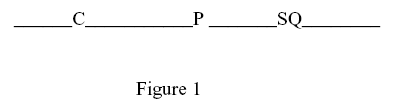
There are basically three situations to consider. A first possibility (see figure 1) places the president between the status quo and the majority. In this case the president and majority want to move in the same direction. The position of the president, however, is more moderate than that of the Congress. If the president can veto undesirable amendments, in other words those that bring the proposal to the ideal point of Congress, his will prevails. Since the veto can be overturned, the president can be forced to moderate his intentions. Nevertheless, even taking into account the veto, it is not necessary to cede completely to the majority. In the worst scenario for the president, the measure that may pass is located between his ideal point and that of the majority41.
]]> A second possibility inverts these positions, in other words, we have from right to left, the president, congress and the status quo42. The situation is analogous and part of the reasoning used in the previous situation can be transplanted to this case. The president has to calibrate his propose, making it acceptable to Congress. The president can place the proposal in the segment that goes from his ideal point towards that of the Congress and he can bring it as close as his ideal point as the distance from Congress to the status quo. This distance may be sufficientto locate it at his ideal point. If the president is an extremist, he will be forced to moderate his proposal. But he will always be capable of jumping over the majority point, dragging politics in his direction.
In these two cases we are facing a situation in which there is room for bargaining. Both parties gain from cooperation, but there are numerous possibilities for the division of the winnings. The presidential agenda power allows him to maximize his gains. He can choose the best proposal for himself among the ones within the set of proposals that the majority will accept. These gains are a direct product of control over the agenda combined with the anticipation of reactions.
The third situation is that in which the differences between the government and majority place them on opposite sides of the status quo. In this situation there are no gains that can be achieved through possible bargaining or negotiations. The majority and the Executive want to move the status quo in opposite directions. In this situation the status quo prevails. Nonetheless, it should be noted through the anticipation of reactions that it is the president who frustrates the pretensions of the majority. Only in this case the agenda of the president becomes a non-agenda.
I believe that I have dealt with the second set of objections. The existence of a possible non-agenda is not sufficient to question the conclusions suggested. The reasons for approximating the Brazilian government's form of operation with parliamentary governments are reinforced. The power of agenda is at the base of the power of the Executive in both forms of government. Success and legislative dominance, as well as party disciple, are direct functions of the control that the Executive exercises over content, the form and the moment when the issues are voted on.
It can be argued that the models considered are extremely simple, based on unrealistic premises that have no real importance from the point of view of the real political game. Nonetheless, the models follow the premises in which the objection was raised. The law of anticipation of reactions supposes complete information. The objection was tested using its own premises.
The scenario is not altered if we take into account more complex models that maintain the premise of complete information43, or consider dynamic games and incomplete information44. For the purposes of this lecture it is not worth while examining these possibilities. I have analyzed the objection on its own terms based on well known models that are widely used in the literature. It is noticeable that the majority of critics content themselves with remembering the law of anticipation of reactions, taking their mere enunciation as a weighty objection. The fact is that if they are considered in a more systematic form, the objection only reinforces the leading position of the Executive.
Many are not convinced. Formal analyses, such as those looked at above, assume a structure that will not be found in Brazil. Does it make sense to suppose the existence of a majority that supports the Executive? We thus reach the third and final objection. What is at play is the nature of the legislative majority, its legitimacy to negotiate, to obtain concessions and to obstruct the proposals of the Executive. As I have said earlier, part of the negative judgments related to the performance of Brazilian democracy is fed by the disqualification and depreciation of the Legislative Power, questioning in an oblique and subtle form the legitimacy of its interests. Only in this way is it possible to see the concessions of the Executive to its support base as the indicator of the crisis of governability. Nonetheless, until it is proved otherwise, the modified version of the law of anticipation of reactions – i.e., the need for the agenda of the Executive to count on the support of the majority – is a basic rule of all and any democratic government.
I return now, in order to better describe this objection and to relate it to the theme of this lecture, to Abranches and his characterization of coalition presidentialism. It should be remembered that in its original formulation the coalition that can support the president is marked by the heterogeneity of its compositions. In a more recent article, written in 2001, during the second mandate of Fernando Henrique Cardoso, Abranches returned to the concept to examine the difficulties that the government was facing at that moment45. For the author the root of the problem is sociological and not institutional46. Patronage and clientelist relations structure the relations between voters and their representatives and as a result relations between the Executive and the Legislature. It is worth citing a long extract from the text:
]]> The problem is thus in the majority, or better in the way in which mandates are obtained. The president's party could have a majority but the difficulties would remain the same, since "the majority continue to be massively based on patronage and clientelism"48. The problem is sociological and not institutional because ultimately it rests on the "survival of these oligarchical forms of political dominance in various political subsystems in the country".49I do not believe that patronage and clientelism are intrinsic to the governance system. They are components of the pattern of relations between parties and voters, therefore they are sociological data. If the majority parties manage to achieve this majority through the type of mechanism of the manipulation of dispossessed voters and there are no competitive alternatives in many bailwicks, the relationship between the legislative majority and the Executive will actually have a high degree of propensity to patronage and clientelism. But it would be like this, if the government were not a coalition.47
The terms used – non-competitive bailwicks, poor and manipulated elector, the survival of oligarchical forms of dominance, clientelism and oligarchy – have clear connotations, especially in an analysis that calls attention to the importance of federalism and more specifically to the power of governors. Nevertheless, what I want to emphasize is that in the final analysis the argument raises suspicions about the legitimacy of the mandates of the majority.
I am obviously bringing the argument of the author to the extreme, removing parts of the text from its context, isolating the mechanisms invoked. In this way I seek only to establish a line of continuity of argument presented within the interpretations of the Brazilian representative system. The obvious reference here is the work of Victor Nunes Leal, and his well known interpretation of coronelismo as a system that presupposes a "a relationship of commitment between the decadent private power and the strengthened public power" whose base is
the superimposition of the representative regime with a broad base on this inadequate social and economic structure, having incorporated into active citizenship a large contingent of voters incapacitated for the conscious performance of their political mission, tied the holders of political power to a large extent to the shepherds of that electoral flock.50
To develop this argument, it is interesting to highlight the reference to the disjunction between political and social power. A social group in decline is overrepresented due to the capacity to transform the social control that it exercises over workers and tenant farmers into votes, into political resources. Nunes Leal, whose main, but not exclusive, reference is the Old Republic, deals with the survival of a political power out of synch in relation to social development. It is forecast that this power will wane, that it will lose its importance51.
After democratization the pioneering studies of electoral sociology in the 1950s and 1960s confirmed the pillars of Nunes Leal's argument. For example, Orlando de Carvalho, examining the first decades of elections under the democratic regime concluded:
We believe that the tendency of the electorate can be accurately described, both in Minas and in Brazil as a whole as moving away from the large parties of the center, such as PSD, UDN and PR. (...) They are parties which in the national scenario rest on conservative elements and whose force rests on the rural electorate.52
The alteration of the record is less than in the continuity of the passage from coronel to the conservative parties (parties in the center of the typology used by Orlando de Carvalho.) What should be emphasized is that this diagnosis implicitly associates the electoral force of conservative parties (on the right) to the survival of social control of landholders over their clientele. Despite the institutional innovations that accompanied democratization in 1945, notably the introduction of Electoral Justice, Nunes Leal's description applies to the two periods: "The votes of the conservative parties are due to the dependence of the rural element on the fazendeiro, preventing the direct contact of the parties with this majority part of our electorate"53. The landholders "lead flocks of voters like someone leading a troop of mules"54 guaranteeing in this way the electoral supremacy of the right and their control over a majority of seats.
]]> The political power of the right came to be explained as the survival, as the result of the persistence of archaic forms of domination55. Therefore, when conservative parties obtain votes, these can be explained by the existence of a large contingent of voters incapable of consciously performing their political mission, the persistence of backwardness and the power of oligarchies. Thus, electoral results, especially the votes obtained by rightwing parties, can be explained by resorting to the alleged absence of the autonomy of the electorate, with it being necessary over time to mention the landholder. Nonetheless, the perception of an adjustment between the political and social power, followed by the reaffirmation of the expectation of its disappearance in the near future still remains.This involves a diffuse vision, but one that underlines a substantial part of the Brazilian political debate. In this perspective, with some exaggeration, we can say that the right entrenched itself in Congress and hinders the changes that country really desires. Despite being out of synch with the socio-economic tendencies of the present, and being out of step with secular transformations, as it was said some time ago, the forces of backwardness were able to resist. In some way they keep on obtaining more votes than they should have.
Returning to the current debate. Are there still bailwicks in which there is no electoral competition? Does the halter vote still survive, modified and adapted to the modern world? After all if the majority obtains its votes in non-competitive electoral bailwicks manipulating the will of the majority of the poor and needy electorate, then we are faced with a majority that has obtained its mandates in a questionable form, without the necessary democratic legitimacy, thereby revealing the original sin that corrupts representation in Brazil and its expression in Congress.
These propositions can be tested. Obviously no empirical test will be conclusive. They can, however, shake convictions and certainties.
The occasion is not the most suitable, due to the format of this lecture, for a detailed examination of the data that can lead to the reconsideration of these objections. I intend only to invert the burden of proof. In other words, I want to show that resorting to known formulas is insufficient to sustain suspicions about the quality of the Brazilian electoral process and the results that it produces, including the quality of its representatives.
Very simple and basic data allow the questioning of the hypothesis of the persistence of non-competitive electoral bailwicks. The competitiveness of a redoubt – equivalent to a municipality in the following analysis – can be verified through the effective number of electoral lists, coalitions56. The closer to one that this number is, the lower the real competition. As this number approaches or exceeds to two, the closer we are to the certainty that competition exists57.
The average effective number of electoral coalitions per municipality is 2.94, taking into account the 5665 Brazilian municipalities. There are obviously non-competitive municipalities, but they are a minority. Only 320 municipalities obtained a value lower than 1.5 effective electoral coalitions. These municipalities represent only 1.7% of the voters who turned out in the 2002 election. Barra do Corda in Maranhão is the only municipality with more than 30,000 voters in this condition. The vast majority of these municipalities have a reduced number of voters. In 296 of them the number of valid votes was lower than ten thousand. Therefore, there are few non-competitive bailwicks and these are concentrated in smaller municipalities, and represent only a small percentage of the electorate.
Small municipalities are chacterized by the presence of electoral competion. . 3964 municipalities have a turnout of less than ten thousand voters, representing 18.6% of voters. The effective number of electoral coalitions in these municipalities was 2.8, which is very close to the national average. Even when the average number of effective coalitions is stratified per state, and restricted to those municipalities with a turnout lower than ten thousand voters, only three states had averages lower than 2.0: Tocantins (1.6), Amazonas (1.7) and Pernambuco (1.97). Taking into account successive groups of smaller cities, it is necessary to restrict the analysis to municipalities with a turnout lower than 2500 to find a state, Amazonas, with an average below 1.5 effective electoral coalitions.
Competition of course is not easy to measure. It is not necessary, due to the limits of this lecture and the purposes of this specific discussion, to search for more refined measures of this concept. I resort to basic descriptive statistics to emphasize the point: it is difficult not to notice how competitive our democracy has become. With this information the burden of proof changes hands: it is up to the critics of the functioning of our democracy to specify its flaws. Obviously, highlighting deviations in relation to idealized democracies is not enough. The challenge is to show the differences in relation to existing democracies.
To complete this discussion I tried to capture is the weight of non-competitive bailwicks in the composition of the last Congress identifying the legislator's electoral dependence on the votes obtained in non-competitive municipalities. Arbitrarily, the bailwicks in which the effective number of coalitions was less 1.5 were taken as being non-competitive. Candidates may or may not belong to this list. It is enough to have received votes in that municipality to consider it as representative of that electorate. In other words, the dependence of parliamentarians on non-competitive bailwicks is inflated. bailwicks.
]]> Of the 513 deputies elected in 2002, 274 received less than one vote in non-competitive municipalities. There are practically no parliamentarians dependent on this type of redoubt. Only three parliamentarians received more than 40% of their votes in non-competitive bailwicks (Rogério Silva, PMDB, MT, Maurício Rabelo PSD, TO and Darci Coelho PFL, TO). Only 17 deputies received more than 20% of their votes from districts of this nature. The other tail of the distribution concentrates a higher number of cases. 239 deputies did not obtain a single vote from non-competitive municipalities, while for 115 parliamentarians the votes of these municipalities represented less than 1% of their vote. The number of deputies with a dependence of lower than 5% is 311, which is enough to pass a constitutional amendment. In summary for the vast majority of parliamentarians the contribution of non-competitive bailwicks is minimal.If deputies respond to their voters, and if relations with the Executive are structured by the way they achieve votes, it seems difficult to sustain that we are dealing with politicians who control 'hordes' of voters. Actually the data only points in the direction of the obvious: the Brazilian electorate is now predominantly urban and in these conditions the subjection of isolated and social and economically voters cannot be invoked to explain the results. If there is control, explanations have to adapt to the current conditions.
I believe that I have shown the limits of the last objection. It does not appear to me that it can be argued that electoral competition in Brazil has vices that 'stain' the country's electoral representation. There are no reasons to question the legitimacy of the mandates obtained by legislators. One may not like the results, but this is a question of an entirely different order. The mandate of the Executive is not more legitimate than the parliamentary majority which it is forced to negotiate with.
Conclusion
There is nothing that allows the Brazilian political system to be treated as singular. Coalitions obey and are ruled by the party principle. There is no paralysis or syndrome to overcome. The institutional structure adopted by the 1988 constitution is different from that of 1946. The president had his institutional power reinforced. For all effects, the Constitution confers on the president a monopoly over legislative initiative. The alteration of the legal status quo in fundamental areas depends on the Executive initiative. By this it is understood that the latter can organize its support through coalitions created on strict party criteria. To influence public policy one has to be aligned with the president. Thus, parliamentarians are left with two basic alternatives: to be part of the presidential coalition in the legislature, or to sit on the opposition benches, hoping to achieve the Presidency in the next term.
It is mistaken to insist on characterizing our system according to its alleged faults, to its needs. Inverting the perspective, however, only makes the task more difficult, since it implies the need to explain the reality, not to condemn it or censure it.
To do this, to learn how the Brazilian political system actually operates, it is necessary, as I have shown, to recognize that different traditions or languages are not in dispute. The questions that structure the discipline disrespect the false frontiers erected to separate theory from the empirical analysis. This is the case whether Brazil or any other democracy is being studied. Even when guided and structured around empirical questions, the discussion touches themes that are central to the discipline, such as the importance of institutional choices and how these affect the relations between the majority and minority in democratic governments. They thus deal with the core of democratic theory.
]]> Received for publication on 10 November 2006
For Adam Przeworski, my professor
1 This is a slightly modified version of the class given on 29 September 2006 during the examination for the position of Full Professor in DCP/USP.
2 Sérgio Henrique Abranches. "O presidentialism de coalizão: o dilema institucional brasileiro". In: Dados 31(1), 1988, pp. 5-33. [ Links ]
3 See, for example, the editorial in O Estado de S. Paulo on 3 June 2006, [ Links ] entitled "Sucessão de vexames" (Succession of embarrassments): "But the PMDB knows that it does not need to formally ally itself with the PT nor with the PSDB-PFL coalition, which is also courting them – it is of course not good manners to speak of programmatic affinities –, to remain in power at the federal level for the next four years, from where it has never been removed since redemocratization, with the exception of the accidental interregnum under Collor. This is the logical of Brazilian coalition presidentialism".
4 Abranches, op. cit., pp. 21-22.
5 Ibid, p. 27. ]]>
6 Ibid, p. 22.
7 Giovanni Sartori. "Concept Misformation in Comparative Politics". In: American Political Science Review 64(4), 1970, pp. 1033-53. [ Links ]
8 Gerhard Lowenberg & Samuel Patterson. Comparing legislatures. Boston: Little Brown, 1979. [ Links ]
9 Valentine Hermamn & Françoise Mendel. Parliaments of the world: a reference compendium. London: Inter-Parliamentary Union/De Gruyter, 1976; [ Links ] and by the same authors, Parliaments of the world: a reference compendium. Berlin and New York: Inter-Parliamentary Union, 1986. [ Links ]
10 Analyses of the English parliament can be found in Edward W. Crowe. "Cross-Voting in the British House of Commons: 1945-1974". In: The Journal of Politics, v. 42, 1980; [ Links ] John E. Schwarz. "Exploring a New Role in Policy Making: The British House of Commons in the 1970s". In: The American Political Science Review, n. 74, 1980; [ Links ] Philip Cowley and Philip Norton. "Rebels and Rebellions: Conservative MPs in the 1992 Parliament". In: British Journal of Politics and International Relations, 1(1), 1999. [ Links ]
11 The data for legislative production and party discipline was updated until March 2006.
12 Only those votes on ordinary bills in which the quorum was reached and were not unanimous were considered, i.e., those in which there was disagreement between the indications of the leaders or where the minority got at least 10% of valid votes. To calculate the discipline of the base of the government the position of the government has to be known. ]]>
13 Internal dissent exists in the base whenever one of the leaders of the coalition parties votes against the wishes of the leader of the government.
14 José Antonio Cheibub, Adam Przeworski and Sebastian Saiegh. "Governos de Coalizão nas Democracias Presidencialistas". In: Dados 45(2), 2002, pp. 187-218. [ Links ]
15 For two complete examples of this type of error, consult Terry Moe & Michael Caldwell. "The Institutional Foundations of Democratic Government: a Comparison of Presidential and Parliamentary Systems". In: Journal Institutional and Theoretical Economics, 150(1), 1994, pp. 171-195; [ Links ] and Bruce Ackerman. "The New Separation of Powers". In: Harvard Law Review, 113(3), 2000, pp. 633-725. [ Links ]
16 As Manin states the separation of powers "aimed to place restraints on what the Federalists expected to be the predominant power, the power of the people. (…) The primary purpose of these two prominent checks and balances was thus to slow down the will of the people and to delay its action. These checks were not supposed to operate as bulwarks that stopped definitively the popular will, but only as obstacles which could be overcome, but after a while". Bernard Manin: "Checks, Balances and Boundaries: the Separation of Powers in the Constitutional Debate of 1787". In: Biancamaria Fontana (org.). The Invention of the Modern Republic. Cambridge: Cambridge University Press, 1994, pp. 60-61. [ Links ]
17 The relevant passage is the following: "The brief description of the characteristic merit of the English Constitution is that its dignified parts are very complicated and somewhat imposing, very old and rather venerable; while its efficient part, at least when in great and critical action, is decidedly simple and rather modern. (...) The efficient secret of the English Constitution may be described as the close union, the nearly complete fusion of the executive and the legislative powers. According to the traditional theory, as it exists in all books, the goodness of our constitution consists in the entire separation of the executive and legislative authorities, but in truth its merit consists in their singular approximation. The connecting link is the cabinet. By that new word we mean a committee of the legislative body selected to be the executive body. (...) The legislature chosen, in name, to make laws, in fact finds its principal business in making and in keeping an executive". Walter Bagehot. The English Constitution. Cambridge: Cambridge University Press: 2001, pp. 8-9. [ Links ]
18 Gary Cox. The efficient secret: the cabinet and the development of political parties in Victorian England. Cambridge: Cambridge University Press, 1987. [ Links ]
19 Terry Moe. "An Assessment of the Positive Theory of 'Congressional Dominance'". In: Legislative Studies Quarterly, XII(4), 1987, pp. 475-520. [ Links ]
20 This ironic observation is made by Terry Moe and Scott Wilson. "Presidents and the Politics of Structure". In: Law and Contemporary Problems 57, 1994, pp 1-44. [ Links ]
21 In relation to this, see: William Howell. Power without persuasion: the politics of direct presidential action. Princeton: Princeton University Press, 2003. [ Links ] For an excellent comparison between Brazilian Medidas Provisórias (Provisional Measures) and Executive Orders, see Marco Aurélio Sampaio. A provisional measure como ato de governo. Doctoral Thesis. Faculty of Law, USP, 2004. [ Links ]
22 Fernando Limongi. "Formas de Government, Leis Partidárias e Poder de Agenda". In: Boletim Informativo e Bibliográfico, 55, 2003, pp. 7-39. [ Links ]
23 "The definition of (…) 'pure' presidentialism is the following: (1) the popular election of the chief executive; (2) the terms of the chief executive and assembly are fixed, and are not contingent on mutual confidence; and (3) the elected executive names and directs the composition of the government; (4) the president has some constitutionally granted lawmaking authority". Mathew Shugart e John Carey. Presidents and assemblies. Cambridge: Cambridge University Press, 1992, p. 19. [ Links ]
24 Article 161, first paragraph, of the 1988 Constitution stipulates that "the following laws are of the exclusive initiative of the President of the Republic: I those that establish or modify the size of the Armed Forces; II Those concerned with a) the creation of positions, functions, or public employment in direct administration or local authorities, or the increase in their remuneration; administrative and judicial organization, tax and budget issues, public services and the administration staff in Territories".
25 Article 166 of the Constitution stipulates that budget amendments will only be accepted if they "indicate the necessary resources, admitting only those arising out of the annulment of expenses, excluding those related to: a) sums allotted for public employment and related costs; b) servicing the debt; c) constitutional tax transfers to States, Municipalities and the Federal District".
26 Juan Linz. "Presidential or parliamentary democracy: does it make a difference?" In: Juan Linz & Arturo Valenzuela (eds.). The failure of presidential democracy: the case of Latin America. Baltimore: Johns Hopkins University Press, 1994, pp.3-87. [ Links ]
27 For this reason the Chilean president was responsible between 1990 and 1996 for the submission of 86% of laws passed (Peter M. Siavellis. The president and the congress in post-authoritarian Chile. Pennsylvania: Penn State University Press, 2000). [ Links ] Even a president considered weak, such as in Venezuela, was responsible for proposing 84% of laws passed between 1959 and 1995 (Brian F. Crisp. Democratic institutional design: the powers and incentives of Venezuelan politicians and interest group. Stanford: Stanford University Press, 2000). [ Links ]
28 Alfred Stepan. "Para uma Análise Comparativa do Federalismo e da Democracia: Federações que Restringem ou Ampliam o Poder do Demos". In: DADOS, 42(2), 1999, p. 231. [ Links ] It is not my intention to discuss Stepan's text, but rather the objection raised. A similar objection can be found in Barry Ames. Os entraves da democracia no Brasil. Rio de Janeiro: Editora FGV, p. 243ss. [ Links ]
29 Peter Bachrach and Morton S. Baratz. "Two Faces of Power". In: The American Political Science Review, 56(4), 1962, pp 947-952. [ Links ] See also by the same authors, "Decisions and Non-decisions: an Analytical Framework". In: The American Political Science Review, 57(3), 1963, pp. 632-642. [ Links ]
30 Keneth Shepsle. "The Changing Textbook of Congress". In: John Chubb & Paul Peterson (eds.). Can the Government Govern? Washington: Brookings Institution, 1989. [ Links ]
31 Keneth Shepsle. "Institutional Arrangements and Equilibrium in Multidimensional Voting Models". In: Mathew McCubbins & Terry Sullivan (eds.). Congress: structure and policy. New York: Cambridge University Press, 1987. [ Links ]
32 Supposedly because preferences can be aggregated according to the rules. Nevertheless, the theoreticians of the social choice school state that the instability of the majority is revealed under any rule related to the aggregation of known preferences.
33 Keith Krehbiel. "Sophisticated Committees and Structure-Induced Equilibrium in Congress." In: Mathew McCubbins & Terry Sullivan (eds.). Congress: structure and policy. New York: Cambridge University Press, 1987. [ Links ]
34 Kenneth Shepsle & Barry Weingast. "The Institutional Foundations of Committee Power". In: American Political Science Review, 81, 1987, pp. 85-103. [ Links ] Keith Krehbiel. "Why are Congressional Committees Powerful?". In: American Political Science Review, 81, 1987, pp. 929-935. [ Links ] Kenneth Shepsle & Barry Weingast. "Reflections on Committee Power." In: American Political Science Review, 81, 1987, pp. 935-45. [ Links ]
35 For this reason, within this debate, whether or not the possibility exists for the congress as a whole to amend the proposals made by the commissions (closed or open rules) and if the capacity of the congress floor to remove a bill from a commission by means of a discharge petition is or not effective assume great relevance. I am leaving these questions aside as well as the numerous conditions related to the debate about whether commission are agents of special interests, parties or the majority. For a revision of this literature, see my article: "O Novo Institucionalismo e os Estudos Legislativos: a Literatura Norte-Americana Recente". In: Boletim Informativo Bibliográfico, 37, 1994, pp. 3-38. [ Links ]
36 Non-cooperative because cooperation cannot be assumed, but rather if it occurs it has to be the result of optimal strategies.
37 For a revision, consult Daniel Diermeier & Keith Krehbiel. "Institutionalism as a Methodology". In: Journal of Theoretical Politics, 15, 2003, pp. 123-144. [ Links ] David Austen-Smith & Jeffrey Banks. "Social Choice Theory, Game Theory, and Positive Political Theory". In: Annual Review of Political Science, 1998, pp. 259-287. [ Links ]
38 Article 164 of the Constituition stipulates: "Paragraph 1. The president can request urgency for the consideration of projects submitted at his initiative. Paragraph 2. If in the case of Paragraph 1 the Chamber of Deputies and the Federal Senate do not make a decision about the proposal, all other legislative decisions in each House successively shall be halted for up to forty-five days, with the exception of those decisions that have a constitutionally determined deadline, until the vote in question is taken".
39 Article 155: "Propositions that deal with questions of undeniable and relevant national interest can be automatically included in the Agenda of the Day for immediate discussion and voting, even if the session in which they are presented has commenced, at the decision of the absolute majority of the House, or leaders representing this number, without the restrictions imposed in the second paragraph of the preceding article".
40 Article 62 of the Constitution: "In the case of relevancy and urgency, the President of the Republic can adopt Provisional Measures under the force of law, and shall immediately submit them to the National Congress".
41 This is because the position of the qualified majority capable of overturning the veto has to be located between the ideal point of the president and that of congress. In practical terms the threat to overturn the veto can be ruled out. For an analysis of vetos, see Mauricio Assumpção Moya. Executivo versus Legislativo: os vetos presidenciais no Brasil de 1988 a 2000. Doctoral thesis, Department of Political Science, USP, 2006. [ Links ]
42 The reader can easily adapt figure 1 to this new situation.
43 For example, the models proposed by John Huber (Rationalizing Parliament: Legislative institutions and party politics in France. Cambridge: Cambridge University Press 1996) and William Howell (Power Without Persuasion. The Politics of Direct Presidential Action. Princeton: Princeton University Press, 2003) can be adapted to show, respectively, how the agenda powers of the Brazilian president can be used to 'protect' the unity of the coalition and to overcome, through the issuing of provisional measures, mutual blockages. ]]>
44 For a model with incomplete information, see Charles Cameron, Veto Bargaining, Cambridge, Cambridge University Press 2000. [ Links ]
45 Sérgio Henrique Abranches. "A Democracia Brasileira Vai Bem Mas Requer Cuidados". In: João Paulo dos Reis Velloso (org.). Como vão a democracia e o desenvolvimento no Brasil? Rio de Janeiro: José Olympio, 2001, pp. 251-277. [ Links ]
46 "I am convinced that the basis of this complexity and of such complications in the governance of Brazil is sociological and not reducible to problems of regulation or institutional regulations." Abranches, op. cit., pp. 269-270.
47 Ibid, p. 268.
48 Ibid, p. 269.
49 Ibid, p. 263.
50 Victor Nunes Leal. Coronelismo, enxada e voto: o município e o regime representativo no Brasil. São Paulo: Alfa-Ômega, 1993, p. 253. [ Links ]
51 "Finally the abolition of the servile regime, and afterwards with the Republic the expansion of suffrage rights, gave a fundamental importance to the vote of the rural worker. Therefore, the political influence of landowners grew, due to the dependence of this part of the electorate, a direct consequence of our agrarian structure, which kept the workers of the roça in a lamentable situation of not being able to grown plants and abandonment. We are, in this particular case, the legitimate heirs of the colonial system of large scale agricultural exploitation, cultivated by slave labor and the producer of raw materials and foodstuffs destined for exportation. The legal emancipation of labor did not profoundly change this outline, which roughly speaking is still today dominated by the large properties and characterized, in relation to class composition, by the subjection of a gigantic mass of unpaid workers, parceiros, squatters and small landholders to the small minority of fazendeiros, powerful in relation to their dependents, though in an ever more precarious position in relation to the national economy" Vitor Nunes Leal, 1993, p. 253
52 Orlando de Carvalho. "Ensaios de Sociologia Eleitoral". Revista de Brasileira de Estudos Políticos, 1958, p. 99 [ Links ]
53 Leal, op. cit., p. 42. It is worth noting that this affirmation is preceded by an analysis of the landholding structure based on data from the 1946 Annual Statistical Bulletin. ]]>
54 Ibid., p. 43.
55 The best known formulation of the decline of conservative parties due to the erosion of their bases can be found in Glaucio Ary Dillon Soares. Sociedade e Política no Brasil. São Paulo: Difusão Européia do Livro, 1973. [ Links ]
56 I use coalitions and not parties because the former and not the latter are the units that actually dispute seats. Obviously, coalitions can be formed by a single party. By definition the effective number of electoral parties is greater than the number of coalitions.
57 The value will be equal to one if a list can win 100% of the votes in the municipality. It will be equal to two if two parties obtain the same percentage of votes. It will be three if the three parties freakishly receive 33% of the votes and so on. Nevertheless, the relationship is not univocal. For example an equal value can be obtained for three effective parties, without having three equal parties. In general, to the extent that the number moves away from one, the lower the proportion of votes obtained by the list that obtained the most votes.