<?xml version="1.0" encoding="ISO-8859-1"?><article xmlns:mml="http://www.w3.org/1998/Math/MathML" xmlns:xlink="http://www.w3.org/1999/xlink" xmlns:xsi="http://www.w3.org/2001/XMLSchema-instance">
<front>
<journal-meta>
<journal-id>0101-3300</journal-id>
<journal-title><![CDATA[Novos Estudos - CEBRAP]]></journal-title>
<abbrev-journal-title><![CDATA[Novos estud. - CEBRAP]]></abbrev-journal-title>
<issn>0101-3300</issn>
<publisher>
<publisher-name><![CDATA[Editora Brasileira de Ciências Ltda]]></publisher-name>
</publisher>
</journal-meta>
<article-meta>
<article-id>S0101-33002006000200001</article-id>
<title-group>
<article-title xml:lang="en"><![CDATA[Fertility in decline: a brief note on the decrease in the number of births in Brazil]]></article-title>
<article-title xml:lang="pt"><![CDATA[Fecundidade em declínio: breve nota sobre a redução no número médio de filhos por mulher no Brasil]]></article-title>
</title-group>
<contrib-group>
<contrib contrib-type="author">
<name>
<surname><![CDATA[Berquó]]></surname>
<given-names><![CDATA[Elza]]></given-names>
</name>
<xref ref-type="aff" rid="A01"/>
<xref ref-type="aff" rid="A02"/>
</contrib>
<contrib contrib-type="author">
<name>
<surname><![CDATA[Cavenaghi]]></surname>
<given-names><![CDATA[Suzana]]></given-names>
</name>
<xref ref-type="aff" rid="A03"/>
</contrib>
<contrib contrib-type="author">
<name>
<surname><![CDATA[Doyle]]></surname>
<given-names><![CDATA[Anthony]]></given-names>
</name>
</contrib>
</contrib-group>
<aff id="A01">
<institution><![CDATA[,UNICAMP Núcleo de Estudos de População ]]></institution>
<addr-line><![CDATA[ ]]></addr-line>
</aff>
<aff id="A02">
<institution><![CDATA[,Cebrap’s Population and Society department  ]]></institution>
<addr-line><![CDATA[ ]]></addr-line>
</aff>
<aff id="A03">
<institution><![CDATA[,IBGE Escola Nacional de Ciências Estatísticas ]]></institution>
<addr-line><![CDATA[ ]]></addr-line>
</aff>
<pub-date pub-type="pub">
<day>00</day>
<month>00</month>
<year>2006</year>
</pub-date>
<pub-date pub-type="epub">
<day>00</day>
<month>00</month>
<year>2006</year>
</pub-date>
<volume>2</volume>
<numero>se</numero>
<fpage>0</fpage>
<lpage>0</lpage>
<copyright-statement/>
<copyright-year/>
<self-uri xlink:href="http://socialsciences.scielo.org/scielo.php?script=sci_arttext&amp;pid=S0101-33002006000200001&amp;lng=en&amp;nrm=iso"></self-uri><self-uri xlink:href="http://socialsciences.scielo.org/scielo.php?script=sci_abstract&amp;pid=S0101-33002006000200001&amp;lng=en&amp;nrm=iso"></self-uri><self-uri xlink:href="http://socialsciences.scielo.org/scielo.php?script=sci_pdf&amp;pid=S0101-33002006000200001&amp;lng=en&amp;nrm=iso"></self-uri><abstract abstract-type="short" xml:lang="en"><p><![CDATA[This article analyses data on fertility in Brazil from the 2004 National Household Sample Survey, which confirmed a downward trend in the number of births per woman. The expectation is that the next few years could see a decrement in the least privileged segments of the population, responsible for the most expressive drops in the average number of children per woman.]]></p></abstract>
<abstract abstract-type="short" xml:lang="pt"><p><![CDATA[Este artigo analisa os dados sobre fecundidade no Brasil apresentados na PNAD 2004, que confirmou a tendência de queda no número de nascimentos. Sustenta-se que, nos próximos anos, reduções possam ocorrer nos segmentos menos favorecidos da população, responsáveis pelas mais expressivas quedas no número médio de filhos por mulher.]]></p></abstract>
<kwd-group>
<kwd lng="en"><![CDATA[NHSS 2004]]></kwd>
<kwd lng="en"><![CDATA[fertility]]></kwd>
<kwd lng="en"><![CDATA[demographics]]></kwd>
<kwd lng="en"><![CDATA[population]]></kwd>
<kwd lng="pt"><![CDATA[PNAD 2004]]></kwd>
<kwd lng="pt"><![CDATA[fecundidade]]></kwd>
<kwd lng="pt"><![CDATA[demografia]]></kwd>
<kwd lng="pt"><![CDATA[população]]></kwd>
</kwd-group>
</article-meta>
</front><body><![CDATA[ <p><font face="verdana" size="4"><b>Fertility in decline: a brief note on the    decrease in the number of births in Brazil</b></font></p>     <p>&nbsp;</p>     <p><font face="verdana" size="3"><b>Fecundidade em decl&iacute;nio: breve nota    sobre a redu&ccedil;&atilde;o no n&uacute;mero m&eacute;dio de filhos por mulher    no Brasil</b></font></p>     <p>&nbsp;</p>     <p>&nbsp;</p>     <p><font face="verdana" size="2"><b>Elza Berquó; Suzana Cavenaghi</b></font></p>     <p><font face="verdana" size="2">Translated by Anthony Doyle    <br>   Translation from <a href="http://www.scielo.br/scielo.php?script=sci_arttext&pid=S0101-33002006000100001&lng=en&nrm=iso" target="_blank"><b>Novos    Estudo - CEBRAP</b>, São Paulo, no.74, p.11-15, Mar. 2006</a>.</font></p>     <p>&nbsp;</p>     <p>&nbsp;</p> <hr noshade size="1">     ]]></body>
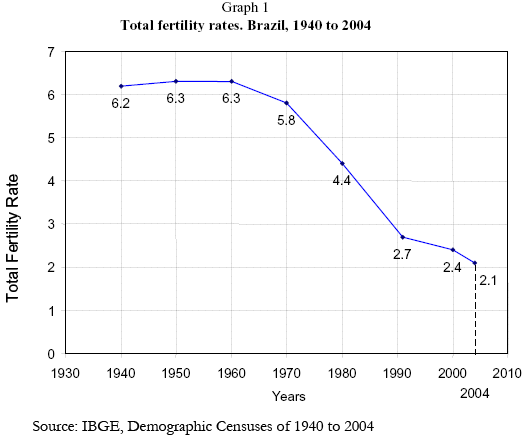
<body><![CDATA[<p><font face="verdana" size="2"><b>SUMMARY</b></font></p>     <p><font face="verdana" size="2">This article analyses data on fertility in Brazil    from the 2004 National Household Sample Survey, which confirmed a downward trend    in the number of births per woman. The expectation is that the next few years    could see a decrement in the least privileged segments of the population, responsible    for the most expressive drops in the average number of children per woman.</font></p>     <p><font face="verdana" size="2"><b>Key words: </b><i>NHSS 2004; fertility; demographics;    population.</i></font></p> <hr noshade size="1">     <p><font face="verdana" size="2"><b>RESUMO</b></font></p>     <p><font face="verdana" size="2">Este artigo analisa os dados sobre fecundidade    no Brasil apresentados na PNAD 2004, que confirmou a tend&ecirc;ncia de queda    no n&uacute;mero de nascimentos. Sustenta-se que, nos pr&oacute;ximos anos,    redu&ccedil;&otilde;es possam ocorrer nos segmentos menos favorecidos da popula&ccedil;&atilde;o,    respons&aacute;veis pelas mais expressivas quedas no n&uacute;mero m&eacute;dio    de filhos por mulher. </font></p>     <p><font face="verdana" size="2"><b>Palavras-chave:</b> PNAD 2004; fecundidade;    demografia; popula&ccedil;&atilde;o.</font></p> <hr noshade size="1">     <p>&nbsp;</p>     <p>&nbsp;</p>     <p><font face="verdana" size="2">The level of fertility of a nation is part of    a series of indicators that guides public policymakers; given the implications    a birthrate below the replacement level (an average of 2.1 children per woman)    could have on decreasing population rate of growth and on aging. Conversely,    a high birthrate could indicate a lack of public access to information and services    in reproductive health.</font></p>     <p><font face="verdana" size="2">As already known, the transition in fertility    in Brazil began in the mid-1960s. The birthrate dropped 24.1% between 1970 and    1980, by 38.6% the following decade and by 11.1% from 1991 to 2000 (<a href="#gra01">Graph    1</a>).</font></p>     ]]></body>
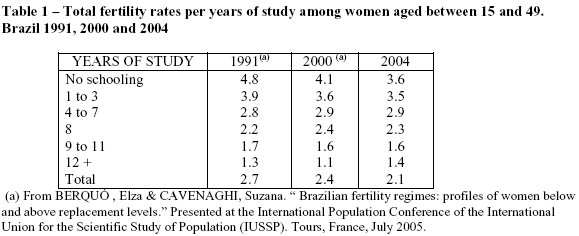
<body><![CDATA[<p><a name="gra01"></a></p>     <p>&nbsp;</p>     <p align="center"><img src="/img/revistas/s_nec/v2nse/a01gra1.gif"></p>     <p>&nbsp;</p>     <p><font face="verdana" size="2">Berquó &amp; Cavenaghi<a name="tx1"></a><a href="#nt1"><sup>1</sup></a>    demonstrated that the fall in fertility rates between 1991 and 2000 was not     uniform across the various socio-demographic segments of the population. Important    differences were identified, revealing that the sharpest drop occurred among    groups which had shown the highest levels of fertility in 1991, namely poorer,    less educated, predominantly black women from rural areas of the North and Northeast.</font></p>     <p><font face="verdana" size="2">The 2004 National Household Sample Survey confirmed    the downturn in birthrate, which slumped to its all-time low in recent years.    The average number of children per woman was 2.1, down 12.5% on the last census.    A Schooling and income remained negatively correlated with fertility<a name="tx2"></a><a href="#nt2"><sup>2</sup></a>.    <a href="#tab1">Table 1</a> crosses fertility vs. years of schooling and shows    that, in 1991, women who never attended school had an average of  3.5 more children    than those with 12 + years of study. By 2000, this difference had slipped to    three children, eventually sliding to 2.2 in 2004. Table 1 also shows that the    decreases during the period 1991-2000 were mostly due to the lower childbirth    rates identified among women with no schooling: 14.6% between 1991 and 2000    and 12.2% from 2000 to 2004.</font></p>     <p><a name="tab1"></a></p>     <p>&nbsp;</p>     <p align="center"><img src="/img/revistas/s_nec/v2nse/a01tab1.gif"></p>     <p>&nbsp;</p>     ]]></body>
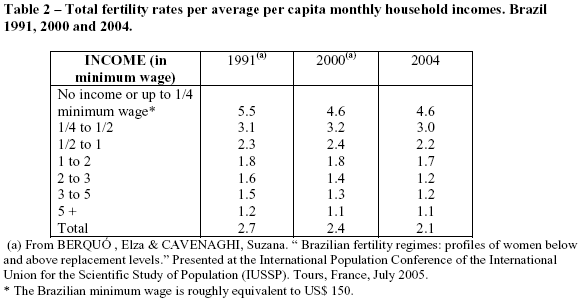
<body><![CDATA[<p><font face="verdana" size="2">However, if we compare average per capita household    incomes for 1991, we see that the poorest women had an average of 4.3 children    more than women at the extreme upper end of the incomescale (<a href="#tab2">Table    2</a>). The gap narrowed in 2000 and 2004, but is still in the order of 3.5    children. Onceagain, the decline observed between 1991 and 2004 was largely    due to the decreased fertility rate(in the region of 16.4%) among poorer women.</font></p>     <p><a name="tab2"></a></p>     <p>&nbsp;</p>     <p align="center"><img src="/img/revistas/s_nec/v2nse/a01tab2.gif"></p>     <p>&nbsp;</p>     <p><font face="verdana" size="2">An urban or rural household setting was another    key differential in women’s fertility regimes. In 1991, women from rural Brazil    had 4.3 children on average, i.e. two more than their urban counterparts. Though    this difference had narrowed to 1.2 children ten years later, it remained unchanged    in 2004.</font></p>     <p><font face="verdana" size="2">The decrease observed in rural Brazil during    the period 1991-2000, from 4.3 to 3.4 children per  woman (a drop of 20.9%),    was largely responsible for the overall nationwide decrease for the same period,    as urban fertility rates stuttered from 2.3 to 2.2, a mere 4.3% reduction. A    comparison of the data for 2004 with that for 2000 reveals that the fall is    continuing, in both urban and rural Brazil. Cities and towns have already reached    a fertility average of 2 children per woman – which is below the replacement    level.</font></p>     <p><font face="verdana" size="2">Regional comparisons still display important    differences, as can be seen from <a href="#tab3">Table 3</a>. In virtue of their    higher rural contingents and less favourable socio-economic indicators, the    North and Northeast have the highest fecundity rates in the country. Nevertheless,    we must note that it was these two regions that registered the sharpest decrements    in average number of children per woman during the period 1991-2004 – in the    order of 31% and 37.8% respectively.</font></p>     <p><a name="tab3"></a></p>     <p>&nbsp;</p>     ]]></body>
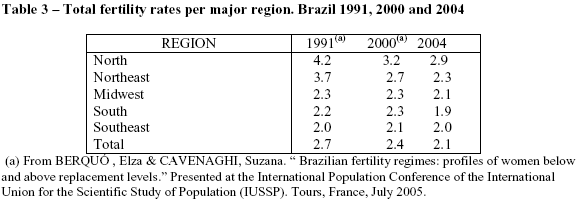
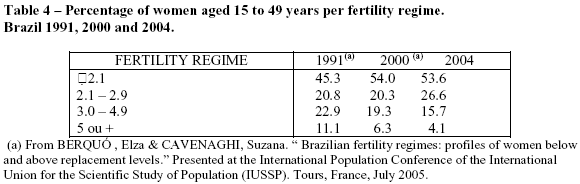
<body><![CDATA[<p align="center"><img src="/img/revistas/s_nec/v2nse/a01tab3.gif"></p>     <p>&nbsp;</p>     <p><font face="verdana" size="2">Despite the abiding differences and the co-existence    of various fertility regimes throughout the country, what we can see is a systematic    decrease in the percentage of women aged between 15 and 49 years with five children    or more and an increase in the number of women showing a fertility rate below    the replacement minimum (<a href="#tab4">Table 4</a>). Indeed, the number of    women in the high fertility level group shrank from 11.1% in 1991 to 4.1% in    2004.</font></p>     <p><a name="tab4"></a></p>     <p>&nbsp;</p>     <p align="center"><img src="/img/revistas/s_nec/v2nse/a01tab4.gif"></p>     <p>&nbsp;</p>     <p><font face="verdana" size="2">In numbers, this amounts to approximately two    million women of reproductive age, compared with four million in 1991. On the    other hand, the number of women of reproductive age living in low fertility    regimes rose from 45.3% in 1991 to 53.6% in 2004. Otherwise put, in 2004 there    were 26.2 million women of reproductive age having a maximum of two children    each, compared with the corresponding 16.6 million in 1991.</font></p>     <p><font face="verdana" size="2">This brief panorama of the decrease in fertility    leads one to suppose that the coming years could see a decrement within the    least privileged segments of the population, responsible for the largest differentials    and the most expressive drops in the average number of children per woman.</font></p>     <p>&nbsp;</p>     ]]></body>
<body><![CDATA[<p>&nbsp;</p>     <p><font face="verdana" size="2">Received for publication on March 24, 2006.</font></p>     <p>&nbsp;</p>     <p>&nbsp;</p>     <p><font face="verdana" size="2">Elza Berquó is a researcher at the Núcleo de    Estudos de População (NEPO/UNICAMP) and coordinator of Cebrap’s Population and    Society department. Suzana Cavenaghi is a researcher at the Escola Nacional    de Ciências Estatísticas do IBGE.    <!-- ref --><br>   <a name="nt1"></a><a href="#tx1">1</a> BERQUÓ , Elza &amp; CAVENAGHI, Suzana. “ Brazilian fertility    regimes: profiles of women below and abovereplacement levels.” Presented at    the International Population Conference of the International Union for the Scientific    Study of Population (IUSSP). Tours, France, July, 2005.    <br>   <a name="nt2"></a><a href="#tx2">2</a> It is worth remembering that fertility trends per income category    have to factor-in changes in the women’s economic conditions over the course    of the decade. The same is also true, though to a lesser degree, of changes    in educational structure, as, unlike income, a woman’s number of school years    can only increase over time.</font></p>      ]]></body><back>
<ref-list>
<ref id="B1">
<nlm-citation citation-type="confpro">
<person-group person-group-type="author">
<name>
<surname><![CDATA[BERQUÓ]]></surname>
<given-names><![CDATA[Elza]]></given-names>
</name>
<name>
<surname><![CDATA[CAVENAGHI]]></surname>
<given-names><![CDATA[Suzana]]></given-names>
</name>
</person-group>
<article-title xml:lang="en"><![CDATA[Brazilian fertility regimes: profiles of women below and abovereplacement levels]]></article-title>
<source><![CDATA[]]></source>
<year></year>
<conf-name><![CDATA[ International Population Conference]]></conf-name>
<conf-date>July, 2005</conf-date>
<conf-loc>Tours </conf-loc>
</nlm-citation>
</ref>
</ref-list>
</back>
</article>