INTRODUCTION
A persistent Brazilian inequality continues to challenge the sociological imagination and rightly so. In 1872 the Gini coefficient, one of the possible measures of inequality in income distribution, may have been 0.56, according to recent estimates1. Almost fifty years later (1920) the coefficient seems to have worsened, reaching 0.622. In 1976, another fifty or so years later, the number was the same: 0.62. And in 2006 the coefficient was 0.57, equivalent to that of 130 years before. This disconcerting and long-lasting dance of the numbers counsels caution to those who study the subject in search of a clear causality restricted to recent events. Over the past 130 years Brazil has transitioned from an agrarian economy to one of the most important industrialized societies in the world. This structural shift did not lead to a more egalitarian society - or even to a society in which most people were no longer poor or restricted in their freedom because of destitution -, as one would expect from similar modernizing processes.
This article seeks to contribute modestly to the current and persistent effort at deciphering the enigma of Brazil's also persistent inequality. The sociology of work is used here as the initial tool of interpretation. I then propose a revision of what is known as the "Vargas Era" - its historical significance and scope -, analyzing the reproduction of inequalities over time. In the first place, I present the parameters for interpreting modern Brazil which were proposed by Juarez Brandão Lopes in the 1960s, as well as the most important spin-offs from the debate which followed his empirical studies with factory workers in the states of Minas Gerais and São Paulo. I suggest that if read in a less biased way and in consonance with the findings of the most recent historiography produced in the country, this interpretative corpus has great explanatory power for the dynamics of Brazilian inequality, far beyond that envisaged by its original authors. After that, I analyze selected aspects of the Vargas programme of "integral appreciation of the Brazilian man", in order to direct attention to its limits and its consequences in the reproduction of inequality over time. I argue that the state's structural poverty was one of the factors responsible for undermining from the outset the possibilities of success of the Varguista endeavour. Nevertheless, the establishment of social and labour legislation fully changed the relationship of the Brazilian state with its people. I maintain that "regulated citizenship" gave the workers the expectation of social protection, which fostered a promise of integration as citizens which, although it never became effective, fulfilled the task of (at last, but not permanently) including workers as participants in the Brazilian process of state development. From Vargas onwards, Brazilians discovered that it was worth fighting for the embodiment of the state as a judicial system that promised them protection and social welfare. In turn, this struggle shaped their social and political identity, since in a country with 80% of the population below the poverty line the promise of rights was a utopian promise. It was capable of competing very favorably for hearts and minds with other promises (such as the socialist or communist ones), because it was embodied in institutions and in the state judicial system, especially in its capacity to legitimately curb dissent. Â Since "regulated citizenship" was a promise that was never made universal, it proved to be an important, multidimensional and institutionalized mechanism for the reproduction of inequalities.
"THE ADAPTATION OF THE WORKER TO INDUSTRY"
Probably the study with the most impact on Brazilian sociology of work in the first half of the 1960s was a short article by Juarez Brandão Lopes, called "The adaptation of the worker to industry: social mobility and motivation". It was based on research carried out in 1957 and published in a book edited by B. Hutchinson in 1960 called Mobility and Work. The article was reprinted in 1964 in a watershed book: Industrial Society in Brazil. It is not hard to determine the impact of this article, and afterwards of the book, on the interpretation of the social world of work in Brazil, since much Brazilian literature of the 1960s and 1970s used it in one way or another as a reference. In what follows, I will retrieve this tradition in order to propose a more general reflection on the inclusion of workers in the dynamics of Brazilian capitalism. Then, I use evidence brought by Lopes himself - to which I add some more - to propose an alternative interpretation of the processes which he presents as aspects of the "crisis of archaic Brazil".
In the aforementioned text, Lopes adheres to the Weberian tradition (as interpreted by Parsons in the United States) and does a classic study of social change. He is interested in the behavioural adaptations required of rural migrant workers who transfer to industrial work. It is a process which generally blends social and geographical mobility. Therefore, it has an enormous capacity to affect the whole life of the people involved. Â
]]>
Lopes works with a very solid set of assumptions, although they are not always explicit in his text. He believed Brazil was on the cusp of becoming an industrial society. Hence, it was essential for sociology to comprehend the mechanisms of this transformation, especially its impact on wage-earners in the cities or in the countryside. With a masterful command of the sociological literature, especially American work on industrialism and its social and organizational ills and dilemmas, Lopes was convinced that industrialization was inevitable and that it would forever transform Brazilian reality and the ways its population was included in the dynamics of capitalism. His explanatory framework was simple and elegant, just like the theories of modernization. His starting point was an ideal type of traditional society, in which "economic facts derive from a system of personal relations" (p. 25)3, and in which the fundamental principles that sustain trade are reciprocity and redistribution, not the free market. The origin of the explanation is Karl Polanyi and his idea that the economy of traditional societies is "embedded in their social relations" (ibid.) (essa frase fazia sentido em português, já que explicava o termo "submergida", que era a tradução de Juarez para embedded). In this society, work is assured by people's moral obligation to the community's norms of survival, on which their self-esteem, the fulfillment of their needs, and their individual survival depend.
This society is a counterpoint to the one in which the free market is the nucleus of the social and economic systems. "Acquisitive activity is approved of; the social expectation is that people seek to achieve their individual economic interests. Economic behaviour […] must be rational" (p. 27). The economic system is open, since each person seeks his own fulfillment, in contrast to the relative inwardness of traditional society; market price, not social norms, is the main factor coordinating these actions.
Thus, the research problem is already outlined: the migration of people from rural areas to the cities is the unmediated shift from an environment similar to traditional societies to one ruled by the rational free market economy. This leads to a problem in adapting expectations and patterns of behaviour, a problem characteristic of the beginnnings of industrialization in Brazil and of the process of development of its working class.
To study this problem Lopes chose a medium-sized factory in the city of São Paulo in which only 7.5% of the workers were originally from that city. Another 28% were foreign and the remaining 63% were internal migrants, 21% being from the Northeast. Because of the large contingent of Northeasterners, Lopes briefly portrays the sociability typical of these workers' rural origins, to show that they did in fact come from a traditional type of society. And he argues that the rural migrants, especially those from the Northeast, believed in "the cultural value of being self-employed, independent, reliant only on their own initiative, and not having to subject themselves directly to anyone" (p. 36). Moreover, few had the intention of staying in São Paulo. Their dream was to make some money and return to the countryside, where they had left their families. This pattern is only partly distinguishable from the migrants from the interior of the state of São Paulo, who would stay in the city "if things worked out", but would go back if they did not (pp. 38-39).
From this point onwards, Lopes' work could be written as pure and simple deduction from modernization theories. After demonstrating that the Northeastern migrant ends up staying in the city - since working in a factory is, after all, easier than working in the fields, and the comparison between their current life, thought of as hard, and their earlier life, thought of as much harder and more insecure, is favourable to the city -, the author insists that "[the] psychological orientation of the interviewees from rural areas is clearly outside the industrial system" (pp. 44-45) and that everyone's wish is "to work for themselves", because then they would not be dependent on working-hours and a boss. But he then offers an interesting piece of evidence, from which he himself does not draw the adequate conclusions, but which would have a lasting impact on future Brazilian sociology. An interviewee from the state of Ceará tells him that "a man who has to clock in has no future; a person who is self-employed can better himself" (p. 46). Lopes sees this discourse as the supreme expression of the unadaptedness of the recently migrated rural worker to industrial society. And to this lack of adaptation he attributes the difficulty (or rather, the impossibility) of forming typical working class solidarity, such as developed in the classical model of industrial capitalism. Â
Maybe the most provocative alternative analysis of the consequences of Lopes' findings has been formulated by Alain Touraine, in a small but very influential text called "Industrialization and working-class consciousness in São Paulo", published in 1961 in the journal Sociologie du Travail. Touraine makes reference to studies made by Lopes, Fernando Henrique Cardoso (who, in turn, based his study on Lopes) and to Florestan Fernandes' Social Changes in Brazil, to assert that the desire to improve one's life, contrary to what Lopes, Fernandes or Cardoso affirmed, is a conduct of mobility (p. 396)4, an expression of certain types of modern attitudes that form what he called "consciousness of mobility". Touraine agrees that the weight of pre-industrial traditions impedes these workers' identification with the working class. But, besides this weight, what is more important is "the belief, which may be utopian, in the opportunities that urban life and industrial work offer; a desire for mobility that is not fulfilled by an unstable and unqualified job and that leads them to hope that one day they will overcome their present condition" (p. 396). According to Touraine, this consciousness of mobility holds many consequences for the social and political dynamics of the working class because it "is accompanied by a relative integration of attitudes, in which the most frequent aspect may be utopian nonconformism, i.e., the combination of traditional submission with hope in the possibilities of betterment for the individual and, more than that, for his children" (p. 397). In this process, past and present are reinterpreted through the expectation of bettering one's life. And since this consciousness closely links individual mobility and the collective development of the country, the result is the legitimation of society as a whole, which consequently becomes protected against a revolutionary uprising.Â
Touraine adds other important arguments that are also taken on board by the subsequent debate, such as the idea that in Brazil urbanization preceded industrialization, and therefore industry was not the main destination of the rural masses. Moreover, this process led to the marginalization and poverty of large segments of workers, not to mention inequality and competition for the few vacancies in industry, contributing to the preservation of low wages, etc.
These studies by Lopes and Touraine strongly influenced subsequent research, although perhaps in ways not anticipated by the authors. Leôncio Martins Rodrigues, for example, in very influential research carried out in the factories of multinational automobile manufacturers5 (a ref. de nota está estranha) which at the time were considered to be employing the most modern sector of the working class, discovered traditional working-class attitudes, consciousness of mobility, and aversion to industrial work, as well as the incapacity for collective action and the absence of class consciousness. Based on the same studies, Fernando Henrique Cardoso supported an even stronger idea in his "The proletariat in Brazil: situation and social behaviour", originally published in 1962. In his opinion, rural workers left the countryside mostly to escape destitution, not to strive for social mobility (Cardoso, 1969[1962]:116), since they were more resigned to their fate and more willing to accept the precarious conditions of industrial work. Intense migration from countryside to cities, in a compressed period of time, produced a  'narcotic effect' on the level of consciousness of the situation […] and accordingly on the possibility of presenting demands at the level of the company or of society as a whole" (p. 117). Because of this and the other reasons mentioned by Lopes and Touraine, this working class could hardly act according to their specific class interest, since they did not see "the issue of power as the touchstone of a proletarian action historically conscious of its role" (p. 121).
Brazilian historiography would demolish these arguments in the 1980s. Since the foundational study of Paoli et alii (1983), the encounter of migrants with the world of industry ceased being treated as inauthentic because it did not lead to the revolutionary attitudes of a class "conscious of its role"6. According to this interpretation, the working class in Brazil would be negatively defined by former studies: there was no class consciousness, it did not act politically to transform society, it was not modern, etc. It is impossible not to agree with this criticism. However, it seems that it should not be taken too far. In my opinion the aforementioned studies, although carrying the mark of inauthenticity identified by later studies, do bring elements that when read in a different prism reflect what actually happened in Brazil after 1930. I pointedly allude to what Touraine considers a "utopian belief" in the possibilities of social mobility inaugurated by a changing Brazilian society. I suggest this is a powerful idea if read in a different perspective, i.e., if applied to the Vargas programme of social integration based on the promise of "regulated citizenship". This is what we shall see below.
]]>
ASPECTS OF A UTOPIAN CONSTRUCTION
The Varguista utopia acquired many interpreters during his first 15 years in power, but few were as systematic and incisive as Oliveira Vianna. His production is not vast, but it is very solid, especially the part devoted to advertising the accomplishments of the 1930 Revolution. I will analyze his conferences, essays, and newspaper articles between 1932 and 1940 (a period in which he directly participated in the administration of what he himself called "revolutionary government"), which were later collected for publication (Vianna, 1951). In this extraordinary propaganda piece, we are exposed to the pinnacle of the ideology of the advancement of the Brazilian man through the Revolution's social policies, which had finally come to redeem national identity from its four centuries of history. For Oliveira Vianna, the social achievements of Vargas had a corrective or purgative aspect in relation to the ills of a civilization which, through the hostile nature of the vast territory in which it flourished, was consolidated without a frame or mechanisms which could foster social solidarity. In fact, Oliveira Vianna evaluates the Vargas government, of which he was also a part, through the prism of his own interpretation of Brazil as presented in seminal works such as Brazilian Political Institutions and especially Southern Populations of Brazil. According to this interpretation, until 1930 the people had been forgotten by the civilizing institutions. They had been abandoned to their own fate in an environment hostile to collective life, which forced them into an individual and submissive relationship to the private power of local caudilhos, masters of the scarce material and symbolic resources of community life.
Or, to put it simply, "whoever has a job gets benefits", as Angela de Castro Gomes articulated (1988:189ff). What I propose is the following: if in the definition of "regulated citizenship" we take into account not only those rights associated with the status of worker in the formal sector of the economy (that is, the professions recognized by law), but also the full Varguista project of integral elevation of the Brazilian man (as it was actually experienced by the recipients of this project), Â citizenship ceases being seen as a set of rights that forever separate those included and those excluded from the system being established. Instead, it begins to indicate a porous and fluid system whose entry door opened and closed many times throughout the paths of those who applied for it. Inclusion in the world of rights could be short-lived, and so could exclusion. This occurred in such a way that real inclusion, brief or permanent exclusion and renewed expectations of new inclusion were part of the same general process of citizenship regulation or of its effectiveness.Â
In an initial approach to the problem, it seems uncontroversial to me that the notion that those that do not have a profession are pre-citizens, as seen in Wanderley Guilherme dos Santos' original formulation, means simultaneously exclusion from the world of rights and the existence of mechanisms through which pre-ctizens may be included at some point, thus becoming full members of the community of rights. Thus, exclusion may be temporary, that is, citizenship becomes a possibility for these pre-citizens. This idea is inscribed in the concept of "regulated citizenship": for Santos, Vargas defined full citizens as well as a set of mechanisms that perhaps made this environment a believable possibility for pre-citizens16, or those in the process of becoming citizens. I will argue here that, more than a possibility, "regulated citizenship" was a promise, and that this notion accurately captures a substantial part of the Brazilian social dynamic after 1930, possibly even more so than was envisaged by Wanderley Guilherme dos Santos.Â
For the typical Brazilian worker, specifically the one emigrating from the countryside, villages and small towns, fleeing poverty or in search of a better life, access to full workers' rights was a long and sometimes frustrating path filled with obstacles17. To begin with, Brazilians almost never had legal identification. This was partly because of the circumstances of life for a significant part of the rural population, almost always far from the urban centres where registration was carried out. But it had partly to do with pure and simple resistance. This came from the hardly unrealistic idea that the state was an enemy of the people, trying to control them, enroll them in the army, enslave them, vaccinate them, sanitize them, or simply persecute them in an arbitrary manner18. Nevertheless, to obtain a carteira de trabalho or any other document, as well as enrolling children in public schools (for decades these would continue to be incapable of offering enough places) or obtaining access to health care (ditto), registration was obligatory. Hence, obtaining a birth certificate was the first step in an always strenuous path to acquiring legal rights. Even in 1948, long after the process of consolidation of "regulated citizenship", 23.4% of shanty dwellers in Rio de Janeiro did not have this document (Fischer, 2008:124)19. There is no reason to imagine that the situation would be better in the remaining urban centres of the country.
]]>
Having acquired legal identification, a carteira de trabalho (the "civic birth certificate", as W. G. dos Santos puts it) required additional effort. As Fischer (2008) demonstrated, workers needed to give a complete set of data to the National Department of Labour, including marital status, education, occupation, address, name of parents, as well as a photograph. Fingerprints were registered there, and the applicant needed to inform his current and former employer's names, activities, and locations, besides the wages earned and the date of their first and last days in the job. Names, activities, and dates of birth of all dependents were also required, as well as any unions that the worker was a member of. Thus far, this was theoretically simple information to provide, were it not for the fact that everything had to be proven by documents or by two witnesses who had a carteira de trabalho. Workers with precarious job statuses, an erratic work history (that could not be proven by documentation) or irregular domestic arrangements (for example, a man with a common-law partner or a single mother) knew beforehand that the document would be hard to obtain and in any case would be unlikely to benefit them by being a passport to a formal job because it would record past irregularities. But there was more. If male, the candidate needed to prove that he was up-to-date with his military service. Illiterate candidates needed three witnesses, one of whom had to be willing to sign the paperwork that constituted the application form. Certificates or letters from employers proving their professional skills or, once again, two witnesses with a carteira de trabalho, were required from all candidates. Finally, the carteira cost five cruzeiros, an excessive amount for the unemployed and for workers who earned a minimum wage or less (ibidem:127ff). To many, these requirements were real obstacles to entering the world of rights, something which was routinely lamented by government social service professionals, for whom the rules for acquiring the carteira were "very onerous" on the poorest20. This brief overview dictates at least two important specifications to the concept of "regulated citizenship". First of all, as previously suggested, the process of establishing social legislation generated for a long time a continuum that made inclusion a more or less distant promise, according to the worker's position in the structure of distribution of money, goods, services, rewards and obviously rights, and not a clear division between the included and the excluded. This means that rights might have been perceived as a "privilege" for those who were able to cross the turbulent sea of bureaucracy involved in the acquisition of the documents that allowed for a formal job, not to mention the job itself. Besides, since there were ways of earning this "privilege", inability to acquire legal identification or, later on, a carteira de trabalho, was seen as a personal failure, especially because others (neighbours, relatives or friends of the loser) were able to. All that was needed was for the worker to formally adhere to impeccable norms in the state's eyes, such as having a birth certificate, being in a good marriage and proving one's professional skills. It was not the state who seemed to impose bureaucratic obstacles to poor and illiterate workers. It seemed that workers were not up to the norms of the state as creator of a new citizenship where none had existed, according to its own ideology.
Fischer, on whom I base myself to defend the idea of a continuum of accession to rights, did not consider this last aspect. The dream worker of Oliveira Vianna, Getúlio Vargas and Marcondes Filho21 was an educated, healthy, clean breadwinner. He had a profession and was granted social rights because his profession was regulated by the state22. The three ideologues knew this man did not exist, which is why the Revolution's task was to create him. "Regulated citizenship" was a project for the whole nation. However, it should be expanded in accordance with each person's ability to improve or become the model person that the state wished to promote. That is why, from its own point of view, the state was not creating a privileged sector. It was pointing out to Brazilians that socioeconomic security was accessible to anyone, as long as he or she was up to the task being asked of them and which, in any case, "was for their own good". And, obviously, as long as there were regulated jobs for all. But jobs were just one of many aspects of the Varguista project of inclusion of citizens.
The second consequence of this arrangement for the concept of "regulated citizenship" is that this was, in a very specific sense of the word, a process. Not only did the legal order appear to be possible to Brazilians, it also legitimated the struggle for its effectiveness. Before 1930, the struggle for social and labour rights was hampered by the liberal Constitution of 1891. Any measure limiting the freedom of contract between free and equal people was seen as unconstitutional, and the demand for worker protection was simply considered subversive. Therefore, the social question itself was unconstitutional. Under Vargas, on the other hand, full rights were there for those who were willing to conform to the requirements defined by the state. According to Oliveira Vianna, unlike the classical model of state development, a worker did not need to struggle for his rights. Finding the means to be entitled to benefits, means that the state itself granted, was enough for him. And, importantly, if even then the employer refused to follow the law, the worker could resort to the state to secure its enforcement. This could be done, for example, through an appeal to the Labour Tribunals or to one's trade union, which was also guaranteed by the state.
This means that, notwithstanding the apologetic discourse of justification of the Varguista regime, social and labour legislation ended up establishing a legitimate field of dispute for its own embodiment in the environment in which it occurred, whose source of legitimation was the state itself. In addition to this, the horizon for the struggle for legal rights legitimately became the horizon for class struggle in the country. Therefore, "regulated citizenship" became the institutional form of the class struggle in Brazil: a struggle for enforcement of existing legal rights; a struggle for expansion of legal rights to new professional categories; and a struggle for new legal rights. Furthermore, this means that if social and labour rights (and education and health services) needed to be embodied through regulated class struggle, then "regulated citizenship" needed to be achieved by its candidates, both individually and collectively. Whether or not it was granted by Vargas (a debate that has consumed so much energy on the part of scholars in Brazil)23, the fact is that in the process of making itself real, social legislation was appropriated by the workers, and "regulated citizenship"Â was the form of this appropriation in its small-scale and everyday process.
This reveals the more profound meaning of the category of pre-citizen, a necessary complement to the concept invented by Santos: in the process of establishing social legislation, all workers were, from the beginning, pre-citizens; when they effectively and gradually were granted legal rights by the state, they partly left their status as pre-citizens, since they needed to struggle to see their rights acquire effectiveness in their personal and collective lives. Finally, this struggle was not equally accessible to all. So much so that these legal rights were not made universal, nor given the embodiment its ideologues and later on the workers themselves (organized or not) intended it to have.
THE PROMISE AND THE REAL BRAZIL
The limits to the universalization of "regulated citizenship", so as to include all those defined by it as pre-citizens, were significant and were far beyond the intervening capacity of the workers themselves. Before showing why, it is necessary to recognize that it seems paradoxical that "regulated citizenship", understood as restricted to a certain part of the population, could be made universal. But it is of the essence of social and labour rights to delimit those who receive entitlements under their regulations24. For example, unemployment benefits make no sense to the owners of the means of production, children, or the retired. The same goes for paid weekly rest. Everywhere in the world, retirement only belatedly included those that were not wage earners25. For the concept of "regulated citizenship" to make sense, the relevant problem is not to recognize that social rights are never universal in the sense of defining those entitled as co-extensive with the whole population, but to know if they are universally available or universally effective for the people they entitle. This is the meaning of pre-citizen in Varguista citizenship: his status as a worker made him an instant potential holder of legal rights, but to obtain this he needed to meet requirements and get a regulated job, as we have said before. The pre-citizen is essential to the concept of "regulated citizenship", because if all potential holders of social rights met the requirements, that is, if they all stopped being pre-citizens, then citizenship would no longer be regulated. It would simply be social citizenship, and indistinguishable from Marshall's classic concept. Brazilian citizenship was regulated because for the most part it remained a possibility. More appropriately, I argue that it remained as a promise of inclusion that became worth fighting for.
Having said that, the Brazilian social dynamic after 1930 led to Vargas' worst fears in relation to the risk of rural exodus in his project of moral, economic, and social elevation of the Brazilian man. Most people led extremely vulnerable lives, no matter whether they lived in the agrarian world, in rural neighbourhoods, or in villages and small towns, in the periphery of big cities or in their central areas; and they were thus prone to seek minimum conditions of survival somewhere else every time their current life became unbearable. The bibliography on migrations in Brazil never tired of indicating that natural catastrophes, short-lived or structural hunger, or even the routine or violent disintegration of traditional ways of life did not represent special reasons for the migration of the rural population26. At best, they hastened or anticipated movements that would occur anyway. Geographical mobility was always a distinguishing mark of this vulnerable population27, who sought their means of survival in a social climate characterized by huge restrictions on their actual aspirations, projects, and possibilities, notwithstanding important regional differences.
]]>
At some point in the 5th Brazilian century, the urban world began to exert an irresistible gravitational force over this population, leading to an overwhelming movement of people and families to the cities in a very short period of time. This has also been studied before, but it is necessary to give an idea of the numbers involved for the correct comprehension of the issue at hand. In the 1950s, the equivalent to 24% of the rural population at the beginning of the decade left the countryside. That is, one in every four country dwellers sought out the cities during the decade. In the 1960s, the figure was 36% of those living in the countryside at the beginning of the decade (more than one in three) and during the following decade nothing less than 42% (or more than two in five) of the rural population of 1970 (Merrick, 1986:62)28. It is impossible to argue counterfactually that those leaving the rural areas or villages of Brazil would not have sought the cities if the labor market had not been so ordered and regulated in them, making them attractive and fueling the collective utopia of social and labour rights. The difficulty with arguments of this nature is that the millions of poor and destitute who inhabited the countryside throughout the centuries did so merely because that was the horizon of their lives. That is, there was no alternative for them except to choose between one farm boss and another. And if not, then the choice was a precarious and miserable situation in some other part of Brazil's immense territory. It is reasonable to suppose that people in this situation would have preferred to migrate to the cities as soon as they envisaged a way out from their destitution, in the same way that hundreds of thousands left the Northeast for the Amazon in the two big rubber cycles, and in the same way that they returned to their region, also in their hundreds of thousands, following the end of these cycles or as a reaction to improving conditions in their home regions29. The attraction of the city would not be different from the attraction of the Amazonian El Dorado. The city would be a place of "illusory opportunities", as Vargas argued. But there is strong evidence in favor of the attractiveness of social rights. We begin with the lament of an employee of the Department of Immigration, who studied cases of immigrants who passed through the Workers Orientation Service in Rio de Janeiro in 1949. The irresistible force of the city is explained by him in the following terms: "In the Northeast, J. B. S., working as a day laborer in agricultural activity, earns ten cruzeiros per day, all day in the sun and in the field. He receives a letter from his single godfather in Rio, revealing the following: a bricklayer's assistant [...] earns 43 cruzeiros, working from seven to four, with one hour for lunch"30.
The relative's letter was not trying to seduce J. S. B. only through higher wages. He also mentioned working hours and rest, central aspects of labour market regulation. All the information added up seemed to the ministerial bureaucrat to be what I am calling "the attractiveness of legal rights".Â
The promises of social rights (especially the minimum wage), as well as access to public services such as education and health (always appreciated by the poor), seem to have attracted not only the wandering populations from the countryside but also many of those who had once been subjected to the traditional patterns of domination (which were, at the same time, actual, albeit subordinate means of socioeconomic security) and who in other circumstances might have remained where they were. In this interpretation, urban workers' rights established a parameter against which rural workers began to judge their current situation. This led to profound changes in relation to how far they would accept their traditional destitution and subordination31.
In a study with shanty dwellers in Campos do Jordão in 1973, Schühly (1981:97) noticed, likewise, that only 18% of 190 interviewees had an identity card. However, of the sample of 195 workers, 82% had a carteira de trabalho, although only 61% had a formal job. Poor shanty dwellers preferred a carteira de trabalho to an identity card, even though having it did not guarantee them access to the formal labour market. At best it was only the symbol of a promise. In the same way, of the 134 migrants who answered the question about reasons for migrating, 42% mentioned the search for "better jobs" and 48% had left their home town or village because of a "lack of jobs". How much of the promise of legal rights is implicit in the search for "better jobs" is hard to gauge. But it seems plausible to assume that this reason was present for a considerable number of workers who, when searching for better jobs, brought with them their carteira de trabalho32.
Sparse but just as robust evidence such as this fills the abundant literature on rural-urban migration in Brazil and on the consolidation of the urban world. But it is frequently invisible to the researchers themselves. So let us return to the work of Lopes (1967:34). While analyzing the motives for migration of factory workers in two small towns in Minas Gerais, the author points out that "the urban setting of these communities, their biggest resources, whether educational, medical-sanitary or even work security, exert perceptible attraction over rural workers and small farmers whose means of subsistence in the countryside are in crisis" (my emphasis)
Later in the same paragraph, Lopes states that "a [worker] claims that he came with his family 'to pay institute and educate his children'", while others mention additional "reasons of this sort". To "pay institute" and other "reasons of this sort", in the case of factory workers in 1957 when Lopes was doing his field research, meant the worker joining one of the official social security institutes. The attractiveness of "regulated citizenship" goes virtually unnoticed by the author's always sharp analysis. In the same speech it is backed up by the second most important promise of Brazilian developmentalism, the one related to education of children as a path to social mobility. Later, Lopes also maintains that workers value factory work over other urban occupations, "not only because of the wages, but also because it offers more security (medical assistance, retirement, etc.)" (ditto:51). Once again the "etc." reveals the minimal importance attributed in the analysis to the integrative promise of labour rights, such as a wage (at the time it was generally a minimum wage), which seems to have been a central reason for those who sought out the cities throughout these decades. Â
These indications of Brazilians' adherence to the integrative promise of social rights suggest that, if on the one hand the process of their inclusion in the world of these rights was unequal and intermittent, on the other hand belief in the possibility of inclusion in "regulated citizenship" seems to have been universal. In 1976, workers with rights (those with formal jobs or government employees) were 59% of the urban workforce in the country. However, indications are that most workers, whether currently employed or not, had achieved entitlement to a formal job if any such job showed up.
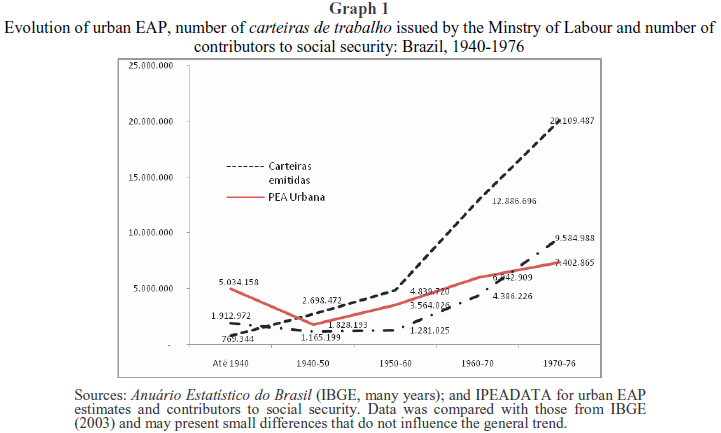
That is what Graph 1 suggests. It presents the growth curves of the urban economically active population - EAP - (or workers of ten or more years that were in a job or looking for one), the number of carteiras de trabalho issued, and the number of contributors to social security between 1940 and 1976. Contribution to social security, in the absence of more accurate indicators, is considered here an approximate measure of the proportion of workers participating in the regulated sector of the economy. In fact, it is quite accurate, since until at least 1971 the possibility of retirement was restricted to workers with carteiras and government employees33. The numbers in the graph show the addition of new members of the EAP, those with carteiras and those with social security in each period. The numbers are significant. In 1940, the urban EAP was made up of a little more than 5 million people. Until then, the Ministry of Labour had issued less than 1 million carteiras, and contributors to social security were slightly less than 2 million people, or around 38% of those in employment. Hence, work that was regulated and protected by social and labor legislation did not reach 40% of those in employment in the cities34. Between 1940 and 1950, the urban EAP gained another 1.8 million people, while new social security contributors were less than 1.2 million. Nevertheless, the Ministry of Labour issued 2.7 million carteiras during the same period. Thus, 150% more carteiras were issued than the growth of the EAP, and 230% more than the beneficiaries of social security. This seems to be a strong indication that the workers believed in the possibility of their inclusion into the consolidating formal market, since they qualified for this (that is, they got their carteiras) in a superior proportion to the jobs created (as measured here by the urban EAP). Moreover, the number of holders of carteiras was far superior to the regulatory capacity of the social security system, i.e., the capacity to include new city dwellers in the world of social and labour rights in an environment of enormous bureaucratic restrictions to entitlement. It seems that the belief in the promise of legal rights must be among the explanations for the always higher number of qualifications than availability of these legal rights, on the part of workers who migrated from the countryside to the cities.Â
This dynamic would accelerate in the following decades. Between 1950 and 1960, carteiras issued were 36% higher than urban EAP growth, and no less than 377% more than the growth in the number of social security contributors. Between 1960 and 1970, carteiras issued surpassed EAP growth by 213%, and by 271% in the six following years (until 1976). There were 2.78 times more Brazilians becoming holders of a carteira than those effectively part of the social security system in the period analyzed here (1940-1976), and 1.92 times more than those part of the EAP35. This means that the increase in social security contributors corresponded to only 38% of the increase in holders of carteiras in this period. In this context, the first number (2.78 times) must be taken as the measure of inflationary belief of Brazilian workers in the promise of legal rights, which led to an expectation of inclusion almost three times greater than the real possibilities in the formal urban labour market for over three decades. Seen from a different angle, one can say that the objective discount rate for expectations of social protection was 62%, which was the proportion of carteira-holders that exceeded the number of social security contributors throughout the years.
]]>
This confirmed Vargas' worst fears in relation to the risks that rural-urban migration represented to his civilizational project. It should be noted that, although the promises of protection suffered a substantial discount rate, it seems undeniable that registered jobs in Brazil represented, to growing segments of urban workers (and, it seems, to segments of rural workers too36), a normative reference point for the shaping of individual and collective expectations in terms of what could be called "minimum requirements of civilization", below which the labour market could not operate in a legitimate manner. The minimum wage, the right to regular vacations, paid weekly rest, a Christmas bonus (equal or close to one's wages) etc, became parameters that also began to function in sectors of the informal wage-earning market, in the sphere of tacit agreements between informal employers and wage earners without carteiras who thought these rights were fair. Although it never became universal, the formal market structured a set of social and economic relations that occurred outside it. The reason was that urban wage earners expected sooner or later to become a part of it. This expectation was in fact achieved now and again during the working lives of men and women, because of the always high rates of turnover in the Brazilian urban economy, especially in the less skilled occupations37.
In regard to this, some occupational trajectories of the migrants studied by Lopes in another groundbreaking study are extraordinary (1971:41). One person was a factory worker for a year and a half, returned to his smallholding for 21 days, became a store salesman for a year, and once again worked in a factory for four years. Another washed buses for three months, was a factory worker for eight years, worked on a farm for two more, then again in a factory for two months, and once again in a factory for two years. A third man was a bricklayer's assistant for two months, a baker's apprentice for two weeks, a factory worker for a year and a half, a salesman earning by commission for a non-specified time, a factory worker for 15 days, and once again a factory worker for two and a half years. These erratic trajectories are perfect examples of the socioeconomic insecurity of urban workers with low qualifications. They are subjected to market dynamics entirely beyond their control, since the lack of any specialization reduces their bargaining power in an extremely saturated market38. The important thing here is that the regular passage, although short-lived, through a formal and protected job ended up leading to expectations of equal retribution in the informal wage-earning market, and this at times occurred39. And it seems that workers believed that the formal market would welcome them again at some point in their working lives40.
THE PROMISE AND INEQUALITY
Even though workers adhered to the Varguista utopia and its struggle to embody "regulated citizenship", the rewards associated with it were almost always insufficient to secure the "integral appreciation of the Brazilian man". As an example, take the setting of the minimum wage, advertised by the Estado Novo as one of the main instruments of appreciation. The wage was defined by presidential decree no. 399, of 1938, as "the minimum amount owed to any adult worker, independently of gender, for a normal days' work and capable of fulfilling, within a certain period and region of the country, his normal needs of food, housing, clothing, hygiene, and transport". This text would later be incorporated in the Consolidated Labour Lagislation (CLT) and improved on by the 1946 Constitution, which would include the needs of the worker and his family.Â
 The presidential decree no. 2162, which defined the first minimum wage in May of 1940 based on specific regional studies throughout 1938 and 1939, established it at 240 mil réis for the Federal District (city of Rio de Janeiro). This was the largest amount in the country. São Paulo was granted 220,6 mil réis, while in certain regions of the interior of the North and Northeast the amount did not surpass 90 mil réis41. This last number was equivalent in 1939 to less than 70% of the monthly expenditure on food for one member of a middle-class family in Rio de Janeiro42. This means that the minimum wage of 240 mil réis was enough to provide food to 2.6 members of the same family per month and nothing more43. Rental for housing for this family would require 2.6 minimum wages. It is true that the minimum wage was not meant for middle-class families, who spent an average of 200 mil réis in 1939 just on domestic servants. But this shows the purchasing power of the income decreed by Vargas and divulged with great fanfare in the Labour Day celebrations of 1938. It also shows the tolerance with social inequality in the minimum wage legislation: that middle-class family from Rio de Janeiro spent, in 1939, on average no less than 10 times the minimum decreed in 194044. If we consider that middle-class women rarely worked and, therefore, the man of the house very likely bore the brunt of this expenditure, it is possible to imagine that the monthly income of a middle-class professional was far more than 10 times the minimum wage in 1940 (considering current expenditure and some savings).
The nominal value of the minimum wage was set at a low level and, furthermore, remained frozen between July 1940 and May 1943, which represented a real loss of purchasing power close to 40%, which was the accumulated inflation during that period. The 25% raise given by Vargas in May of 1943 did not replace the losses, which were compensated with a raise of 27% in December of the same year, after an additional inflation of 12%45. Nevertheless, although legislation ordered a review of its amount every three years, from January 1944 to December 1951 (the latter date thus falling in Vargas' new government) there would be no new raises and the minimum wage, corroded by inflation, reached its lowest value in many decades, equivalent to 40% of what it had been at the beginning of the period46.
Even so, for certain sectors of the urban economy, setting the minimum wage may have represented income gains. They were obviously dependent on their effective endorsement by employers, which is problematic in a state that has historically had meager resources to enforce labour legislation47. In any case, there is evidence that the depreciated value of the minimum became a reference in time, not as a minimum wage, but as a ceiling for a significant number of urban wage-earning occupations, even in industry.
In fact, the monthly average wage in 1939 for an industrial worker was 177 mil réis48. In modern industries the amount was higher: 238,4 in metalworking; 284,4 in mechanics; and 300,9 in transport material. All these industries were concentrated in the Rio-São Paulo axis. The following year, the minimum wage was set above 177 mil réis precisely for the following states: São Paulo (220), Federal District (240), Rio de Janeiro and Rio Grande do Sul (200), Bahia and Paraná (180), according to Montali (n. d.:2). Thus, some industries exceeded the average wage effectively paid out in 1939, but not in the emerging and most dynamic sectors49. These continued to be "detached" for a while longer from what had been decided. But this detachment, contrary to what one would expect in sectors with a scarce and specialized workforce, did not go in the direction of higher wages.
]]>
Thus, in December of 1943, the minimum wage was set at Cr$ 360 in the Federal District and Cr$ 340 in São Paulo (mil-réis had ceased to exist in 1942). The average wage paid in manufacturing in these two places in July of that same year was Cr$ 417 and Cr$ 354 respectively, therefore, above the minimum wage of the time which had been frozen since 1940 at Cr$ 240 and Cr$ 220. The new minimum was similar to what manufacturing already paid out in average terms, and may have forced an increase of lower wages towards the new level set in these two regions. However, it is hard to demonstrate that with the available evidence50. Even so, it is highly unlikely that this increase occurred in the other states of the federation, since in all of them workers earned on average, in December of 1943, less than the state had determined as the subsistence wage, which in turn was set at a lower level than the real needs of a typical working-class family51. Vargas would not increase the minimum wage again during the Estado Novo, and the Dutra administration simply did not follow the legislation that obliged a three year review of its level (which should have been in December of 1946). Hence, the biggest squeeze to basic wages until then and for a few more decades occurred when inflation reached 182% between 1944 and 195152. The consequence was a new detachment of average wages for factory workers from the artificially low amount that had been set. In fact, this was the intention of the Dutra government, which tried to nullify the role of the minimum wage in the regulation of the economy53. In 1949, an average wage for a worker was 835 cruzeiros per month, for a minimum wage frozen at 360 cruzeiros in the Federal District54. In spite of the enormous repression and intervention in almost all trade unions identified with Vargas or controlled by the communists55, industrial workers seem to have been able to partly recover their inflationary losses during the period56. But after a new policy of recuperation initiated in Vargas' second term and followed by Juscelino Kubitschek in 1959, the minimum wage was again set according to the average earned salary of a production worker, which was 6 thousand cruzeiros. Once again, a substantial number of industrial workers earned less than the legal minimum, and once again wages in general seem to have converged only partially to that level, exemplifying the aforementioned "lighthouse effect" of the wage that had been set as a ceiling for a significant number of wages.
Thus, no less than 56% of urban workers earned up to one minimum wage in 196057. Separating them by industrial sectors, one finds that 83% of employees in manufacturing , 91% of workers in civil construction, and 95% of those in extractive industries found themselves at this level, i.e., equal to or less than one58. In 1966, when the minimum wage was worth 36% less than in 1959, manufacturing wages had become detached again, but only partly: 46% of workers from the state of São Paulo with a carteira de trabalho, 49% of workers in Rio, 70.5% of those in Pernambuco and 70% of those in Minas Gerais (for a 53% national average) earned up to one minimum wage; 78% of formal urban workers earned up to two minimum wages59. Oliveira (1981) asserted in his classic analysis, "the range of earnings of urban workers is not a range, but a poor trunk with just two branches", those that earn up to one minimum wage and the few who earn more than that (ibidem). And the author added that:
Setting the minimum wage at almost always low levels had an impact on the country's income distribution, since the social distance between the very rich and the very poor deepened over time. In 1960, the richest 10% took 39.65 of the national income. In 1970, 46.7%; and 51% in 198060. This result can hardly by attributed solely to the minimum wage, but there is no longer any controversy over the fact that - especially during the military regime, when the price set was depreciated once again, in a period in which the state controlled the trade unions and again set the official policy of wage increases - the influence of the minimum wage was strong, in the sense that it shrank wages in the more dynamic sectors or, at the very least, prevented them being defined by what Oliveira called the "specific scarcity" of the workforce.
FINAL WORD
It is true that the minimum wage has almost always been a simple promise of subsistence income. For a significant part of its history, it has been below this level and most workers were paid below the level set by the state. But this did not nullify its civilizational aspect, since workers were told that they had the right to a fair income. Therefore, they should fight for it, even if the state, for political or economic reasons, abstained from keeping the purchasing power of the wage it had unilaterally set. This is true of the wage that was established, the health and educational services, the retirement funds and all the other things that had become a legal right with a view to the "appreciation of the Brazilian man", thus justifying the struggle to make them effective.
Even if for a number of Brazilians the world of rights formed throughout the Vargas era had remained a promise - since until at least the end of the 1960s there were never less than 50% of urban workers with jobs outside of the labour legislation -, what matters to this discussion is the idea that this world became an irremovable element of the horizon of expectations of the working population as the very emblem of the "good life", as measured against a parameter of great and multidimensional socioeconomic vulnerability and insecurity: life in the countryside. For a significant number of the rural and urban masses, whose daily life and whose processes of differentiation were spontaneous, incidental, unstable, and to a large extent invisible to the state or to capital, the world of social and labour rights, or "regulated citizenship", offered a powerful reference for the development of their individual and collective identities. Now the horizon of aspirations was no longer defined by everyone's destitution, but by the dream of personal self-improvement through the path of labour protected by the state.    Â
]]>
To put it differently, during most of Brazil's recent history the feeling of relative deprivation, which has had important consequences for the social dynamic in unequal societies in process of accelerated change61, did not find fertile ground because the lifestyles of the dominant and the subordinate classes were unfathomable. For the subordinate ones it seemed impossible to aspire to the position of the powerful, simply because it seemed too far away. "Regulated citizenship", on the other hand, was within everyone's reach, if they attempted to qualify for it. This established an irresistible distinction between Brazilians from the countryside and the cities. The city became an irresistible destiny, a place of "utopian beliefs" (Touraine, 1961) in the inclusion of social rights. This was one of the reasons for the failure of the Varguista project. It is necessary to reiterate here that it does not matter if this project was "in good faith" or if part of the ruling elites around Vargas saw in it only a way of controlling the masses or maintaining their own political project62. It is probable that motives of this nature prompted many of them. Nonetheless, from the perspective of the argument here what matters is that, once established, social legislation became a real object of aspiration for the masses deprived of resources and rights, simply because it was portrayed precisely as a set of legal rights, not privileges. The most recent literature on the topic is partially right in maintaining that those workers who were able to ascend to the world of "regulated citizenship" seemed privileged63. Ideally, since this position was accessible to anyone who could get a carteira de trabalho, the privilege immediately transformed itself into legitimate aspiration, and access to it was a victory in an environment ruled by legal rights, not privileges. And this is despite the via crucis of the state bureaucratic channels for obtaining the documents that gave access to these rights. It is a new concept of the state that is at stake here. Up until Vargas the social question was unconstitutional, and the face of the state for Brazilians was the police. It is true that French (2004) is right in claiming that Vargas was just as, if not more, violent in relation to organized labour than Washington Luis or Arthur Bernardes. The social question was always combated in a bloody manner after 1935, whenever it emerged outside of "regulated citizenship" (for example, through communist or socialist proselytizing, or through the struggle for independent trade unions)64. By portraying itself to Brazilians as a project and a judicial system still to be implemented, the Varguista state asserted itself as the state of its nation, and not as an institution at the service of the powerful. Vargas (and I use him here as the personification of a project of state development) announced to a nation, which until then had been alienated from its state, that there was a national development project in progress and that in it there was a place for the workers. Furthermore, at least in the apologetic discourse of order, it was a prominent place. This represented something completely new in Brazilian history, a history in which the state was built against the internal enemy represented by the impoverished, half-caste, dangerous people. Whether this was true or not and an ideology or not, the fact is that this made the effectiveness of the evolving system an interest of those who the system said it wished to include. From that moment onwards, the struggle to put social rights into effect became a central aspect through which the state became effective in Brazil. With Vargas the workers gained a general centre of identification and, importantly, inside and within the limits of the capitalist order that the Varguista state also tried to transform. From then on, any project of overcoming the deprivation to which the workers were continuously subjected in the decades after Vargas' first term needed to compete with this solid aspiration of workers for inclusion in the realm of social rights65. The class consciousness of Brazilian workers was, for a long time, the consciousness of the right to their rights, whose effectiveness was always a process and, therefore, always and repeatedly utopian. Another aspect that current literature does not pay too much attention to is the fact that Vargas initiated the process (still unfinished) of the civilization of capital, by burdening it with the idea of workers as people to which they had obligations defined by law, and not as bodies which capitalists dumped unceremoniously like slave masters. To a large extent, the Varguista state burdened the indifferent elites with a mass of workers endowed with humanity and, therefore, deserving of recognition in their individuality, autonomy, and liberty. Even though Brazilian businessmen profoundly resisted putting into effect the regulation of the labour market, it forever lost the right to be indifferent. After 1945, this would be replaced by mistrust, by fear and class prejudice, but the substantial indifference in relation to the destiny of the masses, a result of the non-recognition of the "other" deserving of a self-referencing "I", no longer had any place in the changing sociability.
It should be reiterated that all this occurred at the expense of the restriction of the aspirations and projects of a significant number of workers. With Vargas, organized labour had the right to form its identity, but if, and only if, this formation ocurred in the sphere of "regulated citizenship". Through physical and symbolic violence Vargas framed the horizon of expectations and the daily life of workers. He limited them to the small-minded frontiers of capitalist sociability, by promising access to the world of consumption and the goods of liberal civilization, especially the social rights that the reformed liberalism of the 20th century added to its regulatory mix. The symbols of worker identity were now the "model worker" (operário padrão), the "father of the poor", and the CLT. However, although small-minded, those frontiers gave a real meaning to most people's lives, as well as reasons to fight for their effectiveness. At least until the 1980s, no political force emerging after Vargas' death was capable of establishing viable alternative projects of identity formation for the people who lived from their labour66.
In the end, the Varguista project of inclusion through social rights revealed itself as a powerful instrument for reproducing social inequalities in Brazil. The immense migratory wave from the 1940s onwards led to long-lasting social inertia in the process of inclusion of migrants into the labour market, which was an important restriction on the effectiveness of the Varguista promise. But the demonstration effect of the not so few upwardly mobile individual trajectories showed Brazilians that, although hard to reach, the promises of integration in the world of rights and access to its civilizational benefits were not only credible, but also possible to those who tried. This generated a retro-alimented process that legitimized the unequal order, which was of great value in maintaining its general structure, notwithstanding the enormous social and personal costs of the persistence of inequality.
NOTES
1.  The Gini coefficient is the most commonly used measure of income allocation by a specific population. It varies from 0 to 1. While 0 means that each person in the population gets the same income as everybody else. 1 means that one person gets all the available income. Thus, the closer the coefficient is to 1, the more concentrated the total distribution of income is for a given population. It has already been demonstrated that in countries with high income inequality Gini is not the best measure, since it does not capture the extremeness of the distribution. Moreover, the coefficient is a very limited measure of inequality since this can manifest itself in multiple dimensions that go beyond income. The objective here is only to show that it has always been very unequal in Brazil, and that the pattern of inequality is persistent over time. Â
2.  The 1872 and 1920 coefficients were calculated by Bértola et alii. (2009) in a preliminary study, therefore the numbers must be analyzed with caution. The 1976 and 2006 numbers are available at http://www.ipeadata.gov.br and are reliable (accessed in September 2009).
3.  In this analysis, I use the version of the text published in Lopes (1971:22-95). Quotes will have only the page number.
]]>
4.  Pages refer to the original edition, Touraine (1961). 5.  Especially, Martins Rodrigues (1966 and 1970).
6.  Also Paoli et alli. (1983), besides Gomes (1988).
7. In Southern Populations of Brazil, Oliveira Vianna sees a powerful agent of social solidarity in the class struggle, which is very "efficient in the organization of Western peoples" (p. 157). Echoing Marx, he states that "all of Greek evolution, all of Roman evolution, all of medieval evolution, all of modern evolution occurs under the prolific influence of the class struggle. These conflicts are extremely rare in our history [...]. They last for an extremely short period of time. They blossom in extremely limited areas". They are not, therefore, promoters of solidarity. On the contrary, they lead to negative effects in relation to "the political and social evolution of national identity" (pp. 157-158).
8. In an example that this might actually be possible, Japan invaded Malaysia in 1943, to where Amazonian rubber tree seeds had been pirated at the end of the 19th century, ending the Brazilian monopoly in latex. The Japanese invasion provoked a sudden dearth of the raw material, and the rubber latex extraction of the Amazon, which had been practically deactivated since the beginning of the 20th century, returned at the hands of the "rubber soldiers". These were mostly Northeastern migrants who heeded the state's call for the production of rubber in the forests of the states of Acre and Amazonas as part of the Brazilian war effort. See Silva (1982).Â
9. In 1939, two years before this speech, coffee and cotton were 60% of the overall value of the country's exports (IBGE, 1941:90). Besides showing the fragility of its foreign trade, this number reveals the enormous dependence of the nation in relation to a handful of large producers of coffee and cotton, as well as Vargas' difficulty in directly confronting their interests. It is important to remember that, in his acceptance speech for the provisional government, on November 3rd, 1930, Vargas listed among the tasks of the revolutionary government "non-violent backing for the progressive extinction of the latifúndio and, this way, protecting the organization of the small holding" and stimulating the worker to "build with his own hands, on his own land, the foundation of his prosperity" (1938, vol. 1:73). In 1941, this task was still only a promise, and would remain that way for the following decades.
10. This is calculated by the IBGE (1941:120), with data for the revenue per capita, deflated by the value of the British pound in mil réis (presented in the same publication, p. 64, table 2).
11. As described in Tavares de Almeida (1978) and Gomes (1979).
12. There were 273,000 workers in São Paulo, according to Dean (1971:127), in an economically active population estimated at 55% of the 1.3 million inhabitants.
13. The numbers are an approximation because the data published in the censuses included the unemployed and those in poorly defined activities in the same category. See IBGE (2003) for data on the population.
]]>
14. It is widely known that a significant amount of Vargas' legislation had been demanded by the workers movement before 1930, as Moraes Filho (1952) first proved, demolishing the myth that Vargas gifted or granted workers their rights. This led Gomes (1988) to suggest that Vargas took the workers' discourse and transformed it into a control mechanism over the workers themselves. Later on we will see that, although relevant in itself, the discussion about the myth of the gift is disconnected to the central argument of this article. 15. Some obligatory references are Simão (1966), Dean (1971), Werneck Vianna (1999), Tavares de Almeida (1978), Santos (1979), Erickson (1979), Gomes (1979 and 1988), French (2004), and Fischer (2008). Differences of opinion in regard to content usually refer to the regulations which this or that author includes (or leaves out) in the legal framework of Varguista social protection.
16. The concept differs from the notion of sub-citizenship, which covers what Souza (2000) calls the ralé (riff-raff), who are permanently excluded by the Brazilian process of "selective modernization". The argument here is the complete opposite of this simplification.
17. To show this in detail for the poor of Rio de Janeiro is one of the great contributions of Brodwyn Fischer (2008) to the understanding of the development of working society in Brazil, even though her research is focused exclusively on this state. The fragile embodiment of labor legislation is also systematically investigated by French (2004), although, as we shall see later on, I consider his understanding of its embodiment to be incomplete.
18. The populations of the 19th and early 20th centuries had enough reasons to mistrust the state's attempts to interfere in their daily lives. Riots such as the Cumbuca (against the compulsory military lottery) in 1874, or against the vaccine in Rio de Janeiro in 1904, mainly stemmed from the perception that the state was going too far in its attempt to regulate poor people's lives. This also explains the resistance to the census and taxation in rural communities and sanitation policies in the cities. For census and taxes, see Queiroz (1965:216). I analyze sanitary measures in  Cardoso (2010).
19. In Rios and Mattos (2005) we find many testimonies of descendants of slaves who had no formal birth certificate. This lack was common in quilombola communities (Gomes, 2006) and in communtiies of Northeastern migrants in cities in the Southeast (Perlman, 1977; Durham, 1973).
20. An SOS Bulletin mentioned by Fischer (2008:129).
21. Alexandre Marcondes Filho, Minister of Labour in the last years of the Estado Novo, was one of the main people responsible for the consolidation of the myth of Vargas gifting rights, with his ten-minute weekly radio chat on Hora do Brasil. The more than 200 lectures given between 1942 and 1945 were analyzed by Gomes (1988:229-256).
22. See also Weinstein (1996) and Dávilla (2003).
23. As mentioned before (see footnote 14), the myth of the granting (or gifting) of workers rights was deconstructed for the first time by Moraes Filho (1952). Martins Rodrigues (1974) is an advocate of the school of thought which holds that the workers, in their political and labour struggles, did not conquer what Vargas established through law, especially considering its ordering and extent. Weffort (1978) is among the many who do not agree with this. Gomes (1988), in accordance with Moraes Filho, suggests that the workers' discourse was seized upon by Vargas, who emerged as the generous father of the historical demands of the labour movement. More recently, Ferreira (1997) and his colleagues have tried to recover the idea that Vargas actually introduced something new in the concession of social rights. French (2004) tries to put an end to the controversy. Although I find it relevant, this debate is disconnected from the central argument of this article. Â
]]>
24. See Supiot (1994) on this. 25. See Rosenvallon (1981), Titmuss (1963), and Castel (1998).
26. See, albeit from very different perspectives but with the same results, Durham (1973), Perlman (1977), Sales (1977), Coutinho (1980), Alvim (1997), Linhares and Teixeira (1998), and Fontes (2008). There is a short review in Hasenbalg (1991). For the inheritance mechanisms as a regular source of expelling sons of small landowners, see Willems (1961) and Moura (1978).
27. "In a culture which is living on the edge, any variation in work conditions represented by climatic or soil differences, or even in variations of benevolence or severity on the part of the employer, frequently represents the main difference between survival and hunger. It is this factor that makes mobility such a generalized feature of Brazilian rural life" (Durham, 1973:120). In the 16th and 17th centuries, nomadic rural populations were strongly contested in Europe, as shown in Castel (1998). And the destruction of the knots that tied these workers to the land in the 18th century and their mass migration to the cities is at the source of Western capitalism, as Marx shows in the memorable analysis of what he called "primitive accumulation". Also see Thompson (1987).
28. Between 1920 and 1960, Minas Gerais was the state with the most net internal emigration (1.8 million people left the state in forty years), followed by Bahia with almost 900,000 and Alagoas with around 450,000. See Villela and Suzigan (2001[1973]:284). This number corresponds to the number of foreign immigrants entering Brazil between 1871 and 1920. See Maram (1977:178). Overall, 5.5 million people migrated from their home states to other regions in these forty years, with São Paulo receiving 1.5 million migrants, Rio 1 million and Paraná almost 1.4 million (Villela and Suzigan, ibid.).
29. For the mass migrations in Brazil during the rubber cycles, see Silva (1982), Costa Sobrinho (1992), and Martinello (2004).
30. Apud Fontes (2008:51).
31. Garcia and Palmeira (2001:61) certainly had these cases in mind when they wrote that "the big industrial cities began to [...] mean the place where there were legal rights, to which the rural world could only be portrayed as 'a place of hardships' and a world of arbitrariness, subjection, and imprisonment. Â
32. See also Lopes (1976).
33. Prorural was created this year. It was a retirement program for rural workers. In 1972, domestic servants were included in the system; and in 1973 self-employed workers. See Santos (1979:35-36).
]]>
34. This represented a mere 12% of the total employed population, since 70% of them were in the countryside. 35. An important part of the explanation for entitlements being so much higher than the EAP has to do with the qualification of women for formal jobs, even if not necessarily exercised throughout their lives.
36. Rios and Mattos (2005:55-57 and 248) suggest that Vargas, especially after 1937, had generated expectations of contractual rights also among rural workers when he opposed coronelismo in the countryside. Not by chance, the periodization of citizenship has two founding moments in the memory of slave descendents: the abolition of slavery and Varguista labour legislation.
37. Turnover in Brazil is studied at length in Cardoso (1999 and 2000). See also Barros and Mendonça (1996).
38. The erratic character of the non-specialized workers' trajectory, the majority of the migrant workforce, did not cease with time. Cardoso (2000), Guimarães (2004), Cardoso et alii. (2006), and Guimarães (2009) portray the job instability that characterizes the labour market to this day.
39. The literature on the influence of the minimum wage and other labour rights is abundant in Brazil. For a good review, see Ulyssea (2005). Lopes (1976) and Sigaud (1979) are classic studies on the importance of legal rights in the shaping of the social identities of sugar cane and sugar mill workers in Pernambuco.
40. Once again see Fontes (2008).
41. See Montali's (s. d.) work, available at http://www.dieese.org.br/cedoc/007171.pdf and Lowenstein (1942). Montali maintains that deciding the minimum did not take into account families' real expenditures, which was anticipated by the 1938 law, but only the average of incomes lower than 420 mil réis.
42. Data from IBGE (1941:94).
43. Inflation measured by IPC-Fipe between January and June of 1940 for the city of São Paulo was of 7.2% according to the data-series available at http://www.ipeadata.gov.br. Since the minimum wage came into effect in July 1940, the cost of living for this same family had changed in relation to 1939, but not to the point of qualitatively changing the amount.
]]>
44. Data from IBGE (1941:94). The total average expenditure of a family such as this in the federal capital was 2,4 contos de réis in 1939. 45. Thus total inflation from 1940 to 1944 was slightly less than 57%, and the minimum wage rose by slightly less than 59%. Â
46. Calculations were all made based on real minimum wage amounts found at http://www.ipeadata.gov.br. In January 1944, the minimum wage was worth the equivalent of R$ 336,8 (in reais of July 2007). In December 1951, it was worth R$ 136,4, or almost 60% less.
47. As John French (2004) abundantly showed. Erickson (1979:104-105) maintains that the Ministry of Labour between 1939 and 1941, responsible for the inspection of the labour legislation and for all regulation of labour relations, spent on average only 0.9% of the federal budget. This number may be an underestimate, since according to data from IBGE (1987:574-576) the number was almost 4% in 1939, which is still very low. There were 1.8 million contributors to some sort of social security in Brazil that year. This should be considered as the approximate size of the formal sector of the economy regulated by the state. The 160 thousand contos de réis spent by the Labor Ministry correponded to 8,9 mil réis per person formally occupied that year, which is the approximate price of a can of olive-oil or two kilos of fat in 1937 (IBGE,1941:93). Data on social security contributors come from the same source of Graph 1.
48. Calculation based on IBGE (1987:347-348, tables 7.10 and 7.12). The total wage paid to production workers that year was divided by the people with jobs and divided by 12.
49. Average wages in commerce were 420,7 mil réis in the Distrito Federal and 341 mil réis in São Paulo. Cf. Tavares de Almeida (1978:244).
50. Data with average wages in industry per state may be found in IBGE (Anuário Estatístico do Brasil 1941-1945:326). See also Tavares de Almeida (1978:247). However, she presents different numbers from the IBGE one (I stick to the official numbers). The same author disagrees with Francisco de Oliveira (1981[1972]) over the effects of the minimum wage on industrial wages, maintaining that there were benefits for workers with lower wages, while Oliveira believes the minimum lowered higher wages, cautioning that average wages in industry, analyzed by IAPI, were overestimated. Therefore, they were even lower than the figures transcribed here. Werneck Vianna (1999) takes Francisco de Oliveira's side.
51. The destitution of the industrial worker in the Federal District during this period was analyzed by Fischer (2008), among others.
52. Cf. inflation data at http://www.ipeadata.org.br.
53. An argument made by Werneck Vianna (1999) and Skidmore (2003).
]]>
54. Calculation of average wage using the same methodology explained in the footnote. In the IBGE Anuário Estatístico do Brasil of 1950, the average wage paid out in July of 1949 was Cr$926, a calculation based on information from the contributors of the Industrial Workers Retirement and Pensions Institute - IAPI (cf. p. 328). However, this source overestimates the actual amount paid to production workers, since it also includes administrative staff. Â IBGE (1987) allows a separation of workers from other occupations. 55. See Gomes (1988).
56. With full compensation for inflation, the average wage in the Federal District shoould have been of Cr$ 1.150,00.
57. According to data from the demographic census, collated for this article.
58. Ditto. In government, 65% of workers earned up to one minimum wage; 69% in commerce.
59. Data in Souza (1971:123).
60. See IBGE (1987:75). It is income from work, as declared by people in demographic censuses. However, it underestimates the real distribution of wealth, which is certainly more concentrated than this. An experiment comparing income declared in the National Sample of Households Study (PNAD) with the one measured by the Standard of Living Study (PPV) observed that the worker's declared income underestimates the income actually earned by around 40%. See Barros et alii. (2007).
61. Â Explored at length in Santos (2006).
62. The dishonesty of a part of the ruling elite under Vargas, himself included, was asserted by French (2004) and Levine (1998).
63. Levine (1998), French (2004), Fischer (2008), and, to a lesser extent, Weinstein (1996) state this.
]]>
64. As Werneck Vianna (1999) asserted, the Estado Novo began for the workers after the failed insurrection of the Aliança Nacional Libertadora in 1935. 65. See Paoli (1988), Weinstein (1996), Negro (2004), and Santana (2001) about this.
66. Only in the 1980s were these symbols effectively circumscribed by a renewed workers movement as an inheritance to be overcome. Lula, as a union leader, used to say that "the CLT is the AI-5 of the worker", referring to the control of unions and the collective bargaining by the state, not to the legislation on the protection of the individual worker. But the "New Unionism" project of overcoming the Varguista legacy would be thrust aside by the neoliberalism of the 1990s, and Brazilian workers saw themselves in a situation where they had to defend the CLT and the rights that the state tried to suppress or flexibilize. I analyzed these processes in Cardoso (2003).
BIBLIOGRAPHY
ALVIM, Rosilene. (1997), A Sedução da Cidade: Os Operários-Camponeses e a Fábrica dos Lundgren. Rio de Janeiro, Graphia.
BARROS, Ricardo P. de & MENDONÇA, Rosane. (1996), "Flexibilidade do Mercado de Trabalho Brasileiro: uma Avaliação Empírica", in J. M. Camargo (ed.), Flexibilidade do Mercado de Trabalho no Brasil. Rio de Janeiro, Editora FGV, pp. 157-201.
 BARROS, Ricardo P. et alii. (2007), "A Desigualdade de Renda no Brasil Encontra-se Su- bestimada? Uma Análise Comparativa com Base na PNAD, na POF e nas Contas Nacionais". Textos Para Discussão, Rio de Janeiro, IPEA, no 1263.
BÉRTOLA, Luis et alii. (2009), Income Distribution in Brazil: 1870-1920. Trabalho apre- sentado na miniconferência A Comparative Approach to Inequality and Development: Latin America and Europe Instituto Figuerola, Madrid, Universidad Carlos III, 8-9 May.
]]>
CARDOSO, Adalberto M. (1999), Sindicatos, Trabalhadores e a Coqueluche Neoliberal: A Era Vargas Acabou? Rio de Janeiro, Editora FGV.
    . (2000), Trabalhar, Verbo Transitivo. Destinos Profissionais dos Deserdados da Indústria Automobilística. Rio de Janeiro, Editora FGV.
    . (2003), A Década Neoliberal e a Crise dos Sindicatos no Brasil. São Paulo, Boitempo.
___. (2010), A Construção da Sociedade do Trabalho no Brasil. Sociabilidade Capitalista, Padrões de Justiça e Persistência das Desigualdades. Rio de Janeiro, Editora FGV.
___ et alii. (2006), "Os Deserdados da Indústria. Reestruturação Produtiva e Trajetórias Intersetoriais de Trabalhadores Demitidos da Indústria Brasileira", in N. Guimarães e H. Hirata (eds.), Desemprego: Trajetórias, Identidades, Mobilizações. São Paulo, Editora Senac, pp. 45-90.
CARDOSO, Fernando H. (1969[1962]), "Proletariado no Brasil: Situação e Comportamento Social". Mudanças Sociais na América Latina. São Paulo, Difusão Europeia do Livro.
CASTEL, Robert. (1998), As Metamorfoses da Questão Social: Uma Crônica do Salário. Petrópolis, Vozes.
COSTA SOBRINHO, Pedro V. (1992), Capital e Trabalho na Amazônia Ocidental: Contribuição à História Social e das Lutas Sindicais no Acre. São Paulo, Cortez; Rio Branco, EDUFAC.
COUTINHO, Ronaldo do L. (1980), Operário de Construção Civil: Urbanização, Migração e Classe Operária no Brasil. Rio de Janeiro, Achiame.
DÁVILLA, Jerry. (2003), Diploma of Whiteness. Race and Social Policy in Brazil, 1917-1945. Durham/London, Duke University Press.
DEAN, Warren. (1971), A Industrialização de São Paulo: 1880-1945. São Paulo, Difel.
 DURHAM, Eunice R. (1973), A Caminho da Cidade. A Vida Rural e a Migração para São Paulo. 2 ed. São Paulo, Perspectiva.
ERICKSON, Kenneth P. (1979), Sindicalismo no Processo Político no Brasil.
FERNANDES, Florestan. (1960), Mudanças Sociais no Brasil. São Paulo, Difusão Europeia do Livro.
FERREIRA, Jorge. (1997), Trabalhadores do Brasil. O Imaginário Popular. Rio de Janeiro, Editora FGV.
FISCHER, Brodwyn. (2008), A Poverty of Rights. Citizenship and Inequality in Twentieth-Century Rio de Janeiro. Stanford, Stanford University Press.
FONTES, Paulo. (2008), Um Nordeste em São Paulo. Trabalhadores Migrantes em São Miguel Paulista (1945-1966). Rio de Janeiro, Editora FGV.
FRENCH, John D. (2001), Afogados em Leis: a CLT e a Cultura Política dos Trabalhadores Bra sileiros. São Paulo, Editora Fundação Perseu Abramo.
    . (2004), Drowning in Laws. Labor Law and Brazilian Political Culture. Chapel Hill/London, University of North Carolina Press.
GARCIA, Afrânio & PALMEIRA, Moacir. (2001), "Rastros de Casas-Grandes e de Senza- las: Transformações Sociais no Mundo Rural Brasileiro", in I. Sachs et alii. (eds.), Bra- sil, um Século de Transformações. São Paulo, Companhia das Letras, pp. 38-77.
GOMES, Angela de C. (1979), Burguesia e Trabalho. Política e Legislação Social no Brasil, 1917-1937. Rio de Janeiro, Campus.
]]>
    . (1988), A Invenção do Trabalhismo. Rio de Janeiro, Vértice/IUPERJ.
GOMES, Flávio dos S. (2006), A Hidra e os Pântanos. Mocambose Quilombos no Brasil Escra- vista (Séculos XVII a XIX). São Paulo, Editora Unesp.
GUIMARÃES, Nadya A. (2004), Caminhos Cruzados. São Paulo, Editora 34.
___. (2007), Trajetórias Inseguras, Autonomização Incerta: os Jovens e o Trabalho em Mercados sob Intensas Transições Ocupacionais. Available at http://www.cen-trodametropole.org.br/pdf/2007/nadyaã03.pdf. Accessed July 2007.
___. (2009), À Procura de Trabalho. Instituições do Mercado e Redes. Belo Horizonte, Argvmentvm.
HASENBALG, Carlos A. (1991), A Pesquisa sobre Migrações, Urbanização, Relações Raciais e Pobreza no Brasil: 1970-1990. Rio de Janeiro, IUPERJ. (Série Estudos, 82).
HUTCHINSON, Bertrand (ed.). (1960), Mobilidade e Trabalho. Rio de Janeiro, Centro Bra- sileiro de Pesquisas Educacionais.
IBGE. (1941), Repertórios Estatísticos do Brasil. Quadros Retrospectivos. Rio de Janeiro, IBGE, vol. 1.
___. (1987), Estatísticas Históricas do Brasil. Rio de Janeiro, IBGE. (Séries Estatísticas Re- trospectivas, vol. 3; Séries Econômicas, Demográficas e Sociais, 1550-1985).
    . (2003), Estatísticas do Século XX. Rio de Janeiro, IBGE.
    . (various years), Anuário Estatístico do Brasil. Rio de Janeiro, IBGE.
LEVINE, Robert M. (1998), Father of the Poor? Vargas and his Era. Cambridge, Cambridge University Press.
LINHARES, Maria Yedda L. e Teixeira, Francisco Carlos S. (1998), Terra Prometida. Uma história da Questão Agrária no Brasil. Rio de Janeiro, Campus.
LOPES, José Sergio L. (1976), O Vapor do Diabo. O Trabalho dos Operários do Açúcar. Rio de Janeiro, Paz e Terra.
LOPES, Juarez B. (1967), Crise do Brasil Arcaico. São Paulo, Difusão Europeia do Livro.
___. (1971[1964]), Sociedade Industrial no Brasil. 2nd. ed. São Paulo, Difusão Europeia do Livro.
LOWENSTEIN, Karl. (1942), Brazil under Vargas. New York, The MacMillan Company.
]]>
MARAM, Sheldom L. (1977), "The Immigrant and the Brazilian Labor Movement, 1890-1920", in A. Davrile W. Dean. Essays Concerning the Socioeconomic History of Brazil and Portuguese India. Gainesville, University of Florida Press, pp. 178-210.
MARTINELLO, Pedro. (2004), A Batalha da Borracha na Segunda Guerra Mundial. Rio Bran co, EDUFAC.
MARTINS RODRIGUES, Leôncio. (1966), Conflito industrial e sindicalismo no Brasil. São Paulo: Difusão Européia do Livro.
    . (1970), Industrialização e Atitudes Operárias: Estudo de um Grupo de Trabalhadores. São Paulo, Brasiliense.
    . (1974), Trabalhadores, Sindicatos e Industrialização. São Paulo, Brasiliense.
]]>
MERRICK, Thomas W. (1986), "A População Brasileira a partir de 1945", in E. Bacha e H. S. Klein (eds.), A Transição Incompleta: Brasil desde 1945. Rio de Janeiro, Paz e Terra, vol. 1, pp. 31-72. MONTALI, Lilia T. (s. d.), Salário Mínimo e Condição de Vida. São Paulo, DIEESE. Available at  http://www.dieese.org.br/cedoc/007171.pdf. Accessed June 2009.
MORAES FILHO, Evaristo de. (1952), O Sindicato Único no Brasil. Rio de Janeiro, A Noite.
MOURA, Margarida M. (1978), Os Herdeiros da Terra. São Paulo, Hucitec.
NEGRO, Antonio. L. (2004), Linhas de Montagem: o Industrialismo Nacional-Desenvolvi- mentista e a Sindicalização dos Trabalhadores. São Paulo, Boitempo/FAPESP.
OLIVEIRA, Francisco de. (1981[1972]), A Economia Brasileira: Crítica à Razão Dualista. 4 ed. Petrópolis, Vozes; São Paulo, CEBRAP.
]]>
OLIVEIRA VIANNA, Francisco J. (1922[1918]), Populações Meridionais do Brasil: História - Organização - Psicologia. 2nd. ed. São Paulo, Monteiro Lobato. Â Â Â Â . (1923), Evolução do Povo Brasileiro. São Paulo, Monteiro Lobato.
___. (1939), O Idealismo da Constituição.2 ed. aumentada. São Paulo, Companhia Editora Nacional. (Coleção Brasiliana).
___. (1951), Direito do Trabalhoe Democracia Social: o Problema da Incorporação do Trabalhador no Estado. Rio de Janeiro, José Olympio.
___. (1987), Instituições Políticas Brasileiras. Belo Horizonte, Itatiaia, 2 vol.
PAOLI, Maria C. (1988), Labour, Law and the State in Brazil, 1930-1950. Tese de doutora- do em História, Birkbeck College, University of London.
___ et alii. (1983), "Pensando a Classe Operária: Os Trabalhadores Sujeitos ao Imaginário Acadêmico". Revista Brasileira de História, vol. 3, no. 6, pp. 129-149.
PERLMAN, Janice E. (1977), O Mito da Marginalidade: Favelas e Política no Rio de Janeiro. Rio de Janeiro, Paz e Terra. (Coleção Estudos Brasileiros, 18).
QUEIROZ, Maria Isaura P. (1965), O Messianismo - no Brasil e no Mundo. São Paulo, Dominus.
RIOS, Ana L. e MATTOS, Hebe M. (2005), Memórias do Cativeiro. Família, Trabalho e Cidadania no Pós-Abolição. Rio de Janeiro, Civilização Brasileira.
ROSANVALLON, Pierre. (1981), La Crise de l'Etat Providence. Paris, Seuil. SALES, Teresa. (1977), Cassacos e Corumbas. São Paulo, Ática.
SANTANA, Marco A. (2001), Homens Partidos. Comunistas e Sindicatos no Brasil. São Paulo, Boitempo.
SANTOS, Wanderley G. dos. (1979), Cidadania e Justiça. Rio de Janeiro, Campus.
___. (2006), Horizonte do Desejo. Instabilidade, Fracasso Coletivo e Inércia Social. Rio de Janeiro, Editora FGV.
SCHÜHLY, Gunther F. (1981), Marginalidade: um Estudo do "Migrante Estabelecido" no Brasil. Rio de Janeiro, PUC/Agir.
SIGAUD, Lygia. (1979), Os Clandestinos e os Direitos. São Paulo, Duas Cidades.
SILVA, Adalberto F. (1982), Ocupação Recente das Terras do Acre: Transferência de Capitais e Disputa pela terra. Belo Horizonte, UFMG.
SIMÃO, Azis. (1966), Sindicato e Estado. Suas Relações na Formação do Proletariado de São Paulo. São Paulo, Dominus.
SKIDMORE, Thomas. (2003), Brasil: de Getúlio a Castelo. 13th. ed. Rio de Janeiro, Paze Terra. SOUZA, Alberto de M. (1971), "Efeitos Econômicos do Salário Mínimo". A Economia Brasileira e suas Perspectivas. Rio de Janeiro, APEC, pp. 121-127.
SOUZA, Jessé. (2000), A Modernização Seletiva. Brasília, UnB.
SUPIOT, Alain. (1994), Critique du Droit du Travail. Paris: Presses Universitaires de France.
TAVARES DE ALMEIDA, Maria H. (1978), Estado e Classes Trabalhadoras no Brasil (1930-1945). Doctoral thesis in Political Science, USP (mimeo).
THOMPSON, Edward P. (1987), A Formação da Classe Operária Inglesa. Rio de Janeiro, Paz e Terra, vol. 1-2.
TITMUSS, Richard M. (1963), Essays on the Welfare State. London, George Allen & Unwin. TOURAINE, Alain. (1961), "Industrialization et Conscience Ouvrière a São Paulo". Soci ologie du Travail, v. 3, no. 4, October-December.
ULYSSEA, Gabriel. (2005), "Informalidade no Mercado de Trabalho Brasileiro: Uma Re- senha da Literatura". Textos para Discussão, Rio de Janeiro, IPEA, no. 1070.
VARGAS, Getúlio D. (1938), A Nova Política do Brasil. Rio de Janeiro, José Olympio, vol. 1-5.
    . (1941), A Nova Política do Brasil. Rio de Janeiro, José Olympio, vol. 8.
]]>
VILLELA, Annibal V. e SUZIGAN, Wilson. (2001[1973]), Política do Governo e Crescimento da Economia Brasileira, 1889-1945. 3 ed. Rio de Janeiro, IPEA.
WEFFORT, Francisco. (1978), O Populismo na Política Brasileira. São Paulo, Paz e Terra.
WEINSTEIN, Barbara. (1996), For Social Peace in Brazil: Industrialists and the Remaking of the Working Class in São Paulo, 1920-1964. Chapel Hill/London, University of North Carolina Press.
WERNECK VIANNA, Luiz. (1999[1976]), Liberalismo e Sindicato no Brasil. 4th  ed. revised. Belo Horizonte, UFMG.
WILLEMS, Emilio. (1961), Uma Vila Brasileira. São Paulo, Difusão Europeia do Livro.
]]>