<?xml version="1.0" encoding="ISO-8859-1"?><article xmlns:mml="http://www.w3.org/1998/Math/MathML" xmlns:xlink="http://www.w3.org/1999/xlink" xmlns:xsi="http://www.w3.org/2001/XMLSchema-instance">
<front>
<journal-meta>
<journal-id>1981-3821</journal-id>
<journal-title><![CDATA[Brazilian Political Science Review (Online)]]></journal-title>
<abbrev-journal-title><![CDATA[Braz. political sci. rev. (Online)]]></abbrev-journal-title>
<issn>1981-3821</issn>
<publisher>
<publisher-name><![CDATA[Associação Brasileira de Ciência Política]]></publisher-name>
</publisher>
</journal-meta>
<article-meta>
<article-id>S1981-38212007000100003</article-id>
<title-group>
<article-title xml:lang="en"><![CDATA[Tradition and diversification in the uses and definitions of the law: a proposed analysis]]></article-title>
</title-group>
<contrib-group>
<contrib contrib-type="author">
<name>
<surname><![CDATA[Engelmann]]></surname>
<given-names><![CDATA[Fabiano]]></given-names>
</name>
</contrib>
</contrib-group>
<aff id="A01">
<institution><![CDATA[,Federal University of São Carlos  ]]></institution>
<addr-line><![CDATA[ ]]></addr-line>
<country>Brazil</country>
</aff>
<pub-date pub-type="pub">
<day>00</day>
<month>00</month>
<year>2007</year>
</pub-date>
<pub-date pub-type="epub">
<day>00</day>
<month>00</month>
<year>2007</year>
</pub-date>
<volume>1</volume>
<numero>se</numero>
<fpage>0</fpage>
<lpage>0</lpage>
<copyright-statement/>
<copyright-year/>
<self-uri xlink:href="http://socialsciences.scielo.org/scielo.php?script=sci_arttext&amp;pid=S1981-38212007000100003&amp;lng=en&amp;nrm=iso"></self-uri><self-uri xlink:href="http://socialsciences.scielo.org/scielo.php?script=sci_abstract&amp;pid=S1981-38212007000100003&amp;lng=en&amp;nrm=iso"></self-uri><self-uri xlink:href="http://socialsciences.scielo.org/scielo.php?script=sci_pdf&amp;pid=S1981-38212007000100003&amp;lng=en&amp;nrm=iso"></self-uri><abstract abstract-type="short" xml:lang="en"><p><![CDATA[This article aims to carry out a sociological survey of the Brazilian legal field in the 1990s. To this end, the relationship between the diversification of the legal sphere and the legitimisation of definitions of the Law in Brazil over the course of the 1990s were investigated. The close match between the differentiation of the teaching of the Law, as a place for producing definitions of legal problems, and the mobilization of certain uses of the legal profession and of the careers of State during this period was analysed. This relationship allows one to gather the emergence of the academic career as a space for the production of specific conceptions and uses of the Law. This process is intimately linked to the repositioning of jurists in the sphere of power in Brazil, after the changes in the country's political landscape that have their institutional expression in the promulgation of the 1988 Constitution.]]></p></abstract>
<kwd-group>
<kwd lng="en"><![CDATA[Sociology of the legal field]]></kwd>
<kwd lng="en"><![CDATA[teaching of the law]]></kwd>
<kwd lng="en"><![CDATA[social diversification of jurists]]></kwd>
<kwd lng="en"><![CDATA[Brazil 1988 Constitution]]></kwd>
</kwd-group>
</article-meta>
</front><body><![CDATA[ <p><font face="Verdana, Arial, Helvetica, sans-serif" size="4"><B>Tradition and    diversification in the uses and definitions of the law: A proposed analysis    </B></font></p>     <p>&nbsp;</p>     <p>&nbsp; </p>     <p><font face="Verdana, Arial, Helvetica, sans-serif" size="2"><B>Fabiano Engelmann</B>    </font></p>     <p><font face="Verdana, Arial, Helvetica, sans-serif" size="2">Federal University    of S&atilde;o Carlos, Brazil </font></p>     <p><font face="Verdana, Arial, Helvetica, sans-serif" size="2">Replicated from <b>Brazilian    Political Science Review (Online)</b>, Rio de Janeiro, v.1, 2007.</font> </p>     <p>&nbsp;</p>     <p>&nbsp;</p> <hr size="1" noshade>     <p><font face="Verdana, Arial, Helvetica, sans-serif" size="2"><b>ABSTRACT</b></font></p>     <p><font face="Verdana, Arial, Helvetica, sans-serif" size="2">This article aims    to carry out a sociological survey of the Brazilian legal field in the 1990s.    To this end, the relationship between the diversification of the legal sphere    and the legitimisation of definitions of the Law in Brazil over the course of    the 1990s were investigated. The close match between the differentiation of    the teaching of the Law, as a place for producing definitions of legal problems,    and the mobilization of certain uses of the legal profession and of the careers    of State during this period was analysed. This relationship allows one to gather    the emergence of the academic career as a space for the production of specific    conceptions and uses of the Law. This process is intimately linked to the repositioning    of jurists in the sphere of power in Brazil, after the changes in the country's    political landscape that have their institutional expression in the promulgation    of the 1988 Constitution. </font></p>     ]]></body>
<body><![CDATA[<p><font face="Verdana, Arial, Helvetica, sans-serif" size="2"><b>Key words:</b>    Sociology of the legal field; teaching of the law; social diversification of    jurists; Brazil 1988 Constitution. </font></p> <hr size="1" noshade>     <p>&nbsp;</p>     <p>&nbsp;</p>     <p><font face="Verdana, Arial, Helvetica, sans-serif" size="3"><B>Introduction</B>    </font></p>     <p><font face="Verdana, Arial, Helvetica, sans-serif" size="2">This article intends    to propose a scheme of analysis that contributes to a better understanding of    the patterns involved in the structuring of the Brazilian legal field as it    takes shape after the country's political democratisation. Three main axes will    be approached as a starting point in the construction of this framework for    analysis. The first relates the expansion of postgraduate teaching in Law to    the production of "social" definitions and methods of interpretation for legal    knowledge. The second analyses the relationship between the jurists positioned    in the careers of State and the political world. Lastly, the third axis suggests    routes for the analysis of the phenomena related to the transposition of collective    political causes to the legal space, whose protagonists are the so-called <I>cause    lawyers</I>. </font></p>     <p><font face="Verdana, Arial, Helvetica, sans-serif" size="2">On these terms,    one may try to understand the emergence of the conditions and possibilities    of use of the Law as a tool of social transformation to the detriment of the    tradition of jurists engaged in the preservation of the social order. A comparison    between the Brazilian case and those of Europe and the USA also contributes    to the construction of this scheme of analysis. </font></p>     <p>&nbsp;</p>     <p><font face="Verdana, Arial, Helvetica, sans-serif" size="3"><B>University Teaching    as a Place for the Production of "Alternative Law"</B> </font></p>     <p><font face="Verdana, Arial, Helvetica, sans-serif" size="2">The discussion    of "the social" within legal careers represents a set of positions taken up    on definitions of the Law constructed on the basis of appropriations from Sociology    and Philosophy of Law. The debate on "Alternative Law" or on "the alternative    use of the Law" has a central role in laying the groundwork for the legal doctrine    produced around these disciplines. In this sense, Sociology of Law or Legal    Sociology, as much as the set of philosophical underpinnings that put at issue    the definitions of Justice, State and Law, figure as resources in the hands    of jurists who present themselves as "critics" of the traditional jurists in    the legal sphere. In the field of doctrinal battles, the latter base their definitions    on the interpretation on codified legal repertoires, claiming the autonomy of    legal science in relation to Sociology. </font></p>     <p><font face="Verdana, Arial, Helvetica, sans-serif" size="2">The origin of the    expression "alternative" at the level of the Judiciary dates back to judges'    movements in Italy and Spain in the 1970s<a name="b1"></a><a href="#1"><sup>1</SUP></a>.    In the Italian case, it is attributed to the mobilizations carried out by the    judges' associations that emerged after the fascist period, especially in the    late 1960s (Andrade 1996). Among the main resources used by the "critical" or    "alternative" jurists for their legitimisation in the legal sphere is the management    of postgraduate academic titles, especially Ph.D.s, within the Brazilian university    legal teaching space in the 1990s. The relative scarcity of academic titles    on the part of Law lecturers and an increasing demand for this due to a Ministry    of Education policy conjuncture relating to the certification of degree courses,    are factors to be considered in the analysis of the rise of marginalized agents    in this space. </font></p>     ]]></body>
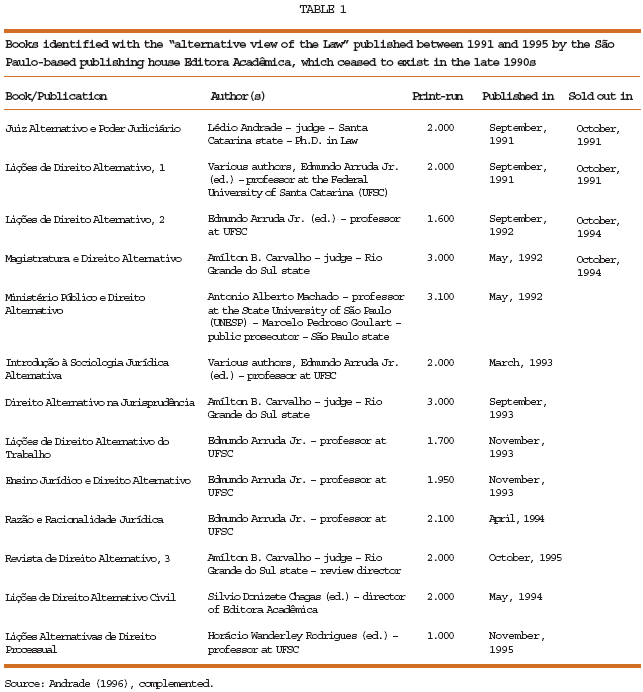
<body><![CDATA[<p><font face="Verdana, Arial, Helvetica, sans-serif" size="2">Jurists with more    academic titles are the majority, both in the management of degree and, principally,    of postgraduate courses, and in the teaching committees and councils of the    Ministry of Education and the OAB (Brazilian bar association). Equally, the    institutional demands for masters and doctors in Law courses have created tensions    with the standard of the bachelor-lecturer, invariably with origins in the world    of legal practice, hence forcing a relative increase in the level of professionalism    of the teaching activity. </font></p>     <p><font face="Verdana, Arial, Helvetica, sans-serif" size="2">With regards to    intellectual production, the space occupied by jurists who hold Ph.D.s and are    teaching professionals is associated to the expansion of a set of repertoires    and definitions of legal doctrine, and of a certain type of academic research.    These jurists who became professionals teaching at university level are responsible    for a kind of intellectual production that takes place in the relatively autonomous    space of postgraduate courses and is characterised by an ambivalent relationship    with the world of legal practice. </font></p>     <p><font face="Verdana, Arial, Helvetica, sans-serif" size="2">The process taking    place in postgraduate courses, of making legal problems become issues, such    as "social issues", involving the interpretation of the Law or the new public    rights, implies new hierarchies for legal disciplines. Traditionally mastered    themes, less prestigious themes, start standing out. The use of Sociology increases    as an interdisciplinary aid in laying the groundwork for definitions involving    themes connected to the new public rights. This appropriation of the social    sciences occurs within both a more empirical perspective, through the incorporation    of field research tools, and a more ideological perspective, through the use    of concepts to buttress the critique of traditional jurists and their forms    of using the judicial space. </font></p>     <p><font face="Verdana, Arial, Helvetica, sans-serif" size="2">On these terms,    the Sociology of Law that emerges on these bases legitimises a series of themes    related to a certain profile of activist jurists, such as human rights, social    rights, access to justice and criminology. Along the same lines, it proposes    "alternative" redefinitions of more traditional disciplines such as Civil Law    or Civil Process Law, specialisation themes linked to more conservative jurists.    </font></p>     <p><font face="Verdana, Arial, Helvetica, sans-serif" size="2">Philosophy of Law    legitimises itself as a modernizer in providing the foundations for these definitions    through the formalization and translation into legal language of jurists' critical    and social positions. In this sense, the use of several concepts imported from    the most varied philosophical systems, notably those related to hermeneutics,    contribute to a "sophisticated" re-founding of the doctrinal repertoires that    may be mobilised in confrontations between jurists. </font></p>     <p><font face="Verdana, Arial, Helvetica, sans-serif" size="2">Invariably, a larger    intellectual investment in Sociology corresponds to the discipline's reduced    prestige within the competitive space of jurists. For example, one may include    in this case Criminal Law and Labour Law, which may be taken as disciplines    that use the social sciences to a greater extent. The main aim of the "sociologisation"    is to bring closer together the Law and the reality of socially dominated groups,    redefining the criteria of decision in a "social" or "critical" sense in relation    to the uses championed by the traditional segments. </font></p>     <p><font face="Verdana, Arial, Helvetica, sans-serif" size="2">According to Dezalay    (1992), in the American case, the doctrinal wars encompass conflicts between    groups formed within the legal space. The relative "autonomisation" of the setting    of these struggles in a university space maintains a dubious relationship with    the "practical" world, as in the case of the protest movement in the American    <I>legal realist</I> tradition, already in the late 1940s. The author demonstrates    how American Sociology of Law initially carried with it the critique of positive    Law and of formalism and that, subsequently, it became a professional move.    In the universe of positions taken up, "Sociology" figures as an importation    of concepts and methods from the social sciences to legal practices, legitimising    a "critical methodology" in the interpretation of norms. In this sense, there    constitutes itself a legitimate counter-position that dominates the debate between    the "formalists" or "positivists" (linked to tradition) and the "criticals".    In other words, those who affirm "the absolute autonomy of the legal form in    relation to the social world" and those who "conceive of the Law as a reflex    or utensil at the service of the dominant" (Bourdieu 1986) oppose one another.    In the American case this phenomenon also involves the <I>Law and Society</I>    movement, to a certain extent the successor of the <I>legal realist</I> critical    jurists. The <I>Law and Society</I> movement emerged in the late 1960s and was    responsible for a range of "critical" reflections on the space of the traditional    US Law schools. In this movement, led by Law professors, the relative "autonomisation"    of the university teaching space in relation to the world of practical careers    also gets discussed. </font></p>     <p><font face="Verdana, Arial, Helvetica, sans-serif" size="2">Vauchez (2001)    emphasises the fact that the success of these "scientific enterprises" making    "critiques of the Law" and producing socio-legal works were intimately linked    to the creation of a "socio-legal research market" from 1950. In this case,    the research was funded by private foundations and government agencies, particularly    on issues of access to justice and the war on poverty. </font></p>     <p><font face="Verdana, Arial, Helvetica, sans-serif" size="2">In the Brazilian    case and in the French case<a name="b2"></a><a href="#2"><sup>2</SUP></a>, Legal    Sociology and the Sociology of Law, as well as providing the basis for the "critique"    of the legal tradition, serve to bring "social" themes to the judicial space.    This occurs both within postgraduate courses and in the growing use in other    social spheres of the knowledge related to these disciplines. Among the cases    that represent these uses, one may cite the mobilisation of the judicial space    by various types of social movements and NGOs involving the legal framing of    political and "social" causes. </font></p>     <p><font face="Verdana, Arial, Helvetica, sans-serif" size="2">Among the most    representative cases, one might mention the Alternative Law movement that emerges    from the mobilisation of a group of judges and the networks of lawyers who work    on collective causes closely linked to social movements and NGOs. In the latter    case, the advocacy of NGOs in defence of human rights, environmental rights,    children's and adolescents' rights, women's rights and the MST (Rural Landless    Workers' Movement) are worthy of note. </font></p>     ]]></body>
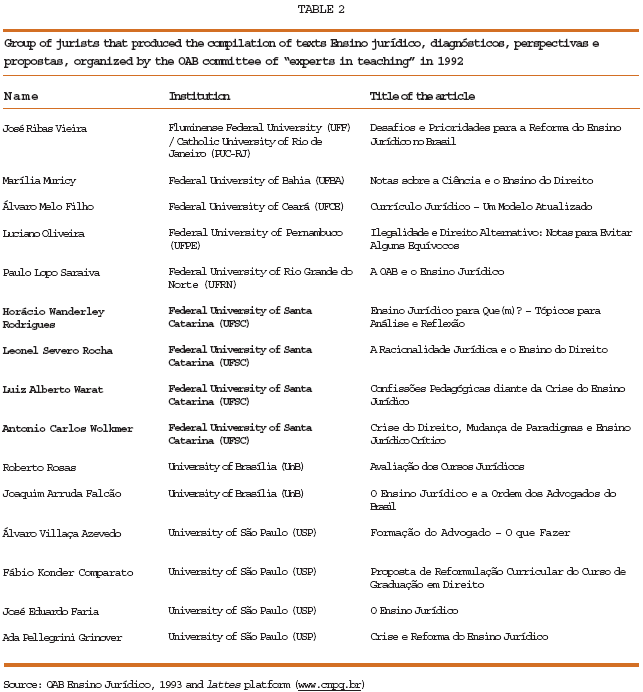
<body><![CDATA[<p><font face="Verdana, Arial, Helvetica, sans-serif" size="2">Also worth highlighting    is a range of studies dealing with the crises of the Law. These appear in expressions    of concern with the "mediocrity of legal teaching"<a name="b3"></a><a href="#3"><sup>3</SUP></a>    and with the "socio-professional identity crisis of bachelors in Law in Brazil."<a name="b4"></a><a href="#4"><sup>4</SUP></a>    The focus of these works is the devaluation of the traditional bachelor, especially    his/her transformation into a salaried worker, and the inadequacies of Law school    curricula in relation to the social reality and the reality of legal practice.    </font></p>     <p><font face="Verdana, Arial, Helvetica, sans-serif" size="2"><a href="/img/revistas/s_bpsr/v1nse/a03tab01.gif">Table    1</a> illustrates the emergence of this literature that invests simultaneously    in the redefinition of the conceptions of the disciplines related to the traditional    universe of jurists, of the methodologies of legal teaching and of the conceptions    of the functions and roles of legal careers. </font></p>     <p><font face="Verdana, Arial, Helvetica, sans-serif" size="2">The positions taken    up in Ph.D. theses and congress talks, as well as in the teaching committees    both of the Ministry of Education and of the OAB, make possible the opening    of a new space for the action of these agents. The establishment of relationship    networks and the investment through these spaces involves, at the same time,    the production on the crisis of the Law as a legitimate object of study (diagnosis)    and the specialisation to resolve it, represented by the formulation of proposals    for solutions. </font></p>     <p><font face="Verdana, Arial, Helvetica, sans-serif" size="2">One is talking    about the production of one more expertise (in legal education) that is legitimised    simultaneously in the university world (postgraduate courses, by means of theses)    and in the world of the "practicals", through the monopoly of the evaluation    of the competences of bachelors of Law by the OAB, and at the Ministry of Education,    which legitimises the expert teaching committees. </font></p>     <p><font face="Verdana, Arial, Helvetica, sans-serif" size="2">On these terms,    the analysis of the differentiation of the space for the production of "social"    views of the Law and of the "critique" of the legal tradition is intrinsically    linked to the rise of a group of jurists socially unconnected to the major families    that invest in the intellectual production of that critique and reconvert such    products in the opening up of several spaces in the 1980s and 1990s. This took    place as much in the State sphere, in the teaching committees of the Ministry    of Education and the OAB, as in the private space of the teaching of Law at    university level. </font></p>     <p><font face="Verdana, Arial, Helvetica, sans-serif" size="2">An indication of    the positioning of the "critical jurists" in the university space may be gathered    from an analysis of the authors who took part in the compilation that guided    the reform of legal curricula in 1994, which resulted from a set of diagnoses    on legal teaching in Brazil. To a large extent, the group of the "critical jurists",    who have more academic grounding, got organized through the postgraduate programme    of the Federal University of Santa Catarina, which has a major presence in these    committees, as a starting point. The space of the teaching committees, as <a href="/img/revistas/s_bpsr/v1nse/a03tab02.gif">table    2</a> illustrates, facilitates the re-conversion of the "critical" and "alternative"    academic production, and highlights the authors as specialists in the generation    of new parameters for the evaluation of the curricula and structures of legal    teaching. </font></p>     <p><font face="Verdana, Arial, Helvetica, sans-serif" size="2">Along the same    lines, the success in the production of such repertoires corresponds to the    market for a redefinition of legal doctrine opened up by the mobilisation of    those practical jurists who move towards the critique and the politicisation,    as well as towards the various forms of militant-lawyering that expand in the    1990s. </font></p>     <p>&nbsp;</p>     <p><font face="Verdana, Arial, Helvetica, sans-serif" size="3"><B>The Definition    of the Careers of State and the "Politicisation" of the Law in the 1990s</B>    </font></p>     <p><font face="Verdana, Arial, Helvetica, sans-serif" size="2">At the level of    the careers of State, the mobilisation of certain definitions of the Law and    of the Judiciary appears as a process of politicisation of this institution    in the 1980s and 1990s. According to Vianna (1999) and Arantes (2002), there    is a "judicialisation" of politics, represented by the use of <I>a&ccedil;&otilde;es    diretas de inconstitucionalidade</I> (direct unconstitutionality suits) at the    superior courts level, where the dispute over the meaning of constitutional    rules is expressly on the agenda. The use of this type of appeal brings regional    disputes between representatives of the Executive and the Legislative to the    field of the Law and to the superior courts, hence transferring what might be    characterised as a traditional problem of the political arena to the sphere    of legal interpretation. </font></p>     ]]></body>
<body><![CDATA[<p><font face="Verdana, Arial, Helvetica, sans-serif" size="2">This transfer implies    a greater intertwining between the political and legal spheres in the sense    of the transit of personnel and of relationships established between jurists    who move between spheres of power. The very internal organisation of the Judiciary    puts in opposition the public selection processes for the first tier of justice,    on the one hand, and the appointments for the composition of the superior courts,    on the other. This structure tends to create cleavages between the judicial    instances that judge interpersonal conflicts, such as the first tier of the    justice system, and the more political superior courts. </font></p>     <p><font face="Verdana, Arial, Helvetica, sans-serif" size="2">On the other hand    &#151; and also related to the opening up of the legal arena to new uses of    the Law &#151;, from the 1990s, there also occurs a greater "judicialisation"    of social life. This process comprises the entry into the legal setting of a    range of problems identified with collective causes (consumer rights, human    rights, environmental rights, social rights and others). In general terms, this    "judicialisation" of politics and social life may be characterised as a phenomenon    that increases the Judiciary's potential of conflict mediation<a name="b5"></a><a href="#5"><sup>5</SUP></a>.    </font></p>     <p><font face="Verdana, Arial, Helvetica, sans-serif" size="2">The greater legitimisation    of the Judiciary and of the institutions connected to the legal milieu may also    be attributed to a disbelief in the traditional channels of political mediation.    This legitimisation is related at the same time to a social diversification    in recruitment, to the new institutional definitions of the careers of State    and to conditions that make possible the mobilisation of new repertoires of    doctrine and conceptions of the Law. </font></p>     <p><font face="Verdana, Arial, Helvetica, sans-serif" size="2">The institutional    definitions of these careers on the basis of the 1988 Constitution involve legal    guarantees, like the fact that the job is for life, that judges cannot be moved    from one municipality to another as punishment for a decision and that their    salaries cannot be reduced, which ensure relative autonomy in relation to the    world of politics. In other words, these guarantees represent conditions that    offer possibilities of action for newly recruited agents, who redefine the social    uses of these careers, projecting them beyond a restricted space and often confronting    other powers of the State. </font></p>     <p><font face="Verdana, Arial, Helvetica, sans-serif" size="2">Specifically, within    Brazilian public space, segments such as those of state and federal prosecutors,    which act in the name of "legitimate public morality", grow in importance. In    the case of the public prosecution service, the monopoly of action "in the name    of society" legitimised trough institutional guarantees brings with it an underlying    perception of Brazilian society as "incapable of defending its rights autonomously".    It equally brings with it a critique of the traditional channels of political    mediation, such as the political parties and other institutions of the representative    system, associated with the "morally reprehensible "practices of corruption    and cronyism (Arantes 2002)<a name="b6"></a><a href="#6"><sup>6</SUP></a>. </font></p>     <p><font face="Verdana, Arial, Helvetica, sans-serif" size="2">In this sense,    the struggles of state and federal prosecutors to affirm their "independence",    their socially instituted space in relation to the groups linked to the political    and bureaucratic worlds, and to the Judiciary, are also representative. One    of the resources utilised is the press, which allows instant repercussion in    the world of politics. The use of this resource to speak "in the name of society"    to a public that transcends the interpreters of the Law contributes to the enlargement    of prosecutors' space and to their social legitimisation as guardians of public    morality. </font></p>     <p><font face="Verdana, Arial, Helvetica, sans-serif" size="2">In the case of    judges, the space for broadening the mediation with the social movements takes    shape in the professional associations and in the training centres administered    by them. Their strengthening occurred over the course of the process of formulation    of the new Constitution that began in 1986. In this sense, they emerge as mediators    of judges' interests and as focal points of the disputes over the definitions    of their "political role", as well as being a space for judges' legitimate politicking.    </font></p>     <p><font face="Verdana, Arial, Helvetica, sans-serif" size="2">The political science-based    studies produced in Brazil, France and Italy<a name="b7"></a><a href="#7"><sup>7</SUP></a>    that analyse this range of phenomena that may be generically termed "politicisation"    of the Law focus on the intertwining between politics and the Law as a new institutional    role played by the Judiciary or the public prosecution service. Such analyses<a name="b8"></a><a href="#8"><sup>8</SUP></a>    reinforce the profile of lawsuits and of the new rights that may be claimed    as determining factors in this new setting, following the re-democratisation    of the country with the advent of the 1988 Constitution (Arantes 2002; Vianna    et al. 1999; Silva 2001). To a large extent, the "politicisation" would be absorbed    in the "constitutionalisation" of the Law, seen as a natural phenomenon in a    process of political opening and institutionalisation of a democratic society.    </font></p>     <p><font face="Verdana, Arial, Helvetica, sans-serif" size="2">In spite of containing    indications of the social diversification in the recruitment for the careers    of State, such research does not go deeper into the relationship between the    changes in recruitment and the possible tensions and redefinitions in jurists'    hierarchies, and possibilities of legitimate uses of the Law. The growth in    the competition for the monopoly of the legitimate application of the law within    the legal space seems to coincide with the different political, ideological    or "social" uses emerging in the 1990s. Equally, the tensions and realignments    between jurists coincide with alterations in the recruitment for careers of    State. </font></p>     <p><font face="Verdana, Arial, Helvetica, sans-serif" size="2">For the segment    of judges, the changes in social origins are indicated in Vianna et al. (1997)<a name="b9"></a><a href="#9"><sup>9</SUP></a>.    A sample of Brazilian judges recruited between 1974 and 1985 shows that 54%    of judges had parents with up to eight years' schooling, while 34% had parents    with "low-ranking occupational profiles". It also shows that 72% of judges'    parents were public employees or employees of State companies. The change in    judges' social makeup, exemplified here by their family origins, may be ascertained    by comparison with population studies on bachelors of Law in the late 19th and    early 20th centuries<a name="b10"></a><a href="#10"><sup>10</SUP></a>. </font></p>     ]]></body>
<body><![CDATA[<p><font face="Verdana, Arial, Helvetica, sans-serif" size="2">The key question    in understanding the factors conditioning these processes of political mobilisation    of the jurists of State lies in the relationship between the social diversification    of their recruitment and these new agents' dispositions activated in several    uses of the Law and of the legal professions. The variables to be considered    in the relationship between the diversification and the uses of the Law do not    involve solely the new recruits' social origins, but also the relationship between    their social characteristics and their dispositions to certain uses of the Law.    This implies including in the analysis conditioning factors such as their religious    and philosophical education, for example, obtained in school or within the family,    as well as political militancy and relations with "social movements", in the    positions taken up in certain uses of the judicial space. </font></p>     <p><font face="Verdana, Arial, Helvetica, sans-serif" size="2">For the French    case, Cam (1978)<a name="b11"></a><a href="#11"><sup>11</SUP></a> indicates    as conditioning factors of the space for judges to take up positions, the relationship    between diversification of schooling, social diversification and the redefinition    of the uses of the Law. In analysing the recruitment of judges in France after    1968, he makes clear the arrival of a third age in the profession. In this case,    the "feminisation" of the judges' population, their younger age and the change    in the social origins of judges recruited from the 1970s, correspond to a growth    in judges' numbers and to a redefinition of the technologies of decision, in    the sense of a preoccupation with the "social" dimension and with the "critique"    of traditional positive Law. </font></p>     <p><font face="Verdana, Arial, Helvetica, sans-serif" size="2">In this process    of taking up positions, religious morals, political experiences and, more broadly,    the predispositions to certain moral definitions of justice and of the use of    the judge's career are concurrently at play in defining the positioning before    the Law. In the case analysed by Cam (1978), for the judges who identify with    Labour Law, the relationship between their social origins, their forms of adherence    to Catholicism and leftwing political positions come into play in defining their    positioning in the legal space. </font></p>     <p><font face="Verdana, Arial, Helvetica, sans-serif" size="2">Working more specifically    on the effects of the moment on the mobilization of judges in the 1980s and    1990s in Italy, France and Spain, there are several works that bring important    references to the analysis of the phenomenon at hand. It is worth mentioning    in particular Roussel (2002), Israel (2001) and Garraud (2003) for the French    case, Briquet (2001) and Vauchez (2001) for the Italian case and Pujas (2000)    for the Spanish case. Their research centres the analysis on the logics of collective    action on the part of judges faced with the scenario of the politico-financial    scandals in France and of the anti-corruption movements in Italy and Spain.    Their main starting point is the "autonomisation" of the legal space in relation    to the political and economic world as the chief hypothesis for the emergence    of the "politicisation" of judges and public prosecutors. This "autonomisation",    based at the same time on the recruitment mechanisms for these careers and in    their institutional guarantees, made possible the conditions for the mobilization    of several resources by the "jurists of State" in their "morality enterprises",    such as the media and even, in some cases, their expertise in accounting and    finance. </font></p>     <p><font face="Verdana, Arial, Helvetica, sans-serif" size="2">In the Brazilian    case, the effects of the "autonomisation" of the legal space on the economic    and political world deserve to be considered in conjunction with the entry of    new agents into the careers of State and their respective aspirations and social    dispositions, whether inherited or acquired in their previous socialisation.    Along these lines, one may combine an analysis of the logics that reveal themselves    in the context of collective action with variables referring to these jurists'    trajectories, the types of involvement in the student movement and the predispositions    acquired within the family group, as well as the interrelationships of this    set of dispositions that engender certain practices and are put in operation    according to the practical contexts of action. In this sense, it is permitted,    at the level of doctrinal confrontations, to investigate the objective affinities    between the social position and the propensity to political involvement and    mobilization of certain resources to strengthen vanguard positions in challenging    or preserving the legal tradition. </font></p>     <p>&nbsp; </p>     <p><font face="Verdana, Arial, Helvetica, sans-serif" size="3"><B>Lawyers' Political    Involvement and the Production of Collective Causes</B> </font></p>     <p><font face="Verdana, Arial, Helvetica, sans-serif" size="2">Lastly, a third    mode of mobilisation of repertoires of "critiques" of the legal tradition and    uses of the judicial space is represented by lawyers engaged in collective causes.    Initially, this phenomenon is most clearly present in the realm of Labour Law,    on the part of lawyers practicing for trade unions, and, during the 1970s, in    the defence of political prisoners and in the international lawyers' networks    related to the movement in defence of human rights. </font></p>     <p><font face="Verdana, Arial, Helvetica, sans-serif" size="2">In Brazil during    the 1990s, these modes of political involvement on the part of lawyers in collective    causes took on other forms. This is chiefly the case with regards to social    movements in which groups of lawyers invest in manifesting<a name="b12"></a><a href="#12"><sup>12</SUP></a>    political causes constituted within the space of these movements. This phenomenon    holds a series of specificities that are closely related to the rise of groups    of jurists linked to efforts to redefine the Law "socially" and to leftwing    political militancy. Equally, this phenomenon is related to the institutional    redefinition of the country, from the adoption of the 1988 Constitution, and    to the conditions making possible certain uses of the judicial space generated    on the basis of its relative "autonomisation". </font></p>     <p><font face="Verdana, Arial, Helvetica, sans-serif" size="2">A range of works    that deal with this phenomenon was developed in the USA over the course of the    1980s and 1990s. It is identified with the notion of the <I>cause lawyer,</I>    developed by Austin Sarat and Stuart Scheingold<a name="b13"></a><a href="#13"><sup>13</SUP></a>.    This framework aims to analyse the various modes of involvement of US lawyers    with collective causes, particularly with the support of the American Bar Association    in the lawyers' movements in favour of the abolition of the death penalty in    the USA<a name="b14"></a><a href="#14"><sup>14</SUP></a>. </font></p>     ]]></body>
<body><![CDATA[<p><font face="Verdana, Arial, Helvetica, sans-serif" size="2">The work done under    this perspective analyses the alterations occurring in the US legal world, both    in the space of production of legal decisions and in the space of the legal    professions, related to the emergence of this pattern of lawyering engaged in    collective causes. According to this literature, the specificity of political    involvement via the Law requires an analysis of the strategies of social movements    in the use of the judicial space, the role of jurists in manifesting and formalising    political causes in the language of the disputes within the Judiciary and how    to reconcile professional action with political militancy. </font></p>     <p><font face="Verdana, Arial, Helvetica, sans-serif" size="2">Another factor    that deserves consideration is the emergence of an international space for the    construction of collective causes by means of the export and import of political    and "social" causes, and the formation of international networks of lawyers.    This internationalisation is strong in the case of the human rights field, especially    through NGOs. As indicated by Dezalay and Garth (2001), the recourse to international    legal forums such as the International Court of Justice and the repertoires    of legal doctrine produced on the basis of human rights conceptions were utilised    mainly to create an alternative to the tightening of the State over the course    of the dictatorial periods in Latin America<a name="b15"></a><a href="#15"><sup>15</SUP></a>.    </font></p>     <p><font face="Verdana, Arial, Helvetica, sans-serif" size="2">In the case of    Latin America, and more specifically of Brazil and Argentina, Meili (1998; 2001)    makes out two patterns of lawyers' involvement in collective causes, one formal    and largely internationalised (formalized-issue networks), the other based on    informal networks of cooperation among lawyers (informally organized networks).    </font></p>     <p><font face="Verdana, Arial, Helvetica, sans-serif" size="2">In the Brazilian    case, Meili (2001) refers to a reduction in the number of formal networks constituted    on the basis of the OAB human rights committees during the military regime and    linked to international networks, in favour of groups of lawyers that began    practicing in defence of social movements of the "landless", "roofless" and    others, all related to social rights. In another sense, the more formal and    internationalised lawyers' networks engaged in collective causes that remain    are connected to movements and issues such as environmental protection, children's    and adolescents' rights, women's rights and the fight against violence. They    are articulated through specialised NGOs. </font></p>     <p><font face="Verdana, Arial, Helvetica, sans-serif" size="2">Equally, the analysis    of lawyers' political involvement needs to consider the series of specificities    present in the history of the formation of the legal profession in Brazil and    recent processes that allowed the re-conversion of certain groups of lawyers    to an involvement in the collective causes of social movements. </font></p>     <p>&nbsp;</p>     <p><font face="Verdana, Arial, Helvetica, sans-serif" size="3"><B>Final Considerations</B>    </font></p>     <p><font face="Verdana, Arial, Helvetica, sans-serif" size="2">One may oppose,    on the one hand, the legal tradition, characterised by the inheritance of <I>bacharelismo    imperial</I><a name="b16"></a><a href="#16"><sup>16</SUP></a>, and, on the other,    a process of social diversification, that has affected the world of the legal    profession, of the careers of State and of university teaching since the 1970s.    As a result of the phenomenon of the diversification of jurists' social, political    and geographic origins, a whole set of definitions and uses of the Law emerged,    the most favourable moment for this process being the institutional redefinition    and the mobilisations around the 1988 Constitution. </font></p>     <p><font face="Verdana, Arial, Helvetica, sans-serif" size="2">The process of    diversification affects simultaneously the space of the practical careers and    of university teaching. In this sense, it permits the emergence of certain profiles    of jurists through a positioning in a relatively autonomous academic space in    relation to the world of the legal tradition. In such a context, a set of repertoires    of critiques and redefinitions of several concepts and doctrines gets produced    and imported. Such repertoires are mobilised by several practical jurists, both    in the universe of the careers of State and in the space of the new forms of    activist lawyering that proliferated during the 1990s. </font></p>     <p><font face="Verdana, Arial, Helvetica, sans-serif" size="2">The growing predominance    of recruitment for the careers of State by an impersonal public selection system,    the struggles for the institutionalisation of these careers and their relative    "autonomisation" in relation to the space of politics and the economy enhance    the conditions for the appropriation of new uses of the Law by several social    groups. On the other hand, this contributes to the emergence of new groundings    for universal moral ideas of Justice, State, the common good and the general    interests of society, these being objects through which jurists express their    expertise and their monopoly of applying the Law, the just or the ethical. </font></p>     ]]></body>
<body><![CDATA[<p><font face="Verdana, Arial, Helvetica, sans-serif" size="2">Such factors contribute    to a new legal repertoire that can be mobilised in the world of the practical    careers as much by the alternative judges who unleashed a movement questioning    the legal tradition in the 1990s, as by the leaderships of judges' and prosecutors'    associations. Along the same lines, they serve to provide the grounding for    manifestations of political and "social" causes by the various networks of lawyer-militants    linked to collective causes such as human rights, "landless", "roofless", feminists    and environmentalists. </font></p>     <p><font face="Verdana, Arial, Helvetica, sans-serif" size="2">This process may    be read more broadly as indicating jurists' moves in the restructuring of the    space of power. In this dimension, the professionals of the Law are losing positions    in the political field and in the management of the State to other segments,    in particular to economists. At the same time, this process accompanies the    pace of the country's political re-democratisation, which implies the activation    of social movements in the 1990s and the use of the Law and the Judiciary by    these movements and by activist jurists. By virtue of corporatist defence, jurists    re-directed themselves to a defence of the State, of the general interests of    society and of the common good, as opposed to a defence of market interests.    </font></p>     <p><font face="Verdana, Arial, Helvetica, sans-serif" size="2">The battle of ideas    put forward in particular by the "Alternative Law movement" between the conservative    and the "critical" conceptions of the legal disciplines, of the teaching models    and of the causes and definitions of the careers of State gives ground to a    division of labour, with the "critical jurists" accommodating themselves in    the space of university teaching. Such division accompanies the rate of absorption    of the critique of the legal tradition by the more traditional centres, notably    those that contribute to the strengthening of the various conceptions of State    and Justice against the set of definitions and specialities identified with    the market and with neoliberalism. </font></p>     <p><font face="Verdana, Arial, Helvetica, sans-serif" size="2">Equally, the activist    legal profession involved in collective causes needs to be better analysed,    as a form of re-conversion of political militants, as does its linkage to international    human rights networks and the space for the import and export of political and    "social" causes with the greater internationalisation of the Law. These questions    deserve to be looked at in more depth, considering the specificities of the    Brazilian case and the configuration of the space for intellectual production    at state level as parts of a phenomenon of re-positioning of jurists within    the sphere of power and of the uses and definitions of the legal and judicial    world that result from it. </font></p>     <p>&nbsp;</p>     <p><font face="Verdana, Arial, Helvetica, sans-serif" size="3"><B>Notes</B> </font></p>     <p><font face="Verdana, Arial, Helvetica, sans-serif" size="2"><a name="1"></a><a href="#b1">1</a>    On this, see Wolkmer (2001) and Andrade (1996). </font></p>     <p><font face="Verdana, Arial, Helvetica, sans-serif" size="2"> <a name="2"></a><a href="#b2">2</a>    Regarding the genesis, emergence and legitimisation of the sociology of Law    discipline in the French academic space, see the set of interviews by Arnaud    and Andrini of Jean Carbonnier (1995). </font></p>     <p><font face="Verdana, Arial, Helvetica, sans-serif" size="2"><a name="3"></a><a href="#b3">3</a>    On the diagnoses of and proposals for legal teaching in Brazil, see the range    of works produced by the expert committee brought together by the Federal Council    of the OAB (OAB Ensino Jur&iacute;dico 1992, 1996, 1997) and the studies by    Nalini (1994) and Rodrigues (1995). </font></p>     <p><font face="Verdana, Arial, Helvetica, sans-serif" size="2"><a name="4"></a><a href="#b4">4</a>    In this case see specifically Arruda Jr. (1988). </font></p>     ]]></body>
<body><![CDATA[<p><font face="Verdana, Arial, Helvetica, sans-serif" size="2"><a name="5"></a><a href="#b5">5</a>    On the new uses of the Law specifically in the realms of political regulation    and public policies, see Jobert (2000) and Commaille (2000). </font></p>     <p><font face="Verdana, Arial, Helvetica, sans-serif" size="2"><a name="6"></a><a href="#b6">6</a>    According to Arantes (2002, 96-97), who conducted interviews with members of    the federal and state public prosecution service, the idea of the "opposition    between degenerated politico-representative institutions and a weak civil society"    is a recurring one. In this sense, prosecutors feel "it is necessary for the    public prosecution service to bring the big issues before the Judiciary, and    that the latter work as a realm for the substitution of politicians incapable,    as they are, of heeding society's appeals due to omission or even bad faith".    </font></p>     <p><font face="Verdana, Arial, Helvetica, sans-serif" size="2"><a name="7"></a><a href="#b7">7</a>    For the French and Italian case, see the works by Maillard (2003), Tirbois (2003),    Garapon (2003) and Liberatti (2003), who deal with the new "political" roles    taken on by judges in the 1990s, on the basis of the notion of "politicisation".    </font></p>     <p><font face="Verdana, Arial, Helvetica, sans-serif" size="2"><a name="8"></a><a href="#b8">8</a>    Specifically on the Brazilian public prosecution service, see Silva (2001).    </font></p>     <p><font face="Verdana, Arial, Helvetica, sans-serif" size="2"><a name="9"></a><a href="#b9">9</a>    See also the research by Bonelli (1998) and Castilho and Sadek (1998). </font></p>     <p><font face="Verdana, Arial, Helvetica, sans-serif" size="2"><a name="10"></a><a href="#b10">10</a>    For the 19<sup>th</SUP> century, see Ven&acirc;ncio Filho (1982). For the early    20<sup>th</SUP> century, see Miceli (1979). </font></p>     <p><font face="Verdana, Arial, Helvetica, sans-serif" size="2"><a name="11"></a><a href="#b11">11</a>    See also, on the oppositions between the characteristics of the "notable judge"    and the "republican judge" and the crises resulting from the recruitment of    judges in France, Charle (1993) and Mounier (1990). </font></p>     <p><font face="Verdana, Arial, Helvetica, sans-serif" size="2"> <a name="12"></a><a href="#b12">12</a>    On the use of the Law in the transposition of "political causes" to the judicial    space by social movements, see Spanou (1989) on the legitimisation of the "ecological    cause" in the universe of European Law. </font></p>     <p><font face="Verdana, Arial, Helvetica, sans-serif" size="2"><a name="13"></a><a href="#b13">13</a>    On the notion and possibilities for use of the notion of <I>cause lawyer</I>,    see Sarat and Scheingold (1998; 2001). In this perspective, for the French case,    there is the recent work by Gaiti and Israel (2003), as well as Israel (2001)    and Spanou (1989). </font></p>     <p><font face="Verdana, Arial, Helvetica, sans-serif" size="2"><a name="14"></a><a href="#b14">14</a>    Specifically on the American Bar Association's active involvement in support    of death row inmates' lawyers and in the construction of the "abolition of the    death penalty" cause, see Sarat (2001). </font></p>     ]]></body>
<body><![CDATA[<p><font face="Verdana, Arial, Helvetica, sans-serif" size="2"><a name="15"></a><a href="#b15">15</a>    This phenomenon of the construction of a space of jurists identified with the    "human rights cause" articulated with the catholic church is particularly clear    in the Chilean case, as demonstrated by Dezalay and Garth (2001) and Garland    (2003). </font></p>     <p><font face="Verdana, Arial, Helvetica, sans-serif" size="2"><a name="16"></a><a href="#b16">16</a>    Expression used by Brazilian social scientists to refer to the hegemony of bachelors    of Law in Brazilian politics during the imperial period. These bachelors were    the sons of the elites who studied in Coimbra (Portugal) and worked in Brazil    as importers of European institutions. They occupied the main positions of power    and were characterised by the use of liberal rhetoric. </font></p>     <p>&nbsp;</p>     <p><font face="Verdana, Arial, Helvetica, sans-serif" size="3"><B>Bibliography</B>    </font></p>     <!-- ref --><p><font face="Verdana, Arial, Helvetica, sans-serif" size="2">Andrade, L&eacute;dio    R. 1996. <I>Introdu&ccedil;&atilde;o ao direito alternativo brasileiro</I>.    Porto Alegre: Livraria do Advogado. </font><!-- ref --><p><font face="Verdana, Arial, Helvetica, sans-serif" size="2">Arantes, Rog&eacute;rio    Bastos. 2002. <I>Minist&eacute;rio P&uacute;blico e Pol&iacute;tica no Brasil</I>.    S&atilde;o Paulo: Educ/Ed. Sumar&eacute;/Fapesp. </font><!-- ref --><p><font face="Verdana, Arial, Helvetica, sans-serif" size="2">Arnaud, Andr&eacute;    A., and Stephen Andrini. 1995. <I>Jean Carbonnier, Renato Treves et la sociologie    du droit: Arch&eacute;ologie d'une discipline</I>. Paris: LGDJ. </font><!-- ref --><p><font face="Verdana, Arial, Helvetica, sans-serif" size="2">Arruda Jr., Edmundo    Lima de. 1988. <I>Advogado e mercado de trabalho</I>. Campinas, SP: Ed. Julex.    </font><!-- ref --><p><font face="Verdana, Arial, Helvetica, sans-serif" size="2">Bonelli, Maria    G. 1998. O Instituto da Ordem dos Advogados Brasileiros e o Estado: A profissionaliza&ccedil;&atilde;o    no Brasil e os limites dos modelos centrados no mercado. <I>Revista Brasileira    de Ci&ecirc;ncias Sociais</I> 14 (39). </font><!-- ref --><p><font face="Verdana, Arial, Helvetica, sans-serif" size="2">Bourdieu, Pierre.    1986. La force du droit: El&eacute;ments pour une sociologie du champ juridique.    <I>Actes de la Recherche en Sciences Sociales</I>, no. 64. </font><!-- ref --><p><font face="Verdana, Arial, Helvetica, sans-serif" size="2">Briquet, Jean Louis.    2001. "La 'Guerre des Justes'": La magistrature antimafia dans la crise italienne.    In Juger la Politique, ed. Jean L. Briquet and Philippe Garraud. Rennes: Presse    Universitaire de Rennes. </font><!-- ref --><p><font face="Verdana, Arial, Helvetica, sans-serif" size="2">Cam, Pierre. 1978.    Juges rouges et droit du travail. <I>Actes de la Recherche en Sciences Sociales</I>,    no. 19. </font><!-- ref --><p><font face="Verdana, Arial, Helvetica, sans-serif" size="2">Castelar, Armando.    2000. <I>O Judici&aacute;rio e a economia no Brasil</I>. S&atilde;o Paulo: Ed.    Sumar&eacute;. </font><!-- ref --><p><font face="Verdana, Arial, Helvetica, sans-serif" size="2">Castilho, Enrique.    V., and Maria T. Sadek. 1998. <I>O Minist&eacute;rio P&uacute;blico Federal    e a administra&ccedil;&atilde;o da justi&ccedil;a no Brasil</I>. S&atilde;o    Paulo: IDESP/ Sumar&eacute;. </font><!-- ref --><p><font face="Verdana, Arial, Helvetica, sans-serif" size="2">Charle, Charle.    1987. <I>Les elites de la R&eacute;publique</I>, 1880-1900. Paris: Fayard. </font><!-- ref --><p><font face="Verdana, Arial, Helvetica, sans-serif" size="2">______. 1989. Pour    une histoire sociale des professions juridiques a l'&eacute;poque contemporaine:    Notes pour une recherche. <I>Actes de la Recherche en Sciences Sociales</I>,    no.76 and 77. </font><!-- ref --><p><font face="Verdana, Arial, Helvetica, sans-serif" size="2">Charle, Cristhophe.    1993. &Eacute;tat et magistrat: Les origines d'une crise prolong&eacute;e. <I>Actes    de la Recherche en Sciences Sociales</I>, no. 96 and 97, mars. </font><!-- ref --><p><font face="Verdana, Arial, Helvetica, sans-serif" size="2">Commaille, Jacques.    2000. "La jurisdicisation du politique. Entre r&eacute;alit&eacute; et conaissance    de la r&eacute;alit&eacute;. En guise de conclusi&oacute;n". In <I>La juridicisation    du politique: Le&ccedil;ons scientifiques</I>, ed. J. Commaille et al. Paris:    LGDJ. </font><!-- ref --><p><font face="Verdana, Arial, Helvetica, sans-serif" size="2">Devill&eacute;,    Alain. 1992. L'entr&eacute;e du syndicat de la magistrature dans le champ juridique    en 1968. <I>Droit et Societ&eacute;</I>, no. 22. </font><!-- ref --><p><font face="Verdana, Arial, Helvetica, sans-serif" size="2">Dezalay, Yves.    1992. <I>Marchands de droit</I>. Paris: Fayard. </font><!-- ref --><p><font face="Verdana, Arial, Helvetica, sans-serif" size="2">Dezalay, Yves,    and Alain Bancaud. 1994. Des 'grands pretres' du droit au march&eacute; de l'expertise    juridique: Transformations morphologiques et recomposition du champ des producteurs    de doctrine en droit des affaires. <I>Revue Politique et Management Public </I>12    (2). </font><!-- ref --><p><font face="Verdana, Arial, Helvetica, sans-serif" size="2">Dezalay, Yves,    and Bryan Garth. 2001. <I>The internationalization of palace of wars: Lawyers,    economists, and the contest to transform Latin American State</I>. Chicago:    The Chicago Series in Law and Society. </font><!-- ref --><p><font face="Verdana, Arial, Helvetica, sans-serif" size="2">Dezalay, Yves et    al. 1989. D'une d&eacute;marche contestataire &agrave; un savoir m&eacute;ritocratique    esquisse d'une histoire sociale de la sociologie juridique am&eacute;ricaine.    <I>Actes de la Recherche en Sciences Sociales</I>, no.78. </font><!-- ref --><p><font face="Verdana, Arial, Helvetica, sans-serif" size="2">Engelmann, Fabiano.    2006. <I>Sociologia do campo jur&iacute;dico: Juristas e usos do direito</I>.    Porto Alegre: Sergio Antonio Fabris Editor. </font><!-- ref --><p><font face="Verdana, Arial, Helvetica, sans-serif" size="2">Faria, Jos&eacute;.    E., and Celso F. Campilongo. 1991. <I>A sociologia jur&iacute;dica no Brasil</I>.    Porto Alegre: Sergio Antonio Fabris, Editor. </font><!-- ref --><p><font face="Verdana, Arial, Helvetica, sans-serif" size="2">Gaiti, Brigite,    and Liora Israel. 2003. Sur l'engajement du droit dans la construction des causes.    <I>Politix</I> 16 (62). </font><!-- ref --><p><font face="Verdana, Arial, Helvetica, sans-serif" size="2">Garapon, Antoine.    2003. S&eacute;cr&eacute;ter de nouvelles formes d'organization collective.    In <I>Panoramiques: Justice et politique: l'impossible cohabitation?</I> Paris:    Ed. Marianne. </font><!-- ref --><p><font face="Verdana, Arial, Helvetica, sans-serif" size="2">Garland, Cuadros,    D. 2003. Formation et reformulation d' une cause: Le cas des droits de l'homme    au Chili, de la dictadura &agrave; la politique de r&eacute;conciliation nationale.    <I>Politix</I> 16 (62). </font><!-- ref --><p><font face="Verdana, Arial, Helvetica, sans-serif" size="2">Garraud, Philipe.    2003. "Transformation des pratiques politiques et r&ocirc;les de juges". In    <I>La politisation</I>, ed. Jacques Lagroye. Paris: Belin. </font><!-- ref --><p><font face="Verdana, Arial, Helvetica, sans-serif" size="2">Israel, Liora.    2001. Usages militants du droit dans l'ar&egrave;ne judiciaire: La 'cause lawyering'.    <I>Droit et Societ&eacute;</I>, no. 49. </font><!-- ref --><p><font face="Verdana, Arial, Helvetica, sans-serif" size="2">Jacobson, Samuel.    2001. Droit et politique dans l'Espagne du XIXe si&egrave;cle: Les avocats barcelonais    et les particularit&eacute;s du lib&eacute;ralisme catalan. <I>Gen&egrave;ses</I>,    no. 45. </font><!-- ref --><p><font face="Verdana, Arial, Helvetica, sans-serif" size="2">Jobert, Bernard.    2000. "Les nouveaux usages du droit dans la r&eacute;gulation politique". In    <I>La juridicisation du politique: Le&ccedil;ons scientifiques</I>, ed. J. Commaille    et al. Paris: LGDJ. </font><!-- ref --><p><font face="Verdana, Arial, Helvetica, sans-serif" size="2">Junqueira, Eliane.    B. 1993. <I>A Sociologia do direito no Brasil</I>. Rio de Janeiro: Lumen J&uacute;ris.    </font><!-- ref --><p><font face="Verdana, Arial, Helvetica, sans-serif" size="2">Karady, Victor.    1991. Une nation des juristes. <I>Actes de la Recherche en Sciences Sociales</I>,    no. 86 and 87. </font><!-- ref --><p><font face="Verdana, Arial, Helvetica, sans-serif" size="2">Karpik, Lucien.    1995. <I>Les avocats entre l'&Eacute;tat, le public et le march&eacute;</I>.    Paris: Gallimard. </font><!-- ref --><p><font face="Verdana, Arial, Helvetica, sans-serif" size="2">Koerner, Andrei.    1998. <I>Judici&aacute;rio e cidadania na Constitui&ccedil;&atilde;o da Rep&uacute;blica    Brasileira</I>. S&atilde;o Paulo: Hucitec/USP. </font><!-- ref --><p><font face="Verdana, Arial, Helvetica, sans-serif" size="2">Lacroix, Bernard.    1992. "Le politiste et l'analyse des institutions": Comment parler de la Pr&eacute;sidence    de la Rep&uacute;blique. In <I>Le pr&eacute;sident de la R&eacute;publique,    usages et gen&egrave;ses d'une institution</I>. Paris: Presses de la Fondation    Nationale des Sciences Politiques. </font><!-- ref --><p><font face="Verdana, Arial, Helvetica, sans-serif" size="2"> Liberatti, Eugen    B. 2003. "Des moments vraiments difficiles". In <I>Panoramiques: Justice et    politique: L'impossible cohabitation?</I> Paris: Ed. Marianne. </font><!-- ref --><p><font face="Verdana, Arial, Helvetica, sans-serif" size="2">Maillard, Julien.    2003. "La justice est devenu une sorte de samu social". In <I>Panoramiques:    Justice et politique: L'Impossible cohabitation?</I> Paris: Ed. Marianne. </font><!-- ref --><p><font face="Verdana, Arial, Helvetica, sans-serif" size="2">Marques, Cl&aacute;udia    Lima. 2001. A pesquisa em direito: Um testemunho sobre a pesquisa em grupo,    o 'M&eacute;todo Spreschtunde' e a inicia&ccedil;&atilde;o cient&iacute;fica    na p&oacute;s-modernidade. <I>Revista da Faculdade de Direito da UFRGS</I> 20.    </font><!-- ref --><p><font face="Verdana, Arial, Helvetica, sans-serif" size="2">Meili, Stephen.    1998. "Cause lawyers and social movements: A comparative perspective on democratic    change in Argentina and Brazil". In <I>Cause lawyering: Political commitments    and professional responsibilities</I>, ed. by A. Sarat and S. Scheingold. Oxford    Socio-Legal Studies collection. New York: Oxford University Press. </font><!-- ref --><p><font face="Verdana, Arial, Helvetica, sans-serif" size="2">______. 2001. "Latin    american cause-lawyering networks". In <I>Cause lawyering in the state in a    global era</I>, ed. A. Sarat and S. Scheingold. Oxford Socio-Legal Studies collection.    New York: Oxford University Press. </font><!-- ref --><p><font face="Verdana, Arial, Helvetica, sans-serif" size="2">______. 2003. Cause    lawyering et justice collective: L'exemple de l'amparo colectivo en Argentine.    <I>Droit et Societ&eacute;</I> 55. </font><!-- ref --><p><font face="Verdana, Arial, Helvetica, sans-serif" size="2">Miceli, Sergio.    1979. <I>Intelectuais e classe dirigente no Brasil (1920-1945)</I>. S&atilde;o    Paulo: Diffel. </font><!-- ref --><p><font face="Verdana, Arial, Helvetica, sans-serif" size="2">Mounier, J. P.    1990. Du corps judiciaire &agrave; la crise de la magistrature. <I>Actes de    la Recherche en Sciences Sociales</I>, no. 64. </font><!-- ref --><p><font face="Verdana, Arial, Helvetica, sans-serif" size="2">Nalini, Jos&eacute;    R., ed. 1994. <I>Forma&ccedil;&atilde;o jur&iacute;dica</I>. S&atilde;o Paulo:    Revista dos Tribunais. </font><!-- ref --><p><font face="Verdana, Arial, Helvetica, sans-serif" size="2">OAB ENSINO JUR&Iacute;DICO.    1992. <I>Diagn&oacute;stico, perspectivas e propostas</I>. Bras&iacute;lia:    OAB, Conselho Federal. </font><!-- ref --><p><font face="Verdana, Arial, Helvetica, sans-serif" size="2">______. 1996. <I>Novas    diretrizes curriculares</I>: Bras&iacute;lia: OAB, Conselho Federal. </font><!-- ref --><p><font face="Verdana, Arial, Helvetica, sans-serif" size="2">______. 1997. <I>170    anos de cursos jur&iacute;dicos no Brasil</I>. Bras&iacute;lia: OAB, Conselho    Federal. </font><!-- ref --><p><font face="Verdana, Arial, Helvetica, sans-serif" size="2">Paye, Olivier.    2001. Rep&egrave;res pour une sociologie politique du droit europ&eacute;en.    <I>Droit et Societ&eacute;</I>, no. 49. </font><!-- ref --><p><font face="Verdana, Arial, Helvetica, sans-serif" size="2">Pujas, Veronique.    2000. Les pouvoirs judiciaires dans la lutte contre la corruption politique    en Espagne, en France et en Italie. <I>Droit et Societ&eacute;</I>, no. 44 and    45. </font><!-- ref --><p><font face="Verdana, Arial, Helvetica, sans-serif" size="2">Rodrigues, Hor&aacute;cio    W. 1995. <I>Novo curr&iacute;culo m&iacute;nimo dos cursos jur&iacute;dicos</I>.    S&atilde;o Paulo: Ed. Revista dos Tribunais. </font><!-- ref --><p><font face="Verdana, Arial, Helvetica, sans-serif" size="2">Roussel, Violaine.    2002. <I>Affaires de juges: Les magistrats dans les scandales politiques en    France</I>. Paris: La D&eacute;couverte. </font><!-- ref --><p><font face="Verdana, Arial, Helvetica, sans-serif" size="2">Sadek, Maria T.    1995a. <I>O Minist&eacute;rio P&uacute;blico e a justi&ccedil;a no Brasil</I>.    S&atilde;o Paulo: IDESP/Sumar&eacute;. </font><!-- ref --><p><font face="Verdana, Arial, Helvetica, sans-serif" size="2">____________. 1995b.    <I>Uma introdu&ccedil;&atilde;o ao estudo da justi&ccedil;a</I>. S&atilde;o    Paulo: IDESP/Sumar&eacute;. </font><!-- ref --><p><font face="Verdana, Arial, Helvetica, sans-serif" size="2">____________. 1995c.    <I>O Judici&aacute;rio em debate</I>. S&atilde;o Paulo: IDESP/Sumar&eacute;.    </font><!-- ref --><p><font face="Verdana, Arial, Helvetica, sans-serif" size="2">____________. 1999.    <I>O sistema de justi&ccedil;a</I>. S&atilde;o Paulo: IDESP/Sumar&eacute;. </font><!-- ref --><p><font face="Verdana, Arial, Helvetica, sans-serif" size="2">____________. 2002.    "Poder Judici&aacute;rio": Cr&iacute;ticas e desafios. In <I>Direito e Mudan&ccedil;a    Social</I>, ed. D. Dora. Rio de Janeiro: Renovar/Ford Foundation. </font><!-- ref --><p><font face="Verdana, Arial, Helvetica, sans-serif" size="2">____________, and    Eduardo W. V. Castilho. 1998. <I>O Minist&eacute;rio P&uacute;blico Federal    e a administra&ccedil;&atilde;o da justi&ccedil;a no Brasil</I>. S&atilde;o    Paulo: IDESP/Sumar&eacute;. </font><!-- ref --><p><font face="Verdana, Arial, Helvetica, sans-serif" size="2">Saint Martin, Monique.    1993. <I>L'espace de la noblesse</I>. Paris: M&eacute;taili&eacute;. </font><!-- ref --><p><font face="Verdana, Arial, Helvetica, sans-serif" size="2">Santos, Jo&atilde;o.    P. 2000. <I>A Faculdade de Direito de Porto Alegre: Subs&iacute;dios para sua    hist&oacute;ria</I>. Porto Alegre: S&iacute;ntese. </font><!-- ref --><p><font face="Verdana, Arial, Helvetica, sans-serif" size="2">Sarat, Austin,    and Stuart Scheingold. 1998. "Cause lawyering and the reproduction of professional    authority": An introduction. In <I>Cause lawyering: Political commitments and    professional responsibilities</I>, ed. A. Sarat and S. Scheingold. Oxford Socio-Legal    Studies collection. New York: Oxford University Press. </font><!-- ref --><p><font face="Verdana, Arial, Helvetica, sans-serif" size="2"> ____________.    2001. "State transformation, globalization, and the possibilities of cause lawyering:    An introduction". In <I>Cause lawyering in the state in a global era</I>, ed.    A. Sarat and S. Scheingold. Oxford Socio-Legal Studies collection. New York:    Oxford University Press. </font><!-- ref --><p><font face="Verdana, Arial, Helvetica, sans-serif" size="2">Silva, C&aacute;tia    A. 2001. <I>Justi&ccedil;a em jogo: Novas facetas da atua&ccedil;&atilde;o dos    promotores de justi&ccedil;a</I>. S&atilde;o Paulo: Ed. Universidade de S&atilde;o    Paulo. </font><!-- ref --><p><font face="Verdana, Arial, Helvetica, sans-serif" size="2">Soubiran-Paillet,    Fr&eacute;d&eacute;ric. 2000. Juristes et sociologues fran&ccedil;ais d'apr&egrave;s-guerre:    Une rencontre sans lendemain. <I>Gen&egrave;ses</I> 41. </font><!-- ref --><p><font face="Verdana, Arial, Helvetica, sans-serif" size="2">Souto, Cl&aacute;udio,    and Joaquim Falc&atilde;o. 1980. <I>Sociologia e direito</I>. S&atilde;o Paulo:    Pioneira. </font><!-- ref --><p><font face="Verdana, Arial, Helvetica, sans-serif" size="2">Spanou, Claude.    1989. "Le droit instrument de la contestation sociale? Les noveaux movements    sociaux face au droit". In <I>Les usages sociaux du droit</I>, ed. D. Lochak.    Paris: PUF. </font><!-- ref --><p><font face="Verdana, Arial, Helvetica, sans-serif" size="2">Tirbois, Thierry.    2003. Les magistrats et les institutions judiciaires. <I>Panoramiques: Justice    et politique: L'impossible cohabitation?</I> Paris: Ed. Marianne. </font><!-- ref --><p><font face="Verdana, Arial, Helvetica, sans-serif" size="2">Vauchez, Antoine.    2001. Entre droit et sciences sociales: Retour sur l'histoire du mouvement 'Law    and Society'. <I>Gen&egrave;ses</I> 45. </font><!-- ref --><p><font face="Verdana, Arial, Helvetica, sans-serif" size="2">Ven&acirc;ncio    Filho, Alberto. 1982. <I>Das arcadas ao bacharelismo: 150 anos de ensino jur&iacute;dico    no Brasil</I>. S&atilde;o Paulo: Perspectiva. </font><!-- ref --><p><font face="Verdana, Arial, Helvetica, sans-serif" size="2">Vianna, Luiz Werneck    et al. 1997. <I>Corpo e alma da magistratura brasileira</I>. Rio de Janeiro:    Revan. </font><!-- ref --><p><font face="Verdana, Arial, Helvetica, sans-serif" size="2">Vianna, Luiz Werneck    et al. 1999. <I>A judicializa&ccedil;&atilde;o da pol&iacute;tica e das rela&ccedil;&otilde;es    sociais no Brasil</I>. Rio de Janeiro: Revan. </font><!-- ref --><p><font face="Verdana, Arial, Helvetica, sans-serif" size="2">Wolkmer, Antonio    C. 2001. <I>Introdu&ccedil;&atilde;o ao pensamento jur&iacute;dico cr&iacute;tico</I>.    3rd ed. S&atilde;o Paulo: Saraiva. </font><p>&nbsp;</p>     <p>&nbsp;</p>     <p><font face="Verdana, Arial, Helvetica, sans-serif" size="2">(Submitted for    publication in September, 2005)</font></p>     <p>&nbsp;</p>     <p>&nbsp;</p>     <p><font face="Verdana, Arial, Helvetica, sans-serif" size="2">Translated from    Portuguese by Leandro Moura </font></p>      ]]></body><back>
<ref-list>
<ref id="B1">
<nlm-citation citation-type="book">
<person-group person-group-type="author">
<name>
<surname><![CDATA[Andrade]]></surname>
<given-names><![CDATA[Lédio R.]]></given-names>
</name>
</person-group>
<source><![CDATA[Introdução ao direito alternativo brasileiro]]></source>
<year>1996</year>
<publisher-loc><![CDATA[Porto Alegre ]]></publisher-loc>
<publisher-name><![CDATA[Livraria do Advogado]]></publisher-name>
</nlm-citation>
</ref>
<ref id="B2">
<nlm-citation citation-type="book">
<person-group person-group-type="author">
<name>
<surname><![CDATA[Arantes]]></surname>
<given-names><![CDATA[Rogério Bastos]]></given-names>
</name>
</person-group>
<source><![CDATA[Ministério Público e Política no Brasil]]></source>
<year>2002</year>
<publisher-loc><![CDATA[São Paulo ]]></publisher-loc>
<publisher-name><![CDATA[EducEd. SumaréFapesp]]></publisher-name>
</nlm-citation>
</ref>
<ref id="B3">
<nlm-citation citation-type="book">
<person-group person-group-type="author">
<name>
<surname><![CDATA[Arnaud]]></surname>
<given-names><![CDATA[André A.]]></given-names>
</name>
<name>
<surname><![CDATA[Andrini]]></surname>
<given-names><![CDATA[Stephen]]></given-names>
</name>
</person-group>
<source><![CDATA[Jean Carbonnier, Renato Treves et la sociologie du droit: Archéologie d'une discipline]]></source>
<year>1995</year>
<publisher-loc><![CDATA[Paris ]]></publisher-loc>
<publisher-name><![CDATA[LGDJ]]></publisher-name>
</nlm-citation>
</ref>
<ref id="B4">
<nlm-citation citation-type="book">
<person-group person-group-type="author">
<name>
<surname><![CDATA[Arruda Jr.]]></surname>
<given-names><![CDATA[Edmundo Lima de]]></given-names>
</name>
</person-group>
<source><![CDATA[Advogado e mercado de trabalho]]></source>
<year>1988</year>
<publisher-loc><![CDATA[Campinas^eSP SP]]></publisher-loc>
<publisher-name><![CDATA[Ed. Julex]]></publisher-name>
</nlm-citation>
</ref>
<ref id="B5">
<nlm-citation citation-type="journal">
<person-group person-group-type="author">
<name>
<surname><![CDATA[Bonelli]]></surname>
<given-names><![CDATA[Maria G.]]></given-names>
</name>
</person-group>
<article-title xml:lang="pt"><![CDATA[O Instituto da Ordem dos Advogados Brasileiros e o Estado: A profissionalização no Brasil e os limites dos modelos centrados no mercado]]></article-title>
<source><![CDATA[Revista Brasileira de Ciências Sociais]]></source>
<year>1998</year>
<volume>14</volume>
<numero>39</numero>
<issue>39</issue>
</nlm-citation>
</ref>
<ref id="B6">
<nlm-citation citation-type="journal">
<person-group person-group-type="author">
<name>
<surname><![CDATA[Bourdieu]]></surname>
<given-names><![CDATA[Pierre]]></given-names>
</name>
</person-group>
<article-title xml:lang="fr"><![CDATA[La force du droit: Eléments pour une sociologie du champ juridique]]></article-title>
<source><![CDATA[Actes de la Recherche en Sciences Sociales]]></source>
<year>1986</year>
<numero>64</numero>
<issue>64</issue>
</nlm-citation>
</ref>
<ref id="B7">
<nlm-citation citation-type="book">
<person-group person-group-type="author">
<name>
<surname><![CDATA[Briquet]]></surname>
<given-names><![CDATA[Jean Louis]]></given-names>
</name>
</person-group>
<article-title xml:lang="es"><![CDATA[La 'Guerre des Justes': La magistrature antimafia dans la crise italienne]]></article-title>
<source><![CDATA[Juger la Politique]]></source>
<year>2001</year>
<publisher-loc><![CDATA[Rennes ]]></publisher-loc>
<publisher-name><![CDATA[Presse Universitaire de Rennes]]></publisher-name>
</nlm-citation>
</ref>
<ref id="B8">
<nlm-citation citation-type="journal">
<person-group person-group-type="author">
<name>
<surname><![CDATA[Cam]]></surname>
<given-names><![CDATA[Pierre]]></given-names>
</name>
</person-group>
<article-title xml:lang="fr"><![CDATA[Juges rouges et droit du travail]]></article-title>
<source><![CDATA[Actes de la Recherche en Sciences Sociales]]></source>
<year>1978</year>
<numero>19</numero>
<issue>19</issue>
</nlm-citation>
</ref>
<ref id="B9">
<nlm-citation citation-type="book">
<person-group person-group-type="author">
<name>
<surname><![CDATA[Castelar]]></surname>
<given-names><![CDATA[Armando]]></given-names>
</name>
</person-group>
<source><![CDATA[O Judiciário e a economia no Brasil]]></source>
<year>2000</year>
<publisher-loc><![CDATA[São Paulo ]]></publisher-loc>
<publisher-name><![CDATA[Ed. Sumaré]]></publisher-name>
</nlm-citation>
</ref>
<ref id="B10">
<nlm-citation citation-type="book">
<person-group person-group-type="author">
<name>
<surname><![CDATA[Castilho]]></surname>
<given-names><![CDATA[Enrique. V.]]></given-names>
</name>
<name>
<surname><![CDATA[Sadek]]></surname>
<given-names><![CDATA[Maria T.]]></given-names>
</name>
</person-group>
<source><![CDATA[O Ministério Público Federal e a administração da justiça no Brasil]]></source>
<year>1998</year>
<publisher-loc><![CDATA[São Paulo ]]></publisher-loc>
<publisher-name><![CDATA[IDESPSumaré]]></publisher-name>
</nlm-citation>
</ref>
<ref id="B11">
<nlm-citation citation-type="book">
<person-group person-group-type="author">
<name>
<surname><![CDATA[Charle]]></surname>
<given-names><![CDATA[Charle]]></given-names>
</name>
</person-group>
<source><![CDATA[Les elites de la République, 1880-1900]]></source>
<year>1987</year>
<publisher-loc><![CDATA[Paris ]]></publisher-loc>
<publisher-name><![CDATA[Fayard]]></publisher-name>
</nlm-citation>
</ref>
<ref id="B12">
<nlm-citation citation-type="journal">
<person-group person-group-type="author">
<name>
<surname><![CDATA[Charle]]></surname>
<given-names><![CDATA[Charle]]></given-names>
</name>
</person-group>
<article-title xml:lang="fr"><![CDATA[Pour une histoire sociale des professions juridiques a l'époque contemporaine: Notes pour une recherche]]></article-title>
<source><![CDATA[Actes de la Recherche en Sciences Sociales]]></source>
<year>1989</year>
</nlm-citation>
</ref>
<ref id="B13">
<nlm-citation citation-type="journal">
<person-group person-group-type="author">
<name>
<surname><![CDATA[Charle]]></surname>
<given-names><![CDATA[Cristhophe]]></given-names>
</name>
</person-group>
<article-title xml:lang="fr"><![CDATA[État et magistrat: Les origines d'une crise prolongée]]></article-title>
<source><![CDATA[Actes de la Recherche en Sciences Sociales]]></source>
<year>1993</year>
<numero>96</numero>
<issue>96</issue>
</nlm-citation>
</ref>
<ref id="B14">
<nlm-citation citation-type="book">
<person-group person-group-type="author">
<name>
<surname><![CDATA[Commaille]]></surname>
<given-names><![CDATA[Jacques]]></given-names>
</name>
</person-group>
<article-title xml:lang="fr"><![CDATA[La jurisdicisation du politique. Entre réalité et conaissance de la réalité: En guise de conclusión]]></article-title>
<source><![CDATA[La juridicisation du politique: Leçons scientifiques]]></source>
<year>2000</year>
<publisher-loc><![CDATA[Paris ]]></publisher-loc>
<publisher-name><![CDATA[LGDJ]]></publisher-name>
</nlm-citation>
</ref>
<ref id="B15">
<nlm-citation citation-type="journal">
<person-group person-group-type="author">
<name>
<surname><![CDATA[Devillé]]></surname>
<given-names><![CDATA[Alain]]></given-names>
</name>
</person-group>
<article-title xml:lang="fr"><![CDATA[L'entrée du syndicat de la magistrature dans le champ juridique en 1968]]></article-title>
<source><![CDATA[Droit et Societé]]></source>
<year>1992</year>
<numero>22</numero>
<issue>22</issue>
</nlm-citation>
</ref>
<ref id="B16">
<nlm-citation citation-type="book">
<person-group person-group-type="author">
<name>
<surname><![CDATA[Dezalay]]></surname>
<given-names><![CDATA[Yves]]></given-names>
</name>
</person-group>
<source><![CDATA[Marchands de droit]]></source>
<year>1992</year>
<publisher-loc><![CDATA[Paris ]]></publisher-loc>
<publisher-name><![CDATA[Fayard]]></publisher-name>
</nlm-citation>
</ref>
<ref id="B17">
<nlm-citation citation-type="journal">
<person-group person-group-type="author">
<name>
<surname><![CDATA[Dezalay]]></surname>
<given-names><![CDATA[Yves]]></given-names>
</name>
<name>
<surname><![CDATA[Bancaud]]></surname>
<given-names><![CDATA[Alain]]></given-names>
</name>
</person-group>
<article-title xml:lang="fr"><![CDATA[Des 'grands pretres' du droit au marché de l'expertise juridique: Transformations morphologiques et recomposition du champ des producteurs de doctrine en droit des affaires]]></article-title>
<source><![CDATA[Revue Politique et Management Public]]></source>
<year>1994</year>
<volume>12</volume>
<numero>2</numero>
<issue>2</issue>
</nlm-citation>
</ref>
<ref id="B18">
<nlm-citation citation-type="book">
<person-group person-group-type="author">
<name>
<surname><![CDATA[Dezalay]]></surname>
<given-names><![CDATA[Yves]]></given-names>
</name>
<name>
<surname><![CDATA[Garth]]></surname>
<given-names><![CDATA[Bryan]]></given-names>
</name>
</person-group>
<source><![CDATA[The internationalization of palace of wars: Lawyers, economists, and the contest to transform Latin American State]]></source>
<year>2001</year>
<publisher-loc><![CDATA[Chicago ]]></publisher-loc>
<publisher-name><![CDATA[The Chicago Series in Law and Society]]></publisher-name>
</nlm-citation>
</ref>
<ref id="B19">
<nlm-citation citation-type="journal">
<person-group person-group-type="author">
<name>
<surname><![CDATA[Dezalay]]></surname>
<given-names><![CDATA[Yves]]></given-names>
</name>
</person-group>
<article-title xml:lang="fr"><![CDATA[D'une démarche contestataire à un savoir méritocratique esquisse d'une histoire sociale de la sociologie juridique américaine]]></article-title>
<source><![CDATA[Actes de la Recherche en Sciences Sociales]]></source>
<year>1989</year>
<numero>78</numero>
<issue>78</issue>
</nlm-citation>
</ref>
<ref id="B20">
<nlm-citation citation-type="book">
<person-group person-group-type="author">
<name>
<surname><![CDATA[Engelmann]]></surname>
<given-names><![CDATA[Fabiano]]></given-names>
</name>
</person-group>
<source><![CDATA[Sociologia do campo jurídico: Juristas e usos do direito]]></source>
<year>2006</year>
<publisher-loc><![CDATA[Porto Alegre ]]></publisher-loc>
<publisher-name><![CDATA[Sergio Antonio Fabris Editor]]></publisher-name>
</nlm-citation>
</ref>
<ref id="B21">
<nlm-citation citation-type="book">
<person-group person-group-type="author">
<name>
<surname><![CDATA[Faria]]></surname>
<given-names><![CDATA[José. E.]]></given-names>
</name>
<name>
<surname><![CDATA[Campilongo]]></surname>
<given-names><![CDATA[Celso F.]]></given-names>
</name>
</person-group>
<source><![CDATA[A sociologia jurídica no Brasil]]></source>
<year>1991</year>
<publisher-loc><![CDATA[Porto Alegre ]]></publisher-loc>
<publisher-name><![CDATA[Sergio Antonio Fabris]]></publisher-name>
</nlm-citation>
</ref>
<ref id="B22">
<nlm-citation citation-type="journal">
<person-group person-group-type="author">
<name>
<surname><![CDATA[Gaiti]]></surname>
<given-names><![CDATA[Brigite]]></given-names>
</name>
<name>
<surname><![CDATA[Israel]]></surname>
<given-names><![CDATA[Liora]]></given-names>
</name>
</person-group>
<article-title xml:lang="fr"><![CDATA[Sur l'engajement du droit dans la construction des causes]]></article-title>
<source><![CDATA[Politix]]></source>
<year>2003</year>
<volume>16</volume>
<numero>62</numero>
<issue>62</issue>
</nlm-citation>
</ref>
<ref id="B23">
<nlm-citation citation-type="book">
<person-group person-group-type="author">
<name>
<surname><![CDATA[Garapon]]></surname>
<given-names><![CDATA[Antoine]]></given-names>
</name>
</person-group>
<article-title xml:lang="fr"><![CDATA[Sécréter de nouvelles formes d'organization collective]]></article-title>
<source><![CDATA[Panoramiques: Justice et politique: l'impossible cohabitation?]]></source>
<year>2003</year>
<publisher-loc><![CDATA[Paris ]]></publisher-loc>
<publisher-name><![CDATA[Ed. Marianne]]></publisher-name>
</nlm-citation>
</ref>
<ref id="B24">
<nlm-citation citation-type="journal">
<person-group person-group-type="author">
<name>
<surname><![CDATA[Garland]]></surname>
<given-names><![CDATA[Cuadros, D.]]></given-names>
</name>
</person-group>
<article-title xml:lang="fr"><![CDATA[Formation et reformulation d' une cause: Le cas des droits de l'homme au Chili, de la dictadura à la politique de réconciliation nationale]]></article-title>
<source><![CDATA[Politix]]></source>
<year>2003</year>
<volume>16</volume>
<numero>62</numero>
<issue>62</issue>
</nlm-citation>
</ref>
<ref id="B25">
<nlm-citation citation-type="book">
<person-group person-group-type="author">
<name>
<surname><![CDATA[Garraud]]></surname>
<given-names><![CDATA[Philipe]]></given-names>
</name>
</person-group>
<article-title xml:lang="fr"><![CDATA[Transformation des pratiques politiques et rôles de juges]]></article-title>
<source><![CDATA[La politisation]]></source>
<year>2003</year>
<publisher-loc><![CDATA[Paris ]]></publisher-loc>
<publisher-name><![CDATA[Belin]]></publisher-name>
</nlm-citation>
</ref>
<ref id="B26">
<nlm-citation citation-type="journal">
<person-group person-group-type="author">
<name>
<surname><![CDATA[Israel]]></surname>
<given-names><![CDATA[Liora]]></given-names>
</name>
</person-group>
<article-title xml:lang="fr"><![CDATA[Usages militants du droit dans l'arène judiciaire: La 'cause lawyering']]></article-title>
<source><![CDATA[Droit et Societé]]></source>
<year>2001</year>
<numero>49</numero>
<issue>49</issue>
</nlm-citation>
</ref>
<ref id="B27">
<nlm-citation citation-type="journal">
<person-group person-group-type="author">
<name>
<surname><![CDATA[Jacobson]]></surname>
<given-names><![CDATA[Samuel]]></given-names>
</name>
</person-group>
<article-title xml:lang="fr"><![CDATA[Droit et politique dans l'Espagne du XIXe siècle: Les avocats barcelonais et les particularités du libéralisme catalan]]></article-title>
<source><![CDATA[Genèses]]></source>
<year>2001</year>
<numero>45</numero>
<issue>45</issue>
</nlm-citation>
</ref>
<ref id="B28">
<nlm-citation citation-type="book">
<person-group person-group-type="author">
<name>
<surname><![CDATA[Jobert]]></surname>
<given-names><![CDATA[Bernard]]></given-names>
</name>
</person-group>
<article-title xml:lang="fr"><![CDATA[Les nouveaux usages du droit dans la régulation politique]]></article-title>
<source><![CDATA[La juridicisation du politique: Leçons scientifiques]]></source>
<year>2000</year>
<publisher-loc><![CDATA[Paris ]]></publisher-loc>
<publisher-name><![CDATA[LGDJ]]></publisher-name>
</nlm-citation>
</ref>
<ref id="B29">
<nlm-citation citation-type="book">
<person-group person-group-type="author">
<name>
<surname><![CDATA[Junqueira]]></surname>
<given-names><![CDATA[Eliane. B.]]></given-names>
</name>
</person-group>
<source><![CDATA[A Sociologia do direito no Brasil]]></source>
<year>1993</year>
<publisher-loc><![CDATA[Rio de Janeiro ]]></publisher-loc>
<publisher-name><![CDATA[Lumen Júris]]></publisher-name>
</nlm-citation>
</ref>
<ref id="B30">
<nlm-citation citation-type="journal">
<person-group person-group-type="author">
<name>
<surname><![CDATA[Karady]]></surname>
<given-names><![CDATA[Victor]]></given-names>
</name>
</person-group>
<article-title xml:lang="fr"><![CDATA[Une nation des juristes]]></article-title>
<source><![CDATA[Actes de la Recherche en Sciences Sociales]]></source>
<year>1991</year>
<numero>86</numero>
<issue>86</issue>
</nlm-citation>
</ref>
<ref id="B31">
<nlm-citation citation-type="book">
<person-group person-group-type="author">
<name>
<surname><![CDATA[Karpik]]></surname>
<given-names><![CDATA[Lucien]]></given-names>
</name>
</person-group>
<source><![CDATA[Les avocats entre l'État, le public et le marché]]></source>
<year>1995</year>
<publisher-loc><![CDATA[Paris ]]></publisher-loc>
<publisher-name><![CDATA[Gallimard]]></publisher-name>
</nlm-citation>
</ref>
<ref id="B32">
<nlm-citation citation-type="book">
<person-group person-group-type="author">
<name>
<surname><![CDATA[Koerner]]></surname>
<given-names><![CDATA[Andrei]]></given-names>
</name>
</person-group>
<source><![CDATA[Judiciário e cidadania na Constituição da República Brasileira]]></source>
<year>1998</year>
<publisher-loc><![CDATA[São Paulo ]]></publisher-loc>
<publisher-name><![CDATA[HucitecUSP]]></publisher-name>
</nlm-citation>
</ref>
<ref id="B33">
<nlm-citation citation-type="book">
<person-group person-group-type="author">
<name>
<surname><![CDATA[Lacroix]]></surname>
<given-names><![CDATA[Bernard]]></given-names>
</name>
</person-group>
<article-title xml:lang="fr"><![CDATA[Le politiste et l'analyse des institutions: Comment parler de la Présidence de la Repúblique]]></article-title>
<source><![CDATA[Le président de la République, usages et genèses d'une institution]]></source>
<year>1992</year>
<publisher-loc><![CDATA[Paris ]]></publisher-loc>
<publisher-name><![CDATA[Presses de la Fondation Nationale des Sciences Politiques]]></publisher-name>
</nlm-citation>
</ref>
<ref id="B34">
<nlm-citation citation-type="book">
<person-group person-group-type="author">
<name>
<surname><![CDATA[Liberatti]]></surname>
<given-names><![CDATA[Eugen B.]]></given-names>
</name>
</person-group>
<article-title xml:lang="fr"><![CDATA[Des moments vraiments difficiles]]></article-title>
<source><![CDATA[Panoramiques: Justice et politique: L'impossible cohabitation?]]></source>
<year>2003</year>
<publisher-loc><![CDATA[Paris ]]></publisher-loc>
<publisher-name><![CDATA[Ed. Marianne]]></publisher-name>
</nlm-citation>
</ref>
<ref id="B35">
<nlm-citation citation-type="book">
<person-group person-group-type="author">
<name>
<surname><![CDATA[Maillard]]></surname>
<given-names><![CDATA[Julien]]></given-names>
</name>
</person-group>
<article-title xml:lang="fr"><![CDATA[La justice est devenu une sorte de samu social]]></article-title>
<source><![CDATA[Panoramiques: Justice et politique: L'Impossible cohabitation?]]></source>
<year>2003</year>
<publisher-loc><![CDATA[Paris ]]></publisher-loc>
<publisher-name><![CDATA[Ed. Marianne]]></publisher-name>
</nlm-citation>
</ref>
<ref id="B36">
<nlm-citation citation-type="journal">
<person-group person-group-type="author">
<name>
<surname><![CDATA[Marques]]></surname>
<given-names><![CDATA[Cláudia Lima]]></given-names>
</name>
</person-group>
<article-title xml:lang="pt"><![CDATA[A pesquisa em direito: Um testemunho sobre a pesquisa em grupo, o 'Método Spreschtunde' e a iniciação científica na pós-modernidade]]></article-title>
<source><![CDATA[Revista da Faculdade de Direito da UFRGS]]></source>
<year>2001</year>
<volume>20</volume>
</nlm-citation>
</ref>
<ref id="B37">
<nlm-citation citation-type="book">
<person-group person-group-type="author">
<name>
<surname><![CDATA[Meili]]></surname>
<given-names><![CDATA[Stephen]]></given-names>
</name>
</person-group>
<article-title xml:lang="en"><![CDATA[Cause lawyers and social movements: A comparative perspective on democratic change in Argentina and Brazil]]></article-title>
<source><![CDATA[Cause lawyering: Political commitments and professional responsibilities]]></source>
<year>1998</year>
<publisher-loc><![CDATA[New York ]]></publisher-loc>
<publisher-name><![CDATA[Oxford University Press]]></publisher-name>
</nlm-citation>
</ref>
<ref id="B38">
<nlm-citation citation-type="book">
<person-group person-group-type="author">
<name>
<surname><![CDATA[Meili]]></surname>
<given-names><![CDATA[Stephen]]></given-names>
</name>
</person-group>
<article-title xml:lang="en"><![CDATA[Latin american cause-lawyering networks]]></article-title>
<source><![CDATA[Cause lawyering in the state in a global era]]></source>
<year>2001</year>
<publisher-loc><![CDATA[New York ]]></publisher-loc>
<publisher-name><![CDATA[Oxford University Press]]></publisher-name>
</nlm-citation>
</ref>
<ref id="B39">
<nlm-citation citation-type="journal">
<person-group person-group-type="author">
<name>
<surname><![CDATA[Meili]]></surname>
<given-names><![CDATA[Stephen]]></given-names>
</name>
</person-group>
<article-title xml:lang="fr"><![CDATA[Cause lawyering et justice collective: L'exemple de l'amparo colectivo en Argentine]]></article-title>
<source><![CDATA[Droit et Societé]]></source>
<year>2003</year>
<volume>55</volume>
</nlm-citation>
</ref>
<ref id="B40">
<nlm-citation citation-type="book">
<person-group person-group-type="author">
<name>
<surname><![CDATA[Miceli]]></surname>
<given-names><![CDATA[Sergio]]></given-names>
</name>
</person-group>
<source><![CDATA[Intelectuais e classe dirigente no Brasil (1920-1945)]]></source>
<year>1979</year>
<publisher-loc><![CDATA[São Paulo ]]></publisher-loc>
<publisher-name><![CDATA[Diffel]]></publisher-name>
</nlm-citation>
</ref>
<ref id="B41">
<nlm-citation citation-type="journal">
<person-group person-group-type="author">
<name>
<surname><![CDATA[Mounier]]></surname>
<given-names><![CDATA[J. P.]]></given-names>
</name>
</person-group>
<article-title xml:lang="fr"><![CDATA[Du corps judiciaire à la crise de la magistrature]]></article-title>
<source><![CDATA[Actes de la Recherche en Sciences Sociales]]></source>
<year>1990</year>
<numero>64</numero>
<issue>64</issue>
</nlm-citation>
</ref>
<ref id="B42">
<nlm-citation citation-type="book">
<person-group person-group-type="author">
<name>
<surname><![CDATA[Nalini]]></surname>
<given-names><![CDATA[José R.]]></given-names>
</name>
</person-group>
<source><![CDATA[Formação jurídica]]></source>
<year>1994</year>
<publisher-loc><![CDATA[São Paulo ]]></publisher-loc>
<publisher-name><![CDATA[Revista dos Tribunais]]></publisher-name>
</nlm-citation>
</ref>
<ref id="B43">
<nlm-citation citation-type="book">
<collab>OAB ENSINO JURÍDICO</collab>
<source><![CDATA[Diagnóstico, perspectivas e propostas]]></source>
<year>1992</year>
<publisher-loc><![CDATA[Brasília ]]></publisher-loc>
<publisher-name><![CDATA[OABConselho Federal]]></publisher-name>
</nlm-citation>
</ref>
<ref id="B44">
<nlm-citation citation-type="book">
<person-group person-group-type="author">
<name>
</name>
</person-group>
<person-group person-group-type="editor">
<name>
</name>
</person-group>
<source><![CDATA[Novas diretrizes curriculares]]></source>
<year>1996</year>
<publisher-loc><![CDATA[Brasília ]]></publisher-loc>
<publisher-name><![CDATA[OABConselho Federal]]></publisher-name>
</nlm-citation>
</ref>
<ref id="B45">
<nlm-citation citation-type="book">
<person-group person-group-type="author">
<name>
</name>
</person-group>
<person-group person-group-type="editor">
<name>
</name>
</person-group>
<source><![CDATA[170 anos de cursos jurídicos no Brasil]]></source>
<year>1997</year>
<publisher-loc><![CDATA[Brasília ]]></publisher-loc>
<publisher-name><![CDATA[OABConselho Federal]]></publisher-name>
</nlm-citation>
</ref>
<ref id="B46">
<nlm-citation citation-type="journal">
<person-group person-group-type="author">
<name>
<surname><![CDATA[Paye]]></surname>
<given-names><![CDATA[Olivier]]></given-names>
</name>
</person-group>
<article-title xml:lang="fr"><![CDATA[Repères pour une sociologie politique du droit européen]]></article-title>
<source><![CDATA[Droit et Societé]]></source>
<year>2001</year>
<numero>49</numero>
<issue>49</issue>
</nlm-citation>
</ref>
<ref id="B47">
<nlm-citation citation-type="journal">
<person-group person-group-type="author">
<name>
<surname><![CDATA[Pujas]]></surname>
<given-names><![CDATA[Veronique]]></given-names>
</name>
</person-group>
<article-title xml:lang="fr"><![CDATA[Les pouvoirs judiciaires dans la lutte contre la corruption politique en Espagne, en France et en Italie]]></article-title>
<source><![CDATA[Droit et Societé]]></source>
<year>2000</year>
<volume>44</volume>
</nlm-citation>
</ref>
<ref id="B48">
<nlm-citation citation-type="book">
<person-group person-group-type="author">
<name>
<surname><![CDATA[Rodrigues]]></surname>
<given-names><![CDATA[Horácio W.]]></given-names>
</name>
</person-group>
<source><![CDATA[Novo currículo mínimo dos cursos jurídicos]]></source>
<year>1995</year>
<publisher-loc><![CDATA[São Paulo ]]></publisher-loc>
<publisher-name><![CDATA[Ed. Revista dos Tribunais]]></publisher-name>
</nlm-citation>
</ref>
<ref id="B49">
<nlm-citation citation-type="book">
<person-group person-group-type="author">
<name>
<surname><![CDATA[Roussel]]></surname>
<given-names><![CDATA[Violaine]]></given-names>
</name>
</person-group>
<source><![CDATA[Affaires de juges: Les magistrats dans les scandales politiques en France]]></source>
<year>2002</year>
<publisher-loc><![CDATA[Paris ]]></publisher-loc>
<publisher-name><![CDATA[La Découverte]]></publisher-name>
</nlm-citation>
</ref>
<ref id="B50">
<nlm-citation citation-type="book">
<person-group person-group-type="author">
<name>
<surname><![CDATA[Sadek]]></surname>
<given-names><![CDATA[Maria T.]]></given-names>
</name>
</person-group>
<source><![CDATA[O Ministério Público e a justiça no Brasil]]></source>
<year>1995</year>
<month>a</month>
<publisher-loc><![CDATA[São Paulo ]]></publisher-loc>
<publisher-name><![CDATA[IDESPSumaré]]></publisher-name>
</nlm-citation>
</ref>
<ref id="B51">
<nlm-citation citation-type="book">
<person-group person-group-type="author">
<name>
<surname><![CDATA[Sadek]]></surname>
<given-names><![CDATA[Maria T.]]></given-names>
</name>
</person-group>
<person-group person-group-type="editor">
<name>
</name>
</person-group>
<source><![CDATA[Uma introdução ao estudo da justiça]]></source>
<year>1995</year>
<month>b</month>
<publisher-loc><![CDATA[São Paulo ]]></publisher-loc>
<publisher-name><![CDATA[IDESPSumaré]]></publisher-name>
</nlm-citation>
</ref>
<ref id="B52">
<nlm-citation citation-type="book">
<person-group person-group-type="author">
<name>
<surname><![CDATA[Sadek]]></surname>
<given-names><![CDATA[Maria T.]]></given-names>
</name>
</person-group>
<person-group person-group-type="editor">
<name>
</name>
</person-group>
<source><![CDATA[O Judiciário em debate]]></source>
<year>1995</year>
<month>c</month>
<publisher-loc><![CDATA[São Paulo ]]></publisher-loc>
<publisher-name><![CDATA[IDESPSumaré]]></publisher-name>
</nlm-citation>
</ref>
<ref id="B53">
<nlm-citation citation-type="book">
<person-group person-group-type="author">
<name>
<surname><![CDATA[Sadek]]></surname>
<given-names><![CDATA[Maria T.]]></given-names>
</name>
</person-group>
<person-group person-group-type="editor">
<name>
</name>
</person-group>
<source><![CDATA[O sistema de justiça]]></source>
<year>1999</year>
<publisher-loc><![CDATA[São Paulo ]]></publisher-loc>
<publisher-name><![CDATA[IDESPSumaré]]></publisher-name>
</nlm-citation>
</ref>
<ref id="B54">
<nlm-citation citation-type="book">
<person-group person-group-type="author">
<name>
<surname><![CDATA[Sadek]]></surname>
<given-names><![CDATA[Maria T.]]></given-names>
</name>
</person-group>
<article-title xml:lang="pt"><![CDATA[Poder Judiciário: Críticas e desafios]]></article-title>
<source><![CDATA[Direito e Mudança Social]]></source>
<year>2002</year>
<publisher-loc><![CDATA[Rio de Janeiro ]]></publisher-loc>
<publisher-name><![CDATA[RenovarFord Foundation]]></publisher-name>
</nlm-citation>
</ref>
<ref id="B55">
<nlm-citation citation-type="book">
<person-group person-group-type="author">
<name>
<surname><![CDATA[Sadek]]></surname>
<given-names><![CDATA[Maria T.]]></given-names>
</name>
</person-group>
<person-group person-group-type="editor">
<name>
</name>
<name>
<surname><![CDATA[Castilho]]></surname>
<given-names><![CDATA[Eduardo W. V.]]></given-names>
</name>
</person-group>
<source><![CDATA[O Ministério Público Federal e a administração da justiça no Brasil]]></source>
<year>1998</year>
<publisher-loc><![CDATA[São Paulo ]]></publisher-loc>
<publisher-name><![CDATA[IDESPSumaré]]></publisher-name>
</nlm-citation>
</ref>
<ref id="B56">
<nlm-citation citation-type="book">
<person-group person-group-type="author">
<name>
<surname><![CDATA[Saint Martin]]></surname>
<given-names><![CDATA[Monique]]></given-names>
</name>
</person-group>
<source><![CDATA[L'espace de la noblesse]]></source>
<year>1993</year>
<publisher-loc><![CDATA[Paris ]]></publisher-loc>
<publisher-name><![CDATA[Métailié]]></publisher-name>
</nlm-citation>
</ref>
<ref id="B57">
<nlm-citation citation-type="book">
<person-group person-group-type="author">
<name>
<surname><![CDATA[Santos]]></surname>
<given-names><![CDATA[João. P.]]></given-names>
</name>
</person-group>
<source><![CDATA[A Faculdade de Direito de Porto Alegre: Subsídios para sua história]]></source>
<year>2000</year>
<publisher-loc><![CDATA[Porto Alegre ]]></publisher-loc>
<publisher-name><![CDATA[Síntese]]></publisher-name>
</nlm-citation>
</ref>
<ref id="B58">
<nlm-citation citation-type="book">
<person-group person-group-type="author">
<name>
<surname><![CDATA[Sarat]]></surname>
<given-names><![CDATA[Austin]]></given-names>
</name>
<name>
<surname><![CDATA[Scheingold]]></surname>
<given-names><![CDATA[Stuart]]></given-names>
</name>
</person-group>
<article-title xml:lang="en"><![CDATA[Cause lawyering and the reproduction of professional authority: An introduction]]></article-title>
<source><![CDATA[Cause lawyering: Political commitments and professional responsibilities]]></source>
<year>1998</year>
<publisher-loc><![CDATA[New York ]]></publisher-loc>
<publisher-name><![CDATA[Oxford University Press]]></publisher-name>
</nlm-citation>
</ref>
<ref id="B59">
<nlm-citation citation-type="book">
<person-group person-group-type="author">
<name>
<surname><![CDATA[Sarat]]></surname>
<given-names><![CDATA[Austin]]></given-names>
</name>
</person-group>
<article-title xml:lang="en"><![CDATA[State transformation, globalization, and the possibilities of cause lawyering: An introduction]]></article-title>
<source><![CDATA[Cause lawyering in the state in a global era]]></source>
<year>2001</year>
<publisher-loc><![CDATA[New York ]]></publisher-loc>
<publisher-name><![CDATA[Oxford University Press]]></publisher-name>
</nlm-citation>
</ref>
<ref id="B60">
<nlm-citation citation-type="book">
<person-group person-group-type="author">
<name>
<surname><![CDATA[Silva]]></surname>
<given-names><![CDATA[Cátia A.]]></given-names>
</name>
</person-group>
<source><![CDATA[Justiça em jogo: Novas facetas da atuação dos promotores de justiça]]></source>
<year>2001</year>
<publisher-loc><![CDATA[São Paulo ]]></publisher-loc>
<publisher-name><![CDATA[Ed. Universidade de São Paulo]]></publisher-name>
</nlm-citation>
</ref>
<ref id="B61">
<nlm-citation citation-type="journal">
<person-group person-group-type="author">
<name>
<surname><![CDATA[Soubiran-Paillet]]></surname>
<given-names><![CDATA[Frédéric]]></given-names>
</name>
</person-group>
<article-title xml:lang="fr"><![CDATA[Juristes et sociologues français d'après-guerre: Une rencontre sans lendemain]]></article-title>
<source><![CDATA[Genèses]]></source>
<year>2000</year>
<numero>41</numero>
<issue>41</issue>
</nlm-citation>
</ref>
<ref id="B62">
<nlm-citation citation-type="book">
<person-group person-group-type="author">
<name>
<surname><![CDATA[Souto]]></surname>
<given-names><![CDATA[Cláudio]]></given-names>
</name>
<name>
<surname><![CDATA[Falcão]]></surname>
<given-names><![CDATA[Joaquim]]></given-names>
</name>
</person-group>
<source><![CDATA[Sociologia e direito]]></source>
<year>1980</year>
<publisher-loc><![CDATA[São Paulo ]]></publisher-loc>
<publisher-name><![CDATA[Pioneira]]></publisher-name>
</nlm-citation>
</ref>
<ref id="B63">
<nlm-citation citation-type="book">
<person-group person-group-type="author">
<name>
<surname><![CDATA[Spanou]]></surname>
<given-names><![CDATA[Claude]]></given-names>
</name>
</person-group>
<article-title xml:lang="fr"><![CDATA[Le droit instrument de la contestation sociale?: Les noveaux movements sociaux face au droit]]></article-title>
<source><![CDATA[Les usages sociaux du droit]]></source>
<year>1989</year>
<publisher-loc><![CDATA[Paris ]]></publisher-loc>
<publisher-name><![CDATA[PUF]]></publisher-name>
</nlm-citation>
</ref>
<ref id="B64">
<nlm-citation citation-type="book">
<person-group person-group-type="author">
<name>
<surname><![CDATA[Tirbois]]></surname>
<given-names><![CDATA[Thierry]]></given-names>
</name>
</person-group>
<source><![CDATA[Les magistrats et les institutions judiciaires: Panoramiques: Justice et politique: L'impossible cohabitation?]]></source>
<year>2003</year>
<publisher-loc><![CDATA[Paris ]]></publisher-loc>
<publisher-name><![CDATA[Ed. Marianne]]></publisher-name>
</nlm-citation>
</ref>
<ref id="B65">
<nlm-citation citation-type="journal">
<person-group person-group-type="author">
<name>
<surname><![CDATA[Vauchez]]></surname>
<given-names><![CDATA[Antoine]]></given-names>
</name>
</person-group>
<article-title xml:lang="fr"><![CDATA[Entre droit et sciences sociales: Retour sur l'histoire du mouvement 'Law and Society']]></article-title>
<source><![CDATA[Genèses]]></source>
<year>2001</year>
<volume>45</volume>
</nlm-citation>
</ref>
<ref id="B66">
<nlm-citation citation-type="book">
<person-group person-group-type="author">
<name>
<surname><![CDATA[Venâncio Filho]]></surname>
<given-names><![CDATA[Alberto]]></given-names>
</name>
</person-group>
<source><![CDATA[Das arcadas ao bacharelismo: 150 anos de ensino jurídico no Brasil]]></source>
<year>1982</year>
<publisher-loc><![CDATA[São Paulo ]]></publisher-loc>
<publisher-name><![CDATA[Perspectiva]]></publisher-name>
</nlm-citation>
</ref>
<ref id="B67">
<nlm-citation citation-type="book">
<person-group person-group-type="author">
<name>
<surname><![CDATA[Vianna]]></surname>
<given-names><![CDATA[Luiz Werneck]]></given-names>
</name>
</person-group>
<source><![CDATA[Corpo e alma da magistratura brasileira]]></source>
<year>1997</year>
<publisher-loc><![CDATA[Rio de Janeiro ]]></publisher-loc>
<publisher-name><![CDATA[Revan]]></publisher-name>
</nlm-citation>
</ref>
<ref id="B68">
<nlm-citation citation-type="book">
<person-group person-group-type="author">
<name>
<surname><![CDATA[Vianna]]></surname>
<given-names><![CDATA[Luiz Werneck]]></given-names>
</name>
</person-group>
<source><![CDATA[judicialização da política e das relações sociais no Brasil]]></source>
<year>1999</year>
<publisher-loc><![CDATA[Rio de Janeiro ]]></publisher-loc>
<publisher-name><![CDATA[Revan]]></publisher-name>
</nlm-citation>
</ref>
<ref id="B69">
<nlm-citation citation-type="book">
<person-group person-group-type="author">
<name>
<surname><![CDATA[Wolkmer]]></surname>
<given-names><![CDATA[Antonio C.]]></given-names>
</name>
</person-group>
<source><![CDATA[Introdução ao pensamento jurídico crítico]]></source>
<year>2001</year>
<edition>3rd</edition>
<publisher-loc><![CDATA[São Paulo ]]></publisher-loc>
<publisher-name><![CDATA[Saraiva]]></publisher-name>
</nlm-citation>
</ref>
</ref-list>
</back>
</article>