Ofícios mecânicos e mobilidade social: Rio de Janeiro e São Paulo (Séculos XVII-XIX)
Translated by Eoin O'Neill
Translation from TOPOI - Revista de História, Rio de Janeiro, n.7.
This article analyses the Seventeenth- to the Twentieth-century Rio de Janeiro and São Paulo capitanias/provinces with an underlining concern about labor conceptions in Brazil by then, highlighting different approaches of the theme as well as trying to intertwine the idea that the mechanical handicap stigmatized workers, especially for freed people and for slaves' descendants. We propose that social mobility happens at the intragroupal level, and that not every social group was based on the aristocratic notion about the mechanical handicap. Moreover, such notion proved some flexibility of time and space even among the elite members.
Key words: mechanical job, social mobility, freed people and descendants.
RESUMO
Analisando as capitanias/províncias do Rio de Janeiro e São Paulo entre os séculos XVII e XIX, o artigo se ocupa basicamente de concepções de trabalho no passado brasileiro, destacando diferentes abordagens sobre o tema, assim como tenta matizar a idéia de que o defeito mecânico estigmatizava trabalhadores, principalmente forros e descendentes de escravos. Propõe-se que a mobilidade social é intragrupal e que nem todos os grupos sociais se pautavam sobre a noção aristocrática do defeito mecânico. Ademais, mesmo entre membros das elites tal noção apresentava fluidez no tempo e no espaço.
Palavras-chave: trabalho mecânico, Mobilidade social libertos e descendentes.
In 1816, a lawyer defending a woman accused of concubinage stated that "everyman is obliged to work to fulfil the functions of human life, and in this way everyone is permitted to engage in that ministry according to what gender and the condition adopted by each allows"i. The words of the lawyer show that Adam's curse was not forbidden to men and women in any social condition, but suggest that there was an explicit hierarchy in work, in which people and social groups were differentiated by what they did.
The historian Caio Prado Júnior, like the lawyer, understood work in broad terms, in other words "work (...) in the broadest and most general sense of the activity that provides individuals with their means of subsistence"ii. However, the author himself emphasises that in Brazilian colonial/imperial society not everyone had economic opportunities and social esteem because the ‘manual flaw' and slavery had disqualified work, especially manual work, socially relegating those who carried it out. Other historians have followed in the footsteps on the São Paulo authoriii.
]]> Adopting Caio Prado's concept of work and dialoguing with historiography, this study is concerned with the concepts of work in the Brazilian Colonial/Imperial past, highlighting some approaches to the subject and trying to advance the idea that the ‘manual flaw' imposed an impedimentiv, not just in regard to the occupation of spaces in the productive spheres, but also in relation to imputing social stigma to workers, especially forros (emancipated slaves) and slave descendants. To the contrary, I argue that work provides space for social ascension, which implies outlining its place in terms of social value and the allocation of social groups. At the same time, reporting social mobility requires the analysis of social structures, since social ascension signifies movement within them. These connected questions are wrapped in controversy.
Work and Social Mobility in a Status-Based Society
In status-based societies that are profoundly socially and juridical hierarchical signs of deference, access to positions, customs, rights, privileges, honours, fiscal exemptions, exclusivity, etc., express, while simultaneously defining, the position of social groups, where work has been attributed since medieval times to those who are not noblesv. In early-modern Portuguese society, despite difference within each strata, there was a basic distinct between commoners and people of higher quality. During the 1600s nobility was defined by what it did not do. Dedicating oneself "to manual work, to being the owner of a shop, an artisan and other ‘inferior' occupations was for the commoners"vi. Work, especially manual, could be regarded pejoratively, preventing access to forms of social distinction.
In relation to colony in Brazil, some have argued that manual labour was regarded negatively due to the ‘manual flawvii. For example, Cabral de Mello states in relation to in Pernambuco in the 1600s and 1700s that, as well purity of blood, there was a "distinction of class, discriminating equally against those with manual flaws, in other words, the exercise of manual labour by an individual, their parents, or grandparents, was also considered debasing". Among the dominant layers this exclusivist conception percolated "all of society, including the rural population", who made their "boorish and illiterate grandparents the coat-of-arms of their own purity of blood". However, the author does not lose sight of the fact that system could be externally contested. On the one hand, "in the form of the ridiculous and the picaresque that are precisely the man and the type of life that constitute the radical negation of honour" and, on the other hand, through the "mechanism of genealogical fraud destined to prevent or remedy the social declassification of those who wanted to live within the system and not on its margins"viii.
In other words the resonance of the manual flaw in Pernambucano society was not restricted to the dominant aristocratic layers that disqualified manual labour in order to maintain their positions, protecting their signs of honour. Genealogical fraud was a way for the groups to remain within the system and not on its margins, which signified that those practising manual activities were relegated to a level that was at the minimum subordinate in its social position. Continuing, he adds:
From fear to generalised vilification and to its consequences for the status of the individual or the family, in Brazil and the metropole there occurred the race after honours that would free them from the infamous blemish, and this hunt took place in accordance with a certain social specialisation. Since merchant activity had always been associated with the Jew, and after the forced conversion, with his successor the New Christian, the Old Christian merchant, as soon as he was prosperous enough, asked to be allowed join the club of familiars of the Santo Ofício (...) But, on freeing the Old Christian merchants from suspicion, the position of familiar, made suspicion of the manual flaw fall on those who had been so rewarded. This phenomenon appears very clearly in colonial Pernambuco precisely because of the invariably subordinate position of the merchants in the kingdom, as a result of which the nobility systematically abstained from disputing entrance to the role of familiars (...) The reciprocity, however, was not true. While the landed nobility repudiated en masse the privilege of the familiar, the ‘merchants of the sobrado' or enriched hawkers did not limit their ambition to it, but through it they moved on to the conquest of more brilliant positions that would give them or their children the habits of the military orders [Christ, Avis and Santiago de Espada], attacking in this way a redoubt that the ‘sugarocracy' and the high ranking employees of the capitania wanted to transform into a chasse gardée, an uncontrollable wave of social climbers who played no small role in the social tensions between two antagonistic groupsix.
Freeing oneself of the suspicion of being a New Christian through the position of familiar of the Holy Office, implied being a bearer of the stigma of the manual flaw, as a result the ‘sugarocarcy' exempted itself from joining that office. Furthermore, the fear of the depreciation of social esteem led to the search for socially valorised signs that would not leave any doubt about the social position of individuals/families, from which would result social specialisation arising out of the occupation performed, opposing the merchants of the kingdom to members of the nobility of the land (the ‘sugarocracy'). Sharpest in Pernambuco, social specialisation was not particular to it, but was common throughout Portugal and Brazil.
First, in the Kingdom and Brazil it was believed that the manual flaw hindered the social ascension of merchants and those who carried out manual work, so that to ascend socially these groups had to appropriate symbols and positions that the landed nobility intended to keep solely for themselves. While it might have been the case in Pernambuco, this supposed extreme occupational specialisation (mill owner versus merchant), was not true for various parts of colonial Brazil.
]]> Cabral de Mello's approach is close to Laima Mesgravis, who categorically states that commerce and manual labour made the exercise of power and the enjoyment of social esteem unfeasible. The inclusion of merchants and artisans in the category of ‘good men' was discouraged in colonial societyx, "both in the reinforcement of aristocratising tendencies in the metropole and through Brazilian peculiarities". Even though the origin of the ‘good men' was humble, aristocratic values such as idleness and ostentation were emphasised. At the same time supposedly bourgeois values, such as work and commerce were condemned, revealing the predominance of the nobility as a "strata, even when the exploitation of a vast colonial empire required the active participation of merchants". This legally hierarchal structure changed little with independence, since, despite the formal creation of a liberal constitution, customs and values continued to restrict the ascension of merchants. In these circumstances social ascension in Brazil under the Ancien Regime, such as the "individual elevation of the rich merchant either successively or concomitantly, as a ‘good man', councillor, army or militia officer" was admitted as a way of reinforcing the dominant strataxi.According to the author, the idea of the disqualification of manual labour and commerce was maintained both in the Kingdom and in Colonial/Imperial Brazilxii, while social mobility between strata was the only form of social ascension. Thus, Laima Mesgravis emphasises that belonging a strata essentially depends on occupation, highlighting institutional aspects such as the criteria for the analysis of social hierarchies. She also argues that the depreciated values were perpetuated throughout the Brazilian Empire.
Finally, in Laima Mesgravis and in Cabral de Mello, their contribution notwithstanding, the manual flaw, the lowering of the social position of the manual trades and merchants and the depreciated values of work seem static, and appear not to alter either in time or space. They are points of arrival, not departure.
In relation to institutional aspects the Portuguese empire did not have very rigid structures. Its institutional framework lacked homogeneity, centrality and rigid hierarchy, allowing its constituent parts considerable autonomy, in other words large variations occurred and the system was not so closed. In the Kingdom itself there was fluidity that counterbalanced the institutional mechanisms which hindered the social mobility of merchants and manual workersxiii. For example, in sixteenth and seventeenth century Portugal, it is evident that there were variations, and some privileges and honours were accessible to artisans representing their trades in the Council, such as the people's judges of Casa dos Vinte e Quatro in Lisbon, although they could be revoked and they continued to be bearers of the manual flaw, an lacked access to honourable positions, such as judge, councillor, etcxiv. It is argued that the lack of access to honourable positions indicates the lack of prestige. This is obvious, but lack of institutional prestige did not necessarily follow social depreciation.
It is evident that, as Nuno Monteiro has stated in reference to Portuguese municipalities, the 1651 legislation stated that neither "manual tradesmen, nor any commoner" would be admitted to governmental positions, only "nobles with qualities for this and the sons of nobles", although jurists debated whether these rules applied to the people of "‘government' (ordinary judges, councillors, prosecutors and almotacés) from all the councils of the country or only those from ‘notable cities and towns'"xv. This exclusionary structure was similar to the English case, but the Portuguese particularity was that the identification between being a noble and living as one ("living the law of the nobility") was legally sanctioned, and could be invoked as proof. However, in Portugal and England the institutional distinction derived from the valorisation, since the end of the Middle Ages, of occupational groups (jurists, officials, merchants, etc.), excluded from the social categories of reference in rural society with medieval roots. This banalisation of nobility created various graduations of the statutes, modified from one place to another, which were not translated into uniformly hierarchical structures. Since occupying positions in the municipal government could lead to the conferring of nobility, these positions were so incompatible with the manual trades. Thus, after analysing 34 municipalities that were capitals of comarcas in the Kingdom between 1796 and 1806, Monteiro concluded that what defined access to the nobility was not the general statute delimited by the legislation "but rather the ‘uses' of each piece of land and the relations of force on the land"xvi.
In practice, if in the Kingdom the system was not rigid, I think it is unlikely that in colonial Brazil it would have been different. Institutional hierarchies have to be considered since in practice, depnding on the circumstances, these could vary, because the lack of institutional homogeneity allowed local realities autonomy in each part of the Portuguese empire.
Some might argue the following: against the idea of institutional rigidity, previously preached by a determined form of historiography in a generalising and static form, another idea can be opposed that emphasises fluidity. No, not at all. First, things have to be analysed case by case. Can the ‘Portuguese' fluidity also be observed in Brazil?
More than 60 years ago, Gilberto Freyre warned about the differences between "forms and contents and substances". According to Freyre, Brazilian organisation was predominantly feudal in its forms for centuries, though it was somewhat capitalist since the beginning. "Sociologically it was characterised as patriarchical, in other words looking at the organisation in its forms and processes, although the economic and geographic content and the cultural and ethnic dominance that gave it regional colour varied". Discounting the characterisation of the social formation – feudal, capitalist – means highlighting the differences between normative prescriptions and diverse local realities, circumscribed by ethnic, economic and geographical predominance – and why not political? Freyre guarantees that manual tradesmen were not systematically excluded from municipal positions since, in Brazil unlike Portugal it was natural that this institution would be ‘softened' like other styles imported from Europexvii.
Taking this ‘softening' into account, the author of Sobrados e Mucambos made some important considerations on the distinct local realities and the attenuation of normative prescriptions:
]]> The historian Taunay notes that having been elected on 8 August 1637 the attorney general of the Council of São Paulo Manoel Fernandes Gigante ‘was suspected of being a tradesman; shortly afterwards, however, it was declared that ‘he was not' and, moreover, if he were ‘he would immediately give up the trade forever' for which reason (...) ‘he was accepted'. This and other cases reflect the fact that when the tradesman or small innkeeper reached a certain level of economic stability, they could repudiate the manual trade or the inn and be elected to the Council or be raised to the position of alcaide. Furthermore, it appears that this renunciation did not always actually happen, sometimes it was even done with a wink of the eye.In 1636 the Council of São Paulo had to reprimand the alcaide Domingos Machado for continuing after becoming alcaide to sell bread and wine. He ‘was using the nobility that His Majesty had given him' he told the Council, clearly showing the process of enoblement through which the tradesman or small innkeeper passed in seventeenth century Brazil, which involved the renouncing when elected to any position of the King the activity considered to be debasing. Evidently, however, there were those who, now being the alcaide, wanted to continue to be an innkeeper, a combination seen as scandalous by the most orthodox parts of society, with their European concepts of class.
Did this happen in other Brazilian urban environments at that time? In Olinda, for example? Salvador? Rio de Janeiro? São Luis? (...).
In the cities in the North, we know that the war against the Dutch, even resulted in the enoblement of blacks, favoured the access of low ranking commoners to the nobility through military service and even acts of bravery. It also appears to have moved members of trade guilds into the ranks of the fidalgos (...) While in Pernambuco it became an aspect of the civil war between the lords of Recife who were low ranking men of trade recently arrived from Portugal, and those of Olinda, who were landholders and sugar mill owners long established in Brazil, some of whom had Amerindian blood of which they were proud. The greater vitality of the agrarian nobility in Pernambuco appears to be attributable to this; initially colonised by Portuguese coming from the low-ranking fidalgos of the provinces of the Kingdom, a group that was perhaps superior in quality to the first regular settlements in other parts of Brazil, keeping themselves relatively pure through inbreeding, and having enough people to occupy the representative positions in the Council. This initial group of settlers appears to have closed itself more than those in other areas against compromises with innkeepers and tradesmen (...).
In no other part of the country which had long been settled was it as clear as in Pernambuco that (...) distinctions were more based on class than on colour. These commitments were reflected in the commitments and statutes of brotherhoods, fraternities and trade guilds which, to a certain point, (...) appear to have flourished with an exuberance that was missing in São Paulo (...)xviii.
Freyre's words show that the idea that work and trade were insurmountable obstacles for the elevation of social esteem and the occupation of public positions throughout all the American parts of the Portuguese empire should not be analysed based on form or in an absolute manner. In relation to the others, the difference of the Pernambuco capitania was that in its origin it had more fidalgos and because of the demographic weight of its agrarian elite, though they were partially Amerindian. Thus, without over-generalising, Freyre's work is similar to Cabral de Mello in relation to a possible greater exclusivity on the parts of the Pernambuco elites, which future comparative analyses may confirm.
However, while the ‘manual flaw' was a crucial point in the social allocation of families for some segments of the Pernambuco elites, I think it highly unlike that, as stated by Cabral de Mello, from "the dominant layers the exclusivist mentality" percolated "all of society". Thus, even including slaves, forros and their descendants, to name just some of the subaltern groups, among "all of society", there would still be contrary and exceptional situations in which these segments held the exclusivist ideal based on the manual flaw. However, it is supposed that if and when the debasement of labour was practised, to a certain extent this was restricted to a single social group - the elites - and in determined situations it prevented access to elevated institutional forms of social distinction (the habits of military orders).
Based o the above what has been shown above, I believe it is important to highlight the nuances that the concept of work had in the Colony/Empire, since although the manual flaw may have had an impact, this did not apply to all areas all of the time and, most especially, to all social groups, and sometimes not even to the elites. Obviously I do not intend to look at each local and temporal reality, nor the resonances of this supposed debasement of labour, or its absence. It is a field that is still in need of research.
First of all, epoch and place have to be analysed, since in the same areas the values given to labour could be modified, as can be seen in the analyses of some authors. João Fragoso believes maritime expansion changed the old notions of honour. Previously the virtues of war and royal service had been closely linked but not the income derived from the manual trades and commerce. In the sixteenth and seventeenth centuries commerce was not monopolised by a single group (the merchants) since the nobility, the military and the King's officers had practised it in Portugal since the fifteenth century. As a result the author states that there is no "reason to think that it would be any different in an overseas empire that was mercantile par excellence". Commerce in itself did not debase. For this reason in Rio de Janeiro in the 1600s the emerging colonial elite and its descendents were involved with trade. Then, already having imbibed a certain amount of pragmatism, part of the landed nobility married their children with merchants to maintain their qualityxix.
Another difference could be observed between Rio de Janeiro and Pernambuco. In Rio the ‘best families' descended from men who had fled poverty in the Kingdom, they had joined the low ranking fidalgos or the ‘elite' of São Paulo, a poor capitaniaxx. Probably for this reason in seventeenth century Rio de Janeiro, the separation between merchants and sugar mill owners was not particularly rigid, since the Carioca landed nobility's forms of accumulation, in addition to the system of mercês (graces) and the control of the Council – political factors –, came from the production of sugarcane and food, the impressment of indigenous peoples, the African slave trade and other forms of commercexxi. As a result the emerging colonial elite was involved with commerce, which indicated that the first elite "had no ‘problems' in relation to the market and perhaps with labour in the broadest sense of the term"xxii.
]]> Therefore, based on the notion that the nobility is locally constitutedxxiii, the author suggests the possibility of members of the best families not having depreciative values of labour.In the nineteenth century in Rio de Janeiro things changed. The economic elite, formed of large-scale merchants, adhered to "a strong aristocratising ideal, identified with the control of men and the affirmation of a certain distance from the world of work". This elite distanced itself from work – which signified first passing through it – since the accumulation of capital, later reinvested in the agrarian and speculative sectors (the property market, policies, etc.), to a large extent came from trade, including slavesxxiv.
Thus in Rio de Janeiro it can be noted that within the elites themselves work and trade were perceived at the same time in different ways. Perhaps the change in the nineteenth century was due to the presence of the Court and the subsequent ‘Europeanisation' of customsxxv.
Also in relation to Rio de Janeiro, and once again going back to the seventeenth and eighteenth centuries, Sampaio has emphasised that between 1650-1700 the elite was fundamentally agrarian and that there was no distinct merchant group. Furthermore, the fact that only one person appeared in the documentation consulted by the author (especially the books of notary offices) as a ‘man of business' signified the "lack of prestige given to the exercise of mercantile activities in society". However, the change in the profile of the Fluminense colonial economic elite between 1700-1750, which had a mercantile base at the time, led to the differentiation of the figure of the merchant, creating the expression ‘man of business' to designate the mercantile elitexxvi.
Step by step, with the process of mercantilisation between 1700-1750, a distinction emerged between the ‘man of business' and the ‘merchant'. The mercantile elite (the ‘men of business') came to control credit, the urban property market, etc.,xxvii. More importantly, this "Fluminense mercantile elite in the first half of the eighteenth century clearly opted not to invest their resources in sugarcane". In other words, despite financing the sugarcane sector through credit, the man of business did not make "an actual investment with the declared purpose of becoming a member of the rural elite". This was exactly the moment when mercantile capital became independent of the agrarian sectorxxviii.
This non-conversion of the man of business into the sugar mill owner in Rio in the first half of the eighteenth century differed from the cases of Campos dos Goitacases at the end of the eighteenth and beginning of the nineteenth centuries, in the same capitania/province, as well as in Bahia. On the other hand, those same businessmen in Rio in the first half of the eighteenth century invested "in the purchase of food producing properties", not sugarcane properties. As the author himself mentions, this is "at first sight surprising". Moreover, it would "not be exaggerated to state that they spurned the possibility of transforming themselves into members of the agrarian elite in favour of investment in less ‘noble' productions, though ones aimed at internal supply", which, to the contrary, contributed to mark the split within the Fluminense colonial elite between the agrarian and mercantile sectorxxix. This option is explained by the strong demand then existing in the markets in the mining areas, the Carioca urbe and the ships which brought the production to other parts of the Portuguese Empire. Apart from the long distance market, such as Portugal and Africa, for example, small merchants, traders, travellers and dealers also participatedxxx.
Similarly, Sampaio says, although this was not his main concern, that during the first half of the eighteenth century, remaining in trade and in the food sector did not cause a loss of social prestige, something that had only occurred in the seventeenth century. However, in the eighteenth century with the ascension of the mercantile elite to the top of the economic hierarchy, the manual flaw, or the lack of prestige of commerce, was attenuated. In reporting the lack of representation of Carioca businessmen in offices, he observes that the "new mercantile elite which strengthened itself continually during the period [especially in the first half of the eighteenth century] to a large extent left aside these instruments to acquire fortune and social prestige". Obviously, businessmen were not immune to the symbols of prestige, since "several of them were members of military companies and/or knights of the Orders of Christ or Santiago"xxxi.
Thus, trade and investment in the food sector did not prevent access to honours. In relation to mercantile activity, was this not the case, at least when carried out on a not very small scalexxxii? In other words did large-scale trade, among other aspects, facilitate access to honours, even without the conversion of men of business into mill owners, even if they invested in growing of foodstuffs without abandoning trade?
These questions need to be investigated in depth. While controversies certainly exist, the fact is that in Rio de Janeiro, the existence and the strength of the depreciation of work varied over time. In the seventeenth century it was more intense according to Jucá Sampaio, with whom João Fragoso might agree. In the first half of the eighteenth century it was attenuated according to the former. Absent from analyses of Rio in the second half of the eighteenth century, distancing from the world of work returned in full force in the nineteenth century according to Fragoso and Florentino.
]]> Elites and the Valorisation of Work
As well as varying over time, it is equally important to emphasise that mercantile practice was widely disseminated in the social corpus, not only among men of business, but with the participation of other occupational segments, since the former did not monopolise trade in Rio de Janeiroxxxiii. For this distinct types of merchants (men of business, merchants, commissaries and clerks) provided guarantees to their contemporaries who left for the mines. Nevertheless, in eighteenth century Rio de Janeiro, it was noted in the book of those going to the mines (Rio de Janeiro 1727-1728) that the Superintendent of the Royal Treasury ordered that the carta de guia, a type of passport, not be given to clerics, friars, foreigners, soldiers, Indians, criminals and mechanics who intended to go to the mines. An edict from the governor and the captain-general of the Capitania, approved by the King on 14 November 1718, determined that people travelling to the mines were not to be examined first by officials from the Council. Previously a "local merchant" was needed as a ‘abonador' (guarantor) who would declare whether or not they were "prohibited people"xxxiv.
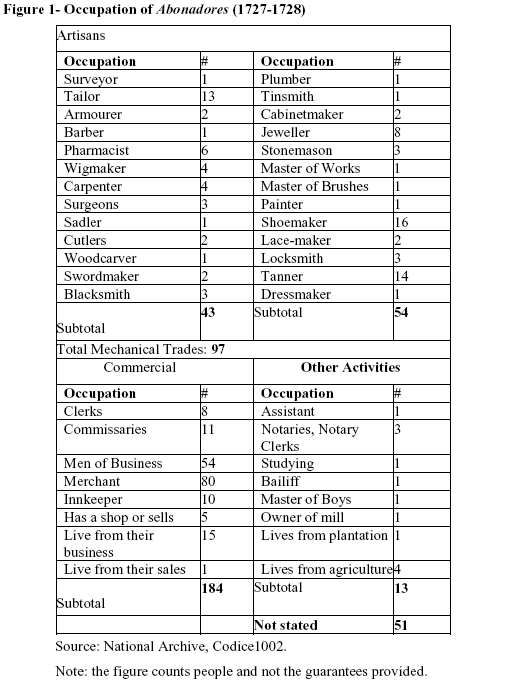
According to the edict, the guarantee of the merchant was needed to travel. Abono, according to Rafael Bluteauxxxv means approval, praise, or testimony, which signified that the governor recognised that local merchants were able to guarantee and to be responsible for someone, in other words they were socially esteemed and enjoyed a high status in the local community. This was not restricted to merchants, since, to the contrary of the measures stipulated in the edict, manual tradesmen, as well as travelling to the mines, also provided abonos for other travellers, as shown in Figure 1, in which it can be seen that 184 (53.3%) of the 345 abonadores carried out commercial activities with the explicit presence of merchants and men of business, as determined by the edict. This is certainly due, in addition to the almost complete absence of people linked to agrarian activities, to the ‘urban' nature of the documentation. However, the participation of artisans of different trades was also striking, accounting for one third of the abonadores with known occupations.
In short, artisans and small merchants had a sufficient social reputation to guarantee travellers as indicated in the words of the governor. Therefore, members of the ruling elites, such as the governor, could have social esteem for merchants and artisans.
Nor were the São Paulo elites excessively concerned with the manual flaw and the depreciation of those bearing it. In a large part this was because, like the elites of seventeenth century Rio de Janeiro, the Paulista elite both in the seventeenth and sixteenth centuries, did not come from the highest ranking fidalgiosxxxvi. It can be argued that the social origin of the nobility is not by itself sufficient to attenuate the pejorative ideology related to work, since this depreciation was reworked in the colonial territoriesxxxvii, but to postulate on the basis of this the unsuitability of manual trades for the exercise of power and social esteem, as well as their abandonment in order to enter the colonial elites is a very large jump, as emphasised by Sérgio Buarque de Holanda.
According to Holanda there were vain attempts to prevent Domingos Luís the coal merchant from occupying a public position in 1585. On another occasion, around 1625, Council officials instructed the capitão-mor and ouvidor (justice of the peace) to implement the laws that prevented tradesmen from holding positions. The captain replied that he was "busy and unwilling". Therefore, while there were obstacles placed against tradesmen and New Christians, it was "notorious" that not even in the seventeenth century, nor afterwards, was the "ascension of people from the poorer classes to high-ranking positions" prohibitedxxxviii. In short, according to Holanda, it can be
]]>(...) stated that in general the frontiers that separated the ‘nobility' from the people were badly sketched out, so that the latter often rose to places theoretically reserved for the former; nor were nobles ashamed of occasionally holding offices said to be beneath their statusxxxix. [emphasis added]
Nor was this something only occasional.
Elizabeth Kuznesof refers in part to the words of Sérgio Buarque in her analysis of relations between merchants and ‘traditional elites' (linked to the agrarian sector) in São Paulo. Between 1765 and 1850 merchants rose to institutions/positions of the elite: they became servants of the Crown (capitão-general, ouvidor, etc.), they held positions in the municipality (judge of orphans and aldermen), in the military (captains and sergeant-majors) and in the Santa Casa de Misericórdia. In relation to command positions in the military in São Paulo, of the nine men who held them between 1765 and 1820, five were related. Of these two were in the cloth trade, one being capitão-mor and afterwards Marshal (marechal-de-campo), and the other capitão-mor. Therefore in an elite family, dedication to trade was not incompatible with the highest local social position. In fact, the position of capitão-mor, in itself, conferred access to the highest forms of social distinctionxl. Moreover, among those who reached the Council between 1761 and 1813, between 47.6% and 70% were merchants or men of business. Even though Kuznesof suggested that the traditional elites did not opt out of preference for positions in the Council, the elevation of merchants to an elite institution was quite commonxli.
In the capitania of São Paulo, this ascension was not confined solely to the city of São Paulo in the eighteenth century. In Itu at the beginning of the nineteenth century, a visitor was shocked to see that the inhabitants of the town, "of whom ‘all were at least nobles' working in the manual trades, which ‘according to the laws of the Kingdoms derogated nobility'"xlii. Confirming the visitor's shock, the brothers of the Order of Mercy of Itu emphasised that the dividing line between tradesmen and nobles was, or should be, non-existent. In May 1805 in a letter sent to the King by General Antônio José de Franca e Horta, it was noted that this distinction did not correspond to the principles of the land understood as a fundamental hierarchy:
The Council of the Brotherhood of Vila de Itu (...) seeing that the commitment of the Order of Mercy of this Court [Lisbon] could not be precisely applied in this country, where, amongst other things, the difference between noble brothers and tradesmen was an obstacle to its subsistence, due to the vanity with which all men deem themselves as equal, not knowing those of a lower sort, other than individuals of colour, those who are born so and those who are slaves; adapted their commitment to the circumstances of time and place and sent me with the Supplication they are making to the Prince Regent for its confirmation (...) São Paulo, 22 May 1805 (...)xliii.
The brothers from the Order of Mercy said that the weights and measures of the Kingdom and Brazil were not the same; if they were their subsistence would be hindered. However, their words demonstrate that the members of the Ituana elite were dedicated to commerce through the monção expeditions and manual trades, as shown in the visitor's words and as analysed by Godoyxliv.
In Porto Feliz, also in the São Paulo capitania/province, the principal landowners also took part in commercial and artisan activitiesxlv. In the nominative lists of the town for the first half of the nineteenth century, the positions/ranks of captain, sergeant, lieutenant, colonel, etc., are mentioned 617 times, with 77 (12.5%) of these people being involved in commerce. However, these lists only state the principal activity of the head of household and prioritise agrarian ones. Other sources indicate the presence of the local elite in manual trades and in commerce. Between 1807 and 1828, of the 220 people granted commercial licences by the Council 29 (13.2%) had mentioned by their name at least once military ranks and/or titles, including lieutenants, alferes (ensigns), captains, lords. Furthermore, crosschecking the information from the Council documentation with the nominative lists from the town 15 were mill owners and 38 had ranks of officers. Crosschecking the information shows that as well as the actual mill owners, their relatives and slaves received licences from the Council. For example, in 1808, 1816, 1821, 1822 and 1823, the mill owner Plácido das Neves received a licence to open an inn and sell drink, etc., showing that he also operated as a merchant. His slave Quitéria was given a sales licence in 1807, 1809 and 1811, as was his other slave Floriana in 1810, 1812 and 1815. But it was not just Plácido and his captives who were concerned with trade. The mill owner also was involved in commerce through his son and son-in-lawxlvi. In fact it was not rare for mill owners to be involved in mercantile activitiesxlvii.
Two cases exemplify the participation of Porto Feliz elites in commercial activities. The first is the capitão-mor who operated on the fluvial route Porto Feliz-Cuiabá, Antonio da Silva Leite. A great part of his fortune originated from monçaõ commerce, including trade with Indians from whom he obtained goods that were sold in Rio de Janeiro and in São Pauloxlviii. The second case is that of the sargento-mor Antonio José de Almeida, who dedicated himself to commerce between 1798 and 1815xlix. Thus, the two men occupied the highest ranking military positions in the town and were involved in commerce.
]]> Until now it has been shown that the local elites in Rio, São Paulo, Itu and Porto Feliz were concerned with trade and/or artisan activities and may not have had a negative ideology abut work. Now it remains to see whether there was actually any valorisation of work.Justifying the accounts religious property he administrated, Taques Aranha, capitão-mor of Itu at the end of the eighteenth century, stated that administering a sugar plantation properly, especially the slaves, rather than idleness, gave "a great amount of work". For him, paradoxically, slaves, responsible for actually doing the work, were lazy, while the white slave owners, being good administrators, had to do "a great amount of work". In fact, Tacques Aranha exaggerated the "great amount of work", in order to emphasise the effort involved in the administration he was proposingl. But his argument must have been plausible. Therefore, among the plantation owner class some idea of the efficiency of work must have existed, though not necessarily with a bourgeois connotation. The document demonstrates perfectly and in great detail the need for the administrator to have a knowledge of the quality of land, sugarcane, animals, etc, suggesting that knowing how to administrate also included technical knowledge, even sometimes getting ones hands dirty, at least while learning how to administrate the plantation.
In effect, in addition to the technical aspects, good administration involved competence in dealing with slaves. While the words of Taques Aranha may represent those of mill owners, a communitarian evaluation of the work of administering a plantation would certainly produce differences. There were good and bad owners, the idle and those with "a great deal of work". There were good and bad ownersli.
This is what is also suggested in the will written in 1825 in Porto Feliz of the alfere and sugarcane planter, Antonio de Arruda Sálii. Without direct heirs, his wife would have the right to use the estate until her death; then it would pass in inheritance to the his stepson, Guilherme, because he had "worked in the house, paid its debts and took great care of everything, and for this I want to pay in the way that I stated herein"liii. Although Guilherme's stepfather had no other heirs, the argument to compensate him was based on work not kinship.
Even more explicit is differentiation for work made among the members of the same family. In 1805 Bernardino José de Camargo registered in a notary office a contract with his father, who stated that he had agreed with his son for the latter to cut cane in his mill with the slaves, without the son receiving "anything at all". The son would work "provide administration in service of the house with his slave Manoel". In order to prevent any doubts in the family about the contract the father had a letter drawn up which he signed with the other sons "for these also to agree with the agreement, due to the undeniable utility that would result from his administration due to the known care and agility" of Bernardinoliv.
Therefore, even while they were not tradesmen, mill owners did not always disqualify the nature of their work. Trying to govern slaves and administer a mill must have involved a lot of work. It can also be added that work was associated with an expected type of social behaviour. The capitão-mor of Itu said that a good administrator was one who did a great deal of work and who was some of good repute. This association was not exclusive to members of the ruling elite.
Manual Trades and Concepts of Work
This can be noted in the Regulations of the Economic Government of the Trade of Shoemaker in Rio de Janeiro in 1817, which prevented the election to judge or notary of the trade anyone who had "exercised an infamous occupation". In addition, blacks and people of mixed colour only could do the professional qualification exam after showing a certificate that they were free or forroslv. As shown by the Regulations there was a hierarchy within the trade and a certain amount of restriction on the exercise of the occupation. Slaves were excluded and the differentiation between white shoemakers and black or coloured shoemakers was maintained, making it difficult to classify artisans as a social group with their own identity, moulded only by the exercise of a particular trade. To the contrary, hierarchies of colour/social condition were preservedlvi.
A certain disqualification of work also appears in the regulations, derived from the ‘manual flaw', since the occupation of an ‘infamous trade' was a way of establishing differences between the trade of shoemaker and ‘infamous trades', pointing to the existence a hierarchy within manual trades. It may also be an attempt on the part of artisans, organised into a guild, to control access to the trade, restricting entrance. In fact, although it does describe what an infamous occupation was for the shoemakers who signed the document, shoemaker is definitely not one.
]]> The Regulations also point to different visions not just of the ‘manual flaw', but of work itself. Members of a guild were demanding in relation to the examination of new members who had to know how "to make perfectly and securely a pair of boots, a pair of buskins and another pair of shoes (...) and if they did not know how to make these the examiners would not pass them and those that let them shall pay the Crown ten cruzados". Certainly they did not see their occupation as degrading and valorised their abilities. Thus, as well as the possibility of the disqualification of work not existing among all social groups – at least in the same form – I suppose that work could have been seen in a positive form, so that manual workers did not feel disqualified. Infamous occupation always means another type of worklvii.The shoemakers from the Court must have had their reason not to consider their occupation as something degrading. Perhaps because buskins (narrow boots that reached up to the middle of the leg) were in only used in Ancien Regime Portugal by the nobility. It is curious that jewellers and wood carvers in seventeenth century Porto and Lisbon tried to deny their manual condition by relating their activity to intellectual work and to the fact that they produced articles consumed by the nobility. To get access to the Casa dos Vinte e Quatrolviii one could not possess the manual flawlix. Moreover, since according to the Regulations blacks and people of mixed colour could not be selected as judges or clerks of the trade, this also indicates that while, on the one hand, they were not prohibited from making buskins, on the other hand, they did not participate in the political representation of the Council. As a result in a status-based society, blacks and people of mixed colour continued to have restrictions on their social mobility, not being inserted among the elites of their trade. Shoemakers, who pretended they were exempt from the manual flaw, deemed that forros and descendents of slaves did not deserve privileges. As I have already mentioned, the brothers of the Order of Mercy of Itu, said the same since there were tradesmen and "tradesmen of colour", slaves and forros.
In the same way, perhaps the shoemakers who demanded that blacks and coloured prove that they were free or forros, were free whites, or socially considered themselves as such. In repelling slaves, the distance between slavery and the condition was being emphasised, but, more importantly, without disqualifying their work. To the contrary the exercise of a trade – the examination letter – identified the non-slaves. Shoemakers believed that their occupation was not infamous not just because they produced socially esteemed articles, but because shoes were a sign of freedom, due to the ostentatiousness of shoes in slaveholding societies. Therefore what impeded blacks and coloured from joining the elite of their trade, or evening joining the Order of Mercy of Itu, was not manual work as such, but their colour/social conditions.
In summary, what excluded or included was not what someone did or did not do, but colour/social condition. This signified that the exclusivist ideal, based on the principle of inequality and with a rigid social hierarchy, so characteristic of status-based societies, remained but founded on another basis. Nonetheless, in the Brazilian colony the hierarchy derived from slavery coupled itself to the status-based hierarchylx. As has been seen in 1805 the brothers from the Order of Mercy of Itu did not accept the social distinction referred to by the manual flaw. Through vanity all believed themselves to be equal and did not know any with an inferior social condition. These inferiors were those of colour, those who had been born slaves – the forros – and those that still were. In a more exclusive form that than the Regulations of the Shoemakers of Court – which at least did not bar forros from the exam – participating in the Order of Mercy in Itu was only allowed to the ingênuos, i.e., those born free.
Work and the Social Mobility of Forros and their Descendents
From the above it cannot be inferred that colour was an insurmountable barrier to social mobility. Therefore, it remains now to analyse how work could contribute to social ascension, especially among forros and their descendents. In relation to this it has to be kept in mind that I am dealing with a society that had both Ancien Regime and slaveholding traits, which implies being attentive to the various forms of social mobility. Echoing those studies that emphasised ascension between stratalxi, the passage from one strata to another is a level of social ascension which in a slaveholding society is associated with the legal transposition of the condition of slave to that of forro, from forro to being free. However, the social mobility of forros and their descendents should not be understood as the simple transposition from one strata to another, since, social ascension preferentially takes place within the social group to which an individual belongs. Paraphrasing Giovanni Levi, a forro or slave descendent did not prioritise being a baron, but the king of forros and of slave descendentslxii. Furthermore, slavery imposed hierarchical referenceslxiii, distinguishing socially and legally slaves, freemen, forros and slave descendents, while the transposition from one legal category to another and the later removal of slave ancestors are steps on the social scale. For these groups, the movement of social ascension takes place gradually over time, it is generational. For forros, liable to be re-enslaved, social mobility could be the means for the maintenance of their own freedomlxiv (which kept them differentiated from slaves); for their descendents it was the gradual moving away from a slave ancestor. For those leaving captivity, these are important movements of social reinsertion.
Finally, I also draw on the idea that social mobility should not be solely understood as enrichment. Rather social reputation was prioritised, to which enrichment may or may not contribute, but still it was reputation that took precedence. For this reason I think it important to emphasise the importance of strata in old colonial/Imperial society, because social consideration rather than wealth is the crucial factor in defining social place in societies with strata-based characteristicslxv.
In summary, social mobility is the change in legal condition, moving away from slave ancestors, and is not restricted to the economic sphere. Therefore, it is crucial to highlight, outside of the economic sphere, the socially shared positive valorisation of work and the way work differentiated social agents.
The free Colonial/Imperial population, especially the segment formed of forros and descendents, is analysed as a single block, ignoring an eclectic contingent with particular realities. There are disagreements about the hierarchy among them. Eduardo França Paiva categorically states:
]]>Starting from their social conditions and leaving aside what was called ‘quality' at that time (white, black, creole, mixed, mulatto, cabra, among other designations), they can be divided into three large groupings: free, freed (including blacks and people of mixed race born free) and slaves. The descendents of freed slaves born after the emancipation of their mothers were legally free. However, they were subject to social restrictions imposed on former slaves and for this reason they were much closer to the world of freed slaves and their captive ancestors than the freedom enjoyed by whites. Nonetheless, this is no reason to establish a fourth social groupinglxvi.
In my opinion this perspective – perhaps because it leaves aside what was called ‘quality' at that time – overlooks differences between those leaving slavery and ignores generational social mobility. Other approaches open space to think the opposite. Peter Eisenberglxvii emphasises that the designations pardo and mulatto do not necessarily refer to the appearance of the skin, but also refer to the condition of being free from slave ancestry. For Hebe Castrolxviii while slavery still existed, the word pardo indicated a distancing from a slave past as an affirmation of liberty, since negro or, preferentially, black designated the condition of slave. Moreover, pardo generally referred to sons of forros and thus to the first generation of slave descendants to be born freelxix.
In this way the social project related to slavery continued in freedom. For example, in 1798 in the city of São João Del Rey, a black creole forro, daughter of a preta mina, now a forro, said she had four children, all of whom were pardoslxx. The first generation were preta mina, the second Creole black, and the third, without any mention of being emancipated, were pardolxxi.
Although the meanings of these expressions can vary in different times and places, research has suggested a gradual move away from the slave past expressed in colour/condition, which implies saying that the spaces of social (re)insertion modify over time and that qualities (black/negro, pardo) can alter in a family. Obviously this does not eliminate the distinction between free, freed and slaves, but its emphasises the need to distinguish forros and their descendents in terms of distance from slaverylxxii. In short, social mobility is generational and as a result comes into the family sphere.
Cacilda Machado, in her study of mixed marriages calls attention to the fact that in a slaveholding society social mobility is not always ascendant, since there are situations in which children can be slaves and their parents free or forros. Her warning is important since it corrects the impression that the social mobility of those leaving captivity is always upwardslxxiii. However, it was still generational and family related even if descendent, but it is very unlikely that the movement returning to captivity was preferential on the part of forros and descendents – or even frequent.
Another important point made by the author is changes in legal condition and status did not always agree. It is possible but not the majority of times. Taking godparents to be a criteria to measure status, in Porto Feliz between 1807 and 1860 in 7854 baptism registrations of freemen, only 60 godmothers and 81 godfathers were slaveslxxiv. Moreover, children of forros were almost never described as forros and most often their colour was not mentioned.
For those who came from slavery the change in legal condition could have critical implications.
The difference between slaves and other groups was basically due to the fact that legally the captives did not even own themselves. When Escolástica Maria Ramos died in 1814 her son-in-law, Sebastião da Costa, said that among the goods that belonging to his mother-in-law was the slave Francisco, "and since this slave, even when the mother-in-law of the supplicant was still alive, did not work except for himself, he was able to acquire goods, which he improperly called his own, which are four mules, two horses, and a small plot of land, all of which legally belongs to the supplicant and the other heirs". The slave lost the goods, was imprisoned to be auctioned and fledlxxv. The difference between slave and forro, in addition to ownership of themselves, also resides in who they worked for. Theoretically the latter worked for himself and the former essentially for another. Furthermore, the case above clearly shows that forros and descendents of slaves who worked for themselves could have mules, horses, small plots of land, etc. Emancipation increased the potential of ownershiplxxvi.
More subtle and more difficult to learn were the distinctions between forros and their descendents. Forros could have their emancipation revoked for ingratitudelxxvii. The black forro Manoel Joaquim de Souza went to court against his former owner who wanted to revoke his emancipation. The trustee of the forro argued in his defence that his "freedom was accepted by the Plaintiff, who out of gratitude to the Defendant continue to render him services as a slave". Though it sound rhetorical, the law allowed re-enslaving and the revoking of emancipation, and the trustee could only state that the Defendant did not have the right to re-enslave the Plaintiff "without giving reasons"lxxviii. In the end the Defendant gave up his attempt to re-enslave the Plaintiff. Nonetheless it was his prerogative whether or not to do so.
]]> Others went much further in their positions. In 1810, Rita Pinheiro de Moraes wrote a rider to render without effect the part of her will that gave freedom to her slave. "I did this because he did not deserve this grace, and thus I revoke the article (...)". Then she added: "I have sold the slave in question"lxxix.For this reason, the differences between forros and their descendents, family/generational and intra-group mobility should not be belittled. This is what is shown by an episode that occurred in 1797. Tomás de Aquino had requested that his own son, Alexandre Garcia, be arrested. This was accepted by the governor and the capitão-mor of the town duly captured the son. However, the captain said that the request was full of lies, adding that:
On the aforementioned fifth day of this month [July], he [Tomás de Aquino] requested the arrest of his son in order not to carry out the unjust and unequal marriage intended, when the son had actually married twenty-two days previously, since on 13 June past they were publicly married. [The father] also alleged that his son wanted to marry the daughter of a black woman, when in fact it was the daughter of Gabriel Antunes and his wife, Maria Leite, only distantly pardos, who are also in relation to blood, little or not at all different from the supplicant and his wife, who are know lowlifes; they exceed the latter in their behaviour, because in fact Gabriel Antunes and his family are honest and fear God, something lacking from the supplicant, who deserves to be called a thief.
The same supplicant also states for reasons of honour he did not want this marriage since it was ignominious (...) when in fact he had long previously agreed this marriage and afterwards (...) sought to unmake the agreement (...) it appears to me to be certain that the supplicant sought escape from that agreement due to the influence of his brother, Agostinho Garcia, who wished to marry the said Alexandre, his nephew, with another girl under his protection (...) Itu, 20 July 1797 lxxx.
Although he spoke harshly with Tomás de Aquino, the capitão-mor agreed with him that there was a difference between the daughter of a negro, probably a forro, and being distantly pardo. In terms of quality of bloodlxxxi, there was little or no differentiation between them, according to the words of the captain, but they distinguished them over the generations from a black, even distantly, according to Tomás de Aquino, father of the bride. Thus, it can be noted that in societies with traits of the Ancien Regime one of the fundamental aspects of social mobility is generational/familiar movementlxxxii. This is a basic difference between social mobility in capitalist societies and in status-based societies. Obviously this does not mean that someone could not during their lifetime ascend socially either in economic terms or in regard to social esteem. However, if the ascension did not continue with his descendents and did not take place within the family sphere – in the broad sense – then he was strictly the self made man of bourgeois society.
Therefore, in status-based societies, rather than in individuals it is the family sphere where social mobility should be located – and this is an unequal condition when dealing with colonial Brazil, due to the role that the family previously assumed – where generational traits are primordial for its understanding. Thus one can understand the efforts of Tomás de Aquino, encouraged by his brother to marry his son to a girl with better prospects. Essentially it is the position of the family and its perpetuation that are in question, rather than the individual. Even the captain referred to the parents of the bride and the father and uncle of the bridegroom rather than to individuals.
On the other hand, also evident in his words is the intra-group aspect of social mobility and the moving away from slave ancestors. Perhaps feeling different not just from blacks, but also from the other pardos, made Tomás de Aquino want to marry his son to the other girl. He wanted a marriage he believed was better for his family. They were distantly pardos, they were not negroes. It should not be forgotten than negro was most frequently attributed to slaves and sometimes to forros. So while little or nothing differentiated them in the words of the captain, this was what Tomás thought, who had surrounded himself with questions of honours as regards the riff-raff.
Although they may seem to be indefinable, there were differences between forros and their descendents. Paiva asserts that descendents of forros were much nearer the world of the freed and their captive ancestors that the freedom enjoyed by the white, but while this might have been experienced in daily experience, which it is difficult to doubt, it does not mean that they had the same status. Socially, this is a white perspective which, while no doubt dominant, was not exclusive. In fact, taking into account the fact that differences in social conditions are not restricted to the material aspect, the capitão-mor did not completely ignore quality. He said little or nothing. Nothing for the captain, but nothing matter how insignificant it may seem, he recognised a difference in quality expressed in colour, a hierarchy among people of slave descendent, even though I do not know how to specify this.
If what has been said above has anything to do with work, how occupation differentiated forros and slave descendents, and within each group, needs to be analysed. Or did those leaving captivity adhere to aristocratic values of not doing manual work, judging that this lowered them and that it should be done by slaves, as argued by Russel-Woodlxxxiii?
]]> In Bahia, despite the predominance of slave labour, the nature of sugar production created "a group of wage earners at the core of the [productive] process". These included the artisans of the mills, many of him were free or freed, who formed an "elite segment of rural workers". "Occupational status provided those who were not white with a means to ascend socially". Even though the subtle differences in colour and the prejudice associated with it were not totally ignored, there was a tendency, as the population of free mixed race people grew, for designations related to colour to disappear from "the records" of the mill in Sergipe do Conde. This is because the "acquisition of abilities and experience which had made the work valuable to the mill tended to supplant the pejorative and characterising designations". On the other hand, the colour of non-specialised workers continued to be mentioned and in a pejorative formlxxxiv.In this way work contributed to the absence of colour.
The same occurred in the Court of Rio de Janeiro in the sixteenth century. In the passports issued by the Police of the Courtlxxxv between 1822 and 1829, 1421 individuals had a stated occupation, of whom 736 were born in Brazil, 598 were Portuguese, nine had other nationalities and the nationality of 78 was not mentioned. Since we are dealing with a slaveholding society, colour was mentioned on the passports, almost always referring to forros and their descendents. Among those with stated occupations, who were born in Brazil and male, as occupation was not stated for women, in only 79 (10.7%) cases was some allusion made to slave descent, for pardos and blacks, whether they were forros or slave descendents. It is difficult to believe that all the others born in Brazil were white. In Bahia the exercise of a determined activity also contributed to the absence of a mention of a captive ancestor, in which the supposed characterisation of work as a slave attribute counted.
In the same documentation, other aspects can be perceived through the designations pardo and black. In a universe of 147 pardos, 69 held some sort of office, compared with only seven among 46 blacks. There are other dissimilarities described between pardos and blacks. On 15 December 1827, Joaquim Antônio was described as:
(...) pardo, born in Campos, 37 years old, ordinary build, long and tanned face, normal beard, curly hair and eyebrows, living in the Court, a carpenter by trade, left for Campos and had in his company his wife Maria Barbosa, tall build, long face, black hair, with a daughter being weaned; was recognised by João Silvério da Rosa, living at Glória (...)lxxxvi.
Joaquim Antônio was married or living with another woman who was married and who "was not of colour", indicating that he was able to maintain stable ties with a person of a social position superior to his own, which was favoured by his occupational specialisation, carpenter. Something different occurred with João Ribeiro, "a freed black", born in Angola, aged 40, no occupation mentioned, who left for Ilha Grande on 13 December 1824 with "his wife Catarina da Conceição, a freed black from the Angolan nation", and four children, but was recognised by a Police employeelxxxvii. In fact only one of the 46 blacks managed to travel with his family, while of the 147 pardos with an occupation, 14 did so.
Since it was not feasible for everyone to travel with their relatives, it is probable that the exercise of an occupation contributed to a margin of social mobility, referred to by the absence of colour or the mention of a certain colour. There are indications that the term pardo, unlike the designation black, implied an approximation to the world of freedom and therefore made the ownership of property more likely, both factors seen as the attributes of free menlxxxviii.
However, even among the pardos there were differences. Joaquim Antônio was pardo and a carpenter but there was no reference to the colour of his wife, nor of Joaquim José, who was described on 27 July 1831 as follows:
]]> Joaquim José Pereira, pardo, master stonemason (...) left for Ilha Grande; brought his wife Josefa Maria de Santa Rita (...) an underage son (...) and five slaves, Balandina Crioula (...), Maria ditto (...), Antônio Benguela (...) José Cabinda (...) Malaquias Benguela (...) guaranteed by Francisco Correa da Silva, who lives behind Lapa do Desterro and possesses propertylxxxix.
Joaquim even brought with him five slaves and was guaranteed by someone from within property holding circles, perhaps an urban rentier. Maybe the fact that he was a master, the highest scale of his trade, had allowed his social mobility towards the universe of property owners.
In summary, as well as the designation of pardo, being at the top of a determined trade and being a skilled worker must have approximated certain pardos to people in a more elevated social position. Whether in eighteenth century Bahia or in the nineteenth century Court, those stated to have an occupation tended not to have their colour mentioned or were pardos. Few were black. Work contributed to cutting through the lines of colour. In Porto Feliz, Cândido Monteiro was a pardo who worked as a carpenter in 1805. From 1808 to 1815 he was a carpentry official, still a pardo. In 1824 and 1829, he was a "master carpenter", he had become whitexc.
However, as the lawyer said, everyone is permitted to engage in that ministry according to what the gender and the condition adopted by each allows, which in a slaveholding society signified that colour had a fundamental weight in the criteria of social classification. Nonetheless, it was not at all static or an indelible mark. As we have seen work could make individuals white.
Finally, we must now look, also among the subaltern groups, at the social values associated with work and those who carried it out. To this I return to São Paulo again, especially to the town of Porto Feliz in the nineteenth century. The large majority of houses in the town did not belong to mill owners, but to other segments, chiefly of free individuals without slaves. Among them, and not just in order to accumulate goods, work could be positively valued, contributing to social esteem. Between 1805 and 1856, out of 48 processes releasing children from parental controlxci, the arguments of the parents, tutors and witnesses always reinforced in addition to expected behaviour, the capacities of the children in question to govern themselves and their goodsxcii. In 1820, Francisco de Paula stated that he "respected the capacity and discretion of his son" to "govern himself and his goods properly", giving up his parental control over his son. The goods that his son possessed (clothes, a horse and harness and a firearm) were acquired with his "work and industry, without my help", he added. Everything that the son would acquire in the future would belong to him, without his brothers requiring an inventory to be made. The judge accepted the requestxciii. In addition to his ability to accumulate goods, the father respected the son for being able to govern himself through his work.
This was not just directed at family members. In the community there was also a recognition of occupational capacities linked to behaviour. Antonio Rodrigues Leite said about the plaintiff João Almeida Vieira that he knew, because he had known him since his was born, that he would be well able to carry out his business and that he could govern his goods properly. In 1811 the ensign Joaquim Vieira de Moraes, who lived from his fazenda seca businessxciv, stated that "he knew for certain" that Manoel Campos Cardoso was "fully able and capable of running his own and others plantations, since for many years [Manoel] has been doing business with him with all credit and satisfaction". Plácido das Neves added that he had known Manoel "since a boy" and that as well as his behaviour, he had "a great capacity to do business"xcv.
As well as community recognition people saw themselves as having the proper autonomy for work. In 1816 Francisco Antonio Soares alleged that he had "good judgment, the ability and economy to govern himself and administrate" his goodsxcvi. On 17 May 1819 Salvador Alves Carriel wanted to obtain his ‘emancipation' from parental control "for his own better utility". He though he had the "ability to rule and govern his goods without depending (...) on parental powers (...) and that for many years he had done public and private business"xcvii.
The above words show that work was associated with autonomy and good behaviour, whatever this might be. There was a socially shared recognition in relation to this aspects, since people were both seen and saw themselves in this manner.
It can be said that the structure of the documentation and the objective of a process requesting release from parental control could lead to an over-valuation of work, but the same can be seen in other sources. In the nominative lists from Porto Feliz in 1810 a domicile formed of five brothers and five slaves was described. The brothers were José de Campos Negreiros, Francisco Xavier do Rego, Joaquim, Estevão and Antônio, aged 24, 19, 17, 12 and 9 respectively. Four of the five slaves were aged between 10 and 31, in full productive age. The census taker, wanting to identify who was responsible for the household, did not mention the oldest brother, and stated that they were all "orphans of the deceased José de Campos Negreiros, and among them Francisco is of the most use for the conservation of his younger brothers since he works the hardest, cares for and is honest in his business"xcviii. The utility of Francisco, his own character, his recognition as a person and his difference in relation to his brothers, in other words the social esteem that he had was judged in function of being "the hardest worker".
Much different was the case of Francisca de Paula in 1845 who took a case of justification against Joaquim do Vale Pereira, with whom she had, after having "lived with him for many years", two children. Despite this she said she would not accept her children staying with the father "who did not work"xcix. Lack of work disqualified her husband.
]]> Non-depreciative concepts of work can also be observed in allusions that certain social groups made about others. Slave owners stipulated that their slaves should work. In 1853 a wealthy man without direct heirs, Manoel Fernandes Teixeira, made his slaves his heirs, including Valêncio and Marcolino, who were still minors. Concerned about the future of these two, he said that the freed slave Eufrosina should raise them and educate them, emphatically order her to "teach them a trade"c.Another example is Cipriano José dos Santos and his wife who in 1830 freed Benedito Crioulo, then ten months old. The emancipation, paid by the boy's godfather was conditioned on Benedito staying with the couple till they died. After this Benedito would be put under the care of his godfather who, as a final condition of freedom, would "educate him and teach him some trade" until the slave "could use his reason to go where it seemed best to him (...)"ci. The intention of these slave owners was that work would guarantee the autonomy of the emancipated slave.
It can be argued that the recommendation to teach a trade was a strategy of slave owners to exploit the work of those freed after they had been emancipated. Possibly, but it was not just this. Cipriano did not free Benedito in a will registered in a notary office. He made his will sick in bed on 4 December 1842, dying six days later. I did not find Benedito among his slaves. At this stage he would have been around 12, perhaps with a trade and free.
Cipriano was no exception. In general people who made wills would die shortly afterwards. For example, of the 144 people who freed their slaves in wills in Porto Feliz between 1788 and 1878, ten died the same year, 131 the following year, one took two years to die, another four years and the rest five (Ferreira, 2005, Chapter IV). In turn the majority of the 495 emancipated slaves were given unconditional freedom or without any conditions being mentionedcii. Among the 110 (22.2%) emancipated slaves who had to remain with a relative or inheritor of the person making the will, there was a concern for the future lives of 33 of them. In general women were recommended to get married and men to learn a trade.
Forros could also share the idea that work favoured autonomy. In 1838, the forro Bento da Costa made the following statement:
He declared that he had been born in Porto Feliz, was the legitimate son of Bastião[sic], a slave who had belonged to José Francisco Fernandes and to his wife Ana Dias (...) He stated that he had been married to a slave who had belonged to Manoel Pinheiro (...) He declared that the goods he possesses are (...) a house, of which only the building is his, while the land belongs to Antonio Fernandes Leite, a trunk containing some of his clothes, a small tool of his trade of violin maker. He declared that Francisco de Campos the carpenter owes him four patacas, José Maciel owes him 5$120 réis, and that his goods as declared above, and debts, will after paying his debts be used for his poor burial and to pay his creditors, namely the slave of Captain Francisco Antonio de Moraes the amount of 87$000 réis for a debit note that is the power of Joaquim do Vale Pereira, [and] Captain José Manoel de Arruda, which appears in his records, whose debts will be paid with his goods (...) He declared that he wanted as witnesses (...) Antonio Fernandes Leite (...) Joaquim do Vale Pereira e (...) Domingos José de Farias (...)ciii.
The will of Bento da Costa demonstrates his social self-recognition through his work, his trade of violin-maker, as well as the social recognition of Francisco de Campos as a carpenter. Identity through work. Carpenters and musicians could gain social esteem through their trades and not just among forros and descendents of slaves, but also with regard to members of the local elite. This can be seen in the words of the capitão-mor of the town who wrote to the governor in 1822 referring to certain skilled pardo workers. Another seemed to be a good carpenters and a skilled mill master, which was needed in the town. Another two were musicians and tailors by trade respectively, worthy of being socially acceptedciv. However, for the captain, it was not just musicians, tailors and carpenters who deserved respect. Vagabonds as well. In 1820 the governor of the capitania ordered the capitão-mor of Porto Feliz to impress vagabonds into the army. In response the captain stated:
I respectfully suggest to Your Excellency that the vagabonds of this country be made part of the repeated expeditions that leave from this town to Cuiabá, and for this reason these people should be respected for their ability to work on the river. However, if Your Excellency should really want me to send them to you, I will do it as soon as I receive your order and in [illegible] I will continue to get rid of the really lazy and turbulent men from the district under my command (...) Porto Feliz, 15 February 1820. ]]> His Excellency [Governor] João Carlos Augusto de Oeynhausen
Antônio da Silva Leite Capitão Morcv [emphasis added].
For authorities such as the governor and the capitão-mor, vagabonds should be made to enlist, but nonetheless it should be noted that they were not considered to be idle. I do not know what criteria were used to differentiate vagabonds from the really lazy. It is probably political, lack of submission. Irrespective of this, vagabonds formed the crews who sailed up the Tietê River towards Cuiabá during the Monções. Furthermore, their work abilities made the capitão-mor dependent on them and for this reason he respected them. Organising work on the river did not necessarily require the collaboration of workers, since conflicts existed. While, on the one hand, the captain exploited them, on the other work gave some negotiating space to the workers, some autonomy. As can be seen the capitão-mor was somewhat hesitant in his words.
Specialised workers were socially esteemed through their trades. Or are the captain's words more concerned with the exploitation of alien labour rather than differentiated blacks through work? One hypothesis does not necessarily exclude the other, but I think the second prevails, at least in the point of view of the workerscvi. To the contrary would be to emphasise only the vision of those who do the exploiting to the detriment of the tailors, the vagabonds and the musicians such as the violinmaker Bento da Costa,for whom it was important to pay his debts with his goods. For he had credit with Captain José Manoel de Arruda, who must have been a merchant with his accounts. Among his executors Antonio Fernandes Leite was the owner of the land where Bento's house was built, Joaquim do Vale Pereira was a pardo tailor in 1824-1829 and a lawyer and building inspector in 1836cvii, and Domingos José de Fariascviii, as well as being a plantador de cana de partidocix was also a fazenda seca merchant. With the exception of Joaquim do Vale Pereira they were all slave owners.
Bento Costa had good relationships with the members of the slaveholding elite of the town, perhaps because of his trade. Unfortunately it is impossible to find out if he was born free, although it is mentioned that his mother had been a slave. However, his father had been a slave and he had a memory of slavery.
Similar to him, 51 years later in December 1889, Benedito das Neves, a former slave, stated:
I, Benedito das Neves (...) declare that I am the natural son of Rosa, then slave of the deceased Salvador das Neves (...) I declare that I am married with Rita Rodrigues Correia das Neves, out of which marriage we had four children who are no longer alive, called Maria, Idalina, José and Benedito. Therefore, I have no heirs (...) and I hereby make my wife my only and universal heir (...) who will only have use of my goods (...) which after my death will come to belong to our adopted son Francisco Egydio, the natural son of Maria Somebody and grandson of the deceased Antonio Somebody, commonly known as Totó Alfaiate (...) And this is my will that I wish to be fulfilled (...)cx.
The words of the forro Benedito das Neves show that his mother, his deceased children, Totó Alfaiate – once again identity through work – his former master and captivity lived in his memory. However, as shown in this will on the threshold of the Republic, which is undoubtedly another historycxi but still to a limited extent this history, making the question relevant - did those leaving captivity depreciate manual work? If the answer were yes, which I would disagree with, what would be the reason – slavery, the manual flaw, or the bacharelism of the nineteenth century? I choose the third optioncxii. But not every forro or descendent who lived in a town like Porto Feliz dreamt of a Graduate Ring in the Court, in Recife or in São Paulo.
]]> Conclusion
I have tried to call attention to a question that is still open for research: manual work in time and space, its valuation among different social groups and how it could or could not contribute to social ascension. Far from answering the question and generalising this study for Brazil's Colonial/Imperial past, I suggest that the depreciation of work did not always exist and that, at least among subaltern groups, it could favour social ascension, even if intra-group.
This concept was not restricted to forros and their descendents. Heirs and legatees also received instructions about learning a trade. In 1840 Gertrudes de Almeida Leite, a woman without children, stated:
I set my slave Francisca and Caetana free without any conditions. Equally I free my slaves Lino Crioulo and Vitória without any condition, except, I mean to say, upon the condition that they live in the company of and serve Ana Joaquina de Almeida, whom I raised. This condition shall apply until the Creole Vitória marries or reaches twenty years of age, while the Creole Lino shall learn some trade, and when he has completed this he shall enjoy his freedom, with the stipulation that when he is twenty he should be free. For all the children that my slave Caetana has /if this happens/ the same conditions shall apply (...)cxiii.
Gertrudes wanted to set Lino out in life having learned a trade.
For forros, learning a trade was an investment which could weigh on families. The tutor of the heirs of Antonio Costa said that the orphan Gabriel, aged 14, had been "in the power" of a "master", "learning the trade of carpenter (...) for three years"cxiv. A tutor of an orphaned son of a black alluded to the expenses spent on the "slave Vicente, who has spent four years learning a trade"cxv.
If the individuals leaving captivity invested in the manual trades it is because they thought they could ascend socially. However, if the reader still remains reticent to accept the idea that those from the underclasses did not always adhere to the idea of the ‘manual flaw', I shall close with the perspective of the black forra Gertrudes Maria in August 1824, who demonstrated the importance of learning a trade in order to improve the living conditions, if not her own then at least those of her descendents:
A legal deed and contract made between Gertrudes Maria and Cipriano de Almeida about a son of the former called José for the latter to teach him the trade of tailor.
Let it be known that (...) in the town of Itu (...) the contracting parties appeared, on the one side Gertrudes Maria, a black forra, and on the other Cipriano de Almeida, a black tailor(...) and Maria Gertrudes told me (...) that out of her own free will she had given the said Cipriano de Almeida her son called José for a period of a year and a half, to teach him the trade of tailor, with the declaration that he would live and dwell with his master for this time, and if in this time Gertrudes Maria gets sick or has to leave the town and for this the company of her son is needed, after the said year and a half José shall be obliged to make up the time that he missed from his master's house for the full period of the contract to be fulfilled (...)cxvi.
]]>
i Museu Republicano Convenção de Itu (MRCI), File 73, doc. 1.
ii PRADO JÚNIOR, Caio. Formação do Brasil contemporâneo. São Paulo: Brasiliense, 1983, p. 346.
iii FRANCO, Maria Carvalho. Homens livres na ordem escravocrata. São Paulo: Ed. UNESP, 4a Ed, 1997, pp. 21-63; SOUZA, Laura de Mello e. Desclassificados do ouro. A pobreza mineira no século XVIII. Rio de Janeiro: Graal, 2004, 4th. Ed., 2004; NADALIN, Sérgio Odilon. "A população no passado colonial brasileiro: mobilidade versus estabilidade" Topoi, v. 4, no. 7, 2003, pp. 230, 231, 240.
iv Another impediment is slavery, outlined in FERREIRA, Roberto Guedes. "Pardos: trabalho, família, aliança e mobilidade social. Porto Feliz, SãoPaulo, cerca 1798 - 1850". Doctoral thesis presented to the Post-Graduate Programme of Social History of UFRJ. Rio de Janeiro, 2005, Chapter 2.
v About the controversial question of social stratification in status-based societies, cf. MOUSNIER, Rolland (Org.). Problemas de estratificação social. Lisbon: Martins Fontes, 1968; ROCHE, Daniel (Org.). Ordenes, estamentos y classes. Madrid: Siglo Veinteiuno de Espana, 1978; STONE, Lawrence. La crisis de la aristocracia (1558-1641). Madrid: Alianza Editorial, 1985. For stratification within strata, cf. DUBY, Georges. As três ordens ou o imaginário do feudalismo. Lisbon: Editorial Estampa, 1982. In relation to the Ancien Regime, it is "difficult to present succinctly a regime (...) that always cultivated confusion (...) whose real functioning is not well known to historians (...)". GOUBERT, Pierre. El Antigo Régimem. La sociedad. Madrid: Siglo Veintiuno de España, 4th Ed, 1984, pp. 8-9. For the Ancien Regime in Brazil, cf. MESGRAVIS, Laima. "Os aspectos estamentais da estrutura social do Brasil Colônia". Estudos Econômicos, no. 13, 1983 and FRAGOSO, João et. All (Orgs.). O Antigo Regime nos trópicos. Rio de Janeiro: Civilização Brasileira, 2001.
vi SCHWARTZ, Stuart B. Segredos Internos: engenhos e escravos na sociedade colonial, 1550-1835. São Paulo: Companhia das Letras, 1988, p. 210.
vii According to Rios, the emphasis on hierarchy based on slavery obscured the importance of the manual flaw as a negative value of social distinction, which remained stigmatised through colonisation, defining social identities and delimiting access to the condition of noble, RIOS, Wilson. A lei e o estilo. A inserção dos ofícios mecânicos na sociedade colonial brasileira. Salvador e Vila Rica 1690-1790. Doctoral thesis presented to the Post-Graduation Programme in History of UFF. Niterói, 2000, pp. 1-3, 46-62, 100 and following. About the manual flaw stigma and its redefinition in Portugal in the colony during the eighteenth century, cf. BOXER, Charles. O império colonial português (1415-1825). Lisbon: Edições 70, 1981, Chapters 11 and 13.
viii MELLO, Evaldo Cabral de. O nome e o sangue. São Paulo: Companhia das Letras, 1989, pp. 26, 28, 33, 134 and following.
ix Idem, pp. 134-135. ]]>
x Recent research has shown, however, that the presence of manual tradesmen and merchants was frequent not just in Brazil, but also in the municipal chambers of the Portuguese Empire. BICALHO, Maria Fernanda. "As câmaras ultramarinas e o governo do Império" and FRAGOSO, João. "A formação da economia colonial no Rio de Janeiro e de sua primeira elite senhorial". In FRAGOSO, João et. All (Orgs.). O Antigo Regime nos trópicos. Rio de Janeiro: Civilização Brasileira, 2001. BICALHO, Maria Fernanda. A Cidade e o Império. O Rio de Janeiro no século XVIII. Rio de Janeiro: Civilização Brasileira, 2003, Chapter 12.
xi MESGRAVIS, op. cit; pp. 799-811.
xii It should be noted that after the end of the colonial period the criteria for defining active citizens in the 1824 Constitution in legal and politico-institutional terms did not exclude those who worked with their hands or in commerce from full participation in the electoral process, indicating that the valorisation of work was to a certain extent experienced on a daily basis.
xiii HESPANHA, Antonio Manuel de "A constituição do império português. Revisão de alguns enviesamentos". In FRAGOSO, João et. All (Orgs.). O Antigo Regime nos trópicos. Rio de Janeiro: Civilização Brasileira, 2001. pp. 163-188[ STANDARDIZEDENDPARAG]
xiv RIOS, op. cit; pp. 76, 128-130.
xv MONTEIRO, Nuno G. "Elites e mobilidade social em Portugal nos finais do Antigo Regime". Análise Social, vol. XXII, 141, 2, 1997. pp. 343-344.
xvi Idem, pp. 343-344, 356.
xvii FREYRE, Gilberto. Sobrados e mucambos: a decadência do patriarcado rural e desenvolvimento do urbano. Rio de Janeiro: Record, 13th ed., 2002, pp. 386-403.
xviii Idem, pp. 403-405.
xix FRAGOSO, 2001, op. cit; pp. 41, 53-55.
xx Idem, p. 37.
xxi FRAGOSO, João. "Algumas notas sobre a noção de colonial tardio no Rio de Janeiro: um ensaio sobre a economia colonial". Locus. Revista de História, no. 10, 2000 and "A noção de economia colonial tardia no Rio de Janeiro e as conexões econômicas do Império português:1790-1820". In FRAGOSO, João et. All (Orgs.). O Antigo Regime nos trópicos. Rio de Janeiro: Civilização Brasileira, 2001b.
xxii FRAGOSO, 2001, op. cit; pp. 40-70.
xxiii In Brazil living according to the law of nobility has implied among other things belonging to the landed nobility, being a citizen, occupying positions in the Republic, and holding governmental positions. Cf. FRAGOSO, 2001, op. cit; pp. 51-62; BICALHO, 2001, op. cit; 203-217.
xxiv FRAGOSO, João and FLORENTINO, Manolo. O arcaísmo como projeto. Mercado Atlântico, sociedade agrária e elite mercantil no Rio de Janeiro, c. 1790 – c. 1840. Rio de Janeiro: Diadorim, 1993. p. 107.
xxv FREYRE, op. cit; pp. 33-59, passim.
xxvi SAMPAIO, Antonio Jucá. Na Encruzilhada do Império: hierarquias sociais e conjunturas econômicas no Rio de Janeiro (c.1650-c.1750). Rio de Janeiro: Arquivo Nacional, 2003, pp. 77-80.
xxvii Idem, ibdem and Chapters 4 and 5.
xxviii Idem, p. 126. In comparative terms, this differentiation of the man of business in Fluminense society preceded that of their Lisbon contemporaries. According to Jorge Pereira in Lisbon in addition to trade not being confined to one social group, the large merchants (who operated at a large scale over a long distance, as well as negotiating credit and contracts with the State) remained undifferentiated in the social corpus, which contributed to the association of their image with that of the New Christian, the low social consideration of those involved in commerce and even the lack of distinction between large-scale and retail operations. This lasted from the sixteenth to the middle of the eighteenth centuries. First, in the "first half of the sixteenth century and the 1700s (...) the language that described the different types of merchants continued to be very imprecise". Only during the Pombalino period did the term men of business come to designate a distinct group of merchants, when they were invested with a "superior social quality". This differentiation took place at two levels: in the legislative sphere and within the actual mercantile community. PEDREIRA, Jorge Miguel Viana. Os homens de negócio da praça de Lisboa. De Pombal ao Vintismo (1755-1822). Diferenciação, reprodução e identificação de um grupo social. Doctoral thesis presented to the Faculty of Social and Human Science of the New University of Lisbon. Lisbon, 1995. See especially Chapters I and II. Quotes, pp. 66, 74.
xxix SAMPAIO, op. cit; pp. 124-28.
xxx Idem, pp. 230-235, 241.
xxxi Idem, pp. 307-308, 313.
xxxii In eighteenth century Portugal the social consideration of merchants did not affect everyone indistinctly. At the very least the question of the debasement of mercantile activity was not a consensus in relation to large merchants. In the Pombalino period the social differentiation of men of business in relation to tradesmen and retailers was crucial for the elevation of their social and statutory position. Obviously this did not occur without a great effort on the part of the state. Despite the persistence of values to the contrary, the habits of military orders, including the Order of Christ, were frequently conceded to large merchants and large-scale commerce was not impeded from civil enoblement. Thus, the "circles linked to the mercantile body" felt "encouraged to demand a higher social position...". Cf. PEDREIRA, op. cit; Chapter II. Quotation, p. 99.
xxxiii SAMPAIO, op. cit, p. 241.
xxxiv Arquivo Nacional (AN), Codice 1002, pp. 2-3.
xxxv Bluteau, Raphael. Vocabulário Português e Latino. Rio de Janeiro: UERJ, 2000, p. 35. CD-ROM version. 1st ed., 1712-1727.
xxxvi ELLIS JÚNIOR, Alfredo. Os primeiros troncos paulistas. São Paulo: Editora Nacional, 1976, pp.189-206; ZEQUINI, Anicleide. "A fundação de São Paulo e os primeiros paulistas: indígenas, europeus e mamelucos". In Setúbal, Maria Alice (Coord). A Formação do Estado de São Paulo. São Paulo: Imprensa Oficial do Estado de São Paulo, 2004, pp. 29-53.
xxxvii MESGRAVIS, op. cit.
xxxviii HOLANDA, Sérgio Buarque de. "Movimentos da população em São Paulo no século XVIII". Revista do Instituto de Estudos Brasileiros. São Paulo: no publisher, 1966, pp. 64-65.
xxxix Idem, ibdem.
xl The positions of capitão-mor and sergeant-major conferred lifelong nobility, Cf. MONTEIRO, op. cit; p. 342.
xli KUZNESOF, Elizabeth Anne. "The Role of merchants in the economic development of São Paulo, 1765-1850". Hispanic American Historical Review, vol. 60, no. 4, 1980, pp. 571-592.
xlii HOLANDA, op. cit; pp. 64-65.
xliii Documentos Interessantes para a História e Costumes de São Paulo (DIHSP), Volume 94, p. 155.
xliv GODOY, Silvana. Itu e Araritaguaba na Rota das Monções (1718 a 1838). Masters Thesis presented to the Post-Graduate Programme in Economic History of UNICAMP, 2002, pp. 36-50, 171-202.
xlv FERREIRA, op. cit; Chapter I.
xlvi Arquivo do Estado de São Paulo (AESP), Cx. 54, File 2. About the Neves, cf. FERREIRA, op. cit; Chapter V.
xlvii FERREIRA, op. cit; Chapter I.
xlviii CAMARGO, Teodorico. O sargento mor das Ordenanças de Porto Feliz, Antônio José de Almeida e duas gerações de seus descendentes. São Paulo: Empresa Gráfica da Revista dos Tribunais Ltda, 1954, pp. 33-34.
xlix FERREIRA, op. cit; Chapter I.
l AESP, Ordenanças de Itu, Cx. 55, File 2, doc. 44, Order 292.
li In relation to the administration of slavery, cf. MARQUESE, Rafael B. Administração e escravidão: idéias sobre a gestão da agricultura escravista brasileira. São Paulo: Hucitec/Fapesp, 1999; Feitores do corpo, missionários da mente: senhores, letrados e o controle dos escravos nas Américas (1660-1860). São Paulo: Companhia das Letras, 2004.
lii Lista Nominativa de Porto Feliz (LNPF), 1803, 2a Companhia, fogo 130; 1805, 2a Cia., f. 107; 1829, 4a Cia., f. 7. In order not to overload the text with notes, I have abbreviated the quotations from the nominative list as follows: Companhia as Cia., fogo (household) as f. and Quarteirão (block) as Q. The citation shall follow the order: name, year, company or block and household. The nominative lists are in the AESP. Hereafter the cases mentioned are from Porto Feliz, except when otherwise indicated in the text.
liii MRCI, File 106, doc 3. ]]>
liv MRCI, Livro de Notas, File 173, pp. 11 and 11v.
lv AN. Codice 773.
lvi I use colour/social condition because the designations of colour did not only refer to the appearance of skin colour.
lvii Within the seventeenth century landed nobility, accusations of infamous occupations and Judaism were related to disputes between different ‘bands'. For this reason they have to be treated cautiously. FRAGOSO, 2001, op. cit; pp. 61-68.
lviii Casa dos Vinte e Quatro was the representative of trades in the Lisbon Council.
lix RIOS, op. cit; pp. 80-85.
lx SCHWARTZ, op. cit; pp. 209-223.
lxi DELUMEAU, Jean. "Modalidad social: ricos y pobres em la época del Renascimiento". In Roche, Daniel (Org.). Ordenes, estamentos y classes. Madri: Siglo Veinteiuno de Espana, 1978, pp. 150-162; STONE, op. cit; pp. 270-298.
lxii According to Giovanni Levi, "(…) such uniformity of behaviour, as a rule of social imitation, is not absolutely a pacific point. Actors need a reason to imitate. Medieval and modern societies were not stratified simply in function of their fortune or the legal barriers that defined statutes. Its segmentation was also based on the existence of cultures, survival strategies, and different forms of consumption. We should not imagine the bourgeoisie in search of an aristocratic model, workers in search of the bourgeois model, beggars in search of the paid employment model, etc. – at the risk of preventing ourselves from understanding the phenomenon of social mobility (...). In a society segmented into bodies, conflicts and solidarity frequently occurred between equals, these competed within a given segment, characterised by the existence of organised forms of consumption, that were hierarchical and intensely invested with symbolic values (...) To use an image, a beggar aspires first of all to be the king of the beggars rather than a poor trader". LEVI, Giovanni. "Comportamentos, recursos, processos: antes da ‘revolução' do consumo". In REVEL, Jacques (Org.) Jogos de Escala. Rio de Janeiro: FGV, 1998, pp. 211-212.
lxiii SCHWARTZ, op. cit; pp. 209.
lxiv I am drawing on Levi who, in relation to sixteenth century Italian peasants, states: "(...) given the society we are studying, the aspects of conservation and equality rather than the aspects of maximisation. In peasant societies of this type (...) the flight from poverty took place in a scenario with a predominance of the conservation of status rather than enrichment as the dominant value. It is a very hierarchical society, but with a more or less latent potential for conflict, more linked to survival than social ascension", apud LIMA FILHO, Henrique. Microstoria: Escalas, indícios e Singularidades. Doctoral thesis presented to the Post-Graduate Programme in History of UNICAMP. Campinas, 1999, p. 251.
lxv MARISCHAL, Dorothy. "A estrutura social na Inglaterra no século XVIII". In MOUSNIER, Rolland (Org.). Problemas de estratificação social. Lisboa: Martins Fontes, 1968, pp. 121-140.
lxvi PAIVA, Eduardo. Escravidão e Universo Cultural na Colônia: Minas Gerais, 1716-1789. Belo Horizonte: Ed. UFMG, 2001, pp. 66-67.
lxvii EISENBERG, Peter. Homens esquecidos. Campinas: Ed. da UNICAMP, 1989, pp.269-270.
lxviii CASTRO, Hebe Mattos de. Das cores do silêncio: os significados da liberdade no sudeste escravista. Rio de Janeiro: Arquivo Nacional, 1995, pp.34 onwards.
lxix FARIA, Sheila de Castro. A colônia em movimento. Rio de Janeiro: Nova Fronteira, 1988, pp. 115, 120, 133-137. Pardo apresenta polissemia. FARIA, Sheila de Castro. Sinhás pretas, damas mercadoras. As pretas minas nas cidades do Rio de Janeiro e de São João Del Rey (1750-1850). Thesis presented for approval as Full Professor. Niterói: UFF, 2005, p. 68.
lxx FARIA, 2005, op. cit; p. 78.
lxxi In relating colour and social mobility in Portuguese America, Russel-Wood emphasises that quality is a word that "is hard to define, but which everyone understands". RUSSEL-WOOD, A. J. R. Escravos e libertos no Brasil colonial. Rio de Janeiro: Civilização Brasileira, 2005, p. 297.
lxxii As well as the fact that rigid categories of classification tend to dilute differences. CERRUTI, Simona. "Processo e experiência: indivíduos, grupos, e identidades em Turim no século XVII". In REVEL, Jacques. Jogos de Escalas.Rio de Janeiro: FGV, 1998, pp 173-201.
lxxiii MACHADO, Cacilda.A Trama das Vontades. Negros, pardos e brancos na produção da hierarquia social (São José dos Pinhais – PR, passagem do XVIII para o XIX). Doctoral thesis presented to the Post-Graduate Programme in Social History of UFRJ. Rio de Janeiro, 2006, 273-287.
lxxiv FERREIRA, op. cit; p. 71.
lxxv MRCI, File 229, doc 7.
lxxvi CASTRO, op. cit; pp. 81-100.
lxxvii Ordenações Filipinas, Book IV, Title LXII, pp. 863-867.
lxxviii MRCI, Libelos. File 203, doc. 9.
lxxix MRCI, File 196.
lxxx AESP, Ordenanças de Itu, Cx. 55, File 3, doc. 22.
lxxxi Quality of blood did not yet have the racialist connotation it would assume in the nineteenth century. It derived from the purity of blood statues in force in the Portuguese empire based on descent. MATTOS, Hebe. Escravidão e Cidadania no Brasil Monárquico. Rio de Janeiro: Zahar, 2000, pp. 14-15.
lxxxii Alluding to Portugal in the Ancien Regime, Monteiro states that "the adoption of this concept of nobility in the sixteenth century created a zone of fluidity in the hierarchy of social space: it was not difficult for son of a farmer to suggest that his parents ‘were covered by the law of nobility', owning ‘beasts and servants'. Although the social mobility was, as in all predominantly agrarian societies, quantitatively limited, this zone of fluidity could allow the opportunity for rapid processes of social ascension in certain conditions and situations". Monteiro, op. cit; pp. 1997: 344-345.
lxxxiii RUSSEL-WOOD, A. J. R. The black man in slavery and freedom in Colonial Brazil. New York, St. Martin's Press, 1982, pp. 63-64; 2005, op. cit; pp. 320-321.
lxxxiv SCHWARTZ, op. cit; pp. 261-269.
lxxxv AN, Codice 425, 5 Volumes. Cf. FRAGOSO, João and FERREIRA, Roberto Guedes. "Alegrias e artimanhas de uma fonte seriada", In: BOTELHO, Tarciso R. et. all. (Orgs.). História quantitativa e serial no Brasil: um balanço. Goiânia: ANPUH-MG, 2001-2002.
lxxxvi AN, Codice 425, Vol. 2, p. 64.
lxxxvii AN, Codice 425, Vol. 1, p. 256.
lxxxviii CASTRO, op. cit; pp. 31-40, 81-102.
lxxxix AN, Codice 425, Vol. 4, p. 40.
xc LNPF, 1805, 2a Cia., f. 15; 1808, 1a Cia., f. 27; 1808, 2a Cia., f. 39; 1810, 1a Cia., f. 24; 1813, 1a Cia., f. 34; 1815, 1a Cia., f. 35; 1824, 6a Cia., f. 75; 1829, 6a Cia., f. 68. Cândido was counted twice in 1808.
xci MRCI, Emancipações, File 49, docs. 1 to 48. ]]>
xcii This was not restricted to the town. In nineteenth century São Paulo, among the reasons for given minors permission to marry most frequently mentioned, after the consent of the bride, was that the "groom is a hard worker". NAZZARI, Muriel. O desaparecimento do dote. São Paulo: Companhia das Letras, 2001, p. 225.
xciii MRCI, File 49, doc 18.
xciv Fazenda seca generally referred to various type of commerce, especially cloths and fabrics, though there were regional variations in the use of the term. Cf. in relation to this Chaves, Cláudia Maria das Graças. Perfeitos negociantes: mercadores das minas setecentistas. São Paulo: Annablume, 1999, Chapters II and III; Carrara, Ângelo Alves. A real fazenda de Minas Gerais: guia de pesquisa da coleção Casa dos Contos de Ouro Preto. Ouro Preto: UFOP, 2003, vol. I, p. 23; Faria, Sheila de Castro. A colônia em movimento. Fortuna e família no cotidiano colonial. Rio de Janeiro: Nova Fronteira, 1998, pp. 178-186.
xcv MRCI, Pasta 49, doc. 3.
xcvi MRCI, File 49, doc 9.
xcvii MRCI, File 49, doc. 14.
xcviii LNPF, 1810, Piracicaba, f. 106.
xcix MRCI, Justificações, File 84, doc. 35.
c MRCI, File 352, unnumbered document. ]]>
ci MRCI, Livro de Notas, File 176, pp. 4v.
cii The conditions for the others were: for 50 (10.1%) slaves they had to remain with the person making the will until his death; 78 (15.8%) were to be freed after the death of the wife; four (0.8%) if they "behaved well"; 25 (5.1%) upon payment; 9 (1.8%) were restricted; while the other four (0.8%) are specific cases. For 61 slaves (12.3%) emancipation was unconditional and for 154 (31.1%) no conditions were mentioned. Only 14 slaves were emancipated after 1871, of whom four were children. FERREIRA, op. cit; p. 186.
ciii MRCI, File 108, doc 11.
civ AESP, Ordenanças de Porto Feliz (OPF), Cx. 54, File 2, doc. 79.
cv AESP, OPF, Cx. 54, Packet 2, doc. 15.
cvi Of course there were various perceptions of manual labour among different social groups. In Campos do Goitacases at the end of the eighteenth and beginning of the nineteenth centuries, a slave owner had five illegitimate children with a slave, all of whom were emancipated at different moments of their lives. The emancipated children lived with their father, but they did not receive equal treatment to their legitimate half-brothers. In relation to marriage and the occupation of positions, the father privileged the legitimate children. The three legitimate daughters married with considerable dowries, while the legitimate son became a priest. In addition, the father did not publicly recognise his natural children. However, the natural children said that "their father had brought them ‘[...] with clean clothes and shoes, so much so that he taught them to read, write and count himself' and ordered that Antonio and João [two of the natural sons] be taught the trades of tailor and carpenter". The attitude of ordering them to learn a trade had a dual interpretation in a process about the qualification of heirs. The legitimate children argued that the others were not the natural children of their father, since he treated them better, not leaving them as slaves until the hour of his death. They also said that the father "before them [the natural sons] used them as slaves, bringing them barefoot and exposed to all the types of work in public which slaves do and ordered than one to be trained as a tailor and the others as a shoemaker". On the other hand, the natural children argued that their father had always treated them as his children, precisely because "he had even taught the plaintiffs Antonio and João to read, write and count, and even had money to pay the teachers [...] and since they had learned their trades the plaintiffs Antonio and João remained in their trades and were not recruited as soldiers, this really was paternal affection [...]". The case therefore shows the possibility of different visions of manual work, but one should not lose sight of the fact that what was involved here was a court case about the qualification of heirs, where associating unclad feet, the street and work to slavery was a strategy to disqualify the forros taking the case form the inheritance. More importantly it was known that leaving socially recognised children as slaves was frowned upon, thus the negation of paternity by the legitimate children. Cf. SOARES, Márcio de Souza. A remissão do cativeiro: alforrias e liberdades nos Campos dos Goitacases, c.1750-c.1830. Doctoral thesis presented to the Post-Graduate Programme in History in UFF. Niterói, 2005, pp. 94-96. What was crucial was that forros did not depreciate investments in manual trades. To the contrary it was a sign of paternal love.
cvii LNPF, Joaquim do Vale Pereira, 1824, 1a Cia., f. 51; 1829, 1a Cia., f. 47; 1836, Q. 5, f. 1.
cviii LNPF, Domingos José de Faria, 1818, 4a Cia., f. 112; 1820, 4a Cia., f. 123; 1824, 1a Cia., f. 9; 1829, 1a Cia., f. 9; 1836, Q. 11, f. 2; 1843, Q. 5, f. 367.
cix The term plantador de cana de partido in Porto Feliz is similar to lavrador de cana used in Bahia. According to Ray Flory, "The society that developed along the Brazilian coast during the colonial period owed much of its character and organization to sugar. Where cane could be grown and transported, the Portuguese acquired land and settled permanently with their families. They planted cane on farms called fazendas de cana, and those among them with sufficient capital to do so constructed mills, or engenho, to manufacture sugar for export to Europe. The separation of cultivation and processing, as well as diverse labor needs at each stage of production, brought to the sugar zone a wide range of social elements whose functions, wealth, origins, and status varied. The structure and social categories of the plantation took form early and remained fixed on the Recôncavo for centuries … Typically the mill owners (senhores de engenho) directly cultivated only a portions of the cane they processed so there developed a much larger and internally diverse group of cane growers (lavradores de cana) who supplied the mills. Millers and growers alike imported the bulk of their labor force form Africa, and the senhores de engenho in particular brought to their states numerous free employees to provide skilled, technical, and supervisory services" [original emphasis]. Thus, in terms of space in the productive process, the term lavrador de cana applies to a cane grower who did not transform the cane into sugar. In Porto Feliz in the nineteenth century, the term plantador de cana de partido has the same sense, though theses growers would have possessed less slaves than their equivalents in Bahia. They planted cane on their own land or land belonging to other people. Furthermore, though this was rare they could also be sugar producers but without the status of senhor de engenho. FLORY, Rae Jean Dell. Bahian Society in the Middle-Colonial period: the sugar planters, tobacco growers, merchants and artisans of Salvador and the Recôncavo. 1680-1725. Dissertation presented to the Faculty of the Graduate School of the University of Texas at Austin in partial fulfillment of the requirements for the Degree of Doctor of Philosophy, 1978, pp. 17-18.
cx MRCI, File 343, unnumbered document. ]]>
cxi About forros in the period after the abolition of slavery, cf. RIOS, Ana Lugão e MATTOS, Hebe. Memórias do cativeiro. Rio de Janeiro: Civilização Brasileira, 2005.
cxii For the first case, cf, FERREIRA, op. cit; Chapter II. I have talked extensively about the manual flaw throughout these pages. About bacharelism, Gilberto Freyre has referred to the Portuguese grown rich from trade who feared "in the mestiços and mulattoes– even when they were their children – the bohemian romanticism of Brazilians who, scornful of commerce and impassioned with the professions, fine arts, beautiful actresses, bel-canto, compromised the ugly continuity that had been achieved and accumulated with much effort, at times heroic (...)". FREYRE, op. cit; p. 295. Therefore, although part of those leaving slavery many have looked down on the manual trades, it should be highlighted that the depreciation of manual work could be mainly related to the culture of bacharelismo that would develop at the end of the nineteenth and beginning of the twentieth century, when the institutionalisation of professions, especially doctors, engineers and lawyers, professions that been born humble, moulded a discourse that disqualified manual labour, as emphasised by Campos Coelho. For example, when the Polytechnic School of Engineering was created in 1874, engineers avoided "the identification of their profession with any type of ‘manual' activity. They did not work in building sites, ‘get their hands dirty', as the English and American who built the railways did (...) They examined contracts, wrote technical opinions, inspected works. Almost all public employees (...) our engineers enjoyed little social prestige and precisely for this, more than doctors and lawyers, they attributed disproportional importance to academic titles and the graduate's ring" COELHO, Edmundo C. As profissões imperiais: medicina, engenharia e advocacia no Rio de Janeiro, 1822-1930. Rio de Janeiro: Record, 1999, pp. 94-95. I disagree with the author, however, when he highlights the lack of prestige of manual work among subaltern groups, based on the advice that the head of the French mission, Joaquin Lebreton, supposedly gave to the Count of Barca, advising him not to repeat in Brazil what had happened in France, where the poor families instead of sending their sons to learn manual trades sent them to the École de Beaux-Arts. COELHO, op. cit; p. 222.
cxiii MRCI, File 196, unnumbered document.
cxiv MRCI, File 250, doc 8
cxv MRCI, File 242, doc 1; File 348, unnumbered document.
cxvi MRCI, Avulsos. Ask for Record Book 25.