Incorporando la estructura tributaria a la teoría: analisis de las reformas fiscales en Argentina, Chile y Uruguay (1990-2008)
Rafael Tejera*
Translated by Lucía Tiscornia y Mateo Porciúncula.
Translation from Revista Uruguaya de Ciência Política, Montevideo, v.17 n.1.
]]>
Abstract
The evolution of income tax in the region since 1990 shows that there has been a steady increase regardless of the political party governing at any given time. The income tax policies of right wing governments emphasized the taxation of companies and did not play a main role in the political agenda. The taxation policies of left wing governments have included macro – reforms, with a central role in the agenda and are based on ideological arguments. However, in Chile the government operated in agreement with the right wing parties, focusing tax increases on companies and removing fiscal policies from the arena of political discussion. In Argentina and Uruguay, where the left wing projects did not require such a great deal of negotiation, increases were focused on reforms of personal taxation, with more progressive designs, and politically conflictive.
Resumen
La evolución de los impuestos a la renta en la región desde 1990 muestra que estos aumentaron bajo gobiernos de todo signo, pero diferenciándose en sus componentes y en la estrategia de reforma. Con gobiernos de derecha la imposición a la renta mantuvo el énfasis en la tributación sobre las empresas y tuvo escaso relieve en la agenda. La izquierda aplicó macro-reformas, con un lugar central en la agenda y argumentadas en términos ideológicos. En Chile el gobierno operó en acuerdo con la derecha, centrando el incremento en el impuesto a empresas y quitando la política fiscal de la discusión partidaria. En Argentina y Uruguay, con formatos menos negociados, el incremento se centró en reformas de la imposición a la renta personal, con diseños más progresivos, y políticamente más conflictivas.
Palabras clave: Reformas Fiscales, Impuestos a la Renta, Cono Sur
1. Introduction
In 2007 the party in office in Uruguay, Frente Amplio, implemented a fiscal reform which raised income taxes and reduced consumer taxes. The government presented this change as one of the fundamental axes of its policy, and the opposition's rejection turned it into one of the key issues of political debate in the period.
]]> A year later, while the conflict generated by the reform was still developing in Uruguay, the Argentinean government of Cristina Fernández was immersed in a political crisis originated by the increase in withholdings on exports of products from agriculture. Such imposition was supported by a discourse based on income redistribution through taxation. Orientation towards a more progressive tax system had become an explicit goal of the Alianza's government (1999-2001) and the following administrations maintained an increased proportion of direct taxes compared to consumer taxes.In Chile, raising income taxes was one of the main reforms with which the Concertación's first government marked a shift in public policies after dictatorship.
The regional experience shows that shifts in the political spectrum from more liberal positions to the center-left have determined relevant changes in tax policy. Such modifications include a greater growth of direct taxes and a particular emphasis on progressiveness of the fiscal system as an outstanding objective in the government's agenda.
The aim of this article is to account for the difference made by the governments' ideological matrix on taxation policy in the Southern Cone and its particularities with regard to the debate in other regions. On the next section the theoretical distinction between left and right wing fiscal policy is explained, as well as the key features that have characterized the policies developed in Latin America. On the third section a typology of ideological matrixes in taxation policy is proposed based on the regional experience. In the following three sections the orientation of tax reforms in Chile, Argentina and Uruguay is analyzed, emphasizing on those applied since the 1990s.
2. Ideology and fiscal policy
The European context and OECD
The extensive literature produced in developed countries about socialdemocracy and liberalism makes little reference to the composition of tax load as a source of differences between the two models. Such pieces of work are connected with two perspectives of analysis: the construction of different kinds of welfare state (distinguished from Titmuss's work) and the role the state has as the engine of economic development investing in infrastructure and human capital (line especially developed by Myrdal for socialdemocracy)1.
In both aspects the socialdemocrat perspective has been differentiated from the liberal by the total amount of tax load: greater public income to sustain greater redistributive spending and greater participation of the state in producing economic growth.
Such is the distribution pointed out by Garrett and Lange (1991), and later studied by Boix (1998) for the group of countries of the OECD. In those analyses fiscal progressiveness is barely incorporated as a relevant variable when referring to the tendency of socialdemocracy to define more progressive scales in Personal Income Taxes. Instead, no relationship between ideology and business tax levels is found2. Moreover, relative participation of direct and indirect taxes, that is, the progressiveness of the fiscal system as a whole, is excluded from the analysis.
]]> Why have comparative studies on ideology and political parties not accounted for this dimension for developed countries? Simply because there is no correlation between the tax system's progressiveness and ideological matrixes implicit in the different models of welfare state.Nordic countries, which exemplify the socialdemocrat model, with high levels of public spending and fiscal collection, do not present, however, progressive tax systems. Together with a high range of income taxes they apply an even greater level of consumer taxes, whose global result is neutral or regressive in terms of income distribution. Thus, the European socialdemocrat formula in terms of taxes is not oriented towards progressiveness of the tax system, but to maximization of total collection and to redistribution through spending.
In the opposite extreme, the Anglo-Saxon model combines a strong bias towards income taxes with more modest levels of fiscal pressure and income redistribution by means of public policies3. Therefore, the European scene does not allow distinguishing between liberalism and social democracy according to the tax structure and its progressiveness4.
The Latin American context
In Latin America, comparative study of fiscal trajectories following partisan-ideological factors is still an area to be developed. However, there are several antecedents of comparative analysis on the composition of the tax matrix in the continent. These highlight a strong bias towards consumer taxes as opposed to the reduction of tariffs and the stagnation or backwardness of income taxes (see for example, Gómez Sabaini, 2006). Even so, they state that these conclusions have to be analyzed according to the different performance between cases and subregions.
That is why it is relevant to study the trajectory followed in the Southern Cone, through the cases of Argentina, Chile and Uruguay. These countries show a similar path in terms of composition and fiscal pressure, and they also have a unitarian structure (Chile, Uruguay) or a very weak federalism (Argentina) and ideological bias of the government can be easily expressed on tax policy.
In terms of the global characterization of its political orientation, the three cases are inserted in the so called "third wave" of left wing governments in Latin America (Lanzaro 2006). Generally speaking, the components of this shift towards the left can be grouped in socialdemocrat governments (including Chile and Uruguay) and populist governments (with which Argentina shares some common features, though its belonging to this group has been questioned).
Also in this case, the classification of Latin American governments has been stated at the general level, underscoring that it should be contrasted with specific comparative studies in different public policy areas.
The study of tax reforms in the Southern Cone implies, then, putting into play categories and concepts previously developed in three fields of analysis: the socialdemocrat and liberal theory of fiscal policy in developed countries, the evolution of tax structure in Latin America and its relation to rotation of right wing governments and those of the "third wave" of the Latin American left wing.
The matrixes of fiscal policies proposed in the next section expresses this connection.
]]>3. Ideological fiscal policy matrixes in the Southern Cone
Historical fundamentals
Comparison of fiscal policies in the Southern Cone since the 90s until now allows defining a substantively different scenario from that described for developed countries, even different from that proposed as a general model for Latin America.
In this period, the left and right wing are not distinguished from one another by their behavior towards tax pressure. On the contrary, tax load grew under governments of different ideologies. Moreover, income taxes increased, and they even increased their proportion of total collection, both in socialdemocrat and liberal governments.
It is the emphasis placed on direct taxes, the central role of progressive forms of taxation in their governmental agenda which has differentiated left wing governments in terms of fiscal policy. These governments have turned the topic into a key point in parliamentary discussions, despite the fact that in developed countries this is not part of distinctive policies of socialdemocracy, and its reach as a distributive tool has often been put into question (this point will be dealt with when analyzing the Chilean strategy).
Why then did it have the relevance it had in the political debate in the Southern Cone? A wide variety of factors led to this result. The substitution of consumer taxes by direct taxation is part of the objectives of the left wing in the region since its creation (it was present in the Frente Amplio and Unión Popular since their creation)5.
What is more, the liberalizing process of dictatorships turned the tax structure of developmentalism, which contained high taxes on foreign trade (including exports) and important levels of tax collection on income. In the three countries, dictatorships destroyed tariffs and took the load on income to the lowest levels. These movements were compensated by the introduction and expansion of the Value Added Tax (VAT), which modernized the way of collecting taxes on sales and facilitated a great increase in consumption taxes in the 70s and 80s. Towards 1990, the Southern Cone was close to the limit of its possibilities of consumption tax collection, and it showed the lowest levels of tax collection on decades.
These conditions set the ground for the expansions of income taxes in this decade, even with right wing governments, and for left wing governments to place the issue on the public agenda.
Right – left contexts of change since 1990
]]> The alternation between left and right wing fiscal policies since 1990 is expressed in a different way. The changes in the fiscal strategy suggest that the main cut in this kind of policy has not resulted from party rotation. In terms of access of left wing representatives to the Executive, the "third wave" has been situated since Lagos took office in Chile, Kirchner in Argentina and Vazquez in Uruguay. However, only the government of Vazquez made a real change in terms of tax policy strategy.In Chile this shift operates in 1990 when Pinochet's dictatorship gives way to the Concertación's government (coalition of christian- democrats and socialists) without consequences in terms of fiscal policy after the change of hegemony inside the coalition.
In Argentina a first shift is given by the ascent of the Alianza to government (center – left coalition of the Unión Cívica Radical and FREPASO), and then by the changes established by Duhalde's peronismo. Kirchner inherits and preserves the legacy of these two phases.
Those contexts of change are expressed in shifts between the following strategies:
A. Liberal matrix. Gradual expansion of income taxes, without ideological or programmatic emphasis on redistribution, and without the government putting it in the first place in the political agenda. It is the result of the principle of simplification of tax collection, focusing it on the main taxes and expanding its tax basis. It tends to preserve a greater emphasis on taxes on businesses (easier to collect and less controversial for public opinion). In addition, there is an increase in consumption taxes. This is the matrix applied by menemismo, and by traditional parties in Uruguay.6
B. Alternatives to liberalism from center-left positions. The growth of income taxes is dealt with through one shot reforms the government places in front of public opinion as the center of its policies, supported by an ideological discourse oriented towards fiscal progressiveness, redistribution and equity. Alternatives can be the socialdemocrat or the developmentalist.
B1.Socialdemocrat matrix. It contends with the liberal approach proposing a greater movement towards income taxes, but remaining in the orthodox axis of fiscal schemes based on combinations of consumer taxes and income. Its use varies between left wing governments with majorities and formats agreed with the opposition.
- Policies generated in agreement with the right wing opposition (Concertación, Chilean governments): increase of tax load with emphasis on income taxes, particularly on taxes on businesses. It is combined with increases of consumer taxes. Personal income taxes have a marginal role in the reform agenda. The changes made, resulting from an extended political agreement, tend to endure in the long term and generate strong majorities in defense of the resulting status quo (a "normative regime" in the sense of Przeworski, 2001) that tax structure acquires a stability close to immobilism.
- Policies generated by left wing governments with their own majority (Frente Amplio and Alianza's reforms in Uruguay, 2007, and Argentina, 1999, respectively): Strong ideological emphasis, oriented towards more progressive tax systems and of greater vertical equity. Within taxes on income, emphasis is placed on strengthening the personal income tax. The basis of VAT is expanded without increasing rates.
While applied in very different economic context, these reforms have in common the fact of creating personal income tax forms of greater impact on middle classes tan the Chilean format and they generated a strong opposition that placed them at the core of parliamentary discussion7.
]]> B2. Developmentalist matrix (Argentina since Duhalde). It shares a shift towards income taxes within the orthodox sphere with the socialdemocrat approach. However, it incorporates new pillars to the system such as heterodox forms of taxes, in particular reinstallation of withholding taxes to exports, centered on primary products (similar measure to the tools for industrial promotion of classical developmentalism). Thus, the discussion on vertical equity of the system (between sections of higher and lower income) is combined with the horizontal dimension (of distribution between sectors of activity). Also in this scenario, fiscal policy has been subject of strong conflicts, to the point that it turned to be the determining issue of the political arena.As shown, this typology reaffirms the socialdemocrat profile of the Uruguayan and Chilean left. But it also highlights distinctive elements between them according to their political and ideological relationship with the opposition, which places the Chilean left closer to liberal positions. On the other hand, it highlights the peculiarities of the recent Argentinean process and the political-economic crisis that ended in 2002 as the context where the country's divergent path originated.
4. Income tax in Chile8
Income taxes had an important increase in Chile during the Frei Montalva's period in office (PDC, 1964-70) and it was taken by Allende's (Unión Popular, 1970-73) as a central pillar of its tax policy9.
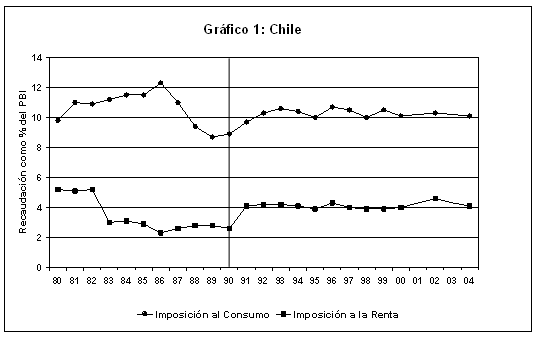
Pinochet's dictatorship (1973-90) added a liberal twist to direct taxes. Even so, the strength income taxes had acquired during the previous administrations kept them in relatively high levels for the region, above 5% of GDP until the beginning of the 1980s. But the reform of 1984 substantively diminished income taxes to a minimum of 2.6% of GDP in 1986. Subsequent reductions of taxes made the state lose one fourth of its fiscal income between 1984 and 1989 (total load was reduced from 20 to 15% of GDP), whereas inequality and poverty worsened.
After dictatorship, trying to respond to those needs, Concertación por la Democracia proposed during the electoral campaign of 1989 to fund the expansion of social policies based on increasing income taxes.
Concertación won the election with the absolute majority, giving presidency to Aylwin (PDC, 1990-94), and having the majority of the seats in both chambers. In the Senate, Concertación had 22 seats, while the right wing coalition had 16 - Renovación Nacional (RN) and Unión Democrática Independiente (UDI). But the system designed by dictatorship included 9 supplemental seats of "appointed senators" who, owing to their right wing filiation, left the government without a majority in that chamber –the number of senators appointed during Aylwin's period was 8, as one of them died and was not replaced (Siavelis, 2001; Angell, 2007).
Despite being a feasible strategy, the government discarded capturing from the appointed senators the two votes necessary to pass a reform (Fairfield, 2006). Instead, it negotiated with Renovación Nacional (RN), the biggest opposition party, leading to a fiscal policy defined by consensus.
The peculiar political environment of democratic reinstatement was the determinant for the government to choose policies through a representative negotiation with the left wing opposition, instead of looking for the minimum majority to pass its projects with the least number of modifications. The distributive fight that marked Allende's defeat and the imposition of dictatorship led Concertación to be especially cautious in its relationship with entrepreneurs and the right wing opposition. Therefore, the fact that policies in general and tax reform in particular expressed a government-opposition-civil society agreement was seen as essential and not the imposition of the government's criteria on the rest of the spectrum.
]]> The negotiation with RN helped fulfilling some of the government's objectives and transformed others. On the one hand, part of the agreement with the majority of the political right wing was the key to overcome the entrepreneurs' resistance to the increase of income taxes on businesses, moving the rate from 10 to 15%. On the same token, a progressive adjustment of the personal income tax was agreed through changes on the stretch structure (Fairfield 2006).Owing to the right's resistance to accept changes of greater scope in income taxes, an increase in collection was established and reached by means of a raise in VAT rate from 16 to 18%. The increase in consumption rate, of regressive effect, had not been part of the Concertación's reform plan and, in fact, it was objected by its left wing. Though, it was incorporated to reform as one of its main pillars and it was responsible for one third of the increment in tax collection.
The results of the strategy developed in Chile were a complex mixture between important changes in the short term and a gradual decrease of subsequent possibilities of transformation.
There was a significant recovery of returns through income taxes, which moved from 2.5% of GDP to 4, though the levels prior to the reform of 1984, above 5 points10.
Even so, this peak in the levels of tax collection was also the only big transformation and the only important progressive change in national level taxes in Chile since then. Both political and economic factors contributed to this continuity. Among the first there is the Chilean model of "consensual democracy", as the strategy of agreements with the opposition as a means to reach governability has been called11. Even if this concept was born in the context of the democratic transition, being put into practice contributed in reaffirming it, turning it into an element of Chileans' political culture.
The validity of this feature was supported by institutional factors, such as that of appointed senators, who prevented the Concertación from having its own majority in the senate until Lago's government inclusive. However, in the case of fiscal policy the matrix of "consensual democracy" was also supported by a growing conceptual coincidence between the government and the opposition.
In 1990 the right wing accepted it was not politically feasible to sustain dictatorship's fiscal scheme. Coalition governments had a tendency to incorporate the postulate that direct incidence of tax policy on income redistribution is of poor relevance compared to the effects reached by public spending (concept accepted in general terms in technical discussions and strongly promoted in Chile by the right wing). The claim of the liberal right following this principle is that it is not relevant that the tax system have regressive effects if collection be used to fund progressive public spending whose effect on income distribution will be substantively greater than the impact of fiscal policy.
The state will then have to worry about redistributing income exclusively by means of spending, and collecting funds for such policies preferably through taxes that are simple to charge, easy to control and of less distortive effect on social features of consumption and savings. That is, to finance them through consumer taxes, in spite of the little margin of regressive impact they generate and will then be reversed by the effect of spending12.
The 1990 reform included a component of this kind, when the government accepted that a great deal of the resources for its social policy would come from an increase in consumer taxes. But if in that occasion the main emphasis was placed on increasing income taxes, the evolution of Concertación's fiscal policy has been signed by the stagnation of growth and even the reduction of the elements of progressiveness of the system, and by a close relationship between financing of social policies and consumer taxes. Even if the effect of this policy has been regressive in comparison with its fiscal effect, it is conceptualized as progressive because of its global impact as it has been directed towards financing social public spending.
In 1993, at the end of Aylwin's period, the 1990 agreement had to be revised. The reform had generated an increase on taxes that was greater than the estimated by its creators, and the Concertación's government accepted to eliminate the amendments upwards on the personal income tax. There was even a staggered reduction of rates to levels below those of democratic restoration (decreasing the maximum marginal rate from 50% to 45% between 1993 and 1995) in exchange for the right wing to accept the increase on the rate on entrepreneurial income, which had been the core of the reform.
]]> At the beginning there was also an agreement to return to the VAT rate prior to the reform in the following administration (16%). However, under the government of Frei Ruiz-Tagle (PDC, 1994-2000) a new agreement with the opposition determined that the VAT rate would be maintained in 18%, devoting collection of those two points of the tax to funding education.Under Lagos's socialist government (2000-2006) rates of the personal income tax were again reduced (setting in 40% the marginal maximum since 2003) at PDC's initiative and as a response to the deceleration of economy. Its effect was attenuated by a complement proposed by socialism: to simultaneously elevate income taxes on businesses to 17%.
Meanwhile, funding for social policies was again resolved through consumer taxes: the VAT rate was raised to 19%, until the following government, and it provided the funds for the health care system reform and the program of direct income transfers "Chile Solidario".
During Bachelet's (PS) administration, there were strong complaints from the socialist and christian democratic branches to implement a tax reform which would increase the social budget. Though, the executive resisted the parliament's pressure and finally (2007) agreed to take the VAT to 18%, as it was foreseen in the previous period and without new changes to the system.
It can be said that the Concertación's administrations removed fiscal policy from the arena of party confrontation, both due to their pragmatism and because they created a true "normative regime" –in Przeworski's sense- in economic policy in general and in the fiscal strategy in particular13.
On the other hand, the poor transformation that has characterized the Chilean fiscal system since 1990 is also a result of its macroeconomic stability, supported by basic coincidences on budgetary management. In other cases in the region, tax load has grown as a result of needs resulting from fiscal deficit, economic crises and growing financing needs of social security systems. In Chile, privatization of the pension system removed that pressure and the sustained strategy of maintaining a regime of fiscal superavit pushed away the possibility that tax load grew as a result of ephemeral needs. While this kind of needs has been a key factor for the increase of taxes in cases such as Argentina or Uruguay, its absence in Chile has conditioned stability of the level of taxes and, together with it, the fact that the component of income taxes did not grow (in Argentina and Uruguay this resource had to be used to increase general tax collection).
Finally, it has to be pointed out that this situation turns Chile into the only case of complete "political management" of the fiscal system in the region. Being this "political management" the capacity of the executive and the parliament to operate on the fiscal scheme according to their policy objectives and not based on external pressures that condition the tax system (fiscal deficit, economic crises, load of contributions to social security). Thus, if the Chilean fiscal policy has resulted so stable it is due to the fact that, in the absence of pressures on collection levels, any increase on tax load has to be a result of explicit political will. The government has to fundament the use it will make of the resources and, as a result of "consensual democracy", convince the opposition of establishing this increase (which tends to be suppressed when the goal that motivated it has been reached).
As we will see, Argentina and Uruguay exemplify a different situation, with increases in fiscal pressure (and evolution towards a greater component of income taxes), facilitated by emergency contexts that make impossible to avoid them, but implemented in a way that prevents the load levels to be "managed", that is, debated with clarity and defined according to an explicit political will. Whereas in Chile the party system effectively governed tax load, in Argentina and Uruguay the amount of income from taxes was randomly defined, as its greatest changes have been determined in contexts where the political system loses control of macroeconomic variables.
5. Income taxes in Argentina14.
Like in Chile, the Argentinean dictatorship considerably reduced income taxes, which had expanded during the developmentalist phase in mid XX century, substituting it for raises in VAT15.
Alfonsín's administration (1983-89) tried to hold tax pressure, so Argentina had historically low levels of tax collection by the end of the decade, in particular, of income taxes16.
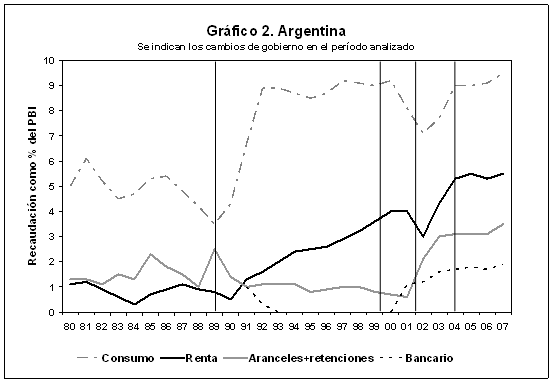
The substantive change to this scheme of low taxes took place during the "menemista" phase, and there is placed the increase of income taxes. The reform cycle of 1990-92 was focused on raising tax collection based on increases of VAT. This phase coincides with a period where the government acted by means of decrees, aiming at skipping legislative negotiation as the president still did not have support from the parliamentarians of his own party. (Novaro and Palermo, 1996; Novaro, 2001). Over the first two years VAT rate scaled three times (going from 13,5% to 18%). In 1992 a last increment of VAT (extending its scope) was contemporary to the beginning of the expansion of income taxes, with an important increase in the rate applied to businesses (from 20 to 30%).
Since 1993 a new period begins in the relationship between the executive and the legislative, by closing a phase of intraparty conflicts and protests, and Menem was able to build up a firm coalition to support him in parliament, sustained by Partido Justicialista and the liberal sectors (Novaro and Palermo, 1996; Novaro 2001). Also from that year on, income taxes will be responsible for the greatest increases on tax collection.
Since then, this was a persisting feature of the system under menemismo, to the point that between 1993 and 1999 income taxes were the taxes with the highest growth in collection of the period, with the exception of 1997 (when consumer taxes collection peaked, influenced by economic reactivation after the "Tequila" crisis).
In some occasions this characteristic of menemismo's fiscal model has been left aside, especially because it is an incremental movement, of gradual increases, not politically sensitive and not highlighted in the public agenda. But the global result of this slow movement was an important change towards strengthening income taxes and the progressive elements of the system.
As it happened in Concertación's Chile and its "consensual democracy", the majority of this increase took place in income tax collection on businesses, mainly due to subsequent expansions in its scope.
In 1995 with the Tequila crisis and the loss of resources generated by privatization in the social security system in 1994, a new cycle of reforms began. The first important change was a new increase of the VAT to 22% (1995). But the greatest increase in resources in the 1995-98 reform was the result of income taxes on businesses, whose scope was expanded in 1995, 96 and 98. Complementarily, income tax increased marginally in 1998 (going from 33 to 35%). The reform package of 1998 was completed with changes on the VAT, establishing a minimum rate (10,5%) to reduce the tax load on basic products expanding its scope to other services that had been exempt. (Heymann, 2000).
]]> By the end of the cycle, the connection between justicialismo and liberal sectors achieved by Menem had begun dissolving. Duhalde led a movement from peronismo towards the center-left with arguments based on criticism to the social effects of liberal reforms and the need of policies that faced inequality generated by the menemista model. The emphasis on social policies that repaired damages caused by the liberal era placed Duhalde virtually overlapping the center left sectors of the Alianza (Novaro 2001). Thus, in the elections of 1999 the two choices that defined the dispute were based on similar positions aside from the model built during the 90s.Owing to the economic crisis they faced, and despite the gradual intentions expressed during the electoral campaign, both sectors ended up living a period of important changes in the tax system which redefined fiscal policy and set grounds for its current features.
After the Alianza won 1999 election, with De la Rúa as the presidential candidate, the Minister of Economy, Machinea, had to announce a package of measures involving a strong increase of tax pressure a few days after taking office, in an attempt of reducing fiscal deficit.
Despite being a change set by circumstances (and despite the economic policy of Alianza has been judged in Argentina as the continuity of menemismo – an example of this perspective can be seen in Dvoskin and Filc, 2008) 1999 reform in Argentina is, together with the Uruguayan of 2007, the product of a socialdemocrat approach to fiscal policy. In both, the approach defended by the center-left in office was imposed without negotiation with the opposition. The result of such scenario were reforms with an explicit ideological content, based on strengthening progressiveness placing more emphasis on tax load on the sectors of higher income.
Those reforms were oriented towards reducing the negative impact of consumer taxes, promoting income taxes. But they also stated a shift in this component, placing emphasis on personal income taxes, which was different from the priority of taxing business revenues shown by right wing governments and the "consensus" formula of Chile.
The reforms of 1999 emphasized personal income tax, reducing the minimum amount where the tax was not applicable and, in the sections of higher income, increasing the amount and reducing deductions, to achieve higher collection and a more progressive structure. At the same time the tax basis was expanded to business revenue. Complementarily the basis of VAT was also expanded and new specific consumer taxes were created – tobacco and non alcoholic drinks.
The core of the reform, centered in income tax generated for the year 2000 an increase of 0.4% of GDP in collection, of which 0.3 correspond to the increase in collection of personal income tax (the tax with the highest growth that year).
As the Argentinean crisis aggravated, the government needed to create new taxes because the reduction in levels of activity, elusion and a raise in interest rates on debt and credit, made reduction of the deficit impossible.
From a retrospective point of view, during mid and towards the end of the 90s, income tax had taken the lead as responsible for the increase of tax load, substituting consumer taxes. The Alianza's government followed that same line, though with greater emphasis and as part of an explicit political choice. However, the fact that the crisis worsened made it necessary to continue looking for new elements when efficient increases on traditional products could no longer be applied.
In that framework, in April 2001, the creation of the tax on bank transfers was established, which had already been introduced in Brazil as a temporary tax (and then kept without a definition on its continuity). In a context of recession where income tax collection was stabilized and consumer tax collection was reduced, the so called "tax on checks" constituted the sphere of greater increase of collection in 2001.
]]> When the crisis worsened, those increments by means of strengthening alternative items did not compensate for the loss in traditional items. In 2001, despite the good performance of banking taxes, fiscal load in terms of GDP was reduced, whereas GDP itself was also reduced and the economic crisis derived in a financial and political crisis.De la Rúa was forced to abandon office in December 2001, and in January Duhalde was appointed by parliament to continue his predecessor's period, which in terms of fiscal policy implied a shift towards heterodox tools.
De la Rúa's government, in its efforts to control the crisis had already been forced to leave orthodoxy aside when installing the "tax on checks", unanimously questioned by the economic doctrine for its distortive effects on the dynamics of economy and banking. However, with Duhalde the path of heterodoxy acquired a different sense, as government was led by an heir to the historic peronismo of a developmental matrix, favorable to an interventionist and industrialist state. If regarding income taxes the Alianza's government emphasized for ideological reasons the increase on tax load Menem had established before for practical reasons, De la Rúa's fiscal heterodoxy, with merely pragmatic instruments and justifications, became, with Duhalde, the expression of a strategic and ideological option regarding the way to capture resources for the state.
When taking office in January 2002, Duhalde announced he would restore the system of withholdings on exports. The practical opportunity to apply the measure was provided by free exchange rate, ending up with "convertibility", because it imposed on the government the need to capture capital to reduce devaluation.
However, his reasons were deeper, as Duhalde stated when he established there would be a 20% withhold on primary products exports, aiming for supporting an industrialist policy. IMF's intervention against this approach led to a temporary modification of the government's route, passing in April a 5% rate applied to all items (Heidrich 2002). But the norm contemplated the possibility of future increases, which could led to withholdings on certain products at higher rates, and based on this element the tax could turn into a system of detractions focused on agrarian production.
In 2002, withholdings on exports were the main item of collection growth and, in fact, one of the few to produce an increase in fiscal revenues, in a context of paralysis where both consumption and income taxes went backwards in terms of effective tax collection.
Moreover, the baking tax that had been part of a means of reducing VAT elusion during De la Rúa's period, turned into a new tax with Duhalde as it could no longer be subtracted from VAT.
Argentina continued generating new fiscal pillars, completing the cycle of changes signed by dynamism in consumer taxes at the beginning of the 90s, of income taxes in the rest of the period and the movement of that dynamic to heterodox taxes, first with the baking tax and then with withholdings on exports, the following year.
In the midterm, the result of the big Argentinean economic crisis allowed an extraordinary increase of resources captured by the state. In a context of economic decay in 1999-2002 the governments had to constantly look for the creation and strengthening of tax tools to react when faced with the fall of tax collection as a result of the crisis. In the short term, these instruments could only cushion the global fall of collection, so fiscal pressure would be reduced (effective net load was reduced from 17,3% to 16,5% of GDP between 1999 and 2002). After reactivation began, a highly strengthened tax scheme in comparison with that previous to the crisis started to operate for the first time on an economy in normal conditions of activity and fulfillment of payments. The result was a historical increase in tax load vis-à-vis GDP placing the state in levels of attraction of resources the economy had never had (reaching 23% in 2003-04 expansion).
The kirchnerista left wing that takes office in 2003 inherits a fiscal system that had been redefined during the crisis under socialdemocrat and developmentalist parameters which, together with the raise of fiscal load determined a progressive bias.
]]> It can be argued that in the period of reactivation, the center-left inherited its own construction; therefore, Kirchner's fiscal policy was signaled by the defense of status quo, avoiding claims for reforms that accounted for the growth of economy, tax collection and inflation.17In this period International Financial Institutions lost their influence on the definition of fiscal policy, the IMF, tried unsuccessfully in 2004 to obtain a commitment from the Argentinean government to begin removing heterodox taxes from 2005 on.
Furthermore, the party opposition's weakness resulted in the government's fiscal strategy having corporate groups as its main contestants, even the government's political allies, instead of political leaders. In 2006, Kirchner had to respond to a conflictive mobilization of the oil sector employees who claimed for a reduction of personal income taxes.
The incidents generated during mobilizations made the claim popular and forced the government to establish a reduction in personal income taxes specifically for workers. In 2007, after claims from the labor union (CGT) to increase the minimum income level to which taxes are not applicable, there were two subsequent modifications, announced jointly by the economic team of the government and union leaders. This scenario, and the one that was taking place in Uruguay in parallel, account for the problems of economic management to handle reactions against strengthening a kind of tax that, despite expressing a leftist approach, was installed with a greater load than the left itself was willing to accept.
The government responded to labor unions complaints, so that the conflicts generated by the personal income tax could be controlled, but the same did not happen in the case of withholdings to the agrarian sector. Protests had begun with Duhalde, but the subject of complaints was the application of VAT and income taxes on the sector. When withholdings on exports grew, they became the focus of discomfort, and a new increase of rates established by Cristina Fernández's administration was blocked by a union's mobilization that was not only a catalyzer for political opposition but it also affected cohesion within the government at the executive and parliamentary levels.
6. Income tax in Uruguay 18
Uruguay tried to apply the personal income tax (introduced by the blanco government in 1960; García Repetto, 2006) which could be eliminated by dictatorship in 1974 for both reasons; the same year as Pinochet carries out his first restructure of the tax system in Chile, maintaining the income tax as a key feature of the model.
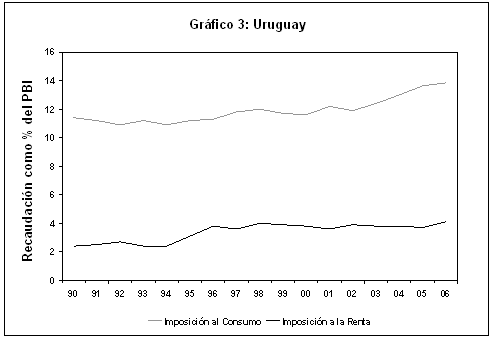
]]> Since then, taxes on businesses were the only form of income tax, even if dictatorship itself introduced in 1982 an incomplete form of personal income tax: the IRP ("tax on personal retributions") which was applied only to salaries and pensions, and in the 80s maintained a low tax level (rates of 1 and 2%, not marginal but applied on total income). Moreover, VAT was increased several times in that decade which placed it in 20% (1984) and then 21% (1987).During the periods of coalition governments of Partido Colorado and Partido Nacional in the 90s there was a greater tax collection through increases on VAT (established following the electoral cycle, in the first year of government of Lacalle and Sanguinetti) and on income taxes (made by Lacalle and maintained in Sanguinetti's period).
In 1990 Lacalle's government accompanied a new increase on VAT to 22%, and upwards adjustments to IRP. Taxes on businesses were set on 40% for a year, returning to 30% in 1991, and it was then expanded to public enterprises. IRP rates, of 1% and 2%, increased to 2%, 6% and 8%, though the duration of those values was the product of a specific context and after a staggered decrease they were established in 2%, 4% and 6% since 2003. From that point onwards, and for almost all the decade, those values remained stable. The beginning of Sanguinetti's government pointed increments of tax load only by means of VAT (which peaked to 23%) and Batlle's began without modifications.
But as the crisis worsened big changes in the tax system were necessary. At the beginning, the government concentrated increases by means of consumer taxes, which had been the traditional instrument of previous administrations, incorporating COFIS (Contribution to Financing Social Security) at a rate of 3% added to VAT. Besides increasing consumer taxes, the measure transferred part of income taxes to consumption, as IRP rate decreased to bands of 0%, 2% and 4% (2001).
However, this intent was ephemeral and in 2002 the need to collect more obliged to raise income taxes as an additional instrument to the increase in consumer taxes. The IRP was adjusted again, having a structure of eight sections above the minimum, with rates ranging from 4 to 20%. In terms of collection, this generated that income from IRP (whose level was generally below a half of collection on businesses income) surpassed taxes on businesses income in 2003.
Owing to the high political sensitivity of this increase in personal taxation, the government eliminated the increase in 2004, when reactivation and the proximity of elections prompted it, going back to the previous scale, which was the lowest since 1990.
Thus, the arrival of the left wing to office in 2005 takes place in a fiscal scenario similar to that of Argentina regarding tax collection growth, but very different regarding its components. Reactivation was followed by an important increase in the percentage of economic resources attracted by the state, as a result of having maintained the taxation scheme of the crisis (for a context of poor levels of activity) during a period of growth. By preserving that status quo, fiscal pressure went from around 17% of GDP prior to the crisis, to 20% in 2006 (excluding contributions to social security).
Like in Argentina, the crisis produced a strengthened state, which attracted resources in a greater proportion than before. Such collection levels were possible because the dynamics of the crisis separated in two phases the increase on taxes. During the crisis, taxation rates increased as it is necessary, and the government generally presents reforms as temporary. Those changes do not achieve all their potential increase until the next phase of economic expansion. Therefore, during the reactivation tax pressure as a percentage of GDP grows fast, though outside of the political agenda, without new reforms. Due to this mechanism the state in Argentina and Uruguay reached a higher level of tax collection than it would have in such a short period, had not been a crisis. The political system would have hardly achieved the necessary majorities to increase fiscal pressure in almost four points of GDP if that had been established as an explicit goal in a normal economic context (though it certainly did it in a way that eluded political discussion, which cannot be prevented in situations of fiscal equilibrium, like the Chilean).
Even so, it is important to highlight that such increase of fiscal pressure has not motivated the creation of liberal platforms among the local parties that call for a return to the tax load levels prior to the crisis. In the case of Uruguay, both the Partido Colorado and the Nacional claim for a reduction of certain taxes in particular, but returning to the tax load level of the 90s is not suggested.
On the other hand, the adaptation of the fiscal system was carried out in Argentina and Uruguay through different mechanisms. Kirchner's left inherited a tax scheme redefined by Alianza and Duhalde along certain lines with which the government agreed. Meanwhile, Frente Amplio had to take control of a fiscal scenario where consolidated changes had the opposit direction, reinforcing consumer taxes and regressiveness.
]]> Just like Alianza in 1999, Frente Amplio seeked to strengthen progressiveness on the basis of a greater role of personal income taxes. But when it took office, the opportunity to make normative changes to increase fiscal pressure had gone, so the shift towards lesser regressiveness had to operate in exchange for a reduced load on consumption. The package of measures was focused on the elimination of COFIS and several other consumption taxes and an increase of the load on personal income (applying a real personal income tax on an ample spectrum of income). Complementarily, VAT rate was reduced as well that of business income tax. Though this was compensated by the expansion of VAT basis.This implies the reform of Frente Amplio had the particularity of having an exclusively ideological motivation, as it sought to reinforce progressiveness without increasing the total load. The changes introduced could not be justified in terms of necessity but exclusively in terms of ideals of justice. The reform had, then, a more explicit political component than any of its national or regional antecedents and, thus, it has been particularly exposed to party confrontation.
There is also the fact of the high political sensitivity of personal income taxation in a context where societies are not used to it and also the fact of highlighting its ideological features, presenting it as a "left wing" reform and thus not open to negotiation with the opposition.19. The bill was passed in parliament with the party in office's own majority. This contributed in protecting the impact of the reform and its progressive bias; different from what happened to the Chilean Concertación and the proposal it negotiated with the opposition in 1990, which derived in a reform with less progressive emphasis. But it also contributed in putting it at the core of the opposition's discourse.
The fact of not having been negotiated with the other parties favored the economic team's position in internal negotiations, as some of the elements that generated resistance in the frentista branch were then subject of the oppositions' attack. That is the case of the non taxable income which the economic team managed to maintain in a lower amount than the government's branch aimed for (Abelando, 2006). Thus, it is likely that the non taxable income had been higher had there been an open negotitation with the other parties and within the Frente Amplio. After the bill was passed, the opposition increased its criticism on this point, which increased complaints within Frente Amplio and even within the government to correct it.
Moreover, the government's branch also aimed for extending the regime of deductions of the personal income tax, to diminish its progressive emphasis, which made it necessary to reduce the VAT in one point, instead of two.
The bill was passed in December 2006, several months later than foreseen owing to the long internal negotiation, and it was first applied in July 2007.
Its implementation generated a strong political reaction the opposition oriented towards inconstitutionality of the personal income tax applied on pensions. The response of the government was to substitute the tax for a specific, new one. They also took the opportunity to reduce tax load on that sector, followed by raising the non taxable income, which in 2008 had turned into an internal complaint of Frente Amplio.
]]> 7. Conclusions
Income taxes have increased since 1990 in all countries studied and under governments of different ideologies, though under different formats. With right wing governments this increment followed a liberal matrix. Under majority left wing governments, it did so based on a socialdemocrat or developmentalist matrix, which were combined with elements of the liberal strategy in the case of Chile (where governments acted on the basis of agreements with the right wing opposition).
Together with political factors, fiscal equilibrium has contributed in Chile to the immobilization of the tax system. On the contrary, greater exposure to external shocks and economic crises of Argentina and Uruguay generated in both cases an increase of state income and in the Argentinean case an heterodox evolution of fiscal policy.
The conceptual framework set by developed countries is only partially transferable to the región. For example, the right and left wing covergence towards a "normative regime" in economic policy and the little relevance of progressiveness of the fiscal system as a distinctive feature among them. Chile evolved towards a normative regime based on the fact that the redistributive effect of fiscal policy is marginal when compared to that of public spending. Thus, it would not be necessary to face the government with political confrontation to defend progressiveness through fiscal mechanisms, if that can be achieved without conflict by means of spending. In turn, in Argentina and Uruguay the fiscal sphere has been the center of confrontation between left and right and this debate has been stated precisely in terms of progressiveness and redistribution. In Argentina debate has taken place in a fiscal scheme that was deeply changed during the crisis. In Uruguay it happened based on smaller changes but of particular political sensitivity.
The cases studied suggest contributions for debate on what formats of reform are more effective to produce progressive changes in the tax scheme. ECLAC has proposed the "fiscal pact" as a mechanism (and for the increase of fiscal pressure, when necessary) defined as an agreement between the government, the opposition and civil society (ECLAC, 1998). The Chilean experience of 1990 (closet o the notion of fiscal pact) shows that, in special contexts, relevant changes can be achieved. Furthermore, the conflict generated by the fiscal strategies of the left wing governments of Uruguay and Argentina exemplifies the political risks of non negotiated reforms. However, the Chilean format has evolved towards maintaining the status quo, while in Argentina and Uruguay there has been a greater advance in terms of direct taxes as opposed to the indirect ones, and, therefore, more progressive designs by means of "governmental" reforms, applied without intraparty negotiations.20 In fact, the reforms generated in the region to strengthen income taxes, had to reduce their scope and moderate their effects when going through instances of negotiation, even when there was an internal discussion among the economic staff of the government and its own branch. Then, the most beneficial political scenario to strengthen progressiveness was provided by governments with majorities willing to act in that sense. The result could be politically unstable, but the tax scheme has a strong component of inertia, which makes important changes difficult. Hence, in contexts particularly favorable to change, a reform can condition the design of the system in the long term and not be substantively reversed, even after rotation in government. An example of this is the Argentinean conflict of 2008, when rural unions emphasized the fact that they did not question the imposition of withholdings on exports but the increase of rates established in March. It is relevant to highlight that in a conflict where some actors questioned the continuity of the government, the continuity of subtractions was never questioned; despite Argentina is the only Latin American country to apply them widely. In this sense, the Argentinean tax scheme is more conditioned by Duhalde's fiscal reforms than by the current political scene.
REFERENCES
Abelando, Víctor (2006). La reforma tributaria en disputa. Brecha Digital, Edición N° 1073. Disponible en http://www.brecha.com.uy [ Links ]
Angell, Alan (2007). Democracy after Pinochet: Politics, Parties and Elections in Chile. Londres: ISA. [ Links ]
]]>Ardanaz, Martín y Ariel Dvoskin (2008). "La evolución histórica del Estado de bienestar en la Argentina: una mirada desde el gasto social y los impuestos", en Filc, Gabriel (comp.) Las políticas fiscales en la Argentina: un complejo camino hacia la equidad y la eficiencia. Buenos Aires: CIPPEC. [ Links ]
Baytelman, Yael, Kevin Cowan y José De Gregorio (1999). "Política económica y bienestar: el caso de Chile", en Serie Economía 56. CEA, Universidad de Chile. Disponible en http://www.webmanager.cl [ Links ]
Boylan, Delia (1996). "Taxation and Transition: the Politics of the 1990 Chilean Reform", en Latin American Research Review 31(1): 7-31. [ Links ]
Boix, Carles (1998). Political parties, growth and equality. Conservative and social democratic economic strategies in the world economy. Cambridge: Cambridge University Press. [ Links ]
Bradley, David, Evelyne Huber, Stephanie Moller, Francois Nielsen y John D. Stephens (2003). "Distribution and Redistribution in Postindustrial Democracies", en World Politics 55 (2): 193-228. [ Links ]
Engel, Eduardo, Alexander Galetovic y Claudio Raddatz (1998). "Reforma tributaria y redistribución del ingreso en Chile". Serie Economía N°40, Agosto. CEA, Universidad de Chile. Disponible en http://www.webmanager.cl [ Links ]
Comisión Económica para América Latina y el Caribe (1998). El pacto fiscal. Santiago: CEPAL. [ Links ]
Dborkin, Daniela y Germán Feldman (2008): "Los ingresos públicos", en Filc, Gabriel (comp.) Las políticas fiscales en la Argentina: un complejo camino hacia la equidad y la eficiencia. Buenos Aires: CIPPEC. [ Links ]
Dvoskin, Ariel y Gabriel Filc (2008): "Introducción", en Filc, Gabriel (comp.) Las políticas fiscales en la Argentina: un complejo camino hacia la equidad y la eficiencia. Buenos Aires: CIPPEC. [ Links ]
Fairfield, Tasha (2006): "La reforma tributaria en Chile", en Gómez-Sabaini, Juan (ed.) Cohesión social, equidad y tributación (análisis y perspectivas para América Latina). Informe presentado al seminario Cohesión Social en América latina y el Caribe, CEPAL, julio; Disponible en http://www.cepal.org [ Links ]
Ffrench-Davis, Ricardo (2003): Entre el neoliberalismo y el crecimiento con equidad: tres décadas de política económica en Chile. Santiago: Comunicaciones Noreste Ltda. [ Links ]
Fleet, Michael (1985). The Rise and Fall of Chilean Christian Democracy. Princeton, NJ: Princeton University Press. [ Links ]
Gaggero, Jorge y Federico Grasso (2006). La reforma tributaria necesaria en Argentina. Problemas estructurales, desafíos y propuesta. Disponible en http://www.cefid-ar.org.ar [ Links ]
Garcé, Adolfo y Jaime Yaffé (2004). La era progresista. Montevideo: Fin de Siglo. [ Links ]
García Repetto, Ulises (2006). "La experiencia del sistema de imposición a la renta en el Uruguay de los sesenta". Documento de Trabajo 05/06. Instituto de Economía, Facultad de Ciencias Económicas de la Universidad de la República. Disponible en http://www.iecon.ccee.edu.uy [ Links ]
Garrett, Geoffrey y Peter Lange (1991). "Political responses to interdependence: what's ‘left' for the left?", en International Organization, 45 (4): 539-564. [ Links ]
Gómez-Sabaini, Juan (2006). Cohesión social, equidad y tributación (análisis y perspectivas para América Latina). Informe presentado al seminario Cohesión Social en América latina y el Caribe, CEPAL, julio; Disponible en http://www.cepal.org [ Links ]
Grau, Carlos, Fernando Lorenzo y Gabriel Oddone (2004). Ideas y lineamientos para la reforma tributaria. CINVE. Disponible en http://www.cpa.com.uy [ Links ]
Heidrich, Pablo (2002). Un semestre de crisis en Argentina. Documento presentado al Observatoire des Amériques, UCAM. Disponible en http://www.er.uqam.ca [ Links ]
Heymann, Daniel (2000). "Políticas de reforma y comportamiento macroeconómico: la Argentina en los noventa", en CEPAL, Serie Reformas Económicas, Nº 61; http://www.cepal.org [ Links ]
Iversen, Torben y David Soskice (2006). "Electoral systems and the politics of coalitions: why some democracies redistribute more than others", en American Political Science Review. 100 (2): 165-181. [ Links ]
Lanzaro, Jorge (2006). "La ‘tercera ola' de las izquierdas latinoamericanas: entre el populismo y la social-democracia". Ponencia presentada a las V Jornadas de Investigación Científica, Montevideo, Facultad de Ciencias Sociales de la Universidad de la República. Montevideo, agosto. Disponible en http://www.fcs.edu.uy [ Links ]
Myrdal, Gunnar (1960). Beyond the welfare state. New Haven: Yale University Press. [ Links ]
Novaro, Marcos (2001). "Presidentes, equilibrios institucionales y coaliciones de gobierno en Argentina, 1989-2000", en Lanzaro, Jorge (comp.), Tipos de presidencialismo y coaliciones políticas en América Latina. Buenos Aires: CLACSO-Asdi. [ Links ]
Novaro, Marcos y Vicente Palermo (1996). Política y poder en el gobierno de Menem. Buenos Aires: Editorial Norma. [ Links ]
]]>Pérez, Claudio (2005). "Chile. Un ejemplo de inequidad tributaria", en Revista Aspectos N°1. Disponible en http://www.googlepages.com [ Links ]
Przeworski, Adam (2001). "¿Cuántas terceras vías puede haber?" en Revista Istor, 7. Disponible en http://www.istor.cide.edu [ Links ]
Serra, Pablo (2006). "La reforma al sistema tributario chileno: una tarea inconclusa", en Estudios Públicos 101, verano. Disponible en http://www.cepchile.cl [ Links ]
Siavelis, Peter (2001). "Chile: las relaciones entre el poder ejecutivo y el poder legislativo después de Pinochet", en Lanzaro, Jorge (comp.), Tipos de presidencialismo y coaliciones políticas en América Latina. Buenos Aires: CLACSO-Asdi. [ Links ]
Stephens, John (1996). "The Scandinavian welfare states: achievements, crisis, and prospects", en Esping-Andersen, Gosta (ed.), Welfare states in transition. National adaptations in global economies. Londres: Sage, pp. 32-65. [ Links ]
Titmuss, Richard (1958). Essays on the welfare state. Londres: Unwin University Books. [ Links ]
Zorrilla, Américo (1970). "Discurso del ministro de Hacienda Américo Zorrilla, 10 de diciembre de 1970", en Archivos Salvador Allende. Disponible en http://www.salvador-allende.cl [ Links ]
Press
Búsqueda, El Observador, El País, La Diaria, La República (Montevideo); Clarín, La Nación, Página 12 (Bs. As.), El Mercurio (Santiago).
Web pages
Dirección General Impositiva: http://www.dgi.gub.uy
Ministerio de Economía y Finanzas: http://www.mef.gub.uy
® Article received on 20 July 2008 and accepted for publication on 15 November 2008
]]>
* Bachelor's Degree in Political Science. Master's Degree Candidate, Universidad de la República.
1 See Titmuss (1958) and Myrdal (1960).
2 In the United States, Quinn and Shapiro (1991) identified in democrat administrations a tendency to raise taxes on businesses' income and holdings of capital, while republicans prioritized incentives towards investment. For Europe, however, Garrett and Lange (1991) explicited the absence of correspondence, even stating that there could be a direct relationship between liberal matrixes and higher tax rates on businesses.
3 For example, the USA has collected around 90% of its total fiscal income through income taxes. In Sweeden, the composition has been around 60% of collection through consumer taxes and 30% through income taxes; a very similar composition to that of South America, but twofold in terms of tax pressure in relation to GDP (statistics from the World Bank taken from Grau and Lagomarsino, 2002).
4 Boix (1998) introduces the opposition between direct and indirect taxes when describing the socialdemocrat and liberal approaches based on two case studies: Felipe González's reforms in Spain (tax raise with emphasis on direct taxes) and those of Margareth Thatcher in the UK (where personal income taxes decreased). However, taking those cases and period limits the argument as Spain's levels of tax pressure and income taxes were very low. The socialdemocrat government was making such variables converge with those of the UK. The model does not only contrast two ideological approaches, but two cases with different tax loads at the starting point. The model cannot be transferred to socialdemocrat governments in countries with a high level of income taxes, which, following international competitiveness, operated downwards on the Personal Income Tax; a well known example is that of the Swedish reform of 1989-90 (see Stephens, 1996). In this sense, the fiscal situation of Mediterranean Europe and the responses it triggered on the left wing are not transferrable to the whole of Europe. It is not in Europe but in the Southern Cone where, as we will see, a similar scene to that of Felipe Gonzalez's reforms is set since the 90s.
5 On Frente Amplio, see Garcé and Yaffé (2004); about Allende's tax policy,see Ffrench-Davies (2003) and Zorrilla (1970).
6 In this case, after dictatorship, advances in income taxes are produced only under the governments of Partido Nacional, while Partido Colorado maintained its traditional rejection to that tool and choosing taxes on patrimony instead.
7 Income taxes are more complex to apply to people than to businesses. That is why in South America it has been usual to develop income taxes based on taxes on businesses, paying little attention to personal income, despite the fact that personal income taxes can account for a wider range of earnings and guarantee a lower tax transfer (the eventual progressiveness of the income tax on businesses depends entirely on them not transferring its cost to consumers). That is why leftist approaches on tax policy have aimed at developing personal taxes; this characteristic is consistent with the European scenario, where income tax rate on businesses, limited by international competition features, is not an effective variable to differentiate the left from the right. ]]>
8 Figures of collection and rates taken from Baytelman et. al. (1999), Pérez (2005) and Serra (2006). For all cases, figures of tax load refer to taxes themselves, excluding contributions to social security, considered at the national level. To facilitate comparative presentation, the conventional denomination of personal income tax is used; in each country both formats are divided in several taxes with different names used locally.
9 Fleet (1985), Zorrilla (1970).
10 Concessions to the right wing have generated the image that 1990 reform was moderated (see for example: Boylan, 1996; Fairfield, 2006).However, from a comparative perspective as the one stated here, it has to be highlighted that an increase of 1.5% in GDP from income tax collection achieved through a specific reform in only one year is an event hardly seen over the last decades in the countries studied. It is in the range of increase of collection by income in Argentina in 2003 (when the economy was reactivated and it reflected the impact of the Alianza's tax reform of 1999) and above the expected increase effect on income taxes by the frentista reform in Uruguay. Due to its practical effect, 1990 reform has to be considered amongst the most radical ones in the history of the region.
11 About this concept see for example Siavelis (2001).
12 For the Chilean case this view has been presented by Engel et. al. (1998). In fact, this is Boix's (1998) starting point who, when situating the difference between socialdemocrat and conservative governments in the total amount of tax load, states "this analysis involves taxes as instruments of income redistribution only in a secondary manner. As specialized literature generally states, the question of how the state affects income redistribution depends on social transfers and public spending more than the tax structure" (Boix 1998: 242).
13 Przeworski (2001) describes the "normative regime" as a point of convergence of the policies applied by different parties. Convergence takes place when new governments take office and assume successful policies inherited from previous administrations and finally installed in public opinion as requisites for stability. The peculiar Chilean conditions have led to areas such as tax policy reaching this situation without the intermediation of changes in governments between the two main competing coalitions.
14 Collection figures are taken from Gaggero and Grasso (2006), Dborkin and Feldman (2008). Modifications to rates and scope of taxes until 1998 are taken from Heymann (2000).
15 For a historical development of tax composition in Argentina: Ardanaz and Dvoskin (2008), Dborkin and Feldman (2008).
16 In the administrations of Allende and Alfonsín an old course of action of Latin American center-left can be identified, different from the current one. Both governments inherited a tax system they considered unfair. They established as a priority to reduce consumption costs (Alfonsín by reducing VAT rate, Allende by reducing public bills) and secondly they tried to strengthen direct taxes. The net result was that state revenue contracted in a way that compromised fiscal balance (about Allende see Ffrench-Davis, 2003; on Alfonsín, Ardanaz and Dvoskin, 2008). Since the 90s, the orientation of the left wing towards progressiveness involves not losing fiscal pressure, as a limit and as a priority.
17 It is of relevance that, according to the leftist format, Kirchner promoted, during his electoral campaign, a reform of the tax system in the same way as it was later done by Frente Amplio in Uruguay: exchanging a reduction of consumer taxes for greater direct taxes. The economic growth and the projection it generated on taxes (particularly direct taxes) led Kirchner to focus on preserving the inherited rules, without making any relevant changes. ]]>
18 Rates taken from Grau et al. (2004) Collection figures base don Grau et al., www.dgi.gub.uy and www.mef.gub.uy.
19 The expression belongs to Danilo Astori, Minister of Economy, during the parliamentary interpellation of 6 July 2007.
20 Bradley et al. (2003) and Iversen and Soskice (2006) state the same situation for the European context, arguing that the most distributive governments tend to be winning coalitions and that to one extreme of inclusion in political choice (for example Switzerland) corresponds a high veto probability, which minimizes redistribution. It is relevant that the perspective prioritizes the rational option over ideological factors to the point that it is not applicable to the region (redistributive conditions would be minimum winners to be able to charge costs on those excluded from the coalition, model which clearly does not respond to the scenery of, for example, the frentista fiscal reform of 2007).