Entre la legitimidad y la eficacia: reformas en los sistemas de elección presidencial en América Latina
Daniel Buquet
Doctor in Political Science for FLACSO-México. Professor and researcher of the Instituto de Ciencia Política, Facultad de Ciencias Sociales, Universidad de la República. E-mail: dbuquet@fcs.edu.uy
Translated by Lucía Tiscorniay and Mateo Porciúncula
Translation from Revista Uruguaya de Ciência Política, Montevideo, n.16, p.35-50, Dec. 2007.
ABSTRACT
This article proposes a model to explain electoral reforms, understood as competitive political processes that evolve in a democratic context. The model departs from a political crisis context expressed in a strong electoral volatility that leads to two different extreme types of electoral reform. When the reform is promoted by a "declining coalition", legitimacy arguments are mobilized and more inclusive rules are proposed. When the promoter is a "growing coalition", arguments on efficacy are used and more exclusive rules are put forward. The model is supported by an empirical analysis of all the reforms affecting presidential electoral rules that took place in South America from 1990.
Key words: Electoral Reform, Political Parties, Latin America
RESUMEN
Este artículo analiza las reformas electorales como un proceso político competitivo que se desarrolla dentro de un contexto democrático. Para explicarlas, propone un modelo que parte de un contexto de crisis política, expresada en una fuerte volatilidad electoral, que conduce a dos procesos típicos polares de reforma electoral. Cuando la reforma es promovida por una coalición declinante, se recurre a argumentos de legitimidad y se proponen normas más inclusivas. Cuando se trata de una coalición ascendente, la propuesta se fundamenta en problemas de eficacia del sistema y se busca establecer reglas más exlcuyentes. El análisis empírico que respalda el modelo considera las reformas a los sistemas de elección presidencial realizadas en América del Sur a partir de la década de 1990.
Palabras claves: Reforma electoral, Partidos Políticos, América Latina
]]> 1. Introduction
This article deals with electoral reforms, understood as competitive political processes that evolve in a democratic context. A competitive political process involves the interaction of different agents with varied or opposed interests and a democratic context demands abiding by certain rules that legitimate the process. This work seeks to establish the conditions that generate reform initiatives and the factors that determine which kind of electoral system is adopted. Even tough electoral reforms happen all around the world, this paper takes as its empirical basis presidential election system reforms occurred in South America since the 90s decade.
Over the last decades a vast literature about electoral systems and its effects on the political life of democratic countries has been produced.1 However, there is little research on the reform of such systems and it has been developed recently. Traditionally scholars have considered the electoral system as a stable and exogenous factor. Thus, such institutions functioned as independent variables which generated incentives in the political actor’s behaviour. Taking as a starting point Duverger’s seminal work (1957), substantial academic production has been developed, both theoretical and comparative. Such production has dealt mainly with establishing the impacts that the electoral system has over the number of political parties2, or over governability conditions3. However, only recently research has investigated electoral systems as a dependent variable, either looking for its causes or going after the reasons that drive its reform.
On the other hand, the third wave of democratization led a considerable group of countries to adopt democratic rule –among these most Latin American countries. This included the adoption of competitive electoral systems (Diamond 1999). Latin American countries that re-established their former democratic systems, normally restored the electoral system that ruled previous to the authoritarian interruption. This feature of democratization processes reaffirmed the idea of stability of electoral systems (Geddes 1996). Since then, and up to the present, democratic regimes have clearly prevailed in the region. However, contrary to the alleged stability of electoral systems, practically in all Latin American countries there have been relevant electoral reforms in this period. (Jones 1995; Payne, Zovatto et al. 2006).
Assuming there is not one optimal electoral system and observing that electoral reforms do not converge in a single set of rules, these processes become a relevant matter to be explained. As reforms are promoted by a part of the political elite that normally holds positions in government and relies on majoritary support, either in the Legislative or among the electorate, the explanation must come from those actors´ interests and the characteristics of their environment. (Boix 1999). This matter is not trivial because a reform coalition holds positions in government due to the fact that they have won elections, and so they should have some advantages with the current electoral system. Therefore, it is necessary to find out firstly which are the conditions and motivations that lead a political coalition in government to modify the electoral rules that once benefited them. Secondly, from those conditions and motivations it is necessary to know what kinds of reform we can expect. The model which will be presented next does not intend to predict when there will be an electoral reform and when there will not. Its main goal is to predict what kind of political reform we should expect, given a set of conditions of the political context and the characteristics of the reformist political coalition.
Even though the model proposed is a general one, and it is intended to be valid for every process of political reform, the empirical analysis that supports it is focused on the reforms of the systems that regulate presidential elections in South America. This decision is based on three reasons: i) first, the scarce attention presidential electoral systems have been given in comparative studies on electoral reforms4; ii) second, because in Latin America the presidency –for its particular relevance in the decision making process- is the main position disputed in elections iii) finally, because comparative studies have shown that the rules for presidential elections determine the effects of the whole electoral system. (Shugart and Carey 1992; Jones 1995; Maiwaring and Shugart 1997).
2. Theoretical model
This paper proposes a very general model that links three dimensions. The first dimension of the model implies the mere adoption of the assumptions of rational choice theory. Consequently, it is assumed that reforms are driven by politicians who take into account their own interest to evaluate the norms that regulate political competition. Therefore, politicians will normally be inclined to approve modifications when they assume these will benefit them, and, on the contrary, they will be reluctant to support changes that might impair them. Along with this first assumption, the model incorporates two additional motivational dimensions for the actors, legitimacy and efficacy. Legitimacy and efficacy may be the two essential attributes that any political system requires to be considered successful. (Lipset 1988). Also, besides being necessary, both dimensions clearly interact with each other. (Linz 1990); On the one hand, a government that holds legitimacy will have it easier to rule with efficiency, and on the other hand, getting the expected results will bring about greater legitimacy. But this virtuous circle can become vicious, as a government that does not attain the results it looks for, might, for that reason, lose legitimacy which would, in turn, be an obstacle to the decision making process and the implementation of successful policies.
Political reforms, particularly the most ambitious ones, are usually made based upon diagnostics which find deficits on both dimensions and, consequently, they tend to incorporate modifications both aimed at generating popular support (legitimacy) and facilitate the government’s work (efficacy). Besides, obviously, favoring –or at least not harming- the short-term interests of the members of the reform coalition. Despite the complementarities and feedback described above between legitimacy and efficacy, this is not necesarily the case regarding the norms that intend to generate one or the other. Quite on the contrary, there is usually a trade-off between both, that is, the norms that are intended to solve some problems in one of the dimensions may cause some in the other. Finally, many of the political reforms made in Latin America constitute package deals that come forward as the result of interparty negotiations that do not necessarily respond to a single rationale. Long-term perspectives and conjunctural interests, along with different political approaches, are combined in products that may bring about different and sometimes even opposite results to the ones originaly intended.
]]> The first step towards building a model that explains an electoral reform process consists in determining the conditions that set the process in motion. Nobody wants to improve an electoral system or tries to get greater electoral benefits without a diagnosis that establishes the existence of a problem that a new electoral system would be able to solve. Thus, the perception of a political crisis associated with some "disfunction" in the electoral system lies at the foundations of every electoral reform process. Critical diagnostics elaborated by dominant political elites can be classified into two categories: legitimacy deficit and efficacy deficit. In the first case the political class is increasingly perceived as self-referential and distant from citizenship. In the second case, political leaders are perceived as deadlocked and unable to perform the leading role they are meant to take. In any case, the dominant political group faces, in the short term, the risk of being displaced from power, or the risk of not being able to fulfill their government duties. It is the perception of such risk that constitutes the trigger of the electoral reform process.But this last statement does not mean the process derives linearly to the design of a reform that facilitates the continuity in power of the dominant group. There are two powerful reasons that support the impossibility of following that linear path. The first is that the reforms we are referring to are processed in democratic contexts, so, the mere possibility that a dominant group could alter the electoral system to their whims in order to remain in power would prevent the classification of such system as democratic. The second–and most important – reason is that the dominant group can hardly be treated as a unified actor whose members share the same order of preferences, even if they have the necessary majorities to manage the reform. Consequently, reforms must overcome two intertwined obstacles in order to be feasible. That is: complying with a series of formalities and reaching political agreement. Certainly, these obstacles can have different magnitudes according to the characteristics of the institutional framework and the configuration of the political map.
A good share of the scarce literature on electoral reforms assumes that elected politicians have as their main goal to stay in office and that their political performance will be oriented towards that goal. (Geddes 1996)5. This assumption leads to a first model of electoral reform that points out that every governing coalition with enough power to reform the electoral system will do so, whenever an alternative electoral system would give them greater benefits than the current one. (Benoit 2004)6. However, in the real world, politicians are not necessarily so ambitious and will surely be satisfied if they expect to win again within the framework of the current electoral rules. If a beneficiary of the current electoral system is interested in modifying it, this is because the same system that allowed him /her to win will prevent or hinder a victory the next time. (Cox 1997). The foundations for change from the perspective of the rulers can only be a consequence of a more or less radical shift in the political preferences of the electorate. This preferences shift –and the threat it represents to the ruling coalition- promotes a change to the electoral system in a more inclusive sense, as a means to increase the benefits for the losers of the system (Boix 1999; Colomer 2004).
Electoral reforms, though frequently proposed, are only exceptionally passed because the concurrence of diverse factors is necessary to make them successful. Generally, long term factors -expressing themselves in political, social and economic trends- are combined with particular aspects of the political situation leading to the configuration of a critical conjuncture in which the reform becomes viable (García Díez 2001). Firstly, the presence of a significant change in voters’ preference is needed, because, if the electoral context is stable there are no incentives for dominant parties to promote an electoral reform. An abrupt change in electoral preferences is the consequence of the deterioration of the political situation, which is perceived by the citizenry as an efficacy or legitimacy crisis. That is, either the citizens lose all trust in the politicians or, on the contrary, they see the political leaders impeded to bring along the necessary measures. In addition to this, it is required that the reform coalition have enough power to reform the electoral system, which in a democratic context means having majority support (or, even, a supermajority), this being in parliament, among the population or on both arenas simultaneously. If both conditions are met (interest and possibility) the dominant party coalition must agree on an electoral reform that benefits all its members.
Up to this point, the common characteristics of every process of electoral reform have been mentioned. From now on, there are two possible types of reform that depend on the type of dominant coalition that promotes it: either it is the case of a coalition whose popularity has declined and runs the risk of losing elections, or on the contrary, the coalition’s popularity is the same or has grown, so they would be in conditions to win elections again. Declining Coalitions are old winning parties who perceive themselves as future losers, sooner than later. In this case, the reform proposal would be oriented to re-legitimate the political system and would contain inclusive norms as a means to minimize possible future losses. Growing coalitions, in turn, are parties or movements that substitute former dominant coalitions as a consequence of a shift in electoral preferences. In such case the reform initiative would aim at improving the government’s efficacy with more exclusive norms, so as to maximize possible future gains.
There are two different typical processes that may lead to an electoral reform. The first has as its central actor a long-time ruling coalition that is losing the electoral support it used to have and, so, sees its possible victory in the next elections threatened. We call this type of actor declining coalition and we assign to the reform process the goal to protect their political status, either by aiming at a new victory or, at least,winning the maximum political space possible due to a change in the rules. In this kind of process, the reform drive is based upon arguments of political legitimacy and ample agreements about more inclusive norms are sought.
In turn, the opposite process takes place when old dominant parties (having achieved an electoral reform in their time or not) have been substituted by a new growing coalition. Opposite to the former case, the new majority comes to government with the expectation to keep or increase their support in the future, so they will have the incentives to seek a reform that expands the power space for the winners. This reform initiative is based upon arguments associated with the efficacy of the system and tries to establish more exclusive rules.
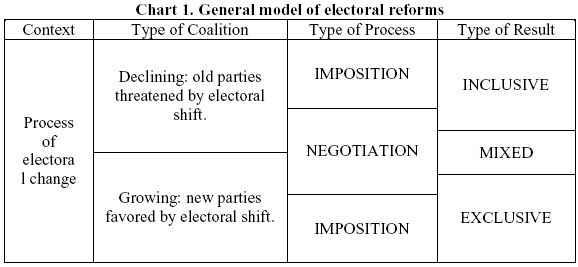
Evidently, electoral reforms in the real world do not have to respond to one of the two models in their pure form. This is so mainly for two reasons: firstly, because the assumed rationality of the actors is not perfect nor the information they have is complete, so, they could support reforms that might harm them electorally, and, secondly, because a reform coalition does not necessarily constitute a unified actor meaning that inside of it diverse and opposed interests could coexist, which would lead to a negotiated reform with initiatives of different types. In such case, the resulting reform could contain both more exclusive and more inclusive norms. Consequently, the result depends as well on the political process by which the reform is achieved, according to the power and homogeneity of the reform coalition. If there is a process of imposition of a reform coalition with homogeneous interests (either growing or declining) we could expect a result closer to one of the pure types of reform. However, if the original reform coalition should expand to include other actors to make the reform viable, it is more likely that the result will be a mixed reform. The following chart synthetically shows the presented model.
3. Empirical model
Research on presidential election systems has focused mainly on two variables: the method through which the position is appointed, or electoral formula, and the temporal relationship among presidential elections and legislative, or timing (Shugart and Carey 1992; Negretto 2006). But presidential elections, differently from the elections of heads of government in parliamentary regimes, are associated to a fixed term, a period which varies among constitutions and that has been subject to modifications in many of the electoral reforms which have taken place in the region. Due to this fact, in order to characterize the system, it is as relevant to establish the way to gain access to the position as it is to establish the period of its duration, or term. Furthermore, the duration of the term is determined not only by the government period but also by the possibility of an immediate re-election, so the norms that regulate the presidential re-election should also be included in the system characterization.
According to this, the paper focuses on three variables which are more relevant to describe the normative corresponding to presidential election in terms of inclusion-exclusion. Firstly the method or formula of election is considered. This allows for two main kinds: on one hand, plurality (PL) or first past the post systems and, on the other hand, methods that establish thresholds and include run-off elections (RO). The PL system implies that the candidate with the greater number of votes in a single election is the winner. Conversely, a RO system establishes a threshold to be reached in order to get the position in a first round7. If no candidate reaches the established threshold, there is a second vote, normally between the two candidates who got more votes in the first round8. RO systems are more inclusive than PL ones for two reasons. Firstly, a RO system, mechanically allows two or more winners in a first round, instead of a single winner which is the result of a PL vote. But these systems are more inclusive as well because second round systems disencourage strategic vote which is incentívated in a PL system, and so they favour the electoral expectations of smaller parties (Buquet 2004). Therefore, RO systems should be preferable by reform players who are members of declining coalitions in contexts of uncertainty and threat –more preferable the higher the threshold demanded to win in the first round-. In turn, growing coalitions should prefer the PL or a more reduced threshold of TR9.
The second variable is the duration of the term in years. A term will be more inclusive the briefer it is because there will be more changes of government and, consequently, more opportunities for more actors, in the same period of time. Therefore, a reform coalition who feels threatened should opt to reduce the duration of the presidential term, whereas a growing coalition will prefer to extend the duration of the term.
Finally, the last variable included is presidential re-election which, though admitting many varieties, in this paper is considered mainly in its immediate form. That is, the possibility that the president in office be nominated for a next consecutive term. In this case a reform coalition with vast popular support would rather incorporate immediate presidential re-election to electoral regulation, particularly when the figure of the president is an essential factor of that popular support. In turn, a declining coalition would try to impede that possibility.
The rationale of this research assumes bipolar variables and, for the three cases, one of the extremes favours legitimacy and the other efficacy. So, incorporating run-off or raising the required threshold to achieve a victory in the first round, the prohibition of immediate re-election and a reduction of the presidential term are inclusive reforms that provide legitimacy to the system, eventually reducing its efficacy and favouring the interest of ruling coalitions that feel threatened in critical contexts. In turn, the shift to plurality systems or lower run-off thresholds, the adoption of immediate re-election and an increase in the duration of presidential term are all exclusive reforms that provide efficacy to the system, eventually against its legitimacy and favour the interests of ruling coalitions that count on popular support. The following chart summarizes the set of variables used.
]]> 4. Empirical check
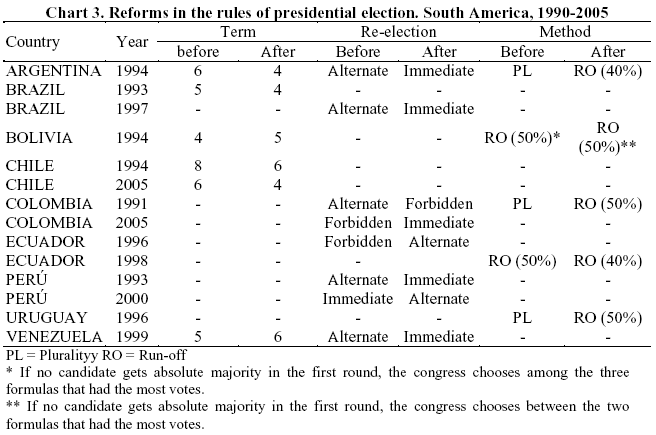
For this paper, information regarding all reforms that modified the rules of presidential election in South America between 1990 and 2005 has been systematized and analyzed. All countries in the region have made at least one modification of at least one of the variables used10. The following chart presents that information.
Even with some exceptions, apparently there are favourable trends towards adopting a run-off system, the reduction in the terms and, finally, the inclusion of immediate presidential re-election. Firstly, practically all countries in the region adopted a RO presidential election system, either in transitions to democracy or in subsequent reforms. In the 1980 decade, five countries in South America used PL and other five RO, whereas nowadays there are only two countries that keep PL and in no cases there were reforms in the opposite direction11. In turn, the average duration of presidential terms was reduced from 5,1 years in the 1980 decade to 4,6 years in the present. However, in this case there are some movements in opposite directions, because while in three countries the presidential term was reduced, it was increased in two others. Finally, the inclusion of immediate presidential re-election also seems to be the prevailing trend, although it was reversed in the case of Peru12. Definitely, it cannot be said that there is a clear trend towards more inclusive or exclusive systems, as some variables have evolved in one direction and others in the opposite way.
Concerning reform processes, in every case they have been promoted by the main actors of government (presidents and/or parliamentary majorities) and, in most cases they had the goal to stay in office although they were supported by arguments of legitimacy and governance. Permanence in government was sought after directly via the inclusion of immediate re-election or indirectly with the inclusion of a two-round system. The tendency towards the reduction of the term appears basically as a counterpoint of the re-election or as a means to adjust the timing of the elections.13.
The Colombian reform of 1991 is an exemplary case as for declining coalitions promoting more inclusive electoral systems. The process was launched from the old establishment in a context of deep political crisis. By initiative of the president Samper and after a broad agreement among the most varied political groups in a constituent assembly, the run-off method was adopted for presidential election and re-election was forbidden indefinitely, plus a package of other inclusive norms. This clearly was an attempt to re-legitimize the political system, promoted by actors whose popularity was declining and felt threatened.
On the contrary, the Venezuelan reform of 1999 clearly incorporates exclusive norms, by prolonging the presidential term and adding immediate presidential re-election. This was a process promoted by president Chávez, who enjoyed a great popularity and had the ability to hegemonize the constitutional process, facing a hostile parliament and creating a new legal order which favoured a strong concentration of power.
An intermediate point between the two cases mentioned is the Argentinean reform of 1994. This reform shows modifications in opposite directions. On one hand it adopted immediate presidential re-election, but at the same time incorporated the run-off and reduced the duration of the presidential term. This combination clearly obeys to the transactions made within a coalition with opposed interests. President Menem (PJ) was looking for a re-election and to get it he had to accept the demands of the radical opposition (UCR) of reducing the duration of the term from 6 to 4 years. Additionally a run-off was introduced, but with a reduced threshold that allows a victory with a relative majority. Definitely, this package looks like a transaction located approximately half-way between the exclusive and the inclusive model.
]]> In turn, Bolivia carried out a reform in 1995 that generated a wide consensus in the political system. The model of this research classifies it as exclusive because the modifications related to presidential election have that feature. However, the reform included other aspects that may well be classified as inclusive and legitimizing. But in practice, the sponsor of the reform (the MNR) was indeed a winning party at that time who could perceive itself as a winner in the future, and therefore, with incentives to promote exclusive reforms.The rest of the cases are reforms of only one of the variables and, generally, respond to the proposed model. Clearly, the reforms establishing immediate presidential re-election in Peru (1993), Brazil (1997) and Colombia (2005) are driven by popular coalitions who seek to stay in power, whereas the Uruguayan reform of 1996 introducing a run-off is promoted by a declining coalition who felt threatened.
The cases in which the only modification was the reduction of the duration of the presidential term require one caveat, even if this type of reform aims to be more inclusive and legitimate, it also adds efficacy to the government when it is good to make presidential and legislative elections coincide. Those were the cases of Brazil (1993) and Chile (2005). Anyway, in both cases the ruling coalitions could have felt threatened by their respective oppositions14, which made more rational the reduction of the duration of the term.
Finally, Ecuador’s case is less clear. The high electoral volatility and the permanent political instability in the country which concluded with the destitution of president Bucarán, generated uncertainty among the elites, so they had to incline towards inclusive reforms. However, the constituent’s assembly was dominated by three major parties that opted to reduce the threshold to be able to access the presidency on the first round, aiming at reducing political fragmentation and favouring governability.
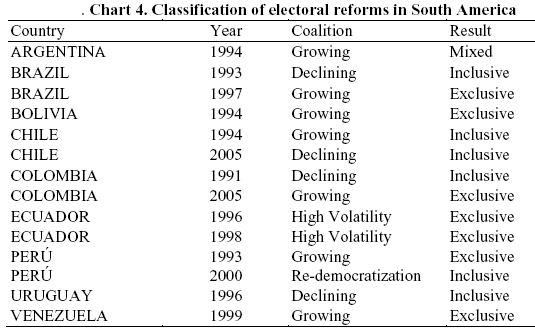
The following chart classifies the reform processes according to the presented model
5. Conclusion
Generally, case analysis is consistent with the presented model. Practically without exceptions declining coalitions promoted more inclusive norms and growing coalitions made exclusive reforms. Beyond the fact that the presented evidence does not pretend to be a proof of hypothesis, it allows to observe political behaviour consistent to the rationale of the model. All the reforms that included an immediate presidential re-election were promoted by growing coalitions built around a charismatic leader (Fujimori, Cardoso, Menem, Chávez and Uribe) who was re-elected in all cases. In turn, reforms in which the plurality method was changed for a run-off system with a threshold of 50% (Colombia and Uruguay), were promoted by declining coalitions who lost votes in the following elections and ended up being removed from power. On the other hand, modifications in the duration of the presidential term do not show such a clear pattern, either because they were carried out as a counterbalance to other change in the rules, or because they generated modifications in the opposite direction regarding the timing of the elections. Therefore, even if the model seems to resist a first empirical check, it is still necessary to continue advancing in the study of the matter, expanding the number of cases and variables and using more refined measure instruments.
]]> Beyond the positive and negative aspects of the model, it is also pertinent to reflect about the role of electoral reforms in political processes in Latin America. The prevalence of short-term interests and the short time elapsed since the reforms prevent any conclusive evaluation of their impact on democratic performances. The general model leads to think that inclusive reforms promoted by threatened coalitions would endanger the efficacy of a system and could lead to worsening a crisis, risking political stability. The political evolution of Colombia since the 1991 reform until Uribe’s victory in 2002 seems to confirm that reasoning. The Colombian case is of particular interest because it shows the two typical processes in different moments: an inclusive reform that does not manage to stop the process of political deterioration until a growing and successful coalition achieves a reform with an opposite sign. On the other hand, a reform promoted by a ruling coalition with great popularity that would consist of a disproportioned increase of its share of power would undermine the system’s legitimacy, also endangering political stability. The Venezuelan reform of 1999 and the subsequent evolution of incidents in that country are consistent with the presented reasoning.As democratic political systems require both legitimacy and efficacy, reforms to favor political stability should have a mixed composition. The format that seems more efficient is the four year term with immediate re-election, provided that legislative elections are simultaneous with presidential elections because a brief term is more legitimate and re-election facilitates the continuity in government of a successful growing coalition with popular support. The conditions that favor the adoption of this format consist of a popular president who is required to negotiate with political allies to make a reform possible (Menem, Cardoso, Uribe). However, despite the Argentinean reform of 1994 having these characteristics, the subsequent political evolution of that country does not confirm that reasoning. Even when the effects of electoral rules are not automatic or immediate, the Argentinean anomaly could be justified by the presence of intermediate legislative elections that might cause, as happened in 2001, a severe conflict among powers15. Alternatively, the Brazilian reforms of 1993 and 1997 lead that country to adopt the same configuration. Although reforms were not part of a single package, in both cases it was possible to combine legitimacy with efficacy and the political evolution of Brazil has shown great stability until this moment. Finally, the Colombian reform is too recent to draw conclusions. In any case there is not enough evidence to think that there is a tendency towards that format, as the factors that have an influence in the reform processes and their contents are too complex and diverse and the conditions that would favor their adoption quite exceptional.
References
Benoit, Kenneth. 2004. "Models of electoral system change" Electoral Studies 23: 363-389. [ Links ]
Boix, Carles. 1999. "Setting the rules of the game: the choice of electoral systems in advanced democracies" American Political Science Review 93(3): 609-624. [ Links ]
Buquet, Daniel. 2004. "Balotaje vs. Mayoría Simple: el Experimento Uruguayo" in Martínez, Rafael (ed.) La Elección Presidnecial Mediante Doble Vuelta en Latinoamérica. Barcelona, Institut de Ciencies Polítiques i Socials de Barcelona: 483-499. [ Links ]
Colomer, Josep. 2004. ¿Cómo votamos? Los Sistemas Electorales del Mundo: Pasado, Presente y Futuro. Barcelona, Gedisa. [ Links ]
Cox, Gary. 1997. Making Votes Count: Strategic Coordination in the World's Electoral Systems. Cambridge, Cambridge University Press. [ Links ]
Diamond, Larry. 1999. Developing Democracy: Toward Consolidation. Baltimore & London, The Johns Hopkins University Press. [ Links ]
Duverger, Maurice. 1957. Los Partidos Políticos. México, Fondo de Cultura Económica. [ Links ]
García Díez, Fátima. 2001. The Emergence of Electoral Reforms in Contemporary Latin America. Barcelona, Institut de Ciènces Polítiques i Socials. [ Links ]
Geddes, Barbara. 1996. "Initiation of new democratic institutions in Eastern Europe and Latin America" in Lijphart, Arendt and Carlos H. Waisman (eds.) Institutional Design in New Democracies: Eastern Europe and Latin America. C.H. Oxford, Westview Press: 14-52. [ Links ]
Jones, Mark P. 1995. Electoral Laws and the Survival of Presidential Democracies. South Bend, Universisty of Notre Dame Press. [ Links ]
Lijphart, Arend. 1994. Electoral Systems and Party Systems. A Study of Twenty Seven Democracies, 1945-1990. Oxford, Oxford University Press. [ Links ]
Linz, Juan J. 1990. La Quiebra de las Democracias. México, Alianza Editorial Mexicana. [ Links ]
Lipset, Seymour M. 1988. El Hombre Político: Las Bases Sociales de la Política. Buenos Aires, Red Editorial Iberoamericana. [ Links ]
Maiwaring, Scott y Matthew S. Shugart (1997). Presidentialism and Democracy in Latin America. Cambridge, Cambridge University Press. [ Links ]
Negretto, Gabriel L. 2006. "Choosing How to Choose Presidents: Parties, Military Rulers, and Presidential Elections in Latin America." The Journal of Politics 68(2): 421-433. [ Links ]
Payne, J. Mark, Daniel Zovatto y Mercedes Mateo Díaz. 2006. La Política Importa: Democracia y Desarrollo en América Latina. Washington D.C., BID-IDEA. [ Links ]
Shugart, Mattew S. y John Carey. 1992. Presidents and assemblies: Constitutional Design and Elecotral Dynamics. Cambridge, Cambridge University Press. [ Links ]
Taagepera, Rein Y Matthew S. Shugart. 1989. Seats and Votes: The Effects and Determinats of Electoral Systems. New Haven, Yale University Press. [ Links ]
1 Literature on the effects of electoral systems is too overwhelming to quote extensively. In turn, only a few particularly relevant works will be mentioned.
2 For example: Taagepera and Shugart (1989).
3 For example: Lijphart (1994).
4 Beyond some marginal references, only Negretto (2006) deals with this matter specifically in theoretical and comparative terms.
5 "...those who make the changes –that is, the members of roundtables, constituent assemblies, and legislatures who must make the choices that determine electoral procedures- pursue their own individual interests above all else, and that their interest center on furthering their political careers." (Guedes 1996:18).
6 "The theory predicts that electoral laws will change when a coalition of parties exists such that each party in the coalition expects to gain more seats under an alternative electoral institution, and that also has sufficient power to effect this alternative through fiat given the rules for changing electoral laws." (Benoit 2004:363). ]]>
7 The threshold is 50% in the majority of cases in South America (Peru, Chile, Brazil, Colombia, Bolivia and Uruguay) but more recently complementary rules and lower thresholds were established in Argentina and Ecuador. In those cases it is required to get more than 45% of the votes or more than 40% with 10 points of margin over the second to be elected president in the first round.
8 Bolivia establishes a threshold of 50% to get to the presidency in the first round, but is an exception regarding the second round which takes place in parliament. Until 1994 the Bolivian parliament could name president any of the three most voted candidates in the first round. That year reform restricted the election to the two most voted candidates.
9 Negretto (2006), following the same rationale assigns those preferences to lesser and major parties respectively.
10 Paraguay does not appear in the chart because, despite having made electoral reforms concerning the indicated variables, it never implemented it. Presidential election with absolute majority and second round was included in the electoral reform of 1990, but, in a new reform in 1992, it returned to a plurality system without ever having presidential elections between these reforms.
11 Without considering the aforementioned reform in Paraguay
12 Immediate presidential re-election in Peru was adopted in an authoritarian context after Fujimori’s coup, therefore, its reversion has been associated with a new re-democratization in the country.
13 The timing of the elections is not the direct target of the reform, but it is modified by a change in the duration of the presidential or parliamentary term.
14 In Brazil Lula appeared as a possible winner and in Chile the Concertación had gradually been losing its hegemony.
15 This is not about explaining the Argentinean political crisis, but pointing out one aspect of its electoral design that might have contributed to its tragic outcome.