Elección de diputados y fraccionalización partidaria en Uruguay 1942-1999
Rafael Piñeiro
BA in Political Science from University of the Republic. Assistant Teacher in the degree course of Political Science from University of the Republic. Assistant Researcher from the Political Science Department, Faculty of Social Sciences, University of the Republic. (rafaelp@adinet.com.uy)
Translated by Rafael Piñeiro
Translation from Revista Uruguaya de Ciencia Política, Montevideo, n.14, p.15-42, 2004.
]]>
ABSTRACT
This article looks at fractionalization in the election of members to the Chamber of Deputies in Uruguay. In particular, it analyzes how this relates to the method of election of Deputies in use during the period 1942-1999. Starting from a discussion of the main hypotheses regarding the links between the electoral system and the degree of party fractionalization that can be observed in Uruguay, it proposes a panel estimate using electoral data disaggregated by party and constituency - to measure the impact on electoral fractionalization of district magnitude and other relevant variables. On the basis of the results of the estimate, the article analyzes the relationship between district magnitude, the triple simultaneous vote and fractionalization, and concludes that the latter developed within the limits imposed by the electoral system through district magnitude.
RESUMEN
Este artículo estudia la fraccionalización en la elección de diputados en Uruguay. En particular analiza su relación con la forma de elección de Representantes en el período 1942-1999. A partir de la discusión de las principales hipótesis sobre los vínculos entre el sistema electoral y el grado de fraccionalización partidaria observado en Uruguay, se propone una estimación de panel -con datos electorales desagregados por partido y circunscripción- en la que se indaga el impacto de la magnitud de la circunscripción y de otras variables relevantes, sobre la fraccionalización electoral. En función de los resultados de la estimación, se analizan las relaciones entre magnitud de la circunscripción, triple voto simultáneo y fraccionalización, y se concluye que ésta se desarrolló dentro de los límites que le impuso el sistema electoral a través de la magnitud de las circunscirpciones.
1. Introduction
Uruguay modeled a particular electoral system during the first half of the XX century. Double simultaneous vote (DSV), established in 1910, constitutes the cornerstone of this peculiarity that remained unchanged until the Constitutional Reform of 1996. Like in a mirror game, political parties generated at the same time, an original fractionalized structure. Consequently, the interaction of both particularities gave rise to a wide variety of speculations, both political and academic, on the relationship between DSV and the degree of fractionalization.
The fractionalized structure of Uruguayan political parties has led governing processes to have the parties as well as their fractions as a reference. Both share the role of relevant agents in politics and in government. Therefore, if it is admitted that there is a relationship between the number of agents in the system and the degree of efficiency of governing processes, the study of the incentives and restrictions to the formation of new agents that the electoral system generates is one of crucial importance.
]]> In this sense, it is reasonable to hypothesize that systems with a high number of agents generate difficulties and additional costs to majority formation. The complexity of political negotiation in these scenarios makes them tend to instability and blockages. Consequently, it is relevant to evaluate how electoral systems influence on the fragmentation and fractionalization of party systems. Moreover, it turns the topic into a central component in the discussion about democratic governability.This paper studies fractionalization in the election of Representatives in Uruguay. In particular, it analyses its relationship with the way how Representatives were elected in the period 1942-1999. Considering the discussion of the main hypotheses about the connection between the electoral system and the degree of party fractionalization observed in Uruguay, a panel estimation is proposed -using electoral data diferentiated by party and electoral district- to find out about the impact of the size of the district and other relevant variables, on electoral fractionalization. Lastly, the relationship between the magnitude of the district, triple simultaneous vote and fractionalization is analyzed.
2. Electoral system and party fractionalization in Uruguay
The history of theoretical developments on electoral systems is not recent. But it is not until mid-twentieth century that the first development which breaks with the tradition and philosophical style imposed by XIX century's works. The book The political parties, published in France in 1951 by Maurice Duverger, paved the way for a positive view on electoral systems. Duverger formulates in his book what is known as "Duverger's laws". He states that proportional representation and majority systems with second round elections tend to generate multiparty systems and those with relative or simple majority lead to bipartdism.
In his argument he identifies two effects of electoral systems: one is mechanical and the other is psychological. The mechanical factor is connected with the underrepresentation of third parties in simple majority systems. Whereas the psychological factor is related to the behavior of voters and politicians. According to Duverger "voters frequently understand that their votes are wasted if they keep on voting for third parties: and so there is their natural tendency to cast their vote to the least bad of their rivals so as to prevent the success of the worst." (1957: 252) The combination of these two factors in systems of simple majority makes bipartidism last "...against the division of old parties and the birth of new ones." (1957:254)
Duverger's analysis has become a source of reference for those studies on electoral systems. Further analyses have gone beyond, contrasted and formalized "Duverger's laws" (Rae 1967; Riker 1986; Katz 1986; Taagepera and Shugart 1989; Palfrey 1989; Sartori 1992 and 1994; Lijphart 1994; Cox 1997 among others). The effects of proportional representation and majority systems on the party system have been the axis on which articulate the most popular hypotheses about the relationship between electoral system and party system. In this sense, Uruguay has not been an exception. A singular electoral system and an original organizational structure of parties stimulated -and still does- diverse explanations and speculations connected with "Duverger's laws".
The system of DSV -that runs in Uruguay since 1910- is the distinctive feature of the Uruguayan electoral system. It was implemented to allow internal competition inside the parties and to prevent them from breaking down at the same time. This mechanism leads to the simultaneity of the national election and internal election in the parties. Summarizing, DSV is a kind of preferential intraparty vote, that allows the voter to choose a party and, at the same time, to make choices inside it. To legislative organs, this system of vote implies a triple simultaneous vote (TSV), the voter votes for a party, for a sublema1 within that party and, lastly, for a list within that sublema.2
The combination of the system of DSV and proportional representation -for the election of the Senate and the House of Representatives- has led an important part of the Uruguayan academy (Pérez Pérez 1970; Rial 1985; González 1991) to relate the electoral system with the fractionalized structure of the parties. According to the view of these authors, the couple DSV-PR appears to be responsible for a high and growing fractionalization.
Without too much empirical worry, but with a refined theoretical argument, Rial's point of view (1985) and mainly González's (1991) could build strong academic consensus. DSV and PR were deemed guilty of that -supposedly- high and growing fractionalization.
]]> Nowadays the fractionalized nature of the Uruguayan parties is not subject to discussion, but there is a discussion concerning the levels of fractionalization and their evolution. Academic debate opposes those who -after having observed the evolution of electoral supply- state that party fractionalization in Uruguay is high and it tends to grow; to those who -when centering their attention in the number of relevant agents- qualify it as moderate and stable. This disagreement finds its grounds on methodological and theoretical differences. Even though both are important, the first are central because they summarize the theoretical. How and where to look at fractionalization are the basis to this methodological disagreement.Vernazza (1989), González (1991) and Monestier (1999) are the most representative works of the authors who support the idea of a high and growing fractionalization. To them the phenomenon is observed in the great and growing number of lists for the election of Representatives3 proposed by the three main parties. Their hypothesis places the electoral system as the cause of fractionalization and proportional representation. More specifically, González suggests that "...double simultaneous vote is the active principle which enhances fractionalization and proportional representation is the facilitator because -as it offers more prizes- it reduces the expected cost of competition." (1991: 21)
Following González (1991), DSV allows many candidates, associated without losing electoral independence, to compete for the same posts without wasting votes. Within this reasoning, the emergence of challengers is not penalized, on the contrary, it is fostered. PR acts facilitating the emergence of lists to the House of Representatives, as it is not necessary to obtain the first place to have a seat at Parliament.4
From a radically different perspective Buquet, Chasquetti and Moraes (1998) and Buquet (2000) propose appreciating the phenomenon considering the analysis of the number of relevant agents in governing processes. On the other hand, they observe partisan agents of relevance at the national level, more precisely, the lists to Senate. Given that they assume it is not the size of the electoral offer what determines the number of fractions, they use the indicator proposed by Laakso and Taagepera (1979) to determine the real number of agents in a system. When pondering lists to the Senate by their electoral weigh they obtain what they call the effective number of electoral fractions. Through the use of this indicator, they find out that Uruguayan party fractionalization is moderate and it does not have a systematic tendency to grow.5 According to Buquet et al. (1998), the use of the system of simple majority to the Presidency election, both among parties and inside them, generates an ordering effect on the lists to the Senate maintaining a reduced effective number of those. (1998:26)
Those who work with electoral offer criticize the analysis of Buquet et al. (1998) because it worries only about lists to the Senate. Monestier states that "this reduces a reality of growing fractionalization that is expressed in the election of Representatives" (1999: 51). At the same time Buquet (2000) argues that when looking at the rise in the number of lists there is an "optical illusion". Despite the fact that the number of lists presented increases, those who have access to Parliament do not register such rise.
3. Election of Representatives and party fractionalization
3.1. Electoral fractionalization of Representatives
May be the study of electoral fractionalization of Representatives tells us little about party fractionalization at the national level. However, it gives us a lot of information to understand the election of Representatives and its link with parliamentary fractionalization. At the same time, it offers us a good opportunity to contrast the hypotheses in the work of Vernazza (1988), González (1991) and Monestier (1999) and to suggest some alternatives to their explanation of this phenomenon.
From a variety of formulations of the hypothesis that places the electoral system as the cause of a high and growing fractionalization, the proposed by González (1991: 21) and contrasted afterwards by Monestier (1999) is the one that has been most spread, due to the strength of the statement and its theoretical refinement.
]]>"Fractionalization appears, therefore, as a result of DSV and PR. These two elements do not play, however, the same role: the DSV is the active principle which impulses fractionalization, and PR is the facilitating condition - because as it offers more prizes it reduces the expected cost of competition." (González 1991: 21)
The formulation of this proposition deserves some critiques. First, the election of Representatives was ruled by TSV and not by DSV6. Botinelli (1991: 3), when making a synthesis of the main components of the electoral system, mentions: "Triple simultaneous vote for parliament". Later we will deal with the different effects associated to each of them.
A second critique, is the one already made by Buquet (1998: 24) about the difference between the role of active principle associated to DSV and the one of facilitating condition given to PR. The roles of the independent variables seem to be reversed in this hypothesis. It is logical to think that what promotes fractionalization is PR, because theory associates it with a greater fragmentation7. Whereas DSV is only what allows fractionalization to exist.
The third objection and undoubtedly the most important, is that it is difficult to think that the election of Representatives is proportional inside the parties. Even though the formula D'Hondt to allocate seats at Parliament allows proportionality, the reduced magnitude8 of the majority of the electoral districts seems not to do it. Only big districts like Montevideo and Canelones allow acceptable levels of proportionality. Buquet (1998: 28) states that "the magnitude of the district is smaller when referring to fractions than to parties, the proportionality applied to appoint legislative posts among party fractions presents a relevant distortion and therefore, the stimulus to its reproduction is very little."
To these three objections to González's (1989) hypothesis has to be added the one that refers to its way of contrasting. As it will be shown later -when discussing the ways to operationalize the concept of fractionalization- the indicators used to measure electoral fractionalization in the work of Vernazza (1989) and Monestier (1999) present important limitations. In this sense, to pay attention to the evolution of electoral offer and to the number of ballots that obtain less than 0,1% of the electorate and more than 0,5%, not necessarily allows us to observe the degree of concentration of votes.
Stated the problems of González's (1989) hypothesis, it seems necessary to work on its reformulation to be able to have a better understanding of the process of electoral fractionalization in the election of Representatives. Consequently, we inquire into the influence of the magnitude of the district on the effective number of lists. At the same time, the existence of a relationship between electoral offer and effective number of lists is analyzed; and the empirical relevance of the hypothesis which states that given the electoral system that ruled until 1994, the simple course of time would lead to a permanent rise in the degree of fractionalization of the main political parties, will be analyzed.
3.2. The methodological problem of measuring fractionalization
The number of parties (or fractions) is the most relevant variable in the studies about party systems. That is why its operationalization constitutes an important methodological challenge to empirical Works. Specifically, the methodological problem is how to count the number of relevant agents, or what is the same, how to measure fragmentation and fractionalization.
One of the ways of working with this problem is by considering without distinction all those who take part in an election, without establishing any criteria that allows to discriminate the agents according to their relevance. This methodological option is, up to a certain extent, the one made in the works of Monestier (1999) and Vernazza (1989), in the sense that they simply count the number of lists -in the case of Monestier- and the number of ballots -in the case of Vernazza- that take part in the election.
]]> Additionally, both Vernazza (1989) and Monestier (1999) use another indicator to state the existence of a growing fractionalization. They add to the analysis of the evolution of electoral offer (national and by district), the study of the electoral performance of "big" and "small" ballots. Even though Vernazza presents an important variety of charts investigating the electoral evolution of the diverse ballots, the majority of these have the same problems of the indicator presented by Monestier9 (1999: 65).The first critique that can be made to these works is that the simple evolution of the offer not necessarily indicates the degree of fractionalization in the election of Representatives. That is to say, even when offer rises, if the votes are concentrated in the bigger lists, offer and fractionalization do not have to be associated.
To complement the analysis of the evolution of offer, these authors add indicators of the electoral performance of ballots. In this sense, Monestier pays attention to "the evolution in the percentage of ballots that received in each election... a quantity of votes above 0,5% of the total and below 0,1% of the total votes" (1999: 65). In Graphic 6 of Monestier's (1999) work the results of the estimations of that indicator are presented; in that, the percentage of sheets with more than 0,5% of votes decreases systematically between 1954 and 1989 (from 31% to 4%), at the same time, the percentage of ballots with less than 0,1% rises from 25% in 1954 to 78% in 1994.
Even though these results seem at first sight obvious; we have to take into consideration that this indicator presents three problems that make it practically useless. First, it is concerned with ballots and not with lists10. In this sense, a list that has been presented in two ballots and, for example, has received in each of them 0,4% of the total electorate, will not be registered as groups that have obtained more than 0,5 %, when in fact this list obtained 0,8% of votes. As an example would be useful the case of Otto Fernández, who was the first in a list for Representatives of the Partido Colorado (PC) in the district of Artigas in the election of 1966. Fernández's list had 0,6% of the total votes, but divided in tour sheets (14, 20, 315 and 1115). None of them reached 0,5 % and there was one below 0,1%. This way, even when Fernandez's list should be among those who had more than 0,5% it was not registered that way, even worse, one of its sheets (20) with only 0,04 % would be added up to the percentage of sheets with less than 0,1 % of the total votes.
The second problem of this way of observing fractionalization is that it takes data at the national level, and it does not discriminate by electoral district or party. Thus, important lists in electoral districts with little number of voters are underestimated and at the same time, small lists of districts with an important quantity of voters are overestimated. Together with this, it is not considered the electoral weigh of the party which the different lists belong to. This way, two lists with the same percentage of votes out of the total votes of their parties, could be catalogued differently according to the weigh of their party in the total electorate. Both lists, despite having the same relevance to their parties, would not be counted in the same way. A clear example of the relevance of the relative weigh is set by the cases of the list of Carlos Flores Mora, from PC in Montevideo, and the one of Arturo Cuevas Cáceres, from the same party in the district of Flores in the election of 1971. Carlos Flores Mora's list had 9.120 votes, only 3,28% of PC in Montevideo and 0,55 % out of the total votes. On the other hand, Arturo Cuevas Cáceres's list obtained 3.716 votes in Flores, which was 50,96 % of the votes from PC in that district, but only 0,22 % out of the total votes at the national level. In this case, a little list from PC in Montevideo would be among the ones that have more than 0,5% and another one, that has more than a half of the votes of PC in Flores would not.
The third problem, and may be the most serious, is that the method used does not say anything about the evolution of big lists. The rise in the percentage of sheets with less than 0,1% of the electorate and concentration of votes in bigger lists are not incompatible processes. If this concentration happened, even if the percentage of lists with less than 0,1% was higher, vote dispersion should diminish.
A somehow different attempt is the one made by Pablo Mieres (1996: 52-53), when measuring fractionalization paying attention to the percentage of votes received by the four main agents -in this case, lists to Senate- of the party system.11 This indicator is closer, more than the ones used by Monestier and Vernazza, to measuring vote concentration. However, it has two problems. On the one hand, it measures it in bulk, as it sets aside the distribution of votes among small agents. On the other hand, and more important, this indicator is affected by the rise of fragmentation in the system. In this sense, when considering the four main lists of the system and not of each party, the reduction in the percentage of votes these four lists to the Senate in Uruguay present -between the election of 1971 and 1994 - is the result of the growth in number of parties and not fractions. For example, if we consider the performance of the four main lists to Representatives in Florida in the year 1966 and then in 1994, we will see that they accumulated 50,5% of the total valid votes from the district in 1966 and 43,7% in 1994. The conclusion that is drawn, using the reasoning of Mieres, is the growth in fractionalization in this district. But if we look at the percentage that accumulate the first four lists of PN and PC within the parties in those two elections in Florida, we will see that: in the PC they obtain 78,6% in 1966and 77,9% in 1994 and in the PN 80,3 % and 87,1% respectively. This indicates that the fractionalization of PC remained unchanged and it diminished noticeably in PN. This apparent contradiction -if we consider the lists related to the total electorate o to the party's electorate-, is caused by the reduction in the percentage of votes collected by PC (from 45,2% in 1966 to 38,8% in 1994) and by PN (from 51,5% in 1966 to 38,4% in 1994) due to the appearance of FA. To conclude, the way to measure fractionalization used by Mieres (1996) is no longer useful, given its sensitivity to variation in the number of parties; in other words, to the rise in the system's fragmentation.
The problems of the methodological options made by Vernazza (1991), Monestier (1999) and Mieres (1996) have been overcome by comparative works on the topic. In this sense, Sartori (1992: 154-455) suggests two rules to count parties. The first, determines that small parties without "possibilities of coalition" are not taken into account. The second, imposes the need to discard parties without "possibilities to blackmail". Even though the concept of "coalition" is obvious, it is not the same with the concept of "blackmail". The latter, refers to how the appearance or existence of a party alters competition within the system (for example, from centripetal to centrifugal, in terms of sartorian typology).
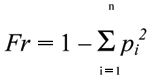
With the same worry as Sartori -how to count relevant actors-, Rae proposes an indicator of party system fragmentation (Fr). This one, ponders parties by their own electoral weigh:12
Markku Laakso and Rein Taagepera (1979) proposed to change this index to make it intuitively more comprehensible. That is why, the effective number (ENF) divides one, instead of subtracting, the addition of the square root of the proportions:
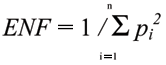
This effective number no longer varies between 0 and 1 but it shows, as Taagepera & Shugart (1989: 79) suggest, "... (a) number of hypothetical equal-sized parties that would have the same effect on fractionalization of the party system as heve the actual parties of varying sizes.". For example, a system where two parties divide the total electorate in equal parts (0,5 - 0,5), would obtain a ENF equal to 2.
The effective number has a series of features -the same as Rae's index and therefore Herfindal's14- that make it valuable. First, it is an independent value from the size of the system where it is measured. This allows us to compare without dimension bias. Secondly, the effective number varies with a change in any pi, decreasing when the participation of a big agent increases due to the fall of a small one and vice versa. Last, the fusion of big agents does not increase ENF.
From the three options -to count all the agents equally, using Sartori's rules or applying the effective number- using Laakso and Taagepera's index (1979) seems to be the correct choice. First, it provides more information than just the number of agents. Second, it is easier to apply than Sartori's rules (we only have to know the electoral results) and it gives less room for the researcher's subjectivity (we must not evaluate the possibilities of blackmail of minor parties). Last, the effective number of parties is the measure mostly used to count relevant agents in comparative studies.
However, the choice of this indicator implies an important judgement that has to be made explicit. On the one hand, in connection with the mere count of agents, it implies, as we saw, an important ponder of the biggest in detriment of the smallest. But, at the same time, the effective number, when using the measure of Herfindahl instead of another one like the one of entropy,15 takes into account the upper part of the distribution of agents reducing the influence of the total number of these (see, Table 1)
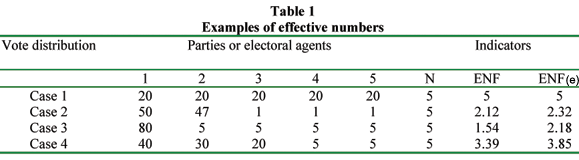
Table 1 presents the results of three indexes -number of agents (N), effective number calculated through ENF and effective number calculated with the entropy index (ENF(e))- for four distributions of percentage of votes among five parties or electoral agents.
The first thing we have to observe is that N is not subject to the variation of vote distributions. Therefore, to N the four cases are the same, even though they are very different. Besides, ENF as well as ENF(e) vary for each distribution. In the first, both indicators present a value of five effective agents owing to the fact that they all have the same ponder. In the remaining three, the ENF(e) is always higher than ENF, because when the index is calculated using the logarithms of the proportions, instead of their square root, rises in this the weigh of the smaller ones. Anyway, both measures are close to the number of relevant agents that we can intuitively infer.
To sum up, the ENF of lists, measured in each of the districts within each party to each election, seems a trustworthy index of the degree of electoral fractionalization in the election of Representatives. Besides, due to its characteristics, allows us to compare without biases among the different cases.
3.3. Proportional representation and magnitude of the district
Comparative studies about electoral systems highlight the determining role of the magnitude of the district in the levels of proportionality. Arend Lijphart (1995) considers that the magnitude of the district represents a central component of what he calls effective threshold and says that " the general rule is that the effective threshold is the almost only and most important variable" (1995: 166). In the same way, Taagepera & Shugart (1989: 112) state that "... magnitude is the decisive factor: the number of seats allocated in an electoral district has a stronger impact on proportionality than almost any other factor..."
Besides, there is academic consensus about the fact that proportionality is connected, not only with the way of allocating, but mainly with the magnitude of the district. Therefore, to talk about proportionality of an electoral system, it is not enough with establishing that seats are distributed proportionally among parties. Even when they are distributed using D'Hondt formula (or any other that accepts proportionality) in the districts where two seats are distributed, it is difficult to have proportionality. Moreover, in uninominal districts, even though the formula of allocation is proportional, it will work as simple majority.16
If we remember "Duverger's laws", the magnitude of the district turns into an important variable to explain fractionalization. In other words, we should expect that in districts of greater magnitude, those who admit a greater degree of proportionality, there would be a high number of lists; on the contrary, in districts of a small magnitude, there would be lower values of fractionalization.
It seems important, then, to define effectively the magnitudes of the districts where Representatives are chosen in the parties. Within the lemas competition for seats, first among sublemas and then among lists of sublemas, takes place in the department district. This allows us to think that the magnitude of the district (M), where sublemas and lists compete, will be determined by the number of seats obtained by the party in the department. For example, in 1954 the magnitude of the district in the election of Representatives of the Partido Nacional (PN) was twelve in Montevideo, four in Canelones, two in Cerro Largo and one in Paysandú (these magnitudes correspond to the number of seats obtained in those departments by the PN).
3.4. Electoral offer, temporal inertia, the Governor's party and the President's
]]> Together with the magnitude of the district it seems interesting to incorporate to our study other variables that can help to explain the phenomenon of electoral fractionalization. In this sense, we will introduce the electoral offer, temporal inertia and belonging to the Governor and the President's party. Even though these variables are not as important as the magnitude of the district, we include them to discard or confirm some ideas that have been traditionally considered, in the Uruguayan academy, with regard to the phenomenon of fractionalization.The electoral offer has been used in Uruguay as an indicator of fractionalization. In our work, we will invert this role and we will place the number of lists as explicative variable. That is to say, we will try to find out if the number of lists (NL) has influence on their effective number of these (ENL).
In theory, offer and fractionalization do not have to be associated. The concentration of votes should not necessarily diminish just by the fact of the rise in the electoral offer or vice versa. Not all the electoral agents that offer their candidatures have the objective of competing effectively for seats17. At the same time, not all those who want to compete effectively for them, obtain a satisfactory answer from the electorate. Summarizing, even though the increase in the number of lists presented to an election can have influence in the number of relevant agents, not necessarily has to do it.
Anyway, to investigate about the effects of the increase in offer over electoral fractionalization is an aspect that should not be left aside. The number of lists (NL), defined as the quantity of lists presented by a party in each district, can be part of the history of electoral fractionalization.
Frequently, it has been argued that fractionalization in Uruguayan parties has been rising. This idea is based on the rise, practically steady, in the number of lists presented by the parties election alter election. However, there are no works that study systematically the effect of the course of time, on the offer and electoral fractionalization. For that reason, we have decided to incorporate, to the estimated models, a tendency term, with the purpose of finding out about its effects on electoral fractionalization. In this sense, we will investigate about the existence of a phenomenon of inertia that makes the degree of fractionalization grow continuously and permanently along the time. This kind of effect is evaluated in estimations including in the models a tendential temporal term (TIEMPO).
The same as with electoral offer, there is no reason to think that the course of time and electoral fractionalization are positively associated. However, it does not seem appropriate to discard a priori this kind of hypothesis. In other words, it is reasonable to evaluate empirically the existence of an inertial effect of the system on fractionalization.
Lastly, there are two more variables: membership of the Governor's party (INT) and of the President's (PRES). This way, we try to ask if the fact of being a member of the party which holds the Town Hall and/or the Presidency, when election is being held, has any impact on the effective number of lists. Both are dichotomic variables (dummy) which reach the value of 1 when the list considered belongs to the lema of the Governor or President, respectively, and 0 when they do not.
3.5. Double and triple simultaneous vote
The mechanism of DSV has a close relationship with fractionalization. Without it, as a system of preferential intraparty vote, parties would not have the possibility of presenting more than one list to Representatives in each district. Therefore, there would not be any electoral fractionalization. However, something different is to say that it promotes or stimulates electoral fractionalization. There is no reason to think that double or triple simultaneous vote fosters a chaotic growth in the effective number of lists.
The TSV, differently from the double, allows different lists to make a group and form a sublema. The rise in these two levels of competition -first there is a fight among sublemas and then among the lists of the sublema- makes possible a greater degree of electoral fractionalization, but it need not be the cause of a continuous growth of it. It can be said that TSV is for sublemas, what DSV is for the lema. Further on, we will consider the effects of the DSV and TSV.18
]]> 3.6. Data and unit of analysisCompetition inside parties -among sublemas first and among lists later- happens at the level of department. Consequently, to appreciate the phenomenon of electoral fractionalization in Representatives, we have to analyze what happens in each party in each of the nineteen departmental districts. It is pointless to consider the aggregate values of the national election, the empirical evidence needed to evaluate the hypotheses that interest us, can be found in the data of the districts.19
For that reason, our units of analysis will be the national election in each party in each of the nineteen districts. The parties that count for our study are the Partido Colorado (PC), the Partido Nacional PN) and the Frente Amplio (FA). If we considered smaller parties, which generally present only one list to Representatives in each department would alter the results. These small parties, even though they have been able to choose national representatives, have not presented relevant processes of fractionalization.
The period we will analyze involves twelve national elections (1942, 1946, 1950, 1954, 1958, 1962, 1966, 1971, 1984, 1989, 1994 and 1999). That the series begins in 1942 is not arbitrary, because between 1942 and 1994, though with minor variations, there was the same electoral system. The incorporation of the election of 1999, is connected with the fact that it is the first to be held under the new electoral system passed in the constitutional reform of 1996.20 On the other hand, given the fact that FA appeared in 1971 election, for this party there are no values in the period 1942-1966. Summarizing, the work uses 516 different cases.
3.7. Methodological outlines
The methodological perspective that is followed in this part of the article is based on the estimation of econometric models of panel data considering information on the electoral offer and the results obtained by PC, PN and FA in the elections between 1942 y 1994. In the methodological anexus the procedure of estimation considered is described. The empirical analysis is carried out in two phases.
In the first are analyzed the determiners of the degree of fractionalization in each party, in each district, represented by the effective number of lists (ENLijt). To begin, explanatory variables of the behavior of ENLijt contain information that allows us to contrast the different hypotheses used in the literature about this topic. This way, the electoral offer is considered (NLijt) as well as the magnitude of the district for the party (Mijt), the inertia of the system represented by a simple temporal tendency (TIEMPOt) and the two dichotomic variables that indicate the membership of the Governor (INTit) and the President (PRESjt) to the party that is considered.
In the second part the determiners of electoral offer in each party NLijt are analyzed. In this case are considered as explanatory variables Mijt ,TIEMPOt, INTit and PRESjt..
In both phases, and as it is usual in the estimation of models of panel data the relevance of including in the model variables that collect fixed specific effects is analyzed (in this case for each department).
3.8. Data analysis21
]]> Among the explanatory variables considered in both phases, the one of greater theoretical relevance is the magnitude of the district, given its influence on the number of competitors in the system and on proportionality. The remaining variables are included in the estimations because they are directly related to explanations and speculations about the electoral system and the electoral fractionalization in the election of Representatives in Uruguay.Specifically, four estimations were carried out, one for each of the three parties and another one that was analyzed together with the information of all traditional parties (PC and PN). To PC and PN, separately and together, estimations were made for the period 1942-1994. To FA, the period considered is 1971-1994.
Additionally, there were estimations in models where the observations of the departments of Montevideo and Canelones were excluded to avoid distortions that could introduce, in the aggregate analysis, the two biggest districts, that is to say the departments where Mijt is highly above the rest.
A summary of the sign of the estimated effects and of the level of relevance of those is presented in Table 2.
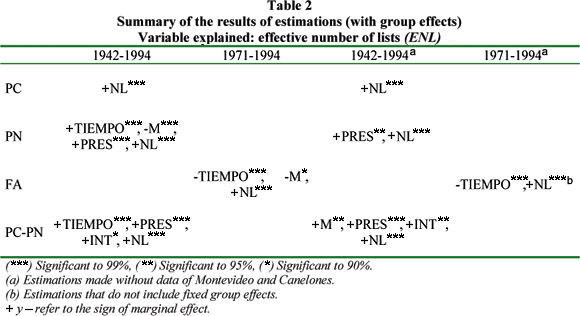
The estimations made show that in the case of PC the degree of fractionalization observed is directly related to the behavior of the electoral offer, that is, with the number of lists NL. In the PN it is observed that, apart from electoral offer, there are two other factors that have influence on the degree of fractionalization. In particular, it is found out that the tendency term has a statistically relevant and positive effect, which indicates that throughout the time there has been a growing fractionalization in this party. At the same time, the results of estimations indicate that the ENL of PN rises in the elections were the Executive was held by a member of that party. Last, it is important to highlight that the effect of the magnitude of the district (M) is statistically relevant, but it presents a sign that is opposite to the one that was expected.
So as to interpret the evidence corresponding to the opposite sign to the expected one in the relation between M and ENL in the PN, the analysis was extended in two directions. On the one hand, new estimations were made excluding the observations corresponding to the two major districts (Montevideo and Canelones). On the other, the behavior of PC and PN were analyzed together.
]]> The new results -when estimating without Montevideo and Canelones- show, firstly, that the effect of the magnitude on the degree of fractionalization in the PN is not relevant. Secondly, it is seen that the tendency term is no longer relevant. The confluence of both results indicates that there is an important heterogeneousness between the behavior of electoral fractionalization of the PN in Montevideo and Canelones in comparison with what was observed in the rest of the departments of the country.On their part, the estimations made for the PC and PN together, indicate that all the variables included in the model, except for the magnitude of the district (M), are statistically relevant and their effects have the expected signs. The main conclusion that comes from joint estimations is that in the level of traditional parties, the behavior of the degree of fractionalization depends on multiple factors and no direct influence of the magnitude of the district on the ENL is registered.
The estimations for FA confirm the relevance of electoral offer in the evolution of the degree of fractionalization. On the contrary, the results show that the magnitude of the district has an effect contrary to the expected. Notwithstanding, when excluding the estimations, the data that belong to Montevideo and Canelones, the variable M loses relevance. In this case, it is observed that, the same as with the case of PN, there are differences of behavior in Montevideo and Canelones, compared to the rest of the country.22
Synthesizing, the evidence that comes from the estimations made, diminishes the importance of a linear and positive relationship between M and ENL as "Duverger's rules" stated. This does not mean that the study of this relation has no sense. We will deal with it further on, when trying to redefine the role of the magnitude of the district in the degree of fractionalization.
Discarded the effect of belonging to the party of the Governor as a relevant variable and made relative the impact of time, the magnitude of the district and the belonging to the party of the president, we still have to define the role of the NL as independent variable. NL is the only variable that has been statistically significant in all the estimations presented before. Moreover, in the case of PC, NL ended up being the only variable with significant effects on the behavior of the degree of fractionalization. Joined to this, the direction of the relation is the same to all three lemas and tells us that the increase in the number of lists affects positively the effective number of them. Consequently, the electoral offer and its evolution play an important role in the explanation of the phenomenon of electoral fractionalization.
It seems, then, necessary to study the factors that affect the electoral offer NL to have a better understanding of electoral fractionalization. To do this, we copy the panel estimations but we substitute, in this case, ENL by NL as independent variable. Table 3 shows the significant variables for the four regions.
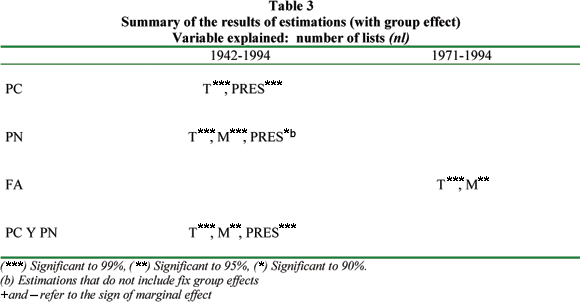
]]> The results of estimations show that the number of lists is a growing-function of TIEMPO, M and PRES, except for the case of PC, where the behavior of electoral offer is associated fundamentally to the tendency term. In this sense, the explanation to the phenomenon of electoral offer in the election of Representatives is simpler than the one of fractionalization.
On the one hand, electoral offer has expanded along the time for the three parties. As it was suggested by the authors who have dealt with this matter, NL has a growing character which can be represented by a growing tendency in each of the three lemas. On the other, the magnitude of the district is also positively associated with NL. This shows the existence of a strategic behavior of political agents. That is, the psychological effect proposed in "Duverger's laws", associates positively M with NL. In bigger districts, more lists have possibilities of obtaining votes and up to a certain extent, seats, whereas for the small ones, these possibilities are reduced.
Last, for PC and PN, the membership of the president to the party acts expanding the number of lists that take part in the election.23 This fact can be the consequence of the possibility of using clientelistic resources with electoral objectives, which involves the performance of the national government. Along with Vernazza (1989) and Aguiar's (1984) speculations, we could say that the parties which hola national government increase their possibilities of recruiting electoral agents through the use of clientelistic resources.
From the analysis of the electoral offer, we can obtain a more complete panorama of the way how the process of electoral fractionalization develops. In order to simplify the description, we will concentrate on two stylized representations (models) that emerge from empirical estimations24 -one for FA and another one for PC and PN together25- that can represent the differentiating features that the process of fractionalization presents among the different parties.
The model that represents the process of electoral fractionalization in FA is presented in Figure 1. Despite the fact that TIEMPO and M have a negative effect (direct) on ENL, these variables have a positive impact on NL, variable that, at the same time, has a positive effect (indirect) on the effective number of lists. Consequently, even though the electoral offer of FA grows in time and with the magnitude of the district, the relationship of TIEMPO and M with the effective number of lists is ambiguous, because it opposes direct and indirect effects of opposite sing.
Insert Figure 1 Piñeiro (Model Frente Amplio)
The model that corresponds to PC and PN (together) that is presented in Figure 2 is more interesting. For the traditional parties (PC and PN), the temporal effects and the magnitude of the district appear more clearly defined. There are no doubts that the effective number of lists increments throughout the time, not only due to its direct impact, but also through their indirect effect on electoral offer (NL). In a similar way, the magnitude of the district is positively associated to the ENL, through the NL. In this sense, the biggest districts, apart from registering a greater quantity of lists they also have greater electoral fractionalization.
Inert Figure 2. (Model Partido Colorado and Partido Nacional)
Membership of the president's party, the same as TIEMPO, impacts on NL as on the effective number of lists. On the one hand, PRES allows more lists to exist (it rises NL) and on the other, it makes more lists to be successful (less concentration of votes, rises the effective number of lists). Lastly, the variable INT also impacts positively on the effective number of lists. Being a member of the president and governor's parties, seems to offer to the smaller lists greater resources and, therefore, better possibilities of electoral competence with their bigger mates.
After having analyzed the impact of the different variables on the electoral offer and fractionalization of the parties, we can conclude that the magnitude of the district is part of the explanation of the process of fractionalization of Uruguayan political parties. This effect is materialized in the electoral offer. In this sense, the estimations made show that the biggest districts are associated with greater electoral offer and effective number of lists.
]]>4. Relationship between electoral system and electoral fractionalization in Representatives
4.1. Triple simultaneous vote and magnitude of the district
The results of the estimations presented above, question the existence of a linear and positive relationship between the magnitude of the district and the electoral fractionalization. Consequently, it seems reasonable to wonder about the characteristics of such relationship in the election of Representatives in Uruguay.
Gary W. Cox (1997) tries to explain how the different electoral systems influence on the strategic behavior of voters and political agents. Through the formalization of Duverger's propositions, Cox precises the extent and effects of strategic coordination on the number of competitors in the different electoral systems.
According to Cox (1997:33), all the electoral systems can be placed in a continuum that goes from those where strategic behavior imposes a restrictive upper limit, until those where this behavior sets an upper limit hardly restrictive of the number of parties. The concept of upper limit, changes substantially the way of seeing the relationship between the electoral system and party system. At least, it questions the multiplying effects assigned to the systems of proportional representation.
The upper limit that can be reached by the number of lists or candidates is to Cox (1997) equal to M+1. That is, the quantity of posts in dispute in the district (its magnitude) plus one. The reasoning is the following. If voters are rational, those candidates who do not have any chance of being elected will lose votes in favor of those who have some chance. In this sense, the candidates or lists with chances are as many as the number of posts to be allocated in the district plus the first loser.
In uninominal districts, under the system of simple majority, the upper limit would be in two candidates. In this case, the voters of the third candidate, who are not indifferent regarding who has possibilities of having a seat and who know that their first preference does not have any chances of doing it, will tend to leave their candidate and choose those who compete to win the first place.
It is interesting, then, to discuss the upper limit of candidates or effective lists for the election of Representatives in Uruguay. Triple simultaneous vote imposes within the parties two phases or levels of competition. First, the sublemas compete within the lema for seats and then the lists do it within the sublemas for the seats they have obtained. Consequently, if M = 1 (if the party obtained a seat in that district) then the upper limit of effective sublemas will be 2; and at the same time, the limit of effective lists within each sublema will also be 2. To sum up, when M =1, we have M + 1 as upper limit for the sublemas and (M+1)' 2 for the lists.
In those districts where the parties obtain two seats, the reasoning is not very different. In this case, if M = 2, the upper limit of sublemas will be 3 = M+1 effective sublemas and 6 = (M+1)' 2 will be the limit to the effective number of lists. If we refer to M+1 as the upper limit for sublemas, we have to suppose that each sublema has the expectation of winning one seat; consequently, within sublemas the magnitude is always 1, then we can suppose that the upper limit of lists within the sublemas will always be 2. Therefore, the upper limit of lists is (M+1)' 2, the upper limit of sublemas multiplied by 2.
]]> Summarizing, the reducing effect of the electoral system, or its upper limit, is set not only by the magnitude of the district, but also by the way of voting. With double simultaneous vote this number is doubled. In this sense, triple simultaneous vote, as it rises the upper limit, affects considerable the reducing effect of the system. However, it is not reasonable to think that triple simultaneous vote fosters the uncontrolled growth in the number of relevant agents.4.2. Effective number of lists and upper limit
In order to demonstrate the existence of such reducing effect, we calculate the upper limit of effective lists (M+1)x2 for each party in each district throughout the 11 elections (1942-1994). After that, we subtracted the effective number of lists to the upper limit to appreciate in how many cases and in what magnitude the effective number surpasses the limit imposed by the electoral system. The aggregated values show that out of 494, only 101 - 20% out of the total- surpass the upper limit.26 Moreover, only 63 cases - 11%- surpass it in more than 0,5 effective lists.
If we concentrate on how the 63 cases are distributed according to the magnitude of the district, we will see that 58 -92,1%- are registered in uninominal districts. Even though districts of magnitude 1 are 58.9% of the studied units, the high concentration of cases that surpass the upper limit of effective lists, in these districts, is equally singular. This element confirms what was said by Cox (1997:100) about the difficulty of thinking about upper limits that restrict in magnitudes higher than five. The strategic behavior of voters and politicians requires information about the electoral possibilities of the different agents, which is difficult to calculate in big districts. For example, with triple simultaneous vote and with M=2, a voter who wishes to vote strategically has to know first, which two sublemas compete for the second seat and second, what lists within that sublema have chances of obtaining it. Therefore, in great magnitudes the upper limits do not represent levels of equilibrium of the system.
On the previous part, we saw that the ENL presents a tendency to grow in time. Even though Monestier (1999: 80) qualifies this growth of fractionalization as "nonstopping"27, it is convenient that we wonder if such increase in ENL takes place within the limits set by the system, or if, on the contrary, it goes beyond them. In other words, does the upper limit act as such, punishing the lack of coordination of voters and politicians through subrepresentation of votes? Table 4, shows how the cases that go beyond the limit are concentrated on the elections subsequent to 1962. Until this election, the cases that surpass the limit were only 3% of the districts in 1946 and 1962. In 1966 this percentage rises to 29%, then it goes down to 11% in 1971 and 1984, it rises again up to 50% in 1989, to go down again to 45% in 1994.28 These data show us the growing tendency of ENL, but they tell us little about whether the electoral system limits the growth of fractionalization.

To be able to observe if the upper limit is a barrier to the effective number of lists, we chose to see if the percentage of cases where fractionalization increases compared to the prior election -after surpassing the limit- equals the percentage of cases where the ENL grows -from one election to the other- in the universe of units we analyzed.29 Out of 380 cases, 205 - 53,9%- increased their fractionalization in comparison with the previous election. But this percentage is reduced to 36,6%, when we calculate it within the 41 cases that surpass -in more than 0.5 lists- the upper limit. Therefore, the guideline of growth of electoral fractionalization of the cases that are in the upper limit is different from the one observed in the rest of the cases. In this sense, the upper limit seems to impose restrictions to the increase in the effective number of competitors.
To sum up, even when there has been growth in the electoral fractionalization, it has taken place within the limits imposed by the electoral system. Consequently, the rise in the effective number of lists, far from having found in the electoral system a cause, it seems to have found a limit.
]]> 4.3. From competition among lists to competition among sublemasTalking about strategic vote, implies that the voters have enough information about the possible electoral performances of the lists and at the same time, they create the functions of utility of their votes from their preferences over the candidates of those lists. Both basic presuppositions are seriously questioned in the election of Representatives in Uruguay.
First, there is not enough information about the candidates' positions or lists of candidates within the parties.30 In order to be able to vote strategically in them, not only should the voters know the probable electoral performance of the lists, but also they should know about the sublemas. However, in the election of Representatives, the majority of the voters ignore which lists are grouped within the different sublemas and they even ignore sometimes their existence. The complexity added to this calculation by the system of triple simultaneous vote -derived from its two levels of competence - makes it difficult to sustain the idea of strategic vote.
Secondly, there are voters who choose small lists because they pay for the support of particulars with political beENFits. That is why, the utility functions of these voters, are indifferent towards the candidates who obtain the seats. It does not matter which candidate within the party can win the seat, the only relevant thing is what different lists can offer him in exchange of his vote.
It is necessary to incorporate to these restrictions in the analysis of the strategic behavior of voters the fact that the election of Representatives in Uruguay -until the election of 1994- is held together with the election of Senators and President. Moreover, these elections are connected at the level of the lema and related through joint vote. This means that the voter has to choose among the different ballots that provide the combination of candidate to the presidency, sublema and list to the Senate and sublema and list to Representatives he prefers. As not all the possible combinations are offered by the party, this way of voting has direct influence on the election of representatives.
Consequently, it is only possible to analyze the strategic behavior of political agents. They are the ones who have sufficient information -about the possible electoral future results- so as to develop this kind of behavior. In this sense, the formation of sublemas among the different lists responds to the requirements of strategic coordination in the competition for seats. Therefore, it is at this level where the electoral rules generate opportunities and impose restrictions.
As Vernazza (1991) suggests, within parties there are usually two kinds of political agents: a) the big ones -those with chances of obtaining the seats in dispute- and b) the small ones, who can only wish to obtain a marginal percentage of the votes. The triple simultaneous vote, obliges the former to build sublemas that allow them to compete for the seats. At the same time, it allows the small local agents to present their own lists within a sublema and to document the votes they contribute with. In this scenario, small lists are not mere testimonial enterprises and acquire great negotiation power with regard to the bigger agents in the sublema. Consequently, the opportunities provided by the TSV softens the effects that reduce the small magnitudes and make the ENL surpass -in many cases- the upper limit of the system.
Even though the lists are the political units in the election of Representatives, they share with sublemas the role of competitive units. Moreover, sublemas are, by all means, the competitive units of the system. It is possible for small lists without the objective of competing for seats to exist, but sublemas are made with the only objective of competing for them. Consequently, it is in the competence among sublemas and not among lists, where strategic behaviors impose their limits. Therefore, the requirements of coordination among agents are made strongly explicit in the relevant number of sublemas (ENS) than in ENL.
When making panel estimations placing the ENS as idependent variable, it is observed that the tendency term loses the relevance it had in the estimations that explained the ENL. The ENS is strongly constrained to the limits set by the magnitude of the district and so, its evolution in time does not present the tendency to grow that has the ENL.
When observing how the upper limit works on the effective number of sublemas - as it was done with the lists- it is seen that it acts with more rigidity on this M+1. In this sense, the percentage of cases that increase their ENS compared to the previous election it is 47,7%, 180 out of 380 cases.31 However, this percentage decreases to 5,8% when we calculate it within the 64 cases that surpass -in more than 0.5 the ENS- the upper limit. Consequently, the limit M+1 for the effective number of sublemas is a barrier difficult to overcome. The sublemas are agents that compete strictly for seats and for that reason, they are motivated to behave strategically to reach their objective.
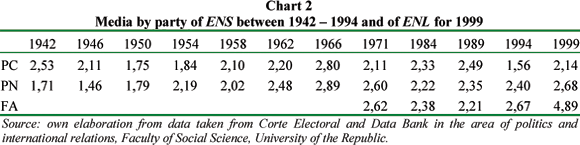
]]> The elimination of the triple simultaneous vote for the election of Representatives after 1996, modified the way of competing inside the parties. The disappearance of the possibility of accumulating in the sublema and the consequent elimination of a level of competition, limited the possibilities of small agents who, until then, could present their own lists and indicate their votes inside a sublema. These, without accumulating by sublema, stopped being a resource for negotiation, as they cannot be added in the competition for seats. In the election of 1999, the lists were subject to the strategic restrictions that had had the sublemas. The need for electoral coordination among the different agents produced an important reduction of the offer and of the effective number of lists. The smaller agents were obliged to integrate to bigger lists. This fact is verified in the continuity that is perceived -in the data presented on table 5- between the ENL in the election of 1999 and the effective number of sublemas (ENS) between 1942-199432.
5. Conclusions
Fractionalization in Uruguayan parties has given birth to a deep academic debate about its degree, evolution and causes. This article has the intention of making a contribution to a discussion full of differences, both methodological and theoretical. In this sense, the election of Representatives is seen from a perspective that goes beyond the mere analysis of its electoral offer. Particularly, it studies the evolution in the number of relevant agents in the electoral competition at the level of Representatives in the period 1942-1999.
The works that have concentrated on the analysis of the electoral offer in the election of Representatives, have sentenced the system as guilty of a high and growing fractionalization. More precisely, they have appointed double simultaneous vote and proportional representation as the causes of that problem. On the contrary, our analysis aims at showing that the phenomenon of growth in electoral fractionalization, far from having its cause in the electoral system, has fount there its limits.
Panel estimations carried out show two relevant phenomena: a) that electoral fractionalization grows along the time, and b) that the magnitude of the district is positively associated to electoral fractionalization. Both the effect of the magnitude and the course of time, are materialized through their influence on electoral offer and - in the particular case of time, directly- on the effective number of lists.
When the relationship between magnitude of the district and electoral fractionalization in the election of Representatives is carefully analyzed, it is seen that its growth takes place within the limits imposed by the electoral system. This limit is (M+1)x2 -the magnitude of the district plus one by two- for effective lists and M+1 for effective sublemas. In this sense, the cases that surpass the limit in an election seem to have a smaller model of growth -in the following election- than the one observed in the total amount of cases.
At the level of sublemas, the restrictions imposed by the electoral system seem to be even greater. The effective number of sublemas adjusts, better than the number of lists, to the limit M+1. Triple simultaneous vote allows the smaller agents to present their own lists and -at the same time- to add up votes to their bigger mates -who compete for seats- through the accumulation by sublema. For that reason, the requirements of electoral coordination among lists are softened by the existence of two levels of competition. Notwithstanding, at the first level, the one of sublemas, the constraints of the electoral system are present and the smaller agents, who are above the limit M+1, do not have a reason to exist. The sublemas are created with the only objective of competing for seats, consequently their effective number does not have a reason to surpass the limit of the system.
]]> The elimination of triple simultaneous vote in the Constitutional Reform of 1996, ended up with the accumulation by sublema. Therefore, it placed the lists in the situation of competition that sublemas faced before. Consequently, the number of effective lists was reduced to what had been in previous elections the level of effective sublemas. The incentives for electoral coordination that sets the limit of M+1, obliged the different lists -which, before, integrated a sublema- to create a single list.To sum up, even though the triple simultaneous vote gave opportunities to smaller lists, electoral fractionalization did not stop developing within the limits imposed by the electoral system, through the magnitude of the districts.
Bibliography
Aguiar, César (1984): "Elecciones y partidos", en Uruguay Hoy Nº 7, CIEDUR, Montevideo.
Botinelli, Oscar (1991): El sistema electoral uruguayo. Descripción y análisis, Working Paper 3, Instituto de Ciencia Política, Heidelberg.
Buquet, Daniel; Chasquetti, Daniel; Moraes, Juan Andrés (1998): Fragmentación política y gobierno en Uruguay: ¿Un enfermo imaginario?, Facultad de Ciencias Sociales, Montevideo.
]]>Buquet, Daniel (2000): "Fragmentación y fraccionalización política: de la oferta electoral a la conformación del gobierno", en Lanzaro, Jorge (coord.) La "Segunda" transición en el Uruguay, Fundación de Cultura Universitaria, Montevideo.
Cardarello, Salvador (1999): ¿Cambio en la representación política en el Uruguay? Efectos de la eliminación de acumulación por sublemas en diputados 1984-1994, Documento de Trabajo Nº 17, Instituto de Ciencia Política, Facultad de Ciencias Sociales, Universidad de la República, Montevideo.
Chasquetti, Daniel (2000): La renovación del Parlamento 1958-1999, Documento de Trabajo Nº 22, Instituto de Ciencia Política, Facultad de Ciencias Sociales, Universidad de la República, Montevideo.
Correa, Fernando (1993): Medidas de la concentración de mercado. Suma volumen 8, Nº 14, CINVE, Ediciones Trilce, Montevideo.
Cox, Gary W. (1997): Making votes count. Strategic coordination in the world's electoral systems, Cambridge University Press, Cambridge, Reino Unido.
]]>Duverger, Mourice (1957): Los partidos políticos, FCE, México.
González, Luis Eduardo (1991): "Legislación electoral y sistemas de partidos: El caso uruguayo", en Revista Uruguaya de Ciencia Política Nº 4, Fundación de Cultura Universitaria, Montevideo.
Katz, Richard (1986): "Intraparty Preference Voting", en Electoral Laws and their Political Consequences, Agathon Press Inc., New York.
Lijphart, Arend (1995): Sistemas electorales y sistemas de partidos. Un estudio de veintisiete democracias 1945-1990, Centro de Estudios Constitucionales, Madrid.
Mieres, Pablo (1996): "Elecciones 1994: una nueva fase de la transformación electoral en el Uruguay", en Revista Uruguaya de Ciencia Política Nº 9, Instituto de Ciencia Política - Facultad de Ciencias Sociales, Montevideo.
]]>Monestier, Felipe (1999): "Partidos por dentro: La fraccionalización de los partidos políticos en el Uruguay (1954-1994)", en Los partidos políticos uruguayos en tiempos de cambio, Fundación de Cultura Universitaria, Montevideo.
Palfrey, Thomas (1989): "A Mathematical Proof of Duverger's Law" en Models of Strategic Choice in Politics. Peter C. Ordeshook, Editor. The University of Michigan Press.
Pérez Pérez, Adolfo (1970): La ley de lemas, Fundación de Cultura Universitaria, Montevideo.
Rae, Douglas (1967): The Political Consequences of Electoral Laws. Yale University Press, New Haven.
Rial, Juan (1985): Las reglas del juego electoral en Uruguay y sus implicancias, Ciesu, Montevideo.
]]>Riker, William (1986): "Duverger's Law Revisited", en Electoral Laws and their Political Consequences, Agathon Press, Inc., New York.
Sartori, Giovani (1992): Partidos y sistema de partidos, Alianza Ed., México.
Sartori, Giovani (1994): Ingeniería institucional comparada: una investigación de estructuras incentivos y resultados, Fondo de Cultura Económica, México.
Taggepera, R y Matthew S. Shugart (1989): Seats & Votes. The Effects & Determinants of Elelctoral Systems, Yale University Press, New Haven.
Vernazza, Francisco (1989): "Minoristas, mayoristas y generalistas en el sistema electoral uruguayo", en Revista uruguaya de ciencia política Nº 3, Fundación de Cultura Universitaria, Montevideo.
]]>
* This article is the result of my work towards my final monograph for the degree on Political Science from the Faculty of Social Sciences from UDELAR. I have to thank the contributions made to this work by: Daniel Buquet, Fernando Lorenzo, Marcelo Perera, Fernando Bettosini, Antonio Cardarello, Daniel Chasquetti y Juan Andrés Moraes.
1 Sublemas are electoral alliances among lists, to the election of Senate or Representatives.
2 For an extensive review of the Uruguayan electoral system see Buquet, Chasquetti and Moraes (1998).
3 Vernazza (1989) works with ballot not with lists of candidates. This can lead to an artificial growth in the number of lists of candidates as the same list can integrate many ballots.
4 González [1991:19-20].
5 Buquet remarks the importante of measuring fractionalization within Parliament, as it is the place where governing processes take place.
6 I make reference to the system previous to the Constitutional Reform of 1996.
7 I use the term fragmentation because I make reference to the hipótesis stated by Duverger (1957) which relates PR and multipartidism. ]]>
8 By magnitude of the district is understood the number of posts to be distributed in that district.
9 This indicator follows the same logic as the ones used by Vernazza.
10 Even though Monestier counts lists, when he investigates the electoral performance of agents, he takes as a unit the ballots.
11 Mieres compares the percentage of votes that receives the four greater lists to the Senate.
12 It can also be calculated by taking into account parliamentary weigh.
13 The only difference is that Herfindahl's index does not subtract to 1 the addition of the square root of the proportions of participation; therefore, the latter works the other way round compared to Rae's because it expresses maximum concentration when it tends to 1 and maximum dispersion when it tends to 0.
14 For this enumeration I will follow what Correa (1993) does about Hall-Tideman's axioms about measures of market concentration.
15 The measure of enthropy is, as well as Herfindahl's measure, a pondered average, but in this case logaritms of the proportions are used as ponders: Enthropy = S pi log pi. To find the number equivalent to ENF, calculating on the basis of Herfindahl's measure, we have to elevate the basis of the logaritm (in this case 10) to -Enthropy:: ENF(e) = 10 (- Enthropy)
16 In these cases the one that obtains the relative majority of votes will have the seat that is of dispute.
17 Testimony candidatures are a clear example of groups that do not have as an objective to win a seat. ]]>
18 In spite of the important role of the TSV, it was not incorporated as a variable in this part of the analysis. This is because we only have one election -1999- where this system was not used. That is why we are not considering TSV in our statistic analysis and we will deal with it later, from a more intuitive perspectiva.
19 For a detailed description of the way of electing Representatives in Uruguay see Cardarello (1999)
20 The Constitutional Reform of 1996 introduced a radical change in the way of electing representatives because it eliminated multiple (or triple) simultaneous vote and accumulation through "identidad de lista". Even though DSV still exists, as voters cose a party and then a lsit to Representatives from that party, the possibility of accumulating by sublema has disappeared and combinations among lists to representatives, senators and presidency have been limited.
21 All the econometric results that are mentioned in this article are detailed in my final monograph of the degree: Election of Representatives and party fractionalization in Uruguay 1942-1999. Mimeo, Institute of Political Science, Faculty of Social Sciences, University of the Republic. However, here it is included a brief methodological anexus where the characteristics of the estimations and the statistic program used are made explicit.
22 Para el FA es imposible calcular el impacto de INT, ya que sólo se dio este caso en la elección de Montevideo en 1994. De igual forma, el FA no obtuvo la presidencia en ninguna de las cinco elecciones que participó, por tanto no se estima el efecto de PRES como variable independiente.
23 It has to be remembered that the effect of PRES is not calculated for FA.
24 Models estimated including the information of the 19 departments of the country.
25 In this case were considered the results of the estimations made for the PC and PN together.
26 When the party does not obtain seats in any district, we suppose that the expectation of those who compete within that party is to obtain one seat. In that sense, we calculate the upper limit based on a magnitude equal to 1.
27 Monestier concludes this fact from an intuitive analysis of charts where he presents the evolution of the electoral offer. ]]>
28 We use the percentage calculated for PN and PC to avoid distortions in the incorporation of FA in the year of 1971.
29 Para esto debimos dejar de lado los casos correspondientes al PN y PC en 1942 y al FA en 1971 (no contamos con el NEL en t-1), al mismo tiempo, no consideramos los casos de 1994 ya que cuando sobrepasan el límite no podemos saber su evolución en t+1. Esto nos deja con 380 casos.
30 La única información disponible sobre los posibles resultados electorales es la que surge del conocimiento del resultado de la elección anterior.
31 For that, we had to set aside the cases corresponding to PN and PC in 1942 and FA in 1971 (we do not have the ENL in t-1), at the same time, we do not consider the cases of 1994 because when they surpass the limit we cannot know their evolution in t+1. This leaves us with 380 cases.
32 This behaviour is not registered in del EP-FA, due to the fact that competition incide the districts is influenced by the nacional one.
Methodological Anexus
In the econometric analysis carried out in this work, econometric techniques of panel data were used (see, Greene, W. H. (1993). Econometric Analysis. Macmillan), using Limdep 7.0.
The units of analysis are the parties in each of the 19 districts. Therefore, the values of each variable are calculated for a party i in a district j in an election t. For the Partido Colorado and the Partido Nacional the period of analysis is 1942-1994 (11 elections) and for EP-FA the period is 1971 to 1994 (4 elections).
]]> The variables explained in the estimated models were:
Number of lists (NLijt): the addition of the lists to representatives presented by the party i in the district j in the election t
The explanatory variables included in the estimations were of two kinds:
A) The index of the effective number of legislative parties is computed by taking the inverse of the sum of the squares of all parties' seat shares
B)
For the four variables to explain, four estimations were made, one for each party and anotherone that was analysed together with the information of the two tradicional parties (PC and PN). For the PC and the PN, separatedly and together, the estimations were made for the period 1942-1994. For FA, the period of study is 1971-1994. Additionally, were estimated models where the observations belongiong to teh departments of Montevideo and Canelones were excluded with the purpose of avoiding distortions that could introduce, in the aggregate analysis, the two biggest districts, that is to say, the two departments with Mijt values, highly above the others.
The criteria to decide if the group effects would be included was the Likelihood ratio test.
]]>