Gerardo Halpern*
Translated by Agostina Marchi
Translation from Sociedad (Buenos Aires), Buenos Aires, n.27, 2008.
In this article I will try to introduce some of the aspects that compose what is commonly known as 'Paraguayan community in Argentina'. Nonetheless, the underlying hypothesis of these considerations assumes that much of such referent transcends what common sense ascribes to it; the so-called 'Paraguayan community' shows dynamics and processes that are often disregarded by the social imagery. Hence, I will herein intend to point out some of the motives and reasons that explain such disregard and, at the same time, collaborate in building up the definitions I will subsequently propose.
It might well be worthwhile saying, before moving any further, that even though it is certainly possible there is some sort of general agreement within the academic field regarding what follows, such is not the case within other fields of discursive and political production. Ethnic relationships within a social formation such as the one that has developed in Argentina from its very beginnings prevent any dialogic conception of and/or between the 'different' social groups involved. Therefore, the specification process that goes across the social construction of a group that becomes visible in Buenos Aires through syntagms related to a 'Latin-American origin' (such as the 'Paraguayan community') will presuppose, update, and reinforce forms of stigmatization that will, on the one hand, define much of the originating dialogue, and, on the other, influence the self-perception of the subject concerned1.
]]> This paper has two sections. The first one deals with a demographic systematization of Paraguayans in Argentina. In the second one, I will present some of the cultural specificities of Paraguayan organized groups in Buenos Aires I believe attest to the disregard above-mentioned.Two final considerations are needed as part of this introduction. Firstly, I would like to stress the fact that it is quite common to find a great de-historization when thinking about immigration to Argentina with regard to certain specific groups. The ways of classifying a group that is quite often labelled as 'new', for example, tend to express the fact it has merely become visible quite recently, and not necessarily the fact that it has actually emerged as a new social actor. This de-historization cannot only be found, furthermore, in the official narratives about the national epic (in which 'immigration' has always meant, in addition, 'European immigration'). On the contrary, it can also be found in many of the discursive productions that, placing regional immigration within the category of 'new migratory currents', reproduce (deliberately or not) the hegemonic ways of classifying Latin-American immigrants in the country.
Such classification produces or reproduces one attention-grabbing operation: it makes the constant look inconstant and, on such assumed alteration, it builds up myths, policies, and stigmas that become strongly entrenched in the social imagery. In turn –for example and despite empiric evidence only shows the percentage of Paraguayan immigrants over the total population of Argentina has been historically minimum (between 0.2% and 0.9%)–, we can nonetheless find operations that have authorized the assumption of Paraguayan immigration being a 'wave', a 'silent invasion', or even a 'crisis generator' by rooting themselves in ideas of massiveness and excess2. I believe it is necessary to draw the attention upon such operations for –among other things– great deal of the production on the Latin-American migratory process to Argentina is much more sifted by the ways in which it becomes visible than by new phenomena or recent formations3.
Thus (and since the second part of this article will work on certain indicators of the Paraguayan migratory process to Buenos Aires that express themselves in the materialization of several institutions), the analysis of the emergence of such organizations within the proposed framework will allow us to understand the kind of activities immigrants dedicate themselves to as an answer to the way of life they are immersed into. And, in addition, we will be able to see the occurrence of these activities is not only related to quantitative phenomena, but also to the social processes of the home and arrival countries.
Secondly, it is also necessary to tell of the scarcity of ethnographic research devoted to analyze the Paraguayan migratory process to Argentina and, specially, to Buenos Aires, is quite remarkable. As we will see, Paraguayans are today the most discursively marginalized and least specifically analyzed –yet the biggest– migratory group of non-nationals living in Argentina. Repeatedly pointed out at (together with other Latin-American groups of immigrants) as part of the dysfunctionalities that have structured some of the explanations regarding the cultural, political, and economical 'degradation' of Argentina, no attention has been paid yet to what immigrants actually do in the country of arrival.
Within this framework, hence, the ways in which Paraguayan immigrants organize themselves and produce discourse are, among other things, more or less effective ways of dealing with an unequal, adverse, and –whether this is lived as such or not– discriminatory daily life. And, in this sense, much of what Paraguayans have done despite having been kept in the darkness by cultural analyses (beyond the aesthetic ways of power of accounting for the 'communities' in state ceremonies by vindicating a certain 'state folklore') does not only respond, therefore, to certain 'national-ethnic' invisibility but, also, to the invisibility imposed over what subordinate social sectors produce from such subordination.
Nevertheless, the absence of research in regard to Paraguayan immigrants stands out against the existence of an embryonic yet relevant academic production regarding other groups that are also defined in national-ethnic terms (such as Bolivians, Chileans, Peruvians, etc.)4. Such contrast becomes even more striking, furthermore, when comparing it to the existing production on European (mainly Italian and Spanish) immigration.
I emphasize this situation for the almost only work that deals with a serious systematization of some of the socio-demographical variables of Paraguayans in Argentina was carried out –though not published yet– a few years ago by María José Marcogliese5. Such report is one of the most relevant contributions to the knowledge of some of the features of the group we are herein trying to analyze6. I am fully aware, on the other hand, these notes of caution must be framed within an interpretation proposed for and centred in Buenos Aires. I know their emphasis and range become thus certainly reduced. Anyhow, we should also take into account the centre of all scientific and academic production in Argentina is highly condensed in Buenos Aires; it is the capital city outwards, hence, where official discourses and constructions about the nation mainly come from. This way, the porteña vision on the Paraguayans or, even more, their legitimate invisibilization as social agents, becomes anything but irrelevant. And, at the same time, this noticeable lack of research on the subject should also be highlighted for, during the last few decades, Paraguayans (together with other social groups) have been, on the contrary, strongly pointed out at and problematized in and by the political and mass-media agendas (mostly as part of an assumed 'invasion' to Argentina and as one of the main reasons for many of the crises through which the country goes or has gone through).
Paraguayans in Argentina I
]]> Paraguayans are, since 1947, the first group of Latin-American immigrants in Argentina. And, since 2001, they have been the more numerous group of foreigners living in the country.
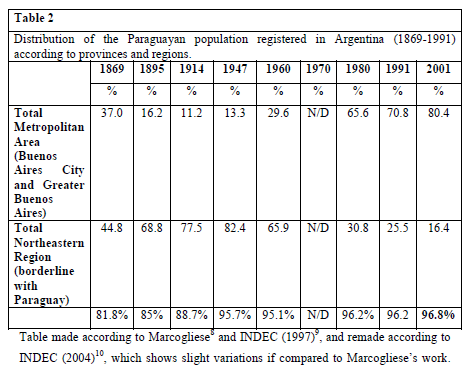
If we take into account Buenos Aires City and Greater Buenos Aires alone, the impact of Paraguayan immigration rises up to even more substantial levels: this area has been, since 1980, the main settlement location for Paraguayan immigrants (which proves, in addition, the dynamics of an 'inner' circulation that goes back up to the mid-1940's and continues until today). Such region and the whole area that borders on Paraguay are the two geographical settings where most Paraguayan immigrants concentrate. If we add both settlements, we will be able to see that, currently, they hold over the 96% of the Paraguayans living in Argentina.
The geopolitical boundaries between Argentina and Paraguay are set, from the Argentinean side of the border, by the Provinces of Salta, Formosa, Chaco, Corrientes, and Misiones. From the Paraguayan side of the border, the frontier is outlined by the Central Department (where Asunción, the capital city, is), and the Departments of Ñeembucu, Misiones, Itapúa, Alto Paraná, Presidente Hayes, and Boquerón. The frontier between both countries is 1,699 kilometres long, and has generated across the years several cultural and socioeconomic formations that work both sides of the border11. Therefore, what research classifies as 'migrations' is usually not lived as such by the agents of an economic and symbolic circulation themselves.
Paraguayan presence in Argentina has been registered, at least according to official databases, since the first national census (1869). In those days, Paraguayans were the 0.2% of the total population of the country, the 1.6% of the entire foreign population living in Argentina, and the 7.9% of the total foreign population coming from neighbouring countries. If we sum up all these neighbouring-countries immigrants, they rose up to the 2.6% of the total population (and, despite whatever official and mass-media discourses and/or the social imagery may suppose, this percentage has remained constant up to the present).
]]> If we stick to a merely quantitative reading of the charts, Paraguayans have never represented more than the 1% of the total population of Argentina. The same as in 1970 and 1980, 2001 registers show Paraguayans reach only the 0.9% over the total population, which is actually the highest peak of Paraguayan presence in the country. A second reading of the same figures, on the other hand, allows extracting the percentage of Paraguayans with regard to international migrations in general (fourth column of Table 3) and Latin-American migrations specifically (fifth column of Table 3). This last reading would highlight, hence, the progressive percentage growth of Paraguayan immigrants over the total migratory mass to Argentina.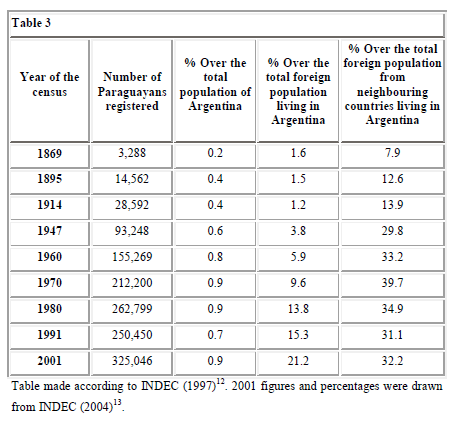
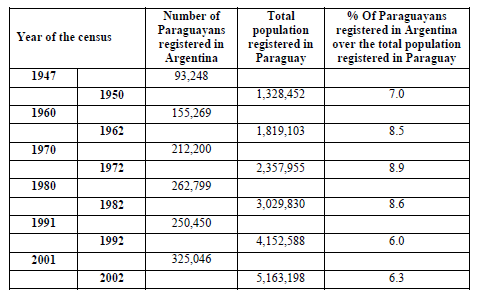
Having said that, I believe we should reject the assumed 'massiveness' so strongly stated by the dominant discourses (especially since the employment crises that have rocketed during the 1990's) with regard to Paraguayan immigration. On the other hand, such perspective changes when we look at the same phenomenon but, this time, from the other side of the border: one of the specificities of Paraguayan migratory movements is actually its high percentage regarding Paraguay's own total population.
Beyond the count of all Paraguayans living abroad that have been registered in each one of the national censuses worldwide (summation that shows percentages that do not reach the 10% of the total population of Paraguay14), there are several estimates that restrict Paraguay's own social imagery on this issue15. According to the most serious research that has been carried out on the subject, between the 10% and 15% of Paraguayan natives live abroad16. Their main destination has been and still is Argentina. Jorge Balán actually states Argentina is the centre of the migratory system within the Southern Cone region17. In any case (and even though the Paraguayan case can quintuplicate the 3% migratory studies believe to be the world migrating population media), such 'drain' of Paraguay's native population outside its frontiers does not get any closer to the most dramatic cases those same migratory studies use to talk about population catastrophes o massive departures18.
This does not mean, on the other hand, that the relevance of this emigration phenomenon can be minimized (quintuplicating the world migrating population media is not at all irrelevant). On the contrary, I herein aim at trying to properly place this issue within certain boundaries. Yet, the truth is that, as a theoretical problem and as it can be concluded from the relevant academic production on the subject, Paraguayan emigration to Argentina has been, at least since the 1910's, much more significant than Paraguayan immigration to Argentina.
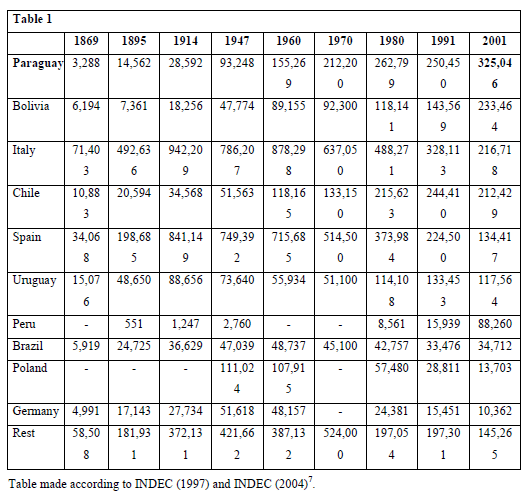
Despite the fact that Paraguayans are currently the most numerous group of immigrants among those coming from neighbouring countries, they nonetheless show periods of both quantitative growth and decay that force us to be careful when analyzing dynamics and, specially, when making projections. As we can see in the charts, Paraguayans have, on the one hand, experienced a proportional growth regarding the total immigrant population between the 1980 and 1991 Argentinean national censuses. But, on the other hand, they have also decreased during that same period quantitatively speaking (that is, in absolute values). Those two pieces of information placed together make us remember that several of the speculations we usually make on this subject have restrictions: we are usually forced to disregard motives (whether it is motives for leaving the native country or for choosing the country of destination –and the idea of 'choosing' already arises, in addition, more than one issue…); we do not always take into consideration the possibilities of staying in the home or arrival country and/or the factors for ejection of either of them; we tend to disregard the phenomena related to immigrants returning to their native countries or not; etc.
The reasons for Paraguayans (the same as Bolivians) having overgrown European (Italian and Spanish) immigrants have to do, mainly, with the fact that migration movements between Bolivia, Paraguay, and Argentina have maintained themselves constant over the years while, at the same time, European migration to the country has –and for a long time now– stopped almost completely. The lack of renewal of native Spanish and Italian immigrants (the same as the decease of their already long-lived representatives: over the 90% of the Italian and Spanish immigrants in Argentina are over 60 years-old) has a lot to do with the changes in the composition of the immigrant population of the country we can track in the charts. In fact, both the absolute figures (second column of table 4) and the percentages of foreigners over the total population (table 5) have shrunk considerably.
]]>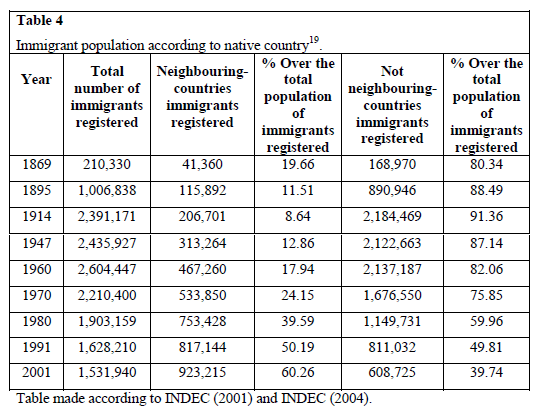
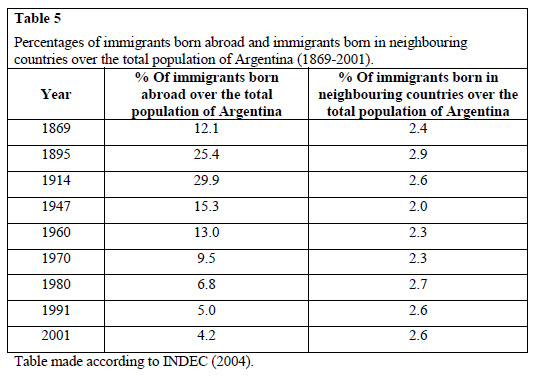
What I am intending to show with these figures and percentages is that, on the one hand, we can certainly see significant changes with regard to the composition of Argentina's immigrant population, but, on the other one, such changes do not have any major percentage impact whatsoever if we compare regional immigration and total population of the country.
The total migratory mass to Argentina could well be becoming 'more Latin-American' (in fact, that is actually the case). Nevertheless, that does not necessarily mean (and it actually does not mean) such 'Latin-Americanized' immigration is having any actual impact (at least quantitatively speaking) on the total population of the country. In fact, if Argentina grew underneath the epic of being 'an immigration country', the proportion of such immigration over the total population is nowadays in its lowest historical peak (4.2% –see table 5)20. In spite of such a low percentage, I do not believe a parallel diminishment to be taking place regarding the 'discourses about immigration'.
Although we should take into account several other elements to analyze the above mentioned phenomena, I will continue to list and briefly characterize the different organizations of Paraguayans living in Argentina that allow a typology with which I intend to close this article. The characterization of the factors of ejection (as well as their relationship with the role played by the Argentinean State since the War of the Triple Alliance (1865-1870) and the ways in which modern Paraguay has shaped itself) will have to wait for future works.
]]> Nonetheless, Paraguay's forms of capital accumulation (its poor industrialization, the large estate, the stagnation, the land consolidation), as well as the political internal struggles and its institutional instability (persecution of political opponents included), have been the main factors for the ejection of Paraguay's own native population abroad21.
Paraguayans in Argentina II
Regarding some of the cultural and political features of Paraguayan groups in Argentina, we should first of all say the heterogeneity of their organizations is not at all something we should disregard. The same as the border is not always lived as such by those who work their lives out through it, that exact same border has served, in many occasions, as a lifesaving resource for all those Paraguayans who have been politically persecuted throughout the most unstable and barely democratic Paraguayan history. The idea of exile, therefore, must be included as one of the main concepts for this analysis. Such word was already in use, in fact, by the times of the War of the Triple Alliance, when the 'Paraguayan Legion' (which was formed, according to Héctor Decoud, by some 400 Paraguayan exiles who were seeking to return to the land that had expelled them22) took part in the conflict within the Argentinean ranks that invaded Paraguay.
One of the main features of this case becomes structured, hence, by the fact that Paraguayans have configured, throughout their entire history in Argentina (and they still continue to configure nowadays), an arena in which political struggle is one of the crucial elements to all the organizations they have created for sustaining their so-called 'Paraguayanness'. Thus, within such 'Paraguayanness', the political component allows to underline one of the questions that guide this article: if we ask 'What do Paraguayan immigrants do in Argentina?', we will have to answer, at least in principle, 'They are politically active'.
Paraguayan immigrants in Argentina have created institutional spaces of organization that were born strongly related to their native country. Therefore, it is useful to mention that, for instance, the country of arrival held headquarters for all Paraguayan political parties already by the mid-1950's. And, furthermore, all the main political leaders of the opposition parties to Stroessner's thirty-five years-long dictatorship used to live, during those days, in Argentina (including, in fact, the factions of Stroessner's Partido Colorado that did not support Stroessner himself).
Even though Stroessner's dictatorship has fallen, such organizations continue to be active nowadays and, in fact, they are one of the main driving forces for many of the initiatives of the Paraguayan community in Argentina. Since their development and growth has entailed strong stands regarding Paraguayan State policies, they have generated, throughout their history, a quite specific political culture: their struggle against the reasons for Paraguayans having to leave their native country and for the retrieval of the civil rights they have lost after the 1992 Constitution has allowed this militancy to have a not at all irrelevant impact on Paraguay's own public sphere. Paraguay's last election (2008) and the repeated claims for the right of Paraguayans living abroad to vote prove it quite clearly.
Despite these struggles are inevitably covered by a 'political' overtone (which goes from the Asociación Nacional Republicana and the Partido Colorado –ANR/PC– to the Partido Liberal Radical Auténtico and all Paraguay's left-wing parties –Partido Revolucionario Febrerista, Tekojoja, Partido Comunista, etc.), these demands have also been upheld by organizations we could describe as 'cultural' rather than as 'political'.
This second kind of organizations groups Paraguayan immigrants around subjects and practices that, in principle, do not intervene in the political arena of their home country. Nevertheless, it is also necessary to say that, even though in different (less explicit) ways, such organizations have also taken part in both Paraguayan and Argentinean public spheres. They have enrolled themselves in the struggle for democracy, in the issues related to Paraguayans returning to their homeland, and in the claims for civil rights and anti-discriminatory policies in both sides of the border.
Such a multiplicity of institutions and organizations has developed throughout the XXth century and, specially, since the 1950's. As Marcogliese states, they "were mainly created (…) for answering needs such as 'gathering the fellow countrymen', 'organizing the participation of the Paraguayans living in Argentina', 'maintaining the links', 'gaining leisure spaces of their own', or 'creating spaces that would help sustaining the love for the «distant Homeland»' (…) Those were decades of major Paraguayan (and Latin-American on the whole) immigration to the Metropolitan Area (Buenos Aires City and Greater Buenos Aires), mainly drove by the opportunities its urban market seemed to offer"23.
]]> These institutions can be characterized by the use of Guarani as their main language, as well as by the vindication of both practices and consumptions that appear related to the native country: 'Paraguayan' food and music are combined in order to create some sort of 'local construction' within a context to which such practices and consumptions are strange. These spaces, therefore, crystallize a 'Paraguayan migratory culture' that is not new for the Paraguayan social imagery. They allow, within their boundaries, to make legitimate what outside them is not: the claim for a 'national culture' in these spaces contrasts with the stigmatization that is projected towards them from outside their margins.Hence, group organization allows Paraguayans reverting, at least momentarily, stigmas that have been both materially and symbolically imposed to them since the 1960's by both Argentinean legislation and Argentinean social imagery.
'Political' and 'cultural' organizations show, thus, spaces of systematized reunion and reorganization where Paraguayans can debate, propose, and reflect on the situation of their own native country. Drawing their boundaries, on the other hand, is quite complex for, among other things, 'cultural' organizations have suffered major transformations as they took stands regarding, first, Paraguay's State policies and, then, the more and more restrictive Argentinean policies on the concerned subjects.
It is also necessary to point out that many of those both political and cultural formations carried out their programmes within 'non-Paraguayan frameworks' by relating themselves with local (Argentinean) political organizations and/or institutions, with whom they have shared spaces and projects in many occasions. Therefore, it is absolutely possible to find militants and active members of both Paraguayan and Argentinean political parties within the Paraguayan groups in Argentina, as well as several Paraguayan 'cultural' institutions that have carried out activities together with 'Argentinean' popular and political organizations24.
The specificity I am herein trying to underline lies, thus, on the strong presence of the 'political' component both inside and outside all these organizations; we become able to highlight, therefore, the presence of politics as one of the main articulating links for Paraguayan both identities and culture in Argentina. Such politics emerge strongly related to the native country: Paraguayan organizations in Argentina suppose a strong bond regarding their native country, both in cultural terms (speaking Guarani, sharing typical food, vindicating folkloric practices, etc.), and in social and political terms (organizing Paraguayan political parties in Argentina, creating spaces for the debate of the general situation of their home country, publically demonstrating in the public sphere of Paraguay, confronting with its token empowered party, and, in extreme cases, rising up against Paraguay's political regime)25.
Nevertheless, since stigmatizing discourses and policies about the 'Latin-American immigrants' in Argentina seem to have gained ground almost uninterruptedly since the 1960's (though, especially, from the 1990's on) these organizations were soon forced to include in their agendas the debate regarding the situation of Paraguayans in Argentina and the struggle against inequality and discrimination in the country of arrival. Such a state of affairs resounded, almost unavoidably, in the consolidation of a migratory (or Paraguayan) public sphere, which started taking active part in many conflicts with the Argentinean state itself (for instance, its intervention in relevant parliamentary debates, in repudiations to restrictive policies, in both local and international charges against discrimination, or –beyond the actual results of those actions– in immigration amnesties processes).
Finally, we must also mention within this heterogeneous framework a third kind of organization that will be mainly related, this time, to the Church: the Equipo Pastoral Paraguayo in Argentina (EPPA) was founded in 1970 for vindicating and denunciating several events related to both Paraguay's socio-political situation and the situation of the Paraguayans living in Argentina. Its creation was strongly related to the Liberation Theology and to the guidelines posed by the Movement of Priests for the Third World, and the EPPA slowly grew into a strong voice within the public sphere (mainly Paraguayan, though also Argentinean) through which many Paraguayans had access to the possibility of organizing themselves publicly.
Among the various initiatives of the EPPA, we must highlight the organization of Caacupé-í, which is a 'religious' ritual that is celebrated each December 8th and summons tens of thousands of Paraguayans, mainly coming from the Greater Buenos Aires. There, and besides the religious ritual itself, a true 'Paraguayan public festivity' takes place. Both the 'cultural' and the 'political' institutions that gather all Paraguayan immigrants living in Argentina take part in this celebration, which becomes, hence, a quite heterogeneous and multifaceted public holiday.
Even though the 'religious' is certainly predominant in this venue, the 'ethnic' and the 'political' are not at all irrelevant either (both for the public exposure of what Paraguayans in Argentina build up as a 'reproduction of the Paraguayan ways' –from food and dances to Guarani and invocations to the Homeland–, as well as for the proclaimed speeches).
Within those speeches (and, in fact, as a relevant part of those 'Paraguayan ways in Argentina'), we can find claims for policies that allow the right not to migrate, denunciations against the direct or indirect ejection of Paraguayans of their home country, demands for an immediate stop to the repressive policies in rural areas, for the democratization of Paraguay, its transparency and the end of corruption in its public sphere, for a better treatment in the border, and for policies that allow Paraguayans to return to their native country. At the same time, they also speak against the discrimination in Argentina, against the corruption both in the frontier and the customs, against inequality, and, finally, for the social organization of Paraguayans in Argentina. Between both types of registers, Daniel Esquivel, who was a priest and active member of the EPPA that was abducted by the last Argentinean military dictatorship, is always honoured and remembered. Those speeches also claim for the full recovery of the political citizenship of Paraguayans living abroad. In short, Caacupé-í renews and updates –in much more than one way– those features that define the organization of Paraguayans throughout their history in Argentina.
]]> We must say, at last, such a renewal allows understanding the political and cultural heterogeneity and richness of those Paraguayans who have been living in our country. Sadly, we must also remember these issues and features are not quite usually included in the Argentinean social imagery around them, who, in the end, are immigrants struggling for the right to become a legitimate part of the social 'totality', both back in their home country and in Argentina.
* Gerardo Halpern is an Assistant Professor to the Chair of Teorías y Prácticas de la Comunicación I (Communication Studies B.A. Degree, Faculty of Social Sciences, University of Buenos Aires), and a researcher at Gino Germani Institute and CONICET.
1 To some extent, that is exactly what Walter Mignolo states when talking about the "double coloniality of power": power can 'colonize' not only through the construction and simultaneous stigmatization of the 'other', but also through the reproduction of the classifications and definition schemes that sustain such power by the 'other' himself. Walter Mignolo, ed., Capitalismo y geopolítica del conocimiento. El eurocentrismo y la filosofía de la liberación en el debate intelectual contemporáneo (Buenos Aires, Argentina: Ediciones del Signo, 2001).
2 Sergio Caggiano, Lo que no entra en el crisol. Inmigración boliviana, comunicación intercultural y procesos identitarios (Buenos Aires, Argentina: Prometeo, 2005).
3 Talking about 'new phenomena' regarding the migratory issue is quite frequent in much of the current production on this subject. Such production usually proposes 'new' concepts for describing merely apparent population innovations (such as transmigration, bivalence, etc.) by accounting geographical, technological, and communicational factors that are certainly part of the global transformations post-1973 crisis. Nevertheless, several of such 'innovations' are actually continuities of historical processes that, in many cases, have been poorly studied. Therefore, I must herein restore some of the more classical approaches that, despite being not necessarily hegemonic, I believe have to be revisited in order to explain the constitution of contemporary migratory movements before assuming they have been completely used up. I do not rule out, on the other hand, the possibility of using the concepts and theories that currently argue much of the already produced on the subject (for example, all the production we could here group within the 'pull-push' theories). On the contrary, what I am merely pointing out is that such current follow-ups of much of the criticism that has been posed to more classical theories and ideas have, in many cases, forgotten a handful of unquestionable truths that should not be forgotten. Even though 'culturalist' contributions to the study of the migratory issue have been fundamental for leaving neoclassical economic explanations behind, this cannot mean, in any case, to forsake political-economical factors of expelling and attraction when trying to interpret migratory processes. Taking this into account shapes not only my perspective regarding migratory movements but, as well, my overall look towards social sciences.
4 Alejandro Grimson, Relatos de la diferencia y la igualdad. Los boliviano en Buenos Aires (Buenos Aires, Argentina: EUDEBA, 1999); Sergio Caggiano. Lo que no entra en el crisol. Inmigración boliviana, comunicación intercultural y procesos identitarios, op. cit.; Mauro Vázquez, "Como en susurros. La identidad política de unas bolivianas piqueteras: entre la nación, la clase y el género" (Communication Studies B.A. Degree thesis, Faculty of Social Sciences, University of Buenos Aires, 2005); Mirtha Lischetti, ed., Desafíos para la integración regional. Chilenos en Argentina. Una perspectiva antropológica (Buenos Aires, Argentina: Editorial Antropología, 2003); Brenda Pereyra, "Más allá de la ciudadanía formal. La inmigración chilena en Buenos Aires", in Cuadernos para el Debate #4 (Buenos Aires, Argentina: IDES, 1999); Brenda Pereyra, R. Castronovo, "Volver o no volver: El retorno de chilenos residentes en Buenos Aires" (paper presented at the V Jornadas sobre colectividades, Buenos Aires, Argentina, IDES, 1998).
5 María José Marcogliese, "Proyecto diagnóstico de la colectividad paraguaya en Argentina" (Buenos Aires, Argentina: Mimeo, 2003).
6 Another work that analyzes part of this migratory process and exile is that of Andrés Flores Colombino (La fuga de intelectuales. Emigración paraguaya –Montevideo, Uruguay: Talleres Gráficos de la Comunidad del Sur, 1972), who analyzes Paraguayan 'intellectuals' and college students that had to immigrate to Uruguay by the late 1960's. By saying this, nonetheless, I am not unaware of the many contributions that have certainly helped my research. I would merely like to highlight the noticeable absence throughout the Latin-American academic production of a subject that, at least every once in a while, seems so much relevant in order to explain so many crises. ]]>
7 Instituto Nacional de Estadísticas y Censos, La migración internacional en la Argentina: sus características e impacto (Buenos Aires, Argentina: Secretaría de Política Económica del Ministerio de Economía y Obras y Servicios Públicos, 1997); Instituto Nacional de Estadísticas y Censos, "Tendencias recientes de la inmigración internacional", in Aquí se cuenta. Revista informativa del Censo 2001 (Buenos Aires, Argentina: 2004).
8 María José Marcogliese, "Proyecto diagnóstico de la colectividad paraguaya en Argentina", op. cit.
9 Instituto Nacional de Estadísticas y Censos, La migración internacional en la Argentina: sus características e impacto, op. cit.
10 Instituto Nacional de Estadísticas y Censos, "Tendencias recientes de la inmigración internacional", op. cit.
11 Alejandro Grimson, "El puente que separó dos orillas. Notas para una crítica del esencialismo de la hermandad", in Alejandro Grimson, ed., Fronteras, naciones e identidades. La periferia como centro (Buenos Aires, Argentina: Ediciones CICCUS-La Crujía, 2000); Alejandro Grimson, El otro lado del río. Periodistas, Nación y Mercosur en la frontera (Buenos Aires, Argentina: EUDEBA, 2004).
12 Instituto Nacional de Estadísticas y Censos, La migración internacional en la Argentina: sus características e impacto, op. cit.
13 Instituto Nacional de Estadísticas y Censos, "Tendencias recientes de la inmigración internacional", op. cit.
14 CELADE (División poblacional de la CEPAL), Observatorio Demográfico No.1: Migración internacional (Santiago de Chile, Chile: 2006; http://www.eclac.cl/publicaciones/xml/8/27498/Observatoriodemografico.pdf); CELADE (División poblacional de la CEPAL), Boletín Demográfico No.65 (Santiago de Chile, Chile: 2000; http://www.eclac.org/Celade/publica/bol65/planilla.xls). Both reports can illustrate these figures: in the first case, the report works with the national censuses carried out between 1999 and 2002; in the second case, it works with the early 1990's censuses.
15 Paraguayan official databases sometimes take into consideration quite exorbitant figures: 1,800,000 out of the 5,163,198 Paraguayans registered in 2002 are supposed to be living in Argentina (that is to say, over the 30% of the total population of the country would be living abroad, and that if we take into account only one of the many countries where Paraguayans have emigrated. Argentina is the country that has had the biggest Paraguayan influx throughout history) (Dirección General de Estadística, Encuestas y Censos, Paraguay. Resultados Finales. Censo Nacional de Población y Vivienda 2002 –Asunción del Paraguay, Paraguay: 2002). Such databases do not take into consideration Paraguayan emigrants living in Brazil, Spain, the United States, and other places in America, Europe, Africa, and Oceania (there are Paraguayans in each one of those places and their figures are not at all irrelevant in Brazil, Spain, Uruguay, and the United States). Following here Marcogliese's work once more, percentages decrease quite considerably if we relate Paraguay's and Argentina's national censuses:
16 Adela Pellegrino, Migrantes latinoamericanos y caribeños: síntesis histórica y tendencias recientes (Santiago de Chile, Chile: CEPAL-ECLAC-Naciones Unidas, September 2000); Tomás Palau Viladesau, "Nostalgia y temor. Las condiciones del retorno de migrantes paraguayos desde Argentina" (paper presented at the Asociación Internacional de Sociología. Seminario de Buenos Aires "La migración internacional en América Latina en el nuevo milenio", Buenos Aires, November 2000); Organización Internacional para las Migraciones, "Población y migración en Paraguay", in Revista sobre Migraciones en América Latina #2/3 (1992). ]]>
17 Jorge Balán, Las migraciones internacionales en el Cono Sur (Buenos Aires, Argentina: CEDES, 1985).
18 Stephen Castles, "Migración internacional a comienzos del siglo XXI: tendencias y problemas mundiales", in Revista Internacional de Ciencias Sociales #165 (UNESCO, 2000); Georges Photios Tapinos, "Mundialización, integración regional, migraciones internacionales", in Revista Internacional de Ciencias Sociales #165 (UNESCO, 2000); Raúl Urzúa, "Migración internacional, ciencias sociales y políticas públicas", in Revista Internacional de Ciencias Sociales #165 (UNESCO, 2000).
19 There are three pieces of data that should be highlighted in Table 4:
a) The total number of immigrants to Argentina only decreases from the 1970 national census on (second column).
b) The influx of neighbouring-countries immigration to the country grows in absolute values (third column) and in parallel with the diminishment of the total influx of immigrants (second column).
c) By 1991, neighbouring-countries immigration exceeds for the first time in Argentinean history not-neighbouring-countries influx of immigrants (fourth and sixth columns). If immigrants coming from neighbouring countries were, in 1980, the 39.59% over the total migratory mass to Argentina, by 1991 they were already reaching the 50.19% (INDEC figures, on the other hand, make it the 52.3%). According to the last national census, neighbouring-countries immigration constitutes the 60.26% over the total number of immigrants registered.
20 The need to insist on several of these figures and percentages entails a risk I have tried to avoid throughout my entire research: conceptually homogenizing Paraguayan immigrants underneath categories such as 'regional immigration', 'Latin-American immigration', 'neighbouring-countries immigration', etc. tends to simplify complex, heterogeneous, contradictory, multi-casual, and multifaceted processes. Nonetheless, I have to acknowledge sometimes there is no other way out and I do not have any other choice but to fall for what I actually intend to argue. Therefore, I feel I should herein clarify I believe taxonomies such as 'Paraguayan community in Argentina usually de-historize what they actually intend to analyze. Homogenization as a theoretical way of codification shows the same symbolic operations with which state classifications work (and, thus, such a classification is as ideological as any other).
21 Adriana Marshall, Dora Orlansky, "Las condiciones de expulsión en la determinación del proceso emigratorio desde países limítrofes hacia la Argentina", in Desarrollo Económico #80 (January-March 1981); Adriana Marshall, Dora Orlansky, "Inmigración de países limítrofes y demanda de mano de obra en la Argentina, 1940-1980", in Desarrollo Económico #89 (April-June 1983).
22 Héctor Francisco Decoud, Los emigrados paraguayos en la Guerra de la Triple Alianza (Buenos Aires, Argentina: L. R. Rosso, 1930).
23 María José Marcogliese, "Proyecto diagnóstico de la colectividad paraguaya en Argentina", op. cit. ]]>
24 I devote a whole chapter of my Ph.D. thesis to the description of these organizations: their relationship with Peronism (Partido Justicialista), Radicalism (Unión Cívica Radical), and communism shows such levels of complexity it does not allow the national-ethnic factor to be 'the' (only) defining factor of migratory identity construction. The relevance of their growth and the density of their organization prove a cultural and political dynamics that is nonetheless seldom studied when analyzing migratory and exile processes in Argentina (and that certainly is one of the debts the Argentinean academic field still owes to the history of Latin-American foreigners living in its country).
25 Due to reasons of space, I will not discuss here the history of Paraguayan guerrillas or revolutionary groups that were created or developed in Argentina. See, for great articles on the subject, Novapolis #8 journal (Asunción del Paraguay, Paraguay: August 2004).