Tema e variantes do mito: sobre a morte e a ressurreição do boi
Maria Laura Viveiros de Castro Cavalcanti
Associate Professor, Department of Cultural Anthropology and Graduate Program of Sociology and Anthropology, Institute of Philosophy and Social Sciences, Federal University of Rio de Janeiro, Brazil . E-mail: <cavalcanti.laura@gmail.com>
Translated by David Allan Rodgers
Translation from Mana, Rio de Janeiro, v.12 n.1, p. 69-104, Apr. 2006.
]]>
ABSTRACT
The folguedos do boi, or ox revelries, have challenged generations of scholars. In the literature, they have been mainly apprehended as the performance of an original short popular drama. The problem is that the supposed drama has rarely been directly observed. The first part of the text argues that the belief in the so-called ox drama expresses a remarkable crystallization of the illusory effect of archaism, an ideological and analytic premise typical of this area of studies that assigns ancient origins to folklore and popular culture. The supposed original ox-drama is here placed in a new context that understands it as a set of origin narratives that blossomed in the 1950s’ wake of Brazilian folkloric studies. The second part of the text analyses nine variants of the ox’s death and resurrection narratives adopting a structuralist-inspired approach that demonstrate the mythic nature of this dynamic symbolic process. In the concluding remarks, I seek to rethink the relations between myth and ritual that emerge from this new understanding of the ox revelries.
Key words: Myth, Ritual, Ox Revelries, Structural analysis, Origin narratives.
RESUMO
A compreensão dos folguedos do boi tem desafiado gerações de estudiosos. Na literatura, eles foram geralmente compreendidos como a apresentação de um drama ou auto popular originário. No entanto, raramente o suposto auto foi observado de modo direto. A primeira parte do texto argumenta que a crença no dito auto expressa uma notável cristalização da ilusão do arcaísmo, uma premissa ideológica e analítica que atribui origens ancestrais aos fatos do folclore e da cultura popular. A idéia de um auto original é aqui situada em um novo contexto. Trata-se de compreendê-la como um conjunto de narrativas de origem da própria brincadeira do boi que ganharam forma na esteira da ampla atuação do Movimento Folclórico Brasileiro, nos idos dos anos 1950. A segunda parte do texto analisa nove variantes das narrativas da morte e ressurreição do boi adotando uma perspectiva estruturalista que demonstra sua natureza mítica e processual. Nas conclusões, busco repensar as relações entre mito e ritual que emergem dessa nova compreensão da brincadeira do boi.
Palavras-chave: Mito, Rito, Brincadeira do boi, Análise estrutural, Narrativas de origem.
We are instruments of our instruments. And we are necessarily susceptible to the particular ills that result from our prowess in the ways of symbolicity. Yet, too, we are equiped in principle to join in the enjoying of all such quandaries, until the last time. ]]> Kenneth Burke (1984 [1966]:viii)
“Este boi bonito não deve morrer, porque só nasceu para conviver.” (This beautiful ox shouldn’t die, ´cause it was only born to congregate) Song from the Reisado do bumba-meu-boi.
Sílvio Romero (1954:350)
An artefact-ox – one that dances, dies, and resurrects – is the center of numerous merriments throughout Brazil. Brincadeira do boi (the merrymaking of the ox) is the Brazilian term that designates the merriment’s many different forms and stresses its ludic and festive dimensions. In its many regional variations, it has different names and occurs at distinct dates in the annual calendar of popular Catholic festivities1.
The folguedos do boi, or ox revelries, have challenged generations of scholars. In the literature, they have usually been conceived as the performance of an original short popular drama2. The problem is that the supposed drama has rarely been directly observed. The first part of the text argues in fact that the so-called ox drama expresses primarily the researchers’ own beliefs. These can be understood as a remarkable crystallization of the illusory effect of archaism, as proposed by Belmont (1986) – an ideological and analytic premise typical of this area of studies that assigns ancient origins to folklore and popular culture. The supposed original ox-drama is here placed in a new conceptual context as a set of origin narratives that blossomed on wake of the 1950s’ Brazilian folkloric studies (Vilhena 1997a).
The second part of the text analyses, from a structuralist viewpoint (Lévi-Strauss 1967, 1971, 1976, 1993; Leach 1969; DaMatta 1973, 1979), nine narrative variants of the ox’s death and resurrection that demonstrate the mythic nature of this dynamic symbolic process. In the conclusion, I develop the relations between myth and ritual that emerge from this new understanding of the ox revelries.
This analysis that demands a specific plane of abstraction and generalization is based on ethnographic research on two modalities of the ox revelries. These are the Bois Bumbás festivals (Ox Dance Festivals) of Parintins in Amazonas state (Cavalcanti 2000, 2002a, 2002b, 2004) and the richly nuanced universe of the Bumba-meu-boi (Dance-my-ox) of Maranhão state (CNFCP 2003b; Carvalho 2005; Carvalho 1995; Albernaz 2004).3 Based on these field researches, I provide an initial overview of the literature and delineate my analytical approach to the ox’s death and resurrection myth.4
I. Drama and myth and in the evolutionistic approach
]]> The studies on the ox revelries that shape the way in which its past forms reaches us through time produced a heteroclite set of materials. These records and research studies, made by chroniclers, travellers, scholars of different shades and training, can be grouped into two basic periods. The documents of the first group date from the first years of the 19th century and indicate the North and Northeast as the regions where the revelries were formed, and define their typically urban locations.5 There are many differences in the characters that play around the artefact-ox (Cascudo 1952:448-461; Salles 1970). Ranging from simple notes to elaborate descriptions, these records primarily express the interest of the chroniclers in criticizing, reporting or praising a particular folk custom (Avé-Lallemant 1961; Lopes Gama 1996; Sacramento 1979; Sanches Frias 1883).This paper focuses on the records made in the 20th century when the interest in the ox revelries shifted substantially to become a key element in the intelligentsia’s quest for ‘Brazilianness.’ During this phase, records and interpretations blend inextricably. Between the 1940s and 1960s in particular, the nationalist aspiration of folklore studies looked to popular culture for a model of authenticity, led by its own projection of a romantic and harmonious image of social life (Cavalcanti et al. 1992; Vilhena 1997a; Cavalcanti 2004; Stocking Jr. 1989; Zengotita 1989; Duarte 2004). Racialist views of culture, celebrating the ideals of miscegenation, were also frequently present (Andrade 1982; Cascudo 1984). This literature constructed a singular ideological niche for the understanding of the ox revelries that substantially over-determined the way in which we conceive it today.
Mário de Andrade in particular expressed a clear predilection for the Bumba-meu-boi (Dance-my-ox)over all the other forms of Brazilian folklore. Within the complex architecture of his work, the Bumba-meu-boi emerges as a paradoxical symbol and an aesthetic model of a potential national cultural unity (Moraes 1978, 1983, 1992; Lopez 1972; Mello e Souza 1979). The author’s immense influence on subsequent generations of folk culture scholars can be seen in the recurrence of the leitmotif that sees the ox revelries as the most ‘Brazilian’ expression of popular culture.6
In his theoretical formulations on what he called the Brazilian dramatic dances, Mário de Andrade (1982) also helped to push the ox revelries’ analysis to a deeper conceptual level (Cavalcanti 2004) localizing its unifying principle in the “mythic” theme of the Ox’s death and resurrection. His notion of myth had a clear evolutionist sense.7 The Ox, seen as a “totemic animal,” was an element isolated from narrative or ethnographic contexts that guided the understanding of the origins and nexus of the many forms taken by the ox revelries. The notion of myth used by Andrade tends to attribute to “primitives and the “folk people” either a virtual lack of reason or a totally different form of human reasoning, whose logical obscurity and emotional intensity induces fascination and repulsion in equal doses (Détienne, 1992).
The evolutionist notion of myth therefore occupied a key place in the conceptual scheme of his understanding of these dramatic dances, allowing the ox that dies and resuscitates in the revelries to function as an icon and index of a primitive layer of humanity, still present in the mentality and practices of Brazil’s popular classes. In this view, the “mythic theme” of the ox’s death and resurrection gives the revelries a “core structure,” a “fixed nucleus,” an “axis,” dramatized in the drama’s central plot to which the multiple ox performances are supposedly connected. For Andrade, this “myth” is, in sum, key to the unity of the many different revelry’s forms.8
In subsequent approaches, Andrade’s idea of the location of an epicenter of meaning in the supposed mythical “dramatic plot” was combined with the widespread idea that the ox revelries were originally the performance of a popular drama. Ascenso Ferreira (1944), who collaborated with Mário de Andrade and recorded the Boi de Afogados in Recife, Pernambuco, expressly cited a section of Andrade’s article on the dramatic dances to corroborate his impression that the “dance-my-ox” (bumba-meu-boi) was “the most nebulous of the Northeastern folk dances,” its apparent incoherence explained by the assertion that “the script had undoubtedly been lost from this drama’s original plot” (1944:52).9
From the second half of the 20th century, studies on the subject crystallized around the idea that a kind of canonical narrative – containing the plot of a supposed drama (Queiroz 1967; Meyer 1991; Monteiro 1972; Ferreira 1944; Borba Filho 1966; Cascudo 1984; Salles 1970; Carvalho 1995; Lima 1982; Marques 1999; Azevedo Neto 1983) – was key to understanding the revelries . Here we may turn to one narrative that will serve as a basic reference throughout our analysis.
version 1. Account by Bordallo da Silva (1981:51)
The main motif of the popular drama is the ownership of an ox renowned for its qualities and bravery, which the owner or farmer gave as a gift to his daughter and left it in the hands of a cowboy. Mãe Catirina (Mother Catirina, the cowboy’s wife) had a desire to eat this famous ox as she was pregnant and felt a craving. Pai Francisco (Father Francisco), her cowboy husband, had no hesitation in killing the animal to satisfy his wife. Discovering that the ox had disappeared, the foreman was summoned to account for the animal entrusted to Pai Francisco and discovered that he had killed the ox. Father Francisco resists to be arrested and the other cowboys admit that they are unable to bring him in. The head warrior from an Indian tribe is called in. Pai Francisco is arrested by the Indians and told that he will only be spared the punishment he justly deserves for his crime if he resuscitates the ox. Terrified, he summons the ‘doctor’ and the ‘priest’ but their best efforts are to no avail. Then they call on the shaman in the Indian village. After a series of exorcisms, rattle dances and plumes of tobacco smoke blown from a cigar wrapped in tauary [Couratari tauary], the shaman miraculously succeeds in reviving the animal. The event is celebrated joyously and the troupe, singing non-stop, ‘says farewell.’
From this point of view, the ox revelries would basically involve the performance of this plot that would provide, or once upon a time had provided, its true script. Two problems in this interpretation obscure an anthropological understanding of the ox revelries. The idea of a plot - a script that guides the development of a drama - is in itself deceptive. As Jakobson & Bogatyrev (1973) alerted, this erudite notion suggests a direct correspondence between text and action, thus clouding our comprehension of popular creative processes.10 At the same time, the presumption of an original popular drama’s existence seems to be the product of an illusion of archaism (Belmont 1986). Curiously enough, although the majority of researchers and players (brincantes) appear to deeply believe in the existence of an original drama, it rarely occurs in actual popular performances, where in fact what we mainly observe is its persistent absence. Indeed, more frequently, the performance of the supposed plot can only be found in para-folkloric circuits, that is, circuits intentionally directed to the diffusion of Brazilian folklore to social groups and segments other than its popular creators and players.
]]> Carvalho (2005:28-92) provides a detailed account of her arduous search for the supposed original drama in the ox revelries in the Northern state of Maranhão – only to conclude that it was non-existent, at least in the normative form in which it is generally conceived. Her research allows us to re-situate the original drama as just one of the different narratives or comic possibilities present in one of the variants Maranhão’s ox revelries, mainly in the so called Zabumba’s accent (a variant developed in the hinterlands of this State), which is famous precisely for being closer to tradition.11Explaining the revelries by the supposed original plot is, at the very least, a reductive argument since, as all of us working in this dense ethnographic universe have discovered, many things happen outside the plot, or even in its absence. Even where the plot exists, the relationship between its elements and concerted collective action is far from the more direct correspondence between script and action in classical dramatic forms.12
In the Amazonian Ox-Dance (Bumbá of Parintins), the relationship between the supposed original plot and the concrete performances tends to be allusive. When I began to research this Bumbá in 1996, the main characters of the plot – the Ox, Pai Francisco, Mãe Catirina, Farmer and Ox Owner, Farmer’s daughter (Sinhazinha), Shaman – were present in fragmentary dramatic sequences superimposed, in striking form, by a narrative level deriving from the annual title themes of the performances drawn from the imaginary of Amazonian legends. There was no special emphasis on one complete dramatic sequence that would represent the original plot. This plot was told to me in extra-ritual contexts by interlocutors pressed by me to explain what the Bumbá was actually about (See version 2, in the Appendix).
Nonetheless, the typical characters found in the drama’s narratives (along with the inclusion of various other unrelated characters) could be found in the Parintins performances, casting a thin web of meaning over their fragmentary dramatic sequences. The theme of the ox’s death and resurrection was itself transposed to an Indian-based cpmtext, developed in a final sequence, called ritual and performed by the shaman. In the Parintins Ox Festival, this ritual effectively involved the death of Amazonian ancient indigenous populations and their resurrection by the festival itself, seen as an assertion of the Northern caboclo identity 13 (Cavalcanti 2000, 2002b).
The idea of the original drama therefore appears questionable. Would it be simply a native rationalization, naively incorporated as an explanation by so many researchers? The issue prompts the need for a more detailed analysis and a consideration of the relations between myth and rite in the context of the ox revelries. In which concrete forms do the ox revelries present themselves to us?
II. Reconsidering the original drama as origins’ narratives
In a small article on forms of belief and rationality in Ancient Greece, Jean Pierre Vernant (2001) distinguishes three places where “believing” can be found. These are: rites – as concerted and expressive human action; images, idols and artefacts – as figurative forms; and myths – as oral narratives without dogma or theology.14
Louis Dumont (1987) also searched for a holistic comprehension of the Tarasque festival through the ethnographic description of the rite, iconography and erudite legends associated with local representations and narratives.15
The flexible ethnographic use of the concepts of myth, rite and figuration in such approaches is suggestive. These notions are effective since they enable us to apprehend distinct levels of reality in the ox revelries. At the same time, we should not lose sight of the insistence placed by Mauss (1978) on the integrated nature of humans and their productions. As Lévi-Strauss has suggested (1967, 1993), the different planes of existence occupied by facts – narratives, actions and figurations – very often involve mental processes of a similar nature. However, it is necessary to distinguish one from the other in order to analyze, compare and finally re-integrate them in an anthropological approach.
]]> First of all, the ‘ox’ is basically an artefact animated by people who dance inside it. Even in 19th century descriptions, this dancing object is the physical element recurring in all the revelries’ modalities, surrounded by a group of players (brincantes) called a ‘bombá,’ bumbah, bumba-meu-boi. The suggestive etymological ambivalence of these words is worth highlighting, since the portuguese terms bumba or bumbá mean equally to beat, to strike or to dance (Borba Filho 1966:10; Cascudo 1984:150).A group of humans dancing around an artefact-ox is enacting a symbolic form of behavior par excellence. This first set of historical records therefore evinces the primacy of the festive and ludic ritual action connecting the processes of symbolization inherent to the ox revelries (Durkheim 1978; Valeri 1994).
In contemporary forms, the ox is also an emblem of the players’ group identities: Boi da Fé em Deus, Caprichoso, Garantido, Tira-teima, Corre campo. A strong affectivity permeates the group’s link to the ‘ox’ (emblem and artefact) which plays and dances in streets, yards, public squares or specially built arenas. One group demands the existence of others. The revelries’ universe is intensely relational, adhesion to one ox group always means establishing strong rivalry with others (Valentin 2005).
The revelry involves different expressive languages: music (a set of specific and varied instruments, singing and speech); dances (specific choreographies for the performance’s different characters and phases); and drama (sequences of action in which certain characters interact). As we shall see, the problem of the original drama can be productively reformulated against this ethnographic backdrop.
In effect, numerous forms of the revelries involve the presence of a system of characters and actions based around the death and resurrection of the ox. This presence is manifested in a variety of forms. The ox – emblem and artefact – is always symbolized in objects, drawings, paintings and embroidery. In the performances, various typical kinds of clothing compose the scenes.16 Particular choreographies may accompany the main characters – such as the ox, the farmer and ox owner, the shaman, the farmer’s daughter, Pai Francisco and Mãe Catirina – who may also perform short – sometimes comic – dramatic sequences (Cavalcanti 2000; Carvalho 2005). Moreover, various legends and fables overflow the ritual context’s limits and feature in the songs’ (toadas) poetic lyrics that also circulate in the phonographic market. This vast array of poetic expressions includes themes suggested by the original drama’s narratives (See version 3 in Appendix).17
An ox group does not necessarily enact only one dramatic sequence combining the action sung and spoken by the ensemble of typical characters related to the theme of the ox’s death and resurrection. One ox group may never perform the supposed original plot and in such a case the prescribed dramatic actions are more generally evoked through loose allusive mechanisms.18 Alternatively, the ox group may perform the original plot only during a certain type of presentation over a lengthy annual cycle that includes many different kinds of performances, since the rhythm of life of these groups is governed by the popular and touristic versions of the festive Catholic calendar that commands an important part of Brazilian contemporary popular culture (Carvalho 1995). When the group enacts the “original” ox drama, this is never the only sequence, nor is it the most important. Ultimately, its presence results from the strong pressure of cultural policies that derive from the bureaucrats’ idea that “true tradition” has to be kept alive.
In light of these observations, it is time to consider the belief in the original drama as a total social fact (Durkheim 1978) and to investigate the active force that this belief exerts on the intellectual interpretations as well as on the ethnographic contexts of the revelries.
This widespread belief expresses itself through narrativity, that is, through the creation or reproduction of a variety of narratives of the supposed original drama’s plot. This kind of narrative emerges only in those studies produced from mid 20th century onwards. Their first records seem to have arisen in the 1950s, in the context of a folklore studies’ boom (Vilhena 1997a). This suggests that the original drama narratives are, in themselves, the product of scholarly interest in popular culture.19 The recording of these narratives, rather than implying the neutral archiving of an original and untouched authenticity, suggest the entry of what were predominantly oral cultural forms into the universe of written records (Vilhena 1997b; Goody 1977; Goody & Watt 1968; Barltett 1965). The accounts made available to us by these studies – and, through them, kept alive in contemporary popular traditions – indicate a deep change in the system of recording and transmitting the ox revelries: the arrival of writing, via scholarly interest, into what was up to that time predominantly oral traditions.20
This kind of development seems to provide a Brazilian variation of anthropological discussions at the end of the 19th century, including the crucial theme of the relationship between myth and rite, and the solidarity between words and gestures. As Détienne elucidates in a review of these evolutionist debates (1987), ritual was seen then as the most primitive element: dance was the active gesture, which preceded and dispensed the use of speech. Ritual was therefore ‘silent’ as well as primordial. The notion of myth as an explanatory tale supposedly filled this silence. In particular, as the author points out in commenting on works that employ this type of argument, where tradition fails, its intellectual guardians create tales (1987:59). In the second half of the 20th century, Brazilian folklorists and researchers seem to have acted as guardians of the ox revelries’ ritual tradition by recording the narratives of its supposed origins already absent or in decline at that time. 21
However, it is also the case that by recording accounts that alluded to mythic rather than historical times, the researchers became victims of the illusion of archaism, taking primarily fictional episodes as real history (Belmont 1986). As Seu Casemiro - the narrator of version 4 (see Appendix) – explains, this story was told to him by his grandfather in 1935 who explained to him that this was a story recounted “from old times,” from a revelry that existed within a “system”[sic] that no longer was - and probably had never been - exactly as narrated.
]]> Thus a dynamic narrative universe gradually developed around the ox revelries. It involves oral accounts, or syntheses of them, recorded by researchers (See versions 5, 6, 7, 9 in Appendix); accounts in which the researchers themselves assume the role of narrators (versions 1 and 2, idem); accounts written by ox players and passed on to researchers (versions 4 and 8, idem); and tunes that thematize aspects of these accounts (version 3, idem). My aim, therefore, is to propose another analytic framework to comprehend these origin narratives of the ox revelries and the way in which they enabled the coalescence of a highly systematic set of relations and standardized actions around the ox that dies and resuscitates. I propose their analysis as a myth in the structural sense of the term.
III. Structural analysis of the Ox Myth
Ne jamais chercher la version originelle, noter toutes les versions.
(Mauss 1967:252)
The systematic nature, the constancy of themes and the recurrence of actions in this narrative universe slowly imposed themselves on my reflections. Certainly, as we have already seen, this does not involve claiming a direct mirror relation between ‘myth’ and ‘rite.’ However, since we are dealing with cultural processes whose multiple levels retain some kind of coherence, “expressions of an organized mental activity” (Vernant 1999), it seems reasonable to suppose that there are forms of connection between these narratives and the wide variety of ox revelries.
Approaching the accounts as objects in their own right, therefore, I intend to proceed on a structural analysis, based on the well-known formulations of Lévi-Strauss that delimit this analytic approach’s premises. I highlight the idea that “the substance of the myth is found in neither the style, nor the narration, nor the syntax, but in the story that is told” (Lévi-Strauss 1967:242). This story founds the linguistic base, operating on a metalinguistic plane through which a certain problem is posited for collective reflection. However, I also sustain another idea that broadens and relativizes the first one: namely, that ‘myth’ and ‘rite’ can be parts of the same system, which becomes visible here and there if, by abandoning the search for mechanical causalities, we conceive their relations “on the level of a dialectic, accessible only on condition of having previously reduced both to their structural elements” (Lévi-Strauss 1967:268).22
All the narratives that tell us about the ox’ death and resurrection allude to – or explicitly aim to identify – a ‘beginning’ whose terms configure an active system of relations: origin narratives, in other words, whose mythic nature as collective creations subject to the coercion of unconscious rules remains to be demonstrated.
I have chosen the concise narrative by Bordallo da Silva (1981:51) (version 1) as the basic version for an analysis that incorporates elements from other variants. All the myth’s variants are organized in three sequences that retain the order assumed by the phases of a rite of passage (Van Gennep 1978): separation, liminality, regrouping; or the phases of a social drama (Turner 1957, 1971) with the crisis provoked by the rupture of social rules, reparation, and reincorporation (or schism).23 I follow the method proposed by Lévi-Strauss (1967:237-265; 1993:152-205), unfolding the narratives into mythemes, sequences and codes, working on both the syntagmatic and paradigmatic levels.
]]> III.1 First Sequence: Situation and Separation1. Farmer presents his daughter with the Ox. Sometimes, only the farmer has the ox ( versions 5 and 6); or the ox is acquired for his wife, ‘D. Maria’(version 8).
Attributes of the ox: acquired by the owner, “famous for its qualities and bravery” (version 1); “the boss’s most beautiful bull,” “the prize bull,” “the famous bull” (version 2); the “Barroso Ox,” “owned by a certain master” (version 5); “a beautiful bull named Barroso,” “the farm favourite,” “it knew how to dance,” “pleasing the eyes of the master” (version 6); the owner “took no half-measures in acquiring it,” “a pampered and cherished present for the birthday of his dear wife, the esteemed and beautiful bull, who was the apple of his eye” (version 8); “the most beautiful ox on the farm” (version 9).
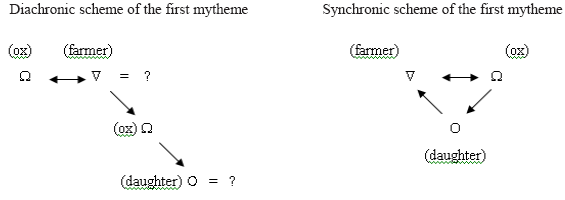
Starting with a syntagmatic reading, the ox connects different generations and opposite sexes linked by ties of descent within the domestic group. There is a father who has already reproduced (pater and genitor) and a daughter (supposedly virgin, or at least definitely unmarried) of reproductive age. Father and daughter are linked by “a special ox, a reproductive ox.” The ox represents wealth, but precisely what kind of wealth? The theme of reproduction emerges in fairly pronounced form, since this first triad is aligned by the sexual code that approximates the human to the animal by linking the farmer (pater + genitor / human phallus whose potency has already been actualized or proven) to the reproductive bull (an animal equivalent of the human genitor / animal phallus, potency in a raw state) and to the daughter (reproductive female / human womb to be fertilized). The semantic chain associated to the dominant masculine pole unfolds into male, genitor, pater, creator, phallus, protector, power and social wealth; while the subsumed feminine pole is associated to female, virgin, future genetrix, womb, protected, obedience and derived social wealth.
The themes of alliance and of social group’s continuity are implied within the sociological code, indicating that the special bull, capable of generating and increasing the farmer’s wealth, is given to the daughter as a future dowry. Sinhazinha’s groom (probably originating from another farm)24 is, however, absent, meaning that the dowry signals an excessive proximity and the veiled presence of incest. A premature gift, without a bridegroom in sight, that operates as almost as a symbolic fertilization of the daughter by the father (the ‘bull’ mentally carries the father's phallus to his daughter’s womb, a hypothesis that seems to be reinforced by version 8 in which the ox is given to the wife D. Maria, on her ‘birthday’). Even without going so far, social wealth and human reproductive capacity are connected and conceptualized via the ox, and the daughter is unable to remain as the final term in the ox’s destiny. The narrative immediately returns the ox to the farmer, in a curious movement within the initial relational universe: rather than opening up to the world outside the farm, that is, to the encounter with other farms (as the glimpsed idea of the ox as a dowry suggests), the story proceeds inwards and downwards on the social scale. The ox is handed over to the care of a cowboy – a special one, like the ox.
In a synchronic reading, the association of the farmer with the ox is simultaneously metonymic and metaphoric: “the farmer owns the ox” and “the farmer is potent like the ox.” The contiguity approximates, although distinguishing the human from the animal through the relation of ownership; the metaphor compares, focusing on a quality shared by both: potency, the capacity for physical reproduction, making the positions of the ox and the farmer in their distinct realms homologous.25 This correlation produces the effect of a hierarchical inversion (Dumont 1970) since, although the human encompasses the animal on the sociological plane, the broader term here is the animal that, as physical and reproductive potency, encompasses the human. This inversion introduces a cosmic and transcendental dimension into the narrative: a wealth of another kind, the life-giving theme in the widest sense. Although physical potency and reproduction are associated at first with social wealth, this is too little and highly unfair. As the narrative sequence unfolds, the themes of potency and reproduction quickly overflow their sociological boundaries.
Still focusing on this equation, while the relation between daughter and father is metonymic, based on descent, the relation between daughter and ox is metaphoric. The daughter is, in a certain sense, like the ox since, just as the farmer possesses the ox, he also ‘possesses’ the daughter, contained within this primary domestic group and destined for future alliance.
]]> Superimposing these two interpretative schemes, we can perceive a centrifugal movement: the father owns the daughter who owns the ox, both destined for reproduction and, just as in the sociological code the human encompasses the animal, the ox-dowry is part of the daughter vis-à-vis the future matrimonial exchange. However, there is also a centripetal movement, which will prevail in the narrative sequence, since we have: the father who bought the ox which he gave to his daughter who still belongs to her father. The father is potent like the ox (just as the future husband of his daughter should be potent) since, like the ox that will procreate, he has already procreated. The daughter is analogous to the ox by inversions (male/phallus x female/womb + human x animal) because, like it, her destiny is to be exchanged, but differently from it, she will be the reproductive potency’s receptacle. The ox – the connection between father and daughter – unites the same animal quality as the father, potency, to the same human quality as the daughter, submission.II. Farmer entrusts the ox to the cowboy
Attributes of the cowboy: a special employee, except for version 8 in which Pai Francisco is part of a group of free residents from a ‘distant land,’ albeit adjacent to the farm pastures, “a fairly well-known family with bad habits, composed of an old man called Pai Francisco, his wife Catirina, his close friend Cazumbá and Mãe Guimá.” In versions 2, 5 and 6, he is a ‘farm hand,’ employed by ‘the boss’ or ‘the master.’ In version 4, he is the slave of a ‘coronelão’ [‘colonel’]26” In version 9, he is “the farm foreman.”
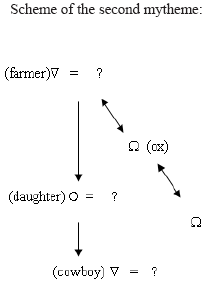
The gift of the ox seems to be premature (a womb to be fertilized in a desirable matrimonial exchange) or perhaps an advance sign of transgression (a womb improperly fertilized in an incestuous relation).The fact is that the ox’s fate as a dowry is not materialized and any suggested transgression is silenced. Sinhazinha’s womb is abandoned, though, and the farmer’s gift remains contained within the domestic group itself. The farmer immediately takes back the ox for himself, handing it over to the cowboy. Not any cowboy (employee or slave), but his most trusted farmhand, individualized with his own categorical name – Pai Francisco, ‘nêgo Chico.’27 He is the real hero of this story, since – given the special ox is not a mediator capable of equilibrating and ensuring the openness of this micro-universe – it will be himself, the special cowboy, the character assigned to undertake this difficult task. From the outset, the name of cowboy emphasizes the human quality that associates him with the farmer; like the latter, Francisco is a Pai or Father.
The cowboy is a metaphysical, ontological Father. In his case, the sociological condition of employee and dependence of the boss is encompassed by a transcendental value. Pai Francisco and ox, both owned by the farmer, oppose each other complementarily. While the ox ended up encompassing the farmer through the animal aspect of reproductive potency, Pai Francisco encompasses the ox, domesticating it through a social and cultural value par excellence: Father. Possessing the possession of his possessor, ‘nêgo’ Chico [Black Chico] embodies the cultural attribute of the male being: he is not only a genitor, but a pater. Latency.
This operation enables a supreme social value, paternity, announced from the start by the character of the farmer, to become located in its pure state, ‘Father,’ in the lower class (Turner 1967; DaMatta 2000). It is not by chance that, in the performances, Pai Francisco (in version 4, “somewhat grotesque and ridiculous”) is a character that belongs to the lineage of clowns: he is a drunkard, immoral, beaten, forever punished. In the understanding of Seu Betinho - who performs Pai Francisco in an ox group from Maranhão State,and who narrated the many plot stories analyzed by Carvalho (2005) - to enact Pai Francisco is a sacred and devotional mission.
In any event, the announced attribute of the cowboy’s paternity remains suspended for a moment in this new transition of the ox. The bond of trust and loyalty between boss and employee emerges from the sociological code. Two of the selected versions – number 6 (the story told by Leonardo) and number 7 (the story of the loyal cowboy,told by Seu Betinho) – dialogue strongly with each other, providing a detailed elaboration of the trust-loyalty-betrayal-command-subordination complex between cowboy and boss.
]]> The richness of the ox as a logical device, up to now the true dynamo of this narrative, is striking: mediator between father / man / older / already assured descent and daughter / woman / younger / to be exchanged; and between upper class / white / boss and lower class / black / employee. Handed over to the care of the cowboy, the ox pauses for a moment in its animal destiny, and becomes a term in a kind of hidden mytheme: Cowboy looks after the ox.The cowboy, for his part, himself enters the scene as a mediating element between the casa grande, the home of the farmer and his daughter, and a new space that has emerged within the farm: the pasture designated for the cattle. Transiting between one world and another, he in a sense owes loyalty to both. In the pasture, his loyalty to the boss transforms into loyalty to the ox. A reproductive ox, it is worth remembering, who, put into the care of the cowboy, exits the confused situation of mediator interposed between father and daughter, in which it seemed to accentuate their proximity dangerously.
In the pasture, with the cowboy and ox, we are however far from equilibrium and in a situation that can be defined as pre-liminal. There is the risky conjunction between human and animal (DaMatta 1973) and version 3, the beautiful tune of the composer Papete, expresses this identification of the cowboy with the ox, not as the farmer’s property, but as a being in its full right that depends on him. This is a sad lament in which the cowboy sings of his “pain on seeing / my ox coming to look at me, and without knowing anything, without defending itself / my ox cries…”
Soon after, a third element, the cowboy’s wife, enters the scene, dramatically separating the cowboy from his ox, and from everyone’s owner, the farmer. Mãe Catirina, the “Catirina who only wants to eat ox tongue,” is a cosmological Mother of the future and pregnancy. Se is a Female-Mother, grotesque and liminal, fertility in its pure state, the full womb, a promise of future life. Through her, the cowboy/male actualizes the latent condition of genitor and (possible) pater, conditions until then belonging to the farmer and, symbolized by ownership of the ox, transferred to the cowboy’s care. Catirina is a highly disturbing character, also belonging in the rite to the lineage of clowns. The ambivalences of the entire series of relations made explicit up to this point are sharply accentuated with her entry into the scene, erupting into an insoluble conflict.
3. Pregnant wife of the cowboy wants to eat ox tongue. Variations: the tongue (versions 2, 3, 4, 7); the liver (versions 5, 9); the filet (version 8). In version 7, the desire for the meat comes from the farmer’s daughter who became the cowboy’s ‘lover.’
Attributes of Catirina: Pregnant and desiring woman in all versions; aloof and lazy (version 3); “a mulata [mestiza] whose beauty was spoken and sung throughout the region” (version 8); “a mulata cook” (version 4).
On one level, the cowboy is analogous to the ox, able to substitute for it on a hidden level of the first mytheme: “Farmer owns cowboy” as he owns the ox. The first triad of relations, farmer/ox/daughter, was quickly exchanged for the second, farmer/ox/cowboy. In the pasture, the dependence of the animal in relation to the cowboy replaces the dependence of the cowboy in relation to the farm owner, while, in turn, the loyalty of the cowboy to the animal substitutes for his loyalty to the owner. Hence, the ox occupies the place of the boss, with a curious inversion of forces in which the black cowboy is now the dominant pole.
In this mytho-logics, the contiguity between the narrative’s elements always entails the contagion of some quality from the first to the second term. When separated by a mediator, the second term retains the quality of the first. Hence, it is possible to say that “the farmer is potent like the living ox” and “the living ox, passed into the cowboy’s care, is the reproductive potency of the farmer” and “the cowboy is potent like the farmer (and the ox).” Along its narrative journey, the ox signifies: 1. the social wealth and physical potency of the owner; 2. a guarantee of the daughter’s matrimonial exchange with another universe of farms, a relationship between ‘equals’ within the social hierarchy; 3. latency: a potency in animal state; 4. trust and loyalty between superior and inferior, elements from socially and economically unequal classes. The ox handed over to the care of Pai Francisco is a plethoric ox, a bearer of all these attributes. It therefore appears reasonable that it is Pai Francisco who actualizes the suggestion of reproductive wealth and the latency of physical potency so strongly suggested in the narrative. He will be obliged to ‘donate’ the ox to his wife: Mãe Catirina is pregnant. The vital, cosmic and reproductive wealth is positioned in the lower class in a paradoxical form. Catirina, a great disruptive force, affirms the cowboy’s humanity in an extremely problematic way: she submits him to the task of realizing her craving, the desire of a pregnant woman, an almost supra-human desire which, if unrealized, would compromise the reproduction/potency of the cowboy himself. In an extraordinary detail, remarked upon by one of the narrators in version 5, Catirina aborts when the ox resuscitates, “since Chico, although he stole the ox, didn’t cut out its tongue.” There is another aspect to be observed. The conjunction between cowboy and ox in the pasture, suggesting a limitrophe domain and the confusion between human and animal (version 3), is separated by an element (Mãe Catirina), who significantly reinforces the confusion of domains through her own liminal state (pregnancy = two lifes in one), accentuating the animal dimension inherent to procreation. There is a potentially transgressive excess in the expression of the uncontrollable desire that demands to be satisfied at whatever cost. A terrible request that is a hellish impasse for Pai Francisco who finds himself having to choose between the betrayal of the ox and the boss versus the ‘betrayal’ of Catirina and the foetus. “This conversation” – version 4 tells us – “led Pai Francisco to the abyss.”
| W(Ox/farmer)1 Ñ(Chico)1 (O+a) (Catirina and foetus) |
If we return now to the narrative’s beginning, we can perceive the liminal situation of Catirina’s pregnancy as the symmetrical inversion of the initial situation: (White Farmer) = (potent Father, possessing the ox and the daughter, both anticipating alliance and human reproduction promised through future exchange) versus (Black Employee) = (latent Mother who, in contrast to the farmer, consumes the ox to have the child. A pregnant woman who ensures reproduction through immediate food consumption).
]]> Mãe Catirina consumes, so to speak, the phallus of the farmer/ox/husband, in an uncontrollable desire that, however animal it may be, still also remains the expression of negative social feelings. Envy and covetousness lead to a theft and a ‘crime’ that ends up castrating, in a sense, the human and sociological condition of her own husband. For, with the death without resurrection of the ox, as in version 4, Pai Francisco will be forever humiliated and offended, eternally castigated, thrashed and beaten: “Clap your hands and stamp your feet, it was Pai Francisco who killed the colonel’s ox, all because of his wife!”The ox desired by Catirina is the boss’s favorite, the ox destined for social exchange, a future promise aborted so that Catirina herself does not abort. The ox – mediator between the upper and lower classes on the farm and, in a suggested future, mediator between the farm (the inside) and the wider social world (the outside) – is eliminated. Catirina’s desire consumes it, transforms it into a food shared between narrow limits (immediately eaten by her, or by herself and her husband, seen “eating roast meat” in version 4). Faced by the future alliance of the rich family, Catirina revolts and affirms the pre-eminence of ensuring the descent of her own poor family, thereby becoming anti-social.
Pai Francisco’s difficulty in ensuring his own dignity is dramatic: either a farmer’s tool helping to ensure the continuity of the latter’s descendents, or his wife’s tool in her attempts to bear their own descendents. It is no accident that in the description by Ascenso Ferreira (1944), in the dramatic sequence of the ox, when it drops dead, struck by an arrow from a wild caboclo, the funeral tune is intoned and the audience falls into a deep silence.
4. Cowboy kills the ox (versions 1, 2, 3, 4, 5, 6, 8). Variations: “just pulled its tongue and cut it out” (version 9)
The death of the ox is an “end of the world.” It is also a paradoxical sacrifice, a death offered up so that the poor and black couple can reproduce, so that the socially impoverished couple can be vitally rich. However, the sacrifice, executed by Pai Francisco with the aim of ensuring the life of his child, destroys the system of ties connecting the farm’s world. Everything began with the ox linking biological reproduction to wealth and social reproduction, defining full masculinity through the conjunction, in the character of the farmer, between pater and genitor. The ox was also the propellant of the narrative movement itself: strength, power, potency, dynamizer and dynamo all at the same time. Its death is tremendously ambivalent: it is a crime (improper consumption, destruction of another’s property), but also a legitimate sacrifice (an animal life in exchange for a human life, the ox's life in exchange for the life of the poor couple’s child). In the second mytheme, the ox is the boss’s trust in the employee, the employee’s loyalty to the boss. Its death is a total crisis within the farm’s system of mediations. The first narrative sequence ends by annihilating the farm’s self-contained universe. The second mediator proposed, the cowboy, by annihilating the first mediator annihilates himself, the relational universe ruptures into extremes.
III.2. Interval. Sociological interpretation in conversation with DaMatta
The narrative begins in a morally and socially dense and uneasy space. The mythic farm is filled with gestures that plunge us in an eye blink from a happy beginning into a tragic outcome: the beloved ox, whom we have just met, has died. The first sequence presents an excessively unbalanced dynamism. The set of relations and inversions announces the central theme: the life and death of the precious beast, unfolded in the following bundle of oppositions: life of the ox (boi +), an element ensuring collective exchange = social wealth / gift, vital and reproductive wealth / trust / male potency versus death of the ox (boi –) = threatened social wealth / poverty / envy / betrayal / female fertility (ox becoming food and immediately consumed, rupture of wider social exchange).
The farm’s world is self-centred, the means of production and reproduction are, in principle, all there, the mutual dependence between rich and poor is clearly affirmed. We are in the full moral universe of traditional patron-client relationships, in which the farm owner versus worker opposition is conceived as complementar in a web of relations full of compensations. There is the farmer’s confidence in his special cowboy. Suggested on Pai Francisco’s side are the qualities of due loyalty and submission. Reaffirmed through the ox, the employee/boss relation signifies dominance/submission, authority/obedience, trust/loyalty – relational pairs proposed as ideal models. The farmer at the outset is a good boss, in contrast to the exploitative boss who bleeds his employees, as in the tale of Pedro Malasartes analysed by DaMatta (1979:194-235). However, as in Malasartes’ story, the initial situation momentarily contains basic imbalances. Following the cowboy’s transgression, some versions unhesitatingly reveal the potential cruelty of the boss: Pai Francisco is threatened with punishment in version 1; in version 4, “the ‘colonel’ ordered him to be punished, promising that he would order his throat cut” (and punishes him every year thereafter, for the pleasure of seeing “how he became angry” [...]); beaten in version 5; awaiting punishment in version 6. The traditional patron-client relationships, with its characteristic esteem and consideration and its violent and rebellious reverse side, emerges as a clear aspect of male social reality.
However, this system’s hierarchical complementarity overlaps with a problematic equality. Wealth and poverty are also presented in an open conflict, since the two domestic groups are rich from the vital and demographic point of view. The cycle of development of both is in full sexual and social productivity, with a lapse of time between one and the other. While the farmer has a daughter, Pai Francisco has a son waiting to be born. The family emerges as a fundamental value in the two social extremes. This vital wealth is affirmed in the midst of severe imbalances. While it remains implicit that the farmer’s daughter is beautiful, unmarried, obedient and marriageable, Catirina’s pregnancy is made unashamedly explicit.
The relation between the two strongest men in the story is one of domination and submission, but it is also one of great moral dependency: both are heads of family. Perhaps for this reason, when the narrative starts to move in reverse after the crisis, deep down the farmer understands Pai Francisco’s motives, giving him in many versions the ‘chance’ to resuscitate the Ox. After all, it was all “because of the wife…” The key question is: how to ensure social reproduction in this closed universe? The apparent harmony covers latent conflicts, which erupt with disruptive force with Catirina’s desire. With it, the pact of loyalty agreed between the two men through the ox is broken. In the end, while the farmer with his daughter and the reproductive bull affirm the capacity to transform a bond of substance into affinity, the pair Pai Francisco and Mãe Catirina are presented in a terrible struggle to transform alliance into descent (Abreu 1983). Their sexuality, seen to be assured (although excessive, on the female pole, due to the lack of shame of an avid and lazy Catirina), still needs to ensure effective reproduction.
]]> In both cases – in pre-eminent form in the second couple, but also in the first upper class couple – there is an attempted narrative opening to characters that are yet to appear: the husband of Sinhazinha and the child of Pai Francisco. Without them, the tense and self-centred universe of the farm would have no future. The two groups are potentially rich in their capacity to reproduce thus preventing any stable equivalence between social and vital wealth. The reconciliation between this common vital wealth is the problem that remains unresolved and endlessly posed by the myth.III.3. Liminality and reincorporation. Second and third sequences
Second sequence: in the forest and back to the farm
5. Farmer searches for ox and discovers the crime
6. Cowboys fail to capture Pai Francisco
7. Indians capture Pai Francisco
8. Farmer punishes / threatens to punish Pai Francisco
This sequence is extremely busy, with comings and goings between farm, pasture, and forest. However, from the strictly narrative point of view, it is not as dense as the first one, apart from the opening of the farm’s relational system of and the expansion of the narrative’s human geography. The ‘forest’ inhabitants emerge: the Indians. In some cases (version 8), it is the ‘leader of the Indians’ or the ‘great warrior’ (tuxaua) and the ‘shaman’ of the tribe who appear as the lords of the forest and its limits, and emerge as candidates for mediating between the known and unknown universes. The narrative starts its process of reversion, returning to the farm, the spatial starting point, with a fundamental absence: the ox. An absence that configure an inversion, since at the start we have, via the ox, a promise of life, and now we have its death casting a cloud over the potential life of Catirina’s foetus. Death, a terrible emptiness that speeds up the pace of the narrative in search of his resurrection.
In the precious ox’s absence, the reincorporation of Pai Francisco into the farm is likewise violent, exposing the other side of the patron-client system through the new situation in which the same characters confront each other. The absence of the ox prompts a searching sequence: the farmer looks for the ox, the cowboys look for Pai Francisco, the cowboys look for the Indians, the Indians look for Pai Francisco, who is finally captured. The spatial reversal – everyone, including the Indians, get back to the farm – corresponds to the reversal of all narrative codes:
Forest versus farm :: Liminal versus centre :: Lower class versus upper class :: Death versus Life.
]]> Third sequence: from the farm to the festive revelry8. Farmer sets resurrection of the ox as the condition for forgiving PF
9. Cowboy calls doctor / cowboy calls priest / cowboy calls shaman.
10. Ox resuscitates in festival
The doctor, priest and shaman are, each in his own way, mediators between this world and the other, operators of transitions between the world of the beyond and this one. In the narrative, these characters are interposed between farmer and cowboy in an effort to assuage the terrible conflict that has emerged: the reproduction of the master negates the reproduction of the slave/worker, and/or vice-versa. An impossible universe, a complementarity transformed into pure antagonism in which the survival and continuity of one of the terms means the destruction of the other. Assuaging the confrontation between rich and poor, loyalty and betrayal, the doctor, priest and shaman aim to give back to the described universe its essential mediator: the ox. All try and end up achieving the impossible: resuscitating the ox. The ox now has to concretize a new transition, returning from death to life. Why does the imagination revive it?
IV. From myth to ritual
Observe initially the presence of paradigmatic characters from Brazilian social history in the narrative universe. There are the doctor and the priest whose importance in patriarchal society was observed by Gilberto Freyre (1977). There is also the shaman, assisted by ‘wild caboclos,’ a type that has been absorbed by popular culture in the 19th century (Boyer 1999). The strong evocation of the economic cycle of cattle farming is apparent, with farmer, animals, cowboys and pastures, slavery, and the protagonists Pai Francisco and Mãe Catirina. The narrative’s recurrent use of the three ethnic types, blacks, Indians and whites, whose interaction conforms the “fable of the three races” as analysed by DaMatta (1987), is also worth pointing out.28 In contrast to what happens in the more common versions of this fable, exposing the precariousness of the farm’s social order, the ox myth proposes a more ambivalent and strongly critical view of domination and hierarchies.
Rather than explaining the historical origin of the revelry or exploring the sociological dimensions already evoked, in this conclusion I simply highlight the fertile symbolic use of such dimensions of Brazilian society. I maintain the analytic focus of examining the narratives in themselves and using them to address the revelries’ ritual dimension. It should be observed that, following the death of the ox – that is, in the passage from the first to the second sequence – the narratives terminate in ritual and feast. I explain: the narrative moment of the death of the ox belongs to the narrative properly speaking, but within it we find the reference to a new dimension of reality: the ritual moment of the festive enactment. The narrative idea of the ox’s death provides immediate connection with the ritual moment in which the artefact-ox has to vanish from the performance’s scene (being carried away by the human ‘innards’ or ‘entrails’). The effort to revive the ox, and to cure the sick society that its death symbolizes, is a topic for comical performances in festive ritual events. In particular, the final narrative moment of the ox’s resurrection corresponds to the full transposition of the temporality of the narrative’s ‘origins’ to the ‘here and now’ of a festive situation: “The event is celebrated joyously and the troupe, singing non-stop, says farewell.” (version 1).
In version 2: “the ox revives and then to everyone’s delight, the singing started again and everyone celebrated the resurrection of the ox (...)”. version 6: “It bellowed! It bellowed! / I heard it bellow!/An ox more beautiful than this / I assure you I’ve never seen! / It bellowed! It bellowed! / It bellowed, its fame is real! / An ox as famous as this / the hinterlands will never see. It was the pardon of Chico, it was the singing, it was celebration.” version 8: “Pai Francisco applied everything that was taught to him to do. At this point, the ox wants to stand up, since someone known as ‘innards’ is again ordered to go inside the artefact. Nego Chico hands over his gun to the farmer. The others respond with: ‘Bumbá stood up/ he stood up to come and dance [repeat]’.”
]]> The death and resurrection of the ox corresponds to the narrative’s opening to another level of reality, a new time and space. With these events, we leave the farm’s fictional world and we arrive at the actual place where a revelry happens: a courtyard, street, arena, stage or terrace. The self-enclosed temporality of the narrative unfolds into the rite. Once again, the ox is the mediator of this effective symbolic operation. In this critical moment, the story’s precious ox and the dancing artefact-ox of the revelries’ performances are juxtaposed. Hence, we pass from myth to ritual.The ox’s resurrection symbolizes the revelry itself and its reason for being. The ox keeps its symbolic vitality up to the end of our story. The narratives glimpse at a future that suggests a new order of existence. The mythic drama opens up to new codes of meaning. The revelries’ festive aspect implies ample commensality and sociability: everyone must eat beef. Since the organization of an ox group is also a form of popular devotion, the ox performances are themselves part of a vast network of sacred reciprocity established with the Junine Saints (Lanna 1995). Seu Betinho, the central narrator in Carvalho’s thesis (2005), clearly expressed this deeper dimension of the players self construction in his view of Pai Francisco’s role as a sacred mission.29
There is also a new temporal code, the cyclical and repetitive temporality of rituals. Performing the bumbá is to restart, resuscitating the ox who must always return to dance another year. In sociological terms, we can read the ox revelry as a satire and critique of the multiple social dependencies in a country in search of democratic citizenship. That is, these narratives can be understood as a kind of origin myth, implying that the revelries involve a repeated search for a new social order. After all, the ox’s death imposes openings on the farm’s world, bringing doctor, priest and shaman to its network. The previous order is transformed and nothing will be as before the ox’s loss. In the performances, the farmer’s fictional role corresponds to social leadership: the ox’s owner is the group leader who serves his group. There is also always a dramatic and psychological distance between actors and their characters, leaving space for irony, criticism and grotesque laugh. After all, Pai Francisco and Mãe Catirina are clowns who, acting out the scenes with the owner, touch on critical areas of social life in their comic performances.30
These narratives also configure an origin myth in the full structural sense of the term (Lévi-Strauss 1976:250-279). The contemporary narration of this drama corresponds to the present activation of symbolic forces. With this device, the yearly performances actualize a supposed past and strongly mark their difference with present time. The highly seductive idea of the ‘origins’ seems above all to have the ritual function of demarcating two basic forms of diachronic temporality: the present which is the future becoming of a past that is always the same. The Ox of the narrative has the function of a churinga (Lévi-Strauss 1976:272-277), “the diachronic being of the diachrony within synchrony itself.” Meanwhile, the artefact-ox, to which the narrative’s ox is linked in the scenic moment of death and resurrection, is an entry into diachrony, an opening up to history. The ox’s resurrection is the transition from one temporal register to another. Between the ox death and revival, a profoundly dangerous non-existence lurks: time of urgent searches. Everything may come to be – or not. Not only not to be as before, since after the animal’s resurrection nothing will ever be the same, but simply not to be. Hence, our mythic narrative expresses, as Lévi Strauss proposes (1976:278-279), the fundamental characteristics of the historical event: its contingency – it was in a farm and not in any other place, it happened this way and not any other way, this and that was done and this was the result – and its power to provoke intense and varied emotions.
In the revelries, seen as ritual processes, the mythic ox resuscitates as living food to be shared by the players, bringing us an entirely new analytic dimension: ritual with its full affective and cognitive aspects (Valeri 1994). In the end, the mythic farm’s effective opening to wider social exchange is realized by the revelries. Once again, the operator of this new transition is the ox, now becoming the emblem of the festive and competing groups. The resurrected ox is a purely symbolic form of life: Bumba-meu-boi!, Dance-my-Ox! It is pure potency, dance or brawl, expressing the possibility of connecting affections and experiences.
Notes
1 The ox merriment names vary according to its regional diversity: Boi-Bumbá in the Amazon (Salles 1970; Monteiro 1972; Menezes, 1972; Bordallo, 1981); Bumba-meu-boi in Maranhão (Azevedo 1983; Pinho de Carvalho 1995) and Pernambuco (Borba Filho 1966); Boi Calemba in Rio Grande do Norte; Cavalo-Marinho in Paraíba (Carvalho 1971) and Pernambuco (Murphy 1994); Bumba de reis or Reis de boi in Espírito Santo; Boi Pintadinho in Rio de Janeiro; Boi de mamão in Santa Catarina (Soares 1978). For more details on the many different forms, see CNFCP 2003a.
2 The Portuguese word for this is auto, an expression that refers to the allegorical forms of medieval theatre, and -- in the scope of folklore -- to theatrical forms enacted in the streets or public squares.
3 The research began in Parintins, Amazonas, where I stayed for three short periods (ten to twenty days) of fieldwork from 1996 to 2004. In June 2000, I watched the revelries in São Luís do Maranhão. I also supervised Carvalho’s research (2005) on the subject and this text establishes a close dialogue with her study. The National Centre of Folklore and Popular Culture (2003b) has also conducted ethnographic research on Maranhão’s Ox dances. For a more detailed discussion, see Cavalcanti (2000) on the Bumbá of Parintins, and Carvalho (2005) on Maranhão’s Bumba-meu-Bof.
]]> 4 These schematic considerations simply aim to situate the proposed inquiries’ plane of discussion. In this extensive literature, I would highlight Prado’s (1977) dissertation.5 Some scholars have suggested the last decades of the 18th century (Cascudo 1984:150; Andrade 1982:71-73) as the revelries’ formation period. In this view, the revelries can be seen as integrating the wider historical process of the constitution of what we know today as Brazilian folklore or popular culture, whose Catholic cultural base has been underlined by Abreu (1998). The earliest record I was able to find during my research was the following small note from 7th July 1829 in the journal O Farol Maranhense, n.104. p. 451, in the varieties section: “Mr. Editor, Sir – I live in Bacanga [Maranhão] and visit the city only on rare occasions. However I have a close friend, a neighbour of mine, who cannot let a revelry go by without coming to watch it. He came to see the S. João feasts, just to see the frenzy of Bumba-meu-boi, and on his return told me the following news, which, since I’m a little doubtful of their authenticity, I shall try to recount for you do me the favour of saying whether they are true or not. This friend said to me that on Saint John’s Eve there were many fireworks: that bands of 40 to 50 people wandered through the streets armed with squibs, all very happy, that the police did not arrest anyone while no disorder occurred. So then Mr. Editor, what would the revolutionary leaders say about this? (….).”
6 Romero (1954), who saw in the revelries popular poetry in action, did not give any special interpretative attention to the ox merriments that he knew in his home town of Lagarto, in Sergipe. Pereira da Costa (1908:260), however, commenting on how the revelry had fallen into disuse in Pernambuco, referred to the Bumba as a “rhapsody of the North, and purely Brazilian, without foreign affinities or imitations.” Almeida (1942:52) considered it “aesthetically and socially the most significant of Brazilian revelries.” Even Cascudo, always adverse to the construction of national cultural boundaries, saw in the ox revelries an “inspired creation of the mestizo” (1984:150). Or further still: “The Brazilian, in joy, satire, sentimentalism, piety, justice and wilfulness, samba and prayer, is in the bumba-meu-boi” (Cascudo 1952:454).
7 As Lopez indicates (1972), Mário de Andrade was a diligent reader of Frazer, Tylor and Lévy-Bruhl. On primitivism in the work of Mário de Andrade, see Travassos (1997).
8 Andrade (1982:54-70) also perceived the fragmentary nature of this popular ‘rhapsody.’ However, despite valorizing this form of aesthetic composition, the absence of the so-called central plot in the then contemporary forms of the revelries was also interpreted by him as a sad sign of the inexorable decline of Brazilian folklore. Observation of the bumba-meu-boi’s variety of forms, and even its internal fragmentation, are common in the literature. This other perception pole of the revelry always provoked ambivalent reactions: “An aggregate of disparate parts,” claimed the bad-tempered Carapuceiro as early as 1840 (Lopes Gama 1996:330).
9 Incidentally, the same Boi Misterioso de Afogados is the subject of another version of the traditional drama recorded by Borba Filho (1966). The idea of an original drama was already present in Artur Azevedo (1906:9), who commented: “It is highly probable that the Bumba meu Boi, in its primitive form, was a drama composed, with all the rules of the genre, by a people’s poet (...) Today it is a simple merriment without any meaning, displaying various characters whose functions are not logically determined.”
10 The same remarks apply to the universe of carnival. See Cavalcanti 2006 and 2002a.
11 A new dramatic universe, found in the hinterlands by Carvalho (2005), loosely related to the theme of the ox’s death and resurrection, is not named by the players as a drama but as “slaughters”(matanças), or “comedies.” In June 2000, in São Luís, I was able to observe an intense anxiety on the part of cultural and touristic officials over the supposed loss of the “tradition of performing the drama.” Carvalho (2005) witnessed similar concerns between 2001 and 2004. Since 1996, when I began my research, the Amazon Ox Dance, in the city of Parintins, assumed a kind of inauthenticity in the context of the different ox revelries. In Parintins, some players and intellectuals used to mention the lack of the ox’s death and resurrection narrative as an important deficiency of their own extremely rich performances. The belief in the drama’s original authenticity went so far that, in 2004, the two groups, on one of the three nights of the performances (the night dedicated to ‘tradition’ and ‘folklore’) included a complete presentation of the ox’s death and resurrection drama, accompanied by a meta-narrative of the script.
12 Incidentally, the literature very often reiterates that this “central nucleus” either displays unexplained residues or appears only in a diffuse way, and highlights the ox revelries’ dimensions of improvisation, fragmentation, and variation.
13 The term caboclo / cabocla refers to anyone or anything originating from a mixture of indigenous and white sources. Mestizo / mestiza would be a close translation. [TN]
]]> 14 Vernant (2001) calls attention to the loose boundaries between what we call ‘belief’ and the awareness, sometimes very clear, of the fictitious nature of the things in which one ‘believes.’ This looseness appears to configure the myth’s domain in opposition to logos – forms of thought based on demonstrable arguments.15 Later, Dumont (1987) would see the Tarasque’s festival as part of Mediterranean Christianity.
16 Like, for example, the character of the ox owner who, in Parintins and in some of Maranhão’s variations of the ox revelries, is always a talented composer and singer.
17 For a discussion of the toadas (tunes) in the Parintins’ Ox Dance Festival, see Braga 2001 and Cavalcanti 2002b.
18 As happens in the Bumbá of Parintins or in the so-called orchestra variation of Maranhão’s revelries.
19 This is not a question of simply proclaiming the artificiality of an “invention of tradition” (Hobsbawn 2002), but of highlighting the complex inventiveness of cultural processes (Sahlins 1999).
20 This narrative universe, formed in the encounter between orality and writing, illustrates the kind of collective processes of creation investigated by Jakobson & Bogatyrev (1973). Its configuration very probably retains links to the entire oral tradition of the Ox tales (Matos 2002) as well as to the many stories referring to blacks slaves, symbolized, significantly, as Pais or Fathers – João, Mateus, José, Francisco – such as the case of Pai João analysed by Abreu (2004).
21 In this melancholic line, it is worth recalling the show Catirina, a performance of the drama presented for the first time in 1996, at the Artur Azevedo Theatre in São Luís, Maranhão. Carvalho (2005:64) was surprised to hear from an advisor of Cajari’s mayor, in the hinterlands of Maranhão, the following suggestion: “Do you want to see the drama of the bumba-meu-boi? Here you won’t see it. Do you know the Artur Azevedo Theatre, in São Luís? The true drama is there, the Catirina.”
22 As Détienne points out (1981), the long maturation of this second idea eventually led to the notion of ‘mythism’ (Lévi-Strauss 1971).
23 Other variants are included in Appendix.
]]> 24 In the Bumbá of Parintins (the Amazonian Ox-Dance) the Sinhazinha is a ritual role always played by an attractive and unmarried young woman, a member of the kingroups of the broad regional society, displaying the strong links between Parintins and the state capital, Manaus.25 For a discussion of metaphor and metonymy as basic modalities of human thinking and language, see Jakobson 2003.
26 The term ‘colonel’ refers here to a powerful landlord with a high degree of political and socioeconomic influence in the region. [TN]
27 versions not considered here give another name to this character, or duplicate it with the characters of Mateus and Bastião, as in the Northeastern cavalos-marinhos (sea-horse dances) of Pernambuco e Paraíba. The farmer and his daughter, the characters from the top of the social hierarchy, are curiously anonymous and commonplace, while the ox and cowboy are special. In Parintins, these two characters are played by individuals from prestigious families. The farmer and ox owner is always a famed composer, while the Sinhazinhas are always young single women.
28 As DaMatta remarks (1987), it is obvious that the three social and ethnic elements – white, black and indigenous – were important in the process of forming Brazilian society. The sociological approach however is interested in how these elements function as ideological resources in the construction of a national social identity.
29 This devotional dimension is present even in the spectacular performances of Parintins. The Boi Garantido (Secure, Safe Ox) organizes a devotional procession to Saint John on June 23rd, while the two ox groups, Garantido and Caprichoso (Capricious Ox), are devotees of Our Lady of Carmo, the patron saint of the city whose celebration begins immediately after the festival ends.
30 This reveals the affinity between the origin narratives of the ox death and resurrection and the comedies and matanças (slaughters) found in Maranhão’s hinterlands, outside the realms of public support for popular culture (Carvalho 2005). As Seu Betinho explains: “when we mention desire, we are close to the origins” (version 7).
Bibliography
ABREU, Ovídio. 1983. “Dona Beija: análise de um mito”. In: M. L. Cavalcanti, B. Franchetto e M. L. Heilborn (eds.). Perspectivas antropológicas da mulher 3. Rio de Janeiro: Zahar Editores. pp.73-108. [ Links ]
ABREU, Martha. 1998. “Mello Moraes Filho: festas, tradições populares e identidade nacional”. In: S. Chaloub e L.M. Pereira (eds.), A história contada. Rio de Janeiro: Nova Fronteira. pp. 171-193. [ Links ]
_____________. 2004. “Outras histórias de Pai João: conflitos raciais, protesto escravo e irreverência sexual na poesia popular. 1880-1950”. Afro-Ásia, 3:235-276. [ Links ]
ALBERNAZ, Lady Selma Ferreira. 2004. O "urrou" do boi em Atenas: instituições, experiências culturais e identidade no Maranhão. Tese de doutoramento. Unicamp. [ Links ]
ALMEIDA, Renato. 1942. História da música brasileira. Rio de Janeiro: Ed. Briguiet. [ Links ]
ANDRADE, Mário de. 1982. “As danças dramáticas do Brasil”. In: O. Alvarenga (ed.), Danças dramáticas do Brasil. 1° tomo. Belo Horizonte: Ed. Itatiaia /Instituto Nacional do Livro/ Fundação Nacional Pró-Memória. pp. 23-84. [ Links ]
AVÉ-LALLEMANT, Robert. 1961. Viagem pelo Norte do Brasil no ano de 1859. Rio de Janeiro: Instituto Nacional do Livro, Ministério da Educação e Cultura. [ Links ]
AZEVEDO, Artur. 1906. “O Bumba-meu-boi”. Revista Kosmos,2:9-14. [ Links ]
AZEVEDO NETO, Américo. 1983. Bumba-meu-boi no Maranhão. São Luís do Maranhão. [ Links ]
BARLTETT, Frederic Charles. 1965. "Some experiments in the reproduction of folkstories". In: A. Dundes (ed.), The study of folklore. New Jersey: Engleewood Cliffs, Prentice-Hall. pp. 243-258. [ Links ]
BELMONT, Nicole. 1986. “Le folklore refoulé, ou les séductions de l’archaisme”. L’Homme, XXVI (1-2):259-268. [ Links ]
BORBA FILHO, Hermilo. 1966. Apresentação do bumba meu boi .O Boi misterioso de afogados. Recife: Imprensa Universitária. [ Links ]
BORDALLO DA SILVA, Armando. 1981. Contribuição ao estudo do folclore amazônico na Zona Bragantina. Bragança: FUNARTE / Fundação Cultural de Bragança. [ Links ]
BOYER, Véronique. 1999. "O pajé e o caboclo: de homem a entidade". Mana. Estudos de Antropologia Social, 5(1):29-56. [ Links ]
BRAGA, Sérgio. 2001. Os bois-bumbás de Parintins. Tese de Doutoramento, USP. [ Links ]
BURKE, Kenneth. 1966. Language as symbolic action. Berkeley:University of California Press. [ Links ]
CARNEIRO, Édison. 1962. “A evolução dos estudos de folclore no Brasil”. Revista Brasileira de Folclore, 3:47-62. [ Links ]
_____________. 1974. Folguedos tradicionais. Rio de Janeiro: Ed. Conquista. [ Links ]
CARVALHO, Luciana. 2004. “O desejo de Betinho e o decreto do presidente”. In: Celebrações e saberes da cultura popular. Série Encontros e Estudos n. 5. Rio de Janeiro: CNFCP, Funarte / IPHAN. pp. 85-94. [ Links ]
_____________. 2005. A graça de contar: as narrativas de um Pai Francisco no bumba-meu-boi do Maranhão. Tese de Doutoramento, IFCS/UFRJ. [ Links ]
CARVALHO, Maria Michol. 1995. Matracas que desafiam o tempo: é o bumba-meu-boi do Maranhão. São Luis/ Maranhão. [ Links ]
CASCUDO, Câmara. 1952. Literatura oral. Rio de Janeiro: Livraria José Olympio Editora. [ Links ]
___________. 1965. Antologia do folclore. Vol. I. São Paulo: Livraria Martins Editora. [ Links ]
___________. 1984. Dicionário de folclore brasileiro. Belo Horizonte: Ed. Itatiaia. 5ª. ed. [ Links ]
CAVALCANTI, Maria Laura. 2006. Carnaval carioca: dos bastidores ao desfile. (3. ed.). Rio de Janeiro: Ed. UFRJ. [ Links ]
2000. “O boi-bumbá de Parintins: breve história e etnografia da festa”. Revista História,Ciência e Saúde: Visões da Amazônia, VI (suplemento especial):1019-1046. [ Links ]
___________. 2002a. “Os sentidos no espetáculo”. Revista de Antropologia, 45(1): 37-89. [ Links ]
___________. 2002b. “O indianismo revisitado pelo boi-bumbá: notas de pesquisa”. Somanlu. Revista de Estudos Amazônicos, 2:127-135. [ Links ]
___________. 2004. “Cultura popular e sensibilidade romântica”. Revista Brasileira de Ciências Sociais, 19(54):57-78. [ Links ]
CAVALCANTI, Maria Laura et alii. 1992. “Os estudos de folclore no Brasil”. In: Folclore e cultura popular: as várias faces de um debate. Rio de Janeiro: Funarte/CNFCP. pp.101-112. [ Links ]
CNFCP. 2003a. CD-Rom. Tesouro de folclore e cultura popular. Rio de Janeiro: CNFCP/IPHAN/Minc. [ Links ]
________. 2003b. CD-Rom. Bumba-meu-boi do Maranhão. Rio de Janeiro: CNFCP/IPHAN/Minc. [ Links ]
DA MATTA, Roberto. 1973. “Panema: uma tentativa de análise estrutural”. In: Ensaios de antropologia estrutural. Petrópolis: Vozes. pp.63-92. [ Links ]
______________. 1979. "Pedro Malazartes e os paradoxos da malandragem" e "A hora e a vez de Augusto Matraga". In: Carnavais, malandros e heróis. Rio de Janeiro: Zahar Editores. pp.260-301 e 305-334. [ Links ]
______________. 1987. “Digressão: a fábula das três raças, ou o problema do racismo à brasileira”. In: Relativizando: uma introdução à antropologia social. Rio de Janeiro: Ed. Rocco. pp. 58-85. [ Links ]
____________. 2000. “Individualidade e liminaridade: considerações sobre os ritos de passagem e a modernidade”. Mana. Estudos de Antropologia Social, 6(1):7-29. [ Links ]
DÉTIENNE, Marcel. 1992. A invenção da mitologia. Brasília/Rio de Janeiro: Ed. UnB / José Olympio Editora. [ Links ]
___________. 1987. “Mito/Rito”. In: Enciclopédia Einaudi, vol. 12. Lisbon: Imprensa Nacional. pp. 59-74. [ Links ]
DUARTE, Luiz Fernando Dias. 2004. “A pulsão romântica e as ciências humanas no Ocidente”. Revista Brasileira de Ciências Sociais, 19(55):5-18. [ Links ]
DURKHEIM, Émile. 1978. As regras do método sociológico. São Paulo: Ed. Nacional. [ Links ]
________________.1996. As formas elementares da vida religiosa. São Paulo: Martins Fontes. [ Links ]
DUMONT, Louis. 1970. Homo hierarchicus. Madrid: Aguilar. [ Links ]
______________. 1987. La tarasque. Paris: Gallimard. [ Links ]
FERREIRA, Ascenso. 1944. “O bumba-meu-boi”. Arquivos, 1-2:121-157. Prefeitura Municipal do Recife. [ Links ]
FREYRE, Gilberto. 1977. Sobrados e mucambos. Rio de Janeiro: Livraria José Olympio Editora. [ Links ]
GALVÃO, Eduardo. 1951. “Boi-bumbá: versão do Baixo Amazonas. Anhembi, 3(8):275-291. [ Links ]
GONÇALVES, José Reginaldo. 1997. A retórica da perda. Rio de Janeiro: Editora da UFRJ. [ Links ]
GOODY, Jack. 1977. “Mémoire et apprentissage dans les sociétés avec et sans écriture: la transmission du bagre”. L'Homme,1:29-52. [ Links ]
_______ e WATT, Ian. 1968. "The consequences of literacy". In: J. Goody (ed.), Literacy in traditional societies. Cambridge: Cambridge University Press.pp. 27-68. [ Links ]
HOBSBAWN, Eric. 2002. “A invenção das tradições”. In: E. Hobsbawn & T. Ranger (eds.) A invenção das tradições. Rio de Janeiro: Paz e Terra. pp.9-23. [ Links ]
JAKOBSON, Roman. 2003. “Dois aspectos da linguagem e dois tipos de afasia”. In: Lingüística e comunicação. São Paulo: Cultrix. pp.34-62 [ Links ]
JAKOBSON, Roman e BOGATYREV, Peter. 1973 [1929]. "Le folklore, forme spécifique de la création" In: R. Jakobson (ed.), Questions de poétique. Paris: Éditions du Seuil. pp. 59-72. [ Links ]
LANNA, Marcos. 1995. A dívida divina. Troca e patronagem no Nordeste brasileiro. Campinas: Ed. Unicamp. [ Links ]
LEACH, Edmund. (ed.). 1967. The structural study of myth and totemism. London: Tavistock Publications. [ Links ]
LEACH, Edmund. 1969. Genesis as myth, and other essays. London: Cape Editions. [ Links ]
LIMA, Carlos. 1982. Bumba-meu-boi. São Luís: Augusta. 3 ed. [ Links ]
LOPES GAMA, Miguel. 1996. “A estultice do bumba-meu-boi”. In: O carapuceiro. São Paulo: Cia das Letras. pp.330-338. [ Links ]
LOPEZ, Telê. 1972. Mário de Andrade: ramais e caminhos. São Paulo: Duas Cidades. [ Links ]
LÉVI-STRAUSS, Claude. 1967. Antropologia estrutural. Rio de Janeiro: Tempo Brasileiro. [ Links ]
___________________. 1971. L’homme nu. Paris: Plon. [ Links ]
___________________. 1976.O pensamento selvagem. São Paulo: Cia. Ed. Nacional. [ Links ]
___________________. 1993. Antropologia estrutural dois. Rio de Janeiro: Tempo Brasileiro. [ Links ]
MARQUES, Ester. 1999. Mídia e experiência estética na cultura popular. O caso do bumba-meu-boi. São Luís: Imprensa Universitária. [ Links ]
MATOS, Edilene. 2002. “Estórias de boi na literatura popular”. XVI Moitará, Sociedade Brasileira de Psicologia Analítica. Campos de Jordão. Ms. [ Links ]
MAUSS, Marcel. 1967. Manuel d'éthnographie. Paris: Petite Bibliotéque Payot. [ Links ]
___________.1978. "Essai sur le don: forme et raison de l'échange dans les sociétés archaiques". In: Sociologie et anthropologie. Paris: PUF. pp. 143-279. [ Links ]
MELLO E SOUZA, Gilda. 1979. O tupi e o alaúde. São Paulo: Duas Cidades. [ Links ]
MENEZES, Bruno. 1972. Boi-bumbá, auto popular. Belém: Imprensa Oficial. [ Links ]
MEYER, Marlyse. 1991. “O elemento fantástico numa forma de teatro popular brasileiro”. In: Pirineus, caiçaras. Campinas: Editora da Universidade. pp. 55-70. [ Links ]
MONTEIRO, Mário Ypiranga. 1972. Folclore: danças dramáticas. Manaus: EMANTUR. [ Links ]
MORAES, Eduardo Jardim. 1978. A brasilidade modernista: sua dimensão filosófica. Rio de Janeiro: Graal. [ Links ]
________________. 1983. A constituição da idéia de modernidade no modernismo brasileiro. Tese de doutorado, Rio de Janeiro, Departamento de Filosofia, IFCS/UFRJ. [ Links ]
________________. 1992. “Modernismo e folclore”. In: Folclore e cultura popular: as várias faces de um debate. Ssérie Encontros e Estudos, n. 1. Rio de Janeiro: Funarte/CNFCP. pp. 75-78. [ Links ]
________________ . 1999. Limites do moderno: o pensamento estético de Mário de Andrade. Rio de Janeiro: Relume Dumará. [ Links ]
QUEIROZ, Maria Isaura Pereira de. 1967. “O bumba-meu-boi, manifestação do teatro popular no Brasil”. Revista do Instituto de Estudos Brasileiros, 2:87-97. [ Links ]
PEREIRA DA COSTA, Francisco Augusto. 1908. Folklore Pernambucano. Revista do Instituto Histórico e Geográfico Brasileiro, LXX, II. Rio de Janeiro: Instituto Histórico e Geográfico Brasileiro. [ Links ]
PRADO, Regina. 1977. Todo o ano tem: as festas na estrutura social camponesa. Dissertação de Mestrado, PPGAS/ Museu Nacional/ UFRJ. [ Links ]
ROMERO, Sílvio. 1954. Cantos populares do Brasil. Tomo I. Rio de Janeiro: Livraria José Olympio Editora. [ Links ]
SACRAMENTO, Domingos. 1979. Crônica interna, Semanário Maranhense. São Luís: Ed Siege. pp. 7-8. [ Links ]
SAHLINS, Marshall. 1999. “Two or three thing that I know about culture”. The Journal of the Royal Anthropological Institute, 5(3):399-421. [ Links ]
SALLES, Vicente. 1970. “O boi-bumbá no ciclo junino”. Brasil Açucareiro, 38:27-33. [ Links ]
SANCHES FRIAS, D. C. 1883. Uma viagem ao Amazonas. Lisboa: Typographia de Mattos Moriera & Cardoso. [ Links ]
STOCKING JR., George W. 1989. "The ethnographic sensibility of the 1920s and the dualism of the anthropological tradition". In: ___. (ed.), Romantic motives. Essays on anthropological sensibility. Madison: The University of Winsconsin Press. pp. 208-279. [ Links ]
TURNER, Victor. 1957. Schism and continuity in an African society. Manchester: Manchester University Press. [ Links ]
________. 1971. “An anthropological approach to the Iceland Saga”. In: The translation of culture. Essays to E. E. Pritchard. New York: Tavistock Publications. [ Links ]
________. 1967. “Betwixt and between: the liminal period in the rites of passage”. Forest of Symbols: aspects of Ndembu ritual. University of Cornell. Ithaca & London. [ Links ]
TRAVASSOS, Elizabeth. 1997. Os mandarins milagrosos: arte e etnografia em Mário de Andrade. Rio de Janeiro: Jorge Zahar Ed. [ Links ]
VALENTIN, Andréas. 2005. Contrários: a celebração da rivalidade dos bois-bumbás de Parintins. Manaus: Ed. Valer. [ Links ]
VALERI, Valeri. 1994. “Rito”. In: Enciclopédia Einaudi, vol. 30. Lisboa: Imprensa Nacional/ Casa da Moeda. pp. 325-359. [ Links ]
VAN GENNEP, Arnold. 1978. Os ritos de passagem. Petrópolis: Vozes. [ Links ]
VERNANT, Jean-Pierre. 1999. “Razões do mito”. In: Mito e sociedade na Grécia Antiga. Rio de Janeiro: José Olympio Editora. pp.71-221. [ Links ]
___________. 2001. "Formas de crença e de racionalidade na Grécia". In: Entre mito e política. São Paulo: Edusp. pp. 197-225. [ Links ]
VILHENA, Luiz Rodolfo. 1997a. Projeto e missão: o movimento folclórico brasileiro, 1947-1964. Rio de Janeiro: FGV/ Funarte. [ Links ]
____________________. 1997b. "Leitura e práticas leitoras em sociedade". In: Ensaios de antropologia. Rio de Janeiro: EdUERJ. pp. 97-114. [ Links ]
ZENGOTITA, Thomas de. 1989. “Speakers of being: romantic refusion and cultural anthropology”. In: G. W. Stocking Jr. (ed.), Romantic motives: essays on anthropological sensibility (History of anthropology, vol. 6). Madison: The University of Wisconsin Press. pp. 74-123. [ Links ]
Received on 9th August 2005
Approved on 20th September 2005
]]> Appendix: OTHER VARIANTS
The transcription of the full set of analyzed variants would overload this Appendix: I therefore transcribe just some of the narratives, summarizing or providing references for the remainder.
version 2. Odinéia Andrade. From Parintins (Amazonas State), teacher, student of folklore and fan of the Boi Caprichoso (Capricious OX); interview conducted by the researcher on 21/06/1999.
The ox, for us, […] was a group of cowboys, the owner. There was a priest, the shaman, the sorcerer, there was the ox, three or four cowboys, the Indian […] and the black man who was represented by Pai Francisco and Mãe Catirina. So, the latter couple were effectively the farm employees. There was theforeman, who was the owner, and themselves, supervised by the owner, who did the work on the farm. And Pai Francisco, obeying the wish of his wife who wanted to eat tongue, the ox’s vital organ, [like] the heart, the liver; for us, it’s the tongue. […] The pedigree bull, the famous bull. Pai Francisco, so that his child is not born crippled, decided to kill the boss’s bull. So he kills it and then flees into hiding, knowing he was going to be punished. They then try to hunt down Pai Francisco. The Indian, given his deep knowledge of the forest, departs alone into the forest after Pai Francisco and then calls everyone, he calls the cowboys and the priest, he calls the doctor – these were the various characters. There was the grindstone. The ox was surrounded by these different characters, who revived the ox with comic singing. Blowing beneath the ox, they succeeded in getting it to stand. They sang the verses and danced in pirouettes around the ox until the animal revived and everyone was overjoyed. The singing began again and everyone celebrated the resurrection of the ox […].
version 3. Tune ‘Boi de Catirina’ (composed by Ronaldo).CD Bandeira de Aço. Discos Marcus Pereira, by the singer Papete (Josias da Silva Sobrinho), Maranhão State. The narrator is Pai Francisco:
I feel cold and ashamed/a feeling my heart can’t contain/because I have to deceive/my ox with my thoughts// But there close to the fire/my black girl awaits me/Aloof and lazy/With a child in the belly/Full of desire…//
Refrain: Ah, it’s painful to see/ My ox looking at me/And knowing nothing/Unable to defend itself/Cry my ox….//Ah! bumba-boi, Bumba-bumbá / Forgive me for wanting/Your tongue just to give it/To this black girl Catirina.
version 4. Account written by Casemiro Anastácio Avelar, player from the bumba-meu-boi of São Luís, Maranhão, addressed to Renato de Almeida and Édison Carneiro, two exponents of the Brazilian Folkloric Movement (Carneiro 1974:205-206).
]]>I shall tell the story of the bumba-meu-boi just as my grandfather José Ponciano Avelar always explained to me on the basis of a story that the bumba-meu-boi started in the sertão [backlands] of Ceará during the era of slavery. On a farm of a ‘colonel’ there were many slaves, including one the owner trusted completely who adopted the name of Pai Francisco and a mulata cook, whose name was Catirina, though everyone called her Catita. On this same farm there was an ox named Boi Barroso. Pai Francisco and Catita became lovers. After a time, Catita told Pai Francisco that she was pregnant and had a craving to eat a piece of liver, but only that of Boi Barroso would do. She continued to insist. Pai Francisco expressed his annoyance and told her that he couldn’t do this because the ox was highly prized, the most cherished on the farm and the most coveted by all. But Catita duped him, telling him that she would lose the child. This conversation led Pai Francisco to the abysm. His shack was located at some distance from the farm. One day he fetched Boi Barroso, killed it, buried the hide and the deed and ceased going to the farm. The ‘colonel’ searched for news of Pai Francisco, but his fellow workers gave him no information. Catita, for her part, was somewhat suspicious. One day, one of his friends, who was on a hunting trip, noticed the smell of roast beef. He remembered Pai Francisco. Walking a little more, he arrived at Pai Francisco’s shack.
Pai Francisco became very ashamed and his friend said that, on arriving at the farm, he found everyone under orders from the farm owner to provide any news on Pai Francisco or else be punished. The friend reported that he had seen Pai Francisco eating roast beef […]. Pai Francisco, after talking to another person, left his hovel and tried to flee. After much difficulty, they caught Pai Francisco and brought him to the farm. When Pai Francisco finally came before the farm owner he had a fit, on being interrogated, lies, saying that it wasn’t him. The farm owner orders him to be punished, promising to order his throat to be cut. Pai Francisco confesses, explaining to the owner that, were he to be freed one day, he would give Catirina a beating. After a few months, the month of June is approaching. The owner told his slaves to hold a festival where Pai Francisco was brought tied up; the owner said: “I’ll bother him, why did you kill the ox of the colonel?” On the 23rd of June, the slaves made an enormous bonfire in front of the farm owner’s house and went to fetch Pai Francisco; they formed a circle, placing Pai Francisco in the middle, clapping they hands and exclaiming: “clap your hands and stamp your feet/ it was Pai Francisco who / killed the owner’s ox/all because of his wife.
Afterwards they continue to hold the festival every year, since the farm owner had greatly enjoyed seeing how Pai Francisco became angry […].
The narrator adds:
This is how my grandfather José Ponciano Avelar told the story to me. I was 15 years old when he died. I first took part in the bumba-meu-boi revelry in 1935, but the system was already different from the one I’ve just recounted. It changed gradually with the times […] [my emphasis]
version 5 . Account by Laurentino, ox owner in São Luís, Maranhão, who died 1983, told to Azevedo Neto (1983:73-75).
Once upon a time,a man called Francisco, also known as Pai Francisco, an honest and peaceful man, although somewhat grotesque and ridiculous, looked after an ox owned by a certain master. Chico was married to Catirina. One day…
]]> – Chico, I’ve got a craving! – Pregnant women are the ones who have cravings.– But I’m pregnant. – So it’s a craving. – But that’s what I'm saying, isn’t it?!
– And what are you craving? – I’ve a craving for Boi Barroso tongue.
Faced with this situation, Chico, although startled, didn’t hesitate: he shot the ox, cut out its tongue, satisfied Catirina’s craving and fled the farm along with his wife. Discovering the loss of the ox and Chico’s absence, the owner summoned the Indians and ordered them to search for Pai Francisco, and the ox, and bring them back to the farm. The Indians left and quickly found the fugitive: Chico, however, reacted and the Indians complained:
– Boss, Chico shot at me. I jumped backwards. The shot missed me.
Chico yelled: – “I’m a tough, tough black, a sand dweller/ I burn in the drought, I burn in the winter/Never do I ever stop burning/I’ve an old shotgun/That weighs 50 tonnes/I’ll only go there/ With five or six real caboclos.”
But Chico was finally captured, taken by the Indians to the owner, along with Catirina and the ox’s carcass. Immediately, the curer was summoned who, as soon as he saw the ox was dead, sang: – “Who killed this ox/this famous ox, this weighty ox/Ah! Pai Francisco, it was you!/Owner, smell the ox’s mouth/ And Chico, you smell its arse.”
Chico, however, responded: – “If anyone really knows me/ for certain it isn’t you/I’m not a man to do such a thing/Smell the arse of an ox.”
Indignant with his refusal, the owner ordered Chico to be beaten, Catirina tried to intervene, but was warned she would be thrashed too. After being beaten, Pai Francisco eventually admitted the theft and the idea of collaborating with the treatment of the ox.
Next on the scene was the shaman: he sang and danced until his endeavours produced their effect and the ox resuscitated, releasing a large bellow as a signal.
]]> – “It bellowed! It bellowed!/I heard it bellow!/An ox more beautiful than this / I assure you I’ve never seen!/It bellowed! It bellowed!/It bellowed, its fame is real! / An ox as famous as this / The sertão will never see.” It was the pardon of Chico, it was the singing, it was the festival.
Note: another informant from Américo de Azevedo Neto, seu Isac (a master of music and leader of a group belonging to the so called orchestra variant in the city of Coroatá, in the hinterlands of Maranhão and Chico Pretinho (a resident of Pau de Estopa) remarked that a long time ago, in the ox revelries held in the region of Mearim and Itapecuruu, it was common for Catirina to abort at the exact moment when the ox bellowed, since Chico, though he had stolen the ox, had not cut out the tongue. The author comments that “it's not possible to reconstruct how this was dramatized” (1983:78).
version 6. Account of the farm owner Leonardo to Américo de Azevedo, São Luís, Maranhão. In 1983, Leonardo had been a farm owner for 40 years and a player for 70 years (Azevedo Neto 1983:78).
version 7.The ‘Killing of the loyal cowboy,’ recounted by Seu Betinho to Luciana Carvalho, Herberth Mafra Reis, Pai Francisco of the Bumba-meu-boi da Fé em Deus, São Luís, Maranhão. Story composed, but not performed(Carvalho 2005:469-473).
version 8. ‘The Comedy of Boi Caprichoso,’ a text by Mr. Francisco Araújo da Silva, sent to Édison Carneiro and Bruno de Menezes (Carneiro 1974:207-212). Menezes was a folklorist and the author of another record (Menezes 1972), presented at the First Brazilian Congress of Folklore, in Rio de Janeiro, 1951, as a contribution from the Northern State of Pará.
version 9. Account by Soraya, a Parantins student and member of the batucada (rhythic orchestra) of the Boi Garantido (Safe Ox) ; interview with the author in the headquarters of Garantido, in 23/06/1999.
Pai Francisco was the farm’s head farmhand. His wife, Catirina, was pregnant and therefore had a craving for ox tongue from the Boi Garantido, isn’t that so? It was the most beautiful ox on the farm. So Pai Francisco acted so he wouldn’t lose his child – because in the past it was said that if the pregnant woman’s craving wasn’t satisfied, the child would be born with the face of the animal that the mother had wanted to eat, or the appearance of the fruit, and so on. And she craved to eat ox tongue. So Pai Francisco went there, he didn’t kill the ox, he just pulled out its tongue and cut it off. But the ox struggled and he thought the ox had died. When he returned the ox had disappeared. Except that when night fell, the ox appeared in front of Pai Francisco and Mãe Catirina, tormenting them. And so this legend came about. As Pai Francisco could not return the ox’s tongue since Catirina had already eaten it, he made a promise: that he was going to conceal the ox and that he would never again eat beef […].
Soraya then sang an old song:
]]>Catirina of the Ox is arriving, hey, hey, hey, hey/ Catirina of the Ox is arriving, hey, hey, hey, hey/ With a craving to eat its tongue,/ remove the tongue from my Ox./ Come and play Boi-Bumbá/ Pai Francisco and Catirina/ The feast’s going to start./ Bumba, bumba, bumba boi,/ come and play Boi-bumbá/ Bumba, bumba, bumba boi,/ come and play Boi-bumbá.
]]>