Flávia do Bonsucesso Teixeira
Doctoral candidate in the Social Sciences – Gender Studies specialty – Unicamp; Professor at the da Universidade Federal de Uberlândia. fb-teixeira@uol.com.br
Translated by Thaddeus Gregory Blanchette
Translation from Cad. Pagu, Campinas, n.31, pp. 275-308, 2008.
ABSTRACT
]]> The dream of traveling between Brazil and Europe is easy to find in the bibliography regarding transvestites. The changes in the Brazilian penal code in 2005 related to trafficking in persons show how different interpretations of the terms "facilitate" and "facilitation" have made a strong impact on transvestites' lives, criminalizing some practices which had, up until then, been part of this group's sociability. I argue that the not recognizing prostitution as legal work creates a substantial gap between transvestites and other illegal Brazilian workers, which leads the former group into potentially vulnerable situations.Key Words: transvestites, migration, prostitution, trafficking in persons.
Introduction
The present text deals with the circulation of Brazilian transvestites between Milan, Rome and Brazil. I use here the emic term European2 to argue that the dreams and experiences involved in circulating across the Brazilian-European divide integrate the transvestite universe with meanings that escape the understandings promulgated by states and NGOs involved in the struggle against the trafficking of human beings.
Prostitution scenes emerge in this analysis as significant spaces for the formation of sociability among transvestites, a fact which has been confirmed by various studies which have taken place since Helio Silva's inaugural work in the field.3 These studies have also demonstrated the fascination that Europe evokes in this universe. Don Kulick (1998, 2008), for example, identifies France as a preferred destination for Brazilian transvestites from the 1970s on up to 1982. Larissa Pelúcio (2005) indicates that this migratory flow intensified in the 1980s and began to be redirected towards Italy. Though Spain, Holland and Sweden have begun to be incorporated into these migratory routes at the beginning of the 21st century, my research confirms that Italy continues to be the preferential destination for Brazil's transvestites, who have incorporated Italian words into their slang and who also indicate their preferences through purchases of clothing and perfumes and in their alimentary habits. Discussions regarding life in Europe (or even discussing someone who has made the trip to the continent) permeate the conversations between transvestites along the sidewalks, in the homes, in the beauty salons and plastic surgery clinics of Brazil. These discussions fan the flames of hope of one day migrating across the Atlantic.
The reflections I present below are anchored in research which I coordinated regarding vulnerabilities and prostitution among transvestites in Uberlândia and which originated in an on-going extension project in 2006,"Em Cima do Salto: saúde, educação e cidadania" ("On high heels: health, education and citizenship"), at the Medical College of the Universidade Federal de Uberlândia. During this project, I identified an intensification of the use of such Italian terms as ciao, bella, grazie, regina, cazzo, aiutami in the vocabulary of transvestites in Uberlândia.4 I also noted that Italian music was quite popular among the members of the group I studied, being constantly played at many of the parties which I attended. Additionally, I noticed that the valorization of the Italian language and its fluent use as a marker of social capital was quite popular on these transvestites' Orkut pages5.
In the present article, I argue that the experiences of working as a prostitute and the dream of working in Europe integrate the transvestite social universe, composing a large portion of its subjectivity. The migratory strategies which are constructed to meet these dreams often contradict state and NGO policies which warn against the use of fraud and against recruitment for prostitution.6
According to Adriana Piscitelli (2004), a debate which associated forced prostitution with sexual tourism and prostitution in general took hold of certain sectors of the Brazilian public (as well as researchers and policy makers) from the 1990s on. The inclusion of transvestites within these debates, however, is a very recent7 thing, dating principally from the changes introduced in the Brazilian Penal Code in 2005 which substituted "women" with "people" in the legal dispositions discussing trafficking of persons. This change had an impact upon transvestites' lives. Earlier, transvestites had been seen through the lens of a legal code which conflated gender with sex and thus had situated them as "men" and thus unable to be sexually trafficked. The alterations introduced into Article 231 (which rules upon the crime of international trafficking of persons for sexual purposes) and the stipulation that said article would henceforth also be applied to internal trafficking in Brazil introduced a series of questions regarding certain common practices among transvestites – practices that integrated a logical and symbolic universe which found now itself at odds with the dispositions of the Penal Code8.
]]> Referring to my fieldwork, I problematize two changes which have heavily affected transvestite life in Brazil. The first is related to the Brazilian Penal Code, which does not recognize that people might voluntarily choose to migrate for sexual work and/or receive help from third parties in this endeavor. As Assis and Piscitell (Assis, 2007; Piscitelli, 2008) have pointed out, the social networks which are activated outside the contexts of sex work in order to make possible these migrations (and which transvestites codify with terms such as help and ajuda) are often understood by the State and anti-trafficking groups to be criminal and even conspiratorial activity. The second change I investigate is the paradoxical activities of certain NGOs operating in the anti-trafficking struggle and in the protection of trafficking victims overseas. The fact that transvestites generally do not recognize themselves as exploited or trafficked creates an ambivalent situation in which the official discourse of the NGOs must either put these people in their place, as duly recognized and exploited victims of trafficking who need protection, or it must consider them to be "dangerous bandits" by linking their prostitution to marginal behavior (undocumented labor9) and public disorder.I am not affirming here that the transvestites who prostitute themselves in Italy and Uberlândia are not exploited or trafficked, under the terms of the Palermo Protocol: they are sometimes involved in situations which involve coercion and fraud. However, as other studies show (Davida, 2005), it is crucial that we differentiate between the processes and problems being discussed here by taking into consideration the logic of the subjects involved.
The field
In spite of being situated in the middle of the "Mineiran Triangle" in inner Brazil, Uberlândia is a representative space for transvestite behavior. BEMFAM (2006), for example, singled Uberlândia (MG) out as one of the spaces it researched regarding prostitution and HIV/AIDS. As this study observed, initially researchers were only going to look at truck drivers and female sex professionals. The study was widened to include transvestites as the researchers became aware of the fact that the city housed a substantial number of transvestites who worked as prostitutes and that this work often involved interactions with truck drivers .
Uberlândia was also cited in an ILO document (ILO, 2006) as belonging to a human trafficking route, according to the Pesquisa sobre Tráfico de Mulheres, Crianças e Adolescentes para Fins de Exploração Sexual Comercial (Study on Trafficking in Women, Children and Adolescents for Commercial Sexual Exploitation in Brazil PESTRAF, 2002). It's my belief that the city was included precisely because it had been associated with Federal Police reports regarding the trafficking of women, given that the region hadn't been researched by PESTRAF itself. Certainly, Uberlândia was included in national reports regarding trafficking after police reports were divulged in the national media following the arrest, in 2006, of two transvestites accused by the Federal Police of being involved in trafficking of persons.10
I learned to speak bajubá11 during my daily street interactions, like the majority of anthropologists who perform ethnographic research along the sidewalks of the red light districts of Brazil. The reflections which I present below are thus anchored in fieldwork which accompanied the rhythm of the daily life of transvestites as they worked the streets, but also in their homes, at their birthday, New Year's and Christmas parties, at extension project meetings and also in situations involving sickness, death and violence. During the period that I was in the field, I also closely accompanied the preparations of a group of transvestites who were getting ready to work in the promised land of Italy. These preparations involved the expenditure of carefully hoarded savings in the production of bodily modifications which included the insertion of silicon prostheses in breasts, laser depilation of facial hair, the application of hair weaves or wigs, obtaining proper travel documents and the purchase of airline tickets. It was in observing this process that I was able to make the connections that allowed my interlocutors to talk about the delicate subject of what kind of agreements they had made which would bring them to Europe.
Aside from the constant observation and interaction with transvestites in Uberlândia, begun in 2002, I also undertook six in-depth interviews as part of the research presented below. I chose my interview subjects based on the key criterion that they had lived in Italy while working as a prostitute. Other criteria were then established with a view to presenting this group's heterogeneity in an attempt to escape the homogenous simplification of transvestites and their lives which too often occurs in depictions of them. Two of my interviewees are owners of so-called transvestite boarding houses and another two migrated to Italy using their own funds and returned to Brazil after a single season. Finally, my last two interview subjects had their trips financed by other transvestites, among them two documented immigrants: one who resides in Italy and the second who resides in Brazil.
From March 2008 on, it became apparent that a large contingent of transvestites had arrived in Uberlândia from Italy. This inspired me to conduct fieldwork in Rome in May 2008, with an eye to comprehending how the immigration policies of the Silvio Berlusconi and Gianni Alemanno governments had impacted upon the daily lives of Brazilian transvestites living in Italy. That these policies had brought about changes was a fact made obvious by the ways in which my returned informants described their presence in Brazil. I commonly heard commentary to the effect that "Italy is naff these days"; "I came back for a rest, but also to wait until things cool down over there"; and "it looks like the same sort of persecution that happened in France is now coming down in Italy".
In Rome, I interviewed the president of the Transvestite Association, a Brazilian with Italian citizenship12, the coordinator of the Fifth Highway Unit of the PARSEC Social Cooperative's Roxanne Project13 – a cultural mediator and also a Brazilian – who was responsible for distributing condoms and for street outreach in the Fifth Highway Unit. This informant was also one of the translators used by the Rome Penal Court in situations in which a judge needed to decide whether or not a given transvestite was to be deported.
]]>The masculine transvestite and the research gap
In official documents regarding immigration and marriage, interest generally gravitates around Brazilian women and transvestites are not mentioned at all. Marriage with an Italian isn't "officially" part of my informants' possibilities, neither as a way to enter the country nor as a means of staying in Italy once there. However, we must take into account Adriana Piscitelli's warning (2007b) that the heterogeneity and complexity of human interrelations must always be emphasized when dealing with studies of this nature. We must consider the fact that, at least on the legal and juridical plane, transvestites are considered to be men and that Italy does not recognize same sex unions. We thus must take into consideration the fact that at least a few of the officially registered marriages between Brazilian men and Italian women might in reality be between a Brazilian transvestite and an Italian woman. My research indicates that this sort of marital arrangement is far from rare.
Rita, for example, is a widower who married an Italian woman in 2004 after paying her a negotiated fee of 8,000 Euros. When I ask about her Brazilian transvestite friends in the photos she shows me, she tells how each of her "documented" friends took the same path to legality via marriage.
Viviane is an Italian citizen and the heir to her grandfather's name, the granddaughter of an immigrant who went to Brazil at the end of the 19th century. At first, she was a bit hesitant when she perceived that I had talked to her friends about arranged marriages. We met, however, during a party and Viviane soon decided to smile and sit next to me to describe her plans for the future. Her Italian last name could earn her many Euros if she agreed to the proposal made by a Brazilian prostitute currently living in Italy. She talked about her situation with a certain degree of hesitation, given that she felt that others would find it strange that she was contemplating marriage to another woman. In official terms, however, her marriage would be between an Italian man and a Brazilian woman. Though she has Italian citizenship and once lived in Italy for a time, Viviane does not plan to return there.
Priscila tells the different stories of the transvestites she met living in Italy during her eight years of back-and-forth movement between that country and Brazil. In particular, she talks about transvestites' anonymous deaths:
I never saw a grave with a plaque identifying the dead transvestite... They were all nameless and buried as if they had been indigents. To tell the truth, I can remember one case that was different. One had a wake because her wife organized it, but they buried her as a man.
When transvestites die in Italy, they are thus registered as members of the masculine sex, in other words as men who die overseas. The same phenomenon occurs in research regarding trafficking of persons: transvestites leave Brazil registered as men and return to the country as members of the same category. In qualitative research, this detail stands out and is duly related. Na excellent example of this can be seen on the research undertaken at Guarulhos airport among Brazilians who had been deported from or not admitted to Europe and in which researchers carefully distinguished between male, female and transgendered informants. (Secretaria Nacional de Justiça, 2007).
]]> Trip arrangements
In the official discourse regarding trafficking, now largely shared by public opinion, the fact that transvestites don't denounce trafficking is due to the fear they have of being harmed by the mafias who run the trafficking networks and who supposedly maintain their victims under constant vigilance. Again, I must emphasize that there may well be Brazilian transvestites who are trafficked and exploited by organized criminal networks that are involved in international trafficking of persons. However, during my fieldwork, I discovered that transvestites' travels to Italy and their initial establishment there overwhelmingly occur via the activation of friendship, kinship and gender networks. Many studies of migration have identified social networks which make emigration and successful reception in the destination country possible. The networks, which supply information about the destination country, shelter or aid in finding housing, and which offer loans or purchases of plane tickets, are recognized and labeled by the different people involved in such transactions as "help". The social networks activated by transvestites in order to achieve their dreams are quite similar to those activated by other immigrants and international travelers, but are often precipitously identified by outsiders as recruitment and extortion networks. The story of Rita can help us to better think about this situation.
Rita is a transvestite who is considered to be belíssima14 (very beautiful). She came to Italy for the first time in 1996 and was one of the first transvestites from Uberlândia to set foot on Italian soil. In order to achieve this goal, she had lived for two years in São Paulo, preparing herself.
The transvestite's first dream is to get some breasts, Italy comes later... that's how it was with me. First I went to São Paulo and learned how to take care of myself on the streets at night. São Paulo was my school: nobody goes to Europe without passing through São Paulo first. I arrived there when I was 17 and stayed and stayed. I made enough money to buy my implants, learned about hormones and met my mother.15 In time, she began to trust me and said that she was ready to help me out. She bought the tickets and left with me for Europe. When I arrived, I went to live in her house and stayed there for almost a year. She stayed with me until I learned how to speak the language (when I left são Paulo I couldn't speak a word of Italian [laughs]). I learned the ropes and then she said: "go live your life". I paid her every cent: 2,500 dollars. It was a lot of money because the dollar was very high back then and the Euro didn't even exist: in Italy, it was all in Lira. But the tricks were paid in dollars and I paid 6 months in advance. She said there was no hurry, but I know we need to pay our debts. Isn't that what one does when one takes out a loan from a bank?
Rita's mother's photograph is in a frame on top of the table in the middle of her living room. In photo albums of Rita's trips to Greece, France and Switzerland, I find snaps hits of her mother mixed in with the tourists. The albums and large number of small souvenirs brought back from these trips are mementos of a life which can't be understood in terms of exploitation or enslavement. In the trip photos, I see that Rita is always accompanied by other Brazilian transvestites with whom she lived or socialized with in Italy. Husbands of friends and members of husbands' and boyfriends' families are also often present in these pictures. Postcards and letters are strewn about Rita's house. In one of them, I read the following: "to my mother". Transvestites reinvent kinship ties in their social networks and Rita and Bruna are thus considered to be cousins, though they have no blood ties.
Bruna traveled to Europe in 2007. Her ticket and initial housing costs were given to her as a birthday present by her cousin and her friends. She used a regular migratory route, with no intermediaries and claims to have had no difficulties in entering Portugal and later Italy, at Bologna. Though Bruna did not come to Europe seeking to work, she could have been considered suspect, given that she was a transvestite. The only prejudice she claims to have encountered, however, was on her return to Brazil, when her baggage was thoroughly searched and she was treated in what she feels was an undignified manner by the officials at the Guarulhos Airport. In this respect, Bruna's experience is unique among my (undocumented) informants. Rita, for example, even refuses to buy airline tickets which make connections in France because she claims that even after regularizing her immigration status in Italy, she had met with prejudice and disrespect in French airports.
Rita's experiences are similar to those of Priscila. When I asked Prisicila if she was willing to travel with me on a direct flight to Italy (Guarulhos/Fiumiccino or Guarulhos/Malpensa) in order to collaborate with my research, she smiled and responded:
]]> The use of so-called alternative routes of travel to Italy often puts transvestites in dangerous positions. And given the stories that are told about this sort of adventure, I began to see that alternatives routes of travel were becoming more and more common among those transvestites who wished to go to Europe.16 Transvestites live in a condition of "double illegality" as illegal or irregular immigrants and sex workers and this condition serves as a source of control and power over immigrants in this situation, as Adriana Piscitelli confirms (2008). In these cases, the laws which prohibit legal immigration and sex work constitute the principal obstacles for those immigrants who wish to work in the overseas sex industry.Never. You'd waltz through beautiful and a woman and me? I'd get sent back on the next flight as a transvestite. It wouldn't matter how much money I had in my pocket or what we were going to do there... we wouldn't get in.
Laura did not go into debt in order to go to Italy. She saved up money from her work as a prostitute and added the funds she received from her father's pension scheme upon his death. She did not travel alone to Europe, however, because she did not know how to get into Italy. "I didn't know the way", she says. She used the same scheme as Mariana to reach Milan, traveling with the other transvestite over alternative routes. Significantly, after returning to Brazil, Laura adopted the same last name as the owner of the boarding house where she stayed while in Italy.
It is significant that many of the transvestites who go to Italy and who now live in their own apartments frequently visit the owners of the boarding houses where they first stayed upon arrival. They maintain friendly relationships with these owners and often stay for weeks in the houses before leaving to visit family back in Brazil. Staying in the boarding houses is referred to as a time of rest and as an opportunity to catch up with friends. Visits to clinics and doctors for routine exams or for plastic surgery are also often part of the routine when temporarily returning to these boarding houses.
Transvestite work
The dream of the transvestite who migrates to work in Europe is, in this perspective, to enter into the ranks of the thousands of Brazilians who have left home looking for work overseas (Assis, 2007). The fact that the work done by transvestites is mostly prostitution situates this group as a key element in the debates regarding sexual exploitation and the trafficking of persons. My argument tries to show that the dual stigma of being an "undocumented" immigrant and a prostitute puts transvestites into situations of vulnerability in Italy.
All of my interviewees emphatically deny that they were tricked or recruited into forced prostitution overseas.
If you're a transvestite and [do sex] work here in Brazil, you go to Italy to do what? Be a baby-sitter? No one here is going to say that they were tricked... and if they do say that, it's a lie. [laughs].
This statement by Bruna was confirmed by data I obtained with the coordinator of one of the units which make up the Roxanne Project. In 2007, this project worked with 1497 prostitutes on the roads and streets of Rome (the project's operating area). 30% of this population was trans (a term used in the Project to indicate transsexuals and transvestites) e 97% of these were Brazilians. In other words, according to this organization, in 2007 there were approximately 435 Brazilian trans working the streets of Rome, just in the region of PARSEC V.17 during this period, the Project registered no complaints by trans regarding trafficking or sexual exploitation. However, the organization's members initially justified their work based on the idea that transvestites were being victimized:
]]>They don't see themselves as exploited, they're afraid of denouncing it because they are afraid of the madams. There's so much violence directed at them and they don't even know that they are victims.
The views of the Project coordinator and cultural mediator follow the script established by documents produced by the so-called "psi" sciences (OIT, 2006), which claim that it's not significant that a person doesn't understand themselves to be trafficked: psychologists, social workers and other intervention specialists are understood to have the authority to say who is and who is not trafficked independent of these "victim's" understanding of their situation.18
Letícia, however, relates a different story. At 26, she's easily recognized as a typical "top and European" among the transvestite community. She rejects these labels and, sitting with me beside a swimming pool, talks about her experiences in Europe. Italy did not present itself a s a dream destination until a transvestite friend who was visiting Letícia's city invited her to come over. In 2000, then, Letícia disembarked in Milan seeking to make her fortune. She planned to work the streets for a year until she got enough money together to rent her own apartment. She then planned to work exclusively out of her home via phone and internet. Letícia often returns to Brazil to visit her family in the south, to visit friends (some of whom live in Uberlândia) or to visit the family of the Brazilian boyfriend whom she met in Milan and with whom she's lived for two years. Letícia relates the deal she made in order to finance her first trip to Italy:
What we agreed upon wasn't expensive. I paid 8,000 Euros for the tickets and the loans to start my life here – that I did. In two months, I'd already paid my debt off, so she [her transvestite friend who had loaned her the money] looked me up and said she needed more cash. I didn't think this was fair. So I went down to the precinct house and there, to my surprise, the police said "You want to complain about an Italian citizen? She's got documents: do you? You're nothing. You're less than a dog, because here even the dogs have documents". So I negotiated with her and paid half of what she was asking and we never spoke again.
As Adriana Piscitelli (2006) identified with regards to women, a certain percentage of the interest charged on loans of this type is considered to be just and logical according to the transvestites with whom I've worked. The feeling of being "exploited" arises when demands are made which go beyond those that were initially agreed to. This feeling, however, does not correspond to the legal definitions of trafficking. The transvestites I interviewed do not consider themselves to be trafficking victims or exploited. Laura paid 350 Euros per week to reside in an apartment with three other transvestites. When I asked if she thought the amount to be abusive, she replied:
You have to pay in order to eat somewhere, for any house in which you live. You think you'll eat for free? You need to pay to live, to pay bills and that's correct. 350 Euros is a night's work for me, or even less. It's not much. It's worth it.
Though the present article focuses on Brazilian transvestites, Peruvian transvestites can also be found in Rome, generally in positions of power, a fact which Priscila emphasizes in her discussion of the "tax" transvestites pay in order to occupy a certain place on the street:
]]>I arrived on the street, I knew the region my friend worked, and so I waited... It was almost morning when she arrived and we went to her house. Three days later I went to live in a house with four other transvestites. I didn't pay to work the street, but some of the older points are controlled by the Peruvians19 and so... when I work there I need to pay. I pay because it's worth it.
Priscila's story highlights the fact that, in this context, work places are not fixed. As the owner of a transvestite boarding house in Uberlândia, Priscila could easily be understood as falling within the legal determinations of the Brazilian Penal Code as a trafficker, but in the situation she discusses above, she'd be understood as a victim. Rita brings up another question regarding control of sales points on the street:
I think it's just like a taxi service: everyone has their point. Can taxis registered at the Uberlândia airport park and wait for passengers downtown? No. So there's a rule for everything, and order to everything. In prostitution as well.
In the view of my interviewees, pimping is not a hard and set part of transvestite street prostitution. All my informants clearly described what they consider to be "exploitation", using the situation of Romanian, African and Albanian women to illustrate their examples:
The organizations that the Italian police should take care of are those that use the Romanian, African and Albanian women. Those women are exploited by pimps. The pimps wait for them to come back from work – 20, 30 minutes, because it's easy to figure out how much time a trick's gonna take – and when the women show up they take all their money. Women make more money than us, generally. If a transvestite makes 400 Euros a night, women will make 700, especially the Albanians and Romanians because they are beautiful and white.
The transvestites which I interviewed recognize that they are exploited in different contexts in Italy. However, they do not understand the meanings which are attributed to their daily lives by the NGOs which claim to aid them. Letícia and Clarissa work out of their own apartments, attending to clients whom they meet on the internet or via cell phone. The safety and convenience of this arrangement compensates for their expenditures on rent, which they understand to be exorbitant: "[Here] you don't have to work on the street... every day on the street... cold on the street... [dealing with] the mosquitoes in the woods, having to run from the police..." Renting an apartment is a challenge and a business deal which involves activating a network of friends who are citizens or who have their documents in order to carry out the transaction. Exploitation of transvestites, then, is not limited to the arena of sex work, nor is it marked exclusively by the fact that they engage in sex work. Being undocumented in a foreign land is a situation which increases the fragility of any migrant, as other studies have quite conclusively shown:
]]> I'll give you an example. If an Italian rents an apartment for 350, 450 Euros, then a foreigner without documents needs 1,300, 1,500 Euros to rent the same place. They ask for three months as a security deposit, an agency tax and also the first month's rent in advance. Even so, you can lose the apartment for no reason at all. And when you lose it... you lose everything. Last time, I dropped a pot on the floor and a neighbor lady complained. The police came and closed down the apartment.
This impotence when faced with citizen complaints makes transvestites feel exploited in many situations that have nothing to do with sex work. Being foreign and a transvestite implies lesser power to negotiate the challenges of daily life, as one of my informants confirms:
You go up to a store's cash register and the price is higher for you, even if its clearly labeled on the product's tag (...) I pay. Who can I complain to?
Not all transvestites who have gone to Italy wish to return. Mariana traveled on her own dime, but after sharing a house with other transvestites for four months in Uberlândia, now says she doesn't want to go back to Italy. She justifies her decision by talking about her work on the street, where she found difficult work conditions and couldn't adapt well to her Italian clients. Though Mariana does not describe her overseas experience as a financial failure, I also observed that she had not acquired any significant material goods since her return.
This might explain Mariana's sense of disillusionment. As Larissa Pelúcio (2005) points out, the success of overseas work is measured by the group by the purchase of land, cars and property upon returning to Brazil. But the greatest mark of success for the transvestites is the body itself. They take great care of their body and this is expressed in their hair, implants, liposuction treatments, laser depilation treatments, clothing, perfumes, jewelry and accessories. Italian brands freely circulate among the group as symbols of success in overseas work.
During the annual Gay Pride Parade, I perceived it was ties of love and affection which kept Mariana in Brazil. Considered to belíssima, her supposed failure in Italy can be attributed in part to the relationship which she maintained with another transvestite who had stayed in Brazil. It also seemed to me that, for transvestites, the decision to migrate to Italy can indeed be described as a strategy for social improvement, but it also involves other choices and projects, including love and affection. When I asked the mediator in Rome about with whom transvestites lived while in the city, she told me about a visit she had made to a poor neighborhood where many transvestites lived in the same house under precarious conditions. The fact that transvestites are also not often seen moving about during the day also seems to feed into the notion that they live in a situation which is similar to imprisonment. I believe that the realties these transvestites deal with in Brazil often distances them from the NGOS, which recite discourses regarding life and the quality of life with which the transvestites do identify. As I've mentioned above, many transvestites in Italy live in conditions similar to those which they live under in Brazil and, for this reason, they do not recognize these situations as imprisonment or sexual exploitation. As in Brazil, they live in communal habitations where one transvestite is the owner or renter of the property to which the others pay daily rent in boarding house fashion. In some houses, food is included in the price of the daily rent; in others, no. There doesn't seem to be a specific rule for this sort of contract. In Brazil, prices are established daily and in Italy weekly. However, this situation does not resemble the kind of social exclusion denounced by Wiliam Peres (2005) and Maitê Scheneider (apud Peres, 2005), in which different sorts of violent manifestations keep the transvestites off the city streets during the day.
In Europe, this sort of situation may be intensified by the fact that most of these transvestites are also undocumented immigrants. This hypothesis is confirmed by Priscila and Letícia. August is a holiday month in Milan and, as such, is a period considered to be difficult by many transvestites. This difficulty, however, is not associated with a reduction in the number of clients nor is it related to the late summer climate. Rather, it has to do with a reduction in the number of people moving about the city during the day, which results in greater chances that the transvestites will be "seen" by the police:
]]> Adriana Piscitelli's (2006) considerations regarding undocumented Brazilian prostitutes in Spain are also pertinent in this context, as well as her observations regarding the repressive activities of the Spanish government. The prostitutes consider deportation from Spain to Brazil to be the greatest risk which they face in their daily lives. The police summons is a well-known document among transvestites in Italy. They know how the deportation mechanism works and many of them have already been through Italian jails. They know that the information passed word of mouth through their social networks regarding police activities is precious. As is the case with other undocumented workers, the larger and more interlinked a transvestite's social networks, the greater the chances for her to make an adequate life in her destination country (Assis, 2007:752).They see us from far off. We might just be walking down the street, but we'll be dragged off to the precinct house. Once they put me in the back of a cop car... and drove around town for three hours. They only let me go because an Indian killed an Italian, so they let me loose and ran off after that case.
The socialization of knowledge integrates the mutual aid network and also permits money to circulate between transvestites and their families, for many transvestites prefer to deposit their earnings in a friend's account. Adriana Piscitelli (2007c) emphasizes the importance of recognizing the transnational space that is created by the circulation of money, gained in sex work, in the countries of origin of these migrants. The money made by transvestites in Italy circulates in Brazil and one often hears the remark that the first money made in Europe is destined to buy a house for one's mother in Brazil.
I didn't buy a house for my mother, because transvestites first think of their moms when they make money. My mom already had a house, however. So instead I reformed everything for her. I put everything of the best into that house and now I send her salary every month. It's sacred. (Rita).
The first thing? I bought a plot of land. I'd already bought my mother's house with the money I'd made here in Brazil (Priscila).
I sent 127 thousand Reais so she [her mother] could buy a house. I also put my brothers through school, paying both their tuitions. And later I brought my sister over to live with me and after her my brother (Letícia).
I bought a house for my mother and I help with her bills every month. I give what I need to give and take care of my nephews (Clarissa).
The money made in Europe gives transvestites power in their families, but not only among their families. Priscila, laughing, gave me news of a transvestite who I had met before she had gone to Europe and who had now built a house in a town in central Goiás state, right next door to the mayor's house. "It's a palace [laughs] and it really puts the mayor's house in the shade."
I'm not here linking transvestite migration to purely economic considerations arising from poverty. What these women want is a better life, confirming Adriana Piscitelli's observations (2008) regarding Brazilian prostitutes in Spain. The criteria utilized to classify what a "better life" actually is may vary from individual to individual. Here is a fragment from my field notes which shows some of this variety:
]]> When I'm sad and down, I open my closet and lie on the bed, looking at my dresses and I think: it's all worth it. Before I had one single lime green dress that I could carry in my purse. Now I have Dolce & Gabbana, Versace... There's a lot of them [dresses], right? (Priscila).
Prostitution: discursive productions
During my fieldwork, undertaken in May 2008, discourses and practices regarding undocumented migrants in Rome became much more restrictive. The government lead the way with discourses which the police put into practice. As is the case in Brazil, prostitution is not a crime in Italy, though police activities seem to follow a pattern similar to those in Brazil. The Italian police do not attack prostitution head on, but use different strategies to attempt to penalize prostitutes' clients. According to Marlene Rodrigues (2004), in Brazil, criminalization of the activities surrounding prostitution, the difficulties the judicial system has in clearly separating it from pimping, and the constant framing of prostitution as a question of public (dis)order favors an understanding of sexual commerce as an issue for the police. In this scenario, police actions are frequently accused of violating the human and civil rights of prostitutes, often violently.
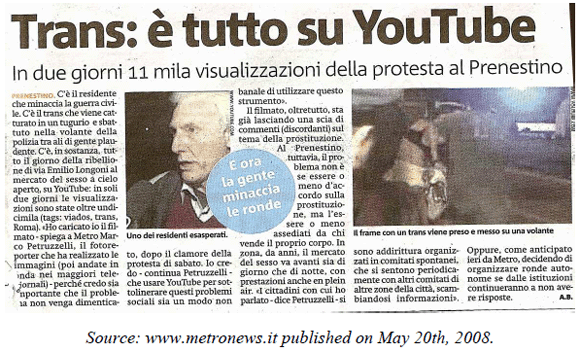
In Rome, a Brazilian transvestite was filmed being arrested b y a local T.V. station. Soon after, this broadcast was distributed on YouTube.20 The video not only shows the police apparatus involved in repressing sexual commerce, but clearly demonstrates the violence and disrespect transvestites suffer in these raids. While one officer shoves the arrested transvestite into the back of a patrol car, the other officers clap and the "citizens" observing the event scream insults at the prisoner.
The support showed by the general population to these sorts of policing activities was further enflamed by appeals published in newspapers and magazines in May 2008 demanding further police actions to restore public order. The official discourse presented in these publications not only called for the repression of sexual exploitation, but also made reference to the need to fight trafficking in persons. The State has thus engaged several NGOs to identify and protect trafficking victims. The police activities which can be observed in the above mentioned video, however, clearly violate the principles of the Palermo Protocol.21
Even when official discourses and the media insist upon associating prostitution and human trafficking for sexual exploitation, one can clearly see that public policies are generally not directed towards victim protection. For example, although the Roxanne Project is recognized as a strategy for getting transvestites to denounce traffickers, only in 2008 did the government start offering shelter sin Rome which could receive transvestites, according to one of my interviewee who works with the program. When questioned about the number of transvestites who received permission to work after denouncing a trafficker, this woman claimed to not know of a single case. She said that the only two transvestites who had denounced traffickers that she knew of had already returned to Brazil. She justified this fact by claiming that the court case was drawn out. She could not say whether or not these two transvestites had been deported.
]]> Italy seems to follow the perspective outlined by Adriana Piscitelli (2006) in which measures taken to eradicate the commercial sex trade are understood to be anti-trafficking measures and vice-versa. In order to exemplify this, I present a fragment of a news report from 2007 regarding the official launch of a set of measures designed to "limit" prostitution along the Via Salaria, in Rome via applying fines to clients and subjecting them to educational programs:Along with a verbal warning, prostitutes' clients will receive a small booklet of information put together by the Committee for Equality and Opportunity in collaboration with assistants from the Social Policies division and the Presidency of the 4th Municipal district. This booklet seeks to sensitize prostitutes' clients regarding the consequences of their behavior. It informs them that the majority of prostitutes live under conditions equivalent to slavery and the fact that the trafficking of prostitutes is now the third largest form of trafficking in the world for criminal organizations, after drugs and weapons. The booklet also reminds clients that it is a crime to be with a underage prostitute.22
Regarding the way in which Italy deals with prostitution, the abolitionist model is the legal statute that's most common among the countries of the European Union and, according to Adriana Piscitelli (2007b), this model oriented the Convention to suppress Trafficking in Persons and the Exploitation of Prostitutes in 1949 . the linkage between prostitution and trafficking and exploitation is explicitly made in the booklet that's handed out to clients and, given this perspective, the State clearly sees its as its objective the abolition of prostitution in the name of protecting women.
Prohibitions against cruising and stopping are not limited to the Via Salaria. When I decided to circulate in the areas where prostitution is practiced and where my informants work, the police blocked my entry into the area and threatened to fine my car. I was invited to undertake a tour of the area in the car of the member of the outreach project during her working hours and was later told to communicate with the department in the Commune of Rome in order to mark a date and specific hour if I wanted to see the area on my own.
These restrictions on moving around in a public space impressed themselves upon me. The calm way in which the police told me about them bothered me, as it seemed to my eyes to be a wholly arbitrary action which was being undertaken via a simple administrative fiction called the "Divieto di Fermata contro la prostituzione".
I chose the late afternoon to get to know these spaces because that seemed to me to be the safest time of day. Coming into the Piazza Pino Pascale (the scene of the arrest of the transvestite, which I will relate below) a sign posted by the "divieto di transito" announced a strategy adopted to diminish prostitution in public spaces: the punishment of clients, not for purchasing services but simply for circulating in the area during the times listed on the sign or for stopping in a prohibited zone.
These signs were distributed up and down the avenue. To my untrained eye, it didn't seem that the avenue could be covered by the criteria established by Article 158 of the Italian Highway Code23 which describes the "divieto di transito" and the "divieto di fermata". It was a large avenue which, on the left, contained substantial parking lot separated from the road by a graffiti covered wall. This appeared to mark the borders of an apparently deactivated factory. On the other side of the avenue there was another open space (which also appeared to be a parking lot) which was used to train beginning drivers. The presence of a police car indicated also indicated the management of this space and the regulation of its legitimate uses and users.
During the period in which I observed the avenue, three cars were stopped by the police. All three were driven by single men who were quickly liberated after being duly identified. On the other side of the street, three transvestites sat next to a public bathroom. During the time I watched, two potential clients came up to the transvestites, one on a motorcycle and one driving a car. Each man left the area accompanied by a transvestite. Another transvestite arrived on foot and alone, after parking her car further up the block. All this movement took place apparently without reference to the police presence in the neighborhood, nor the signs spread up and down the block.
However, as soon as I approached, it became obvious that the presence of an unknown person excited suspicions. The transvestites abandoned their spot, avoiding contact with me. The ease with which they left the area showed that, although they were apparently sitting calmly and carelessly, they were in fact highly attentive to the possibilities which the area offered for a quick getaway.
]]> I made many frustrated attempts to contact transvestites on the streets of Rome. When they didn't run, they denied being Brazilian and claimed to be Italian or even Peruvian. These refusals and suspicions were not entirely due to the fact that I was an unknown Brazilian researcher. People who work for the Highway Unit also report meeting the same sort of behavior. However, the attitude of the transvestites was at least partially justified by the fact that one needed certain credentials to be inserted in their social network – credentials I didn't have. This situation can be understood via a fragment of my interview with the Highway unit's cultural mediator who compared the project I coordinate in Brazil with her project in Italy by saying "We're on opposite sides here: I represent the government and you defend the transvestites". I believe that at this moment, by using the pronouns "you" and "I", this woman was constructing a metaphor which adequately encompasses the opposing postures of the Brazilian and Italian governments in dealing with the questions of transvestites and prostitution.24 While I wrote this text, a news story was published on the internet entitled: "Le prostitute sono soggetti pericolosi": a Rimini ‘guerra' alla lucciole".25 The report said that in the city of Rimini, foreign prostitutes have been considered as "dangerous characters" by Promoter Antonio Pezzano. A veritable hunt for them was organized during the month of July, as revealed by the numbers presented in the story: 47 were served with summons and another 40 were denounced and now await deportation proceedings.This wave of repression followed the presentation of as-yet unapproved bill in the Senate which would modify Law 1423 of 1956. This law deals with punishments given to people adjudged to be "dangerous characters" and who out at risk the moral or physical integrity of minors or public health and safety. Prostitutes are contemplated by this bill. By labeling all those who live off of prostitution as "dangerous" and subjecting them to the penalties of this law, Italy may in fact move from the abolitionist to the prohibitionist model of dealing with prostitution. And it is exactly the penalty that's being contemplated which shows that this law is not as straight forward as it might first appear: the crime is specifically attributed to migrants, because it would not be logical to punish Italian prostitutes with a summons to appear at a deportation hearing.
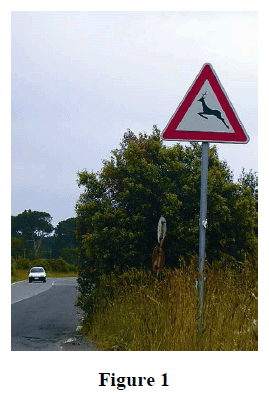
The proposal now in front of the Italian Senate might even be interpreted as an explicit attempt to combat prostitution. However, the relationship between transvestites and the status of "dangerous character" antedates this proposal, as the signs placed along the areas of "highway prostitution" show. I followed some of these highways which leave Rome and head towards the sea at Ostia, crossing Castel Fusano Park where I found several signs warning of "animali selvatici vaganti" (wandering wild animals) along the route. (fig. 1).
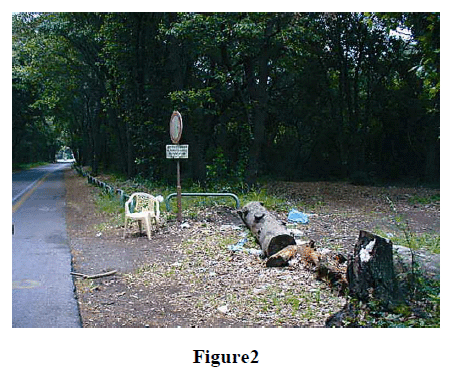
The signs are usually surrounded by old chairs, used condoms, leftover food and other indications that these areas are in constant use. The clearings inside the Park are used by prostitutes and clients and the area does not have any artificial lights. (fig. 2). Examining the photos, Priscila explained to me that light is obtained at night by burning small cans of Gasolio. "The clients already know that there's a prostitute next to each little fire".26 In observing these spaces and the work situations of the transvestites, I must emphasize that at no point did I ever hear State representatives, NGO members, or even members of the population in general complain about the precarious work conditions under which prostitution is conducted. There was no visible worry that this particular form of labor could be considered degrading. A local magazine announced the coming of the summer season and emphasized local resident's concerns with traffic, parking and, in particular, the visible presence of prostitutes along the access roads to the sea27. Here, once again, we find prostitution understood as strictly a problem of public order.
]]>
While the bill goes through the Senate...
This article seeks to offer a partial reading of the circulation of transvestites in the Italian sex market, demonstrating that the constitution of transvestite social networks marked by gender and ties of friendship shows great similarities with the social networks activated by other immigrants who seek out new lives overseas. Transvestite prostitution also shares many characteristics with female Brazilian prostitution, on both the theoretical and practical planes. These similarities, however, do not wipe out the differences. I write this article at a moment when closing of Italy's borders has intensified, leaving transvestites in a situation of dual illegality and exponentially increasing their vulnerability.
In closing, I would like to repeat the invitation made by Adriana Piscitelli (2007a) when she affirms that one of the characteristics of the feminist movement is that it gives voice to women and to marginalized women in particular. The debate regarding prostitution as work offers an excellent opportunity to continue this line of action, paying serious attention to the ability of prostitutes, individually and organized on the regional and national level, to widen our debate, especially if we realize that prostitution also encompasses transvestite and transsexual sex workers.
Bibliographic References
ASSIS, G. O. Mulheres migrantes no passado e no presente: gênero, redes sociais e migração internacional. Estudos Feministas, 15(3), Florianópolis, 2007.
BENEDETTI, M. Toda Feita: o corpo e o gênero das travestis. Rio de Janeiro, Garamond, 2005.
BENTO, Berenice. A Reinvenção do Corpo: sexualidade e gênero na experiência transexual. Rio de Janeiro, Garamond, 2006.
DAVIDA. Prostitutas, "traficadas" e pânicos morais: uma análise da produção de fatos em pesquisas sobre o "tráfico de seres humanos". Cadernos Pagu (25), Campinas-SP, Núcleo de Estudos de Gênero- Pagu/Unicamp, 2005, pp.153-184.
FERRAZ, E. A. (coord.) Travestis Profissionais do Sexo: Parcerias do Asfalto – conhecimentos, atitudes e práticas sobre o HIV/Aids em Uberlândia. Rio de Janeiro, BEMFAM, 2006.
JAYME, Juliana Gonzaga. Travestis, transformistas, drag-queens, transexuais: personagens e máscaras no cotidiano de Belo Horizonte e Lisboa. Tese de Doutorado, Programa de Pós-Graduação em Ciências Sociais, Universidade Estadual de Campinas, 1999.
KEMPADOO, Kamala. Mudando o debate sobre o tráfico de mulheres. Cadernos Pagu (25), Campinas-SP, Núcleo de Estudos de Gênero- Pagu/Unicamp, 2005, pp.55-78.
KULICK, Don. Travesti: sex, gender and culture among Brazilian transgendered prostitutes. Chicago, The University of Chicago Press, 1998.
__________. Travesti. Protituição, sexo, gênero e cultura no Brasil. Rio de Janeiro, Editora Fiocruz, 2008 [Trad.: César Gordon] .
OLIVEIRA, Neuza Maria de. Damas de paus: o jogo aberto dos travestis no espelho da mulher. Salvador, Centro Editorial e Didático da UFBA, 1994.
PELÚCIO, Larissa. Na noite nem todos os gatos são pardos: Notas sobre a prostituição travesti. Cadernos Pagu (25), Campinas-SP, Núcleo de Estudos de Gênero-Pagu/Unicamp, 2005, pp.217-248.
________. Nos Nervos, Na Carne, Na Pele. Uma etnografia sobre prostituição travesti e o modelo preventivo de Aids. Doctoral thesis, Programa de Pós-Graduação em Ciências Sociais, Universidade Federal de São Carlos, 2007.
]]> PERES, Wiliam. Subjetividade das travestis brasileiras: da vulnerabilidade da estigmatização à construção da cidadania. Masters Dissertation, Instituto de Medicina Social, Universidade Estadual do Rio de Janeiro, 2005.PISCITELLI, Adriana. Entre as "máfias" e a "ajuda", visões de migrantes brasileiras. 26th meeting of the Associação Brasileira de Antropologia – ABA, Special Symposium: Gênero no marco do tráfico de pessoas e migrantes, Porto Seguro-Bahia, 2008.
__________. Prostituição e Trabalho. In: LIMA, Maria Ednalva Bezera de; COSTA, Ana Alice Alcantara; COSTA, Albertina; ÁVILA, Maria Betania; SOARES, Vera Lúcia. (orgs.) Transformando as relações trabalho e cidadania, produção, reprodução e sexualidade. Salvador, UFBA/FFCH/CUT, vol. 1, 2007a, pp.183-195.
__________. Corporalidade em Confronto: Brasileiras na indústria do sexo na Espanha. Revista Brasileira de Ciências Sociais, vol. 22, nº 64, 2007b.
__________. Sexo tropical em um país europeu: migração de brasileiras para a Itália no marco do "turismo sexual" internacional. Estudos Feministas, 15(3), Florianópolis, 2007c.
__________. Entre a Praia de Iracema e a União Européia: turismo sexual internacional e migração feminina. In: PISCITELLI, A. et alii. Sexualidades e Saberes, Convenções e Fronteiras. Rio de Janeiro, Garamond, 2004.
]]>RODRIGUES, Marlene Teixeira. O Sistema de Justiça Criminal e a Prostituição no Brasil Contemporâneo: administração de conflitos, discriminação e exclusão. Sociedade e Estado, vol. 19, nº 1, Brasília, 2004, pp.121-150.
SILVA, H. R. S. Travesti: a invenção do feminino. Rio de Janeiro, Relume-Dumará/Iser, 1993.
__________. Travesti: entre o espelho e a rua. Rio de Janeiro:, Rocco, 2007.
SIQUEIRA, M. S. Sou Senhora: um estudo antropológico sobre travestis na velhice. Dissertação de Mestrado, Programa de Antropologia, Universidade Federal de Santa Cantarina, 2004.
WOLFF, Cristina S.; PEDRO, Joana Maria. Gênero e migrações na história entre Brasil e Itália: uma entrevista com Chiara Vangelista. Estudos Feministas, 15(3), Florianópolis, 2007.
]]> Documentos consultadosCECRIA. Tráfico de Mulheres, crianças e adolescentes para fins de exploração sexual no Brasil. Relatório Final de Projeto de Pesquisa (PESTRAF), Brasília, 2002. http://www.cecria.org.br/pub/livro_pestraf_portugues.pdf.
SECRETARIA INTERNACIONAL DO TRABALHO. Tráfico de pessoas para fins de exploração sexual. Brasília, OIT, 2006.
SECRETARIA NACIONAL DE JUSTIÇA. Indícios de tráfico de pessoas no universo de deportadas e não admitidas que regressam ao Brasil via aeroporto de Guarulhos. Pesquisas em tráfico de pessoas, parte 2, Brasília, 2006 (coord. técnica: Adriana Piscitelli).
ORGANIZAÇÃO INTERNACIONAL DO TRABALHO. Trabalho digno-trabalho em segurança-VIH/sida. Relatório do BIT para o dia mundial da segurança e saúde no trabalho, 2006. http://www.ishst.pt/downloads/content/Brochura_OIT_2006.pdf
SECRETARIA NACIONAL DE JUSTIÇA/ ORGANIZAÇÃO INTERNACIONAL DO TRABALHO. Tráfico Internacional de Pessoas e Tráfico de Migrantes entre Deportados(as) e não Admitidos(as) que Regressam ao Brasil via o Aeroporto Internacional de São Paulo, Brasília, 2007.
]]>
1 Received for publication in August 2008, accepted in September 2008. This article was originally presented at the Gender in Trafficking of People Seminar of the Pagu/Unicamp Gender Studies Nucleus and the Combat trafficking in Persons Project of the International Labor Organization in Brazil. I would like to thank Adriana Piscitelli for her orientation and for the careful reading and contributions she gave to the final version of this text. I would also like to thank Adrian Vianna for her generous support of me during my debate with Karla Bessa and for the inspiration and criticism which she freely gave during my fieldwork.
2 According to Larissa Pelúcio (2005), in order to be considered European, a transvestite must have lived for a season outside of Brazil working as a prostitute. Babádo is also an emic term, but one which is more ambiguous in nature, meaning either something which is very good or disastrous. The meaning of the term can thus only be understood in its larger context.
3 Neuza Oliveira, 1994; Don Kulick, 1996, 1998, 2008; Larissa Pelúcio, 2005, 2007; Mônica Siqueira, 2004; Marcos Benedetti, 2005; Wiliam Peres, 2005.
4 This project attends to some 40 transvestites per month. Activities are organized on a weekly basis and we estimate that some 150 transvestites are in the program or using its services at any given moment.
5 A social networking platform in which members' pages are publically available for consultation (roughly the equivalent of Facebook in the United States).
6 I must emphasize that I consider problematic the view that there is a direct relationship between being a transvestite and being a prostitute, or the view that prostitution is "naturally" the only career route for transvestites. However, I share with other researchers the perception that red-light districts are indeed a significant space for transvestite sociability. I refer here to the fact that the vast majority of transvestites – around 97% - engage in sex work according to data presented by the First National Consultation on DST/AIDS, Human Rights and Prostitution which took place in Brasília between the 26th and 28th of February, 2008.
7 A document relating research undertaken by the National Justice Secretariat of the Brazilian Ministry of Justice and the International Labor Organization (ILO) and released in 2007, clearly demonstrates that the category "pimp/madam" (cafetina) is poorly understood in debates regarding trafficking. This is also the case both within the legal field, whose members ignore the emic meanings this term has for transvestites, who sometimes use it to indicate affection for someone who has aided them.
8 The Federal Police operation "Caraxué", which took place on the 18th of October, 2006 and which included the city of Uberlândia in its sphere of operations was presented to the media as a successful action in combating trafficking of persons. My fieldwork, however, has revealed a different understanding of this operation among the city's transvestites, who understood it to be a chaotic and confusing action, being that they could not see the connection between the activities of their quotidian lives and what the Federal Police were denominating as "trafficking". ]]>
9 According to Gláucia Assis (2007), "undocumented" refers to immigrants who do not possess the documents which authorize their legal presence in a foreign land.
10 I refer here to the articles by Adriana Piscitelli (2004) and Grupo Davida (2005) which point out the need to problematize the ways in which facts regarding trafficking are produced. In particular, i believe that trafficking is not an adequate characterization of the situation in which these two people were involved.
11 A cant widely used by transvestites composed of ioruba-nagô words. Also known as pajubá or bate-bate. Translator's note: bajubá is somewhat similar to the English gay/street cant of polari.
12 The Rome Libellula ArciTrans Association. Confronting trafficking and sexual exploitation are not listed as Association objectives on the group's website, nor did these topics appear as major issues for the group during the interview I conducted there. The group's website can be accessed at http://www.libellula2001.it/ (consulted on 08/04/2008).
13 The Roxanne Project involves prevention activities, aid and help in finding work for people who have been victims of sexual trafficking. It functions through highway units which are, in turn, linked to the Comune di Roma according to the Project's official webpage (http://www.spqrdipsociale.it/disagio_sociale/tratta_sessuale.asp).
14 This is anemic term used to define those transvestites who obtained great success after modifying their bodies, approximating the western female pattern of beauty, at least in the eyes of their social group. According to Pelúcio (2005), these transvestites are also known as "Tops".
15 An emic term used to define a transvestite to whom one owes respect in one's network of social relations. In this context, it also indicates an origin and belonging to a given group.
16 One of the conditions of being granted an interview was that I not reveal any details about these alternative routes.
17 These documents make specific reference to post-traumatic syndrome disorder which, under the current International Disease Classification scheme (CID-10) is diagnosed as F43.0 – extreme stress reaction. By giving "psi" scientists and professionals the right to speak with authority about others, the legal system has thus become a relevant field for the study and analysis of sexuality (see Bento, 2006).
18 The data presented here shows the numerical supremacy of the Brazilian transvestites in Rome. Another indication of this presence can be seen in the colloquial way in which many Italians refer to transvestites, pejoratively, as "Brazilian queers". It's significant, in this sense, that Italians generally do not use curses which refer to homosexuality. ]]>
19 All the transvestites I interviewed have had contact with the transvestites from Peru, called "Peruvians" in Italian, a term that has been incorporated into the lexicon of the Uberlândia transvestites in order to indicate older transvestites. I currently have no data as to whether or not this term is used in other parts of Brazil.
20 Information from the Rai Ter channel news, May 17th, 2008. Available at http://br.youtube.com/watch?v=wj_X2Tn6fyg
21 The Protocol has a non-discrimination principle: signatories are enjoined to not discriminate against trafficking victims in either material or procedural law, in public policies or in practice. It also includes a disposition regarding security and just treatment: signatories should not consider trafficking victims to be undocumented migrants but should recognize them as victims of grave human rights abuses. They should teach victims about their rights and protect them against reprisals and other dangers.
22 "Contestualmente al verbale, ai clienti delle prostitute verrà consegnata uma piccola brochure informativa predisposta dall'assessorato capitolino alla Comunicazione e Pari opportunità, con la collaborazione dell'assessorato alle Politiche sociali e della Presidenza del IV Municipio. Una brochure che si prefigge di sensibilizzare i clienti delle prostitute sulle conseguenze del loro comportamento: li informa sullo stato di riduzione in schiavitù cui sono sottoposte la maggior parte delle prostitute, sul fatto che la tratta della prostituzione è il terzo traffico mondiale delle organizzazioni malavitose dopo quello della droga e quello delle armi, e sul fatto che andare con una prostituta minorenne costituisce um reato penale". Disponível em http://www.romanotizie.it/spip.php?article3335 (consulted on 22/05/2008).
23 Nuovo codice della strada, decreto legisl. 30 aprile 1992 n. 285, available at: http://www.ricercagiuridica.com/Codici/vis.php?num=3358 (consulted on 25/05/2008).
24 In Brazil, the national movement of transvestites is well organized and maintains a presence at the table when it comes to defining public policies, the National Encounter of Transvestites and Transsexuals in the Struggle Against AIDS (ENTLAIDS), for example the National Transvestite Movement is financed by the National AIDS Program of the Health Ministry and has recently undertaken its 10th meeting in 2008 in Salvador. More recently, the 1st National Consultation on STDs/AIDS, Human Rights and Prostitution was organized by the National STDs/AIDS Program and met in Brasília. It brought together leaders of the Brazilian Prostitution Network, the National Union of Transvestites and Transsexuals, the Transsexual Collective and members of the federal government.
25 Available at http://www.romagnaoggi.it/rimini/2008/8/4/99103/ (consulted on 04/08/2008). The word "war" was also chosen as part of the title of the report "Guerra alle prostitute di strada in arrivo foglio di via e espulsione". Available at http://www.dirittiglobali.it/articolo.php?id_news=6736 (consulted on 05/08/2008).
26 A few scenes from the film Tirésia illustrate the lifestyle of the highway prostitute in France. Tiresia, directed by Bertrand Bonello, France/Canada, 2003.
27 L'OCCHIO che..., ano 4, nº 7, maggio 2008 (also available at www.occhioche.it).