Ernesto Seidl
Federal University of Sergipe – Brazil
Translated by Letícia Maria Costa da Nóbrega Cesarino
Translated from Horizontes Antropológicos, Porto Alegre, v.13, n.27, p. 145-164, Jan./June 2007.
ABSTRACT
]]> This article analyzes the relations of Brazil's Catholic bishops and their position, as a representative group, regarding "political" and "social" issues. The purpose of the study is twofold: it seeks to shed light on the logic of the mechanisms shaping the representations of the Brazilian high clergy as a homogeneous group responsible for elaborating univocal messages to a heterogeneous public; and to apprehend a vast set of strategies for crafting and presenting official discourses well-adapted to both Brazil's and the world's realities, as a way of legitimizing the Church as an authority on a vast array of subjects.Keywords: Catholic Church, ecclesiastic elite, episcopate, politics.
RESUMO
O artigo aborda as relações entre o episcopado católico brasileiro e seu posicionamento como grupo de representação frente ao universo da "política" e do "social". A análise procura evidenciar, por um lado, a lógica dos mecanismos de produção de representações do alto clero como grupo homogêneo destinado a produzir mensagens unívocas para públicos variados e, por outro lado, um conjunto variado de estratégias de elaboração e apresentação de discursos institucionais adequados à "realidade do país" e do "mundo" e que visam a legitimar a posição da Igreja como instituição capaz de falar com autoridade sobre ampla gama de temas.
Palavras-chave: elite eclesiástica, episcopado, Igreja católica, política.
I don't consider myself a progressive, but I don't think I'm a conservative either.
I don't think I'm a conservative, much less a progressive. I think
I'm a moderate. That's what I think I am… (laughter).
This study focuses on the relations between the catholic episcopate in Brazil and its stances as a representative group in the 'political' and 'social' spheres. More broadly, the research questions broached here speak to a series of debates on the structuring, functioning and transformations of the high ecclesial sphere in Brazil from the second half of the twentieth century on. Such debates include the redefinition of the catholic space within spaces of power, particularly the dynamics between the religious and political spheres and their consequences for the mechanisms of recruitment and selection of the Church's ruling elites.1
The dimensions to be analytically explored were educed from this broader problem, and inspired by indications from studies about different contexts (Bourdieu, 1971, 1996; Bourdieu; Saint Martin, 1987; Vassort-Rousset, 1986, 1987), and are presented along two main axes. My perspective contrasts both with approaches centered on the examination or description of the official stances held by the Catholic Church's higher echelons vis-à-vis 'politics' and their changes in time (Azzi, 1978, 1981; Lima, 1979; Morais, 1982), and those aimed at understanding the Church's 'role' or 'function' as an institution that legitimates or questions established political power (Bruneau, 1974, 1985; Della Cava, 1978; Löwy, 2001; Mainwaring, 1989; Serbin, 2001). It seeks, on the one hand, to evince the logic by which representations of the high clergy as a homogeneous group in charge of providing univocal messages to various publics are produced while securing the group's image of internal unity. On the other, it sheds light on a multifaceted set of strategies for devising and presenting institutional discourses supposedly appropriate for 'the realities of the country and the world' which aim at legitimating the Church's status as an institution capable of speaking authoritatively on a wide array of issues.
The bishops and 'politics'
No other topic is probably addressed as homogeneously by Brazil's high catholic clergy as the relations between the Church – particularly the episcopate itself – and 'politics'. Their position in the ecclesial space demands a high degree of control over the religious body's image of unity. These experts in double meaning and euphemism quite impressively manipulate a univocal rhetoric when talking about the limits between the 'spiritual' domain –Churchmen's legitimate realm of action – and the 'temporal' – laypeople's action field. Underlying the principle of separate 'competences' evoked by members of the high ecclesial hierarchy are fundamental differences between a body of experts in the manipulation of spiritual goods and 'profane' clients divested of such religious knowledge capital. However, as Bourdieu (1996) and Bourdieu and Saint Martin (1987) have argued, it is precisely in the need to maintain the unity of both the institution's religious professional personnel and its actual or potential clients – that is, the 'unity of the Church' as a 'whole', or as a 'family' – that one can find the logics justifying the refusal to take on the 'excluding', 'combative', and 'dividing' stances typical of political and partisan ideologies.
In tune with the theological argument of non-discrimination of individuals liable to join the Christian group – namely, the purported 'universality of the evangelizing appeal' –, the systematic dismissal of partisan or ideological adherence invariably found in statements by prelates from the Brazilian State of Rio Grande do Sul is built in opposition to ethic-religious principles which claim to stand above 'political' options which, according to the bishops, 'divide', 'dissent', and 'compromise'. This naturalization of political positions by ecclesial leaders therefore operates by means of a dichotomy between catholic values which are 'general', 'universal', 'common', 'higher', and those that are 'particular, 'partial', 'partisan'. It is thus that, for instance, if social interests manifest in political party ideologies necessarily pit individuals competing against each another – what would be fundamentally understood as 'politics' –, the Church should be kept at arm's-length from contingent particularities. It should defend 'higher' principles with no ideological identification, that is, that 'politics with a capital "p"', 'in the wider sense of the word', 'true politics' – terms which are quite common in the episcopate members' repertoire.
Another aspect I would like to address: How do you see the relation between the clergy, the Church, and politics?
]]> Politics is to me the science of the common good; so we should be involved. I am radically opposed to participation in party politics, because our role as bishops, as priests, as a church, is to unite and not divide. If I choose a party, I am automatically dividing a community, a parish, a bishopric, so I am absolutely against priests participating in party politics. I think there should be a lot of caution and balance, which does not mean we should be omissive, but anything we say carelessly might cause a division which won't heal. […] We have to provide principles, and the actualization of such principles is up to the layman. (Diocesan Bishop, 71 years old, consecrated in the 80's).
The first mission of the Church and of the bishop is to evangelize; the problem is to evangelize in the abstract. If people are suffering, we cannot ignore it. […] But I believe that, politically, the bishop or the priest should not align himself with a political party. They should align with the common-good party, which stands above all political parties. The common good should be always there for a true education policy to take place, a true health policy, a true media policy, a true housing policy, a true land distribution or agrarian policy, a labor policy. I think this tends to favor those who are in need. We have to guard against political parties. Sometimes this will hurt; we will be labeled, classified. So be it, let them do it. Later on, they will recognize that we are doing no less than our obligation. (Diocesan Bishop, 65 years old, consecrated in the late 80's).
On the other hand, if 'politics' as a declared ideological option is part of the episcopal discursive universe only to negate its legitimacy in the ecclesiastic sphere, the hierarchy's public manifestations on the country's and the world's social, political and economic order – those 'pressing issues of our times', which include a wide array of topics not exclusively framed as belonging to 'spirituality' – are both one of the most common ways by which the catholic 'point of view' is made explicit amidst major ongoing ideological disputes, and one of the contemporary episcopate's legitimate tasks. The effects of such Conciliar (Vatican II) reorientation toward 'inculturating' Catholicism in the different 'social realities' and attempting at a new catholic framing of social life in its multiple dimensions include, as key elements in the re-articulation of experts-laymen relations, the intensification of manifestations by religious authorities about an increasingly secularized and complex world, as well as deep changes in the ways liturgy is celebrated. Just as the mass and sacraments came to be ministered in vernacular languages in order to become more accessible to the faithful, so too should religious professionals seek to approach their clients through languages more appropriate to ever-increasingly urban, educated, and diffuse audiences.
Indeed, the imposition of religious competence based on scholar or intellectual ability is one of the central regulatory mechanisms of the catholic space. The significant increase in investments in academic degrees by institutional agents as a condition for climbing to higher positions – especially visible among members of the episcopate – brings into relief the space opened to scholarly-legitimized culture as a tool for adapting the church to more urbanized and educated publics. Indicative of this new direction is not only the expansion of religious training services, but the diversification of the kind of qualification and knowledge forms (among which figure prominently the incorporation of 'non-traditional' theological fields as well as 'profane' disciplines). One of the most visible consequences of the centrality of scholarly knowledge for the Church's forms of symbolic domination has been precisely the redefinition of the ways religious authority is exercised, especially in terms of its 'intellectual' functions. In the wake of the Second Vatican Council, the re-articulation of religious pedagogic tools by means of their approximation vis-à-vis sites of production of scientific knowledge, notably colleges and universities, was a watershed in the displacement of the intellectual reproduction of the religious body from consecrated educational institutions ('rural', 'closed') to environments much less differentiated from the lay educational world.2
The catholic 'agenda's' homogeneousness and its partial coincidence with the country's 'social and political agenda' are intimately connected with a significant shift in the Brazilian Church's stance towards the social, after the 1964 Military Regime and changes taken place during the last three decades.3 Most prominently, the role of the National Conference of Brazilian Bishops (Conferência Nacional dos Bispos do Brasil, CNBB) – with all its specialized units assisted by social scientists and other lay and religious social experts in charge of subsidizing it with academically grounded knowledge – as the hierarchy's official body favoring en bloc decision-making was decisive for the elaboration of a 'critical' discourse, and for the display of an image of the episcopate as the group authorized to speak on 'the country's issues'.4 The constant 'declarations' and 'documents' issued by the bishops' representative entity and recognized by Rome provide prelates with an official institutional guideline in relation to which hierarchical leaders, to a greater or lesser extent, devise their orientations at the diocese level – always at risk of challenging the 'legitimate problems' (Bourdieu, 1979).
CNBB: 'an opinion that matters'
How is CNBB's position like when it is called to talk about politics in general?
Even if not wanting to, everybody goes to CNBB to find out what it thinks. CNBB is a natural reference in Brazil today. So it doesn't matter whether or not you want to make a statement, they will come and ask: 'what do you think of Fernando Henrique [Cardoso, former President]?, 'what do you think about the energy blackout?', 'what did you think about this and that?'. Then you're forced to get into these issues in order to provide the people with a meaningful and reasonable opinion. It is not that you wish to do that. Whether you want it or not, they will come. Of course I could be discourteous and declare that I don't talk about this, only about Jesus Christ. But then people would say, 'this bishop is out of touch with the world. He is just plain out of it'. (Diocesan bishop, former CNBB president)
]]> So, the practice... Let me tell you something: the bishop is not a bishop as he would like to be, and many times he has to take responsibility, as our CNBB does, and so forth. It is not that we don't like to make so many statements. I think laypeople should do it, but if there's no one to do it, we are circumstantially forced to, the moment makes us do it. I don't think I have been the bishop I'd like to be. Also because of that… but circumstances have forced me, and in this regard I am thankful to God. (Diocesan bishop, 65 years old, consecrated in the early 70's)
As institutional leaders of a dominant religion counting on multiple structures scattered throughout Brazil, endowed with cultural resources which are increasingly legitimated by the educational system, and trained in the use of the spoken and written word, bishops regularly resort to the Church's world view which claims to be 'up-to-date' and capable of mobilizing various publics. Differences of intensity and style of intervention stemming from diverse origins and trajectories5 notwithstanding, the approaches taken in pieces and allocutions by currently active prelates in Rio Grande do Sul, as well as in their declarations during interviews,6 show no substantive variation. Along with 'spiritual' analyses (that is, those centered in comments about Gospel's passages, clarification of doctrine or celebrations in the Christian calendar), a broad range of 'social' and 'contemporary' themes – ranging from 'economic policy' to 'the environment', 'poverty', 'external debt', 'violence', 'political reforms', 'drugs', 'elections' – make up the other chief axis of ecclesial leadership's legitimate 'concerns'.
Even though all prelates have specific means to communicate the 'Church's word' in their dioceses, those who are most notable among them (due to the kind of diocese they head and position they occupy or have occupied) tend to more frequently spouse the ecclesial position about 'polemic' and 'momentous' topics. Especially the Porto Alegre archdiocese and a few central dioceses in the state (Rio Grande do Sul) are led by clergymen bearing the resources demanded by their position and favoring the accumulation of authority capital – prominent degrees, excursions abroad, communicational skills, experience in holding national positions. It is from there that the Rio Grande do Sul episcopate's stances resonate most loudly at the state and even national level. It is thus that, for instance, about a month before presidential elections in Brazil, the Porto Alegre Archbishop – in his status as the leader of the catholic church in Rio Grande do Sul, based on the state capital, counting with the largest religious structure in the state and with a 'history' of strong 'presence in society'; himself a Licentiate in Canon Law, former staff in the Vatican and author of several books on broad issues – convened the press to express the local Church's 'official stance' on the Brazilian government's reforms. The statement below was issued by the Metropolitan Curia's press relations office, a very active unit linked to the Archdiocese's Communication Pastoral, itself directed by a journalist priest:
Archbishop issues brochure on Reforms
Next Monday, September 1st [2002], the Porto Alegre Archbishop will release a Brochure on Brazilian Reforms. Dom Dadeus Grings will meet with the press at 2pm in the Metropolitan Curia. The text presents the Archdiocese Church's official stance on the ongoing reforms and on those projected by the current Federal Administration. For the Archbishop, opening is lacking to a broader debate with society before projects are submitted to appreciation by the Legislature. Dom Dadeus declared that all citizens have the right to participate in such discussions. He affirmed that they cannot be restricted to a small elite, nor to the exclusive debate between professional politicians. The brochure presents the local Church's official stance on reforms being debated in the National Congress, as well as suggestions for debate in society on proposed reforms such as the political and the party-system reforms. The Archbishop asserted that this material presents a firm posture that will hopefully encourage serious debate on the changes the nation needs to effect.
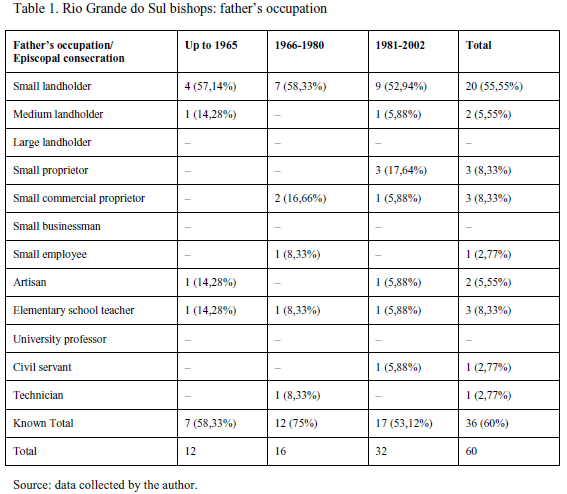
Firmly predicated on the idea of internal unity and alignment with national and Vatican guidelines, the group of rio-grandense bishops manifests understandings of strategies for pursuing catholic religious work that diverge little between themselves and the national episcopate. On the one hand, the group's homogeneous social (see Table 1), ethnic and educational composition – marked by 'Roman culture' and 'loyalty to the Pope's orientations' – has a decisive weight in the configuration of a widely shared episcopal stance. On the other, the maintenance of the group's outlines through control of member-recruiting mechanisms cannot be ignored. Mostly coming from lower strata of tenant farmers, small merchants and artisans, almost all consecrated bishops after the Second Vatican Council, with Romanized training and virtually lacking professional experience in contexts of extreme destitution (such as urban outskirts peripheries, slums, missions in poor regions), these ecclesial leaders tend to take on a position of 'average virtue'.
Close to accomplishing social self-objectification, these clergymen easily associate their 'simple origins' in the state's immigrant settlers' rural life – even though far from the miserable realities common to many regions in the country – with a 'balanced' and 'moderate' position. According to them, this position would resonate better with the 'community' universe of 'lesser injustice and social difference' in which they 'grew up' and where they act as religious ministers.
Commonly invoking the situation of dioceses in the Northern and Northeastern areas of Brazil, where the precariousness of life conditions would justify more intense religious intervention toward social change, in a 'vindicatory' tone Rio Grande do Sul bishops claim an 'intermediate' position providing them with a vantage point for the delicate role of producing messages for various social groups without exclusively committing to any of them. Thus, even though their rhetoric is perfectly attuned with the Brazilian and Latin-American Church's mainstream position of 'preferential option for the poor' or a 'Church for the oppressed and unprivileged', these clergymen insist in bringing nuance to the implications of such theological trend in non-reductionist terms.
The straddling-the-fence 'bias'
So, I have participated; however, I do have a bias. And I acknowledge that I have a bias. Let me explain: I'm not capable of reading and becoming a supporter. I'm very critical, so I'm always at arm's-length. Say, the following: I go to an inter-ecclesial [meeting], but I don't jump right in, as a supporter, an unyielding advocate. I watch, and then I say: 'no, this point has not been taken care of, this one I think is better, that one less so'. And it's like that with everything else. Likewise in the movements: I don't belong to any movement, but I take part in all of them. For instance, I participate in the cursilhos, in the charismatic renewal, but I'm not from the charismatic renewal movement nor from the foccolarianos movement. I participate, but I don't belong. I'm not enrolled as an adept of the grassroots Basic Ecclesial Communities, but I participate. I'm even the referential bishop, but I always keep myself at bay, because sometimes it can harm me, it's not a good position to be in. […] People always say I straddle the fence, never coming down on either side of any issue. But no, what I want is distance in order to be able to assess, assess. (Diocesan Bishop, 69 years old, consecrated in the early 80's)
The higher the hierarchical position, the greater the demands on its occupant for coming up with a unitary view of the institutional body, as well as for producing messages for broad publics. Episcopal leadership therefore entails mastery over a rhetoric charged with ambiguities and implicit meanings tailored to bring opposites together and be interpreted less as 'critical' than as a 'suggestion' or a 'point of view'.7 When asked to talk about their 'view of the Church', the 'strategies' and 'challenges' faced by contemporary Brazilian Catholicism, prelates are unanimous in responding with an 'evangelizing' discourse. This would be their 'primary task', squarely centered on the 'social dimension' – official Church designation for a set of institutional policies and their respective structures, geared toward assisting specific, and commonly unprivileged, publics (landless and factory workers, incarcerated populations, abandoned children, and others). Drifting toward institutional vocabulary, the episcopal discourse on the 'poor' and those 'in need' (the 'sensitivity toward the social', as they use to say) never appears, however, isolated from a broader contextualization of what should be the other targets of evangelical action, or even from challenges to the notion of 'poor' itself ('we have to be careful as to what is understood by "poor", because I cannot take "poor" only in the material, economic, social sense'). In other words, this refusal to take a stance exclusively on behalf of the 'poor' ('it is a preferential, but not exclusive, option', as prelates are used to repeat) or of any other well-defined constituency in order to avoid compromising the plurality of their religious catholic appeal, makes up a central axis of the argumentative scheme of these professionals. They are impressively skilled in devotedly representing the notion of a 'unity in plurality', applicable both to the community of faithful and to the ecclesial body itself.
'Politics' and the 'social' transfigured: CNBB's General Assembly
]]> A privileged opportunity for getting closer to the high ecclesial sphere, directly interacting and observing this hierarchical elite in flesh-and-blood, assembled in a physical space whose access is highly controlled, provided some of the most valuable material for capturing a series of specific situations in order to understand part of the elements making up the social and cultural universe of contemporary Brazil's ecclesial elite.8 Even though far from a full-fledged ethnography of the catholic high clergy, my experience amidst the members of the Brazilian episcopate and other religious agents from various positions within the catholic space (episcopal secretaries, assistants, lay staff, catholic journalists, event staff, and so forth) opened up a new field of analytical expectations. These included the episcopate's internal (unofficial) hierarchies, the ambiguities in their relations with the power and uses of religious authority, and strategies for producing an image and messages in fine tune with dominant perceptions about the 'Brazilian Church' ('united', 'concerned', 'socially active', 'well-informed', and so forth), among many others. Thus, it became interesting to account for not only what was said during the assembly, but also how it was said, under which conditions (in which spaces, for which audience, in which occasion), and by whom. Similarly, I was able to sketch a contrastive outline of the universe of interdictions made up of laughter, jocosity, insinuations, metaphors and silences pregnant with implicit meaning which would be just as revealing of the ways through which the image of the episcopate and the Church as a whole is managed.Even though the assembly was to last ten days, discussion meetings were concentrated in one week, excluding a day off (Sunday) in which no mandatory activities were scheduled. Each year there is a central theme directing the meeting, and in 2001 it was 'CNBB: life and organization at the service of God'. This was an opportunity to discuss and vote the institutions' new canonic statute. The intensity of the activities distributed along the entire meeting is significant, as it followed a dynamics similar to religious life at large, with first prayers early in the morning and dinner in the early evening. Time schedules were quite strict, and sessions in small or large groups took up entire mornings and afternoons, except for Saturday (retreat) and Sunday (day off). All meetings dealing with CNBB's statute or some other private issues of the episcopate (around four) excluded all other participants, including assistants. Moreover, for topic meetings according to pastoral engagement or episcopal regional jurisdiction, smaller groups met in breakout rooms around the main auditorium.
Various aspects can be singled out for comment on the way sessions are conducted, behavior of clergymen, and the overall environment of more formal moments in the auditorium. If the few religious rituals and some symbols accompanying the sessions (initial and final prayers, representation of Our Lady) were excluded, it is likely that at first it would be hard to distinguish the bishops' from other non-religious assemblies such as those of political parties or certain (mostly male) professional categories. Concern with procedures promoting 'horizontality', 'transparency' and 'democracy' in the assembly – socially consecrated rites in the political sphere and various groups – along with other forms of euphemizing hierarchical relations were evident. These included from the tone of voice and vocabulary used, especially by the conference's directors, to the practice of consulting with the entire assembly regarding each decision, even the most seemingly trivial. The notion of authority equality among prelates undoubtedly prevailed in their actions on occasions of reconciling and speaking to the public. Manifestations of symbolic power expressed for instance in the greater notoriety of certain bishops were continuously blurred by a bland uniform treatment by those coordinating a session or a meeting, as well as by the absence of prerogatives and gestures of deference. The very attitude of CNBB's coordinating bishops toward the assembly seemed to transpire some discomfort, indicated by minimal intervention by the president and the extreme caution pursued by the secretary-general bishop, the sessions' chief coaching facilitator, while directing the activities.
The 'democratic' character they seek to lend the institution is also evident in the chance all prelates had to verbally manifest their opinion in the pulpit after a presentation or conference, even though oftentimes there was not enough time for all those who signed in to speak (it was thus asked that their intervention be sent in writing to the Secretarial Officers). The first act after the event's official opening was the presentation of the assembly's agenda, which underwent a symbolic vote and was unanimously approved by the bishops who raised their hands in agreement. After that, the floor was opened to communications by prelates who wished to address specific items. Virtually all of them related to particular issues in their dioceses, except for the proposal for discussing a federal Bill of Law establishing the civil union between homosexuals. Similarly, the willingness to 'take into account' the opinions and evaluations of the entire body of bishops regarding the event's general activities and structures was carried out through consultation. This was performed by means of questionnaires including various topics such as satisfaction with punctuality, meals, topics of the spiritual retreat, prayers, meeting outcomes, among many others. Once compiled, each piece of data was graphically presented in the main auditorium's screen, and discussed almost playfully by the secretary-general. The same was true for the presentation of the conference's yearly economic report, during which the joking commentary that 'obviously there were no dividends for the bishops' made the entire audience burst into laughter.9
The division of tasks among the members of the episcopate within the assembly followed the different pastoral coordinating functions performed by part of the responsible bishops.10 Thus, specific debates on dimensions of each pastoral commission took place between their respective prelates and their assistants in smaller rooms. Some of these even took place at nighttime, but never overlapping with the general meetings. On the other hand, certain themes stood out, and were presented to the entire assembly. That was the case of the exposition titled 'The Amazon: reality and challenges for evangelization', offered by a bishop member of the special commission created to debate this subject. The remaining participants in the assembly made up a broad and heterogeneous group, whose complicated affiliations I could only partially grasp through the multiple acronyms in their name tags. Of these, it was those religious and laymen acting as assistants and heads of regional offices who enjoyed the most prestige within the group, stemming from the position they occupied in the administrative structure, their proximity to bishops or even their authority in a certain field of knowledge legitimated by participation in intellectual or academic spheres (especially in the case of assistants).11 These performed a dynamic function of orienting and informing bishops during the meetings, and as far as I could gather were the only ones entitled to speak publically during the event as experts. The expected minimal feminine presence among the assembly's participants – which included representatives of bodies linked to CNBB and some of the bishops' assistants – contrasted with the prevalence of (especially religious) women in the performance of organizational and manual dynamic tasks (reception, logistics, distribution of materials, institutional press).
The support to interventions, and even to the very presence, of 'notable' lay assistants brings into relief the growing importance of the 'Church intellectual' in its institutional structure. At the same time, it allows a glimpse into the dominant image that the conference seeks to impose both on society and on its own members. The open debate about themes pertaining to the 'national agenda' – 'politics', 'economics', 'poverty', 'scandals', 'ecology' – within an institution whose participation in social struggles over the definition of such an agenda has been unyielding during the last three decades and is an central source of its legitimacy is not surprising. But it is worth reckoning with the ways in which such debate is made explicit, as well as its terms and visible effects. Similarly, it should be placed within the whole of the assembly's activities, which oscillates between two administrative-institutional lines: one 'internal', encompassing for instance decisions on how the conference operates and how power is distributed; and another one comprising forms of strategic insertion by the Church as well as the renewal of its social agenda. All these activities are interwoven with religious rituals which unify their purposes.
From this perspective, an indication of the relevance of the 'social question' and of the fact that the institution is in tune with it was the long presentation (and reactions to it) in the beginning of the assembly by a well-known 'sociologist of religion' – a layman and CNBB assistant – titled 'Conjunctural Analysis'. The text was almost entirely read, and was also distributed to the audience. Proposing to offer a 'key for reading reality', it approached 'critically' a vast array of subjects understood as 'the main issues of Brazilian conjuncture since 1989' in order to 'highlight alternatives' involving Church action.12 After the assembly applauded, the speech's somber tone was reproduced in the series of comments by bishops who wished to speak from the pulpit. They consisted of supports and complements to the 'criticism' of the 'national conjuncture', seconded by relatively vague proposals of 'solutions' or 'responses' by means of 'evangelizing' actions. A beacon to the 'social agenda' around which the event was to gravitate, this harsh and clearly pessimistic 'diagnosis' about the country's situation, and even about the global scene, conveyed right at the opening of the assembly seemed also to have served the purpose of instrumentalizing the bishops' discourse not only in meetings, but also in interviews and conversations.13 On the other hand, assistants' declarations to the media on behalf of the institution in press conferences scheduled by CNBB, alone or accompanied by bishops, further suggest a strategic presentation of the conference's 'univocal' image with respect to 'pressing' issues faced by the country. Among such situations, I highlight an individual interview with the sociologist in charge of the 'conjectural analysis', an interview with the assistant ('professor' and 'writer') on Amazonia issues together with three bishops members of the special commission, and an interview with a nationally renowned 'intellectual' on 'political corruption'.
Concerns about the integrity of the episcopate's and the Church's unitary image were generally perceived also in the avoidance to broadcast individual stances or any piece of information suggesting divergence within the group. An example was the request for the press to leave the auditorium when it was time for bishops to make a 'statement on the country's contemporary moment'. By disallowing the presence of persons not belonging institutionally to the conference, the presentation of the document by prelates (rather than assistants) and the individual manifestations that followed were guarded, with the effect of preserving the episcopal group's image of integrity and unanimous decision. On the other hand, moments after this closed session, a two-page synthesis of the document was issued as a press release –CNBB's official position was thus revealed.14 This material informing that the four-page long 'declaration' summarized its 'main points', suggested that the bishops' document dealt basically with the same topics approached in the 'conjunctural analysis' presented shortly before. But in contrast to the previous document – relying exclusively on lay lexicon and dotted with statistical data, reports from research institutions and newspapers –, this synthesis was notable for its multiple references to the Pope's words, to one document from the Puebla Conference, and to one Biblical passage.
All clues lead us to think that in its private meeting, CNBB merely said with its own words and its own way what had already been publically conveyed by one of its 'intellectuals'. Except that now its presentation as a 'declaration' made on behalf of the conference manifested greater commitment. The various procedures aiming at cloaking conflict, direct criticism or divergences within the episcopate followed one of the constitutive logics of the religious universe: the euphemization of social relations. The 'traditional'– and never publically admitted – fundamental tension within the episcopate revolves around the definition of the Church's tasks and the ways of carrying them out, simplified in the following formulae: favoring an institution more concerned with 'administering spiritual goods' and concerned with 'internal affairs'; or, on the contrary, one more 'engaged' in 'social issues' and manifesting its views on whatever has to do with the human being, not only religion. All this supposed debate remained intangible in the assembly. My multiple efforts were not enough to break the taboo around this topic during private conversations with the prelates, whose evasion only bear out the existence of such distinct positions. The question is further made more complex by the fact that the Church's official position is dominated by a discourse markedly 'engaged' in 'social issues' ('social denunciation', 'critique' of a variety of questions, involvement in movements such as the 'foreign debt referendum'). In other words, it is unthinkable that a bishop will come forward publicly, or even privately to an unknown researcher, to show his discordance vis-à-vis the institution's prevailing 'social line'. That would have threatened one of the group's key legitimating principles; therefore virtually all possible avenues for apprehending such divergent stances remain blocked.
]]> References
AZZI, Riolando. O episcopado brasileiro frente à Revolução de 1930. Síntese, v. 5, n. 12, p. 47-78, jan./mar. 1978.
AZZI, Riolando. Em prol de uma nova ordem: a posição do episcopado brasileiro na década de 1970-1980. Síntese, v. 8, n. 22, p. 49-82, maio/ago. 1981.
BOURDIEU, Pierre. Genèse et structure du champ religieux. Revue Française de Sociologie, v. 12, n. 3, p. 295-334, 1971.
BOURDIEU, Pierre. La distinction: critique sociale du jugement. Paris: Minuit,1979.
BOURDIEU, Pierre. A economia dos bens simbólicos. In: BOUDIEU, Pierre. Razões práticas. Campinas: Papirus, 1996. p. 163-203.
BOURDIEU, P.; SAINT MARTIN, M. de. La sainte famille: l'épiscopat français dans le champ du pouvoir. Actes de la Recherche en Sciences Sociales, n.44-45, p. 2-53, nov. 1987.
BRUNEAU, Thomas. O catolicismo brasileiro em época de transição. São Paulo: Loyola, 1974.
BRUNEAU, Thomas. Church and politics in Brazil: the genesis of change. Journal of Latin American Studies, n. 17, p. 271-293, 1985.
CNBB. Análise de conjuntura. [Texto para a 39ªAssembléia Geral]. 2001. Mimeografado. 15 p.
CNBB. Release para imprensa. [s.d.]. 2 p.
DELLA CAVA, Ralph. Igreja e Estado no Brasil do século XX: sete monografias recentes sobre o catolicismo brasileiro – 1916/1964. Novos Estudos – CEBRAP, n. 12, p. 5-52, 1975.
DELLA CAVA, Ralph. Política a curto prazo e religião a longo prazo: uma visão da Igreja católica no Brasil (em abril de 1978). Encontros com acivilização brasileira, n. 1, p. 242-256, jul. 1978.
FARAH, Paulo Daniel. Novo estatuto da CNBB concentra poder. Folha de S.Paulo, São Paulo, p. A13, 22 jul. 2001.
LIMA, Luiz. G. de Souza. Evolução política dos católicos e da Igreja no Brasil. Petrópolis: Vozes, 1979.
LÖWY, Michael. Rapports entre le religieux et le politique en Amérique Latine. Archives de Sciences Sociales des Religions, n. 114, p. 61-66, avril-juin 2001.
MAINWARING, Scott. Igreja católica e política no Brasil (1916-1985). São Paulo: Brasiliense, 1989.
MARIN, Richard. Dom Hélder Câmara: les puissants et les pauvres. Paris: Les Éditions de L'Atelier: Éditions Ouvrières, 1995.
MICELI, Sérgio. A elite eclesiástica brasileira. Rio de Janeiro: Bertrand Brasil,1988.
MORAIS, João F. Régis de. Os bispos e a política no Brasil: pensamento social da CNBB. São Paulo: Autores Associados: Cortez, 1982.
ROUSSEAU, André. Les classes moyennes et l'aggiornamento de l'Église. Actes de la Recherche en Sciences Sociales, n. 44-45, p. 55-68, nov. 1982.
SEIDL, Ernesto. A elite eclesiástica no Rio Grande do Sul. Tese (Doutorado em Ciência Política)–Programa de Pós-Graduação em Ciência Política, Universidade Federal do Rio Grande do Sul, Porto Alegre, 2003.
SERBIN, Kenneth. Diálogos na sombra. São Paulo: Companhia das Letras, 2001.
VASSORT-ROUSSET, B. Les évêques de France en politique. Paris: Pressesde la Fondation Nationale des Sciences Politiques, 1986.
VASSORT-ROUSSET, B. Positions politiques des évêques français Projet, n.208, p. 11-20, 1987.
]]>
Received 10/10/2006
Approved 15/02/2007
1 The empirical material on which this study is based is part of a broader research enterprise on the institutional structure of the Catholic Church in the Brazilian state of Rio Grande do Sul, more precisely on the composition and transformations of its ruling elite during the second half of the twentieth century. Data were collected through interviews with a group of bishops (in activity and emeritus) from that state in 2003, as well as through field observation and contacts during the XXXIX General Assembly of the National Conference of Brazilian Bishops, held in the Itaici convent, in the city of Indaiatuba (São Paulo state) between July 12 and 21, 2001. The full body of findings from this broader work is presented in Seidl (2003).
2 In this regard, see Seidl (2003), especially Chapter 3, "A Igreja em Movimento: dos Seminários aos Institutos de Teologia" (The Church in Motion: from Seminaries to Theology Institutes), and Rousseau (1982).
3 Relevant literature is unanimous in showing the significant inflection in the high clergy's official stance vis-à-vis the Military Regime from the 60's on, as well as the assertion of the institution as a space for opposition and legitimate dialogue with representatives of military governments. In particular, see Azzi (1981), Bruneau (1974, 1985), Della Cava (1975, 1978), Mainwaring (1989), Marin (1995), Morais (1982) and Serbin (2001).
4 On the origins of the National Confederation of Brazilian Bishops and its main stances vis-à-vis 'politics' and the 'social', see Morais (1982).
5 Access to and use of the word, intimacy with the media, and an approach to issues far off from the strictly spiritual universe are directly related to religious trajectories favoring not only the accumulation of cultural authority capital linked to the possession of educational resources – no doubt, a fundamental element – but also social dispositions that tend to render familiar and common interactions with the press, large events and large audiences, participation in debates and events organized or not by the Church. ]]>
6 The analysis is based on articles published weekly by the press, as well as on pieces and notes diffused through the web by Rio Grande do Sul dioceses' communications offices. Less systematically, I have also received this kind of service from other state dioceses.
7 As Pierre Bourdieu and Monique de Saint Martin (1987, p. 2, my translation) have remarked in the opening paragraphs of their work on the French episcopate: 'Of all representative groups, no other goes so consciously and systematically about shaping its own image as the episcopate. This certainly includes the secrecy shrouding the episcopate's plenary assemblies and the sibylline prudence of statements loaded with cunning ambiguities and implicit meanings addressed only to those capable of understanding them; the effort to make most visible those characters better trained for incarnating the representation that the body wishes to have and to ascribe itself […]; and above all, a concern with attenuating differences and differents, as well as with showing the unity and homogeneity of a body that holds dear the idea of thinking and acting 'collegiately'.
8 The unexpected decision to travel to the hinterlands of São Paulo state, the conditions and negotiating strategies for having access to the assembly, as well as various other aspects of this stage in my fieldwork will not be discussed here. These are presented in detail in Seidl (2003), Section 5.5, "Um sociólogo em meio aos bispos" (A sociologist amidst the bishops). For a deeper methodological discussion of the research tools used, I refer the reader to Section V of this work's introduction, "Entrando no 'mundo da Igreja': etapas da investigação e seus aspectos metodológicos" (Entering the 'Church world': research stages and their methodological aspects).
9 This immediately brought to mind a section of a piece by Bourdieu (1996, p. 163-203) entitled precisely 'The bishops' laughter'. There, this author remarks that the bishops he had interviewed laughed whenever they talked about the Church's economy. This would relate to the repression of the objectification of the economic (business) dimension proper to anti-economic universes such as the religious. I thank Monique de Saint Martin for having generously provided me with the full transcription of several interviews with French bishops as part of her research with Pierre Bourdieu. The comparison between these and the material I collected about Brazilian bishops has pointed to remarkable similarities between the ways the high catholic sphere in both countries operates.
10 It should be kept in mind that, even though counting with a general coordination and commissions at the national level, CNBB is organized into 16 regional conferences across the country, each with its own administrative structure (president, secretaries, staff) and respective pastoral commissions and corresponding institutions.
11 The number of national-level assistants at the time spanned about 35. Of the resolutions about the new CNBB statute, the central subject of the meeting, it was precisely the attempt at watering down the influence and intermediation of assistants standing between the Vatican and prelates that was received with most polemics – as indicated by conversations with some clergymen and by the press (Farah, 2001).
12 As stated in the following passage of its introduction: 'this analysis provides an interpretation for Brazil's economic, social, and political crisis. For this very reason, more than a synthesis of the chief events occurred since the last Assembly, it will offer a key for reading reality'. Among the topics addressed were: 'currency stability', 'loss of ethic density', 'fragmentation of the government's political base and electoral perspectives', 'economic crisis', 'energy crisis and risk of blackout', 'external context: crisis of U.S. hegemony', 'referendum on the external debt', 'outcry from the semi-arid', 'accompanying the law against electoral fraud' (CNBB, 2001).
13 I have noted references to the 'conjunctural analysis' piece both in statements by some of the interviewed bishops and in declarations by other prelates to the press – and even during informal conversations.
14 As read in the first paragraph: 'In a Declaration on the Country's Current Moment titled "Brazil: Anxieties and Hopes", Catholic Bishops gathered in CNBB's XXXIX General Assembly in Itaici, Indaiatuba (São Paulo) from July 12 to 21 manifested their "anxieties regarding this difficult moment of the country", but also their hopes, while sharing their commitment as pastors' (CNBB, [no date], emphases in the original). The italicized word 'of' is worthy of note, aimed as it is at disambiguating interpretations that such difficulties would refer to the catholic institution (which could have been the case if it read in the country).