O ajuste gerencial e seus limites: a falha seqüencial em perspectiva comparada
L'ajustement de gestion et ses limites: la défaillance séquentielle en perspective comparée
Flávio da Cunha Rezende
Flávio da Cunha Rezende (rezzende2005@gmail.com) is PhD in Public Policies and Planning from Cornell University (USA) and Professor of the Graduate Program in Political Science at the Federal University of Pernambuco (Universidade Federal de Pernambuco (UFPE), Brazil).
]]> Translated by Míriam Adelman
ABSTRACT
This paper offers an explanation of the phenomenon of sequential failure in the implementation of managerial administrative reforms. Working in a comparative perspective and connecting the analytical theory with empirical evidence from cross-country data, the papers analytically explores the limits of managerial adjustment. These limits are understood in three interconnected levels of analysis. The first level is the cross-national aggregate evidence using a specific set of indicators that capture the degree of change in the role of the state. The second analytical level identifies four central mechanisms identified by the literature of comparative studies of reforms. The purpose is to provide a theoretical matrix about the mechanisms underlying the complex phenomenon of reforms in the public organizations. The third analytical level is the experience of managerial reform in Brazil, giving special attention for one special and important mechanism: the dilemma of control. The comparative analysis of managerial change identifies four main mechanisms that caused sequential failure: a) the presence of high transaction costs in the politics of implementation; b) path dependence; c) preponderance of fiscal adjustment; and, d) the dilemma of control. The mechanisms working isolated or combined are the key forces inhibiting change in the major transformations in the role of the State under managerial models. Empirical evidence gives support to the argument that reforms in the 1990 failed in their attempt to reduce public expenditure, alter the logic of the resource allocation, downsize, and also redefine the functions of the State at national level. The key conclusion of the paper is that managerial reform failed sequentially in their purpose to alter the logic of control and delegation connecting decision-making and service delivery under performance based organization structures.
KEYWORDS: comparative politics; public policy; State reform; implementation; administrative reforms.
RESUMO
O artigo focaliza a explicação da falha seqüencial nas reformas gerenciais. Ele trata do problema dos limites do ajuste gerencial, em uma abordagem que tenta conectar teoria e dados empíricos, articulando três níveis de análise. O primeiro nível apresenta evidências comparativas da falha seqüencial das reformas nos governos nacionais a partir de um conjunto de indicadores voltados para compreender transformações no papel dos estados. O segundo nível analítico identifica, à luz da análise de um conjunto representativo de estudos comparativos da implementação de reformas, quatro mecanismos típicos presentes na explicação das falhas do ajuste gerencial. Busca-se configurar uma matriz explicativa de teorias sobre a falha seqüencial. Em seguida discute-se a experiência da reforma gerencial no contexto brasileiro, conferindo especial atenção para um dos mecanismos geradores da falha: o dilema do controle. As principais hipóteses são que guiam o artigo são que as reformas falham sequencialmente e existem pelo menos quatro mecanismos causais que produzem as reformas: a) custos de transação envolvidos na produção das reformas; b) legados de desempenho; c) preponderância do ajuste fiscal e d) o dilema do controle. Esses mecanismos atuam isolada ou combinadamente, reduzindo consideravelmente as chances de transformações do papel do Estado nos moldes gerenciais. As principais evidências analisadas no artigo permitem tornar consistente o argumento geral de que as reformas falharam nas tentativas de reduzir os gastos públicos, alterar padrões de alocação de recursos, reduzir a força de trabalho e transformar o papel do Estado. A principal conclusão é que as reformas falharam seqüencialmente e o ajuste gerencial exibe consideráveis limites, especialmente de natureza política.
Palavras-chave: política comparada; políticas públicas; reforma do Estado; dilemas de implementação; reformas administrativas.
L'article est centré sur l'explication de la défaillance séquentielle dans les réformes de gestion. Il traite du problème des limites de l'ajustement de gestion, dans une approche visant relier théorie et données empiriques et articulant trois niveaux d'analyse. Le premier niveau présente des évidences comparatives de la défaillance séquentielle des réformes dans les gouvernements nationaux à partir d'un ensemble d'indicatifs permettant de comprendre les transformations dans le rôle des états. Le deuxième niveau analytique identifie, à la lumière de l'analyse d'un ensemble représentatif d'études comparatifs de mise en oeuvre de réformes, quatre mécanismes typiques présents dans l'explication des défaillances de l'ajustement de gestion. On cherche à établir une matrice explicative de théories sur la défaillance séquentielle. Ensuite, on discute de l'expérience de la réforme de gestion dans le contexte brésilien, en consacrant une attention spéciale à un des mécanismes générateurs de la défaillance : le dilemme du contrôle. Les principales hypothèses qui orientent l'article sont : il y a défaillance séquentiellement des réformes et il existe au moins quatre mécanismes provocateurs qui originent les réformes : a) des coûts de transaction compris dans la production des réformes ; b) legs de la performance ; c) prépondérance de l'ajustement fiscal et d) le dilemme du contrôle. Ces mécanismes agissent seuls ou en combinaison, et réduisent assez bien les chances de transformations du rôle de l'État dans les modèles de gestion. Les principales évidences analysées dans l'article permettent de rendre solide l'argument général selon lequel les réformes sont tombées en défaillance lors des tentatives de réduire les dépenses publiques, de modifier les normes d'allocation de ressources, de réduire la force de travail et de transformer le rôle de l'État. La principale conclusion est que les réformes ont séquentiellement défailli et l'ajustement de gestion exhibe d'importantes limites, surtout à caractère politique.
Mots-clés: politique comparée; politiques publiques; réforme de l'État; dilemmes de mise en application; réformes administratives.
I. Introduction
The diffusion of a managerial paradigm in public administration paved the way for reforms in a wide range of countries at the end of last century. Governments of different political orientations fostered a drive towards constructing new frameworks for public management in which redesigning the role of the State and introducing models targeting performance acquired centrality. Policies aiming to introduce major changes in the logic and modus operandi of the state apparatus became central amongst developed and developing nations. Making bureaucracy cost less and work better was the core value driving domestic reform strategies.
While the spread of these values achieved a considerable level of success, the same cannot be said about implementing these reforms. Comparative analysis reveals there are considerable limits to managerial adjustment. This article discusses the limits for the implementation of management adjustments. It offers a theoretical explanation for the problem of why reforms failures happen very often.
The analytical strategy in this paper involves a research design which is processed at three levels. The first is the analysis of comparative evidence based on "objective data" from implementing changes in the role of the State in several national contexts. The second level works with data collected from the analysis of several studies of reform implementation and it aims to identify the four typical mechanisms present in explaining the failures of the management adjustment. The purpose is to configure an explanatory matrix about arguments about failure. The third analytical step is related to the experience of management reform in Brazil. In this case study, special attention being given to one of the mechanisms that generate sequential failure: the dilemma of control.
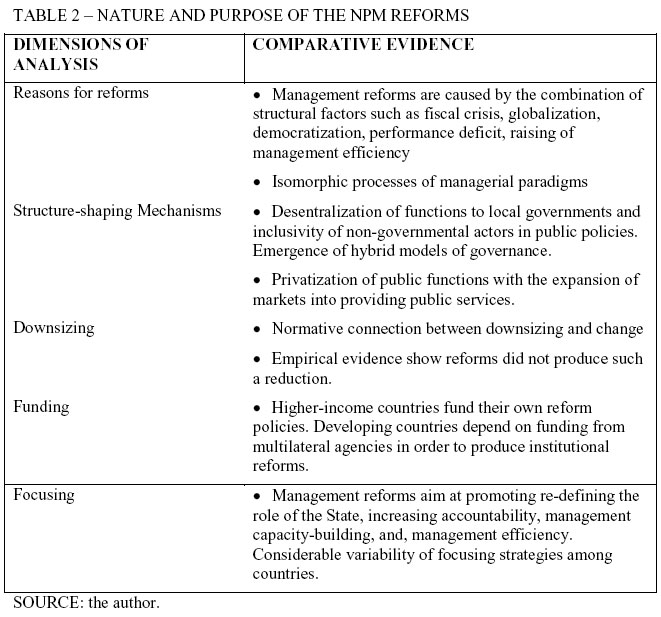
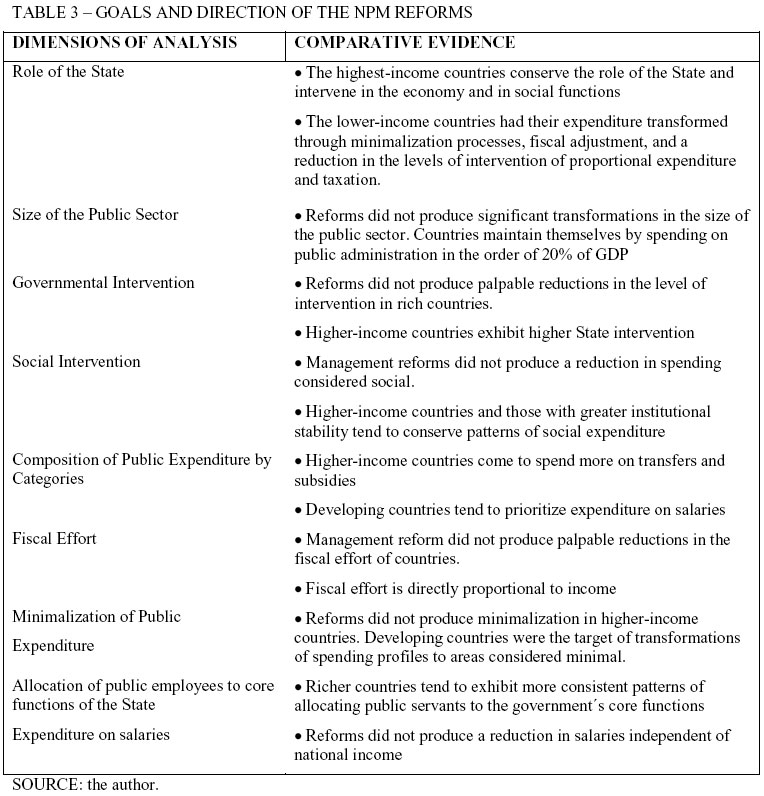
]]> The article is organized as follows. In the first section, comparative data are analyzed on national management reforms, using the evidence of elements relating to two analytical categories: nature and purpose; and the goals and direction of the management reforms. In order to analyze the nature and purpose of the reforms, an analysis is made of the factors related to the emergence of reforms, the mechanisms which structure them, downsizing; funding, and focusing. On the other hand, the analysis of the goals and direction of the reforms is aimed at presenting examples of comparative evidence on tendencies in the transformations verified in the role of nation States such as: of the size of the public sector, social intervention, composition of public expenditure by categories, fiscal effort, adherence to the profile of expenditure on minimal functions, and, allocation of public servants to the strategic functions of the State.In the following section, based on the analysis of comparative studies on management reforms in different contexts, a typology is constructed with the four basic mechanisms which set out to explain, comparatively, the limits of management adjustment: a) transaction costs; b) preponderance of the fiscal adjustment; c) legacies of performance; and, d) the dilemma of control. These arguments underpin the base of a matrix of explanations for the problem tackled, set in a diversity of contexts of implementing management reforms.
Finally, we have recourse to analyzing the limits of management adjustment by focusing on one specific case of sequential failure: the experience of the Brazilian Federal Government of reforming public administration in 1995. The case illustrates the limits of implementation in a context in which there are wider possibilities for configuring the control dilemma mechanism, one of the four mechanisms identified when analyzing the literature consulted.
II. Managerial Reforms in Comparative Perspective
Management reforms in the 1990s were centered on the idea of constructing a new role of the State. The new roles should be compatible with a set of values for public management as well as on consolidating decentralized models of governance1. Reforms were designed to adjust institutions to a new set of values for the functioning of the State such as high pressure for fiscal discipline, raising performance, and, for widening democratic accountability in government. The major foundations for reorganizing bureaucracies were driven for the creation of public value, strengthening management capacity, and broadening public sector performance.
Changing the role of the State was supported by two key arenas of action: fiscal adjustment and institutional design change. Fiscal adjustment was associated with fiscal balance policies, reducing the size of the public service, privatizing public functions, as well as proposing new intervention models of the State in the economy. The state should ideally be reduced to exclusive functions and open doors for markets and new forms of hybrid organizations involving that state and society links.
Institutional design change were strongly connected with the introduction of new forms of delegation and bureaucratic control, decentralizing public policies, creating new models of social and economic regulation, creating flexible institutional models between the public and private sectors, and, altering the culture and bureaucratic values. Institutional change would necessarily be connected with the assumption of raising performance in public administration. Increasing performance was associated with the creation of new role for the State, which was fundamentally hitched to a new configuration of the relationships between institutions, controls and organizational incentives. Creating a new bureaucratic order by designing new forms of delegation, responsiveness and performance incentives was the key idea under institutional change.
The idea of new organizational models oriented towards performance was the archetype of managerial reforms. Changing the internal incentives of behind "controls and ways of delegating" on which traditional bureaucratic models rested was the foundation to exit in constructing new roles to the state and its organizations. The success of management reforms highly depended on how successfully government were able to institutionalize new forms and institutional arrangements which would be able to produce new and more efficient patterns for the relationship between State, markets and civil society in the management of public policies.
Managerial reforms were, thus, a strategy of institutional change based on post-bureaucratic models imported from the private sector. This sets out from the assumption that raising the performance of public administration depends mainly on introducing market mechanisms into public organizations; decentralizing management controls; making public managers responsible and accountable for performance; and, making procedures flexible.
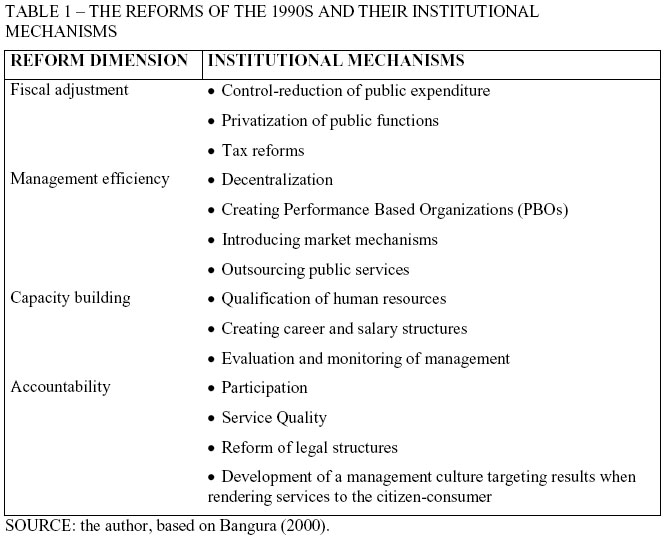
]]> Accountability and performance change would come from an institutional design in which the distinction between the functions of formulation (policy-making) and implementation (service delivery) of public policies were clear. Implementation of public policies and services to citizens are supposed to be delivered by administrative agencies operating with decentralization and flexible contractual models with central agencies. Administrative reforms sought to create a "new bureaucracy", for which the standard of accountability by controls was progressively replaced by one of accountability by results.The design of reform policies was conceived as having initiatives combining four basic dimensions of strategic action: fiscal adjustment, management efficiency, management capacity building, and the expansion of accountability. Table 1 presents the repertoire of specific institutional mechanisms used by the reforms in each dimension of change.
Beyond the focus on fiscal adjustment, and the need for a new role for the State, the management reforms intended transformations which were processed on three dimensions: a) mechanisms for social participation; b) transformations in the rules, procedures and controls of the bureaucracy; c) competitive mechanisms for recruiting public servants, for managing public policies, and providing public services.
The experiences of reforms will be considered using two analytical categories. The first is associated with the elements relating to the nature and purpose of the reforms, and the second is directly targeted on understanding the goals and direction of the reforms. As to the data regarding the nature and purpose of the reforms, the following indicators are examined: a) the main reasons for encouraging reforms; b) innovative mechanisms; c) reforms and downsizing; d) funding; e) focusing the reform programs. Secondly, the group of indicators aimed at accounting for the goals and direction of the transformations is related to variables regarding the size, patterns of intervention, and role of the State2.
II.1. The nature and purpose of managerial reforms
The comparative analysis of the nature and purpose of reforms seeks to understand variables which allow convergence (or divergence) to be identified in each dimension. Based on a specific set of research questions, the analysis endeavors to identify characteristics related to: the basic reasons or motivation for encouraging reforms; the innovative mechanisms; the relationship between reforms and downsizing; the funding mechanisms; and, finally, to aspects relating to focalization the reform initiatives.
1.For what reasons were different groups of countries led to implement management reforms? Reforms emerge out of different combinations of inter-meshed causes. The comparative studies analyzed in this paper associate the sudden emergence of management administrative reforms in the 1990s as an organized response to the joint activating of factors such as the fiscal crisis, democratization, globalization, performance deficit, and greater demands for efficiency in the public sector. These causes began to shape strategic decisions at domestic levels on formulating and implementing reform programs aimed at reforming public administration based on management presuppositions. Other responses were to be more closely linked to isomorphic3 factors which heralded management paradigms as important mechanisms such that very distinct countries would begin to take on board very similar standards in terms of a programmed agenda for public policies. The important empirical study undertaken by Kamarck (2000) for a group of 123 countries shows that the main reasons for nation States to initiate reforms emerge as responses to processes concerning economic and-or fiscal crisis, democratization, adjustment to external4 conditions and raising the efficiency of the public sector.
2.What are the structure-giving principles of the institutional mechanisms of the management reforms? The innovating mechanisms used in the reforms basically arose from two pillars of logic: privatization and decentralization5. By means of privatizations, the intention of governments was to transfer functions of the State to the markets with the aims of achieving efficiency and reducing the size of the public sector6. On the other hand, the logic of decentralization was driven by expanding the functions and roles of central governments to sub-national levels (in federalist systems), or to the broadening of hybrid models involving organizations from the non-governmental sector, from the private sector, and, from society. The decentralization strategies were underpinned by the idea that these would produce models of governance enhanced by greater accountability, participation and social capital7. Decentralized models were to be endowed with greater flexibility for managing and public policies provision, especially in democratic contexts.
]]> 3.To what extent were the reforms associated with the question of downsizing? The management reforms were associated with the idea of promoting reductions in costs and increasing the efficiency of public administration. In normative terms, the management model experienced connections with downsizing strategies. Doing more with fewer employees was a guideline that would be the central issue in the agenda for reforms in the ‘90s. Surprisingly, no evidence for such a connection can be identified at the level of empirical observation. Tanzi and Schuknecht (2000) show that only in 11% of the reform programs did governments manage to reduce more than ¼ of jobs in the public sector. In 70% of the cases, no significant change was detected. The new "wave" of management reforms was not able to deal effectively with the quick growth of public expenditure on personnel and salaries that is observed especially in higher-income countries.4.What was the logic behind funding policy reforms? Being a point for comparative consideration, funding is a criterion which differentiates management reform programs. The rich and higher-income countries are capable of funding their own programs, which are usually oriented in-country. In lower-income countries, programs are financed through (sectorial and multi-sectorial) projects supported by multilateral agencies such as the World Bank and the Inter-American Development Bank8. The thematic composition of projects financed for developing countries shows that there is a profile which gives priority to institutional reforms. These projects involve actions which lead directly to those which involve initiatives aimed at transforming the role of the State, as well as capacity-building in public management, and which fit into the management paradigm. Therefore, it is basically because of these agencies that strategies for management adjustment are spread and are adjusted to the specificities of different countries.
5.How do the reforms vary in terms of focalization? Despite being guided by a management paradigm, data analyzed in this research study reveal that the reform strategies vary considerably in terms of how they are focused. In more general terms, they are guided by promoting fiscal adjustment and institutional change. As to the specific group of developing countries, the programs funded by multilateral agencies9 reveal that the "management reform" component is directed towards promoting transformations in the role of the State, capacity building, accountability, and management efficiency in the public sector10.
II. 2. Goals and Purposes of Managerial Reforms11
Analysis of the goals and direction of the management reforms will be aimed at presenting comparative evidence on the tendencies in the transformations verified in the role of nation States. The basic questions for which answers are essayed are as follows: to what extent were the management reforms accompanied by palpable transformations in the role of the State? Did the experiences of reforms in countries produce shapes and patterns which draw closer to the distribution and allocation profile of public resources?12 Are there considerable variations of role because of income and levels of development and other indicators?
1. Do variations in the role of the Nation States exist as a function of national income? The comparative evidence analyzed suggest that large transformations in the role of the state were more intense in lower-income countries. In these transformations, it was possible to identify patterns of expenditure on functions of the Minimum State. Such countries were the target of processes for reducing the range of their functions, and, sharp processes of fiscal adjustment were unleashed. In richer countries, and in the regions of greater human development, by contrast, the reforms did not cause a significant impact on the role of the nation States. They continue to maintain high levels of social intervention, especially in functions such as health, education and social security.
]]> 2. Are there variations in the size of the public sector as a function of income? Comparative analysis of the participation of public administration in in national income13 reveals thatno large alterations were introduced in the magnitude of the relative participation of "governments" in the national economies when sectional data for the 1990s and 2000s are compared. The reforms did not produce significant transformations in the size of the public sector as a function of income. For their part, the governments of developed countries displayed a greater participation in public administration, in the order of 20% of GDP. As to the specific set of 25 Latin-American countries examined in the analysis, the data reveal that the average value lay around 14.2%. Brazil drew close to the pattern of the upper income countries and even to the example of the richest countries. Comparative data (World Bank, 1997 and 2002) show that Brazil went from a pattern of 9% in 1980 to 17% in 1995, and reached the profile of 20% in 2000. In Brazil there emerged a profile of the public sector expanding its consumption of GDP.3. Do variations exist in the level of State intervention as a function of income? When the level of intervention by States as a function of income is considered, the data analyzed reveal that the reforms did not produce significant reductions in the profile of government intervention in the richer countries. It is the developing countries which started to present the largest average reductions. For the group of developing countries analyzed, however, the data suggest that government participation in GDP rose as a general average for the 76 countries, and specifically for the group of 25 Latin American countries and 23 African countries. Nevertheless, it is possible to differentiate a "more interventionist" profile in the higher-income countries and a tendency towards public expenditure for the minimum State, in the lower-income countries.
4. Are there variations in the patterns of social intervention? The data analyzed in this paper suggest that the management reforms were not accompanied by a reduction of social expenditure. Such comparative evidence permits broadening of the hypothesis that in countries with the highest income and institutional stability, the allocative preferences in social functions are maintained. In countries with high institutional instability, the allocative preferences are altered with greater intensity, and it becomes easier to change the status quo by altering the pattern of expenditure. It is in the lower-income countries that there is consolidation of a pattern of drawing closer to "minimal functions", with an accentuated tendency towards reducing social expenditure. An important contrast is established here: it is exactly in the regions of least (human and economic) development that the process occurs of the "withdrawal" of the State from social functions to the detriment of functions considered minimal14. Brazil follows such a tendency, and moves closer to the more developed countries, yet nevertheless a long way behind those considered as having the greatest HDI. The total funds applied by the federal government in the period 1992-2000 in social areas15 evolved from R$ 58.5 billion to R$ 129.5 billion in 2000. This growth was almost four times higher than the growth of GDP and the growth in population, thus indicating the effort of the government to be active in social programs of various kinds. With regard to the allocation priorities in social policy, on the other hand, the average data from the 90s show great variation relative to several sectors. Social security represented approximately 65% in average terms of total expenditure, while the sectors of health and education, together, totaled 25% on average.
5. What is the shape of public expenditure profiles in terms of their principal categories? There are profound differences, when a comparison is made of data regarding the profile of public expenditure in terms of its categories. In developed countries and those of greatest income it is observed that the main expenditure targets the production of government subsidies and transfers which reach 56.6% of total public expenditure for a group of 24 countries. In this group, salaries represent roughly 15% of expenditure. In contrast, when a group of 76 developing countries is considered, the evidence reveals that the public sector in developing countries has great responsibility for generating jobs, and this reaches close to 26% of the total expenditure of the State16. The reforms did not produce a great impact on this pattern. In lower-income countries, the question of salaries assumes the greatest importance, thus confirming the hypothesis that, in these countries, the public sector functions as a network of social protection by means of public sector employment. The State continues to be the main employer, and forms markets in these countries.
6. To what extent did the reforms produce transformations at the level of tax interference? The data suggest that the relative participation of tax collection as a % of GDP is more intense in developed countries and those with the highest income. In developing countries, despite their having a tax burden approximately half that of rich countries, the data suggest that the reforms prompted the fiscal effort to increase. The Latin American experiences were marked by an attempt to raise tax receipts in a context of economic crisis, growing unemployment, and poverty. In Brazil, as in other developing regions, the reforms produced a rise in tax collection.
7. To what extent did the management reforms prompt the profiles of expenditure on the intervention model to draw closer together in functions considered minimal?17 The data analyzed reveal that the behavior of this indicator as a function of income is differentiated. The higher-income countries are those which, comparatively, have the smallest MGI value in the period 1975-2000. Basically this means that the reforms were not accompanied by broadening expenditure on functions of the minimum State. These countries continue to exhibit a high level of economic and social intervention. On the contrary, it is the countries of average and average-high income which have governments fundamentally oriented towards expenditure on administration, which draw closer to a "minimalization" of public expenditure. The implementation of reforms in these countries fostered a profound transformation in the profile and composition of expenditure, as well as a significant reduction in the intervention pattern of the State from the 80s. Nation states began to invert their expenditure priorities, by cutting social and economic expenditure as well as expenditure on the public service payroll and machine. As the individual analysis of the regional cases of this set of countries confirms, those economies that were developing, with a larger income, saw their economies being strongly influenced by structural reforms, and the policy of being continually in debt made the "payment of interest on debt" item a central and exclusive function of the State. This explains in large measure the reasons for such States coming to be "minimum States", more so than those of developed countries18. The richest countries present a profile of conserving expenditure on expanded functions, thus reflecting a different strategy of economic and social development. It is worth stressing, on the other hand, that the developing countries were already more "minimal" States than those deemed developed in 1975, when the issue of reform had not yet assumed central importance on the agenda of these countries. The richer countries intervene more in social functions than countries of lesser income, and the comparative evidence considered herein allows it to be said that these patterns of preference for governmental interference are more stable in the richer countries than in the poorer ones.
8. To what extent did the management reforms produce a greater allocation of public servants to the functions considered at the government's strategic core (the government's exclusive activities)? The first set of comparative evidence for 19 developed countries reveals there is a distribution of public servants by functions, marked by strong variation among the national cases, but which, as an average value, gives shape to an administration profile of central governments: 51% of public employees work in functions that are considered exclusive, 26% in social functions, and 21% in activities which can be considered as economic ones. At least in terms of the distribution of employees by sphere of action, the governments of the most developed countries are more in consonance with the management reforms as they allocate public servants to the exclusive functions of the State. In six cases – Germany, USA, Italy, Finland, Holland and the Czech Republic – such a division corresponds to more than 60% of the employees of central government. On the other hand, in the cases of Korea, France, Portugal, and Turkey, the data point to the shaping of a profile in which more than half of the employees are distributed among the social functions. With regard to the distribution of public employees, the governments of the developed countries have, in aggregate terms, a composition close to the core functions of the State.
9. Did the reforms produce a reduction of expenditure on salaries in public administration as a function of national income? On the other hand, the reforms did not produce noteworthy reforms in the magnitude of the public service payroll. When the proportional participation of payroll relative to national income is considered, there is no evidence of a significant reduction, and, these patterns are repeated by groups of countries independent of income. The public sector continues, despite strong pressure from reforms, to generate greater expenditure on paying employees.
]]>
In the light of the comparative evidence presented, it is verified that the management reforms did not produce substantial transformations in the role of the State. In broader terms, it can be considered that the reforms failed sequentially. Despite producing considerable innovations at the domestic level, the reforms did not manage to promote more significant transformations in their main indicators.
The role of the State was not transformed as intensely as heralded with the spread of the reforms. Comparative experience reveals that governments, especially the richest ones, maintain their intervention profiles, the make-up of their expenditures and the size of their public administrations. Comparative examination indicates there has, however, been a revision of the role of the governments of lower-income countries as a result of a new process of fiscal adjustment, processes of reduction in state intervention in economic activities, with programs for privatizing public companies, and a redefinition of their role regarding the re-organization of their priorities, especially in young democracies, in which social expenditure was expanded. The reforms did not significantly reduce the size of the workforce in public administrations. Comparative data show there are variations among the cases analyzed, both among countries, and in regional and income terms. Management adjustment was not produced on the scale desired and the comparative evidence points in this direction. What possible explanations may be useful to permit understanding of this important phenomenon? In the following sections, based on various comparative evaluation studies of the processes of management reform19, we shall present existing reasons which endeavor to interpret this problem. In the last section, we return to presenting the specific explanation for the 1995 management reform in Brazil in the light of the theory of sequential failure.
III. Sequential Failures in Managerial Reforms
Reforms fail sequentially. This important statement is one of the main convergences arising from comparative analysis of the State's reform policies. Despite the important interest in raising performance – fiscal adjustment and institutional change – of the apparatus of the State, what become clear are the limits of management adjustment in various contexts. International experience reveals that attempts at management reforms were curtailed, abandoned, or had their program content altered. This piece of real-world data is the problem which we shall focus on in this paper beginning with systematizing the most commonly-found explanations and interpretations offered by comparative studies.
There is a set of explanations in the comparative literature which endeavors to understand for what reasons attempts at reforms fail sequentially. Reform policies are typically marked by "lines of organized resistance", by erratic processes, by the increased difficulty of organizing interest groups around the program objectives desired by the reforms, and, principally, of obtaining the cooperation of the actors for the wider purposes of fiscal adjustment and institutional change. What are the main strategies for explaining this important problem as revealed by comparative analysis? In this section, we shall develop four arguments or basic mechanisms for which comparative analysis provides evidence on the limits of management adjustment: a) costs of transition, uncertainties and ambiguities in the production of reforms; b) preponderance of the fiscal adjustment; c) legacies of performance20; and, d) the dilemma of control21. These arguments underpin an explanatory matrix for the interpretations of the problem tackled in a diversity of contexts and empirical configurations.
One of the first interpretations available is the connection between transition costs and producing reforms. The basic argument is that reforms tend to introduce high transition costs thus reducing the chances of obtaining strategic support for such reforms. These costs can be understood as being relative to the excess of veto players, the widening of policy uncertainty, the difficulty of cooperation and collective action22 involving strategic actors, and, the convergence of preferences around the program objectives of the reforms23. The uncertainty generated by management reforms is much greater, given that they touch on the simultaneous need to reduce public expenditure and, at the same time, to create a new institutional matrix oriented by performance. Since management reforms introduced discontinuities in the traditional mechanisms as to how the patterns of the bureaucracy function, such as centralization, the technocratic style of how it is is professionalized, as well as in the dynamics of the relationship between bureaucracy and politics, reforms tend to produce considerable levels of uncertainty, and reduced chances of cooperation24. For such a reason, it is common to associate the ability to implement reforms with the levels of bureaucratic insulation from central control that agencies charged with such a mission have. The political conflict of reform policies is usually related to elements of the political system such as presidentialism, federalism, multi-party system, electoral rules, the structure of accountability, and, institutional stability.
Another argument of considerable relevance in the debate associates the failures of reforms with the preponderance of the fiscal adjustment. Given the intense pressure to reduce the costs on the State and its bureaucracy, these policies tend to be conceived such that they might draw more attention to the problems of fiscal adjustment than to institutional change.25
The relative primacy of the fiscal adjustment compressed the other dimensions of the reform, thus leading governments to give more attention to the strategies for reducing public spending, cutting social programs, extinguishing governmental agencies, and superficial reorganizations of administrative structures. Comparative studies show that the new, flexible and decentralized models proposed by management reforms, especially of budgets and staffing, aimed at autonomy in decision-making, rendering the bureaucracy accountable and at controls by results were not synthesized with the wider purposes of balancing the public accounts.
]]> In several contexts, decentralization of management controls and processes tends to be perceived by the bureaucratic mandarins of the bureaucracy as a process for producing inefficiencies in public management and a rise in spending and fiscal imbalance.26Another dominant mechanism in the contemporary debate associates effectiveness and efficiency in implementing reforms with the performance legacies. The typical mechanism for which the literature provides evidence is that in which the chances of sequential failures tend to be greater in contexts of reduced performance. Implementing reforms in these conditions depends on a considerable effort to persuade the strategic actors in the area of the reform to abandon the incentives which lead them to operating at reduced levels of efficiency.
This issue is all the more problematic, given that, in the public sector, organizational and institutional longevity is scarcely ever linked to performance. Management reforms do not spark the spontaneous cooperation of the actors in order to create a results-oriented culture27. A considerable part of this problem derives from the well-known situation of "relative dissent" and the difficulty of institutionalizing coherent patterns for evaluating performance in organizations. Multiple meanings coexist for performance and the reforms are still barely coherent with regard to structuring more consistent models in order to consolidate desirable patterns of performance at various hierarchical levels. On the other hand, it is not clearly known what the adequate ways forward are for promoting higher levels of performance. In international experience, there still is a considerable problem of asymmetry of information regarding the performance problems of the various organs of government.
The pressure for greater rationality in public spending on fiscal adjustment has still not produced greater efforts to diagnose the problems of organizational and institutional performance. This asymmetry contributes to the production of reforms which fail sequentially. Comparatively, the data analyzed reveal that the reforms can be more effective when the problems of performance are known28. This demands a widespread effort to generate institutional studies and research activities which may produce consistent information on how organizations really function and what the key-problems are. Reforms which set out to cut spending and to embed controls targeting information on the public sector are necessary, yet insufficient. Thus, the construction of a new decentralized and autonomous results-oriented matrix is de facto the crucial factor for management reforms (Bresser Pereira, 2007).
Another sound argument on the limits of management adjustment is associated with the well-known problem of control. Rezende (2004) argues that one of the main dilemmas of these reforms resides in the contradiction between performance and control. Basically, the mechanism is as follows: if, on the one hand, the reforms propose reducing bureaucratic controls with a view to better performance within decentralized and flexible models of delegation from the point of view of the management of policies, it is a fact that problems of coordination between formulation (policy-making) and implementation (service-delivery) tend to be exacerbated and produce inefficiency.
Even in contexts where there is greater consistency in these policies, the dilemmas still persist of how to delegate responsibility without creating more bureaucratic controls. Moreover, in contexts noted for having greater institutional instability and a fragile tradition of control, delegation itself constitutes a decisive problem. How to delegate without losing management efficiency is still one of the crucial dilemmas. The question of introducing new control models on management is fundamental to the performance of institutions, and so is the need for this to require the combination of two elements: the political legitimacy of the top echelons who wish reform and the technical competence of public sector managers. At bottom, this requires a change of political and administrative culture regarding the principles of management reforms.
This problem was addressed by Rezende (2004) in his theory of sequential failures in administrative reforms. He explains that, in the circumstances of the case in Brazil, and, in many other contexts of reform, the mechanism for the dilemma of control is one of the main tensions present in management reforms. More widely it can be considered that the management reforms represent a critical case of "sequential failure", given that there is a contradiction between the wider purposes of fiscal adjustment and institutional change. The reforms tend to produce incentives contradictory to winning cooperation from the actors on institutional change and fiscal adjustment: "if, on the one hand, fiscal adjustment demands more control, institutional change, especially those which demand more decentralization and flexible mechanisms of delegation and accountability, demand less control". It is in this contradiction that there resides the root of the problems for obtaining cooperation for the two objectives of the reforms. The chances of success would, therefore, be associated with the specific mode by which this dilemma is incorporated when the reforms are conceived.
IV. The Dilemma of Control and the Limits of Management Reform in Brazil29
This section offers the analysis of the sequential failure of the management reform in the context of Federal Government of Brazil implemented in 1995. The argument developed is one in which the dilemma of control was one of the decisive mechanisms which, in the conditions and circumstances of Brazilian experience, promoted the occurrence of failure in the reform30.
]]> The sequential failure of the Brazilian management reform is directly related to the important fact of the Ministry of Administration and Reform of the State – MARE, not having obtained the simultaneous cooperation of the strategic actors for the purposes of fiscal adjustment and the institutional change sought by the proposed reform. In the Brazilian case, the dilemma of control resulted in a dual pattern of cooperation, in which fiscal adjustment had pride of place, thus inhibiting the chances of flexible models in its structure of delegation and control of public policies. The decentralized institutional model suggested by the reform in order to transform the role of the Brazilian State was not adopted. The reform was partially implemented.The paradox of implementing the reforms can be understood as starting from the problem of collective action regarding the demand for control on the bureaucracy which each of the program objectives of reform (fiscal adjustment and institutional change) usually requires. Since this is directly associated with control, this explanation acquires an essentially political nature. If, on the one hand, the demand for fiscal adjustment is associated with control on the bureaucracy and its organizations, in the sense of fostering the due use of resources, as well as the rendering of accounts, budgetary control, and fiscal efficiency; then, on the other hand, institutional change centered on processes of decentralization, autonomy and accountability demands a need to "de-control" the bureaucracy, thus endowing it with greater management autonomy and greater accountability.
The implementation of the management reform in Brazil signaled highly contradictory incentives which made simultaneous cooperation of the strategic actors difficult in the political arena31. Management reforms in contexts of low performance and large gains with the maintenance of the status quo usually manage to receive support for fiscal adjustment, given that cooperation on reducing public spending leaves the set of institutional practices intact which, de facto, produce chronic problems of performance.
In the management reforms, the transition from the bureaucratic paradigm to results-oriented models necessarily led to re-designing and re-defining the traditional delegation and control mechanisms between formulating and implementing public policies. As to Brazil, the 1995 Steering Plan for Reform launched the bases for institutional change and a new decentralized and flexible model of delegation and control. Social Organizations and Executive Agencies were created as decentralized institutions which were to be responsible for functions of implementing public policies, controlled by central agencies and based on performance evaluation mechanisms32, the Management Contracts ("contratos de gestão").
The need to delegate functions to the PBOs was perceived by the top echelons of public administration as having the potential risk of increasing fiscal inefficiency. The threat of a large-scale institutional fragmentation arising from this new management model, especially in Brazil, in which there predominates a fragile tradition of control and of historical processes of "de-controlled decentralization"33, could unleash serious coordination problems between formulators and implementers of public policies. The relationship between control and delegation is already strongly affected by the lack of defining a framework for the relationship between the Ministries (formulating agencies) and the decentralized agencies regulated by performance; high degrees of uncertainty of the types of control on account of performance; and, on account of the difficulties inherent in defining the standards of performance that should be attained by the various organizations.
The new institutional decentralized matrix was incompatible with the purposes of fiscal adjustment and widened the problems of collective action for cooperation with the reform. The strategic actors saw that they were being confronted with a considerable threat to fiscal stability and produced a specific equilibrium: dual cooperation with the proposal of management reform. The reform was necessary for the government to create plausible alternatives to achieve its purposes of reducing (controlling) spending but, inadequate from the point of view of its proposal of performance-oriented institutional design. The broadening of decentralization and the loss of control over the flexible agencies could be a considerable risk to fiscal adjustment. The control dilemma led to the extinction of MARE in 1999. The ambitious plan for transforming the structures of functioning, with the implementation of a new institutional matrix regulated by performance, was not very successful.
This happened for reasons that were clear. First, the new institutional matrix was not a proposal endowed with credibility by the strategic actors. The proposal for institutional change was perceived as "a threat to the structure of bureaucratic control" in the relationships between the direct and indirect administration in the Federal Government and not as a mechanism capable of producing short-term impacts on the problem of the fiscal balance. The Office of the Chief of Staff of the Presidency of the Republic, the Ministry for the Economy, and the Ministry of Planning and Budgets perceived the administrative reform as a question more directly associated with the process of reducing staff and controlling expenditure on the administrative machine, rather than being related to the introduction of substantial changes in the existing institutional arrangements, even though these were crucial to raising performance.
MARE opted for the strategy that reform of the public sector depended essentially on an institutional change and not only on cuts in and controls on public spending. For MARE, the root of the performance problems of public administration was generated by the inefficiency in the design of the relationships between formulating and implementing public policies. The Brazilian State suffered from an excess of autonomy and from reduced controls on a decentralized bureaucracy. The creation of the PBOs would be a plausible alternative for overcoming the crisis of delegation that inhibited more rational patterns of organization and functioning of public bureaucracy, widening the social controls on the State, the creation of a culture of results. Much of the reduced fiscal performance derived from an institutionally inadequate and unsatisfactory design. The management adjustment was the catalyzing axis of a new bureaucracy in Brazil.
On the other hand, this line of argument collided with the perception that excessive decentralization combined with the precariousness of the controls was harmful to fiscal adjustment. A great many of the fiscal problems derived from decentralization and from the degree of autonomy of administrative agencies, which were consolidated in the process of constructing a modern State in Brazil. Therefore, performance-oriented organizations were perceived as a threat, since the intention was to give autonomy and responsibility (accountability) to the agencies for the management of its budgetary and human resources, and on its results. This tension structured the control dilemma in the Brazilian experience and scarcely made any advance in constructing a new institutional matrix.
On the other hand, from the perspective of the organizations of the executive power which implement public policies, non-cooperation with new institutional forms was directly linked to the risk of losing budgetary grants in case of reduced performance. The results-oriented proposal based on goals and management contracts with Ministries, did not evoke a cooperative response from the large majority of public sector organizations. This was, to a large extent, due to the fact that decentralization was very markedly not accompanied by budgetary restrictions associated with the results attained. Implementing agencies receive budgets and non-budgetary resources in a way that is decoupled from performance. Therefore, it can be argued that it was a pattern of "de-controlled" decentralization which inhibited the spreading of the new organizational models for the management of public policies suggested by the 1995 reform.
]]> The Brazilian case presents the problem typical of management reforms. The contradiction between the objectives of institutional change and fiscal adjustment over control was a decisive variable for showing why the objective of raising performance does not meet with "spontaneous" cooperation. The beneficiaries of the order prefer to maintain the institutions and to cooperate strategically with fiscal adjustment. In conditions of low performance and of strong interest in fiscal adjustment, cooperation with institutional change becomes rare.In performance-oriented reforms, the institutions of central government tend to perceive the creation of PBOs as a process which takes away their control over human and budgetary resources, and, consequently, lesser performance, thus contributing to their resistance to reform. Thus, the question of control, and not that of performance, becomes fundamental for explaining the adhesion or not of organizations to the proposals of reforms. Although raising performance is the apparent motivation for administrative reforms, the specific mode by which the various actors perceive and calculate the costs and benefits generated by changing the structure for organizing control, is fundamental for explaining the problem of sequential failure. The more that any given reform policy proposes radically altering the form of control which regulates the relationship between formulating and implementing public policies, the greater the chances for the lack of success of such administrative reforms, above all those in democratic contexts marked by high political fragmentation, administrative lack of control and reduced performance, as in the case of Brazil.
BIBLIOGRAPHIC REFERENCES
Bangura, Y. 2000. Public Sector Restructuring: The Institutional and Social Effects of Fiscal, Managerial and Capacity-Building Reforms. Geneva: United Nations Research Institute for Social Development.
Barzelay, M. 2000. The New Public Management: A Bibliographical Essay for Latin American and (Other) Scholars. International Journal of Public Management, n. 33, p. 222-265.
Bresser Pereira, L. C. 1999. Reflexões sobre a reforma gerencial brasileira. Revista do Serviço Público, Brasília, v. 50, n. 4, p. 5-30, out.-dez.
_____. 2007.The Structural Public Governance Model. International Public Management Review, v. 8, n. 1, p. 16-31.
Dahl, R. A. 1971. Polyarchy. New Haven: Yale University.
Hall, P. A. & Taylor, R. C. 1996. Political Science and the Three New Institutionalisms. MPIFG Discussion Paper n. 96. Cologne: Max-Planck-Institut für Gesellschaftsforschung. Available at: http://www.uned.es-dcpa-old_Doctorado_1999_2004-Torreblanca-Cursodoc2003-primerasesion-HalyTaylor1996.pdf. Access in: Oct 15 2009.
Jann, W. & Reichard, C. 2002. Melhores práticas na modernização do Estado. Revista do Serviço Público, Brasília, v. 3, p. 30-50.
Kamarck, E. C. 2000. Globalization and Public Administration Reform. In: Nye Jr, J. S. & Donhaue, J. D. (eds.). Governance in a Globalizing World. Washington D. C.: Brookings Institution.
Kettl, D. 2000. The Transformation of Governance: Globalization, Devolution, and the Role of Government. Public Administration Review, v. 60, n. 6, p. 488-499.
MARE. 1998. Projeto Agências Executivas e Organizações Sociais: balanço e avaliação do período 1995-1998. Relatório de Trabalho. Brasília: s-n.
OECD. 1997. Issues and Developments in Public Management. Paris. Several Issues.
_____. 2001. Highlights of Public Sector Pay and Employment Trends. Paris: Organization for Economic Cooperation and Development.
Olson, M. 1965. The Logic of Collective Action: Public Goods and the Theory of Groups. Cambridge, Mass.: Harvard University.
Pollitt, C. & Bouckaert, G. 2000. Public Management Reform: A Comparative Analysis. New York: Oxford University.
_____. 2002.Avaliando reformas da gestão pública: uma perspectiva internacional. Revista do Serviço Público, Brasília, n. 3, p. 5-30.
]]>Putnam, R. 1994. Making Democracy Work. New Jersey: Princeton University.
Rezende, F. C. 1996. Os leviatãs estão fora de lugar. Dados, Rio de Janeiro, v. 39, n. 2, p. 195-211.
_____. 1998. A nova gestão pública, performance e reinvenção das instituições: um desafio para a Reforma do Estado. Revista Reforma Gerencial, n. 4, p. 27-28, nov.
_____. 2002a. Por que as reformas administrativas falham? Revista Brasileira de Ciências Sociais, São Paulo, v. 40, n. 2, p. 123-142, out.
_____. 2002b. Gastos públicos e transformações recentes no papel do Estado nacional. Novos Estudos, São Paulo, n. 62, p. 123-140, mar.
_____. 2002c. O dilema do controle e a falha seqüencial nas reformas gerenciais. Revista do Serviço Público, Brasília, n. 3, p. 51-76.
_____. 2004. Por que falham as reformas administrativas? Rio de Janeiro: Fundação Getúlio Vargas.
]]> Ruggeri, G. 2005. Public Expenditure Incidence Analysis. In: Shah Anwar, A. (ed.). Public Expenditure Analysis. Washington D. C.: The World Bank Group.Tanzi, V. & Schuknecht, L. 2000. Public Spending in the 20th Century: A Global Perspective. New York: Cambridge University.
World Bank. 1997. World Development Report. The State in a Changing World. Washington D. C.: The World Bank Group.
_____. 2002. World Development Report. Washington D. C.: The World Bank Group.
1 In his new article, Bresser Pereira (2007) argues that the offer of new models of governance represents one of the most decisive innovations brought out by the policies of management reform. The reform of the Federal public administration conducted by MARE in 1995, led by Bresser Pereira, was meshed into a strategy for redefining the roles and functions of the State, by combining hybrid models of (exclusive and non-exclusive) public intervention. The Brazilian experience was paradigmatic in the comparative analysis of management reforms and will be analyzed in section III of this article.
]]> 2 The indicators used are: a) relative share of public administration in GDP; b) public expenditure as a % of GDP; c) profile of public expenditure; d) relative share of payroll expenses in the total spent; e) taxes collected; f) index of minimum government (Rezende, 2002a); f) distribution of the priorities of public expenditure; g) social, minimum and economic interference of the government (Rezende, 1996; 2002a).3 The isomorphic explanations for the spreading of reforms have become very visible in comparative studies on public policy reforms. More specifically in the field of political science, as Hall and Taylor (1996) suggest, these are associated with a tradition of research affiliated to the new sociological institutionalism. The studies applied to the spreading use four basic concepts: policy transfer, rational learning, policy convergence, and lesson-drawing. This article does not deal with exploring isomorphic aspects when structuring reform policies, which would far extrapolate the boundaries of this article.
4 The bias of the adjustment to external factors is decisive for lower-income countries in which these factors are, to a considerable extent, aligned to the policy standards set by the multilateral agencies which fund the management reforms.
5 These sets of essential or fundamental logical thinking on the reforms of the 90s are not excluding ones, when specific cases or clusters of cases are examined. They may be more preponderant or be combined in different degrees and intensities in the several domestic contexts of the policy reforms.
6 Bangura (2000) shows that, in the period 1980-96, national experiences of privatization mobilized a total sum of resources in the order of US$ 156 billion in developing countries. More than half of these programs were concentrated on countries in Latin America and the Caribbean. In the same period, for a set of 11 European Union countries, privatizations rendered approximately US$ 97 billion (about 3% of GDP), with the cases of the United Kingdom, Portugal and Sweden being those of greatest importance. In Brazil, the strategy for privatizing public companies was decisive from the very start of the 90s with the institution of the National Program for Denationalization (PND in Portuguese), created in 1991 and coordinated by the National Bank for Economic and Social Development (BNDES in Portuguese). This program mobilized resources of the order of US$ 39.6 billion with the sell-off of 68 federal state enterprises.
7 Putnam (1994) inaugurates an important analytical tradition in comparative political sciences by attributing decisive importance to share (social) capital to explain variations in the effects of decentralization in the context of the reform of the model for governance in Italy. This argument come to be at the mainstream of the current debate on the capacity of government, institutions, and, the production of social (share) capital and the performance of public institutions.
8 In the period 1997-2000 when the spread of reforms in developing countries was gathering pace, the lending operations of the World Bank to projects classified as State Reform and Governance, amounted to around US$ five to seven billion per year, and were materialized in 1,600 specific projects analyzed in the context of this paper. The reform experience of the Brazilian Federal Government with MARE was begun in 1995, and had the support of the Inter-American Development Bank – IDB.
9 The analysis of reform projects undertaken by the World Bank between 1997-2000 in the various regions under development – Sub-Saharan Africa, East Asia, East Europe and Central Asia, Latin America, North Africa and the Middle East – show that the reform programs of the State involve 08 thematic areas : a) fiscal management; b) reform of public companies; c) tax modernization; d) reform of the human resources systems; e) legal and juridical reforms; f) regulatory reforms; g) management reforms; and h) decentralization strategies.
10 In Latin America, 21.9 % of the funding resources to promote the reform of the State by multi-lateral institiutions were applied on such specific policies.
11 This section was constructed based on two distinct samples which will be pointed out as they arise. The first of these corresponds to my study explained in detail in Rezende (2002b). The other consists of a study on a set of 108 countries and generated by OECD IMF data, in material as yet unedited and in progress, entitled Os leviatãs estão fora do lugar: umestudo comparativo sobre transformações no papel do Estado (Transforming the Role of Leviathans: a comparative study on transformations on the role of the State). The use of the distinct samples will be pointed out during this section, when necessary.
]]> 12 The comparative analysis of the role of the State (and of its transformations based on patterns of public expenditure (by type, categories and functions) is a much-used resource in studies on public finances, economics and in political science, and, it is known from its wider form as "Public Expenditure Incidence Analysis". For further conceptual and methodological details cf. Ruggeri (2005).13 Such an indicator specifically reflects the degree to which the government and its administration "consume" resources in the form of public goods and services in their most diverse forms in relation to the size of national wealth.
14 These data are consistent with the comparative analytical results found in the analyses of Rezende (1996; 2002b): the developed countries presented more interventionist profiles in economic and social functions than those States in the developing countries.
15 In Brazil, social expenditure is considered to be the sum of non-financial expenditure referring to actions in social security, health, education, culture, social work, sewage, environment, housing and land organization.
16 The expansion of employment in the public sector is still one of the most important mechanisms found by governments to protect groups from increased risks arising from economic performance. This important mechanism is also acknowledged as decisive to permit the keeping of the political pact and governability in the new democracies and in societies in transition to democratic models.
17 This indicator is made operational through temporal variations in the Minimum Government Indicator - MGI (Rezende, 2002a). It measures the relative weight of the minimum expenditure of the government (the so-called core activities of the government) in the total of public expenditure. The greater the value of the MGI, the more public resources are allocated to core functions, thus leaving to the market and private agents, the performance of social and economic functions and revealing transformations towards the minimum State.
18 As to the Brazilian case, for example, the payment of interest function, for 1994, was higher than any other rubric, which implies the raising of expenditure on minimum functions, which include the payment of debt. It is curious to note that in the group of high-income countries both the MGI degree is low as well as its variability being much lower, represented in the table below by the deviation from the pattern. This confirms preliminary results found by Rezende (1996), which suggest that it is the highest-income countries which have a pattern of strong governmental intervention in non-core functions.
19 The comparative experience of the processes for formulating and implementing reform policies in the 1990s generated a legacy of studies which target evaluating their results against the most different methodological and epistemological positions. These studies, as Jann and Reichard (2002) argue make it possible to differentiate clearly between the specific groups of countries, in terms of results, as well as of the methods, criteria and indicators used in the evaluation.
20 This type of explanation is affiliated to the tradition of the new, historical institutionalism in political science which uses the concept of path dependency to explain change or stability in collective decisions. Hall and Taylor (1996) discuss the presuppositions and types of explanation of this paradigm in various fields of political science.
21 This argument is constructed in a brand new way by Rezende (2004) in his book, Por que falham as reformas administrativas? (Why Do Administrative Reforms Fail?) which outlines a theory for the problem of sequential failure in administrative reforms. We explore this argument in the final section of this paper.
]]> 22 Another learning point from comparative experience is that the reforms are slow and depend on mounting complex networks of cooperation among institutional actors. Time and collective action are decisive requisites for the success of the management reforms. The process of constructing a new bureaucracy centred on results, on performance controls, and on monitoring depends on the continued presence of policy advocates who act decisively in constructing networks aligned with interests concerned with the program proposals of the management reforms.23 In using the problem of collective action formulated by Olson (1965), a considerable collection of available studies on comparative political science points to the tense relationship between democracies and the problems of collective action in situations of change relating to the status quo. Thus, this gives rise to the typical argument that implementing reforms in democratic contexts, given the high complexity generated by political competition and inclusivity (Dahl, 1971) tends to be much less than in authoritarian contexts.
24 Bangura (2000) reveals that, although the pressures had been strong for change in the profile and in the intensity of social expenditure, organized resistance was no lesser as a result. He claims that the welfare state in these countries has shown a considerable degree of resistance which can be explained by three inter-linked factors. First, it is based on account of the difficulty of forming political coalitions in Congress favorable to change of the status quo. Secondly, because of the fact that people in general support the maintenance of their social benefits, despite the growing costs of doing so. Finally, there is the strong political organization of the beneficiaries who organize themselves politically against the reforms.
25 The implementation strategies of new institutional guidelines regulated by performance and decentralized in the management model did not achieve the cooperation of the political and bureaucratic agents. Although decisive for raising performance, the construction of a new public governance model for the public sector was not constituted as being central to formulating and implementing the reforms.
26 As mentioned earlier, fiscal adjustment strategies were relatively successful in controlling the tendency to the rapid expansion of public expenditure and fiscal imbalance which had taken hold from the 80s. However, there was neither a reduction in total public expenditure nor even a reduction on payroll or the size of the public sector. Only a small group of countries, both in the developed and developing world, presents concrete cases of a reduction in the level of public expenditure.
27 Comparative experience reveals that were few cases in which governance models were implemented centred on the institutional designs in the models of Performance-Based Organizations (PBOs), the main innovation brought on by the management model. These were not created at the intensity and quantity desired by the proposals of the reforms. In the 1995 Brazilian reform of the Federal Government, the limits to implementing the new models of governance were decisive for sequential failure. The data analyzed in this study reveal that in cases where changes were introduced, there are great challenges to be faced in order to define, monitor, and control the performance of these organizations.
28 The case of the National Performance Review in the Clinton government in the USA in the 1990s was one of the reform models in which concern about the performance problems of administrative agencies obtained centrality. The creation of re-invention laboratories in various agencies was one important institutional innovation that conferred a differentiated treatment of creating incentives matched to performance. Even though having such a concern, the reforms did not manage to achieve sustainability after the Clinton government.
29 This section is based on arguments developed by Rezende (2004).
30 The sequential failure of administrative reforms is a well-known problem and is directly related to a complex set of causes. As Rezende (2004) argues, this mechanism exists in a more intense form in management reforms and can be considered as one of the most decisive limits to management adjustment.
31 Cooperation with the objectives of reform depends on the specific way in which the strategic actors align their interests concerning variable control. When reform is produced so as to make the strategic actors perceive that fiscal adjustment is complementary to institutional change, the chances of implementation are greater. In circumstances in which the fiscal adjustment predominates, and the risks of loss of control with the introduction of new institutional models, as it was the case for Brazil in 1995, the chances of sequential failure are higher.
]]> 32 These organizations are analogs to the models typical of Performance-Based Organizations (PBOs) in management experience.33 In contexts, in which there is a historical legacy of low performance, of concrete experiences of sequential failures, and of a direct relationship between decentralization and fiscal imbalance, such as in the Brazilian case of administrative pre-reform, the question of performance was associated, to a large extent, with fragmentation and with the risks of the latter to fiscal adjustment.
]]>