
José M. Gordillo2
Translated by Sara Shields
Translation from T'inkazos, La Paz, n.22, July 2007.
ABSTRACT
Who calls the shots in Cochabamba today? A research study examined the region's powerful groups, delving deeper than their representatives or leaders. This article presents some of its main findings, as well as describing the methodology and the different tools used to show how the elites were destroyed by the 1952 revolution and why they never recovered.
The issue of regional power was addressed recently in a research study entitled "Pitaq Kaypi Kamachiq: Power structures in Cochabamba, 1940-2006". The research was carried out by José M. Gordillo, Alberto Rivera and Ana Sulcata, with the support of PIEB.3 It analyses power from a historical and sociological perspective, focusing on the study of the networks in which power circulates rather than just its representatives or leaders. The aim is to understand who is in command in Cochabamba today, looking at the changes in power structures brought about by the National Revolution of 1952 and the New Economic Policy implemented in 1985. Expressed briefly, the results of the research show that: a) the elites whose power derived from landowning were seriously affected by the revolution and never recovered; b) the new emerging social sectors (the study looked at traders, transport operators and water committees), despite their economic importance, are currently only political pressure groups without a class identity; and c) power is fragmented among several separate groups, giving rise to a structure in which many are giving the orders but few are obeying.
In this article we will discuss the methodology used in the study, which enabled us to arrive at the first result in the historical research. We will describe the different tools we used to observe how the family networks in which the power of the pre-1952 landowning elites circulated were destroyed by the revolution and why they never recovered. In other words, we will set out the ways in which we were able to find that power was concentrated in family clans; that the economic interests of the landowning patriarchs had no direct connections with the modern industrial, financial and service sectors that started to emerge at the dawn of the 20th century; that modernity flourished among the family groups of migrants from other parts of the country and foreigners who settled in the region, changing production and consumption patterns; that from the bosom of landowning families emerged groups of entrepreneurs and intellectuals who challenged the order established by their patriarchs; and that, despite the difficulty of making the interests of a regional agrarian elite compatible with those of the early 20th century export mining model, an environment favourable for generating wealth and transforming the distribution system did exist in Cochabamba at that time.
We will also look at the effects of the 1952 Revolution on the region's powerful elites and explain how the use of an ethnographic tool – genealogy – enables us to understand the changes in these powerful elites' family groups over the course of more than half a century.4 We will therefore explain how the use of the genealogical method led us initially to take the following steps. First, choose the elite families and group them in three sub-elites characterised by holding economic, intellectual and trade union power. Second, identify an EGO or key informant in each family, under certain control parameters. Third, interview the EGOS with the main aim of reconstructing their family tree, covering three generations: the parents, children and grandchildren of the 1952 revolution. Fourth, synthesize the genealogical information around two specific variables: the level of education and the place of residence of the members of these three generations.
To make the explanation of the use of these research methods easier, we will describe them as they were used in the context of the historical narrative and illustrate their results in tables that summarise the most important empirical findings.
The region's history and social structure
Cochabamba's regional history takes on an identity of its own as a result of certain specific characteristic elements. The first is geography, which places its inter-Andean valleys in a strategic position between the east and the west of the country, in addition to the fertility of its soil.5 The next is the economy, which connected this farming region with mining in Potosí from the early colonial period onwards, by means of the crops grown in the vast indigenous reservations and agricultural estates owned by Spaniards and Creoles.6 Another is demography, which turned Cochabamba into a migrant region of high intensity in quantitative and qualitative terms, because the population inflows led to the circulation of new ideas, visions and expectations.7 The last is culture, which created a pattern of social relations between those who gave the orders and those who obeyed that functioned according to its own defined codes.8
At the start of the 20th century, the increase in the production of tin destined for the world market led the liberal political elites to concentrate power in La Paz while the business elites installed their production facilities around Oruro, giving rise to the operation of an export mining model that changed the economic geography of the country. The prevailing mercantile and political logic in the previous, silver-producing era at the end of the 19th century, that enabled power to be shared from Sucre with an alliance of mining and landowning patriarchs in which Cochabamba was included as a region, gave way to a new arrangement. As a result, the valley landowners who had hitherto enjoyed a natural monopoly of the mining markets, thanks to their favourable geographical location, were sidelined from national power.9
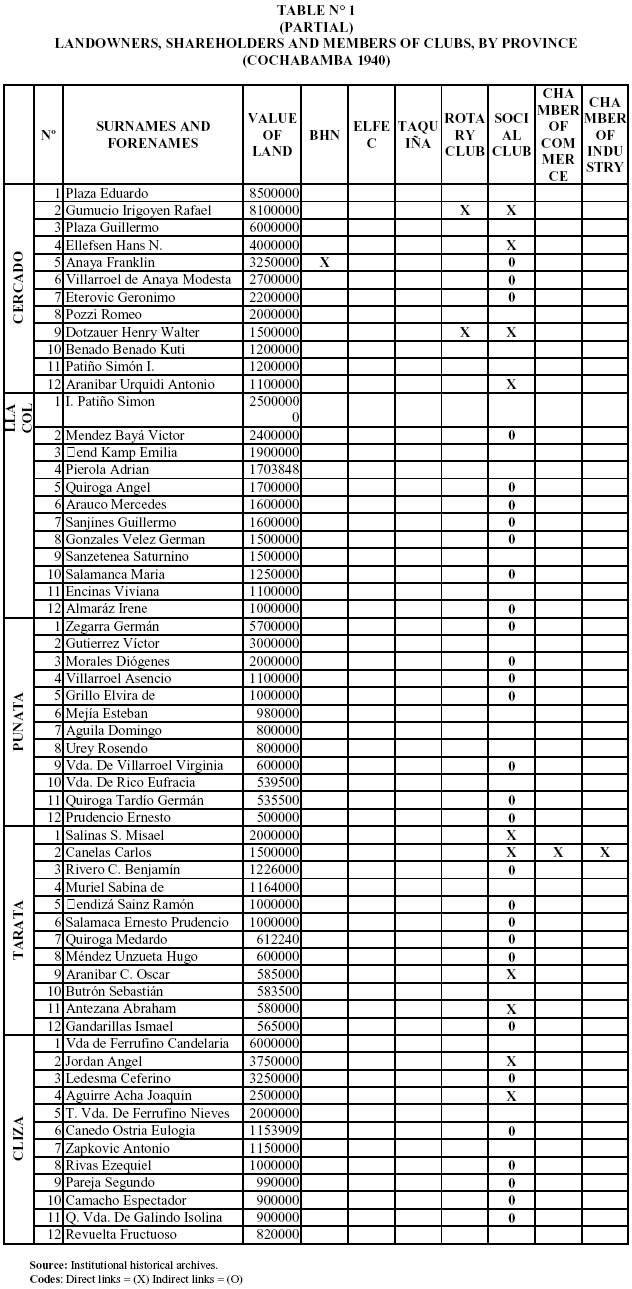
]]> Competition for the mining markets intensified when railways were built between the Pacific coast and the highlands and started to bring in raw materials and food previously supplied by Cochabamba. This led to a fall in prices, and the region's profits from farming dropped sharply as a result. How did this economic event affect the elites whose power derived from landowning? To find out, we started the archive work by checking and recording the names of the owners of landed estates with a property value of more than 100,000 bolivianos in the currency of the day, and began to build a database with the information obtained about the 14 provinces in Cochabamba. We then chose the 12 most valuable properties in each province and defined ranges that allowed us to look at them in comparative terms. We concluded that the properties in Cercado and Cliza were earning profits which, because of their location, meant that their value was very much higher than that of other landed estates in provinces such as Mizque and Tapacarí. In other words, the spread in land values indicated to us that the landowning elite was not homogeneous and that power had become concentrated around the departmental capital city and the railways, while the marginal landowners were only in charge of local economies and power.10If these elites were economically diverse, how did they manage their social capital? To answer this second question we added to our database the names of people who were members of the Social Club and the Rotary Club in Cochabamba, in order to analyse whether there were any links between the ownership of large landed estates and the sites of social prestige where the symbols of regional power were reproduced. The link was direct when the name and surname of the landowner appeared in the membership lists of these clubs. When the exact name of the landowner was not recorded but the surname was, leading us to think that the club member belonged to the landowner's nuclear or extended family, we took the link to be indirect. Having processed this information, we looked again at the list of the 12 largest landowners in the 14 provinces of Cochabamba. It turned out that the provinces whose landowners participated most in the clubs were Chapare, Tarata and Ayopaya, while in Tapacarí and Mizque their involvement was minimal.11
If we compare these figures with the previous results, we can conclude firstly that owning valuable property was not sufficient to obtain social prestige, and secondly that the marginal elites were not just poor but also had no social prestige. In other words, the elites whose power derived from landowning were so fragmented that they were not even similar economically, let alone in their social status.
This led us to broaden the spectrum of our analysis by formulating a third question. Given that these landowning elites were so fragmented, how did they relate to the financial, services and industrial sectors that emerged with the dawn of the modern age? To analyse this issue, we added to our database the names of the shareholders in three of the region's strategic firms: the Banco Hipotecario Nacional (BHN), a bank, the Empresa de Luz y Fuerza Eléctrica Cochabamba (ELFEC), an electricity company, and the Cervecería Taquiña, a brewery. We also included the names of the members of the chambers of industry and commerce. These were associations set up by the new industrialists and traders who specialised in such activities in line with the modern ideas coming in from abroad.
The information presented in Table 1 is partial, because it refers to the large landowners in only five of the fourteen provinces in Cochabamba. Nevertheless, it does illustrate the overall situation, as it shows that the landowners had a strong link with the Social Club but not with the Rotary Club, because the latter was a recently-formed international charitable organisation whose members were the new urban middle classes and the families of immigrants. The remarkable thing is that the rest of the columns are practically empty. This is an interesting example of how the absence of a specific type of record in fact provides us with information. At first sight, we get the impression that the landowners were utterly divorced from business activities, as Franklin Anaya appears as the only shareholder and Carlos Canelas as the only modernist landowner involved in the chambers of industry and commerce. There are two sides of this particular coin, however, and we therefore had to look again at the same relationship, this time from the point of view of the business community and also at two moments in time, before and after 1952, in order to understand the changes brought about by the revolution.
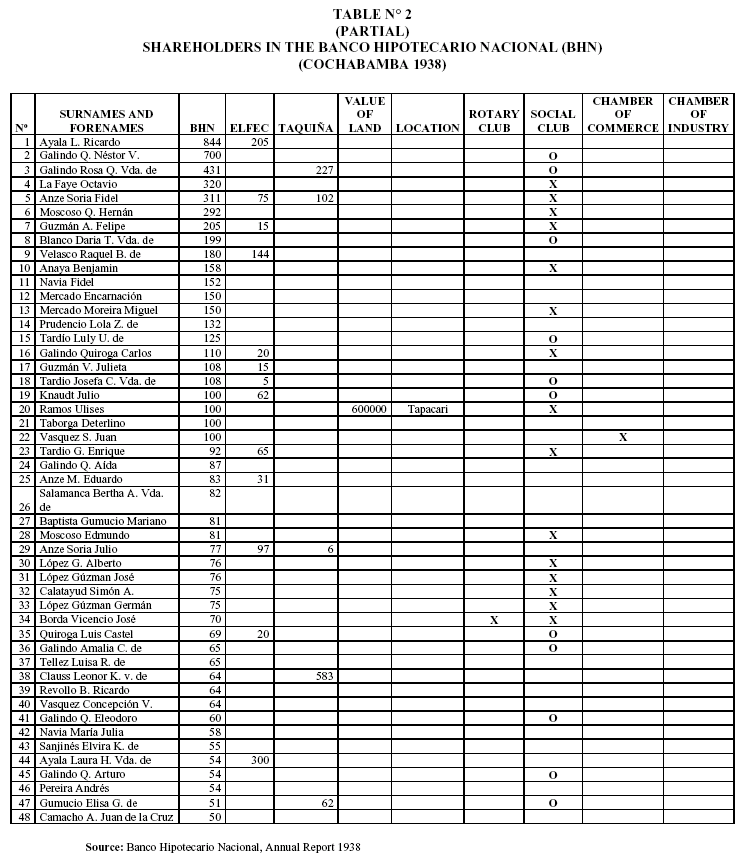
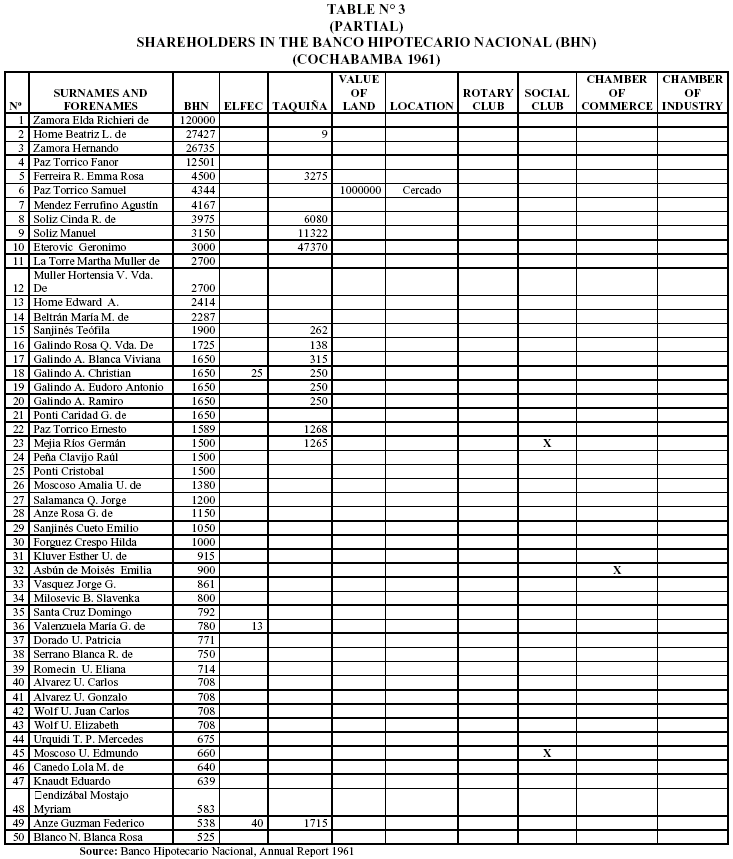
Tables 2 and 3 show the case of the BHN shareholders. The only landowner who appears in this list is Ulises Ramos.12 Does this confirm that the landowners had no links at all to financial capital? Apparently it does, but when we study the shareholders' surnames we see that in many cases they are the same as the landowners' surnames, leading us to think that they belonged to a generation of the landowner's family who lived in the capital city of Cochabamba, perhaps no longer much involved in farming but well on their way to establishing themselves in finance. As well as this new generation of the landowning elite, the shareholders included a few members of the nascent urban middle class and a small number of successful national and foreign immigrants such as Julio Knaudt and the ladies Leonor Kunst vda. de Clauss and Elvira Kunst de Sanjinés.
Most of the BHN shareholders in the 1940s also had shares in ELFEC. Both were firms with local urban roots, although the capital of the former had closer connections to farming while that of the latter tended to come from the savings of an emerging middle class in Cochabamba. Most of the people who owned shares in the Cervecería Taquiña, in contrast, belonged to the families of German immigrants who brought industrial know-how and modern consumption habits to the region. What is clear is that these groups of bankers and shareholders were almost totally unconnected to the chambers of industry and commerce, whose members include a thrusting middle class with a large number of foreign surnames of varying origin, especially German, Jewish, Arab, Italian, Serb and Croat.
In the 1960s the ownership of BHN shares changed dramatically. The Zamora and Horne families, both descended from immigrants, bought up most of the shares, while the traditional surnames were pushed into the background from the business point of view. Neither were they left with much symbolic power as the site of its reproduction, the Social Club, lost its importance in the new, post-revolutionary social structure. Many medium-sized shareholders placed their capital in the Cervecería Taquiña but not in ELFEC, as this firm passed into municipal government hands. Among the bank's medium-sized shareholders, Samuel Paz Torrico is a solitary figure as the owner of a valuable urban property. This leads us to think that the few landowners who managed to survive the revolutionary upheaval were those whose properties were in the areas where the city of Cochabamba was expanding, because they divided up their land and profited from the revenue produced by rapid urbanisation.
We have not included the information about the ELFEC and Taquiña shareholders in this article because of space constraints, but we can comment that our analysis of the same type of tables produced the following results. In the 1940s the largest shareholder in ELFEC was Simón I. Patiño, who owned more than half the shares, while the rest were small investors from the urban middle class. In the 1960s the Patiño Foundation gave the share package to the Municipality of Cochabamba and it was later used as the municipal contribution to set up the National Electricity Company (Empresa Nacional de Electricidad - ENDE). A group of 27 investors held more than 50 per cent of the shares in the Cervecería Taquiña in the 1940s. Half of them were of German origin and three quarters had a foreign surname. In 1965 the capital became concentrated in just a few hands (3.5 per cent of the shareholders controlled 51 per cent of the shares), but only a third were German and half had a foreign surname. Several of the surnames that appeared at that time were a combination of Bolivian and German (Sanjinés, Jastram, Kunst), Arab (Asbun) and Slav (Eterovic), and in both companies the link with the landowners was weak.13
At an early stage of the analysis we have just described, when we had completed the database but had not yet interpreted it, we explored the information using a statistical package designed for multivariate analysis. Our intention was to form groups of landowners linked to the attributes of the database in different ways. It was not possible to achieve this aim because the structure of the information was not internally coherent. In other words, there were no defined patterns in the relationships between the variables and therefore it was not possible to form differentiated groups. This meant that we had to manually construct the tables presented above, in order to observe the relationships between the variables and interpret the meaning of their links.14
]]> Finally, we went back to the original list of names we had obtained when we defined each variable (land ownership, share ownership, memberships, etc.), where each individual could appear with one or more attributes. This final list contained the names of about 4,500 people and we grouped them by surname, thus obtaining a table of family clans in Cochabamba which we ordered by their frequency or number of individuals. This empirical method gave us a general overview of the most important family groups among which local power circulated and was reproduced over time, because it is striking that many of these surnames were related through kinship and that such connections became closer as we observed the links between the most numerous clans.
The ethnography of regional power
Historians are once again taking up genealogical methods to better understand the social contexts they analyse. In-depth study of powerful families or family clans reveals the most intimate fundamentals underlying economic or social behaviour at a particular time, but also allows one to enter the labyrinths in which power circulates and the networks that sustain it.15
In our case, although we did use the genealogical tool, the aim was different. What interested us was to study the changes in the power held by a landowning elite hit by a revolutionary process. In other words, we wanted to test a working hypothesis suggesting that the family groups holding power in the region before 1952 did not recover after the revolution and that consequently there is no regional oligarchy derived from the old landowners.
Based on this premise, and having gathered the empirical data described above, we set ourselves to the task of reflecting on the nature of the local landowning elite. Despite their monopoly over natural resources and their hegemony in the exercise of economic, political and symbolic power, we knew that this powerful elite was intrinsically weak and that, furthermore, dissident family groups had detached themselves from its bosom and were challenging the principles of its patriarchs' rule from the field of politics and intellectual production. Moreover, the revolutionary process had led to the emergence of rural and urban trade union leaders who immediately exercised regional and even national power, likewise clashing with the power of the landowners.16
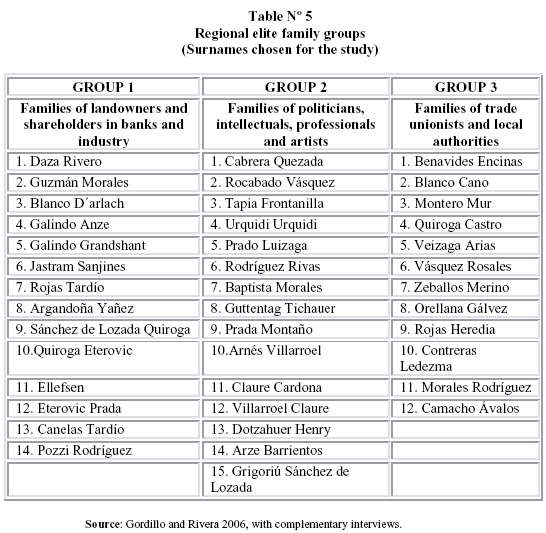
We therefore decided to divide the region's elite into three groups holding economic, intellectual and trade union power. We then chose families that were representative of these powerful groups and finally worked with the ones named in Table 5. We adopted basic criteria that enabled us to choose the EGOS (informants) in each selected family. These included that their age should be 60 or more and that we should, if possible, arrive at a gender balance, which was difficult given the patriarchal baggage of these traditional families. Nevertheless, we should highlight the fact that the women we interviewed had much more subtle perceptions of family power than the men, who instead placed more emphasis on social and political issues.
]]>
We designed forms to set down the information gathered in the interviews and basic strategies for addressing the key issues. Because of the age range chosen for the EGOS, we knew that they would be players directly involved in the revolution process or the children of those players, but they would not be third generation descendants. In other words, taking 1952 as the reference year, we wanted to reconstruct the family trees of the parents, children and grandchildren of the revolution, with informants from one of the first two cohorts. In the first generation the only data to be gathered would be about the father and mother, in the second generation (to which the EGO belonged) data would be gathered about all the siblings and their respective partners, while in the third generation the data to be recorded would refer to the descendants of the EGO and their partners.
The interviews themselves offered us an extraordinary overview, but when the accounts were transcribed and we were able to study the texts comparatively, the social fabric connecting the three selected powerful groups became clearer. Thus, the group of families with economic power turned out to have a long historical memory, as they located their ancestors in the colonial period or the beginning of the republican era. This starting point subtly differentiated the family clans who implicitly stressed their more Spanish or more Creole origins. Nevertheless, they all felt that land was the source of their historical existence, so that the 1952 Agrarian Reform, by uprooting them, deprived them of their social identity. The group of intellectual families, in contrast, identified the core of their social identity as their critical position with regard to the social relations that tied landowners to their workers. Many of these families are aware of their kinship with the landowners, but they defend the non-conformist position taken by those branches of their family who challenged the patriarchs. Furthermore, several of these families are descended from the marginal or provincial elites of the time. They settled into urban life and stood up to the discrimination practised by the most powerful local elites. Finally, the group of trade unionist families locate the start of their historical memory in the revolutionary process and have built their social identity around their struggle against the social relations that characterised the pre-modern landowning era. For this latter group, the family and family relationships are not the channels through which power circulates. Their networks are knitted around the trade union and their class solidarity ties.
Having thus delineated their group identities, our next step was to study how these family groups have changed over time, trying particularly to understand the ways in which, as elite groups, they were able to adapt – or ended up losing – the status they had gained by wielding economic power, the power of knowledge or political power. With this aim in mind, we set up a new database using the information obtained during the process of reconstructing the family trees, and focused our attention on the level of education and place of residence of the members of each generation of the families in the three elite groups.
The results obtained for the first group, those with economic power, are presented in tables 7 and 8. In the parents' generation, the men have higher levels of formal education than the women. As for the men in the second generation, i.e. the children of the revolution, although the number of them who gained access to vocational and university education was larger in absolute terms, in relative terms two out of ten of these men found their expectations limited by zero, primary or secondary levels of education. In the third generation, the grandchildren of the revolution, practically all of them have the highest levels of education.
]]>
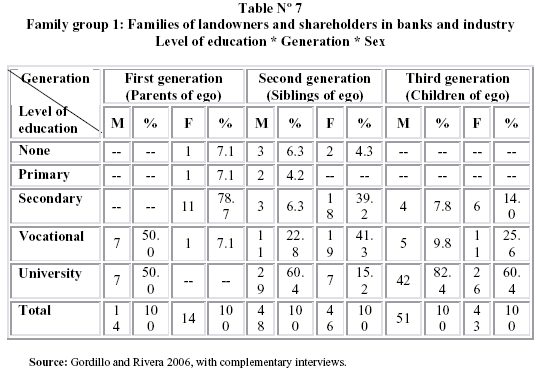
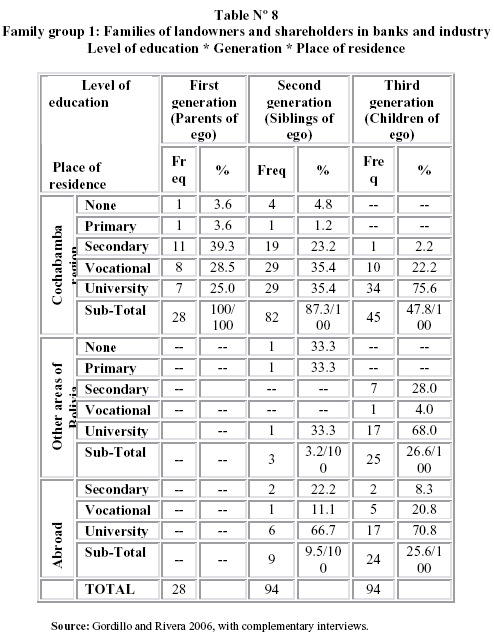
What happened to the women? Their levels of education improved substantially. Eight out of ten daughters of the revolution obtained secondary or vocational qualifications, one went to university and the other had no formal education. The granddaughters of the revolution were even more successful. Six out of ten went to university, three obtained vocational qualifications and one went to secondary school. These educational achievements, however, become relative when we look at the place of residence of these graduates. Among the children of the revolution, two out of ten left the region, one with a low level of education moved to another area of the country and the other, with a high level of education, went abroad. The grandchildren migrated in large numbers, with five out of ten leaving the region. Half of them moved to another area of Bolivia and the other half went abroad. Almost all those who emigrated had a high level of education. What does this process mean? It means that the revolution financed a high level of education for men and women in this group of regional elites, enabling them to go and develop their skills in other areas of the country or other parts of the world. The region was leached of its most capable scions.
Again because of space constraints, we will not include the same tables on the family groups of intellectuals and trade unionists. We can mention, however, that in the case of the intellectuals, members of the third generation were able to gain professional qualifications in proportions very similar to the group holding economic power. Where they differ is that only two out of ten individuals in the intellectual group migrated out of the region. This means that most of them are currently practising their profession in Cochabamba. The trade unionist group did not educate its third generation to the level achieved by the other powerful family groups, and most of them were left with vocational or secondary school qualifications. The two-way migration patterns they use to find work mean that many of them stay in the region but are employed as low-skilled labour.
]]>Conclusions
The 1952 revolution, and particularly the agrarian reform that was applied in Cochabamba, deeply affected the region's pre-revolutionary powerful elites. With the aim of gauging the social effects of this political change over a period of more than half a century, we used genealogical tools to look at families in the three groups into which we divided the region's powerful elites.
The results of the analysis confirm that these powerful elites did not wholly recover the status they used to enjoy, but a closer look reveals several interesting findings. First, the group holding economic power migrated out of the region and those who stayed fell apart. Second, the trade union group has no power at all and gradually dissolved. Finally, the intellectual group is the only one that has managed to re-accommodate itself in today's power structure, based on its use of knowledge and its practice of urban-based professions.
In a subsequent stage of this same research, which used sociological methods to analyse power in the region today, we found that the descendants of the intellectual families have rebuilt their networks of power, especially inside state institutions such as the prefecture, the municipal government and the public university, among others. This finding is interesting because, in the Cochabamba region today, where agriculture does not produce wealth and opportunities are concentrated in a non-industrial capital city, the founts of public expenditure confer a great deal of power on those who weave their networks in state institutions.
Bibliography
Baptista, M. 2000 Mis hazañas son mis libros. Vida y obra de Augusto Guzmán. La Paz: Plural. [ Links ]
Baptista, M. 2000ª Evocación de Augusto Céspedes. La Paz: Caraspas. [ Links ]
Baptista, M. 2002 Fragmentos de memoria. Wálter Guevara Arze. La Paz: Editorial Garza Azul. [ Links ]
Baptista, M. 2002ª José Cuadros Quiroga. Inventor del Movimiento Nacionalista Revolucionario. La Paz, n/d. [ Links ]
Dandler, J. 1987 Sindicalismo campesino en Bolivia. Cambios estructurales en Ucureña, 1935-1952. Cochabamba: El Buitre. [ Links ]
Gordillo J. M. and Jackson, R. H. 1987 "Mestizaje y proceso de parcelación en la estructura agraria de Cochabamba: El caso de Sipe Sipe en los siglos XVIII y XIX". HISLA 10: 15-37. [ Links ]
Gordillo, J. M. 2000 Campesinos revolucionarios en Bolivia. Identidad, territorio y sexualidad en el Valle Alto de Cochabamba, 1952-1964. La Paz: Plural. [ Links ]
Gordillo, J. M. and Rivera, A. 2006 "La revolución de 1952: Continuidades y cambios". Research report. Cochabamba: UNDP. [ Links ]
Guzmán, G. 1999 Patrones, arrieros y piqueros. Emergencia de una estructura agraria poblacional, Toco-Cliza (1860-1920). Cochabamba: Honorable Alcaldía Municipal de Cochabamba. [ Links ]
Irurosqui, M. 1994 La armonía de las desigualdades: Elites y conflictos de poder en Bolivia, 1880-1920. Cuzco: Centro Bartolomé de las Casas. [ Links ]
Lagos, M. L. 1997 Autonomía y poder. Dinámica de clase y cultura en Cochabamba. La Paz: CID. [ Links ]
Larson, B. 1992 Colonialismo y transformación agraria en Bolivia. Cochabamba, 1550.1900. La Paz: Hisbol. [ Links ]
Morales, J. and N. Pacheco 1999 "El retorno de los liberales". In: Campero, F. (Ed.). Bolivia en el siglo XX. La formación de la Bolivia contemporánea. La Paz: Harvard Club de Bolivia. [ Links ]
Presta, A. M. 2000 Los encomenderos de La Plata. Lima: IEP. [ Links ]
Rivas, S. 2000 Los hombres de la revolución. Cochabamba: Plural. [ Links ]
Rivera, A. 1992 Los terratenientes de Cochabamba. Cochabamba: Editorial Serrano. [ Links ]
Sánchez-Albornoz, N. 1978 Indios y tributos en el Alto Perú. Lima: IEP. [ Links ]
Rodríguez, G. 1993 Poder central y proyecto regional, Cochabamba y Santa Cruz en los siglos XIX y XX. Cochabamba: ILDES/IDEA. [ Links ]
Rodríguez, G. 1995 El lugar del canto. Historia de Cervecería Taquiña, S.A., 1892-1995. Cochabamba: Cervecería Taquiña, S.A. [ Links ]
Rodríguez, G. 1997 Energía eléctrica y desarrollo regional. ELFEC en la historia de Cochabamba (1908-1996). Cochabamba: ELFEC. [ Links ]
Rodríguez, G. 1998 De la colonia a la globalización. Historia de la industria cochabambina, siglos XVIII-XX. Cochabamba: Cámara Departamental de Industria. [ Links ]
Rodríguez, G. 2003 Región y nación. La construcción de Cochabamba, 1825-1952. Cochabamba: Honorable Concejo Municipal de Cochabamba. [ Links ]
Varón, R. 1997 La ilusión del poder. Apogeo y decadencia de los Pizarro en la conquista del Perú. Lima: IEP/IFEA. [ Links ]
Wachtel, N. 1981 "Los mitimas del valle de Cochabamba: La política de colonización de Wayna Capac". In: Historia Boliviana I (1). [ Links ]
1 This article was published in July 2007 in issue 22 of the journal T'inkazos, edited by the Strategic Research Programme in Bolivia (Programa de Investigación Estratégica en Bolivia - PIEB).
2 The author is an economist with a PhD in history, researcher and university lecturer.
3 The study will be published with support from PIEB, CESU and DICyT – UMSS.
4 The idea of using genealogy to study changes in powerful family groups was suggested by the researchers who produced the 2007 National Human Development Report for the UNDP. Three teams were asked to study the changes in regional power structures in La Paz, Santa Cruz and Cochabamba – the latter assigned to J. M. Gordillo and A. Rivera (2006) – and produced a report entitled "The 1952 revolution: continuity and change". We are grateful to the UNDP for authorising us to use these data to present to PIEB a new research project covering a longer period of time. We particularly wish to acknowledge the theoretical contribution made by George Gray, Fernanda Wanderley, Rossana Barragán and Claudia Peña.
5 Cochabamba's agrarian and integrating role began in the Inca period, when Wayna Capac installed a maize-growing enclave in the low valleys which sent food to Cuzco. Every year, 14,000 Aymara-speaking settlers were moved there from the highlands as a state labour force. See Wachtel 1981.
6 Until the 1980s, the region's economic history was always linked to the cycles of mining production in the highlands. Its role as food supplier to the domestic market was weakened at the start of the 20th century, however, with the introduction of the tin export mining model, and the region's landowning elite found itself sidelined from national power. See Larson 1992 and Rodríguez 1993 and 2003.
7 The segregation-based systems of the colonial and republican era, which separated "indians" from "Spaniards" or "whites", which were very deeply rooted in highland societies, operated differently in the valleys, where there was an intense process of (predominantly cultural) mixing. Amongst other factors, this was brought about by the multi-ethnic background of the indigenous peoples who became involved in regional trade networks very early on. See Sánchez-Albornoz 1978, Gordillo and Jackson 1987 and Guzmán 1999. ]]>
8 The emergence of small farmers in the region dates back to the 18th century. It was reinforced in the 19th century with the application of the Disentailment Law and consolidated with the takeover of the landed estates in the 1952 Revolution. Although the large landowners monopolised symbolic capital and their power was hegemonic, they were unable to restrain the social and economic ascent of the small farmers, who fought them for the sites of power and asserted their rural identity. See Dandler 1983, Lagos 1997 and Gordillo 2000.
9 See Irurosqui 1994 and Morales & Pacheco 1999.
10 Looking at the extremes, we see that the value of the landed estates in Cercado and Cliza ranged between 2 and 3.5 million bolivianos, while in Mizque and Tapacarí it varied from 100 to 400 thousand bolivianos. Simón I. Patiño's estate in Quillacollo was worth 25 million, and we therefore excluded it from the calculation of the ranges. But this does indicate that even the wealthiest landowners in Cochabamba did not capitalise their properties, as Patiño did with the aim of demonstrating the advantages of modern agricultural technology. In short, the landowning elite was fragmented and poor, and its farming techniques were obsolete.
11 If we look at the extremes again, we see that the level of participation by the landowners in Chapare, Tarata and Ayopaya ranged from 70 to 100 per cent, while only between 10 and 40 per cent of the landowners in Tapacarí and Mizque were involved. It is important to note that nearly 4 out of 10 large landowners' surnames did not appear in the Social Club's membership lists. In the context of the time, this shows their low level of integration within oligarchic society.
12 The list of the bank's shareholders is partial because it only includes the first 50 major shareholders. Neither does it include institutional shareholders. These were not taken into account because we were interested in studying the families rather than the share ownership structure.
13 See Rodríguez 1995 and 1997.
14 We are grateful to Dr. Víctor H. Blanco for his assistance with the handling and interpretation of the data using the SPADN package. In the end, the statistical work was done with SPSS.
15 Two important studies of colonial power in the 16th century, based on an analysis of the families of Francisco Pizarro and four other important encomenderos or feudal lords in Alto Peru, were published recently by Varón (1997) and Presta (2000).
16 See Rivas 2000, Rivera 1992, Rodríguez 1998 and Baptista 2000, 2000ª, 2002 and 2002ª.
