<?xml version="1.0" encoding="ISO-8859-1"?><article xmlns:mml="http://www.w3.org/1998/Math/MathML" xmlns:xlink="http://www.w3.org/1999/xlink" xmlns:xsi="http://www.w3.org/2001/XMLSchema-instance">
<front>
<journal-meta>
<journal-id>1990-7451</journal-id>
<journal-title><![CDATA[T'inkazos]]></journal-title>
<abbrev-journal-title><![CDATA[T'inkazos]]></abbrev-journal-title>
<issn>1990-7451</issn>
<publisher>
<publisher-name><![CDATA[Fundación para la Investigación Estratégica en Bolivia (PIEB)]]></publisher-name>
</publisher>
</journal-meta>
<article-meta>
<article-id>S1990-74512005000100001</article-id>
<title-group>
<article-title xml:lang="en"><![CDATA[Ethnicity, class, and party system change in Bolivia]]></article-title>
</title-group>
<contrib-group>
<contrib contrib-type="author">
<name>
<surname><![CDATA[Gisselquist]]></surname>
<given-names><![CDATA[Rachel M.]]></given-names>
</name>
</contrib>
</contrib-group>
<aff id="A">
<institution><![CDATA[,  ]]></institution>
<addr-line><![CDATA[ ]]></addr-line>
</aff>
<pub-date pub-type="pub">
<day>00</day>
<month>00</month>
<year>2005</year>
</pub-date>
<pub-date pub-type="epub">
<day>00</day>
<month>00</month>
<year>2005</year>
</pub-date>
<volume>1</volume>
<numero>se</numero>
<fpage>0</fpage>
<lpage>0</lpage>
<copyright-statement/>
<copyright-year/>
<self-uri xlink:href="http://socialsciences.scielo.org/scielo.php?script=sci_arttext&amp;pid=S1990-74512005000100001&amp;lng=en&amp;nrm=iso"></self-uri><self-uri xlink:href="http://socialsciences.scielo.org/scielo.php?script=sci_abstract&amp;pid=S1990-74512005000100001&amp;lng=en&amp;nrm=iso"></self-uri><self-uri xlink:href="http://socialsciences.scielo.org/scielo.php?script=sci_pdf&amp;pid=S1990-74512005000100001&amp;lng=en&amp;nrm=iso"></self-uri><abstract abstract-type="short" xml:lang="en"><p><![CDATA[Within the framework of a research project on social cleavage and political parties in countries in the process of democratization, the author pauses over the case of Bolivia to show how one can measure the changes of emphasis in class to the ethnicity in the party system and, at the same time, to make an outline of a hypothesis to explain the changes in the party system.]]></p></abstract>
</article-meta>
</front><body><![CDATA[ <p><font face="Verdana, Arial, Helvetica, sans-serif" size="4"><b>Ethnicity, class,    and party system change in Bolivia<a href="#_ftn1" name="_ftnref1" title=""><sup>1</sup></a></b></font></p>     <p>&nbsp;</p>     <p>&nbsp;</p>     <p align=left><font face="Verdana, Arial, Helvetica, sans-serif" size="2"><b>Rachel    M. Gisselquist<a href="#_ftn2" name="_ftnref2" title=""><sup>2</sup></a></b></font></p>     <p align=left><font face="Verdana, Arial, Helvetica, sans-serif" size="2">Replicated from <b>T'inkazos</b>, La Paz, n.18, p.190, May 2005.</font></p>     <p>&nbsp;</p>     <p>&nbsp;</p> <Hr size="1" noshade>     <p align="left"><font face="Verdana, Arial, Helvetica, sans-serif" size="2"><b>ABSTRACT</b></font></p>     <p align="left"><font face="Verdana, Arial, Helvetica, sans-serif" size="2">Within    the framework of a research project on social cleavage and political parties    in countries in the process of democratization, the author pauses over the case    of Bolivia to show how one can measure the changes of emphasis in class to the    ethnicity in the party system and, at the same time, to make an outline of a    hypothesis to explain the changes in the party system.</font></p> <hr size="1" noshade>     <p align="left">&nbsp;</p>     ]]></body>
<body><![CDATA[<p align="left">&nbsp;</p>     <p><font face="Verdana, Arial, Helvetica, sans-serif" size="2">How social cleavages    are represented in a party system can affect important political outcomes.     Recent work in political science and economics, for instance, highlights that    ethnic party systems, in particular, may have implications for everything from    economic policy and growth, to the quality of governance, to democratic stability    and intrastate conflict.<a href="#_ftn3" name="_ftnref3" title=""><sup>3</sup></a>     Understanding the relationship between social cleavages and political parties    – how it develops, how it changes, and what it means for policy – is thus important    not only for those seeking to explain and predict political outcomes, but also    for those working to improve them.  This paper focuses on party system change    through an exploration of the Bolivian case. </font></p>     <p><font face="Verdana, Arial, Helvetica, sans-serif" size="2">In Bolivia in the    1970s, the Katarista movement, led by a group of primarily Aymara intellectuals,    proposed the theory of “both eyes” as a new way of understanding Bolivian society.     It should be viewed, they argued, not only in terms of the oppression of classes    – as the leftists had long viewed it – but also in terms of the oppression of    indigenous nations.  Since then, ethnic social movements and political parties,    many direct descendants of the Katarista movement, have emerged and gained increasing    prominence in Bolivian national politics.  In the 2002 general elections, an    indigenous party, the Movement toward Socialism (<i>Movimiento al Socialismo</i>—MAS),    placed second, and in 2003, indigenous social movements and parties were instrumental    in organizing protests that led to the resignation of President Gonzalo Sánchez    de Lozada.  An increasing awareness of ethnic issues has also given rise to    clear institutional changes, including the revision of the Bolivian Constitution    in 1994 to declare Bolivia a “pluri-ethnic” nation.</font></p>     <p><font face="Verdana, Arial, Helvetica, sans-serif" size="2">This paper asks:    When and why exactly did this shift toward the salience of ethnic identification<a href="#_ftn4" name="_ftnref4" title=""><sup>4</sup></a> in the national party    system occur?  In addressing this question, I build on a considerable body of    work, by both Bolivian and international scholars, focusing on the rise of indigenous    parties and leaders in Bolivian politics.  This work can be loosely separated    into two groups.  The first, drawn mainly from work in political science, focuses    on the formation and rise of indigenous social movements and parties, since    the mid 1990s, and especially since 2000, highlighting the role of municipal    decentralization and other institutional reforms, the effect of international    changes, and regional demonstration effects tied to indigenous mobilization    elsewhere in Latin America.  The second, generally more sociological and anthropological,    traces the rise of indigenous social movements since the late 1960s and before,    suggesting that the birth and success of indigenous parties has been a natural    outcome of the development of these movements.  </font></p>     <p><font face="Verdana, Arial, Helvetica, sans-serif" size="2">Although both of    these groups of work shed light on the development and rise of indigenous parties,    I argue that neither fully answers the question posed.  On the one hand, work    highlighting institutional and international changes in the 1990s does not fully    explain the shift towards ethnic identification in Bolivian politics because    this shift in fact began in the late 1980s, not the 1990s – i.e., <i>before</i>    these institutional and international changes – as I show in this paper.  On    the other hand, sociological and anthropological work on indigenous social movements,    which does highlight their national emergence in the 1970s and 1980s, does not    fully explain the shift because it assumes a fluid relationship between social    identities and partisan identification, supporting the incorrect prediction    that the shift towards indigenous identification in partisan politics should    have begun in the late 1970s, when the indigenous movement was flourishing.     Although there are ample studies<a href="#_ftn5" name="_ftnref5" title=""><sup>5</sup></a>    that show that social cleavages do not translate naturally and directly into    partisan cleavages, much of this work simply fails to problematize the relationship.     </font></p>     <p><font face="Verdana, Arial, Helvetica, sans-serif" size="2">In this paper,    I try to pick up where this work has left off.  Part of a cross-national project    on social cleavages and political parties in democratizing countries, this paper    uses the case of Bolivia to show how the changing salience of ethnicity versus    class in party systems might be measured and to sketch out a working hypothesis    to explain party system changes – in Bolivia, towards more ethnic identification.     </font></p>     <p><font face="Verdana, Arial, Helvetica, sans-serif" size="2">One of the key    differences between this project and other work on social cleavages and parties    is that it approaches ethnicity from within an explicitly “constructivist” <a href="#_ftn6" name="_ftnref6" title=""><sup>6</sup></a>    framework, an approach that highlights the flexibility of ethnic boundaries    in certain circumstances.  This paper first discusses that framework and how    it is relevant to the study of social cleavages and political parties.  Working    within that framework, it then presents an overview of Bolivia's social cleavages,    focusing on its ethnic divisions.  Next, it develops a new method of measuring    changes in the political salience of ethnic versus class identities in the national    party system and discusses general trends in the Bolivian case.  Finally, it    presents a working hypothesis to explain the observed changes and explores the    plausibility of this hypothesis for Bolivia.  </font></p>     <p><font face="Verdana, Arial, Helvetica, sans-serif" size="2">Recent work on    social cleavages and political parties has focused on the causal role of elite    manipulation of social cleavages following authoritarian transition (Torcal    and Mainwaring 2003; Chhibber and Torcal 1997).  Although focusing on elite    action, this work also suggests that structure and institutions are important,    but gives us little guidance as to how.  Torcal and Mainwairing, for instance,    note that “The demand side, i.e., the ways in which societal interests shape    party systems from below, is important, but an analysis of cleavages from a    sociological approach does not satisfactorily explain Latin American party systems.     We must also turn our attention to the ways in which political agency and politics    shape party systems from above” (2003: 84).  </font></p>     <p><font face="Verdana, Arial, Helvetica, sans-serif" size="2">I argue that without    incorporating the “demand side” – specifically, the structure of social cleavages    – the causal story here is incomplete.<a href="#_ftn7" name="_ftnref7" title=""><sup>7</sup></a>     My hypothesis is that, during periods of regime transition, when traditional    parties are discredited, elites are presented with opportunities to “re-construct”    the salient lines of social cleavage in the party system to their advantage,    but that these opportunities are limited.  I hypothesize that the two key elements    that constrain their arena of action are the messages and social bases of the    traditional parties and the structure of existing, mobilized social groups,    especially how they overlap and intersect.  Thus, in contrast to work in the    pluralist tradition which that suggests that in systems where cleavages overlap    (i.e., reinforce each other, such as in ranked ethnic systems), we should see    complete stasis over time, my hypothesis is that this overlap should provide    political leaders and would-be leaders with the political space to switch between    dimensions of social cleavage, for instance, from class to ethnicity.  </font></p>     <p><font face="Verdana, Arial, Helvetica, sans-serif" size="2">In Bolivia, in    more specific terms, the argument is that the increasing salience of ethnicity    can be explained by the discrediting of traditional leftist parties and policies    during the economic crisis of the 1980s; the overlap between the groups that    had been “represented” by these parties (i.e., peasants and the working class)    and “the indigenous” population; and the objectives and ideologies of the new    leaders that emerged during this period.  The first two of these factors created    the space within which elites could act.  The last helps to explain the particular    character of the parties that emerged. </font></p>     ]]></body>
<body><![CDATA[<p>&nbsp;</p>     <p><font face="Verdana, Arial, Helvetica, sans-serif" size="3"><b>A Constructivist    Approach to Social Cleavages and Political Parties</b></font></p>     <p><font face="Verdana, Arial, Helvetica, sans-serif" size="2">Social scientists    often treat ethnic groups as if they are primordial and unchanging, self-evident    categories that can be read straightforwardly from physical characteristics,    family history, language, etc.  Work in ethnic politics over the past thirty    years, however, shows that ethnic groups are not fixed.  Rather they are “constructed.”      Ethnic boundaries may shift, groups may combine or divide, and the same individuals    may identify themselves or be identified by others in different ways depending    on the context of their interactions.<a href="#_ftn8" name="_ftnref8" title=""><sup>8</sup></a>  A simple example of this from the U.S.    is the category “Asian American,” which combines a number of ethnic categories<a href="#_ftn9" name="_ftnref9" title=""><sup>9</sup></a>    – “Chinese American,” “Japanese American,” “Vietnamese American,” etc.  And,    the same individual who in one context might identify in ethnic terms as “Japanese    American,” might in others be “<i>Nisei</i>” (or second-generation Japanese    American), or “Asian American,” or simply “American.”  </font></p>     <p><font face="Verdana, Arial, Helvetica, sans-serif" size="2">While there is    general agreement that ethnic groups are constructed in some way, what this    insight means for the study of social cleavages and political parties, and for    other political outcomes, has not yet been explored for the most part.  This    is clear in the literature on social cleavages and political parties, in which    one standard way of studying their relationship is to define the groups in society    based on various socioeconomic measures and then to analyze how well these measures    explain support for particular parties or other political outcomes (Torcal and    Mainwairing 2003; Chhibber and Torcal 1997; see also Cho 1999; Arvizu 1994;    Lawson and Gisselquist 2004).  In this type of analysis, the researcher accepts    as “objective facts” responses to questions in the census or survey data and    uses this data to define membership in various social identity groups.  The    “social cleavages” that are most salient to the party system then are those    defined by the variables that are statistically significant in regressions and    explain the most variation in party membership, voting, or political behavior.</font></p>     <p><font face="Verdana, Arial, Helvetica, sans-serif" size="2">Constructivist    findings in ethnic politics suggest several problems with this approach.  The    first stems from its reliance on “official” data which may reflect official    agendas more than social realities.  Projects to enumerate and measure the groups    in society, especially ethnic groups, are highly political.  As Nobles (2000)    and Cohn (1987) have shown, censuses do not so much capture the social cleavages    that “exist” in society as name, create, and officially sanction certain ones    that the state (or survey-taking agency) has an interest in.  This is true even    for cleavages like race, which might seem at first glance to be clear cut.     </font></p>     <p><font face="Verdana, Arial, Helvetica, sans-serif" size="2">As Nobles's study    of the U.S. and Brazilian censuses illustrates, driven by political debates    and interests, both have defined “black” and “white” differently from each other    and both have each defined these terms differently over time.  Some censuses    have instructed individuals to classify themselves as “white” only if they have    no “black” ancestors.  In other censuses, someone is “white” if at least three    of his grandparents are “white.”  And so on.  Using such data to study the voting    behavior or party membership of “racial groups” then may in fact capture very    little of how socially-salient racial groups behave, but more of how officially-sanctioned    groups behave. </font></p>     <p><font face="Verdana, Arial, Helvetica, sans-serif" size="2">A related issue    is the leaving off of certain socially-relevant categories from the census for    political reasons.  From 1951 until the present, for instance, the Indian census    has not reported data on caste (except for the “Scheduled Caste” category),    yet studies of Indian politics suggest that caste has been salient in Indian    politics.  Another example is the Belgian census, which since 1947 has not collected    data on language, also a highly salient division.  If data from the Indian or    Belgian censuses were used straightforwardly to analyze how well social groups    – as measured in the census – predicted party membership, key variables would    have been omitted, likely skewing results.</font></p>     <p><font face="Verdana, Arial, Helvetica, sans-serif" size="2">A second set of    problems raised by constructivist work on ethnic politics has to do with the    concept of “identity repertoires” (Lustick 2000; Waters 1990; Laitin 1992).     That is, the finding that individuals may identify or be identified with any    number of social identity groups (or social cleavages), based on their ancestry,    skin color, cultural practices, language, income, occupation, wealth, education,    gender, sexual preference, and so on.  Which identification comes to the fore    often depends on the institutional or social context (e.g., Posner 1998; Mozaffar,    Scarritt, and Galaich 2003; Brubaker 2003).  In other words, it is incorrect    to assume that that an individual who <i>can</i> identify as “indigenous” because    of her family background, physical characteristics, or maternal language will,    and will in all circumstances.  Although “indigenous” is in this person's identity    repertoire, this identity will not necessarily “trump” the rest.<a href="#_ftn10" name="_ftnref10" title=""><sup>10</sup></a>     For instance, work by Nash (1993) on miners in Bolivia shows that many individuals    who could identify as “indigenous” instead identified and organized as “miners.”     This work suggests that their occupational or class identity “trumps” their    ethnic and other options.  In other words, it is problematic to identify individuals    as members of social groups based on whether they have various socioeconomic,    cultural, or physical attributes and to attribute causality to their <i>supposed</i>    membership in these groups.    </font></p>     <p><font face="Verdana, Arial, Helvetica, sans-serif" size="2">Both of these problems    suggest that further work problematizing and identifying social cleavages is    needed in studies of their relationship with political parties.  Thus, rather    focusing on how well various socioeconomic indicators predict party membership    and voting behavior, this paper adopts an alternate approach to social cleavages    and parties, focusing on how parties define and appeal to groups in society.     Focus on the other side of the question – </font><font face="Verdana, Arial, Helvetica, sans-serif" size="2">how    these groups define themselves and how and why they respond to these appeals    by voting for or joining particular parties – is left for future work.</font></p>     <p><font face="Verdana, Arial, Helvetica, sans-serif" size="2"><b>&nbsp;</b></font></p>     ]]></body>
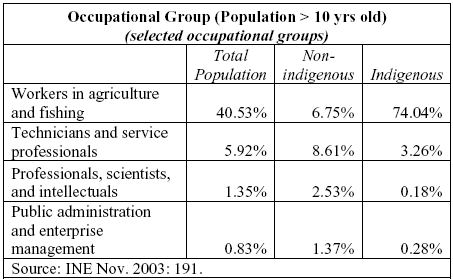
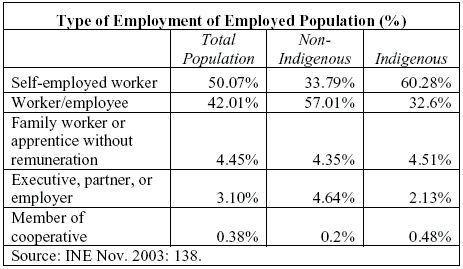
<body><![CDATA[<p><font face="Verdana, Arial, Helvetica, sans-serif" size="3"><b>Social Cleavages    in Bolivia</b></font></p>     <p><font face="Verdana, Arial, Helvetica, sans-serif" size="2">This paper focuses    on two types of cleavages, those based on ethnicity and those based on class.     In particular, this section highlights ethnic cleavages drawing on a constructivist    approach.  Drawing on constructivist work, I define an <i>ethnic group </i>as    a group that identifies by an ascriptive category generally inherited at birth,    including language, tribe, race, religion, and culture.  This definition builds    on Chandra (2004) and is also consistent with definitions used in classic work,    including Horowitz (1985) and Laitin (1986).  </font></p>     <p><font face="Verdana, Arial, Helvetica, sans-serif" size="2">Because most work    on “ethnic politics” in Bolivia focuses exclusively on “indigenous” politics,    it is useful to be clear here about why my definition differs. Understanding    indigenous political participation in Bolivia is of obvious importance because    the subjugation and political exclusion of indigenous communities has been part    and parcel of the Bolivian state.  I employ a broader definition of ethnicity    for three reasons.  First, as I illustrate below, there are many other ethnic    cleavages in Bolivia beyond the indigenous – non-indigenous divide.  Second,    there are a number of hypotheses in the literature about the behavior of ethnic    groups in general.  If we exclude non-indigenous populations from study at the    outset, we may be mistakenly attributing causal significance to indigenous group    membership when it is in fact ethnic identification more generally that is key.     Related, third, although not inherent in the definition of indigenous, many    of our theories about indigenous populations assume them to be small minorities,    such as in Brazil, Canada, or the U.S.  This is clearly not the case in Bolivia,    making the application of theories about indigenous minorities problematic.     The fact that the majority of Bolivia's population is indigenous suggests that    general models of <i>ethnic</i> politics are much more relevant than theories    of indigenous <i>minority</i> politics.</font></p>     <p><font face="Verdana, Arial, Helvetica, sans-serif" size="2">That said, certainly    one of the most salient ethnic divisions in Bolivia is between the indigenous    and whites (or those who are “Europeanized” or “<i>mestizo-criollos</i>” or    “<i>q'aras”</i>).  According to the 2001 census, 62.05 percent of Bolivia's    population self-identifies as indigenous, and most of the remainder as “non-indigenous.”     </font></p>     <p><font face="Verdana, Arial, Helvetica, sans-serif" size="2">Although not measured    in the census, more disaggregated ethno-racial divisions, based on the degree    of racial and cultural intermixing, are also highly salient.  A distinction    is sometimes made, for instance, in terms of “indigenous,” “<i>mestizo</i>,”    and “white.”<a href="#_ftn11" name="_ftnref11" title=""><sup>11</sup></a>  Another    distinction is made in terms of “indigenous,” “<i>cholo</i>,” “<i>mestizo,</i>”    and “white”; while both “<i>cholo</i>” and “<i>mestizo</i>” are terms used to    describe those of mixed race and cultural practice, “<i>cholos</i>” would be    more “indigenous,” while “<i>mestizos</i>” more “Western” in their practices    (see Sanjínes C. 2004).  “<i>Cholo/a,</i>” which can sometimes have a pejorative    connotation, also is used, more specifically, to refer to indigenous individuals    in urban areas and, especially, to women wearing traditional dress and to market    women (see Paredes Candia 1992).  One's degree of assimilation into western    culture also defines even more refined categorizations in everyday use in some    areas, such as “<i>chota</i>” or “<i>birlocha</i>” (see Guaygua, Riveros, and    Quisbert 2003; see also Rivera C. 1996; Archondo 2003).</font></p>     <p><font face="Verdana, Arial, Helvetica, sans-serif" size="2">The indigenous    category also can be further disaggregated.  One key division is between “Highland    indigenous” and “Lowland indigenous.”  Highland indigenous constitute the majority    of the indigenous population in Bolivia, and include the two largest ethno-linguistic    groups, the Quechua (30.71 percent) and the Aymara (25.23 percent).<a href="#_ftn12" name="_ftnref12" title=""><sup>12</sup></a>  Lowland indigenous    groups make up about 6.9 percent of the total indigenous population and are    a much more diverse group.<a href="#_ftn13" name="_ftnref13" title=""><sup>13</sup></a>     The largest Lowland indigenous group is the Guaraní, who make up about 26 percent    of the lowland Indian population, followed by the Chiquitano at about 22 percent,    and the Moxeno at 13 percent.  In Bolivian national party politics today, it    is the voices of highland Indians, especially the Aymara, that have been the    loudest, although lowland Indian groups such the <i>Confederación de Indígenas    del Oriente Boliviano</i> (CIDOB) have also been active.  Although indigenous    organizations based in the Highlands, such the <i>Confederación Sindical Unica    de Trabajadores Campesinos de Bolivia </i>(CSUTCB), claim to work on behalf    of all indigenous in Bolivia, some observers see their objectives as more attuned    to, and in the interests of, highland communities (Strobele-Gregor 1994; Hahn    1996).  In general, therefore, even if many studies treat the “indigenous” as    a single unified group, even a quick sketch of the diversity of the indigenous    population highlights that there are many varied groups that make up the broad    category “indigenous,” and thus that identifying politically as “indigenous”    (rather than as “Highland indigenous,” “Quechua,” “Guaraní,” etc.) is, at least    at some level, a political choice, not an obvious reflection of social identities    in the political arena.  </font></p>     <p><font face="Verdana, Arial, Helvetica, sans-serif" size="2">Other salient ethnic    divisions can also be described along regional lines, such as between <i>kollas    </i>of the altiplano and <i>cambas </i>of the lowlands.  Indeed, especially    over the past several years, the ethno-regional identity expressed by the <i>Nación    Camba</i> has been increasingly vocal, even including a calls for secession    (see Forero 2004; Sandoval 2001; International Crisis Group 2004; Talavera 2003).<a href="#_ftn14" name="_ftnref14" title=""><sup>14</sup></a>     Finally, divisions between residents of different cities and departments form    another line of ethno-regional cleavage (between Paceños from La Paz, Cruceños    from Santa Cruz, Cochabambinos from Cochabamba, and so on).  Evidence of the    salience of ethno-regional divisions can be seen in various calls for regional    autonomy.  </font></p>     <p><font face="Verdana, Arial, Helvetica, sans-serif" size="2">In terms of economic    difference, a number of cleavages also can be traced – between the rich and    the poor; as well as among different classes, occupational groups, sectors,    and so on.  This paper focuses on <i>class</i> cleavages, defined loosely here    in the Marxist sense in terms of the relationship to the means of production.     I adopt this definition because it is the one that is closest to that employed    by leftist parties, many of which draw explicitly on Marxist-Leninist ideology.     However, because the language of class is also used to imply income differences    more generally, I also use this distinction, especially when data is not available    on class defined more strictly.</font></p>     <p><font face="Verdana, Arial, Helvetica, sans-serif" size="2">In Bolivia, the    overlap between class and ethnicity (along indigenous versus white lines) can    be seen both in hard numbers, and in popular perception.  In terms of popular    perception, the fact that “indigenous” and “<i>campesino</i>” have been and    are often used interchangeably is telling.   Looking at hard numbers, there    is a clear correlation between indigenous status and education levels, income,    and employment.  The following tables, for instance, highlight the differences    in types of employment for those classified as indigenous and non-indigenous    in the 2001 census.</font></p>     <p align="center">&nbsp;</p>     ]]></body>
<body><![CDATA[<p align="center"><img src="/img/revistas/s_tinkazos/v1nse/a01tab1.gif"></p>     <p align="center">&nbsp;</p>     <p align="center"><img src="/img/revistas/s_tinkazos/v1nse/a01tab2.gif"></p>     <p>&nbsp;</p>     <p><font face="Verdana, Arial, Helvetica, sans-serif" size="2">Finally, although    class differences between the indigenous and non-indigenous populations are    especially pronounced, class differences can also be identified within the indigenous    category, among indigenous groups.  As Hahn, for instance, explains, the Quechua    and Aymara have traditionally been “'peasantry' in the sense that they are small-plot    subsistence agriculturalists,” while non-Andean indigenous populations “have    been artisans, hunters, and gatherers for the most part” (1996: 97).  In addition,    Quechua communities of the Cochabamba valley have historically been more integrated    into the mining economy than the Aymara communities of the altiplano (Albó 1994).</font></p>     <p><font face="Verdana, Arial, Helvetica, sans-serif" size="2"><b>&nbsp;</b></font></p>     <p><font face="Verdana, Arial, Helvetica, sans-serif" size="3"><b>Measuring the    Salience of Particular Identities</b></font></p>     <p></p>     <p><font face="Verdana, Arial, Helvetica, sans-serif" size="2">At its heart, this    is a study of political identities.  Scholars of ethnic politics have proposed    several ways to measure the salience of identities and changes in identities    (see Abdelal, Herrera, Johnston, and McDermott 2003; Laitin 1999).  Here, the    method I use is to focus on one context, national party politics, measuring    salient political identities through political discourse, specifically, the    national platforms and messages of political parties.<a href="#_ftn15" name="_ftnref15" title=""><sup>15</sup></a>     I define an identity as salient to a party if the party makes an appeal based    on that identity central to its platform.  I focus here on parties that make    ethnicity and class central to their platforms, that is, on “ethnic-mobilizing    parties” and “class-mobilizing parties.”  An <i>ethnic-mobilizing party</i>    represents itself to voters as the champion of the interests of one or several    ethnic groups and makes that representation central to its mobilizing strategy.<a href="#_ftn16" name="_ftnref16" title=""><sup>16</sup></a>  A <i>class-mobilizing    party</i> represents itself to voters as the champion of the interests of one    class or set of classes to the exclusion of others, and makes such a representation    central to its mobilizing strategy.  In classifying parties, I first drew on    several key, general secondary sources on parties (Rolon Anaya 1999; Lora 1987)    and histories.  I then supplemented this information with data from secondary    studies on specific parties, party documents, interviews, writings by party    leaders, records of pre-election debates, and news articles.  </font></p>     <p><font face="Verdana, Arial, Helvetica, sans-serif" size="2">A clear example    of an ethnic-mobilizing party in Bolivia is the <i>Movimiento Indigena Pachakuti    </i>(MIP), which appeals openly and explicitly to the indigenous, as evident,    for one, in its name.  An example of a class-mobilizing party is the <i>Movimiento    de la Izquierda Revolucionaria </i>(MIR)<i>.  </i>Although the MIR is firmly    towards the center-left in terms of policy, it is classified here as “class-mobilizing”    based on its explicit platform.   </font></p>     ]]></body>
<body><![CDATA[<p><font face="Verdana, Arial, Helvetica, sans-serif" size="2">In general, my    classifications are consistent with other work.  The key exception, which is    important because it explains much of the rise in the ethnic-mobilizing vote    from 1989, is the <i>Conciencia de Patria</i> (Condepa).  Although many scholars    object to the classification of Condepa as an “ethnic party” because it does    not fit well into the category of an indigenous party and because its leader    Carlos Palenque was not indigenous, I classify Condepa as an ethnic-mobilizing    party because of its appeal to the indigenous and to “<i>cholos.</i>”  As Rivera    notes, Palenque described his party as “an expression of a ‘new Bolivia of <i>indios    </i>and <i>cholos'</i>” (1993: section 3.5; see also Albó 1994).  Most work    highlights its “populist” appeal, which of course is also key (Alenda 2002;    Lazar 2002; Paz Ballivián 2000).  </font></p>     <p><font face="Verdana, Arial, Helvetica, sans-serif" size="2">Another point to    highlight is that the classifications used here are not mutually exclusive;    a party can make, for instance, <i>both</i> <i>ethnicity and class</i> salient    to its platform, i.e., be an <i>ethnic-mobilizing and class-mobilizing party</i>    which represents itself to voters as the champion of the interests of <i>both</i>    an ethnic group and a class.<i>  </i>One important example of a party that appeals    to voters both on an ethnic and class basis is the <i>Movimiento al Socialismo    </i>(MAS), which makes appeals to the “the indigenous” and to “the poor” and    working class central to its message.  </font></p>     <p><font face="Verdana, Arial, Helvetica, sans-serif" size="2">Likewise, a party    can make neither ethnicity nor class salient in its platform.  For instance,    a party might focus on the environment, gender, foreign policy, or “good government,”    or appeal to voters purely on the basis of its leader's personality and reputation.     Finally, a party that makes ethnicity or class central to its platform can also    appeal on other bases.  Condepa, for instance, also has appealed to voters along    gender lines, especially to <i>chola </i>women in El Alto (Alenda 2002; Lazar    2002).  </font></p>     <p><font face="Verdana, Arial, Helvetica, sans-serif" size="2">The dependent variable    (DV) to be explained in this paper is changes in the political salience of ethnicity    and class in the Bolivian party system.  I operationalize this DV by looking    at how successful the different types of parties I have classified have been    in general elections, mapping out the percentage of the vote that has gone to    parties that appeal to voters in ethnic terms as compared to those that stress    class.<a href="#_ftn17" name="_ftnref17" title=""><sup>17</sup></a>  The following    chart summarizes the results of this analysis:  </font></p>     <p><font face="Verdana, Arial, Helvetica, sans-serif" size="2">These measures    are obviously blunt.  Especially in the case of parties that appeal both on    ethnic and class lines, they cannot show which aspect of the party message resonated    most with voters.  Nor do they necessarily get at the “sincerity” or “underlying    interests” of parties.  Nevertheless, they illustrate in broad brushstrokes    the variation in politically-salient identities at the national party level    in Bolivia over time.  The claim here is simple: Although there is, of course,    more to politics than what party leaders say, what party leaders say and how    they explicitly identify their target constituencies is important.  A great    deal of the information that voters receive about parties is through their platforms    and explicit statements, and thus, looking at these statements systematically    provides valuable data.  Whether or not one believes (as I do) that these data    on party discourse should to be supplemented with “deeper” analysis, this method    at least provides clear comparative data over time, that can be used to study    broad changes and that can be evaluated by other scholars.</font></p>     <p><font face="Verdana, Arial, Helvetica, sans-serif" size="2"><b>&nbsp;</b></font></p>     <p><font face="Verdana, Arial, Helvetica, sans-serif" size="3"><b>Trends in Bolivia</b></font></p>     <p></p>     <p><font face="Verdana, Arial, Helvetica, sans-serif" size="2">The first and most    important trend illustrated by these data is that ethnicity has become increasingly    salient in the Bolivian national party system since the democratic transition    in 1982, and especially after 1985.  This trend can be seen by comparing the    vote shares won by parties with ethnic and class appeals in the chart.  The    data suggest that between 1980 and 1993, class became less politically salient    overall while ethnicity became more salient.  Although recent attention has    focused on the showing of indigenous parties in the 2002 elections, these data    remind us that ethnic appeals were also quite successful in 1989, 1993, and    1997.  Thus, rather than reflecting a sudden increase in the salience of ethnic    identification, the results of the 2002 elections seem tied to a longer, gradually    increasing trend of increasing ethnic salience that began in 1989, or before.</font></p>     <p><font face="Verdana, Arial, Helvetica, sans-serif" size="2">A second point    suggested by the data is that, although support for ethnic parties increased    from 1993 to 1997 to 2002, it would be misleading to read these trend lines    as clear evidence of gradually increasing party mobilization of the “indigenous”    per se.  While it was messages appealing primarily to “the indigenous” that    were most successful in 2002, populist messages appealing particularly to “<i>cholo</i>”    voters were especially successful from 1989 to 1997.  Furthermore, in 2002,    although generally not an explicit part of party message, party leadership and    members of the parties that won were primarily Highland indigenous.  The <i>Movimiento    Indigena Pachacuti </i>(MIP) also does make explicitly pro-Aymara appeals, in    addition to broader appeals to the indigenous.  </font></p>     ]]></body>
<body><![CDATA[<p><font face="Verdana, Arial, Helvetica, sans-serif" size="2">This change in    target ethnic groups between 1997 and 2002 is explained in the numbers primarily    by a drop in Condepa's support, from 17.20 percent to 0.40 percent, and the    emergence of the MAS and its mass appeal in 2002.  In terms of Condepa, a specific    explanation for its demise was the death of its charismatic leader, Carlos Palenque,    who died of a heart attack in 1997, just before the general elections.  Although    Remedios Loza filled the slot and the party received a record vote, after the    elections it was unable to find a suitable permanent successor for Palenque    and its prospects dropped (see Alenda 2002).  What is puzzling in some ways    about this change is that despite Condepa's previous electoral successes running    on a pro-<i>cholo</i> and indigenous message, no other urban indigenous ethnic    party arose to take its place.  The MAS and MIP, the ethnic parties that won    influence in 2002, adopted a different ethnic rhetoric, MAS's being more focused    on economic benefits for indigenous and rural communities and MIP's on indigenous    social and economic rights and on Aymara nationhood.  </font></p>     <p><font face="Verdana, Arial, Helvetica, sans-serif" size="2">Finally, these    data show that, despite the increasing political salience of ethnicity at the    national level, class continues to be salient.  Although an ethnic message has    resonated with about 19 percent of voters since 1989, there is some evidence    of a resurgence in leftist voting:  in 2002, a class message resonated with    about 38 percent of voters.   Over half of this vote (20.94 percent of the total)    can be attributed to the MAS alone, which raises both ethnic and class issues.     Thus, unlike previously, in 2002, we find that the class message that resonated    especially with voters was that championed by a new brand of “indigenous leftists”    – that is, leftists who explicitly mingled a class message with an ethnic one.     </font></p>     <p><font face="Verdana, Arial, Helvetica, sans-serif" size="2"><b>&nbsp;</b></font></p>     <p><font face="Verdana, Arial, Helvetica, sans-serif" size="3"><b>Explaining These    Trends</b></font></p>     <p><font face="Verdana, Arial, Helvetica, sans-serif" size="2">I have argued that    these trends are neither a “natural,” obvious outcome of the historical development    of indigenous social movements, nor a result of institutional and international    changes.  Rather, they have come about as a result of the “opportunity” for    change created by party system crises, the constraints of social structure,    and the instrumental actions of political elites operating within these structural    constraints to manipulate these social cleavages and their relationships with    parties.  Building on work by Torcal and Mainwaring (2003) and Chhibber and    Torcal (1997), I hypothesize that during periods of transition, when traditional    parties are discredited, elites are presented with constrained opportunities    to re-construct the salient lines of social cleavage in the party system to    their advantage. These opportunities are constrained specifically by the messages    and social bases of the traditional parties <i>and</i> by how potentially-salient    social groups overlap and intersect.  These latter two factors create the space    within which elites can act.  It is then the ideologies and objectives of elites    that explain the particular character of the parties that emerge.  In this section,    I explore this hypothesis through the Bolivian case.  </font></p>     <p><font face="Verdana, Arial, Helvetica, sans-serif" size="2">Broadly, the sequence    of events in Bolivia that I detail below suggests that the discrediting and    weakening of traditional leftist parties and the party system's move towards    the right in terms of economic policy from the mid 1980s, left many of those    who had been at least nominally represented by the traditional left and populist    nationalist parties – i.e., the working class, <i>campesinos</i>, and the poor    – without any explicit representation in the party system. New urban migrants    were also voiceless.  Generally both “working class” or “poor” and “indigenous”    and/or “<i>cholo</i>,” this unrepresented population could be appealed to either    in class or ethnic terms.  The fact that leftist policy was discredited by national    events, as well as international ones (e.g., the fall of the Berlin wall), made    ethnic appeals more credible.  Condepa, the first major ethnic-mobilizing party    to emerge, appealed precisely to urban migrant “<i>cholos</i>.”  As Condepa    and indigenous social movements gained strength, traditional parties began to    take note of indigenous and other groups, implementing several institutional    reforms in the mid-1990s that were consistent with their demands, and that improved    the electoral prospects of regionally-based parties.  By the 2002 elections,    two ethnic parties representing the indigenous emerged, both led by highland    indigenous leaders with union backgrounds and appealing to the indigenous poor    and working class.  The larger, the MAS, which began as a municipal party, benefited    directly from these institutional reforms (see Van Cott 2003).</font></p>     <p><font face="Verdana, Arial, Helvetica, sans-serif" size="2">In short, the Bolivian    case follows the broad mechanism described.  Several other factors which seem    specific to the case also are important:  One is the economic crisis of the    1980s, which discredited leftist economy policy.  A second is internal migration,    largely sparked by the economic crisis, which created new social groups that    were not well represented by the traditional parties.  And a third is the specific    institutional reforms undertaken by the Bolivian government in the 1990s, which    primarily affected the “second stage” of ethnic-mobilizing parties after Condepa.</font></p>     <p><font face="Verdana, Arial, Helvetica, sans-serif" size="2">The focus of this    paper is the period since Bolivia's democratic transition in 1982, but the country's    multiparty system extends well before that.  Bolivia gained independence in    1825, and from about the end of the War of the Pacific in 1880, began to develop    a modern multiparty system (Klein 1969; Hofmeister and Bamberger 1993).  For    nearly half a century, this system was dominated by the conservative and liberal    parties.  Under the liberal oligarchy, the indigenous were seen as an innately    inferior race and were excluded from political participation.  The key event    that changed this system was the Chaco War with Paraguay from 1932 to 1935.     During the war, close contact between indigenous and <i>mestizo-criollo</i>    soldiers had a nationalizing effect.  Returning home, a new generation of soldiers    entered politics, bringing with them a new populist spirit and dedication to    <i>mestizaje</i> and the incorporation of the indigenous population into the    national project.  This is not to say that their goals were enlightened by the    standards of today – the objective was the “whitening” of the Indian population    through racial intermixing – but they did favor broader political participation    in general (Sanjínes 2004).  At the same time, the country's defeat contributed    to the decline of the Liberal oligarchy and the traditional parties.  During    this period, several new populist and leftist parties arose.  The four most    important of these were the <i>Partido Obrero Revolucionario </i>(POR), a Trotskyite    party; the <i>Partido Izquierda Revolucionario </i>(PIR), a Marxist party; and    the <i>Movimiento Nacionalista Revolucionario </i>(MNR) and the <i>Falange Socialista    Boliviana </i>(FSB), both nationalist parties.</font></p>     <p><font face="Verdana, Arial, Helvetica, sans-serif" size="2">The MNR, in particular,    became a force in the opposition.  It built its base among Chaco war veterans    associations, peasant unions of Quechua farmers in the Cochabamba valley, and    the <i>mestizo-criollo</i> middle class.  It also gained the support of the    mining unions, with particular ties to the powerful <i>Federación Sindical de    Trabajadores Mineros de Bolivia</i> (FSTMB).  In ethnic terms, the MNR's indigenous    support was based in the highlands and was more Quechua than Aymara.  The Aymara    were less part of the system of peasant unions and were less integrated into    the market economy.  In addition, less Hispanicized and <i>mestizo</i> than    the Quechua, they did not fit well into the MNR's project of <i>mestizaje</i>    (Sanjínes 2004: 20).  Although not often emphasized, the MNR's base among mining    unions also suggests a “<i>cholo”</i> aspect to its support base.  As Nash's    discussion of <i>cholo</i> culture among Bolivian tin miners suggests, miners    identified more as “<i>cholo</i>” than as Quechua or Aymara, or as “campesino”    (Nash 1993: 312).  This is not, of course, to say that the MNR appealed explicitly    to “<i>cholos”</i> in these terms.</font></p>     <p><font face="Verdana, Arial, Helvetica, sans-serif" size="2">Preaching a populist    ideology of “revolutionary nationalism,” and with the support of labor and peasant    unions and of Chaco war veterans, the MNR led Bolivia's National Revolution    in April 1952.   The revolution had far-reaching effects, including the establishment    of universal suffrage, nationalization of the mines, agrarian reform, and education    reform (see Dunkerley 2003 &#91;1987&#93;; Grindle and Domingo 2003).  The newly    founded workers' union, the <i>Central Obrera Boliviana </i>(COB), worked directly    with the MNR government.  In 1964, however, a coup brought the military to power,    and it stayed in power almost uninterrupted until 1982.  During the presidency    of General René Barrientos (1964-1965, 1966-1969), the state consolidated its    power in part through the <i>Pacto Militar-Campesino </i>(PMC).  As with the    MNR, state relations were strongest with the Quechua of Cochabamba.  However,    after Barrientos's death, and especially during the dictatorships of General    Hugo Banzer (1971-1978) and Luis García Meza (1980-1981), and their repression    of indigenous/<i>campesino</i> communities, the military-peasant pact dissolved.     It was during this period, Albó (1994) notes, that the Aymara of La Paz and    Oruro became more politically active, displacing the Quechua who had been co-opted    and then disillusioned by the dissolution of the PMC (see also Sanjínes 2004).     It was during this period that the Katarista movement emerged and we see the    formation of the <i>Movimiento Revolucionario Tupaj Katari</i> (MRTK) and MRTKL,    as well as the Indianist <i>Movimiento Indio Tupaj Katari </i>(MITKA).  None    of these parties, however, ever won more than 2.1 percent of the vote in general    elections.  Several leftist parties also were founded, including the <i>Movimiento    de la Izquierda Revolucionaria </i>(MIR) and the <i>Partido Socialista</i> (PS)    in 1971.  And, in 1979, the rightist <i>Acción Democrática Nacionalista</i>    (ADN), founded by General Banzer.</font></p>     ]]></body>
<body><![CDATA[<p><font face="Verdana, Arial, Helvetica, sans-serif" size="2">In 1980, elections    were held and won (38 percent) by the <i>Unidad Democrática y Popular</i> (UDP),    a leftist coalition.  This government was overthrown in July of the same year    in a military coup led by García Meza.  During a general strike in September    1982, however, the military decided to step down and to convene the 1980 Congress    and accept its presidential choice.  This marked the country's transition to    democracy and brought Hernán Siles Zuazo of the UDP to the presidency in October.     The UDP government included the <i>Movimiento Nacionalista Revolucionario de    Izquierda</i> (MNRI), the <i>Movimiento de la Izquierda Revolucionaria</i> (MIR),    <i>Partido Comunista de Bolivia</i> (PCB), and the <i>Partido Democrata Cristiano</i>    (PDC) (although eventually all parties except the MNRI withdrew) (see Laserna    1985).  </font></p>     <p><font face="Verdana, Arial, Helvetica, sans-serif" size="2">Despite high hopes    for the new democratic administration, the UDP suffered from the start from    internal disagreements, as well as from strong legislative opposition by the    MNR and ADN.  In terms of its economic program, the UDP sought to consolidate    the nationalist revolutionary model of 1952, based in a mixed economy and economic    gradualism (see Mesa Gisbert 2003: 739-40).  This program, compounded by political    opposition and internal disunity, backfired completely and the years of the    UDP government are remembered as the period in which Bolivia suffered its worst    period of hyperinflation ever, with indices rising from 123 percent in 1982    to 8,757 percent in 1985 (INE and Banco Central in Mesa Gisbert 2003: 740).     The crisis discredited the UDP and its economy policy, as well as exacerbating    internal divisions within the government.</font></p>     <p><font face="Verdana, Arial, Helvetica, sans-serif" size="2">As a result, in    the 1985 elections, the country swung noticeably to the right (see Torranzo    1989; Estellano 1994).  These elections were won by the ADN (32.8 percent),    which took a strong neo-liberal stance, followed closely by the MNR (30.40 percent),    and brought Victor Paz Estenssoro (MNR) to the presidency.  The MIR won just    10.2 percent and MNRI 5.5 percent, less than half of the UDP's total in 1982.     The discrediting of the leftist program was so complete that that it was Paz    Estenssoro and the MNR &#151; which had built the Bolivian state of 1952 – that    oversaw its dismantling through a program of neo-liberal reform and stabilization.     </font></p>     <p><font face="Verdana, Arial, Helvetica, sans-serif" size="2">The country's swing    to the right meant that the interests of many of those who had been spoken for    by the traditional left and populist nationalist parties<a href="#_ftn18" name="_ftnref18" title=""><sup>18</sup></a> – i.e., the working class, <i>campesinos</i>,    and the poor – were subsumed by the project of economic stabilization.<a href="#_ftn19" name="_ftnref19" title=""><sup>19</sup></a>    At the same time, the effect of the economic situation and the government's    austerity measures on the poor and working class – i.e., especially on the non-white    population – were becoming obvious.  And, the collapse of the price of tin,    combined with privatization of the mines, threw thousands of miners out of work.     The closures of the mines and poverty in the countryside, brought thousands    into the cities, noticeably in the area around the country's administrative    capital, La Paz.  Between 1976 and 2001, the population of La Paz's satellite    city, El Alto, multiplied almost six times.<a href="#_ftn20" name="_ftnref20" title=""><sup>20</sup></a>  No longer peasants nor miners, these    migrants also did not fit well into traditional channels for interest incorporation    through unions or parties.  With the incidence of poverty at about 70 percent    nationwide,<a href="#_ftn21" name="_ftnref21" title=""><sup>21</sup></a> all of the major parties remained    most focused on macroeconomic stabilization.    </font></p>     <p><font face="Verdana, Arial, Helvetica, sans-serif" size="2">It is during this    period that we begin to see increasing ethnic claims in the national political    arena, calling for economic changes and relief from the effects of the austerity    program, as well as for political equality and cultural recognition.  In the    1980s, for instance, we see the emergence of indigenous organizations in the    lowlands of eastern Bolivia, and in 1991, the <i>Confederación Indígena del    Oriente, Chaco y Amazonía de Bolivia</i> (CIDOB) led the March for Territory    and Dignity to La Paz.  In terms of parties, the key event was the 1988 founding    of Condepa, which appealed to exactly the latter group mentioned above, i.e.,    especially to “urban indigenous” and “<i>cholo” </i>migrants in El Alto, as    well as more generally to the indigenous.  In 1989, party leader Remedios Loza    became the first woman <i>de pollera </i>to be elected to the Bolivian Congress.     </font></p>     <p><font face="Verdana, Arial, Helvetica, sans-serif" size="2">In the 1989 elections,    the vote for parties making ethnic claims jumped from less than 4 percent in    1985 to 13.90 percent.  Support for leftist parties also increased, but not    to the level of 1980.  Although not reflected in vote shares, we also begin    to see discussion of ethnic issues by the leaders of the traditional parties,    reflecting the increasing salience of ethnic identity.  For instance, President    Jaime Paz Zamora (MIR) promised to use the <i>wiphala</i> as an alternate national    symbol, although he did not carry this out (Albó 1994: 65).    </font></p>     <p><font face="Verdana, Arial, Helvetica, sans-serif" size="2">In the 1993 elections,    the salience of ethnicity was reflected in MNR's choice of alliance partner    – the MRTKL.  The MNR-MRTKL alliance won these elections with 35.60 percent    of the vote.  Ethnic parties won 14.30 percent of the vote, a figure which does    not take into account support for the MRTKL as votes for the MNR and MRTKL were    not counted separately.  The MRTKL message appealed explicitly to the indigenous.     Indeed, significant attention was paid to the fact that Victor Hugo Cárdenas    (MRTKL) was Bolivia's first indigenous vice-president.  In his inaugural address,    Cárdenas, wearing indigenous dress, highlighted indigenous issues and spoke    in Quechua, Aymara, and Guaraní.  There was also a clear class component to    this message.  Although the MNR did not use leftist terminology, the coalition    appealed explicitly to the poor, the rural population/<i>campesinos</i>, and    workers.<a href="#_ftn22" name="_ftnref22" title=""><sup>22</sup></a>  The MNR's    1993 government program, the <i>Plan de Todos</i>, highlighted a number of social    programs to dampen the effects of the neo-liberal program on these groups.</font></p>     <p><font face="Verdana, Arial, Helvetica, sans-serif" size="2">The <i>Plan de    Todos </i>further outlined several key institutional reforms.  One of the most    significant had to do with popular participation and decentralization, which    led to the passage of the <i>Ley de Participación Popular</i> in April 1994,    which led in turn to the first municipal elections in 1995, which facilitated    the emergence of regionally-based ethnic parties (see Ayo Saucedo 2004).  As    Van Cott (2003a) notes:  “In the first-ever nationwide direct municipal elections    in 1995, candidates identifying themselves as peasant or indigenous won 28.6    per cent of municipal council seats, constituting a majority in 73 of 311 municipalities.    … &#91;T&#93;he indigenous party Asamblea de la Soberanía de los Pueblos (ASP)    was formed in 1995 and established a foothold in these municipal elections that    it would use to expand representation to the national level” (756).  The ASP    was a predecessor of Evo Morales's MAS, which placed second in the 2002 elections,    with 20.94 percent of the vote.  Another key ingredient of the success of the    MAS in 2002 was its ability, as a party based in coca-growing regions, to capitalize    on opposition to U.S. coca eradication policy and imperialism in the region.     These issues, at least as much as indigenous rights, have been key to Morales's    message throughout his political career as a coca union leader.  </font></p>     <p><font face="Verdana, Arial, Helvetica, sans-serif" size="2">In contrast to    the MAS, the other key ethnic party in the 2002 elections, the MIP, which won    6.10 percent of the vote, adopted a much clearer and hard-line Aymara and indigenous    nationalist message, reflecting the Indianist background of its leader, Felipe    Quispe.</font></p>     <p><font face="Verdana, Arial, Helvetica, sans-serif" size="2"> </font></p>     ]]></body>
<body><![CDATA[<p><font face="Verdana, Arial, Helvetica, sans-serif" size="3"><b>Alternative    Hypotheses</b></font></p>     <p></p>     <p><font face="Verdana, Arial, Helvetica, sans-serif" size="2">As noted above,    several hypotheses are offered by the literature to explain the central question    of this project and the Bolivian case in particular.  This section turns to    arguments about two broad factors often emphasized in the literature in political    science, institutions and modernization.</font></p>     <p><font face="Verdana, Arial, Helvetica, sans-serif" size="2">The role of institutional    reform in contributing especially to the “second wave” of ethnic-mobilizing    parties in the 2002 elections has been touched on above.  Institutional arguments    build on a large body of work about how institutional changes create new electoral    incentives and/or facilitate the participation of ethnic groups (e.g., see Horowitz    1991; Reilly and Reynolds 1999; Lardeyret 1993; Horowitz 1985; Cox 1997; Lijphart    1977).  With regard to Bolivia, for instance, one key institutional argument    has been developed by Van Cott (2003a):  she argues that “institutional changes    that opened the system” were one of the five interacting factors that explain    the emergence and success of indigenous parties in Bolivia's 2002 elections.     Her argument highlights the effects of the municipal decentralization of 1995    and the creation in 1994-95 of uninomial electoral districts (755).  </font></p>     <p><font face="Verdana, Arial, Helvetica, sans-serif" size="2">The analysis here    has not disputed this argument with regard to the 2002 elections.  Indeed, as    Van Cott argues, these changes seem to have been especially significant in explaining    the MAS's electoral success.  However, institutional changes in 1994 and 1995    cannot explain the earlier rise in the salience of ethnicity that I have shown    in Bolivia.  Rather, these institutional reforms seem to have been undertaken    partly to respond to increasingly vocal demands by politicized ethnic groups.     Furthermore, the institutional hypothesis does not explain why it was <i>ethnic</i>    participation that increased as a result of these changes, rather than participation    by other types of regionally-concentrated groups, such as local unions.  An    especially interesting area for future work thus might be to look more at how    and why these <i>particular </i>reforms were undertaken, at who were the relevant    actors and what were their positions, etc.</font></p>     <p><font face="Verdana, Arial, Helvetica, sans-serif" size="2">Another key body    of work that speaks directly to the central question of this project comes from    modernization theory (e.g., Lipset 1960; Lerner 1958; Deutsch 1971; Parsons    1964; Pye 1966).<a href="#_ftn23" name="_ftnref23" title=""><sup>23</sup></a>  According to modernization    theory, the process of modernization involves a shift from identification on    the basis of traditional status groups to identification on the basis of class    within a modern economy.  Changes at the individual level from ethnic to class    identification should be reflected in national politics, including in the party    system (Lipset 1960).<a href="#_ftn24" name="_ftnref24" title=""><sup>24</sup></a>  </font></p>     <p><font face="Verdana, Arial, Helvetica, sans-serif" size="2">The contemporary    emergence of ethnic parties in Bolivia – and indeed in Latin America in general    – offers an obvious challenge to this hypothesis.  We see here precisely the    opposite process from what modernization theory would predict: over the long    term as the Bolivian economy has grown, ethnic identities have become more,    rather than less, salient in party politics.  At the individual level, among    those who have migrated to urban centers we also find little support for this    hypothesis.  Modernization theory predicts that individuals who are more incorporated    into the modern economy should identify more along class lines than ethnic lines.     On the one hand, Quechua and Aymara miners did develop a class consciousness    (Nash 1993).  On the other, migrants to the cities in the 1980s and 1990s (some    of them from these mining centers) have developed an alternative “indigenous”    and in some cases “<i>cholo</i>” ethnic identification in the political sphere.     These data show no clear progress from ethnic to class identification over time.     </font></p>     <p><font face="Verdana, Arial, Helvetica, sans-serif" size="2">Another testable    prediction that can be drawn from modernization theory is that, across regions,    richer regions should show stronger support for class-based parties, while poorer    regions should support ethnic parties.  This too does not seem to be supported    by the facts of the case.  For instance, support for ethnic Katarista parties    has been based in the department of La Paz (Romero Ballivián 1998: 203-227).     But La Paz has the third highest human development index of all nine Bolivian    departments (PNUD 2004: 27).<a href="#_ftn25" name="_ftnref25" title=""><sup>25</sup></a></font></p>     <p><font face="Verdana, Arial, Helvetica, sans-serif" size="2">In short, the predictions    offered by modernization theory do not hold in the Bolivian case.  But this    does not mean we should throw out modernization as a causal factor altogether.     There is in fact some support for an alternative hypothesis that could be termed    “modernization backlash.”  This hypothesis, developed especially by Melson and    Wolpe (1970), is that modernization threatens the values of traditional society,    thus prompting a reaction among traditionalists seeking to maintain their influence    and way of life.  This reaction should be particularly strong among those with    the most contact with other groups – for example, among urban migrants (see    also Varshney 2002).  There does seem to be some support for this hypothesis    in that Condepa's base was among urban migrants in El Alto and the Katarist    parties have roots among urban Aymara intellectuals.  In addition, in the case    of the MIP, Felipe Quispe holds the traditional position of “<i>El Mallku</i>”    and the party's platform focuses on traditional cultural practices, among other    issues.  On the other hand, the leaderships of Condepa and the MAS do not fit    well the prediction that “traditionalists” should lead and dominate the process    of ethnification.  </font></p>     <p>&nbsp;</p>     ]]></body>
<body><![CDATA[<p><font face="Verdana, Arial, Helvetica, sans-serif" size="3"><b>Conclusion</b></font></p>     <p><font face="Verdana, Arial, Helvetica, sans-serif" size="2">In this paper,    I have argued that adopting a constructivist approach to ethnic groups can help    us to better understand the relationship between social cleavages and political    parties.  Working within this framework, I have proposed a simple method of    measuring the political salience of ethnic and class identity groups in party    politics and illustrated this method using data on legislative elections in    Bolivia from 1980 to 2002.  One of the key insights of this constructivist approach    is that individuals have multiple identities that can be mobilized.  Along these    lines, I have argued that in order to understand changes in the social groups    salient in a party system, we need to better understand, in particular, the    underlying structure of ethnic and other groups and how they overlap and intersect.     I have proposed that during periods of transition, this factor, along with the    social bases of the traditional parties, and the actions of political elites,    explains how the social bases of party systems shift.  I have explored the plausibility    of this hypothesis using the Bolivian case, along with several key alternative    factors highlighted in the literature.    </font></p>     <p><font face="Verdana, Arial, Helvetica, sans-serif" size="2">There are several    implications that can be drawn from this analysis.  One is that the success    of “indigenous parties” may in fact be part of a broader trend of party system    “ethnification.”  That is, it is not so much that individuals are participating    more as “indigenous,” but that they are increasingly defining themselves in    the national political arena in ethnic terms, rather than as members of classes    or other social groups.  Because there are a number of ethnic cleavages in Bolivia    that are not currently spoken for by existing parties (e.g., lowland Indian,    <i>camba, cholo</i>), one prediction that emerges from this argument is that    we should see such parties forming in the future.  Given the recent divisiveness    of regional issues in the county, the possibility of the formation of parties    organized along ethno-regional lines, in particular, is worrisome.  </font></p>     <p>&nbsp;</p>     <p><font face="Verdana, Arial, Helvetica, sans-serif" size="3"><b>Works Cited</b></font></p>     <!-- ref --><p><font face="Verdana, Arial, Helvetica, sans-serif" size="2">Abdelal, Rawi,    Yoshiko M. Herrera, Alastair Iain Johnston, Rose McDermott.  2003. “Identity    as a Variable.” Unpublished paper, Harvard University, 26 February.</font><!-- ref --><p><font face="Verdana, Arial, Helvetica, sans-serif" size="2">Albó, Xavier.     1994.  “And from Kataristas to MNRistas? The Surprising and Bold Alliance between    Aymaras and Neoliberals in Bolivia.”  In <i>Indigenous Peoples and Democracy    in Latin America</i>, ed. Donna Lee Van Cott.  New York: St. Martin's Press.     </font><!-- ref --><p><font face="Verdana, Arial, Helvetica, sans-serif" size="2">Albó, Xavier. 2002.    <i>Pueblos Indios en la Política. </i>La Paz: Plural.</font><!-- ref --><p><font face="Verdana, Arial, Helvetica, sans-serif" size="2">Alenda Mary, Stéphanie.     2002.  “CONDEPA y UCS ¿fin del populismo?”  <i>Opinones y Análisis</i>: 85-12</font><!-- ref --><p><font face="Verdana, Arial, Helvetica, sans-serif" size="2">Alesina, Alberto,    Reza Baqir, and William Easterly. 1999. “Public Goods and Ethnic Divisions.”    <i>Quarterly Journal of Economics</i> 114.4: 1243-84. </font><!-- ref --><p><font face="Verdana, Arial, Helvetica, sans-serif" size="2">Archondo, Rafael.     2003.  “Being Young in El Alto: Between Rock and <i>Sikuris.”  T'inkazos </i>6:    133-143.</font><!-- ref --><p><font face="Verdana, Arial, Helvetica, sans-serif" size="2">Arvizu, John R.     1994.  “National Origin Based Variations of Latino Voter Turnout in 1988:  Findings    from the Latino National Political Survey.”  Tuscon: Mexican American Studies    and Research Center, University of Arizona.  Working Paper Series #21.</font><!-- ref --><p><font face="Verdana, Arial, Helvetica, sans-serif" size="2">Ayo Saucedo, Diego.    2004. <i>Voces críticas de la descentralización: Una década de Participación    Popular</i>.<i>  </i>La Paz: Plural Editores.</font><!-- ref --><p><font face="Verdana, Arial, Helvetica, sans-serif" size="2">Banton, Michael.    1983. <i>Racial and Ethnic Competition. </i>Cambridge: Cambridge University    Press.</font><!-- ref --><p><font face="Verdana, Arial, Helvetica, sans-serif" size="2">Barth, Frederik,    ed. 1969. <i>Ethnic Groups and Boundaries</i>.  Boston: Little Brown.</font><!-- ref --><p><font face="Verdana, Arial, Helvetica, sans-serif" size="2">Bates, Robert H.     Forthcoming.  “Ethnicity.” In <i>The Elgar Companion to Development Studies.</i></font><!-- ref --><p><font face="Verdana, Arial, Helvetica, sans-serif" size="2">Bates, Robert H.    1999.  “Ethnicity, Capital Formation, and Conflict.”  CID Working Paper No.    27. October.</font><!-- ref --><p><font face="Verdana, Arial, Helvetica, sans-serif" size="2">Bates, Robert H.    1974. “Ethnic Competition and Modernization in Contemporary Africa.” <i>Comparative    Political Studies</i> 6.4: 457-483.</font><!-- ref --><p><font face="Verdana, Arial, Helvetica, sans-serif" size="2">Binir, Johanna.    2004.  “The Ethnic Effect: The Effect of Ethnic Electoral Behavior on the Political    Development of New Democracies.” Unpublished manuscript.  </font><!-- ref --><p><font face="Verdana, Arial, Helvetica, sans-serif" size="2">Brysk, Alison.     2000.  <i>From Tribal Village to Global Village: Indian Rights and International    Relations in Latin America.  </i>Stanford: Stanford University Press.</font><!-- ref --><p><font face="Verdana, Arial, Helvetica, sans-serif" size="2">Calla Ortega, Ricardo,    ed.  2003.  <i>Indígenas, Política y Reformas en Bolivia: Hacia Una Etnología    del Estado en América Latina.  </i>Guatemala: Instituto Centroamericano de Prospectiva    e Investigación.</font><!-- ref --><p><font face="Verdana, Arial, Helvetica, sans-serif" size="2">Centellas, Miguel.     N.d.  “Bolivia Data Set.”  Available at <a href="http://www.centellas.org/politics/data/bolivia/elecpercent.html" target="_blank">http://www.centellas.org/politics/data/bolivia/elecpercent.html</a>.      </font><!-- ref --><p><font face="Verdana, Arial, Helvetica, sans-serif" size="2">Chandra, Kanchan.    2004. <i>Why Ethnic Parties Succeed: Patronage and Ethnic Headcounts in India</i>.    Cambridge: Cambridge University Press.  </font><!-- ref --><p><font face="Verdana, Arial, Helvetica, sans-serif" size="2">Chandra, Kanchan.    2001. “Cumulative Findings in the Study of Ethnic Politics: Constructivist Findings    and Their Non-Interpretation.” <i>APSA-CP </i>(Winter): 7-11.</font><!-- ref --><p><font face="Verdana, Arial, Helvetica, sans-serif" size="2">Chandra, Kanchan.    2004. <i>Why Ethnic Parties Succeed: Patronage and Ethnic Headcounts in India</i>.    Cambridge: Cambridge University Press.</font><!-- ref --><p><font face="Verdana, Arial, Helvetica, sans-serif" size="2">Chandra, Kanchan    and Cilanne Boulet.  2003.  “A Model of Change in an Ethnic Demography.”  Unpublished    paper, MIT, August.</font><!-- ref --><p><font face="Verdana, Arial, Helvetica, sans-serif" size="2">Chandra, Kanchan    and Daniel Metz. 2002. “A New Cross-National Database on Ethnic Parties.” Paper    prepared for the annual meetings of the American Political Science Association.</font><!-- ref --><p><font face="Verdana, Arial, Helvetica, sans-serif" size="2">Chandra, Kanchan;    Rachel M. Gisselquist; Daniel Metz; Adam Ziegfeld; Christopher Wendt; et al.     In progress.  “Cross-National Dataset on Ethnic Political Parties.”</font><!-- ref --><p><font face="Verdana, Arial, Helvetica, sans-serif" size="2">Chhibber, Pradeep    and Mariano Torcal.  1997.  “Elite Strategy, Social Cleavages, and Party Systems    in a New Democracy: Spain.” <i> Comparative Political Studies</i> 30.1: 27-54.</font><!-- ref --><p><font face="Verdana, Arial, Helvetica, sans-serif" size="2">Cho, Wendy K. Tam.    1999. “Naturalization, Socialization, Participation: Immigrants and (Non-) Voting.”     <i>The Journal of Politics</i> 61.4: 1140-1155.</font><!-- ref --><p><font face="Verdana, Arial, Helvetica, sans-serif" size="2">Cohn, Bernard S.     1987.  “The Census, Social Structure and Objectification in South Asia.”  In    <i>An Anthropologist among the Historians and Other Essays.</i>  Delhi: Oxford    University Press.</font><!-- ref --><p><font face="Verdana, Arial, Helvetica, sans-serif" size="2">Comaroff, Jean    and John Comaroff. 1969. <i>Ethnicity and the Historical Imagination. </i>Boulder:    Westview Press.</font><!-- ref --><p><font face="Verdana, Arial, Helvetica, sans-serif" size="2">Corte Nacional    Electoral.  N.d. “Elecciones Generales 2002, Resultados Departamentales.”  Available    at <a href="http://www.cne.org.bo/resultados2002" target="_blank">http://www.cne.org.bo/resultados2002</a>.</font><!-- ref --><p><font face="Verdana, Arial, Helvetica, sans-serif" size="2">Cox, Gary. 1997.    <i>Making Votes Count. </i>Cambridge: Cambridge University Press.</font><!-- ref --><p><font face="Verdana, Arial, Helvetica, sans-serif" size="2">Dahl, Robert.     1971.  <i>Polyarchy: Participation and Opposition.</i>  New Haven: Yale University    Press.</font><!-- ref --><p><font face="Verdana, Arial, Helvetica, sans-serif" size="2">Deutsch, Karl.    1971. “Social Mobilization and Political Development.” In <i>Political Development    and Social Change,</i> ed. Jason Finkle and Richard Gable. New York: Wiley.    384-402.</font><!-- ref --><p><font face="Verdana, Arial, Helvetica, sans-serif" size="2">Dunkerley, James.     2003 &#91;1987&#93;.  <i>Rebelión en las venas: La lucha política en Bolivia    1952-1982.  </i>Trans., Rose Marie Vargas Jastram.  La Paz: Plural Editores.</font><!-- ref --><p><font face="Verdana, Arial, Helvetica, sans-serif" size="2">Easterly, William    and Ross Levine<i>. </i>1997. “Africa's Growth Tragedy: Policies and Ethnic    Divisions.”  <i>Quarterly Journal of Economics</i> (November)<i>:</i> 1203-1250.</font><!-- ref --><p><font face="Verdana, Arial, Helvetica, sans-serif" size="2">Estellano, Washington.    1994.  “From Populism to the Coca Economy in Bolivia.”  Trans., Kathryn Nava-Ragazzi.     <i>Latin American Perspectives</i> 21.4: 34-45.</font><!-- ref --><p><font face="Verdana, Arial, Helvetica, sans-serif" size="2">Fearon, James D.     1999. “Why Ethnic Politics and ‘Pork' Tend to Go Together.”  Unpublished paper,    Stanford University, 16 June.</font><!-- ref --><p><font face="Verdana, Arial, Helvetica, sans-serif" size="2">Fearon, James D.    and David D. Laitin. 1996.  “Explaining Interethnic Cooperation.”  <i>American    Political Science Review</i> 90.4: 715-735.</font><!-- ref --><p><font face="Verdana, Arial, Helvetica, sans-serif" size="2">Forero, Juan.     2004.  “In Bolivia's Elitist Corner, There's Talk of Cutting Loose.”  <i>The    New York Times.</i>  27 August.</font><!-- ref --><p><font face="Verdana, Arial, Helvetica, sans-serif" size="2">Gamarra, Eduardo.     2004.  “The Construction of Bolivia's Multiparty System.”  In <i>Proclaiming    Revolution: Bolivia in Comparative Perspective</i>, ed. Merilee S. Grindle and    Pilar Domingo.  Cambridge, MA, and London, England:  Institute of Latin American    Studies, University of London, and David Rockefeller Center for Latin American    Studies, Harvard University.  289-317.</font><!-- ref --><p><font face="Verdana, Arial, Helvetica, sans-serif" size="2">Geertz, Clifford.    1973. <i>The Interpretation of Cultures</i>. New York: Basic Books.</font><!-- ref --><p><font face="Verdana, Arial, Helvetica, sans-serif" size="2">Gisselquist, Rachel    M.  2004.  “Protocol for Coding of Party Issues.”  Unpublished paper, MIT, 24    July.</font><!-- ref --><p><font face="Verdana, Arial, Helvetica, sans-serif" size="2">Grindle, Merilee    S. and Pilar Domingo.  2004. <i>Proclaiming Revolution: Bolivia in Comparative    Perspective</i>.  Cambridge, MA, and London, England:  Institute of Latin American    Studies, University of London, and David Rockefeller Center for Latin American    Studies, Harvard University.  </font><!-- ref --><p><font face="Verdana, Arial, Helvetica, sans-serif" size="2">Guaygua, Germán,    Angela Riveros, and Máximo Quisbert.  2003.  “An Ultrasound Scan of Young People    in El Alto.”  <i>T'inkazos </i>6 (February 2003): 117-130.</font><!-- ref --><p><font face="Verdana, Arial, Helvetica, sans-serif" size="2">Gustafson, Bret.     2002.  “Indigenous Movements and State Processes in Bolivia: Racism, Regional    Politics, and the Paradoxes of Intercultural Reform.”  In <i>The Politics of    Ethnicity: Indigenous Peoples in Latin American States</i>, ed. David Maybury-Lewis<i>.    </i> Cambridge: Harvard University Press.</font><!-- ref --><p><font face="Verdana, Arial, Helvetica, sans-serif" size="2">Hahn, Dwight R.     1996.  “The Use and Abuse of Ethnicity: The Case of the Bolivian CSUTCB.”  <i>Latin    American Perspectives </i>23: 91-105.</font><!-- ref --><p><font face="Verdana, Arial, Helvetica, sans-serif" size="2">Hardin, Russell.    1995. <i>One for All: The Logic of Group Conflict.</i> Princeton: Princeton    University Press.</font><!-- ref --><p><font face="Verdana, Arial, Helvetica, sans-serif" size="2">Hechter, Michael.    1975. <i>Internal Colonialism</i>. Berkeley: University of California.</font><!-- ref --><p><font face="Verdana, Arial, Helvetica, sans-serif" size="2">Hofmeister, Wilhelm,    and Sascha Bamberger. 1993.  “Bolivia.”  In <i>Enciclopedia Electoral Latinoamericana    y del Caribe</i>, ed. Dieter Nohlen.  San Jose, Costa Rica: Instituto Interamericano    de Derechos Humanos.  69-91.</font><!-- ref --><p><font face="Verdana, Arial, Helvetica, sans-serif" size="2">Horowitz, Donald    L. 1985. <i>Ethnic Groups in Conflict</i>. Berkeley: University of California    Press.</font><!-- ref --><p><font face="Verdana, Arial, Helvetica, sans-serif" size="2">Horowitz, Donald.     1991.  “Electoral Systems for Divided Societies.”  In <i>A Democratic South    Africa?</i>  Berkeley and Los Angeles: University of California Press.</font><!-- ref --><p><font face="Verdana, Arial, Helvetica, sans-serif" size="2">Huntington, Samuel.    1971. “The Change to Change: Modernization, Development, and Politics.” <i>Comparative    Politics </i>3 (April): 283-322.</font><!-- ref --><p><font face="Verdana, Arial, Helvetica, sans-serif" size="2">Instituto Nacional    de Estadística.  2003.  <i>Bolivia: Características Sociodemográficas de la    Población Indígena.</i>  La Paz:  Republica de Bolivia, Ministerio de Hacienda,    Instituto Nacional de Estadística.  Available at <a href="http://www.ine.gov.bo/pdf/Indigenas/Indigenas.pdf" target="_blank">http://www.ine.gov.bo/pdf/Indigenas/Indigenas.pdf</a>.</font><!-- ref --><p><font face="Verdana, Arial, Helvetica, sans-serif" size="2">International Crisis    Group.  2004.  <i>Bolivia's Divisions: Too Deep to Heal?</i>  Quito and Brussels:    International Crisis Group.  6 July.</font><!-- ref --><p><font face="Verdana, Arial, Helvetica, sans-serif" size="2">Klein, Herbert.     1969.  <i>Parties and Political Change in Bolivia</i> <i>1880-1952.</i>  Cambridge:    Cambridge University Press.</font><!-- ref --><p><font face="Verdana, Arial, Helvetica, sans-serif" size="2">Laitin, David.    1986. <i>Hegemony and Culture: Politics and Religious Change among the Yoruba</i>.    Chicago: University of Chicago Press.</font><!-- ref --><p><font face="Verdana, Arial, Helvetica, sans-serif" size="2">Laitin, David.     1992.  <i>Language Repertoires and State Construction in Africa</i>. Cambridge:    Cambridge University Press.</font><!-- ref --><p><font face="Verdana, Arial, Helvetica, sans-serif" size="2">Laitin, David.    1998. <i>Identity in Formation</i>. Ithaca: Cornell University Press.</font><!-- ref --><p><font face="Verdana, Arial, Helvetica, sans-serif" size="2">Laserna, Roberto,    ed.  1985.  <i>Crisis, Democracia y Conflict Social.  </i>La Paz: CERES.</font><!-- ref --><p><font face="Verdana, Arial, Helvetica, sans-serif" size="2">Laydeyret, G. 1993.    “The Problem with PR.” In <i>The Global Resurgence of Democracy,</i> ed. Larry    Diamond and Marc Plattner. Baltimore: The Johns Hopkins University Press. 159-164.</font><!-- ref --><p><font face="Verdana, Arial, Helvetica, sans-serif" size="2">Lawson, Chappell,    and Rachel M. Gisselquist.  2004.  “Learning Democracy: The Mexican-Origin Population    in the U.S.”  Unpublished paper, MIT, March.</font><!-- ref --><p><font face="Verdana, Arial, Helvetica, sans-serif" size="2">Lazar, Sian.  2002.     <i>The ‘Politics of the Everyday': Populism, Gender and the Media in La Paz    and El Alto, Bolivia</i>.  Goldsmiths Anthropology Research Papers, Number 6.     London: Goldsmiths College, University of London.</font><!-- ref --><p><font face="Verdana, Arial, Helvetica, sans-serif" size="2">Lerner, Daniel.    1958. <i>The Passing of Traditional Society. </i>Toronto: The Free Press.</font><!-- ref --><p><font face="Verdana, Arial, Helvetica, sans-serif" size="2">Levi, Margaret    and Michael Hechter. 1985. “A Rational Choice Approach to the Rise and Decline    of Ethnoregional Political Parties.” In <i>New Nationalisms of the Developed    West, </i>ed. Edward A. Tiryakian and Ronald Rogowski. Boston: Allen &amp; Unwin.    128-146.</font><!-- ref --><p><font face="Verdana, Arial, Helvetica, sans-serif" size="2">Lipset, Seymour    Martin. 1960.  <i>Political Man: The Social Bases of Politics. </i>Baltimore:    The Johns Hopkins University Press.</font><!-- ref --><p><font face="Verdana, Arial, Helvetica, sans-serif" size="2">Lipset, Seymour    Martin and Stein Rokkan. 1967. <i>Party Systems and Voter Alignments. </i>New    York: Free Press.</font><!-- ref --><p><font face="Verdana, Arial, Helvetica, sans-serif" size="2">Lijphart, Arend.    1977. <i>Democracy in Plural Societies. </i>New Haven: Yale University Press.     </font><!-- ref --><p><font face="Verdana, Arial, Helvetica, sans-serif" size="2">Lora, Guillermo.     1987.  <i>Historia de los Partidos Políticos de Bolivia.  </i>La Paz: Ediciones    "La Comena".</font><!-- ref --><p><font face="Verdana, Arial, Helvetica, sans-serif" size="2">Madrid, Raul. 2003.    “Electoral Volatility and Indigenous Voters in Latin America.” Paper presented    at the annual meeting of the American Political Science Association, Philadelphia,    PA. August.</font><!-- ref --><p><font face="Verdana, Arial, Helvetica, sans-serif" size="2">Maybury-Lewis,    David, ed. 2002. <i>The Politics of Ethnicity: Indigenous Peoples in Latin American    States. </i>Cambridge: Harvard University Press.</font><!-- ref --><p><font face="Verdana, Arial, Helvetica, sans-serif" size="2">Melson, Robert,    and Howard Wolpe.  1970.  “Modernization and the Politics of Communalism: A    Theoretical Perspective.”  <i>American Political Science Review</i> 64.4: 1112-1130.</font><!-- ref --><p><font face="Verdana, Arial, Helvetica, sans-serif" size="2">Mesa Gisbert, Carlos    D.  2003.  “Libro VIII.  La República.  1952-2002.”  In <i>Historia de Bolivia</i>,    by José de Mesa, Teresa Gisbert, and Carlos D. Mesa Gisbert.  La Paz: Editorial    Gisbert.  649-826.</font><!-- ref --><p><font face="Verdana, Arial, Helvetica, sans-serif" size="2">Mozaffar, Shaheen,    James R. Scaritt, and Glen Galaich. 2003. “Electoral Institutions, Ethnopolitical    Cleavages and Party Systems in Africa's Emerging Democracies.” <i>American Political    Science Review</i> 97 (August): 379-390. </font><!-- ref --><p><font face="Verdana, Arial, Helvetica, sans-serif" size="2">Nash, June. 1993.     <i>We Eat the Mines and the Mines Eat Us: Dependency and Exploitation in Bolivian    Tin Mines</i>.  New York: Columbia University Press.</font><!-- ref --><p><font face="Verdana, Arial, Helvetica, sans-serif" size="2">Nobles, Melissa.    2000. <i>Shades of Citizenship: Race and the Census in Modern Politics</i>.    Stanford, CA: Stanford University Press.</font><!-- ref --><p><font face="Verdana, Arial, Helvetica, sans-serif" size="2"><i>Opiniones y    Analisis</i>.  1998.  <i>Datos Estadisticos Elecciones Generales 1979-1997.</i>     La Paz: Fundación Boliviana Para La Capacitación Demócrata y La Investigación    (FUNDEMOS).  February.</font><!-- ref --><p><font face="Verdana, Arial, Helvetica, sans-serif" size="2">Parson, Talcott.     1964.  “Evolutionary Universals in Society.” <i>American Sociological Review    </i>29.3: 339-357.</font><!-- ref --><p><font face="Verdana, Arial, Helvetica, sans-serif" size="2">Pye, Lucien. 1966.    <i>Aspects of Political Development. </i>Boston: Little, Brown and Company.</font><!-- ref --><p><font face="Verdana, Arial, Helvetica, sans-serif" size="2">Paz Ballivián,    Ricardo. 2000.  “¿Una Ideologia Populista?  Los Casos de CONDEPA Y UCS,” <i>Opinones    y Analisis</i> 50: 145-180.</font><!-- ref --><p><font face="Verdana, Arial, Helvetica, sans-serif" size="2">Posner, Daniel    N.  1998.  “The Institutional Origins of Ethnic Politics in Zambia.”  Ph.D.    diss, Harvard University.  </font><!-- ref --><p><font face="Verdana, Arial, Helvetica, sans-serif" size="2">Posner, Daniel.     Forthcoming.  <i>The Institutional Origins of Ethnic Politics in Africa</i>.    Cambridge: Cambridge University Press.</font><!-- ref --><p><font face="Verdana, Arial, Helvetica, sans-serif" size="2">Przeworski, Adam    et al. 2000.  <i>Democracy and Development.</i> Cambridge: Cambridge University    Press.</font><!-- ref --><p><font face="Verdana, Arial, Helvetica, sans-serif" size="2">Programa De Las    Naciones Unidas para el Desarrollo (PNUD).  2004.  <i>Indice de Desarrollo Humano    en los Municipios de Bolivia:  Una publicación del Informe Nacional de Desarrollo    Humano 2004</i>.  La Paz: PNUD.</font><!-- ref --><p><font face="Verdana, Arial, Helvetica, sans-serif" size="2">Rabushka, Alvin    and Kenneth A. Shepsle. 1972. <i>Politics in Plural Societies: A Theory of Democratic    Instability</i>.  Columbus, OH: Charles E. Merrill.</font><!-- ref --><p><font face="Verdana, Arial, Helvetica, sans-serif" size="2">Reilly, Ben and    Andrew Reynolds. 1999. <i>Electoral Systems and Conflict in Divided Societies</i>.    Washington, DC: National Academy Press.</font><!-- ref --><p><font face="Verdana, Arial, Helvetica, sans-serif" size="2">Rolon Anaya, Mario.     1999.  <i>Politica y Partidos en Bolivia.  </i>La Paz: Libreria Editorial Juventud.</font><!-- ref --><p><font face="Verdana, Arial, Helvetica, sans-serif" size="2">Romero Ballivián,    Salvador. 1998. <i>Geografía Electoral de Bolivia.</i> La Paz: Caraspas/Fundemos.</font><!-- ref --><p><font face="Verdana, Arial, Helvetica, sans-serif" size="2">Rosengren, Dan.     2002.  “Indigenous Peoples of the Andean Countries: Cultural and Political Aspects.”     Paper commissioned by SIDA.  </font><!-- ref --><p><font face="Verdana, Arial, Helvetica, sans-serif" size="2">Sandoval Rivera,    Angel, ed.  2001.  <i>La Nación Camba</i>.  Santa Cruz, Bolivia: La Nación Camba.</font><!-- ref --><p><font face="Verdana, Arial, Helvetica, sans-serif" size="2">Sanjinés C., Javier.     2004.  <i>Mestizaje Upside-Down:  Aesthetic Politics in Modern Bolivia</i>.     Pittsburgh: University of Pittsburgh Press.</font><!-- ref --><p><font face="Verdana, Arial, Helvetica, sans-serif" size="2">Strobele-Gregor,    Juliana. 1994.  “From Indio to Mestizo...to Indio: New Indianist Movements in    Bolivia.”  Trans., Bert Hoffman and Andrew Holmes.  <i>Latin American Perspectives    </i>21.2:  106-123.</font><!-- ref --><p><font face="Verdana, Arial, Helvetica, sans-serif" size="2">Talavera, Maggy.     2003.  “La Nación Camba: Una Propuesta Provocadora.” <i>La Razón</i> &#91;La    Paz&#93;.  16 February.  Available at <a href="http://ea.gmcsa.net/2003/02-Febrero/20030218/Rev_escape/Febrero/esc030216a.html" target="_blank">http://ea.gmcsa.net/2003/02-Febrero/20030218/Rev_escape/Febrero/esc030216a.html</a>.</font><!-- ref --><p><font face="Verdana, Arial, Helvetica, sans-serif" size="2">Ticona, Esteban,    Gonzalo Rojas, and Xavier Albó.  1995.  <i>Votos y Wiphalas: Campesinos y Pueblos    Originarios en la Democracia</i>.  La Paz: CIPCA.</font><!-- ref --><p><font face="Verdana, Arial, Helvetica, sans-serif" size="2">Torranzo, Carlos,    et al.  1989.  <i>Nueva derecha y desproletarización en Bolivia.</i>  La Paz:    UNITAS-ILDIS.</font><!-- ref --><p><font face="Verdana, Arial, Helvetica, sans-serif" size="2">Torcal, Mariano    and Scott Mainwaring.  2003.  "The Political Recrafting of Social Bases    of Party Competition: Chile, 1973-95.”  <i>British Journal of Political Science    </i>33: 55-84.</font><!-- ref --><p><font face="Verdana, Arial, Helvetica, sans-serif" size="2">Urban, Greg and    Joel Sherzer, eds.  1991.  <i>Nation-States and Indians in Latin Americ a</i>.     Austin: University of Texas Press.</font><!-- ref --><p><font face="Verdana, Arial, Helvetica, sans-serif" size="2">Van Cott, Donna    Lee, ed. 1994. <i>Indigenous Peoples and Democracy in Latin America. </i>New    York: St. Martin's Press.</font><!-- ref --><p><font face="Verdana, Arial, Helvetica, sans-serif" size="2">Van Cott, Donna    Lee.  2000.  “Party System Development and Indigenous Populations in Latin America:    The Bolivian Case.”  <i>Party Politics</i> 6.2: 155-174.</font><!-- ref --><p><font face="Verdana, Arial, Helvetica, sans-serif" size="2">Van Cott, Donna    Lee.  2000.  <i>The Friendly Liquidation of the Past: Democratization and Constitutional    Transformation in Latin America</i>.  Pittsburgh: University of Pittsburgh Press.</font><!-- ref --><p><font face="Verdana, Arial, Helvetica, sans-serif" size="2">Van Cott, Donna    Lee.  2003a. “From Exclusion to Inclusion: Bolivia's 2002 Elections.”  <i>Journal    of Latin American Studies</i> 35.2: 751-776.</font><!-- ref --><p><font face="Verdana, Arial, Helvetica, sans-serif" size="2">Van Cott, Donna    Lee.  2003b. “Institutional Change and Ethnic Parties in South America.”  <i>Latin    American Politics and Society </i>45.2: 1-39.</font><!-- ref --><p><font face="Verdana, Arial, Helvetica, sans-serif" size="2">Van Evera, Stephan.     2001.  “Primordialism Lives!” <i>APSA-CP </i>(Winter 2001).</font><!-- ref --><p><font face="Verdana, Arial, Helvetica, sans-serif" size="2">Varshney, Ashutosh.    2002. <i>Ethnic Conflict and Civic Life: Hindus and Muslims in India. </i>New    Haven: Yale University Press.</font><!-- ref --><p><font face="Verdana, Arial, Helvetica, sans-serif" size="2">Wantchekon, Leonard.    2003. “Clientelism and Voting Behavior: Evidence from a Field Experiment in    Benin.” <i>World Politics </i>55.3:  399-422.  </font><!-- ref --><p><font face="Verdana, Arial, Helvetica, sans-serif" size="2">Waters, Mary.     1990.  <i>Ethnic Options.</i>  Berkeley: University of California Press.</font><!-- ref --><p><font face="Verdana, Arial, Helvetica, sans-serif" size="2">Weber, Max. 1946.    “Class, Status, Party.” In <i>From Max Weber: Essays in Sociology</i>, ed. H.    H. Gerth and C. Wright Mills. New York: Oxford University Press. 180-195.</font><!-- ref --><p><font face="Verdana, Arial, Helvetica, sans-serif" size="2">Yashar, Deborah    J.  1998.  “Contesting Citizenship: Indigenous Movements and Democracy and Latin    America.”  <i>Comparative Politics</i> 31.1: 23-42.</font><!-- ref --><p><font face="Verdana, Arial, Helvetica, sans-serif" size="2">Yashar, Deborah    J. 1999. “Democracy, Indigenous Movements, and the Postliberal Challenge in    Latin America.” <i>World Politics</i> 52.1: 76-104.</font><!-- ref --><p><font face="Verdana, Arial, Helvetica, sans-serif" size="2">Yashar, Deborah    J. Forthcoming. <i>Contesting Citizenship: Indigenous Movements, the State,    and the Postliberal Challenge in Latin America</i>. New York: Cambridge University    Press.</font><!-- ref --><p><font face="Verdana, Arial, Helvetica, sans-serif" size="2">Young, Crawford.    1976. <i>The Politics of Cultural Pluralism. </i>Madison: University of Wisconsin.</font><p>&nbsp;</p>     <p>&nbsp;</p>     <p><font face="Verdana, Arial, Helvetica, sans-serif" size="2"><a href="#_ftnref1" name="_ftn1" title="">1</a>    "This article was published&nbsp; in the 18th number of T'inkazos, may    2005.    <br>   <a href="#_ftnref2" name="_ftn2" title="">2</a> I am grateful to Rossana Barragán,    Robert Bates, Kanchan Chandra, Chappell Lawson, Ramiro Molina Rivero, Roger    Petersen, Shanti Salas, Donna Lee Van Cott, and Adam Ziegfeld for thoughtful    comments and suggestions on this project and on earlier versions of this paper.     My current research is supported by a Dissertation Improvement Grant from the    National Science Foundation (SES-0419737) and a fellowship from the National    Security Education Program.  It has also been supported by summer research grants    from the MIT Center for International Studies.    <br>   <a href="#_ftnref3" name="_ftn3" title="">3</a> On economic policy, see Alesina,    Baqir, and Easterly (1999); Easterly and Levine (1997). On governance and patronage,    see Chandra (2004); Fearon (1999); Wantchekon (2003), Young (1976).  On democratic    stability and conflict, see, e.g., Bates (1999); Dahl (1971); Horowitz (1985);    Lijphart (1977); Rabushka and Shepsle (1972); see also Birnir (2004).    <br>   <a href="#_ftnref4" name="_ftn4" title="">4</a> I adopt the term “identification”    from Calla Ortega (1993; 2003), who adopts it from Bell (1975).      <br>   <a href="#_ftnref5" name="_ftn5" title="">5</a> E.g., this is one of the key    points of the classic work on social cleavages and parties, Lipset and Rokkan    (1967).    ]]></body>
<body><![CDATA[<br>   <a href="#_ftnref6" name="_ftn6" title="">6</a> Constructivist work in ethnic    politics argues that ethnic identities are “constructed,” rather than “primordial.”     For a summary of the constructivist literature on ethnic politics, see Chandra    (2001).  See also Bates (forthcoming).  Bates and some other scholars use the    term “instrumentalist” to refer to work emphasizing the role of elites in constructing    identities and/or to work that suggests that individuals adopt and change their    ethnic identities based on instrumental calculations.  I treat this work as    one branch of constructivism.  For examples of constructivist work, see Barth    (1974); Bates (1974); Comaroff and Comaroff (1969); Hardin (1995); Hechter (1975);    Hardin (1995); Banton (1983); Levi and Hechter (1985); Fearon and Laitin (1996).     For examples of the opposing view, primordialism, see Geertz (1973) and Van    Evera (2001).      <br>   <a href="#_ftnref7" name="_ftn7" title="">7</a> This hypothesis also draws on    the sociological institutionalist literature (see Lipset and Rokkan 1967).    <br>   <a href="#_ftnref8" name="_ftn8" title="">8</a> For examples, see fn. 5.    <br>   <a href="#_ftnref9" name="_ftn9" title=""></a>“    <br>   <a href="#_ftnref10" name="_ftn10" title="">10</a> It might, but if this is    the claim, a further argument needs to be made about why ethnic identity (or    a certain type of ethnic identity, like “indigenousness” rather than language)    is weightier than other types of identities.    <br>   <a href="#_ftnref11" name="_ftn11" title="">11</a>  There are also small minorities    of Afro-Bolivians and Asian Bolivians that do not fit these categories well.    <br>   <a href="#_ftnref12" name="_ftn12" title="">12</a> 2001 census, based on self-identification.    <br>   <a href="#_ftnref13" name="_ftn13" title="">13</a> Figures in this section are    from the 1998 Bolivian Census as reported in Rosengren (2002), 25.    <br>   <a href="#_ftnref14" name="_ftn14" title="">14</a> The identity “camba” is an    interesting case of quite recent ethnic identity construction.  Some scholars    object to calling it an ethnic group for precisely this reason.  It has also    been associated with a racist conception of its identity as white and non-indigenous,    a conception exemplified by the comments made by Bolivia's representative in    the Miss Universe pageant, Gabriela Oviedo, a Santa Cruz native who in 2004    told pageant judges that not all Bolivians are “poor people and very short people    and Indian people,” that in the east “we're tall, and we are white and can speak    English” (Forero 2004).    <br>   <a href="#_ftnref15" name="_ftn15" title="">15</a> Of course, there are drawbacks    to this method as to any other.  While this approach tells us about national    party politics, it does not tell us about social movements active at the national    level, unless they are reflected in the party system.  On social movements and    political parties, see Van Cott (2003a; forthcoming).  It also misses ethnic    appeals that might be made at the local level, but not nationally.    ]]></body>
<body><![CDATA[<br>   <a href="#_ftnref16" name="_ftn16" title="">16</a> This definition builds on    Chandra (2004).  See also Chandra and Metz (2002).    <br>   <a href="#_ftnref17" name="_ftn17" title="">17</a> Note that the combined total    of these values can be greater than one because votes to parties that appeal    on both ethnic and class lines are included both in the ethnic and class totals.         <br>   <a href="#_ftnref18" name="_ftn18" title="">18</a> I do not mean to imply that    these parties were ideal representatives for these groups, but simply that they    at least purported to be channels for the representation of their interests.    <br>   <a href="#_ftnref19" name="_ftn19" title="">19</a> The project of economic stabilization    was successful in terms of bringing inflation under control.  It dropped from    8,767 percent in 1985 to 16 percent in 1989 (INE and Banco Central in Mesa Gisbert    2003: 746).    <br>   <a href="#_ftnref20" name="_ftn20" title="">20</a> From 95,455 in 1976 to 647,350    in 2001, according to the 2001 census (in Mesa Gisbert 2003: 752).    <br>   <a href="#_ftnref21" name="_ftn21" title="">21</a> Based on 1992 census (from    Ministerio de Desarrollo Humano 1993, Table 1.7).      <br>   <a href="#_ftnref22" name="_ftn22" title="">22</a> See coding for the 1993 election    in the Chandra Dataset on Ethnic Political Parties.    <br>   <a href="#_ftnref23" name="_ftn23" title="">23</a> For a summary and critique    of modernization theory, see Huntington (1971).  Note also the bases of some    of this work in Weber (1946), as well as Marx and Tönnies 1957 &#91;1887&#93;.     The reader might object that modernization theory has been largely discredited    by recent academic research (in particular, see Przeworski et al. 2000).  I    think it remains important to address this hypothesis head on because looking    cross-nationally, one of the most common explanations for why ethnicity is politically    salient in some countries, and class – or something else – in others, highlights,    either explicitly or implicitly, the effect of modernization.  Ask many observers    why there are more tribal wars and ethnic parties in sub-Saharan Africa than    in Western Europe or Latin America, and they will draw a distinction between    “underdeveloped” or “primitive” societies, in which individuals have fixed,    primordial tribal, clan, ancestral or some other type of ethnic attachments,    and “modern” societies, in which individuals have more fluid interactions in    the context of the marketplace.      <br>   <a href="#_ftnref24" name="_ftn24" title="">24</a> More specifically, Lipset    (1960) argues that we should be able to determine party support bases by social    demographic characteristics: manual workers and rural laborers should support    parties on the left; owners of large industry and farms, managers, and those    with strong ties to traditional institutions like the Church should support    parties on the right; and the middle classes should support centrist, democratic    parties.    <br>   <a href="#_ftnref25" name="_ftn25" title="">25</a> These rankings of course    may have changed over time, but La Paz has certainly not been the poorest department.</font></p>     ]]></body>
<body><![CDATA[ ]]></body><back>
<ref-list>
<ref id="B1">
<nlm-citation citation-type="book">
<person-group person-group-type="author">
<name>
<surname><![CDATA[Abdelal]]></surname>
<given-names><![CDATA[Rawi]]></given-names>
</name>
<name>
<surname><![CDATA[Herrera]]></surname>
<given-names><![CDATA[Yoshiko M.]]></given-names>
</name>
<name>
<surname><![CDATA[Johnston]]></surname>
<given-names><![CDATA[Alastair Iain]]></given-names>
</name>
<name>
<surname><![CDATA[McDermott]]></surname>
<given-names><![CDATA[Rose]]></given-names>
</name>
</person-group>
<source><![CDATA[Identity as a Variable]]></source>
<year>26 F</year>
<month>eb</month>
<day>ru</day>
<publisher-name><![CDATA[Harvard University]]></publisher-name>
</nlm-citation>
</ref>
<ref id="B2">
<nlm-citation citation-type="book">
<person-group person-group-type="author">
<name>
<surname><![CDATA[Albó]]></surname>
<given-names><![CDATA[Xavier]]></given-names>
</name>
</person-group>
<article-title xml:lang="en"><![CDATA[And from Kataristas to MNRistas?: The Surprising and Bold Alliance between Aymaras and Neoliberals in Bolivia]]></article-title>
<person-group person-group-type="editor">
<name>
<surname><![CDATA[Cott]]></surname>
<given-names><![CDATA[Donna Lee Van]]></given-names>
</name>
</person-group>
<source><![CDATA[Indigenous Peoples and Democracy in Latin America]]></source>
<year>1994</year>
<publisher-loc><![CDATA[New York ]]></publisher-loc>
<publisher-name><![CDATA[St. Martin's Press]]></publisher-name>
</nlm-citation>
</ref>
<ref id="B3">
<nlm-citation citation-type="book">
<person-group person-group-type="author">
<name>
<surname><![CDATA[Albó]]></surname>
<given-names><![CDATA[Xavier]]></given-names>
</name>
</person-group>
<source><![CDATA[Pueblos Indios en la Política]]></source>
<year>2002</year>
<publisher-loc><![CDATA[La Paz ]]></publisher-loc>
<publisher-name><![CDATA[Plural]]></publisher-name>
</nlm-citation>
</ref>
<ref id="B4">
<nlm-citation citation-type="journal">
<person-group person-group-type="author">
<name>
<surname><![CDATA[Alenda Mary]]></surname>
<given-names><![CDATA[Stéphanie]]></given-names>
</name>
</person-group>
<article-title xml:lang="es"><![CDATA[CONDEPA y UCS ¿fin del populismo?]]></article-title>
<source><![CDATA[Opinones y Análisis]]></source>
<year>2002</year>
<page-range>85-12</page-range></nlm-citation>
</ref>
<ref id="B5">
<nlm-citation citation-type="journal">
<person-group person-group-type="author">
<name>
<surname><![CDATA[Alesina]]></surname>
<given-names><![CDATA[Alberto]]></given-names>
</name>
<name>
<surname><![CDATA[Baqir]]></surname>
<given-names><![CDATA[Reza]]></given-names>
</name>
<name>
<surname><![CDATA[Easterly]]></surname>
<given-names><![CDATA[William]]></given-names>
</name>
</person-group>
<article-title xml:lang="en"><![CDATA[Public Goods and Ethnic Divisions]]></article-title>
<source><![CDATA[Quarterly Journal of Economics]]></source>
<year>1999</year>
<page-range>114. 4</page-range><page-range>1243-84</page-range></nlm-citation>
</ref>
<ref id="B6">
<nlm-citation citation-type="journal">
<person-group person-group-type="author">
<name>
<surname><![CDATA[Archondo]]></surname>
<given-names><![CDATA[Rafael]]></given-names>
</name>
</person-group>
<article-title xml:lang="en"><![CDATA[Being Young in El Alto: Between Rock and Sikuris]]></article-title>
<source><![CDATA[T'inkazos]]></source>
<year>2003</year>
<volume>6</volume>
<page-range>133-143</page-range></nlm-citation>
</ref>
<ref id="B7">
<nlm-citation citation-type="book">
<person-group person-group-type="author">
<name>
<surname><![CDATA[Arvizu]]></surname>
<given-names><![CDATA[John R.]]></given-names>
</name>
</person-group>
<source><![CDATA[National Origin Based Variations of Latino Voter Turnout in 1988: Findings from the Latino National Political Survey]]></source>
<year>1994</year>
<volume>21</volume>
<publisher-loc><![CDATA[Tuscon ]]></publisher-loc>
<publisher-name><![CDATA[Mexican American Studies and Research Center, University of Arizona]]></publisher-name>
</nlm-citation>
</ref>
<ref id="B8">
<nlm-citation citation-type="book">
<person-group person-group-type="author">
<name>
<surname><![CDATA[Ayo Saucedo]]></surname>
<given-names><![CDATA[Diego.]]></given-names>
</name>
</person-group>
<source><![CDATA[Voces críticas de la descentralización: Una década de Participación Popular]]></source>
<year>2004</year>
<publisher-loc><![CDATA[La Paz ]]></publisher-loc>
<publisher-name><![CDATA[Plural Editores]]></publisher-name>
</nlm-citation>
</ref>
<ref id="B9">
<nlm-citation citation-type="book">
<person-group person-group-type="author">
<name>
<surname><![CDATA[Banton]]></surname>
<given-names><![CDATA[Michael.]]></given-names>
</name>
</person-group>
<source><![CDATA[Racial and Ethnic Competition]]></source>
<year>1983</year>
<publisher-loc><![CDATA[Cambridge ]]></publisher-loc>
<publisher-name><![CDATA[Cambridge University Press]]></publisher-name>
</nlm-citation>
</ref>
<ref id="B10">
<nlm-citation citation-type="book">
<person-group person-group-type="author">
<name>
<surname><![CDATA[Barth]]></surname>
<given-names><![CDATA[Frederik]]></given-names>
</name>
</person-group>
<source><![CDATA[Ethnic Groups and Boundaries]]></source>
<year>1969</year>
<publisher-loc><![CDATA[Boston ]]></publisher-loc>
<publisher-name><![CDATA[Little Brown]]></publisher-name>
</nlm-citation>
</ref>
<ref id="B11">
<nlm-citation citation-type="">
<person-group person-group-type="author">
<name>
<surname><![CDATA[Bates]]></surname>
<given-names><![CDATA[Robert H.]]></given-names>
</name>
</person-group>
<article-title xml:lang="en"><![CDATA[Forthcoming. "Ethnicity."]]></article-title>
<source><![CDATA[The Elgar Companion to Development Studies]]></source>
<year></year>
</nlm-citation>
</ref>
<ref id="B12">
<nlm-citation citation-type="journal">
<person-group person-group-type="author">
<name>
<surname><![CDATA[Bates]]></surname>
<given-names><![CDATA[Robert H.]]></given-names>
</name>
</person-group>
<article-title xml:lang="en"><![CDATA[Ethnicity, Capital Formation, and Conflict]]></article-title>
<source><![CDATA[CID Working Paper]]></source>
<year>1999</year>
<numero>27</numero>
<issue>27</issue>
</nlm-citation>
</ref>
<ref id="B13">
<nlm-citation citation-type="journal">
<person-group person-group-type="author">
<name>
<surname><![CDATA[Bates]]></surname>
<given-names><![CDATA[Robert H.]]></given-names>
</name>
</person-group>
<article-title xml:lang="en"><![CDATA[Ethnic Competition and Modernization in Contemporary Africa]]></article-title>
<source><![CDATA[Comparative Political Studies]]></source>
<year>1974</year>
<page-range>6.4</page-range><page-range>457-483</page-range></nlm-citation>
</ref>
<ref id="B14">
<nlm-citation citation-type="">
<person-group person-group-type="author">
<name>
<surname><![CDATA[Binir]]></surname>
<given-names><![CDATA[Johanna]]></given-names>
</name>
</person-group>
<source><![CDATA[The Ethnic Effect: The Effect of Ethnic Electoral Behavior on the Political Development of New Democracies]]></source>
<year>2004</year>
</nlm-citation>
</ref>
<ref id="B15">
<nlm-citation citation-type="book">
<person-group person-group-type="author">
<name>
<surname><![CDATA[Brysk]]></surname>
<given-names><![CDATA[Alison]]></given-names>
</name>
</person-group>
<source><![CDATA[From Tribal Village to Global Village: Indian Rights and International Relations in Latin America]]></source>
<year>2000</year>
<publisher-loc><![CDATA[Stanford ]]></publisher-loc>
<publisher-name><![CDATA[Stanford University Press]]></publisher-name>
</nlm-citation>
</ref>
<ref id="B16">
<nlm-citation citation-type="book">
<person-group person-group-type="author">
<name>
<surname><![CDATA[Calla Ortega]]></surname>
<given-names><![CDATA[Ricardo]]></given-names>
</name>
</person-group>
<source><![CDATA[Indígenas, Política y Reformas en Bolivia: Hacia Una Etnología del Estado en América Latina]]></source>
<year>2003</year>
<publisher-loc><![CDATA[Guatemala ]]></publisher-loc>
<publisher-name><![CDATA[Instituto Centroamericano de Prospectiva e Investigación]]></publisher-name>
</nlm-citation>
</ref>
<ref id="B17">
<nlm-citation citation-type="">
<person-group person-group-type="author">
<name>
<surname><![CDATA[Centellas]]></surname>
<given-names><![CDATA[Miguel]]></given-names>
</name>
</person-group>
<source><![CDATA[Bolivia Data Set.]]></source>
<year></year>
</nlm-citation>
</ref>
<ref id="B18">
<nlm-citation citation-type="book">
<person-group person-group-type="author">
<name>
<surname><![CDATA[Chandra]]></surname>
<given-names><![CDATA[Kanchan]]></given-names>
</name>
</person-group>
<source><![CDATA[Why Ethnic Parties Succeed: Patronage and Ethnic Headcounts in India]]></source>
<year>2004</year>
<publisher-loc><![CDATA[Cambridge ]]></publisher-loc>
<publisher-name><![CDATA[Cambridge University Press]]></publisher-name>
</nlm-citation>
</ref>
<ref id="B19">
<nlm-citation citation-type="book">
<person-group person-group-type="author">
<name>
<surname><![CDATA[Chandra]]></surname>
<given-names><![CDATA[Kanchan]]></given-names>
</name>
</person-group>
<source><![CDATA[Cumulative Findings in the Study of Ethnic Politics: Constructivist Findings and Their Non-Interpretation]]></source>
<year>2001</year>
<page-range>7-11</page-range><publisher-name><![CDATA[APSA-CP (Winter)]]></publisher-name>
</nlm-citation>
</ref>
<ref id="B20">
<nlm-citation citation-type="book">
<person-group person-group-type="author">
<name>
<surname><![CDATA[Chandra]]></surname>
<given-names><![CDATA[Kanchan]]></given-names>
</name>
</person-group>
<source><![CDATA[Why Ethnic Parties Succeed: Patronage and Ethnic Headcounts in India]]></source>
<year>2004</year>
<publisher-loc><![CDATA[Cambridge ]]></publisher-loc>
<publisher-name><![CDATA[Cambridge University Press]]></publisher-name>
</nlm-citation>
</ref>
<ref id="B21">
<nlm-citation citation-type="book">
<person-group person-group-type="author">
<name>
<surname><![CDATA[Chandra]]></surname>
<given-names><![CDATA[Kanchan]]></given-names>
</name>
<name>
<surname><![CDATA[Boulet]]></surname>
<given-names><![CDATA[Cilanne]]></given-names>
</name>
</person-group>
<source><![CDATA[A Model of Change in an Ethnic Demography]]></source>
<year>2003</year>
<publisher-name><![CDATA[Unpublished paperMIT]]></publisher-name>
</nlm-citation>
</ref>
<ref id="B22">
<nlm-citation citation-type="confpro">
<person-group person-group-type="author">
<name>
<surname><![CDATA[Chandra]]></surname>
<given-names><![CDATA[Kanchan]]></given-names>
</name>
<name>
<surname><![CDATA[Metz]]></surname>
<given-names><![CDATA[Daniel]]></given-names>
</name>
</person-group>
<source><![CDATA[A New Cross-National Database on Ethnic Parties]]></source>
<year>2002</year>
<conf-name><![CDATA[ annual meetings of the American Political Science Association]]></conf-name>
<conf-loc> </conf-loc>
</nlm-citation>
</ref>
<ref id="B23">
<nlm-citation citation-type="">
<person-group person-group-type="author">
<name>
<surname><![CDATA[Chandra]]></surname>
<given-names><![CDATA[Kanchan]]></given-names>
</name>
<name>
<surname><![CDATA[Gisselquist]]></surname>
<given-names><![CDATA[Rachel M.]]></given-names>
</name>
<name>
<surname><![CDATA[Metz]]></surname>
<given-names><![CDATA[Daniel]]></given-names>
</name>
<name>
<surname><![CDATA[Ziegfeld]]></surname>
<given-names><![CDATA[Adam]]></given-names>
</name>
<name>
<surname><![CDATA[Wendt]]></surname>
<given-names><![CDATA[Christopher]]></given-names>
</name>
</person-group>
<source><![CDATA[Cross-National Dataset on Ethnic Political Parties]]></source>
<year></year>
</nlm-citation>
</ref>
<ref id="B24">
<nlm-citation citation-type="journal">
<person-group person-group-type="author">
<name>
<surname><![CDATA[Chhibber]]></surname>
<given-names><![CDATA[Pradeep]]></given-names>
</name>
<name>
<surname><![CDATA[Mariano]]></surname>
<given-names><![CDATA[Torcal]]></given-names>
</name>
</person-group>
<article-title xml:lang="en"><![CDATA[Elite Strategy, Social Cleavages, and Party Systems in a New Democracy: Spain]]></article-title>
<source><![CDATA[Comparative Political Studies]]></source>
<year>1997</year>
<page-range>30.1</page-range><page-range>27-54</page-range></nlm-citation>
</ref>
<ref id="B25">
<nlm-citation citation-type="journal">
<person-group person-group-type="author">
<name>
<surname><![CDATA[Cho]]></surname>
<given-names><![CDATA[Wendy K. Tam.]]></given-names>
</name>
</person-group>
<article-title xml:lang="en"><![CDATA[Naturalization, Socialization, Participation: Immigrants and (Non-) Voting.]]></article-title>
<source><![CDATA[The Journal of Politics]]></source>
<year>1999</year>
<page-range>61.4</page-range><page-range>1140-1155</page-range></nlm-citation>
</ref>
<ref id="B26">
<nlm-citation citation-type="book">
<person-group person-group-type="author">
<name>
<surname><![CDATA[Cohn]]></surname>
<given-names><![CDATA[Bernard S.]]></given-names>
</name>
</person-group>
<article-title xml:lang="en"><![CDATA[The Census, Social Structure and Objectification in South Asia]]></article-title>
<source><![CDATA[An Anthropologist among the Historians and Other Essays]]></source>
<year>1987</year>
<publisher-loc><![CDATA[Delhi ]]></publisher-loc>
<publisher-name><![CDATA[Oxford University Press]]></publisher-name>
</nlm-citation>
</ref>
<ref id="B27">
<nlm-citation citation-type="book">
<person-group person-group-type="author">
<name>
<surname><![CDATA[Comaroff]]></surname>
<given-names><![CDATA[Jean]]></given-names>
</name>
<name>
<surname><![CDATA[Comaroff.]]></surname>
<given-names><![CDATA[John]]></given-names>
</name>
</person-group>
<source><![CDATA[Ethnicity and the Historical Imagination]]></source>
<year>1969</year>
<publisher-loc><![CDATA[Boulder ]]></publisher-loc>
<publisher-name><![CDATA[Westview Press]]></publisher-name>
</nlm-citation>
</ref>
<ref id="B28">
<nlm-citation citation-type="">
<collab>Corte Nacional Electoral</collab>
<source><![CDATA[Elecciones Generales 2002, Resultados Departamentales]]></source>
<year></year>
</nlm-citation>
</ref>
<ref id="B29">
<nlm-citation citation-type="book">
<person-group person-group-type="author">
<name>
<surname><![CDATA[Cox]]></surname>
<given-names><![CDATA[Gary]]></given-names>
</name>
</person-group>
<source><![CDATA[Making Votes Count.]]></source>
<year>1997</year>
<publisher-loc><![CDATA[Cambridge ]]></publisher-loc>
<publisher-name><![CDATA[Cambridge University Press]]></publisher-name>
</nlm-citation>
</ref>
<ref id="B30">
<nlm-citation citation-type="book">
<person-group person-group-type="author">
<name>
<surname><![CDATA[Dahl]]></surname>
<given-names><![CDATA[Robert]]></given-names>
</name>
</person-group>
<source><![CDATA[Polyarchy: Participation and Opposition]]></source>
<year>1971</year>
<publisher-loc><![CDATA[New Haven ]]></publisher-loc>
<publisher-name><![CDATA[Yale University Press]]></publisher-name>
</nlm-citation>
</ref>
<ref id="B31">
<nlm-citation citation-type="book">
<person-group person-group-type="author">
<name>
<surname><![CDATA[Deutsch]]></surname>
<given-names><![CDATA[Karl]]></given-names>
</name>
</person-group>
<article-title xml:lang="en"><![CDATA[Social Mobilization and Political Development]]></article-title>
<person-group person-group-type="editor">
<name>
<surname><![CDATA[Finkle]]></surname>
<given-names><![CDATA[Jason]]></given-names>
</name>
<name>
<surname><![CDATA[Gable]]></surname>
<given-names><![CDATA[Richard]]></given-names>
</name>
</person-group>
<source><![CDATA[Political Development and Social Change]]></source>
<year>1971</year>
<page-range>384-402</page-range><publisher-loc><![CDATA[New York ]]></publisher-loc>
<publisher-name><![CDATA[Wiley]]></publisher-name>
</nlm-citation>
</ref>
<ref id="B32">
<nlm-citation citation-type="book">
<person-group person-group-type="author">
<name>
<surname><![CDATA[Dunkerley]]></surname>
<given-names><![CDATA[James]]></given-names>
</name>
<name>
<surname><![CDATA[Jastram]]></surname>
<given-names><![CDATA[Rose Marie Vargas]]></given-names>
</name>
</person-group>
<source><![CDATA[Rebelión en las venas: La lucha política en Bolivia 1952-1982]]></source>
<year>2003</year>
<publisher-loc><![CDATA[La Paz ]]></publisher-loc>
<publisher-name><![CDATA[Plural Editores]]></publisher-name>
</nlm-citation>
</ref>
<ref id="B33">
<nlm-citation citation-type="journal">
<person-group person-group-type="author">
<name>
<surname><![CDATA[Easterly]]></surname>
<given-names><![CDATA[William]]></given-names>
</name>
<name>
<surname><![CDATA[Levine]]></surname>
<given-names><![CDATA[Ross]]></given-names>
</name>
</person-group>
<article-title xml:lang="en"><![CDATA[Africa's Growth Tragedy: Policies and Ethnic Divisions]]></article-title>
<source><![CDATA[Quarterly Journal of Economics]]></source>
<year>1997</year>
<page-range>1203-1250</page-range></nlm-citation>
</ref>
<ref id="B34">
<nlm-citation citation-type="journal">
<person-group person-group-type="author">
<name>
<surname><![CDATA[Estellano]]></surname>
<given-names><![CDATA[Washington]]></given-names>
</name>
</person-group>
<article-title xml:lang="en"><![CDATA[From Populism to the Coca Economy in Bolivia]]></article-title>
<source><![CDATA[Latin American Perspectives]]></source>
<year>1994</year>
<page-range>21.4</page-range><page-range>34-45</page-range></nlm-citation>
</ref>
<ref id="B35">
<nlm-citation citation-type="book">
<person-group person-group-type="author">
<name>
<surname><![CDATA[Fearon]]></surname>
<given-names><![CDATA[James D.]]></given-names>
</name>
</person-group>
<source><![CDATA[Why Ethnic Politics and ‘Pork' Tend to Go Together]]></source>
<year>16 J</year>
<month>un</month>
<day>e</day>
<publisher-name><![CDATA[Stanford University]]></publisher-name>
</nlm-citation>
</ref>
<ref id="B36">
<nlm-citation citation-type="journal">
<person-group person-group-type="author">
<name>
<surname><![CDATA[Fearon]]></surname>
<given-names><![CDATA[James D.]]></given-names>
</name>
<name>
<surname><![CDATA[David]]></surname>
<given-names><![CDATA[D. Laitin.]]></given-names>
</name>
</person-group>
<article-title xml:lang="en"><![CDATA[Explaining Interethnic Cooperation]]></article-title>
<source><![CDATA[American Political Science Review]]></source>
<year>1996</year>
<page-range>90.4</page-range><page-range>715-735</page-range></nlm-citation>
</ref>
<ref id="B37">
<nlm-citation citation-type="journal">
<person-group person-group-type="author">
<name>
<surname><![CDATA[Forero]]></surname>
<given-names><![CDATA[Juan]]></given-names>
</name>
</person-group>
<article-title xml:lang="en"><![CDATA[In Bolivia's Elitist Corner, There's Talk of Cutting Loose]]></article-title>
<source><![CDATA[The New York Times]]></source>
<year>2004</year>
<month>27</month>
<day> A</day>
</nlm-citation>
</ref>
<ref id="B38">
<nlm-citation citation-type="book">
<person-group person-group-type="author">
<name>
<surname><![CDATA[Gamarra]]></surname>
<given-names><![CDATA[Eduardo]]></given-names>
</name>
</person-group>
<article-title xml:lang="en"><![CDATA[The Construction of Bolivia's Multiparty System]]></article-title>
<person-group person-group-type="editor">
<name>
<surname><![CDATA[Grindle]]></surname>
<given-names><![CDATA[Merilee S.]]></given-names>
</name>
<name>
<surname><![CDATA[Domingo]]></surname>
<given-names><![CDATA[Pilar]]></given-names>
</name>
</person-group>
<source><![CDATA[Proclaiming Revolution: Bolivia in Comparative Perspective]]></source>
<year>2004</year>
<page-range>289-317</page-range><publisher-loc><![CDATA[Cambridge^eMALondon MA]]></publisher-loc>
<publisher-name><![CDATA[Institute of Latin American StudiesUniversity of LondonDavid Rockefeller Center for Latin American StudiesHarvard University]]></publisher-name>
</nlm-citation>
</ref>
<ref id="B39">
<nlm-citation citation-type="book">
<person-group person-group-type="author">
<name>
<surname><![CDATA[Geertz]]></surname>
<given-names><![CDATA[Clifford]]></given-names>
</name>
</person-group>
<source><![CDATA[The Interpretation of Cultures]]></source>
<year>1973</year>
<publisher-loc><![CDATA[New York ]]></publisher-loc>
<publisher-name><![CDATA[Basic Books]]></publisher-name>
</nlm-citation>
</ref>
<ref id="B40">
<nlm-citation citation-type="book">
<person-group person-group-type="author">
<name>
<surname><![CDATA[Gisselquist]]></surname>
<given-names><![CDATA[Rachel M.]]></given-names>
</name>
</person-group>
<source><![CDATA[Protocol for Coding of Party Issues]]></source>
<year>24 J</year>
<month>ul</month>
<day>y</day>
<publisher-name><![CDATA[MIT]]></publisher-name>
</nlm-citation>
</ref>
<ref id="B41">
<nlm-citation citation-type="book">
<person-group person-group-type="author">
<name>
<surname><![CDATA[Grindle]]></surname>
<given-names><![CDATA[Merilee S.]]></given-names>
</name>
<name>
<surname><![CDATA[Domingo]]></surname>
<given-names><![CDATA[Pilar]]></given-names>
</name>
</person-group>
<source><![CDATA[Proclaiming Revolution: Bolivia in Comparative Perspective]]></source>
<year>2004</year>
<publisher-loc><![CDATA[Cambridge^eMALondon MA]]></publisher-loc>
<publisher-name><![CDATA[Institute of Latin American StudiesUniversity of LondonDavid Rockefeller Center for Latin American StudiesHarvard University]]></publisher-name>
</nlm-citation>
</ref>
<ref id="B42">
<nlm-citation citation-type="journal">
<person-group person-group-type="author">
<name>
<surname><![CDATA[Guaygua]]></surname>
<given-names><![CDATA[Germán]]></given-names>
</name>
<name>
<surname><![CDATA[Riveros]]></surname>
<given-names><![CDATA[Angela]]></given-names>
</name>
<name>
<surname><![CDATA[Quisbert]]></surname>
<given-names><![CDATA[Máximo]]></given-names>
</name>
</person-group>
<article-title xml:lang="en"><![CDATA[An Ultrasound Scan of Young People in El Alto]]></article-title>
<source><![CDATA[T'inkazos]]></source>
<year>2003</year>
<month>Fe</month>
<day>br</day>
<volume>6</volume>
<page-range>117-130</page-range></nlm-citation>
</ref>
<ref id="B43">
<nlm-citation citation-type="book">
<person-group person-group-type="author">
<name>
<surname><![CDATA[Gustafson]]></surname>
<given-names><![CDATA[Bret.]]></given-names>
</name>
</person-group>
<article-title xml:lang="en"><![CDATA[Indigenous Movements and State Processes in Bolivia: Racism, Regional Politics, and the Paradoxes of Intercultural Reform]]></article-title>
<person-group person-group-type="editor">
<name>
<surname><![CDATA[Maybury-Lewis]]></surname>
<given-names><![CDATA[David]]></given-names>
</name>
</person-group>
<source><![CDATA[The Politics of Ethnicity: Indigenous Peoples in Latin American States]]></source>
<year>2002</year>
<publisher-loc><![CDATA[Cambridge ]]></publisher-loc>
<publisher-name><![CDATA[Harvard University Press]]></publisher-name>
</nlm-citation>
</ref>
<ref id="B44">
<nlm-citation citation-type="journal">
<person-group person-group-type="author">
<name>
<surname><![CDATA[Hahn]]></surname>
<given-names><![CDATA[Dwight R.]]></given-names>
</name>
</person-group>
<article-title xml:lang="en"><![CDATA[The Use and Abuse of Ethnicity: The Case of the Bolivian CSUTCB]]></article-title>
<source><![CDATA[Latin American Perspectives]]></source>
<year>1996</year>
<volume>23</volume>
<page-range>91-105</page-range></nlm-citation>
</ref>
<ref id="B45">
<nlm-citation citation-type="book">
<person-group person-group-type="author">
<name>
<surname><![CDATA[Hardin]]></surname>
<given-names><![CDATA[Russell]]></given-names>
</name>
</person-group>
<source><![CDATA[One for All: The Logic of Group Conflict]]></source>
<year>1995</year>
<publisher-loc><![CDATA[Princeton ]]></publisher-loc>
<publisher-name><![CDATA[Princeton University Press]]></publisher-name>
</nlm-citation>
</ref>
<ref id="B46">
<nlm-citation citation-type="book">
<person-group person-group-type="author">
<name>
<surname><![CDATA[Hechter]]></surname>
<given-names><![CDATA[Michael]]></given-names>
</name>
</person-group>
<source><![CDATA[Internal Colonialism]]></source>
<year>1975</year>
<publisher-loc><![CDATA[Berkeley ]]></publisher-loc>
<publisher-name><![CDATA[University of California]]></publisher-name>
</nlm-citation>
</ref>
<ref id="B47">
<nlm-citation citation-type="book">
<person-group person-group-type="author">
<name>
<surname><![CDATA[Hofmeister]]></surname>
<given-names><![CDATA[Wilhelm]]></given-names>
</name>
<name>
<surname><![CDATA[Bamberger]]></surname>
<given-names><![CDATA[Sascha]]></given-names>
</name>
</person-group>
<article-title xml:lang="pt"><![CDATA[Bolivia]]></article-title>
<person-group person-group-type="editor">
<name>
<surname><![CDATA[Nohlen]]></surname>
<given-names><![CDATA[Dieter]]></given-names>
</name>
</person-group>
<source><![CDATA[Enciclopedia Electoral Latinoamericana y del Caribe]]></source>
<year>1993</year>
<page-range>69-91</page-range><publisher-loc><![CDATA[San JoseCosta Rica ]]></publisher-loc>
<publisher-name><![CDATA[Instituto Interamericano de Derechos Humanos]]></publisher-name>
</nlm-citation>
</ref>
<ref id="B48">
<nlm-citation citation-type="book">
<person-group person-group-type="author">
<name>
<surname><![CDATA[Horowitz]]></surname>
<given-names><![CDATA[Donald L.]]></given-names>
</name>
</person-group>
<source><![CDATA[Ethnic Groups in Conflict]]></source>
<year>1985</year>
<publisher-loc><![CDATA[Berkeley ]]></publisher-loc>
<publisher-name><![CDATA[University of California Press]]></publisher-name>
</nlm-citation>
</ref>
<ref id="B49">
<nlm-citation citation-type="book">
<person-group person-group-type="author">
<name>
<surname><![CDATA[Horowitz]]></surname>
<given-names><![CDATA[Donald]]></given-names>
</name>
</person-group>
<article-title xml:lang="en"><![CDATA[Electoral Systems for Divided Societies]]></article-title>
<source><![CDATA[A Democratic South Africa?]]></source>
<year>1991</year>
<publisher-loc><![CDATA[BerkeleyLos Angeles ]]></publisher-loc>
<publisher-name><![CDATA[University of California Press]]></publisher-name>
</nlm-citation>
</ref>
<ref id="B50">
<nlm-citation citation-type="journal">
<person-group person-group-type="author">
<name>
<surname><![CDATA[Huntington]]></surname>
<given-names><![CDATA[Samuel]]></given-names>
</name>
</person-group>
<article-title xml:lang="en"><![CDATA[The Change to Change: Modernization, Development, and Politics.]]></article-title>
<source><![CDATA[Comparative Politics]]></source>
<year>1971</year>
<volume>3</volume>
<page-range>283-322</page-range></nlm-citation>
</ref>
<ref id="B51">
<nlm-citation citation-type="book">
<collab>Instituto Nacional de Estadística</collab>
<source><![CDATA[Características Sociodemográficas de la Población Indígena]]></source>
<year>2003</year>
<publisher-loc><![CDATA[BoliviaLa Paz ]]></publisher-loc>
<publisher-name><![CDATA[Republica de BoliviaMinisterio de HaciendaInstituto Nacional de Estadística]]></publisher-name>
</nlm-citation>
</ref>
<ref id="B52">
<nlm-citation citation-type="book">
<collab>International Crisis Group</collab>
<source><![CDATA[Bolivia's Divisions: Deep to Heal?]]></source>
<year>6 Ju</year>
<month>ly</month>
<publisher-loc><![CDATA[QuitoBrussels ]]></publisher-loc>
<publisher-name><![CDATA[International Crisis Group]]></publisher-name>
</nlm-citation>
</ref>
<ref id="B53">
<nlm-citation citation-type="book">
<person-group person-group-type="author">
<name>
<surname><![CDATA[Klein]]></surname>
<given-names><![CDATA[Herbert]]></given-names>
</name>
</person-group>
<source><![CDATA[Parties and Political Change in Bolivia 1880-1952]]></source>
<year>1969</year>
<publisher-loc><![CDATA[Cambridge ]]></publisher-loc>
<publisher-name><![CDATA[Cambridge University Press]]></publisher-name>
</nlm-citation>
</ref>
<ref id="B54">
<nlm-citation citation-type="book">
<person-group person-group-type="author">
<name>
<surname><![CDATA[Laitin]]></surname>
<given-names><![CDATA[David]]></given-names>
</name>
</person-group>
<source><![CDATA[Hegemony and Culture: Politics and Religious Change among the Yoruba]]></source>
<year>1986</year>
<publisher-loc><![CDATA[Chicago ]]></publisher-loc>
<publisher-name><![CDATA[University of Chicago Press]]></publisher-name>
</nlm-citation>
</ref>
<ref id="B55">
<nlm-citation citation-type="book">
<person-group person-group-type="author">
<name>
<surname><![CDATA[Laitin]]></surname>
<given-names><![CDATA[David]]></given-names>
</name>
</person-group>
<source><![CDATA[Language Repertoires and State Construction in Africa]]></source>
<year>1992</year>
<publisher-loc><![CDATA[Cambridge ]]></publisher-loc>
<publisher-name><![CDATA[Cambridge University Press]]></publisher-name>
</nlm-citation>
</ref>
<ref id="B56">
<nlm-citation citation-type="book">
<person-group person-group-type="author">
<name>
<surname><![CDATA[Laitin]]></surname>
<given-names><![CDATA[David]]></given-names>
</name>
</person-group>
<source><![CDATA[Identity in Formation]]></source>
<year>1998</year>
<publisher-loc><![CDATA[Ithaca ]]></publisher-loc>
<publisher-name><![CDATA[Cornell University Press]]></publisher-name>
</nlm-citation>
</ref>
<ref id="B57">
<nlm-citation citation-type="book">
<person-group person-group-type="author">
<name>
<surname><![CDATA[Laserna]]></surname>
<given-names><![CDATA[Roberto]]></given-names>
</name>
</person-group>
<source><![CDATA[Crisis, Democracia y Conflict Social]]></source>
<year>1985</year>
<publisher-loc><![CDATA[La Paz ]]></publisher-loc>
<publisher-name><![CDATA[CERES]]></publisher-name>
</nlm-citation>
</ref>
<ref id="B58">
<nlm-citation citation-type="book">
<person-group person-group-type="author">
<name>
<surname><![CDATA[Laydeyret]]></surname>
<given-names><![CDATA[G.]]></given-names>
</name>
</person-group>
<article-title xml:lang="en"><![CDATA[The Problem with PR.]]></article-title>
<person-group person-group-type="editor">
<name>
<surname><![CDATA[Diamond]]></surname>
<given-names><![CDATA[Larry]]></given-names>
</name>
<name>
<surname><![CDATA[Plattner]]></surname>
<given-names><![CDATA[Marc]]></given-names>
</name>
</person-group>
<source><![CDATA[The Global Resurgence of Democracy]]></source>
<year>1993</year>
<page-range>159-164</page-range><publisher-loc><![CDATA[Baltimore ]]></publisher-loc>
<publisher-name><![CDATA[The Johns Hopkins University Press]]></publisher-name>
</nlm-citation>
</ref>
<ref id="B59">
<nlm-citation citation-type="book">
<person-group person-group-type="author">
<name>
<surname><![CDATA[Lawson]]></surname>
<given-names><![CDATA[Chappell]]></given-names>
</name>
<name>
<surname><![CDATA[Gisselquist]]></surname>
<given-names><![CDATA[Rachel M.]]></given-names>
</name>
</person-group>
<source><![CDATA[Learning Democracy: The Mexican-Origin Population in the U.S.]]></source>
<year>2004</year>
<publisher-name><![CDATA[MIT]]></publisher-name>
</nlm-citation>
</ref>
<ref id="B60">
<nlm-citation citation-type="journal">
<person-group person-group-type="author">
<name>
<surname><![CDATA[Lazar]]></surname>
<given-names><![CDATA[Sian.]]></given-names>
</name>
</person-group>
<article-title xml:lang="en"><![CDATA[The ‘Politics of the Everyday: Populism, Gender and the Media in La Paz and El Alto, Bolivia]]></article-title>
<source><![CDATA[Goldsmiths Anthropology Research Papers]]></source>
<year>2002</year>
<numero>6</numero>
<issue>6</issue>
<publisher-loc><![CDATA[London ]]></publisher-loc>
<publisher-name><![CDATA[Goldsmiths CollegeUniversity of London]]></publisher-name>
</nlm-citation>
</ref>
<ref id="B61">
<nlm-citation citation-type="book">
<person-group person-group-type="author">
<name>
<surname><![CDATA[Lerner]]></surname>
<given-names><![CDATA[Daniel]]></given-names>
</name>
</person-group>
<source><![CDATA[The Passing of Traditional Society]]></source>
<year>1958</year>
<publisher-loc><![CDATA[Toronto ]]></publisher-loc>
<publisher-name><![CDATA[The Free Press]]></publisher-name>
</nlm-citation>
</ref>
<ref id="B62">
<nlm-citation citation-type="book">
<person-group person-group-type="author">
<name>
<surname><![CDATA[Levi]]></surname>
<given-names><![CDATA[Margaret]]></given-names>
</name>
<name>
<surname><![CDATA[Hechter]]></surname>
<given-names><![CDATA[Michael]]></given-names>
</name>
</person-group>
<article-title xml:lang="en"><![CDATA[A Rational Choice Approach to the Rise and Decline of Ethnoregional Political Parties]]></article-title>
<person-group person-group-type="editor">
<name>
<surname><![CDATA[Tiryakian]]></surname>
<given-names><![CDATA[Edward A.]]></given-names>
</name>
<name>
<surname><![CDATA[Rogowski]]></surname>
<given-names><![CDATA[Ronald]]></given-names>
</name>
</person-group>
<source><![CDATA[New Nationalisms of the Developed West]]></source>
<year>1985</year>
<page-range>128-146</page-range><publisher-loc><![CDATA[Boston ]]></publisher-loc>
<publisher-name><![CDATA[Allen & Unwin]]></publisher-name>
</nlm-citation>
</ref>
<ref id="B63">
<nlm-citation citation-type="book">
<person-group person-group-type="author">
<name>
<surname><![CDATA[Lipset]]></surname>
<given-names><![CDATA[Seymour Martin]]></given-names>
</name>
</person-group>
<source><![CDATA[Political Man: The Social Bases of Politics]]></source>
<year>1960</year>
<publisher-loc><![CDATA[Baltimore ]]></publisher-loc>
<publisher-name><![CDATA[The Johns Hopkins University Press]]></publisher-name>
</nlm-citation>
</ref>
<ref id="B64">
<nlm-citation citation-type="book">
<person-group person-group-type="author">
<name>
<surname><![CDATA[Lipset]]></surname>
<given-names><![CDATA[Seymour Martin]]></given-names>
</name>
<name>
<surname><![CDATA[Rokkan]]></surname>
<given-names><![CDATA[Stein]]></given-names>
</name>
</person-group>
<source><![CDATA[Party Systems and Voter Alignments]]></source>
<year>1967</year>
<publisher-loc><![CDATA[New York ]]></publisher-loc>
<publisher-name><![CDATA[Free Press]]></publisher-name>
</nlm-citation>
</ref>
<ref id="B65">
<nlm-citation citation-type="book">
<person-group person-group-type="author">
<name>
<surname><![CDATA[Lijphart]]></surname>
<given-names><![CDATA[Arend]]></given-names>
</name>
</person-group>
<source><![CDATA[Democracy in Plural Societies]]></source>
<year>1977</year>
<publisher-loc><![CDATA[New Haven ]]></publisher-loc>
<publisher-name><![CDATA[Yale University Press]]></publisher-name>
</nlm-citation>
</ref>
<ref id="B66">
<nlm-citation citation-type="book">
<person-group person-group-type="author">
<name>
<surname><![CDATA[Lora]]></surname>
<given-names><![CDATA[Guillermo]]></given-names>
</name>
</person-group>
<source><![CDATA[Historia de los Partidos Políticos de Bolivia]]></source>
<year>1987</year>
<publisher-loc><![CDATA[La Paz ]]></publisher-loc>
<publisher-name><![CDATA[La Comena]]></publisher-name>
</nlm-citation>
</ref>
<ref id="B67">
<nlm-citation citation-type="">
<person-group person-group-type="author">
<name>
<surname><![CDATA[Madrid]]></surname>
<given-names><![CDATA[Raul]]></given-names>
</name>
</person-group>
<source><![CDATA[Electoral Volatility and Indigenous Voters in Latin America]]></source>
<year>2003</year>
</nlm-citation>
</ref>
<ref id="B68">
<nlm-citation citation-type="book">
<person-group person-group-type="author">
<name>
<surname><![CDATA[Maybury-Lewis]]></surname>
<given-names><![CDATA[David]]></given-names>
</name>
</person-group>
<source><![CDATA[The Politics of Ethnicity: Indigenous Peoples in Latin American States]]></source>
<year>2002</year>
<publisher-loc><![CDATA[Cambridge ]]></publisher-loc>
<publisher-name><![CDATA[Harvard University Press]]></publisher-name>
</nlm-citation>
</ref>
<ref id="B69">
<nlm-citation citation-type="journal">
<person-group person-group-type="author">
<name>
<surname><![CDATA[Melson]]></surname>
<given-names><![CDATA[Robert]]></given-names>
</name>
<name>
<surname><![CDATA[Wolpe]]></surname>
<given-names><![CDATA[Howard]]></given-names>
</name>
</person-group>
<article-title xml:lang="en"><![CDATA[Modernization and the Politics of Communalism: A Theoretical Perspective]]></article-title>
<source><![CDATA[American Political Science Review]]></source>
<year>1970</year>
<page-range>64.4</page-range><page-range>1112-1130</page-range></nlm-citation>
</ref>
<ref id="B70">
<nlm-citation citation-type="book">
<person-group person-group-type="author">
<name>
<surname><![CDATA[Gisbert]]></surname>
<given-names><![CDATA[Mesa]]></given-names>
</name>
<name>
<surname><![CDATA[Carlos]]></surname>
<given-names><![CDATA[D.]]></given-names>
</name>
</person-group>
<article-title xml:lang="es"><![CDATA[Libro VIII: La República. 1952-2002]]></article-title>
<person-group person-group-type="editor">
<name>
<surname><![CDATA[Mesa]]></surname>
<given-names><![CDATA[José de]]></given-names>
</name>
<name>
<surname><![CDATA[Gisbert]]></surname>
<given-names><![CDATA[Teresa]]></given-names>
</name>
<name>
<surname><![CDATA[Gisbert]]></surname>
<given-names><![CDATA[Carlos D. Mesa]]></given-names>
</name>
</person-group>
<source><![CDATA[Historia de Bolivia]]></source>
<year>2003</year>
<page-range>649-826</page-range><publisher-loc><![CDATA[La Paz ]]></publisher-loc>
<publisher-name><![CDATA[Editorial Gisbert]]></publisher-name>
</nlm-citation>
</ref>
<ref id="B71">
<nlm-citation citation-type="journal">
<person-group person-group-type="author">
<name>
<surname><![CDATA[Mozaffar]]></surname>
<given-names><![CDATA[Shaheen]]></given-names>
</name>
<name>
<surname><![CDATA[Scaritt]]></surname>
<given-names><![CDATA[James R.]]></given-names>
</name>
<name>
<surname><![CDATA[Galaich]]></surname>
<given-names><![CDATA[Glen]]></given-names>
</name>
</person-group>
<article-title xml:lang="en"><![CDATA[Electoral Institutions, Ethnopolitical Cleavages and Party Systems in Africa's Emerging Democracies]]></article-title>
<source><![CDATA[American Political Science Review]]></source>
<year>2003</year>
<volume>97</volume>
<page-range>379-390</page-range></nlm-citation>
</ref>
<ref id="B72">
<nlm-citation citation-type="book">
<person-group person-group-type="author">
<name>
<surname><![CDATA[Nash]]></surname>
<given-names><![CDATA[June]]></given-names>
</name>
</person-group>
<source><![CDATA[We Eat the Mines and the Mines Eat Us: Dependency and Exploitation in Bolivian Tin Mines]]></source>
<year>1993</year>
<publisher-loc><![CDATA[New York ]]></publisher-loc>
<publisher-name><![CDATA[Columbia University Press]]></publisher-name>
</nlm-citation>
</ref>
<ref id="B73">
<nlm-citation citation-type="book">
<person-group person-group-type="author">
<name>
<surname><![CDATA[Nobles]]></surname>
<given-names><![CDATA[Melissa]]></given-names>
</name>
</person-group>
<source><![CDATA[Shades of Citizenship: Race and the Census in Modern Politics]]></source>
<year>2000</year>
<publisher-loc><![CDATA[Stanford ]]></publisher-loc>
<publisher-name><![CDATA[CAStanford University Press]]></publisher-name>
</nlm-citation>
</ref>
<ref id="B74">
<nlm-citation citation-type="book">
<article-title xml:lang="es"><![CDATA[Opiniones y Analisis]]></article-title>
<source><![CDATA[Datos Estadisticos Elecciones Generales 1979-1997]]></source>
<year>1998</year>
<publisher-loc><![CDATA[La Paz ]]></publisher-loc>
<publisher-name><![CDATA[Fundación Boliviana Para La Capacitación Demócrata y La Investigación (FUNDEMOS)]]></publisher-name>
</nlm-citation>
</ref>
<ref id="B75">
<nlm-citation citation-type="journal">
<person-group person-group-type="author">
<name>
<surname><![CDATA[Parson]]></surname>
<given-names><![CDATA[Talcott]]></given-names>
</name>
</person-group>
<article-title xml:lang="en"><![CDATA[Evolutionary Universals in Society]]></article-title>
<source><![CDATA[American Sociological Review]]></source>
<year>1964</year>
<page-range>29.3</page-range><page-range>339-357</page-range></nlm-citation>
</ref>
<ref id="B76">
<nlm-citation citation-type="book">
<person-group person-group-type="author">
<name>
<surname><![CDATA[Pye]]></surname>
<given-names><![CDATA[Lucien]]></given-names>
</name>
</person-group>
<source><![CDATA[Aspects of Political Development]]></source>
<year>1966</year>
<publisher-loc><![CDATA[Boston ]]></publisher-loc>
<publisher-name><![CDATA[Little, Brown and Company]]></publisher-name>
</nlm-citation>
</ref>
<ref id="B77">
<nlm-citation citation-type="journal">
<person-group person-group-type="author">
<name>
<surname><![CDATA[Paz Ballivián]]></surname>
<given-names><![CDATA[Ricardo]]></given-names>
</name>
</person-group>
<article-title xml:lang="es"><![CDATA["¿Una Ideologia Populista?: Los Casos de CONDEPA Y UCS]]></article-title>
<source><![CDATA[Opinones y Analisis]]></source>
<year>2000</year>
<volume>50</volume>
<page-range>145-180</page-range></nlm-citation>
</ref>
<ref id="B78">
<nlm-citation citation-type="">
<person-group person-group-type="author">
<name>
<surname><![CDATA[Posner]]></surname>
<given-names><![CDATA[Daniel N.]]></given-names>
</name>
</person-group>
<source><![CDATA[The Institutional Origins of Ethnic Politics in Zambia]]></source>
<year>1998</year>
</nlm-citation>
</ref>
<ref id="B79">
<nlm-citation citation-type="book">
<person-group person-group-type="author">
<name>
<surname><![CDATA[Posner]]></surname>
<given-names><![CDATA[Daniel]]></given-names>
</name>
</person-group>
<source><![CDATA[Forthcoming: The Institutional Origins of Ethnic Politics in Africa]]></source>
<year></year>
<publisher-loc><![CDATA[Cambridge ]]></publisher-loc>
<publisher-name><![CDATA[Cambridge University Press]]></publisher-name>
</nlm-citation>
</ref>
<ref id="B80">
<nlm-citation citation-type="book">
<person-group person-group-type="author">
<name>
<surname><![CDATA[Przeworski]]></surname>
<given-names><![CDATA[Adam]]></given-names>
</name>
</person-group>
<source><![CDATA[Democracy and Development]]></source>
<year>2000</year>
<publisher-loc><![CDATA[Cambridge ]]></publisher-loc>
<publisher-name><![CDATA[Cambridge University Press]]></publisher-name>
</nlm-citation>
</ref>
<ref id="B81">
<nlm-citation citation-type="book">
<collab>Programa De Las Naciones Unidas para el Desarrollo</collab>
<source><![CDATA[Indice de Desarrollo Humano en los Municipios de Bolivia: Una publicación del Informe Nacional de Desarrollo Humano]]></source>
<year>2004</year>
<publisher-loc><![CDATA[La Paz ]]></publisher-loc>
<publisher-name><![CDATA[PNUD]]></publisher-name>
</nlm-citation>
</ref>
<ref id="B82">
<nlm-citation citation-type="book">
<person-group person-group-type="author">
<name>
<surname><![CDATA[Rabushka]]></surname>
<given-names><![CDATA[Alvin]]></given-names>
</name>
<name>
<surname><![CDATA[Shepsle]]></surname>
<given-names><![CDATA[Kenneth A.]]></given-names>
</name>
</person-group>
<source><![CDATA[Politics in Plural Societies: A Theory of Democratic Instability]]></source>
<year>1972</year>
<publisher-loc><![CDATA[Columbus^eOH OH]]></publisher-loc>
<publisher-name><![CDATA[Charles E. Merrill]]></publisher-name>
</nlm-citation>
</ref>
<ref id="B83">
<nlm-citation citation-type="book">
<person-group person-group-type="author">
<name>
<surname><![CDATA[Reilly]]></surname>
<given-names><![CDATA[Ben]]></given-names>
</name>
<name>
<surname><![CDATA[Reynolds]]></surname>
<given-names><![CDATA[Andrew]]></given-names>
</name>
</person-group>
<source><![CDATA[Electoral Systems and Conflict in Divided Societies]]></source>
<year>1999</year>
<publisher-loc><![CDATA[Washington^eDC DC]]></publisher-loc>
<publisher-name><![CDATA[National Academy Press]]></publisher-name>
</nlm-citation>
</ref>
<ref id="B84">
<nlm-citation citation-type="book">
<person-group person-group-type="author">
<name>
<surname><![CDATA[Rolon Anaya]]></surname>
<given-names><![CDATA[Mario]]></given-names>
</name>
</person-group>
<source><![CDATA[Politica y Partidos en Bolivia]]></source>
<year>1999</year>
<publisher-loc><![CDATA[La Paz ]]></publisher-loc>
<publisher-name><![CDATA[Libreria Editorial Juventud]]></publisher-name>
</nlm-citation>
</ref>
<ref id="B85">
<nlm-citation citation-type="book">
<person-group person-group-type="author">
<name>
<surname><![CDATA[Romero Ballivián]]></surname>
<given-names><![CDATA[Salvador]]></given-names>
</name>
</person-group>
<source><![CDATA[Geografía Electoral de Bolivia]]></source>
<year>1998</year>
<publisher-loc><![CDATA[La Paz ]]></publisher-loc>
<publisher-name><![CDATA[CaraspasFundemos]]></publisher-name>
</nlm-citation>
</ref>
<ref id="B86">
<nlm-citation citation-type="">
<person-group person-group-type="author">
<name>
<surname><![CDATA[Rosengren]]></surname>
<given-names><![CDATA[Dan]]></given-names>
</name>
</person-group>
<source><![CDATA[Indigenous Peoples of the Andean Countries: Cultural and Political Aspects.]]></source>
<year>2002</year>
</nlm-citation>
</ref>
<ref id="B87">
<nlm-citation citation-type="book">
<person-group person-group-type="author">
<name>
<surname><![CDATA[Sandoval Rivera]]></surname>
<given-names><![CDATA[Angel]]></given-names>
</name>
</person-group>
<source><![CDATA[La Nación Camba]]></source>
<year>2001</year>
<publisher-loc><![CDATA[Santa Cruz ]]></publisher-loc>
<publisher-name><![CDATA[La Nación Camba]]></publisher-name>
</nlm-citation>
</ref>
<ref id="B88">
<nlm-citation citation-type="book">
<person-group person-group-type="author">
<name>
<surname><![CDATA[Sanjinés]]></surname>
<given-names><![CDATA[C.]]></given-names>
</name>
<name>
<surname><![CDATA[Javier]]></surname>
</name>
</person-group>
<source><![CDATA[Mestizaje Upside-Down: Aesthetic Politics in Modern Bolivia]]></source>
<year>2004</year>
<publisher-loc><![CDATA[Pittsburgh ]]></publisher-loc>
<publisher-name><![CDATA[University of Pittsburgh Press]]></publisher-name>
</nlm-citation>
</ref>
<ref id="B89">
<nlm-citation citation-type="journal">
<person-group person-group-type="author">
<name>
<surname><![CDATA[Strobele-Gregor]]></surname>
<given-names><![CDATA[Juliana]]></given-names>
</name>
</person-group>
<article-title xml:lang="en"><![CDATA[From Indio to Mestizo...to Indio: New Indianist Movements in Bolivia]]></article-title>
<source><![CDATA[Latin American Perspectives]]></source>
<year>1994</year>
<page-range>21.2</page-range><page-range>106-123</page-range></nlm-citation>
</ref>
<ref id="B90">
<nlm-citation citation-type="journal">
<person-group person-group-type="author">
<name>
<surname><![CDATA[Talavera]]></surname>
<given-names><![CDATA[Maggy]]></given-names>
</name>
</person-group>
<article-title xml:lang="es"><![CDATA[La Nación Camba: Una Propuesta Provocadora]]></article-title>
<source><![CDATA[La Razón]]></source>
<year>2003</year>
<publisher-loc><![CDATA[La Paz ]]></publisher-loc>
</nlm-citation>
</ref>
<ref id="B91">
<nlm-citation citation-type="book">
<person-group person-group-type="author">
<name>
<surname><![CDATA[Ticona]]></surname>
<given-names><![CDATA[Esteban]]></given-names>
</name>
<name>
<surname><![CDATA[Rojas]]></surname>
<given-names><![CDATA[Gonzalo]]></given-names>
</name>
<name>
<surname><![CDATA[Albó]]></surname>
<given-names><![CDATA[Xavier]]></given-names>
</name>
</person-group>
<source><![CDATA[Votos y Wiphalas: Campesinos y Pueblos Originarios en la Democracia]]></source>
<year>1995</year>
<publisher-loc><![CDATA[La Paz ]]></publisher-loc>
<publisher-name><![CDATA[CIPCA]]></publisher-name>
</nlm-citation>
</ref>
<ref id="B92">
<nlm-citation citation-type="book">
<person-group person-group-type="author">
<name>
<surname><![CDATA[Torranzo]]></surname>
<given-names><![CDATA[Carlos]]></given-names>
</name>
</person-group>
<source><![CDATA[Nueva derecha y desproletarización en Bolivia]]></source>
<year>1989</year>
<publisher-loc><![CDATA[La Paz ]]></publisher-loc>
<publisher-name><![CDATA[UNITAS-ILDIS]]></publisher-name>
</nlm-citation>
</ref>
<ref id="B93">
<nlm-citation citation-type="journal">
<person-group person-group-type="author">
<name>
<surname><![CDATA[Torcal]]></surname>
<given-names><![CDATA[Mariano]]></given-names>
</name>
<name>
<surname><![CDATA[Mainwaring]]></surname>
<given-names><![CDATA[Scott]]></given-names>
</name>
</person-group>
<article-title xml:lang="en"><![CDATA[The Political Recrafting of Social Bases of Party Competition: Chile, 1973-95]]></article-title>
<source><![CDATA[British Journal of Political Science]]></source>
<year>2003</year>
<volume>33</volume>
<page-range>55-84</page-range></nlm-citation>
</ref>
<ref id="B94">
<nlm-citation citation-type="book">
<person-group person-group-type="author">
<name>
<surname><![CDATA[Urban]]></surname>
<given-names><![CDATA[Greg]]></given-names>
</name>
<name>
<surname><![CDATA[Sherzer]]></surname>
<given-names><![CDATA[Joel]]></given-names>
</name>
</person-group>
<source><![CDATA[Nation-States and Indians in Latin Americ a]]></source>
<year>1991</year>
<publisher-loc><![CDATA[Austin ]]></publisher-loc>
<publisher-name><![CDATA[University of Texas Press]]></publisher-name>
</nlm-citation>
</ref>
<ref id="B95">
<nlm-citation citation-type="book">
<person-group person-group-type="author">
<name>
<surname><![CDATA[Van Cott]]></surname>
<given-names><![CDATA[Donna Lee]]></given-names>
</name>
</person-group>
<source><![CDATA[Indigenous Peoples and Democracy in Latin America]]></source>
<year>1994</year>
<publisher-loc><![CDATA[New York ]]></publisher-loc>
<publisher-name><![CDATA[St. Martin's Press]]></publisher-name>
</nlm-citation>
</ref>
<ref id="B96">
<nlm-citation citation-type="journal">
<person-group person-group-type="author">
<name>
<surname><![CDATA[Van Cott]]></surname>
<given-names><![CDATA[Donna Lee]]></given-names>
</name>
</person-group>
<article-title xml:lang="en"><![CDATA[Party System Development and Indigenous Populations in Latin America: The Bolivian Case]]></article-title>
<source><![CDATA[Party Politics]]></source>
<year>2000</year>
<page-range>6.2</page-range><page-range>155-174</page-range></nlm-citation>
</ref>
<ref id="B97">
<nlm-citation citation-type="book">
<person-group person-group-type="author">
<name>
<surname><![CDATA[Van Cott]]></surname>
<given-names><![CDATA[Donna Lee]]></given-names>
</name>
</person-group>
<source><![CDATA[The Friendly Liquidation of the Past: Democratization and Constitutional Transformation in Latin America]]></source>
<year>2000</year>
<publisher-loc><![CDATA[Pittsburgh ]]></publisher-loc>
<publisher-name><![CDATA[University of Pittsburgh Press]]></publisher-name>
</nlm-citation>
</ref>
<ref id="B98">
<nlm-citation citation-type="journal">
<person-group person-group-type="author">
<name>
<surname><![CDATA[Van Cott]]></surname>
<given-names><![CDATA[Donna Lee]]></given-names>
</name>
</person-group>
<article-title xml:lang="en"><![CDATA[From Exclusion to Inclusion: Bolivia's 2002 Elections]]></article-title>
<source><![CDATA[Journal of Latin American Studies]]></source>
<year>2003</year>
<month>a</month>
<page-range>35.2</page-range><page-range>751-776</page-range></nlm-citation>
</ref>
<ref id="B99">
<nlm-citation citation-type="journal">
<person-group person-group-type="author">
<name>
<surname><![CDATA[Van Cott]]></surname>
<given-names><![CDATA[Donna Lee]]></given-names>
</name>
</person-group>
<article-title xml:lang="en"><![CDATA[Institutional Change and Ethnic Parties in South America]]></article-title>
<source><![CDATA[Latin American Politics and Society]]></source>
<year>2003</year>
<month>b</month>
<page-range>45.2</page-range><page-range>1-39</page-range></nlm-citation>
</ref>
<ref id="B100">
<nlm-citation citation-type="book">
<person-group person-group-type="author">
<name>
<surname><![CDATA[Van Evera]]></surname>
<given-names><![CDATA[Stephan]]></given-names>
</name>
</person-group>
<source><![CDATA[Primordialism Lives]]></source>
<year>2001</year>
<publisher-name><![CDATA[APSA-CP]]></publisher-name>
</nlm-citation>
</ref>
<ref id="B101">
<nlm-citation citation-type="book">
<person-group person-group-type="author">
<name>
<surname><![CDATA[Varshney]]></surname>
<given-names><![CDATA[Ashutosh]]></given-names>
</name>
</person-group>
<source><![CDATA[Ethnic Conflict and Civic Life: Hindus and Muslims in India]]></source>
<year>2002</year>
<publisher-loc><![CDATA[New Haven ]]></publisher-loc>
<publisher-name><![CDATA[Yale University Press]]></publisher-name>
</nlm-citation>
</ref>
<ref id="B102">
<nlm-citation citation-type="journal">
<person-group person-group-type="author">
<name>
<surname><![CDATA[Wantchekon]]></surname>
<given-names><![CDATA[Leonard]]></given-names>
</name>
</person-group>
<source><![CDATA[World Politics]]></source>
<year>2003</year>
<page-range>55.3</page-range><page-range>399-422</page-range></nlm-citation>
</ref>
<ref id="B103">
<nlm-citation citation-type="book">
<person-group person-group-type="author">
<name>
<surname><![CDATA[Waters]]></surname>
<given-names><![CDATA[Mary]]></given-names>
</name>
</person-group>
<source><![CDATA[Ethnic Options]]></source>
<year>1990</year>
<publisher-loc><![CDATA[Berkeley ]]></publisher-loc>
<publisher-name><![CDATA[University of California Press]]></publisher-name>
</nlm-citation>
</ref>
<ref id="B104">
<nlm-citation citation-type="book">
<person-group person-group-type="author">
<name>
<surname><![CDATA[Weber]]></surname>
<given-names><![CDATA[Max]]></given-names>
</name>
</person-group>
<article-title xml:lang="en"><![CDATA[Class, Status, Party]]></article-title>
<person-group person-group-type="editor">
<name>
<surname><![CDATA[Gerth]]></surname>
<given-names><![CDATA[H. H.]]></given-names>
</name>
<name>
<surname><![CDATA[Mills]]></surname>
<given-names><![CDATA[C. Wright]]></given-names>
</name>
</person-group>
<source><![CDATA[From Max Weber: Essays in Sociology]]></source>
<year>1946</year>
<page-range>180-195</page-range><publisher-loc><![CDATA[New York ]]></publisher-loc>
<publisher-name><![CDATA[Oxford University Press]]></publisher-name>
</nlm-citation>
</ref>
<ref id="B105">
<nlm-citation citation-type="journal">
<person-group person-group-type="author">
<name>
<surname><![CDATA[Yashar]]></surname>
<given-names><![CDATA[Deborah J.]]></given-names>
</name>
</person-group>
<article-title xml:lang="en"><![CDATA[Contesting Citizenship: Indigenous Movements and Democracy and Latin America.]]></article-title>
<source><![CDATA[Comparative Politics]]></source>
<year>1998</year>
<page-range>31.1</page-range><page-range>23-42</page-range></nlm-citation>
</ref>
<ref id="B106">
<nlm-citation citation-type="journal">
<person-group person-group-type="author">
<name>
<surname><![CDATA[Yashar]]></surname>
<given-names><![CDATA[Deborah J.]]></given-names>
</name>
</person-group>
<article-title xml:lang="en"><![CDATA[Democracy, Indigenous Movements, and the Postliberal Challenge in Latin America]]></article-title>
<source><![CDATA[World Politics]]></source>
<year>1999</year>
<page-range>52.1</page-range><page-range>76-104</page-range></nlm-citation>
</ref>
<ref id="B107">
<nlm-citation citation-type="book">
<person-group person-group-type="author">
<name>
<surname><![CDATA[Yashar]]></surname>
<given-names><![CDATA[Deborah J. Forthcoming]]></given-names>
</name>
</person-group>
<source><![CDATA[Contesting Citizenship: Indigenous Movements, the State, and the Postliberal Challenge in Latin America]]></source>
<year></year>
<publisher-loc><![CDATA[New York ]]></publisher-loc>
<publisher-name><![CDATA[Cambridge University Press]]></publisher-name>
</nlm-citation>
</ref>
<ref id="B108">
<nlm-citation citation-type="book">
<person-group person-group-type="author">
<name>
<surname><![CDATA[Young]]></surname>
<given-names><![CDATA[Crawford]]></given-names>
</name>
</person-group>
<source><![CDATA[The Politics of Cultural Pluralism]]></source>
<year>1976</year>
<publisher-loc><![CDATA[Madison ]]></publisher-loc>
<publisher-name><![CDATA[University of Wisconsin]]></publisher-name>
</nlm-citation>
</ref>
</ref-list>
</back>
</article>