Eduardo Alemán
University of Houston (UH), Texas, USA
Replicated from Brazilian Political Science Review (Online), Rio de Janeiro, v.2, n.2, July/Dec. 2008.
ABSTRACT
This paper examines the policy positions of Chilean senators. The empirical analysis focuses on two different legislative activities: voting and coauthoring bills. The roll call analysis evaluates the degree to which coalitions act as cohesive policy teams on the floor of Congress, whether parties' positions match conventional ideological rankings, and the dimensionality of voting decisions. The coauthorship analysis provides alternative ideal points to examine similar questions. The findings of the voting analysis reveal a rather unidimensional world with two distinct clusters matching coalitional affiliation, while the analysis of coauthorship illuminates a more complex pattern of associations. Neither roll call votes nor coauthorship patterns, however, reveal substantive fissures within the governing coalition. In comparison, the opposition coalition appears more divided along partisan lines.
]]> Keywords: Senate; Coalitions; Legislative politics; Roll call votes; Chile.
The transformation of the Chilean party system following the military dictatorship has attracted considerable attention among political scientists. Unlike most Latin American nations, Chile had a long tradition of parliamentary politics before the 1973 coup, and a wealth of research examined the evolution of the party system from its 19th century origins to the 1970s. For the most part, legislative studies focusing on the contemporary period support the view that a fundamental realignment of the party system characterized the most recent transition to democracy.1 They reveal a bipolar mapping of legislators' preferences, with members of the Chamber of Deputies clustered around two coalitions. Such a distribution of partisan preferences differs from the conventional characterization of the party system in the pre-1973 era, which portrays a tripartite grouping along ideological lines. The earlier centrists, the Christian Democrats, are now depicted as close allies of socialists and radicals, who became their partners in the post-1989 governing coalition.
Most of the evidence presented to support the bipolar alignment in Congress is based on recorded plenary votes in the Chamber of Deputies. Given the importance of the Senate in Chilean politics, this emphasis on the lower chamber appears problematic. Good reasons exist to expect some variation between the two groups of legislators: senators are elected for longer terms, work in smaller committees, tend to have greater congressional tenure and seem to be more well-known and possess greater access to non-partisan campaign resources than members of the Chamber of Deputies. Whether these different incentives have actually led to lower coalition cohesiveness in the Senate remains to be studied.
This paper seeks to advance the study of Chilean congressional politics by analysing voting and bill coauthoring in the Senate. The analysis of roll call votes seeks to uncover the revealed preferences of senators on floor choices, and evaluate the extent to which the distribution of legislators' "ideal points" mirrors the bipolar grouping present in the lower chamber. The choice of bill coauthors can also be used to infer positional proximity between senators. Since choosing a bill coauthor is subject to partisan and agenda constraints different from the choice of voting for or against a bill on the plenary floor, policy positions revealed by analysing coauthorship networks should complement the results of the roll call analysis.
The rest of this paper is divided into four sections. The first discusses the motivation for examining roll calls and bill initiation in the Senate. The second presents the analysis of voting behaviour, showing that despite variations in incentives vis-à-vis the lower chamber, the voting behaviour of senators is accurately captured by a single dimension representing ideological and coalitional differences. The related mapping presents partisan coalitions as highly cohesive organizations, with senators' positions set clearly apart from those of their political rivals. The third section presents the analysis of coauthorship bills, which reveals a more complex pattern of associations: while partisan forces continue to structure individual positions, ideology is less constraining and cross-coalition commonalities are more evident. The final section draws conclusions.
Shifting Attention to the Senate
The post-1989 Chilean party system exhibits certain fundamental differences from its predecessor, with one striking discrepancy being the stability of multiparty coalitions formed at the time of democratization. The Concertación coalition,2 composed of Christian Democrats (DC), Socialists (PS), Radicals (PRSD) and other social-democrats (PPD), has governed for nearly twenty years without losing the support of any of its major constituent parties. This makes the Concertación the most stable government coalition in the history of democratic Latin America. Opposing it is the Alianza coalition,3 which unites two parties of the ideological right founded in the 1980s: National Renewal (RN) and the Independent Democrat Union (UDI). This configuration of partisan alliances contrasts sharply with the feeble alliances that characterized the party system during the prior democratic period (1932-1973).
]]> Christian Democrats and Socialists moved from being bitter adversaries in the early 1960s to declared enemies by the time of the military coup. However, since the transition to democracy, the two partisan groups have worked as close allies. A distinctive centre, acting independently from the interests of the left and the right — i.e., the Christian Democrats or the Radical Party before the 1970s — has not been a typical characteristic of the contemporary Chilean party system. Instead, the reconciliation between the centre and left, and the fault line dividing them from parties on the ideological right, define the new party system.The two alliances originally formed at the end of military rule, taking opposite sides in the referendum for the continuation of General Augusto Pinochet's government. Since then, they have dominated the composition of Congress, and their candidates have received an overwhelming majority of the votes cast in presidential elections. Some research has highlighted the influence of electoral rules in cementing these coalitions.4 Under the binominal system (open list with district magnitude = 2), dropping from one of the two main district lists entails significant electoral risks.5 Studies have also highlighted persistent discrepancies in the political preferences of Concertación and Alianza supporters, and the relevance of coalition labels for Chilean voters.6 In addition, the stability of the government coalition has been fostered by a political class accustomed to the benefits of office.
Legislative studies have examined the voting behaviour of legislators in the Chilean Congress to evaluate, among other things, the degree of coalition cohesiveness (Carey 2002; Morgenstern 2004; Toro Maureira 2007; Alemán and Saiegh 2007). All these analyses highlight the high unity levels of the governing coalition, with the evidence based mainly on roll calls votes taken in the Chamber of Deputies. Alemán and Saiegh (2007), for example, show that Christian Democrat deputies hold preferences that are almost indistinguishable from those of their leftist allies. Their analysis reveals that voting in the lower chamber is well represented in one dimension, with coalition and ideological differences explaining most of the variation present in the roll call data. No comparable works exist for voting on the Senate floor and the only contemporary analysis of legislative positions in the Chilean Senate is Londregan's (2000) analysis of voting in three congressional committees. Londregan, who focuses on the period immediately following democratization (1990-1994), considers the Senate the institutional battlefield of the transition. Using a special technique developed to map ideal points in cases where only a small number of legislators are voting, he found support for the bipolar distribution of legislative positions in two of the three committees. He reveals that the government coalition behaved in a highly cohesive way in the Labour and Education committees, but exhibited some fragmentation on social issues in the Constitutional Committee.7
The empirical analysis that follows extends prior research in two critical ways. First, it provides the first analysis of roll call votes taken in the Chilean Senate. Given the importance of the Senate in Chilean politics, evidence drawn solely from behaviour in the lower chamber paints an incomplete picture of congressional politics. It remains to be seen whether bipolarity and unidimensionality also characterize floor choices in the Senate, where partisan constraints are arguably less stringent. The political careers of senators are comparatively less dependent on the whims of coalition leaders than those of deputies, and senators tend to be more well-known and possess more experience as professional politicians than members of the Chamber of Deputies. Given that from 1990 to 2006 the government held a clear majority in the Chamber of Deputies (but not the Senate), it could also be argued that senators experienced greater opportunities to become independent actors in policy bargaining than the more easily whipped Deputies in the larger government-dominated chamber. Therefore, if the empirical analysis fails to find substantive behavioural differences between senators and deputies at the time of voting on bills, this would strengthen the concept of bipolarity presented by earlier studies.
The second way in which the empirical analysis presented here extends earlier work is by analysing information on bill coauthorship. Data on initiated bills provides an alternative source of information about the policy positions and individual relationships that senators develop. The legislative literature has begun paying considerable attention to bill coauthorship activity, with some authors portraying cosponsorship as a (low-cost) position-taking device targeting electoral constituents (Balla and Nemacheck 2000; Campbell 1982; Highton and Rocca 2005; Mayhew 1974). Others have portrayed it as a signalling device, with other legislators serving as the primary targets (Kessler and Krehbiel 1996; Light 1992; Wawro 2000). Despite differences in emphasis, both perspectives tend to see cosponsorship as a means of communicating policy positions (i.e., ideology in the U.S. context).
The extent to which voting and coauthoring bills reflect the same underlying positions held by legislators is debatable. In general, bill initiation tends to be less influenced by the disciplining forces of party whips and agenda control than voting choices on the floor of Congress. Coalitions work through the leaders of the respective legislative blocs and seek to maintain unity on voting decisions, including exerting pressure on potential dissenters. Since voting affects the value of the party label, opposing one's own party in important floor votes can bring serious repercussions, including expulsion from the party. This implies that legislators who occasionally share positions with the opposing coalition are disciplined to avoid dissent on the plenary floor.8 Activities that do not have immediate policy consequences or harm the party label, such as introducing bills, are less closely monitored by party leaders than floor votes.9 Consequently, certain policy coincidence among members of different parties may be better captured by analysing the choice of bill coauthor.
Similarly, agenda-setters influence the sample of issues that are voted on the floor, preventing certain latent commonalities from manifesting themselves. Actors with control over the legislative agenda typically prevent issues that would divide their own parties from reaching a floor vote.10 To maintain coalition or party unity, agenda-setters seek to exclude such proposals from the daily calendar or block them from being reported out of committee. This means that the actual menu of voting choices usually lacks alternatives that could seriously undermine the unity of the agenda-setter's coalition. Alemán (2006), for instance, examines final passage votes in the Chamber of Deputies and reveals that the Concertación is never rolled in final passage votes, which suggests a high degree of agenda control by majority leaders.11 In contrast, bill initiation is a bottom-up process where individuals must take positive action to advance their legislative proposals. Agenda-setters play the role of gatekeepers here, halting unwanted or inappropriate bills. Differences within the governing coalition should therefore be more obvious in the coauthorship links that senators develop than in their voting alignments.
In a recent paper on the Chilean Congress, Crisp et al. (2004) emphasise how electoral incentives at the district level influence patterns of coauthorship. They present a model wherein a legislator's decision to coauthor bills with the opposition, with one's coalition or with one's party, depends on the popularity of these groups in the legislator's electoral district. Their analysis points out that under certain conditions, legislators have incentives to forge links with members of the opposition to improve their reelection chances, and this decision is not influenced by ideological considerations. If such associations have the potential to improve reelection chances, as their results suggest, then party leaders may not discourage some cross-coalition bonding after all.
In short, partisan and/or constituency pressure is more likely to act as a constraining force on plenary votes than in the choice of coauthors at the bill initiation phase. This means that party leaders, through agenda-setting mechanisms, old-style whipping or selective inducements (i.e., patronage), are more likely to structure floor votes than tightly control the bill initiation and coauthorship process. In addition, the ability of individual legislators to strategically signal fellow legislators or specific constituent groups should be greater at the initiation phase. Coauthorship choices should also be likely to reflect some degree of mutual trust between initiators, besides commonalities with the policy at hand.
As Crisp et al. (2004) note, coauthorship information is a relevant source of political data that can be extended in time to include periods where roll call data is unavailable. In the case of the Chilean Senate, roll call votes are available only from March of 2004 onward, while data on bill initiation is available online from the moment Congress reopened in 1990 (and in hardcopy format for years prior to 1973). Unlike their Argentinean or U.S. peers, who are permitted to co-sponsor bills, Chilean legislators are not formally allowed to attach their names to bills after they are introduced. Hence, coauthored bills are only associated with the few senators who crafted the proposal in the first place. Extending the analysis of roll call votes to the Chilean Senate and investigating policy positions in relevant lawmaking activities besides voting should improve our understanding of legislative politics in contemporary Chile. To this end, the next two sections present the empirical analyses of roll call and coauthorship data.
]]>Ideal Points from Recorded Roll Call Votes
Most of the techniques associated with measuring individual preferences and party unity focus on the analysis of congressional votes. Plenary votes often hold relevant policy consequences and are important to legislative parties. Interest groups, the media and constituents also tend to pay greater attention to such votes and their consequences than to any other single congressional activity. Given the above, it is not surprising that a rich literature has grown from the analysis of congressional votes.12
The first method employed here to recover senators' ideal points from roll call votes is Poole and Rosenthal's (1997) W-NOMINATE. This method, the most common technique employed within the U.S. legislative literature, is a scaling procedure based on a probabilistic spatial model of voting.13 It employs a matrix of legislators and roll calls and produces a k-dimensional map of individual ideal points and roll call parameters. A legislator's overall utility for voting "Yea" is conceived as the sum of a deterministic utility and a random error. This technique provides various measures of fit, including the proportion of correctly classified votes, and the overall weight (i.e., strength of the eigenvalues) of each dimension.
The roll call data available for the Chilean Senate, beginning in March 2004, is rather small in comparison with the data available for the lower chamber. Until the new cohort of senators took office in 2006, a total of 313 votes were recorded. Of these recorded votes, 118 were unanimous or near unanimous and were therefore dropped from the statistical analysis; the other 195 votes comprise the dataset utilized here. The total number of senators included in the analysis is 49, with 25 belonging to the Concertación and 24 belonging to Alianza. The actual membership at any given time was 48, since one member of the Concertación, Senator Jorge Lavandero (DC) was replaced halfway through his term by Senator Guillermo Vásquez (PRSD). Among these senators, a group of ten exists that were not popularly elected: six appointed senators associated with the Alianza, as well as three appointed senators and one former President (Eduardo Frei) associated with Concertación.
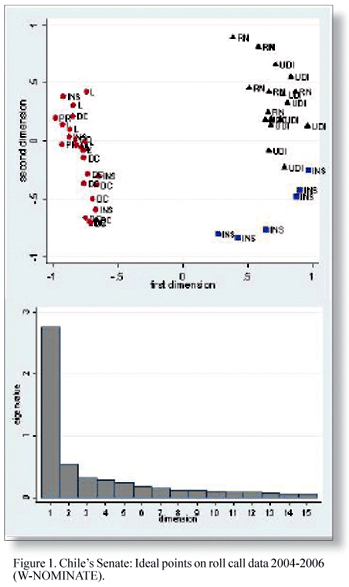
The results of applying W-NOMINATE to the roll call data are plotted in Figure 1.14 The top panel maps senators' ideal points on two dimensions, while the bottom panel provides information on the dimensionality of voting. Senators from the Concertación coalition are represented by round nodes and labels indicating whether the senator is from the Christian Democratic Party (DC), the Radical Social-Democratic Party (PR), one of the other leftist parties comprising the Concertación (L), or is an appointed senator (INS). Elected senators from the Alianza coalition are represented by triangular nodes and labels indicating the initials of the senator's party (UDI or RN). Appointed senators associated with Alianza are represented by squared nodes.
]]> Overall, W-NOMINATE does a very good job in predicting individual choices on the plenary floor, with the proportion of correctly predicted votes at 90.8%. The aggregate proportional reduction in error, measuring how well the model classifies choices beyond a random baseline, is .63. The geometric mean probability, measuring fit based on the log-likelihood function, is .80.15 Both measures, which are comparable across legislatures, reflect a good statistical fit.16
The distribution of senators' ideal points derived from the roll call analysis resembles the bipolar mapping ascribed to the lower chamber. All senators from Concertación are grouped together in one area of the first dimension, with senators from Alianza clustered on the opposite side.17 Although differences within coalitions are very small on this dimension, the rank ordering of partisan medians follows the conventional expectations of the partisan literature: at the far left we find socialists and other non-DC members of Concertación (-.84), closely followed by the DC (-.74), with RN (.58) and the UDI (.76) on the far right. On roll call votes, appointed senators appear positioned closely to their fellow (popularly elected) coalition members.
The second, less-relevant dimension captures intra-coalition differences, particularly within Alianza. Appointed senators (all placed at the lower end of the map) stand opposite to RN senators (all on the upper side of the map). UDI senators are positioned in the middle, somewhat closer to RN. Within Concertación, the second dimension captures some differences between a group of DC senators (at the lower end) and a cohort of senators from the ideological left (at the upper end). It should be noted that regardless of coalition, most appointed senators are positioned at the low end of the second dimension. Senator Enrique Silva Cimma, a social-democrat and former President of the Radical Party, is the only appointed senator with an ideal point clearly on the upper end.
The low dimensionality of voting patterns is reflected in the eigenvalues reported in the lower panel of Figure 1. A sharp drop occurs when moving from the first to the second dimension. The number of correctly classified votes increases by just over 2% when moving from a one-dimensional to a two-dimensional model. Overall, the values suggest that a one-dimensional model accurately describes voting behaviour in the Chilean Senate.
Applying a non-parametric model to this data, such as Poole's OPTIMAL CLASSIFICATION, may further illuminate this issue. It also provides a solid check on the results, since this method does not rely on particular distributional assumptions about errors.18 As Rosenthal and Voeten (2004) note, in legislatures where party discipline is high but not uniform across partisan blocs, the assumption of independent and identically distributed errors is likely to be violated. Under such circumstances, a non-parametric method may prove more appropriate. The one dimension rank ordering of legislators resulting from applying OPTIMAL CLASSIFICATION to this data appears in Figure 2.
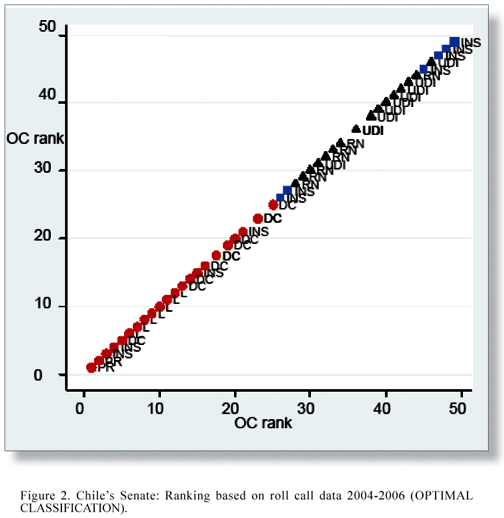
The OPTIMAL CLASSIFICATION analysis successfully predicts 91.9% of votes. The ranking of legislators shown in Figure 2 is highly correlated with the one stemming from W-NOMINATE's first dimension (Spearman's rank correlation is .96). The distribution of partisan preferences matches conventional ideological rankings and no cross-coalition overlap exists.
]]> The so-called "military bloc" comprising four senators appointed by the National Security Council and one elected UDI senator is ranked at one end. This group includes three former members of the military junta under Pinochet — Senators Jorge Martínez (Navy), Julio Canessa (Army) and Rodolfo Stange (Carabineros) —, as well as former Air Force chief Ramón Vega and another past head of the Carabineros, Fernando Cordero. Within Alianza, the two senators nearest the centre were appointed by the Supreme Court — Enrique Zurita and Marcos Aburto. Both senators became members of the Supreme Court during the military government and continued serving there until their appointment to the Senate.Within Concertación, the three senators from the Radical Social-Democratic Party (one of them appointed) are ranked at one end, while most senators from the Christian Democratic Party appear closer to the centre. For example, Senator Adolfo Zaldívar, former President of the Christian Democratic Party, is ranked 19 (to the right of the Concertación median and just beside his party's median), while senators from the PS/PPD parties are all positioned next to each other, occupying rankings 6-12. The senator taking the median position in the chamber, Jorge Lavandero, was present for relatively few votes before being expelled from the Christian Democratic Party and resigning amid a criminal scandal.19 The actual median of the entire chamber lay in between the Concertación and Alianza. The other three senators sharing the highest (more moderate) ranking within Concertación are Alejandro Foxley, Gabriel Valdés and Carmen Frei. Former President Eduardo Frei is ranked next to them.
In sum, the results derived from the roll call analysis convey two salient findings. Firstly, they reveal a party system organized around two cohesive coalitions that tend to adopt distinct policy positions. There is no separate centre composed of "moderate" members of both coalitions; instead, voting behaviour reflects unity between leftists and Christian Democrats, foes before the military coup. Secondly, the voting data is accurately captured in one dimension. The central force driving positions in the first dimension is coalitional affiliation. Within the two coalitions, differences tend to reflect the ideological ranking of parties commonly present in the literature on Chilean politics. It should also be noted that both blocs differ not only in electoral goals and ideological positions, but also in their adherence to the government or the opposition. These overlapping influences also contribute to the bipolar clustering of positions observed on the first dimension.
Bill Coauthorship Links
The underlying dimensions of political conflict in Congress should also be reflected in the analysis of coauthorship ties. After all, voting and coauthoring represent two sets of bill-related choices made by the same senators. The constraints and incentives behind coauthorship choices, however, are unlike those surrounding plenary votes. This leads us to expect greater cross-partisan connections and higher dimensionality.
The data utilized in this section includes information on all 101 bills coauthored by senators between March 2002 and March 2006. These bills, representing 56% of all bills introduced by senators during this period, have a median of four coauthors per proposal. The relationships developed between senators can be conceptualized as a network of policy links and in this coauthorship network, about ¼ of all possible dyadic ties are actually present. A major difficulty in applying techniques common to the analysis of roll call data to coauthorship data lies in attempting to infer the position of non-authors regarding the bills introduced. Unlike roll call votes, where members present must choose to support, oppose or abstain, the only concrete information available when a bill is introduced is a partial count of supporters. In a recent paper, Alemán et al. (2009) develop a method to map ideal points that overcomes this problem by analysing the symmetric matrix capturing dyadic relations.
The procedure begins with transforming a two-mode matrix (legislators x bills) into a one-mode matrix (legislators x legislators), reflecting the strength of coauthorship ties present inside the chamber. This valued matrix representing the count of ties between each pair of legislators is then transformed into an agreement matrix indicating the relative proportion of ties each legislator has with others. Principal components analysis (using singular value decomposition) is then applied to the normalized agreement matrix. The positions of Chilean senators, derived by applying this method to the coauthorship data, appear in the top panel of Figure 3. Labels and node shapes are identical to those used in prior figures.
]]>
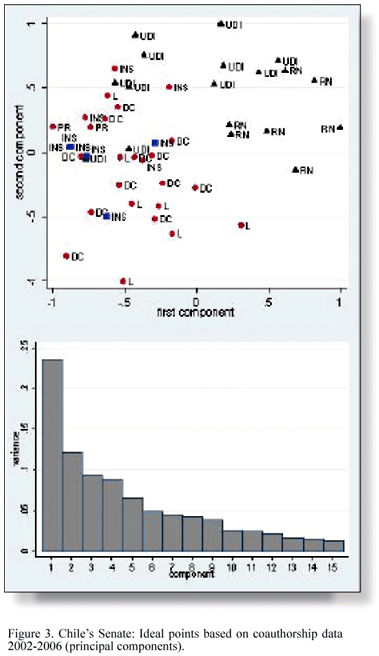
The bottom panel of Figure 3 provides information on the dimensionality of the data, indicating the proportion of variance explained by each component. As expected, the results provided by examining coauthorship data reflect a more multidimensional setting than that rendered through analysing voting data. The first component captures an important part of the variance present in the data (close to ¼); however, the decrease when moving to subsequent components is not as steep as the eigenvalue decline in the voting data. The two-dimensional map (formed by the first two components) presented in Figure 3 explains 35.7% of the variance.
While the results from analysing coauthorship data do not reflect the same bipolar distribution of positions common to roll call data, coalitions and partisan groupings still tend to pull their senators close to each other. For example, all senators from RN appear very near each other on the right of the map, almost all UDI senators are positioned high on the second component moving from centre-left to centre-right, and nearly all senators from the governing coalition are placed on the left of the map. All appointed senators appear on the left of the map: those associated with Alianza are grouped closely together and generally lower than those associated with the Concertación.
Ideological differences appear to be captured better by the second than by the first component. The ordering of party medians on the second component follows conventional ideological rankings: UDI = .622, RN = .194, DC = -.136, and non-DC members of Concertación = -.397. The correlation between senators' positions on the second component and their first dimension positions derived using W-NOMINATE on voting data is .483. In turn, senators' positions on the first component have a rather high correlation of .582 with the second dimension positions derived with W-NOMINATE.20 This dimension captured mainly intra-coalition differences, particularly within Alianza.
It can be argued that mathematical dimensions do not necessarily coincide with the substantive ideological dimension, which appears to run in a diagonal fashion. One technique that aids in interpreting the structure of spatial maps is using the estimated dimensions as independent variables in a simple linear regression where the dependent variable is a characteristic of the legislators, such as ideology (Poole 2005, 152-154). The line drawn in Figure 4 was created by regressing the score produced by the first dimension of W-NOMINATE (proxy for ideology) on the two coauthorship components.21 Coefficients of the independent variables are used as elements of a normal vector, which together with its reflection contribute to form the line added in Figure 4. Moving from "ideological left" to "ideological right", the predicted values run from the lowest to the highest possible. The dashed line perpendicular to this vector signals the ideological centre; senators below it "should be" from the ideological centre-left, and those above it "should be" from the ideological centre-right.
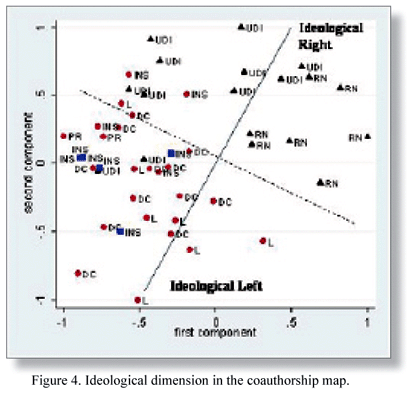
]]> As can be seen, most senators are grouped with fellow coalition members on the same side of the projected ideological vector. All popularly elected senators from Concertación are on the expected side of the substantive ideological dimension. A few senators, however, appear closer to their political rivals despite ideological disparities.
Coauthorship ties, motivated by more complex political concerns than floor votes, bring some members together despite salient ideological differences. A closer examination of the results suggests that those adopting more ideologically extreme positions in roll call votes are also quite likely to build substantive coauthorship links with members of the opposing coalition. This is in fact the opposite of what Alemán et al. (2009) expect when analysing cosponsorship and voting in Argentina and the USA. They see legislators who take extreme positions as less susceptible to party pressure when voting, which to them suggests greater ideological consistency in both activities. They present evidence from the USA and the Argentine lower chambers supporting the view that extremists take more consistent positions than more moderate legislators. This association for Chilean senators can be appreciated in Figure 5, which plots the rank of legislators by employing optimal classification on roll call votes (on the vertical axis) and positions derived from the second component by employing principal components on bill coauthorship data (on the horizontal axis).
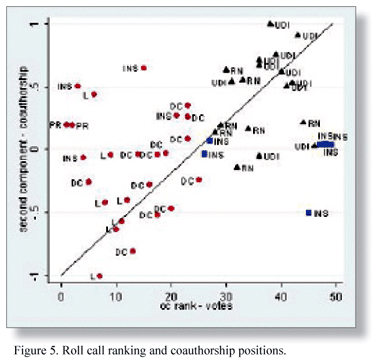
This figure illustrates that senators that the roll call analysis had placed at the extremes are closer to the centre in the coauthorship analysis.22 The so-called "military bloc", positioned opposite the leftist parties in the analysis of floor voting, is actually rather close to the non-DC members of Concertación in terms of bill initiation. Although the left and the "military bloc" seldom share the same side on divided roll call votes, they still have policy agreements that are reflected in bill initiation patterns. Non-ideological interests can often lead to strange bedfellows. While this interesting finding deserves attention in future research, one rationale for this pattern is worth mentioning here.
The introductory discussion noted that senators tend to possess greater leeway to act independently from partisan or constituent pressures at the initiation stage than at the voting stage, thereby creating a less limiting context for individual senators to signal specific constituencies, fellow legislators or both. When coauthorship is viewed as a signalling device, the occasional choice of a rather extreme opponent as a coauthor can be interpreted as a valuable signal. For example, a Concertación senator pushing a proposal seen as lacking in ideological content may be better able to promote it as a consensual bi-coalitional bill if it is also associated with a known right-winger, vis-à-vis a more moderate member of the opposition. If the more extreme member is committed to the bill, presumably all moderates from the opposing coalition should support it on the floor of Congress. However, frequent coauthoring with extreme adversaries is likely to entail some costs with constituents and party militants. Despite common cross-coalition links, the evidence indicates that in the end, elected senators are significantly more likely to coauthor bills with a fellow coalition member.
Six appointed senators adopting rather extreme positions in roll call votes appear as moderates in terms of coauthorship. Strictly speaking, appointed senators do not possess electoral constituencies that constrain their behaviour, and the influence of coalition leaders over them is presumably lower than that imposed upon elected senators. Therefore, any differences in behaviour between coauthoring bills and voting cannot be explained by such constraints. Their occasional appeal as extremists provides one possible explanation; however, their defining trait — the lack of an electoral connection — may also play a role. Their more central position on coauthoring may reflect their inability to use bill coauthoring as an electoral asset, providing another reason why opposition members may prefer to coauthor with them rather than with future competitors at the district level. Their non-partisan status may also contribute to give bills a non-ideological appearance. In turn, appointed senators seeking to make a policy impact may see building some bridges with the governing party as their only chance.
The substantive links developed between members of different partisan groups can be visualized in Figure 6, with lines indicating coauthorship ties and line width reflecting the strength of such connections (i.e., number of bills coauthored).23
]]>
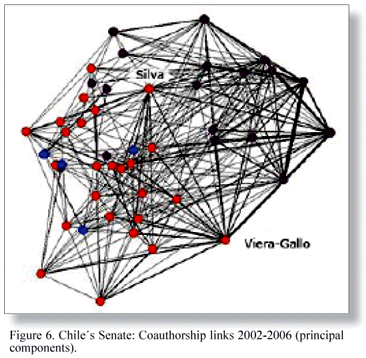
The figure illustrates a tightly connected group of opposition senators at the top right of the figure (all RN senators and half of the UDI senators belong to this group). A more populous and less compact cross-partisan group that includes almost all Concertación senators is placed to the left of the figure. Differences within Alianza again separate RN senators from the appointed senators (with UDI members somewhere in between).
Figure 6 also highlights the distinctive role played by a few senators who serve as bridges between these groups. This is particularly evident in the case of Concertación Senators José Antonio Viera-Gallo and Enrique Silva Cimma. Senator Viera-Gallo, a socialist, appears to play a central linking role between a sizeable group of Concertación senators (on the lower part of the second dimension) and a small cadre of Alianza senators (particularly members of RN). Appointed Senator Silva Cimma seems to play a similar role with a different and somewhat smaller group of Concertación and UDI senators. While it can be said that these two senators occupy a middle position between both groups in the network, they are not ideological centrists (according to OPTIMAL CLASSIFICATION, Silva Cimma and Viera-Gallo are ranked 3 and 11, respectively).
Conclusion
The empirical analyses of roll call and coauthorship data present complementary views on the behaviour of Chilean senators. On the one hand, the analysis of voting reveals a rather unidimensional world, with two distinct clusters matching coalitional affiliation. When dissent exists in plenary votes, coalition unity tends to prevail. In addition, senators' positions along the main dimension correlate with conventional ideological rankings. These findings coincide with those presented by Alemán and Saiegh (2007) in their analysis of voting behaviour in the Chamber of Deputies. Despite variations in incentives and institutional context, the results confirm that coalitions in the Senate also act as highly cohesive teams at voting time. On the other hand, the analysis of coauthorship data reveals a more complex pattern of associations. While parties continue to act as magnets in drawing their members together, coalitions are less clearly separated. In particular, an important group of senators associated with the Alianza appears closer to the governing coalition with regard to coauthoring.
These findings contribute to the debate on the reconfiguration of the Chilean party system by illuminating senators' behaviour in two fundamental legislative tasks. In terms of coalitional strength, both analyses portray a closely-linked government coalition. Neither roll call votes nor coauthorship patterns reveal substantive fissures within Concertación. However, the opposition coalition appears comparatively more divided along partisan lines. This is consistent with earlier empirical work focusing on the lower chamber that portrays Alianza as less unified on floor votes. The results also suggest that the elimination of appointed senators (institucionales) — effective since the second trimester of 2006 — would probably lead to greater cohesiveness within Alianza. However, the inverse of this change is a potential lowering of cross-coalition links in bill initiation.
]]> In conclusion, the bipolarity evident in roll call votes and electoral competition does not necessarily imply that senators' behaviour is consistently polarized along ideological lines. Some years have passed since the end of military rule, and the daily interplay of congressional politics has forced adversaries to work together and find policy commonalities. This has contributed to a resurgence in substantial links between ideological opposites that has not eroded the unity of purpose that coalitions show in floor votes. Further research on the evolution of coauthorship networks and motivations behind coauthorship links should improve our overall understanding of congressional politics in Chile.
Notes
1 Carey (2002), Morgenstern (2004), Alemán and Saiegh (2007).
2 Its full name is Concertación de Partidos por la Democracia.
3 Its full name is Alianza por Chile. The alliance had different names in the past (e.g., Unión por Chile; Democracia y Progreso).
4 Magar et al. (1998) and Dow (1998).
5 Carey (2002) and Rabkin (1996).
6 See, for example, Tironi and Agüero (1999), Torcal and Mainwaring (2003) and Carey (2002).
7 Most permanent committees in the Senate have five members.
]]> 8 Presumably such legislators are, in the long run, compensated for occasional losses with policy and/or electoral benefits.9 Alemán et al. (2009).
10 This is the negative agenda power that Cox and McCubbins (2005) highlight in their influential book, Setting the Agenda.
11 A coalition (or party) is rolled when a majority of its members vote against a bill and the bill passes nonetheless. See Cox and McCubbins (2005).
12 Poole (2005), chapter 1.
13 See Poole and Rosenthal (1997), and Poole (2005), chapter 4.
14 Figures made with STATA 10.1 software.
15 When APRE = 0 the model explains nothing, while APRE = 1 means a perfect classification. GMP varies from .5 (no better than flipping a coin) to 1.
16 For instance, in an analysis of the U.S. Senate (90th Congress) commonly used as a W-NOMINATE example, APRE = .476 and GMP = .706.
17 The actual placement on the left or right is arbitrary. Here, it follows conventional ideological perceptions.
]]> 18 See Poole (2005), chapter 3.19 He was replaced by Senator Vasquez.
20 The correlation with the first dimension is .350.
21 This is: wnominate1 = α + β1 × PC1 + β2 × PC2, resulting in: wnominate1 = -0.036 + 0.351 × PC1 + 0.703 × PC2. The associated standard errors are 0.1948 and 0.2184 (both statistically significant at conventional levels). The R2 is 0.2838.
22 This pattern is also present when coauthorship positions from the first component are plotted instead of those from the second component. This figure is not shown, but available upon request.
23 In this map, produced with Netdraw software, all nodes are round and only colour divides Concertación senators (red) from popularly elected Alianza members (black) and appointed senators associated with Alianza (blue). Borgatti, Stephen P. 2002. Netdraw Network Visualization. Harvard, MA: Analytic Technologies.
Bibliographical References
Alemán, Eduardo. 2006. Policy gatekeepers in Latin American legislatures. Latin American Politics and Society 48 (3): 125-155. [ Links ]
]]>Alemán, Eduardo, and Sebastián M. Saiegh. 2007. Legislative preferences, political parties and coalition unity in Chile. Comparative Politics 39 (3): 253-272. [ Links ]
Alemán, Eduardo, Ernesto Calvo, Mark P. Jones, and Noah Kaplan. 2009. Comparing cosponsorship and roll-call ideal points. Legislative Studies Quarterly 34 (1): 87-116. [ Links ]
Balla, Steven J., and Christine L. Nemacheck. 2000. Position-taking, legislative signaling, and non-expert extremism: Cosponsorship of managed care legislation in the 105th House of Representatives. Congress & the Presidency 27 (2): 163-188. [ Links ]
Campbell, James. 1982. Cosponsorship legislation in the U.S. Congress. Legislative Studies Quarterly 7:415-422. [ Links ]
Carey, John M. 2002. Parties, coalitions and the Chilean Congress in the 1990s. In Legislative politics in Latin America, ed. Scott Morgenstern and Benito Nacif, 223-253. Cambridge: Cambridge University Press. [ Links ]
]]>Cox, Gary W., and Mathew D. McCubbins. 2005. Setting the agenda: Responsible party government in the U.S. House of Representatives. Cambridge: Cambridge University Press. [ Links ]
Crisp, Brian, Kristin Kanthak, and Jenny Leijonhufvud. 2004. The reputations legislators build: With whom should representatives collaborate? American Political Science Review 98 (4): 703-716. [ Links ]
Dow, Jay K. 1998. A spatial analysis of candidates in dual member districts: The 1989 Chilean senatorial elections. Public Choice 97:119-142. [ Links ]
Highton, Benjamin, and Michael Rocca. 2005. Beyond the roll-call arena: The determinants of position taking in Congress. Political Research Quarterly 58 (2): 303-316. [ Links ]
Kessler, Daniel, and Keith Krehbiel. 1996. Dynamics of cosponsorship. American Political Science Review 90 (3): 555-566. [ Links ]
]]>Light, Paul C. 1992. Forging legislation. New York: W. W. Norton. [ Links ]
Londregan, John B. 2000. Legislative institutions and ideology in Chile. New York: Cambridge University Press. [ Links ]
Magar, Eric, Marc R. Rosenblum, and David Samuels. 1998. On the absence of centripetal incentives in double-member districts: The case of Chile. Comparative Political Studies 31 (6): 714-739. [ Links ]
Mayhew, David. 1974. Congress: The electoral connection. New Haven: Yale University Press. [ Links ]
Morgenstern, Scott. 2004. Patterns of legislative politics: Roll-call voting in Latin America and the United States. Cambridge: Cambridge University Press. [ Links ]
]]>Poole, Keith. 2005. Spatial models of parliamentary voting. Cambridge: Cambridge University Press. [ Links ]
Poole, Keith, and Howard Rosenthal. 1997. Congress: A political-economic history of roll call voting. Oxford: Oxford University Press. [ Links ]
Rabkin, Rhoda. 1996. Redemocratization, electoral engineering, and party strategies in Chile, 1989-1995. Comparative Political Studies 29 (3): 335-356. [ Links ]
Rosenthal, Howard, and Erik Voeten. 2004. Analyzing roll calls with perfect spatial voting: France 1946-1958. American Journal of Political Science 48 (3): 620-632. [ Links ]
Tironi, Eugenio, and Felipe Agüero. 1999. ¿Sobrevivirá el actual paisaje político chileno? Estudios Públicos 74:151-168. [ Links ]
]]>Torcal, Mariano, and Scott Mainwaring. 2003. The political re-crafting of social bases of party competition: Chile 1973-95. British Journal of Political Science 33:55-84. [ Links ]
Toro Maureira, Sergio. 2007. Conducta legislativa ante las iniciativas del Ejecutivo: Unidad de los bloques políticos en Chile. Revista de Ciencia Política 27 (1): 23-41. [ Links ]
Wawro, Gregory. 2000. Legislative entrepreneurship in the U.S. House of Representatives. Ann Arbor: University of Michigan Press. [ Links ]
Submitted in October, 2008.
Accepted in December, 2008.
* The author would like to thank Sebastián M. Saiegh, Ernesto Calvo, Marina Lacalle, Aldo Ponce, Chris Nicholson and the anonymous reviewers for their comments and suggestions.
]]>