<?xml version="1.0" encoding="ISO-8859-1"?><article xmlns:mml="http://www.w3.org/1998/Math/MathML" xmlns:xlink="http://www.w3.org/1999/xlink" xmlns:xsi="http://www.w3.org/2001/XMLSchema-instance">
<front>
<journal-meta>
<journal-id>1981-3821</journal-id>
<journal-title><![CDATA[Brazilian Political Science Review (Online)]]></journal-title>
<abbrev-journal-title><![CDATA[Braz. political sci. rev. (Online)]]></abbrev-journal-title>
<issn>1981-3821</issn>
<publisher>
<publisher-name><![CDATA[Associação Brasileira de Ciência Política]]></publisher-name>
</publisher>
</journal-meta>
<article-meta>
<article-id>S1981-38212008000100002</article-id>
<title-group>
<article-title xml:lang="en"><![CDATA[Relationships between institutional economics of cooperation and the political economy of trust]]></article-title>
</title-group>
<contrib-group>
<contrib contrib-type="author">
<name>
<surname><![CDATA[Vargas-Hernández]]></surname>
<given-names><![CDATA[José G.]]></given-names>
</name>
<xref ref-type="aff" rid="A01"/>
</contrib>
</contrib-group>
<aff id="A01">
<institution><![CDATA[,University of Guadalajara Centre for Economic-Administrative Sciences ]]></institution>
<addr-line><![CDATA[ Mexico]]></addr-line>
</aff>
<pub-date pub-type="pub">
<day>00</day>
<month>00</month>
<year>2008</year>
</pub-date>
<pub-date pub-type="epub">
<day>00</day>
<month>00</month>
<year>2008</year>
</pub-date>
<volume>3</volume>
<numero>se</numero>
<fpage>0</fpage>
<lpage>0</lpage>
<copyright-statement/>
<copyright-year/>
<self-uri xlink:href="http://socialsciences.scielo.org/scielo.php?script=sci_arttext&amp;pid=S1981-38212008000100002&amp;lng=en&amp;nrm=iso"></self-uri><self-uri xlink:href="http://socialsciences.scielo.org/scielo.php?script=sci_abstract&amp;pid=S1981-38212008000100002&amp;lng=en&amp;nrm=iso"></self-uri><self-uri xlink:href="http://socialsciences.scielo.org/scielo.php?script=sci_pdf&amp;pid=S1981-38212008000100002&amp;lng=en&amp;nrm=iso"></self-uri><abstract abstract-type="short" xml:lang="en"><p><![CDATA[The aim of this paper is to analyse the relationship between institutional economics of cooperation and the political economy of trust. Transactions costs, principal-agent theory, market power, increasing-returns theory and value creation, strategic management: competitive forces, resource-based theory, organisational knowledge and learning, strategic choice theory and collective efficiency theory are reviewed. Lastly, the political economy of trust is sustained.]]></p></abstract>
<kwd-group>
<kwd lng="en"><![CDATA[Cooperation]]></kwd>
<kwd lng="en"><![CDATA[Institutional economics]]></kwd>
<kwd lng="en"><![CDATA[Political economy]]></kwd>
<kwd lng="en"><![CDATA[Trust]]></kwd>
</kwd-group>
</article-meta>
</front><body><![CDATA[ <p><font size="4" face="verdana"><b>Relationships between institutional economics    of cooperation and the political economy of trust</b></font></p>     <p>&nbsp;</p>     <p>&nbsp;</p>     <p><font size="2" face="Verdana"><b>Jos&eacute; G. Vargas&#45;Hern&aacute;ndez</b></font></p>     <p><font size="2" face="Verdana">Centre for Economic&#45;Administrative Sciences,    University of Guadalajara, Mexico</font></p>     <p><font face="verdana" size="2">Replicated from <b>Brazilian Political Science    Review (Online)</b>, Rio de Janeiro, v.2, n.1, Jan/Jun. 2008.</font></p>     <p>&nbsp;</p>     <p>&nbsp;</p> <hr size="1" noshade>     <p><font size="2" face="Verdana"><b>ABSTRACT</b></font></p>     <p><font size="2" face="Verdana">The aim of this paper is to analyse the relationship between institutional economics of cooperation and the political economy of trust. Transactions costs, principal&#45;agent theory, market power, increasing&#45;returns theory and value creation, strategic management: competitive forces, resource&#45;based theory, organisational knowledge and learning, strategic choice theory and collective efficiency theory are reviewed. Lastly, the political economy of trust is sustained.</font></p>     ]]></body>
<body><![CDATA[<p><font size="2" face="Verdana"><b>Keywords:</b> Cooperation; Institutional economics; Political economy; Trust.</font></p> <hr size="1" noshade>     <p>&nbsp;</p>     <p>&nbsp;</p>     <p><font size="3" face="Verdana"><b>Introduction</b></font></p>     <p><font size="2" face="Verdana">The objective of this paper is to analyse the relationship between institutional economics of cooperation and the political economy of trust. In recent years, a great amount of scholarly attention has been devoted to the political, social, and economic consequences of cooperation. A central question in interdisciplinary literature is the relationship between cooperation and trust. Some researchers (Cook 2000; Kramer and Tyler 1996; Ostrom 1998) have already considered the role of trust in facilitating cooperation. If trust facilitates cooperative behaviour, it is possible that there is a link between the attitude of trust and behavioural outcomes. Previous research (Scholz and Lubell 1998a, 1998b) has already provided some evidence of a link between trust and cooperation. Research on collective action assumes trust increases the likelihood of cooperation.</font></p>     <p><font size="2" face="Verdana">A new instrument for value production in the global economy is the cooperative mode of organisation characterised as interdependent, long&#45;term relations among autonomous organisations. Productive and creative cooperation is considered a potential incentive&#45;related coordination in many spheres and activities among governments and their agencies, firms of the industrial and commercial sectors, cooperation and conflict between firms, between workers and management, and between firms and functions that must contribute to a major economic project.</font></p>     <p>&nbsp;</p>     <p><font size="3" face="Verdana"><b>Institutional Economics of Cooperation</b></font></p>     <p><font size="2" face="Verdana">Institutions have an important influence on individuals' expectations of the future, locking in the system to a stable long&#45;run structure. Cooperative structures can emerge as an 'institution' defined as an observed regularity in the behaviour and/or actions of individuals or groups when they encounter a similar set of circumstances (Witt 1987, 87). Social institutions are sets of rules that structure social interactions in particular ways. These rules provide information about how people are expected to act in particular situations, can be recognized by those who are members of the relevant group as the rules to which others conform in these situations, and  structure the strategic choices of actors in such a way as to produce equilibrium outcomes (Knight &#91;1968&#93; 1982, 54).</font></p>     <p><font size="2" face="Verdana">The self&#45;organisational perspective sustains that institutionalisation of competitive or cooperative behaviours results from micro&#45;macro interactions more than coordination costs and asset specificity. New organisational economics explains theoretically the different modes of vertical relations between firms, suppliers and customers.</font></p>     ]]></body>
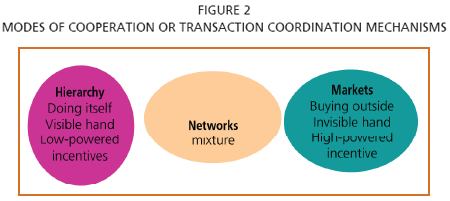
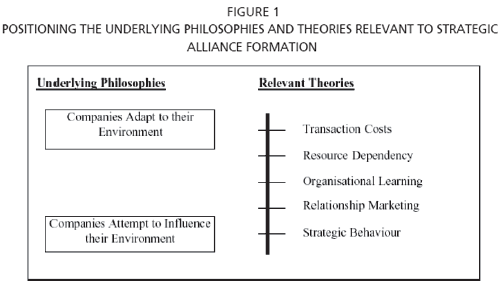
<body><![CDATA[<p><font size="2" face="Verdana">Trust may be sustained by appropriate institutions (Levi 1998, 77&#45;101; Hardin forthcoming). Trust facilitates co–operative exchanges between actors to make commitments to behave without the monitoring and enforcement of an external agent reducing the transaction costs of cooperation (Coleman 1990; Putnam 1993; Granovetter 1985; Kreps 1990). An institutional account of trust is made by Farrell and Knight (2003). Institutions may exert an independent effect on trustworthiness. The evolution of institutions may be expected to have an impact on trustworthiness and cooperation among individuals.</font></p>     <p><font size="2" face="Verdana">Transaction costs, principal&#45;agent theory, market power, increasing returns theory, strategic management (competitive forces, resource&#45;based view (RBV), organisational knowledge and learning), strategy choice theory and resource dependency theory, offer complementary explanations of cooperative arrangements. Transaction cost theory focuses on cost minimisation; relationship marketing on providing superior customer value; organisational learning on knowledge; strategic behaviour theory on profit maximisation; and resource dependency theory on obtaining resources (<a href="#fig01">Figure 1</a>).</font></p>     <p><a name="fig01"></a></p>     <p>&nbsp;</p>     <p align="center"><img src="/img/revistas/s_bpsr/v3nse/a10fig01.gif"></p>     <p>&nbsp;</p>     <p><font size="2" face="Verdana"><b>Transaction costs</b></font></p>     <p><font size="2" face="Verdana">Transaction cost theory rests on the assumption that markets are most efficient for minimising transaction costs. Transactions are defined as the goods or services being transferred across some boundary (Williamson 1981). Transaction costs include the planning, monitoring and adapting of transfers under the various governance structure choices available (Mosakowski 1991).</font></p>     <p><font size="2" face="Verdana">Firms internalise transaction costs through ownership when this exceeds the benefits of non&#45;ownership (Williamson 1991). Transaction costs deals with environmental factors: asset specificity, technological uncertainty and small numbers bargaining, which may lead to more control and to provide incentives to look for other arrangements such as quasi&#45;hierarchies or vertical integration to internalise the transaction (Hennart 1988; Osborn and Baughn 1990; Pisano 1990; Williamson 1987). There is a positive correlation between level of integration and degree of control.</font></p>     <p><font size="2" face="Verdana">Transaction costs economics explains the economic rationale behind the choice of different modes of cooperation or transaction coordination mechanisms. The three basic mechanisms are markets, hierarchies or firms and hybrid modes, including inter&#45;firm cooperation agreements. The minimisation of transaction costs is the basic principle in selecting institutional forms for different kinds of activities (<a href="#fig02">Figure 2</a>).</font></p>     ]]></body>
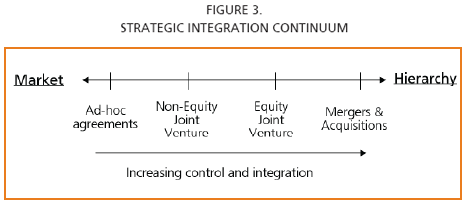
<body><![CDATA[<p><a name="fig02"></a></p>     <p>&nbsp;</p>     <p align="center"><img src="/img/revistas/s_bpsr/v3nse/a10fig02.gif"></p>     <p>&nbsp;</p>     <p><font size="2" face="Verdana">A strategic integration continuum (Sparling and Cook 2000) of organisational forms ranging from market through network to vertically integrated firms (Williamson 1985; Powell and Di Maggio 1991) is shown in <a href="#fig03">Figure 3</a>.</font></p>     <p><a name="fig03"></a></p>     <p>&nbsp;</p>     <p align="center"><img src="/img/revistas/s_bpsr/v3nse/a10fig03.gif"></p>     <p>&nbsp;</p>     <p><font size="2" face="Verdana">The task of transaction cost economics is to give theoretical support to decision&#45;making on vertical integration, cooperation or collaboration, use of the market or a combination of them. Each one can be efficient, depending on the expected level of transaction costs involved. Hennart (1988) has identified a competition/cooperation tension from the transaction cost perspective. When assets are highly specific, transaction theory predicts instability of alliances, while resource&#45;based theory predicts that an alliance can be stable if the benefits are evenly divided between members.</font></p>     ]]></body>
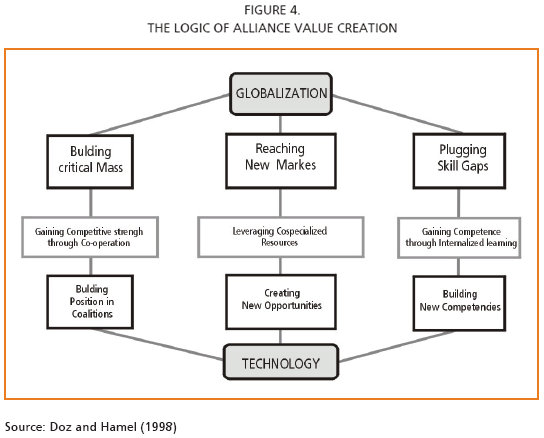
<body><![CDATA[<p><font size="2" face="Verdana">Mutual trust reduces the transactional costs of risky social interactions. (Coleman 1990, 306&#45;10) According to Putnam, "Norms such as those that under gird social trust evolve because they lower transaction costs and facilitate cooperation." (Putnam 1993, 172). The social capital investments embodied in the construction of inter&#45;firm learning through cooperation give rise to economies of scale and scope, although the effects may be non&#45;linear over time. Social capital benefits in the form of new relationships of trust and cooperation can extend a non&#45;profit's limited resources.  Cooperation becomes less attractive with the depletion of opportunities. Transaction costs involve different forms of learning through interaction, such us technology transfers.</font></p>     <p><font size="2" face="Verdana">Transaction cost economists have examined the "temporal specificity" or the importance of timing in receipt of goods or services, which are related to coordination costs (Masten, Meehan and Snyder 1991). Cooperative agreements are combinations of internalisation and market exchanges, and the best one is when transaction costs are intermediate and not high enough to justify vertical integration.</font></p>     <p><font size="2" face="Verdana"><b>Principal&#45;agent theory</b></font></p>     <p><font size="2" face="Verdana">Cooperation arrangements, such us a strategic alliance, involve principal&#45;agent&#45;problems. Agency theory explains how to best organise relationships in which the principal determines the work, which the agent undertakes (Eisenhardt 1985). Agency theory underpins the relationship between the principal and the agent.</font></p>     <p><font size="2" face="Verdana">Agency theory explains the economic rationality of voluntarily providing costly information to partners in cooperative situations (Fleisher 1991). The theory argues that under conditions of incomplete information and uncertainty, which characterise most business settings, two agency problems arise: adverse selection and moral hazard. Adverse selection is the condition under which the principal cannot ascertain if the agent accurately represents his ability to do the work for which he is being paid. Any cooperation agreement between legally independent entities often creates a moral hazard problem. Moral hazard is the condition under which the principal cannot be sure if the agent has put forth maximal effort (Eisenhardt 1989).</font></p>     <p><font size="2" face="Verdana"><b>Market power</b></font></p>     <p><font size="2" face="Verdana">A cooperative strategy may enable collaborating firms to increase their position within a market.</font></p>     <p><font size="2" face="Verdana"><b>Increasing&#45;returns theory and value creation</b></font></p>     <p><font size="2" face="Verdana">The logic of alliance value creation is shown in <a href="#fig04">Figure 4</a>.</font></p>     <p><a name="fig04"></a></p>     ]]></body>
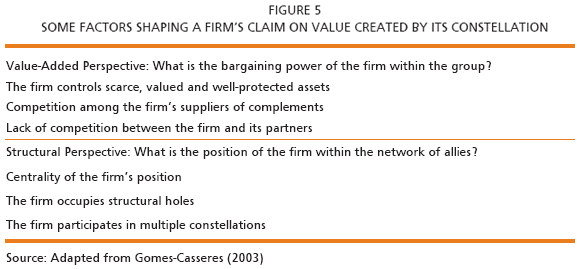
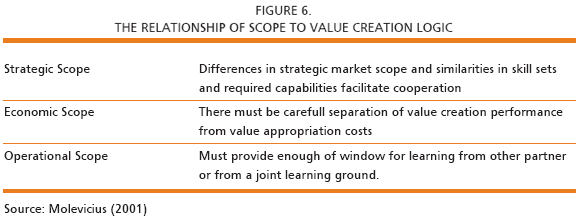
<body><![CDATA[<p>&nbsp;</p>     <p align="center"><img src="/img/revistas/s_bpsr/v3nse/a10fig04.gif"></p>     <p>&nbsp;</p>     <p><font size="2" face="Verdana">Some factors shaping a firm's claim on value created by its constellation are shown in <a href="#fig05">Figure 5</a>.</font></p>     <p><a name="fig05"></a></p>     <p>&nbsp;</p>     <p align="center"><img src="/img/revistas/s_bpsr/v3nse/a10fig05.gif"></p>     <p>&nbsp;</p>     <p><font size="2" face="Verdana">To sustain successful cooperation, partners need to learn in five key areas: the environment in which the alliance will operate, the tasks to be performed, the process of collaboration, the partners' skills, and their intended and emerging goals. Thus, the strategic, operational and economic scope plays a very important role in the alliance management and value creation logics (Molevicius 2001). <a href="#fig06">Figure 6</a> shows the relationship of scope to value creation logic.</font></p>     <p><a name="fig06"></a></p>     ]]></body>
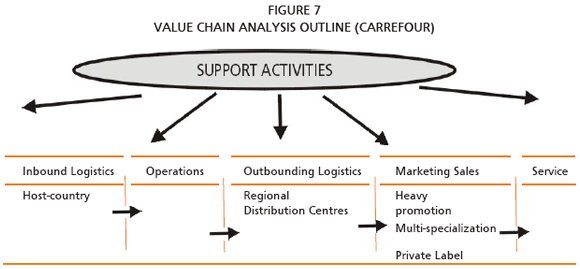
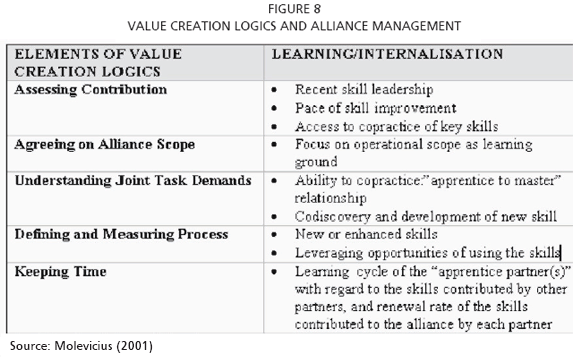
<body><![CDATA[<p>&nbsp;</p>     <p align="center"><img src="/img/revistas/s_bpsr/v3nse/a10fig06.gif"></p>     <p>&nbsp;</p>     <p><font size="2" face="Verdana">An example of value chain analysis is outlined for Carrefour (<a href="#fig07">Figure 7</a>).</font></p>     <p><a name="fig07"></a></p>     <p>&nbsp;</p>     <p align="center"><img src="/img/revistas/s_bpsr/v3nse/a10fig07.gif"></p>     <p>&nbsp;</p>     <p><font size="2" face="Verdana">Collaboration is bound to be difficult if partners fail to understand each other's goals. A joint effort at learning about the competitive, technological and market environment develops mutual trust, shares understanding and reduces risks. <a href="#fig08">Figure 8</a> shows the value creation logics and alliance management.</font></p>     <p><a name="fig08"></a></p>     ]]></body>
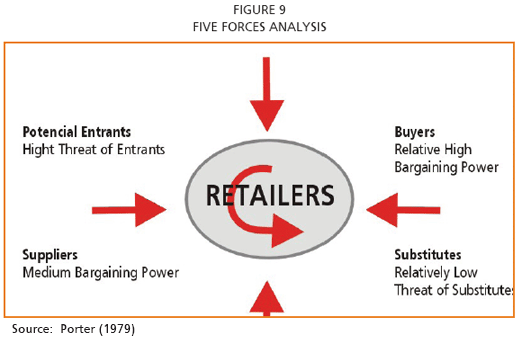
<body><![CDATA[<p>&nbsp;</p>     <p align="center"><img src="/img/revistas/s_bpsr/v3nse/a10fig08.gif"></p>     <p>&nbsp;</p>     <p><font size="2" face="Verdana"><b>Strategic management: Competitive forces, resource&#45;based theory,    organisational knowledge and learning</b></font></p>     <p><font size="2" face="Verdana">Competitive forces intend to maximize profits by improving a firm's competitive position against rivals. The five forces analysis is shown in <a href="#fig09">Figure 9</a>.</font></p>     <p><a name="fig09"></a></p>     <p>&nbsp;</p>     <p align="center"><img src="/img/revistas/s_bpsr/v3nse/a10fig09.gif"></p>     <p>&nbsp;</p>     <p><font size="2" face="Verdana">A few authors have shown the way forward in the search for a theory of regulation of inter&#45;firm cooperation. The emergence of resource&#45;based approaches to strategy has provided broader bases upon which to build a theory of inter&#45;firm cooperation. The resource&#45;based view (RBV) seeks to bridge the gap between theories of internal organisational capabilities and external competitive strategy theories.</font></p>     ]]></body>
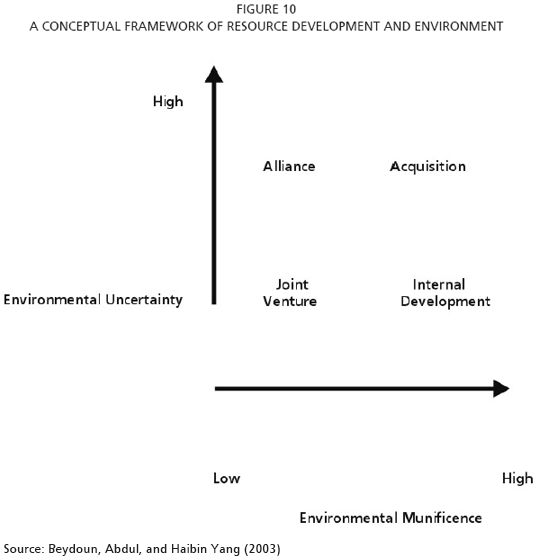
<body><![CDATA[<p><font size="2" face="Verdana">The RBV suggests that differences in firms' performance are related to the variance in firms' resources. Firms are bundles of resources and those inter&#45;firm relationships allow them to obtain or retain resources, and enable exploitation of learning capabilities that will allow reduced risks to enter into new competence areas. Performance risk is attributable to the alliance's interaction with its environment. The RBV suggests that a company with strong internal capabilities can enjoy an enduring competitive advantage and achieve superior performance (Dierickx and Cool 1989).</font></p>     <p><font size="2" face="Verdana">Resource dependency theory (Pfeffer and Salancik 1978) suggests that in order to survive, organisations must constantly interact with their environment, either to exchange resources or their products. Organisations seek to gain control over the uncertainty of their external environment through cooperative arrangements to guarantee stable flows of resources (Pfeffer and Salancik 1978; Galaskiewicz 1985; Miner, Amburgey and Stearns 1990; Stearns, Hoffman and Heide 1987). Complexity and dynamism are closely related to environment uncertainty.</font></p>     <p><font size="2" face="Verdana">Dess and Beard (1984) identified three dimensions of task environments: munificence, complexity and dynamism. Complexity and dynamism are usually thought of as determinants of environmental uncertainty (Thompson 1967). Cooperation is seen as a mechanism to understand and cope with uncertainty (Spekman et al. 1998). Environment can be conceptualised by two categories: uncertainty and munificence (Beydoun and Yang 2003). A conceptual Framework of Resource Development and Environment is shown in <a href="#fig10">Figure 10</a>.</font></p>     <p><a name="fig10"></a></p>     <p>&nbsp;</p>     <p align="center"><img src="/img/revistas/s_bpsr/v3nse/a10fig10.gif"></p>     <p>&nbsp;</p>     <p><font size="2" face="Verdana">Organisational knowledge and learning explains that tacit knowledge can be transferred under cooperative strategies. The transfer of know&#45;how, product of complex organisational routines, can be severely impaired unless the organisation is itself replicated (Kogut 1988, 323).</font></p>     <p><font size="2" face="Verdana">The management of a portfolio of multiple cooperative agreements raises new questions about the cooperative capabilities of firms. In managing a portfolio of alliances, there may be systematic differences in the cooperative capabilities that firms build up. Having more experience and learning with alliances may affect the relative success of those firms with alliances (Lyles 1988).</font></p>     <p><font size="2" face="Verdana">Research has "neglected concepts/measures that focus on alliance management" (Spekman et al. 1998) as an explanatory variable for alliance success. Challenges of increasing complexity and conflicting objectives from different alliance partners confront the management experience of a firm that seeks out ties with partners who could help it manage such strategic interdependencies. Firms have to focus on a series of organisational and strategic issues when they are at the centre of an alliance network. "Networks can be thought of as a higher stage of alliances, for in the strategic center there is a conscious desire to influence and shape the strategies of the partners, and to obtain from partners ideas and influences in return" (Lorenzoni and Baden&#45;Fuller 1995, 157). The critical dimensions of a centre are to create value for its partners, to act as a leader, rule&#45;setter and capability&#45;builder, and to structure and set up the network strategy.</font></p>     ]]></body>
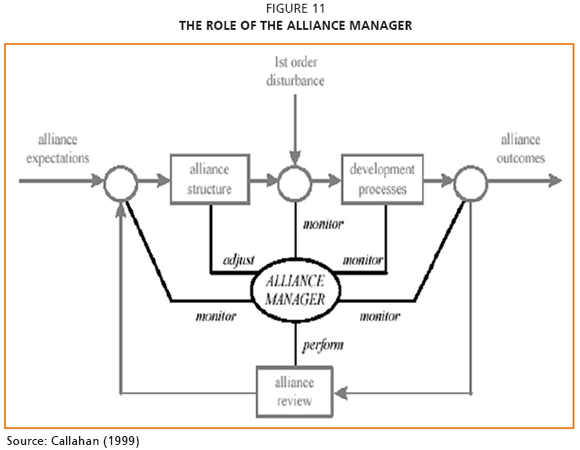
<body><![CDATA[<p><font size="2" face="Verdana">Callahan (1999) outlines the components of the role of the alliance manager in the first order control model (see <a href="#fig11">Figure 11</a>).</font></p>     <p><a name="fig11"></a></p>     <p>&nbsp;</p>     <p align="center"><img src="/img/revistas/s_bpsr/v3nse/a10fig11.gif"></p>     <p>&nbsp;</p>     <p><b><font size="2" face="Verdana">Strategy choice theory</font></b></p>     <p><font size="2" face="Verdana">Strategic choice theory supports alliances as complementary to the new core competence, allowing for organisations a strategy of choice for a governance structure to capitalise on functional expertise and contract other needed functions (Fagre and Wells 1982; Kogut 1988; Porter 1980). Specifying performance and control is required, as is taking into consideration flexibility of non&#45;equity contractual arrangements in such a way that the closer the alliance is to the strategy of the new venture, the more likely it would be to choose an equity structure.</font></p>     <p><font size="2" face="Verdana">McGee, Dowling and Megginson (1995) support the strategic choice theory by finding a relationship between business strategy and use of alliances. Strategy for cooperative arrangements between firms is an important variable in the effectiveness of a strategic alliance. The use of cooperative arrangements is growing and having a positive impact on firm performance when the alliance was chosen in a functional area that the firm's management team had prior experience (McGee, Dowling and Megginson 1995; Wisnieski and Dowling 1997). Organisations have to choose the right cooperative strategy to achieve their objectives through cooperation with other organisations, rather than in competition with them (Child and Faulkner 1998); see <a href="#fig12">Figure 12</a>.</font></p>     <p><a name="fig12"></a></p>     <p>&nbsp;</p>     ]]></body>
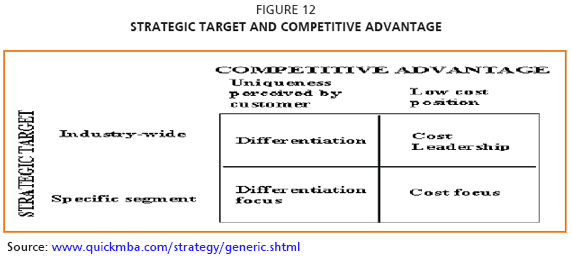
<body><![CDATA[<p align="center"><img src="/img/revistas/s_bpsr/v3nse/a10fig12.gif" border="0" usemap="#Map"> <map name="Map"><area shape="rect" coords="49,237,303,257" href="http://www.quickmba.com/strategy/generic.shtml" target="_blank"> </map></p>     <p>&nbsp;</p>     <p><b><font size="2" face="Verdana">Collective efficiency</font></b></p>     <p><font size="2" face="Verdana">Collective efficiency has two aspects to it: external economies (the passive dimension) that clustered agents accrue by virtue of their location, and joint action (the active dimension), benefits that arise from deliberate and active cooperation between local agents to obtain external gains. For example, under the allocate efficiency principle, some allied nations cooperate to integrate collectives of highly mobile peacekeeping forces to maintain security with diminished resources.</font></p>     <p><font size="2" face="Verdana">A cluster is a concentrated grouping together of firms and institutions, which have horizontal and vertical relationships, and linkages based on cooperation to achieve synergy. Marshall used the term "constructive cooperation" to describe the economies of scale and scope gained from cooperation.</font></p>     <p><font size="2" face="Verdana">Partnerships must be inclusive and involve the active participation of many members, which involves a balancing of the power differentials that exist within the partnership (Sampson et al. 1989, 491). Regard therefore has to be given to group dynamics, to the symbolic importance of including and excluding particular interests and individuals and to showing proper respect for the joint activity and all the partners involved in it, e.g., by avoiding an 'inner core' of the 'senior' parties (Webb 1991, 239).</font></p>     <p><font size="2" face="Verdana">In horizontal partnerships, firms endowed with specific skills, that compete typically on the market, linked with other companies of complementary core competencies, cooperate in product development, basic research, cross&#45;transfer of new technologies and manufacturing capabilities. Horizontal partnerships enable firms to serve new markets, sharing risks and learning. Regional cluster prototypes are shown in <a href="#fig13">Figure 13</a>.</font></p>     <p><a name="fig13"></a></p>     <p>&nbsp;</p>     <p align="center"><img src="/img/revistas/s_bpsr/v3nse/a10fig13.gif"></p>     ]]></body>
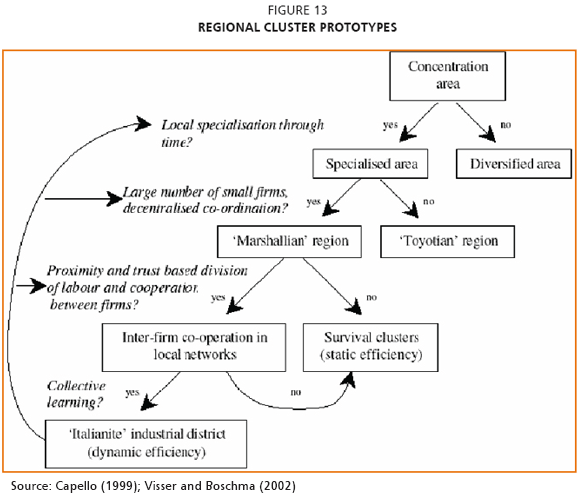
<body><![CDATA[<p>&nbsp;</p>     <p><font size="2" face="Verdana">However, there are some "externalities of joint action" (Nadvi 1999), such as the reputation basis created by local standard regulation. An example of environmental externality occurs when cooperation between firms in one line of activity affects other lines of activity, such as the case when research and development (R&amp;D) affects pricing.</font></p>     <p><font size="2" face="Verdana">Collective efficiency involves social and technological innovation. Social innovation transforms a non&#45;cooperative behaviour into a cooperative&#45;minded setting, which increases the propensity to cooperate in technological innovation.</font></p>     <p><font size="2" face="Verdana">Minimising transaction costs and reducing principal&#45;agent problems can be achieved through arrangements of relational contracting and long&#45;term networks based on mutual trust. Cooperative behaviour is further enhanced by direct communication between actors and agents, and stabilised through the mechanisms of rules and trust, which can overcome opportunistic behaviours and rivalry.</font></p>     <p>&nbsp;</p>     <p><font size="3" face="Verdana"><b>The Political Economy of Trust</b></font></p>     <p><font size="2" face="Verdana">Farrell and Knight (2003, 8) define trust as "a set of expectations held by one party that another party or parties will behave in an appropriate manner with regard to a specific issue".</font></p>     <p><font size="2" face="Verdana">Promoting trust and cooperation between firms, institutions and local government can achieve economic gains. "What is needed is sufficient trust to initiate cooperation and a sufficiently successful outcome to reinforce trusting attitudes and underpin more substantial, and risky, collaborative behavior. (…) Virtuous spirals of trust and effective collaboration need to be established." (Webb 1991, 237).</font></p>     <p><font size="2" face="Verdana">Harmonious relationships between firms, communities and government are built upon trust and mutuality. "Social trust in complex modern settings can arise from two related sources — norms of reciprocity and networks of civic engagement." (Putnam 2003, 171). The reciprocity characteristic of networks enhances cooperation because: (1) it increases the costs of defection, (2) it fosters robust norms of reciprocity, (3) it facilitates communication and improves information flows, and (4) it embodies past success at collaboration and provides a blueprint for future cooperation (Putnam 2003, 172). Empirical studies on the evolution of cooperative network relationships that focus on inter&#45;organisational relationships include Human and Provan (2000).</font></p>     <p><font size="2" face="Verdana">Economic cooperation is impacted by trust. Trust is a key element and decisive factor in the cooperation relationship, which allows real commitment and confidence among the partners to develop a vision for the long&#45;run. A seriously flawed cooperative working relationship will doom any agreement to failure, although a flawed written agreement can always be modified. Interdependent decisions to cooperate are influenced by the degree of cooperation already present in the organisations and may lead to an equilibrium in which cooperative alliances prevail.</font></p>     ]]></body>
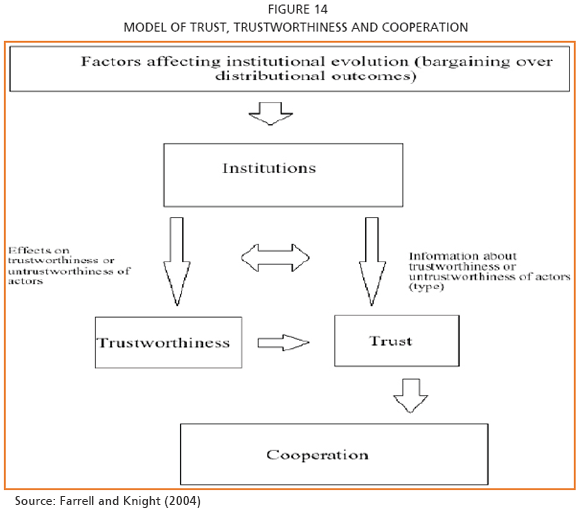
<body><![CDATA[<p><font size="2" face="Verdana">In the more socialised version of trust, it has been observed that norms of fairness may enter into transactions between parties and firms. Often in relational contracting, norms of conflict resolution within the relation develop (Macneil 1978). Trust is an interdependent action of social cooperation for mutual benefit (Coleman 1990, 306&#45;10).</font></p>     <p><font size="2" face="Verdana">Rational choice theory explains that trust is a factor in social interactions characterised by risk, as Coleman (1990, 91) puts it: "They are situations in which the risk one takes depends on the performance of the other actor." There is a positive relationship between trust and social capital, on the one hand, and political and economic success. Researchers attempt to document the various ways in which trust and social capital can improve the performance of political and economic systems. Putnam (1993, 2000) intends to demonstrate that the political and economic success of large social communities is linked to generalised trust and cooperation, though.</font></p>     <p><font size="2" face="Verdana">Luhmann (2000) distinguishes between person&#45; and system&#45;trust according to the recipient of trust. Person&#45;trust is aimed at individuals and system&#45;trust refers to the trust in abstract systems of relationships (Krause 1996) such as organisations. Thus, trust can exist towards the representative and at the same time towards the partner organisation.</font></p>     <p><font size="2" face="Verdana">Rational choice theory of institutions explains why individual actors come to trust each other, sets out different forms of cooperation and helps one understand the differences between them. The "encapsulated interest" account of trust combined with institutional theory provides the basis for comparative analysis of trust in explaining cooperation (Farell 2000). The "encapsulated interest" account of trust specifies the relationship between institutions and trust predicated as trustworthiness in a three&#45;party relationship (Hardin, forthcoming), with people's own self&#45;interest involved.</font></p>     <p><font size="2" face="Verdana">Farrell and Knight specify this relationship between trust and social institutions, in a middle ground between Hardin (forthcoming) and the broader conception of social trust (Putnam 1993). According to Farrell and Knight's account (2003, 8), "the existence of institutions in common social settings can affect the trustworthiness of the actors in those situations in such a way as to create ongoing relationships of trust among those actors." The authors suggest a model of the relationship between institutions and trust among actors. Institutions give actors an incentive to behave in a trustworthy or untrustworthy manner and/or affect social beliefs about the trustworthiness or untrustworthiness of actors through their dissemination of information about the expected behaviour of others.</font></p>     <p><font size="2" face="Verdana">Trust and trustworthiness become relevant when the social cooperation cannot be reduced to simple institutional compliance. Cooperation inherent in institutional compliance is different from cooperation through the use of the concepts of trust and trustworthiness. Thus, in any relationship among institutions, trust and social cooperation are relevant. "Cooperation through compliance with institutional rules in particular social settings affects an actor's beliefs about the propensity of others to cooperate (their level of trustworthiness) in similar settings which affects that actor's willingness to cooperate at some subsequent point in time in that same social setting." (Farrell and Knight 2003, 10&#45;11.) Changes in trustworthiness and in trust between actors lead to changes in the extent and form of cooperation. The model the authors set out specifies a set of causal relationships, which may plausibly affect trust and cooperation between actors (Farrell and Knight 2003, 15).</font></p>     <p><font size="2" face="Verdana">The model of trust, trustworthiness and cooperation appears "to provide a good account both of cooperation between actors, and the evolution of this cooperation over time, in relations between economic actors" (Farrell and Knight 2003, 38). A model of trust, trustworthiness and cooperation is shown in <a href="#fig14">Figure 14</a>.</font></p>     <p><a name="fig14"></a></p>     <p>&nbsp;</p>     <p align="center"><img src="/img/revistas/s_bpsr/v3nse/a10fig14.gif"></p>     ]]></body>
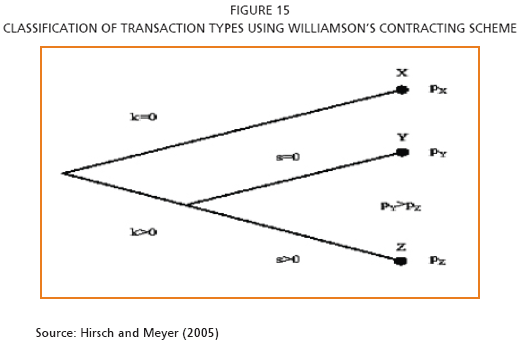
<body><![CDATA[<p>&nbsp;</p>     <p><font size="2" face="Verdana">Trust and confidence in the partner can rise unrealistically during the partner search and selection stages, only to drop as difficulties arise (Doz 1996). A simple contracting scheme in order to differentiate transactions and corresponding governance structures can be shown by using the classification of transaction types of Williamson's contracting scheme (<a href="#fig15">Figure 15</a>).</font></p>     <p><a name="fig15"></a></p>     <p>&nbsp;</p>     <p align="center"><img src="/img/revistas/s_bpsr/v3nse/a10fig15.gif"></p>     <p>&nbsp;</p>     <p><font size="2" face="Verdana">Hirsch and Meyer (2005) explain the scheme in the following terms: a good or service can be supplied either (1) by a general&#45;purpose technology or (2) by a special purpose technology. The latter has the advantage that it is more efficient for servicing steady&#45;state demands (e.g., for a cooperation partner), but it requires greater investments in transaction&#45;specific durable assets.</font></p>     <p><font size="2" face="Verdana">The variable k is used to measure the extent of transaction&#45;specific assets. An investment in the general&#45;purpose technology can be described by k=0 and, respectively, k&gt;0 when there have been transaction&#45;specific investments. According to Williamson (1989; 1999, 62&#45;63), classical market contracting suffices for the first kind, while for the latter type, unassisted market governance poses hazards. The question is whether individuals should trust each other. The authors call this the trust problem in cooperation. Game theory, and more specifically, the prisoner's dilemma, models this kind of trust decisions as shown in <a href="#fig16">Figure 16</a>.</font></p>     <p><a name="fig16"></a></p>     <p>&nbsp;</p>     ]]></body>
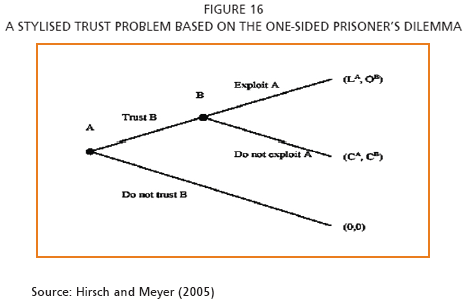
<body><![CDATA[<p align="center"><img src="/img/revistas/s_bpsr/v3nse/a10fig16.gif"></p>     <p>&nbsp;</p>     <p><font size="2" face="Verdana">The trust engendered in the partner will result in behaviour of benefit to the firm in the alliance. The political economy of trust in clusters of small firms geographically concentrated relies on cooperation to prosper.</font></p>     <p><font size="2" face="Verdana">Power has distribution aspects (Knight 1992). Power affects cooperation based on trustworthiness as a relational concept. Any agreement puts in place relationships of power and prescribes roles of action to the partners. Relationships of partnership include the distribution of power and may not be based on equality and equity. In the case of indigenous groups, real partnership must involve equitable cooperation. Power over relevant decisions can be shared but not necessarily equal power. There is not always a consensus on decisions and the degree of influence exerted by partners may not be equal. Thus, any asymmetries in power affect the trusting relationship of cooperation. There is a widespread perception of alliances as "weapons of power", instead of being "tools of management" (Schroeder 1976).</font></p>     <p><font size="2" face="Verdana">Firms frequently exercise their power over other firms to solicit compliance. Schroeder (1976) argues that alliances work, to a certain extent, as pacta de contrahendo, constraining and controlling the actions of the allies. To achieve a genuine relationship based on trust it is necessary to establish an appropriate culture linked to reputation sanctions (Kreps 1990) or to subject behaviours to external organisational forms or institutions that provide actors with a technology limiting their ability to use power (Levi 1998). Cultural and legal backgrounds of partners give rise to communication and coordination information asymmetry.</font></p>     <p><font size="2" face="Verdana">Explaining the relationship between trust, distrust and power in subcontracting relations among firms, Farrell and Knight (2003), Farrell (2005; 2004) have suggested that asymmetries of power are incompatible with trust up to a certain level, and even when trust and its outcomes are asymmetric, trust may be possible. Disparities of power prevent trust from arising and distrust is the likely outcome. Firms may prefer to exploit their power instead of nurturing complex relationships of cooperation (Helper 1993).</font></p>     <p><font size="2" face="Verdana">The level of confidence required by a partner is not static. Increasing the level of trust does not necessarily lead to a reduction in the control exerted by partners: "the trust level and the control level jointly and independently contribute to the level of confidence in partner cooperation" (Das and Teng 1998, 496). These authors deny any relationship between trust and control, suggesting that high levels both of control and of trust are necessary in international joint ventures compared with other forms of inter&#45;organisational cooperation. In a joint venture, a new corporate entity is formed. Thus, trust and control seem to be independent, but other contingencies should be included in the analyses of the relationship between trust and control in different forms of inter&#45;organisational cooperation, such as the impact that cultural factors have on these variables.</font></p>     <p><font size="2" face="Verdana">As a means of both enhancing cooperative behaviour and mitigating competitive conflicts, relational capital based on mutual trust and interaction at the individual level between alliance partners creates a basis for learning and know&#45;how transfer across the exchange interfaces (Kale, Singh and Perlmutter 2000). Canadian companies currently in Mexico concur and overwhelmingly view establishing trust as very important to doing business with Mexicans (Dennis and Beamish 1993).</font></p>     <p>&nbsp;</p>     <p><font size="3" face="Verdana"><b>Conclusion</b></font></p>     ]]></body>
<body><![CDATA[<p><font size="2" face="Verdana">There is a causal relationship between institutional economics of cooperation and the political economy of trust. Increasing the number of cooperative relationships and activities between agents increases the probability of cooperation, as they develop trust by working together over time. I argue that institutional cooperative arrangements should be considered in relation to economic gains for the parties and agents involved. These cooperative arrangements are the result of relationships of trust that aim to develop economies of scale, economies of scope and to internalize externalities, but also of the economic and political interests of agents and the institutional context in which cooperation takes place.</font></p>     <p><font size="2" face="Verdana">The political economy of trust plays a major role in the development and ultimate success of cooperative relationships between political and economic agents. Lack of opportunism in cooperative relations between economic agents and political actors is the result of trustworthiness of some kind between them. Cooperative practices are affected by changes in trust and by the bargaining weight of actors affected by the existing institutions. However, it has been almost impossible to completely isolate the effects of trust from other incentives adequately calculated about the relevant benefits and transaction costs of cooperation specific to different types of actors. Asymmetrical forms of cooperation seem to be likely when the existing institutional rules do not provide the required trust for bargaining between economic agents. A political economy model of trust, trustworthiness and cooperation provides a cooperative equilibrium between economic actors over time.</font></p>     <p>&nbsp;</p>     <p><font size="3" face="Verdana"><b>Bibliographical References</b></font></p>     <!-- ref --><p><font size="2" face="Verdana">Beydoun, Abdul, and Haibin Yang. 2003. Resource development and organization task environments. Dallas. School of Management, University of Texas at Dallas. <a href="http://cobacourses.creighton.edu/MAM/2004/papers/Beydoun%20and%20Yang.doc" target="_blank">http://cobacourses.creighton.edu/MAM/2004/papers/Beydoun%20and%20Yang.doc</a></font><!-- ref --><p><font size="2" face="Verdana">Callahan, John. 1999. Metrics for strategic alliance control. <I>R&amp;D Management </I>29 (4): 365&#45;78.    </font></p>     <!-- ref --><p><font size="2" face="Verdana">Capello, R. 1999. Spatial transfer of knowledge in high technology milieux: Learning versus collective learning processes. <I>Regional Studies</I>, no. 33:353&#45;65.    </font></p>     <!-- ref --><p><font size="2" face="Verdana">Child, J., and D. Faulker. 1998. <I>Strategies of cooperation: Managing alliances, networks, and joint ventures</I>. New York: Oxford University Press.    </font></p>     <!-- ref --><p><font size="2" face="Verdana">Coleman, James. 1990. <I>Foundations of social theory</I>. Cambridge, MA: Harvard University Press.    </font></p>     <!-- ref --><p><font size="2" face="Verdana">Cook, Karen, ed. 2000. <I>Trust in society</I>. New York: Russell Sage Foundation.    </font></p>     <!-- ref --><p><font size="2" face="Verdana">Das, T. K., and B. S. Teng. 1998. Between trust and control. Developing confidence in partner cooperation in alliances. <I>Academy of Management Review</I> 23 (3): 491&#45;512.    </font></p>     <!-- ref --><p><font size="2" face="Verdana">Dennis, Stevens, and Paul W Beamish. 1993. Forging alliances in Mexico. <I>Business Quarterly</I> 58 (2): 79&#45;84.    </font></p>     <!-- ref --><p><font size="2" face="Verdana">Dess, G. G., and D. W. Beard. 1984. Dimension of organizational task environments. <I>Administrative Science Quarterl</I> 29:52&#45;73.    </font></p>     <!-- ref --><p><font size="2" face="Verdana">Dierickx, I., and K. Cool. 1989.  Asset stock accumulation and sustainability of competitive advantage. <I>Management Science</I> 35:1504&#45;11.    </font></p>     <!-- ref --><p><font size="2" face="Verdana">Doz, Y. L. 1996. The evolution of cooperation in strategic alliances: Initial conditions or learning processes? <I>Strategic Management Journal</I> 17:55&#45;83.    </font></p>     <!-- ref --><p><font size="2" face="Verdana">______, and G. Hamel. 1998. <I>Alliance advantage: The art of creating value through partnering</I>. Boston, MA: Harvard Business School Press.    </font></p>     <!-- ref --><p><font size="2" face="Verdana">Eisenhardt, K. M. 1985. Control: Organizational and economic approaches. <I>Management  Science</I> 31:134&#45;49.    </font></p>     <!-- ref --><p><font size="2" face="Verdana">______. 1989. Agency theory: An assessment and review. <I>Academy of Management Review</I> 14:57&#45;74.    </font></p>     <!-- ref --><p><font size="2" face="Verdana">Fagre, N., and L. Wells. 1982. Bargaining power of multinationals and host governments. <I>Journal of International Business Studies</I> XIII (2): 9&#45;23.    </font></p>     <!-- ref --><p><font size="2" face="Verdana">Farrell, Henry. 2000. The political economy of trust: Exploring cooperation between    mechanical engineering firms in Emilia Romagna and Baden&#45;W&uuml;rttemberg.  Ph.D.   diss., Georgetown University.    </font></p>     <!-- ref --><p><font size="2" face="Verdana">______. 2004. Trust, distrust and power. In <I>Distrust</I>, ed. Russell Hardin. New York: Russell Sage Foundation.    </font></p>     <!-- ref --><p><font size="2" face="Verdana">______. 2005. Trust and political economy: Institutions and the sources of inter&#45;firm cooperation. Comp. Polit. Stud (June): 459–93</font><!-- ref --><p><font size="2" face="Verdana">______, and Jack Knight. 2003. Trust, institutions and institutional change: Industrial districts and the social capital hypothesis. <I>Politics and Society</I> 31 (4): 537&#45;66.    </font></p>     ]]></body>
<body><![CDATA[<!-- ref --><p><font size="2" face="Verdana">Fleisher, C. S. 1991. Using an agency&#45;based approach to analyze collaborative federated interorganizational relationships. <I>The Journal of Applied Behavioral Science</I> 27 (1): 116&#45;20.    </font></p>     <!-- ref --><p><font size="2" face="Verdana">Galaskiewicz, Joseph. 1985. Professional networks and the institutionalization of the single mind set. <I>American Sociological Review</I> 50:639&#45;58.    </font></p>     <!-- ref --><p><font size="2" face="Verdana">Gomes&#45;Casseres, Benjam&iacute;n. 2003. Competitive advantage in alliance constellations. <I>Strategic Organization</I> 1 (3): 327&#45;35.    </font></p>     <!-- ref --><p><font size="2" face="Verdana">Granovetter, Mark. 1985. Economic action and social structure: The problem of embeddedness. <I>American Journal of Sociology</I> 91:481&#45;510.    </font></p>     <!-- ref --><p><font size="2" face="Verdana">Hardin, Russell. Forthcoming. <I>Trust and trustworthiness</I>. New York: Russell Sage Foundation.    </font></p>     ]]></body>
<body><![CDATA[<!-- ref --><p><font size="2" face="Verdana">Helper, Susan. 1993. An exit&#45;voice analysis of supplier relations: The case of the US automobile industry. In <I>The embedded firm: On the socio&#45;economics of industrial networks</I>, ed. Gernot Grabber. London: Routledge.    </font></p>     <!-- ref --><p><font size="2" face="Verdana">Hennart, Jean&#45;Francois. 1988. A transaction costs theory of equity joint ventures. <I>Strategic Management Journal</I> 9:361&#45;74.    </font></p>     <!-- ref --><p><font size="2" face="Verdana">Hirsch, Bernhard, and Matthias Meyer. 2005. <I>The trust decision in cooperation viewed from investment theoretic perspectives</I>. Working paper, Otto Beisheim Graduate School of Management, Management Accounting and Management Control, in Vallendar, Germany.    </font></p>     <!-- ref --><p><font size="2" face="Verdana">Human, S., and K. Provan. 2000. Legitimacy building in the evolution of small&#45;firm multilateral networks: A comparative study of success and demise. <I>Administrative Science Quarterly</I> 45  (2): 327&#45;65.    </font></p>     <!-- ref --><p><font size="2" face="Verdana">Hynes, Niki, and Diane A. Mollenkopf. 1998. Strategic alliance formation: Developing a framework for research. Paper presented at the New Zealand Marketing Academy Conference, November 29&#45;December 2, at the Commerce Division Lincoln University in New Zealand.    </font></p>     ]]></body>
<body><![CDATA[<!-- ref --><p><font size="2" face="Verdana">Kale, P., H. Singh, and H. Perlmutter. 2000. Learning and protection of proprietary assets in strategic alliances: Building relational capital. Special issue, <I>Strategic Management Journal</I> 21 (3): 217&#45;37.    </font></p>     <!-- ref --><p><font size="2" face="Verdana">Knight, Jack. &#91;1968&#93; 1982. Institutions and social conflict. In<I> Collective Action</I>, ed. Russell Hardin. Baltimore: Johns Hopkins,    </font></p>     <!-- ref --><p><font size="2" face="Verdana">______. 1992. <I>Institutions and social conflict</I>. Cambridge: Cambridge University Press.    </font></p>     <!-- ref --><p><font size="2" face="Verdana">Kogut, B. 1988. Joint ventures: Theoretical and empirical perspectives. <I>Strategic Management Journal</I> 12:319&#45;32.    </font></p>     <!-- ref --><p><font size="2" face="Verdana">Kramer, Roderick, and Tom Tyler, eds. 1996. <I>Trust in organizations</I>. Thousand Oaks, CA: Sage.    </font></p>     ]]></body>
<body><![CDATA[<!-- ref --><p><font size="2" face="Verdana">Krause, D. 1996. <I>Lumann&#45;Lexikon</I>. Stuttgart: Enke.    </font></p>     <!-- ref --><p><font size="2" face="Verdana">Kreps, David M. 1990. Corporate culture and economic theory. In <I>Perspectives on positive political economy</I>, ed. J. E. Alt and K. A. Shepsle. Cambridge: Cambridge University Press.    </font></p>     <!-- ref --><p><font size="2" face="Verdana">Levi, Margaret. 1998. A state of trust. In <I>Trust and governance</I>, ed. V. Braithwaite and M. Levi. New York: Russell Sage Foundation.    </font></p>     <!-- ref --><p><font size="2" face="Verdana">Lorenzoni, G., and C. Baden&#45;Fuller. 1995. Creating a strategic center to manage a web of partners. <I>California Management Review</I> 37 (3):146&#45;63.    </font></p>     <!-- ref --><p><font size="2" face="Verdana">Luhmann, N. 2000. <I>Vertrauen. Ein Mechanismus zur Reduktion sozialer Komplexit&auml;t</I>. 4th ed. Stuttgart: Enke.    </font></p>     ]]></body>
<body><![CDATA[<!-- ref --><p><font size="2" face="Verdana">Lyles, M. 1988. Learning among joint venture&#45;sophisticated firms. In <I>Cooperative strategies in international business</I>, ed. F. Contractor and P. Lorange, 301&#45;16. Lexington, MA: Lexington Books.    </font></p>     <!-- ref --><p><font size="2" face="Verdana">Macneil, I. R. 1978. Contracts: Adjustments of long&#45;term economics relations under classical, neoclassical and relational contract law. <I>Northwestern University Law Review</I> 72:854&#45;906.    </font></p>     <!-- ref --><p><font size="2" face="Verdana">Masten, Scott E., James W. Meehan, and Edward A. Snyder. 1991. The costs of organization. <I>Journal of Law, Economics and Organization</I> 7:1&#45;25.    </font></p>     <!-- ref --><p><font size="2" face="Verdana">McGee, J. E., M. J. Dowling, and W. L. Megginson. 1995. Cooperative strategy and new venture performance: The role of business strategy and management experience. <I>Strategic Management Journal</I> 16 (7).    </font></p>     <!-- ref --><p><font size="2" face="Verdana">Miner, A. S., T. L. Amburgey, and T. M. Stearns. 1990. Interorganizational linkages and population dynamics: Buffering and transformational shields. Administrative Science Quarterly 5:689&#45;713.    </font></p>     ]]></body>
<body><![CDATA[<!-- ref --><p><font size="2" face="Verdana">Molevicius, Algis. 2001. Knowledge management in context of strategic alliance creation. Paper presented at Swedish&#45;Lithuanian seminar, University of Boras in Sweden. <a href="http://www.hb.se/bhs/seminar/semdoc/molevicius.htm" target="_blank">http://www.hb.se/bhs/seminar/semdoc/molevicius.htm</a></font><!-- ref --><p><font size="2" face="Verdana">Mosakowski, E. 1991. Organizational boundaries and economic performance: An empirical study of entrepreneurial computer firms. <I>Strategic Management Journal </I>12:115&#45;33.    </font></p>     <!-- ref --><p><font size="2" face="Verdana">Nadvi, Khalid. 1999. Collective efficiency and collective failure: The response of the Sialkot surgical instrument cluster to global quality pressures. <I>World Development</I> 27 (9): 1605&#45;26.    </font></p>     <!-- ref --><p><font size="2" face="Verdana">Osborn, R., and C. Baughn. 1990. Forms of interorganizational governance for multinational alliances. <I>Academy of Management Journal</I> 3:503&#45;19.    </font></p>     <!-- ref --><p><font size="2" face="Verdana">Ostrom, Elinor. 1998. A behavioral approach to the rational choice theory of collective action. <I>American Political Science Review</I> 92:1&#45;22.    </font></p>     <!-- ref --><p><font size="2" face="Verdana">Pfeffer, J., and G. R. Salancik. 1978. <I>The external control of organizations: A resource dependence perspective</I>. New York: Harper and Row Publishers.    </font></p>     <!-- ref --><p><font size="2" face="Verdana">Pisano, G. 1990. The R&amp;D boundaries of the firm: an empirical analysis. <I>Administrative Science Quarterly</I> 35:153&#45;76.    </font></p>     <!-- ref --><p><font size="2" face="Verdana">Porter, M. E. 1979. The structure within industries and companies' performance. <I>The Review of Economics and Statistics</I> 6 (1): 214&#45;27.    </font></p>     <!-- ref --><p><font size="2" face="Verdana">______. 1980. <I>Competitive strategy</I>. New York: Free Press.    </font></p>     <!-- ref --><p><font size="2" face="Verdana">Powell, W. W., and P. J. Di Maggio. 1991. <I>The new institutionalism in organizational analysis</I>. Chicago: The University of Chicago Press.    </font></p>     <!-- ref --><p><font size="2" face="Verdana">Putnam, Robert D. 1993. <I>Making democracy work: Civic traditions in modern Italy</I>. Princeton, NJ: Princeton University Press.    </font></p>     <!-- ref --><p><font size="2" face="Verdana">______. 2003. <I>Bowling alone: The collapse and revival of American community</I>. New York: Simon and Schuster.    </font></p>     <!-- ref --><p><font size="2" face="Verdana">Sampson, J. R., S. J. Scahill, J. B. P. Stephenson, L. Mann, and J. M. Connor. 1989. Genetic aspects of tuberous sclerosis in the west of Scotland. <I>Journal of Medical Genetics</I> 26:28&#45;31.    </font></p>     <!-- ref --><p><font size="2" face="Verdana">Scholz, John T., and Mark Lubell. 1998a. Adaptive political attitudes: Duty, trust, and fear as monitors of tax policy. <I>American Journal of Political Science</I> 42:903&#45;20.    </font></p>     <!-- ref --><p><font size="2" face="Verdana">______. 1998b. Trust and taxpaying: Testing the Heuristic approach to collective action. <I>American Journal of Political Science</I> 42:398&#45;417.    </font></p>     <!-- ref --><p><font size="2" face="Verdana">Schroeder, Paul. 1976. Alliances, 1815&#45;1945: Weapons of power and tools of management. In <I>Historical Dimensions of National Security</I>, ed. Klaus Knorr, 227&#45;62.  Kansas: University Press of Kansas.    </font></p>     <!-- ref --><p><font size="2" face="Verdana">Sparling, David, and Roberta Cook. 2000. Strategic alliances and joint ventures under NAFTA: Concepts and evidence. In <I>Policy harmonization and adjustment in the North American agricultural and food industry</I>, ed. R. M. Loyns, Karl Meilke, Ronald D. Knutson and Antonio Yunez&#45;Naude Winnipeg, CA: Friesen Printers.    </font></p>     <!-- ref --><p><font size="2" face="Verdana">Spekman, R., T. Forbes, I. Lynn, and T. MacAvoy. 1998. Alliance management: a view from the past and a look to the future. <I>Journal of Management studies</I> 32 (6).    </font></p>     <!-- ref --><p><font size="2" face="Verdana">Stearns, T., A. Hoffman, and J. Heide. 1987. Performance of commercial television stations as an outcome of interorganizational linkages and environmental conditions. <I>Academy of Management Journal</I> 30 (1): 71&#45;90.    </font></p>     <!-- ref --><p><font size="2" face="Verdana">Thompson, James D. 1967. <I>Organizations in action: Social science bases of administration</I>. New York: McGraw&#45;Hill.    </font></p>     <!-- ref --><p><font size="2" face="Verdana">Visser, E. J., and R. A. Boschma. 2004. Learning in districts. Novelty and lock&#45;in in a regional context. <I>European Planning Studies</I> 12 (6): 793&#45;808.    </font></p>     <!-- ref --><p><font size="2" face="Verdana">Webb, A. 1991. Coordination: A problem in public sector management. <I>Policy and Politics</I> 19:229&#45;41.    </font></p>     <!-- ref --><p><font size="2" face="Verdana">Williamson, O. E. 1981. The economics of organizations: The transaction cost approach. <I>American Journal of Sociology</I> 87 (3): 548&#45;77.    </font></p>     <!-- ref --><p><font size="2" face="Verdana">______. 1985. <I>The economic institutions of capitalism</I>. New York: Free Press.    </font></p>     <!-- ref --><p><font size="2" face="Verdana">______. 1987. <I>Markets and hierarchies: Analysis and antitrust implications</I>. New York: Free Press.    </font></p>     <!-- ref --><p><font size="2" face="Verdana">______. 1989. <I>Las instituciones econ&oacute;micas del capitalismo</I>. M&eacute;xico: Fondo de Cultura Econ&oacute;mica.    </font></p>     <!-- ref --><p><font size="2" face="Verdana">______. 1991. Comparative economic organization: The analysis of discrete structural alternatives. <I>Administrative Science Quarterly</I> 36:269&#45;96.    </font></p>     <!-- ref --><p><font size="2" face="Verdana">______. 1999. Public and private bureaucracies: A transaction cost economics perspective. <I>The Journal of Law, Economics and Organization</I> 15 (1): 306&#45;42.    </font></p>     <!-- ref --><p><font size="2" face="Verdana">Wisnieski, J. M., and M. J. Dowling. 1997. Strategic alliances in new ventures: Does governance structure affect new venture performance? In <I>Frontiers of Entrepreneurship Research</I>. Wellesley, MA: Babson College</font><!-- ref --><p><font size="2" face="Verdana">Witt, U. 1987. <I>Individualistische Grundlagen der Evolutorischen &Ouml;konomik</I>. Mohr Siebeck: T&uuml;bingen.    </font></p>     <p>&nbsp;</p>     <p>&nbsp;</p>     ]]></body>
<body><![CDATA[<p><font size="2" face="Verdana">Submitted in May, 2007.    <BR>   Accepted in May 2008</font></p>      ]]></body><back>
<ref-list>
<ref id="B1">
<nlm-citation citation-type="book">
<person-group person-group-type="author">
<name>
<surname><![CDATA[Beydoun]]></surname>
<given-names><![CDATA[Abdul]]></given-names>
</name>
<name>
<surname><![CDATA[Yang]]></surname>
<given-names><![CDATA[Haibin]]></given-names>
</name>
</person-group>
<source><![CDATA[Resource development and organization task environments]]></source>
<year>2003</year>
<publisher-loc><![CDATA[Dallas ]]></publisher-loc>
<publisher-name><![CDATA[School of Management, University of Texas at Dallas]]></publisher-name>
</nlm-citation>
</ref>
<ref id="B2">
<nlm-citation citation-type="journal">
<person-group person-group-type="author">
<name>
<surname><![CDATA[Callahan]]></surname>
<given-names><![CDATA[John]]></given-names>
</name>
</person-group>
<article-title xml:lang="en"><![CDATA[Metrics for strategic alliance control]]></article-title>
<source><![CDATA[R & D Management]]></source>
<year>1999</year>
<volume>29</volume>
<numero>4</numero>
<issue>4</issue>
<page-range>365-78</page-range></nlm-citation>
</ref>
<ref id="B3">
<nlm-citation citation-type="journal">
<person-group person-group-type="author">
<name>
<surname><![CDATA[Capello]]></surname>
<given-names><![CDATA[R.]]></given-names>
</name>
</person-group>
<article-title xml:lang="en"><![CDATA[Spatial transfer of knowledge in high technology milieux: Learning versus collective learning processes]]></article-title>
<source><![CDATA[Regional Studies]]></source>
<year>1999</year>
<numero>33</numero>
<issue>33</issue>
<page-range>353-65</page-range></nlm-citation>
</ref>
<ref id="B4">
<nlm-citation citation-type="book">
<person-group person-group-type="author">
<name>
<surname><![CDATA[Child]]></surname>
<given-names><![CDATA[J.]]></given-names>
</name>
<name>
<surname><![CDATA[Faulker]]></surname>
<given-names><![CDATA[D.]]></given-names>
</name>
</person-group>
<source><![CDATA[Strategies of cooperation: Managing alliances, networks, and joint ventures]]></source>
<year>1998</year>
<publisher-loc><![CDATA[New York ]]></publisher-loc>
<publisher-name><![CDATA[Oxford University Press]]></publisher-name>
</nlm-citation>
</ref>
<ref id="B5">
<nlm-citation citation-type="book">
<person-group person-group-type="author">
<name>
<surname><![CDATA[Coleman]]></surname>
<given-names><![CDATA[James]]></given-names>
</name>
</person-group>
<source><![CDATA[Foundations of social theory]]></source>
<year>1990</year>
<publisher-loc><![CDATA[Cambridge^eMA MA]]></publisher-loc>
<publisher-name><![CDATA[Harvard University Press]]></publisher-name>
</nlm-citation>
</ref>
<ref id="B6">
<nlm-citation citation-type="book">
<person-group person-group-type="author">
<name>
<surname><![CDATA[Cook]]></surname>
<given-names><![CDATA[Karen]]></given-names>
</name>
</person-group>
<source><![CDATA[Trust in society]]></source>
<year>2000</year>
<publisher-loc><![CDATA[New York ]]></publisher-loc>
<publisher-name><![CDATA[Russell Sage Foundation]]></publisher-name>
</nlm-citation>
</ref>
<ref id="B7">
<nlm-citation citation-type="journal">
<person-group person-group-type="author">
<name>
<surname><![CDATA[Das]]></surname>
<given-names><![CDATA[T. K.]]></given-names>
</name>
<name>
<surname><![CDATA[Teng]]></surname>
<given-names><![CDATA[B. S.]]></given-names>
</name>
</person-group>
<article-title xml:lang="en"><![CDATA[Between trust and control: Developing confidence in partner cooperation in alliances]]></article-title>
<source><![CDATA[Academy of Management Review]]></source>
<year>1998</year>
<volume>23</volume>
<numero>3</numero>
<issue>3</issue>
<page-range>491-512</page-range></nlm-citation>
</ref>
<ref id="B8">
<nlm-citation citation-type="journal">
<person-group person-group-type="author">
<name>
<surname><![CDATA[Dennis]]></surname>
<given-names><![CDATA[Stevens]]></given-names>
</name>
<name>
<surname><![CDATA[Beamish]]></surname>
<given-names><![CDATA[Paul W]]></given-names>
</name>
</person-group>
<article-title xml:lang="en"><![CDATA[Forging alliances in Mexico]]></article-title>
<source><![CDATA[Business Quarterly]]></source>
<year>1993</year>
<volume>58</volume>
<numero>2</numero>
<issue>2</issue>
<page-range>79-84</page-range></nlm-citation>
</ref>
<ref id="B9">
<nlm-citation citation-type="journal">
<person-group person-group-type="author">
<name>
<surname><![CDATA[Dess]]></surname>
<given-names><![CDATA[G. G.]]></given-names>
</name>
<name>
<surname><![CDATA[Beard]]></surname>
<given-names><![CDATA[D. W.]]></given-names>
</name>
</person-group>
<article-title xml:lang="en"><![CDATA[Dimension of organizational task environments]]></article-title>
<source><![CDATA[Administrative Science Quarterl]]></source>
<year>1984</year>
<volume>29</volume>
<page-range>52-73</page-range></nlm-citation>
</ref>
<ref id="B10">
<nlm-citation citation-type="journal">
<person-group person-group-type="author">
<name>
<surname><![CDATA[Dierickx]]></surname>
<given-names><![CDATA[I.]]></given-names>
</name>
<name>
<surname><![CDATA[Cool]]></surname>
<given-names><![CDATA[K.]]></given-names>
</name>
</person-group>
<article-title xml:lang="en"><![CDATA[Asset stock accumulation and sustainability of competitive advantage]]></article-title>
<source><![CDATA[Management Science]]></source>
<year>1989</year>
<volume>35</volume>
<page-range>1504-11</page-range></nlm-citation>
</ref>
<ref id="B11">
<nlm-citation citation-type="journal">
<person-group person-group-type="author">
<name>
<surname><![CDATA[Doz]]></surname>
<given-names><![CDATA[Y. L.]]></given-names>
</name>
</person-group>
<article-title xml:lang="en"><![CDATA[The evolution of cooperation in strategic alliances: Initial conditions or learning processes?]]></article-title>
<source><![CDATA[Strategic Management Journal]]></source>
<year>1996</year>
<volume>17</volume>
<page-range>55-83</page-range></nlm-citation>
</ref>
<ref id="B12">
<nlm-citation citation-type="book">
<person-group person-group-type="author">
<name>
<surname><![CDATA[Doz]]></surname>
<given-names><![CDATA[Y. L.]]></given-names>
</name>
</person-group>
<person-group person-group-type="editor">
<name>
</name>
<name>
<surname><![CDATA[Hamel]]></surname>
<given-names><![CDATA[G.]]></given-names>
</name>
</person-group>
<source><![CDATA[Alliance advantage: The art of creating value through partnering]]></source>
<year>1998</year>
<publisher-loc><![CDATA[Boston^eMA MA]]></publisher-loc>
<publisher-name><![CDATA[Harvard Business School Press]]></publisher-name>
</nlm-citation>
</ref>
<ref id="B13">
<nlm-citation citation-type="journal">
<person-group person-group-type="author">
<name>
<surname><![CDATA[Eisenhardt]]></surname>
<given-names><![CDATA[K. M.]]></given-names>
</name>
</person-group>
<article-title xml:lang="en"><![CDATA[Control: Organizational and economic approaches]]></article-title>
<source><![CDATA[Management Science]]></source>
<year>1985</year>
<volume>31</volume>
<page-range>134-49</page-range></nlm-citation>
</ref>
<ref id="B14">
<nlm-citation citation-type="journal">
<person-group person-group-type="author">
<name>
<surname><![CDATA[Eisenhardt]]></surname>
<given-names><![CDATA[K. M.]]></given-names>
</name>
</person-group>
<article-title xml:lang="en"><![CDATA[Agency theory: An assessment and review]]></article-title>
<source><![CDATA[Academy of Management Review]]></source>
<year>1989</year>
<volume>14</volume>
<page-range>57-74</page-range></nlm-citation>
</ref>
<ref id="B15">
<nlm-citation citation-type="journal">
<person-group person-group-type="author">
<name>
<surname><![CDATA[Fagre]]></surname>
<given-names><![CDATA[N.]]></given-names>
</name>
<name>
<surname><![CDATA[Wells]]></surname>
<given-names><![CDATA[L.]]></given-names>
</name>
</person-group>
<article-title xml:lang="en"><![CDATA[Bargaining power of multinationals and host governments]]></article-title>
<source><![CDATA[Journal of International Business Studies]]></source>
<year>1982</year>
<volume>XIII</volume>
<numero>2</numero>
<issue>2</issue>
<page-range>9-23</page-range></nlm-citation>
</ref>
<ref id="B16">
<nlm-citation citation-type="">
<person-group person-group-type="author">
<name>
<surname><![CDATA[Farrell]]></surname>
<given-names><![CDATA[Henry]]></given-names>
</name>
</person-group>
<source><![CDATA[The political economy of trust: Exploring cooperation between mechanical engineering firms in Emilia Romagna and Baden-Württemberg]]></source>
<year>2000</year>
</nlm-citation>
</ref>
<ref id="B17">
<nlm-citation citation-type="book">
<person-group person-group-type="author">
<name>
<surname><![CDATA[Farrell]]></surname>
<given-names><![CDATA[Henry]]></given-names>
</name>
</person-group>
<article-title xml:lang="en"><![CDATA[Trust, distrust and power]]></article-title>
<person-group person-group-type="editor">
<name>
<surname><![CDATA[Hardin]]></surname>
<given-names><![CDATA[Russell]]></given-names>
</name>
</person-group>
<source><![CDATA[Distrust]]></source>
<year>2004</year>
<publisher-loc><![CDATA[New York ]]></publisher-loc>
<publisher-name><![CDATA[Russell Sage Foundation]]></publisher-name>
</nlm-citation>
</ref>
<ref id="B18">
<nlm-citation citation-type="journal">
<person-group person-group-type="author">
<name>
<surname><![CDATA[Farrell]]></surname>
<given-names><![CDATA[Henry]]></given-names>
</name>
</person-group>
<article-title xml:lang="en"><![CDATA[Trust and political economy: Institutions and the sources of inter-firm cooperation]]></article-title>
<source><![CDATA[Comp. Polit. Stud (June)]]></source>
<year>2005</year>
<page-range>459-93</page-range></nlm-citation>
</ref>
<ref id="B19">
<nlm-citation citation-type="journal">
<person-group person-group-type="author">
<name>
<surname><![CDATA[Farrell]]></surname>
<given-names><![CDATA[Henry]]></given-names>
</name>
<name>
<surname><![CDATA[Knight]]></surname>
<given-names><![CDATA[Jack]]></given-names>
</name>
</person-group>
<article-title xml:lang="en"><![CDATA[Trust, institutions and institutional change: Industrial districts and the social capital hypothesis]]></article-title>
<source><![CDATA[Politics and Society]]></source>
<year>2003</year>
<volume>31</volume>
<numero>4</numero>
<issue>4</issue>
<page-range>537-66</page-range></nlm-citation>
</ref>
<ref id="B20">
<nlm-citation citation-type="journal">
<person-group person-group-type="author">
<name>
<surname><![CDATA[Fleisher]]></surname>
<given-names><![CDATA[C. S.]]></given-names>
</name>
</person-group>
<article-title xml:lang="en"><![CDATA[Using an agency-based approach to analyze collaborative federated interorganizational relationships]]></article-title>
<source><![CDATA[The Journal of Applied Behavioral Science]]></source>
<year>1991</year>
<volume>27</volume>
<numero>1</numero>
<issue>1</issue>
<page-range>116-20</page-range></nlm-citation>
</ref>
<ref id="B21">
<nlm-citation citation-type="journal">
<person-group person-group-type="author">
<name>
<surname><![CDATA[Galaskiewicz]]></surname>
<given-names><![CDATA[Joseph]]></given-names>
</name>
</person-group>
<article-title xml:lang="en"><![CDATA[Professional networks and the institutionalization of the single mind set]]></article-title>
<source><![CDATA[American Sociological Review]]></source>
<year>1985</year>
<volume>50</volume>
<page-range>639-58</page-range></nlm-citation>
</ref>
<ref id="B22">
<nlm-citation citation-type="journal">
<person-group person-group-type="author">
<name>
<surname><![CDATA[Gomes-Casseres]]></surname>
<given-names><![CDATA[Benjamín]]></given-names>
</name>
</person-group>
<article-title xml:lang="en"><![CDATA[Competitive advantage in alliance constellations]]></article-title>
<source><![CDATA[Strategic Organization]]></source>
<year>2003</year>
<volume>1</volume>
<numero>3</numero>
<issue>3</issue>
<page-range>327-35</page-range></nlm-citation>
</ref>
<ref id="B23">
<nlm-citation citation-type="journal">
<person-group person-group-type="author">
<name>
<surname><![CDATA[Granovetter]]></surname>
<given-names><![CDATA[Mark]]></given-names>
</name>
</person-group>
<article-title xml:lang="en"><![CDATA[Economic action and social structure: The problem of embeddedness]]></article-title>
<source><![CDATA[American Journal of Sociology]]></source>
<year>1985</year>
<volume>91</volume>
<page-range>481-510</page-range></nlm-citation>
</ref>
<ref id="B24">
<nlm-citation citation-type="">
<person-group person-group-type="author">
<name>
<surname><![CDATA[Hardin]]></surname>
<given-names><![CDATA[Russell]]></given-names>
</name>
</person-group>
<source><![CDATA[]]></source>
<year></year>
</nlm-citation>
</ref>
<ref id="B25">
<nlm-citation citation-type="book">
<person-group person-group-type="author">
<name>
<surname><![CDATA[Helper]]></surname>
<given-names><![CDATA[Susan]]></given-names>
</name>
</person-group>
<article-title xml:lang="en"><![CDATA[An exit-voice analysis of supplier relations: The case of the US automobile industry]]></article-title>
<person-group person-group-type="editor">
<name>
<surname><![CDATA[Grabber]]></surname>
<given-names><![CDATA[Gernot]]></given-names>
</name>
</person-group>
<source><![CDATA[The embedded firm: On the socio-economics of industrial networks]]></source>
<year>1993</year>
<publisher-loc><![CDATA[London ]]></publisher-loc>
<publisher-name><![CDATA[Routledge]]></publisher-name>
</nlm-citation>
</ref>
<ref id="B26">
<nlm-citation citation-type="journal">
<person-group person-group-type="author">
<name>
<surname><![CDATA[Hennart]]></surname>
<given-names><![CDATA[Jean-Francois]]></given-names>
</name>
</person-group>
<article-title xml:lang="en"><![CDATA[A transaction costs theory of equity joint ventures]]></article-title>
<source><![CDATA[Strategic Management Journal]]></source>
<year>1988</year>
<volume>9</volume>
<page-range>361-74</page-range></nlm-citation>
</ref>
<ref id="B27">
<nlm-citation citation-type="book">
<person-group person-group-type="author">
<name>
<surname><![CDATA[Hirsch]]></surname>
<given-names><![CDATA[Bernhard]]></given-names>
</name>
<name>
<surname><![CDATA[Meyer]]></surname>
<given-names><![CDATA[Matthias]]></given-names>
</name>
</person-group>
<source><![CDATA[The trust decision in cooperation viewed from investment theoretic perspectives: Working paper]]></source>
<year>2005</year>
<publisher-loc><![CDATA[^eVallendar Vallendar]]></publisher-loc>
<publisher-name><![CDATA[Otto Beisheim Graduate School of Management, Management Accounting and Management Control]]></publisher-name>
</nlm-citation>
</ref>
<ref id="B28">
<nlm-citation citation-type="journal">
<person-group person-group-type="author">
<name>
<surname><![CDATA[Human]]></surname>
<given-names><![CDATA[S.]]></given-names>
</name>
<name>
<surname><![CDATA[Provan]]></surname>
<given-names><![CDATA[K.]]></given-names>
</name>
</person-group>
<article-title xml:lang="en"><![CDATA[Legitimacy building in the evolution of small-firm multilateral networks: A comparative study of success and demise]]></article-title>
<source><![CDATA[Administrative Science Quarterly]]></source>
<year>2000</year>
<volume>45</volume>
<numero>2</numero>
<issue>2</issue>
<page-range>327-65</page-range></nlm-citation>
</ref>
<ref id="B29">
<nlm-citation citation-type="confpro">
<person-group person-group-type="author">
<name>
<surname><![CDATA[Hynes]]></surname>
<given-names><![CDATA[Niki]]></given-names>
</name>
<name>
<surname><![CDATA[Mollenkopf]]></surname>
<given-names><![CDATA[Diane A.]]></given-names>
</name>
</person-group>
<source><![CDATA[Strategic alliance formation: Developing a framework for research]]></source>
<year>1998</year>
<conf-name><![CDATA[ New Zealand Marketing Academy Conference]]></conf-name>
<conf-loc> </conf-loc>
</nlm-citation>
</ref>
<ref id="B30">
<nlm-citation citation-type="journal">
<person-group person-group-type="author">
<name>
<surname><![CDATA[Kale]]></surname>
<given-names><![CDATA[P.]]></given-names>
</name>
<name>
<surname><![CDATA[Singh]]></surname>
<given-names><![CDATA[H.]]></given-names>
</name>
<name>
<surname><![CDATA[Perlmutter]]></surname>
<given-names><![CDATA[H.]]></given-names>
</name>
</person-group>
<article-title xml:lang="en"><![CDATA[Learning and protection of proprietary assets in strategic alliances: Building relational capital. Special issue]]></article-title>
<source><![CDATA[Strategic Management Journal]]></source>
<year>2000</year>
<volume>21</volume>
<numero>3</numero>
<issue>3</issue>
<page-range>217-37</page-range></nlm-citation>
</ref>
<ref id="B31">
<nlm-citation citation-type="book">
<person-group person-group-type="author">
<name>
<surname><![CDATA[Knight]]></surname>
<given-names><![CDATA[Jack]]></given-names>
</name>
</person-group>
<article-title xml:lang="en"><![CDATA[Institutions and social conflict]]></article-title>
<person-group person-group-type="editor">
<name>
<surname><![CDATA[Hardin]]></surname>
<given-names><![CDATA[Russell]]></given-names>
</name>
</person-group>
<source><![CDATA[Collective Action]]></source>
<year>1982</year>
<publisher-loc><![CDATA[Baltimore ]]></publisher-loc>
<publisher-name><![CDATA[Johns Hopkins]]></publisher-name>
</nlm-citation>
</ref>
<ref id="B32">
<nlm-citation citation-type="book">
<person-group person-group-type="author">
<name>
<surname><![CDATA[Knight]]></surname>
<given-names><![CDATA[Jack]]></given-names>
</name>
</person-group>
<person-group person-group-type="editor">
<name>
</name>
</person-group>
<source><![CDATA[Institutions and social conflict]]></source>
<year>1992</year>
<publisher-loc><![CDATA[Cambridge ]]></publisher-loc>
<publisher-name><![CDATA[Cambridge University Press]]></publisher-name>
</nlm-citation>
</ref>
<ref id="B33">
<nlm-citation citation-type="journal">
<person-group person-group-type="author">
<name>
<surname><![CDATA[Kogut]]></surname>
<given-names><![CDATA[B.]]></given-names>
</name>
</person-group>
<article-title xml:lang="en"><![CDATA[Joint ventures: Theoretical and empirical perspectives]]></article-title>
<source><![CDATA[Strategic Management Journal]]></source>
<year>1988</year>
<volume>12</volume>
<page-range>319-32</page-range></nlm-citation>
</ref>
<ref id="B34">
<nlm-citation citation-type="book">
<person-group person-group-type="author">
<name>
<surname><![CDATA[Kramer]]></surname>
<given-names><![CDATA[Roderick]]></given-names>
</name>
<name>
<surname><![CDATA[Tyler]]></surname>
<given-names><![CDATA[Tom]]></given-names>
</name>
</person-group>
<source><![CDATA[Trust in organizations]]></source>
<year>1996</year>
<publisher-loc><![CDATA[Thousand Oaks^eCA CA]]></publisher-loc>
<publisher-name><![CDATA[Sage]]></publisher-name>
</nlm-citation>
</ref>
<ref id="B35">
<nlm-citation citation-type="book">
<person-group person-group-type="author">
<name>
<surname><![CDATA[Krause]]></surname>
<given-names><![CDATA[D.]]></given-names>
</name>
</person-group>
<source><![CDATA[Lumann-Lexikon]]></source>
<year>1996</year>
<publisher-loc><![CDATA[Stuttgart ]]></publisher-loc>
<publisher-name><![CDATA[Enke]]></publisher-name>
</nlm-citation>
</ref>
<ref id="B36">
<nlm-citation citation-type="book">
<person-group person-group-type="author">
<name>
<surname><![CDATA[Kreps]]></surname>
<given-names><![CDATA[David M.]]></given-names>
</name>
</person-group>
<article-title xml:lang="en"><![CDATA[Corporate culture and economic theory]]></article-title>
<person-group person-group-type="editor">
<name>
<surname><![CDATA[Alt]]></surname>
<given-names><![CDATA[J. E.]]></given-names>
</name>
<name>
<surname><![CDATA[Shepsle]]></surname>
<given-names><![CDATA[K. A.]]></given-names>
</name>
</person-group>
<source><![CDATA[Perspectives on positive political economy]]></source>
<year>1990</year>
<publisher-loc><![CDATA[Cambridge ]]></publisher-loc>
<publisher-name><![CDATA[Cambridge University Press]]></publisher-name>
</nlm-citation>
</ref>
<ref id="B37">
<nlm-citation citation-type="book">
<person-group person-group-type="author">
<name>
<surname><![CDATA[Levi]]></surname>
<given-names><![CDATA[Margaret]]></given-names>
</name>
</person-group>
<article-title xml:lang="en"><![CDATA[A state of trust]]></article-title>
<person-group person-group-type="editor">
<name>
<surname><![CDATA[Braithwaite]]></surname>
<given-names><![CDATA[V.]]></given-names>
</name>
<name>
<surname><![CDATA[Levi]]></surname>
<given-names><![CDATA[M.]]></given-names>
</name>
</person-group>
<source><![CDATA[Trust and governance]]></source>
<year>1998</year>
<publisher-loc><![CDATA[New York ]]></publisher-loc>
<publisher-name><![CDATA[Russell Sage Foundation]]></publisher-name>
</nlm-citation>
</ref>
<ref id="B38">
<nlm-citation citation-type="journal">
<person-group person-group-type="author">
<name>
<surname><![CDATA[Lorenzoni]]></surname>
<given-names><![CDATA[G.]]></given-names>
</name>
<name>
<surname><![CDATA[Baden-Fuller]]></surname>
<given-names><![CDATA[C.]]></given-names>
</name>
</person-group>
<article-title xml:lang="en"><![CDATA[Creating a strategic center to manage a web of partners]]></article-title>
<source><![CDATA[California Management Review]]></source>
<year>1995</year>
<volume>37</volume>
<numero>3</numero>
<issue>3</issue>
<page-range>146-63</page-range></nlm-citation>
</ref>
<ref id="B39">
<nlm-citation citation-type="book">
<person-group person-group-type="author">
<name>
<surname><![CDATA[Luhmann]]></surname>
<given-names><![CDATA[N.]]></given-names>
</name>
</person-group>
<source><![CDATA[Vertrauen: Ein Mechanismus zur Reduktion sozialer Komplexität]]></source>
<year>2000</year>
<edition>4</edition>
<publisher-loc><![CDATA[Stuttgart ]]></publisher-loc>
<publisher-name><![CDATA[Enke]]></publisher-name>
</nlm-citation>
</ref>
<ref id="B40">
<nlm-citation citation-type="book">
<person-group person-group-type="author">
<name>
<surname><![CDATA[Lyles]]></surname>
<given-names><![CDATA[M.]]></given-names>
</name>
</person-group>
<article-title xml:lang="en"><![CDATA[Learning among joint venture-sophisticated firms]]></article-title>
<person-group person-group-type="editor">
<name>
<surname><![CDATA[Contractor]]></surname>
<given-names><![CDATA[F.]]></given-names>
</name>
<name>
<surname><![CDATA[Lorange]]></surname>
<given-names><![CDATA[P.]]></given-names>
</name>
</person-group>
<source><![CDATA[Cooperative strategies in international business]]></source>
<year>1988</year>
<page-range>301-16</page-range><publisher-loc><![CDATA[Lexington^eMA MA]]></publisher-loc>
<publisher-name><![CDATA[Lexington Books]]></publisher-name>
</nlm-citation>
</ref>
<ref id="B41">
<nlm-citation citation-type="journal">
<person-group person-group-type="author">
<name>
<surname><![CDATA[Macneil]]></surname>
<given-names><![CDATA[I. R.]]></given-names>
</name>
</person-group>
<article-title xml:lang="en"><![CDATA[Contracts: Adjustments of long-term economics relations under classical, neoclassical and relational contract law]]></article-title>
<source><![CDATA[Northwestern University Law Review]]></source>
<year>1978</year>
<volume>72</volume>
<page-range>854-906</page-range></nlm-citation>
</ref>
<ref id="B42">
<nlm-citation citation-type="journal">
<person-group person-group-type="author">
<name>
<surname><![CDATA[Masten]]></surname>
<given-names><![CDATA[Scott E.]]></given-names>
</name>
<name>
<surname><![CDATA[Meehan]]></surname>
<given-names><![CDATA[James W.]]></given-names>
</name>
<name>
<surname><![CDATA[Snyder]]></surname>
<given-names><![CDATA[Edward A.]]></given-names>
</name>
</person-group>
<article-title xml:lang="en"><![CDATA[The costs of organization]]></article-title>
<source><![CDATA[Journal of Law, Economics and Organization]]></source>
<year>1991</year>
<volume>7</volume>
<page-range>1-25</page-range></nlm-citation>
</ref>
<ref id="B43">
<nlm-citation citation-type="journal">
<person-group person-group-type="author">
<name>
<surname><![CDATA[McGee]]></surname>
<given-names><![CDATA[J. E.]]></given-names>
</name>
<name>
<surname><![CDATA[Dowling]]></surname>
<given-names><![CDATA[M. J.]]></given-names>
</name>
<name>
<surname><![CDATA[Megginson]]></surname>
<given-names><![CDATA[W. L.]]></given-names>
</name>
</person-group>
<article-title xml:lang="en"><![CDATA[Cooperative strategy and new venture performance: The role of business strategy and management experience]]></article-title>
<source><![CDATA[Strategic Management Journal]]></source>
<year>1995</year>
<volume>16</volume>
<numero>7</numero>
<issue>7</issue>
</nlm-citation>
</ref>
<ref id="B44">
<nlm-citation citation-type="journal">
<person-group person-group-type="author">
<name>
<surname><![CDATA[Miner]]></surname>
<given-names><![CDATA[A. S.]]></given-names>
</name>
<name>
<surname><![CDATA[Amburgey]]></surname>
<given-names><![CDATA[T. L.]]></given-names>
</name>
<name>
<surname><![CDATA[Stearns]]></surname>
<given-names><![CDATA[T. M.]]></given-names>
</name>
</person-group>
<article-title xml:lang="en"><![CDATA[Interorganizational linkages and population dynamics: Buffering and transformational shields]]></article-title>
<source><![CDATA[Administrative Science Quarterly]]></source>
<year>1990</year>
<volume>5</volume>
<page-range>689-713</page-range></nlm-citation>
</ref>
<ref id="B45">
<nlm-citation citation-type="confpro">
<person-group person-group-type="author">
<name>
<surname><![CDATA[Molevicius]]></surname>
<given-names><![CDATA[Algis]]></given-names>
</name>
</person-group>
<source><![CDATA[Knowledge management in context of strategic alliance creation]]></source>
<year>2001</year>
<conf-name><![CDATA[ Swedish-Lithuanian seminar]]></conf-name>
<conf-loc> </conf-loc>
</nlm-citation>
</ref>
<ref id="B46">
<nlm-citation citation-type="journal">
<person-group person-group-type="author">
<name>
<surname><![CDATA[Mosakowski]]></surname>
<given-names><![CDATA[E.]]></given-names>
</name>
</person-group>
<article-title xml:lang="en"><![CDATA[Organizational boundaries and economic performance: An empirical study of entrepreneurial computer firms]]></article-title>
<source><![CDATA[Strategic Management Journal]]></source>
<year>1991</year>
<volume>12</volume>
<page-range>115-33</page-range></nlm-citation>
</ref>
<ref id="B47">
<nlm-citation citation-type="journal">
<person-group person-group-type="author">
<name>
<surname><![CDATA[Nadvi]]></surname>
<given-names><![CDATA[Khalid]]></given-names>
</name>
</person-group>
<article-title xml:lang="en"><![CDATA[Collective efficiency and collective failure: The response of the Sialkot surgical instrument cluster to global quality pressures]]></article-title>
<source><![CDATA[World Development]]></source>
<year>1999</year>
<volume>27</volume>
<numero>9</numero>
<issue>9</issue>
<page-range>1605-26</page-range></nlm-citation>
</ref>
<ref id="B48">
<nlm-citation citation-type="journal">
<person-group person-group-type="author">
<name>
<surname><![CDATA[Osborn]]></surname>
<given-names><![CDATA[R.]]></given-names>
</name>
<name>
<surname><![CDATA[Baughn]]></surname>
<given-names><![CDATA[C.]]></given-names>
</name>
</person-group>
<article-title xml:lang="en"><![CDATA[Forms of interorganizational governance for multinational alliances]]></article-title>
<source><![CDATA[Academy of Management Journal]]></source>
<year>1990</year>
<volume>3</volume>
<page-range>503-19</page-range></nlm-citation>
</ref>
<ref id="B49">
<nlm-citation citation-type="journal">
<person-group person-group-type="author">
<name>
<surname><![CDATA[Ostrom]]></surname>
<given-names><![CDATA[Elinor]]></given-names>
</name>
</person-group>
<article-title xml:lang="en"><![CDATA[A behavioral approach to the rational choice theory of collective action]]></article-title>
<source><![CDATA[American Political Science Review]]></source>
<year>1998</year>
<volume>92</volume>
<page-range>1-22</page-range></nlm-citation>
</ref>
<ref id="B50">
<nlm-citation citation-type="book">
<person-group person-group-type="author">
<name>
<surname><![CDATA[Pfeffer]]></surname>
<given-names><![CDATA[J.]]></given-names>
</name>
<name>
<surname><![CDATA[Salancik]]></surname>
<given-names><![CDATA[G. R.]]></given-names>
</name>
</person-group>
<source><![CDATA[The external control of organizations: A resource dependence perspective]]></source>
<year>1978</year>
<publisher-loc><![CDATA[New York ]]></publisher-loc>
<publisher-name><![CDATA[Harper and Row Publishers]]></publisher-name>
</nlm-citation>
</ref>
<ref id="B51">
<nlm-citation citation-type="journal">
<person-group person-group-type="author">
<name>
<surname><![CDATA[Pisano]]></surname>
<given-names><![CDATA[G.]]></given-names>
</name>
</person-group>
<article-title xml:lang="en"><![CDATA[The R&D boundaries of the firm: an empirical analysis]]></article-title>
<source><![CDATA[Administrative Science Quarterly]]></source>
<year>1990</year>
<volume>35</volume>
<page-range>153-76</page-range></nlm-citation>
</ref>
<ref id="B52">
<nlm-citation citation-type="journal">
<person-group person-group-type="author">
<name>
<surname><![CDATA[Porter]]></surname>
<given-names><![CDATA[M. E.]]></given-names>
</name>
</person-group>
<article-title xml:lang="en"><![CDATA[The structure within industries and companies' performance]]></article-title>
<source><![CDATA[The Review of Economics and Statistics]]></source>
<year>1979</year>
<volume>6</volume>
<numero>1</numero>
<issue>1</issue>
<page-range>214-27</page-range></nlm-citation>
</ref>
<ref id="B53">
<nlm-citation citation-type="book">
<person-group person-group-type="author">
<name>
<surname><![CDATA[Porter]]></surname>
<given-names><![CDATA[M. E.]]></given-names>
</name>
</person-group>
<person-group person-group-type="editor">
<name>
</name>
</person-group>
<source><![CDATA[Competitive strategy]]></source>
<year>1980</year>
<publisher-loc><![CDATA[New York ]]></publisher-loc>
<publisher-name><![CDATA[Free Press]]></publisher-name>
</nlm-citation>
</ref>
<ref id="B54">
<nlm-citation citation-type="book">
<person-group person-group-type="author">
<name>
<surname><![CDATA[Powell]]></surname>
<given-names><![CDATA[W. W.]]></given-names>
</name>
<name>
<surname><![CDATA[Di Maggio]]></surname>
<given-names><![CDATA[P. J.]]></given-names>
</name>
</person-group>
<source><![CDATA[The new institutionalism in organizational analysis]]></source>
<year>1991</year>
<publisher-loc><![CDATA[Chicago ]]></publisher-loc>
<publisher-name><![CDATA[The University of Chicago Press]]></publisher-name>
</nlm-citation>
</ref>
<ref id="B55">
<nlm-citation citation-type="book">
<person-group person-group-type="author">
<name>
<surname><![CDATA[Putnam]]></surname>
<given-names><![CDATA[Robert D.]]></given-names>
</name>
</person-group>
<source><![CDATA[Making democracy work: Civic traditions in modern Italy]]></source>
<year>1993</year>
<publisher-loc><![CDATA[Princeton^eNJ NJ]]></publisher-loc>
<publisher-name><![CDATA[Princeton University Press]]></publisher-name>
</nlm-citation>
</ref>
<ref id="B56">
<nlm-citation citation-type="book">
<person-group person-group-type="author">
<name>
<surname><![CDATA[Putnam]]></surname>
<given-names><![CDATA[Robert D.]]></given-names>
</name>
</person-group>
<person-group person-group-type="editor">
<name>
</name>
</person-group>
<source><![CDATA[Bowling alone: The collapse and revival of American community]]></source>
<year>2003</year>
<publisher-loc><![CDATA[New York ]]></publisher-loc>
<publisher-name><![CDATA[Simon and Schuster]]></publisher-name>
</nlm-citation>
</ref>
<ref id="B57">
<nlm-citation citation-type="journal">
<person-group person-group-type="author">
<name>
<surname><![CDATA[Sampson]]></surname>
<given-names><![CDATA[J. R.]]></given-names>
</name>
<name>
<surname><![CDATA[Scahill]]></surname>
<given-names><![CDATA[S. J.]]></given-names>
</name>
<name>
<surname><![CDATA[Stephenson]]></surname>
<given-names><![CDATA[J. B. P.]]></given-names>
</name>
<name>
<surname><![CDATA[Mann]]></surname>
<given-names><![CDATA[L.]]></given-names>
</name>
<name>
<surname><![CDATA[Connor]]></surname>
<given-names><![CDATA[J. M.]]></given-names>
</name>
</person-group>
<article-title xml:lang="en"><![CDATA[Genetic aspects of tuberous sclerosis in the west of Scotland]]></article-title>
<source><![CDATA[Journal of Medical Genetics]]></source>
<year>1989</year>
<volume>26</volume>
<page-range>28-31</page-range></nlm-citation>
</ref>
<ref id="B58">
<nlm-citation citation-type="journal">
<person-group person-group-type="author">
<name>
<surname><![CDATA[Scholz]]></surname>
<given-names><![CDATA[John T.]]></given-names>
</name>
<name>
<surname><![CDATA[Lubell]]></surname>
<given-names><![CDATA[Mark]]></given-names>
</name>
</person-group>
<article-title xml:lang="en"><![CDATA[Adaptive political attitudes: Duty, trust, and fear as monitors of tax policy]]></article-title>
<source><![CDATA[American Journal of Political Science]]></source>
<year>1998</year>
<volume>42</volume>
<page-range>903-20</page-range></nlm-citation>
</ref>
<ref id="B59">
<nlm-citation citation-type="journal">
<person-group person-group-type="author">
<name>
<surname><![CDATA[Scholz]]></surname>
<given-names><![CDATA[John T.]]></given-names>
</name>
</person-group>
<article-title xml:lang="en"><![CDATA[Trust and taxpaying: Testing the Heuristic approach to collective action]]></article-title>
<source><![CDATA[American Journal of Political Science]]></source>
<year>1998</year>
<volume>42</volume>
<page-range>398-417</page-range></nlm-citation>
</ref>
<ref id="B60">
<nlm-citation citation-type="book">
<person-group person-group-type="author">
<name>
<surname><![CDATA[Schroeder]]></surname>
<given-names><![CDATA[Paul]]></given-names>
</name>
</person-group>
<article-title xml:lang="en"><![CDATA[Alliances, 1815-1945: Weapons of power and tools of management]]></article-title>
<person-group person-group-type="editor">
<name>
<surname><![CDATA[Knorr]]></surname>
<given-names><![CDATA[Klaus]]></given-names>
</name>
</person-group>
<source><![CDATA[Historical Dimensions of National Security]]></source>
<year>1976</year>
<page-range>227-62</page-range><publisher-loc><![CDATA[Kansas ]]></publisher-loc>
<publisher-name><![CDATA[University Press of Kansas]]></publisher-name>
</nlm-citation>
</ref>
<ref id="B61">
<nlm-citation citation-type="book">
<person-group person-group-type="author">
<name>
<surname><![CDATA[Sparling]]></surname>
<given-names><![CDATA[David]]></given-names>
</name>
<name>
<surname><![CDATA[Roberta]]></surname>
<given-names><![CDATA[Cook]]></given-names>
</name>
</person-group>
<article-title xml:lang="en"><![CDATA[Strategic alliances and joint ventures under NAFTA: Concepts and evidence]]></article-title>
<person-group person-group-type="editor">
<name>
<surname><![CDATA[Loyns]]></surname>
<given-names><![CDATA[R. M.]]></given-names>
</name>
<name>
<surname><![CDATA[Meilke]]></surname>
<given-names><![CDATA[Karl]]></given-names>
</name>
<name>
<surname><![CDATA[Knutson]]></surname>
<given-names><![CDATA[Ronald D.]]></given-names>
</name>
<name>
<surname><![CDATA[Yunez-Naude]]></surname>
<given-names><![CDATA[Antonio]]></given-names>
</name>
</person-group>
<source><![CDATA[Policy harmonization and adjustment in the North American agricultural and food industry]]></source>
<year>2000</year>
<publisher-loc><![CDATA[Winnipeg^eCA CA]]></publisher-loc>
<publisher-name><![CDATA[Friesen Printers]]></publisher-name>
</nlm-citation>
</ref>
<ref id="B62">
<nlm-citation citation-type="journal">
<person-group person-group-type="author">
<name>
<surname><![CDATA[Spekman]]></surname>
<given-names><![CDATA[R.]]></given-names>
</name>
<name>
<surname><![CDATA[Forbes]]></surname>
<given-names><![CDATA[T.]]></given-names>
</name>
<name>
<surname><![CDATA[Lynn]]></surname>
<given-names><![CDATA[I.]]></given-names>
</name>
<name>
<surname><![CDATA[MacAvoy]]></surname>
<given-names><![CDATA[T.]]></given-names>
</name>
</person-group>
<article-title xml:lang="en"><![CDATA[Alliance management: a view from the past and a look to the future]]></article-title>
<source><![CDATA[Journal of Management studies]]></source>
<year>1998</year>
<volume>32</volume>
<numero>6</numero>
<issue>6</issue>
</nlm-citation>
</ref>
<ref id="B63">
<nlm-citation citation-type="journal">
<person-group person-group-type="author">
<name>
<surname><![CDATA[Stearns]]></surname>
<given-names><![CDATA[T.]]></given-names>
</name>
<name>
<surname><![CDATA[Hoffman]]></surname>
<given-names><![CDATA[A.]]></given-names>
</name>
<name>
<surname><![CDATA[Heide]]></surname>
<given-names><![CDATA[J.]]></given-names>
</name>
</person-group>
<article-title xml:lang="en"><![CDATA[Performance of commercial television stations as an outcome of interorganizational linkages and environmental conditions]]></article-title>
<source><![CDATA[Academy of Management Journal]]></source>
<year>1987</year>
<volume>30</volume>
<numero>1</numero>
<issue>1</issue>
<page-range>71-90</page-range></nlm-citation>
</ref>
<ref id="B64">
<nlm-citation citation-type="book">
<person-group person-group-type="author">
<name>
<surname><![CDATA[Thompson]]></surname>
<given-names><![CDATA[James D.]]></given-names>
</name>
</person-group>
<source><![CDATA[Organizations in action: Social science bases of administration]]></source>
<year>1967</year>
<publisher-loc><![CDATA[New York ]]></publisher-loc>
<publisher-name><![CDATA[McGraw-Hill]]></publisher-name>
</nlm-citation>
</ref>
<ref id="B65">
<nlm-citation citation-type="journal">
<person-group person-group-type="author">
<name>
<surname><![CDATA[Visser]]></surname>
<given-names><![CDATA[E. J.]]></given-names>
</name>
<name>
<surname><![CDATA[Boschma]]></surname>
<given-names><![CDATA[R. A.]]></given-names>
</name>
</person-group>
<article-title xml:lang="en"><![CDATA[Learning in districts: Novelty and lock-in in a regional context]]></article-title>
<source><![CDATA[European Planning Studies]]></source>
<year>2004</year>
<volume>12</volume>
<numero>6</numero>
<issue>6</issue>
<page-range>793-808</page-range></nlm-citation>
</ref>
<ref id="B66">
<nlm-citation citation-type="journal">
<person-group person-group-type="author">
<name>
<surname><![CDATA[Webb]]></surname>
<given-names><![CDATA[A.]]></given-names>
</name>
</person-group>
<article-title xml:lang="en"><![CDATA[Coordination: A problem in public sector management]]></article-title>
<source><![CDATA[Policy and Politics]]></source>
<year>1991</year>
<volume>19</volume>
<page-range>229-41</page-range></nlm-citation>
</ref>
<ref id="B67">
<nlm-citation citation-type="journal">
<person-group person-group-type="author">
<name>
<surname><![CDATA[Williamson]]></surname>
<given-names><![CDATA[O. E.]]></given-names>
</name>
</person-group>
<article-title xml:lang="en"><![CDATA[The economics of organizations: The transaction cost approach]]></article-title>
<source><![CDATA[American Journal of Sociology]]></source>
<year>1981</year>
<volume>87</volume>
<numero>3</numero>
<issue>3</issue>
<page-range>548-77</page-range></nlm-citation>
</ref>
<ref id="B68">
<nlm-citation citation-type="book">
<person-group person-group-type="author">
<name>
<surname><![CDATA[Williamson]]></surname>
<given-names><![CDATA[O. E.]]></given-names>
</name>
</person-group>
<person-group person-group-type="editor">
<name>
</name>
</person-group>
<source><![CDATA[The economic institutions of capitalism]]></source>
<year>1985</year>
<publisher-loc><![CDATA[New York ]]></publisher-loc>
<publisher-name><![CDATA[Free Press]]></publisher-name>
</nlm-citation>
</ref>
<ref id="B69">
<nlm-citation citation-type="book">
<person-group person-group-type="author">
<name>
<surname><![CDATA[Williamson]]></surname>
<given-names><![CDATA[O. E.]]></given-names>
</name>
</person-group>
<person-group person-group-type="editor">
<name>
</name>
</person-group>
<source><![CDATA[Markets and hierarchies: Analysis and antitrust implications]]></source>
<year>1987</year>
<publisher-loc><![CDATA[New York ]]></publisher-loc>
<publisher-name><![CDATA[Free Press]]></publisher-name>
</nlm-citation>
</ref>
<ref id="B70">
<nlm-citation citation-type="book">
<person-group person-group-type="author">
<name>
<surname><![CDATA[Williamson]]></surname>
<given-names><![CDATA[O. E.]]></given-names>
</name>
</person-group>
<person-group person-group-type="editor">
<name>
</name>
</person-group>
<source><![CDATA[Las instituciones económicas del capitalismo]]></source>
<year>1989</year>
<publisher-loc><![CDATA[México ]]></publisher-loc>
<publisher-name><![CDATA[Fondo de Cultura Económica]]></publisher-name>
</nlm-citation>
</ref>
<ref id="B71">
<nlm-citation citation-type="journal">
<person-group person-group-type="author">
<name>
<surname><![CDATA[Williamson]]></surname>
<given-names><![CDATA[O. E.]]></given-names>
</name>
</person-group>
<article-title xml:lang="en"><![CDATA[Comparative economic organization: The analysis of discrete structural alternatives]]></article-title>
<source><![CDATA[Administrative Science Quarterly]]></source>
<year>1991</year>
<volume>36</volume>
<page-range>269-96</page-range></nlm-citation>
</ref>
<ref id="B72">
<nlm-citation citation-type="journal">
<person-group person-group-type="author">
<name>
<surname><![CDATA[Williamson]]></surname>
<given-names><![CDATA[O. E.]]></given-names>
</name>
</person-group>
<article-title xml:lang="en"><![CDATA[Public and private bureaucracies: A transaction cost economics perspective]]></article-title>
<source><![CDATA[The Journal of Law, Economics and Organization]]></source>
<year>1999</year>
<volume>15</volume>
<numero>1</numero>
<issue>1</issue>
<page-range>306-42</page-range></nlm-citation>
</ref>
<ref id="B73">
<nlm-citation citation-type="book">
<person-group person-group-type="author">
<name>
<surname><![CDATA[Wisnieski]]></surname>
<given-names><![CDATA[J. M.]]></given-names>
</name>
<name>
<surname><![CDATA[Dowling]]></surname>
<given-names><![CDATA[M. J.]]></given-names>
</name>
</person-group>
<article-title xml:lang="en"><![CDATA[Strategic alliances in new ventures: Does governance structure affect new venture performance?]]></article-title>
<source><![CDATA[Frontiers of Entrepreneurship Research]]></source>
<year>1997</year>
<publisher-loc><![CDATA[Wellesley^eMA MA]]></publisher-loc>
<publisher-name><![CDATA[Babson College]]></publisher-name>
</nlm-citation>
</ref>
<ref id="B74">
<nlm-citation citation-type="book">
<person-group person-group-type="author">
<name>
<surname><![CDATA[Witt]]></surname>
<given-names><![CDATA[U.]]></given-names>
</name>
</person-group>
<source><![CDATA[Individualistische Grundlagen der Evolutorischen Ökonomik]]></source>
<year>1987</year>
<publisher-loc><![CDATA[Mohr Siebeck ]]></publisher-loc>
<publisher-name><![CDATA[Tübingen]]></publisher-name>
</nlm-citation>
</ref>
</ref-list>
</back>
</article>