Marta Arretche
University of São Paulo, Brazil
Replicated from Brazilian Political Science Review (Online), Rio de Janeiro, v.1, n.2, July/Dec. 2007.
ABSTRACT
The article analyses the veto power of territorial governments in Brazil, by examining the parliamentary behaviour of state caucuses (bancadas) as well as their institutional veto opportunities when it comes to matters related to sub-national governments’ revenues and decision-making authority over their own taxes, policy responsibilities and expenditures. The " imposition of losses" upon territorial governments characterized legislative production during the 1989-2006 period, even though these decisions were intensely negotiated. The article concludes that the decision-making centralization at the central arenas, the absence of additional veto arenas and the ease with which constitutional amendments may be approved characterize decision-making on federal issues in Brazil. Furthermore, state caucuses (bancadas) do not act as collective players, since they vote divided along party lines. These institutional factors limit the veto power of territorial governments in Brazil.
]]> Keywords: Federal state; parliamentary behaviour; political parties; veto power; regional questions
This article examines one of the dimensions of federal relations in Brazil, namely, what sub-national governments can resort to in order to veto changes in the status quo that affect their interests negatively. In the field of comparative analysis, recent developments have suggested that it is not possible to derive results of the decision-making process directly from federalism per se. These might only be understood in their interaction with other political institutions (Gibson, 2004; Obinger, H.; Leibfried, S. and Castles, F.G., 2005). For the problem examined in this article, this proposition implies reviewing the proposition that federalism greatly leverages the veto power of territorial governments (Weir, Orloff, Skocpol, 1988; Skocpol, 1992; Orloff, 1993; Lipjhart, 1999; Stepan, 1999). In other words, this research agenda has been questioning the premise that federal states necessarily generate obstacles to the initiatives of the Union.
The comparative literature postulates that among federal states, the role of the Supreme Court, the rules regarding the composition of the Senate, the distribution of decision-making authority among levels of government, the degree of party system integration and the rules for approving constitutional amendments operate and combine in such varied fashions that they render the binary division between federal and unitary states practically devoid of analytic meaning (Filippov, Ordeshook and Shvetsova, 2004; Obinger, Leibfried and Castles, 2005). In this case, an analytically useful path consists in disaggregating each of these specific institutions and systematically examining their effects.
This article examines the political institutions through which the veto power of territorial governments might express itself, by analysing the behaviour of state caucuses in the Chamber of Deputies (lower house of Congress), as well as the institutional rules for changing the federal status quo. It is assumed that if territorial governments in Brazil had a veto power over the legislative initiatives of the central government, this should manifest itself in the form of a rejection or a substantial alteration of matters that negatively affect their interests.
To analyse the veto power of territorial governments in the Chamber of Deputies, the study takes as its empirical object only matters of federal interest. Most analyses of the decision-making process on federal matters in Brazil have been undertaken on the basis of case studies (Abrucio and Costa, 1999; Melo, 2000, 2005). On the other hand, analyses of deputies’ behaviour have taken as their object all the legislative decisions of a given period (Figueiredo and Limongi, 1999; Carey and Reinhart, 2001).1 In both cases, the inferences obtained regarding the effects of federalism may involve a bias of selection. Without controlling the whole variation of the phenomenon, case studies may make inferences based on the examination of decisions that have more the character of exception than of rule. On the other hand, studies that take the totality of parliamentary decisions as their object include in the analysis decisions that do not involve federal conflicts.
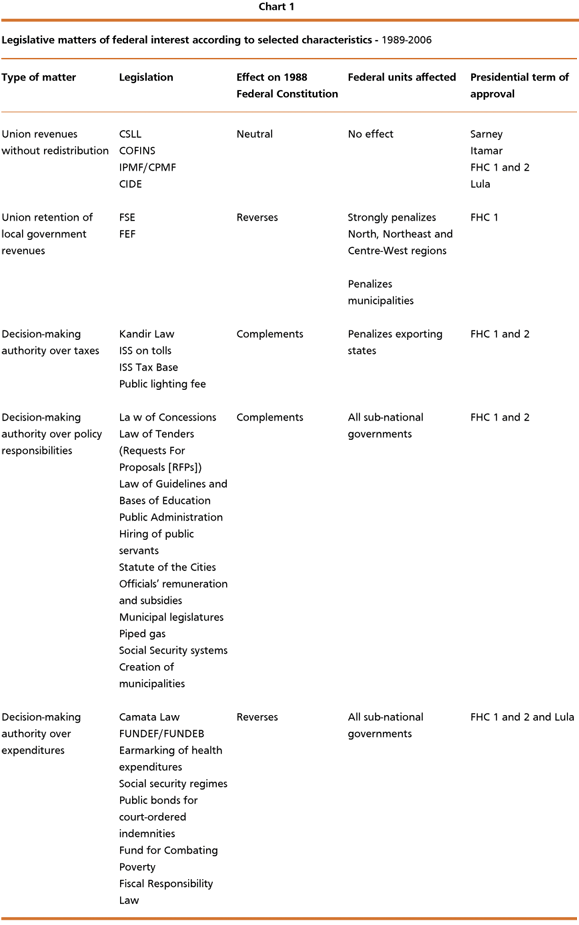
This study selected only matters that pitted the interests of the Union against those of sub-national governments,2 from January 1989 to December 2006. Furthermore, it takes an additional step, by disaggregating different matters over which the Union and territorial governments had opposite interests, distinguishing matters related to revenues from matters involving distinct dimensions of authority, such as local governments’ decision-making autonomy over their own taxes, expenditures and policy responsibilities. The different dimensions of the analysis are set out in chart 1. The first column presents the classification of the legislative matters examined, according to the type of interest involved, distinguishing revenues from distinct dimensions of decision-making authority. The second column shows the main laws involved in each one. The third column describes each effect — in terms of change — over the status quo established by the 1988 Federal Constitution. The fourth column spells out the territorial governments potentially affected by each type of matter. Lastly, the fifth column informs the presidential terms during which each one was approved.
]]>
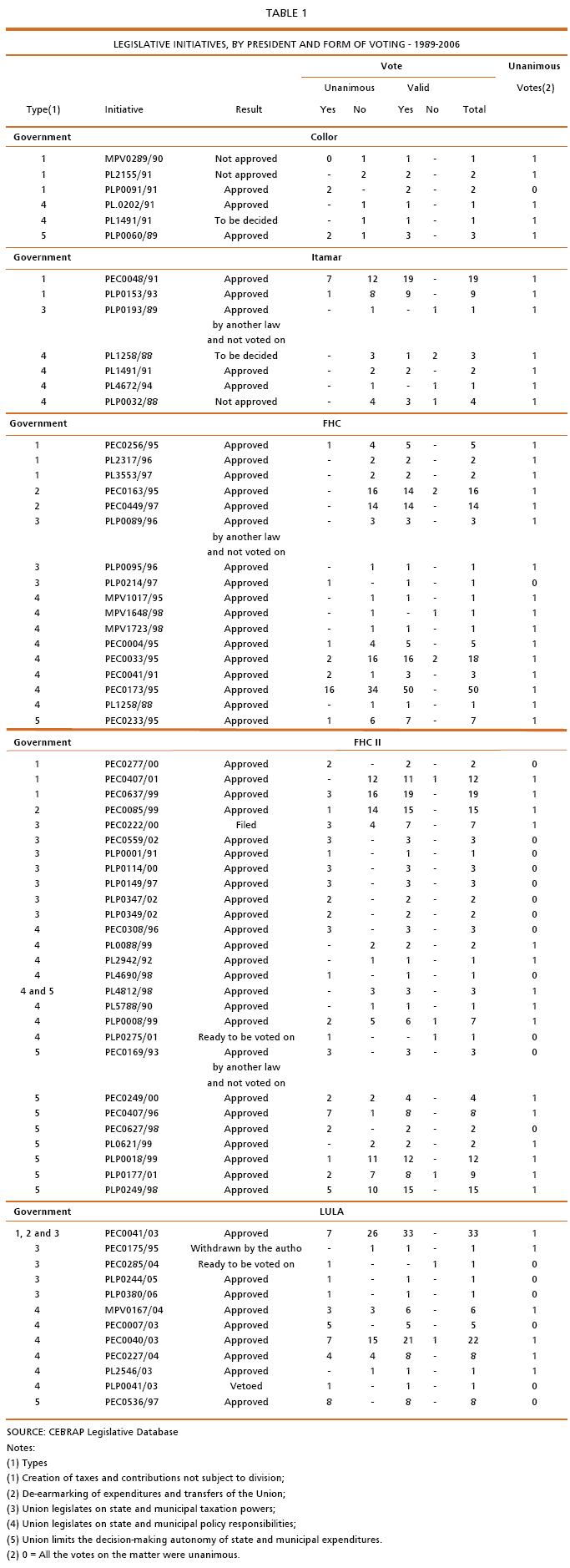
The legislation examined totalled 69 legislative initiatives3 (see table 1) and 417 roll-call votes, which represented 24% of the total number of roll-call votes that occurred in the Chamber of Deputies. This relative number is in itself evidence of the centrality of federal questions to Brazil’s contemporary agenda. However, this figure underestimates the number of these decisions at the federal parliamentary arenas. Firstly, in this study, the selection of roll-call votes is only a methodological device, which allows the examination of state caucuses’ (bancadas) parliamentary behaviour. In fact, a large number of decisions involving ordinary bills that affect the interests of the three levels of government are voted on by symbolic vote,e which does not permit one to identify the deputies’ votes. Additionally, the Senate also takes highly relevant decisions through its resolutions (Loureiro, 2001; Leite, 2006), which would demand another study. Secondly, given its objectives, this study selected just those matters whose content pitted Union against sub-national governments, therefore excluding matters that implied horizontal federal conflicts.
The article concluded that the decision-making centralization at the federal arenas affects the institutional veto opportunities of territorial governments in Brazil. The Union concentrates the authority to legislate over most of the policy responsibilities of states and municipalities, which converts the federal arenas into the main locus of decision-making on federal issues, as well as allowing a meaningful share of such matters to be processed in the form of ordinary legislation. Further, the approval of constitutional amendments is not very demanding, since there are no specific rules for the approval of amendments that affect the interests of sub-national governments, nor are there additional veto arenas besides the central ones. Taken as a whole, these institutional rules limit the veto opportunities of territorial governments. Lastly, state caucuses (bancadas) do not behave as collective players, as their parliamentary action is characterized by low cohesion.
This article is organized into three sections, beyond this introduction and the conclusions. The first section details the procedures of analysis. The second section analyses the parliamentary decision-making process of each type of federal issue examined in the study, as well as the parliamentary behaviour of state caucuses (bancadas). The third section examines the institutional veto opportunities of territorial governments in Brazil.
Procedures of Analysis
The procedure adopted here was to specify the content of the preferences of the players involved (Steinmo, Thelen and Longstreth, 1992) — in this case, the central and territorial governments —, controlling for the original legislative proposal and the outcomes of the decision-making process. This procedure allowed one to identify the net result of the negotiations, i.e., it was possible to identify " losses" and " gains" of these specific players in the final decision, as well as to what extent the federal government accepted altering (or was obliged to alter) the original proposal. In other words, the examination of the content of the legislative proposals permits one to analytically distinguish the content of the original legislative initiative from its results, and to identify the (possible) veto power of the negatively affected interests (Immergut, 1996).
Every legislative initiative involving the interests of territorial governments was selected. These were matters relating to taxation, expenditures and policy responsibilities that were voted on in the Chamber of Deputies (henceforth, ‘CD’), from the Sarney government, after the promulgation of the 1988 Federal Constitution (henceforth, ’88 FC’), until the Lula government.5 As a second step, the content of each legislative initiative was examined, based on an analysis of the original proposal and of the debates on the CD floor, as contained in the Diários da Câmara dos Deputados (CD Diaries).
The examination of these legislative decisions’ content allowed for the identification of a significant share of the post-1988 federal agenda. However, the analysis does not exhaust the totality of this agenda, inasmuch as its object is limited to matters that got voted on at the CD. It thus involves the part of this agenda that had priority for central government, inasmuch as it deals with those matters that were treated as relevant at the CD.
]]> The examination of the legislation’s content, as well as the debates, also made it possible to distinguish between different types of federal interest affected. The classification — that distinguishes matters relating to tax receipts from matters involving distinct dimensions of decision-making authority — was based on the variables that studies on federalism traditionally deal with, i.e., taxation, revenues, expenditures and policy responsibilities.The classification took into account the distinction between the formal assignment of responsibilities and the decision-making authority, since these are not equivalent concepts. This conceptual distinction is important, because both the distribution of competencies to collect taxes and the autonomy to define the rules of these taxes’ collection are, equally, central components of a federal vertical structure. The interests of the sub-national governments are affected when a given item of legislation involves " who" raises the taxes as much as the " autonomy" to define the rules of these taxes’ collection. Equally, federal members should have an interest both in having as much revenue as possible and in spending it autonomously. Indeed, the formal assignment of policy responsibilities does not necessarily imply the autonomy to make decisions on the way they are executed.
This procedure allowed one to make out five different types of legislative matter processed by the CD in this period. It also allowed one to identify the extent to which the original proposals presented were rejected or altered by the parliamentarians, hence permitting the measurement of the veto power of states’ representatives.
The next step of the analysis consisted in examining the behaviour of the state caucuses (bancadas) in 275 roll-call votes. Out of a total of 417 roll-call votes, 16 were excluded for being invalid due to a lack of quorum and 126 were excluded because they were cases of unanimous decisions. The latter were defined as those in which all the party leaders recommended the same voting orientation,6 making it impossible to determine the parliamentarians’ loyalty (see table 1). Next, the cohesion of the state caucuses (bancadas) was measured, according to Rice’s index. The state caucuses’ rates of party discipline, of discipline to the central government voting orientations and of discipline to their respective governors were also measured,7 for each of the five types of matter examined in the study.
Lastly, the rules of the decision-making process on matters of federal interest in Brazil — more specifically, the veto opportunities that these offered to states’ representatives on the CD — were analysed.
The Post-1988 Federal Agenda
A significant share of the contemporary Brazilian federal agenda is derived from the decisions of the 88 FC. The latter affected the revenues of the Union negatively, by raising the total volume of constitutionally mandated automatic transfers to states and municipalities. For the sake of the Union’s fiscal balance, obtaining additional revenues became imperative. This objective was pursued by every Brazilian president since 1988. Basically, two types of strategy were followed: (a) creating fiscal contributions not subject to being shared with states and municipalities; and (b) de-earmarking a share of the Union’s expenditures and revenues. The former increased federal revenues, without the obligation of sharing them with the territorial governments. The latter reversed one of the most " decentralizing" 88 FC decisions, by retaining 20% of the constitutionally mandated transfers to states and municipalities. With both strategies in mind, successive presidents submitted legislative initiatives to the CD. Their content negatively affected the revenues of the state and municipal governments.
However, these initiatives did not exhaust the post-1988 political agenda. Actually, the CD also deliberated on matters that negatively affected the decision-making authority of territorial governments. More specifically, this agenda involved the autonomy of territorial governments to take decisions about their own taxes, revenues and policy responsibilities. This agenda involved: (c) the centralization of authority over local government taxation powers, meaning that the Union legislates on the way those taxes defined in 1988 as being under the exclusive authority of states and municipalities would be collected; (d) the centralization of authority over policy responsibilities, meaning that the Union legislates on competencies attributed to states and municipalities by the 88 FC; and, lastly, (e) the centralization of authority over expenditures, meaning that the Union limits the autonomy of states and municipalities to take decisions on the allocation of their own revenues.
]]> Increasing the Union’s Revenues
Creation of non-shared contributions
This dimension of the Union’s fiscal adjustment consisted in recovering the fiscal losses derived from the fiscal decentralization of the 88 FC by means of the creation of contributions whose receipts would not be subject to division with states and municipalities. It involves, therefore, the creation of the CSLL (Social Contribution on Net Profits), the COFINS (Contribution for Financing Social Security), the CPMF (Provisional Contribution on Financial Movements — tax on bank account transactions) and the CIDE (Contribution on the Intervention in the Economic Domain).
The CSLL (Law 7689/88) was created during the Sarney government. Far from facing any resistance in Congress, it was approved according to British standards: it made its way through the parliamentary arena in just nine days, from being presented to the CD floor until its final approval. The COFINS was created during the Collor government by means of a unanimous vote which, incidentally, also raised the rate of the CSLL.8 The IPMF — precursor of the CPMF — was created by the approval of PEC 48/91 during the Itamar government.9 Lastly, only the CIDE was created during the FHC government, by the approval of PEC 277/00, which became Constitutional Amendment (henceforth ‘EC’) 33/01.10
In short, the dimension of the fiscal adjustment agenda that raised the revenues of the Union through the creation of non-shared contributions was conceived and approved in the Sarney, Collor and Itamar governments. In this aspect, the only innovation of the Fernando Henrique government was the creation of the CIDE. In fact, with the latter’s exception, the constitutional and legislative strategy of the Fernando Henrique and Lula governments, as regards this dimension of the fiscal adjustment, essentially consisted in extending over time and raising the rates of these contributions created by Sarney, Collor and Itamar.11
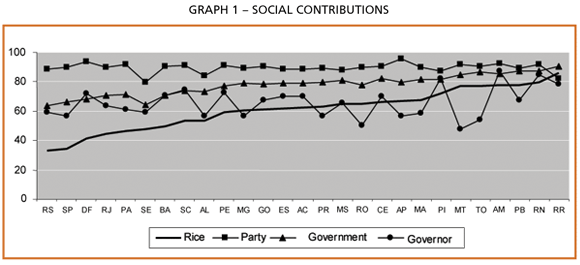
The creation of non-shared contributions involved 76 valid roll-call votes without unanimity. Low cohesion of state caucuses (bancadas) and party command of the votes were the patterns of parliamentary behaviour in these votes (graph 1). If the caucus of each state behaved like a party, Rice’s index would be close to 100, corresponding to the situation in which all the representatives of a state voted the same way. Actually, of the indicators shown in graph 1, Rice’s index is the lowest. More than this, there is a relationship between the size of the state caucus and its cohesion, given that the latter increases as the group’s size decreases.
]]> For this type of matter, it would not be reasonable to expect governors to mobilize to affect the parliamentary behaviour of their respective state caucuses, because the creation of the CSLL, COFINS, CPMF and CIDE did not affect negatively either their revenues or their decision-making authority.12 For this reason, parliamentarians’ low level of loyalty to the voting orientation of their governor’s party cannot be taken as refuting the hypothesis that governors have influence over the behaviour of their states’ representatives.
However, it is important to note that party loyalty rates are systematically higher than the rates of loyalty to the central government leader’s voting orientation.13 This reveals that even for a type of matter of vital importance for the Union’s fiscal balance, party discipline is the dominant behaviour. This type of matter is usually described as one for which the federal government would deploy its budgetary powers — in particular, the freeing up of parliamentarians’ amendments — to obtain individual representatives’ parliamentary support. The fact that discipline to the federal executive is systematically lower than party discipline indicates that, in each state bancada, opposition parties’ members vote according to the orientation of their parties’ leaders.14
De-earmarking of Union’s revenues and expenditures: from the Emergency Social Fund (FSE) to the De-earmarking of Union Revenues (DRU)
This dimension of the Union’s fiscal adjustment consisted basically in reversing the decisions of the 88 FC by means of two combined measures: (a) making more flexible the percentages of Union revenues earmarked for specific items of expenditure (‘earmarked expenditures’); and (b) the retention of a share of the constitutionally mandated transfers to states and municipalities. The latter reversed one of the most highly regarded victories obtained by the sub-national governments in the 88 FC, reducing by 20% their participation in the Income Tax (IR) and Tax on Industrialized Products (IPI) receipts.
Making the Union’s earmarked expenditures more flexible — through the a priori retention of 20% of its total receipts — was successively approved every time the measure came up for renewal, from the Itamar to Lula governments. However, the retention of the automatic transfers to states and municipalities encountered growing difficulties for obtaining parliamentary approval, which led President Fernando Henrique to pull back from this component of the strategy in his second term.
The first approval of the Emergency Social Fund (FSE) was the harshest one from the point of view of imposing losses upon states and municipalities, since it combined simultaneously the de-earmarking of Union expenditures and the retention of 20% of the constitutional transfers to states and municipalities over a period of 2 years.15 In the first and second renewals of the strategy, the federal Executive encountered growing difficulties for obtaining parliamentary approval for the two measures combined. The opposition parties adopted a strategy of heightening the costs of the support of the government coalition members, making visible (through roll-call votes on specific clauses) their responsibility for the imposition of losses upon states and municipalities. At the occasion of the third renewal, in 1999, it was President Fernando Henrique himself who avoided the blame of imposing revenue losses upon sub-national governments, forwarding to Congress PEC 85/99, which proposed just the de-earmarking of Union expenditures but taking constitutional transfers out of the measure. However, even though the Federal Executive made concessions in its strategy in order to compensate municipalities, the net result of the decision is widely favourable to the Union. In other words, in spite of having involved intense negotiations, the concessions made to ensure the approval of these measures were residual, when compared with the Union’s gains.
It is worth detailing the process through which this measure was renewed on different occasions. The first renewal of the FSE — which became EC 10/96 — imposed actual fiscal losses upon states and municipalities because it established that the de-earmarking of Union revenues would take place in advance of the calculation of any type of revenue-sharing — including the constitutionally mandated transfers. The initial proposal forwarded by the Executive contained a 4-year period of validity for the FSE. However, the deputy appointed to report the proposal (Ney Lopes, of the Rio Grande do Norte state Liberal Front Party [ PFL] ) made a deal with the governing coalition parties and the Executive itself and proposed a reduction of the validity period to 18 months. On the CD floor, the opposition strategy of arguing that the FSE would imply fiscal losses for municipalities was answered by the PSDB leadership with the argument that states and municipalities had had fiscal gains with the Real Plan. For this reason, the retention of 20% of their revenues from transfers would not imply net revenue losses.16 In this round, therefore, the net loss for the Union was only the reduction in the FSE period of validity, which compelled the president to initiate a new PEC as early as 1997.
In the original proposal of the second renewal, PEC 449/97, the Federal Executive kept the same content of the PECs approved in the previous renewals, i.e., a priori retention of 20% of all federal revenues, including constitutional transfers, over a 2-year period. Yet, it proved to be very difficult to obtain support in the government coalition parties, more specifically among the PMDB (Party of the Brazilian Democratic Movement).17 However, the net result of this negotiation was that the Union would carry on retaining 20% of the constitutional transfers, but out of this amount, municipalities would receive just a rebate that would vary between 1.56% and 2.5% of IR receipts.18 In summary: the outcome of the intense negotiations around the approval of PEC 449/97 was that the Union obtained major net gains and municipalities would receive a minor compensation for their losses, while states were net losers (as they lost 20% of their constitutional transfers and gained no compensation).
During the third renewal in 1999, PEC 85/99 proposed the de-earmarking of Union revenues but constitutional transfers would be removed from its calculation base. Hence, from 1999, the principle of the 1988 Constitution was re-established, that is, a significant share of IR and IPI revenues went back to being directly transferred to states and municipalities.
The successive approvals of the de-earmarking of Union revenues, in the form of FSE/FEF/DRU, involved 59 roll-call votes. However, only part of the legislative proposals affected negatively the automatic transfers to states and municipalities, reversing the decisions of the 88 FC. Hence, we may examine solely the 28 roll-call votes of PEC 163/95 and PEC 449/97, in which the " imposition of losses" of the retention of constitutional transfers was on the agenda (graph 2), and analyse the behaviour of the state caucuses (bancadas) during these votes.
]]> In this case, it is plausible to expect that governors and mayors would mobilize their representatives to veto the federal government’s initiative. Moreover, it is plausible to expect that the caucuses (bancadas) of the states of the North, Northeast and Centre-West regions would be the most highly mobilized, as these states are the major beneficiaries of the States’ Participation Fund.19 If they did, they were not successful. This is so firstly because low cohesion characterizes state caucuses (bancadas). The larger ones have cohesion rates under 60, in which 20% of those present voted differently from the other 80%, excluding abstentions.20 When the voting orientation of the governor’s party does not coincide with the voting orientation of the federal government leader, the discipline rates in relation to the voting orientation of the latter are higher than those to the former. In other words, party discipline divides the state caucuses (bancadas), since members of the government coalition parties do not follow the voting orientation of their governor when the latter is in opposition.
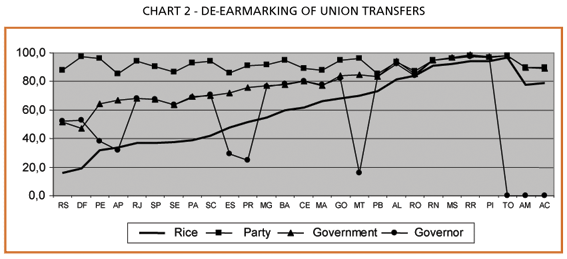
Secondly, the state caucuses (bancadas) that displayed high cohesion behaviour (over 80) are the small ones. However, in these cases, the high cohesion level coincides with loyalty to the party voting orientation.21 In this case, it means that this cohesion may be explained by the fact of belonging to the government’s support coalition, and thus that these state representatives voted cohesively in favour of a proposal that penalized state and municipal revenues.
Note that we are talking about the parliamentary behaviour of the state caucuses from the North, Northeast and Centre-West regions, which would be the ones most seriously affected by the measures of retention of constitutional transfers. Note, equally, that this behaviour implied the risk of electoral costs, because the opposition strategy during the decision-making process consisted in highlighting the " revenue losses" these measures would impose upon territorial governments, by means of requesting separate roll-call votes for each of the articles in which such losses were at issue. In spite of this, the parliamentarians of the government’s support coalition backed the measures’ approval.
Vertical Distribution of Decision-Making Authority
Who legislates on state and municipal taxes?
The interpretations of the 88 FC emphasized the idea that it conferred broad tax autonomy to states and municipalities. In fact, this interpretation ignored the 88 FC’s centralizing aspects. States and municipalities did gain the authority to establish the rates of their own taxes, but the members of the Constituent Assembly left in the Union‘s hands the authority to formulate the norms on the conditions for raising territorial governments’ taxes, as well as their tax bases.
]]> The (failed) attempts at federalizing the ICMS (Tax on the Circulation of Goods and Services) seem to confirm states’ veto power on taxation issues. In fact, this initiative has been on the federal agenda since the Fernando Henrique Cardoso government, which intended to transform the 1988 vertical distribution of taxation authority, by creating a single federal value-added tax and standardizing the ICMS rates, through PEC 175/95.22 The Lula government had the same initiative, through PEC 41/03. However, neither of these was approved. PEC 175/95 was bottled up in committees until it was withdrawn due to the arrival of Lula’s proposal. The federalization of the ICMS was dismembered from PECs 255/04 and 285/04, ending up as did the Fernando Henrique initiative, i.e., not even going to the floor to be voted on. The unification of the ICMS thus remains on the agenda of the federal government.The visibility of these central government parliamentary failures seems to confirm the proposition that state governments have a veto power on taxation issues in Brazil. Actually, this interpretation is derived from a selection bias that took this part of the governmental agenda as representing its totality.
In fact, during the Fernando Henrique Cardoso government, a number of legislative initiatives were approved that affected the decision-making authority of states and municipalities over their own taxes. These consisted basically of the Kandir Law23 and of the authorization for municipalities to charge the ISS (Tax on Services) from tolls and to introduce public lighting fees. The Kandir Law imposed important losses upon states’ revenues, while the other measures enlarged municipalities’ tax base. However, the approval of these laws not only did not alter the distribution of authority over taxation under the 88 FC, but it actually represented the continuity of constitutional norms.
The Kandir Law became known as the law that removed the ICMS on exports and semi-manufactured goods, leaving the calculation of the compensation for these losses subject to permanent negotiation between the Union and the states. In fact, the net result of this decision imposed significant tax losses on states,24 particularly because the lifting of the tax collection is permanent, while the compensation is negotiated regularly. However, the Kandir Law (Complementary Law 95/96) had a much broader reach. It was discussed in the Chamber of Deputies as the law that unified all the ICMS revenue-raising norms, involving even the rules under which states would give back their own municipalities’ quota. Indeed, the Kandir Law ended up solving an absence of regulation of the 88 FC that had attributed provisionally to the states the authority to regulate the ways in which the ICMS would be collected. The Transitional Constitutional Measures Act had determined that the ICMS would be regulated by a federal25 Complementary Law (henceforth ‘LC’). In short, the Kandir Law imposed actual fiscal losses upon the states, which reveals that governors were unable to veto it. Yet, its approval did not alter at all the distribution of taxation authority of the 88 FC, which had already spelt out that ICMS regulation was a federal attribution.26
Let us now turn to an analysis of municipal taxes in order to reiterate this point. Believing the much-proclaimed thesis that they had been converted into autonomous federal members and had decision-making autonomy over their own taxes, many municipalities began charging the ISS on tolls and created public lighting fees. The companies holding road concessions appealed to the STF (Supreme Federal Court), which found in their favour, based on the argument that article 156 of the 88 FC established that an LC should determine the rates and the services included in the ISS base. Since LC 56/87 did not include tolls, their taxation was not authorized. Basically, the understanding of the STF was that it is up to the Union to define what can be included in the incidence base of taxes exclusively levied by municipalities. If a certain incidence base is not forecast in the Federal Legislation, the municipality cannot tax it. Only after the approval of LC 100/99 were municipalities able to charge the ISS on tolls.27
A similar trajectory was followed by the municipal public lighting fee. To mayors’ credulity in their taxation prerogatives, there corresponded the fact that the STF ruled in favour of the appeals against its collection. In this case, article 145 (88 FC) does not authorize the incidence of fees on top of bases already taxed. More than this, the fact that the charging of fees had been authorized by an ordinary bill was struck down by the STF due to its unconstitutionality. It was therefore necessary to pass a constitutional amendment.
To illustrate the point, it is interesting to examine the legislative path taken by PEC 222/00 (Deputy Juquinha, of Goiás state PMDB). His original proposal authorized only the public lighting fee. However, the Special Committee reporter’s substitute text (by Osmar Serraglio, of Paraná state PMDB) included in the municipal fees’ incidence base a series of new areas, such as electricity, cleansing, paving and maintenance of streets. Once again, there was a conflict on the Chamber floor between the other parties and the PMDB. This time, the central issue was the excessive broadening of the incidence base of the ISS. However, under intense pressure from mayors,28 Deputy Serraglio’s text was approved in the two CD voting rounds, with a favourable voting recommendation from the central government leader. But the proposal was rejected by the Senate, which forwarded an alternative PEC (559/02), authorizing just the charging of public lighting fees.29
It is important to highlight the fact that, during the parliamentary debates, there were no manifestations in favour of preserving territorial governments’ decision-making autonomy to establish the incidence bases and ways of collecting their own taxes. In line with the 1988 Constituent Assembly’s principles, there prevailed the norm of nationwide homogeneous rules over the decision-making autonomy of territorial governments.30
Hence, the votes in which the Union legislates on state and municipal tax matters were grounded on the premise that it is up to the Union to define the incidence of state and municipal taxes, as well as to establish the parameters for collecting them. However, these legislative initiatives involved decisions that penalized exporting states — compensating them later — and favoured municipalities. The public lighting fee and the ISS on tolls (which increased municipalities’ revenue-raising potential), like the laws on the compensation of losses resulting from the Kandir Law, were passed by unanimous votes (see table 1). So, the 35 valid roll-call votes in graph 3 basically involved the Kandir Law and the Lula’s government tax reform, which affected negatively the most economically dynamic states. In this case, if the state caucuses (bancadas) behaved as parties in the defence of their tax revenues and decision-making authority, one would expect them to display high rates of cohesion. Moreover, one would expect caucuses (bancadas) from the most economically dynamic states not to follow the voting orientation of the federal government leader.
]]>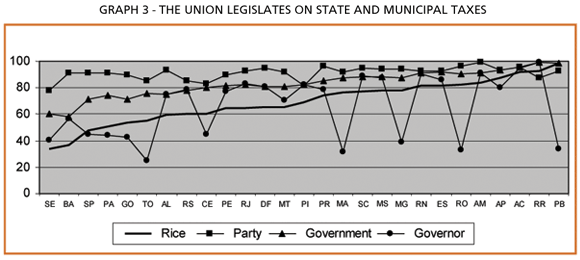
The state caucuses did not behave this way, as party orientation was the predominant factor in their parliamentary performance. If, for argument’s sake, the president had needed the votes of deputies recruited by the governor of São Paulo, the proposal would have been defeated. In these votes, this state’s representatives displayed a high rate of party discipline — on average over 90% — that affected negatively the bancada’s cohesion, since on average 25% of those present voted against the caucus majority, while only 45% of those present followed the state governor’s orientation.31
Furthermore, only the small state caucuses (bancadas) displayed a rate of cohesion above 80, in which only 10% of those present voted against the caucus majority — in this case voting " no" . As well as this, these are caucuses (bancadas) from states affected only slightly (or not at all) by these measures (graph 3).
Who legislates on the competencies of states and municipalities?
Analyses of the 1988 decentralizing decisions have emphasized their local government empowering role, or even their effects in bringing local governments closer to citizens’ preferences. These interpretations assume that decentralization has implied autonomy for local governments to decide on their own policies. However, this assumption does not correspond to the actual distribution of authority over policies in Brazil, whether in the recent period or under the 88 FC.
During President Fernando Henrique Cardoso’s terms, extensive legislation was approved regulating the policy responsibilities of states and municipalities. Among others, laws as important as the Law of Concessions, the Law of Guidelines and Bases for Education (LDB), the reform on the public administration, and the Statute of the Cities were approved. Taken together, this legislation disciplines the social security regimes of state and municipal employees, as well as their participation in private social security systems; it determines elected officials’ salaries and subsidies at all the levels of government; it regulates the terms for the concession of public services; and it regulates the hiring of public servants as well as public-sector tenders (RFPs). Decisions that vary from rules for creating municipalities within each state to the dismissal of public servants are defined by federal laws. Even though urban policy is a municipal policy responsibility, the Statute of the Cities disciplines the rules according to which municipalities must exert their competencies regarding urban development. Taken as a whole, the legislation approved during the two FHC terms disciplines a major part of the conditions for executing decentralized policy responsibilities, i.e., those that must be exerted by states and municipalities.
This legislative production is associated with the Fernando Henrique administration. Until 1995, the only law that had disciplined the competencies of territorial governments passed by a roll-call vote in the Chamber of Deputies was the Law of Tenders (RFPs) (8666/93), approved during the Itamar government, whilst in FHC’s first term, legal initiatives that had been making their way through Congress for years were enacted into law. This is the case, for example, of the Law of Concessions, on the initiative of Senator Fernando Henrique, which was voted in the first round still during the Collor government, but was only forwarded beyond the Senate in January 1995, right when FHC was being inaugurated for his first term. Equally, the LDB (PL 1258/88) made its way through Congress, with intense negotiations, for eight years, to be finally converted into Law 9349 in 1996. The Statute of the Cities had an identical trajectory: PL 5788/90 ran a lengthy course through the CD’s committees, to be converted into Law 10257 in 2001, during FHC’s second term in office. So, bills disciplining policies to be implemented by states and municipalities were put high on the CD agenda, under the urgent voting regime. The fact that they were not enacted under previous governments is evidence of a change in the presidency’s agenda, which led to initiatives from party leaders to give them urgency to be voted on.
This legislation — that is, the LDB, the Statute of the Cities and the Law of Concessions — establishes homogenous rules for every Brazilian sub-national government, detailing the way they should exert their competencies. The LDB, for example, defines teachers’ minimum school hours, working conditions for schooling, students’ minimum school hours, students’ minimum schooling year and the minimum duration of each schooling level, among other details. Although education is a municipal and state policy responsibility, a significant share of the decision-making authority of the education policy lies outside their sphere of autonomy, as it is previously defined by a federal law. The same may be said of the Statute of the Cities, which contains detailed prescriptions on the way urban planning functions should be exerted, even though this policy is a municipal responsibility.
]]> Contrary to what is expected on the basis of the celebratory interpretation of the decision-making autonomy of local governments in Brazil, this decision-making centralization does not go against the fundamental principles of the 88 FC at all, representing, indeed, a continuity of its central measures. The Statute of the Cities merely regulates article 182 of the 88 FC, which establishes that the overall guidelines for the urban policy to be implemented by municipalities would be defined by a federal law. Equally, article 21 of the 88 FC defines as a competency of the Union " instituting guidelines for urban development" . In similar fashion, the LDB is a direct consequence of article 22, which establishes as an exclusive competency of the Union instituting nationwide guidelines for education. The Law of Concessions is also under the exclusive competency of the Union (article 22).In fact, a long list of decision-making competencies exclusive to the Union in policies whose execution was assigned to states and municipalities was already included in the 88 FC. These reveal the decision of the Constitution’s framers to keep homogenous the rules regarding a whole set of decentralized policies. In fact, nationwide homogenous rules are matched by centralization of decision-making authority on decentralized policies.
This centralization is confirmed by examining an entirely unexplored aspect of the thoroughly analysed administrative reform. This aspect regards the extent to which the administrative reform limits the decision-making authority of territorial governments. Its approval in the form of EC 19/98 is much more than an administrative reform. It is, in fact, the Chapter of the Public Administration, derived from the Union’s exclusive competency (art. 22) to establish the general norms either for tenders (RFPs) or public contracts, at all government levels. Besides, this Chapter includes, among the general norms of the public administration, the rules for establishing public servant’s wages, as well as elected officials’ salaries. Thus, EC 19/98 establishes the way in which the subsidies will be decided and calculated, for governors, mayors, state deputies and city/town councillors. Therefore, the detailing extent of what is understood as " general norms of the public administration" , in practice, suppresses the decision-making autonomy of states and municipalities on these questions, centralizing them at the Union. Although the 88 FC — in articles 27 and 29 — already set out the method for deciding the remuneration of elected officials at state and municipal level, EC 19/98 adds to the already existing regulation the rule of its calculation, adding still more limitations to the state and municipal decision-making spheres of authority.
This example — that could be extended to other norms of the Chapter of the Public Administration — aims only to demonstrate that EC 19/98 simply deepened and developed a principle already contained in the 88 FC, which is a normative goal of centralizing at the federal level the decision-making authority regarding the execution of policies formally assigned to states and municipalities, in order to ensure nationwide homogenous rules of implementation. Its direct consequence is the suppression of the decision-making spheres of autonomy of sub-national governments.
Moreover, even though the vote on the Chapter of the Public Administration (PEC 173/95) was highly conflictive, involving 50 roll-call votes and 31 sessions, the division on the CD floor was not along federal lines, but along ideological lines.32 The debate in the CD was not one centred on a conflict of interests between the Union and sub-national governments about the latter’s decision-making autonomy. The cleavage in the CD regarded programmatic questions related to different conceptions of the State, dividing the representatives between the left-wing parties, supporters of more statist conceptions, and centre-right parties, which favoured the modernization of the State. The actual divisive questions were the ones regarding public servants’ job stability and the privatization of State functions, which needed to be previously approved at the federal level only then to be implemented by sub-national governments.
Indeed, deputies shared a common view that the Union should regulate sub-national governments’ conditions for hiring, dismissing and paying their public servants; they disagreed only on the programmatic content of this regulation. In other words, it was not the federal vertical distribution of authority that was under discussion, but what the (centralized) State should do.33
This same cleavage was repeated in the votes of FHC’s and Lula’s pension system reforms (PEC 33/95 in the former case, and PECs 40/03 and 227/04, in the latter case). Their deliberation directly affected states’ and municipalities’ interests, inasmuch as they dealt with issues such as the retirement of public servants and the setting up of their complementary pension regimes. The sub-national governments’ interests were affected not just because these decisions would have an important fiscal impact. They were affected also because the possibility of approving reforms in their respective states depended on a priori authorization by the Constitution. Furthermore, the wages and subsidy levels adopted by states and municipalities are linked to the amounts paid at the federal level. In other words, the interest of states and municipalities in the pension system reforms is a direct consequence of the centralized character of the regulation of state and municipal competencies.
In order to present more evidence to this argument, it is worth describing the trajectory of PEC 41/91 (César Bandeira – Maranhão state PFL), which restricted the authority of states over the creation of municipalities (Tomio, 2002). This PEC was introduced under the Collor government and sat at the Speaker’s table until 14/12/93, when it was forwarded to the Constitutional Review. There, it was impaired by the expiration of the deliberation period and subsequently filed away. It returned to the government agenda in the first few months of the FHC presidency. It was then converted into EC 15/96, having been approved unanimously. During the debate on the CD floor, the argument in favour of transferring this authority to the federal government was based on the need to " ensure uniformity" (Luiz Carlos Hauly – Paraná state PSDB), assuming that " we cannot leave the creation of municipalities up to the will of state complementary laws" (Antonio Geraldo – Bahia state PFL) (CD Diary, 14/04/96).
In short, the decision-making centralization of the regulation of territorial governments’ competencies was already contained in the 88 FC. A large number of laws and constitutional amendments with this content obtained a greater chance of approval during the Fernando Henrique governments, due to their centrality in the president’s agenda. The priority of this issue in the presidential agenda brought a whole set of legal initiatives for floor deliberation, allowing them to be approved. Their unanimous approval, in its turn, reveals that defending the prerogatives of sub-national governments’ decision-making authority over their own policy responsibilities was not something that found great resonance among state caucuses (bancadas).
The centralization of the authority to legislate on state and municipal policy responsibilities has the effect of limiting their decision-making autonomy on these specific questions. However, this decision-making centralization does not go against the fundamental principles of the 88 FC at all, representing, in fact, the development and continuity of its main measures. These forecast, in the form of the Union’s exclusive competencies, a wide range of decentralized policies that would be implemented according to nationwide homogenous standards. For this reason, it would be necessary to obtain the Union’s a priori authorization or regulation.
]]> Matters involving the Union’s legislation on state and municipal competencies involved the passage of the LDB, of the Law of Tenders (RFPs), of the Law on Concessions, of the Public Administration Chapter, of the Public Pension System, of the creation of municipalities and of the Statute of the Cities. They included 100 valid roll-call votes, in which there was no unanimity (graph 4). As we have seen, the passage of these matters was based on the shared assumption that the Union should regulate the conditions for implementing decentralized policies, so as to guarantee their homogeneity across the national territory. When these matters were making their way through the CD, the fault-line on the house floor was not about the autonomy of territorial governments to legislate on these questions, but, rather, it was a programmatic one, between different conceptions of what the Union should compel states and municipalities to do. On these terms, it is not surprising that for all the state caucuses (bancadas) the party discipline rate is higher than the others, i.e., the type of matter does not affect the capacity of party leaders to command parliamentarians’ behaviour.
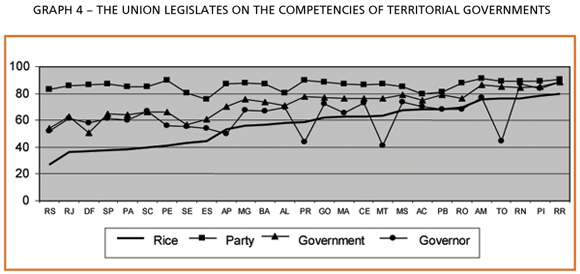
As it may be observed from the low cohesion rates (under 80 for all the state caucuses (bancadas), these were affected by the divisions along parties as to what states and municipalities should be obliged to do, by force of the federal legislation. Once again, the evidence reveals that it is not possible to demonstrate state governors’ capacity to command the behaviour of their respective states’ parliamentarians. These voted systematically according to the orientation of their respective party leaders.
Who legislates on state and municipal expenditures?
During President Fernando Henrique Cardoso’s two terms, federal regulation of states’ and municipalities’ expenditures was at the heart of the government’s agenda. The centralization of the parliamentary arena, in its turn, allowed him to change the federal structure of the 88 FC, which accorded great spending autonomy to states and municipalities, with the exception of the education area. This change in the federal structure meant a substantial reduction in the decision-making autonomy of state and municipal governments over their own expenditures. From 1995 onwards, the federal legislation began regulating in detail sub-national governments’ levels of spending on education, health, personnel, municipal legislatures and pension systems. Furthermore, it regulated the payment of public bonds for judicial indemnities, ordered the creation of Funds for Combating Poverty and established limits to the expansion of expenditure and debt levels, defining any breach of these limits as fiscal responsibility crimes.
This is a dimension of the post-1988 federal agenda that is associated with the FHC government. With the exception of the Camata Law, not a single legislative proposal with this objective went to a roll-call vote in the CD until 1995. The Camata Law, incidentally, is the exception that confirms the rule.34 The bill received two unanimous votes in the CD during the Collor government, but ended up filed away. Later, it was reactivated in the Chamber to be sent to the Senate. There it sat until March 1995 (the first few months of the FHC presidency), when it was converted into Law 82/95. From then on, the fact that federal regulation had entered the heart of the president’s agenda led to the approval of extensive legislation with this specific objective.
Beyond the Camata Law, only the FUNDEF was approved in FHC’s first term. His second term, however, was extremely active in terms of the approval of legislation earmarking state and municipal revenues for health expenditure; obliging states and municipalities to create Funds for Combating Poverty, based on additional revenues from the ICMS and ISS; determining the conditions and time limits for the payment of public bonds for court-ordered indemnities; establishing ceilings for municipal legislatures’ expenditures, as well as on active and retired personnel; regulating pension regimes, as well as creating restrictions on sub-national governments’ indebtedness and expansion of spending. This agenda reversed the principles of the 88 FC, which had decided in favour of granting broad autonomy to sub-national governments in the allocation of their revenues.
]]> FUNDEF (EC 14/96) revised articles 34 and 35 of the 88 FC, which defined the conditions under which the Union may intervene in states and municipalities. EC 14/96 authorizes the Union’s intervention in case the rules of minimum spending on fundamental education (first 8 years of schooling) are not respected. Consequently, states and municipalities must spend 15% of their total revenue on fundamental education, of which 60% on the salaries of classroom teachers.35 EC 29/00 revised once again articles 34 and 35 of the 88 FC, earmarking 12% of states’ revenues and 15% of municipalities’ revenues for health expenditure, leaving the Union’s earmarked spending linked only to GDP growth.36 EC 25/00 revised article 29 of the 88 FC, which stated that municipalities had the autonomy to define the remuneration of their town/city councillors. Instead, it established that the total spending on the municipal legislature, including the remuneration of town/city councillors, could not be over a certain share (that varied between 3% and 8%, according to the municipality’s population size) of the total expenditure.37 EC 31/00, which created the federal Fund for Combating Poverty, obliges states and municipalities also to create their respective Funds for Combating Poverty. To this end, it authorizes states to charge an additional 2% on the ICMS collection and municipalities to charge an additional 0.5% on the ISS collection on superfluous services, provided that a federal Complementary Law defined what these superfluous services are. Lastly, EC 30/00 altered article 100 of the 88 FC, setting out time limits for the payment of bonds for judicial indemnities and the conditions under which these might be converted into ordinary bonds of the public debt.Note, therefore, how these constitutional amendments not only reverse the principles of sub-national government spending autonomy of the 88 FC, but also legislate with a reasonable degree of detail on the expenditures’ sources, percentages and time frames for allocating revenues, as well as the specific destination of the expenditure, authorizing the Union to intervene in sub-national governments in case these requirements are not met.
Out of all the federal regulations of sub-national governments’ public finances adopted during FHC’s governments, only the Camata Law (LC 82/95), the LC 96/99 and the Fiscal Responsibility Law were not Constitutional Amendments. All of them regulate sub-national government finances according to articles 163 and 169 of the 88 FC, which remit to complementary legislation the definition of sub-national governments’ finance norms, as well as their expenditures on active and retired personnel, confirming the argument that the principle of the decision-making centralization of states’ and municipalities’ finances was already present in the 88 FC. LC 96/99 — authored by the Federal Executive — was approved within the scope of the administrative reform to reduce the Union’s level of expenditure on personnel to 50% of its current net revenue, without affecting the 60% already set for states and municipalities by the Camata Law. However, it constitutes an important chapter in the regulation of sub-national governments’ finances because it defines with precision the content of its concepts, as well as limiting their issue of AROs (Advances on Budgetary Revenue) and the renegotiation of their debts. The Fiscal Responsibility Law, in its turn, is seen as the crowning of a process of fiscal organization (Leite, 2006) that criminalizes fiscal practices that affect the transparency of public accounts and compromise their balance. It sets out in detail the legal limits to the expansion of state and municipal expenditures, regulating levels of spending on active and retired personnel, as well as credit operations. It is worthwhile stating that it is addressed only to sub-national governments.
In the Lula government, only the approval of the FUNDEB had an identical objective. However, it was partly inherited from FHC’s agenda, as the FUNDEF would expire in 2007, imposing upon the Lula government the need to renew or enlarge it. The FUNDEB (EC 53/06) deepens the principles contained in the FUNDEF, raising the earmarking of state and municipal revenues for basic education to 20%38 and constitutionally guaranteeing the Union’s complement to the states’ FUNDEBs. Additionally, it once again affects the decision-making autonomy of states and municipalities, since it establishes a national wage floor for teachers.39
Taken together, this federal regulation touches the most significant part of the spending decisions of states and municipalities, removing from their decision-making sphere the authority over the expenditure levels in areas like education, health, pensions, social services, the hiring of personnel, the payment of bonds for court-ordered indemnities, indebtedness and the municipal legislature.40 Once again: the fact that the rules must be homogenous for the whole national territory implies the decision-making centralization at the federal level.
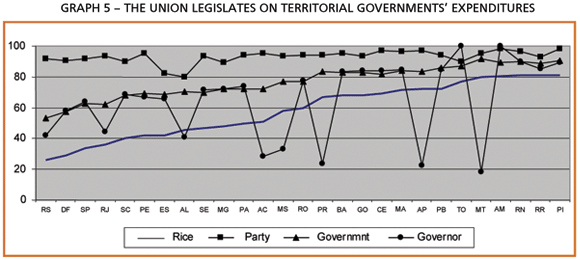
The matters in which the Union limits the decision-making autonomy of states and municipalities to determine the allocation of their own revenues are those that in fact reverse the decentralizing advances of the 88 FC, as we have seen. These involved the approval of FUNDEF and FUNDEB, the earmarking of sub-national revenues to health, the Fund for Combating Poverty, the public bonds for judicial indemnities, the spending limit on municipal legislatures and the Fiscal Responsibility Law. The approval of these measures represents a step back in relation to what is usually described as an important interest of governors and mayors, i.e., their autonomy to spend. If this description of their preferences corresponds to reality, one would expect them to put pressure on their state caucuses (bancadas) to vote against these legislative initiatives. Furthermore, if they had the power to influence the parliamentary behaviour of their respective state caucuses, one would expect higher cohesion rates at the parliamentary arena, inasmuch as the state caucuses would behave like parties, defending their sub-national governments’ spending autonomy.
Hence, in 41 roll-call votes (graph 5), the state caucuses (bancadas) were able to manifest themselves regarding legislative measures that imposed autonomy losses upon governors and mayors as to the destination of their revenues. However, once again it is not possible to say that the state caucuses (bancadas) behaved as collective actors. The Rice index is higher than 80 only for a small number of state bancadas. On the other hand, the systematic behaviour is one of loyalty to the party leaders’ voting orientation. Once again, the voting orientation of the governor’s party displays the lowest discipline rates.41
The institutional veto opportunities of territorial governments
An examination of territorial governments’ institutional veto opportunities in Brazil does not support the proposition that there is a multiplicity of veto points in the chain of decisions that involve changes in the legislation that affects the interests of sub-national governments, nor does it support the proposition that super-majorities are necessary to alter the federal status quo.
The legislative authority of the Brazilian Federal State is concentrated in the Union. Even though states and municipalities are formally assigned to raise their own taxes, to implement a number of public policies and to spend decentralized revenues, their autonomy to take decisions about these functions is limited by extensive and detailed federal legislation, as the Brazilian Constitution states that the initiatives of territorial governments pre-suppose regulation on the part of the Union. This means that the Brazilian federation concentrates authority at the federal decision-making arenas, given that, to exert their own competencies, states and municipalities need a priori authorization by the federal legislation and the Constitution. Therefore, a large part of the matters of sub-national governments’ interest must be processed at the federal decision-making arenas.
That said, it is worth examining these decision-making rules. Firstly, in Brazil (unlike other federations), there are no specific decision-making rules regarding matters of sub-national government interest. The rules for the passage of these matters are the same as those related to any type of federal legislation. The veto points are basically the legislative committees and the floor of the two houses. The result of the committees’ work and of the votes on the floor, in turn, are affected by the resources the Federal Executive and party leaders are able to employ in order to obtain support for the Federal Executive’s proposals. Once the latter obtains support in a majority coalition, the opposition’s veto resources are enormously restricted (Figueiredo and Limongi, 1999).
Secondly, the fact that the 88 FC attributed exclusively to the Union the authority to legislate on a large part of the sub-national government competencies has the effect of limiting their veto opportunities. Legislative matters of this sort may make their way through Congress in the form of ordinary bills (PLs) or proposed complementary laws (PLPs). PLs may be approved by a majority of those present in the session and by symbolic vote, requiring at most a roll-call vote for the approval of an urgency request. PLPs must be approved by a roll-call, requiring a minimum quorum of a majority of CD members. Out of the 69 legislative initiatives in this study, 37 made their way under one of these forms. In neither case are super-majorities necessary to alter the status quo.
Thirdly, the approval of constitutional amendments is comparatively easy in Brazil. These may be evaluated by the high amendment rates in the recent period. From 1992 to 2006, 53 constitutional amendments were approved; of these, 28 had to do with matters of federal interest. This result means a yearly amendment rate of 3.5. In international comparative terms, this rate is much higher than those of countries that adopted restrictive strategies for approving constitutional amendments, where this rate is equal to or lower than 1.3 (Lutz, 1994).42 If we measure only those matters exclusively related to federal issues, Brazil’s yearly rate falls to 1.8, still higher than those of countries that adopted measures to restrict constitutional amendments.
The fact that the Brazilian Constitution is very large and detailed implies the need to approve constitutional amendments, should a change in the status quo be necessary (Stepan, 1999). However, the data above do not indicate that the reach and level of detail of the 88 FC constituted a decisive obstacle to the approval of reforms. Therefore, the success rate of the amendment initiatives is, in fact, indicative of the relative ease with which the Constitution may be amended in Brazil.
Hence, although the approval of constitutional amendments is the most demanding type of change in the status quo of the Brazilian legislation, the approval of constitutional amendments in Brazil is comparatively undemanding in international terms. In Lutz’s classification, Brazil would be in an intermediate situation between countries that adopted a strategy highly favourable to the approval of constitutional amendments (in which a single parliamentary vote allows the Constitution to be amended) and countries that adopted an additional request, which consists of requiring an intervening election between two votes on the same proposed amendment. Even though Brazil adopts a formula requiring two rounds of voting in the CD and Senate, only five sessions need elapse between each vote, during the same legislature. In this sense, the uncertainty with regards to obtaining a majority in the second vote is practically zero. The definition of the parliamentary majority in the Brazilian case is also low in international standards, requiring only 3/5. So, unlike the usual description of the Brazilian case, super-majorities are not necessary to approve constitutional amendments, given that a 60% majority in 4 sessions relatively near one another allows the Charter to be changed.
It is also worth highlighting an important institutional difference between Brazil and other federations. Federations that sought to create additional veto opportunities for territorial governments established additional decision-making arenas. Thus, the USA adopted the principle that alterations must be confirmed by a majority of state assemblies. In Australia and Switzerland, legislative changes affecting the interests of the states or cantons are subject to a mandatory referendum and the change requires a popular majority and support in a majority of states or cantons. Both strategies create additional veto arenas, giving territorial governments veto opportunities on matters already approved by the majority in federal decision-making arenas. In Brazil, the decision of the legislative chambers at the federal level is enough to amend the Constitution. In this case, a majority coalition in the federal government can approve a constitutional amendment, which will have immediate validity for all sub-national governments, without the latter having any additional veto opportunity. So the only veto strategy that is possible for sub-national governments is to gather an " opposition majority" of 41% of parliamentarians in four sessions during the same legislature. If the president is able to gather a majority of 61% in the two houses of Congress, the veto chances of the territorial governments are practically nil.
]]> In short, the decision-making centralization at the federal parliamentary arenas — based on the Union’s exclusive competencies and the absence of additional decision-making arenas to approve matters of federal interest — implies that Congress is the only institutional veto opportunity for Brazilian territorial governments. Furthermore, the numerous exclusive competencies of the Union contained in the 88 FC allow a large part of the legislation of sub-national government interest to be processed in the form of legislation that requires only simple majorities for approval. Lastly, the rules for the approval of constitutional amendments, even when these affect interests of sub-national governments, are comparatively undemanding. These institutional rules, therefore, confirm neither the interpretation according to which these decision-making processes are characterized by a multiplicity of points of veto, nor that super-majorities are necessary to alter the federal status quo.
Conclusions
Matters of federal interest had a major presence in the Brazilian post-1988 legislative agenda. The need to achieve fiscal balance, combined with the Union’s losses of revenue derived from the 88 FC, implied that part of this agenda was centred on the Union’s recovery of revenues. Additionally, this agenda involved matters that negatively affected territorial governments’ authority, given that they legislated on the way these governments were to perform their own competencies, more specifically, how they would collect their own taxes, execute their policy responsibilities, and allocate their expenditures. In short, both the revenues of territorial governments and their autonomy to take decisions about their own competencies were at the centre of the agenda of federal decision-making arenas in the post-1988 period.
The examination of these decisions’ content allows one to state that the " imposition of losses" — of revenues and of decision-making autonomy — characterized this legislative production. Even though this decision-making process may be described as an intensely negotiated one, it is possible to state that the Union’s strategy for recovering revenues was very successful, even when it implied imposing revenue losses upon states. Furthermore, the Union broadened its margin of authority over the competencies of states and municipalities — in matters of policy responsibilities and expenditures.
These results reveal the limited capacity of territorial governments to veto Union initiatives. The " losses" imposed on territorial governments in the period are not negligible. The retention of constitutional transfers reversed for a period of 5 years 20% of the constitutionally mandated automatic revenues to states and municipalities, as well as penalizing more strongly the states of the North, Northeast and Centre-West regions and small municipalities, whose revenues are more dependent on these transfers. The Kandir Law penalized the revenues of exporting states. The limitation of the decision-making autonomy of sub-national governments over their own expenditures substantially revised the preferences manifested by the framers of the 1988 Federal Constitution. Furthermore, in continuance to the measures contained in the 88 FC, the Union enhanced the extent to which it regulates the way states and municipalities carry out their own policies and collect their own taxes.
These results may be explained by the rules governing decision-making on matters of federal interest in Brazil. Firstly, the decision-making centralization at the federal arenas limits the institutional veto opportunities of territorial governments. Legislative authority is concentrated in the Union’s hands, i.e., it is the Union that has the authority to deliberate over the rules governing the policy competencies of states and municipalities. The decentralization of taxation, policy responsibilities and expenditure in Brazil hides the fact that these attributions are carried out under detailed legislation defined at federal level. This legislative centralization, combined with the absence of additional decision-making arenas that might function as guarantees for the sub-national governments, implies that the number of veto arenas for territorial governments is limited.
In fact, territorial governments in Brazil might have institutional veto opportunities if they could count on institutional guarantees against changes in the legislation that affected their interests. In some Federal States, legislative initiatives that affect such interests must be approved in additional decision-making arenas, like state legislative assemblies or even referenda. In this case, super-majorities would be necessary in cases where interests of sub-national governments are to be affected. This is not Brazil’s case. Legal changes that affect the interests of sub-national governments begin and end in the federal decision-making arenas, and come into force right after their approval. This means that these decision-making processes cannot be adequately described as being characterized by a multiplicity of points of veto.
Secondly, the centralization of legislative authority allows a large part of matters of sub-national government interest to be processed in the form of ordinary or complementary legislation, which permit approval by simple majorities. In other words, these decision-making processes are not characterized by the demand for super-majorities.
Thirdly, the rules for amending the Constitution, one of the political institutions most highlighted by the literature as a resource for defending the prerogatives of sub-national governments, are not very demanding in Brazil, when compared with federations that opted for creating veto opportunities for territorial governments. A 3/5 majority in two rounds in the two legislative houses — Chamber of Deputies and Senate — is enough to approve amendments to the Constitution. Only countries that require a single parliamentary vote for constitutional amendments have rules less demanding than Brazil’s. In this case, the rules for amending the Constitution, even when the amendments in question affect the interests of territorial governments, do not demand super-majorities.
]]> Taken together, these factors serve to limit the institutional veto opportunities of territorial governments.Lastly, territorial governments could veto the initiatives that negatively affected their interests in case state caucuses (bancadas) behaved cohesively at the federal decision-making arenas and were oriented by an exclusively regional vision. This is not the case either. Cohesive Brazilian state caucuses (bancadas) are the exception in the Chamber of Deputies. They are divided by loyalty to their respective party leaders, whose voting orientation they follow. Actually, unlike what is usually described, issues of a programmatic nature revealed themselves to be more divisive than questions of regional interest. These are formulated within parties and are negotiated by party leaders. In other words, even for matters affecting the interests of territorial governments, party cohesion was revealed to be more important than state cohesion.
Notes
1 The paper by Cheibub, Figueiredo and Limongi (2006) is an exception.
2 The term sub-national governments is employed here as a synonym for states and municipalities, given that in Brazil municipalities are also considered autonomous federal units.
3 These involve proposed constitutional amendments (PECs), proposed complementary laws (PLPs) and proposed ordinary laws (PLs).
4 Symbolic votes are those in which individual deputies’ votes are not registered. The Speaker counts the votes in favour (corresponding to the parliamentarians who remained seated) and against (corresponding to the parliamentarians who remained standing) and declares the result of the vote.
5 This selection was based on the CEBRAP Legislative Database.
6 There are six votes that were unanimous but invalid, because they did not reach the quorum necessary for approval of the proposal in question.
]]> 7 In order to build these indicators, the method adopted by Cheibub et alii (2006) was used. Rice’s index is calculated based on the difference, in each nominal vote, between the YES and NO votes of the state caucuses, excluding abstentions and absences. Party discipline is calculated based on the average number of parliamentarians of each state caucus that followed their respective party leader’s orientation, in each vote for which this recommendation occurred, excluding abstentions and absences. Discipline to the central government voting orientation is calculated based on the average number of parliamentarians of each caucus that followed the orientation of the central government leader, in each vote for which this recommendation occurred, excluding abstentions and absences. Discipline to the governor’s voting orientations is calculated based on the average number of parliamentarians of each caucus that followed the orientation of the leader of the party to which the governor belonged, in each vote for which this recommendation occurred, excluding abstentions and absences.8 The COFINS was approved by means of an agreement between the federal government leader and some parties’ leaders. In return for its approval, and the increase in the rate of the CSLL, states’ debts would be rolled over (re-financed). (See CD Diary referent to the session of 18/12/91.) During this same session, an increase in the rate of the Rural Territorial Tax (ITR, a federal tax) was voted on, a measure which would affect landowner interests, represented in Congress by a parliamentary group, known as the ‘ruralists’. President Collor had already tried to pass the initiative employing his decree-powers (MPV 289/91), but had not succeeded. Although the centre-left parties — namely, the Workers’ Party (PT), the People’s Socialist Party (PPS), the Communist Party of Brazil (PCdoB) and the Party of Brazilian Social Democracy (PSDB) had supported increasing the tax burden on rural property, the measure was not approved because the Party of the Brazilian Democratic Movement (PMDB) voted against it, stating that the measure had not been included in the agreement. The debate on the CD floor makes it absolutely clear that the measure would not affect state governors negatively, but would affect the ruralists’ interests negatively.
9 Although the approval of PEC 48/91 involved intense negotiations, the net balance of the Constitutional Amendment (henceforth ‘EC’) 03/93 produced gains for the Union and losses for states and municipalities. The Union’s gains were that the new revenues would not be subjected to sharing with states and municipalities — as well as 20% of them being earmarked for low-cost housing programmes. The Union also kept the Rural Territorial Tax. Moreover, the states of the North, Northeast and Centre-West regions did not obtain additional transfers; the restriction in the issue of bonds by states and municipalities was approved. The Union’s losses included giving way both on the expansion of the Tax on Industrialized Products (IPI) to include its charging on fuel and on the creation of a Tax on Large Fortunes (both of which had forecast transfers to states and municipalities, which means that states and municipalities also lost out). Further, EC 03/91 abolished the additional 5% on the Union’s revenues that states could make from taxation on profits, capital gains and returns, as well as taking away from municipalities the exclusive authority to tax the sale of liquid and gaseous fuels.
10 The votes on PEC 277/2000 had the same parliamentary support rate as the vote on the Law that created the COFINS in the Collor government: only seven " no" votes in the first round and only nine in the second.
11 In the FHC 1 government, EC 12/96, resulting from the approval of PEC 256/1995, created the CPMF for 2 years. The approval of PL 3553/97 extended the CPMF for another 24 months. In the FHC 2 government, EC 37/02 extended the CPMF for another 36 months and increased the rate to 0.38% in the first 12 months, and to 0.30% in the last 24 months, earmarking the increase in revenue for social security. EC 37/02 extended the CPMF until 2004, making its destination even more flexible. Finally, in the Lula government, the approval of PEC 41/2003 only extended the validity of the CPMF until December 2007. Furthermore, in the Lula government, the sharing of the CIDE with the states, the Federal District (DF) and the municipalities has been approved.
12 It is worth mentioning, however, that when the PECs of the IPMF/CPMF and of the CIDE were making their way through Congress, amendments were introduced proposing the sharing of their revenues with states and municipalities. These were systematically defeated. The CIDE started being shared with states and municipalities under the Lula government.
13 The only exception is the small Roraima state caucus, whose loyalty to the government’s orientation was higher than to the party’s.
14 In fact, this result is explained by the behaviour of the PFL, which was against the creation of the IPMF in the Itamar government, but supported it during FHC’s governments, and then went back to opposing it during the Lula government. The same happened with the PT: it opposed the CPMF during the FHC government, but supported it during Lula’s.
15 The Revision Constitutional Amendment (ECR) 01/94, approved in March 1994, created the FSE with validity for the 1994 and 1995 fiscal years. The Fund was made up of up to 86.2% of ITR receipts and up to 5.6% of IR receipts (both resulting from Laws 8847/94, 8848/94 and 8849/94), as well as the receipts derived from the increase in the CSLL rate; additionally, it retained 20% of the receipts of all the Union’s taxes and contributions, including the constitutional transfers to states and municipalities.
16 Note that the argument that the federal government leaders had to adopt to defend the proposal is diametrically opposed to the evaluation that the Real Plan had allegedly produced a strengthening of the president as a consequence of states’ fiscal weakening (see Abrucio and Costa, 1999: 55-6).
]]> 17 The deputy appointed as reporter of the PEC (Yeda Crusius, of the Rio Grande do Sul state PSDB) rejected the 15 amendments presented to the Special Committee, forwarding the original proposal to be voted by the floor, therefore signalling an unwillingness to negotiate. However, during the first round of voting in the Chamber of Deputies, the government’s leader found great difficulty in obtaining support within its coalition. PMDB parliamentarians lined up with the opposition, asking for a deduction of the constitutional transfers from the retentions, using the explicit argument that the measure would harm their own electoral support base. The PMDB leader only changed this position after the PSDB leader announced an agreement with the president, according to which measures for compensating municipalities, by means of the partial sharing of IR tax receipts, would be incorporated into the PEC. With the deal sealed, the PMDB leader voted " yes" and the PEC was approved.18 Article 3 of EC 17/97: The Union shall transfer to Municipalities the revenue raised by the Income Tax, as considered in the constitution of the funds dealt with by art. 159, I, of the Constitution, excluding the share referred to in art. 72, I, of the Transitional Constitutional Measures Act, the following percentages:
I – 1.56%, during the period from 1 July 1997 to 31 December 1997; II – 1.875%, during the period from 1 January 1998 to 31 December 1998; III – 2.5%, during the period from 1 January 1999 to 31 December 1999.
19 The States’ Participation Fund is composed of 21.5% of the total receipts of the IPI and the IR. Out of this total, 85% is earmarked for the states of the North, Northeast and Centre-West regions.
20 Note that this definition does not compute absence or abstention on votes about matters of federal interest as evidence of a lack of cohesion. This is measured using the average number of those present at the votes.
21 For the states of Tocantins, Amazonas and Acre it was not possible to determine the voting orientation of the governor’s party. When the governor belongs to a small party, there is no indication of the party’s voting orientation.
22 This amendment also intended to legislate on the taxes under municipalities’ exclusive responsibility, transferring to the Union the authority to determine the rates of the IPTU collection (Urban Tax on Buildings and Land).
23 The name Kandir Law comes from the fact that its proponent was Deputy Antonio Kandir (São Paulo state, PSDB).
24 In fact, such losses also extend to municipalities, due to their quota in the ICMS receipts.
25 The terms in italics reproduce the words of the deputy appointed to report PLP 95/96 (Kandir Law) during the debates of the proposal’s first round vote in the Chamber of Deputies (27 August 1996).
]]> 26 Extensive legislative activity resulted from the approval of the Kandir Law. This may be divided into two types: (a) bills aiming to specify which products would be tax-exempt, attempting to extend to other sectors of activity the Law’s fiscal benefits; and (b) bills regulating the terms and duration of the so-called ‘revenue-insurance’ (seguro-receita), meant to compensate states’ losses. All were approved at the Chamber of Deputies by unanimous votes, making it impossible to know who to attribute the loyalty of parliamentarians to.27 PLP 149/97, leading to LC 100/99, was approved unanimously. As well as its approval, the content of the Law marks yet another important victory of municipalities. While the proposal ran its course in Congress, the PMDB presented an amendment according to which the proceeds of the tax until the Law came into force would be earmarked for the DNER (National Department of Highways), which was controlled by this party. There was an evaluation that a great mass of resources " without destination" existed, because concession holders were already collecting the tax without transferring it to municipal governments. The impasse in the approval of the proposal occurred because the PMDB wanted the ISS collected from tolls until December 1997 to go to the DNER. However, Law 100/99 determined that all the revenue should go to municipal governments.
28 As well as their presence at the votes, registered by parliamentarians’ speeches, the approval of the Public Lighting Fee had been the motivation for a March of Mayors to Brasília in March 2002.
29 This was approved unanimously in all the votes.
30 Note in table 1 that most of the legislative initiatives that established a single federal legislation regarding territorial governments’ taxation powers were approved unanimously, thus revealing a major consensus around the centralization of authority to regulate state and municipal tax bases.
31 As may be inferred from the evidence of the other graphs, the São Paulo state caucus is systematically among the least cohesive ones. Furthermore, it displays high rates of absenteeism. For a state group with 70 seats, the average attendance during these 35 roll-call votes was of 50.8, i.e., 19 parliamentarians on average did not attend the voting sessions. If one were to compute absenteeism as a vote against the majority, the rates of cohesion of this state’s representatives would be much lower.
32 Yoshida (2006) conducted a detailed quantitative study on the roll-call votes of the Administrative Reform and concluded that party discipline was more important than states’ interests to explain representatives’ parliamentary behaviour.
33 This same cleavage is present in the path taken by the legislation related to EC 19/98, such as MPV 1648/98, PL 4690/98, PL 4812/98 and PLPs 08/99 and 09/99. The state caucuses (bancadas) were divided along party lines, not federal lines.
34 PLP 60/89 (Camata Law) stated that the expenditure of the Union, states and municipalities on personnel could not exceed 55% of their current net revenue. During its passage through the CD, this ended up rising to 60%.
35 In spite of having conducted a mini tax reform at state level, FUNDEF was approved very fast. It was sent by the Federal Executive to the CD on 23/10/95 and converted into a Constitutional Amendment on 18/06/96.
]]> 36 The path taken by EC 29/00 is rather illustrative of the resources at the disposal of the Federal Executive to approve an item of legislation when a policy joins the heart of its agenda. EC 29/00 comes from the approval of PEC 169/93, which means it was put forward during the Itamar government. It was authored by deputies Waldir Pires (Bahia state PSDB) and Eduardo Jorge (São Paulo state PT), and earmarked 30% collected from contributions as well as 10% collected from all federal taxes to health, and earmarked also 10% of state and municipal revenues to health. The PEC was forwarded to the Constitutional Revision and ended up being harmed by the expiration of the Revision period. It was filed away and reactivated in 1995. It remained stuck in Committees until September 1999, when Minister José Serra changed his mind regarding earmarking expenditures and started pressing this PEC to be voted on by the floor. The substitute text also included the earmarking of 48% of COFINS’s revenues for health spending. However, in intense negotiations with the Federal Executive, involving Minister of Finance Pedro Malan, the substitute proposal was withdrawn and replaced by an amendment that suppressed the earmarking of the Union’s revenues. Further, for the PEC’s approval not to be credited to Deputy Eduardo Jorge (PT-SP), a member of the opposition, this amendment was withdrawn and EC 29/00 was credited to PEC 82/95 (Carlos Mosconi – Minas Gerais state PSDB), which originally proposed simply that the totality of the COFINS revenues should be earmarked to the SUS (National Health System), therefore not having any relation with the content of the text eventually approved.37 PEC 627/98 (Espiridião Amin – Santa Catarina state PFL) was approved unanimously in the two rounds of voting in the Chamber. Parliamentarians stated during the debates that the PEC, which originated in the Senate, was intensely negotiated over with mayors, who attended the votes, intending to protect themselves from the spending pressures on the part of their respective Municipal Chambers (see CD Diaries).
38 Defined as including pre-school, primary and secondary education levels.
39 Like other federal matters originating in the Legislative, PEC 536/97 (Valdemar da Costa Neto – São Paulo state PL [ Liberal Party] ) was put forward during the FHC government, simply to write into the Constitution the Union’s complement to the FUNDEF. It was filed away and reactivated twice, to enter the CD voting order only on 13/12/05, when the FUNDEB entered the centre of Minister of Education Fernando Haddad’s agenda. The proposal was intensely negotiated, so that the substitute text finally approved was the PEC 536-E/97, denoting that this was the sixth version of the Proposal. In spite of this, the amendment was passed unanimously in 8 roll-call votes, in the twilight of the first Lula government.
40 In 2003, the average expenditure of Brazilian municipalities on education was 28% of their total expenditures; for health, it was 20%; for the areas of social services and social security, it was 6% (Ribeiro, 2005). Therefore, Brazilian municipalities employed on average some 55% of their total expenditures on these three areas alone.
41 The only exceptions in this case are Amazonas and Tocantins, whose bancadas’ rates of discipline to the governor are, however, affected by the number of roll-call votes in which the party indicated a voting orientation.
42 Lutz (1994) compared 32 countries, examining the relationship between the rules for constitutional amendment and the amendment rates, finding a high level of correlation between these variables. The less demanding strategy would be one in which a legislative vote is sufficient to amend the Constitution. In these countries, the average annual amendment rate is 5.6. In the classification, an additional demand capable of negatively affecting the approval rates would consist of requiring an intervening election between two votes on the same proposed amendment. In this case, the average annual amendment rate falls to 1.3.
Bibliography
Abrucio, Fernando Luiz. 1998. Os Barões da Federação. São Paulo, USP/Hucitec. [ Links ]
Abrucio, Fernando Luiz. 2005. A coordenação federativa no Brasil: a experiência do período FHC e os desafios do governo Lula. Revista de Sociologia e Política 24: 41-68. [ Links ]
Abrucio, F. L., and V. M. F. Costa. 1999. Reforma do Estado e o Contexto Federativo Brasileiro. São Paulo: Konrad Adenauer Stiftung. [ Links ]
Almeida, Maria Hermínia Tavares de. 2005. Recentralizando a federação?. Revista de Sociologia e Política 24: 29-40. [ Links ]
Carey, John M. and Gina Reinhardt. 2001. Coalition brokers or breakers? Brazilian governors and legislative voting. Paper presented at the conference Brazilian political institutions in comparative perspective: the role of Congress in presidential systems, Centre for Brazilian Studies, St. Anthony’s College, University of Oxford. [ Links ]
Cheibub, J. A., A. Figueiredo and F. Limongi. 2006. The politics of federalism: The role of governor in the Brazilian National Congress. Paper prepared for presentation in the workshop State politics and institutions in comparative perspective: Lessons from Brazil" . Centre for Brazilian Studies, University of Oxford. [ Links ]
Figueiredo, Argelina and Fernando Limongi. 1999. Executivo e legislativo na nova ordem constitucional. Rio de Janeiro/São Paulo, FGV/ANPOCS. [ Links ]
Filippov, Mikhail, Peter C. Ordeshook, and Olga Shvetsova. 2004. Designing federalism: A theory of self-sustainable federal institutions. Cambridge: Cambridge University Press. [ Links ]
Gibson, Edward L., ed. 2004. Federalism and democracy in Latin America. Baltimore/London: The Johns Hopkins University Press. [ Links ]
Immergutt, Ellen M. 1996. As regras do jogo: A lógica da política de saúde na França, na Suíça e na Suécia. Revista Brasileira de Ciências Sociais 30 (11): 139-63. [ Links ]
Leite, Cristiane K. S. 2006. O processo de ordenamento fiscal no Brasil na década de 1990 e a Lei de Responsabilidade Fiscal. Ph.D. diss., FFLCH-USP. [ Links ]
Lijphart, Arend. 1999. Patterns of democracy: Government forms and performance in thirty-six countries. New Haven: Yale University Press. [ Links ]
Loureiro, Maria Rita. 2001. Instituições, política e ajuste fiscal: o Brasil em perspectiva comparada. Revista Brasileira de Ciências Sociais: 16 (47): 75-96. [ Links ]
Lutz, Donald S. 1994. Toward a Theory of Constitutional Amendment. American Political Science Review 88 (2): 355-70. [ Links ]
Mainwaring, Scott. 1997. " Multipartism, robust federalism, and presidentialism in Brazil" . In Presidentialism and democracy in Latin America, ed. Scott Mainwaring and Matthew Shuggart. Cambridge: Cambridge University Press. [ Links ]
Melo, Marcus André. 2000. As reformas constitucionais no Brasil: instituições políticas e processo decisório. Rio de Janeiro: Editora Revan. [ Links ]
______. 2005. O sucesso inesperado das reformas de segunda geração: Federalismo, reformas constitucionais e política social. Dados 48 (4): 845-88. [ Links ]
Obinger, H., S. Leibfried, and F. G. Castles., eds. 2005. Federalism and the Welfare State. New World and European experiences. Cambridge; Cambridge University Press. [ Links ]
Orloff, Ann Shola. 1993. The politics of pensions. Wisconsin: University of Wisconsin. [ Links ]
Palermo, Vicente. 2000. Como se governa o Brasil? O debate sobre instituições políticas e gestão de governo. Dados 43 (3): 521-57. [ Links ]
Ribeiro, Leandro Molhano. 2005. Partidos e políticas sociais nos municípios brasileiros. Ph.D. diss., IUPERJ. [ Links ]
Samuels, D. 2004. " Strong federalism in Brazil. In Federalism and Democracy in Latin America, ed. E. Gibson. Baltimore/London: The Johns Hopkins Press. [ Links ]
Skocpol, Theda. 1992. Protecting soldiers and mothers. Cambridge: Harvard University Press. [ Links ]
Steinmo, S., K. Thelen, and F. Longstreth, eds. 1992. Structuring politics: historical institutionalism in comparative analysis. New York: Cambridge University Press. [ Links ]
Stepan, Alfred. 1999. Para uma nova análise comparativa do federalismo e da democracia: Federações que restringem ou ampliam Poder do Demos. Dados 42 (2): 197-251. [ Links ]
Tomio, Fabricio Ricardo. 2002. A criação de municípios após a constituição de 1988. Revista Brasileira de Ciências Sociais 17 (48): 61-90. [ Links ]
Weir, M., A. S. Orloff, and T. Skocpol, eds. 1988. The politics of social policy in the United States. Princeton: Princeton University Press. [ Links ]
Yoshida, Ivo Fernando. 2006. Governadores estaduais e partidos políticos na reforma administrativa do governo FHC: Análise da negociação e votação. Master’s thesis, FFLCH-USP. [ Links ]
Submitted in May, 2007. ]]> Accepted in September, 2007.
*The author thanks Argelina Figueiredo and Fernando Limongi for kindly granting access to the Legislative Database of CEBRAP (Brazilian Center for Analysis and Planning). Thanks also to Andréa Freitas for her competent research cooperation in organizing the data on roll-call votes. Lastly, she thanks the CNPq (National Council for Scientific and Technological Development) for the financial support provided in the form of a Research Grant and of research project aid from the 2003 Notice for Human, Social and Applied Social Sciences. A debate held within CEBRAP and the comments made by this Review’s anonymous referees were particularly useful in revising the original text.
]]>