 ), as depicted in table 2.
Felipe BoteroI; Lucio R. RennóII
IAndes University, Colombia
IIUniversity of Brasília, Brazil
Replicated from Brazilian Political Science Review (Online), Rio de Janeiro, v.1, 2007.
ABSTRACT
]]> This paper explores the differences and similarities between the electoral systems in Brazil and Colombia and how it affects Brazilian incumbent Federal Deputies' and Colombian Diputados' political career choices and electoral success. The main argument is that even though both electoral systems are, in general terms, quite distinct, they appear to produce very similar effects in career choices and reelection. The main cause of the effects found is that the institutional minutiae of the two electoral systems increase their similarities.Key words: Legislative Careers; reelection; electoral systems.
Introduction
This paper explores the puzzling situation in which distinct electoral systems generate an almost identical set of incentives and constraints for incumbent legislators' electoral strategies. Multi-member, proportional representation (PR) systems are typically divided between systems that use open lists (OLPR) and those that use closed lists (CLPR). These systems provide altogether quite different incentives for the functioning of political parties, candidate nomination, the selection of electoral strategies, and electoral outcomes (Shugart and Carey 1995; Shugart and Wattenberg 2001; Taagepera and Shugart 1989). Ideal-type closed-list systems tend to strengthen and unify political parties because party leaders have the prerogative to decide the order of the candidates in the party ballot. As a result, politicians have incentives to cultivate party reputations because their political destinies are tied to the performance of the party as a whole. On the other hand, ideal-type open-list systems tend to abate party discipline because the ordering of candidates in the party's list is decided by the voter in the voting booth. Hence, candidates have incentives to cultivate their personal reputations in order to garner enough votes to get elected. Clearly, ideal-type OLPR and CLPR systems should generate opposite incentives for incumbents, molding electoral strategies very distinctively.
Brazil and Colombia, until 2003, are examples of countries that espouse these different electoral systems. The former still uses open-List PR, the latter employed closed-List PR. One would expect the set of incentives and constraints generated by these systems to be very different. Consequently, the determinants of career choice and electoral success in each country should be very distinct. However, this is not the case. Brazil and Colombia are both seen as personalistic systems that put a premium on the reputations of individual politicians and reduce the electoral influence of political parties. We suggest that Colombia was a peculiar case of CLPR as careful inspection of its electoral system reveals multiple lists of a single party competing in the same election. That is, a political party presents not just one list in the election, which is the case of most closed-list PR systems, but several lists. In practice, this distortion of closed-list leads to a situation where the number of votes received by each list determines the winning lists of a particular party. This approximates the Colombian case to an open-list system, the main difference being that in Colombia multiple party lists compete in elections, instead of multiple candidates, which is the case of OLPR in Brazil. However, party lists in Colombia usually only obtain enough votes to elect the top candidate. Hence, in practice, competition is centered on candidates in both countries. Both systems encourage the cultivation of personal reputations instead of partisan ones.
The question that emerges is: are the incentives and constraints for reelection to the Chamber of Deputies generated by these two distinct electoral systems identical in both countries? What is the impact of variables that measure traits of electoral competition, partisan affiliation and incumbents' performance in office on incumbents' choice to run for reelection and their ultimate electoral success in these two countries? If we ignore the specifics of each case and rely on the general, broader argument about the incentives created by open-list vs. closed-list systems, we would be forced to claim that the determinants of seeking reelection are very different in Brazil and Colombia. However, if we dive deeper into the nuances of these two electoral systems, we find them to be very similar in practice. Our main point is that by paying attention to institutional minutiae, we can better stipulate how these two institutional designs, at first sight very distinct, provide similar incentives and constraints leading to identical determinants of career choice and electoral success.
Yet, our concern is not with the oddities of electoral systems in exotic countries with exciting music, superb football, and tropical climates. Instead, we are concerned with the way in which the institutional details of electoral systems affect politicians' career choices and electoral success more broadly. Career stability, which is closely related to increasing specialization and knowledge, is a central factor in the institutionalization of organizations (Polsby 1968). Hence, career patterns are central factors in better understanding the process of congressional strengthening in executive-dominated political regimes (Cox and Morgenstern 2001; Morgenstern and Nacif 2002). Fortunately, there is a growing body of literature that focuses on how different institutional settings shape career choice and electoral success. This paper provides evidence that the Brazilian and Colombian legislatures are populated by career politicians and that the determinants of the decision to seek reelection and to ultimately win office are similar in both countries in spite of different electoral systems. We can even speculate that these systems approximate in some aspects single-member districts in that they are candidate-centered and personal reputations are meaningful. The study of Brazil and Colombia can contribute to broader theoretical debates about the impact of electoral institutions in patterns of political career stability.
In the following two sections we discuss the characteristics of the Colombian and Brazilian political system, focusing on how a small variation in Colombia's closed-list system approximates it to the Brazilian case. We then offer a brief theoretical discussion about reelection and career choice in Latin America, which underpins the hypotheses we test both for why incumbents choose to run for reelection and for what defines the outcome of their reelection bids. We test the model derived from the literature using a unique data set that contains data for two consecutive elections in Brazil and Colombia. This allows us to test for differences both between countries as well as within countries over time. Finally, we conclude by pointing out the similarities in the results of the analysis of the two countries.
]]>The Colombian Political System
Colombia's bicameral congress is composed of a 100-seat Senate whose members are elected in a single at-large nationwide electoral district; two additional seats are granted to indigenous peoples. In turn, the House uses the departmental (i.e., state) boundaries as the electoral districts for the representatives. Each of the 32 departments elects one representative for every 250,000 inhabitants. In total, the House is composed of 161 representatives. The average district magnitude for the House is 5 seats, ranging from 2 to 18 seats per district2. However, our knowledge of the dynamics in the Colombian House of Representatives is somewhat limited. Given the notoriety of the 1991 change in the senatorial election, scholars have focused mainly on the effects of this change (Botero 1998; Crisp and Desposato 2004; Crisp and Ingall 2002; Rodríguez Raga 1998 and 2001) and have not paid similar levels of attention to House elections.
The elections for the national Congress are held every four years and all seats in both chambers are renewed in their entirety. Elections for the national and local executives as well as elections for state legislatures and city councils are held on different schedules. The election for the national executive is held every four years, typically ninety days after the congressional election3. Local level executive posts are subject to term limits. While governors and mayors can return to office after sitting out for a term, a recent constitutional reform allows presidents to seek immediate reelection. There are no term limits in place for positions in the national legislature, state assemblies or municipal councils.
Colombia uses plurality formulas for executive elections and PR formulas for legislative elections. Governors and mayors are elected using a simple plurality rule and the presidential election uses a majority run-off system, where a run-off election pits the top two candidates in the event of no-one garnering a majority of the vote in the first round4.
Up to 2003, all seats to cuerpos colegiados (national, state, and local legislatures) were granted according to the Hare quota and larger reminders systems under a closed-list PR system5.
In theory, closed-list systems give more power to the party leaders as they decide the order in which candidates appear on the party's ticket. However, Colombian party leaders had no control over the use of the party label and, as a result; multiple lists of the same parties competed against each other. High levels of intra-party competition forced candidates to differentiate themselves from other candidates of their same party and put a premium on personal reputations at the expense of the reputation of the party (Carey and Shugart 1995). Given their abundance, few lists obtained vote totals greater than the simple quota and the vast majority of seats were allocated using the largest remainders component of the allocation procedure. Furthermore, there was no vote pooling at the party level so that the "unused" votes of the lists that obtained vote shares greater than the quota could not be used by other lists in the party and were wasted. Technically speaking, electoral lists were artifices in the sense that seldom more than one candidate was elected in any given list. That is, "lists" were in effect one-person lists6.
We want to emphasize the discrepancy between the way in which Colombia's closed-list PR system should have worked and the way it actually worked. Colombia's electoral system encouraged personalistic behavior chiefly because of two key features. First, it allowed intra-party competition by giving parties the possibility to offer voters more than one party list. Second, it did not allow for votes to be aggregated at the party level. The combination of these two characteristics exacerbated the importance of individual recognition of candidates and minimized the relevance of the party label for electoral purposes. During campaigns, politicians asked voters to vote for them because of who they were, not because the party to which they belonged. It did not really help politicians to campaign on a partisan basis because there were several other co-partisans competing for a limited number of seats. As an illustration, table 1 a reports the extent to which parties presented multiple lists for election. It may be useful to keep in mind that there were 161 seats available.
]]>
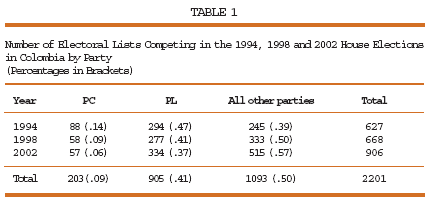
The figures in table 1 show the aggregate number of electoral lists that competed under the Liberal (PL) and Conservative (PC) party labels across all districts. Even though this table does not detail the levels of inter- and intra-party competition in each electoral district, it shows that in general terms an exorbitant number of party lists competed against each other and against lists of other parties in every election, especially within the Liberal Party.
For further illustration, let us consider the number of lists that the PL and the PC ran in 1998 in the electoral districts whose magnitude equals the average district magnitude for the whole country (i.e. ), as depicted in table 2.
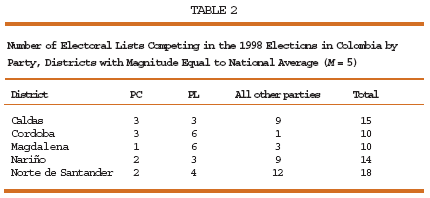
Number of electoral lists competing in the 1998 elections in Colombia by party, districts with magnitude equal to national average (M = 5)
With one exception, both parties offered voters several choices of party lists in the election. In two instances, the PL presented more lists that there were seats available. Hence, only in Magdalena could the conservative candidate appeal to voters on the basis of their party affiliation. In all other cases, PL and PC candidates faced at least another co-partisan candidate in addition to all candidates from other parties also competing. From the citizens' perspective, the high number of party lists implies that voters have to use cues other than the party label to make their voting decision.
]]>The Brazilian Political System
Brazil has a bi-cameral congress with Senators and Federal Deputies elected in identical at-large electoral districts, equivalent to the political boundaries of states. Every state elects 3 Senators for 8-year terms with one-third renewal in one election and two-thirds in the next. The number of Federal Deputies per state varies from a minimum of 8 to a maximum of 70, according to the state's voting population size. Elections for the Senate and Chamber of Deputies are concurrent, along with legislative elections at the state level and executive level elections at the federal and state levels.
Elections for the Senate are ruled by a plurality system. The candidate with the most votes wins in a one-round election. Like in Colombia, elections for the executive branch are also decided with a majority run-off procedure with the top two candidates facing each other in a second round. This procedure ensures that no candidate is elected for executive office without a majority of the valid votes7.
Elections for the Chamber of Deputies are ruled by an Open-List PR electoral system. In Brazil, voters choose to vote either on political parties or individual candidates. Party lists are defined after the election, based on the total vote obtained by each individual candidate. The difference between open and closed-list systems lies exactly on the way in which the ranking of candidates in party lists is defined. In the open-list systems, voters determine the placement of the candidates in the party lists during the elections. In closed-list systems, the order of the list is defined ex-ante by intra-party decisions, during conventions, primaries or caucuses. Scholars maintain that open-list systems generate incentives for a personal vote because candidates depend mostly on their reputations and resources to win elections (Ames 1995; Samuels 2000; Samuels 2002; Taagepera and Shugart 1989). In addition, the "birthright rule" (candidato nato), in force up until the 1998 elections, guaranteed incumbents automatic access to the ballot, decreasing even more parties' control over the nomination process (Samuels 2003). In 2002, the "birthright rule" was revoked. Still, incumbent Federal Deputies are the ones responsible for obtaining funding and for conducting their campaigns, with very little interference of parties in the campaigning (Samuels 2002).
Some authors claim that as a consequence of the emphasis on personal reputations, party leaders lose their capacity to affect the career decisions of incumbent Deputies, which leads to higher degrees of independence of Federal Deputies vis-à-vis party leaders (Novaes 1994; Ames 2001). Nonetheless, such claims have been contested by authors who argue that parties are influential inside the Chamber of Deputies because of the centralization of decision-making generated by the Chamber's standing rules (Figueiredo and Limongi 1999). Still, others claim that the centralization process occurs because the executive branch controls the policy-making process and budgetary appropriation procedures. This leads to a situation where the executive branch is able to obtain support in the Chamber by the distribution of Federal monies.
Therefore, there are factors in the Brazilian policy system that may increase the role of political parties in affecting incumbents' performance in office. Brazilian electoral laws may also increase the role of parties when stipulating that parties or coalitions of parties must achieve an electoral quota to gain seats in Congress. The quota is defined by dividing the total number of votes in the district by the number of seats in the Chamber allocated at that district. The total number of seats obtained by a party or coalition depends on how many times the party or coalition meets the quota. The remainders are distributed following the d'Hondt formula, which favors larger parties (Nicolau 1999; Taagepera and Shugart 1989). Hence, there is vote pooling within parties and coalitions.
Some argue that intra-party competition is attenuated by the rules of seat allocation and by votes pooling at the party level (Figueiredo and Limongi 2002). This means that there are incentives for candidates to avoid campaigning against their fellow party or coalition members. Given that it is in the interest of candidates that their parties achieve the highest number of votes, candidates from the same party may refrain from campaigning directly against fellow party colleagues, similarly to the pattern identified by Crisp and Desposato for senatorial elections in Colombia (2004).
Even though the Brazilian electoral system generates incentives to cultivate personal reputations, parties cannot be completely ignored as factors that influence incumbents' electoral strategies. Since electoral quotas are achieved at the party or coalition level, party leaders have some leverage to affect backbenchers' careers. Finally, the power of party leaders is also increased by the centralization of power in the hands of the executive branch at the federal level. Party leaders mediate access to federal monies that incumbents use to distribute in their districts (Pereira and Renno 2003).
]]> Contrasting Brazil and Colombia
From the discussion above, it is clear that there are many similarities between Brazil and Colombia in the functioning of their electoral systems. Institutional minutiae in the electoral system increase the similarities between the two countries. However, there is a clear difference that also appears when we examine another institutional detail. In Colombia, votes are not aggregated at the party level when calculating the quota. This means candidates in Colombia have no incentive to cooperate with fellow party candidates. In Brazil, on the other hand, the party or coalition's votes are added when calculating the quota, which increases the likelihood that parties have different levels of electoral influence in the two countries. This difference between the two systems may affect the incentive structure of reelection strategies. In fact, vote transference inside parties and coalitions approximates Brazil to a CLPR system and the absence of it in Colombia approximates Colombia even more to an OLPR system. Our question then is: do Brazil and Colombia meet mid-way between these two systems, each country moving in opposite directions of the pure-brand, ideal type systems from which they originate?
To sum up, the Brazilian and Colombian political systems generate a mix of incentives. Some aspects of these systems strengthen party reputations; others place emphasis on candidates' personal traits. How factors associated with personal reputations and partisan reputations influence election results in these two countries is a matter of empirical verification. The next section proposes a simple model of career choice and reelection success in Latin America that tests the impact of these mixed institutional incentives.
Career Politicians in Latin America
The study of political careers and how they are affected by the institutional framework of the electoral system and of intra-legislative rules is a topic of intense debate in Latin America. There is a dispute, especially evident in the Brazilian case, about what factors lead to a centralization of power in the hands of party leaders and what factors decentralize power and the grip of party leaders over backbenchers. It is clear that some systems offer more institutional resources to the construction of coordinated collective action inside parties and legislatures, but the exact impact of variations in institutional details has not yet been fully explored. Most of the literature tends to stick to the "big picture", ignoring how minutiae may approximate or distance a functioning system from its ideal type. Furthermore, authors tend to focus either on the electoral system or on rules inside congress when constructing their arguments. Even worse, when they do so, especially those who look at the electoral system, they fail to notice some institutional minutiae that are critical to fully understanding the incentives generated by the system.
Ames (1995) established the conventional wisdom in the study of the impact of electoral systems on the behavior of lower house legislators inside congresses and while seeking reelection in Latin America. Focusing on legislatures elected immediately after the promulgation of the 1988 Constitution, Ames set the tone of the debate by pointing out some central factors that influence Federal Deputies' electoral success in Brazil. The emphasis of this approach is on the impact of the electoral system in generating intense competition between candidates and how such competition affected election outcomes. Ames finds that candidates' strategies of concentrating their campaigning in specific localities and distributing pork-barrel policies are central determinants of electoral success in Brazilian legislative elections.
Building upon Ames' work, Samuels (2000) argues that the high turnover rates in the Brazilian Chamber of Deputies are due to the fact that safer incumbents seek higher office and the pool of challengers in elections for Federal Deputy is very strong. Hence, the nature of political ambition in Brazil and the intense electoral competition inside districts reduces incumbents' chances of reelection. Samuels (2002) has also argued that campaign finance rules favor candidates that have bigger war chests and campaign finance plays a decisive role in Brazilian elections. Therefore, the focus on the electoral system still prevails, and candidates make career choices exclusively looking outside of the Chamber of Deputies.
Differently from the two approaches above, Pereira and Renno (2003) and Leoni, Pereira and Renno (2004) have claimed that in addition to the incentives generated by the electoral system, one must also consider the impact of the rules inside the Chamber of Deputies and executive/legislative relations in incumbents' electoral success and career choices. Incumbents' performance in the chamber, the influence of political parties and the role of the executive branch in affecting the disbursement of federal largesse also influence incumbents' choices and electoral strategies. These authors build upon the unquestionable contribution of Figueiredo and Limongi (1999) to the study of legislative politics in Latin America, calling attention to how the internal rules of the Chamber of Deputies concentrate powers and increase the ability of the executive branch and of party leaders to stimulate cooperative behavior.
It is exactly this last strand of research that calls attention to how cooperative behavior in Latin American legislatures is a consequence of a combination of several distinct institutional incentives that may generate contradicting pressures on Federal Deputies. Such pressures, may lead to a situation in which political parties may not matter in the electoral arena but may do so in the legislative one (Pereira and Mueller 2003). Hence, dissociation between electoral pressures and legislative behavior may be possible, which contradicts Ames's and Samuels's approaches that focus mostly on the electoral arena and Limongi and Figueiredo, who emphasize mostly the legislative one. Our claim is that by focusing on the different sides of the same coin, the existing literature either completely ignores the impact of the institutional factor they overlook or ignore important minutiae of the institution they analyze.
]]> In addition to the discussion about which institutional framework matters more in affecting political career choices and electoral success, the discussion about how incumbent Federal Deputies cater to their constituencies is also important to understand the incentives created by the institutional system. Careerism has been included as an assumption in studies about the geographical patterns of support and constituency-building efforts of Senators (Crisp and Desposato 2004; Crisp and Ingall 2002). In their study of patterns of support, Crisp and Ingall (2002) assume that politicians want to get elected and reelected and analyze the effects of prior experience and membership of traditional parties on their electoral strategies. Their findings suggest that Colombian senators concentrate their vote share in particular districts as opposed to having spread, nationwide electoral support and that this trend is stronger for members of traditional parties who have been previously elected to office.In turn, Crisp and Desposato (2004) focus on the way in which legislators decide whom to target as prospective constituents. In multi-member PR districts with personal lists, incumbents compete against each other and need to decide how to allocate resources to groups of constituents. Therefore, the authors suggest that constituency development should focus on developing and maintaining personal vote niches achieved in previous elections. Hence, incumbents try to avoid costly inter-incumbent competition for votes. If senators need to increase their share of the vote, they are more likely to seek votes in areas that are not dominated. This cooperative behavior is explained by the weakness of the party system. Electoral competition in Colombia does not pit parties against each other in a zero-sum game, like it does in ideal-type CLPR systems. Instead, politicians care about their individual fortunes and to do so engage in cooperation to protect their joint survival.
In Brazil, there is a consensus among part of the literature that pork-barrel politics plays a fundamental role in affecting incumbents' electoral success and also career choice (Ames 1995, Pereira and Renno 2003). The idea is that pressures coming from the electoral system stimulate candidates to build a personal reputation by doing service in their electoral bailiwicks. This view has not gone unquestioned. Figueiredo and Limongi (2005) and Samuels (2000) argue that the percentage of the budget that is used for pork-barrel politics in Brazil is miniscule and that other factors matter more in elections like campaign finance in Samuels' view or more programmatic issues in Figueiredo and Limongi's view.
To sum up, the literature indicates that there are still lasting gaps in the debate about how institutions really affect choices and behaviors. There are conflicting views if building a personal reputation or a party reputation matters more in Latin America, especially in Colombia and Brazil. The literature on both countries provides evidence that contradicts initial, naïve, expectations about these countries' electoral systems. In fact, our main hypothesis is that Brazil's hybrid OLPR may have an impact on Federal Deputies' behavior that is closer to a pure CLPR than Colombia's hybrid CLPR. If this is the case, then partisanship of the incumbent Federal Deputy may matter more in Brazil than in Colombia, but the electoral and intra-legislative incentives should have similar effects.
In addition to this main hypothesis, and based on the literature and in the description of the institutional framework of the two cases, we derive several other hypotheses that test the impact of both the electoral system and incumbents' performance in office in Brazil and Colombia in two elections. We believe that the incentives generated by the electoral system affect both the legislators' decision to run for reelection and their likelihood of winning. The main goal of the empirical analysis is to test the extent to which Brazilian and Colombian legislators behave similarly given the differences in the electoral systems in the two countries.
Data and Hypotheses
For our empirical analysis, we collected data on electoral results and legislative performance of deputados federais in Brazil and representantes a la cámara in Colombia in two recent congresses. For Brazil, we use data from the last two legislatures: the 50th, elected in 1998 and the 51st, elected in 2002; for Colombia, we use data from the 1994 and 1998 congresses. The unit of observation is the individual titular deputy8.
In order to test the extent to which the incentives and constraints to run for reelection are similar in Brazil and Colombia, we use as our dependent variable the decision of incumbent legislators to run for reelection. We are also interested in analyzing how the institutional incentives and constraints affect the electoral fate of incumbents who run for reelection. Thus, we run identical models using as the dependent variable whether or not legislators are successful in their reelection bids.
Finding equivalent indicators in two different systems is one of the main challenges of incurring in comparative institutional analysis. The data available allowed us to include a central indicator of the effects of the electoral system, two indicators of the performance of legislators once in office and two of the structure of the party system in the two countries. In this way we evaluate how rules and relationships inside the Chamber of Deputies and how electoral competition generated by the electoral system provides contrasting effects on incumbents' career choices and electoral success. We examine the incentives generated from distinct institutional origins, clearly incorporating the teachings of part of the literature discussed above. Furthermore, we also analyze how the structure of the party systems may affect incumbents' electoral luck. One of our points, based on the evaluation of the institutional minutiae of these two countries is that parties may end up being more significant in Brazil than in Colombia. But in both countries, parties should be weak determinants of electoral success because both systems are more candidate-centered.
]]> In terms of the electoral system, we include an index of electoral competition in the district that accounts for the number of candidates and the district magnitude. We aim at testing how varying levels of competition affect the career choices incumbents make and their likelihood of winning reelection9. Samuels has argued that incumbents decide to run for higher office in part because elections for the chamber of deputies are very competitive (2003). Furthermore, turnover ratios are also very high because elections are competitive. Therefore, district competition should first have a negative impact on running for reelection and second, it should decrease incumbents' electoral success in both countries.With regards to performance in office, we used a variable that indicates whether the legislator served as chairperson of a committee during his or her term in office. Committee chairs in both countries are not as powerful as their counterparts in the USA, mostly because they do not regulate the allocation of monies (Aleman and Tsebelis 2005). However, committee chairs are more likely to get media exposure during their tenure in office and they do control the agenda of the committee, which also increases their visibility inside Congress and in the Executive branch (Pereira and Muller 2000). Committee chairs are also more likely to occupy other positions of power in the Chamber of Deputies, which increases their intra-legislative ambition (Hall and Houweling 1994) and therefore the incentive to return to the chamber in future elections.
Additionally, we included a measure for the total number of bills sponsored or co-sponsored by the legislator that became law during his or her term in office. This is an indicator of legislators' legal productivity during their tenure and the claim is that more productive legislators are more likely to win reelection. It must be clear that these are two very stringent indicators of performance in office because by definition only a few legislators can become chairs of their committees and a small percentage of bills initiated actually become law. However, these are the only two comparable measures available.
With regards to the role of political parties, given their electoral preponderance in both countries, we also include an indicator for membership of a traditional party. Thus, we code as members of traditional parties the legislators affiliated to parties that supported Fernando Henrique Cardoso's administration in Brazil: PSDB, PFL, PTB, PPB10. For Colombia, we included in the "traditional party" category members of the PC and PL. The hypothesis is that members of traditional parties will be more likely to run for reelection, partially because they are also more likely to win reelection. The claim is that members of traditional parties that support the executive branch in these countries have more access to pork-barrel policies and are, therefore, more likely to benefit electorally from their access to pork. Hence, our measures of party affiliation follow part of the literature in claiming that parties may be strengthened when they serve as intermediates in the distribution of pork-barrel politics (Pereira and Renno 2003).
Another measure of how parties may affect the construction of party or personal reputations is the actual number of parties in the legislature based on the partisan composition of the chamber. The more parties there are, the less constrained politicians feel to run under a party label. Where there are more parties and restrictions to party-switching are lax, candidates can circumvent partisan influence by changing party allegiances. This would lead to a weakening of party leaders' grip over backbenchers and a diminished impact of partisanship on career choice and reelection. However, the actual impact of party fragmentation on career choice and electoral success is not evident. More parties give incumbents more flexibility to run for office; hence it can lead incumbents to seek parties that will allow them to run for reelection or for higher office. More parties though, can lead incumbents to seek parties that will allow them to run for reelection in Brazil or be better placed in the list in Colombia, increasing chances of electoral success. More parties also lead to more vote fragmentation, giving incumbents the advantage over challengers due to name recognition. To sum up, party fragmentation may also affect electoral success positively, by increasing vote dispersion and reducing the number of votes necessary to have a high placement in the final electoral outcome. In relation to career choices, the impact of parties is not so obvious.
Analysis
We estimate fully specified models that interact the variables in the basic model with dummy variables for the country and legislature. The country dummy is coded 1 for Brazilian legislators, and the congress dummy is coded 1 for the first congress of each country in the sample. This is the best way of testing if there are statistically significant differences between the two countries and the two time periods (Jaccard and Turrisi 2003). The coefficients and their respective standard errors for the interaction terms will allow us to verify the direction of the differences and the efficiency and 'generalizability' of the findings.
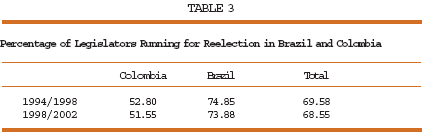
An initial inspection at the data indicates that reelection is one of the main career options for incumbents in both Colombia and Brazil as depicted in table 3. This is especially true in Brazil, where around 75% of incumbents opt to run for reelection instead of running for any other office or retiring. In Colombia, the turnover is necessarily higher because fewer incumbents choose to run for reelection. However, it is clear that legislatures in these countries are populated by career politicians.
]]>
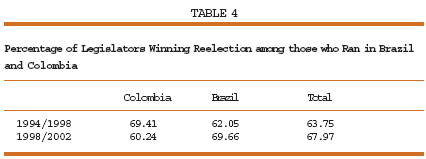
Of those who choose to run for reelection, a majority of them in both countries are victorious. In Brazil the trend is of an increase in reelection rates. In Colombia just the opposite happens. However, the rate of success among those who try is about the same in both places. What is clear is that a majority of the incumbents who attempt to have careers in the Chamber of Deputies in both of these countries are quite successful.
The table 5 explore how the independent variables described earlier affect incumbent's probability of being reelected. We applied an identical model to explain both running for reelection as well as winning reelection11.
]]>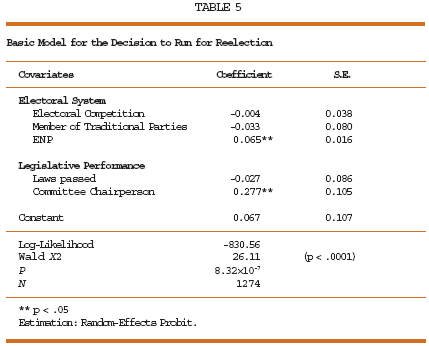
Table 5 contains the results for the analysis of choosing to run for reelection in a combined, weighted sample of both countries12. We estimated all of our models using Random-Effects Probit regression, which accounts for the panel structure of our data when estimating standard errors. Hence, variation both within as well as between individuals is accounted for when estimating the efficiency of the coefficients.
The analysis indicates that in the combined sample of these countries, both the actual number of parties inside the Chamber as well as the fact of having held a position as committee chair increases the incumbents' likelihood of attempting to stay in the chamber.
As the number of parties increases, incumbents have more alternatives, more avenues to attempt reelection13. In both countries, candidates need to be nominated by parties, independent candidates are not allowed, and hence parties are essential for incumbents who aspire to run for reelection. The more parties there are, the easier for an incumbent to decide to run for reelection.
Holding a position of power in the chamber is also a sign of intra-legislative ambition (Hall and Houweling 1994). Incumbents who have held influential positions in the hierarchy of the chamber are more prone to staying in the chamber because they are more likely to hold similar positions of power again in the future. For such politicians, returning to the chamber is an interesting career option.
Table 6 presents the results for winning reelection. It is clear that several factors influence incumbents' chances of winning. First, in districts where competition is very stark, the likelihood of success decreases. The status of member of a traditional party increases incumbents' chances of winning reelection. The actual number of parties also affects winning reelection positively. The more parties there are, the more candidates among whom the vote gets fragmented, which decrease the burden of winning. All of these findings confirm our initial expectations.
]]>
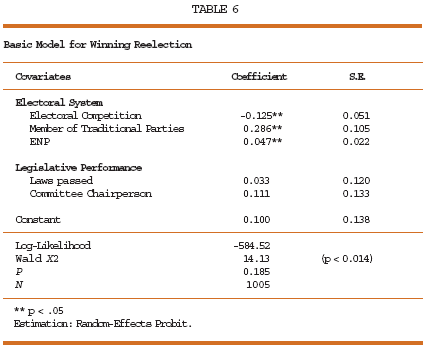
It is interesting to notice that none of the indicators of incumbents' performance in office — holding the presidency of a committee and proposing laws — has any impact on electoral success. What incumbents do inside the chamber affects their calculus of running for reelection, but does not appear to affect the outcome of the election, confirming Pereira and Renno's findings for Brazil and expanding them in the case of Colombia (Pereira and Renno 2003).
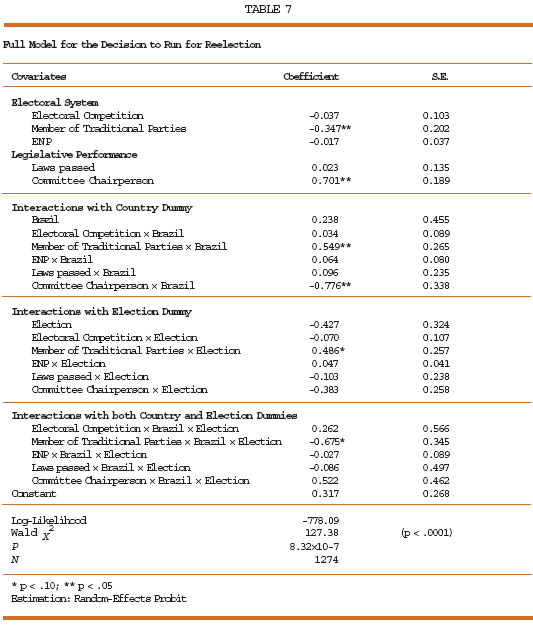
In spite of offering interesting information about what the factors are in relation to running for reelection and increasing the probability of winning reelection, the basic models do not allow us to compare the impact of these variables in the two countries and in the different elections. It is worth recalling that the main puzzle of this study refers to the comparative analysis of the impact of these variables in two countries with distinct institutional environments. The most appropriate way of making such a comparison is through the use of interaction terms. Tables 7 and 8 contain a model that interacts the independent variables discussed above first with country, then with election and then with election and country. This allows us to verify if there are statistically significant changes in the impacts of the independent variables in all the different environments and elections.
]]>
Let us consider first a full model for the decision to run for reelection. The results of this model are shown in Table 7. The first part of the table presents the "main effects" of the independent variables. These coefficients indicate the impact of the independent variables when a dummy for Brazil equals zero and when a dummy for the second electoral period equals zero. In substantive terms, this means that these coefficients represent the impact of the independent variables in Colombia (Brazil = 0) in the 1994 election (election = 0). Results indicate that incumbents' choice of running for reelection in Colombia was only affected by being a member of a traditional party and by being president of a committee.
The second part of the table presents the interaction terms between the Brazil dummy variable and the independent variables. The results illustrate how the impact of the independent variables found in the case of Colombia's 1994 elections changes in relation to the 1998 election in Brazil (Brazil = 1, election = 0).
There are two main differences. First, in Brazil, the impact of being from a traditional party is positive (0.54 + (-0.34) = 0.20), and the change in impact between the two countries is statistically significant. Also the impact of being president of a committee is different in the two countries. The impact in Colombia is positive, whereas there is a negative, statistically significant change in relation to Brazil (0.701 + (-0.776) = -0.075).
The finding that the partisanship of Federal Deputies is stronger in Brazil is in accordance with our expectation. As we claimed before, the institutional minutiae in Brazil increase the chance that parties matter more because quotas are based on parties or coalitions, differently from Colombia, where candidates must achieve the quota.
Apparently, the role an incumbent plays in the Chamber of Deputies in Colombia affects more strongly his/her decision to attempt reelection. Hence, holding a position of power in the chamber in Colombia has more of a pull factor than in Brazil in stimulating incumbents to return to the chamber. Committee leaders in Colombia have substantial gate-keeping and agenda-setting powers. Committee leaders decide who reads and reports back to the committee on the bills assigned to it, which allows them to pick legislators who may favor bills they like or who oppose bills they dislike. Additionally, leaders control who speaks in the committee and decide when a vote may take place. Holding such power to affect legislation may tempt members of congress to seek reelection.
There are no other statistically significant differences between Colombia and Brazil in the elections of 1994 and 1998 (the first elections we have data for in each country).
The third part of the table shows the impact of independent variables in the second election included in the data set for the two countries. As mentioned, this is the 1998 election in Colombia and the 2002 election in Brazil. The two-way interaction terms between election and the independent variables indicate the impact of the variables when the election dummy equals one and when the Brazil dummy equals zero. Substantively, these are the changes in results for the 1998 election in Colombia in comparison to the 1994 one. Hence, this is a test of changes over time in a single country.
The only statistically significant change is in relation to the impact of traditional parties. In the 1998 elections in Colombia, the impact of being a member of a traditional party positively affected running for reelection, whereas those who belonged to a traditional party in 1994 decided it was best not to run for reelection. In 1998, being from a traditional party increased the likelihood of running for reelection.
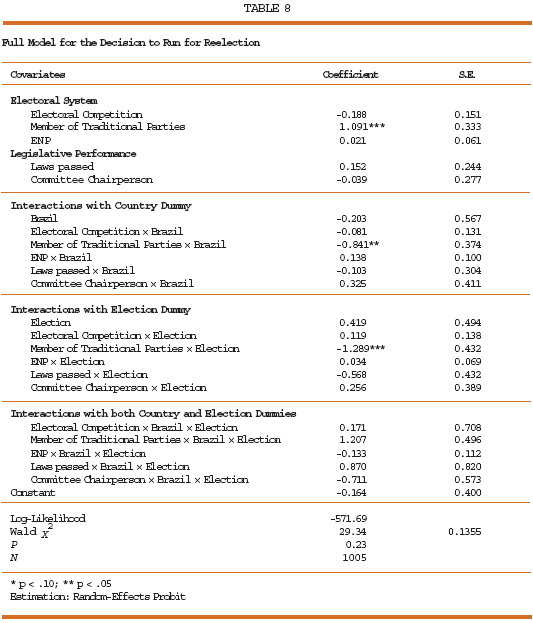
]]> In relation to Brazil in its 2002 election, indicated by the fourth and last part of the table, the only significant change is also in relation to being a member of a traditional party. There is a decrease in the impact of being from a traditional party in Colombia in 1998 to Brazil in 2002. The impact in Brazil is still positive ((-0.34) + 0.54 + 0.48 + (-0.67) = 0.01), but it is very small.Finally, we also run a full model for the likelihood of winning election in which we interacted the variables of the basic model with country and election dummies. The results of this model are reported in table 8. In the 1994 elections in Colombia, the only statistically significant variable affecting electoral success is being a member of a traditional party.
The change in impact of this variable was statistically significant in Brazil. Being a member of a traditional party has a weaker impact in electoral success in Brazil, than in Colombia. The impact of membership of a traditional party in the 1998 elections in Brazil is still positive (1.09 + (-0.84) = 0.25), but its impact is smaller than in Colombia.
Party membership is also the only variable whose impact changes in Colombia from 1994 to 1998. There is a steep decline in the positive impact of being from a traditional party in Colombia from one election to the next. The impact of being from such parties has a negative impact in the 1998 Colombian elections (1.09 + (-0.84) + (-1.28) = -1.03). Finally, in relation to Brazil in the 2002 elections, again, partisanship is the only factor that changes. In Brazil, being from a right-wing party still affects electoral success in a positive way (1.09 + (-.84) + (-1.28) + 1.20 = 0.17), but this impact is weaker than in 1998 (1.09 + (-0.84) = 0.25).
Most importantly for our argument, none of the changes in the other independent variables is statistically significant. That is, electoral competition, our main indicator of the impact of the electoral system in these countries, affects reelection success in similar ways in both countries. Furthermore, the impact of the actual number of parties and of incumbents' performance in office does not vary between the two countries. There are no statistically significant changes in the impact of these variables.
Conclusion
In this paper, we test if distinct institutional environments have similar impacts in the choice to run for reelection and the likelihood of winning office for House members in Brazil and Colombia. On paper, Brazil and Colombia have different electoral rules. However, a closer inspection of the way the electoral system works indicates that some rules in the Colombian electoral system approximate it to the Brazilian case. More specifically, the fact that Colombian parties can nominate several different lists in Colombian lower house legislative elections produces a situation that resembles Brazil's open-list proportional representation system. When we compare the two systems, we find that the difference in impact of electoral competition, of actual number of parties and of incumbents' performance in office between these two countries is not statistically significant. This leads us to conclude that the formal differences, when closely inspected, do not lead to significant variation in the behavior of politicians and in the outcomes of elections. This is relevant for both theoretical and substantive reasons. Theoretically, it calls our attention as analysts of institutions and their impact. The literature has relatively clear predictions about how different institutional designs affect the behavior of politicians. However, as the case of Colombia illustrates, minor variations in the setup of the electoral rules result in incentive structures that are different from what is expected. Substantively, the comparison of two different cases sheds light on the functioning of 'personalistic' systems.
The only variable that appears to change in the two countries is more closely related to the role of partisanship. The impact of being a member of a traditional party in choosing to run for reelection and winning reelection changes synchronically and diachronically. The changes can be attributed to specific political factors in both countries. In the 2002 Brazilian elections, right-wing parties that supported the incumbent president Fernando Henrique Cardoso faced growing dissatisfaction, which affected its members' career decisions and the outcomes of elections. In Colombia, the political climate did not favor traditional parties in the 1998 election either. The Samper administration (1994-1998) was deeply affected by accusations that leaders of the Liberal party accepted campaign contributions from drug lords. One of the major themes in the 1998 election was the anti-corruption discourse, which may have affected the fate of members of traditional parties.
In Colombia the changes in the impact of being a member of a traditional party are more radical. In 1994, being a member of such parties had a positive impact in winning reelection. In 1998, the impact became negative. As suggested, the dissatisfaction with members of the traditional parties, and particularly members of the Liberal party, may explain why membership in these parties became a liability in the 1998 election. We would need to include results of other elections in order to assess the extent to which there is a trend in terms of the effect of membership of traditional parties.
]]> In Brazil, the impact of being from a traditional party in affecting electoral success is always positive and it only decreases in magnitude from one election to the next. The national political climate in the 2002 elections favored left-wing parties as attested by the victory of Lula da Silva from the Workers' Party in the 2002 presidential election and the increasing number of seats that his party obtained in the Chamber of Deputies. Nevertheless, being from a traditional party still had a positive influence in electoral results in Brazil in 2002, albeit much smaller than it did in 1998, when Cardoso won reelection.In addition to these circumstantial explanations, the fact that parties had a more consistent impact in Brazil confirms our expectation that because the party's or coalition's votes are added up when calculating the electoral quota in Brazil (and not in Colombia), the likelihood that parties may have different electoral influences in the two countries increases. It does seem that vote transference inside parties and coalitions approximates Brazil to a CLPR system and the absence of it in Colombia approximates Colombia even more to an OLPR system.
The comparative nature of our project restricts the inclusion of several variables that have been tested previously in Brazil. To mention only a few, direct measures of budgetary amendment allocation, campaign expenditures and support for executive branch legislative proposals in Congress have been pointed out as being central to a model of career choice and electoral success in Brazil. However, such variables are not readily available in Colombia. Nonetheless, some of our variables, like membership of a traditional party, serve as a broad indicator of such factors.
Therefore, we were able to test our main hypotheses with the best data available and demonstrate that in relation to the central aspects of electoral competition, the role of political parties and the legislative performance of incumbents, there are very few differences between Colombia and Brazil regarding career choices and electoral success. Institutional minutiae have a dramatic effect on the role electoral rules play in affecting career choices and reelection success in Brazil and Colombia. Our findings indicate that there still is fertile ground for institutional analysis in comparative studies, as long as researchers dig deep into the institutional settings of countries and focus on the details of their systems — not just on general outlines. After all, the devil lies in the details.
Notes
1 Earlier versions of the paper were presented at the meetings of the Midwest Political Science Association MPSA (2003) and Latin American Studies Association LASA (2004). We are thankful to the participants for their comments. We also thank Scott Desposato and Juan Carlos Rodríguez for reading and commenting on earlier versions. Finally, we also thank anonymous reviewers at BPSR..
2 However, the population is not evenly distributed over the country's 32 departments. There are a few urban centers that encompass large populations and several rural zones with low population density, which implies that the House is 'malapportioned' in the sense that rural areas are significantly over-represented. For instance, data from the 1998 House election show that departments with higher percentages of rural population obtain a larger proportion of seats compared to their proportion of votes. Overall, the House 'malapportionment' is equal to 12.5%, which means that twelve and a half percent of the seats were allocated to districts that would have not received those seats if there were no 'malapportionment'. See Samuels and Snyder (2001).
3 Congressional elections first preceded the presidential elections in 1978. The electoral calendar was modified to use legislative elections as quasi-primaries for the selection of presidential candidates. See Martz (1997) and Taylor et al. (2004).
4 The majority run-off system was implemented in the 1991 reform. In the four elections held since, the first two required a run-off election. In the last two elections, held in 2002 and 2006, president Uribe won with a majority of the vote in the first round. The 2006 election was also salient in that Uribe was reelected for a second consecutive term after he managed to have Congress approve a constitutional amendment in 2005 that allowed immediate reelection, something that had been banned for over 100 years.
]]> 5 In an effort to promote party cohesion, Congress passed an important reforma política in June 2003. Now Colombia has a more straightforward PR system, in which parties win seats based on their vote shares. The 2003 political reform contains four major features: (i) parties are restricted to run only a single list in each district, (ii) the d'Hondt allocation formula was adopted, (iii) an electoral threshold was established and (iv) parties have the option to use open or closed lists. The first three features encourage the cultivation of party reputations. The possibility to use open lists, which actually a vast majority of parties did on the local elections of 2003, and the national elections of 2006, provides incentives to legislators to cultivate their personal reputations. While the results of the 2003 local elections and the 2006 national elections show that parties appear stronger, there are still incentives for personalistic behavior because of the voto preferente and the campaign finance system. Current campaign finance puts the burden of fundraising solely on the individual candidates and not on the parties. See Botero (2006), Hoskin and García Sánchez (2006) Rodríguez Raga and Botero (2006), and Shugart et al. (2003)6 The case of the senate is illustrative. In the 1991 election only 9 lists obtained more than one seat. In the 1994, 1998, and 2002 elections, only 3 lists won more than one seat respectively. Some scholars claim that because of the way in which it functions, the proportional system is transformed into a de facto Single Non-Transferable Vote (SNTV) system. Due to the inability of party leaders to limit the number of lists nominated in each district, politicians face a prisoner's dilemma in the sense that it is clear that increased intra-party competition reduces the odds of winning election for all candidates as the party vote is thinly spread. To cooperate, politicians must decide the order of the list which implies a rapidly decreasing likelihood of election for those not at the top of the list. Because they rely on their personal reputations, politicians nominate their own lists. See Cox and Shugart (1995).
7 This is true for presidential, gubernatorial and mayoral elections in municipalities with over 200,000 registered voters.
8 In Brazil and Colombia, main officeholders and substitutes take office during a legislature. We included only main officeholders to make the comparison between the two countries easier. For a discussion about the inclusion of substitutes, see Pereira and Renno (2003), Leoni, Pereira and Renno (2004) and Samuels (2003).
9 The index of competition is given by IC = (N/2M) - 1, where N represents the total number of candidates competing in the district and M represents the number of seats available in that district. See Santos (1997) for a thorough description of this index.
10 PSDB is the Partido da Social Democracia Brasileira, PFL is the Partido da Frente Liberal, PTB is the Partido Trabalhista Brasileiro and PPB is the Partido Popular Brasileiro. All of these stand in the right, pro-government side of the Brazilian ideological spectrum (Figueiredo and Limongi 1999).
11 Of course, this is an oversimplification of the choice process, mostly due to difficulties in homogenizing the data for both countries. Future studies should focus on specifying more correctly the choice model by including career options outside politics, performance in past elections and age. Given that such data is not available, we make the best of the data we have and are able to test how some fundamental aspects of politics in both of these countries affect incumbents' choices.
12 Weights were applied to increase the comparability in sample sizes between Brazil and Colombia. Brazil has almost three times more seats in the Chamber of Deputies (513) than Colombia (161). Weights were applied to make sample sizes more equivalent, overweighting Colombian incumbents and underweighting Brazilian ones.
13 Until the 1998 elections in Brazil, incumbents were granted the right of assured nomination by their parties if they decided to run for reelection. This was called the "candidato nato" rule. This rule was revoked in the 2002 elections. Nonetheless, even with the "candidato nato" rule, incumbents were forced to be members of a party if they decided to run. Therefore, the argument that more parties increase the likelihood of running for reelection is not affected by the change in rules.
]]> Bibliography
Aleman, Eduardo, and George Tsebelis. 2005. The origins of presidential conditional agenda setting. Latin American Research Review 40 (2): 3-26. [ Links ]
Ames, Barry. 1995. Electoral strategy under open-list proportional representation. American Journal of Political Science 39 (2): 406-33. [ Links ]
____________. 2001. The deadlock of democracy in Brazil. Ann Arbor: The University of Michigan Press. [ Links ]
Botero, Felipe. 1998. "El senado que nunca fue: La circunscripción nacional después de tres elecciones". In Elecciones y democracia en Colombia 1997-1998, ed. A. M. Bejarano and A. Dávila. Bogotá: Universidad de los Andes. [ Links ]
____________. 2006. "Reforma política, personalismo y sistema de partidos. ¿Partidos fuertes o coaliciones electorales?". In La reforma política de 2002. ¿La salvación de los partidos políticos colombianos?,ed. Gary W. Hoskin and Miguel G. Sánchez. Bogotá: Uniandes/ Fundación Konrad Adenauer. [ Links ]
Cox, Gary W., and Matthew Soberg Shugart. 1995. In the absence of vote pooling: Nomination and vote allocation errors in Colombia. Electoral Studies 14 (4): 441-60. [ Links ]
Cox, Gary W., and Scott Morgenstern. 2001. Latin America's reactive assemblies and proactive presidents. Comparative Politics 33 (2): 171-90. [ Links ]
Crisp, Brian F., and Scott Desposato. 2004. Constituency building in multimember districts: Collusion of conflict? The Journal of Politics 66 (1): 136-56. [ Links ]
Crisp, Brian F., and Rachael E. Ingall. 2002. Institutional engineering and the nature of representation: Mapping the effects of electoral reform in Colombia. American Journal of Political Science 46 (4): 733-48. [ Links ]
Figueiredo, Argelina, and Fernando Limongi. 1999. Executivo e Legislativo na nova ordem constitucional. São Paulo: Ed. FGV. [ Links ]
____________. 2002. Incentivos eleitorais, partidos e política orçamentária. Dados 45 (3). [ Links ]
____________. 2005. Processo orçamentário e comportamento legislativo: Emendas Individuais, apoio ao Executivo e programas de governo. Dados 48 (4). [ Links ]
Hall, Richard, and Robert Van Houweling. 1994. Avarice and ambition: Representatives' decisions to run for or retire from the U.S. House. American Political Science Review 89 (1): 121-36. [ Links ]
Hoskin, Gary W., and Miguel García Sánchez. 2006. La reforma política de 2002. ¿La salvación de los partidos políticos colombianos? Bogotá: Uniandes/ Fundación Konrad Adenauer. [ Links ]
Jaccard, James, and Robert Turrisi. 2003. Interaction effects in multiple regression. Thousand Oaks, CA: Sage Publications. [ Links ]
Leoni, Eduardo, Carlos Pereira, and Lucio Renno. 2004. Political survival strategies: Political career decisions in the Brazilian Chamber of Deputies. Journal of Latin American Studies 36 (1): 109-30. [ Links ]
Martz, John D. 1997. The politics of clientelism: Democracy and the State in Colombia. New Brunswick: Transaction Publishers. [ Links ]
Morgenstern, Scott, and Benito Nacif, ed. 2002. Legislative politics in Latin America. New York: Cambridge University Press. [ Links ]
Nicolau, Jairo. 1999. Sistemas eleitorais. Rio de Janeiro: FGV Editora. [ Links ]
Novaes, Carlos. 1994. Dinâmica institucional da representação. Novos Estudos CEBRAP, no. 38: 99-147. [ Links ]
Pereira, Carlos. 2000. What are the conditions for the presidential success in the Legislative arena?The Brazilian electoral connection. PhD diss., The New School. [ Links ]
____________, and Bernardo Mueller. 2000. Uma teoria da preponderância do Poder Executivo: O sistema de comissões no Legislativo brasileiro. Revista Brasileira de Ciências Sociais 15 (43): 45-67. [ Links ]
____________. 2002. Comportamento estratégico em presidencialismo de coalizão: As relações entre Executivo e Legislativo na elaboração do orçamento brasileiro. Dados 45 (2): 265-301. [ Links ]
____________. 2003. Partidos fracos na arena eleitoral e partidos fortes na arena legislativa: A conexão eleitoral no Brasil. Dados 46 (4). [ Links ]
____________, and Lucio Renno. 2003. Successful re-election strategies in Brazil: The electoral impact of distinct institutional incentives. Electoral Studies 22 (3): 425-48. [ Links ]
Polsby, Nelson. 1968. The institutionalization of the U.S. House of Representatives. American Political Science Review 62 (1): 47-60. [ Links ]
Rodríguez Raga, Juan Carlos. 1998. Participación, sistema de partidos, y sistema electoral. Posibilidades de la ingeniería institucional. Análisis Político 33: 94-108. [ Links ]
____________. 2001. "¿Cambiar todo para que nada cambie? Representación, sistema electoral y sistema de partido en Colombia: Capacidad de adaptación de las élites políticas a cambios en el entorno institucional". In Degradación o cambio: Evolución del sistema político colombiano, ed. Francisco Gutierrez. Bogotá: IEPRI/ Norma. [ Links ]
____________, and Felipe Botero. 2006. Ordenando el caos. Elecciones legislativas y reforma electoral en Colombia. Revista de Ciência Política 26 (1): 138-51. [ Links ]
Samuels, David. 2000. Ambition and competition: Explaining legislative turnover in Brazil. Legislative Studies Quarterly XXV (3): 481-97. [ Links ]
______. 2002. Pork-barreling is not credit-claiming or advertising: Campaign finance and the sources of the personal vote in Brazil. The Journal of Politics 64 (3): 845-863. [ Links ]
______. 2003. Ambition, federalism, and legislative politics in Brazil. Cambridge: Cambridge University Press. [ Links ]
Samuels, David, and Richard Snyder. 2001. The value of a vote: Malapportionment in comparative perspective. British Journal of Political Science 31 (3): 651-71. [ Links ]
Santos, Fabiano, and Lucio Renno. 2005. The selection of committee leadership in the Brazilian Chamber of Deputies. Journal of Legislative Studies 10 (1). [ Links ]
Santos, Wanderley Guilherme dos. 1997. Da oligarquia à poliarquia — competição eleitoral e processos 'não-encarceráveis'. Série Estudos (95). Rio de Janeiro: Iuperj/SBI. [ Links ]
(Submitted for publication in August, 2005)
]]>
Article originally written in English. Revised by Leandro Moura
]]>