Louis Arreghini
This paper was published in Spanish in the Revista de Humanidades y Ciencias Sociales, Vol. 14, Nº 1-2 (June – December 2008), pp. 41-73. ISSN 1819-0545. Louis Arreghini is a geographer of the Institut de Recherche pour le Développement (IRD), and an associate researcher at the Instituto de Investigaciones Económicas y Sociales "José Ortiz Mercado" (e-mail: louis.arreghini@ird.fr). Translated by Monia Benarfa-Agier.
Translated by Monia Benarfa-Agier
Translation from Revista de Humanidades y Ciencias Sociales, vol.14, n. 1-2, pp. 41-73, (June – December 2008)
SUMMARY
]]> The concept of nation is confusing due both to its polysemy and symbolic dimensions, which range from individual identities to collective beliefs. This paper discusses the relationships between State and Nation in Bolivia. It first outlines concepts regarding a model of nation-States based on the European experience. This model, and the ideology that comes with it, helps to understand the mishaps of the collective constructions known as nation-States. The analysis of State mottos around the World reveals a lot about prevailing ideologies. But this model is entering into a crisis, as the French debate about its collective identity shows. Those who want to manipulate the concepts to their political needs, manage to wake up the demons of nationalism and racism. In a global World where the death of the nation-State is regularly announced, the looks are increasingly aiming at Bolivia's politic experience. The achievement of a new social pact in Bolivia could be an example for Humanity.
The nation: a dynamic dense-word; a polysemous concept; multiple realities
Modern societies are using a great number of dense-words, tailored for the needs of modernity and even of post-modernity. Beyond the ideas and realities they are linked to, these dense-words, of cardinal virtues (they locate us and sometimes guide us), are concentrating our emotions and our collective beliefs. The destiny of these words is often surprising – torn between the density, the variety and the complexity of the ideas they are pointing out and the realities they are indicating, and divided by the polysemy which is building up in them. Some words get apart from the object and begin to live for themselves, fetishized, fascinating or disquieting, condemned at last to agony or even to death. When the mass media lay hold of them, no doubt that they will know a tragic end, being employed for everything and for nothing. Thus, geographers almost lost the territory, a dense-word too much depreciated by meanings and platitudes. They got it back thanks to a drastic semantic cleaning.1 Dense-words ended in –ism are not so popular. Words like communism and socialism, for example, got through the 20th century carrying humanist and universalist hope, but also ruined by the tyranny, the alienation and the horrors exuded by the slogans of totalitarian governments. And capitalism is not in better health. Max Weber found its essential principle and linked it to the ethics of Protestantism. 2 He also points out a disillusion of the world and denounces the vacuity of purchasing wealth without any ethical-religious sense, only based on agonistic passions.3 A century of such an evolution leads to inequalities erected as virtues, and to question and give up national and social solidarities4.
Nation seems to escape such a tragic destiny. It is one of those few words whose density and semantic diversity cannot be only explained by etymology. Knowing that the word nation comes from the Latin nascor (to be born) only teaches us that in its old origin the word originally referred to mean a community whose growth was founded on blood links.5 Nevertheless, the semantic charge of the word nation gained so much density and diversity that the concept invaded all the aspects of people's and society's life and became a widely broadcasted theme of scientific reflection.
Philosophy took over an idea which was strengthened by both the French Revolution and the cultural movement of Romanticism in Europe in the early 19th. It then turned it into a political concept torn between the ethnicized conception of a "being" and a "willing" based on a project: "[...] a population which, for many generations, has experienced such a community of territory, language, culture, economics and history that its members have a precise consciousness of what unifies them." (Vattimo, Montenot, 2002: 1135). The definition of the Enciclopedia Garzanti di filosofia is both rich and open. It is rich insofar as it contains at the same time the depth of time (history), of location (territory) as well as of creation (language, culture) of the action (economics), and of common connivance (consciousness). And it is open because such a definition goes far beyond the modern Nation-State and includes any human group of least numerical importance and united by a being, a making and a will through a more or less mystified history.
Nation is also a fully sociological category. Edgar Morin suggests a sociological theory of the Nation (Morin, 1994: 165 à 173). He introduces a notion of minimal size (neither tribe, nor village), a large territorialized political group with a centralized power. It is a long process that takes its origins in Western Europe on the ruins of feudality, with the simultaneous emergence of town and bourgeoisie. The length of the process smoothes out the peaceful or dramatic events that go along with the crystallization of the European nation. The author is particularly interested in the national feeling, as well as in consciousness and identity. The complexity of this feeling can be approached by the notion of fatherland, a principle which is both paternal and maternal. The fatherland nourishes in its breast the patriot's litter of brotherhood and educates them in order to pass them on the values which constitute the substance of the Nation.
One frequently opposes the German pattern of nation, based on an ethnical conception of the genius-nation, and finally on the being, with the French pattern of contract-nation, kind of precocious melting-pot and close to the willing (Cabanel, 1997). Therefore, the early document of the German pattern, the Johann Gotlieb Fichte long and rich Addresses to the German Nation, is mostly impregnated with idealism, but also with liberty and independence, both principles related to the spirit of the Age of Enlightenment and the French Revolution (Fichte, 1992). The points of view of Ernest Renan, theorist of the French nation, and Fichte's ones, before the trauma of the French defeat of 1870, were not so distant. The public correspondence between Ernest Renan and David Strauss during the very heart of the war conflict between Prussia and France shows —beyond the national divergences— a will for a civilizational rapprochement that led both authors to exceptionally high positions (Amossy, 2004). But the issue of the fights and its consequences —the annexation of Alsace and Lorraine— created an irreparable gap and a radicalization of both countries intellectuals' points of views. In 1883, Ernest Renan defines the French position in a speech at the Sorbonne (Renan, 1883).
On the other hand, nation is not a concept very employed in geography. Yves Lacoste, since he published Vive la Nation! Le destin d'une idée géopolitique (Lacoste, 1996), is considered a provocative.6 This publication was prepared for an issue of the journal Hérodote dedicated to the topic Territories of the nation, highly centered on geopolitics. Although Lacoste became a mediatic figure and gained respect among his peers, nation remains a marginal concept in geography. Yet, modern geography remains a subject closely linked to the nation-state. It even became an uppermost discipline at the end of the 19th century, with the mission of essentializing the nation by showing the organic link between its regions and by justifying the vital necessity of the colonial adventure. Thus, Geography divided itself into national schools a long time ago.7
]]> The absence of the concept of nation in geography comes from the divorce between our discipline and geopolitics, and reveals a difficulty of the subject to think the political in geography.8 It would certainly be exciting to explore all the dimensions of that kind of taboo of French geography towards the treatment of the political and politics, but it's a wide subject that would not be of great utility to our purpose. Let us just mention the large features in order to allow a sufficient understanding of the subject.The distrust of the French geographers towards politics and the political come from continental rivalry between French and German on one side – to which contributed the national geographies of each country at the turning point of the 19th and 20th, and the colonial French British rivalry on the other side. The classical French geography makes a point of showing that complementarity and solidarity of the regions making up the country have a certain historical seniority. On the other hand, Germany still has to realize and strengthen its unity.9 As for the United Kingdom, it is anxious to justify its preeminence as a colonial power.10
Geopolitics, a term that pretends to belong to science as well as to geography, is a dense-word too: it has crystallized emotions and collective beliefs with dramatic effects, and continue doing so. The distrust and the embargo of French geography towards geopolitics can be understood through the filter of its conceptual ambiguity. This ambiguity lays on the two major acceptations of geopolitics (Lévy, Lussault, 2003):
Geopolitics as a spatial dimension of the relationship between states: the definition given by Denis Retaillé in the Dictionnaire de la Géographie et de l'espace de la Société links together the terms: appropriation, territory control and organized violence. Thus, geopolitics has to do with rivalries and fights led by the States to control the bordering territories. As they had been asking geography, the States then asked geopolitics to be a scientific guarantee regarding their antagonistic nationalist vision. Geography, after some painful epistemological breakings off, dissociated itself from that manipulation to claim a higher scientificity. Geopolitics is winning a newer epistemological restoring to favor, but its implication/takeover in the great tragedies of the 20th century —especially in Nazism— slightly delayed its rehabilitation.
Geopolitics as a discourse associating intrinsic knowledge, inter-state engineering and nationalist/imperialist ideologies: John Agnew's point of view, expressed in the same work as the previous one, seems to uphold that it is not easy to distinguish between scientific discourse, pragmatism of state control and ideology, all together composing the basis of geopolitics. Denis Retaillé had previously put in a prominent position the two geographic levels (territorial scale of inter-states rivalry; world-wide scale in which big blocks express their visions) holding up geopolitics. John Agnew insists on the global level, and therefore on the geopolitical foundation of imperialist and colonialist aims of maritime powers like England.
However, unable of including the concept of nation among the key-concepts founders of their discipline, such as space, territory, place or even area, and the exotic geon suggested by Roger Brunet to "scientificize" the notion of region, some geographers line up three evolutive acceptations for the term nation in order of complexity:11
When nation is synonymous of ethnic group, it refers to a homogenous biological group based on jus sanguinis. This logically implicates the people's right to self-determination. Any big enough human group can claim to define itself as a nation, and any nation might become a sovereign State.
A more complex degree of elaboration in the national construction appears when a strong social link and a system of collective representations are tailored. In addition to common categories of national construction (history, economics, culture, education, anthropological, demographic and geopolitical conditions, etc.), geographers insist on the territorial construction of the nation. When it becomes central, the nation is the basis of the jus solis definition.
The more achieved pattern of national construction is the Nation-State for it combines all the dimensions of the nation (to be - to do - to want) with a political dimension of power. The nature of this latter dimension has been determined by the French Revolution: the State is ruling and administrating the country in name of the people constituted in nation, owner of the sovereignty according to the Declaration of the Rights of Man and of the Citizen's 25th article. Thus the Nation-State resulting from the Revolution becomes the source of the practice of democracy.
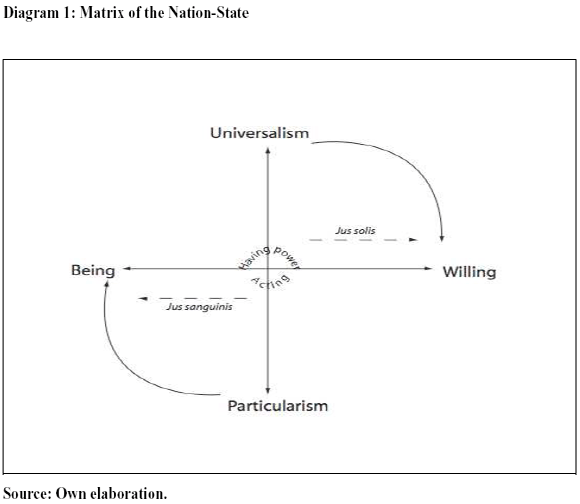
The essence of the nation is therefore defined by the trilogy to be - to do - to want which is considered to be its matrix. If adding the power, then it is the Nation-State. This trilogy also determines a double tension between Identity (to be) and will (to want), but also between universalism and distinctive identity. Diagram 1 schematize that double tension and suggests a nation matrix pattern. The main tension between to be and will defines the pattern of the nation-State, founded by the right of blood or the right of land.
]]>
Universalism leans towards the will while the distinctive identity falls over the being. Two blocks appear: "to want / social contract / universalism" and "to be / essence / distinctive identity", maintaining a well-balanced tension. To do and can stand in the orthocenter because they do not take part in the tension process. Actually, the "acting together" (economic system, resistance or war act) and the power (state coercion) are common to every Nation-State. If this tension between the two conceptions of the nation happens to break up, unbalanced evolutions bring about the Nation-State crisis, in its European form as well as the Bolivian "multinational" one. A nation that withdraws into its being, parting from the will, looses its assimilating power and opens its doors to racism-like exclusive feelings. When a nation looses the tension of the being and sinks into a doctrinaire corps of an unbalanced will, it runs a high risk of falling into a crisis of identity and may loose as well its assimilating power.
Does that mean that nation is a European concept, born and developed in Europe, then imposed during its expansion, the conquest and the political, military, economic and cultural domination of the world, and that it is dying with the crisis of the European pattern and the extinction of that domination? Not at all, because beyond the specific relation between the Nation and the State, at the very heart of the Nation-State European pattern, and the institutions —in crisis themselves— engendered by this relation, the nation keeps on arousing a sociological/spatial/anthropological complex expressing a dimension which at the same time is affective, psychological and of identity. Edgar Morin explains how that three-part dimension makes the nation go through time and space in spite of multi-dimensional crisis affecting the European countries and more generally the western world: "The nation, a sociological and historical formation, has become of major importance in the modern world because a key problem of the human being is placing its hope in it. This makes it easier to understand why, nowadays, some nations are rising up apart from the singular process of their birth." (Morin, 1994: 167). The nation seems to survive to the European Nation-State pattern crisis, but its existence can also be asserted long before the raising of this pattern, if referring to the definitions and concepts identified at the beginning of this topic. History teaches us that empires and people are mortal, but some of them showed extraordinary surviving abilities. Survival relies more and more on the three-part nation matrix, which is to be – to do – to want. Without this matrix, would not the Greek nation have been diluted into the powers and empires that enslaved it? Would the Viet nation have survived to almost a thousand years of domination and vassalage from the Middle Earth Empire?
But this crisis of the European nation-State is real and unquestionable. It seems to be the completion of an evolution that begun two centuries ago, and the opening of a new political and societal paradigm. Nevertheless, others areas of the World go on operating on the model of old categories like nation or State. We are particularly interested in Bolivia's case in Latin America. Before going into details, it may be necessary to present the characteristics of such a crisis, to identify the elements of the discussion and the suggestions to get over it, and to set the positions of non-European countries confronted with this crisis.
Nation-State crisis and its overcoming
]]> Questioning and acting to delegitimize the nation-State contributes to reveal a highly deep crisis in Occident. Basically, it is a moral crisis of a complex pattern which hegemony has been based upon all the following components:Nature of the crisis in Occident: Nation and modernism
A philosophical component: values derived from Christianity, establishing the base of the Enlightenment with universalist pretensions through concepts like Liberty, Equality, Solidarity, Human Rights, etc.
A political component: democracy in all its aspects within the context of the nation-State.
An economical component: a market economy controlled by a financial capital whose objective is its endless accumulation and whose stability —essential to its development — is guaranteed by the State.
A scientific component: a knowledge following the same accumulation rules and crisis breaks as the economic ones, and founding its legitimacy upon the notion of progress and the technical and technological exploitability of its discoveries.12
An ideological component: essentializing people and cultures according to the implicit or explicit theory of a hierarchy among them, and putting the Occident atop as a model to be imitated and followed.
This complex pattern, synthesized by the concept of modernity, is being demolished in the proper occidental side.13 More exactly, the nation is becoming conceptus non gratus in the Occident, being considered obsolete by the global actors of the business world, arousing mistrust and rejection among the political actors from the free-market right to the left wing. Globalization, in all its economical, political, social, cultural and ecological dimensions seams to be an inescapable horizon shared by everyone, even if it means suffering a manipulated drift towards globalism (Beck, 2004).14 The crisis of modernity —and of the nation-State linked to it— gives rise to intellectual attitudes of resignation or adaptation. On one side, there is a movement rejecting modernity: it is the postmodern posture;15 on the other side, there are some attempts to go beyond modernity, with a large variety of options.16 Without any pretension to sufficiency, let us point out some of these intellectual postures whose aim is to get over that crisis linked to modernity and European nation-State:
Ulrich Beck is in favor of a new modernity. Being of German culture, he is wary of the nation-State and trusts in a European construction able to stand this new modernity, re-appropriating its values while getting rid of the wrecks of universalism. That new modernity will have to deal with several levels of responsibility. It will have to oppose to globalism —globalization reduced to its sole economical dimension— whose purpose is the death of the political in benefice of the "market rules". Such a pretension is nothing but a confiscation of the political by ideological manipulation to the benefit of "the realization of the utopia of the minimum State's venal anarchy" (Beck, 2004: 17). Beck notices the removal of the political utopia. Thinking of the future "is no more within the competence of Parliament or political parties, but of the research laboratories and administration councils" (Beck, 2001: 472). Here are the "revolutionary cells" of the social change, hidden under the rags of normality.
The second responsibility of the new modernity is to find out an answer to the following contradiction: whether to make possible the end of the shortage, or to deal with the civilizational risks of globalization which are generating —in spite of their global and embracing nature— new inequalities (Beck, 2001).
Immanuel Wallerstein's position (2006) is quite similar to Ulrich Beck's one. He has been more virulent in denunciating the fraud of the European universalism. Having duly denounced it (right of interference, essentialism, scientific universalism), he opens the door to a universalist universalism entrusted to a collective of universalists on the basis of the "give and receive" concept.
]]> Neo-universalism is a posture adopted by Edgar Morin, whose recommendation is to get back to the biological foundations of a human being aware of his biotope's fragility: the Homeland-Earth (Morin, Kern, 1993).
The case of the nation-State born from decolonization
Has the crisis of modernity and of nation-State an influence on the process of construction/breaking down of the Southern countries? Edward Saïd (2000: 308) reminds us that independencies had been hard to gain but that "resistance, far from being a mere reaction to imperialism, is an alternative conception of the human history", based on the destruction of walls between the cultures. This means that, in spite of aberrations such as borders dividing a nation or making live together antagonist nations, regaining a political and cultural word power did not eradicate the western influence.
The latter has been studied through literature, institutions, economics, etc. Its symbols reveal an interesting mirror image facet. Thus, the analysis of the mottos, veritable summaries of collective representation of the Nation-States, shows us how deep the collective unconscious may be influenced by the European values inherited from Christianity, the Enlightenment and positivism. Africa is the continent employing the largest number of symbolic words among which we can underline Union/unity (19 occurrences), Work (16), Liberty (12), Justice (11) and Progress (9). America prefers Liberty (11 occurrences) followed by a symbolic trio: God (6), Union and Peace (5 each). Asia gives priority to God/Faith (9 occurrences) to the detriment of Unity (7) and Homeland (6). Oceania reveals 6 occurrences, all of them about God. This leads us to the following deductions:
In a parceled out and indigent Africa, where ethnic conflicts often take a tragic turn and may menace the nation-State viability, they insist on concrete problems yearning for union and development. The first symbolic word, pragmatic, is often followed by a second or even a third one, the latter reflecting ideals impregnated with the Enlightenment and the French Revolution's values like Liberty, Justice, and Progress.
Through their mottos, Latin American countries adopted a symbolic system divided between Catholicism and the Enlightenment. We no longer are in the African's multitude of symbolic words, but in the moderation of the couple Christian values / Enlightenment values. In all the Bolivian Constitutions, the catholic religion had always been notified as State religion. That mention has been removed from the last one, approved by referendum in January 2009.
In Asia, the State symbolic system gives priority to the traditional religions (Islam, Hinduism, Buddhism, etc.), whereas the secular values (Unity, homeland) are not adopted "as they are" but arise from a synthesis between Orient and Occident.17
The importance of God in the mottos of the Oceanian countries reveals the quasi-exclusive influence of the catholic and protestant missions on the collective imaginary of the Oceanian micro-states. This represents the very heart of the contradictions whose discussion is mentioned by Edward Saïd (2000): is the non-occidental nationalism reprehensible in itself on the basis that it is a "second class" imitation, far different from its "ethos"? (Elie Kedourie). Are the decolonizated States bound to depend on the new trans-national realities of the modern economies with their communicational technology and the spread out of their military power? (Eric Hobsbawn et Ernest Gellner). Are the decolonized States able to create an alternative?
The three postmodern empires
]]> Empires and imperialism always gave rise to a resistance that ends up crystallizing on nationalist aspirations. The European colonial empires, in the peak between the two world wars, were occupying 85% of the earth, with an exponential growth rate between 1800 and 1914 (Saïd, 2000: 42). The almost general resistance to their domination and the destructive rivalries between the European colonial powers led to the decolonization and the creation of about a hundred nation-States from the second half of the 20th century. But even so, imperialism and empires are still alive. My hypothesis is that three post-modern empires exist in the 21st century: the American, Russian and Chinese ones. Edward Saïd, who has been studying the strong resilience of the cultural legitimization of the European imperialism and colonialism, gives a definition in this regard.18 But some continental empires have their own logic and their specific domination and expansion strategy. Regarding the neocolonialist imperialism, it uses other methods than annexation to dominate what it considers of its own. We however restrict the word empire to military powers, sometimes launching themselves rather far away in order to defend their strategic and economical interests.The American empire is the most powerful and the most fragile. Its fragility comes from its political regime, a democracy in which interests and values are facing each other, founding a public opinion. This public opinion is easy to manipulate, as we could notice during the recent event of the weapons of mass destruction, which caused the war in Iraq. Still, it does not admit any more direct interventions of the United States on the American continent since the Panama case in 1989 and the Haiti one in the 90's. In that democratic Empire, though it is easy to call up patriotic feelings around a common demand of the territory safeguard and/or the values maintenance, winning thereby the approbation of a military intervention abroad, it is however more difficult to thrill nationalist feelings and justify interventions of conquest, even if they are presented as preventive wars as it has been the case in Iraq (Douzet, 2003).
The Russian Empire has rebuilt itself on the ruins of the Soviet empire. Some nations, with European, Caucasian or Asiatic borders took advantage of that slump to recover their independence. But the Russian empire did not let it happen with those, which it considers vital to its interests. With the intention of showing its belonging to the occidental World, the Russian empire developed a pseudo-democracy hardly concealing its authoritarian functioning.
The Chinese empire does not have such problems of a real democracy or excuse to entertain, nor public opinion to seduce or manipulate. Its challenge is controlling the development of an unbridled capitalism while avoiding class wars (hence its concept of "harmonious society"). It attempts to keep under control the sources of its economical growth with a maritime expansionist strategy19. It is then acting without any inhibitions according to "its own values", alternating brutality and messages of peace and cooperation, inherent to the totalitarian and autocratic regimes.
In the States located in the orbit of the post-modern empires, the terms of the discussion about globalization and nation are different because of imperial threats. They force such States to strengthen their internal cohesion and their external alliances in order to face them. These areas still belong to the conception of geopolitics, dear to Yves Lacoste.
The Bolivian State: birth and distinctive features
Mishaps in the construction of a Creole State
The American continent has constituted, in its whole, a population colony, a sort of Promised Land of a historicized vision of the world by the Occident. Natives' fates are various, from the physical elimination in the Caribbean Islands and in the North of the continent, to the assimilation in Colombia or Venezuela. Some pockets of dense mountain population, like in the Andes, resisted to the ferocious colonization shock that reduced them to servitude (encomienda in haciendas and mita in the mines). In the Spanish colonial empire, a class of discriminated Creoles and mixed-race people emerged and led a rebellion against the invaders. In opposition to the Portuguese colonies where the decolonization did not cause much damage, the Spanish empire became the scene of fighting of long fierce wars that let it battered and ruined. The winners, Creoles and mixed-race, take charge of the empire without any training or experience in public administration (Chevalier, 1977). Those were the conditions in which the Creole States were founded, on the disillusion of Simon Bolivar's federal dream.20 The division of the Empire goes together with the settlement of caudillismo, culture of the strong providential man. The libertadores, impregnated with ideas from the Enlightenment and the French Revolution, influenced the writing of the Cartas Magnas; still, the caudillos, often common people, were those who built the South-American States with their specific features: internal and chronic instability, separatism and numerous border conflicts, native people's exploitation and marginalization.
Bolivia is a summary of that history and its specificities. The lack of construction of a veritable Bolivian nation is the result of it.21
If we consider Bolivia through the pattern of nation-State, we can notice that it corresponds to some outlined criteria: it claims a genuine will in its Constitution and its symbols (the motto Union is Strength appearing on its money, for example), presents a long history filled with doing, particularly recurrent wars. But its being is not strong enough and its power remains fragile, which is transforming its will into weak will, and its doing into a succession of incoherent and meaningless acts. That fragility is both external and internal. On the external aspect, its virtual surface area decreased from 1.360 square miles to about 621 to the benefit of all its border countries (Costa Arduz, in: Quiroga, Requena, 2003).22 Those territorial losses, consequences of treaties, sales and mostly wars, thrilled a national feeling stirred up by frustration among the population, except for the Native American, excluded from citizenship (Demélas, 1980).
On the internal side, the dominating groups, composed of important landlords and mine owners, have never been in a position to develop a well-integrated social corps, either by elimination or by assimilation of the Native American, as it occurred in most countries in the continent. To establish their power, the dominating groups built a racist and discriminatory State based on an archipelago of towns, villages and haciendas upon an ocean of excluded Natives. This archipelago gives birth to an embryo of proletariat: workmen, craftsmen and retailers. But the resistance to the Creole State was instigated in the excluded Native American ocean, leading them to develop their own projects for the community, to claim their separatism and to conquest the State with its own democratic rules.
Conditions for the emergence of a Native American political strength
The ways that led the Native American from marginalization to the conquest of the Bolivian State are basically made of local specific considerations. They however belong to a global context reflecting the evolution of a worldwide opinion hostile to any form of discrimination. Thus, from the 80's-90's, a campaign spread over the world for the rehabilitation and the recognition of Native people. Even if its effects were no more than symbolic, it actually had some effects.23 The commemorations of 1989 (500 years of Christopher Columbus' discovery) were an opportunity for all Native people to estimate their power.
From the instauration of universal suffrage in Bolivia in 1952, the political expression of the Natives is frequently perverted by the populism of often-ephemeral political parties.24 It however crystallize around two matrix of sustainable expression: the Aymara separatism of Felipe Quispe sustained by a major part of the North Altiplano peasants; the mining25 and rural26 syndicalism at the origin of the political party Movimiento al Socialismo (MAS), based in the Chapare of Cochabamba. This party's amazing and fast ascension shows how disrepute the traditional parties were, how deep the need of change was, but it also reveals how numerous the opportunists were.
The revolution of 1952 and its agrarian reform has been an important step towards the Native people's emancipation, because it freed them from a latifundia system maintaining them in serfdom. The other major event on their way to emancipation was the Law of Decentralization and Popular Participation, promulgated by the government of Gonzalo Sánchez de Lozada during his first term between 1993 and 1997. Planned to make swallow the bitter pills of free-market reforms called for by the international financial powers,27 this law enabled the devolution of powers directly to the municipalities, double-crossing the Departments where an opposition power —harder to control— could have expanded. But the Popular Participation cropped up a much more powerful opposition. Actually, Native parties and organizations invested municipalities having their own operating budgets, and many of them became political basis of the MAS.
The concept of Aymara nation
François Chevalier points out an interesting semantic change in the Constitution of Mexico under the pressure of an Amerindian intelligentsia. The Constitution declares in 1971 that Mexico is a multicultural State, a multi-ethnical State in 1976, and finally a multinational State in 1982 (Chevalier, 1977/1993: 617). Those rapid changes in the definition of the State point out a growth of Native Americans' pressures, no more satisfied with a single recognition of their distinctive cultural identities. Asking to be recognized as distinctive nations is a way of demanding political rights, from autonomy to self-determination. This constitutional change can be compared with the Bolivian case. Its Constitution of 1967, amended by numerous reforms until 2005, defines a free, sovereign, independent, multi-ethnical and multi-cultural State, and insists on the unitary specificity of the Republic and the nation. "Nationalities", then, do not appear on that Carta Magna.
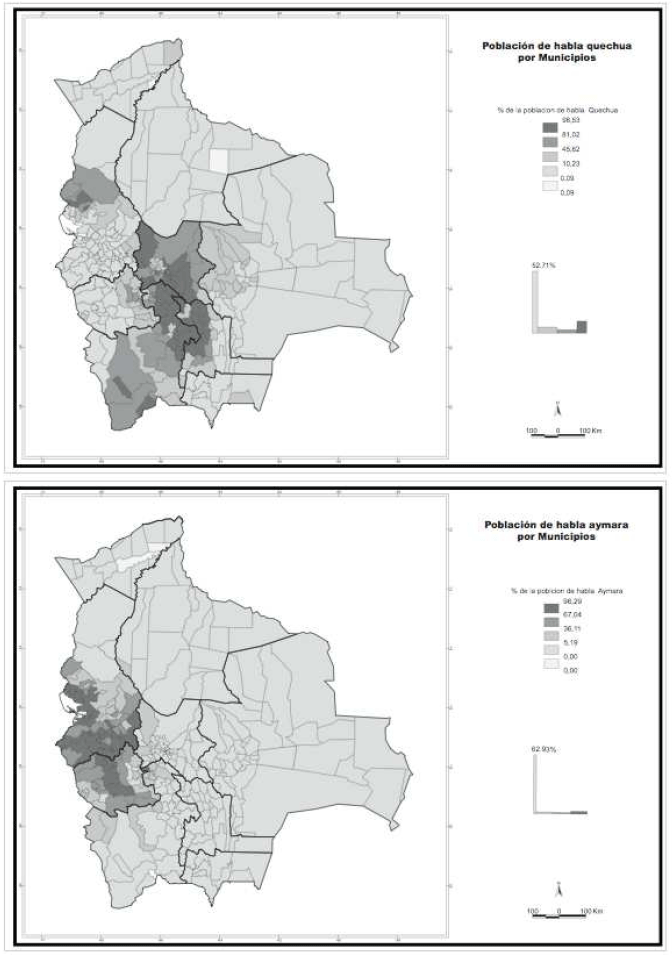
In this crumbled landscape of Native communities, two linguistic groups are of major importance: the Quechua-speakers are by far the most numerous with 3.5 millions against 2.5 millions of Aymara-speakers, each group being located in dense territories. We however notice that the Quechua territory (south of the Altiplano and the high valleys), is divided into four departments. It looks as if the legislator stood up right in the middle of the Quechua territory and drew the limits of the Andean departments. The Aymara-speaking territory is of a similar density and spreads North of Altiplano, including the city of La Paz. This may explain that the Aymaras took advantage of the capital city for accessing education and diversifying their activities. That allowed the development of political and syndical elites who contributed to the fact that the Aymaras are aware of being a people joined by its culture, its symbols, its history, and its heroes; in short, they are aware of being a nation.
]]>
Nevertheless, this self-identification happened rather belatedly; it has been thrilled by Felipe Quispe, the leader of the MIP (Movimiento Indio Pachakuti, separatist) and theorized by Álvaro García Linera, the current vice-president of Bolivia (García Linera in: Quiroga, Requena, 2003: 169-201). In a document published in a collective work, the author applies Marxist arguments based on class war. His analogical thought puts the Aymara nation in the role of the historical proletarian class; the role of the other historical class —the bourgeoisie— is in the hands of the Creole society, at the head of the State. The Aymara nation is going to overthrow the Creole order —bourgeois— by means of a revolution, if only through an electoral revolution. The other ethnical groups, like the unhistorical social classes of Marx (craftsmen, retailers, peasants, etc.) will have to take sides. The author legitimizes the rights to autonomy and self-determination of the Aymara linguistic community because it "presents all the components of a highly coherent and politicized ethnical unity". And also because it has a cultural elite able to work out an autonomous ethnical rhetoric based on the quest of a future strongly linked with the past of the community. Finally, because of its rallying ability; this again reveals its awareness of being a full-fledged nation. On the contrary, the other ethnic groups do not present any of these specificities and therefore cannot pretend to be a nation (García Linera in: Quiroga, Requena, 2003: 180). It is worth noting that the holistic vision of García Linera is to be compared to the way the Creole were looking down at the undifferentiated Native mass of the Altiplano and the Lowlands.
Xavier Albó moderates that position noticing that a lot of elements of the Aymara culture are common to all the Andean people and may all the same lead to an Andean national awareness (Albo, 2002: 156, 157). On the other side, the author outlines a specificity of the Aymara culture, which he calls the Aymara paradox. Being a nation, it has a strong rallying power, but it is crossed by centrifugal and factious strengths. Albó indicates a permanent tension between the communitarism and the duo individualism / faction, affecting all the aspects of every day and political life. This Aymara paradox, which also could be defined as a communitarism without solidarity, materializes in a range of situations depending on the communities and their leaders' abilities to maintain in balance the tension between both individualist and communitarian poles.28
However, the Quechua linguistic area is not as bereft of awareness or of political projects, as asserted by García Linera. In Northern Potosí and the South of Oruro, a political expression of ethnical and cultural matrix developed in the 90's. It is based on the revival of the traditional territorial entities ayllus and markas rejecting any other representation form (political or syndical) as being foreigner and colonial. Behind this cultural-like movement —gathered into the National Council of the Ayllus and the Markas of the Quilasuyu (Consejo Nacional de Ayllus y Markas del Qullasuyu - CONAMAQ)—, the political project is to get their territories and resources back, and to make Bolivia into a crumbled federation of ayllus and markas with full powers. Such an empowerment in a short time can only be explained by the massive inflows of financial means from NGOs, international cooperation aid from States like Denmark, or IMF and World Bank's financings, justified by a cultural genuineness and the expression of an alternative economy. It is a mix of romantic vision based on the reactivation of long lost territorial control forms, and deliberate support strategies to ethnicize political forces, with the aim of taking control of the failed State. Jean-Pierre Lavaud employs the expression "split anarchy" to describe the evolution of the Bolivian political life (Lavaud, 2006).
Neither are the Natives of the Orient politically silent. Gathered into the CIDOB (Confederación de Indígenas del Oriente Boliviano - Natives' Confederation of the Bolivian Orient) under a Guaraní leadership, they obtained significant compensations for the exploitation of hydrocarbons in their territories and will play an important part in tomorrow's Bolivia.
The Aymara linguistic community, despite its ethnical awareness, is far from being politically or socially homogenous because of the diversity of its activities due to the presence of the capital city La Paz on its territory. In terms of politics, the community is divided into at least three trends of expression:
An absolute separatism and the arrival or an ethnical State – the Collasuyo, whose leader is Felipe Quispe, called El Mallku;
A political movement of revolutionary inspiration , the MAS, nourished by its double union and political matrix, led by Evo Morales, head of the Cocaleros union, and "theoricized" by Alvaro García Linera, of Trotskyism influence;
]]> A moderate political expression in a movement led by Víctor Hugo Cárdenas, former vice-president of the Bolivian Republic and leader of the MRTKL (Movimiento Revolucionario Tupac Katari de Liberación – Tupac Katari Revolutionary Movement of Liberation).Identity crisis of the Creole people in a communitary multi-national State
The election of Evo Morales at the presidency of the Bolivian Republic is not a mere political change over. It consists in a radical change of the society imposed on behalf of the Aymara people to whom he belongs, and of his Native allies, expressed in the new Constitution adopted in January 2009. However, whatever the future evolution of that new Carta Magna, it will no more be possible to come back to the previous situation. The Creole State, which lasted 200 years or so, could not found a real nation because it was too engaged in promoting an integrating pattern denying the country's multicultural realities.
The radical changes expressed through hard political actions (nationalizations, regulations of the foreign exchange market, new international political partnerships, etc.), an authoritarian governing pressuring the social protests, even the Constitution's content itself, set the Creole and mixed-race society in front of a serious identity crisis. The tough confrontations with the new Government resulted in a united defensive situation, though impeding a reflection about the nature of the crisis itself. All the same, it has to face new rules and find its place in a new constitutional system, either through negotiation, either through a proposal for an alternative society capable of seducing the urban middle class and the minority rural communities. In this confrontation, one question to be asked is: if we cannot identify with the communitarian values promoted by the Aymara nation (which the current leaders belong to) who on earth are we?
The "newcomer" term Multi-national is to be compared to the Mexican Constitution studied by F. Chevalier, though Bolivia's case consists more in self-government's right than in a self-determination's right; besides, this is duly stated in the second article. Bolivia used to be a Unitary Republic. It becomes a Communitarian Multi-national State with no less than 36 official languages. The most noteworthy with the new Carta Magna is its willingness to have both individual and communitarian rights coexisting, which causes contradictions not always easy to resolve. Besides, so as to avoid them, Felipe Quispe declared the area of Achacachi "State-free", which means that the communitarian right is the only one to be applied. The authorities of the Province of Omasuyos imitated this attitude after the expulsion of Cárdenas' family on the base of some constitutional clauses (articles 190 to 192 about the communitarian justice). A second important clause is that the Constitution restricts the private ownership to a "social utility".
Beyond all these clauses questioning the Creole society, adhered to its supposedly universal individualistic values, it is the ambivalent attitude of the Government before the increasing number of cursory "communitarian justice" cases that causes problems.29 The Cárdenas' case is symptomatic of the government's difficulty to have the right respected, even leading it to off-load its responsibilities on a communitarian justice. The government opened the Pandora's Box of the communitarian right, which hardly fits with the public law because it lays on a nonexistent or vague legal foundation. This opens the way to all sorts of abuses and put all the Bolivian people, Natives and Creole, in a constant state of legal insecurity.
The geographical radicalization is outlined at each referendum —very numerous since Evo Morales' accession to power—, increasing the gap between the Andes and the Orient. The current governing movement, the MAS, opted for the marginalization and the conquest of the Orient, satisfying thus its most extremist basis, rather than for a consensual approach looking for a compromise regarding for all the components of the Bolivian society - including its allochtone part, an undoubtedly more perilous and awkward position. In the Orient, the Aymaras' opposition to the State remains apathetic, though united. It had no influence on the Constitutive Assembly, and was unable to develop any alternative project, mainly because of the attacks and pressures it had to ward off. Nevertheless, the new Constitution includes clauses which intentions are clearly to balance the communitarian and the Creole worlds together. As an example, the articles about the citizenship attribution are exceptionally open, accommodating the jus solis with the jus sanguinis. Dual citizenship is now allowed. Such an openness contrasts with the self-centeredness of both the ethnical communities and some European States. Such a Constitution is almost about to restore the tension between the being and the will, the ethnical and communitarian perception of the nation with the approach through a social contract, that tension being essential to the foundation of a real and balanced nation-State.
¿Are multi-national States viable?
]]> United we stand, divided we fall
The multi-national States are inherently centrifugal. This is a worrying problem in Africa where the inter-ethnic wars are increasing. We already pointed out this concern in the analysis of the national mottos in which the first value is union. On the American continent, union is also very well-placed in the imaginary and the symbolic expression of the nation-States. This word appears on the Bolivian currency as an expression of a crucial worry for the country.
The need of union is diverse in a country crumbled into plentiful ethnic groups and which attracted, moreover, European and Asiatic immigration. Additional mentions of the 36 official languages in the Constitution are a well-disposed and symbolic measure. But it will not be enough to smooth over some contradictions and divergent interests among the Natives. As an example, the recent colonization of the Lowlands, North of the department of Santa Cruz, planned or spontaneous, is endangering the forest-cultural communities living there. The Aymara hegemony within the new power may turn into a locomotive for the new national train, but it may also represent a new form of oppression for the other communities.
Secondly, union means dialogue and cohabitation of two, even three cultural areas with very different cosmogonic visions (the Amerindian, the Occidental and the Asiatic ones). This is the main issue of the national construction. A wide gap already exists between the Native and the Occidental worlds, inherited from the European colonization. The Creole State ratified and even strengthened it. The Aymara State is likely to reduce it on paper but not in practice: it even increased it to please his partisans and to cope with the intransigence of the Creole, traumatized by the change.
Evo Morales' government is in the same situation as the first Creole government was in the early 19th century, when the Spanish colonial power left away; that is to say, with no experience in public administration and with executives without the necessary and sufficient training for an efficient managing of the res publica. Corruption cases are undermining the Government's prestige because it mainly relies on the President's speeches about radical changes in political habits and the eradication of corruption.30
Prospects based on a scenario of political crisis
After three years of Evo Morales' presidency, including an extremely confrontational year within the Constituent Assembly, one can notice that the social and geographic gap dividing the Andes from the Orient is now achieved. The new Constitution looks more like a "rights and contradictory clauses' catalogue" than like a Carta Magna, a legal guide for a nascent Republic proclaiming a frame of common values. Each position remains stable and hard core in spite of the central power's constant attempts to implicate the opposing local powers and the Orient's responses that impede the government reforms.
Deeply involved in the conception and realization of the new Constitution, Evo Morales and the MAS opened a Pandora's Box when they introduced in it, without any safeguards, the communitarian law. From now, they will have a hard time trying to reduce it or subject it to a higher authority. Particularisms will spring up, arbitrary and inconsistent. The Cárdenas expulsion's case reveals the uncontrollable nature of the exactions committed in the name of communitarian rights, and the generalization of potential situations of conflict between communitarian and public rights.31
In spite of the massive support of the population at the time of referendums about the revocation of the President of the Republic and the local prefects, or more recently about the approval of the Constitution, Morales' government is gradually forced to reduce its reformist attempts.
But the government's weakening is of no benefit for the political and local opposition that remains apathetic, unable to look ahead beyond the everyday life and the constant elections' deadlines. Why is the Creole and mixed-race society unable to tailor a society plan as an alternative to the communitarian approach promoted by the current Government? A global explanation is probably to be found in the crisis of the pattern of the European nation-State and of modernity, previously discussed, which is conditioning the destiny of Creole and mixed-race, urban and Oriental societies in Bolivia. But basically, the main reasons are local and due to the political and civic leaders. Almost all the Oriental leaders in Bolivia seem to be unable to draw up any alternative political offer and just take advantage of the troubled situation leading to the fear of the Communitarian State. Before this lack of integrating project up to the electorate's hopes, the Creole society opens the door to excluding racist projects like the MNCL's one (Movement for the Liberation of the Camba Nation) quite similar to the separatist Aymara project of the MIP.32 The concept of "Camba Nation", as well as the "Aymara Nation", is supported by intellectuals like Gustavo Pinto Mosqueira who endeavor to give it theoretical foundations.33 Looking for inspiration in the conceptual matrix of post-modernism, creating for this occasion the notion of "ethnical miscegenation", contrasting State nationalism and identity nationalism, the author appeals to history and culture to prove the existence of a "Camba people" whose features, demographic importance and awareness might be sufficient to claim the right to be a nation.34 It is obvious that the remoteness of Santa Cruz encouraged the emergence of a strong and original cultural expression. Nevertheless, the attempts to "essentialize" the whole Bolivian Orient —from Santa Cruz to Cobija, in Pando— turned out difficult.
]]> All this indicates that the confrontations' postures are going to last. Still, except a veiled separatism expressed in the Camba Nation's and MIP's manifestos, nobody really wishes a division of the country in spite of the revealed cultural differences and the violent confrontations.The crisis of the nation-State is actually affecting Bolivia, but its resolving will not lean upon the same statements as the Occident's ones: post-modernism, neo-modernism, States confederations, universal neo-universalism, etc. Quite the contrary, the contradictions to be resolved come from particularism, fragmentation, "segmentary anarchy", according to Jean-Pierre Lavaud. The Occidental crisis of modernity increases that state of division and weakens the Creole society. The break-up risks are significant because of so many centrifugal strengths working together towards the weakening of the State: "ethnicization" of the political, financial and economical globalization, anti-universalist ideologies and anti-modernism, interests of the post-modern Empires. One can hardly feel optimistic before the elements composing the national question and the role of the State in Bolivia. Yet Bolivian people will need quite some originality and fortitude to find a new expression of the political within the framework of a multi-national and "multi-cosmogonic" State, stretching again the particular and the universal, the dimension of the being and the dimension of the willing. The achievement of a social pact allowing such a proposal —utopian for the moment— would not only be a world-first in the nation-State history; it would be an example for Humanity.
Bibliography
Amossy R., 2004, Dialoguer au cœur du conflit? Lettres ouvertes franco-allemandes, 1870/1914, Mots. Les langages du politique, n° 76, [ Links ] Guerres et paix. Débats, combats, polémiques, novembre 2004 [en ligne], mis en ligne le 21 avril 2008. URL: http://mots.revues.org/index2013.html [ Links ]
Beck U., 2004, ¿Qué es la globalización? Falacias del globalismo, respuestas a la globalización, 221 páginas, Paidós, Estado y Sociedad, Buenos Aires, Barcelona, México. [ Links ]
Braudel F., 1985, La dynamique du capitalisme, 120 pages, Champs/Flammarion, Paris. [ Links ]
]]>Cabanel P., 1997, La question nationale au XIXième siècle, 121 pages, Repères/la Découverte, Paris. [ Links ]
Chevalier F., 1977, L'Amérique Latine. De l'indépendance à nos jours, puf, réédition 2003, La nouvelle Clio/l'histoire et ses problèmes, Paris. [ Links ]
Demélas M.-D., 1980, Nationalisme sans nation? La Bolivie aux XIXième et au XXième siècles, 227 pages, Éditions du CNRS, Paris. [ Links ]
Douzet F., 2003, Le patriotisme et le nationalisme américains, n° 109, 2003/2, Hérodote – La Découverte, pages 37 à 56, Paris. [ Links ]
Fichte J. G., 1992, Discours à la nation allemande, Éditions Imprimerie Nationale. [ Links ]
]]>Lacoste Y., 1996, Vive la Nation! Le destin d'une idée géopolitique. 338 pages, Fayard, Paris. [ Links ]
Lavaud, J.-P., 2006, Bolivie: vers l'anarchie segmentaire? L'«ethnicisation» de la vie politique, in: Hérodote 2006/3 n° 123, La découverte, Paris. [ Links ]
Lévy J., Lussault M. (sous la direction de), 2003, Dictionnaire de la géographie et de l'espace des sociétés, 1033 pages, Belin, Paris. [ Links ]
Lyotard J.-F., 1979, La condition postmoderne, 109 pages, Les Éditions de Minuit, Paris. [ Links ]
Moïsi D., 2008, La géopolitique de l'émotion, 267 pages, Flammarion, Paris. [ Links ]
]]>Montenot J. (sous la direction de), 2002, Encyclopédie de la philosophie, 1777 pages, La Pochothèque/Garzanti, Paris, édition originale: Vattimo G. [ Links ], 1981, Enciclopedia de la filosofia, Garganzi editore. [ Links ]
Morin E., 1994, Sociologie, 459 pages, Points/Essais Fayard, première édition : 1984, Paris. [ Links ]
Morin E., Kern A. B., 1993, Terre-Patrie, 216 pages, Seuil, Paris. [ Links ]
Quiroga Y., Requena C., éds., 2003, La descentralización que se viene. Propuestas para la (re)constitución del nivel estatal intermedio, 478 p., Descentralización-Participación n°6, FES-ILDIS/Plural editores, La Paz. [ Links ]
Renan E., 1883, Qu'est-ce qu'une nation? Discours à la Sorbonne, Encyclopédie de l'Agora, http://agora.qc.ca/reftext.nsf/Documents/Nation--Quest-ce_quune_nation_par_Ernest_Renan. [ Links ]
Said E., 2000, Culture et impérialisme, 555 pages, Fayard/Le Monde Diplomatique, Paris. [ Links ]
Tocqueville A. de, 1963, De la démocratie en Amérique, 377 pages, Collection 10/18, Union Générale d'Éditions, Paris. [ Links ]
Wallerstein, I., 2008, L'universalisme européen. De la colonisation au droit d'ingérence, 137 pages, Demopolis, Paris. [ Links ]
Weber M., 1964, L'éthique protestante et l'esprit du capitalisme, 341 pages, Plon, Paris. [ Links ]
Zajec O., septembre 2008, La Chine affirme ses ambitions navales, Le Monde Diplomatique. [ Links ]
1 The Dictionnaire de géographie et de l'espace des sociétés (Lévy, Lussault, 2003) contains no less than eight definitions of territory, even suggesting a ninth one to get the concept denser while getting rid of some senses.
2 In L'éthique protestante et l'esprit du capitalisme (Weber, 1964), the author studies the influence of some features of the ascetic Protestantism (Calvinism, Pietism, Methodism and Baptism) on the development of a certain spirit in capitalism.
3 Max Weber compares the current practice of capitalism —a routine freed from the support of the ascetic Protestantism— to the emulation provided by sports practices.
4 Fernand Braudel (La dynamique du capitalisme, 1985) does not agree with Max Weber's theses. According to him, capitalism —distinct from the free market economy— comes from a kind of transactions apart from the traditional channels and evades the political controls on markets and fairs. It appears long before the ascetic Protestantism in the 15th century in the Mediterranean countries and moves along over the course of its exchange markets' development Venice, Anvers, Genes, Amsterdam, then London, and finally New York).
5 The terms of nation and nationality appear in Cicero's work (Marcus Tullius Cicero, Ist B.C.), especially in De officiis, a collection of philosophical and moral precepts for his son Marcus, and in the famous De natura deorum, addressed to Brutus, in which he relates a controversy between Epicureans and Stoics. Cicero alludes to the people and cities that Rome subdued to the Pax Romana and treated mildly except in certain occasions (destruction of Carthage, Numance and Corinth). «Rome, rather than ruling an empire, had the world under his protection» (De officiis, livre I).
6 Its first "provocation" was the work: «La géographie ça sert d'abord à faire la guerre (Geography is useful to make war)» (1976) that brought him quite a lot of hostilities in the profession.
7 The arrival of modern geography at the end of the 19th century reflects the French-German rivalry.
]]> 8 Things are developing thanks to the contributions of geographers working together on the journal Hérodote, and also thanks to the increasing interest for the globalization and the global analysis scale on the part of authors like Olivier Dolfuss or Jacques Lévy.9 The territorial scale geopolitics was born in Germany and has been theorized by Friedrich Ratzel and then popularized by Karl Haushofer. It offers determinist concepts derived from Darwinism, such as herzland (essencialization of a land linked to an ethnic group), pan-ideen (continental hegemony) and lebensraum (a nation's vital space).
10 The doctrines of the British geopolitics brings along a new scale: the world's map becomes a chessboard on which Haldford Mackinder opposes a continental heartland block to the maritime powers of the insular crescent.
11 "Nation" can be found in the Dictionnaire de la géographie et de l'espace des sociétés (Lévy J., Lussault M., 2003), but not in Les mots de la géographie, the Brunet, Ferras and Théry's dictionary (1992).
12 Immanuel Wallerstein (2008: 79-109) describes the process of partition of the occidental science between two antagonistic cultures (the objective science looking for the truth, and the human sciences dealing with the good and the beauty). He also relates the conquest of legitimacy and prestige of the objective science by offering a knowledge convertible in technical inventions and by focalizing on the technology, relegating the human science to their unfalsifiable speculative researches. The division goes through the social sciences like sociology or geography, some of them choosing the scientific camp, some others reaching the humanist camp. The Bricmont-Sokal's case has been, in the 90's, one of the paroxysms punctuating the conflicts between the two camps.
13 The extent of the crisis can be measured through the amount of publications on this subject, reviews for the general public as well as works from specialists. By way of example: Jean-Claude Guillebaud (1995) La trahison des Lumières, Enquête sur le désarroi contemporain, «a lucid and visionary book about the financial crisis of October 2008»; Dominique Moïsi (2009) La géopolitique de l'émotion, «hope, humiliation, fear: from the espoir, humiliation, peur : from the anecdote to the instauration of phantasms as a new imaginary horizon of the Occident de l'anecdote à l'instauration de phantasmes comme nouvel horizon imaginaire de l'Occident» (authors' commentaries in quotation marks).
14 Ulrich Beck defines globalism as being an ideology reducing globalization to its single economical dimension, and intending to replace the political dimension of the decisions by the world market.
15 Jean-François Lyotard (1979) defines the post-modern condition as being a delegitimization of the two sources of the modern science, which he calls "big stories": in both the state political version and the speculative philosophical version.
16 Ulrich Beck is in favor of a new modernity. Being of German culture, he is wary of the nation-State and trusts in a European construction able to stand this new modernity, re-appropriating its values while getting rid of the wrecks of universalism.
17 As an example, the motto of Vietnam, Independence, Freedom, Happiness, reflects the ideal of Nguyễn Sinh Cung [Ho Chi-Minh], a man of traditional culture moved by the values of the French Revolution. Independence is closely linked to a nation, which always had to fight against great powers to free itself. Freedom refers to the values of both the Enlightenment and a Buddhist concept of karmic liberation. Happiness is all together a hedonist version and a State vision of the "right middle", free from human passions.
]]> 18 «Fundamentally, imperialism means aim, settlement and takeover of a land which is not of its own, a distant territory where others live and that belongs to them.» «[…] Imperialism designates the practice, the theory and the mentality of a dominating Metropolis ruling a distant territory.» (Saïd, 2000: 41).19 According to Olivier Zajec (Monde diplomatique: "La Chine affirme ses ambitions navales", septembre 2008), China alternates pacific speeches of cooperation towards its border countries and a fait accompli politics like the annexation of the archipelagos in the south of the China sea. Such an attitude creates a feeling of insecurity and leads the neighboring seaside countries to an armamentistic race.
20 François Chevalier points out: «In the countries with rival ethnic groups, it was particularly difficult to change from an absolute monarchy [...] to parliamentarian republics».
21 cf. Marie-Danielle Demélas, 1980, Nationalisme sans nation? La Bolivie aux XIXième et au XXième siècles. Paris: Éditions du CNRS, 1980.
22 According to the author: 189,356 square miles to the benefit of Brazil (Mato Grosso in 1867 and Acre in 1903); 65,930 square miles for Argentina (Central Chaco and the Atacama puna in 1898 and 1925); 34,749 square miles plus 11,583 square miles in favor of Chile (Pacific War 1887-1884); treatise cession in 1909 of 96,526 square miles to Peru; the war of Chaco (1932-1938) ended with a territorial loss of 90,348 square miles to the benefit of Paraguay.
23 Conferment of the Nobel Peace Prize to Rigoberta Menchú in 1992; article 169 of ILO (International Labour Organization) in favor of Native people ; Declaration about the rights of the autochthon people, adopted by the UNO in 2007 after 20 years of negotiation.
24 It is the case of the political party Consciencia de Patria (CONDEPA), created by a charismatic folk musician and social communicator, and disappeared with the death of the founder.
25 A lot of cocaleros in Chapare used to be miners before the mine crisis in the 80's.
26 Capitalization and privatization of public enterprises, reductions of public spending.
27 According to Xavier Albó (2002: 25), the Aymara individualism is based on mutual mistrust and envy. Weaknesses and individual sinning in collective activities are not compensated for, at the risk of the settled goals.
]]> 28 Since the instauration of the new Constitution, cases of lynching have been committed in Achacachi without the Judiciary system being able to intervene in order to establish the facts and penalize abuses.29 Víctor Hugo Cárdenas, an Aymara from Huarina, former vice-president of the Republic (1993-1997), campaigned for the "no" vote at the referendum on the new Constitution. He has been expropriated from his house in Sank'ajawira by communitarians in the name of «people's sake and public interest». The Government hesitated between having the private ownership respected and non-interfering in communitarian matters (Cf. Pulso, 15-21 and 22-28 of March, 2009)
30 The press mentioned cases of corruption in almost all the fields of government actions.
31 Communitarians refer to articles 190 to 192 of the Constitution ruling the communitarian rights to assert their actions. In addition, the article 56 defends the private ownership's right. As the article 13 III establishes that there is no hierarchy among the rights in this Constitution, one can easily imagine the potential situations of conflict to come between communitarian right and public right.
32 Cf. the Camba Nation's website: http://www.nacioncamba It develops and exalts a Guarani-Hispanic mixed-race culture and opposes it to the others pre-Hispanic Andean cultures.
33 Pueblo, Nación y Nacionalismo Camba, Gustavo Pinto M. (2008).
34 The author insists that «The amount of population (adding together the Native population with the Creole/mixed-race one) that can be considered and understood as "Camba" represents no less than one million and five hundred thousands inhabitants in the Bolivian Orient» (Pinto, 2008: 9).
]]>