<?xml version="1.0" encoding="ISO-8859-1"?><article xmlns:mml="http://www.w3.org/1998/Math/MathML" xmlns:xlink="http://www.w3.org/1999/xlink" xmlns:xsi="http://www.w3.org/2001/XMLSchema-instance">
<front>
<journal-meta>
<journal-id>1819-0545</journal-id>
<journal-title><![CDATA[Revista de Humanidades y Ciencias Sociales (Santa Cruz de la Sierra)]]></journal-title>
<abbrev-journal-title><![CDATA[Rev. humanid. cienc. soc. (St. Cruz Sierra)]]></abbrev-journal-title>
<issn>1819-0545</issn>
<publisher>
<publisher-name><![CDATA[Instituto de Investigaciones Económicas y Sociales "José Ortiz Mercado"]]></publisher-name>
</publisher>
</journal-meta>
<article-meta>
<article-id>S1819-05452007000100001</article-id>
<title-group>
<article-title xml:lang="en"><![CDATA[The balance of payments constrained growth model: empirical evidence for Bolivia, 1953-2002]]></article-title>
</title-group>
<contrib-group>
<contrib contrib-type="author">
<name>
<surname><![CDATA[Vasquez]]></surname>
<given-names><![CDATA[Bismarck J. Arevilca]]></given-names>
</name>
<xref ref-type="aff" rid="A01"/>
</contrib>
<contrib contrib-type="author">
<name>
<surname><![CDATA[Charquero]]></surname>
<given-names><![CDATA[Wiston Adrián Risso]]></given-names>
</name>
<xref ref-type="aff" rid="A02"/>
</contrib>
<contrib contrib-type="author">
<name>
<surname><![CDATA[Jordan]]></surname>
<given-names><![CDATA[Jeremy]]></given-names>
</name>
</contrib>
</contrib-group>
<aff id="A01">
<institution><![CDATA[,the University of Kent at Canterbury Keynes College ]]></institution>
<addr-line><![CDATA[ ]]></addr-line>
<country>United Kingdom</country>
</aff>
<aff id="A02">
<institution><![CDATA[,University of Siena  ]]></institution>
<addr-line><![CDATA[ ]]></addr-line>
<country>Italy</country>
</aff>
<pub-date pub-type="pub">
<day>00</day>
<month>00</month>
<year>2007</year>
</pub-date>
<pub-date pub-type="epub">
<day>00</day>
<month>00</month>
<year>2007</year>
</pub-date>
<volume>3</volume>
<numero>se</numero>
<fpage>0</fpage>
<lpage>0</lpage>
<copyright-statement/>
<copyright-year/>
<self-uri xlink:href="http://socialsciences.scielo.org/scielo.php?script=sci_arttext&amp;pid=S1819-05452007000100001&amp;lng=en&amp;nrm=iso"></self-uri><self-uri xlink:href="http://socialsciences.scielo.org/scielo.php?script=sci_abstract&amp;pid=S1819-05452007000100001&amp;lng=en&amp;nrm=iso"></self-uri><self-uri xlink:href="http://socialsciences.scielo.org/scielo.php?script=sci_pdf&amp;pid=S1819-05452007000100001&amp;lng=en&amp;nrm=iso"></self-uri><abstract abstract-type="short" xml:lang="en"><p><![CDATA[Much of the theoretical and empirical literature has focused on supply factors when studying economic growth determinants, leaving aside demand factors. The present study, instead, analyzes external demand factors as determinants of Bolivian economic growth between 1953-2002 utilizing models introduced by Thirlwall (1979). According to cointegration analysis, exports were an important determinant in Bolivian economic growth for the whole period. Later analysis of other variables showed that real exchange rates presented a negative relationship in respect to long term growth. Further results show that Bolivian imports are more elastic than exports before a growth of the GDP, producing a negative impact on the trade balance. Our hypothesis is that the economic model implemented since 1985 has increased the external constraint of the country causing a process of "deindustrialization".]]></p></abstract>
</article-meta>
</front><body><![CDATA[ <p><font face="verdana" size="4"><b>The balance of payments constrained growth    model: empirical evidence for Bolivia, 1953-2002</b><a name="_ftnref1"></a><a href="#_ftn1"><b><sup>*</sup></b></a></font></p>     <p>&nbsp;</p>     <p>&nbsp;</p>     <p><font face="verdana" size="2"><b>Bismarck J. Arevilca Vasquez; Wiston Adrián    Risso Charquero</b></font></p>     <p><font face="verdana" size="2">Translated by Jeremy Jordan    <br>   Translation from <b>Revista de Humanidades y Ciencias Sociales (Santa Cruz de    la Sierra)</b>, Santa Cruz de la Sierra, v.9, n.1-2, p.187-219, June/Dec. 2006.</font></p>     <p>&nbsp;</p>     <p>&nbsp;</p> <hr noshade size="1">     <p><font face="verdana" size="2"><b>SUMMARY</b></font></p>     <p><font face="verdana" size="2">Much of the theoretical and empirical literature    has focused on supply factors when studying economic growth determinants, leaving    aside demand factors. The present study, instead, analyzes external demand factors    as determinants of Bolivian economic growth between 1953-2002 utilizing models    introduced by Thirlwall (1979). According to cointegration analysis, exports    were an important determinant in Bolivian economic growth for the whole period.    Later analysis of other variables showed that real exchange rates presented    a negative relationship in respect to long term growth. Further results show    that Bolivian imports are more elastic than exports before a growth of the GDP,    producing a negative impact on the trade balance. Our hypothesis is that the    economic model implemented since 1985 has increased the external constraint    of the country causing a process of "deindustrialization".</font></p> <hr noshade size="1">     ]]></body>
<body><![CDATA[<p>&nbsp;</p>     <p><font face="verdana" size="2"><b>&nbsp;</b></font></p>     <blockquote>       <p><font face="verdana" size="2"><i>Economists have inherited from physical      sciences the myth that scientific inference is objective and free from personal      prejudices. This is nonsense. All knowledge is a product of human conviction;      stated in a more precise way, it is a product of human opinion. </i></font></p> </blockquote>     <p align=right><font face="verdana" size="2"><i>-</i>Leamer, Let's Take the Con    Out of Econometrics</font></p>     <p>&nbsp;</p>     <p><font face="verdana" size="3"><b>I)&nbsp;Introduction</b></font></p>     <p><font face="verdana" size="2">The majority of studies on growth are based on    traditional neoclassical models. Among these, it is possible to mention the    endogenous type, such as those based on Solow (1956), or those of endogenous    growth, such as Romer (1986) and Lucas (1988), among others. Both models are    characterized by indicating as determinants of growth, variables that are provided    by the supply side of the economy. In this way, the productive factors of physical    and human capital, just like technology, are the principal causes of growth.    This form of modeling growth will be valid under the assumption that demand    adjusts rapidly to supply.</font></p>     <p><font face="verdana" size="2">An alternative model to those mentioned above    is the Thirlwall proposition (1979). Such a model of post-Keynesian style puts    the accent on the factors of demand. Like this, Thirlwall's Law establishes    that in an open economy, exports are a determining factor that clearly explains    economic growth.</font></p>     <p><font face="verdana" size="2">Exports are fundamental for any economy, because    they not only generate employment but also contribute to collecting foreign    currencies that are necessary to finance imports and development projects. Other    variables also exist that can influence the long term growth of the economy,    among them we can emphasize the terms of trade (TOT) and real exchange rates    (RER). Real exchange rates have had a fundamental role on controlling inflation    in macroeconomic stabilization policies applied to Latin-American economies.</font></p>     ]]></body>
<body><![CDATA[<p><font face="verdana" size="2">It has to be stressed that few studies exist    that empirically analyse Thirlwall's Law for developing countries, and even    less for economies like that of Bolivia that suffer from a structural character    of external restriction on economic growth, as we shall see shortly.</font></p>     <p><font face="verdana" size="2">The principal objective of this study is to utilize    Thirlwall's Law to verify if there exists a relationship between growth and    exports in the case of the Bolivian economy during the period 1953-2002. Also    there will be an analysis to see if the real exchange rate and the terms of    trade played an important role on such an economy.</font></p>     <p><font face="verdana" size="2">Then, in the second part of the study we will    develop the basic model of Thirlwall. In the following section there will be    a brief review of the empirical application of such a model on other Latin-American    economies. Next, will be presented some stylized facts of the external vulnerability    that have troubled the Bolivian economy. Following that, an analysis of cointegration    will be made to detect if in the long term Thirlwall's Law has been accomplished    in such an economy. After that, an empirical analysis will be made on variations    of the model<a name="_ftnref2"></a><a href="#_ftn2"><sup>1</sup></a> in order    to incorporate the effect of the real exchange rate and terms of trade on Bolivian    growth. Finally, the conclusions will be presented.</font></p>     <p>&nbsp;</p>     <p><font face="verdana" size="3"><b>II) Thirlwall's Model</b></font></p>     <p><font face="verdana" size="2">Thirlwall's model (1979) is based on Harrod's    dynamic foreign multiplier (1939) which determines long term economic growth.    Such model can be expressed in the following three equations:</font></p> <table width="75%" border="0">   <tr>      <td>            <p><font face="verdana" size="2"><i>x =<font face="Symbol">f</font>q +<font face="Symbol">r</font>z</i></font></p>     </td>     <td width="10%">            <p><font face="verdana" size="2">(1)</font></p>     </td>   </tr> </table>     <p>&nbsp;</p><table width="75%" border="0">   <tr>      <td>            <p><font face="verdana" size="2"><i>m =<font face="Symbol">a</font>q +<font face="Symbol">p</font>y</i></font></p>     </td>     <td width="10%">            ]]></body>
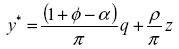
<body><![CDATA[<p><font face="verdana" size="2">(2)</font></p>     </td>   </tr> </table>     <p>&nbsp;</p> <table width="75%" border="0">   <tr>      <td>            <p><font face="verdana" size="2"><i>x + q = m</i></font></p>     </td>     <td width="10%">            <p><font face="verdana" size="2">(3)</font></p>     </td>   </tr> </table>     <p><font face="verdana" size="2">Equation (1) is the function of exports, equation    (2) is the demand for imports, and (3) shows the current account equilibrium.    The variables are the real growth rate of: <i>x</i> (exports), <i>m</i> (imports),    <i>q</i> (relative prices), <i>y </i>(national income), and <i>z</i> (world    income).</font></p>     <p><font face="verdana" size="2">Substituting equations (1) and (2) into equation    (3) we obtain:</font></p> <table width="75%" border="0">   <tr>      <td>            <p><font face="verdana" size="2"><img src="/img/revistas/s_rhcs/v3nse/a01frm04.gif"></font></p>     </td>     <td width="10%">            <p><font face="verdana" size="2">(4)</font></p>     </td>   </tr> </table>     <p><font face="verdana" size="2">Substituting equation (1) into (4), and bearing    in mind the Marshall-Lerner condition, or assuming that relative prices are    constant (that is its growth rate is zero, <i>q</i>=0), we obtain:</font></p> <table width="75%" border="0">   <tr>      <td>            <p><font face="verdana" size="2"><i>y</i><sup>*</sup> = (1/<i><font face="Symbol">p</font></i>)<i>x</i></font></p>     </td>     <td width="10%">            ]]></body>
<body><![CDATA[<p><font face="verdana" size="2">(5)</font></p>     </td>   </tr> </table>     <p><font face="verdana" size="2">This equation is known in economic literature    as Thirlwall's Law, which establishes that, an increase of income elasticity    for the demand for imports (<font face="Symbol">p</font>) reduces the rate of    growth of the product of equilibrium in respect to the balance of payments.    Notice that the causality in this model goes from exports to the product, which    is why, differently to the traditional models of growth; it is considered that    an increase of external demand is an important source in the growth of an economy.</font></p>     <p>&nbsp;</p>     <p><font face="verdana" size="3"><b>III) Empirical Evidence of Thirlwall's Law    for Latin-American Countries </b></font></p>     <p><font face="verdana" size="2">Models of growth with restrictions of foreign    currency have been thought over basically for developed countries. In this sense,    McCombie (1997) analyzes the case of three developed economies: the United States,    Japan, and the United Kingdom. The author concluded that although the United    States like the United Kingdom fulfill the hypothesis that the restriction of    the balance of payments and the rates of growth have been close to the rates    of growth of equilibrium with the balance of payments, nevertheless this fails    to be the case of Japan.</font></p>     <p><font face="verdana" size="2">However, in the last few years there has been    an increasing interest in his application for emerging economies. In the study    of such model for Latin-American economies the work of Moreno-Brid (1998), (1999),    and (2000), Loría (2001), Loría and Fujii (1997), López and Cruz (2000), Porcile,    Higashi and Bittencourt (2000), Bértola, Higashi and Porcile (2002), Fugarolas    and Matesanz (2003), Márquez (2006), García and Quevedo (2005), and Pardo and    Reig (2002), should be emphasized.</font></p>     <p><font face="verdana" size="2">Moreno-Brid (1999) analyzes the case of the Mexican    economy during the period from 1950 to 1996, separated into two sub-periods:    1950 to 1975 and 1976 to 1996. Accordingly, we can capture possible differences    in the relationship between growth rates of exports and the GDP due to shifts    in the regime of foreign exchange rates<a name="_ftnref3"></a><a href="#_ftn3"><sup>2</sup></a>.    In the study it is stressed that the terms of trade and the current account    deficit are not perfectly aligned to the Mexican reality during the period of    1950-96<a name="_ftnref4"></a><a href="#_ftn4"><sup>3</sup></a>. Thus, it proves    the existence of a relationship of cointegration of long term and positive significance    between the GDP and exports, in which the income elasticity of imports (<font face="Symbol">p</font>) is    1.04 from 1950-81 and 2.47 for 1982-86. As can be observed in equation (5),    an increase of <font face="Symbol">p</font> provokes a reduction of growth.    In fact, Moreno-Brid (1999) points out that such increase in elasticity restricted    the balance of payments, reducing Mexico's economic growth. Probably, this could    have been the major reason for the long term fall in the expansion rate of its    domestic activity in the last fifteen years. In a later study, Moreno-Brid (2000)    analyzes what he calls the "three generations of Balance of Payment Constraint    models" and evaluates the McCombie test<a name="_ftnref5"></a><a href="#_ftn5"><sup>4</sup></a>    for the Mexican economy. This author stresses that most of the empirical studies    on Mexican imports have been unable to capture the effects of commercial protection    on import demands. Other authors have tried to capture such effects in different    ways, among which are emphasized the inclusion of "dummy" variables such as    regressors to catch the hysteresis effect on the change of import demands. Another    alternative focus would be to include variables that reflect the incidence of    non-tariff restrictions on commercial flow<a name="_ftnref6"></a><a href="#_ftn6"><sup>5</sup></a>.    Following this logic, Moreno-Brid (2000) includes in his estimation of import    demands an index of licenses on importations<a name="_ftnref7"></a><a href="#_ftn7"><sup>6</sup></a>.    The lack of statistical significance of long term effects of relative prices    on import demands found in his estimation for the period 1967-99, validates    the Balance of Payment Constraint hypothesis. Such is pointed out by McCombie    and Thirlwall (1999), in a country that is potentially constrained in its balance    of payments, a change of relative prices has no significant effect on the growth    of exports or imports. The authors conclude that during the period 1967-99,    the balance of payments has restricted the long term growth of the Mexican economy.    It was also pointed out that during those years the terms of trade did not play    a significant role in the determination of Mexican economic growth.</font></p>     <p><font face="verdana" size="2">Another study to be highlighted is that of López    and Cruz (2000), who incorporated the real exchange rate in the model in order    to analyze how it affected long term domestic output. These authors conclude    that the real exchange rate is significant for product growth with external    equilibrium. This means that those countries where the Marshall-Lerner condition    is satisfied could achieve a faster rate of output growth if they pursue a policy    whose real exchange rate is kept at competitive levels. However, the real exchange    rate by itself does not guarantee that output will be higher.</font></p>     <p><font face="verdana" size="2">Loría (2002) analyzed the external restriction    to economic growth in the case of Mexico, covering the period 1980-1999, with    panel data for 59 sectors of goods. He studied the Mexican economy in three    divisions<a name="_ftnref8"></a><a href="#_ftn8"><sup>7</sup></a> in order to    detect which sector is restricting economic growth. The leading hypothesis is    that the manufacturing sector has not generated nor developed nor transferred    resources to the rest of the economy. The results obtained are such that the    real exchange rate, like the GDP of the United States, is a factor that corrects    the Mexican trade balance. Finally, he concludes that sectors such as automobiles    have increased exports and at the same time imports; this by itself has not    generated any spillover effects.</font></p>     <p><font face="verdana" size="2">Bertola, Higashi and Porcile (2002) made a study    about Brazil. This work covered a large period of the economic history of the    country, covering the primary export growth period and industrialization based    on import substitution. The study came to a close in 1973 because the decade    of the 1970's represented a new and particular phase from the perspective of    capital flows and qualitative changes in the degree of external debt. The authors,    after seeing that the series GDP, TT, and Z<a name="_ftnref9"></a><a href="#_ftn9"><sup>8</sup></a>    are integrated processes of the first order (that is to say they are I(1)),    when applying cointegration analysis using the Johansen procedure; at least    two cointegration vectors can be found. Then, by obtaining the relationship    over a long term can estimate an error correction model in order to see the    dynamic that follows the process in the short term. Finally, they conclude by    finding a relationship between GDP, exchange terms, and world income, thus verifying    Thirlwall's Law.</font></p>     ]]></body>
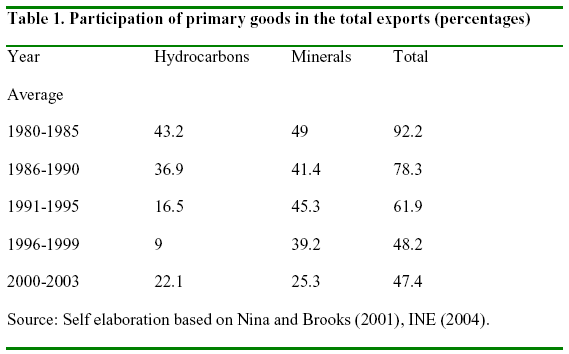
<body><![CDATA[<p><font face="verdana" size="2">Fugarolas and Matesanz (2003) showed that the    traditional version of Thirlwall is a useful analytical framework to explain    the slow growth of Argentina during the period 1968-2003. Observing that before    the crisis of 2002, just as in the period 1968-2000 and of 1980-2000, the real    growth rate was greater than the theoretical, what it was pointing out is that    the country was capable of overcoming its restriction of balance of payments    during a short period of time.</font></p>     <p><font face="verdana" size="2">In the case of Colombia, Márquez (2006) concluded    that Thirlwall's Law is more adequate to explain the relation between foreign    commerce and economic growth. On the other hand, there is no evidence to show    that international prices exercise an effect on the level of exports, although    there exists a growing tendency of the real exchange rate. However, this inclusion    in the model has almost zero effect. For their part, García and Quevedo (2005)    analyzed the period of 1952-2000 verifying Thirlwall's Law for the Colombian    economy, as having a growth rate of 4.4% the center of gravity towards which    the country tended in the long term.</font></p>     <p><font face="verdana" size="2">Pardo and Reig (2002), analyzed the case of Uruguay    for the period 1960-2000, finding empirical evidence supporting Thirlwall's    Law, they were suggesting the existence of a situation of restriction of the    balance of payments on the growth during this time.</font></p>     <p>&nbsp;</p>     <p><font face="verdana" size="3"><b>IV) The Bolivian External Vulnerability: Past    and Present</b></font></p>     <p><font face="verdana" size="2">From 1985, Bolivia implemented a series of structural    reforms that have formed a model of development characterized by deregulation,    privatization and commercial liberalization<a name="_ftnref10"></a><a href="#_ftn10"><sup>9</sup></a>    that have influenced not only exports and imports of goods and services, but    also other balance of payment variables.</font></p>     <p><font face="verdana" size="2">The new commercial policy also sought to expand    exports. From 1985, obstacles to exports were eliminated and a neutral taxation    environment was instituted, also institutions were created to facilitate and    promote such policies.<a name="_ftnref11"></a><a href="#_ftn11"><sup>10</sup></a>    The external openness was not only focused on the commercial trade balance but    also on the capital account of the balance of payments, eliminating restrictions    to movement of capital in or out of the country, establishing free exchange    and convertibility and forming environments of economic institutions in favor    of receiving foreign investment.</font></p>     <p><font face="verdana" size="2">In spite of external orientation, Bolivia has    not changed its productive structure characterized by being primarily an exporter<a name="_ftnref12"></a><a href="#_ftn12"><sup>11</sup></a>    (Arevilca, 2003).</font></p>     <p><font face="verdana" size="2">According to Jordan (1993),<a name="_ftnref13"></a><a href="#_ftn13"><sup>12</sup></a>    to understand Bolivian economic growth during the last two centuries is to return    to the past of the mining crises in a process of dialectical synthesis. The    reflection of these crises was seen in the shortage of foreign currencies, on    the side of exports, and its impact on the balance of payments; also compared    with other sectors of the economy it was losing force in its contributions to    the GDP. For example, it is possible to mention that exports of natural gas    doubled in value compared to exports of minerals between 1985 and 1986.</font></p>     <p><font face="verdana" size="2">According to Nina and Brooks (2001), during 1986    hydrocarbons continued being the largest contributors to the General Treasury    of the Nation. Therefore, there are two sectors of primary products regarding    the total level of exports to explain the evolution of revenues of foreign currencies.    During the first half of the decade of the eighties, their participation rose    to 92.2% of the yearly average, while for the period 2000-2003 the average fluctuated    around 47%, being evidence of the changes in the structure. In this last case    hydrocarbons grew between 9% and 22% with respect to the total export (see <a href="#tab01">Table    1</a>).</font></p>     ]]></body>
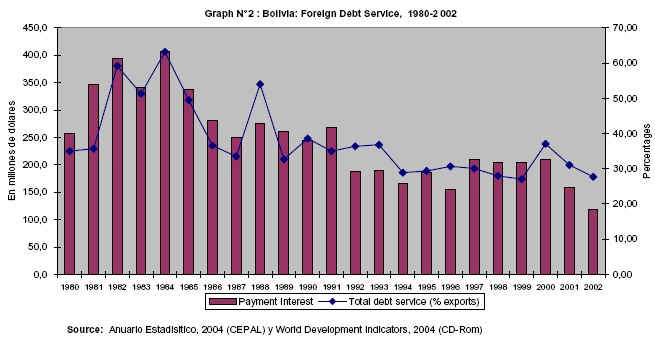
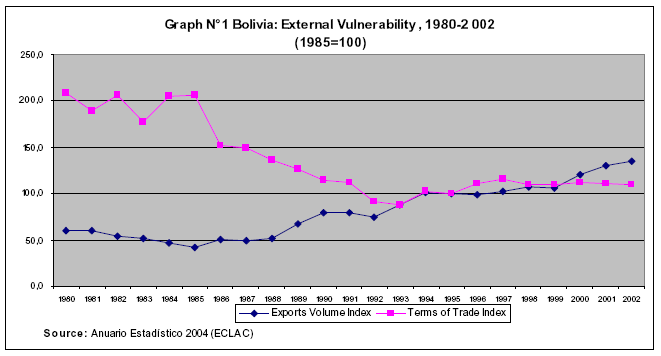
<body><![CDATA[<p><a name="tab01"></a></p>     <p>&nbsp;</p>     <p align="center"><img src="/img/revistas/s_rhcs/v3nse/a01tab01.gif"></p>     <p>&nbsp;</p>     <p><font face="verdana" size="2">Although it is certain, as many analysts point    out, that exports have grown after the liberalization process; these did not    change significantly in their structural content, since basically the country    was continuing to export <i>commodities.</i> So the Prebisch-Singer Thesis (a    permanent deterioration in the terms of trade, see Prebisch (1950)) holds valid    for such economies, as emphasized by Larrazábal et al. (2002) and Arevilca (2003)    (See <a href="/img/revistas/s_rhcs/v3nse/a01grf01.gif">graph No. 1</a>).</font></p>     <p><font face="verdana" size="2">As indicated by Larrazábal et al. (2000), the    foreign debt has been a restriction to the long term growth of the Bolivian    economy, transforming itself into a concern of State after the crisis in the    decade of the eighties. For example, as pointed out by Cariaga (1994), in 1984    there was an agreement with the Central Obrera Boliviana (COB – the principal    labor union in Bolivia)) to designate 25% of exports for paying the foreign    debt.</font></p>     <p><font face="verdana" size="2">Although the HIPC<a name="_ftnref14"></a><a href="#_ftn14"><sup>13</sup></a>    program has helped to reduce the foreign debt service (See <a href="/img/revistas/s_rhcs/v3nse/a01grf02.gif">graph    No. 2</a>) these are conditioned to the application of counter-productive policies    such as the structural reforms. Also the use of such funds was destined to a    greater social expense and the fight against poverty<a name="_ftnref15"></a><a href="#_ftn15"><sup>14</sup></a>;    by this it does not mean to say that it is such a bad purpose, but on the contrary,    it could be used more productively with greater multiplying effects on the economy.</font></p>     <p><font face="verdana" size="2">A great part of these resources (62.8% of the    debt relief) are provided by bilateral sources, while the remaining 37.2% are    derived from the participation of international cooperation at a multilateral    level.</font></p>     <p><font face="verdana" size="2">Another relevant aspect has been the handling    of the exchange rate. Schweickert (2001) indicates that this instrument has    two objectives in economies like that of Bolivia: a) to help generate expectations    against inflation; and b) to preserve external competitiveness. One of the author's    conclusions is that although the exchange rate helped to reduce inflationary    expectations, it did not help, and on the contrary, it was a negative factor    on the performance of exports.</font></p>     <p>&nbsp;</p>     ]]></body>
<body><![CDATA[<p align="center"><font face="verdana" size="2"><a href="/img/revistas/s_rhcs/v3nse/a01grf03.gif">Graph    No. 3</a></font></p>     <p>&nbsp;</p>     <p><font face="verdana" size="2">According to Loría (2003) and Elliot and Rhodd    (1999), the high cost of servicing the foreign debt, the misalignment of the    exchange rate (overvaluation) and the influence of the terms of trade are factors    that have influenced the long term performance of economies like that of Bolivia.</font></p>     <p><font face="verdana" size="2">Next, a table is presented which summarizes the    balance of payment constraint growth model, besides the graphical representation    applied to the Bolivian economy, in order to understand with greater accuracy    the changes on the path of long term growth and how the availavility of foreign    currencies influenced their performance. For this purpose, the period under    analysis is divided into six sub-periods that were crucial for the economic    and political history of Bolivia.</font></p>     <p>&nbsp;</p>     <p align="center"><font face="verdana" size="2"><a href="/img/revistas/s_rhcs/v3nse/html/a01tab03.htm">Table    3</a></font></p>     <p>&nbsp;</p>     <p><font face="verdana" size="2">The first period covers 1953 to 1962, coinciding    with the process of the national revolution and the later macroeconomic stabilization;    the <i>boom </i>exporter will manifest itself during 1963 – 1971, a period in    which the prices of the main export products rallied. For example, it is enough    to see the rate of growth of exports, which rose to 10.39% compared with those    during 1953-62, that show a clear decline.</font></p>     <p><font face="verdana" size="2">The following sub-period is one of the most important    in the contemporary life of the country, not only economically but also politically.    It began in 1972 with the dictatorship of the then Colonel Banzer, this period    is characterized for its positive <i>shock </i>in terms of trade, such as international    financial help thanks to the support of the United States, that endorsed this    government. The favorable situation did not last too long, and then began signs    of economic recession as an effect of the already important load of debt and    pressure from international private creditors. Without saying more, such period    was characterized as "the lost decade" that affected the majority of Latin-American    countries. Another important date is 1985, a year in which the Supreme Decree    (D.S.) 21060 became valid, and this changed the actual model of development    until the present time. During the period 1989 to 1995 important events took    place such as the wave of the first generation policies of structural reforms    and the deepening of privatization policies. These have not been modified during    the following years, now that the premarket reforms have been deepened as much    in the economic context as the institutional.</font></p>     <p><font face="verdana" size="2">Continuing with Moreno-Brid (1998), the model    is exemplified in a graphic representation of the period 1953-62 and 1963-71,    when, as was already explained shows a process of social revolution at the onset    of the 1950's and later, a process of <i>boom </i>exporter for the following    period.</font></p>     ]]></body>
<body><![CDATA[<p>&nbsp;</p>     <p align="center"><font face="verdana" size="2"><a href="/img/revistas/s_rhcs/v3nse/a01fig04.gif">Figure    4 </a></font></p>     <p>&nbsp;</p>     <p><font face="verdana" size="2">The upward movement of the line B towards B'    reflects the accelerated expansion of exports. The income of foreign currencies    for exports makes for an improved economic situation and accelerated rate of    growth. On the other side, the line Q towards Q' reflects the increment in the    income elasticity of imports, and their upward movement gains the effect of    improving terms of trade.</font></p>     <p>&nbsp;</p>     <p><font face="verdana" size="3"><b>V)&nbsp;Empirical Evidence for Bolivia (1953-2002):    Application of Thirlwall's Model.</b></font></p>     <p><font face="verdana" size="2"><b>V.1) Econometric specification</b></font></p>     <p><font face="verdana" size="2">This section basically aims to test Thirlwall's    model in the case of the Bolivian economy. Considering the fundamental equation    (5) given in section II, an econometric specification is proposed:</font></p> <table width="75%" border="0">   <tr>      <td height="8">            <p><font face="verdana" size="2"><i>Ln</i>(GDP)<sub>t</sub>=<font face="Symbol">a</font><sub>0</sub>          +<font face="Symbol">a</font><sub>1</sub> <i>Ln</i>(<i>X</i>)<sub><i>t</i></sub>          +<font face="Symbol">e</font><sub><i>t</i></sub></font></p>     </td>     <td width="10%" height="8">            <p><font face="verdana" size="2">(6)</font></p>     </td>   </tr> </table>     ]]></body>
<body><![CDATA[<p><font face="verdana" size="2">Equation (6) is known as the econometric specification    of Thirlwall's Law and tells us that the GDP is determined by exports plus an    error term. Where the coefficient <font face="Symbol">a</font><sub>1</sub> is    the inverse of the income elasticity of imports.</font></p>     <p><font face="verdana" size="2">Afterwards, some modifications are made to estimate    the real exchange rate (RER) effect on the economic growth as shown in equation    (7).</font></p> <table width="75%" border="0">   <tr>      <td height="8">            <p><font face="verdana" size="2"><i>Ln</i>(<i>GDP</i>) = <font face="Symbol">b</font><sub>0</sub>          +<font face="Symbol">b</font><sub>1</sub> <i>Ln</i>(<i>RER</i>)<sub>t</sub>+          <i>u</i><sub>t</sub></font></p>     </td>     <td width="10%" height="8">            <p><font face="verdana" size="2">(7)</font></p>     </td>   </tr> </table>     <p><font face="verdana" size="2">The objective of equation (7) is to see if other    variables considered as insignificant in Thirlwall's model are relevant. The    RER has been important in developing economies when applying stabilization policies;    therefore, the significance of coefficient <font face="Symbol">b</font><sub>1</sub> will    be considered.</font></p>     <p><font face="verdana" size="2">Equations of trade balance (TB), imports (M),    and exports (X) will be estimated to analyze the level of external constraint,    see equations (8), (9) and (10).</font></p> <table width="75%" border="0">   <tr>      <td height="8">            <p><font face="verdana" size="2"><i>TB</i><sub>t</sub> =<font face="Symbol">d</font><sub>0</sub>          +<font face="Symbol">d</font><sub>1</sub> <i>Ln</i>(<i>GDPUSA</i>)<sub>t</sub>          +<font face="Symbol">d</font><sub>2</sub> <i>Ln</i>(<i>GDP</i>)<sub>t</sub>          +<font face="Symbol">d</font><sub>3</sub> <i>Ln</i>(<i>RER</i>)<sub>t</sub>          + <i>v</i><sub>t</sub></font></p>     </td>     <td width="10%" height="8">            <p><font face="verdana" size="2">(8)</font></p>     </td>   </tr> </table>     <p><font face="verdana" size="2">Note that in equation (8) it is important to    test the Marshall-Lerner condition checking to see if RER is of significance    in the model, otherwise Thirlwall's supposition would be invalid.</font></p> <table width="75%" border="0">   <tr>      <td height="17">            <p><font face="verdana" size="2"><i>Ln</i>(<i>X</i>)<sub>t</sub> =<font face="Symbol">g</font><sub>0</sub>          +<font face="Symbol">g</font><font face="verdana" size="2"><sub>1</sub></font>          <i>Ln</i>(<i>GDP</i>)<sub>t</sub> +<font face="Symbol">g</font><font face="verdana" size="2"><font face="verdana" size="2"><sub>2</sub></font></font>          <i>Ln</i>(<i>TOT</i>)<sub>t</sub> + <i>z</i><sub>t</sub></font></p>     </td>     <td width="10%" height="17">            ]]></body>
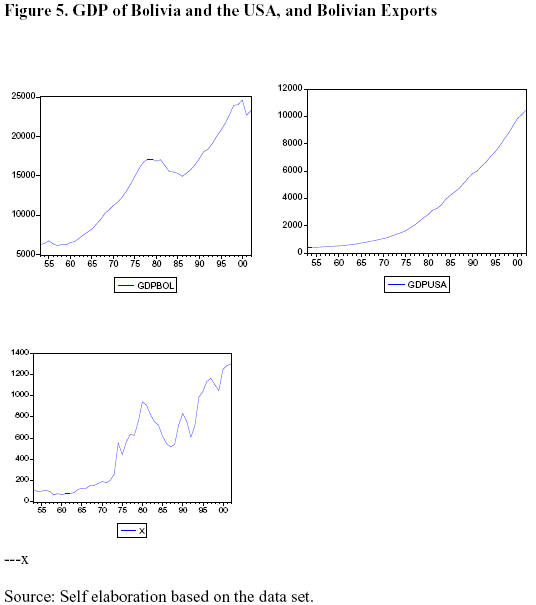
<body><![CDATA[<p><font face="verdana" size="2">(9)</font></p>     </td>   </tr> </table>     <p>&nbsp;</p> <table width="75%" border="0">   <tr>      <td height="8">            <p><font face="verdana" size="2"><i>Ln</i>(<i>M</i>)<sub>t</sub> =<font face="Symbol">j</font><sub>0</sub>          +<font face="Symbol">j</font><font face="verdana" size="2"><sub>1</sub></font>          <i>Ln</i>(<i>GDP</i>)<sub>t</sub> +<font face="Symbol">j</font><font face="verdana" size="2"><font face="verdana" size="2"><font face="verdana" size="2"><sub>2</sub></font></font></font>          <i> Ln</i>(<i>TOT</i>)<sub>t</sub> + <i>h</i><sub>t</sub></font></p>     </td>     <td width="10%" height="8">            <p><font face="verdana" size="2">(10)</font></p>     </td>   </tr> </table>     <p><font face="verdana" size="2">By equations (9) and (10) the impact of the GDP    on exports and imports can be seen, also they can be used as a test to see the    equality between the ratio of income elasticity of exports and imports with    the average domestic and foreign growth ratio, as in equation (11) (see Moreno-Brid    2003).</font></p> <table width="75%" border="0">   <tr>      <td height="8"><img src="/img/revistas/s_rhcs/v3nse/a01frm11.gif"></td>     <td width="10%" height="8">            <p><font face="verdana" size="2">(11)</font></p>     </td>   </tr> </table>     <p><font face="verdana" size="2">Where y is the average domestic growth and y<sub>rm    </sub>the foreign growth (the rest of the world).</font></p>     <p><font face="verdana" size="2"><b>V.2) Data Set</b></font></p>     <p><font face="verdana" size="2">We will begin the empirical analysis with the    revision of the statistical series that will be used as being the Gross Domestic    Product of Bolivia at the constant prices of 1970, the United States product    in billion of dollars, the volume of exports and imports in millions of dollars,    the nominal exchange rate, the service of the foreign debt and lastly the terms    of trade. The data of the series to calculate the import and export functions    come from the International Monetary Fund (International Financial Statistics),    World Development Indicators, 2004 of the World Bank (CD-Rom), the database    of the OXLAD (Oxford University)<a name="_ftnref17"></a><a href="#_ftn17"><sup>16</sup></a>,    besides the Annual Statistics Yearbook 2004, ECLAC. </font></p>     <p><font face="verdana" size="2">Note, it can be appreciated in <a href="#fig5">figure    5</a> that the series seem to follow a tendency in time<a name="_ftnref18"></a><a href="#_ftn18"><sup>17</sup></a>,    suggesting that they are not stationary. Moreover, it can be observed that the    series of the Bolivian GDP follows a continuous process of <i>stop and go</i>    cycles possibly influenced by external factors such as, for example, the terms    of trade. </font></p>     ]]></body>
<body><![CDATA[<p><a name="fig5"></a></p>     <p>&nbsp;</p>     <p align="center"><img src="/img/revistas/s_rhcs/v3nse/a01fig05.gif"></p>     <p>&nbsp;</p>     <p><font face="verdana" size="2"><b>V.3) Unit-Root Analysis</b></font></p>     <p><font face="verdana" size="2">As a preliminary step to study the existence    of one or more cointegration relationships, it is necessary to analyse the integration    order of the variables to include in the model. That is why it is important    to know if the variables are stationary or not, and if not then what order of    integration do they have. Therefore, the Augmented Dickey-Fuller (ADF) and Phillips-Perron    (PP) tests are applied.</font></p>     <p><font face="verdana" size="2">To carry out the study, the logarithmic expression    of the following series are considered: the Gross Domestic Product (GDP), real    exports (X), real imports (M), real exchange rate (RER), terms of trade (TOT),    and GDP of the United States (GDPUSA). In addition the Trade Balance (TB) was    defined as the difference between the logarithm of exports and imports, a study    that was made during the period 1953-2002, and all the series appear to behave    as I(1) processes. </font></p>     <p><font face="verdana" size="2">ADF and PP test results are shown in <a href="/img/revistas/s_rhcs/v3nse/html/a01tab03.htm">Tables    3</a> and <a href="/img/revistas/s_rhcs/v3nse/a01tab04.gif">4</a> for the three    traditional models (without both constant and trend, with constant and without    trend, and with constant and trend) for both variables of level and difference,    respectively.</font></p>     <p>&nbsp;</p>     <p align="center"><font face="verdana" size="2"><a href="/img/revistas/s_rhcs/v3nse/html/a01tab03.htm">Table    3</a></font></p>     ]]></body>
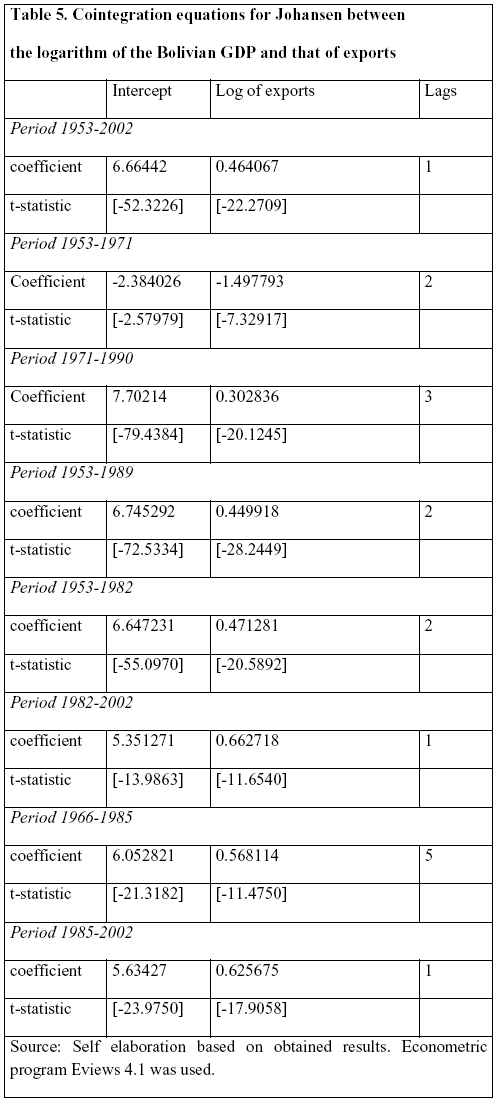
<body><![CDATA[<p>&nbsp;</p>     <p><font face="verdana" size="2"><b>V.4) Estimation of Thirlwall's Law</b></font></p>     <p><font face="verdana" size="2">According to Espasa and Cancelo (1993), from    a strictly economic point of view, the study of the existence, or not, of a    relationship of cointegration between the variables that are analyzed is one    of the fundamental results of the modeling process, also to what level the analysis    explains the behavior of the variables over the long term through the explicative    variables that are considered in the process of modelization.</font></p>     <p><font face="verdana" size="2">Following Jayme (2001), firstly, a cointegration    study between the Bolivian GDP and exports is made for the whole period (1953-2002).    Such is the first step to discover whether it is possible to have the existence    of a long term relationship, as was proposed by Thirlwall.</font></p>     <p><font face="verdana" size="2"><a href="#tab5">Table 5</a> shows the cointegration    relationships for the entire period and for different sub-periods. The Johansen    cointegration test (Johansen, 1988) was applied, which is preferable to the    two stage method of Engle and Granger due to one advantage: in case of more    than one relationship of cointegration, the Johansen test estimates all of the    vectors.</font></p>     <p><a name="tab5"></a></p>     <p>&nbsp;</p>     <p align="center"><img src="/img/revistas/s_rhcs/v3nse/a01tab05.gif"></p>     <p>&nbsp;</p>     <p><font face="verdana" size="2">The results show the existence of a cointegration    vector for every period. Accordingly, we obtain a necessary condition that defends    Thirlwall's Law for the Bolivian economy.</font></p>     ]]></body>
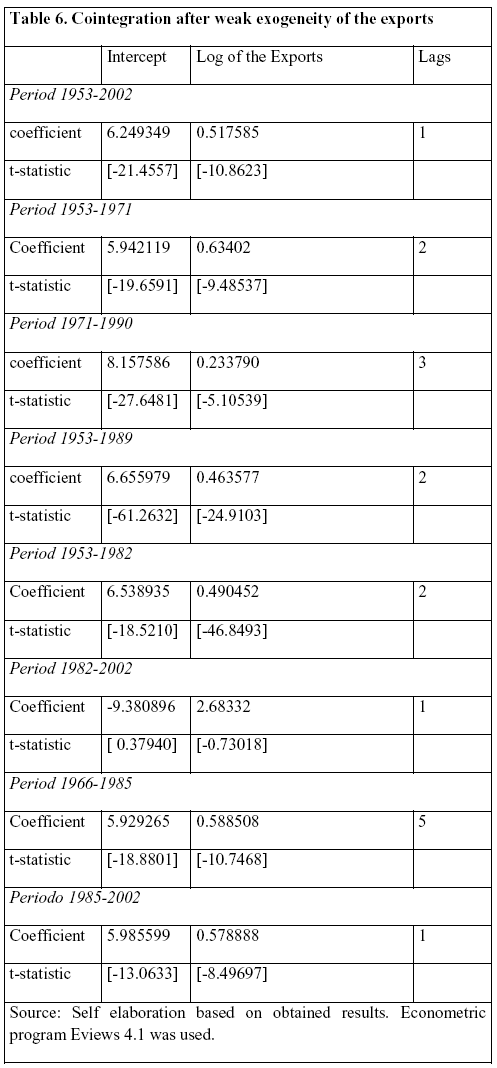
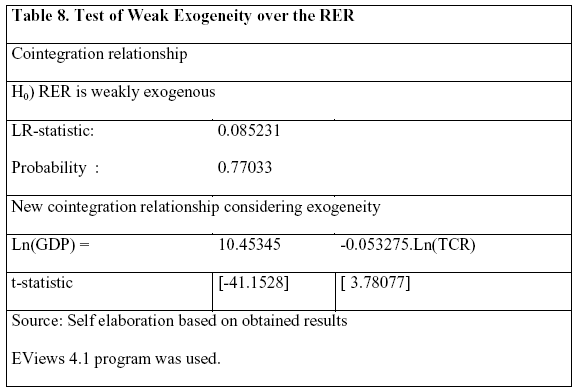
<body><![CDATA[<p><font face="verdana" size="2">However, in order to analyze the period it will    be recommendable to consider the explicative variable (exports) as being weakly    exogenous in the model. As suggested by Espasa and Cancelo (1993), a variable    is exogenous in the analysis being made, if it can be done without the need    of modelling the explicative equation of the presumed exogenous variable. Therefore,    <a href="#tab6">Table 6</a> shows the cointegration relations obtained after    testing for weak exogeneity of the exports.</font></p>     <p><a name="tab6"></a></p>     <p>&nbsp;</p>     <p align="center"><img src="/img/revistas/s_rhcs/v3nse/a01tab06.gif"></p>     <p>&nbsp;</p>     <p><font face="verdana" size="2">Note that <a href="#tab6">Table 6</a> permits    the study of the long term implicit elasticity of imports (<font face="Symbol">p</font>)    for each period. For the period 1953-2002, the income elasticity of imports    is 1.92 (represented by a coefficient of 0.52). During the period 1953-1971,    the income elasticity of imports is 1.59 (represented by a coefficient of 0.63).    In comparison with the period 1985-2002, when the coefficient is 0.58 and the    income elasticity of imports is 1.72, it is possible to appreciate an increment    of 8.18% in such elasticity. This suggests to us that the actual economic model    (implemented since 1985) has been harmful to the Bolivian economy increasing    the external constraint of economic growth.</font></p>     <p><font face="verdana" size="2"><b>V.5) Effects of the RER on the Bolivian GDP</b></font></p>     <p><font face="verdana" size="2">López and Cruz (2000) suggested that the exchange    rate has played an essential role in the long term growth of the Bolivian economy.    It can be highlighted that after trade and financial liberalization according    to the Washington Consensus (WC), the exchange rate took an essential role not    only in fomenting exports but also controlling inflation generating a trade-off    in terms of economic policy; that means violating Tinberger's rule: an instrument    and two objectives; see Tinberger (1952), Fernández et.al. (2002),  Martner    (2000), and Arevilca (2004).</font></p>     <p><font face="verdana" size="2">In <a href="/img/revistas/s_rhcs/v3nse/a01tab07.gif">Table 7</a>,    it can be observed that the relation of cointegration proportioned for Johansen's    test, has 5% significance. Such vector of cointegration represents a stable    long term relationship between the product and the exchange rate, as in López    and Cruz (2000).</font></p>     <p><font face="verdana" size="2">However, in order to do an inference analysis    during the period, it is necessary to see if the RER is an exogenous variable    in the model. <a href="#tab8">Table 8</a> shows the cointegration relationship    obtained, assuming that the RER is weakly exogenous. Note that the exogeneity    test does not reject such hypothesis, having similar coefficients in both specifications.</font></p>     ]]></body>
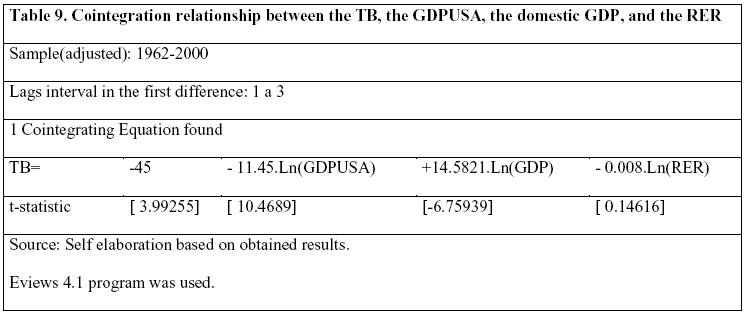
<body><![CDATA[<p><a name="tab8"></a></p>     <p>&nbsp;</p>     <p align="center"><img src="/img/revistas/s_rhcs/v3nse/a01tab08.gif"></p>     <p>&nbsp;</p>     <p><font face="verdana" size="2">Without rejecting that the TCR is weakly exogenous    in the model, it is possible to make an inference analysis for the whole period.</font></p>     <p><font face="verdana" size="2">In all cases the signs are what are expected    and it is possible to affirm that an increment in the RER has reduced the long    term rate of growth for the product in the whole period. In order to confirm    such a hypothesis a cointegration relationship for the trade balance is estimated    to prove if the Marshall Lerner condition is fulfilled.</font></p>     <p><font face="verdana" size="2"><b>V.6) Cointegration relationship for the Bolivian    trade balance</b></font></p>     <p><font face="verdana" size="2">When including the trade balance (in constant    dollars), the world product (taking as a reference the GDP of the USA, in constant    dollars), the domestic product (in constant units), and the real exchange rate    (in logarithms), a cointegration vector is found of 5%.</font></p>     <p><font face="verdana" size="2">According to <a href="/img/revistas/s_rhcs/v3nse/a01tab09.gif">Tables    9</a> and <a href="/img/revistas/s_rhcs/v3nse/a01tab10.gif">10</a>, the trade balance is positively    related to the Bolivian GDP and negatively with the GDP of the USA and the RER.</font></p>     <p><font face="verdana" size="2">Note that the RER coefficient is of little significance,    almost equal to 0. Since the <i>Marshall-Lerner</i> condition is satisfied,    and then in order to obtain larger growth rates of products it is necessary    to maintain the RER at competitive levels. Finally, an impulse-response function    is made to study the innovation effects of the mentioned variables on the trade    balance.</font></p>     ]]></body>
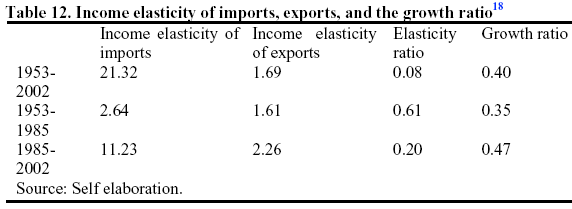
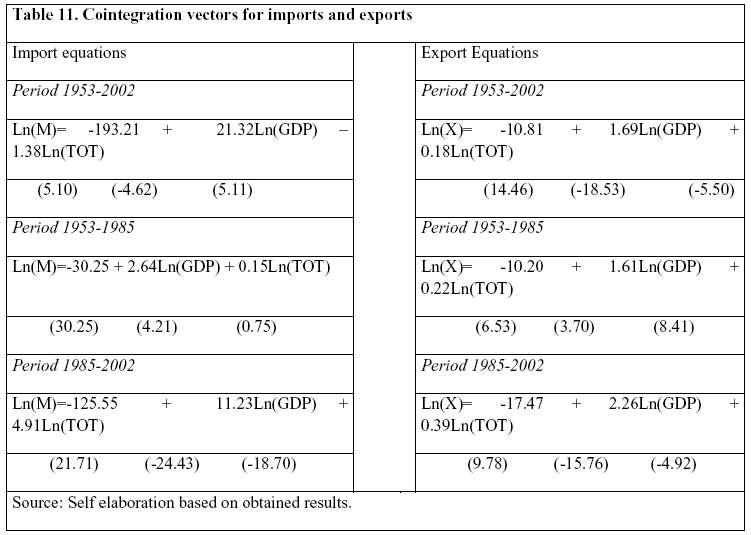
<body><![CDATA[<p>&nbsp;</p>     <p align="center"><font face="verdana" size="2"><a href="/img/revistas/s_rhcs/v3nse/a01fig06.gif">Figure    6</a></font></p>     <p>&nbsp;</p>     <p><font face="verdana" size="2">A final comment is due on the TB model, from    the graph: the signs are confirmed, it can be appreciated that the US GDP has    a negative effect. Also, the Bolivian GDP has a long term positive effect on    the trade balance, while the RER has an almost insignificant effect. This brings    us to conclude that depreciation could have a negative effect on the domestic    demand in the long term but an almost null effect on the trade balance.</font></p>     <p><font face="verdana" size="2">Following Moreno-Brid and Pérez (2000; 2003),    <a href="/img/revistas/s_rhcs/v3nse/a01tab11.gif">Table 11</a> shows the analysis of the effect    of TOT on long term growth. Thus we can estimate the functions of imports and    exports. </font></p>     <p><font face="verdana" size="2">The results indicate the existence of at least    one cointegration vector at a level of 5% in all the cases. It calls our attention    to the high income elasticity of imports for the whole period of the study,    which represents a magnitude of 21.32.</font></p>     <p><font face="verdana" size="2">If the two traced periods are compared, it is    seen that the income elasticity of imports has increased in an important way    during the period 1953-1985 and 1985-2002, from 2.64 to 11.23 respectively.    In the case of exports, the results show us an income elasticity of 1.69 for    the whole period; presenting a variation for the periods 1953-1985 and 1985-2002,    that goes from 1.61 to 2.26, correspondingly.</font></p>     <p><font face="verdana" size="2">The above-mentioned explains the negative elasticity    that the Bolivian GDP presents on the trade balance. This arises from the fact    that imports react in a stronger way when faced with a change of GDP, than exports.    In this way,  an increment of 1 point of the GDP would increase imports by 21.3    points, but exports by only 1.69 points; the net balance is negative, pointing    to a fall in the trade balance.</font></p>     <p><a name="tab12"></a></p>     <p>&nbsp;</p>     ]]></body>
<body><![CDATA[<p align="center"><img src="/img/revistas/s_rhcs/v3nse/a01tab12.gif" usemap="#Map" border="0">    <map name="Map">     <area shape="rect" coords="492,-2,505,12" href="#_ftn19">   </map> </p>     <p>&nbsp;</p>     <p><font face="verdana" size="2">The empirical validity of the model can be verified    by means of a comparison of the ratio of elasticity that arises from the cointegration    equations with the ratio between the average growth of the national GDP and    that of the USA. Note that income elasticity of imports for the period 1953-2002,    affects the estimation of the ratio of elasticity and of growth. A clear justification    of this fact could be applied to the decade of the seventies, when Bolivia received    not only a positive influx of capital but also foreign support. (See Arevilca,    2003)</font></p>     <p>&nbsp;</p>     <p><font face="verdana" size="3"><b>Conclusions</b></font></p>     <p><font face="verdana" size="2">Most of the studies about economic growth have    focused on the analysis of productive factors (physical and human capital),    as well as technology, as determinants. Thirlwall (1979), from a post-Keynesian    point of view, proposed a model of growth that was focused on factors of external    demand (exports, imports,  and demand from the rest of the world).</font></p>     <p><font face="verdana" size="2">This paper intends to contribute to the empirical    study of the Bolivian economy. Accordingly, statistical and econometric analysis    was carried out, without rejecting the validity of Thirlwall's Law for the Bolivian    economy during the period of 1953-2002. Additionally, this approach suggests    that there exists a situation of constraint on the balance of payment, associated    with a slow evolution of the export growth rate in relation to the income elasticity    of the demand for imports, which indicates the importance of the above-stated    constraint in explaining the low effective long term rate of product growth.</font></p>     <p><font face="verdana" size="2">To this study, were added some variations of    the model, such as the suggestions by Moreno-Brid and Pérez (2000; 2003), and    by López and Cruz (2000).  Also, the effect of the real exchange rate was analyzed,    this is crucial to understand the long term growth of the Bolivian economy,    since it has been an important variable in the policies of stabilization. It    was observed that this had a negative effect on the long term product growth.    On the other hand, it had a null effect on the trade balance, which is in agreement    with the assumptions of Thirlwall's model. A curious result is that the Bolivian    GDP has a negative effect on the trade balance. While estimating the functions    of exports and imports, two conclusions can be obtained. Firstly, imports are    more elastic to the GDP than exports, which explain the negative sign of the    trade balance; it means that an increase of the Bolivian GDP causes the growth    of imports to be above that of exports, resulting in a negative trade balance.    Secondly, it can be appreciated that income elasticity of imports and exports    present a close relationship with the growth ratio between domestic and foreign    income, verifying the assumptions of Thirlwall's model.</font></p>     <p><font face="verdana" size="2">Considering that Bolivia has specialized principally    in exporting raw materials (non-traditional), while the demand for imports of    manufactured products has increased more than exports, before the growth of    GDP, then the model applied since 1985 increased the income elasticity of imports,    augmenting the external constraint of the country. A hypothesis could be that    Bolivia has followed a "deindustrialization" process (increasingly importing    overseas manufactured products), while losing competitivity to the rest of the    world. Then, we need to consider about the strategy that the country has bet    on since 1985 that has not contributed to any modification of productive conditions,    stressing even more foreign constraint.</font></p>     <p>&nbsp;</p>     ]]></body>
<body><![CDATA[<p><font face="verdana" size="3"><b>References</b></font></p>     <!-- ref --><p><font face="verdana" size="2">Arevilca B. (2003), La Restricción Externa al    Crecimiento Económico en Bolivia. Un análisis de Cointegración, 1970-2000".    XIII Coloquio Mexicano de Economía Matemática y Econometría. (San Luis Potosí,    México). Aceptado para su publicación en el libro de Memorias del XIII Coloquio    Mexicano de Economía Matemática y Econometría, coeditado por la Universidad    Autónoma de San Luis Potosí y la Editorial Trillas, 2005.</font><!-- ref --><p><font face="verdana" size="2">Arevilca B. (2004), The Balance of Payments Constrained    Growth Model: an Empirical Evaluation for Bolivia, 1970-2000. Linda Hall Library,    University of Missouri at Kansas City, USA.</font><!-- ref --><p><font face="verdana" size="2">Bértola Luis, Hermes Higashi, and Gabriel Porcile    (2002). Balance-of-payments-constrained growth in Brazil: a test of Thirlwall's    Law, 1890-1973. <i>Journal of Post Keynesian Economics</i>, Volume 25, N° 1    Fall .</font><!-- ref --><p><font face="verdana" size="2">Cariaga, Juan (1994), La Moratoria Boliviana    y el Ajuste Económico exitoso. en Oscar Altimir y Robert Devlin (comp.), <i>Moratoria    de la deuda en América Latina</i>. FCE, Argentina.</font><!-- ref --><p><font face="verdana" size="2">CEPAL (2004), Anuario estadístico de América    Latina y el Caribe. Santiago, Chile.</font><!-- ref --><p><font face="verdana" size="2">Elliot D.R. y R. Rhodd (1999), Explaining growth    rate differences in Highly Indebted Countries: an extension to Thirlwall and    Hussein, <i>Applied Economics</i>, 31. </font><!-- ref --><p><font face="verdana" size="2">Espasa, A.,  Cancelo, J. (1993), <i>Métodos Cuantitativos    para el Análisis de la Coyuntura Económica. Alianza Economía.</i></font><!-- ref --><p><font face="verdana" size="2">Fernández, Parejo y Rodríguez (2002), <i>Política    Económica</i>. Tercera edición. Editorial Mc Graw  Hill, España.</font><!-- ref --><p><font face="verdana" size="2">Ferreira L. A. and Canuto O.  (2001), Thirlwall´s    Law and Foreign Capital Service: The Case of Brazil. <i>Workshop on "Macroeconomia    Aberta Keynesiana Schumpeteriana: Uma Perspectiva Latinoamericana", UNICAMP</i>,    Campinas, Brazil, June 27-28, 2001.</font><!-- ref --><p><font face="verdana" size="2">Fugarolas, G., Matesanz, D., (2005), "Restricción    de balanza de pagos y vulnerabilidad externa en la Argentina de los noventa.    Un análisis de caso", MPRA Paper 210, University Library of Munich, Germany,    revised 2005.</font><!-- ref --><p><font face="verdana" size="2">García, M., Quevedo A. (2005), "Crecimiento económico    y la balanza de pagos: evidencia empírica para Colombia", Cuadernos de Economía,    Vol. 24, No. 43, pp. 83-104. Bogotá.</font><!-- ref --><p><font face="verdana" size="2">Granger, C.; Newbold, P. (1974), "Spurious Regressions    in Econometrics", <i>Journal of Econometrics</i>, Vol. 2, pp. 111-120.</font><!-- ref --><p><font face="verdana" size="2">Harrod, R. (1939). <i>International economics</i>.    Cambridge, Cambridge UP.</font><!-- ref --><p><font face="verdana" size="2">INE (2004), <i>Anuario Estadístico</i>. La Paz,    Bolivia. </font><!-- ref --><p><font face="verdana" size="2">Jayme F. (2001), <i>Balanced-of-payments constrained    economic growth in Brazil</i>. Texto para Discussao N° 155<i>,</i> UFMG, CEDEPLAR,    Brazil.</font><!-- ref --><p><font face="verdana" size="2">Johansen, S (1988). <i>Statistical analysis of    cointegrating vectors</i>. <i>Journal of Economic Dynamics and Contro</i>l<i>,</i>    12.</font><!-- ref --><p><font face="verdana" size="2">Jordan R. (1993),  La Mineria y los Hidrocarburos    en Bolivia, en Mario Miranda, Bolivia en la hora de su modernización. Centro    Coordinador y Difusor de Estudios Latinoamericanos, Universidad Nacional Autónoma    de México.</font><!-- ref --><p><font face="verdana" size="2">Larrazabal H. et.al. (2000), Ajuste Estructural    y Desarrollo Productivo en Bolivia. Centro de Estudios para el Desarrollo Laboral    y Agrario (CEDLA), La Paz, Bolivia. </font><!-- ref --><p><font face="verdana" size="2">Leamer, E. (1983), "Let's Take the Con Out of    Econometrics", <i>The American Economic Review, </i>Vol.73, No.1, pp. 31-43.</font><!-- ref --><p><font face="verdana" size="2">López, J. y Cruz, A. (2000), <i>"Thirlwall's    Law" and beyond: the Latin American experience</i>. <i>Journal of Post Keynesian    Economics</i>, Spring 2000, vol. 22, No. 3.</font><!-- ref --><p><font face="verdana" size="2">Loría E. (2001), La restricción Externa Dinámica    al crecimiento de México, a través de las propensiones del comercio, 1970-1999.    <i>Estudios Económicos</i>, El Colegio de México. </font><!-- ref --><p><font face="verdana" size="2">Loría E. (2002), Mexico : Growth constrained    by the balance of payments. An analysis of productive branches, 1980-2000. Mimeo,    UNAM.</font><!-- ref --><p><font face="verdana" size="2">Loría and Fujii (1997), "The Balance of Payment    Constraint to Mexico's Economic Growth 1950-1996". <i>Canadian Journal of Development    Studies</i>. Vol. XVIII, No. 1. University of Ottawa.</font><!-- ref --><p><font face="verdana" size="2">Loza T. Gabriel (2000), <i>Algunas consideraciones    sobre el problema del crecimiento económico en Bolivia</i>. mimeo, <i>UCB</i>,    Bolivia.</font><!-- ref --><p><font face="verdana" size="2">Loza T. Gabriel (2001), "Tipo de Cambio, Exportaciones    e Importaciones: El caso de la economía boliviana".  <i>Revista de Análisis    Económico</i>, BCB, Bolivia.</font><!-- ref --><p><font face="verdana" size="2">Loza T. Gabriel (2002), El shock de precios de    los productos básicos en Bolivia. <i>Revista de la CEPAL</i> N° 76, Santiago,    Chile.</font><!-- ref --><p><font face="verdana" size="2">Lucas, R. (1988), On the Mechanics of Economic    Development, <i>Journal of Monetary Economics</i>, Vol.22.</font><!-- ref --><p><font face="verdana" size="2">Márquez, Y. (2006), "Estimaciones econométricas    del crecimiento en Colombia mediante la ley de Thirlwall", <i>Cuadernos de Economía</i>,    v. 25, No. 44, Bogotá, pp. 119-142.</font><!-- ref --><p><font face="verdana" size="2">Martner R. (2000), Estrategias de Política Económica    en un Mundo Incierto. <i>Series Cuadernos del ILPES N° 45</i>, Chile.</font><!-- ref --><p><font face="verdana" size="2">McCombie, J. S. L. (1997), <i>On the empirics    of balance-of-payments-constrained growth. Journal of Post Keynesian    Economics</i>, Spring 1997, vol. 19, No. 13.</font><!-- ref --><p><font face="verdana" size="2">McCombie, J. S. L. y Thirlwall, A. P. (1994),    <i>Economic growth  and the balance-of-payments constraint</i>, London, St.    Matins's Press,. </font><!-- ref --><p><font face="verdana" size="2">McCombie, J. S. L. y Thirlwall, A. P. (1999),    Growth in an International Context:  A Post-Keynesian View, in J. Deprez and    J. Harvey (eds), Foundations of International Economy:  A Post Keynesian Perspective    (Routledge, 1999).</font><!-- ref --><p><font face="verdana" size="2">Morales, Espejo y Chavez (1992), Shocks Externos    Transitorios y Políticas de Estabilización para Bolivia. Documento de Trabajo    No. 03, Instituto de Investigaciones Socio Económicas. Universidad Católica    Boliviana, La Paz, Bolivia. </font><!-- ref --><p><font face="verdana" size="2">Moreno-Brid, J.C. (1998), On Capital Flows and    the Balance of payments constrained growth model, <i>Journal of Post Keynesian    Economics</i>, Vol. 21, pp. 283-289.</font><!-- ref --><p><font face="verdana" size="2">Moreno-Brid, J.C. (1999), Mexico's Economic Growth    and the Balance of Payments Constraint : a cointegration analysis, <i>International    Review of Applied Economics</i>, Vol. 13, N° 2.</font><!-- ref --><p><font face="verdana" size="2">Moreno-Brid, J.C. (2000), Testing the original    and the New Version of the Balance of Payments Constrained Growth Model: The    Mexican Economy 1967-99, <i>Six International Post Keynesian </i>Workshop Knoxville    Tenesse, June 23-28, 2000.</font><!-- ref --><p><font face="verdana" size="2">Moreno-Brid (2003), Capital Flows, Interest Payments    and the Balance-of-Payments Constrained Growth Model: A Theoretical and Empirical    Analysis, <i>Metroeconomica</i> 54 (2-3), 346–365.</font><!-- ref --><p><font face="verdana" size="2">Moreno-Brid, J. C. y Pérez, E. (2000), Balance-of-payments-constrained    growth in Central América: 1950-96. <i>Journal of Post Keynesian Economics</i>,    Fall 1999, vol. 22, No.1.</font><!-- ref --><p><font face="verdana" size="2">Moreno-Brid, J. C. y Pérez, E. (2003), Liberalización    comercial y crecimiento económico en Centroamérica. <i>Revista de la CEPAL</i>    Nº 81, Santiago, Chile.</font><!-- ref --><p><font face="verdana" size="2">Nelson C.R., Plosser C.I. (1982), "Trends and    random walks in macroeconomic time series". <i>Journal of Monetary Economics.</i>10,    pp.139-162.</font><!-- ref --><p><font face="verdana" size="2">Nina y Brooks (2001), "Vulnerabilidad Macroeconomica    ante shocks externos: el caso Boliviano". <i>Documento de Trabajo N° 10</i>,    Instituto de Investigaciones Socio-Económicas, Universidad Católica Boliviana.</font><!-- ref --><p><font face="verdana" size="2">Pardo, J., Reig, N. (2002), "Crecimiento, Demanda    y Exportaciones en la Economía Uruguaya. 1960-2000", Depto. De Economía. Universidad    de la República. Doc. No. 11/02.</font><!-- ref --><p><font face="verdana" size="2">Porcile Gabriel, Hermes Higashi, and Mauricio    Bittencourt (2000), "Balance of payments constrained growth in Brazil: A cointegration    test of the Thirlwall's law", presentado en <i>LACLIO Conference</i>, November    17-18, 2000, Stanford University.</font><!-- ref --><p><font face="verdana" size="2">Prebisch, R. (1950), <i>The Economic Development    of Latin America and its Principal Problems</i> (New York:  ECLA, UN Dept. of    Economic Affairs).</font><!-- ref --><p><font face="verdana" size="2">Romer, P. (1986), "Increasing Returns and Long    Run Growth", <i>Journal of Political Econom<u>y</u>,</i> Vol. 94, No. 5, pp.    1002-1037.</font><!-- ref --><p><font face="verdana" size="2">Schweickert R. (2001), Macroeconomic Constraints    on Economic Development and Poverty Reduction: The Case of Bolivia. Kiel Working    Paper No. 1060, Kiel Institute of World Economics. </font><!-- ref --><p><font face="verdana" size="2">Solow, R. (1956), "A Contribution to the Theory    of Growth", Quarterly Journal of Economics, Vol. 70, pp. 65-94.</font><!-- ref --><p><font face="verdana" size="2">Thirlwall, A. P. (1979), <i>The balance of payments    constrained growth as an explanation of international growth rate differences.    Banca Nazionale del Lavoro Quarterly Review</i>, 1979, 128.1</font><!-- ref --><p><font face="verdana" size="2">Tinberger, J. (1952), <i>On the Theory of Economic    Policy</i>, Amsterdam: North-Holland.</font><p>&nbsp;</p>     <p>&nbsp;</p>     <p><font face="verdana" size="2"><a name="_ftn1"></a><a href="#_ftnref1">*</a>    Published originally in Spanish in <i>Revista de Humanidades y Ciencias Sociales</i>,    Vol. 9, Nº 1-2 (June - December 2006), pp. 187-219. ISSN 1819-0545. The authors    thank Professor Anthony Thirlwall and Benjamín García Páez for their commentaries    to a preliminary version. Also, thank Alejandro Nadal and PROCIENTEC, El Colegio    de México A.C., for the space provided during this research.    <br>   Bismarck J. Arevilca Vásquez studied Economics in Bolivia at the Universidad    Autónoma "Gabriel René Moreno", and he is working on his Ph.D. dissertation    in Economics in the United Kingdom at the University of Kent at Canterbury,    Keynes College (e-mail: <a href="mailto:bismarck.arevilca@gmail.com">bismarck.arevilca@gmail.com</a>).    Wiston Adrián Risso Charquero is a Ph.D. candidate in Economics at the University    of Siena, Italy (e-mail: <a href="mailto:risso@unisi.it">risso@unisi.it</a>).        <br>   <a name="_ftn2"></a><a href="#_ftnref2">1</a> See Elliot and Rhodd (1999), Ferreira    and Canuto (2001), Moreno-Brid and Perez (2000), Moreno-Brid (2003) and López    and Cruz (2000), for variations to the original model.    <br>   <a name="_ftn3"></a><a href="#_ftnref3">2</a> The first sub-period was characterized    by a system of fixed Exchange rate between the peso and the US dollar. The second    for a system of administered flotation (Moreno-Brid, 1999 pp. 153).    <br>   <a name="_ftn4"></a><a href="#_ftnref4">3</a> During the period 1950-91 to 1995-96    the terms of trade, measured according to the correct price of exports/imports,    registered an accumulated fall of 16%.    <br>   <a name="_ftn5"></a><a href="#_ftnref5">4</a> Such test was based on the developed    methodology of McCombie (1997), and is known as the proof for BPC models of    the third generation, which catch the potential effects of the capital flows    in long term economic growth and accumulated external debt (Moreno-Brid, 2000    p.2)    <br>   <a name="_ftn6"></a><a href="#_ftnref6">5</a> Among other observations made    by Moreno-Brid and other studies on import demands, the stationary properties    of the series were not considered, which were subject to spurious regression    criteria (Granger and  Newbold, 1974).    <br>   <a name="_ftn7"></a><a href="#_ftnref7">6</a> Import demands were estimated    as:    ]]></body>
<body><![CDATA[<br>   ln(<i>m</i><sub>t</sub>) = <font face="Symbol">b</font><sub>0</sub> +<font face="Symbol">b</font><sub><i>y</i></sub>    ln(<i>y</i><sub>t</sub>) +<font face="Symbol">b</font><sub><i>p</i></sub> ln(    p ) +<font face="Symbol">b</font><i><sub>q</sub></i>q<i><sub>t</sub></i> +<font face="Symbol">u</font><i><sub>t</sub></i>    <br>   </font><font face="verdana" size="2">Where <i>q </i>is the index of customs    protection. Which remains between 0 and 1, being 0 when all the requirements    for licenses have been eliminated and 1 when applying to all goods with or without    import services?     <br>   <a name="_ftn8"></a><a href="#_ftnref8">7</a> Those sectors are agriculture,    mining, and manufacturing.    <br>   <a name="_ftn9"></a><a href="#_ftnref9">8</a> These represent the product, terms    of trade and world income. For world income the markets most representative    for Brazil were taken, among them are found Argentina, Belgium, France, Germany,    Holland, Italy, the United Kingdom and the United States.    <br>   <a name="_ftn10"></a><a href="#_ftnref10">9</a> Elimination of import prohibitions,    exemptions for volume and value, special and temporary licenses, among others.    <br>   <a name="_ftn11"></a><a href="#_ftnref11">10</a> At the time of liberalizing    exports, procedures and institutions were implemented that facilitated the processes    of exporting. For example, the creation of the Ministry of Exports. The implementation    of tax neutrality based on the devolution of tax among those highlighted the    Value Added Tax (IVA), and the Specific Consumption Tax (ICE), and others.    <br>   <a name="_ftn12"></a><a href="#_ftnref12">11</a> A clear example can be appreciated    in Morales, Espejo and Chávez (1992), showing that between 1950 and 1990 exports    of three primary natural resources (RNP), tin, zinc and natural gas, had constituted    an average of 65% of the value of exports of merchandise from Bolivia. In the    study of Loza (2002), it was shown that,, in real values, exports had fallen    by 5.7% over 10 years and their deterioration had been registered in two parts:    between 1990 and 1992; with a fall of 27% as a consequence of the reduction    of gas exports to Argentina, and in 1998 to 1999, due to the international crisis,    with an accumulated fall of 16%.     <br>   <a name="_ftn13"></a><a href="#_ftnref13">12</a> In the 16<sup>th</sup>, 18<sup>th</sup>,    and 19<sup>th</sup> centuries the country had been through devastating crises    of employment, production and the global function on the colonial and national    economy. This calls our attention equally to the actual crisis, the macroeconomic    context had been the determinant that accentuated and/or deepened the economic    crisis.    <br>   <a name="_ftn14"></a><a href="#_ftnref14">13</a> Heavily Indebted Poor Countries.    <br>   <a name="_ftn15"></a><a href="#_ftnref15">14</a> The country had benefited by    a relief of 1,137 millions of dollars on its external debt. Under the initiative    of HIPC II, Bolivia benefited from an additional debt relief of the order of    1,543 millions of dollars, as a result of the approbation of the Bolivian Strategy    of the Reduction of Poverty (EBRP).    ]]></body>
<body><![CDATA[<br>   <a name="_ftn16"></a>15 With the purpose of illustrating that the diagram only    represents that period and not those that follow (See further details in Arevilca,    2004).    <br>   <a name="_ftn17"></a><a href="#_ftnref17">16</a> <b><a href="http://oxlad.qeh.ox.ac.uk/" target="_blank">http://oxlad.qeh.ox.ac.uk/</a>.    </b>In this webpage can be found a hundred years of series statistics of various    Latin American countries.<b>     <br>   </b><a name="_ftn18"></a><a href="#_ftnref18">17</a> It is important to show    the discussion which tries to elucidate if the economic series have a deterministic    tendency (TS) or are stationary in difference (DS). A discussion on this theme    can be found in Nelson and Plosser (1982).    <br>   <a name="_ftn19"></a><a href="#tab12">18</a> This table follows the methodology    employed by Moreno-Brid and Pérez (2003). </font></p>      ]]></body><back>
<ref-list>
<ref id="B1">
<nlm-citation citation-type="confpro">
<person-group person-group-type="author">
<name>
<surname><![CDATA[Arevilca]]></surname>
<given-names><![CDATA[B.]]></given-names>
</name>
</person-group>
<article-title xml:lang="es"><![CDATA[La Restricción Externa al Crecimiento Económico en Bolivia: Un análisis de Cointegración, 1970-2000]]></article-title>
<source><![CDATA[]]></source>
<year>2003</year>
<month>20</month>
<day>05</day>
<conf-name><![CDATA[XIII Coloquio Mexicano de Economía Matemática y Econometría]]></conf-name>
<conf-loc>San Luis Potosí </conf-loc>
<publisher-name><![CDATA[Universidad Autónoma de San Luis Potosíla Editorial Trillas]]></publisher-name>
</nlm-citation>
</ref>
<ref id="B2">
<nlm-citation citation-type="book">
<person-group person-group-type="author">
<name>
<surname><![CDATA[Arevilca]]></surname>
<given-names><![CDATA[B.]]></given-names>
</name>
</person-group>
<source><![CDATA[The Balance of Payments Constrained Growth Model: an Empirical Evaluation for Bolivia, 1970-2000]]></source>
<year>2004</year>
<publisher-name><![CDATA[Linda Hall LibraryUniversity of Missouri at Kansas City]]></publisher-name>
</nlm-citation>
</ref>
<ref id="B3">
<nlm-citation citation-type="journal">
<person-group person-group-type="author">
<name>
<surname><![CDATA[Bértola]]></surname>
<given-names><![CDATA[Luis]]></given-names>
</name>
<name>
<surname><![CDATA[Higashi]]></surname>
<given-names><![CDATA[Hermes]]></given-names>
</name>
<name>
<surname><![CDATA[Porcile]]></surname>
<given-names><![CDATA[Gabriel]]></given-names>
</name>
</person-group>
<article-title xml:lang="en"><![CDATA[Balance-of-payments-constrained growth in Brazil: a test of Thirlwall's Law, 1890-1973]]></article-title>
<source><![CDATA[Journal of Post Keynesian Economics]]></source>
<year>2002</year>
<volume>25</volume>
<numero>1</numero>
<issue>1</issue>
<publisher-name><![CDATA[Fall]]></publisher-name>
</nlm-citation>
</ref>
<ref id="B4">
<nlm-citation citation-type="book">
<person-group person-group-type="author">
<name>
<surname><![CDATA[Cariaga]]></surname>
<given-names><![CDATA[Juan]]></given-names>
</name>
</person-group>
<article-title xml:lang="es"><![CDATA[La Moratoria Boliviana y el Ajuste Económico exitoso]]></article-title>
<person-group person-group-type="editor">
<name>
<surname><![CDATA[Altimir]]></surname>
<given-names><![CDATA[Oscar]]></given-names>
</name>
<name>
<surname><![CDATA[Devlin]]></surname>
<given-names><![CDATA[Robert]]></given-names>
</name>
</person-group>
<source><![CDATA[Moratoria de la deuda en América Latina]]></source>
<year>1994</year>
<publisher-name><![CDATA[FCE]]></publisher-name>
</nlm-citation>
</ref>
<ref id="B5">
<nlm-citation citation-type="">
<collab>CEPAL</collab>
<source><![CDATA[Anuario estadístico de América Latina y el Caribe]]></source>
<year>2004</year>
<publisher-loc><![CDATA[Santiago ]]></publisher-loc>
</nlm-citation>
</ref>
<ref id="B6">
<nlm-citation citation-type="journal">
<person-group person-group-type="author">
<name>
<surname><![CDATA[Elliot]]></surname>
<given-names><![CDATA[D.R.]]></given-names>
</name>
<name>
<surname><![CDATA[Rhodd]]></surname>
<given-names><![CDATA[R.]]></given-names>
</name>
</person-group>
<article-title xml:lang="en"><![CDATA[Explaining growth rate differences in Highly Indebted Countries: an extension to Thirlwall and Hussein]]></article-title>
<source><![CDATA[Applied Economics]]></source>
<year>1999</year>
<volume>31</volume>
</nlm-citation>
</ref>
<ref id="B7">
<nlm-citation citation-type="book">
<person-group person-group-type="author">
<name>
<surname><![CDATA[Espasa]]></surname>
<given-names><![CDATA[A.]]></given-names>
</name>
<name>
<surname><![CDATA[Cancelo]]></surname>
<given-names><![CDATA[J.]]></given-names>
</name>
</person-group>
<source><![CDATA[Métodos Cuantitativos para el Análisis de la Coyuntura Económica]]></source>
<year>1993</year>
<publisher-name><![CDATA[Alianza Economía]]></publisher-name>
</nlm-citation>
</ref>
<ref id="B8">
<nlm-citation citation-type="book">
<person-group person-group-type="author">
<name>
<surname><![CDATA[Fernández]]></surname>
<given-names><![CDATA[Parejo]]></given-names>
</name>
<name>
<surname><![CDATA[Rodríguez]]></surname>
</name>
</person-group>
<source><![CDATA[Política Económica]]></source>
<year>2002</year>
<edition>Tercera</edition>
<publisher-loc><![CDATA[España ]]></publisher-loc>
<publisher-name><![CDATA[Editorial Mc Graw Hill]]></publisher-name>
</nlm-citation>
</ref>
<ref id="B9">
<nlm-citation citation-type="confpro">
<person-group person-group-type="author">
<name>
<surname><![CDATA[Ferreira]]></surname>
<given-names><![CDATA[L. A.]]></given-names>
</name>
<name>
<surname><![CDATA[Canuto]]></surname>
<given-names><![CDATA[O.]]></given-names>
</name>
</person-group>
<article-title xml:lang="en"><![CDATA[Thirlwall´s Law and Foreign Capital Service: The Case of Brazil]]></article-title>
<source><![CDATA[]]></source>
<year>2001</year>
<conf-name><![CDATA[ Workshop on "Macroeconomia Aberta Keynesiana Schumpeteriana: Uma Perspectiva Latinoamericana]]></conf-name>
<conf-date>June 27-28, 2001</conf-date>
<conf-loc>Campinas </conf-loc>
</nlm-citation>
</ref>
<ref id="B10">
<nlm-citation citation-type="book">
<person-group person-group-type="author">
<name>
<surname><![CDATA[Fugarolas]]></surname>
<given-names><![CDATA[G.]]></given-names>
</name>
<name>
<surname><![CDATA[Matesanz]]></surname>
<given-names><![CDATA[D.]]></given-names>
</name>
</person-group>
<source><![CDATA[Restricción de balanza de pagos y vulnerabilidad externa en la Argentina de los noventa: Un análisis de caso]]></source>
<year>2005</year>
<publisher-name><![CDATA[University Library of Munich]]></publisher-name>
</nlm-citation>
</ref>
<ref id="B11">
<nlm-citation citation-type="journal">
<person-group person-group-type="author">
<name>
<surname><![CDATA[García]]></surname>
<given-names><![CDATA[M.]]></given-names>
</name>
<name>
<surname><![CDATA[Quevedo]]></surname>
<given-names><![CDATA[A.]]></given-names>
</name>
</person-group>
<article-title xml:lang="es"><![CDATA[Crecimiento económico y la balanza de pagos: evidencia empírica para Colombia]]></article-title>
<source><![CDATA[Cuadernos de Economía]]></source>
<year>2005</year>
<volume>24</volume>
<numero>43</numero>
<issue>43</issue>
<page-range>83-104</page-range><publisher-loc><![CDATA[Bogotá ]]></publisher-loc>
</nlm-citation>
</ref>
<ref id="B12">
<nlm-citation citation-type="journal">
<person-group person-group-type="author">
<name>
<surname><![CDATA[Granger]]></surname>
<given-names><![CDATA[C.]]></given-names>
</name>
<name>
<surname><![CDATA[Newbold]]></surname>
<given-names><![CDATA[P.]]></given-names>
</name>
</person-group>
<article-title xml:lang="en"><![CDATA[Spurious Regressions in Econometrics]]></article-title>
<source><![CDATA[Journal of Econometrics]]></source>
<year>1974</year>
<volume>2</volume>
<page-range>111-120</page-range></nlm-citation>
</ref>
<ref id="B13">
<nlm-citation citation-type="book">
<person-group person-group-type="author">
<name>
<surname><![CDATA[Harrod]]></surname>
<given-names><![CDATA[R.]]></given-names>
</name>
</person-group>
<source><![CDATA[International economics]]></source>
<year>1939</year>
<publisher-loc><![CDATA[Cambridge ]]></publisher-loc>
<publisher-name><![CDATA[Cambridge UP]]></publisher-name>
</nlm-citation>
</ref>
<ref id="B14">
<nlm-citation citation-type="">
<collab>INE</collab>
<source><![CDATA[Anuario Estadístico]]></source>
<year>2004</year>
<publisher-loc><![CDATA[La Paz ]]></publisher-loc>
</nlm-citation>
</ref>
<ref id="B15">
<nlm-citation citation-type="book">
<person-group person-group-type="author">
<name>
<surname><![CDATA[Jayme]]></surname>
<given-names><![CDATA[F.]]></given-names>
</name>
</person-group>
<source><![CDATA[Balanced-of-payments constrained economic growth in Brazil]]></source>
<year>2001</year>
<publisher-name><![CDATA[UFMGCEDEPLAR]]></publisher-name>
</nlm-citation>
</ref>
<ref id="B16">
<nlm-citation citation-type="journal">
<person-group person-group-type="author">
<name>
<surname><![CDATA[Johansen]]></surname>
<given-names><![CDATA[S]]></given-names>
</name>
</person-group>
<article-title xml:lang="en"><![CDATA[Statistical analysis of cointegrating vectors]]></article-title>
<source><![CDATA[Journal of Economic Dynamics and Control]]></source>
<year>1988</year>
<volume>12</volume>
</nlm-citation>
</ref>
<ref id="B17">
<nlm-citation citation-type="book">
<person-group person-group-type="author">
<name>
<surname><![CDATA[Jordan]]></surname>
<given-names><![CDATA[R.]]></given-names>
</name>
</person-group>
<article-title xml:lang="es"><![CDATA[La Mineria y los Hidrocarburos en Bolivia]]></article-title>
<person-group person-group-type="editor">
<name>
<surname><![CDATA[Miranda]]></surname>
<given-names><![CDATA[Mario]]></given-names>
</name>
</person-group>
<source><![CDATA[Bolivia en la hora de su modernización]]></source>
<year>1993</year>
<publisher-name><![CDATA[Centro Coordinador y Difusor de Estudios LatinoamericanosUniversidad Nacional Autónoma de México]]></publisher-name>
</nlm-citation>
</ref>
<ref id="B18">
<nlm-citation citation-type="book">
<person-group person-group-type="author">
<name>
<surname><![CDATA[Larrazabal]]></surname>
<given-names><![CDATA[H.]]></given-names>
</name>
</person-group>
<source><![CDATA[Ajuste Estructural y Desarrollo Productivo en Bolivia]]></source>
<year>2000</year>
<publisher-loc><![CDATA[La Paz ]]></publisher-loc>
<publisher-name><![CDATA[Centro de Estudios para el Desarrollo Laboral y Agrario]]></publisher-name>
</nlm-citation>
</ref>
<ref id="B19">
<nlm-citation citation-type="journal">
<person-group person-group-type="author">
<name>
<surname><![CDATA[Leamer]]></surname>
<given-names><![CDATA[E.]]></given-names>
</name>
</person-group>
<article-title xml:lang="en"><![CDATA[Let's Take the Con Out of Econometrics]]></article-title>
<source><![CDATA[The American Economic Review]]></source>
<year>1983</year>
<volume>73</volume>
<numero>1</numero>
<issue>1</issue>
<page-range>31-43</page-range></nlm-citation>
</ref>
<ref id="B20">
<nlm-citation citation-type="journal">
<person-group person-group-type="author">
<name>
<surname><![CDATA[López]]></surname>
<given-names><![CDATA[J.]]></given-names>
</name>
<name>
<surname><![CDATA[Cruz]]></surname>
<given-names><![CDATA[A.]]></given-names>
</name>
</person-group>
<article-title xml:lang="en"><![CDATA[Thirlwall's Law" and beyond: the Latin American experience]]></article-title>
<source><![CDATA[Journal of Post Keynesian Economics]]></source>
<year>2000</year>
<month>20</month>
<day>00</day>
<volume>22</volume>
<numero>3</numero>
<issue>3</issue>
<publisher-name><![CDATA[Spring]]></publisher-name>
</nlm-citation>
</ref>
<ref id="B21">
<nlm-citation citation-type="journal">
<person-group person-group-type="author">
<name>
<surname><![CDATA[Loría]]></surname>
<given-names><![CDATA[E.]]></given-names>
</name>
</person-group>
<article-title xml:lang="es"><![CDATA[La restricción Externa Dinámica al crecimiento de México: a través de las propensiones del comercio, 1970-1999]]></article-title>
<source><![CDATA[Estudios Económicos]]></source>
<year>2001</year>
<publisher-name><![CDATA[El Colegio de México]]></publisher-name>
</nlm-citation>
</ref>
<ref id="B22">
<nlm-citation citation-type="book">
<person-group person-group-type="author">
<name>
<surname><![CDATA[Loría]]></surname>
<given-names><![CDATA[E.]]></given-names>
</name>
</person-group>
<source><![CDATA[Mexico: Growth constrained by the balance of payments. An analysis of productive branches, 1980-2000]]></source>
<year>2002</year>
<publisher-name><![CDATA[UNAM]]></publisher-name>
</nlm-citation>
</ref>
<ref id="B23">
<nlm-citation citation-type="journal">
<person-group person-group-type="author">
<name>
<surname><![CDATA[Loría]]></surname>
</name>
<name>
<surname><![CDATA[Fujii]]></surname>
</name>
</person-group>
<article-title xml:lang="en"><![CDATA[The Balance of Payment Constraint to Mexico's Economic Growth 1950-1996]]></article-title>
<source><![CDATA[Canadian Journal of Development Studies]]></source>
<year>1997</year>
<volume>XVIII</volume>
<numero>1</numero>
<issue>1</issue>
<publisher-name><![CDATA[University of Ottawa]]></publisher-name>
</nlm-citation>
</ref>
<ref id="B24">
<nlm-citation citation-type="book">
<person-group person-group-type="author">
<name>
<surname><![CDATA[Loza T.]]></surname>
<given-names><![CDATA[Gabriel]]></given-names>
</name>
</person-group>
<source><![CDATA[Algunas consideraciones sobre el problema del crecimiento económico en Bolivia]]></source>
<year>2000</year>
<publisher-name><![CDATA[UCB]]></publisher-name>
</nlm-citation>
</ref>
<ref id="B25">
<nlm-citation citation-type="journal">
<person-group person-group-type="author">
<name>
<surname><![CDATA[Loza T.]]></surname>
<given-names><![CDATA[Gabriel]]></given-names>
</name>
</person-group>
<article-title xml:lang="es"><![CDATA[Tipo de Cambio, Exportaciones e Importaciones: El caso de la economía boliviana]]></article-title>
<source><![CDATA[Revista de Análisis Económico]]></source>
<year>2001</year>
<publisher-name><![CDATA[BCB]]></publisher-name>
</nlm-citation>
</ref>
<ref id="B26">
<nlm-citation citation-type="journal">
<person-group person-group-type="author">
<name>
<surname><![CDATA[Loza T.]]></surname>
<given-names><![CDATA[Gabriel]]></given-names>
</name>
</person-group>
<article-title xml:lang="es"><![CDATA[El shock de precios de los productos básicos en Bolivia]]></article-title>
<source><![CDATA[Revista de la CEPAL]]></source>
<year>2002</year>
<numero>76</numero>
<issue>76</issue>
<publisher-loc><![CDATA[Santiago ]]></publisher-loc>
</nlm-citation>
</ref>
<ref id="B27">
<nlm-citation citation-type="journal">
<person-group person-group-type="author">
<name>
<surname><![CDATA[Lucas]]></surname>
<given-names><![CDATA[R.]]></given-names>
</name>
</person-group>
<article-title xml:lang="en"><![CDATA[On the Mechanics of Economic Development]]></article-title>
<source><![CDATA[Journal of Monetary Economics]]></source>
<year>1988</year>
<volume>22</volume>
</nlm-citation>
</ref>
<ref id="B28">
<nlm-citation citation-type="journal">
<person-group person-group-type="author">
<name>
<surname><![CDATA[Márquez]]></surname>
<given-names><![CDATA[Y.]]></given-names>
</name>
</person-group>
<article-title xml:lang="es"><![CDATA[Estimaciones econométricas del crecimiento en Colombia mediante la ley de Thirlwall]]></article-title>
<source><![CDATA[Cuadernos de Economía]]></source>
<year>2006</year>
<volume>25</volume>
<numero>44</numero>
<issue>44</issue>
<page-range>119-142</page-range><publisher-loc><![CDATA[Bogotá ]]></publisher-loc>
</nlm-citation>
</ref>
<ref id="B29">
<nlm-citation citation-type="">
<person-group person-group-type="author">
<name>
<surname><![CDATA[Martner]]></surname>
<given-names><![CDATA[R.]]></given-names>
</name>
</person-group>
<source><![CDATA[Estrategias de Política Económica en un Mundo Incierto]]></source>
<year>2000</year>
</nlm-citation>
</ref>
<ref id="B30">
<nlm-citation citation-type="journal">
<person-group person-group-type="author">
<name>
<surname><![CDATA[McCombie]]></surname>
<given-names><![CDATA[J. S. L.]]></given-names>
</name>
</person-group>
<article-title xml:lang="en"><![CDATA[On the empirics of balance-of-payments-constrained growth]]></article-title>
<source><![CDATA[Journal of Post Keynesian Economics]]></source>
<year>1997</year>
<month>19</month>
<day>97</day>
<volume>19</volume>
<numero>13</numero>
<issue>13</issue>
<publisher-name><![CDATA[Spring]]></publisher-name>
</nlm-citation>
</ref>
<ref id="B31">
<nlm-citation citation-type="book">
<person-group person-group-type="author">
<name>
<surname><![CDATA[McCombie]]></surname>
<given-names><![CDATA[J. S. L.]]></given-names>
</name>
<name>
<surname><![CDATA[Thirlwall]]></surname>
<given-names><![CDATA[A. P.]]></given-names>
</name>
</person-group>
<source><![CDATA[Economic growth and the balance-of-payments constraint]]></source>
<year>1994</year>
<publisher-loc><![CDATA[London ]]></publisher-loc>
<publisher-name><![CDATA[St. Matins's Press]]></publisher-name>
</nlm-citation>
</ref>
<ref id="B32">
<nlm-citation citation-type="book">
<person-group person-group-type="author">
<name>
<surname><![CDATA[McCombie]]></surname>
<given-names><![CDATA[J. S. L.]]></given-names>
</name>
<name>
<surname><![CDATA[Thirlwall]]></surname>
<given-names><![CDATA[A. P.]]></given-names>
</name>
</person-group>
<article-title xml:lang="en"><![CDATA[Growth in an International Context: A Post-Keynesian View]]></article-title>
<person-group person-group-type="editor">
<name>
<surname><![CDATA[Deprez]]></surname>
<given-names><![CDATA[J.]]></given-names>
</name>
<name>
<surname><![CDATA[Harvey]]></surname>
<given-names><![CDATA[J.]]></given-names>
</name>
</person-group>
<source><![CDATA[Foundations of International Economy: A Post Keynesian Perspective]]></source>
<year>1999</year>
<month>19</month>
<day>99</day>
<publisher-name><![CDATA[Routledge]]></publisher-name>
</nlm-citation>
</ref>
<ref id="B33">
<nlm-citation citation-type="book">
<person-group person-group-type="author">
<name>
<surname><![CDATA[Morales]]></surname>
<given-names><![CDATA[Espejo]]></given-names>
</name>
<name>
<surname><![CDATA[Chavez]]></surname>
</name>
</person-group>
<source><![CDATA[Shocks Externos Transitorios y Políticas de Estabilización para Bolivia]]></source>
<year>1992</year>
<publisher-loc><![CDATA[La Paz ]]></publisher-loc>
<publisher-name><![CDATA[Instituto de Investigaciones Socio EconómicasUniversidad Católica Boliviana]]></publisher-name>
</nlm-citation>
</ref>
<ref id="B34">
<nlm-citation citation-type="journal">
<person-group person-group-type="author">
<name>
<surname><![CDATA[Moreno-Brid]]></surname>
<given-names><![CDATA[J.C.]]></given-names>
</name>
</person-group>
<article-title xml:lang="en"><![CDATA[On Capital Flows and the Balance of payments constrained growth model]]></article-title>
<source><![CDATA[Journal of Post Keynesian Economics]]></source>
<year>1998</year>
<volume>21</volume>
<page-range>283-289</page-range></nlm-citation>
</ref>
<ref id="B35">
<nlm-citation citation-type="journal">
<person-group person-group-type="author">
<name>
<surname><![CDATA[Moreno-Brid]]></surname>
<given-names><![CDATA[J.C.]]></given-names>
</name>
</person-group>
<article-title xml:lang="en"><![CDATA[Mexico's Economic Growth and the Balance of Payments Constraint: a cointegration analysis]]></article-title>
<source><![CDATA[International Review of Applied Economics]]></source>
<year>1999</year>
<volume>13</volume>
<numero>2</numero>
<issue>2</issue>
</nlm-citation>
</ref>
<ref id="B36">
<nlm-citation citation-type="confpro">
<person-group person-group-type="author">
<name>
<surname><![CDATA[Moreno-Brid]]></surname>
<given-names><![CDATA[J.C.]]></given-names>
</name>
</person-group>
<article-title xml:lang="en"><![CDATA[Testing the original and the New Version of the Balance of Payments Constrained Growth Model: The Mexican Economy 1967-99]]></article-title>
<source><![CDATA[]]></source>
<year>2000</year>
<conf-name><![CDATA[Six International Post Keynesian Workshop]]></conf-name>
<conf-date>June 23-28, 2000</conf-date>
<conf-loc>Knoxville Tenesse</conf-loc>
</nlm-citation>
</ref>
<ref id="B37">
<nlm-citation citation-type="journal">
<person-group person-group-type="author">
<name>
<surname><![CDATA[Moreno-Brid]]></surname>
</name>
</person-group>
<article-title xml:lang="en"><![CDATA[Capital Flows, Interest Payments and the Balance-of-Payments Constrained Growth Model: A Theoretical and Empirical Analysis]]></article-title>
<source><![CDATA[Metroeconomica]]></source>
<year>2003</year>
<volume>54</volume>
<numero>2-3</numero>
<issue>2-3</issue>
<page-range>346-365</page-range></nlm-citation>
</ref>
<ref id="B38">
<nlm-citation citation-type="journal">
<person-group person-group-type="author">
<name>
<surname><![CDATA[Moreno-Brid]]></surname>
<given-names><![CDATA[J. C.]]></given-names>
</name>
<name>
<surname><![CDATA[Pérez]]></surname>
<given-names><![CDATA[E.]]></given-names>
</name>
</person-group>
<article-title xml:lang="en"><![CDATA[Balance-of-payments-constrained growth in Central América: 1950-96]]></article-title>
<source><![CDATA[Journal of Post Keynesian Economics]]></source>
<year>2000</year>
<month>19</month>
<day>99</day>
<volume>22</volume>
<numero>1</numero>
<issue>1</issue>
<publisher-name><![CDATA[Fall]]></publisher-name>
</nlm-citation>
</ref>
<ref id="B39">
<nlm-citation citation-type="journal">
<person-group person-group-type="author">
<name>
<surname><![CDATA[Moreno-Brid]]></surname>
<given-names><![CDATA[J. C.]]></given-names>
</name>
<name>
<surname><![CDATA[Pérez]]></surname>
<given-names><![CDATA[E.]]></given-names>
</name>
</person-group>
<article-title xml:lang="es"><![CDATA[Liberalización comercial y crecimiento económico en Centroamérica]]></article-title>
<source><![CDATA[Revista de la CEPAL]]></source>
<year>2003</year>
<numero>81</numero>
<issue>81</issue>
<publisher-loc><![CDATA[Santiago ]]></publisher-loc>
</nlm-citation>
</ref>
<ref id="B40">
<nlm-citation citation-type="journal">
<person-group person-group-type="author">
<name>
<surname><![CDATA[Nelson]]></surname>
<given-names><![CDATA[C.R.]]></given-names>
</name>
<name>
<surname><![CDATA[Plosser]]></surname>
<given-names><![CDATA[C.I.]]></given-names>
</name>
</person-group>
<article-title xml:lang="en"><![CDATA[Trends and random walks in macroeconomic time series]]></article-title>
<source><![CDATA[Journal of Monetary Economics]]></source>
<year>1982</year>
<volume>10</volume>
<page-range>139-162</page-range></nlm-citation>
</ref>
<ref id="B41">
<nlm-citation citation-type="book">
<person-group person-group-type="author">
<name>
<surname><![CDATA[Nina]]></surname>
</name>
<name>
<surname><![CDATA[Brooks]]></surname>
</name>
</person-group>
<source><![CDATA[Vulnerabilidad Macroeconomica ante shocks externos: el caso Boliviano]]></source>
<year>2001</year>
<publisher-name><![CDATA[Instituto de Investigaciones Socio-EconómicasUniversidad Católica Boliviana]]></publisher-name>
</nlm-citation>
</ref>
<ref id="B42">
<nlm-citation citation-type="book">
<person-group person-group-type="author">
<name>
<surname><![CDATA[Pardo]]></surname>
<given-names><![CDATA[J.]]></given-names>
</name>
<name>
<surname><![CDATA[Reig]]></surname>
<given-names><![CDATA[N.]]></given-names>
</name>
</person-group>
<source><![CDATA[Crecimiento, Demanda y Exportaciones en la Economía Uruguaya: 1960-2000]]></source>
<year>2002</year>
<publisher-name><![CDATA[Depto. De EconomíaUniversidad de la República]]></publisher-name>
</nlm-citation>
</ref>
<ref id="B43">
<nlm-citation citation-type="confpro">
<person-group person-group-type="author">
<name>
<surname><![CDATA[Porcile]]></surname>
<given-names><![CDATA[Gabriel]]></given-names>
</name>
<name>
<surname><![CDATA[Higashi]]></surname>
<given-names><![CDATA[Hermes]]></given-names>
</name>
<name>
<surname><![CDATA[Bittencourt]]></surname>
<given-names><![CDATA[Mauricio]]></given-names>
</name>
</person-group>
<article-title xml:lang="en"><![CDATA[Balance of payments constrained growth in Brazil: A cointegration test of the Thirlwall's law]]></article-title>
<source><![CDATA[]]></source>
<year>2000</year>
<conf-name><![CDATA[ LACLIO Conference]]></conf-name>
<conf-date>November 17-18, 2000</conf-date>
<conf-loc> </conf-loc>
</nlm-citation>
</ref>
<ref id="B44">
<nlm-citation citation-type="book">
<person-group person-group-type="author">
<name>
<surname><![CDATA[Prebisch]]></surname>
<given-names><![CDATA[R.]]></given-names>
</name>
</person-group>
<source><![CDATA[The Economic Development of Latin America and its Principal Problems]]></source>
<year>1950</year>
<publisher-loc><![CDATA[New York ]]></publisher-loc>
<publisher-name><![CDATA[ECLAUN Dept. of Economic Affairs]]></publisher-name>
</nlm-citation>
</ref>
<ref id="B45">
<nlm-citation citation-type="journal">
<person-group person-group-type="author">
<name>
<surname><![CDATA[Romer]]></surname>
<given-names><![CDATA[P.]]></given-names>
</name>
</person-group>
<article-title xml:lang="en"><![CDATA[Increasing Returns and Long Run Growth]]></article-title>
<source><![CDATA[Journal of Political Economy]]></source>
<year>1986</year>
<volume>94</volume>
<numero>5</numero>
<issue>5</issue>
<page-range>1002-1037</page-range></nlm-citation>
</ref>
<ref id="B46">
<nlm-citation citation-type="book">
<person-group person-group-type="author">
<name>
<surname><![CDATA[Schweickert]]></surname>
<given-names><![CDATA[R.]]></given-names>
</name>
</person-group>
<source><![CDATA[Macroeconomic Constraints on Economic Development and Poverty Reduction: The Case of Bolivia]]></source>
<year>2001</year>
<publisher-name><![CDATA[Kiel Institute of World Economics]]></publisher-name>
</nlm-citation>
</ref>
<ref id="B47">
<nlm-citation citation-type="journal">
<person-group person-group-type="author">
<name>
<surname><![CDATA[Solow]]></surname>
<given-names><![CDATA[R.]]></given-names>
</name>
</person-group>
<article-title xml:lang="en"><![CDATA[A Contribution to the Theory of Growth]]></article-title>
<source><![CDATA[Quarterly Journal of Economics]]></source>
<year>1956</year>
<volume>70</volume>
<page-range>65-94</page-range></nlm-citation>
</ref>
<ref id="B48">
<nlm-citation citation-type="journal">
<person-group person-group-type="author">
<name>
<surname><![CDATA[Thirlwall]]></surname>
<given-names><![CDATA[A. P.]]></given-names>
</name>
</person-group>
<article-title xml:lang="en"><![CDATA[The balance of payments constrained growth as an explanation of international growth rate differences]]></article-title>
<source><![CDATA[Banca Nazionale del Lavoro Quarterly Review]]></source>
<year>1979</year>
<month>19</month>
<day>79</day>
<volume>128</volume>
<numero>1</numero>
<issue>1</issue>
</nlm-citation>
</ref>
<ref id="B49">
<nlm-citation citation-type="">
<person-group person-group-type="author">
<name>
<surname><![CDATA[Tinberger]]></surname>
<given-names><![CDATA[J.]]></given-names>
</name>
</person-group>
<source><![CDATA[On the Theory of Economic Policy]]></source>
<year>1952</year>
<publisher-loc><![CDATA[Amsterdam ]]></publisher-loc>
</nlm-citation>
</ref>
</ref-list>
</back>
</article>