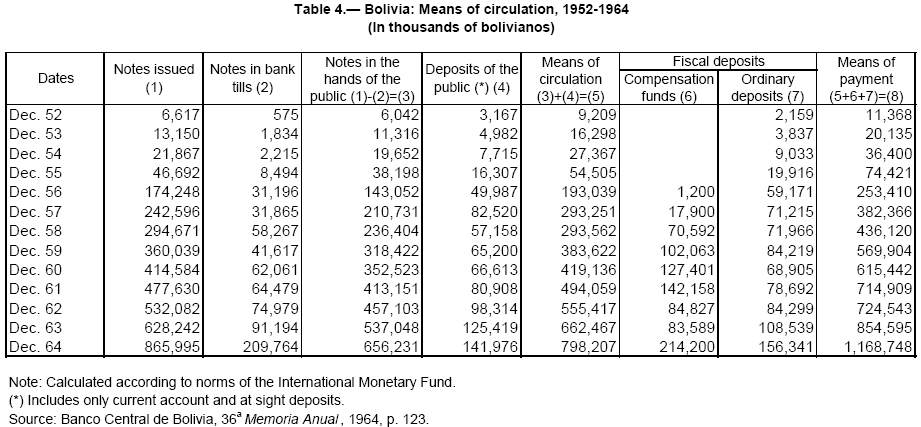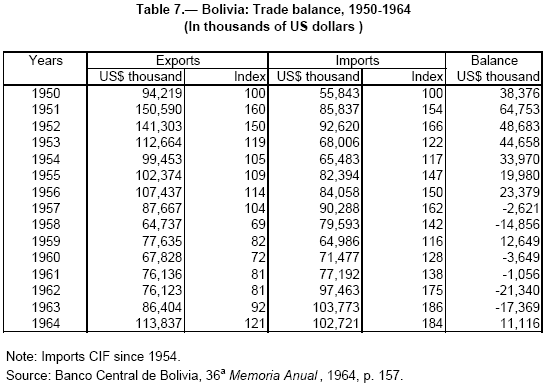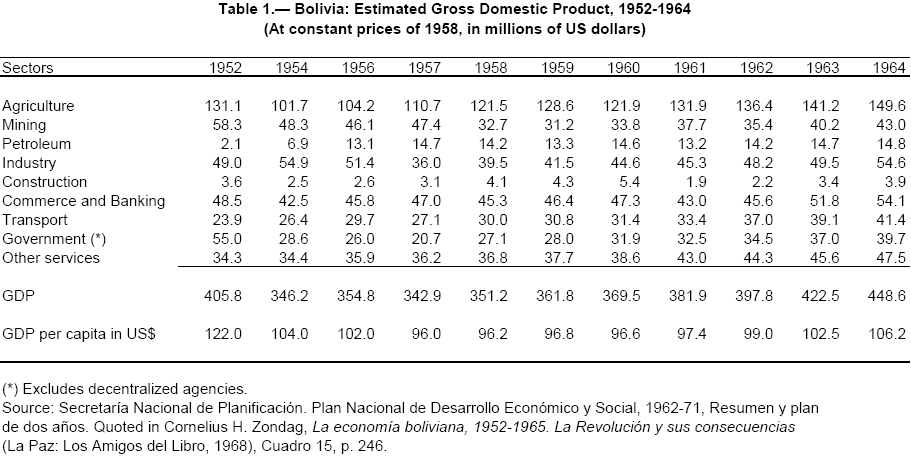
Table 1 - Click here to enlarge
_ftn21 An account of the monetary and fiscal history of the revolutionary period suggests that it is not enough for the authorities to know what the most advisable policies to achieve economic stability are, nor that they have the firm purpose to adopt such policies; history insinuates that stability can only be achieved if the government is backed up by enough political, social and financial support to implement the appropriate measures. The dilemma between monetary stability and economic growth -one of the most polemic topics about Latin American development- conditioned the monetary and fiscal policies applied in those years and determined the institutional changes which were operated at the Central Bank of Bolivia [Banco Central de Bolivia (BCB)]. This essay, which is divided into four parts, starts with a discussion of the Law of reorganization of the Central Bank promulgated on December 20th of 1945, which was designed as a legal framework for fiscal austerity and restrictive credit policies undertaken by the government of Gualberto Villarroel in January of 1944. This background is crucial to understand the attitudes of key political actors and of the most important economic authorities in the decade of the 1950’s. In the second part, it is shown that the stabilizing intentions manifested by the economic authorities after the triumph of 1952, as well as the attempt to re-establish institutional independence of the Central Bank, had to be abandoned in view of the impetus of the revolutionary agenda imposed by popular pressure. Financing of the growing fiscal deficit with inorganic issue of money, allied to a commotion of the productive system caused by reforms, generated a formidable inflationary outbreak which could not be restrained by the stabilizing attempts of May 1953 and July 1956. In the third part, the internal circumstances and the external forces that determined the establishment of the National Council of Monetary Stabilization [Consejo Nacional de Estabilización Monetaria - CNEM], in August 1956, and the consequent subordination of the Central Bank to the Council of Stabilization, are considered. This intervention uncovered political interference in which the Bank had been put down during the previous four years and unveiled administrative deficiencies and failures in accounting procedures. The exposition continues with an analysis of the gestation and application of the stabilization plan of December 1956, which was based upon a severe policy of fiscal austerity and entailed the adoption of free market rules referring to internal prices, foreign currency and external trade. In this section, a reform proposal for the Central Bank, which was discussed and approved at the Stabilization Council, but was not put into practice, is also analyzed. The third part concludes with an evaluation of political costs and economic effects of the stabilizing measures. In the last part, a brief recapitulation is attempted.]]>
Gustavo A. Prado Robles; Herbert S. Klein
Translated by Jeremy Jordan
Translation from Revista de Humanidades y Ciencias Sociales (Santa Cruz de la Sierra), Santa Cruz de la Sierra, v.11, n.1-2, p.33-93, June/Dec. 2005.
SUMMARY
Gesualdo A. Constanzo, probably was not exaggerating when he wrote that the monetary experience of the Bolivian national revolution was "one of the most fascinating chapters of economic history in modern times".1 An account of the monetary and fiscal history of the revolutionary period suggests that it is not enough for the authorities to know what the most advisable policies to achieve economic stability are, nor that they have the firm purpose to adopt such policies; history insinuates that stability can only be achieved if the government is backed up by enough political, social and financial support to implement the appropriate measures. The dilemma between monetary stability and economic growth -one of the most polemic topics about Latin American development- conditioned the monetary and fiscal policies applied in those years and determined the institutional changes which were operated at the Central Bank of Bolivia [Banco Central de Bolivia (BCB)]. ]]> This essay, which is divided into four parts, starts with a discussion of the Law of reorganization of the Central Bank promulgated on December 20th of 1945, which was designed as a legal framework for fiscal austerity and restrictive credit policies undertaken by the government of Gualberto Villarroel in January of 1944. This background is crucial to understand the attitudes of key political actors and of the most important economic authorities in the decade of the 1950’s. In the second part, it is shown that the stabilizing intentions manifested by the economic authorities after the triumph of 1952, as well as the attempt to re-establish institutional independence of the Central Bank, had to be abandoned in view of the impetus of the revolutionary agenda imposed by popular pressure. Financing of the growing fiscal deficit with inorganic issue of money, allied to a commotion of the productive system caused by reforms, generated a formidable inflationary outbreak which could not be restrained by the stabilizing attempts of May 1953 and July 1956. In the third part, the internal circumstances and the external forces that determined the establishment of the National Council of Monetary Stabilization [Consejo Nacional de Estabilización Monetaria - CNEM], in August 1956, and the consequent subordination of the Central Bank to the Council of Stabilization, are considered. This intervention uncovered political interference in which the Bank had been put down during the previous four years and unveiled administrative deficiencies and failures in accounting procedures. The exposition continues with an analysis of the gestation and application of the stabilization plan of December 1956, which was based upon a severe policy of fiscal austerity and entailed the adoption of free market rules referring to internal prices, foreign currency and external trade. In this section, a reform proposal for the Central Bank, which was discussed and approved at the Stabilization Council, but was not put into practice, is also analyzed. The third part concludes with an evaluation of political costs and economic effects of the stabilizing measures. In the last part, a brief recapitulation is attempted.
1. Reorganization of the Central Bank in 1945
1.1 Background
In the unfortunate years of the Great Depression and the Chaco War (1932-1935), the Central Bank of Bolivia, which was founded as an institution of mixed capital [institución mixta] with private predominance, whose essential function was to keep monetary stability, was transformed into a bank dominated by the state, that was forced to carry out growing inorganic issues of money in order to take care of urgent governmental requirements of fiscal credit. After abandoning the gold standard, necessary arrangements were made so that Central Bank could grant emergency credits for private businessmen as well as for the government.2 During the period of the Chaco War, the government -lacking external credit- increasingly depended on loans granted by the biggest mining companies (to solve its obligations in foreign currencies) and by inflationary credit of the Central Bank (in order to carry out payments in national currency). The Bank lowered the requirements of its reserves to 40%, increased loans to the government and reduced the rates of interest from 9 to 7%.3
The state’s participation in the economy was widened after the Chaco War. Yacimientos Petrolíferos Fiscales Bolivianos (YPFB) was founded at the end of 1936 in order to administrate the assets of the Standard Oil Co., which had been nationalized. The President Germán Busch Becerra (1937-1939) -through the decree of June 7th of 1939- established a state monopsony in the foreign currency market, increased the tax pressure on the mining industry and had the state take over the Banco Minero de Bolivia (which had been founded in July 1936). A short time later, through the decree of August 3rd of 1939, Busch had the state take over the Banco Central de Bolivia as well. The following year, through the decree of February 29th of 1940, the Rural Credit Section was formed into the Central Bank. On these grounds, the Banco Agrícola de Bolivia (BAB) was established in February 1942. The Corporación Boliviana de Fomento (CBF) was founded in 1943 and the airline Lloyd Aéreo Boliviano (LAB) received a powerful injection of state capital.4 The state constructed roads, built schools and provided basic services to some cities of the country. The expenses that the new state organizations and the public works program demanded were financed with credits from the Central Bank and with the increase of mining revenues which was achieved through taxation and foreign exchange mechanisms.
Inflationary pressures were intensified in the first years of the Second World War (the cost of living in La Paz increased by 22% annually between December of 1939 and December of 1943) and the government had difficulties to maintain the exchange rate. The idea that it was necessary to repair public finances and to concede greater autonomy to the Central Bank gained strength in such a difficult conjuncture.
The fiscal obligations of the Central Bank had been increased rapidly (from Bs. 486.864.000 in December of 1939 to Bs. 715.915.000 in December of 1943). Surprisingly, this growth was produced in a favorable external circumstance (exports had increased from $US33.889.000 in 1939 to $US81.604.000 in 1943) which had generated greater governmental revenues (Bs. 564.409.000 in 1940 and Bs. 1.203.654.000 in 1943) and had allowed external reserves to accumulate (the amount of reserves in gold and foreign currencies in the Central Bank had increased from $US5.820.000 in December of 1939 to $US19.111.768 in December of 1943). The credit given to the public by the Central Bank had increased even faster (from Bs. 38.000.000 in December of 1939 to Bs. 186.300.000 in December of 1943) and the portfolio of the commercial banks had expanded considerably (from Bs. 180.700.000 in January of 1941 to Bs. 508.848.000 in December of 1943).5
Víctor Paz Estenssoro, Minister of Finance and Statistics of the government of Gualberto Villaroel López (from December 20th of 1943 to July 21st of 1946), imposed a severe policy of credit restrictions on the Central Bank with the purpose of stopping monetary devaluation. Starting in January of 1944, the Bank could only grant new credits to the state and to private borrowers with resources coming from the repayments of credits in force until December 31st of 1943.6 At the same time, the capability of the private banks to receive deposits was limited (depending on their capital and reserves) and the proportion of bank reserves that those banks should keep with the Central Bank was raised.7
]]> The government decreed an increase in the percentage of obligatory sales of foreign currencies (Supreme Decree of January 25th and April 3rd of 1945) and the control of imports through the Committee of Imports, to avoid the wasting of foreign currencies on superfluous imports. The Minister Paz Estenssoro considered it necessary to accumulate external reserves in order to maintain monetary stability and to confront, in better conditions, the severity of recession, but he was also in favor of using part of the foreign currency accumulated to finance a program of productive diversification, "by means of a large scale import of agricultural machinery and implements, the construction of an oil duct from the centers of production to the consumers, the acquisition of mechanical equipment for road construction and the encouragement of sugar production."8These measures were fully observed and the rhythm of inflation was reduced from an annual rate of 22% between 1939 and 1943, to 7.5% from December of 1943 until December of 1945. The restrictions to money circulation and bank credit, the equilibrium of the national budget, the raising of the percentages of obligatory sales of foreign exchange to the Central Bank, the control of exports and imports, the cuts of public works programs and the maintenance of a fixed exchange rate in relation to the dollar, allowed the stabilization of the economy.9 These measures of stabilization did not produce an appreciable reduction in the supply of goods and services. Imports grew and the index of industrial production registered considerable increases in those years.
1.2 The law of December 20th, 1945
The reorganization of the Central Bank was conceived with the double purpose of "giving an organic legal structure" to the policy of credit restriction (that had been put into practice since the beginning of 1944) and "enabling" the Central Bank to perform its functions efficiently.10 For Franklin Antezana Paz, Manager of the Bank, the law of reorganization of the Central Bank was "...the most solemn commitment made with the nation by government leaders of the present time, to refrain from practicing an inflationary policy that was disastrous for the country, and to assure monetary stability, desired by all of the Bolivian people."11
The law of reorganization of the Central Bank caused the formal abandonment of the monetary mechanism of automatic regulation of the gold standard and brought about the division of the Bank into two departments. The experiments with the gold standard in the country (from 1909 to 1914 and from 1929 to 1931) had failed. The rate of discount had not functioned as an effective regulator of the movement of capital and, given the structural vulnerability of the Bolivian economy, the system failed to consolidate, giving way to the flight of capital and intensifying the recessive effects of the external sector crisis.12 For these reasons, and because the greatest part of the foreign currency was being generated by a small number of large mining companies based overseas, the Minister Paz Estenssoro considered that the obligatory sales of foreign currency and the control of the exchange rate were indispensable in order to reach monetary stability.
Paz Estenssoro was convinced of the virtues of monetary stability, but had inclinations towards development policies and assigned a crucial role to the state in the promotion of productive diversification; he considered that the Central Bank, besides looking after monetary stability, should support the efforts of productive diversification. In order to avoid the confusion and the excesses of the past, the government proposed to divide the Central Bank into two departments with different functions and different boards of directors.
The law ratified the exclusive state character of the Central Bank,13 but conferred it greater autonomy of management and restricted its capacity to concede credit to the government. The Monetary Department had the proper attributes of a typical central bank: stability of internal prices and maintenance of the exchange rate were their main objectives.14 However, by establishing the Banking Department with faculties for granting commercial credit and functioning as an industrial development bank, the law exceeded the conventional normative framework.15 The role of the Central Bank as a financial organization of development was vital to compensate for the credit restrictions that the country had overseas.
At the inauguration of the reorganized Central Bank, the General Manager, Franklin Antezana Paz, expressed:
]]> Article number 73 of the law of December 20th of 1945 –by establishing that the total direct and indirect obligations of the government and the other public and semi-public entities could not exceed the amount owed in terms of loans, prepayments, advances of a current account and other operations to the date the law was enacted - constituted a rigid "legal barrier" to the credit expansion of the Central Bank to the government. The Central Bank had the faculties to concede advances to the government up to an amount that could not exceed 8% of the revenues of the national budget. Such advances had to be repaid within a deadline of 90 days from the date in which they were conceded.17"The division of the Bank into two departments... creates practically two organizations technically and legally different. This division ends the mental incompatibility that existed when the same board of directors had to act as the defender of monetary stability –the mission entrusted to the Central Bank - and as one who grants commercial credit, - the mission that corresponds to a commercial bank, - and concludes with the exorbitant privilege that the Bank had to concede credit to the public in an unlimited form, by the simple and accelerated functioning of the machine that prints banknotes."16
The law arranged that the reserves in gold and foreign currency of the Central Bank had to be 50% of all the notes that it emitted. The other 50% could be represented by corresponding notes of credit, loans with guarantees of gold to other banks or to the Banking Department, advances to state development banks and advances to the government of up to 8% of the revenues specified in the national budget.18
The law established that the Banking Department should handle operations with the public, independently from those handled by the Monetary Department. The Banking Department was the unique depositary of national, departmental and municipal funds, as well as of resources belonging to autarchic, autonomous and semi-autonomous organizations, but could not use these deposits to make operations with the public. Equally to the commercial banks, the Banking Department had the faculties to receive deposits from the public and to invest up to 80% of these deposits in short term credits. Therefore, the Banking Department could not expand its offer of credit in an inflationary form.19
The law prescribed that the Banking Department had to be divided into two sections: the Commercial Section and the Industrial Section. The Commercial Section could make loans and discounts with obligatory guarantees of repayment within one year. The Commercial Section was enabled to deal with the public in all the standard commercial banking operations, conforming to the General Law of Banks. The Industrial Section was able to handle long term operations with an interest rate lower than those fixed for commercial operations.20
In article number 83 of the law, the state recognized the full capacity of the Central Bank for determining its internal organization and the credit policies, subjected to the dispositions of the Organic Law of the Central Bank, of the General Law of Banks and of its own statutes. In this way, the law tried to protect the Central Bank from political party interferences.21
The optimism and confidence of the financial authorities in the new formal rules were reflected through the speech of the General Manager at the inauguration of the reorganized Central Bank in this way:
"With the enactment of the law that reorganizes the Central Bank of Bolivia, there had been overcome: the period of immoral speculations, easy enrichment without justified cause, plundering of creditors, workers or wage-earners in general and the stripping of whoever had committed the ‘simplicity’ of saving money or keeping titles of fixed incomes for their old age..."22
2. Times of inflation, 1952-1956
]]> 2.1 Stabilizing IntentionsVíctor Paz Estenssoro was in favor of fiscal equilibrium and assumed the Presidency of the Republic with the purpose of controlling the inflationary sprout generated by fiscal excesses of the governments that had ruled the country in the six previous years. The new regime intended to restore the policy of fiscal austerity that Paz Estenssoro, as Minister of the Treasury and Statistics of the President Gualberto Villarroel, had introduced in January 1944.
Armando Pinell, President of the Central Bank, at the inauguration of the new board of directors that took place on May 6th of 1952, disapproved of previous governments for having exceeded the limits of debt that were laid out in the law of December 20th of 1945. Pinell also criticized them for having established a complex system of foreign exchange control and import permits that had fed speculation.23
The aggregate of banknotes in circulation plus deposits in the two departments of the Central Bank [circulante combinado] had increased from Bs. 2.666 million to Bs. 6.868 million between June 30th of 1946 and March 31st of 1952. Between 1945 and 1951, the governmental deficit had provoked an increase of Bs. 3.434 million in fiscal bonds with the Central Bank.24
The Central Bank financed these fiscal deficits of the central government and a vast program of public works (some in charge of Corporación Boliviana de Fomento), granted large loans to Yacimientos Petrolíferos Fiscales Bolivianos (of an amount of Bs. 720 million by the end of 1951) and, smaller amounts, to Banco Minero de Bolivia (Bs. 82 million) and to Banco Agrícola de Bolivia (Bs. 19 million). The financial requirements of prefectures and municipalities were also attended to by the Central Bank. The legal dispositions that limited loans by the Central Bank to the public sector were modified. The upper limit was raised from Bs. 863 million to Bs. 1.300 in 1946 and to Bs. 1.400 in 1949. In 1951, this limitation remained restricted to the direct obligations of the Treasury, leaving out of such restriction autonomous entities and local governments. Anyway the new limits were bypassed by a large margin.25
The portfolio of credits of the private sector was also amplified. The Central Bank raised their commercial portfolio from Bs. 336 million in 1945 to Bs. 697 in 1951. The loans and investments of the private banks rose from Bs. 536 to Bs. 1.434 million in the same period, while their capital accounts and reserves scarcely grew from Bs. 207 to Bs. 328 million. The dispositions relating reserves and ratios between capital and deposits were modified to allow increases of bank credits.26
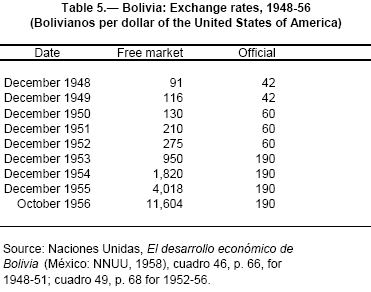
The disequilibrium of the balance of payments and the pressure over the foreign exchange rate had reappeared stimulated by the government deficit and the expansion of credits. The exchange rate in the free market rose from Bs. 91 per dollar in December of 1948 to Bs. 210 in December of 1951. The official exchange rate was maintained at Bs. 42 per dollar from 1946 to 1949, and at Bs. 60 in 1950 and 1951. The government hardened the regime of control of imports, and from 1948 elaborated a budget of foreign exchange, but could not prevent the devaluation of the boliviano. The cost of living index rose by an annual accumulative rate of 18.3% between 1945 and 1952. This rate was equivalent to that registered during the first years of the Second World War.27
In a speech given on May 6th of 1952, when the new board of directors of the Central Bank was installed, Federico Gutiérrez Granier, Minister of the Treasury and Statistics, strongly criticized the fiscal excesses of the sexenio (the six year period beginning on July 21st of 1946) and ratified the governmental commitment with monetary stabilization. In the words of Gutiérrez Granier:
"...the country should rest in the security that the Government of the Movimiento Nacionalista Revolucionario shall do everything within its reach to cure the economy and public finances, because it is not tied to interests outside of the state’s nor has any other commitments that have been taken on apart from serving the people.
]]> ... We will try... to put a limit on the issue of banknotes and a greater growth of fiscal debt, with the same determination and honesty as made by Dr. Víctor Paz Estenssoro in 1945, attempting not to provoke a sudden contraction of the means of circulation....Through a coordinated operation between the government and the Central Bank it will be possible to adopt certain prior measures that will prepare the way forward to monetary stabilization and gradual unification of exchange rates."28
2.2 Pressures of the left wing of the MNR impose the agenda of reforms
The authorities of the new regime did not accomplish their promises. The rules established by the law of reorganization of the Central Bank of Bolivia (December 20th of 1945) were broken. The internal debt with the Central Bank grew from Bs. 4.192 million in 1951 to Bs. 5.349 million in 1952; the quantity of banknotes in circulation grew from Bs. 3.967 million to Bs. 6.213 from December of 1951 until December of 1952. An appreciable part of the issues made by the Monetary Department of the Central Bank were used to pay for installments on bills of exchange bought from Banco Minero de Bolivia and Corporación Minera de Bolivia (COMIBOL).29
Strong pressures from the left wing faction of the Nationalist Revolutionary Movement (MNR), headed by Juan Lechín Oquendo and Ñuflo Chávez Ortiz, precipitated the reforms and determined the decontrol of public finance. Struggles between the right wing faction and the left wing faction of the MNR for hegemony had produced threats of violence since the very beginning of the new government. The defeat of the army and the organization of militias of workers and peasants being controlled by the left wing of the MNR allowed various leaders of the workers to replace outstanding and old militants of the MNR in key positions of the government and party’s structure. The struggle was resolved on January 6th of 1953, when the coup promoted by the right wing faction was suffocated and Paz Estenssoro was forced to co-govern with the Central Obrera Boliviana (COB) [Bolivian Central Workers Union] and to finance the reforms with inorganic issue of money.30
By the judgment of a functionary of the United Nations who was assessing the President in financial affairs,
"...the majority of the assistants of Paz Estenssoro were more expert in making revolutions than in ruling a country. However, thanks perhaps to their lack of experience, they had no fear of the costs or the consequences and completely transformed the economy in a few months."31 One of the first measures of the new regime was to decree a retroactive increase of wages of 50% and the establishment of appreciable social benefits in favor of the workers. Labor disputes were resolved at the Ministry of Labor invariably in favor of the workers. These practices fomented indiscipline among the workers.32
The nationalization of the biggest tin companies, the agrarian reform, the economic diversification and the spatial integration of the national economy were soon reinforced as fundamental objectives of the Revolution. Structural backwardness and economic stagnation, allied to the surprising defeat of the army, help to explain the weak resistance by which the elites opposed the formidable changes that were produced in the countryside and the mining industry following the popular insurrection of 1952. The pressure of the urban and rural militias, in view of the neutralization of the National Police and the dismantling of the army, contributed to radicalize the MNR agenda. The leadership of the MNR, headed by Víctor Paz Estenssoro and Hernán Siles Suazo, reacted slowly to the political and paramilitary pressures of the workers and in vain tried to contain or moderate the reforms.33
Víctor Paz Estenssoro, upon appointing the commission in charge of studying the nationalization of the mines (the commission was named by decree on May 13th of 1952), underlined the importance that the measure had to give political stability to the new regime:
]]>"The life of the whole nation can not depend on the whim of three people no matter how powerful they are. The rights of the people to have the government whom they conveniently believe will defend their interests, does not have to be subjected to the viewpoint of the tin barons. Bolivia needs peace and tranquility to organize itself and progress, and there is no reason to justify the continuous fear in the face of counter-revolutions financed by the big mining industry".34
In July of 1952, after three months of intense debate, the state monopoly of exports and sales of minerals under the management of the Banco Minero de Bolivia was decreed. At the beginning of October the Corporación Minera de Bolivia (COMIBOL) was created and on the 31st the state took over, with indemnification, the companies of Patiño, Hochschild and Aramayo by which the state controlled two thirds of the national production of tin. Even though the most radical groups in the new regime were advocating expropriation without compensation, a moderate posture prevailed as they did not want to risk losing the political support and financial help of the United States of America, crucial elements for the consolidation of the government; but they had to hand over in the management of COMIBOL. The workers obtained two of the seven seats of the Council of Administration and the power to veto the determinations of the Council that affected them. The workers utilized their power to raise wages, contract and re-contract workers and obtain other labor benefits.35
The winds of change were felt with force in the rural world during the second half of 1952 and the beginnings of 1953. The peasants of the highlands and the valleys, encouraged by the Bolivian Workers Confederation (COB), organized themselves into unions, gathered arms, formed militias and began a process of violent occupation of lands that made the country shudder. The government, subjected to a strong pressure, established the Agrarian Reform Commission in January of 1953 in charge of formulating a proposal. The decree of Agrarian Reform was promulgated on August 2nd. Lands were expropriated and granted to peasants organized into unions and communities. In compensation, the landowners received government bonds payable in 25 years; the expropriation resulted as if being without indemnity, as inflation completely depreciated the true value of the bonds.36
The nationalization of the principal mining companies had the purpose of exercising absolute state control over the most dynamic and strategic sector of the Bolivian economy. The agrarian reform intended to distribute the lands of the landlords to the peasants who had been held in servitude for centuries. In this way, they wanted to transform the socioeconomic reality of the rural world. With the strategy of sectorial diversification and spatial integration of the economy they tried to widen the productive base and to connect the plains of the orient with the central valleys and the Andean highlands.37
The policies adopted by the new regime, which had a marked slant towards redistribution, overestimated the benefits and underestimated the costs of the reforms. The nationalization of the mines and the agrarian reform shook the productive system. As a result of the increased wages and the fall of productivity, internal costs rose, inflationary pressures surfaced with force and the economic instability put at risk the social and political achievements of the revolution.
2.3 Attempt at stabilization
The dollar in the black market, that in April of 1952 was valued at Bs. 215, rose to Bs. 275 in December of 1952 and to Bs. 650 in May of 1953. The annual index of the cost of living in the city of La Paz rose by 152% between 1952 and 1953.38 President Paz Estenssoro was aware of the urgency to take deflationary measures, but vacillated out of fear of popular reactions. At the beginning of 1953, the President asked Arthur Karasz, functionary of the United Nations attached to the Central Bank, to prepare a plan to stop the runaway inflation, ensure the lucrative operation of the nationalized mines, encourage the exploitation of gold and private savings, unify exchange rates and eliminate the chain of speculators who were enriching themselves with the system.39
The proposal of Karasz, whose principal objective was to put the brakes on the rise of consumption through monetary contraction, served as the base for the formulation of the supreme decree promulgated on May 14th of 1953. The measures counted on the support of the International Monetary Fund (IMF). Bolivia withdrew US$2.5 million from the IMF, an amount equivalent to her quota in gold. This was, it appeared, the first time that the IMF supported the efforts of monetary stabilization in Bolivia.40
The measures taken in May of 1953 can be summarized in the following manner:41
]]>1. The Bolivian currency was devalued (from Bs. 60 to Bs. 190 per dollar) and the exchange system was considerably simplified. The number of exchange rates were reduced from six to two: a) the official and fixed exchange rate (of Bs. 190 per dollar) for trade and the majority of transactions; and b) the free and fluctuating exchange rate, determined by supply and demand, for tourism and other invisible transactions.
2. The Central Bank was instructed to prepare an annual budget of foreign exchange, which would determine with anticipation expenses and incomes of foreign exchange at the official rate among the various users and sources of supply. This budget should be approved by the government. The Central Bank was granted the monopoly of purchase and sales of foreign exchange in the official market. The entire product, in foreign exchange, from all exports and re-exports should be sold to the Central Bank or to authorized banks at the official exchange rate. The Central Bank remained in charge of issuing import and export licenses and of authorizing international payments for services and other concepts at the official exchange rate, within the limits of the annual budget of foreign exchange.
3. A special tax of 50% and 100% was established on the CIF value of imported products that were non-essential. Simultaneously, a tax of Bs. 35 was created for each dollar sold by COMIBOL to the Central Bank for the concept of minerals exported. The Central Bank was obligated to transfer the total income from this tax to the National General Treasury.
4. Quantitative and qualitative restrictions were established on credit granted to the public by private banks to slow down the rise in consumption and to reduce the pressure on the exchange market. The portfolios of private banks were frozen at the existing level and the banks remained prohibited of loaning more than Bs. 2 million per month to any borrower without the previous authorization of the Central Bank. Only balances [saldos] in the Monetary Department of the Central Bank could be taken into account by the commercial banks to fit the legal requirements of reserves (20% on current account deposits and 10% on time deposits). The deposits exceeding seven times the capital and reserves of a commercial bank had to be re-deposited in the Central Bank.
5. Consumption subsidies were cancelled. Maximum prices were fixed on basic consumer goods in La Paz, Oruro, Cochabamba, Sucre and Potosí. Rents on housing remained frozen.
6. A fixed wage increase of Bs. 4,000 was arranged for all workers and employees who did not enjoy grocery stores [pulpería] at frozen prices nor received food from their employers. The compensation was of Bs. 2,000 if the workers enjoyed the above-mentioned benefits. The compensation for domestic workers was 50% of their monthly wage. Functionaries of the public administration also received a compensation for cost of living increases of Bs. 4,000 and Bs. 2,000. The monetary compensations covered only partially the increase in the cost of living. This type of settlement was a novelty in Bolivia; those who were better paid received relatively less than those in the lower paid levels.
7. The Central Bank was authorized to mint gold coins with a fine gold content of 7, 14 and 35 grams, by the standard of 900 thousandths of fine gold alloyed with copper. The coins were to be freely sold at market prices inside and outside of the country.
8. An Office of Stabilization was created, dependent on the Presidency of the Republic, entrusted with studying the consequent problems of the measures of stabilization adopted by the government. The Superintendent of Banks remained in charge of the directorship of the Office of Stabilization. His principal function was to propose to the President of the Republic -with recommendations by the Ministers of Finance, National Economy, Mines and Petroleum, Labor and Social Prevision and of the President of the Central Bank- the measures required to assure future stability of prices and wages.
The measures of May 14th of 1953 strengthened state controls, but were not enough to stabilize the economy. The country confronted an unfavorable external conjuncture: the prices of a pound of pure tin in New York, that were around US$0.98 in April of 1953, fell to US$0.95 in June and to US$0.81in September. This tendency of falling prices continued until 1956.
]]> The official exchange rate (Bs. 190 per dollar) was fixed at a level that heavily overvalued the national currency in relation to the quotations that reigned in the free market (Bs. 650 per dollar). It was thought that this way larger increases in government spending and in basic consumer goods prices could be avoided, but speculative attacks did not diminish: the price of the dollar in the free market, after an initial fall to Bs. 550, rose to Bs. 950 in December, to Bs. 1,525 in May of 1954 and to Bs. 1,820 in December of 1954. Starting in 1955, the depreciation of the boliviano was even more rapid: the quotation in December of 1955 was of Bs. 4,018 and in October 1956 it reached Bs. 11,604. The official exchange rate remained at Bs. 190 per dollar, but half way through 1954 a variety of new exchange rates were introduced with the purpose of lessening the distortions. From this began the mechanism of the "revertibles", for which importers paid a premium to the Ministry of Economy based on the difference between the import costs of certain commodities and the prices at which they were then sold in distinct parts of the country. This income for the Ministry was utilized to subsidize the consumption of certain essential foodstuffs, both imported and national. These funds were not included in the government budget.42The deficit of the public sector financed by inorganic issue of money grew. The loans awarded by the Central Bank to the government in 1953 and 1954 were higher than those of 1952. Even so, funds raised by taxation remained almost at a standstill. In April of 1954 increases of wages and salaries were approved by 50% for workers and employees of the private sector and by 25% for employees in the public sector. The wage compensation was transferred to prices. The policy of restriction of bank credit was not applied firmly for fears of its recessive effects. In February of 1954 the arrangements over obligatory legal reserves were suspended.43
2.4 Subordination of the Central Bank to the revolutionary agenda
Government interference in the policies of the Central Bank was continuous. Through laws and decrees, the government obliged the Bank to finance fiscal deficits and programs of development without observing the established restrictions by the law of 1945. The government financed expenditures through direct orders to the Central Bank. The highest increase was produced in 1954, when the national government’s debt to the Bank doubled, and in the first ten months of 1956, when the debt grew from Bs. 8,910 million to Bs. 20,338 million. The Central Bank also attended to the growing requirements of credit coming from prefectures and municipalities, even though the sums emitted were small in comparison to the total amount of fiscal loans.44
The loans to cover the losses of COMIBOL were the main source of the issue of money:
"In 1953 the issues of the Central Bank destined to finance the mining sector reached the elevated cipher of 11,318 million, of which 3,920 million corresponded to the Mining Bank. This figure was greater than the total of the means of payment at the end of the previous year. The procedure continued and 7,768 million were emitted in 1954. In 1955 the government assumed the responsibility to pay the Mining Corporation and the Mining Bank for losses resulting from their operations, always through emissions of the Central Bank, which had caused an increase of fiscal debt in the issuing institution, for this one concept of 25,450 million in 1955 and 38,295 million in the first week of 1956. The proportion of the emissions destined to the mining industry during the period of 1952 to 1956 represented from 63 to 85 percent of the total increase of the public sector obligations at the Central Bank, and from 53 to 110 percent of the increase of the means of payment."45
The losses of COMIBOL increased appreciably for the differences between the free market exchange rate and the prices the government periodically fixed for the obligatory sales of foreign exchange (arising from the exports of minerals) COMIBOL had to make to the Central Bank. "… The rate of exchange that was paid to COMIBOL for its exports rose to 500 in 1955, to 1,200 at the beginning of 1956 and to 3,500 in October of 1956. However, until October of 1956, COMIBOL and other government entities continued to import at lower rates of exchange than those that they paid for their exports."46 The Central Bank covered the difference by printing money.
The government established, moreover, a multiplicity of exchange rates for exports:
]]> "Also for exports a diversity of exchange rates was established... The disparity between the rates of exchange and the damages the overvaluation caused to the exporting sector obliged the government to modify by act the official parity, granting a preferential treatment to foreign currencies coming from this sector. In 1955, as a form of subsidizing production, [the government] established at 900 bolivianos the rate for buying dollars from the Mining Bank and at 500 for those of the Mining Corporation. In March of 1956, a decree was enacted, with a retroactive effect from the 1st of January, which elevated those rates of exchange to 1,500 and 1,200 bolivianos respectively. The petroleum industry received a similar treatment. In October of 1956 the effective exchange rates were 3,500 bolivianos per dollar for the mining sector, and 1,790 for the petroleum industry; the other exporters disposed of their foreign exchange in the free market."47
The exchange regime was gaining complexity from 1953, distorting the system of prices, raising the costs of transaction, stimulating speculation and smuggling of food, and accelerating inflation.
The loans from the Central Bank to the autonomous institutions also fed the inflation:
"Since the end of 1952 until October of 1956, the autonomous institutions obtained loans from the Central Bank for 54,293 million, which meant a 45 times increase in relation with the quantity that the same entities owed in 1952, 43% of the emissions made until October of 1956 were to cover mining deficits and 30% of the means of payment held by the public. If from these loans those granted to the Mining Corporation are excluded, which were destined to make up for the losses of this institution, the rest of the credits were destined for investments in petroleum, roads, soil dressing, electrical energy and other industries such as sugar and cement."48
Support funds from the United States, guaranteeing loans from the Export-Import Bank of Washington (Eximbank) and other resources from the Ministry of Economy also financed public investments, but the bulk of such investments were paid for with paper notes issued by the Central Bank.
2.5 Results
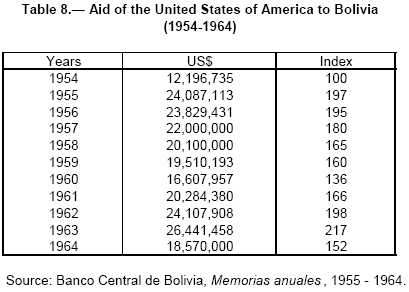
The cost of living index in the city of La Paz increased annually at 147.6% in the period 1952-1956. This pace overcame with amplitude previous records of inflationary outbreaks, like those produced after the Chaco War (50.7% annually in the period 1936-1939) and those following the Second World War (18.3% annually between 1945 and 1951).49 Restrictions on foreign trade, foreign exchange controls and the American aid were not enough to protect the balance of payments from the impact of internal inflation. The reserves of gold and foreign exchange, amounting to US$35 million when the MNR took power, fell to US$14 million by the end of 1955, and were completely exhausted by June of 1956; the figure was negative (- US$2.3 million) at the end of October 1956.50 The country contracted loans of short and medium term for US$50 million from overseas providers in the years 1955 and 1956. The annual cost of servicing the external debt rose to US$22 million. Support from the United States (US$12.2 million in 1954, US$24.1 million in 1955 and US$23.8 million in 1956) lessened the deterioration of the balance of payments, but could not prevent the devaluation of the boliviano: the dollar in the free market was quoted at Bs. 950 at the end of 1953, at Bs. 1,820 at the end of 1954, at Bs. 4,018 at the end of 1955 and at Bs. 11,604 at the end of October of 1956.
The distortions generated by the exchange system stimulated inflation. A substantial part of the COMIBOL deficit was due to the overvaluation of the exchange rate that ruled for the foreign exchange gained by this state corporation. The diversity of exchange rates contributed to form a structure of relative prices that encouraged smuggling of commodities to neighboring countries and stimulated speculation of products of basic necessity in the domestic market. The subsidies of foodstuffs established through the exchange system discouraged their national production.
The overvaluation of the boliviano stimulated imports and caused large losses to the Central Bank in transactions of foreign exchange.51 At the end of 1956, the Central Bank paid Bs. 3,500 per dollar generated by exporting of minerals and only Bs. 1,790 per dollar originated in petroleum exports. There was a more elevated rate for dollars produced from minor exports (manufactures and agricultural products). Foreign exchange was sold to importers, public and private, at the official rate of Bs. 190. The private importers paid the government an import tax (from which certain essential goods were exempt) that amounted up to 3,000% for luxury items, but the average incidence of this tax over the value of the imports rose scarcely to Bs. 200 per dollar. The deficit of the Central Bank for the operations of buying and selling foreign exchange was Bs. 53,000 million in the first nine months of 1956; this amount was greater than the quantity of money issued at the end of 1955 (Bs. 42,000 million).52
]]> The management of grocery stores subsidized by COMIBOL is an extreme case of distortion allowed by the exchange system. The mining workers had managed to keep the prices frozen for provisions from the groceries at a rate of exchange of Bs. 60 per dollar, which was the official exchange rate in April of 1952. In the middle of 1956, the sales of the groceries at fixed prices corresponded to double the amount of COMIBOL’s payroll. The groceries of COMIBOL, in spite of acquiring foreign exchange at the Central Bank at the official rate of Bs. 190 per dollar, showed losses of Bs. 45,000 million in the first half of 1956; the payroll of COMIBOL in the same period reached the sum of Bs. 31,000 million.53The negative impact of the revolution over the national economy was notable. Total gross investment fell from US$ 42.5 million in 1952 to US$ 25.2 million in 1953.54 Gross Domestic Product (GDP) suffered a sudden drop between 1952 and 1954(-14.68%), principally due to the commotion that affected agriculture and livestock (-22.42%) and mining (-17.15%). In 1955 there was a small recovery, but it did not compensate for the loss of the previous three years. GDP per capita (at constant prices of 1958) fell from US$122 in 1952 to US$102 in 1956.55
In the last weeks of Paz Estenssoro’s government, speculative attacks against the boliviano strengthened and the authorities were worried. The President and his closest advisors shared the idea of utilizing stricter controls in the foreign exchange market and of establishing penalties for the rule breakers. President Paz manifested his intention to publish the names of the speculators and to impose severe punishments. Siles Suazo, who would assume the Presidency on August 6th of 1956, expressed that if the classic economic remedies to stop the devaluation of the boliviano had failed, then "it was necessary to enforce effective punitive measures, if necessary "at bayonet point" or with jail sentences, in order to stop improper merchandise imports and the flight of capital".56
With the purpose of diminishing the flight of capital, Karasz recommended the following restrictive measures and controls:
]]> These decrees were promulgated on July 20th of 1956 by President Paz Estenssoro and the result was completely ineffective to slow the flight of capital. Karasz attributed the failure of the plan to the excessive creation of money to finance subsidies and fiscal deficits, combined with an acute shortage of goods. In October of 1956, the free market exchange rate was Bs. 11,604 per dollar, whilst the official rate continued to be fixed at Bs. 190, and inflation was reaching the galloping stage that Germany and Hungary experienced after the First World War.581. "Taxation as income of foreign exchange purchases on the free market, or from dealers", unless the buyer could prove a non-speculative transaction.
2. "Seizure by the Central Bank of merchandise imported at official or special exchange rates with foreign exchange derived from certain agricultural or mining exports…"
3. "Restriction of free exchange operations by banking institutions to a total of Bs. 20 million (say US$2,000 at the prevailing exchange rate) for each bank, out of their own capital; depositors’ money could not be used for that purpose."
4. "Restriction on the use of "excess production" foreign exchange by the private mines to the purchase of imports for their own use (i.e., under existing regulation, if a mining company produced ore in excess of previous production, it could keep 80 per cent of the foreign exchange from this excess, and use it for imports or sell the privilege to others; this right was now to be made nontransferable)."
5. "Prohibition of transfer to third parties of the right to import goods at the official rate of exchange against exports of agricultural and livestock products." 57
3. Times of stabilization, 1956 - 1960
3.1 Gestation of the National Monetary Stabilization Council
Before the growing shortage of foodstuffs that was produced in the country after the revolution and the lack of funds to begin programs of development, the government sought assistance from the United States of America. Bolivia had participated in the first program of assistance to Latin American countries (that of Point IV during the presidency of Harry S. Truman, 1945-53) that had accomplished important results. The Embassy of the United States recommended to continue the support to Bolivia and accepted the thesis of Paz Estenssoro which asserted that he and his regime were the unique alternative to the communists taking power.59 The favorable opinion of Milton Eisenhower, who had visited La Paz in June of 1953 as a special envoy of President Dwight David Eisenhower (1953-1961), was decisive for the materialization of the Treaty of Economic Assistance signed on November 6th of 1953.60
In June of 1953, under pressure of the United States and in front of negativity of the foundries "William Harvey Co.", of Patiño, to refine Bolivian tin, the government was obliged to indemnify the owners of the mining companies that had been nationalized. The following month, a contract was signed to sell minerals to the government of the United States, who announced the doubling of their previous program of support and the immediate embarkation of foodstuffs valued at US$5 million by virtue of the Public Law 480 (Bolivia was the first Latin American country to benefit from the donation of provisions). In the period 1954-1964, American support to Bolivia reached US$227.7 million, such number converted the country into the most favored of Latin America in absolute terms and in the most supported in the world in per capita terms. One third of the national budget of Bolivia in 1958 was covered by funds from the United States of America.61
An appreciable part of the support offered by the United States government, as of 1953, was made up of consumer goods and raw materials:
]]> When the government of the United States of America perceived that the regime of President Paz Estenssoro was unable to contain the inflation, they conditioned the continuity of their support to a program of stabilization whose formulation, execution and control had the participation of American experts and functionaries of the IMF. Eder relates:"From July of 1953 to June of 1954 the contributions in wheat and flour, lard, cotton and cotton seeds reached to 10.9 million dollars, or that is 17% of Bolivia’s imports, at current prices; from 1954 to 1955 the amount of support was 18.3 million, or that is 22% of the imports; in 1955-56 reached to 17.5 million dollars. Another part of the North American support was in the form of capital goods for economic development, in amounts that were over 1.2 to 5.7 and 6.3 million in the three periods mentioned".62
"The credits of the Bank of Exports and Imports [Eximbank], for the construction of the highway from Cochabamba to Santa Cruz, were added to the other sources of finance. The sums contributed by that organism between 1952 and 1955 rose to 13.2 million dollars [18.4 million in credit minus 5.2 million in repayment], that is equivalent to 1,075 million bolivianos".63
"Finally, after long negotiations, the Bolivian government, faced with the threat that U.S. assistance would be cut off unless Bolivia put its house in order, "requested" the U.S. government to send a financial mission to stabilize the boliviano. Thus, I arrived in Bolivia on June 1, 1956, as an invited, but scarcely welcome, guest of the Bolivian government."64
Washington considered that before starting any program of stabilization, Bolivia should show proof of their firm commitment to re-establish fiscal normality and to enforce property rights. According to Eder, the previous steps that were suggested were the following:
1. Enactment of a new ad valorem customs tariff with criminal penalties for smuggling or false declarations.
2. An over-all government and government enterprise budget, balanced without borrowing from the Central Bank, and computed at my suggested hypothetical rates of 4,000, 5,000, and 6,000 bolivianos to the dollar, coupled with a statement of anticipated post-stabilization price and wage levels.
3. Establishment of quantitative credit controls and new reserve requirements.
4. An agreement with IMF on a stabilization program, following a study to be made of Bolivia’s situation by a special mission which would be sent to Bolivia by the IMF.
5. An increase in Bolivia’s free foreign exchange reserves by US$1million (from less than zero).
]]> 6. Evidence that Bolivia was increasing its reserves at the rate of US$300,000 a month.7. Conclusion of a "satisfactory" arrangement for resumption of payments on the foreign debt.
8. A mutually acceptable agreement negotiated with the Patiño group covering compensation for nationalization of their properties (Patiño Mines & Enterprises Consolidated, Inc. was the only one of the "Big Three" that included a substantial American interest, and hence the only one that could legitimately ask for U.S. protection).
9. Enactment of a law providing that takings of private property shall be subject to prompt, adequate, and effective compensation.
10. Enactment of a fair mining and investment code.
11. Effective action to carry out a reorganization plan for COMIBOL
12. Participation by a New York banking group in any stabilization program financing that might be undertaken by ICA, the IMF, and the Treasury.
In Eder’s opinion, the expectations of Washington did not make practical sense: "…some of the foregoing steps were completely unrealistic, and to require that they be taken prior to enactment of a stabilization program was to delay the unpostponable and to demand the impossible."65
Victor Paz Estenssoro, two days before transferring the Presidency to Hernán Siles Suazo, enacted the supreme decree 4469 that created the National Monetary Stabilization Council [Consejo Nacional de Estabilización Monetaria – CNEM].66 The Presidency of the Stabilization Council corresponded to the President of the Republic and the Vice-Presidency to the Minister of the Treasury and Statistics. The Ministers of Foreign Affairs, of the National Economy and of Mining and Petroleum, as well as the President of the Central Bank and the Executive Vice-President of the National Commission of Coordination and Planning, made up the Council as permanent members. The Stabilization Council had the advice of foreign experts. George Jackson Eder, chief of the mission of the North American experts hired by the government of the United States, was designated as Executive Director of CNEM.67 Gesualdo A. Costanzo, chief of the mission of IMF in Bolivia, participated in the meetings of CNEM since October 30th of 1956.68
Article number 13 of supreme decree 4469, of August 4th of 1956, determined that the Central Bank could not issue money nor grant credit to the government, to the state companies and the private sector without the unanimous consent of CNEM, whose members should have previously studied the details and information provided by the appropriate technical expert.
]]> The judgment of Eder over the institutional situation of the Central Bank at the end of the first government of MNR was severe:"The Central Bank of Bolivia had ceased to exist – at least as a central bank. The building remained intact; the law creating the bank had not been repealed; but pressure from the government from above for forced loans, and from the union of bank employees from below, preventing any accounting controls or employee discipline, had crushed any vestige of independence of action, leaving the bank a mere vehicle of unmanageable inflation."69
In a visit that Eder made to the Central Bank on October 26th of 1956 in the company of Franklin Antezana Paz, President of the Bank, to verify if the credit restrictions established by supreme decree 4469 were being accomplished, detected administrative irregularities and failures in accounting procedures. He observed that the system of accounting was antiquated and that the accounting entries had not been updated. The records of the borrowers, that contained updates of credit ceilings written in pencil and of guarantees conceded by the Central Bank, were not adequately organized. Eder found files corresponding to the Bolivian Development Corporation (CBF) where it was assumed that the files of the Bolivian Mining Corporation (COMIBOL) should have been placed. There was neither seriousness nor responsibility in handling the records. Eder recalls that the young man in charge of these papers changed the credit limit of CBF, without any previous verification, when he mentioned that the figure had been modified in a recent session of the Monetary Council.70
On reviewing the records, Eder confirmed his suspicion that the Central Bank had been subjected to a strong political interference, and that informal practices had prevailed in the institutional management. Eder testifies:
"…I was assured; the bank had a very complete record of all the credits it granted to its customers, including the avals on the notes and bills of government enterprises. This "record" proved to be a number of simple file folders, each containing a batch of loose letters and memoranda. The former were generally informal requests from the Mining Corporation for the Bank to increase its credit by so many million bolivianos or to place its aval on a series of bills of exchange, in accordance with a telephone conversation or some other form of communication with the President of the Republic. The letter was in each case initialed by the President of the Central Bank and by the bank’s accountants. The memoranda were generally nothing more than small sheets of paper signed by the President of the Central Bank with an annotation that the President of the Republic had instructed him by telephone to extend the credit or sign the aval."71
The accounts of the Central Bank were confused and disordered, but there had been no way that the administrators could have exercised authority over the employees; it was difficult to fire employees for incompetence, disobedience or negligence. Eder recounts that Franklin Antezana Paz commented to him that since 1953 it had been impossible to impose discipline on the employees or investigate what they had done; the union was strong and was backed-up by the Minister of Labor and by President Paz.72
The registers of the government’s external debt with commercial banks were untrustworthy. The Central Bank had no idea about the credits of short and medium term with foreign providers that it had guaranteed. Hugo Moreno Córdova, Minister of Finance and Statistics of President Siles Suazo, points out:
]]> "The initial studies for the application of the plan had enormous difficulties because of the almost complete lack of details. The estimation of commercial debt at first was assigned a value of US$120,000,000 but, later, as investigations developed, it became evident that such a figure was below the reality and grew to US$200,000,000."73
Regarding the revelation of Hugo Moreno Córdova, Eder comments:
"… [The declarations of the Minister] constitute an official admission of the Bolivian government’s ignorance of some $80 million in indebtedness incurred by the government and government agencies during the financial chaos of the first MNR regime, and the consequent understatement of obligations in the government’s petition for stabilization loan financing… [It was impossible to obtain] trustworthy figures of 1952-56 government expenditures and obligations."74
In the first quarter of 1957, the Stabilization Council was completely alarmed because the Central Bank had given its guarantee for at least US$33 million without any register in the Bank’s account books. The Council also knew of US$20 million in short term credits that had expired but were never registered.75
The accounting disorder at the Central Bank was such that at the end of May 1957, in response to a demand made by creditors of COMIBOL, a simultaneous embargo was produced on the accounts of the Central Bank of Bolivia at the Chemical Corn Exchange Bank, at the Chase Manhattan Bank, at the Manufacturers Trust Company and on the accounts of the New York agency of the Bank of London and South America, Ltd.76 When the Stabilization Council requested a report from COMIBOL over its obligations overseas, the state firm presented four different figures -on four different occasions- for its balance in the Chemical Corn Exchange Bank on the date of April 30th of 1957.77
On August 15th of 1957, the Embassy of Bolivia in the United States of America presented to the bankers a government declaration of insolvency and a formal promise to honor their obligations according to the demands of the creditors. Eder lamented:
"…Thus ended what must have been one of the most humiliating episodes to which a sovereign nation and a central bank have ever been exposed, reaching the point where dozens, perhaps hundreds, of checks drawn by the Central Bank were refused payment, many of them for sums of as little as $80 to $100."78
3.2 Eder and the IMF impose their ideas
]]> The debate over inflation and monetary stabilization that took place in Bolivia in the decade of the 1950’s was enriched by the presence of fifty or so foreign experts of the United Nations assessing the government.79 Until the middle of 1956 the structuralist ideas and postulates of the Economic Commission for Latin America and the Caribbean (ECLAC) predominated. ECLAC was then strongly influenced by Keynesianism and the critical thought of the London School of Economics.80 Arthur Karasz was the most conspicuous representative of these ideas in Bolivia. With the arrival of George Jackson Eder (who was backed up by the U.S. government and by the IMF mission), monetarism and economic liberalism began to prevail in the decisions of economic policy. The participation of the American team of experts in the program of stabilization had been imposed upon by the State Department with veiled threats of cutting down help. This resort was utilized by Eder on several occasions to impose his criteria on the Stabilization Council.81Eder points out that the major part of the experts of the United Nations’ mission believed in the efficiency of the intervention of the state in the economy and supposes that the doubts and delays of Paz Estenssoro in taking the decision to invite a team of American experts to cooperate in the process of stabilization were influenced by the functionaries of the United Nations, especially by Arthur Karasz, who acted as financial advisor to the Central Bank and, as Paz Estenssoro, was an "ardent Keynesian".82
Eder, on the other hand, considered himself a Jefferson Republican, he believed that the best government "is that which governs least", and that all that "is necessary to make us happy and prosperous people is a wise and frugal government which shall restrain men from injuring one another, which shall leave them otherwise free to regulate their own pursuits of industry and improvement, and shall not take from the mouth of labor the bread it has earned."83 The program of stabilization proposed by Eder had as a foundation the re-establishment of free market rules regarding internal prices, foreign exchange and foreign trade. Eder fought hard battles with influential advisors, political leaders and executives from state corporations who upheld state intervention. Eder was in favor of "shock treatment" or "surgical operation", not of gradualism, in order to stabilize the economy.
From the first moment, Eder fixed both his ideological posture (conservative) and his theoretical approach (monetarist). In the first session of the Stabilization Council he attended, Eder said: "Before beginning to consider the technical aspect, I want to give evidence of speaking as a conservative". Eder quoted ex-President Roosevelt, who had once said that "many liberal governments had been ship-wrecked on the rocks of monetary instability" and added that this was what had happened with Bolivia’s revolutionary government. In order to prevent being ship-wrecked, he affirmed that "it was necessary to take conservative measures".84 Some time later, Eder remembered:
"There were no doubts in my mind about the prime cause of the inflation – briefly, spending by the government and government enterprises in excess of their means, with deficits financed by the Central Bank through the issuance of additional paper currency. The obvious remedy for this situation was simple, but, of course, it meant the repudiation, at least tacitly, of virtually everything that the revolutionary government had done over the previous four years. Hence, my first task was twofold: (1) to expose the fallacies propounded by the "structural" economists and neo-Keynesians…, who for four years had misled the MNR government; and (2) to convince the new administration that stabilization would only be possible with an almost complete change in course from a controlled to a free market economy – save for the irreversible blunders of a misguided agrarian reform and the nationalization of the mines."85
Congress granted emergency powers for one year to President Siles Suazo (law of November 22 of 1956), to apply measures of stabilization by decree, with the backing of the ministerial cabinet and the Stabilization Council. Siles Suazo remained capable of contracting loans abroad, signing contracts with investors, to both foreigners and nationals, and to take decisions in all areas of economic policy. At the end of 1957, Congress renewed the special powers conceded to the President for another year.
The plan of stabilization was elaborated in consultation with political, labor and business leaders. Opinions were also asked of both Bolivian and foreign bureaucrats. Lechín and Chávez gave their consent to the measures, but when the decrees were promulgated, both of them repudiated the plan.
The program counted on a stabilization fund of US$22.5 million, whose composition was as follows: a credit of immediate availability (stand-by) from the IMF for US$7.5 million, a credit of stabilization of US$5 million conceded by the US Department of Treasury and a donation of US$10 million channeled through the International Cooperation Administration (ICA) of the same country.86 The formalities to obtain the stabilization fund were concluded by the President of the Central Bank (Franklin Antezana) and the Executive Secretary of the Stabilization Council (George J. Eder) in Washington.87
Gesualdo A. Costanzo refers that the stand-by credit conceded by the IMF to Bolivia on November 29th of 1956 was the first "financial operation destined to support an economic stabilization program that had been undertaken by a member country."88 However, the IMF had loaned the Central Bank US$2.5 million to back-up the plan of 1953.89 The agreement established that Bolivia could borrow up to US$7.5 million from the IMF (additionally to a former loan, pending on payment, of US$2.5 million) and that US$5 million would be immediately available and US$2.5 million in thirty days. Interests, of 2 per cent to 4 per cent annually, would be charged according to the gradual scale of the IMF over the amounts effectively withdrawn; the committed (but not withdrawn) balances would pay a stand-by gratification of 0.25 per cent annually. Neither the interest nor the gratification were specified in the stand-by agreement, these rates were established periodically by the Executive Board of the IMF and ruled over all borrowers.90
]]> 3.3 Measures of stabilizationOn December 15th of 1956 the basic decrees were promulgated; a short time later some complementary resolutions were approved.91 The stabilization measures tried to favor a rapid transition from a controlled economy to a free market economy; entailed, therefore, the negation of the policies adopted during the previous four years.92 The changes were put into practice under a state of siege that was in force since the social disturbances of September of 1956.93
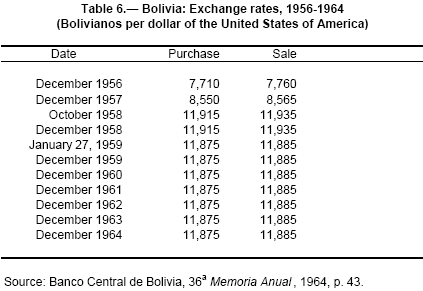
The measures contemplated the suppression of the system of multiple exchange rates, the devaluation of the boliviano and the establishment of a rate of exchange that was unique and fluctuating. The Central Bank fixed the exchange rate initially at 7,700 bolivianos per dollar. Transactions of foreign currency and gold should be made at a unique exchange rate determined daily by the Central Bank, considering the forces of supply and demand. The decree stipulated the complete freedom of the private sector to operate in the foreign exchange market, as such all types of licenses and restrictions remained abolished.
The government and state enterprises had no access to the free market; their exchange transactions were handled through the Central Bank. State enterprises were obliged to sell the foreign exchange they generated to the Central Bank. Imports carried out by the government and state enterprises were controlled through a unique budget of foreign exchange elaborated annually.
Foreign trade was also liberalized. The controls and prohibitions managed by private agents that ruled imports and exports were replaced by a system of free trade subjected only to moderate tariffs and export royalties.
Direct or indirect fiscal subsidies for articles of basic necessity and the internal controls on prices, with the exception of rents on housing, were abolished. Subsidized grocery stores remained prohibited; they were only permitted to sell products at cost price plus 10% to cover administrative expenses. The Ministry of Economy continued to import foodstuffs of basic necessity during the period of transition and exercised a certain control over retail prices for these articles.
Wages and salaries were readjusted (to compensate workers for the rises in prices resulting from devaluation and the elimination of subsidized groceries) and then frozen for a year. The general compensation for all the recipients of wages and salaries - including those in public administration but not those in domestic service (who were supposed to negotiate the compensation individually with their employers) or bank workers (who had recently received a wage rise)- was to be 1,300 bolivianos per day. As a special compensation for the disappearance of subsidized grocery stores, there was also granted a daily increase of Bs. 3,950 for workers in the nationalized mining industry, of Bs. 1,350 to workers of private mines and railways and of Bs. 450 to factory workers.
The social charges employers had to pay were reduced from 46% to 30% of the basic payroll; the workers contribution was kept at 7.5%. It was thought that such was the maximum the economy could support at the current productivity levels.
Deposits of the commercial banks at the Central Bank remained frozen and could only be freed if a reduction of deposits at the commercial banks occurred. Besides, marginal reserves were imposed against bank deposits, which were equivalent to 50% of the growth of bank deposits following the measures of stabilization. The Banking Department of the Central Bank remained subjected to the same restriction. In case the norms were not accomplished then a fine of 1% per week would be imposed on the amount of the deficiency. The Monetary Department of the Central Bank limited their activities exclusively to rediscount operations to banks that were found to be in temporary difficulties due to sudden withdrawals of deposits.
All government accounts and the US compensation funds [fondos de contrapartida] were transferred to the Monetary Department at the Central Bank. The control of reserve requirements and credit restrictions of the Banking Department of the Central Bank, as well as of commercial banks, was granted to the Ministry of Finance (through the Superintendancy of Banks), subjected to the advice of the Stabilization Council (where O. Ernest Moore, the banking expert of the USA mission, and of John R. Woodley, of the IMF mission, were in charge of these tasks).94
]]> It was decreed that the general budget of the nation included all the entities, divisions and agencies of the state and it was prohibited for them to resort to Central Bank loans. In the unique budget of foreign exchange for the public sector were included only indispensable imports and the most urgent expenses. No government organization was able to contract loans from external providers without an express authorization by the President of the Republic. With these procedures, the Ministry of Finance was able to control the planned expenditure of the government.A scale of royalties was established for the export of minerals that considered the mineral purity and international quotations.95 Rights of export of agricultural and industrial products were established within a range of 3 to15% ad valorem. A new and simplified customs duty was adopted that raised taxes ad valorem on imports. The new customs duty established ad valorem rates that varied between 2% (for essential consumer products) and 200% (for articles considered to be luxury items, such as cars). It was assumed that a substantial part of the revenues would come from a new tax of 3% on sales in all transactions of merchandises, with the exception of essential products that were specified. The tax on the transactions of services was fixed at 10%. A small part of the revenues would originate from: a) income, property and inheritance taxes; b) tax on the revaluation of fixed assets and on bank deposits of gold and foreign exchange; and c) the increase of values, such as stamped paper and postage stamps.
The measures included increases in prices of public services, cuts of investment programs of public enterprises and dismissals of COMIBOL supernumeraries with the purpose of reducing the fiscal deficit. The price of gasoline was increased by seven times, train fares were increased by 70% to 130% and investment projects of the Development Corporation (CBF) and state enterprises suffered cuts.
In the framework of the stabilization plan it was also decided that the government would resume the servicing of the external debt corresponding to the loans made by Chandler, Nicolaus and Dillon Read that had not been paid since January of 1931 (S.D. No. 04657-2, of May 24th of 1957). The government re-initiated these payments in July of 1957.96
3.4 Proposal of reform for the Central Bank
The reform of the state banking system was discussed in various sessions of the Stabilization Council.97 Some foreign experts who were counseling the government in financial affairs had critical opinions over the performance of the development banks and the Central Bank. They had the idea of merging the Mining Bank (BMB), the Agricultural Bank (BAB) and the Development Corporation (CBF) in a single bank of economic development. Eder "sought to kill four birds with one stone by suggesting the separation of the banking department of the Central Bank from the monetary department and merging the former with the three other development finance agencies". In this way it would be possible to achieve economies of scale and more administrative efficiency. Eder also urged reinforcing the Central Bank and giving it greater institutional autonomy so that it could better resist the well known government pressures. Ernest Moore, of the U.S. Financial Mission, agreed with the idea and worked on a proposal based on his own experience at the Chilean Development Bank.98
Moore thought that the two departments that made up the Central Bank held divergent and conflicting objectives and had to be separated as quickly as possible in order to achieve greater institutional consistency and efficiency. He proposed to convert the Monetary Department (which issued the currency) into a true central bank and to transform the Banking Department (which dealt with the general public and granted commercial and industrial loans) into a true development bank, each of them with their own board of directors and executive personnel. Moore agreed that the new central bank had to have sufficient capacity to firmly resist and oppose any excessive government demands for credit and to be able to determine its own monetary and administrative policies free from undue political interference. He thought that the existing Agricultural Bank and Mining Bank should be merged to form a new bank of development that would be in charge of granting supervised credit and technical assistance to small borrowers, and of giving medium and long-term loans to private companies and state enterprises like COMIBOL and YPFB. The bank of development was not supposed to compete with private banks in the field of short-term commercial credits.99
In May of 1957, Moore had completed a draft of a decree-law reorganizing the Central Bank and a statute creating the bank of development with which the Banking Department of the Central Bank would be merged. The President of the Central Bank was in agreement with the proposal, but manifested that he would like to discuss it more with members of the cabinet and others. In September of 1957, Moore presented a complete report to the Stabilization Council in which he had made recommendations of change to the financial system, including his suggestion to separate the two departments of the Central Bank. Moore’s proposal was approved by the Stabilization Council, but was never put into practice.100
3.5 Results
The leaders of the Revolution had been consulted and ended up accepting the plan of stabilization reluctantly, but they left President Siles Suazo alone at the time of promulgating the decrees; soon afterwards, they began to challenge the government.101 The attacks worsened after Christmas and in April and June of 1957.
]]> At the Congress of the Bolivian Workers Confederation (Central Obrera Boliviana - COB), which began on December 27th of 1956, various speakers vehemently whipped the plan of stabilization and called for the resignation of the three ministers representing the workers in the cabinet of Siles Suazo (the Ministers of Mining, Labor, and Peasants Affairs). Lechín, who besides being the Executive Secretary of the Workers Confederation was also President of the Senate, manifested that the Workers Confederation had not been consulted and that he, personally, only knew some details, but had not been informed of the complete plan.102 Lechín recommended not attacking the plan of President Siles Suazo until the Workers Confederation had prepared an alternative stabilization plan.The Minister of Mining, Jorge Tamayo Ramos, was forced to resign for having dared to defend the measures in front of the workers. Lechín managed to appoint Mario Torres Calleja in the place of Tamayo. Because President Siles Suazo wanted to keep Tamayo in the cabinet, he named him Minister of Economy replacing Carlos Morales Guillén.103
On December 28th of 1956, Siles Suazo began a hunger strike protesting against the uncompromising attitude of the workers’ leaders; his decision motivated popular manifestations of support and numerous expressions of adherence. The hunger strike finished in three days with a President strengthened by the demonstrations of support for his administration.104
Ñuflo Chávez Ortiz presented his letter of resignation to the Vice-Presidency of the Republic on June 24th of 1957 and requested to Juan Lechín Oquendo, President of the Senate, to hold an extraordinary congress in order to know his renunciation. Chávez accused Siles of abusing the extraordinary faculties the Congress had granted to him when he recognized a devalued external debt with detriment for the country. Chávez demanded the President not to take part in "the scandalous game of speculation conceived by Eder", who was branded as "the agent of imperialism". Lechín did not convene an extraordinary congress and in August, when the congressional leadership was renewed, Federico Álvarez Plata substituted Lechín as the President of the Senate, and the national legislative body, now more aligned with President Siles Suazo, accepted the resignation of Chávez. The differences within the governing party deepened even further.105
Siles Suazo started to give concessions by the end of June of 1957: the prices of fuels derived from petroleum, the contributions to social security and the prices for foodstuffs donated by the United States were reduced; family subsidies were raised. Even though the ministerial cabinet decisions of the MNR-COB co-government prevailed over the Stabilization Council’s views, wage increases were kept reasonably controlled.106
In the second congress of the Workers Confederation (COB), that took place in June of 1957, the dismissal of Franklin Antezana Paz as President of the Central Bank was demanded. Luis Peñaloza Cordero took over on July 29th of 1957 as the Bank’s President.107 The whole board of directors was changed in July of 1957 by pressure of the faction headed by Lechín.108
The measures of stabilization provoked an immediate and generalized increase in prices, but the merchandise reappeared in the markets, the lines evaporated and, a few days later, the prices stabilized. Prices began to drop in the second quarter of 1957. The cost of living index remained stable until the middle of 1958, when new wage increases generated inflationary outbreaks that put at risk the advances made in a year and a half of austerity. The annual rate of inflation was 11% in the three year period 1957-1959.109 This was a notable achievement in comparison to the inflation of 147% annually registered in the period 1952-1956.
The Central Bank fixed the exchange rate at Bs. 7,750 per dollar in the middle of December of 1956. The quotation, which was modified by the Bank according to the supply and demand of foreign exchange, remained below Bs. 7,500 in the first weeks following the promulgation of the decrees of stabilization. The fall in the production of the Mining Corporation, the drop in the international prices of minerals and the mobilizations of the Workers Confederation for wage increases affected the foreign exchange market. The exchange rate rose to Bs. 8,900 per dollar. When the pressure of labor unions lessened, then the exchange rate fell and stayed between Bs. 8,600 and Bs. 8,700 per dollar.110 The boliviano depreciated in September of 1958 to Bs. 11,885 per dollar, after the wage raises the government was forced into conceding, but the exchange rate was kept stable since then.111
Monetary stability was achieved in spite of unfavorable external circumstances. The value of exports dropped from US$85 million in 1956 to US$53 million in 1959 and the country had to make efforts to resume the external debt service and to continue paying indemnities to the nationalized mining enterprises.112 The authorities managed to restrain credit expansion. The growth of the portfolio slowed down from Bs. 224,000 million in 1956 to Bs. 80,000 million in 1957, to Bs. 44,000 million in 1958 and to Bs. 13,000 million in 1959.113
The government contained to some degree the strong pressures to increase wages, cut its investment budget and reduced its spending according with the purpose of diminishing the fiscal deficit; however, the government resorted anew to Central Bank loans in December of 1956 in order to pay the Christmas bonus [aguinaldo]. The Bank had to issue money to satisfy the requirement. The boliviano became overvalued and this encouraged the flight of capital, which had to be financed with resources from the stabilization fund.114
]]> In the middle of February of 1957, Siles Suazo and his cabinet, without consulting the Stabilization Council, approved a budget with an increase of expenditures of Bs. 36,000 million beyond the figures presented to the IMF and other organizations of credit. The fiscal situation was worrying: in the budget of 1957, 38% of the revenues corresponded to U.S. compensation funds [fondos de contrapartida]. The disequilibrium of public finances in 1958 was of such a magnitude that it almost ruined the program of stabilization.115In the first months of 1957 it was evident that some of the main sources of fiscal income had been held back. COMIBOL, for example, did not pay taxes. Falling international prices and declining production had negative repercussions on the finances of COMIBOL. The new custom duties on imports were very high in some cases (300% on cars and certain luxury items) and this stimulated smuggling. In the middle of 1957, tariffs were revised: customs duties were reduced for import of luxury items and even more for products of massive consumption. Products of American aid (wheat, flour, lard, rice, milk) became far too expensive at the new official exchange rate and had to be reduced to generate part of the necessary funds to balance the budget. The utilization of "authorizations of purchase" under the Cooperative Program for Aid in the Development of Economically Underdeveloped Areas (Point IV) was stimulated through bank credit at low interest rates. These measures increased government income.116 However, the tax reform was delayed. President Siles Suazo did not take the risk of carrying it out, in spite of the extraordinary powers the Congress had granted to him.
The manufacturing industry was the private sector most affected by the measures of stabilization. The textile industry, for example, had benefited by importing raw material at the official exchange rate; at least 50% of the production was smuggled into Peru and Chile. With the unification of the exchange rates, costs rose and the business was ruined. Imports and exports also decreased.
Traditional agriculture benefited from economic stabilization. The stabilization and the unification of exchange rates put an end to imports of subsidized foodstuffs that had competed with the national production. Commercial agriculture and the agro-industry of Santa Cruz also grew.
The national economy felt the recessive impact of the stabilization, but performed better since 1960. The advance of agriculture was the most notable. The manufacturing sector recovered and grew beyond the levels before stabilization. Even though the prices of minerals for export rose from 1960, the production did not grow appreciably. Private mines recovered, but the nationalized mines continued in decadence. Bolivia was not able to cover its quota of exports established by the International Tin Agreement. The Bolivian quota was cut progressively, from 28% of world production (December 15th, 1957) to 16.39% (July 1st, 1962).117
The consolidation of monetary stability depended in great measure on the reorganization and capitalization of the state enterprises, especially COMIBOL and YPFB; but as both had been created to administer assets of foreign enterprises which had been nationalized, the American government denied the use of funds from Point IV to capitalize them. Washington had expectations that the new institutional reforms -the Petroleum Code of 1956 and the investment norms to be approved for mining and other activities- would attract considerable amounts of foreign direct investment of private capital to Bolivia.
Washington’s position became more flexible as the Cold War escalated. On August 31st of 1961 a contract was signed by the government of the United States, the Federal Republic of Germany and the Inter-American Development Bank, as lenders, and COMIBOL as borrower, with the guarantee of the Central Bank. The contract established that COMIBOL would receive a fund of US$37,750,000 in a period of three years for exploration, metallurgical research, repairs, inventories, equipment and transport vehicles.118 The external debt of COMIBOL rose to US$49.62 million at the end of 1964.119 Notwithstanding this injection of capital, the enterprise continued making losses. The deficit of COMIBOL reached US$40.57 million in the three year period of 1961-1963.120 Government spending, which had been reduced with stabilization, soon began to grow rapidly. COMIBOL continued generating the most exaggerated deficit in the public sector. The fiscal deficits were covered mostly with funds from American aid.121
4 Recapitulation
The financial authorities manifested the firm commitment of the government with monetary stability right after the triumph of the Revolution of 1952, but the institutional changes propelled by the left wing of MNR shook the productive apparatus and threw off balance the public finances. The rules established by the Law of Reorganization of the Central Bank (passed on December 20th of 1945) were violated. The Monetary Department, which was designed to perform the conventional functions of a central bank, was utilized, above all, as an office of issuing money to finance public spending; the Banking Department, which had been established both as a commercial bank and as a bank of industrial development, became the object of political capture and accumulated a huge portfolio that could not be recovered. In the period 1952-56, the fiscal deficit rose, the external disequilibrium worsened; the international reserves were used up, the inflation accelerated and the GDP contracted. The shortages of foodstuffs and the deficit of the balance of payments were covered with donations from the United States of America.
]]> In view of the runaway inflation, Washington insinuated that help would be cut if a consistent plan of stabilization -with the participation of American experts and the support of the IMF- was not elaborated. The National Monetary Stabilization Council (CNEM) was established in August of 1956 according to the requirements of the U.S. government. In December of 1956, the administration of President Siles Suazo imposed hard measures of monetary and fiscal discipline, as well as free market rules referring to internal prices, foreign currencies and external trade. The measures managed to contain inflation and remained as the basis of monetary stability that was kept for more than ten years, but could not change the model of state capitalism that had been forged in the revolutionary process. The political cost of stabilization was high.The demand for resources to finance projects of productive diversification was restored very soon, but the inflationary trauma contributed to generate consciousness over the necessity to preserve macroeconomic equilibrium. The pressure on the Central Bank diminished and the country resorted to external debt to finance development projects. Loans from the Inter-American Development Bank to Bolivia totaled US$37.82 million on December 31st of 1964.122 The country continued to depend on American aid to balance the budget and to keep the currency stable. The external support represented more than 25% of the import capacity between 1956 and 1960; donations constituted almost 55% of the foreign incoming transfers.123 Donations exempted the country from a premature foreign indebtedness, a balance of payments crisis did not happen and the Central Bank could accumulate external reserves. The foreign exchange reserves of the Central Bank grew from US$18.69 million in 1963 to US$30.77 million in 1964.124
Monetary policy became more flexible as of 1963 to encourage economic development under the rules of state capitalism.125 The Central Bank was increasingly involved in development affairs during those years and assumed the administration of special funds allocated to fostering productive activities.126
The available figures, although not completely trustworthy, suggest that those years of revolution were "lost years" from the point of view of economic growth. It is estimated that the GDP per capita dropped rapidly during the years of inflation (from US$122.0 in 1952 to US$102.0 in 1956), stagnated (around US$96.4) in the four year period after the measures of stabilization, and recovered slowly since 1961. The GDP per capita in 1964 (US$106.2) was 13% less than that registered in 1952.127
Bibliography
Antezana Paz, Franklin. Discurso pronunciado por el Dr. Franklin Antezana Paz, Gerente General del Banco Central de Bolivia, en la inauguración de las nuevas funciones del Banco Central reorganizado por ley de 20 de diciembre de 1945 (La Paz, 2 de enero de 1946), in Ley de reorganización del Banco Central de Bolivia. 20 de diciembre de 1945 (La Paz: Escuela Tipográfica Salesiana, s/f). [ Links ]
Antezana Paz, Franklin. La política monetaria de Bolivia (La Paz: Banco Central de Bolivia, 1954). [Quoted by Eder, op. cit.] [ Links ]
Banco Central de Bolivia. Acta de la sesión ordinaria de Directorio del Departamento Monetario del Banco Central de Bolivia, correspondiente al 2 de agosto de 1957 (Acta N° 385). [ Links ]
Banco Central de Bolivia. 23ª Memoria Anual, 1951. [ Links ]
Banco Central de Bolivia. 24ª Memoria anual, 1952. [ Links ]
Banco Central de Bolivia. 28ª Memoria anual, 1956. [ Links ]
Banco Central de Bolivia. 35a Memoria anual, 1963. [ Links ]
Banco Central de Bolivia. 36ª Memoria anual, 1964. [ Links ]
Comisión Económica para América Latina (CEPAL). La política económica de Bolivia en el periodo 1952-64 (Boletín Económico de América Latina, Vol. XII, N° 2, octubre de 1967; mimeo.). [ Links ]
Chávez Ortiz, Ñuflo. Recuerdos de un revolucionario (La Paz: CEPBOL, 1988). [ Links ]
CNEM. Acta de la sesión del Consejo Nacional de Estabilización Monetaria del 18 de septiembre de 1956 (Acta N° 6). [ Links ]
CNEM. Acta Nº 10 (30 de octubre de 1956). [ Links ]
CNEM. Acta N° 25 (13 de noviembre de 1956). [ Links ]
CNEM. Acta N° 26 (13 de noviembre de 1956). [ Links ]
CNEM. Acta N° 27 (14 de noviembre de 1956). [ Links ]
CNEM. Acta N° 28 (15 de noviembre de 1956). [ Links ]
CNEM. Acta N° 29 (15 de noviembre de 1956). [ Links ]
CNEM. Acta N° 30 (16 de noviembre de 1956). [ Links ]
CNEM. Acta N° 35 (10 de diciembre de 1956). [ Links ]
CNEM. Acta N° 64 (28 de enero de 1957). [ Links ]
CNEM. Acta Nº 89 (21 de marzo de 1957). [ Links ]
CNEM. Acta Nº 112 (5 de junio de 1957). [ Links ]
Costanzo, G. A. Programas de estabilización económica en América Latina (México, D.F.: Centro de Estudios Monetarios Latinoamericanos, 1961. [ Links ]
Crespo, Alfonso. Hernán Siles Suazo. El hombre de abril (La Paz: Plural, 1997). [ Links ]
Drake, Paul W. Kemmerer en los Andes. La misión Kemmerer, 1923-1933 (Quito: Banco Central del Ecuador, 1995). [ Links ]
Eder, George Jackson. Inflation and Development in Latin America. A Case History of Inflation and Stabilization in Bolivia (Ann Arbor, Michigan: The University of Michigan, 1968). [ Links ]
Gale, Thomson. "Eder, George Jackson (1900-1998)", in Thomson Gale, pub., Contemporary Authors (Biography), January 1, 2004. [ Links ]
International Monetary Fund. Annual Report, 1954, Washington, D.C. [ Links ]
Íñiguez de Salinas, Elizabeth. Apuntes históricos del Banco Central de Bolivia e instituciones conexas (La Paz: Don Bosco, 1980). [ Links ]
Karasz, Arthur. "Experiment in Development: Bolivia since 1952," en Fredrick B. Pike, editor, Freedom and Reform in Latin America (1959; 1st paperback ed., Notre Dame, Indiana: University of Notre Dame Press, 1967). [ Links ]
Klein, Herbert S. Historia de Bolivia (1982; 3ª edición aumentada y corregida, La Paz: Juventud, 2002). [ Links ]
Lechín Oquendo, Juan. Memorias (La Paz: Litexsa Boliviana S.R.L., 2000). [ Links ]
Malloy, James M. Bolivia: la revolución inconclusa (La Paz: CERES, 1989). [ Links ]
Martner, Gonzalo. "Un análisis estructural de la inflación en Bolivia", El Trimestre Económico, Vol. XXIX (4), N° 116 (octubre – diciembre de 1962): pp. 599-621. [ Links ]
Ministerio de Hacienda y Estadística, Informe de Labores, 1956-1960 (La Paz, mayo de 1960). [ Links ]
Moore, O. Ernest. "The Stabilization of the Bolivian Peso," Public Finance XIII, no. 1 (1958). [ Links ]
Morales, Juan Antonio y Napoleón Pacheco. "El retorno de los liberales", en Fernando Campero Prudencio, director, Bolivia en el siglo XX. La formación de la Bolivia contemporánea (La Paz: Harvard Club de Bolivia, 1999). [ Links ]
Naciones Unidas, Análisis y proyecciones del desarrollo: IV. El desarrollo económico de Bolivia (México: Naciones Unidas, febrero de 1958). [ Links ]
Paz Estenssoro, Víctor. Discurso del Sr. Ministro de Hacienda en la inauguración del Banco Central de Bolivia reorganizado conforme a ley de 20 de diciembre de 1945 (La Paz, 2 de enero de 1946), in Ley de reorganización del Banco Central de Bolivia. 20 de diciembre de 1945 (La Paz: Escuela Tipográfica Salesiana, s/f). [ Links ]
Villarroel, Gualberto. Mensaje del Poder Ejecutivo a la H. Convención Nacional, enviando el Proyecto de Ley de Reorganización del Banco Central de Bolivia (La Paz, 31 de octubre de 1945), in Ley de reorganización del Banco Central de Bolivia. 20 de diciembre de 1945 (La Paz: Escuela Tipográfica Salesiana, s/f). [This message is signed by Gualberto Villarroel, President of the Republic, and by Víctor Paz Estenssoro, Minister of Finance and Statistics.] [ Links ]
Zondag, Cornelius H. La economía boliviana, 1952-1965. La Revolución y sus consecuencias (La Paz: Los Amigos del Libro, 1968). [ Links ]
]]>
* Published in Spanish in the Revista de Humanidades y Ciencias Sociales, Vol. 11, N° 1-2 (June – December 2005), pp. 33-93. ISSN 1819-0545. Gustavo A. Prado Robles is Professor Emeritus of economic history and the Director of the Institute "José Ortiz Mercado" for Economic and Social Research in the School of Economics at the Universidad Autónoma "Gabriel René Moreno"(e-mail: gaprado@cotas.com.bo). Herbert S. Klein is Professor of history, a senior fellow at the Hoover Institution and the Director of the Center for Latin American Studies at Stanford University (e-mail: hklein@stanford.edu). Translated by Jeremy Jordan.a) Looking after the regime of exchange control, suggesting appropriate monetary and exchange policies to the government.
b) Fighting against any expansion of the money supply not accompanied by a correlative increase of goods and services, susceptible of producing an inconvenient instability of internal prices. For this purpose, and at any time that the quantity of money in circulation increases by more than 10% within a period of twelve months, [the Board should] communicate this fact to the Ministry of Finance pointing out the factors that, according to their judgment, constitute the causes of the expansion and in case it is of an inflationary character, shall inform about the adopted measures to fight it, shall suggest another legal or administrative procedure necessary for achieving currency stability, and shall continue informing to the mentioned Ministry about the results obtained until monetary normality is re-established…"
15 "Article 2.- The Central Bank of Bolivia will be divided into two Departments: The Monetary Department, with character of a Central Bank and the Banking Department, with character of a Commercial and Industrial Bank, whose attributions are detailed in chapters VI, VII, VIII, IX and X of this law"; "Article 67. The Banking Department will have a character of a Commercial and Industrial Bank and will be ruled by this chapter and by the General Law of Banks." The development loans the Banking Department of the Central Bank could grant were exclusively for the industrial sector. The agricultural sector and the mining sector had their respective state banks of development (the Agricultural Bank of Bolivia and the Mining Bank of Bolivia).
16 Discurso de Antezana, p. 23. ]]>
17 Mensaje del Poder Ejecutivo, pp. 37-38.
18 Ibid., p. 40.
19 Ibid., pp. 41-42.
20 Ibid., pp. 42-43.
21 Ibid., p. 43.
22 Discurso de Antezana, p. 22.
23 Banco Central de Bolivia, 23ª Memoria Anual, 1951, pp. 78-79. Armando Pinell was a senior militant of the Nationalist Revolutionary Movement (MNR) with experience in financial affairs. He was a member of the Board of Directors of the Central Bank in 1946, together with Humberto Fossati. Both were alternate representatives in the Parliament at that time. See "Acta de la primera sesión ordinaria del Directorio del Departamento Monetario del Banco Central de Bolivia" (January 16th of 1946). Pinell held the presidency of the Central Bank in the period 1952-1954 and Fossati did it from 1961 until 1963.
24 For data on the money supply see Banco Central de Bolivia, 23ª Memoria Anual, 1951, p. 76; for figures on fiscal obligations, Naciones Unidas, El desarrollo económico de Bolivia, cuadro 45, p. 65.
25 Naciones Unidas, El desarrollo económico de Bolivia, pp. 65-66.
26 Ibid., p. 66. ]]>
27 Ibid., pp. 64-66.
28 Discurso del Sr. Ministro de Hacienda y Estadística, Dr. Federico Gutiérrez Granier (La Paz, 6 de mayo de 1952), in BCB, 23ª Memoria Anual, 1951, pp.73-74.
29 BCB, 24ª Memoria Anual, 1952, pp. 23-25.
30 James M. Malloy, Bolivia: La revolución inconclusa (La Paz: CERES, 1989), pp. 296-298 and pp. 279-304. Juan Lechín Oquendo, in Memorias (La Paz: Litexsa Boliviana S.R.L., 2000), confirms that there were two contrary factions in MNR since the taking of power (pp. 255-258); he tells how the coup d’etat of the right wing developed and failed on January 6th of 1953 (pp. 291-294); and he boasts of the power he flaunted, with the support of the mining and peasants’ militia, to impose the agenda of reforms during the first government of President Paz Estenssoro, whom, it was said, Lechín could have removed with a telephone call (pp. 276-277; and p. 292).
31 Arthur Karasz, "Experiment in Development: Bolivia since 1952," in Frederick B. Pike, editor, Freedom and Reform in Latin America (1959; 1st paperback ed., Notre Dame, Indiana: University of Notre Dame Press, 1967), p. 268.
32 Ibid.
33 Herbert S. Klein, Historia de Bolivia (1982; 3rd enlarged and corrected edition, La Paz: Juventud, 2002), pp. 238-239.
34 BCB, 23ª Memoria Anual, 1951, p. 68.
35 Klein, Historia de Bolivia, pp. 239-240.
36 Ibid., p. 241. ]]>
37 Comisión Económica para América Latina (CEPAL), La política económica de Bolivia en el periodo 1952-64 (Boletín Económico de América Latina, Vol. XII, Nº2, octubre de 1967; mimeo.), pp. 14-16.
38 Naciones Unidas, El desarrollo económico de Bolivia, pp. 67 and 78.
39 Arthur Karasz (December 13th of 1907 - January of 1992) was born in Kolozsvar, Hungary. He received his doctorate in law at the University of Budapest. He was a functionary of the Bank of Hungary since 1932; in 1945-1946 he was President of the Bank. He started his academic career in 1947 as a professor of Central Banking at the Economic University (Budapest). From 1949 to 1950 he gave lectures at The New School for Social Research (New York) and was professor of Finance in De Paul University (Chicago), from 1950 until 1952. In the period 1952-1956, he was a member of the United Nations Mission to Bolivia, as an economic adviser to the Bolivian government attached to the Central Bank. He was a visiting professor at the Universities of Chicago, Montevideo, La Paz and Cochabamba and at the Centro de Estudios Monetarios de América Latina (CEMLA), in the City of Mexico. From 1956 he worked as an Economist in the International Bank for Reconstruction and Development, in Washington (Cf. Karasz, "Experiment in Development: Bolivia since 1952," note p. 256). He was appointed Director of the European Office of the World Bank Group with its headquarters in Paris (International Bank for Reconstruction and Development) on January 24th of 1968. He stayed in that position until July 1st of 1972, when he was replaced by Jean P. Carriere (Cf. http//web.worlbank.org).
40 O. Ernest Moore, "The Stabilization of the Bolivian Peso," Public Finance XIII, number 1 (1958): pp. 51-52. George Jackson Eder, in Inflation and Development in Latin America. A Case History of Inflation and Stabilization in Bolivia (Ann Arbor, Michigan: The University of Michigan, 1968), p. 135, confirms that the IMF granted a loan of US$2.5 million to the Central Bank in 1953 to back the stabilization plan. Eder´s sources are Franklin Antezana Paz, La política monetaria de Bolivia (La Paz: BCB, 1954), pp. 40, 41; and the International Monetary Fund, Annual Report, 1954, Washington, DC.
41 Cf. BCB, 24ª Memoria Anual, 1952, pp. 63-81; Eder, Inflation and Development, p. 34; Karasz, "Experiment in Development: Bolivia since 1952", pp. 270-271; and Moore, "The Stabilization of the Bolivian Peso", p. 51.
42 Moore, "The Stabilization of the Bolivian Peso", p. 52.
43 Naciones Unidas, El desarrollo económico de Bolivia, pp. 78-79.
44 Ibid., cuadro 52, p.70.
45 Ibid., pp. 70-71.
46 Moore, "The Stabilization of the Bolivian Peso", p. 52. ]]>
47 Naciones Unidas, El desarrollo económico de Bolivia, p. 79.
48 Ibid., p. 73.
49 Ibid., cuadro 44, p. 62.
50 In the first government of MNR, the external reserves of the Central Bank, which had accumulated during the Second World War, were used up. Eder points out that the Bank "pledged its last eleven tons of gold for a loan from Manufacturers Trust Company of New York, originally for US$9.5 million, later raised to US$11 million. By 1954 it had become evident that Bolivia would be unable to repay the loan… The gold was therefore sold, the loan repaid and, by June, 1956, the country’s gold and foreign exchange reserves were nil – a minus figure, in fact, as it was later turned out, despite the fact that no indication of this state of affairs could be gathered from the published statistics of the Central Bank". Eder, Inflation and Development, p. 47. According to Eder, in 1957, the Central Bank sold Bolivia’s last 87 bars of gold to the Federal Reserve Bank of New York (34.669 ounces worth approximately US$1.213.000).
51 The value of imports increased from US$65.5 million in 1954 to US$90.3 million in 1957; the value of exports fluctuated around US$99.2 million in the period 1954-1957.
52 G. A. Costanzo, Programas de estabilización económica en América Latina (México: Centro de Estudios Monetarios Latinoamericanos, 1961), pp. 78-79.
53 Ibid., p. 80.
54 Naciones Unidas, El desarrollo económico de Bolivia, cuadro 21, p. 23. Private investment was the most affected. Since 1954, public investment increased rapidly its relative participation in total investment.
55 Cornelius H. Zondag, La economía boliviana, 1952-1965. La Revolución y sus consecuencias (La Paz: Los Amigos del Libro, 1968), cuadro 15, p. 246.
56 Eder, Inflation and Development in Latin America, pp. 104-106. ]]>
57 Ibid., pp. 104-105.
58 Karasz, "Experiment in Development: Bolivia since 1952", p. 276.
59 Klein, Historia de Bolivia, pp. 244-245.
60 Eder, Inflation and Development, p. 161.
61 Klein, op. cit., pp. 244-245.
62 Naciones Unidas, El desarrollo económico de Bolivia, cuadro 62, p. 77.
63 Ibid., cuadro 58, p. 74.
64 Eder, Inflation and Development, p. IX. George Jackson Eder was born on September 5th of 1900 in the city of New York. He studied at the National University, Washington, D.C., where he obtained a B.Sc. (Bachelor of Science, presumably in Accountancy or Economics) and a LL.B. (Bachelor of Laws) in 1928. Forty years later, in 1968, he achieved the title of J.D. (Doctor of Laws) at George Washington University. After a brief stay at the public administration during the years of the Great Depression (when he was Chief of the Latin-American Section of the Bureau of Foreign and Domestic Commerce and a member of the Inter-American High Commission), he made his career in the private sector: he worked at Standard Statistics Corp. (which later was transformed into Standard & Poor's), as manager of International Securities Division in the city of New York from 1932 until 1937; in Pan American Management Corp., as general manager of the office in Buenos Aires in 1937 and 1938; and at International Telephone & Telegraph Corp., in New York City, where he worked as South American attorney (1938-46) and assistant general attorney (1938-61). Eder left temporarily his position at ITT, hired by the Government of United States of America to advise the Government of Bolivia on issues of monetary stabilization (1956-57). During the decade of the 1960’s he was dedicated to academic activities at Harvard University (1961-63) and at the University of Michigan (1963-67). He ended his professional career as a private practitioner of law in Washington, D.C. (1968-76). Apart from Inflation and Development in Latin America (University of Michigan, 1968), he is the author of What's Behind Inflation and How to Beat It (Prentice-Hall, 1979), and coauthor of Taxation in Colombia (School of Law, Harvard University, 1964). Eder passed away on November 30th of 1998 in Gainesville, Florida. (Cf. "Eder, George Jackson (1900-1998)", in Thompson Gale, pub., Contemporary Authors (Biography), January 1st, 2004).
65 Eder, Inflation and Development, pp. 147-148.
66 Eder, op. cit., p. 89, refers that Paz Estenssoro, in the last days of his term of office, appeared to be reluctant to promulgate the decree that created the Stabilization Council and Siles Suazo did not want to assume the double responsibility of promulgating the decree and of putting into practice the measures of stabilization. Paz Estenssoro, finally, promulgated the decree on August 4th of 1956. This decree was elevated to the rank of law on October 29th of 1956. ]]>
67 Eder was designated Executive Director of the Stabilization Council by DS 4476, of August 14th of 1956, the same day of the inaugural session of the Council. The other two members of the U.S. Fiscal Mission arrived later. Ernest O. Moore arrived in La Paz on October 8th of 1956 and Roger Freeman on November 16th. Both participated for the first time in the Council’s sessions on November 19th of 1956. Moore had 35 years of experience both in commercial banking and in central banking. He had worked for 20 years at the Federal Reserve Bank of New York and for 5 years at the Bank for International Settlements in Basel. In the three previous years, Moore had been an economic and financial advisor to the Government of Haiti and to the Banque Nationale d'Haiti. Moore stayed in Bolivia until October of 1957. Roger Freeman was the advisor for tax issues. He had reorganized the tax administration of the State of Washington and came recommended by the U.S. Department of Treasury. Freeman did not speak Spanish and felt upset when he saw that his proposals of tax reform were discarded or distorted because of political interference. He abandoned La Paz in April of 1957, after little more than 5 months of work (Cf. Eder, op. cit., pp. 162-163).
68 Acta de la sesión del Consejo Nacional de Estabilización Monetaria del 30 de octubre de 1956 (Acta Nº 10). Costanzo, who arrived in La Paz on October 13th of 1956, had been a functionary of the U.S. Department of Treasury and, by Eder's judgment, he was the "chief architect of the successful Greek stabilization plan of 1947" (Cf. Eder, op. cit., pp. 167 and 124). Eder praises the cooperation of Costanzo and of John R. Woodley (the other member of the IMF Mission in Bolivia) in the discussion and revision in detail of the plan of stabilization (Cf. Eder, op. cit., pp. 88-89).
69 Eder, op. cit., pp. 47-48.
70 Ibid., pp. 212-215.
71 Ibid., p. 212. Discretional and deficient management was not exclusive of the Central Bank. The Agricultural Bank of Bolivia, the Mining Bank of Bolivia and the Bolivian Development Corporation (CBF) had also suffered political interference and deficient administration. See Eder, op. cit., p. 351.
72 Ibid., p. 214. Franklin Antezana Paz had communicated to President Siles Suazo that "80% of the employees of the Bank were incapable and should be fired, but he could not [fire them]". Acta de la sesión del Consejo Nacional de Estabilización Monetaria del 5 de junio de 1957 (Acta Nº 112).
73 Ministerio de Hacienda y Estadística, Informe de labores, 1956-1960 (La Paz, Mayo de 1960), p. 7.
74 Eder, op. cit., p. 414.
75 Ibid., p. 43.
76 Acta de la sesión del Consejo Nacional de Estabilización Monetaria, del 21 de marzo de 1957 (Acta Nº 89); Acta de la sesión ordinaria de Directorio del Departamento Monetario del Banco Central de Bolivia, del 2 de agosto de 1957 (Acta Nº 385); and Eder, Inflation and Development, pp. 414-418. ]]>
77 Eder, op. cit., pp. 382-386.
78 Ibid., p. 418.
79 In the middle of 1956, the Mission of the United Nations was composed of more than fifty technical advisors distributed through the main public offices and state owned enterprises. There were advisors of the United Nations in COMIBOL, the Development Corporation (CBF), the National Planning and Coordination Commission, the Central Bank, the National Social Security Administration (CNSS) and the ministries of Finance, Economy, Agriculture and Peasants Affairs. The annual budget of the U.N. Mission in Bolivia was of US$640.000 in 1956. See Eder, op. cit., p. 477.
80 For a structuralist interpretation of the Bolivian inflation see Gonzalo Martner, "Un análisis estructural de la inflación en Bolivia", in El Trimestre Económico, Vol. XXIX (4), Nº 116 (octubre – diciembre de 1962): pp. 599-621.
81 Eder arrived in the country on June 1st of 1956; the other two American experts arrived in October (O. Ernest Moore, expert in public finance) and November (Roger A. Freeman, advisor in tributary matters). Eder was the Executive Director of the Stabilization Council from the beginning of its functioning (August 14th of 1956) until June of 1957. Moore substituted Eder, as acting Executive Director, from June until October of 1957.
82 Eder, op. cit., p. 478.
83 "Eder, George Jackson (1900-1998)", in Thomson Gale, publisher, Contemporary Authors (Biography), January 1, 2004.
84 Acta de la sesión del Consejo Nacional de Estabilización Monetaria del 18 de septiembre de 1956 (Acta Nº 6).
85 Eder, Inflation and Development, pp. 87-88.
86 G. A. Costanzo, Programas de estabilización económica en América Latina (México: Centro de Estudios Monetarios Latinoamericanos, 1961), p. 81. ]]>
87 Ministerio de Hacienda y Estadística, Informe de labores, 1956-1960, p. 65; Eder, op. cit., pp. 245-256.
88 Costanzo, op. cit., p. 9.
89 Eder, op. cit., p. 135.
90 Ibid., p. 246.
91 On December 15th of 1956, President Siles Suazo promulgated four decrees: Decree Nº 4538, about the freedom of foreign exchange operations and the establishment of a single exchange rate; Decree Nº 4539, which modified the tariff regime and abolished CIF surcharges; Decree Nº 4540, which established royalties on exports of minerals; and Decree Nº 4541, which imposed royalties on exports of products of animal origin, agricultural products and manufactures. A copy of the decrees was published in the 28ª Memoria Anual of the Central Bank, 1956, pp. 105-122; see also Eder, op. cit., pp. 269-273.
92 The account of the stabilization measures presented in the following paragraphs is based on the writings of Moore, "The Stabilization of the Bolivian Peso", pp. 55-57; Costanzo, Programas de Estabilización económica en América Latina, pp. 81-85; Eder, Inflation and Development, pp. 219-220; and Naciones Unidas, El desarrollo económico de Bolivia, pp. 81-82.
93 Alfonso Crespo, Hernán Siles Suazo. El hombre de abril (La Paz: Plural, 1997), pp. 200-201.
94 Eder, Inflation and Development, pp. 219-220.
95 The royalties on mineral production equaled 5% of the gross value of exports of minerals carried out at a determined basic price. The surplus over the maximum price would be taxed by 50%. In this way, if the price of tin in world markets was 0.80 dollars per pound, the tax would be 4 cents of dollar. If the price rose to one dollar per pound, the tax would rise to 4 cents plus 10 cents (50% of the excess over 0.80). See Costanzo, op. cit., p. 83.
96 Íñiguez, Apuntes históricos del Banco Central de Bolivia, p. 143. ]]>
Statistical appendix
Table 1 - Click here to enlarge
]]>
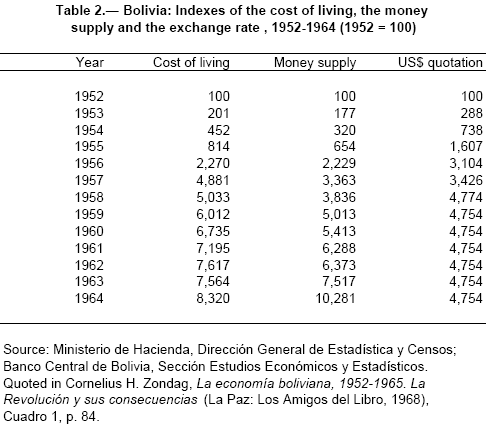
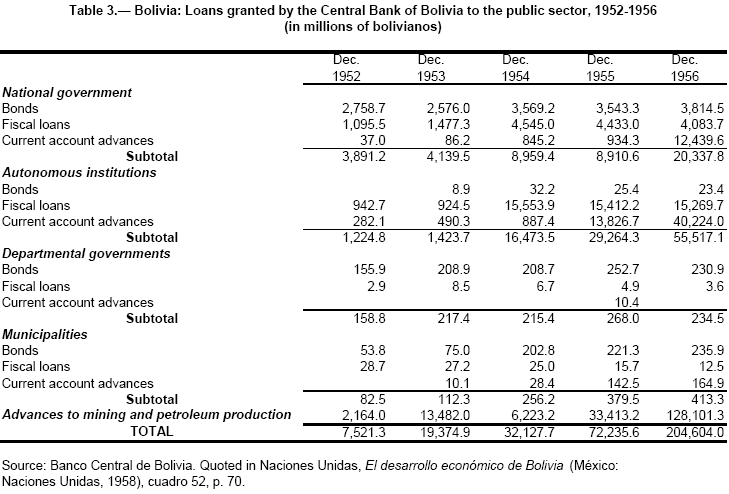
Table 3 - Click here to enlarge
]]>