Roberto Vila De Prado*
Translated by Jeremy Jordan
Translation from Revista de Humanidades y Ciencias Sociales (Santa Cruz de la Sierra), Santa Cruz de la Sierra, v.11, n.1-2, p.1-32, June/Dec. 2005.
SUMMARY
This article analyses the processes of construction of the Bolivian popular revolutionary nationalist thought since the Chaco war until the first phase of the Movimiento Nacionalista Revolucionario (MNR) government. After placing this school of thought in the Bolivian ideological spectrum of the time, the relationships between the crisis of hegemony provoked by the Chaco war and the transformation of the discursive formations are studied. The central part of this paper contains an analysis of the discourses elaborated by the main ideologues of the movement. Finally, keeping in mind that they were militants and propagandists dedicated to an intense proselytism (through articles in newspapers and magazines, pamphlets and manifestos), next to a list of books published along their lives, another list of abridged books edited by relatives and friends after the passing away of the authors is added.
Introduction
In every social formation, different specific ideological formations coexist and circulate, which as a whole constitute a dominant ideological combination. The above-mentioned ideological formations change constantly in order to ensure the conditions of domination. Nevertheless, in certain circumstances «atypical» formations arise, which present variations regarding the dominant combination, which some call dislocations [dislocaciones]. Thus,
- If a dislocation arises in order to maintain domination, some things are changed to keep the status quo.
- If a dislocation involves effects that go beyond the guarantees of the system which regulate the admissible and inadmissible, we would be standing in front of an ideological mutation.
In this last case, «everything happens as if the sudden superposition in the same place of an ideological space, of several ways of incongruent clipping and joining had as an effect of «showing» objects that until then were invisible [...] and consequently a weakening of the ideological resistance at this point» (Herbert, 1967). These mutations (political, esthetic or scientific) are presented as something unusual or delirious for the dominant ideology's followers.
These transformations are produced in circulating discourses' spaces. The discourses require officials to produce them, select them, distribute and interpret them. In every society there are ideas and representations imposed by the dominant class. The rest of the social groups have a "differentiated capacity of relations" (provided that such relations of power are asymmetrical) to resist, oppose, resemanticise [resemantizar] or reinterpret the dominant discourses (Mozejko & Costa, 2000).
A discursive formation is, by convention, the case in which the objects of practical discourses, the type of statement, concepts and thematic choices present regularity: an order, correlations, positions in operation, transformations (Foucault, 1970; 62).
]]> Intellectual communities are constantly blending and exchanging influences, which are not always easy to identify; this is a field where not only arguments and demonstrations operate, but emotions, too. The break-ups, turns and discontinuities of ideological formations originate in social conflicts, although the fracture lines and discursive transformations do not necessarily express class antagonism.Mutations, far from devastating the existing world's vision, are processes of transformation and re-articulation of already existing ideological elements (Laclau, 1980; 143). Therefore, relations with other texts/discourses (intertextual and interdiscourse) gain importance in the construction process of the subject of enunciation [sujeto de enunciación] (Mozejko & Costa, 2000).
Popular nationalist discourse arises from the disarticulation and reconsideration of liberal discourse, but expecting to overcome it by affirming «the true democratic and republican institutions» (already contained in liberal ideology) through revolutionary transformations of economy and society. This new vision is inspired by two main sources: Marxism and Latin-American nationalism (Mayorga, 1993; 78); without letting go of roots in authors like Franz Tamayo, whose work La pedagogía nacional is one of the most integrated into the Bolivian imaginariness [imaginario] (Piñero Iñíguez, 2004); as well as in the writings by Carlos Medinacelli and his vision of mestizaje as the matrix of national development (Tapia, 2002).
Liberal ideological formation is based on ideologuems [ideologemas] such as "peoples' sovereignty" and "human rights", the nation-state and the "territorial sovereignty". However, the liberal-conservative Bolivian discourse justifies the qualified vote. Even in the most democratic liberal discourses a separation exists between the political sphere, where equality is preached, and the spheres (economic and social) in which big inequalities appear.
Every ideological formation is composed of discursive formations, these last ones being a group of statements which refer to the same objects, for example: democracy, liberty, etc. At the same time, in every discursive formation there is a set of anonymous and historically determined rules imposed on every speaking subject [sujeto hablante], functioning as an acceptability principle, since it determines what can/must be said, and at the same time, by exclusion, what cannot/must not be said (Courtine, 1981).
The liberal discursive formation prevents one from thinking about the goodness of certain collective purposes (from which it is unaware and prevents others from being aware) such as the overcoming of the semi-colonial situation and the effective achievement of national sovereignty.
Ideological Map
A discourse has the ability to produce events, subjects and political actions, but within the framework of the constrictions and historical characteristics of the political field. We can talk about a discursive field ordered around two axes with Nation (N) and Revolution (R) as extremes:
]]>
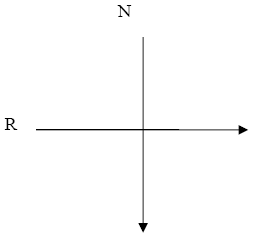
The ideology of revolutionary nationalism has as a semantic organiser, the antinomy nation/anti nation, and as a semantic operator the watchword formulated by Tristán Marof in 1926: «Mines to the State, land to the [Bolivian] Indians ».1 These elements were already in the discursive formations of the left-wing and the university reform, but while revolutionary nationalism incorporates them into their discourses, those on the left wing cannot take advantage due to class reduction [reducción clasista].
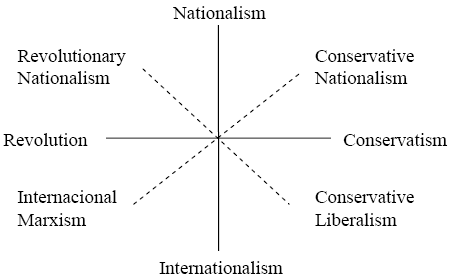
Going on from these axes, we can assemble the political spectrum corresponding to the political currents of the 50's:
Following the dashed lines, clockwise, we will find:
- Conservative Nationalism which is represented in Bolivia by the Falange Socialista Boliviana. At the beginning, this party adopted a moderate nationalist position (Klein, 1982; 288), subsequently it repeatedly practiced coup d'état to overthrow the MNR government. In its constitutive document it assigns to the State, considered as a «supra individual and eternal organism», the duty of reconstructing the greatness of the homeland, the creation of the national soul, the unity of the homeland and the integral solution to the problems that afflict Bolivia (Sandóval, 1993; 135).
]]> - «Conservative Liberalism», a term that can be applied to Bolivian liberalism due to the contradiction that meant the articulation of the traditional hacienda with the modern tin mining industry; and not the least contradictory policy of limiting the Church's influence on the urban areas and at the same time needing it to legitimate the traditional order in the countryside (Córdova, 2002; 203).- International Marxism, represented in Bolivia by the Partido Comunista and the Partido Obrero Revolucionario (POR), members of III and IV International, respectively; and
- Bolivian Popular Nationalism, of which the political partisan expression is the Movimiento Nacionalista Revolucionario (MNR).
The Partido de la Izquierda Revolucionaria (PIR) was founded in Oruro (1940), locating itself in a close position to the III International. However, internally, together with a pro-communist wing oriented towards the international scenario, which later on would constitute the Partido Comunista, there was another formation with a higher inclination towards indigenousness and nationalism (Klein, 1968; 394).
The ideological formation of MNR and the mobilization that it provokes cannot be reduced to a specific class conscience, because it has the capacity to fuse different types of discursive formations: indigenous, socialists, fascists, etc.
The ideologuem [ideologema] «nation» symbolizes the integration of social classes that until then had not taken part in political decisions: miners, craftsmen, small bourgeoisies; and at the same time, it declares the will to overcome the class contradictions and subordinate them under a national unity which hides the dominating system. The ideologuem [ideologema] «revolutionary» designates the liberation of the popular sectors from the conditions of servitude and political abuse.
Chaco's generation
The Chaco war meant the end of traditional political parties and it provoked a generational rupture of the Bolivian people.
]]> «Chaco is changing [...] into a microcosm of the Bolivian reality, where the failure of a social structure is shown and people gain consciousness of their causes» (Gómez-Martínez, 1988; 182).
At the time of generalized crisis there is an exacerbation of all the ideological contradictions and, according to Laclau (1980; 116) «dissolution of the dominant discourse» is produced. The once articulated elements around an interpretation become disarticulated. The ideological mutation involves a new articulation, inasmuch as every discourse is the result of other discourses.
According to Gramsci, a crisis of hegemony (separation of the social groups from the traditional parties) is generally produced when facing two situations:
- when the ruling class fails at a great political task for which it had demanded or imposed the consensus of the masses (above all the peasants) like in a war, for example; or
- because a great part of the masses go through a situation of relative political passivity to one of activity and formulate demands which in "its chaotic group constitute a revolution" (Gramsci, 1995; 76-77).
However, wars do not always involve the automatic gain of revolutionary conscience by the dominated. There are cases, such as France in the First World War, where the hegemony ended up stronger. This occurs when members of the subaltern class are «modern citizens» with acknowledged rights and, therefore, are not insulted or mistreated by any pretext as had happened in the Russia of the tsars.
It is not easy to measure the impact the Chaco war had on the Bolivian people. The army was composed of in its majority by Aymaras and Quechuas who were settlers or servants, fighting far away from their homes, and were dying for a cause beyond their comprehension. The army kept a caste system. The indigenous people were kept separated from the whites and mestizos, and almost always were chosen to fight on the front line. Few were their chances to expand their horizons, although they were self-conscious about the existence of a wide and strange world, and they changed some of their cultural patterns. Those who managed to return to their lands, once the war was over, were easily reincorporated to their previous situation; although some of them made their way to the cities and joined the unemployment lines.
The place where the war produced a big impact was on the middle classes and the workers, who started to look at the reality of the country in a different way. The successive defeats of those who were fighting, following orders of incompetent officials, under the worst conditions with respect to provisions and medication, were the cause of disappointment of these men. The number of desertions increased considerably and a culture medium was formed from which a new political order did not take much time to arise. Young men from the bourgeoisie in the midst of the cruelty of the war «discovered» the indigenous people, these become «visible». A large current of novels and essays started to flourish, whose authors sought for the «true Bolivia» and started asking themselves about the land, races and classes.
Middle class young people together with workers had declared their dissatisfaction, before the conflict, filling the lines of trade unions and left-wing parties. After the war, the economic situation became worse, especially for these sectors, because they were exposed to unemployment and inflation (Malloy, 1989; 109).
]]>«The revolutionary people of the post Chaco war constituted a mixture of nationalists, socialists, anarchists, communist Stalinists and Trotskyite elements; all of them were grouped or not in one social thought» (Bedregal, 1999; 250).
PIR possessed a large number of intellectuals and until the mid 40's it was the main political organization of the labor union movement. POR was trying to include the working class into its ranks. «But MNR was a party consisting of ex-combatants of the war, therefore, they could easily communicate with the official nationalist youth, which was very difficult for the Marxist parties to do, due to the leaders, at least the most relevant ones, who had failed to converge into the campaign» (Bedregal, 1999; 77).
The new discourse was marked, as it could not be in any other way, by the traces2 of other texts. The generation of Chaco was fed by post-war literature, especially that inspired by Marxism. APRA proclaimed the popular revolutionary alliance against Yankee imperialism. Leninism, as well as aprismo, was offered as a source of solution for the problems associated with poverty. Young peoples' thought was fed by Marx, Lenin and Haya de la Torre (Cuadros Quiroga, 2002; 150).
«There was plenty of work done by Soviet propaganda such as the ABC of Communism [ABC del comunismo] of Bujarin or the wide-spread work of Lenin such as What to do? [¿Qué hacer?], and The State and the Revolution [El Estado y la revolución]. They talk about learning to think in a revolutionary way without memorizing the dogmas of proletarian revolution» (Bedregal, 1999; 249-250).
The contact between popular Latin-American nationalists was not carried out only through readings; staying in other countries due to exile contributed to the mutual knowledge and exchange of ideas with politicians in a kindred position. In Peru, José Cuadros Quiroga and the syndicalist Waldo Alvarez were related to Victor Haya de la Torre and with the Venezuelan Rómulo Betancourt (Baptista, 2002; 26). In Argentina, Víctor Paz Estenssoro, Fellman Velarde and other MNR members had access to Marxist bibliography and spent long soirées discussing at cafes in Buenos Aires. The Argentinean justicialismo was also an experience and source of inspiration for this group.
During his first stay in Buenos Aires (1935 - 1939), Montenegro, who acted as a diplomat, participated in social meetings which were frequently attended by Argentinean intellectuals, artists and writers who had escaped from the Spanish Civil War, and Latin-Americans such as Pedro Henríquez Ureña and the Peruvian apristas.3 Their most significant relationships with the world of ideas were those he had established with Arturo Jauretche and other Argentinean writers aligned to historical revisionism.
During his second stay in Buenos Aires –this time as an exile– he got in touch with Raúl Scalabrini Ortiz (independent nationalist), Rodolfo Puiggrós (Stalinist), Jorge Abelardo Ramos (Trotskyite) and Abel Alexis Latendorff (socialist).4 All of them were politicians and writers, and came from different schools of thought, although they ended up supporting Peronism:
]]> «The dichotomy between nation and colony was initially sketched by Argentinean popular revisionism, but only two decades later it was expressed precisely and included in works of importance. From there it is not unthinkable that the talks that they had with Montenegro were decisive in this sense» (Piñeiro Iníguez, 2003).
The starting point of the nationalist ideology in Bolivia was the work Nacionalismo y coloniaje by Carlos Montenegro. The other fundamental documents are Bases y principios del MNR by J. Cuadros Quiroga, Tesis de Ayopaya by Walter Guevara Arce and the novel Metal del diablo by Augusto Céspedes. Guevara and Céspedes took part as editorial staff at the newspaper La Calle which had a huge popular impact.
In the years of its short existence (1936-1946), La Calle resisted with courage and wit, the competition of the other five major newspapers in La Paz. Among its journalists, Augusto Céspedes, Carlos Montenegro, Armando Arce and José Cuadros Quiroga, were the most outstanding. During the first years it was considered to be the voice of «military socialism». Then it became the MNR's banner.
The editorial group was composed of moderate socialists, so called «independent socialists». Under the direction of Montenegro and Céspedes, the newspaper started to emphasize its position as «national» and sided in favor of the Axis powers. From 1938 onwards its news sources were coming from Germany and its headlines referred to «Wall Street's imperialist Jews» and to the Zionists' conspiracies.
The affection the MNR had towards the German Nazi is justified, according to Bedregal, Baptista and other MNR members, by two main causes:
- lack of information; because until almost the end of the war the horrors of the concentration camps were unknown to the people; and
- the idea that we should support the enemies of our enemies, moved by the desire to see the ruler being humiliated, rather than feeling affection towards Germany.
On the other hand, in the early 40s, a lot of people saw Hitler as the winner of the war and his regime as an alternative to «bourgeoisie democracy».5
In its content, humorous notes were mixed with articles of opinion. It was one of the few newspapers which dealt with subjects like indigenous people's education and land distribution. But, together with these big national problems, it promoted the socialization of medicine, it published advise about how to avoid contracting syphilis and other venereal diseases (which was considered to be too audacious at that time), a plan to protect abandoned children and the separation of the Church from the State (Knudson, 1988).
]]> While dealing with a newspaper aiming at the popular sectors (workers and middle class), the important subjects were getting mixed with lighter materials. La Calle's journalists started out as activists and ended up being political leaders.The newspapers' office was attacked in 1946 by groups of students of the opposition and it was closed down. After the MNR's triumph in 1952, the official voice of the MNR was La Nación (Knudson, 1988).
Augusto Céspedes
Augusto Céspedes (1904-1997) introduced in the imaginariness of several Bolivian generations the myths of Germán Busch and Gualberto Villarroel through his books El dictador suicida and El presidente colgado:
[Busch] «life of a Bolivian Camba [native of Santa Cruz], in which suddenly and only for dying, a soul transmigration took place of an ancient Germanic king who was destroyed, before surrendering, covered in pride during a party night, in front of flabbergasted slaves, military officers who loved life and drunken courtiers» (Céspedes, 2002; 231).
The fundamental contradiction, for Céspedes, was nation - antination. In his writings he attacks the «tin barons» and also Washington and its «lackeys». He did not show affection towards liberal democracy, because he thought it was a democracy of imperialism (Mesa, 1997). On the other hand, «the Bolivian drama is similar to all the proletarian nations of the Americas».
«But the key word is rosca, which is a neologism or Americanism of Bolivian origin by which, since 1930, native groups and foreigners were classified, who, from inside the country, helped the superestado minero [big mining organizations who were beyond State control] to despoil the country in exchange for jobs and managing certain businesses.
]]> Sectors with the same functions exist everywhere [...] The great mine exploiter reduced the national plutocracy, quantitatively, to a circle so small, to a so dwarfish minority of persons in rotating functions, that it made the oligarchy and bourgeoisie lose their quality, degrading them to a rosca of a proletarian nation» (Céspedes, 2002; 10).
Inside the predestined being that Busch was «the forces of nation and antination collided until their lamps were burned out», leaving to the future [revolution of 1952] the light of an outbreak (Céspedes, 2002, 232).
Céspedes, when talking about the foundation of MNR, stresses the performance of an intellectual group which, in spite of having been incubated in a «dominant caste, they detached from it [...] looking for a deeper root in the national being [...] Paz Estenssoro could thrive as a lawyer of Patiño. I worked with Aramayo [stated Céspedes] and Montenegro was repeatedly invited to help him. We witnessed those advantages by choosing the high duty imposed on the intellectuals by a frustrated country» (Bedregal, 1999; 86).
«...MNR handled, better than the scientists, the data of historical materialism. The national reality, walled in by the liberals, was being obstructed by the communists who, with their staggered dogma, from known economical grounding were arriving to conclusions so remote, like Russia with regard to Bolivia. Native Marxists as well as liberals possessed their ‘revealed' truths for which the Bolivian people were nothing more than an instrument. Or labor to be exploited, or a tactical mass for operations of the III or IV Internationals, according to the enthusiasts' taste» (Céspedes, 2002; 265).
Céspedes upholds that the social sensibility and intelligence of the MNR founders were more important than their theory to gain the peoples' support and achieve revolutionary transformations, different from APRA, who possessed a very «rich thesis [...] spread and clarified by splendid writers and thinkers», but that did not have any relation with the given reality. For an imported scheme to be «lodged» in a reality, it requires such corrections that, in the end, it cannot be recognized by its own creator» (Céspedes, 2002; 265-266).
In his long life, Céspedes was in politics, public functions and journalism. In his last years, he was surrounded by brilliant young men such as Sergio Almaraz, René Zavaleta Mercado, Marcelo Quiroga Santa Cruz and Mariano Baptista Gumucio (Piñeiro Íñiguez, 2004; 234).
Carlos Montenegro
For Carlos Montenegro (1903-1953), the Bolivian people are the main character of their national history. His work Nacionalismo y coloniaje is a fundamental piece to understand the MNR ideology.6 His main thesis is that from the beginning of the republic's history two tendencies were struggling, the national and the colonial, «the native autonomist currents» and the «foreign currents of domination». The first one was looking for freedom for the nation itself, the second one aspired to independence to the measure that conveyed the castes' interests. The above mentioned currents –according to Montenegro– acted as «existential aspirations», like «historical energies»; although behind each one of them there were economic interests which encouraged them. (Montenegro, 1990; 73-74).
]]> The bipolar díadas of Montenegro, running the risk of every outline of a discourse, can be expressed as follows:
| People (popular mass) | Oligarchy |
| Nation (national tendency) | Antination (antinational tendency) |
| Homeland (patria) | Anti homeland (antipatria) |
During the war of independence, the national tendency was represented by the Altoperuvian guerillas and the anti national by the criollos who were trying to substitute the Spanish by having control over the rest of the nation.
]]> The oligarchy is the native agent of the imperialist powers which offers its services as a mediator, pursuing anti national interests. Its alienated ideology is shown in its maximum «living in the country, but in a foreign way». It cannot think of a Bolivian destiny for Bolivia. Such vision of Bolivian history reduces it to a conflict between caudillos, or else debates among learned persons, leaving the popular masses out of the scenario.The popular masses express the emancipation of the oppressed. «The masses understood that, in essence, people and nation have the same destiny». The masses would have intuitively recognized the objectives of the fight and taken over, by a rebellion, the government in favor of one or another caudillo. (Montenegro, 1990; 74):
«The popular masses find their own way with astonishing rightness in the labyrinth like process of conflicts. There's no doubt that their intuition could see between the shadows, of historic phenomenon, the real objectives of the fight. They participate as usual in the rebellion and bring this or that caudillo to power» (Montenegro. 1990; 75).
Montenegro's use of the dialectic method gives a very peculiar relation between thesis and anti-thesis:
«Using such terms of method, Santa Cruz represents the synthesis of the political contradiction in which Sucre represents the thesis and Blanco, the anti-thesis» (Montenegro, 1990; 86).
The collision of both tendencies (national and anti-national) in the form of thesis and anti-thesis leads to a synthesis that then is a thesis, which opposes another anti-thesis. The main contradiction of Bolivian social formation is the one that opposes the oligarchy and the «people»; therefore, the revolution must be done by the proletariat, the peasants and the small bourgeoisie.
Walter Guevara Arze
]]> Another of the MNR founders, Walter Guevara Arze (1912-1996), referred in various opportunities to the ideology of this movement as:«I saw and see that in Bolivia there's no sense of classes so as to make any struggle among them. International solidarity of workers is a myth: English workers would never support workers belonging to countries that England was exploiting colonially. PIR's internationalism did not work because in our country there is an acute sense of nationality, different from European countries, a typical nationalism of a country in formation. A violent nationalism sometimes. And, finally our country is Catholic. How can a politician fail to be unaware of this reality...?» (Paulovich, 1996).
Guevara always considered a dictatorship of the proletariat not to be feasible in Bolivia, since this requires certain objective pre-conditions: Socialist revolution can take place only in nations with a big territory, abundant economic resources and a large population (Russia, China, USA, Brazil); moreover, the class consciousness of the proletariat arises in the last stages of capitalist development in a country.
«If we cannot make a socialist revolution, what can we do then? We can and must make the national revolution. National revolution does not deny class struggles, but it is not founded on them» (Guevara, cit. Lora, 1987; 291).
The absence of objective and subjective conditions proved the necessity of a national revolution (democratic bourgeois) away from capitalism and socialism.
José Cuadros Quiroga
The restlessness of nationalist youth was reflected in the party, the one that was prepared in countless meetings brought about at the founders' residences, coffee shop La Ópera and at the editorial office of La Calle newspaper. Walter Guevara Arze states that MNR has no established date of foundation. In 1941, when «the Nazi putsch»7 was set up, Guevara signed with other people of like beliefs the first document of the Party, and due to this declaration those who had signed it were confined at San Ignacio de Velasco (Paulovich, 1996). Nevertheless, Luis Antezana Ergueta tells that on January 17th, 1941 at Paz Estenssoro's lawyers office an act had been elaborated in which it was declared necessary to create a party «that from the beginning should be independent and without concomitance with communists and extreme socialists and with international tendencies, neither contacts with ‘socialists' [...] nor with traditional parties» (Antezana Ergueta, 1992; 30). Subsequently, on May 10th of the same year, a new act was signed in which it reiterated the commitment of «developing a patriotic movement guided in a socialist way, with the purpose of defending the Bolivian nationality» (Antezana Ergueta, 1992; 31).
]]> The writing of the party's basis was assigned to Carlos Montenegro and, subsequently, to Cuadros Quiroga (1908-1941), who finally, wrote a document entitled Movimiento Nacionalista Revolucionario: sus bases y principios de acción inmediata. This document was dated July 7th of 1942, remembering a governmental decree of Busch which established the State control over the mining industry's foreign exchange revenues [divisas], and it is considered by Bedregal as a record of MNR's foundation (Bedregal, 1999; 97).While for Baptista, Cuadros Quiroga, the author of Bases, had «the capacity to summarize in a phrase one chapter of Bolivian history» (Baptista, 2002; 27), Guzmán describes the document as a well intentioned work similar to the one belonging to Falange Socialista Boliviana and «different to the wise, dialectic and revolutionary program of PIR»8 (Guzmán, 1986). Bedregal, on the other hand rushes to clarify certain excesses of the document which he describes as anti-liberal and anti-democratic, meanwhile liberalism and democracy were attitudes simulated by the tin barons to legitimize their abuse and plundering (Bedregal, 1999; 101-102). The titles of Bases' sections are sufficiently illustrative: «Against false entreguista democracy [Contra la falsa democracia entreguista]»; «Against pseudo-socialism, instrument of a new exploitation»; «With MNR»; «For the consolidation of the State and the safety of the homeland»; «For economic liberation and people's sovereignty» (Cuadros Quiroga, en Baptista y otros, 2002; 200-203).
Bedregal tries to justify certain of Bases' affirmations about Jewish immigrants from Europe, arguing that it is due to circumstantial problems:
«All of us have seen how new Jewish immigrants contributed to affirm their faith in democracy making use of liberties and guarantees to obtain the much talked about triumphs with these typical forms of progress: system of bribery as a base in businesses with the State, smuggling, forgery, forbidden monopolies, barefaced speculation, feasting, women and money as the means of success» (Cuadros Quiroga 1942, en Baptista, 2002; 191).
«We demand absolute prohibition of the Jews' immigration and of any others who lack productive efficacy» (Cuadros Quiroga, 1942, en Baptista, 2002; 201).
This last affirmation had arisen in reply to manoeuvres for the sale of passports in exchange for illegal payments.
Víctor Paz Estenssoro
Víctor Paz Estenssoro (1907-2001), as expressed by Céspedes, was
]]>«a talent without finery, but very superior to all the other current economists or those educated by the superestado... did not drink, nor smoke, did not go out at night except for his Masonic meetings....The Freemason Paz,consequently, anointed by the unknown; nor shallow or profound, therefore easily understood; lacking of vibration, in other words preserved from risky enthusiasm, not too brilliant, better said, concentrated and receptive; deprived of transparency, consequently he did not reveal his true intentions or his weaknesses...he became the polarizer of the masses' longing» (Piñeiro Íñiguez, 2004; 232).
Augusto Guzmán, another of his biographers, drew a different picture:
«Even when it was about the vocation of serving, his vocation was of command. When it was not convenient for him to use power he knew how to manage by being as cunning as the fabled fox. He had breaks in power but not in actions that when it was not of command and practice it was of permanent conspiracy at nights of waiting in which frustrations and disappointments failed to meet the edge of his purposes which aimed as an arrow towards power» (Guzmán, 1986; 7).
From another point of view, Bedregal considers him as the «necessary man» who personified experiences, instincts and intuitions appearing at the time to make justice and to ask for it, being a medium of the peoples' intimate longing (Bedregal, 1999; 39).
MNR is called a «movement» and not a «party», and this denomination –according to Paz Estenssoro– reflects a profound difference between parties from the right (old and new ones) as well as from the extreme left which have as a goal the immediate establishment of proletariat dictatorship in Bolivia. MNR proposes, on the other hand, «compatibility of interests of peasants as well as of working class, middle class and national bourgeoisie, social sectors that can and must walk together, for a long historical period, without expecting hegemonies of any type that cause drying [secantes] effects» (Bedregal, 1999; 86).
Although at the moment of the revolution of 1952, it was the action of workers and peasants that transformed a coup d'état into a revolution, rapidly the party that had directed the coup d'état, MNR, recovered control of the political process (Touraine, 1989; 170).
The fact is that, as Touraine (1989; 175) points out, MNR was between 1952 and 1964 a party, a State and a movement, even though these functions did not form total unity.
]]> Revolutionary nationalism: discourse and politics
In Bolivia, national revolution modified radically the socioeconomic structure of the country: nationalization of mines, agrarian reform, diversification of the production, as well as efforts oriented towards territorial integration, were the main reforms.
The ideological matrix of popular nationalism has as its main articulating axes the nation's sovereignty and the liberation of popular sectors from conditions of servitude and political abuse. The desire for sovereignty comes from ex-colonies and semi-colonies, according to Chaterjee (1997; 211-233), from post-illustration thought; but it is about making it real starting from the people and not from the elite who denied citizenship to the indigenous people. Subsequently, studies such as of Walter Guevara Arze and the last work of Montenegro emphasized economic development, modernization and the extension of capitalist relations of production to the rest of the country.
However, although in the nationalist revolutionary discourse, as a public discourse, differences of race and culture were reduced or eliminated, in social life, racism and discrimination continued to be common practices.
The revolution of 1952 allowed the entry of the masses into the electoral system, installing a populist democracy «which appeared not to be very liberal, above all in the field of individual liberties and even of associations and political parties of the opposition. Power was concentrated on the party that embodied the State and the people, and monopolized the capacity to define future images of the nation, conditions considered to be indispensable for the construction of national unity» (Romero Pittari; 2001; 161).
The revolution proclaimed the nations' capacity to manage its own resources and to overcome foreign dependency. The image of the party was confused with that of the State, and this turned into the mobilizing agent of economic and political projects.9
In view of the non-existing national bourgeoisie, the MNR leaders made the State the core of Bolivian society. On the other hand, hegemony of the nationalist discourse made those who were identified with the statist project to take part in politics but, those who were not, were «excluded» either by repression or through «legal channels» (Mayorga, 1987; 233).
As a consequence, two constructs integrating a «double operator»10 can be distinguished:
- an ideology of «emission» around the ideologuem [ideologema] «nation», alluding to the integration of popular classes and having a legitimizing character; and
]]> - an «internal» ideology that goes around the «national State», and expresses the dictatorial exercise of power (Sanjinés, 1992; 62).
Gramsci affirmed that, at the initial stages of a revolution, a period of «state idolatry» [estadolatría] is necessary. This is produced when the State is identified with a determined social group that acts as an agent for the creation of a new civilization, better said, a new type of man and citizen. In some cases, this is a normal way through which a society can have access to an independent State life. But he warns that the above-mentioned state idolatry must not be transformed into a theoretical fanaticism nor be conceived as being perpetual (Gramsci, 1990; 206).
The centrist faction of MNR was able to neutralize the demands of workers and peasants through a concession of wage increments and subsidies. The State started to be seen as a philanthropic entity from which people could pull up by the roots, using pressure or force, scarce resources circulating around political disputes. In other cases, it was perceived as a referee who resolved conflicts and as re-distributor of wealth. Gradually, a state-owned apparatus and a new political culture were being constructed. This apparatus was in charge of administering privileges [prebendas] and favors to its clients (Gamboa Rocabado, 1999; 63).
Since 1956, the State was controlled by bureaucracy and strengthened its authoritarian character. Nationalist ideology started to be an instrument of domination over the masses materializing (in institutions), suspending and concealing social interests.
Political culture substituted debate for massive parades and transformed critical conscience into a capacity to be identified with goals and practices of the only party, legitimated in this way by the social consensus (Mansilla 1991; 98).
The party, organized by the government, was turned into a public distributor which represented the civil bureaucracy's and military's interests, displaced the working class out of power11 and leaned on the peasants, to whom it guaranteed ownership of land. Peasant militias acted as a factor of coercion of the workers' movement and the displaced oligarchies (Mayorga, 1988; 182-184).
Revolutionary nationalism's ideologists, in order to put the peasant masses under the control of the revolutionary elites, re-invented the past, leaving out the fights of indigenous communities. In this way, according to Javier Sanjinés, revolutionary nationalism took over the indigenous past and took away from the peasants their historical dimension, leaving them disarmed in front of the State's actions (Sanjinés 1992; 63).
Trade unions were privileged as an organizational form of the official apparatus, which grew into a «legion of guided trade union leaders» (Quiroga Santa Cruz, 1960; 57), and repressive mechanisms were progressively developed.
Since then, in the official nationalist revolutionary discourse, legitimacy was acquiring more significance than theory. Discourse and political practice of the party were losing connection. As Lefort (1990; 72) said when emphasizing the representation of «people-one», denied the internal division of society and imagined the opponent to be the evil one «other». On the other hand, the party's elite failed to come up with a different discourse, because their identity's features were associated with the ideology which had been formed during the pre-revolutionary period.
]]> Final reflections
Referring to theorists of popular Bolivian nationalism, J. Fellman Velarde affirmed:
"Never as in the period of the National Revolution, thought had such major influences over political development and, at the same time, never had the political development had such an influence over thought" (Fellman Velarde, 1976; 469).
According to this author, revolutionary nationalism possessed the necessary elements to theoretically develop the new society which they had created when implanting reforms:
"After all, [the Bolivian revolutionary nationalism] was well advanced regarding orthodox Marxism by pointing out the basic contradictions between the poor countries, and recognizing similarities of interests between workers, peasants, middle class and national bourgeoisie inside a semi-colonial society, everything, by pure logic, pointed towards an anti-imperialist redefinition" (Fellman Velarde, 1976; 469).
However, some further studies pointed out that, although nationalists, of the period currently being studied, overcame racism that ruled in the first half of the 20th century, its criticism of national elite and imperialist domination was based on coordinates of the European development model; and therefore it did not answer to the exigencies of spatial discontinuity between the countryside and the cities (and distinct temporalities), typical of what Zavaleta (1986) called «motley societies», which constituted contradictions that could not be resolved in a synthesis of identity (Sanjinés, 90-92).
The fundamental feature of the State is sovereignty, and it is precisely sovereignty which determines the distinction friend - foe according to C. Schmitt (1984). The need to build a collective identity and to erect a nation as a political subject prevailed in the studied period about "the need to recognize and explain the differences among the collectivities that compose it" (Tapia, 2002; 74).
Aware of the need to form collective wills capable of facing old oligarchies, nationalists hid signs of diversity of subordinate layers and imposed a beliefs' system based on occidental culture and territory. As García Soruco (2004) points out, if subordinate groups took a while to show signs of autonomous form, until almost these days, this is possibly because the populist State satisfied its basic needs. According to Chakrabarty (1997; 246), nationalist theorists, in certain contexts and legitimately, «removed all differences of class to give place for a category called pueblo, the opposite to something such as imperialism».
]]> Over the inclusion [subsunción] of subordinate layers of Bolivian society under nationalism, during the revolutionary period, Luis Tapia says:«In our contemporary history there are two ways of recognition, one the substitute of the other. First, with the national revolution of 1952 the first great national identification was produced around contemporary facts, in which it was unified through the universalization of citizenship for those people, who were before excluded, under the idea of nation which involved a sort of acknowledgement of those people as part of Bolivia, changing their identification from Indian [indio] to Bolivian. Both are generalizations that erase underlined specificities, one with colonial roots and the other usual and constituent part of modern states» (Tapia, 2002; 116).
Among Bolivian nationalist historians, nation/antination duality operated as the selecting criteria of facts and its articulation in new nets of significance. In this way ignored facts by traditional histography became visible, as well as the presence of social popular actors. At the same time, the heroes role symbolizing the struggle against the colonial regime and resistance against oligarchic domination during the republican period, were highlighted. As a compensation, intellectuals of the post Chaco war generation created a nationalist horizon which dulled the peasant struggles.12
The purpose of authors such as Céspedes and Montenegro was to develop a national conscience, and to do so, they had to appeal to historical knowledge constructed from a particular set of values. It is said about their work, that their explanations rested upon people's intentions and that they did not take into consideration structures and social processes; but even if this criticism were accepted, it is evident that the ideas they kept "turned into conditions of the development of the possibilities of social sciences in subsequent decades" (Tapia, 2002; 73). In turn, these authors criticized Marxist reductionism:
«... The backbone of Stalinism imported to Latin America was disjoined, when the Yankee-Russian alliance during World War II, forced it to abjure rapidly its anti-imperialism and put itself under the service of the State Department. The same aberration was shown by Communism when, facing problems that non-industrialized countries had, its wit was intensified and, planned to delay proletarian revolution and instead took its time to first make the bourgeoisie revolution, so that later it could have the pleasure to destroy it.
Trotskyites must give their Talmud larger snips with scissors [tijeretazos] when, facing evidence that colonies and semi-colonies rebelled, they repudiated their internationalism and attached themselves like parasites to the nationalist revolutions» (Céspedes, 2002; 266).
Since the 60's, with Almaraz and Zavaleta,13 revolutionary nationalism thought became more critical and thoughtful, better said it moved away from the facts and practiced theoretical development that arose from a systemic conceptual construction that gave the possibility for a more complex analysis.14
For different reasons, local production of Latin-American knowledge was developed in the form of literary and philosophical practices, which arose in the margins of social sciences. Academic and scientific practices settled on regions of great economic and technological development; and the fore-mentioned practices, were bound to colonizing ventures (Mignolo, 1998). Philosophical, literary and essayist reflections still seem today to be the way that makes it possible to tackle reality from a Latin-American perspective.
]]>Bibliography
ANTEZANA ERGUETA, L. y otros (1992). Origen, fundación y futuro del MNR. La Paz. Editorial Abril. [ Links ]
BAPTISTA GUMUCIO, M. (2002). José Cuadros Quiroga. Inventor del Movimiento Nacionalista Revolucionario. La Paz. Edic. del autor. [ Links ]
BEDREGAL, G. (1999). Víctor Paz Estenssoro. El político. Una semblanza crítica. México. F.C.E. [ Links ]
BIEBER, L. E. (2003). «Bolivia 1936-1945. En la encrucijada entre un nacionalismo militante y la rivalidad germano-norteamericana». En J. Salmón & G. Delgado. Identidad, ciudadanía y participación popular desde la colonia al siglo XX. La Paz. Plural. [ Links ]
CÉSPEDES, A. (2002). El dictador suicida. La Paz. Juventud. [ Links ]
CÓRDOBA, J. C. (2002). «Capacidades políticas del movimiento evangélico boliviano». En PNUD. Nuevos actores sociales, t. 1. La Paz. Plural. PNUD. ASDI. [ Links ]
COURTINE, J-J (1981). «Analyse du discour politique (Le discours communiste adreseé aux chrétiens)». En [publicación electrónica] Langage (junio) [ www.fortunecity.com/victorian/bacon/1244 ]. [ Links ]
CUADROS QUIROGA, J. (2002). «Textos de José Cuadros Quiroga». En M. Baptista Gumucio. José Cuadros Quiroga. Inventor del Movimiento Nacionalista Revolucionario. La Paz. Edic. del autor. [ Links ]
CHAKRABARTY, D. (1997). «Invitación al diálogo». En S. Rivera Cusicanqui & R. Barragán. Debates Post Coloniales: Una introducción a los estudios de la subalternidad. La Paz. SEPHIS, Aruwiyiri. SIERPE. [ Links ]
CHATTERJEE, P. (1997). «El Estado Nacional». En S. Rivera Cusicanqui & R. Barragán. Debates Post Coloniales: Una introducción a los estudios de la subalternidad. La Paz. SEPHIS, Aruwiyiri. SIERPE. [ Links ]
DALMASSO, M. T. & BORJA, A. (1999). «El discurso social argentino. Memoria 70/90» [versión electrónica]. Córdoba. Topografía. Proyecto Editorial [ www.secyt.unc.edu.ar/artículos/art9.htm ] [ Links ]
FELLMAN VELARDE, J. (1976). Historia de la cultura boliviana. La Paz. Los Amigos del Libro. [ Links ]
FOUCAULT, M. (1970). El orden del discurso. Barcelona. Tusquets Editores S.A. [Hay versión electrónica] [www.sociología.cl]. [ Links ]
GAMBOA ROCABADO, F. (1999). «La revolución del 52 bajo la luz del presente». En revista Tinkazos N° 3 (enero-abril). La Paz. PIEB. [ Links ]
GARCÍA SORUCO, J. (2004). «El problema del otro excluido en la construcción del Estado Nacional» [página web]. En Ciudad Política [www.ciudadpolitica.com/modules/news/article.php?storyid=337] [ Links ]
GÓMEZ-MARTINEZ, J. L. (1987). Bolivia: Un pueblo en busca de su identidad. La Paz. Los Amigos del Libro. [ Links ]
GUIBERNAU, M. (1996). Los nacionalismos. Barcelona. Ariel. [ Links ]
GRAMSCI, A. (1995). Notas sobre Maquiavelo, sobre política y sobre el Estado moderno. Cuadernos de la cárcel. México. Juan Pablo Editor. [ Links ]
_________. (1990). Pasado y presente. Cuadernos de la cárcel. México. Juan Pablo Editor. [ Links ]
GUZMÁN, A. (1986). Paz Estenssoro. La Paz. Los Amigos del Libro. [ Links ]
HERBERT, T. (1967). «Observações para uma teoria geral das ideologias». En revista RUA N° 1 (setembro) [versión electrónica] Laboratorio de estudios avanzados en periodismo. Campinas, SP [www.laberurb.unicamp.br/textos.4.thm ]. [ Links ]
KLEIN, H. S. (1968). Orígenes de la revolución nacional boliviana. La crisis de la generación del Chaco. La Paz. Juventud. [ Links ]
KNUDSON, J. (1988). «La Calle: Un precursor de la revolución nacional boliviana». En suplemento Com-Un (18-12-98) diario El Día. Santa Cruz de la Sierra. [ Links ]
LACLAU, E. (1980). Política e ideología en la teoría marxista. México. Siglo Veintiuno. [ Links ]
LORA, G. (1987a). ¿Fue un revolucionario Montenegro? La Paz. Futuro SRL. [ Links ]
_________. (1987b). Historia de los partidos políticos de Bolivia. La Paz. La Colmena. [ Links ]
MALLOY, J. M. (1989). Bolivia: La revolución inconclusa. La Paz. CERES. [ Links ]
MANSILLA, H. C. F. (1991). La cultura del autoritarismo ante los desafíos del presente. Ensayos sobre una teoría crítica de la modernización. La Paz. CEBEM. [ Links ]
MARFOT, T. (1961). Ensayos y crítica. La Paz. Juventud. [ Links ]
MAYORGA, F. (1993). Discurso y política en Bolivia. La Paz. ILDIS-CERES. [ Links ]
__________. (1987). «La crisis del discurso del nacionalismo revolucionario». En Repensando el país. La Paz. MBL. [ Links ]
__________. (1988). «Milicia campesina en la revolución nacional». En revista Autoderminación N° 6 (diciembre). La Paz. CELMES. [ Links ]
__________. (1985). El discurso del nacionalismo revolucionario. Cochabamba. CIDRE. [ Links ]
MESA, C. D. (1997). «El Chueco». En diario El Deber (18-05-97). [ Links ]
MIGNOLO, W. (1998). «Postoccidentalismo: El argumento desde América Latina» [versión electrónica] En S. Castro-Gómez & E. Mendieta. Teorías sin disciplina (latinoamericanismo, poscolonialidad y globalización en debate). México. Miguel Ángel Porrúa. [ Links ]
MONTENEGRO, C. (1990). Nacionalismo y coloniaje. La Paz. Juventud. 1ª Ed.1943. [ Links ]
MOZEJKO, D. T. & COSTA, R. L. (1997). "La circulación de los discursos" [versión electrónica]. En D. Navarro y otros, Intertextualité. Francia en el origen de un término y el desarrollo de un concepto. La Habana. UNEAC [www.ffyh.unc.edu.ar/dependencias/biblio/cema/revistas] [Reproducido en revista Sincronía, Winter/Invierno 2000 (versión electrónica). Universidad de Guadalajara]. [ Links ]
PAULOVICH (1996). «Walter Guevara Arze, un hombre que hizo historia». En diario La Razón. Ventana (23-08-96). La Paz. [ Links ]
PIÑEIRO ÍÑIGUEZ, C. (2003). «Carlos Montenegro y la República Argentina» [publicación electrónica]. En Comunidad Boliviana en Argentina. Buenos Aires [página web] [Consulta 27-10-03]. [ Links ]
___________. (2004). Desde el corazón de América. El pensamiento boliviano en el siglo XX. La Paz. Plural. [ Links ]
QUIROGA SANTA CRUZ, M. (1960). La victoria de abril sobre la nación. La Paz. E. Burillo. [ Links ]
REQUENA GUTIÉRREZ, J. (s/f). "Sergio Almaraz: su obra y sus ideas". En Revista Diplomática Internacional [Reproducido en Almaraz (1979) y otros. Para abrir el diálogo. La Paz. Los Amigos del Libro]. [ Links ]
ROMERO PITTARI, S (2001). «Debate sobre la democracia contemporánea». En G. Rojas Ortuste y otros. Visiones de la democracia. La Paz. Fundemos-Fundación Hans Seidel. [ Links ]
SANDÓVAL RODRÍGUEZ, I. (1993). Los partidos políticos en Bolivia. La Paz. UMSA. [ Links ]
SANJINÉS, J. C. (2003). «Entre la historia y la literatura: Carlos Montenegro y la representación de la realidad». En revista Tinkazos N°15 (octubre). La Paz. PIEB. [ Links ]
__________. (1992). Literatura contemporánea y grotesco social en Bolivia. La Paz. Fundación BHN-ILDIS. [ Links ]
SCHMITT, C. (1984). El concepto de lo político. Buenos Aires. Folios. [ Links ]
SOLIZ RADA, A. (2003). "Del nacionalismo al coloniaje". En Reconquista Popular [http://archives.econ.utah.edu]. [ Links ]
TAPIA, L. (2002). La producción del conocimiento local. Historia y política en la obra de René Zavaleta. CIDES-UMSA. Muela del Diablo. [ Links ]
___________. (1992). La condición multisocietal. Multiculturalidad, pluralismo, modernidad. CIDES-UMSA. Muela del Diablo. [ Links ]
___________. (1988). «Las transformaciones de las interpelaciones del MNR». En revista Autodeterminación N°5 (mayo-julio) La Paz. CELMES. [ Links ]
ZAVALETA MERCADO, R. (1986). Lo nacional- popular en Bolivia. México. Siglo XXI. [ Links ]
ZELLMAN, H. (1989). De la historia a la política. México. Siglo XXI. UNU. [ Links ]
Annex: Bibliography of Bolivian revolutionary nationalists
Augusto Céspedes
1946. Metal del diablo
]]> 1956. El dictador suicida. 40 años de historia de Bolivia1962. Sangre de mestizos
1966. El presidente colgado
1968. Trópico enamorado
(s/d). Un regalo de los incas
(s/d). Imperialismo y desarrollo
1973. Salamanca o el metafísico del fracaso
1975. Crónicas heroicas de una guerra estúpida
José Cuadros Quiroga
1941. Nosotros frente a los traidores
]]> 1941. Las bases y principios de acción inmediata del MNRWalter Guevara Arze
1946. Manifiesto de Ayopaya
1954. Planteamientos de la Revolución Nacional en la Décima Conferencia Interamericana
1961. Acusación a Paz Estenssoro
1969. Exposición de motivos y declaración de principios del Partido del Movimiento Nacionalista Revolucionario Auténtico
Carlos Montenegro
1936. El derecho del Estado frente al oro de la Standard Oil
1943. Nacionalismo y coloniaje
1948. Caducidad de las concesiones mineras
]]> 1948. Biografía de Spruille Braden1949. La hora cero del capitalismo
1954. Pensamientos políticos. Documentos
1962. Las inversiones extranjeras en América Latina
Víctor Paz Estenssoro
1942. El pensamiento económico en Bolivia
1961. La revolución boliviana
2003. Pensamiento político (compilación)
]]> * The author is Professor emeritus of the Universidad Autónoma "Gabriel René Moreno", and a researcher at the Instituto de Investigaciones Económicas y Sociales "José Ortiz Mercado" (e-mail titov@acelerate.com).