Ana María Lema Garret*
Translated by Julio H. Cole
Translation from Revista de Humanidades y Ciencias Sociales (Santa Cruz de la Sierra), Santa Cruz de la Sierra, v.4, n.2, p.31-46, Dec. 1998.
SUMMARY
On the eve of the civil war that pitted the new elites in La Paz, representing the Liberal Party, against the conservative mining elites of the south, based in the departments of Chuquisaca, Potosí and Tarija and in power since the War of the Pacific (1880), other conflicts were also latent in the peripheral regions of Bolivia: in the Amazonian region, to the north-east, as well as in the Chaco, to the south. The indigenous inhabitants of those regions, which did not fit the model of the “productive Indian,” were regarded as obstacles to progress. The exploitation of rubber, in the north, and the development of cattle-breeding in the south promoted incursions of non-indigenous peoples into those territories in which State control was virtually non-existent. During this process, criollos, traders and cattlemen ran into Franciscan missionaries who were not exempt from attacks on the part of civilians.
Introduction
For the Bolivian state, the transition from control over a territory to actual management of a nation was, and still is, a long-run project. This required work on various levels: administration and spatial articulation of the national territory, and conquering its periphery as well as its interior.
Towards the end of the 19th century, the political projects of a certain criollo elite placed greater emphasis than in the past1 upon the control of space as a means of strengthening the State, to which end it implemented initiatives such as:
]]> The “geographic consciousness” of the paceño elite (Qayum, 1993), as revealed in publications (mostly due to Manuel Vicente Ballivián), and in the creation of institutions such as the Sociedad Geográfica de La Paz and the Oficina de Estadística, Propaganda Geográfica e Inmigración, seeked to promote greater knowledge of the territory, its inhabitants, and its history (through the republication of colonial documents, for instance), as a stepping-stone for the integration of the country. But while some undertook scientific activities to approach the country’s internal frontiers, others acted in the field, with other means and ends in mind.- The sale of community-held lands (to achieved the expansion of haciendas) in the Altiplano and the valleys.
- Reform of the State apparatus via specific instruments (land registries, censuses, statistics, fiscal and tax reforms).
- Railroad construction projects.
- The expansion of real (or imagined) borders (via exploratory expeditions, and attempts at colonization).
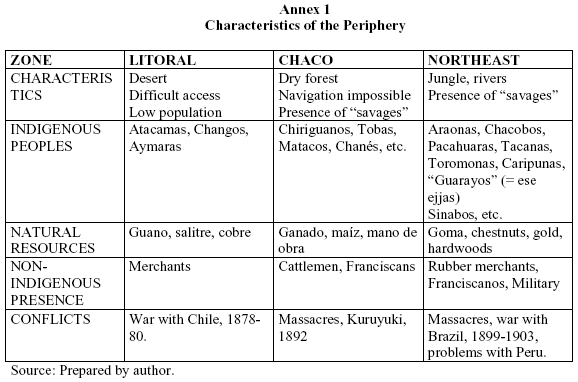
As of the late 19th century, Bolivia’s map was still not clearly defined. After the loss of the Pacific territories, Bolivian officials might have viewed the borders with Peru, Brazil, Paraguay and Argentina with jealous eyes. This, however, was not the case. The borders with these countries were not clearly defined, and the spaces between these ambiguous lines and the furthest outposts of “civilized” settlements within the country were too broad, both northwards and southwards, and they certainly were not under State control.
It was missionary efforts, on the one hand, and private initiatives, on the other, which permitted some enlargement of the country’s internal frontiers, both in the Amazonian northeast and in the Chaco zone, to the south.
In this paper, we will try to show that Bolivia’s peripheral zones were not empty spaces, even though the State was noticeably absent, creating opportunities for interventions and private initiatives. Little by little, the State developed a series of legal instruments that served as inducements to the colonization of the periphery. Nonetheless, relations between different actors on the scene were in fact characterized by conflicts, giving rise to situations of internal regional conflict.
1. The Actors Involved
The Northeast: Savages, Missions and Traders
Bolivia’s Amazonia can be divided in two large areas: the Moxos plains and the Amazonian north.
In the former, during colonial times the Jesuit missions of Moxos gathered Moxeños, Movimas, Cayubabas, Canichanas and Itonamas into flourishing settlements (known as reducciones) in the 18th century, while towards the edges of this territory the Franciscan friars developed evangelizing activities and their own reducciones (in the Toledan sense of reducción) among Tacanas, Mosetenes, Yuracarés and Chimanes.
Once the Republic was created, the State left its imprint by creating the department of Beni, in 1842, which at the time covered the provinces of Moxos, Caupolicán (Franciscan missions of Apolobamba, in Tacana territory, geographically within the department of La Paz) and Yuracarés, in Cochabamba.
]]> The second large area, the Amazonian north, was still virtually unexplored as late as the second half of the 19th century. Contacts between colonial—and, later, national—society and the nomadic groups of hunters and gatherers living in the basins of the Beni, Madidi and Madre de Dios rivers and their sources, were sporadic. The State’s nonexistence was a characteristic of this region, and its limits were not clearly demarcated until the loss of the Acre.The 19th century witnessed the exploitation of non-mining exportable natural resources, such as cinchona bark, and later, rubber. From about 1860, though exploration of this region was partially a religious (Fray Nicolás Armentia, a Franciscan missionary and ethnographer) or foreign effort (Orthon, Heath), the settlement of this immense space located between Brazil and Peru was an essentially private enterprise (Antonio Vaca Díez, Nicolás Suárez), driven more by cruceños than paceños, and with the presence of foreign capital (Sanabria, 1988).
With the discovery of the navigability of the River Beni up to its confluence with the Madre de Dios and the Mamoré, in 1880, new opportunities were opened for the commercial exploitation of rubber trees. Rapidly, the State became interested in collecting taxes, the creation of customs houses, and the city of Riberalta was founded (1892): the north was linking up with Beni from the point of view of territorial administration.
A decree of 1878 alloted to any explorer that acquired lands held by “savages” 25 square kilometers on the banks of the rivers Inambary, Madre de Dios and others in the northeast. This implied that, once land was conquered, any surviving human resources were at the disposal of the entrepreneurs. The latter installed rubber processing sheds at strategic points, and recruited local indigenous labor or imported it from other regions. Thus, Chiquitanos from Santa Cruz and Moxeños from Beni were transported to lands formerly belonging to the Araonas, Pacahuaras, Chacobos, Cavineños, Tacanas, etc., and were there subjected to particularly harsh working conditions (Gamarra, 1992).
In 1897, with the enactment of legislation pertaining to the “hitching” (enganche) of peons, the mistreatment of Amazonian labor became legalized.
The Chaco: Chiriguanos, Missions and Estancias
The Chaco was inhabited since the 16th century by numerous tribes, among which the Chiriguanos (Guaranís) were both numerically important, and notable for their warlike character and ability to deal with non-Guaraní society (Saignes, 1990). On the other hand, Tobas, Matacos and other groups also shared these spaces.
The “Chiriguano frontier,” which corresponded to the dividing line between “civilization” and “barbarism” since the time of the Incas until the late 19th century, was the scene of clashes between the ava (Chiriguanos) and karai (whites) which fought for control of the territory, with alternating phases of coexistence and confrontation (the latter coinciding with an advancing front of pioneering criollos from Chuquisaca, Tarija and Santa Cruz).
During the first half of the 19th century, the Chiriguano leaders managed to hold sway over this great space, almost achieving coexistence with the cattle-raising criollo colonizers (called mestizos by the Franciscans) and with the authorities. To insure the peace (and their cattle) the criollos paid a tribute to the Chiriguanos (in clothing, tools, weapons or money) and avoided molesting them as far as possible—a form of treatment that was unheard of in any other part of the country (Langer, 1989).
The land inhabited by the Chiriguanos, known as the Cordillera, corresponded in the 19th century to the provinces of Cordillera in Santa Cruz, Salinas in Tarija, and Azero in Chuquisaca. Lack of coordination between the authorities in the three departments “bordering” the Chiriguano territory impeded a coherent policy towards this population segment.
]]> On the other hand, in colonial times missionary efforts directed towards this “heathen” population were led by Franciscan friars, from the Colegio de Propaganda Fide in Tarija.2 After the war of independence, the work of the missionaries was largely destroyed, and of the 21 missions that existed at one time or another, only the one at Salinas was left standing. However, a second wave of evangelization took place during the 19th century with the creation of new Colegios in La Paz (1835), Sucre (1837) and Potosí (1853).3 These Colegios, and specifically those of Potosí and Tarija, served as springboards for the creation of new missions in the Chaco, with the objective of converting the savages into “Christians, artisans and citizens” (Giannecchini, 1995: 142).Meanwhile, relations between the Indians and the country’s new administrators gradually deteriorated during the 19th century. During the second half of that century, the pioneering front became more aggressive, due to the reactivation of the mining sector (which created a great demand for beef), the growing power of the State, and the use of new weaponry. The colonizers, hungry for land and pastures, were determined to evict the savages. The encroachment upon Chiriguano territory was reinforced by the establishment of military posts along the border, especially after 1870.
Internal conflicts among the Chiriguanos facilitated the destabilization of the region, where successive periods of “turmoil” (turbulencias) resulted in dispersal and migration of the indigenous population.
2. Tools for Consolidation of a National Space?
The control of geographic space requires territorial organization. Naming spaces, linking them administratively, providing for bureaucracies and creating a sense of attachment to the central power, these were some of the steps that had to be taken in order to incorporate these distant territories, at least on paper.
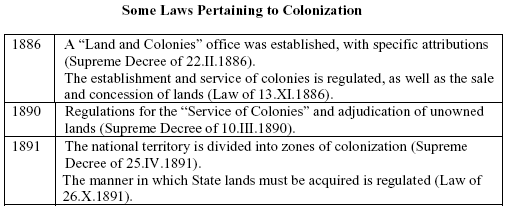
To the country’s well-established and consolidated departments (La Paz, Oruro, Potosí, Litoral, Tarija, Chuquisaca, Santa Cruz, Cochabamba, Beni) were added the peripheral zones, and to control the latter the State opted for a policy of colonization.4 To this end, many legal instruments and regulations were created during the late 19th and early 20th centuries.
]]>
Innovations in territorial organization were introduced as well. In 1890, the Bolivian state tried to impose its sovereignty, at least on paper, creating the Delegación Nacional del Madre de Dios y del Purús, which would become in 1900 the Territorio Nacional de Colonias.
The “drawing of lines” proceeded apace with the proposal (Article 10, Supreme Decree of 10.III.1890) that once a colony’s settlement surpassed 500 adults, it could apply for registration as a canton.
It is interesting to observe the realization, among Bolivian legislators, that the situation of access to and holding of land could not be homogenous across the country, and that the laws of 1874, for instance, regarding sale of community lands, etc., did not square with the realities of physical occupation in the Eastern lowlands, in the Amazonia, and in the Chaco. Some provisions took this situation into account.5
Interest in the Amazonian region was also evident from the other side of the fluctuating borders with Brazil and Peru, leading to armed conflict with the former (the Acre war), and diplomatic exchanges with the latter,6 which resulted in large territorial losses for Bolivia (Cortez, 1995). In all this, the opinions (or even the existence) of the original inhabitants, for whom no borders existed, were never considered.
In the case of the Chaco, Argentina was only interested in cheap Bolivian labor, attracting Chiriguanos and Matacos for the sugarcane harvest. In this situation, the local authorities reacted by taking certain measures to discourage the Indians’ exodus.7 The latter, however, attracted by one side (Argentina) and repulsed by the other (Bolivia), had no reservations whatsoever in crossing a border which, just as in the north, meant nothing to them.
Therefore, we are dealing with a situation in which the State declares, ever more strongly, its will to encompass the totality of the national territory, even if it must resort to private citizens (the “colonizers”), but without taking into account a segment of the population which, though it already inhabited those “empty” spaces, did not do so according to the patterns of “civilization” and “progress.” Lacking the requisites for citizenship, and producing no tangible benefit to the State (taxes, agricultural output, etc.), the indigenous peoples of the lowlands were marginalized.
3. Late 19th Century “Ethnic Policies”
Bolivia’s “Indian problem” in the 19th century was that, from the point of view of the ruling elites, the heterogeneous mass of indigenous peoples living within the Bolivian territory (but not regarded as citizens) were a serious hindrance to progress (as conceived by those elites). Ideals regarding lifestyles, land occupation, cultural referents, and even productive activity, were simply incompatible. While one group hunted and fished, the other group wanted them to become farmhands.
]]> To remain indigenous became anachronistic, that is, out of time, when the rest of the country aspired to attain civilization (although, according to some, the degeneration of the Indian was a result of his exploitation, and therefore, to some extent a result of civilization ...).Given the intuition that Bolivia contained within its nebulous borders several countries and several nations (though not acknowledged as such), it became necessary to find a solution, in order to achieve modernity, by avoiding the collapse of the young nation and rising to the level of Western models.
Though one cannot speak of “ethnic policies” during the 19th century in the same sense in which term is applied to 20th century Bolivia, there were nonetheless tendencies and proposed solutions to the so-called “Indian problem.” Some were quite humanitarian, others were much more radical.8
E is for Evangelization
The Catholic Church, through its missionary presence—whether Jesuitic, in colonial times, or Franciscan, under the Republic—was able to act as an intermediary between the State and the indigenous societies, though its role became more complicated once third parties arrived on scene.
Towards the end of the 19th century, for instance, the Franciscans achieved a broad presence in the so-called “territorios de colonización,” earning the trust of the Indians, who seeked refuge in the reducciones, not so much of their own will but rather as a survival strategy given the increasingly aggressive and violent incursions of civilians who by that time were supported by the State. This was clearly the case of the Chiriguanos.
The missionary presence was subject to strict State regulations, as expressed in several enactments (1845, 1905, for example), in addition to the legislation pertaining to colonization, which stressed the subordination of missions to the official entities in charge of these matters.
Towards the end of the 19th century, the presence of the missions was widely questioned. The economic interests involved were more important than the Church’s proselytizing efforts. According to some rubber merchants (Vaca Díez, 1876), the missionaries were hindering progress, since they kept the indigenous peoples stuck in their customs and isolated from productive activities, that is, beyond the reach of civilization.
]]> In fact, in the Caupolicán province of La Paz,9 the Franciscans tried to protect the Indians against the rubber merchants’ policy of forced “hitching” of labor.“What needs to be done now, in view of the increasing distress, is to do away with the so-called missions and add these peoples and individuals to the national sovereignty as an integral part of its legitimate domain and territory, so that they may lead the same life, the same customs, the same laws that are observed in the rest of the republic” (Vaca Diez, 1876; italics added).
According to others (Román Paz, 1895), the missionaries’ work was valuable to the extent that it was a first step towards territorial expansion and the process of civilizing the Indians, since the Church presence helped protect the future labor supply from some pernicious aspects of civilization, such as alcoholism.
Still others (Pando, 1893) praised the missionary effort in distant areas, but suggested that it be complemented by the presence of military outposts, which would serve a more effective purpose, and one more closely tied to the needs of the State.
In the Chaco, the enmity between Franciscans and criollo cattlemen was also a well-known fact, and one which increased over the course of the 19th century, since the criollos, bent upon hoarding land and labor for their own use, were opposed to the consolidation of the missions. In this regard, the Franciscan Giannecchinni lamented:
“[The mestizos] … have always been enemies to the missions and neophytes, have always been troublemakers to the poor sons of the forest. And against this sort of people, hungry for gold and pleasures, the missionaries have always had to wage open war in order to care for and defend the neophytes, who are simple and ignorant of their hypocrisy and arrogance” (Giannecchinni, 1995: 39).
Each defends his own cause: souls in one case, cattle in the other ... Unfortunately, there are almost no remaining testimonies from the interested parties!
E is for Extermination
The repressive attitudes of the elites, in government as well as in the private sector, was based on the concept of “Social Darwinisim,” as represented by the views of certain cruceño intellectuals, which were echoed by some influential paceños (Démelas, 1981). Social Darwinism was defined as a scientific theory that suggested that history is guided by the concepts of progress and evolution—as opposed to savagery and barbarism—, that races compete, and that some will be victors while others will be eliminated. Among the “victors” are the different Western societies, whereas the Indians are “losers.” An issue that was debated was whether the Indian race had to be eliminated, or whether it might be better to “improve” it via interbreeding with European immigrants, for instance.
Usually, the most effective solution was physical extermination, either deliberate or by natural causes. In the Amazonian northeast, for example, observers commented on the progress of rubber concerns in territories inhabited by the “savages”:
]]>“... it seems that there are not many tribes left, and with time and a good system, we will see them disappear, with great benefit to the region and a powerful contingent for the rubber industry if we manage to reduce them all” (Baldivieso, 1896).
“It is better to defend the territories used by industry, building forts, organizing military garrisons and making frequent raids; plagues and hunting will finish off, before long, those savages that refuse to settle down, clearing the field for the development of those industries best adapted to those places” (Pando, 1893).
At the other end of the country, by the end of the century the situation had become unsustainable. As a result of criollo pressure to stop the establishment of new missions (of the Franciscan type) and the constant harassment against the Indians, the Chiriguanos revolted in January 1892, led by Hapia Oeaki Tumpa, in order to destroy the “bolivianos.” Many criollo settlements were attacked, raising concerns among the authorities in Santa Cruz. State-led repression resulted in a historic massacre in Kuruyuki, which—added to the process of emigration to Argentina and the impact of other migrations that ravaged the region—marked the end of an era for the Chiriguanos (Sanabria, 1972).
Towards the end of the 19th century, the advance of the State was perceived as a confrontation between the postulates of civilization (= progress, nowadays “development”), on the one hand, and Indian “backwardness,” on the other. And how was progress defined at the time? By the railroad, by urban life, for example. The population census of 1900 bewailed the rural world and its poverty, a world of social and political marginality:
“... if there has been a cause for the backwardness of our civilization, it is due to the Indian race, which is essentially resistant to any sort of innovation and progress” (Census of 1900: 1902, 2: 35-36).
The encroachment, both State-led and private, upon large open spaces containing natural resources, of national interest, in some cases, of only local interest in others, condemned its “traditional” inhabitants, the indigenous peoples, to multiple disappearance: by physical death, by removal (through migration), and, finally, by loss from memory.
References
]]>Anasagasti, Pedro de. 1992. Los franciscanos en Bolivia. La Paz: Don Bosco. [ Links ]
Baldivieso, Pastor. 1896. Informe que presenta al Sr. Ministro de Colonización el Intendente de la Delegación Nacional Pastor Baldivieso. Riberalta. [ Links ]
Castelnau, Francis de. 1998. Expedición a las partes centrales de Sudamérica. La Paz: Embajada de Francia – Amigos del Libro (forthcoming). [ Links ]
Cortez, Jorge. 1995. “La guerra del Acre,” in Los Bolivianos en el tiempo. La Paz: INDEAA – Reforma Educativa. [ Links ]
Démelas, Marie Danielle. 1981. “Darwinismo a la criolla,” in Historia Boliviana, II/1. Cochabamba. [ Links ]
Gamarra, Pilar. 1992. Haciendas y peones en el régimen hacendatario gomero boliviano. Las bases económicas de un poder regional: la Casa Suárez (1880 – 1940). La Paz: UMSA (dissertation). [ Links ]
Giannecchini, Doroteo and Vincenzo Mascio. 1995. Álbum fotográfico de las misiones franciscanas en la república de Bolivia, a cargo de los Colegios Apostólicos de Tarija y Potosí (1898). La Paz: Banco Central de Bolivia – Archivo y Biblioteca Nacional de Bolivia. [ Links ]
Groff Greever, Janet. 1987. José Ballivián y el Oriente boliviano. La Paz: Empresa Editora Siglo. [ Links ]
Langer, Erick. 1989a. “Las guerras chiriguanas. Permanencia y adaptación en la frontera boliviana, siglo XIX”. Paper presented at Primer Congreso de Etnohistoria, Buenos Aires. [ Links ]
______. 1989b. “La guerra de recursos entre chiriguanos y colonos (siglo XIX),” in Presencia Literaria (Dec 3). La Paz. [ Links ]
______. 1994. “Mission land tenure on the southeastern Bolivian frontier, 1845 – 1949,” in The Americas, 50/3. [ Links ]
Lema, Ana María (ed.) 1998. Pueblos indígenas de la Amazonía Boliviana. La Paz: TAC – PNUD – FIDA/CAF. [ Links ]
Lema, Ana María, Ximena Medinaceli and María Luisa Soux. 1993. De Charcas a Bolivia, de territorio a nación. La Paz: Coordinadora de Historia (ms.) [ Links ]
Maurtua, Víctor. 1905. Juicio de límites entre Perú y Bolivia. Prueba peruana. Madrid. [ Links ]
______. 1906. Juicio de límites entre Perú y Bolivia. Contestación al alegato boliviano. Buenos Aires. [ Links ]
Oficina Nacional de Inmigración, Estadística y Propaganda. 1902. Censo de 1900. La Paz. [ Links ]
Pando, José Manuel. 1893. Informe que el Jefe de la exploración de los ríos del norte de Bolivia eleva al conocimiento del Supremo Gobierno. [ Links ]
Paz, Román. 1895. De Riberalta al Imambari. Informe del Dr. Román Paz, Jefe de la expedición al Alto Madre de Dios, organizada por la Delegación Nacional. La Paz: Imprenta de El Comercio. [ Links ]
Qayum, Seemin. 1993. “Espacio y poder: la élite paceña en el ‘periodo geográfico’,” in Autodeterminación, 11. La Paz. [ Links ]
Saavedra, Bautista. 1906. Defensa de los derechos de Bolivia en el litigio de fronteras con la república del Perú. Buenos Aires. [ Links ]
Saignes, Thierry. 1990. Ava y Karai. Ensayo sobre la frontera chiriguano (XVI-XX). La Paz: Hisbol. [ Links ]
Sanabria, Hernando. 1972. Apiaguaiqui Tumpa: biografía del pueblo chiriguano y de su último caudillo. La Paz: Amigos del Libro. [ Links ]
______. 1988. En busca de Eldorado: la colonización del Oriente boliviano. La Paz: Ed. Juventud. [ Links ]
Vaca Díez, Antonio. 1989. De Santa Cruz a Reyes. Crónica de un viaje (1876). Santa Cruz. [ Links ]
Van Den Berg, Hans. 1988. Bibliografía de las etnias del Oriente boliviano. Una obra en permanente construcción. Cochabamba: Biblioteca Etnológica. [ Links ]
* The author is a member of the Coordinadora de Historia (e-mail: anitalema@infonet.com.bo).
1 Ballivián was perhaps an exception. See Groff Greever (1987) and Castelnau (forthcoming).
2 On the Franciscans in Bolivia, see Anasagasti (1992). There are many studies and testimonies regarding the Franciscan presence in the Chaco during the colonial period. For a survey and review of the literature on indigenous populations in Bolivia, see Van den Berg (1998). ]]>
3 There was also a Colegio in Tarata (1796), which undertook the evangelization of the Yuracarés in Cochabamba and the Guarayos in Santa Cruz.
4 These areas included large portions of the aforementioned departments: Beni in its entirety, as well as the provinces of Cordillera and Chiquitos in Santa Cruz, Yuracarés in Cochabamba, Gran Chaco in Tarija, Caupolicán in La Paz and the region of the Madre de Dios river.
5 Supreme Resolution of 27.III.1882; Law of 10.III.1890, Art. 12, para. 4; Law of 26.X.1905, Art.10.
6 This produced, both in Peru and Bolivia, many compilations of historical sources to support each country’s allegations (Maúrtua in Perú, Saavedra in Bolivia, for instance).
7 For instance, the Resolution of 6.IV.1886 which approved the measures taken by the Prefecture of Tarija favoring the Chiriguanos and Matacos
8 One way to achieve “national unity” amidst a highly diverse population was to erase the differences that might exist between ethnic and social groups. One of these differences was linguistic. Though the official language was Spanish, it was actually an urban language, and since the larger part of the population was rural, each group kept its own language. In this case, the solution was literacy and education, which was regarded as a first step towards citizenship. In effect, a citizen was required to read and write. But was anything done in this respect during the 19th century in the rural areas?
9 Nowadays Iturralde and Franz Tamayo provinces.