José Ricardo Cunha
Professor, PhD in law from the State University of Rio de Janeiro, Brazil. Since 2003 he has coordinated the research group "Human Rights in the State Supreme Court", which investigates the limitations and the possibilities of the justiciability of human rights, in particular economic, social and cultural rights. E-mail: <jr-cunha@uol.com.br>
Translated by Barney Whiteoak
Translation from Sur - Revista Internacional de Direitos Humanos, São Paulo, n.3, p.139-172, 2005.
ABSTRACT
]]> The purpose of this article is to analyze the information obtained from a survey entitled "Human Rights in the comarca of the city of Rio de Janeiro, Brazil: conception, application and qualification", which proposes to investigate the extent of the justiciability of human rights in adjudication by trial court judges from the comarca* or the judicial district of the city of Rio de Janeiro. The survey concludes that the type of vara,** or trial court, the color of the judge and the amount of knowledge the judge has about the OAS and UN international human rights protection systems are all key variables in determining the way judges apply international human rights instruments as grounds for their sentences. The empirical explanation of the aforementioned variables is extremely valuable when it comes to implementing programs designed to broaden judges’ knowledge of the subject. The survey was conducted with the support of FAPERJ (Fundação de Amparo à Pesquisa do Estado do Rio de Janeiro).Keywords: Human rights – Justiciability – Judiciary
Human rights constitute the principal instrument for defending, guaranteeing and promoting public liberties and they are essential to material conditions for a life of dignity. While the executive and legislative branches of government are always required to observe human rights, the judicial branch is the last bastion of these rights and the hope that they will be respected. Accordingly, it is crucial to lobby the courts to enforce their protection.
The struggle for the enforcement of human rights within the judiciary has made it necessary to determine how judges perceive and apply human rights norms, particularly those which protect socio-economic rights. Therefore, the survey "Human Rights in the comarca of the city of Rio de Janeiro: conception, application and qualification" proposes to investigate the extent of the enforcement – justiciability – of human rights by courts.
The first stage of the survey, which will be analyzed in this paper, investigated the trial courts of the State System of Justice in the city of Rio de Janeiro.2
The survey has been organized into two strands: one theoretical and the other practical. The theoretical strand involved a systematic study of the legal, philosophical and political fundamentals of human rights, drawing on the works of Carlos Santiago Nino, Antonio Enrique Pérez Luño, Chaïm Perelman and Robert Alexy.
The empirical strand, meanwhile, consisted of a survey of 225 of the 244 varas, or trial courts, located in the city of Rio de Janeiro. A questionnaire was administered to the judges to investigate the way each magistrate responsible for adjudication in the court perceives and applies norms of human rights. The questionnaire was also designed to determine how qualified the judges are in the area of human rights.
For the main analysis, the data collected in the survey were statistically examined using the multinomial logistic regression model, specifically to find an explanation for the use of international human rights protection instruments as grounds for the sentences handed down by the judges, through an analysis of all the variables involved. Basically, the procedure used consisted of applying hypothesis tests to calculate the contribution of each variable to the model, at a significance level of 5%. Variables were rejected if their contribution was not considered significant, at the established level, in explaining the use of international instruments as grounds for sentences.
]]> Considering that the primary subject of this survey is the judicial protection afforded by the action of the judge, it was necessary to gather data directly at the source, which was achieved through personal interviews with the judges.3 The comarca or the judicial district of the city of Rio de Janeiro was chosen both for its representativeness in relation to other state circuits/districts and for the larger quantity and diversity of cases.The trial court was the research unit considered for the survey, since it is through this court that the judge operates, and it is through this court that citizens gain access to justice. This being the case, the questionnaire corresponds to the trial court or vara, not to the judge, even though the judge speaks for the court. In trial courts with more than one judge, a full judge and deputy judge(s), only one questionnaire was filled out. In some cases the same judge was responsible for more than one trial court or vara, so the responses were repeated and included for each court.
The research units were registered in accordance with the index of trial courts listed in November 2003 on the State Supreme Court’s website: <www.tj.rj.gov.br>. At that time there were 255 trial courts, including the central and regional courthouses. When contact was made in the field the registration was updated during the interviews, and it was discovered that some of the listed trial courts had either not been installed or had been merged with other existing trial courts. Consequently, the final tally was 244 trial courts.
To gather the data, 225 of the 244 registered trial courts were visited4 between January and May of 2004, and in nearly 40% of the courts the questionnaire was not filled out. The main reasons for this omission of information from those courts were: (1) an unexplained refusal by the judge; (2) a refusal by the judge under the allegation that human rights are not part of his or her job; (3) a refusal by the judge to see the researcher.
For a better understanding of the extent of judicial safeguards afforded to human rights, the questions were prepared to take into account both subjective and objective elements that make up the actual conditions affecting the decisions on the subject. As a result, the final version of the questionnaire contained questions relating to: the profile of the judges; pre-university and university qualifications; conception of human rights, and the extent to which they afford judicial protection. The data collection instrument was developed both to be used by researchers in personal interviews with the judge responsible for each of the trial courts as well as to be filled out independently in cases when judges refused to see interviewers.
Data analysis
What now follows is a classification of the information collected in the questionnaires, as well as an analysis of the responses.
Profile of the judges
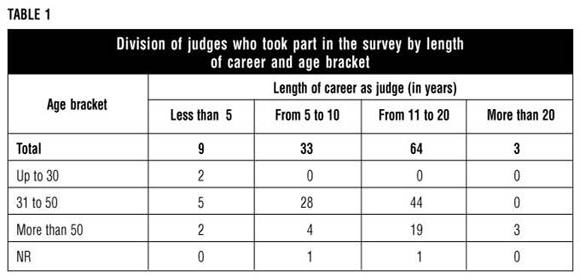
]]> The judiciary, as a social institution, still reflects a male predominance in positions of power. The majority of judges, or 60%, are males. Nevertheless, as these institutions have become more feminized over the years due to the changes in society, the difference between the two percentages has narrowed significantly. This phenomenon is most noticeable in trial courts, where new judges start their careers. It appears that the higher the court, the lower the percentage of female judges, as these courts are the workplace of older magistrates.The Table 1 (right) illustrates a division of the judges who took part in the survey, arranged by length of career and age bracket. From this table, we can tell that there is only a slim chance that anyone would become a full judge before they become 30 years of age. Only 2 (2%) of the full judges surveyed are in this age bracket. Of the 77 judges in the age bracket of 31-50 who represent nearly 75% of the interviewees, 44 have been judges for 11-20 years. And this is the age bracket that figures the most among trial court judges in the judicial district of the city of Rio de Janeiro. Not a single judge from this age group has had a career spanning more than 20 years, which leads us to believe that judges with more than 20 years experience are usually promoted to the state’s appellate courts. The vast majority of judges, who are more than 50 years old, have had careers spanning from 11-20 years. In this age group, only 2 have been judges for less than 5 years. It is rare for people to become judges at this age; and it is also rare for full judges to continue working in a trial court once they have turned 50.
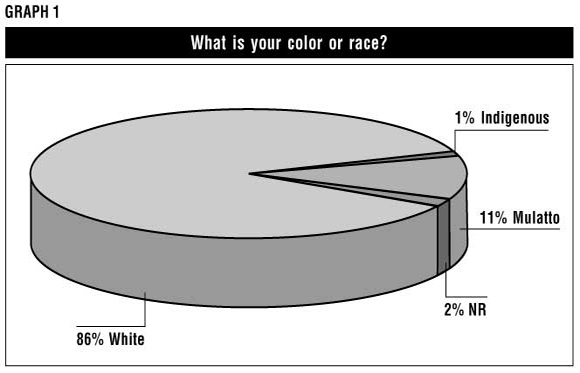
The most striking percentages – although by no means surprising – refer to the color or race of the judges, as we can see in Graph 1 (right). Judges who described themselves as white represent 86% of the total. This result confirms the existence of a marked exclusion of the black/mulatto population from the profession of judge, given that, according to Brazil’s 2000 Census, blacks*** and mulattos account for 44.6% of the Brazilian population.
Qualifications in human rights
Considering that in qualifying judges the inclusion of "human rights" as a subject is a factor capable of influencing their application of norms that ensure such rights, particularly during their baccalaureate graduate degree studies, the questionnaire asked about the existence of this subject at universities.
Subjects relating to human rights do not generally carry much prestige in university graduation courses. When asked whether a human rights course existed during their baccalaureate studies, 84% of the judges responded negatively. Among those who responded positively, only 4% said the subject was obligatory, while 12% said it was optional.
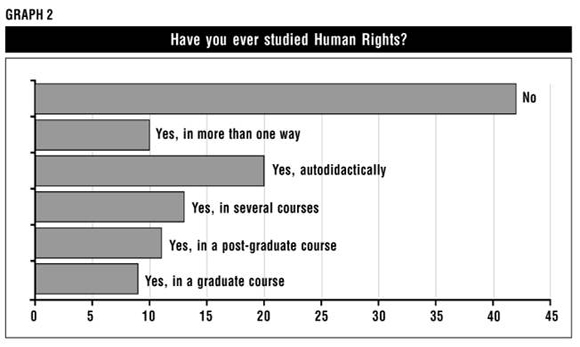
Despite the all but nonexistent provision of this subject in universities, yet considering the importance of the topic, the judges were asked about their interest in studying human rights. Their responses are shown in Graph 2 (right). An analysis of the graph enables us to conclude the following: 42 judges (40%) have never studied human rights. This information reveals that four out of every 10 judges have had no formal instruction in the systematic examination of fundamental human rights issues.
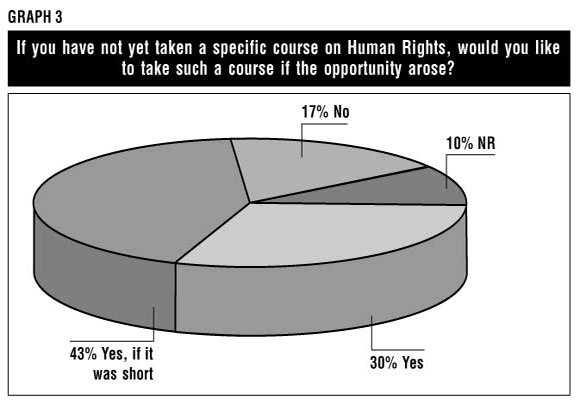
It is worth pointing out that despite the relative lack of training on the topic by the majority of the judges, many of them demonstrated an interest in taking courses on human rights: nearly 73% would be prepared to study the topic, as is shown on Graph 3 (below).
]]>
When asked whether they had any personal, hands-on experience in the area of human rights, the results revealed an even greater abyss between the judges and the topic. Only 6% of interviewees said they had engaged in any way in this area.
An analysis of this data helps us understand, at least preliminarily, why the rulings of these judges draw so infrequently on the human rights instruments of the United Nations (UN) and the Organization of American States (OAS) systems. With the subject so overlooked by the judges, the application of human rights norms is hampered.
Conception of human rights
When it comes to legal and political theory, there is a reasonable consensus on the fact that for a proper understanding of the Democratic State of Law, human rights are a fundamental topic. From this perspective, Jürgen Habermas (2003), when asserting the "equiprimordiality", that is, the inner nexus between human rights and democracy (popular sovereignty), declared that a state cannot be considered truly democratic without the effective implementation of human rights. This means that citizens may only make effective use of their public autonomy if they are sufficiently independent, in virtue of the uniformly assured human rights. In this vein, Brazil will only be able to complete the democratization process prescribed in its Constitution when human rights become part of the daily life of its citizens, with full legal force. To achieve this, the state is expected to take effective steps to promote rights either by political action through the legislative and executive branches, or through guarantees from the judicial branch. Nevertheless, it is necessary, first and foremost, to ensure that judges – as the last bastions of justice – understand human rights.
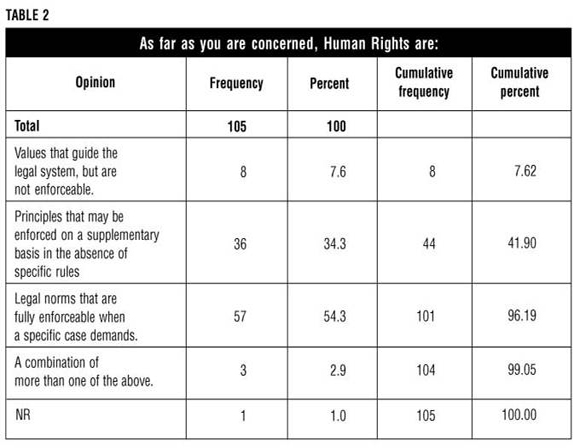
In the Table 2 (below), we can see that, when questioned on the nature of human rights, 7.6% of judges affirmed that they were "unenforceable values". For another 34.3%, human rights constitute "enforceable principles in the absence of a specific rule", while 54.3% considered them "fully enforceable rules". It is important to emphasize that nearly 7% of the judges conceived human rights merely as values that carry absolutely no legal clout, in spite of all the legal and political efforts made to assert these rights. This opinion is not so dissimilar from the 34.3% of judges who considered that these principles have a "supplementary nature", and may be applied only in the absence of a specific rule. For this group of judges, any deliberation following a more specific rule, even if it is conflictive, would preclude the application of human rights norms. However, the majority of the responses demonstrated a strong conception of human rights, as more than 50% of the judges considered human rights fully enforceable rules.
]]>
Indivisibility of human rights
Delivering sentences that assure effective application of the different generations of human rights – not least the defense of these rights in a democratic State with limited financial resources – involves important issues that need be reflected and deliberated on by the executors of the law.
Historically, human rights emerged as civil rights opposing invasive action of the state in the area of individual liberties and private property rights, and requiring abstention on the part of the state. However, considering the "non-exhaustive" nature of human rights, since they emerge and evolve within a given social context, new generations of rights have developed what now constitute human rights. According to Norberto Bobbio (2004, p. 53), the rights enshrined in the 1948 Universal Declaration of Human Rights represent "a summary of the past and an inspiration for the future: but its dictates are not carved in stone", as these rights are historical and constitute a group permanently open to fresh additions, specifications and upgrades.
We have moved from the context of a "liberal state of law" to a "state of social well-being", with the respective protection of other rights, such as: health, education, housing, defense of the environment, and others. This shift has required the state to take positive regulatory action – and at times, intervene in the country’s social and economic reality. Controversies sometimes arise concerning the enforcement of these social and economic rights, as many argue that their promotion is the job exclusively of political action by the executive and legislative branches. In other words, it is not up to the judicial branch to protect these rights when this incurs an obligation for the legislative branch, which is autonomous in its legislative acts. The problem that arises is the following: are there acceptable legal arguments for not judicially guaranteeing these rights? To put the question another way: can the judiciary, as a branch of the state, abstain from assuring rights capable of endowing citizens with minimal conditions for subsistence, particularly in a society so profoundly unequal as Brazil’s?
Ultimately, this boils down to the important matter of the indivisibility of human rights. Regardless of the different classifications they receive, be they civil or political rights (to life, to liberty, to equality or to equal political participation) or economic and social rights (to housing, to work, to education and to health), human rights are complementary and interdependent. At this point, we might cite a 1977 UN General Assembly resolution, n. 32, which asserts the indivisibility of human rights and their inalienable character, while ratifying the mandatory character of economic and social rights (see Mello, 2001, v. I, p. 816).
The 1993 Vienna Declaration of Human Rights reiterates the indivisible conception of human rights by affirming, in paragraph 5, the universality, interdependence and interrelation between civil and political rights and economic, social and cultural rights. The firm guarantee to preserve the dignity of the human person presupposes the enforcement of all these rights. The exercise of citizenship would be impeded if, while the right to vote was guaranteed, the same guarantee were not extended to the right to a high quality public education and healthcare.
]]> Based on these considerations, we can now take a look at the opinion of the 105 judges who agreed to answer the following question: "Do you think that economic, social and cultural human rights can be judicially applied in the same way as civil and political human rights?". A small minority of judges responded that the judicial application of economic and social rights cannot occur in the same way with civil and political rights. A minority of magistrates also believe that the judiciary should not interfere in promoting the enforcement of second generation rights, claiming that the implementation of public policies is not the job of the judiciary. Furthermore, others believe that the protection of these rights is the jurisdiction of the other two branches of government, or that application by the judiciary would result in the phenomenon of a judge legislating from the bench. However, the vast majority of magistrates (79%) defend that economic and social rights as well as civil and political rights can equally be judicially protected. In addition, they also consider that even rights that require the action of the State should be judicially protected. Therefore, a sizable portion of the interviewed judges, approximately 80%, assign to human rights, at least theoretically, the condition of fully enforceable norms, and they consider that even those rights that might interfere with the budget of the State should be assured by the courts.
Application of human rights norms
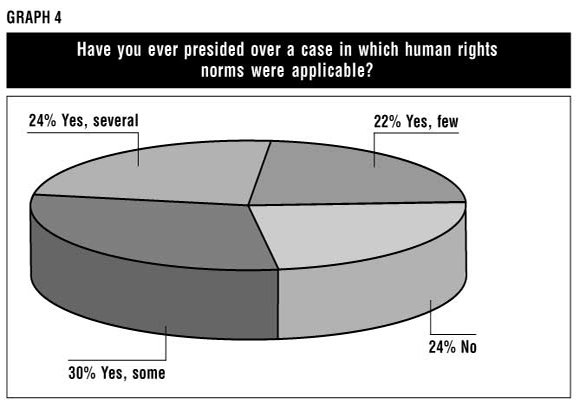
In our survey, one of the most significant questions referred to the justiciability of human rights, enquiring into the involvement of judges in the outcome of cases which required the application of human rights norms (see Graph 4, below).
The question was intended to ascertain whether the interviewee recognized the presence of human rights norms in the cases they preside over, given that these norms present themselves in multiple forms in the Brazilian legal system, veritably constituting normative developments in the judicial protection of dignity.
When asked about their involvement in cases in which human rights norms were applied, 24% of the judges responded negatively. Another 25% said they had presided over several proceedings requiring norms of this nature, 30% said they had presided over some cases in which human rights norms were applicable, while 22% said they had judged few such cases.
]]> One can observe, therefore, that 52% of interviewed judges had presided infrequently over claims requiring human rights norms. What’s more, if we consider both the judges who had only occasionally been involved in these proceedings and those who had never presided over such cases, the percentage rises to 76%. Paradoxically, however, the majority of the interviewed judges said that in the Brazilian legal system human rights are fully enforceable norms, although they are not effectively applied, since they are not inherent in the legal cases they have been submitted.It must be pointed out, however, that such reasoning cannot be considered accurate. As a matter of fact, a sizable number of the cases submitted to the judiciary are conflicts that have human rights at their very core, and as often as not actually involve fundamental rights.
Therefore, this raises the hypothesis that the judges are ignorant about human rights: their lack of intimacy with the general concept of human rights and the norms of those rights may have clouded the perception of the interviewees, making it difficult for them to recognize cases dealing with this topic.
We should not forget, meanwhile, that in all cases submitted to the judiciary, the judge should take into account the full scope of the law, making a systematic interpretation. After all, legal norms are not the written laws or the body of laws themselves, but the meaning that is built from a systematic interpretation of the law.
Consequently, presiding judges should always take the dignity of the human person into account, as this is one of the fundamental values of the Brazilian democratic state, and as such has been enshrined in Article 1, Item III of the 1988 Brazilian Constitution.
It would seen reasonable then, that when the matter in question is an existentially subjective situation, the legal norm should be constructed based on human rights, either from the constitution or from international human rights norms, even if the intensity of the bond may be considered different (see Sarlet, 2002, p. 85). Non-recognition of such applicability may therefore be associated with questionable knowledge of, or even ignorance of the topic.
Affirmative action
One of the most valuable principles enshrined in the 1988 Federal Constitution is the concept of isonomy, which is engraved in Article 5, caput,* and which states that everyone is equal before the law. We must bear in mind, however, that the principle of isonomy was, historically, a victory won by the French and American revolutions at the end of the 18th century, and was aimed at abolishing the privileges of the nobility and the clergy.
At the time, it was important to formalize this equality. But over the years, experience has taught us that merely defining this right in law does not guarantee that all individuals have the same opportunities for effectively accessing the prerogatives available to society.
]]> By way of an example, we might cite the dichotomy between free public schools and private institutions in Brazilian primary and secondary education. The former offer a questionable education to pupils with sparse financial resources, while private institutions, greater in number, provide an excellent service to well-to-do students. The situation is paradoxically reversed when it comes to university entrance examinations: the vast majority of students who are accepted into tuition-free public universities, which are renowned for their excellence, come from private secondary schools.Until fairly recently, public institutions always selected students for higher education courses based entirely on the results of entrance examinations. Historical inequalities and the uneven access to education by students were ignored. As a result, a very controversial quota policy has been established in some Brazilian universities, that while always observing the results of entrance examinations for each category of candidate, also takes into account socio-economic criteria, and eventually will include ethnic parameters.
The aforementioned example is just one of the situations embraced by the policy of affirmative action, which symbolizes the attempt to make up for the shortfalls of the liberal model through the social action of public institutions. As such, equality can be conceived as having a dual dimension: formal and material. From the formal treatment conferred to the principle of isonomy, expressed in the maxim "everyone is equal before the law", there is now an attempt to actually "materialize" these guarantees. In this context, "the state abandons its traditional position of neutrality and as a mere spectator of the conflicts that embitter the coexistence between mankind and starts to act actively in an attempt to enforce the equality substantiated in constitutional texts" (Gomes, 2001, p. 20).
One might say, then, that affirmative action policies aspire to combat political and social inequalities and consist of any form of incentive that will distribute rights that are unattainable for discriminated groups. It is important to emphasize that this is done within the established Brazilian constitutional order, which textually is within the context of a democratic state of law that ensures that development, equality and justice are supreme values guiding a fraternal, pluralistic and unprejudiced society.
From this point of view, it became important to question the judges about the constitutionality of affirmative action, since the policy appears to be a suitable means of "materializing" human rights.
Looking at the Table 3 (below), 22.9% of the judges said they consider affirmative action unconstitutional, as it breaches the principle of isonomy, which in turn illustrates that they consider equality purely in its formal sense. Among the interviewees, 10.5% chose not to respond, although 66.7% subscribed to the opinion that affirmative action is constitutional, given the need to make up for social and historical inequalities.
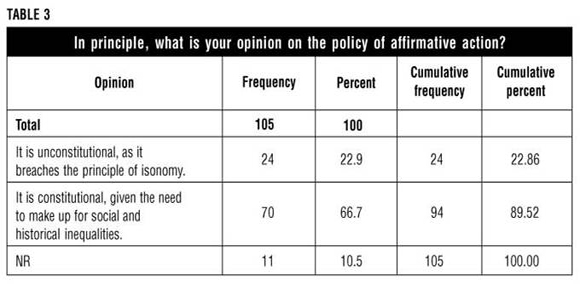
]]> These data permit us to conclude that the legal conception of isonomy is still dichotomic, although the material dimension does prevail, since the vast majority of interviewees demonstrated that they accede to the principle of the democratic state of law that is present throughout the text of the Brazilian Constitution and is expressly enshrined in Article 1.
It should be noted, moreover, that by accepting the constitutionality of affirmative action, judges do not necessarily agree politically with the policy, but only with its admissibility in the legal-constitutional order.
The UN and OAS protection systems
The advent of the Universal Declaration of Human Rights (December, 1948) and the American Declaration of the Rights and Duties of Man (April, 1948) prompted the development of the UN and OAS International Systems of Human Rights Protection.
The UN Protection System is comprised of both norms of a general scope that take into account all individuals, in a generic and abstract way, and norms of a special scope, aimed at specific subjects and violations that require a differential response. Brazil has ratified the majority of these international instruments, namely: the Convention on the Elimination of All Forms of Racial Discrimination, on 27 March 1968; the Convention on the Elimination of All Forms of Discrimination Against Women, on 1 February 1984; the Convention on the Rights of the Child, on 24 September 1990; the Covenant on Civil and Political Rights, on 24 January 1992; and the Covenant on Economic, Social and Cultural Rights, on 24 January 1992. Nevertheless, in the case of analyzing individual claims, Brazil does not recognize the jurisdiction of their supervisory and monitoring bodies, such as the Human Rights Committee and the Committee against Torture.
Besides the UN Protection System, there is also the regional Inter-American Protection System. The two protect the same rights, and victims may select the most convenient of the two. They complement each other, providing an additional guarantee and a greater promotion and enforcement of the fundamental right of the dignity of the human person. At a regional level, European and African systems of human rights protection also exist.
When the judges were asked whether they had any knowledge of the workings of the UN and OAS protection systems, they gave the responses illustrated in Graph 5 (below): 59% have a superficial knowledge, while 20% do not know how the protection systems work.
]]>
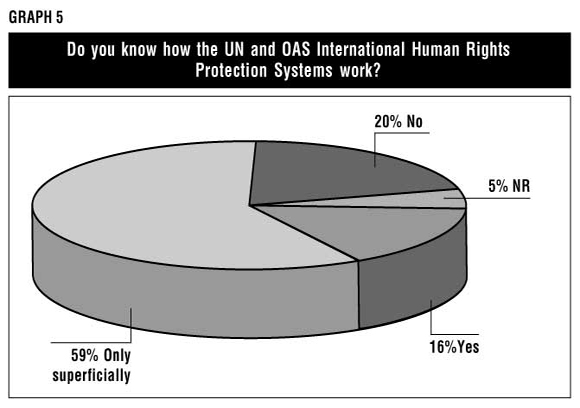
Considering the two highest percentages together – the highest representing those who have a superficial knowledge and the second highest those who have no knowledge of the systems – a full 79% of the judges are not properly informed about International Human Rights Protection Systems. Such ignorance constitutes an obstacle to the full enforcement of these rights by the judicial branch on a routine basis, since this lack of information is closely connected to the non-application of human rights instruments.
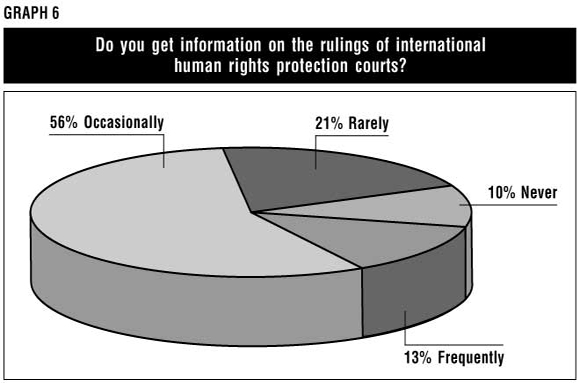
To a question which addressed their knowledge of the rulings of international courts of human rights, 56% of the judges responded that they only occasionally examine this information; 21% said they rarely do; 10% said they have never examined these decisions; and only 13% answered that they frequently look at this information (see Graph 6, right). There is no doubt that the percentage of 13% for judges who frequently access these decisions is extremely low for any real proliferation of a human rights culture.
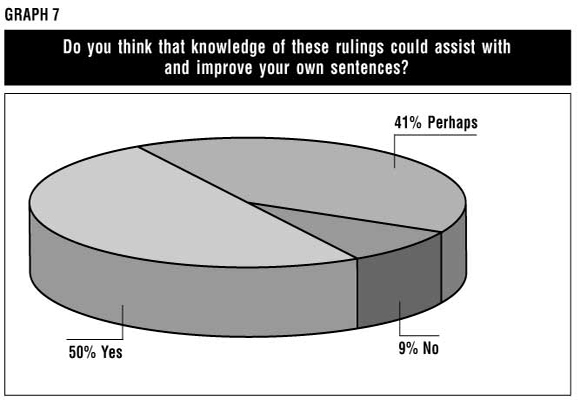
When asked about the possibility that knowledge of these rulings would assist with and improve their own sentences, 50% of the interviewed judges answered yes; 41% said perhaps; and 9% answered no (see Graph 7, right). Therefore, although few of the judges know the details of these rulings, the majority believe that it would be useful to familiarize themselves with them. This illustrates the importance of establishing a means of publicizing the rulings of international courts of human rights at the State Supreme Court, as part of a process to foster a greater application and enforcement of these rights.
]]>
Specific use of human rights instruments
The Covenant on Civil and Political Rights and the Covenant on Economic, Social and Cultural Rights
The United Nations General Assembly approved, on 16 December 1966, the International Covenant on Civil and Political Rights (ICCPR) and the International Covenant on Economic, Social and Cultural Rights (ICESCR), which were both ratified by Brazil in Legislative Decree n. 226 (12 December 1991) and enacted by Decree n. 592 (12 June 1992). It could be said that the ICCPR resembles the first Declarations of the Liberal State, while the ICESCR is more like the Constitutions of the Welfare State. Both texts specify the content of the Universal Declaration of 1948, and the elaboration of two covenants, not just one, as Fabio Konder Comparato (1999, pp. 276 and following) does well to point out, is illustrative of the natural divide between the capitalist and socialist blocs, given the polarization that was characteristic of the era.
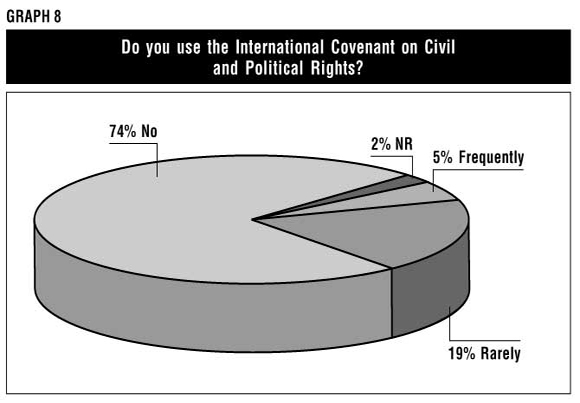
With regard to the International Covenant on Civil and Political Rights, only 5% of the judges said they apply it with any regularity and 74% said they have never used it, while 19% said they do so only rarely (see Graph 8, right).
The results are even more worrying in relation to the Covenant on Economic, Social and Cultural Rights (Graph 9, right). Only 3% of the judges said they apply it frequently when sentencing; 20% rarely do so and 75% never use this instrument in their cases.
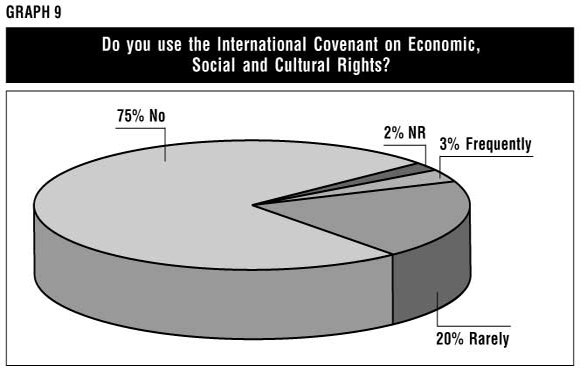
It is somewhat surprising that a mere 5% of judges from the judicial district of the city of Rio de Janeiro use the ICCPR, and that nearly 75% of them have never applied the ICESCR. Putting aside all the material and moral issues involved, it is also worth considering that the application of human rights instruments has more than merely a legal function per se, it is also symbolic. The application of these rules demonstrates that government agents and the community itself are aware of the fact that the protection and promotion of human rights are developed on two closely related dimensions: national and international.
American Convention and the Protocol of San Salvador
The human rights system of the Organization of American States holds states internationally responsible for human rights violations. Consequently, the invasion of a person’s legally protected rights by the state makes it internationally accountable. The Inter-American Commission on Human Rights and the Inter-American Court of Human Rights have been established and formed by impartial and independent people, with the intention of avoiding any selectivity by the system, and avoiding the eventuality that the offending state is simultaneously judge and party in the same case.
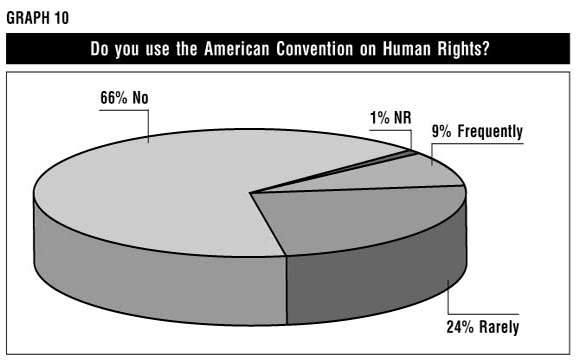
]]> On this topic, 66% of the judges said they do not use the aforementioned convention (see Graph 10, right). This result reveals that, in spite of the advances made by the international community in establishing a minimum consensus on human rights, and in creating the necessary legal instruments to assure them in practice, many judges still ignore this process and its contribution to the strengthening of democracy.
The inter-American system initially relegated economic, social and cultural rights to a position of secondary importance. Taking this into account, the Additional Protocol to the American Convention on Human Rights in the Area of Economic, Social and Cultural Rights, or the Protocol of San Salvador, was adopted on 17 November 1988.5
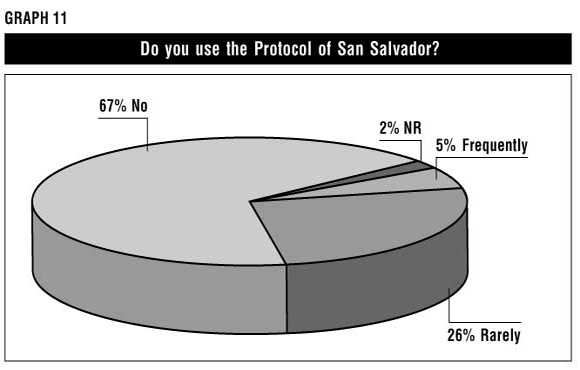
As can be seen in Graph 11 (right), when asked about the Protocol of San Salvador, 93% of the judges said they never or rarely used it. This is indeed alarming when one considers the reality of Brazil, which is marked by deep-rooted social inequalities. There can be no doubt of the importance of economic, social and cultural rights as a legitimate means of guaranteeing minimums of social well-being.
It is curious to note that 79% of the judges said they consider economic, social and cultural rights norms just as effective and applicable as the norms assuring civil and political rights, but in practice, they do not draw on them as grounds for their decisions.
Convention on the Elimination of All Forms of Racism
Prompted by important historical events that occurred in the 1960s – including the admission of 17 new African countries to the United Nations; the 1st Non-Aligned Movement Summit in Belgrade (1961); and the resurgence of Nazi-fascist activities in Europe – the UN adopted, on 21 December 1965, the Convention on the Elimination of All Forms of Racial Discrimination, which was ratified by Brazil on 27 March 1968.
This convention is part of the so-called Special System for the Protection of Human Rights. Special because, unlike the general system that targets protection for all people, abstractly and generically, the Special System for the Protection of Human Rights is aimed at particular subjects of law, considered in their specificness and in the reality of their social relations. This system is a complement to the general system, and focuses on protecting and promoting the equality of historically discriminated groups and individuals. It is grounded on the principle of equity, according to which differential treatment should be afforded to certain groups or individuals to help redress past inequalities. The Inter-American system has no international instrument for the elimination of forms of racial discrimination.
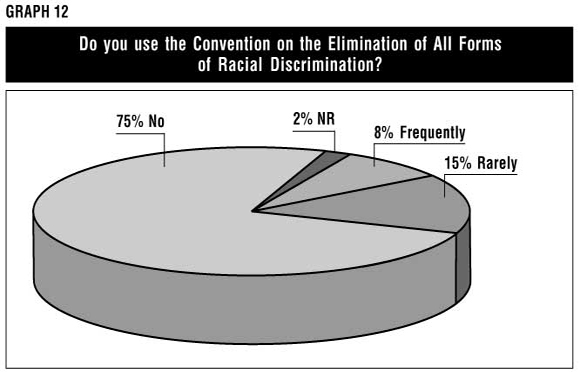
Concerning the Convention on the Elimination of All Forms of Racial Discrimination, the survey revealed that 75% of judges never draw on this international instrument, while 15% rarely do so (see Graph 12, right). This result is particularly unsettling in a country in which racist behavior is still a routine occurrence. The first step towards abolishing racism in our social environment is in recognizing that the problem exists and that it deserves urgent treatment. This matter must not be overlooked by the judiciary. In this vein, neglecting to use this convention is akin to rejecting a powerful weapon for combating racism in all its forms. This does not mean turning a blind eye to any fundamental role of the Brazilian Constitution, but rather incorporating an important instrument for eliminating racism.
Convention on the Elimination of All Forms of Discrimination Against Women
Men and women have equal rights and duties. This is guaranteed by Article 5, Item I of the Brazilian Constitution, which reflects the concern of the original constituents to correct a situation that remains societally engrained in the most routine of daily occurrences. It is remarkable that in the 21st century women still do not enjoy the same treatment as men, in spite of the unquestionable doctrinal and legislative developments of the past few decades.
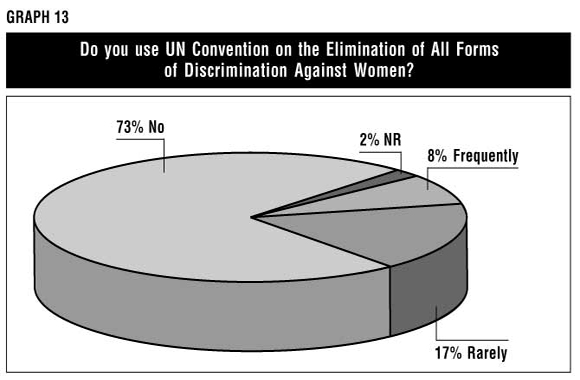
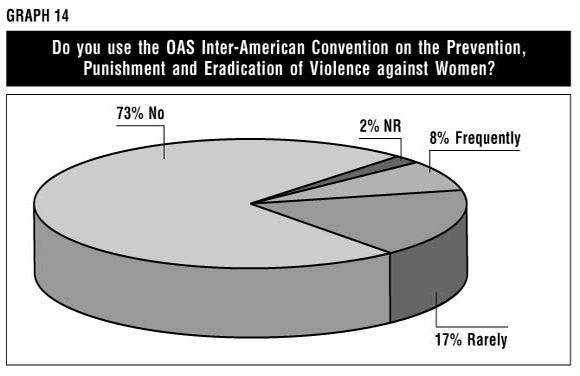
This survey found that only 8% of judges frequently employ the UN Convention on the Elimination of All Forms of Discrimination Against Women and the Inter-American Convention on the Prevention, Punishment and Eradication of Violence Against Women (see Graphs 13 and 14, below). At the other end of the scale, 73% said they have never drawn on these conventions, while 17% said they have done so only rarely. This result can be interpreted both as an obstacle to the proper enforcement of fundamental rights, and as a barrier to the establishment of equality between men and women. This equality can only be achieved by a conjunction of two parallel movements: one is the cultural movement, which is more complex and long-term; the other is the legal movement, capable of producing more immediate results, but one that requires recognition and application of available legislation.
]]>
Convention against Torture and Other Cruel, Inhuman or Degrading Treatment or Punishment
The Universal Declaration of 1948 is doubtless the most important document when it comes to abolishing acts of torture. Thereafter, the absolute rejection of any such acts was reaffirmed by a series of broad-ranging covenants and conventions, such as: the European Convention on Human Rights (November 1950); the International Covenant on Civil and Political Rights (December 1966); the American Convention on Human Rights – the Pact of San José, Costa Rica (1969); the UN Convention (1984); and the OAS Convention (1985). Accordingly, torture has been recognized as a crime established in International Law, imposing upon states the obligation to prevent acts of torture, and to punish violators.
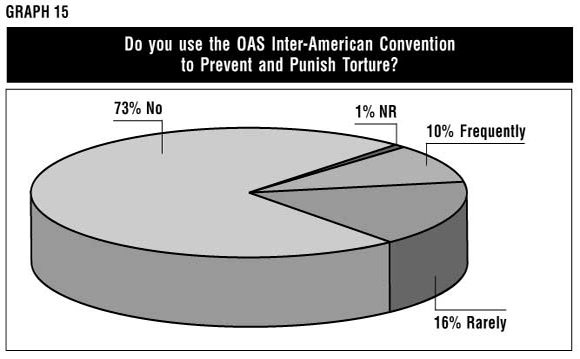
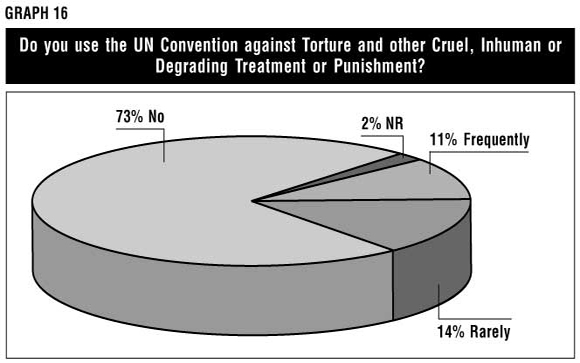
In Article 1.III; Article 4.II; and Article 5.I and 5.II, the Brazilian Constitution of 1988 demonstrates that it affords special or differential treatment to internationally enshrined rights and guarantees, accompanying the trend followed by other Latin American constitutions. Nevertheless, when asked whether they apply these conventions, only 10% of judges said they made frequent use of the Inter-American Convention against Torture and just 11% said they often used the protection system of the UN Convention. Only a slightly higher percentage said they rarely draw on these conventions – 16% and 14%, respectively, given that 1% and 2% did not respond. But the percentage of judges who never use these conventions in their sentencing is extremely high: 73% (see Graphs 15 and 16, right).
]]>
Despite the fact that these instruments establish rights for Brazilian citizens and obligations for Brazil in the eyes of the international community, they are of little value if the executors of the law keep silent.
Convention on the Rights of the Child
Following the Declaration of the Rights of the Child, on 20 November 1959, and the International Year of the Child, in 1979, the doctrine of full protection for children prevailed, later expressed in the Convention on the Rights of the Child (20 November 1989). The 1959 Declaration had already professed that "mankind owes to the child the best it has to give", thereby establishing a moral commitment to be assumed by future generations. However, history has proven to be particularly cruel to the infant and adolescent population. By way of example, each year thousands of children are compelled to leave school to help sustain their families.
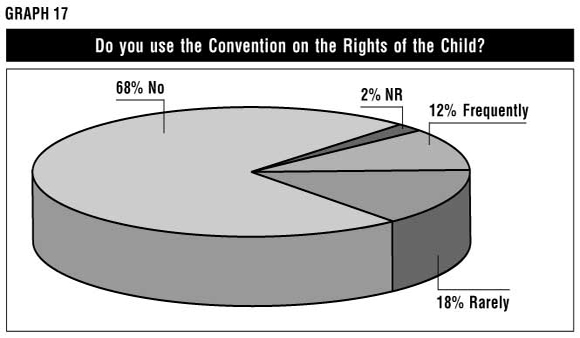
Our fieldwork reveals, as illustrated in Graph 17 below), that just 30% of the trial court judges that took part in the survey apply the convention in question – a figure arrived at by adding the 12% that use it frequently and the 18% that do so rarely. In contrast, 68% have never used this instrument to protect the situation of Brazilian children. A Brazilian law, n. 8069/90, establishes the Child and Adolescent Statute (Estatuto da Criança e do Adolescente – ECA); a modern and sophisticated legislation protecting infants and juveniles. Particularly when considering the symbolic importance of using the inter-American and UN human rights systems, there can be no reason for omitting the application of the convention.
]]>
The historical and social context outlined above accentuates the need for and the importance of the United Nations Convention on the Rights of the Child; ratified by Brazil on 24 September 1990. It is worth pointing out that only two countries have not ratified the 1989 convention: the United States and Somalia.
Convention on the Elimination of All Forms of Discrimination against Persons with Disabilities
The constitution of a fraternal, pluralistic and unprejudiced society founded on social harmony, as set forth in the preamble of the Brazilian Constitution of 1988, requires a substantial effort from all people to recognize and respect differences. In the specific case of persons with disabilities, the demand for respect is not just of a moral order, to substitute feelings of commiseration for those of solidarity, but of a social and political order, to substitute rhetorical discourse for effective action to promote inclusion.
This requires the implementation of policies to dismantle the numerous barriers confronting all persons with disabilities – from access to education to inclusion in the job market. It is along precisely these lines that the legal system enumerates, in the very constitution, specific provisions for this group of people, such as articles 7, 23, 37 and 203.
These provisions endow the Brazilian Constitution with all the conditions necessary to embrace the Inter-American Convention on the Elimination of all Forms of Discrimination against Persons with Disabilities. The abovementioned convention was ratified in Brazil by Legislative Decree n. 198/2001 and Executive Decree n. 3956/2001. However, as the results of our survey reveal (see Graph 18, right), the convention is not commonly used by executors of the law as an effective instrument in the ongoing struggle for the rights of persons with disabilities.
]]>
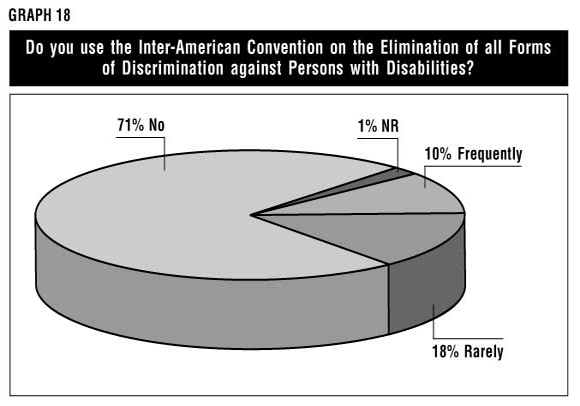
When asked about the use of this convention as grounds for their sentences, just 10% of the judges said they used it frequently. Of all the judges interviewed, a full 71% said they had never drawn on the convention and 18% said they had done so rarely.
In a country with nearly 24 million people with some form of disability6 and very few effective societal policies capable of dismantling barriers; it is truly remarkable to note that this convention – an important legal tool – is so infrequently applied. As an explanatory hypothesis, one could point to a combination of two basic factors: (1) the low number of judicial claims made to guarantee the rights of persons with disabilities; (2) the lack of knowledge, on the part of judges, of the International Human Rights Protection Systems to which Brazil is a signatory.
Decisive variables in the application of human rights
The choice of regression models as a tool to help analyze the data above is related to their applicability in hypothesis tests, used to test the influence of the profiles of judges, their qualifications, and their conceptions of the topic, in their application of the enforcement of human rights in the trial courts of the city of Rio de Janeiro.
To build the multinomial logistic models, the response variable was an indicator of the use of international instruments as grounds for the sentences handed down by the judges. This variable was created from the responses "frequently", "rarely" or "never" given for each of the eleven instruments contained in the survey.
The indicator variable was considered "frequently" when this response was given for at least one of the instruments, and it was considered "rarely" when there was not any response of "frequently" but at least one response of "rarely". It was considered "never" when this response was given for all the instruments.
The procedure adopted to build the models consisted of applying hypothesis tests to calculate the contribution of each variable to the model, at a 5% significance level. The variables that could be considered significant at the established level were used in the composition of the next model; then new hypothesis tests were applied. Finally, an adjusted model was obtained by excluding any variables that did not contribute significantly to the model.
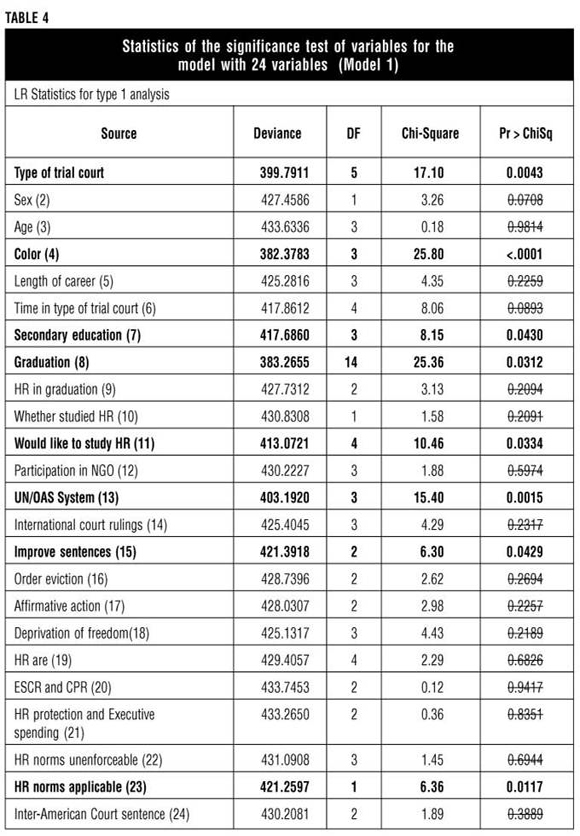
]]> The values of the statistics7 used to test the significance of the respective models can be seen in Table 4 (below). The results of the first hypothesis test, whose statistics and respective p-values are shown in this table, indicated that the following variables contributed, at a 5% significance level, to explaining the use of international human rights instruments by judges as grounds for their sentences: (a) type of trial court; (b) color and race of the judge; (c) type of school where most of their secondary education was received; (d) where they graduated; (e) their interest in taking a human rights course; (f) whether they know how the human rights protection systems of the UN and OAS work; (g) whether they think their own sentences could be assisted or improved with a knowledge of international court rulings; (h) whether they would order the eviction of a defendant who owned no other property; and (i) whether they have ever presided over a case in which human rights norms were applicable. These variables were used in the composition of the next model, to which a new hypothesis test was applied, after discarding the other variables. Statistics from the significance test for the model with eight variables are shown in Table 5 (next page).
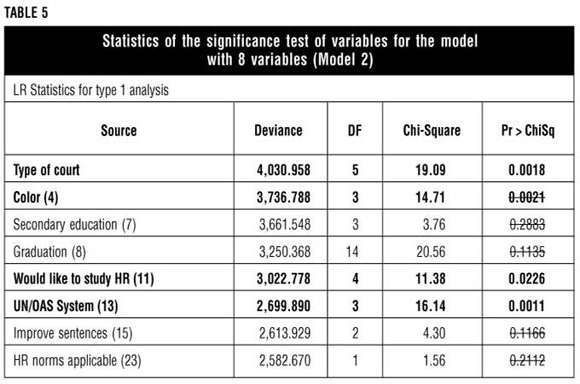
The results of the new hypothesis test, whose statistics and respective p-values are shown in Table 5, led us to conclude that some variables – the type of school where judges received most of their secondary education or where they graduated; whether they think knowledge of international court rulings could assist with or improve their own sentences; and whether they have ever before presided over a case in which human rights norms were applicable – did not contribute significantly, at a 5% significance level, to explaining the use of international instruments as grounds for their sentences. These variables were then discarded and testing was adjusted to a new model which contained the four remaining variables, shown in Table 6 (next page).
]]>
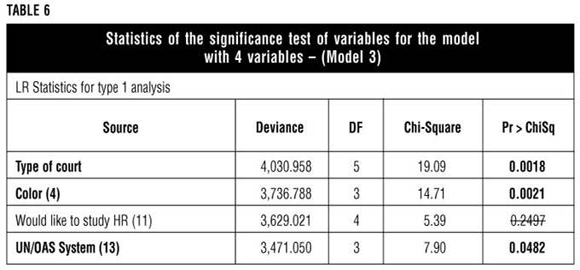
The results of the final hypothesis test, whose statistics and respective p-values are shown in Table 6, led us to conclude that the fact that a judge may or may not be interested in taking a human rights course did not contribute significantly, at a 5% significance level, in explaining the use of international instruments as grounds for their sentences. This variable was then discarded, and we concluded that the model containing only three remaining variables explained the use of international human rights protection instruments as grounds for sentences handed down at the trial courts of Rio de Janeiro as well as the previously tested models. The statistics and respective p-values are shown in Table 7 (next page).
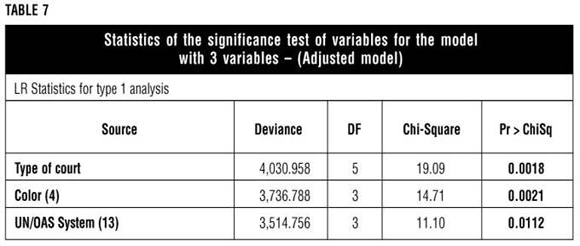
The adjusted model with the principle effects of the three variables can be obtained by applying to the general equation the estimated values of the parameters presented in Table 8 (next page).
]]>
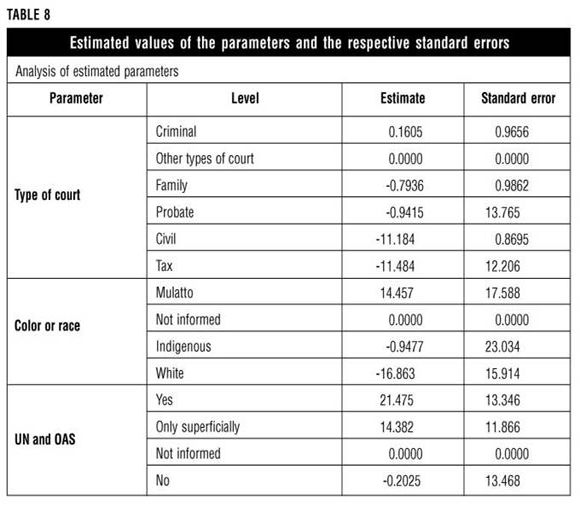
The analysis of the parameters estimated values enables us to identify the type of contribution of each variable level in the use of international human rights protection instruments in sentences handed down by judges. What follows is an analysis of each of these three variables.
Type of trial court or vara
The trial court or vara, considered here the unit of research, is organized in accordance with various areas of the law, facilitating the role of the judge and the access to justice by society.
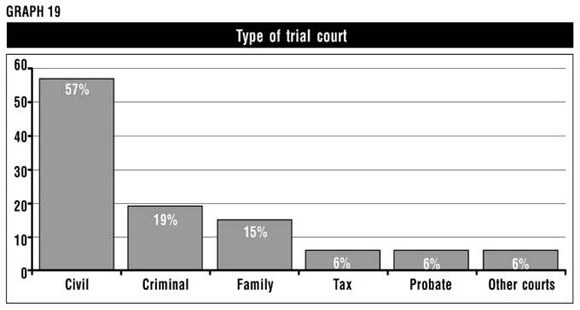
A majority of trial courts surveyed in the judicial district (57) belonged to the civil area. These are followed by criminal courts, 19 in all were surveyed, and family courts, 15 in total. Finally, six courts from each of three groups participated in the survey. These were: tax courts, probate courts, and "other courts" (see Graph 19, below).
]]>
To examine the conception and application of human rights by judges it is essential to consider the type of trial court in which the judge works, as the type of cases they handle is directly related to the application of some of the aforementioned instruments. In Table 9 (right), the types of court are organized in a declining order of their contributions to the use of international instruments as grounds for sentences.
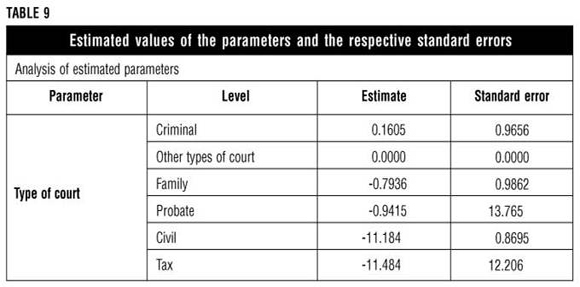
When we make a comparative analysis of the types of trial courts, we can determine that in criminal courts the probability of international instruments being frequently used as grounds for sentences is greater.
At the other end of the scale are tax courts and civil courts, which present the least likelihood of using these instruments in sentences. It is surprising that the state (tax courts) and affairs between individuals (civil courts) are so far removed, in both the public and private sphere, from discussions on the recognition of the different models of fundamental rights efficiency.
]]> The "other courts" category is also at this end of the scale – which includes youth courts, courts that oversee prison sentencing, military courts, family courts, probate courts, and courts of public records – in which the chances of judges using these instruments gradually diminishes.
Color or race
When looking at the descriptions of the judges who participated in the survey, presented in the previous section, some things that stand out are that only two judges declined to provide information on their color or race, and only one was self-described as of indigenous race. As a result, greater importance should be attributed to the white and mulatto (pardo) data. In Table 10 (right), the color or race of the judges is organized in declining order of their contribution to the use of international instruments as grounds for sentences.
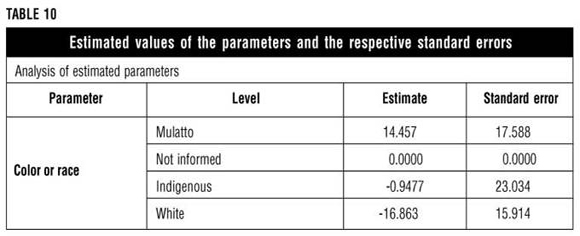
One can observe that mulatto is the color or race associated with the greater probability that international instruments will be used. Meanwhile, white judges presented the greatest probability that these instruments will never be used. The category of judges who declined to provide information on their color or race ("not informed") can be compared to the indigenous race which also presented a lower probability of frequently using international instruments in sentences.
The strong probability of mulatto judges using international human rights protection instruments to reinforce their sentences may be associated with a greater concern of this topic developed over the long history of social exclusion experienced by this social group. Even though Brazil is the country with the second largest population of African descent, the majority of people in this group endure an inferior social and economic status. The claim that ethnic exclusion does not exist in Brazil is not representative of what actually occurs in practice. The presence of mulatto people is still insignificant in universities and management positions, as well as other high-ranking social positions.
]]> The results of the survey demonstrate the consequences of a process of awareness. The privileged few from this social group who have had the opportunity to go to university and now hold the office of trial court judge act with critical awareness and concern about social inequalities. Although they are in the minority on the judicial disctrict of the city of Rio de Janeiro, mulatto judges take a position compatible with the understanding that international human rights protection instruments are powerful allies when it comes to guaranteeing human dignity.
Knowledge of the UN and OAS International Human Rights Protection Systems
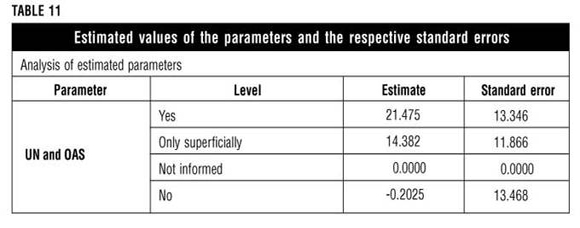
The majority of all the judges belong to a group that has no knowledge, or a superficial knowledge, of UN and Inter-American Human Rights Protection Systems. Just 17% said they have a comprehensive knowledge.8 A very brief analysis was enough to indicate that the use of human rights protection instruments by the judges is inadequate. Knowledge of these systems is reflected strongly in the application of international instruments. The chance of an international instrument being applied is minimal by a judge who has no knowledge of the protection systems in question. The chance of their application increases as lack of knowledge is converted into superficial knowledge, and even more so when converted into full knowledge. Therefore, lack of knowledge of the UN and Inter-American Protection Systems is closely associated with the non-application of international human rights instruments.
In Table 11 (below), the degree of knowledge of the UN and Inter-American Human Rights Protection Systems are organized in declining order of their contribution to the use of international instruments in sentences.
Final considerations
]]> The primary aim of this study was to investigate the extent of the enforcement, or justiciability, of human rights in adjudication by trial court judges from the comarca or the judicial district of the city of Rio de Janeiro.A thought provoking paradox emerged during the course of the survey: if the judges demonstrate a keen concept of human rights and of the application in principle of the norms that guarantee them, very few of them actually do apply these norms, particularly those of the UN and Inter-American Human Rights Protection Systems. This might be explained by these facts: only 16% of the judges know how the UN and Inter-American Human Rights Protection Systems work, and 40% of them have never studied human rights. Nevertheless, 73% of the magistrates, or the vast majority, said that if the opportunity arose they would like to take a course on human rights.
By employing the regression model, three variables – type of trial court or vara, color of judge, and knowledge of the UN and OAS systems – were found to be decisively sufficient in explaining the behavior of the judges when it comes to the use of international instruments as grounds for their sentences.
Moving on to a comparative analysis of the variables, first by type of trial court; it was determined that the use of international instruments in sentences is greater in criminal courts, and is less frequent in civil courts and tax courts. Among the magistrates, there is also a mentality that conflicts with most modern doctrinal studies; studies which recognize the enforceability of fundamental rights in private affairs. And in affairs involving the state, it is possible to encounter with a certain ease hypotheses invoking human rights protection. For example, there are cases of dependent people who claim from the state supplies of medicine and the costs of their medical treatments, based on the constitutionally assured rights to life and health.
In relation to the second variable, it was observed that mulatto was the color or race most likely to make frequent use of international instruments, while the group least likely to use these instruments was white. This result is alarming considering that the majority of judges are white.
The third variable, on the knowledge of UN and OAS Human Rights Protection Systems, reveals what has already been asserted: the greater the knowledge of the international human rights protection systems, the greater the chance the aforementioned instruments will be used.
Finally, it needs to be emphasized that an understanding of the influence of each of these three variables on the use of international human rights instruments could be extremely valuable in an implementation of mechanisms aimed at an increase in the enforcement of human rights.
There is no doubt, therefore, that all judges should be made the target of information and training efforts for the purpose of broadening their knowledge on the subject of human rights, particularly the white judges who work in civil courts and tax courts. The justiciability of human rights is, after all, a matter of improving judicial protections.
References
]]>AGRESTI, Alan. Categorical Data Analysis. New York: John Willey & Sons, 1990. [ Links ]
ALEXY, Robert. Teoria del discurso y derechos humanos. Bogota: Universidad Externado de Colombia, 1995. [ Links ]
BLALOCK, Hubert M. Social Statistics. Tokyo: McGraw-Hill, 1972. [ Links ]
BOBBIO, Norberto. "Presente e futuro dos direitos do homem". In:, A era dos direitos. Portuguese translation by Carlos Nelson Coutinho. Rio de Janeiro: Elsevier, 2004. [ Links ]
COMPARATO, Fábio Konder. A afirmação histórica dos direitos humanos. São Paulo: Saraiva, 1999. [ Links ]
]]>COSTA NETO, Pedro Luís de Oliveira. Estatística. São Paulo: Edgard Blücher, 1977. [ Links ]
DOBSON, Annette J. An Introduction to Generalized Linear Models. London: Chapman & Hall, 1996. [ Links ]
EVERITT, B. S. & DER, G. A Handbook of Statistical Analyses Using SAS. London: Chapman & Hall. [ Links ]
LOPES, José Reinaldo de Lima. "Justiça e Poder Judiciário ou a virtude confronta a instituição". Dossiê Judiciário. Revista USP. São Paulo, n. 21, 1994. [ Links ]
GAMERMAN, Dani & MIGON, Hélio dos Santos. "Introdução aos modelos lineares". Textos de métodos matemáticos n. 27. Rio de Janeiro: Universidade Federal do Rio de Janeiro, 1993. [ Links ]
]]>GATTI, Bernardete Angelina. Estatística básica para ciências humanas. São Paulo: Alfa-Omega, 1978. [ Links ]
GOMES, Joaquim B. Barbosa. Ação afirmativa e princípio constitucional da igualdade. Rio de Janeiro: Renovar, 2001. [ Links ]
HABERMAS, Jürgen. "Sobre a legitimação pelos direitos humanos". In: J-C. Merle & L. Moreira (orgs.). Direito e legitimidade, pp. 67-82. São Paulo: Landy, 2003. [ Links ]
LEVIN, Jack. Estatística aplicada a ciências humanas. São Paulo: Habra, 1987. [ Links ]
MELLO, Celso D. da Albuquerque. Curso de Direito Internacional Público. 13th ed. rev. e ampl. Rio de Janeiro: Renovar, 2001. [ Links ]
]]>MINAYO, Maria Cecília de Souza (org). Pesquisa social: teoria, método e criatividade. Petrópolis: Vozes, 1994. [ Links ]
NINO, Carlos Santiago. Ética y derechos humanos: um ensayo de fundamentación. Buenos Aires: Astrea, 1989. [ Links ]
PASOLD, Cesar Luiz. Prática da pesquisa jurídica: idéias e ferramentas úteis para o pesquisador do direito. Florianópolis: OAB/SC Ed., 1999. [ Links ]
PERELMAN, Chaïm. Ética e direito. São Paulo: Martins Fontes, 1996. [ Links ]
PÉRES LUÑO, Antonio Enrique. Derechos humanos, estado de derecho y contitución. Madrid: Tecnos, 1999. [ Links ]
]]>PIZZINGA, Adrian Heringer. Modelos de regressão para respostas nominais politômicas. Graduation monograph. Rio de Janeiro: Escola Nacional de Ciências Estatísticas (ENCE), 2000. [ Links ]
POWERS, Daniel A. & XIE, Yu. Methods for Categorical Data Analysis. San Francisco: Academic Press, 2000. [ Links ]
RATKOWSKY, David A. Handbook of Nonlinear Regression Models. New York: Marcel Dekker, 1989. [ Links ]
SÃO PAULO(State). Office of the State Attorney General. Working group on human rights. Direitos Humanos: construção da liberdade e da igualdade. São Paulo: Centro de Estudos da Procuradoria Geral do Estado, 2000. [ Links ]
SARLET, Ingo Wolfgang. Dignidade da pessoa humana e direitos fundamentais na Constituição Federal de 1988. Porto Alegre: Livraria do Advogado, 2002. [ Links ]
]]>
Coauthors: Andréa Diniz (IBGE); Alexandre Garrido da Silva and Isolda Abreu de Carvalho Mattos Sant’Anna (UERJ); Diana Felgueiras das Neves, Rodrigo da Fonseca Chauvet and Tamara Moreira Vaz de Melo (UERJ); Lia Motta Gould and Priscila de Santana (PUC-Rio)
* The comarca is a territorial division of jurisdiction of the State Justice, in opposition to the Federal Justice. It usually extends over one or more municipalities, such as the Comarca of the city of Rio de Janeiro. In this paper, comarca will be translated as "judicial district". [EN]
** The vara is a thematic sub-division of the comarca. Each comarca may encompass one or more varas. When the comarca has more than one vara, each vara will hold jurisdiction over a particular object, such as the rights of the child, family law, criminal law, and so forth. Each vara may have one or more judges in the beginning of their career. In this paper, vara will be translated as "trial court". Although this translation is not precise, it is aimed at facilitating comprehension. [EN]
*** Official research institute IBGE uses the term preto (negro) instead of negro (black). For the purposes of this survey, the term was substituted for black, while all the other categories are the same as those used by the institute. The IBGE’s term pardo has been translated here as "mulatto". [NT]
1 Ongoing survey, conducted by students and professors at the State University of Rio de Janeiro (UERJ), the Catholic University of Rio de Janeiro, the Getúlio Vargas Foundation in Rio de Janeiro and the Cândido Mendes University (Ucam).
2 The field research is still ongoing with judges from the Rio de Janeiro State Supreme Court (TJRJ) appellate courts.
3 Interviews were held, whenever possible, with the full judge or, whenever this was not possible, with the deputy judge. In cases when it was not possible to interview either, or when both turned down the interview, this was considered "no response".
4 Given unanticipated limitations, we were unable to conduct the survey in the regional courts Campo Grande (11 trial courts) and Santa Cruz (8 trial courts). ]]>
5 Adopted by Brazil through Legislative Decree n. 56/95 and Executive Decree n. 3321/99.
6 See IBGE, Demographic Census 2000.
7 These test statistics were obtained using SAS’s Proc GENMOD.
8 See the section "UN and OAS protection systems", page 144.