<?xml version="1.0" encoding="ISO-8859-1"?><article xmlns:mml="http://www.w3.org/1998/Math/MathML" xmlns:xlink="http://www.w3.org/1999/xlink" xmlns:xsi="http://www.w3.org/2001/XMLSchema-instance">
<front>
<journal-meta>
<journal-id>1518-4471</journal-id>
<journal-title><![CDATA[Teoria & Sociedade]]></journal-title>
<abbrev-journal-title><![CDATA[Teor. soc.]]></abbrev-journal-title>
<issn>1518-4471</issn>
<publisher>
<publisher-name><![CDATA[UNIVERSIDADE FEDERAL DE MINAS GERAIS (UFMG)Faculdade de filosofia e Ciências HumanasDepartamentos de Sociologia e de Antropologia e de Ciência Política ]]></publisher-name>
</publisher>
</journal-meta>
<article-meta>
<article-id>S1518-44712006000200004</article-id>
<title-group>
<article-title xml:lang="en"><![CDATA[Comparing houses of representatives: parliamentary recruitment in Argentina, Brazil, Chile and Mexico]]></article-title>
</title-group>
<contrib-group>
<contrib contrib-type="author">
<name>
<surname><![CDATA[Santos]]></surname>
<given-names><![CDATA[André Marenco dos]]></given-names>
</name>
<xref ref-type="aff" rid="A01"/>
</contrib>
<contrib contrib-type="author">
<name>
<surname><![CDATA[Silva]]></surname>
<given-names><![CDATA[Vera Alice Cardoso]]></given-names>
</name>
</contrib>
</contrib-group>
<aff id="A01">
<institution><![CDATA[,Federal University of Rio Grande do Sul Political Science Department ]]></institution>
<addr-line><![CDATA[ ]]></addr-line>
</aff>
<pub-date pub-type="pub">
<day>00</day>
<month>00</month>
<year>2006</year>
</pub-date>
<pub-date pub-type="epub">
<day>00</day>
<month>00</month>
<year>2006</year>
</pub-date>
<volume>2</volume>
<numero>se</numero>
<fpage>0</fpage>
<lpage>0</lpage>
<copyright-statement/>
<copyright-year/>
<self-uri xlink:href="http://socialsciences.scielo.org/scielo.php?script=sci_arttext&amp;pid=S1518-44712006000200004&amp;lng=en&amp;nrm=iso"></self-uri><self-uri xlink:href="http://socialsciences.scielo.org/scielo.php?script=sci_abstract&amp;pid=S1518-44712006000200004&amp;lng=en&amp;nrm=iso"></self-uri><self-uri xlink:href="http://socialsciences.scielo.org/scielo.php?script=sci_pdf&amp;pid=S1518-44712006000200004&amp;lng=en&amp;nrm=iso"></self-uri><abstract abstract-type="short" xml:lang="en"><p><![CDATA[The essay aims at comparing differences in patterns of parliamentary recruitment for federal legislatures in Latin American countries. Those patterns as well as the political performance of state delegations were analyzed from the viewpoint of levels of stability in the control of seats. The Chilean House of Representatives is the case presenting the highest level of stable political careers in a context of moderate political turnover.. By contrast, Mexico and Argentina present high rates of political turnover among elected representatives, a condition facilitating the access of politicians lacking previous experience at the federal sphere of politics. Brazil is a intermediary case, displaying long periods of high rates of turnover, followed by reversals of such trend, as it occurs since 1998. When changes in the composition of party representation in federal legislatures resulting from voter's behavior are discarded, one may conclude that, with the exception of Chile, the high rates of political turnover are only marginally connected with electoral variations among the competing parties. Intra-party politics determining strategies for choosing and promoting candidates appear to be the most relevant variable explaining rates of parliamentary turnover.]]></p></abstract>
<kwd-group>
<kwd lng="en"><![CDATA[Houses of Representatives]]></kwd>
<kwd lng="en"><![CDATA[parliamentary recruitment]]></kwd>
<kwd lng="en"><![CDATA[political parties]]></kwd>
<kwd lng="en"><![CDATA[political careers]]></kwd>
<kwd lng="en"><![CDATA[parliamentary turnover]]></kwd>
</kwd-group>
</article-meta>
</front><body><![CDATA[ <p><font face="Verdana, Arial, Helvetica, sans-serif" size="4"><b>Comparing houses    of representatives: parliamentary recruitment in Argentina, Brazil, Chile and    Mexico</b></font></p>     <p>&nbsp;</p>     <p>&nbsp;</p>     <p><font face="Verdana, Arial, Helvetica, sans-serif" size="2"><b>André Marenco    dos Santos</b></font></p>     <p><font face="Verdana, Arial, Helvetica, sans-serif" size="2">PhD in Political    Science, Professsor of the Political Science Department, Federal University    of Rio Grande do Sul – Brazil</font></p>     <p><font face="Verdana, Arial, Helvetica, sans-serif" size="2">Translated by Vera    Alice Cardoso Silva    <br>   Translation from <b>Teoria &amp; Sociedade</b>, Belo Horizonte, v.11, n.2, p.42-69,    July/Dec. 2003.</font></p>     <p>&nbsp;</p>     <p>&nbsp;</p> <hr size="1" noshade>     <p><font face="Verdana, Arial, Helvetica, sans-serif" size="2"><b>ABSTRACT</b></font></p>     ]]></body>
<body><![CDATA[<p><font face="Verdana, Arial, Helvetica, sans-serif" size="2">The essay aims    at comparing differences in patterns of parliamentary recruitment for federal    legislatures in Latin American countries. Those patterns as well as the political    performance of state delegations were analyzed from the viewpoint of levels    of stability in the control of seats.  The Chilean House of Representatives    is the case presenting the highest level of stable political careers in a context    of moderate political turnover.. By contrast, Mexico and Argentina present high    rates of political turnover among elected representatives, a condition facilitating    the access of politicians lacking previous experience at the federal sphere    of politics. Brazil is a intermediary case, displaying long periods of high    rates of turnover, followed by reversals of such trend, as it occurs since 1998.    When changes in the composition of party representation in federal legislatures    resulting from voter's behavior are discarded, one may conclude that, with the    exception of Chile, the high rates of political turnover are only marginally    connected with electoral variations among the competing parties. Intra-party    politics determining strategies for choosing and promoting candidates appear    to be the most relevant variable  explaining rates of parliamentary turnover.</font></p>     <p><font face="Verdana, Arial, Helvetica, sans-serif" size="2"><b>Key-words:</b>    Houses of Representatives; parliamentary recruitment; political parties, political    careers; parliamentary turnover</font></p> <hr size="1" noshade>     <p>&nbsp;</p>     <p>&nbsp;</p>     <p><font face="Verdana, Arial, Helvetica, sans-serif" size="3"><b>INTRODUCTION</b></font></p>     <p><font face="Verdana, Arial, Helvetica, sans-serif" size="2">Which relevance    is there in the study of recruitment for the Houses of Representatives? One    may raise the issue from another perspective, that is, does the knowledge of    variations in the composition of state and party delegations  - rates of turnover,    identification of short or long careers, levels of expertise in the legislative    process – increase our ability to understand and explain the dynamics of political    representation? Beginning with Shugart and Carey (1992), the study of legislatures    in Latin American countries became a reliable source of data supporting interpretations    concerning the consolidation of new  - and some not so new – poliarchies in    the region. The predominance of the executive over the legislative branch of    government is a feature well established by most scholars who detect,  in accepted    political practices  prerogatives of executive authorities not granted by the     respective national   constitutions (Shugart and Carey, 1992). They also point    out to aspects of the political process denoting such predominance:  the <i>power    of agenda </i>secured by the president, magnified by the <i>problems of coordination    </i>among elected representatives (Figueiredo and Limongi, 1999); the relationship    between presidential majority and presidential iniatives in legislation (Polina,    Weldon and Lopez, 2000); the pattern of reactive behavior common to legislatures    <i>vis-à-vis </i>the federal government (Cox and Morgenstern, 2002).  </font></p>     <p><font face="Verdana, Arial, Helvetica, sans-serif" size="2">According to the    institutionalist approach the way institutions are shaped affect the behavior    of members. Given this assumption what data on political turnover and on patterns    of political careers  tell about the working of Latin American poliarchies?    The issue may be approached from two different perspectives.</font></p>     <p><font face="Verdana, Arial, Helvetica, sans-serif" size="2">From one viewpoint    it is reasonable to assume the connection between stabler political institutions,    such as the House of Representatives, and incentives for stabler political careers,    less defections and smaller turnover rates in scheduled elections. This trend    is confirmed by long-run electoral results in western poliarchies. High turnover    rates in those cases are exceptional and the trend to stability resumes in subsequent    elections (Blondel, 1973, Best and Cotta, 2000).</font></p>     <p><font face="Verdana, Arial, Helvetica, sans-serif" size="2">High turnover rates    were a common feature in American politics till the end of the 19<sup>th</sup>    century, connected to high levels of social and geographical mobility. From    this moment onwards declining numbers of first mandate representatives became    the dominant trend, with few exceptions, such as the 37% turnover registered    in 1933. From 1950 till the beginning of the 1990s the turnover rate varied    around 16% (Polsby, 1968, Buckley, 1999, Brady, Cogan and Fiorina, 2000). The    1994 election for Congress brought along a high number of freshmen, that is,    14 Democrats and 73 Republicans. However, the total represented only 20% of    the new House (Fenno, 1997, Aldrich and Rohde, 1997, Jacobson, 2000).  The same    pattern may be found in France, where high rates of political turnover are related    to political crises. According to Gaxie (1993:85), </font></p>     <blockquote>        ]]></body>
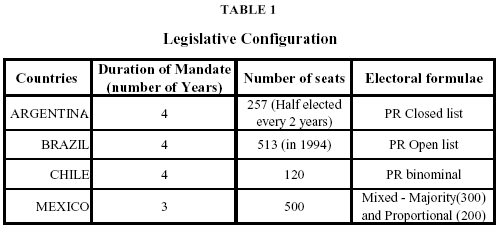
<body><![CDATA[<p><font face="Verdana, Arial, Helvetica, sans-serif" size="2"><i>lorsque une      nouvelle 'génération d`élus accède aux responsabilités comme ce fut le cas,      par example, em 1919 ou en 1945, la plupart d´entre eux parviennent ensuite      à se faire réelire et les taux de renouvellement des élections ultérieures      se stabilisent à des niveaux assez bas.</i> </font></p> </blockquote>     <p><font face="Verdana, Arial, Helvetica, sans-serif" size="2">High turnover occurred    again in 1958 when ¾ of the seats were occupied by new representatives. However,    many of them were not new to party politics: some  had previously competed in    elections or had held public offices at the local administration level (Gaïti,    1999). In 1981 the Socialists  were the majority in the National Assembly  and    the turnover rate was even higher, that is, 41,9%. But also in this case research    on the personal data of the elected show that most of them had already a political    career (<i>maire, conseiller général, conseiller municipal)</i>. Once again    the turnover was exceptional and had opened access to national politics to <i>old    hands </i>in politics.</font></p>     <p><font face="Verdana, Arial, Helvetica, sans-serif" size="2">Political recruitment    for the German <i>Bundestag</i> show a consistent downward longitudinal trend    in turnover rates. From the high of 40% registered in the first two legislatures    elected after the establishment of the Federal Republic (1949 and 1953), the    numbers are 31% for 1957 down to the low of 21% in 1987. In 1990 the turnover    rate of 35% may be explained by the commotion of the national unification. From    1994 onwards the turnover rates resumed the trend of low variation (Wessels,    1997).</font></p>     <p><font face="Verdana, Arial, Helvetica, sans-serif" size="2">The same stabilization    trend may be found in parliaments of southern European countries. As expected,    higher turnover rates were registered in the first two elections under democratic    rules. They reached 50% to 60% in Italy, Spain, Greece and Portugal. However    stabilization trends settle after the third election and stabler careers become    a common feature of the political system (Liebert and Cotta, 1990, Morlino,    1992).</font></p>     <p><font face="Verdana, Arial, Helvetica, sans-serif" size="2">From another perspective    and contrasting with the trend of lower rates of political turnover and stabler    political careers, it is plausible to assume that, given a constitutional design    restrictive to parliamentary initiatives in legislation, control over the government    and political intermediation, the incentives to  stable representative careers    become jeopardized. The result may be intermittent careers and higher  rates    of political turnover. This may have happened in Brazil, according to Fabiano    dos Santos (2000). He stresses the limitations imposed by the Federal Constitution    of 1988 upon congressional scope of action, comparing it with the Constitution    of 1946, and assumes that the changes  adversely affected the patterns of political    recruitment for the House of Representatives, that is, the rates of political    turnover become higher and abler politicians are not keen on keeping  the conquered    seats. </font></p>     <p><font face="Verdana, Arial, Helvetica, sans-serif" size="2">Following this    kind of argument one should not minimize the importance of feedback, that is,    restrictions on legislative initiative and action  and on the role of parliament    as a sphere of political intermediation impose limits on individual efforts    to building a stable political career; political recruitment may become a hazardous    process, involving higher costs of obtaining and transmitting information needed    to generate institutional loyalty and efficient coordination of political processes.    Awareness of this kind of problem may have inspired Norris's comment: <i>institutional    approach have also paid little attention to the motivation and experience of    candidates (</i>1997:09).</font></p>     <p><font face="Verdana, Arial, Helvetica, sans-serif" size="2">Polsby (1968) and    later Putnam (1976) stressed the connection between political turnover and professionalization    of parliamentary representation. High rates of political turnover may have a    positive effect on innovation and flexibility of political representation. But    they may also difficult the consolidation of political leadership and the acquisition    of legislative knowledge needed to ensure efficiency in specialized  branches    of legislation. As a side feature of this kind of problem Schepsle (1978) points    out to the prevailing attitude among freshmen whose political concerns are mainly    the ones directly connected with the interests of their constituencies. However    shared expertise may bring about collective benefits for the institution as    a whole because it maximizes the control of information needed for efficient    monitoring of public policies by the representatives. The costs of obtaining    information may be high and unapealing, unless the institution and the political    rules provide incentives to individual specialization.</font></p>     <p><font face="Verdana, Arial, Helvetica, sans-serif" size="2">Long parliamentary    careers also contribute to creating a body of knowledge shared by members of    legislatures concerning accepted practices and patterns of behavior which reduce    the element of uncertainty in the process of decision making . According to    Tsebelis, <i>if information is available, it will be easier for the individual    to choose rationally than it would be the case if the payoffs are not clearly    discernible.</i> (1998: 46). This pool of knowlegde may have resulted from political    socialization, that is, each representative learns the rules of the game by    observing his peers's actual behavior. This practical knowledge provides the    elements to be taken into account when individual calculations and definition    of strategies must be made in situations requiring evaluation of consequences    (support or denial of support by peers). From this viewpoint careful party recruitment    of candidates is generally recommended in order to maximize the pool of shared    knowledge concerning legislative institutions and practices.</font></p>     <p><font face="Verdana, Arial, Helvetica, sans-serif" size="2">Intermittent political    careers, high rates of political turnover and hazardous recruitment are features    of competitive politics which difficult the formation and consolidation of a    pool of common knowledge to be shared by the whole body of representatives concerning    policy-making processes and accepted legislative practices. The difficulty may    be increased when the political system is federal. In this institutional format    the composition of the national House of Representatives results from party    competition in elections held at subnational political constituencies. Those    constituencies may greatly vary in economic, social and cultural aspects. The    transformation of state representatives into a national political elite, able    to legislate for the whole country and in specialized matters requires learning    and incentives to adopting values and behavior congruent with the office. Stable    patterns of parliamentary recruitment become a strategic resource convertible    into political power, political prestige and votes. By contrast, when lack of    complete information and uncertainty concerning behavior of peers prevail, any    level of concertation will depend upon the balance between incentives and sanctions    offered to the individual, generally controled by other institutions such as    the executive branch of government. </font></p>     <p><font face="Verdana, Arial, Helvetica, sans-serif" size="2">This paper focus    on patterns of political careers in Houses of Representatives structured by    different constitutional designs and frames of incentives and political opportunities    in four Latin American countries: Argentina, Brazil, Chile and Mexico. It is    assumed that stabler political careers and a high level of congruence in the    distribution of party seats by region may be taken as evidence to favorable    conditions for building a parliamentary elite committed to strengthening the    legislative branch of government.</font></p>     ]]></body>
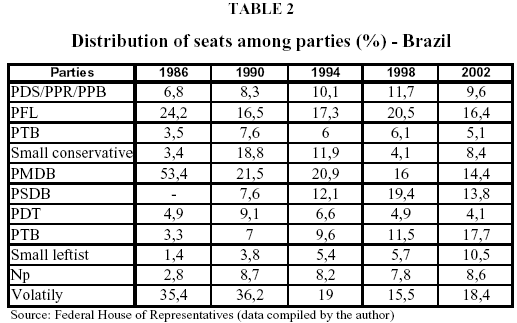
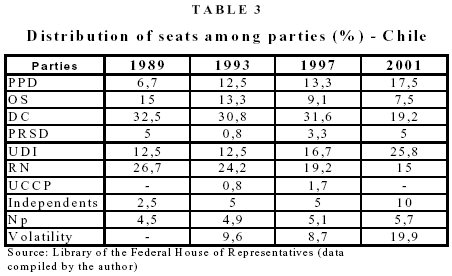
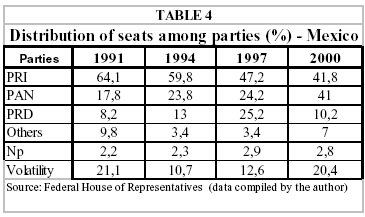
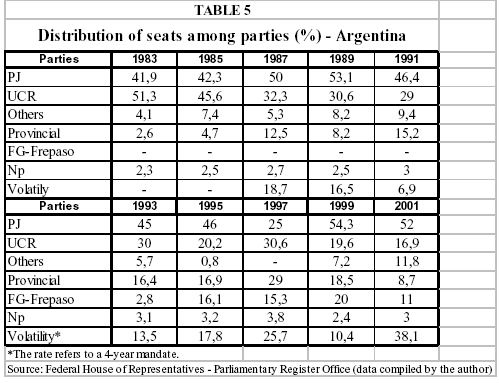
<body><![CDATA[<p><font face="Verdana, Arial, Helvetica, sans-serif" size="2">The countries under    scrutiny were chosen because of their political relevance in the region and    also because they offer good research matter, given the institutional variations    they present. The following are stressed: Argentina, Brazil and Mexico adopt    the federal format, Chile is a unitary State; their electoral systems are different    (<a href="#tab1">Table 1</a>): proportional representation with closed list    (Argentina), with open list (Brazil), a mix of majority/proportional representation    (Mexico) and binominal proportional representation (Chile); the electoral cycles    are different and connected to distinct party organizations and political traditions    (<a href="#tab2">Tables 2</a>, <a href="#tab3">3</a>, <a href="#tab4">4</a>    e <a href="#tab5">5</a>).    </font></p>     <p><font face="Verdana, Arial, Helvetica, sans-serif" size="2">The findings here    presented summarize data concerning parliamentary recruitment and electoral    results over the  recent period of the national history of each country (10    years). The number of legislatures in each case was defined by the electoral    rules of the country, establishing the length of the parliamentary mandate:    3 years in Mexico, 4 years in Argentina, Brazil and Chile, another relevant    rule being full substitution in every election or substitution of half of the    House every two years, as is the rule in Argentina.</font></p>     <p>&nbsp;</p>     <p><font face="Verdana, Arial, Helvetica, sans-serif" size="3"><b>POLITICAL TURNOVER</b></font></p>     <p><font face="Verdana, Arial, Helvetica, sans-serif" size="2">Rates of turnover    registered in every election is a basic variable in the study of parliamentary    recruitment. The turnover rate denotes the number of first mandate elected representatives    for the House of Representatives. It should be pointed out that research on    this variable does not require comparing one legislature with the previous one.    The approach here adopted is a non-sequential analysis of electoral results.    This methodological procedure does not prevent taking into account the return    of politicians who already  have  a previous political career albeit interrupted    at the national level for a given length of time. The substitutes were not considered    even when they occupied the seat during the legislature under study.</font></p>     <p><font face="Verdana, Arial, Helvetica, sans-serif" size="2">Interpreting the    meaning of parliamentary turnover should assume explanations other than electoral    defeat. The politician may have decided not to compete or may be pursuing a    political career in other branches of government. It is not a easy task to determine    the reasons why any given politician decides not to compete. However, plausible    reasons are calculations concerning one's political strength in competitive    elections and some evidence of forseeable defeat. According to Erickson, <i>turnover    also has implications for the retirement rate. When MPs anticipate electoral    defeat, many may decide to retire voluntarily</i> (1997:35). Some relevant elements    in this calculation are: the public criticism of opinions held by the politician    which may reflect on the vote, lack of financial support, loss of personal purpose    for performing the role of member of parliament.</font></p>     <p><font face="Verdana, Arial, Helvetica, sans-serif" size="2">Research focusing    on the American House of Representatives pointed out that electoral uncertainty    is a very strong reason for political retirement. The mathematical formula developed    by Black (1972) summarized this hypothesis:  U= P(Bw) + (1-P) (B1) –C. It is    thus interpreted: the utility of competing is the result of the probability    of winning (P), the gain derived from keeping the seat (Bw) compared to the    gain of other activity available in case of defeat (B1), minus the cost of competing    for reelection. The variation of Bw and C is the decisive element in the decision    to compete. Fenno (1973) stressed the same sort of calculation to explain the    decision to retire from electoral competition: uncertain victory and  the opinion    that one's priorities for the legislative agenda will not prevail. Moore and    Hibbing (1998) have recently studied political turnover in American politics,    which reached the high of 60% between 1946 and 1996. Their findings point out    to the relevance of the following variables explaining the turnover trend: being    a member of the minority party and few opportunities to hold prestigious offices    in parliament<a href="#_ftn1" name="_ftnref1" title=""><Sup>1</Sup></a>.</font></p>     <p><font face="Verdana, Arial, Helvetica, sans-serif" size="2">The interpretation    of political retirement as a defensive option in a political environment adverse    to the individual is well supported by findings comparing different political    systems. The identification of the politicians elected for the national legislatures    during the Fourth Republic in France reveals that 43% of them have held up to    5 mandates. This is indicative of a stable parliamentary elite. The political    climate changed in the parliamentary elections of 1958 and 1962 when criticism    of the Fourth Republic and of gaullist politics among the electorate allowed    for significant political turnover. In the polarized climate of opinion, and    forseeing predictable defeat, many of the <i>grands noms</i> voluntarily retired,    a development that has not received enough attention in the study of the period    (Birnbaum, 1977; Gaxie, 1993). </font></p>     <p><font face="Verdana, Arial, Helvetica, sans-serif" size="2">Later and also    quite revealing is the circumstance of the 1994 national elections in Italy,    when the <i>partitocrazia </i>collapsed (Guzzini, 1994). The traditional party    system was then imploded, the electorate displaying strong disapproval of politicians    denounced as criminals and generally avowing deep mistrust of political institutions.    The end result was the sweeping redesign of the party system, the traditional    Christian-Democrats becoming the Popular Party, the Socialist Party reduced    to a very small political association, all these changes accompanied by the    amazing electoral growth of new political groups such as the <i>Forza Italia</i>.    The extensive political realignment caused, as expected, high rates of parliamentary    turnover. In the 1994/96 elections the turnover rate reached 70%, a major change    comparing to the rate varying around 35% registered since 1953 (Briquet, 1999;    Bartolini and D'Alimonte, 1995). Two conditions may have accounted for the better    chances for freshmen in the electoral competition for a parliamentary seat.    First, the climate of political opinion unfavorable to well-known members of    the current political class; second, the decision made by many of them not to    compete. The underlying meaning of this retirement poses a interesting question    of political interpretation, thus summarized by Briquet (1999:258):</font></p>     <blockquote>        ]]></body>
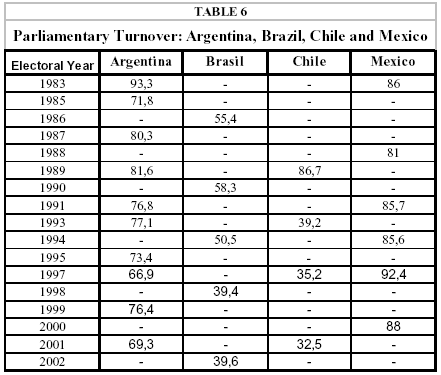
<body><![CDATA[<p><font face="Verdana, Arial, Helvetica, sans-serif" size="2"><i>dans un grand      partie des cas, le renouvellement s'explique par le fait que le nombre des      députés de la XI législature (1992-1994) ne sont pas représentés, soit qu'ils      aient anticipé une défaite prévisible, soit que leur implication dans les      affaires de corruption ait incité les appareils partisans nationaux à leur       refuser leur investiture.</i> </font></p> </blockquote>     <p><font face="Verdana, Arial, Helvetica, sans-serif" size="2">The data reveal    that 49% of members of parliament in 1994 competed for reelection, a lower rate    than the 65% in 1987 and 54% in 1992. Only 21% of those who competed for reelection    returned to the House of Representatives. The distribution of the retirement    rate is uneven, affecting more severely the Christian – Democrats (63%) and    less the Communists (34,6%). Only 12% of PPI candidates to reelection were elected,    a worse result than the overall counting for the Italian Left (<i>sinistros)</i>.</font></p>     <p><font face="Verdana, Arial, Helvetica, sans-serif" size="2">We turn now to    the chosen Latin American countries. The time span covers elections held after    the return to democratic regimes. For Chile and Argentina the study includes    all elections held for the national parliament; for Brazil and Mexico, since    the electoral calendar was respected during the authoritarian regimes, the time    span is lengthier, beginning in the second half of the 1980s, when electoral    competition among parties increased.</font></p>     <p><font face="Verdana, Arial, Helvetica, sans-serif" size="2">Taking stable poliarchies    as a guiding reference, it is assumed that routinization of democratic procedures    in new poliarchies should lead to diminishing rates of political turnover and    to incentives to stabler parliamentary careers. Available data for the countries    under study indicate variation in the expected pattern (<a href="#tab6">Table    6</a>). </font></p>     <p><font face="Verdana, Arial, Helvetica, sans-serif" size="2">The closest reproduction    of the conventional pattern of recruitment is found in Chile.  As expected,    the turnover rate is high after 16 years without elections and regular congressional    life. But beginning with the second legislature it fell consistently, the dominant    trend being a high level of political return to the seat in the following election.    Mexico and Argentina are the opposite cases. The high turnover rates in Mexico    are easier to explain: in 1933 a constitutional provision forbade consecutive    reelection for the national and provincial Houses of Representatives. The prohibition    applies also to different forms of representation – majority or proportional    and also to the position of substitute.The result of this rule is that turnover    is total, that is, each legislature is entirely new in terms of membership.    The cost of keeping party loyalty during the interim period explains the low    rate of return in subsequent legislatures (Carbonell, 2000). </font></p>     <p><font face="Verdana, Arial, Helvetica, sans-serif" size="2">The case of Argentina    calls for finer analysis. The turnover rates are lower than the Mexican ones,    but the constitutional and electoral rules were designed to prevent  this kind    of political variation. Reelection is not forbidden and the selection of representatives    follows the proportional principle with closed lists of candidates. These are    rules stimulating stabler parliamentary careers. However, the electoral results    show that in every election two out of three seats are occupied by freshmen.    In 1983, 1989 and 1999 the president and the representatives were elected in    the same electoral process, the elections happening after the mandate of a president    either member of the Radical Party (Union Cívica Radical) or of the Peronist    Party (Partido Justicialista). This condition may explain the high rate of parliamentary    turnover. However, the same trend prevails when elections for the House of Representatives    follow a different calendar, both at the national and at provincial levels (1985,    1987, 1991, 1993, 1997 and 2001). Addressing the issue, Jones (2000:165) takes    into account some features of party politics: a) patterns of competition among    party members which affect the level of difficulty of nomination for the provincial    lists of candidates; b) electoral coalitions which may affect the ranking of    individual members in the making of lists, notwithstanding their historical    political prestige; c) individual calculations which take into account the costs    of reelection and better options of career advancing by occupying offices in    the executive branch of government or by competing directly for a seat in the    National Congress (<i>progressive ambition)</i>.</font></p>     <p><font face="Verdana, Arial, Helvetica, sans-serif" size="2">In Brazil parliamentary    turnover is a permanent feature of the political system. The elections under    study reveal that the turnover rates vary around 50% since 1946, the last of    them held in 1994 (Marenco dos Santos, 2000). Empirical evidence indicates that    most freshmen do not have previous political experience as representatives or    incumbents of other kind of public office.. However, the election for the 1998    legislature brought back a higher number of members of the previous legislature.    Indeed, it showed the lowest turnover rate in the last 52 years, including elections    held during the authoritarian regime. The same trend is found in 2002 pointing    out to a possible change of a historical pattern. The change may be thus summed    up: growing number of representatives in their second or third mandate, diminishing    number of freshmen, consolidation of parliamentary careers. Another striking    feature of the Brazilian poliarchy is the significant number of representatives    who have occupied offices in the executive branch of government. A hypothesis    to be further examined refers to the impact of this pattern of political career    in the lowering of political turnover in the federal House of Representatives.    The shape of governamental and party institutions turned into accepted routine    since the 1990s may be affecting the process of parliamentary recruitment towards    greater levels of stabilization.</font></p>     <p>&nbsp;</p>     <p><font face="Verdana, Arial, Helvetica, sans-serif" size="3"><b>PARTY CONTRASTS    IN PARLIAMENTARY TURNOVER </b></font></p>     <p><font face="Verdana, Arial, Helvetica, sans-serif" size="2">The study of parliamentary    turnover based only on statistical data do not allow for assessing differences    in party behavior that might be relevant in explaining the phenomenon. One of     the issues to be addressed from this perspective may be thus summed up: does    parliamentary turnover derive from practices in the political recruitment, adopted    by the parties which control seats or is it a outcome of electoral realignments    which affects the choice of voters and increases the chances of victory for    political newcomers?</font></p>     ]]></body>
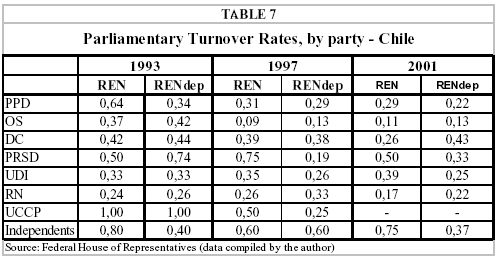
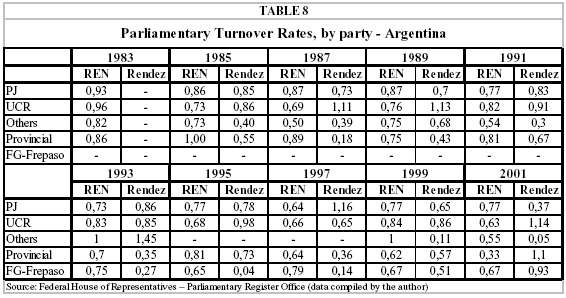
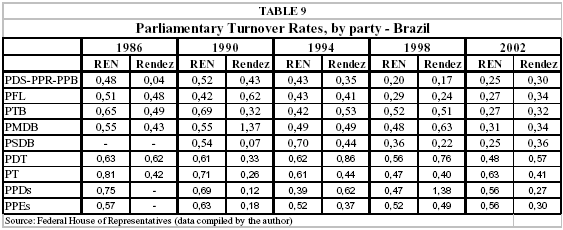
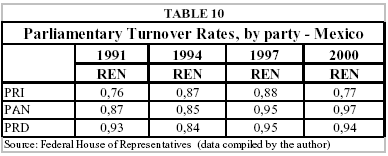
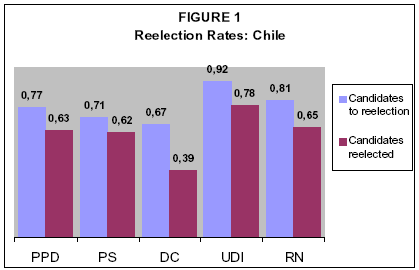
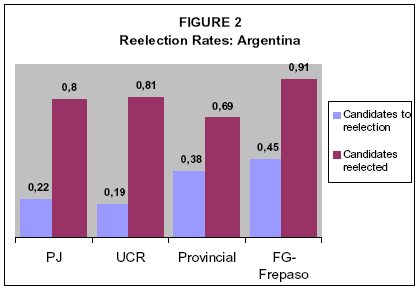
<body><![CDATA[<p><font face="Verdana, Arial, Helvetica, sans-serif" size="2">Jacobson (2000)    interpreted the electoral results for the American House of Representatives    in 1994 and came to the conclusion that the number of freshmen was due to  electoral    realignment in the Southern States, where vote for the Republicans increased.    Fenno (1997) also assumes that turnover and political realignment are connected    but offers another interpretation of the 1994 results. He points out that 40    years of political hegemony of Democrats in the House of Representatives induced    a new generation of Republicans keener on ideological issues, who finally won    the day in 1994. New parties competing in established parliamentary systems    may also cause political realignments and give way to higher rates of political    turnover (Best and Gaxie, 2000; Rush and Cromwell, 2000). Interpreting the variation    in political turnover (the ratio freshmen/elected delegation) presents a further    difficulty since the ratio denominator varies as a funtion of the party performance    in each election<a href="#_ftn2" name="_ftnref2" title=""><Sup>2</Sup></a>.    Summing up: the political turnover within parties may have different causes:    1) freshmen may have access due to increase in the number of seats secured by    the party; 2) unbalanced variation between the number of seats controlled by    the party and the number of freshmen who get elected in one given election;    3) the loss of seats which alter the structure of opportunities for veterans    and novices. </font></p>     <p><font face="Verdana, Arial, Helvetica, sans-serif" size="2">Statistical control    of the effect connected to variation in the number of party seats in every legislature    is possible by establishing the ratio between nominal turnover and the actual    number of seats secured by each party.</font></p>     <p><font face="Verdana, Arial, Helvetica, sans-serif" size="2"> When the <i>flat    </i>rate of turnover is considered (REN), one may find that the Chilean political    parties follow the same trend of diminishing numbers of freshmen in their delegations    (<a href="#tab7">Table 7</a>). The exception is the small PRSD (5% of seats    in 2001) and the independents. However, the <i>corrected</i> rates of turnover    (RENdep) depict a more complex political scenario. The two leftist parties follow    opposite trajectories: PPD is securing more seats and the Socialist Party is    losing them. The positive variation is accounted by the turnover rates in the    Partido por la Democracia which were high in 1993 and somewhat lower in 2001.    The recruitment pattern among the Socialists is intriguing. They have lost half    of the party seats between 1989 and 2001. But they offer few opportunities for    newcomers (only 1 freshman among the 9 elected in 2001). Facing adverse electoral    competition, the Socialists choose to boost the careers of veterans. The rightist    parties UDI and RN opt for a different strategy. The high turnover rate registered    in UDI is less striking when interpreted against the trend of increasing electoral    weight of the party. The Christian Democrats who were dominant until 1997 do    not provide safe electoral returns for the veterans since they are losing seats    (the loss was significant in 2001). The turnover rate is also diminishing among    them. </font></p>     <p><font face="Verdana, Arial, Helvetica, sans-serif" size="2">Indication for    reelection is higher among members of conservative parties (UDI, RN), as well    the probability of electoral success (Figure I). The practice of indicating    incumbent representatives for reelection is also common among leftist parties    and the Christian Democrats, albeit less ingrained as it is among conservatives.    It should be pointed out though that only a small number of Christian Democrats    is reelected.</font></p>     <p><font face="Verdana, Arial, Helvetica, sans-serif" size="2">The data on political    recruitment in Argentina show that in 2001 all parties were affected by high    rates of political turnover due to inter-party volatility (<a href="#tab8">Table    8</a>). In the period under study high rates of parliamentary turnover due to    electoral variations are relevant only among provincial parties (the periods    of expansion being the years of 1985, 1991 and 1999) and in the voting for the    parliamentary representation of FREPASO since 1993.  The data lead to the conclusion    that the high rates of political turnover in Argentina, which affect every poltical    faction after the demise of the authoritarian regime, are not explained by changes    in the voters's party identification. The case of the strongest party, the Justicialista,    is a good example. The statistical correction of the impact resulting from the    variation in the number of seats secured in every election reveals that there    is no significant oscillation  in six elections, from 1985 till l995. In 1997    the party lost many seats due to defection of veterans to the newly created    FREPASO. The inter-party turnover followed previous rates, meaning that the    chances of indication for reelection or for competing for the first mandate    were severely restricted.  Only in 2001 the electoral recovery of the party    allowed for a rate of parliamentary turnover higher than intra-party circulation.    The UCR's trajectory deserves special attention: the party's parliamentary decline    does not seem to prevent significant circulation of members in the lists for    electoral competition.</font></p>     <p><font face="Verdana, Arial, Helvetica, sans-serif" size="2">The dissociation    between parliamentary turnover and changes in the voters's choices of candidates    in the lists presented by the competing parties is clearer when one considers    the number of candidates occupying seats in one legislature who look for reelection    and are successful (Figure 2). This control indicates that the most important    criterion of selection (and, in the case of Argentina, of rejection) is the    party decision when composing the list of candidates, the opinions of voters    playing no decisive role. Statistically, in the two dominant Argentinian parties    at least one in every five representatives completing the mandate will be included    in the list for reelection. This proportion increases among provincial parties    and in the FG-FREPASO's lists without altering the general trend. It deserves    mention that the chances of reelection following the party's indication are    higher in Argentina than it is the case in Brazil or Chile.</font></p>     <p><font face="Verdana, Arial, Helvetica, sans-serif" size="2">Until 1994 high    rates of parliamentary turnover were common to all parties in Brazil, the highest    numbers affecting PT, PDT and PTB (<a href="#tab9">Table 9</a>). The increase    registered in 1994 may be due to electoral realignments, connected with the    ongoing expansion of the vote in PT and the localized growth of PSDB's political    weight. In 1998 this pattern is altered. The rates of parliamentary turnover    clearly diminish among the elected delegations of PPB and PSDB and at a lower    pace of PFL and PT. The turnover rate for PSDB would have been smaller but for    the increase in the number of seats in competition. In the case of PT, variations    in electoral behavior appear to be a variable explaining parliamentary turnover    less decisive than intra-party competition in the composition of lists of candidates.     The rates of political turnover for PMDB and PDT are stabler. However, due to    decreasing in the number of seats they muster, the chances of following a stable    career in the House of Representatives also decrease.</font></p>     <p><font face="Verdana, Arial, Helvetica, sans-serif" size="2">Electoral results    in Mexico throughout the 1990s reveal a continuing declining trend of PRI, the    steady strengthening of PAN, with a remarkable victory in 2000, when the party    won the presidency, and the rise followed by decline of PRD. However the overall    parliamentary turnover is not explained by changes in party preferences among    the electorate (<a href="#tab10">Table 10</a>). The single most important cause    of the phenomenon is the constitutional provision forbidding consecutive reelection.    The politician may return to the House of Representatives after a three-year    interim period, but occupying offices in other branches of the government is    the strategic option to pursue a stable political career. Until 2000 PRI was    the dominant party in control of the national government. It should be then    expected higher rates of reelection among its members. From this perspective,    comparing the median time span required for the return to the office of representative    reveal a higher duration for PRI (5,7 years) and a faster pace for candidates    of PRD (4,8 years) and PAN (3,6 years). Albeit the turnover rate in PRI be smaller    than the ones registered in the other parties, the chances for any single <i>priista</i>    to be part of a list for reelection is low. It is quite probable that the continuing    reduction in the number of PRI seats in the House of Representatives gave way    to tougher internal competition. </font></p>     <p>&nbsp;</p>     <p><font face="Verdana, Arial, Helvetica, sans-serif" size="3"><b>CONCLUDING REMARKS</b></font></p>     ]]></body>
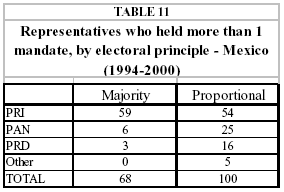
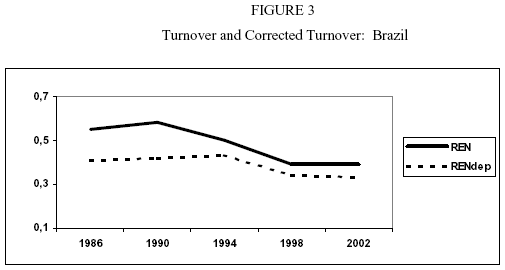
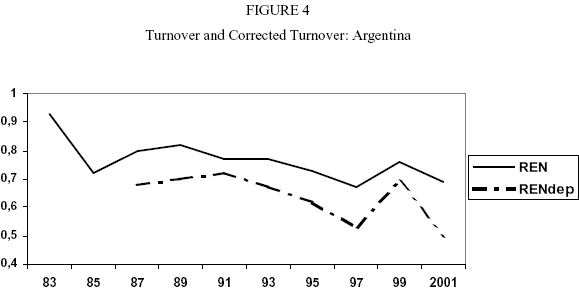
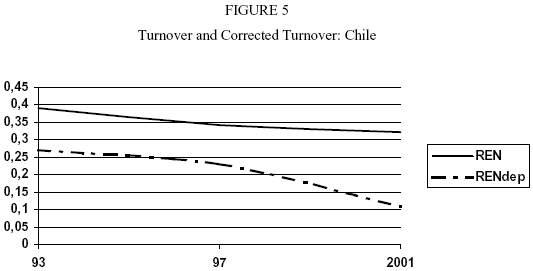
<body><![CDATA[<p><font face="Verdana, Arial, Helvetica, sans-serif" size="2">Assuming that professionalising    political careers in the legislative branch of government requires some amount    of stability in the composition of lists of candidates, one may find important    differences in the structure of political opportunities among the four Latin    American countries under study. The lowest rate of political turnover is found    in Chile, thus stimulating stabler parliamentary careers. Mexico and Argentina    present the highest rates, thus offering greater opportunity for access to politicians    lacking previous career in the national House of Representatives. Brazil stands    in the middle, with a long history of high rates of political turnover followed    by the recent lowering trend, beginning in 1998.  </font></p>     <p><font face="Verdana, Arial, Helvetica, sans-serif" size="2">Given the idiosyncrasies    of all possible institutional arrangements which may turn out to be a real puzzle    for the researcher, it is a difficult task to determine the effective causes    explaining the variation of this phenomenon. Incentives to investing in building    and maintaining a political career in the House of Representatives are conditioned    by one's evaluation on the relevance of political participation in the legislative    process and the costs of electoral competition.  From this perspective, political    systems which allow wide margins of legislative and non-legislative power to    the executive branch of government limiting the legislatures to <i>reactive    </i>behavior most of the time give way to negative incentives for parliamentary    careers and shrink the pool of political resources available to competing candidates    in the electoral arena. </font></p>     <p><font face="Verdana, Arial, Helvetica, sans-serif" size="2">Despite the plausibility    of this reasoning, some caution is advisable when establishing any kind of causality    connecting institutional structure and political recruitment. Incumbents of    legislative offices may control or have access to other types of political resources,    such as political offices and captive audiences which may affect positively    the results when competing for reelection. </font></p>     <p><font face="Verdana, Arial, Helvetica, sans-serif" size="2">It is not a easy    task interpreting the elements which interact in electoral competitions. When    the impact in the party delegation's turnover caused by changes in electoral    preferences of the electorate is controlled  (Figures 3, 4 and 5), it turns    out that, with the exception of Chile, the high rates of parliamentary turnover    are only marginally accountable by variations among the parties. Empirical findings    point out to greater weight of intra-party decisions and electoral strategies    in explaining the rates of parliamentary turnover. The influence of electoral    rules should also be taken into account. It is to be expected that a set of    rules restricting the access to freshmen and stimulating the decision to look    for reelection among the present holders of mandates strongly determined the    configuration of parliamentary representation.  According to this assumption,    proportional representation with closed lists of candidates should facilitate    securing the seat in successive elections, especially in the case of low inter-    party turnover. By contrast, open lists of candidates are seen as incentive    to competition among parties. When this sort of interpretation is applied to    understanding the Brazilian and Argentinian patterns the results appear contradictory.    Some caution is advised thus when predicting electoral behavior based on prevailing    electoral rules. </font></p>     <p><font face="Verdana, Arial, Helvetica, sans-serif" size="2">The Mexican case    offers the opportunity of comparing electoral results based on majority and    proportional formulae, under stable political institutions (<a href="#tab11">Table    11</a>). Taking into account that political return is a rare event, it is possible    to calculate its probability according different electoral principles. For the    members of the then governing party PRI the electoral principle did not alter    the established rate of probability of returning to the House of Representatives.    For members of opposition parties, the nominal indication to the list of candidates    actually remained the only chance of reelection. Besides the known restrictions    connected to the majority rule, the prohibition of consecutive reelection and    the lack of access to offices in the executive branch of governement make the    chances of victory in uninominal electoral competitions very low for candidates    of opposition parties.</font></p>     <p><font face="Verdana, Arial, Helvetica, sans-serif" size="2">Norris (1997) points    out to another condition that might explain different patterns of political    recruitment, that is, the structure of political opportunities in unitary or    federal political systems. A federal system offers a wider range of options    for political careers at different levels of government. This political feature    might explain the lower levels of parliamentary turnover in Chile, contrasting    with Mexico and Argentina and, to a lesser extent, with Brazil. Besides the    many options for individual careers at the federal, state and municipal institutions,    the federal system further induces electoral competition among parties focused    on the territorial distribution of political and administrative resources. Aiming    at pursuing this line of reasoning, further research on political turnover at    the subnational level is called for, in order to determine if party dispersion    in local government (province or state units) widens the range of electoral    competition and increases the number of competitors for seats at the national    level.</font></p>     <p><font face="Verdana, Arial, Helvetica, sans-serif" size="2">The extension of    time series of electoral data will allow for stronger conclusions and finer    theorization concerning the impact of institutional changes, such as legislative    prerogatives and electoral rules. The study of other countries such as Venezuela    and Uruguay may offer additional elements to understanding the patterns of relationships    between institutional change and political recruitment in Latin America.</font></p>     <p>&nbsp;</p>     <p><font face="Verdana, Arial, Helvetica, sans-serif" size="3"><b>TABLES AND FIGURES</b></font></p>     <p><font face="Verdana, Arial, Helvetica, sans-serif"><a name="tab1"></a></font></p>     ]]></body>
<body><![CDATA[<p>&nbsp;</p>     <p align="center"><font face="Verdana, Arial, Helvetica, sans-serif"><img src="/img/revistas/s_tsoc/v2nse/a04tab01.gif"></font></p>     <p>&nbsp;</p>     <p><font face="Verdana, Arial, Helvetica, sans-serif"><a name="tab2"></a></font></p>     <p>&nbsp;</p>     <p align="center"><font face="Verdana, Arial, Helvetica, sans-serif"><img src="/img/revistas/s_tsoc/v2nse/a04tab02.gif"></font></p>     <p >&nbsp;</p>     <p align="center"><font face="Verdana, Arial, Helvetica, sans-serif"><a name="tab3"></a></font></p>     <p >&nbsp;</p>     <p align="center"><font face="Verdana, Arial, Helvetica, sans-serif"><img src="/img/revistas/s_tsoc/v2nse/a04tab03.gif"></font></p>     ]]></body>
<body><![CDATA[<p>&nbsp;</p>     <p><font face="Verdana, Arial, Helvetica, sans-serif"><a name="tab4"></a></font></p>     <p>&nbsp;</p>     <p align="center"><font face="Verdana, Arial, Helvetica, sans-serif"><img src="/img/revistas/s_tsoc/v2nse/a04tab04.gif"></font></p>     <p>&nbsp;</p>     <p><font face="Verdana, Arial, Helvetica, sans-serif"><a name="tab5"></a></font></p>     <p>&nbsp;</p>     <p align="center"><font face="Verdana, Arial, Helvetica, sans-serif"><img src="/img/revistas/s_tsoc/v2nse/a04tab05.gif"></font></p>     <p>&nbsp;</p>     <p><font face="Verdana, Arial, Helvetica, sans-serif"><a name="tab6"></a></font></p>     ]]></body>
<body><![CDATA[<p>&nbsp;</p>     <p>&nbsp;</p>     <p align="center"><font face="Verdana, Arial, Helvetica, sans-serif"><img src="/img/revistas/s_tsoc/v2nse/a04tab06.gif"></font></p>     <p>&nbsp;</p>     <p><font face="Verdana, Arial, Helvetica, sans-serif"><a name="tab7"></a></font></p>     <p>&nbsp;</p>     <p align="center"><font face="Verdana, Arial, Helvetica, sans-serif"><img src="/img/revistas/s_tsoc/v2nse/a04tab07.gif"></font></p>     <p>&nbsp;</p>     <p><font face="Verdana, Arial, Helvetica, sans-serif"><a name="tab8"></a></font></p>     <p>&nbsp;</p>     ]]></body>
<body><![CDATA[<p align="center"><font face="Verdana, Arial, Helvetica, sans-serif"><img src="/img/revistas/s_tsoc/v2nse/a04tab08.gif"></font></p>     <p >&nbsp;</p>     <p align="center"><font face="Verdana, Arial, Helvetica, sans-serif"><a name="tab9"></a></font></p>     <p >&nbsp;</p>     <p align="center"><font face="Verdana, Arial, Helvetica, sans-serif"><img src="/img/revistas/s_tsoc/v2nse/a04tab09.gif"></font></p>     <p >&nbsp;</p>     <p align="center"><font face="Verdana, Arial, Helvetica, sans-serif"><a name="tab10"></a></font></p>     <p >&nbsp;</p>     <p align="center"><font face="Verdana, Arial, Helvetica, sans-serif"><img src="/img/revistas/s_tsoc/v2nse/a04tab10.gif"></font></p>     <p >&nbsp;</p>     ]]></body>
<body><![CDATA[<p align="center"><font face="Verdana, Arial, Helvetica, sans-serif"><a name="tab11"></a></font></p>     <p >&nbsp;</p>     <p align="center"><font face="Verdana, Arial, Helvetica, sans-serif"><img src="/img/revistas/s_tsoc/v2nse/a04tab11.gif"></font></p>     <p >&nbsp;</p>     <p align="center"><font face="Verdana, Arial, Helvetica, sans-serif"><a name="fig1"></a></font></p>     <p >&nbsp;</p>     <p align="center"><font face="Verdana, Arial, Helvetica, sans-serif"><img src="/img/revistas/s_tsoc/v2nse/a04fig01.gif"></font></p>     <p >&nbsp;</p>     <p align="center"><font face="Verdana, Arial, Helvetica, sans-serif"><a name="fig2"></a></font></p>     <p >&nbsp;</p>     ]]></body>
<body><![CDATA[<p align="center"><font face="Verdana, Arial, Helvetica, sans-serif"><img src="/img/revistas/s_tsoc/v2nse/a04fig02.gif"></font></p>     <p >&nbsp;</p>     <p align="center"><font face="Verdana, Arial, Helvetica, sans-serif"><a name="fig3"></a></font></p>     <p >&nbsp;</p>     <p align="center"><font face="Verdana, Arial, Helvetica, sans-serif"><img src="/img/revistas/s_tsoc/v2nse/a04fig03.gif"></font></p>     <p >&nbsp;</p>     <p align="center"><font face="Verdana, Arial, Helvetica, sans-serif"><a name="fig4"></a></font></p>     <p >&nbsp;</p>     <p align="center"><font face="Verdana, Arial, Helvetica, sans-serif"><img src="/img/revistas/s_tsoc/v2nse/a04fig04.gif"></font></p>     <p >&nbsp;</p>     ]]></body>
<body><![CDATA[<p align="center"><font face="Verdana, Arial, Helvetica, sans-serif"><a name="fig5"></a></font></p>     <p >&nbsp;</p>     <p align="center"><font face="Verdana, Arial, Helvetica, sans-serif"><img src="/img/revistas/s_tsoc/v2nse/a04fig05.gif"></font></p>     <p >&nbsp;</p>     <p><font face="Verdana, Arial, Helvetica, sans-serif" size="3"><b>Bibliographical    references</b></font></p>     <!-- ref --><p><font face="Verdana, Arial, Helvetica, sans-serif" size="2">BARTOLINI, Stefano    et ALIMONTI, R. 1995. "Les elections parlamentaires de 1994 en Italie". Competition    majoritaire et réalignement partisan"<i>. Revue Française de Science Politique,    </i>45 (6).<i> </i></font><!-- ref --><p><font face="Verdana, Arial, Helvetica, sans-serif" size="2">BEST, Heinrich    and COTTA, Maurizio.2000. <i>Parliamentary representatives in Europe 1848-2000.</i>    Legislative recruitment and careers in eleven european countries. London: Oxford    University Press.</font><!-- ref --><p><font face="Verdana, Arial, Helvetica, sans-serif" size="2">BEST, Heinrich    and GAXIE, Daniel. 2000.  "Detours to modernity: long-term trends of parliamentary    recruitment in Republican  France 1848-1999". In: BEST, Heinrich and COTTA,    Maurizio. <i>Parliamentary representatives in Europe 1848-2000.</i> Legislative    recruitment and careers in eleven european countries. London: Oxford University    Press.</font><!-- ref --><p><font face="Verdana, Arial, Helvetica, sans-serif" size="2">BIRNBAUN, Pierre.1977.    <i>Les sommets de l' Etat. </i>Essai sur l'elite du pouvoir en France. Paris:    Seuil.</font><!-- ref --><p><font face="Verdana, Arial, Helvetica, sans-serif" size="2">BLACK, Gordon.1970.    "A Theory of Profissionalization in Politics". <i>American Political Science    Review, </i>64 (3).</font><!-- ref --><p><font face="Verdana, Arial, Helvetica, sans-serif" size="2">BLONDEL, Jean.1973.    <i>Comparative Legislatures. </i>Prentice Hall.</font><!-- ref --><p><font face="Verdana, Arial, Helvetica, sans-serif" size="2">BRADY, David, COGAN,    John F. and FIORINA, Morris.2000. <i>Continuity and change in House elections.    </i>Palo Alto: Stanford University Press, 2000. </font><!-- ref --><p><font face="Verdana, Arial, Helvetica, sans-serif" size="2">BRIQUET, Jean-Louis.1999.    "L'imperatif du changement. Critique de la classe politique et renouvellement    des parlementaires dans la crise italienne (1992-1994)". In: OFFERLÉ, Michel.    <i>La profession politique. </i>XIXe.-Xxe. Siècles. Paris: Belin.</font><!-- ref --><p><font face="Verdana, Arial, Helvetica, sans-serif" size="2">BUCKLEY, Kara.1998.    <i>The roots of careeirism in the United States House of Representatives. </i>Palo    Alto: Stanford University Press.</font><!-- ref --><p><font face="Verdana, Arial, Helvetica, sans-serif" size="2">CARBONELL, Miguel.2000.    "Hacia un Congreso profesional: la no reelección legislativa en México". In:    PÉREZ, Germán y MARTÍNEZ, Antonia. (compiladores). <i>La Cámara de Diputados    en México. </i>México: Flacso.</font><!-- ref --><p><font face="Verdana, Arial, Helvetica, sans-serif" size="2">COLLOVALD, Annie.1985.    "La République du militant. Recrutement et filières de la carriere politique    des deputés socialistes". In: BIRNBAUN, Pierre (ed). <i>Les Élites Socialistes    au Pouvoir, 1981-1985. </i>Paris: Presses Universitaires de France.</font><!-- ref --><p><font face="Verdana, Arial, Helvetica, sans-serif" size="2">COX, Gary and MORGENSTERN,    Scott.2002. "Epilogue: Latin America's reactive assemblies and proactive presidents".    In: MORGENSTERN, Scott &amp; NACIF, Benito (Eds). <i>Legislative politics in    latinoamerica. </i>Cambridge University Press.</font><!-- ref --><p><font face="Verdana, Arial, Helvetica, sans-serif" size="2">DOGAN, Mattei.1999.    "Les professions propices à la carrière politique". In: OFFERLÉ, Michel. <i>La    profession politique. </i>XIXe.-Xxe. Siècles. Paris: Belin.</font><!-- ref --><p><font face="Verdana, Arial, Helvetica, sans-serif" size="2">ERICKSON, Lynda.    1997 . "Canada". In: NORRIS, Pippa. <i>Passages to power. </i>Legislative recruitment    in advanded democracies. Cambridge University Press.</font><!-- ref --><p><font face="Verdana, Arial, Helvetica, sans-serif" size="2">FENNO, Richard.    1973. <i>Congress in commitees. </i>Boston: Little Brown.</font><!-- ref --><p><font face="Verdana, Arial, Helvetica, sans-serif" size="2">FENNO, Richard.    1997. <i>Learning to govern. </i>An institutional view of the 104<sup>th</sup>.    Congress. Washington: Brookings.</font><!-- ref --><p><font face="Verdana, Arial, Helvetica, sans-serif" size="2">FIGUEIREDO, Argelina    e LIMONGI, Fernando. 1999. <i>Executivo e legislativo na nova ordem constitucional.    </i>São Paulo: FGV.</font><!-- ref --><p><font face="Verdana, Arial, Helvetica, sans-serif" size="2">FIORINA, Morris.    1994. "Divided government in the american states: a by product of legislature    profissionalism?" <i>American Political Science Review, </i>88 (2).</font><!-- ref --><p><font face="Verdana, Arial, Helvetica, sans-serif" size="2">GAÏTI, Brigitte.    1999. "'Syndicat des anciens' contre 'forces vives' de la nation. Le renouvellement    politique de 1958". In: OFFERLÉ, Michel. <i>La profession politique. </i>Paris:    Belin.</font><!-- ref --><p><font face="Verdana, Arial, Helvetica, sans-serif" size="2">GAXIE, Daniel.    1993. <i>La Démocratie Representative</i>. Paris: Montchrestien.</font><!-- ref --><p><font face="Verdana, Arial, Helvetica, sans-serif" size="2">GUZZINI, Stefano.    1994. "La longue nuit de la premiére république: l'implosion clientéliste en    Italie". <i>Revue Française de Science Politique</i>, 44 (6).</font><!-- ref --><p><font face="Verdana, Arial, Helvetica, sans-serif" size="2">JACOBSON, Gary.    2000. "Reversal of fortune: the transformation of US House of Representatives    in the 1990s". In: BRADY, David; COGAN, John F and FIORINA, Morris. <i>Continuity    and change in House elections. </i> Palo Alto: Stanford University Press. </font><!-- ref --><p><font face="Verdana, Arial, Helvetica, sans-serif" size="2">JONES, Mark. 2002.    "Explaining the high level of party discipline in the argentine congres". In:    MORGENSTERN, Scott &amp; NACIF, Benito (Eds). <i>Legislative politics in latinoamerica.    </i>Cambridge University Press. </font><!-- ref --><p><font face="Verdana, Arial, Helvetica, sans-serif" size="2">JONES, Mark, SAIEGH,    Sebastian, SPILLER, Pablo, TOMASI, Mariano. 2000. <i>Politicos profesionales    – legisladores 'amateurs'. </i>El Congreso argentino en el siglo XX. Mimeo,    2000. </font><!-- ref --><p><font face="Verdana, Arial, Helvetica, sans-serif" size="2">LIEBERT, Ulrike    &amp; COTTA, Maurizio. 1990. <i>Parliament and Democratic Consolidation in Southern    Europe. </i>London: Pinter Pub.</font><!-- ref --><p><font face="Verdana, Arial, Helvetica, sans-serif" size="2">MARENCO DOS SANTOS,    André. 2000. <i>Não se fazem mais oligarquias como antigamente. </i>Recrutamento    parlamentar, experiênica política e vínculos partidários entre deputados brasileiros    (1946-1998). Tese de Doutorado, Ufrgs.</font><!-- ref --><p><font face="Verdana, Arial, Helvetica, sans-serif" size="2">MOORE, Michael    &amp; HIBBING, John. 1998. "Situational disafaction in Congress: explaining    voluntary departures".  <i>The Journal of Politics, </i>60 (4).</font><!-- ref --><p><font face="Verdana, Arial, Helvetica, sans-serif" size="2">MORGENSTERN, Scott    &amp; NACIF, Benito (Eds). 2002. <i>Legislative politics in latinoamerica. </i>Cambridge    University Press.</font><!-- ref --><p><font face="Verdana, Arial, Helvetica, sans-serif" size="2">MORLINO, Leonardo.    1992. "Partidos Políticos y Consolidación Democrática en el Sur de Europa".    In: BENEDICTO, Jorge y REINARES, Fernando(eds). <i>Las Transformaciones de lo    Político</i>. Madrid: Alianza Editorial.</font><!-- ref --><p><font face="Verdana, Arial, Helvetica, sans-serif" size="2">NACIF, Benito.    2002. "Understanding party discipline in the mexican Chamber of Deputies: the    centralized party model". IN: MORGENSTERN, Scott &amp; NACIF, Benito (Eds).    <i>Legislative politics in latinoamerica. </i>Cambridge University Press.</font><!-- ref --><p><font face="Verdana, Arial, Helvetica, sans-serif" size="2">NICOLAU, Jairo.    1996. <i>Multipartidarismo e democracia. </i>Rio de Janeiro: FGV.</font><!-- ref --><p><font face="Verdana, Arial, Helvetica, sans-serif" size="2">NORRIS, Pippa.    1997. <i>Passages to power. </i>Legislative recruitment in advanced democracies.    Cambridge  University Press.</font><!-- ref --><p><font face="Verdana, Arial, Helvetica, sans-serif" size="2">NORRIS, Pippa &amp;    LOVENDUSKI, Joni. 1997. "United Kingdom". In: NORRIS, Pippa. <i>Passages to    power. </i>Legislative recruitment in advanced democracies. Cambridge  University    Press.</font><!-- ref --><p><font face="Verdana, Arial, Helvetica, sans-serif" size="2">OFFERLÉ, Michel.    1999. <i>La profession politique. </i>XIXe.-XXe. Siècles. Paris: Belin.</font><!-- ref --><p><font face="Verdana, Arial, Helvetica, sans-serif" size="2">PANEBIANCO, Angelo.    1994. "Comparación y explicación". In: SARTORI, Giovanni y MORLINO, Leonardo.    <i>La comparación en las ciências sociales. </i>Madrid: Alianza.</font><!-- ref --><p><font face="Verdana, Arial, Helvetica, sans-serif" size="2">PÉREZ, Germán y    MARTÍNEZ, Antonia. (compiladores). 2000. <i>La Cámara de Diputados en México.    </i>México: Flacso.</font><!-- ref --><p><font face="Verdana, Arial, Helvetica, sans-serif" size="2">POLINA, Maria del    Carmen; WELDON, Jeffrey y LÓPEZ, Jorge. 2000. "Cambio político, presidencialismo    y producción legislativa en la Camara de Diputados: 1988-1998". In: PÉREZ, Germán    y MARTÍNEZ, Antonia. (compiladores). <i>La Cámara de Diputados en México. </i>México:    Flacso.</font><!-- ref --><p><font face="Verdana, Arial, Helvetica, sans-serif" size="2">POLSBY, Nelson.    1968. The Institutionalization of U.S.House of Representatives. <i>American    Political Science Review, </i>LXII.</font><!-- ref --><p><font face="Verdana, Arial, Helvetica, sans-serif" size="2">PUTNAM, Robert.    1976. <i>The comparative study of political elites. </i>New Jersey: Prentice    Hall.</font><!-- ref --><p><font face="Verdana, Arial, Helvetica, sans-serif" size="2">RUSH, Michael and    CROMWELL, Valerie. 2000. "Continuity and change: legislative recruitment in    the United Kingdom 1868-1999". In: BEST, Heinrich and COTTA, Maurizio. <i>Parliamentary    representatives in Europe 1848-2000.</i> Legislative recruitment and careers    in eleven european countries. Oxford University Press.</font><!-- ref --><p><font face="Verdana, Arial, Helvetica, sans-serif" size="2">SAMUELS, David.    <i>Ambassadors of the state. </i>Political ambition, federalism and congressional    politics in Brazil. PHD Dissertation Thesis, University of California.</font><!-- ref --><p><font face="Verdana, Arial, Helvetica, sans-serif" size="2">SANTOS, Wanderley    Guilherme. 1997. "Da poliarquia à oligarquia? Eleições e demanda por renovação    parlamentar".  <i>Sociedade e Estado, </i>07.</font><!-- ref --><p><font face="Verdana, Arial, Helvetica, sans-serif" size="2">SANTOS, Fabiano.    2000. "Deputados federais e instituições legislativas no Brasil: 1946-99". In:    BOSCHI, Renato; DINIZ, Eli e SANTOS, Fabiano. <i>Elites políticas e econômicas    no Brasil contemporâneo. </i>São Paulo: Fundação Konrad Adenauer.</font><!-- ref --><p><font face="Verdana, Arial, Helvetica, sans-serif" size="2">SARTORI, Giovanni.    1994. "Comparación y método comparativo". In: SARTORI, Giovanni y MORLINO, Leonardo.    <i>La comparación en las ciências sociales. </i>Madrid: Alianza.</font><!-- ref --><p><font face="Verdana, Arial, Helvetica, sans-serif" size="2">SCHEPSLE, Kenneth.    1978. <i>The giant jigsaw puzzle. </i>Chicago: Chicago University Press.</font><!-- ref --><p><font face="Verdana, Arial, Helvetica, sans-serif" size="2">SHUGART, Matthew    &amp; CAREY, John. 1992. <i>Presidents and assemblies. </i>Constitutional design    and electoral dynamics. Cambridge University Press.</font><!-- ref --><p><font face="Verdana, Arial, Helvetica, sans-serif" size="2">SINCLAIR, Barbara.    1992. "The emergence of strong leadership in U.S. House of Representatives".    <i>The Journal of Politics, </i>54 (3).</font><!-- ref --><p><font face="Verdana, Arial, Helvetica, sans-serif" size="2">TSEBELIS, George.    1998. <i>Jogos ocultos. </i>Escolha racional no campo da política comparada.    São Paulo: Edusp.</font><!-- ref --><p><font face="Verdana, Arial, Helvetica, sans-serif" size="2">WESSELS, Bernhard.    1997. "Germany". In: NORRIS, Pippa. <i>Passages to power. </i>Legislative recruitment    in advanded democracies. Cambridge University Press.</font><p>&nbsp;</p>     <p>&nbsp;</p>     <p><font face="Verdana, Arial, Helvetica, sans-serif" size="2"><a href="#_ftnref1" name="_ftn1" title=""><Sup>1</Sup></a>    <i>Members voluntary departing are often encouraged to do so by a precarious    electoral situation </i>(Moore and Hibbings, 1998:104)    <br>   <a href="#_ftnref2" name="_ftn2" title=""><Sup>2</Sup></a> This kind of problem may be lessened when    agggregate data are used. There may be increases in the overall number of seats    but it seldom happens. One may recall the 1987 addition of 100 seats to the    Mexican House of Representatives (the event was not considered in the present    research) or the 1994 addition of 10 seats to the Brazilian Congress.In the    Brazilian instance if all the new seats were occupied by freshmen the overall    impact on the rate of political turnover would be marginal, only 2 points in    a rate varying around 55% and 60%.</font></p>      ]]></body><back>
<ref-list>
<ref id="B1">
<nlm-citation citation-type="journal">
<person-group person-group-type="author">
<name>
<surname><![CDATA[BARTOLINI]]></surname>
<given-names><![CDATA[Stefano]]></given-names>
</name>
<name>
<surname><![CDATA[ALIMONTI]]></surname>
<given-names><![CDATA[R.]]></given-names>
</name>
</person-group>
<article-title xml:lang="fr"><![CDATA[Les elections parlamentaires de 1994 en Italie: Competition majoritaire et réalignement partisan]]></article-title>
<source><![CDATA[Revue Française de Science Politique]]></source>
<year>1995</year>
<volume>45</volume>
<numero>6</numero>
<issue>6</issue>
</nlm-citation>
</ref>
<ref id="B2">
<nlm-citation citation-type="book">
<person-group person-group-type="author">
<name>
<surname><![CDATA[BEST]]></surname>
<given-names><![CDATA[Heinrich]]></given-names>
</name>
<name>
<surname><![CDATA[COTTA]]></surname>
<given-names><![CDATA[Maurizio]]></given-names>
</name>
</person-group>
<source><![CDATA[Parliamentary representatives in Europe 1848-2000: Legislative recruitment and careers in eleven european countries]]></source>
<year>2000</year>
<publisher-loc><![CDATA[London ]]></publisher-loc>
<publisher-name><![CDATA[Oxford University Press]]></publisher-name>
</nlm-citation>
</ref>
<ref id="B3">
<nlm-citation citation-type="book">
<person-group person-group-type="author">
<name>
<surname><![CDATA[BEST]]></surname>
<given-names><![CDATA[Heinrich]]></given-names>
</name>
<name>
<surname><![CDATA[GAXIE]]></surname>
<given-names><![CDATA[Daniel]]></given-names>
</name>
</person-group>
<article-title xml:lang="en"><![CDATA[Detours to modernity: long-term trends of parliamentary recruitment in Republican France 1848-1999]]></article-title>
<person-group person-group-type="editor">
<name>
<surname><![CDATA[BEST]]></surname>
<given-names><![CDATA[Heinrich]]></given-names>
</name>
<name>
<surname><![CDATA[COTTA]]></surname>
<given-names><![CDATA[Maurizio]]></given-names>
</name>
</person-group>
<source><![CDATA[Parliamentary representatives in Europe 1848-2000: Legislative recruitment and careers in eleven european countries]]></source>
<year>2000</year>
<publisher-loc><![CDATA[London ]]></publisher-loc>
<publisher-name><![CDATA[Oxford University Press]]></publisher-name>
</nlm-citation>
</ref>
<ref id="B4">
<nlm-citation citation-type="book">
<person-group person-group-type="author">
<name>
<surname><![CDATA[BIRNBAUN]]></surname>
<given-names><![CDATA[Pierre]]></given-names>
</name>
</person-group>
<source><![CDATA[Les sommets de l' Etat: Essai sur l'elite du pouvoir en France]]></source>
<year>1977</year>
<publisher-loc><![CDATA[Paris ]]></publisher-loc>
<publisher-name><![CDATA[Seuil]]></publisher-name>
</nlm-citation>
</ref>
<ref id="B5">
<nlm-citation citation-type="journal">
<person-group person-group-type="author">
<name>
<surname><![CDATA[BLACK]]></surname>
<given-names><![CDATA[Gordon]]></given-names>
</name>
</person-group>
<article-title xml:lang="en"><![CDATA[A Theory of Profissionalization in Politics]]></article-title>
<source><![CDATA[American Political Science Review]]></source>
<year>1970</year>
<volume>64</volume>
<numero>3</numero>
<issue>3</issue>
</nlm-citation>
</ref>
<ref id="B6">
<nlm-citation citation-type="book">
<person-group person-group-type="author">
<name>
<surname><![CDATA[BLONDEL]]></surname>
<given-names><![CDATA[Jean]]></given-names>
</name>
</person-group>
<source><![CDATA[Comparative Legislatures]]></source>
<year>1973</year>
<publisher-name><![CDATA[Prentice Hall]]></publisher-name>
</nlm-citation>
</ref>
<ref id="B7">
<nlm-citation citation-type="book">
<person-group person-group-type="author">
<name>
<surname><![CDATA[BRADY]]></surname>
<given-names><![CDATA[David]]></given-names>
</name>
<name>
<surname><![CDATA[COGAN]]></surname>
<given-names><![CDATA[John F.]]></given-names>
</name>
<name>
<surname><![CDATA[FIORINA]]></surname>
<given-names><![CDATA[Morris]]></given-names>
</name>
</person-group>
<source><![CDATA[Continuity and change in House elections]]></source>
<year>2000</year>
<publisher-loc><![CDATA[Palo Alto ]]></publisher-loc>
<publisher-name><![CDATA[Stanford University Press]]></publisher-name>
</nlm-citation>
</ref>
<ref id="B8">
<nlm-citation citation-type="book">
<person-group person-group-type="author">
<name>
<surname><![CDATA[BRIQUET]]></surname>
<given-names><![CDATA[Jean-Louis]]></given-names>
</name>
</person-group>
<article-title xml:lang="fr"><![CDATA[L'imperatif du changement: Critique de la classe politique et renouvellement des parlementaires dans la crise italienne (1992-1994)]]></article-title>
<person-group person-group-type="editor">
<name>
<surname><![CDATA[OFFERLÉ]]></surname>
<given-names><![CDATA[Michel]]></given-names>
</name>
</person-group>
<source><![CDATA[La profession politique: XIXe.-Xxe. Siècles]]></source>
<year>1999</year>
<publisher-loc><![CDATA[Paris ]]></publisher-loc>
<publisher-name><![CDATA[Belin]]></publisher-name>
</nlm-citation>
</ref>
<ref id="B9">
<nlm-citation citation-type="book">
<person-group person-group-type="author">
<name>
<surname><![CDATA[BUCKLEY]]></surname>
<given-names><![CDATA[Kara]]></given-names>
</name>
</person-group>
<source><![CDATA[The roots of careeirism in the United States House of Representatives]]></source>
<year>1998</year>
<publisher-loc><![CDATA[Palo Alto ]]></publisher-loc>
<publisher-name><![CDATA[Stanford University Press]]></publisher-name>
</nlm-citation>
</ref>
<ref id="B10">
<nlm-citation citation-type="book">
<person-group person-group-type="author">
<name>
<surname><![CDATA[CARBONELL]]></surname>
<given-names><![CDATA[Miguel]]></given-names>
</name>
</person-group>
<article-title xml:lang="es"><![CDATA[Hacia un Congreso profesional: la no reelección legislativa en México]]></article-title>
<person-group person-group-type="editor">
<name>
<surname><![CDATA[PÉREZ]]></surname>
<given-names><![CDATA[Germán]]></given-names>
</name>
<name>
<surname><![CDATA[MARTÍNEZ]]></surname>
<given-names><![CDATA[Antonia]]></given-names>
</name>
</person-group>
<source><![CDATA[La Cámara de Diputados en México]]></source>
<year>2000</year>
<publisher-loc><![CDATA[México ]]></publisher-loc>
<publisher-name><![CDATA[Flacso]]></publisher-name>
</nlm-citation>
</ref>
<ref id="B11">
<nlm-citation citation-type="book">
<person-group person-group-type="author">
<name>
<surname><![CDATA[COLLOVALD]]></surname>
<given-names><![CDATA[Annie]]></given-names>
</name>
</person-group>
<article-title xml:lang="fr"><![CDATA[La République du militant: Recrutement et filières de la carriere politique des deputés socialistes]]></article-title>
<person-group person-group-type="editor">
<name>
<surname><![CDATA[BIRNBAUN]]></surname>
<given-names><![CDATA[Pierre]]></given-names>
</name>
</person-group>
<source><![CDATA[Les Élites Socialistes au Pouvoir, 1981-1985]]></source>
<year>1985</year>
<publisher-loc><![CDATA[Paris ]]></publisher-loc>
<publisher-name><![CDATA[Presses Universitaires de France]]></publisher-name>
</nlm-citation>
</ref>
<ref id="B12">
<nlm-citation citation-type="book">
<person-group person-group-type="author">
<name>
<surname><![CDATA[COX]]></surname>
<given-names><![CDATA[Gary]]></given-names>
</name>
<name>
<surname><![CDATA[MORGENSTERN]]></surname>
<given-names><![CDATA[Scott]]></given-names>
</name>
</person-group>
<article-title xml:lang="en"><![CDATA[Epilogue: Latin America's reactive assemblies and proactive presidents]]></article-title>
<person-group person-group-type="editor">
<name>
<surname><![CDATA[MORGENSTERN]]></surname>
<given-names><![CDATA[Scott]]></given-names>
</name>
<name>
<surname><![CDATA[NACIF]]></surname>
<given-names><![CDATA[Benito]]></given-names>
</name>
</person-group>
<source><![CDATA[Legislative politics in latinoamerica]]></source>
<year>2002</year>
<publisher-name><![CDATA[Cambridge University Press]]></publisher-name>
</nlm-citation>
</ref>
<ref id="B13">
<nlm-citation citation-type="book">
<person-group person-group-type="author">
<name>
<surname><![CDATA[DOGAN]]></surname>
<given-names><![CDATA[Mattei]]></given-names>
</name>
</person-group>
<article-title xml:lang="en"><![CDATA[Les professions propices à la carrière politique]]></article-title>
<person-group person-group-type="editor">
<name>
<surname><![CDATA[OFFERLÉ]]></surname>
<given-names><![CDATA[Michel]]></given-names>
</name>
</person-group>
<source><![CDATA[La profession politique: XIXe.-Xxe. Siècles]]></source>
<year>1999</year>
<publisher-loc><![CDATA[Paris ]]></publisher-loc>
<publisher-name><![CDATA[Belin]]></publisher-name>
</nlm-citation>
</ref>
<ref id="B14">
<nlm-citation citation-type="book">
<person-group person-group-type="author">
<name>
<surname><![CDATA[ERICKSON]]></surname>
<given-names><![CDATA[Lynda]]></given-names>
</name>
</person-group>
<article-title xml:lang="en"><![CDATA[Canada]]></article-title>
<person-group person-group-type="editor">
<name>
<surname><![CDATA[NORRIS]]></surname>
<given-names><![CDATA[Pippa]]></given-names>
</name>
</person-group>
<source><![CDATA[Passages to power: Legislative recruitment in advanded democracies]]></source>
<year>1997</year>
<publisher-name><![CDATA[Cambridge University Press]]></publisher-name>
</nlm-citation>
</ref>
<ref id="B15">
<nlm-citation citation-type="book">
<person-group person-group-type="author">
<name>
<surname><![CDATA[FENNO]]></surname>
<given-names><![CDATA[Richard]]></given-names>
</name>
</person-group>
<source><![CDATA[Congress in commitees]]></source>
<year>1973</year>
<publisher-loc><![CDATA[Boston ]]></publisher-loc>
<publisher-name><![CDATA[Little Brown]]></publisher-name>
</nlm-citation>
</ref>
<ref id="B16">
<nlm-citation citation-type="book">
<person-group person-group-type="author">
<name>
<surname><![CDATA[FENNO]]></surname>
<given-names><![CDATA[Richard]]></given-names>
</name>
</person-group>
<source><![CDATA[Learning to govern: An institutional view of the 104th]]></source>
<year>1997</year>
<publisher-name><![CDATA[Brookings]]></publisher-name>
</nlm-citation>
</ref>
<ref id="B17">
<nlm-citation citation-type="book">
<person-group person-group-type="author">
<name>
<surname><![CDATA[FIGUEIREDO]]></surname>
<given-names><![CDATA[Argelina]]></given-names>
</name>
<name>
<surname><![CDATA[LIMONGI]]></surname>
<given-names><![CDATA[Fernando]]></given-names>
</name>
</person-group>
<source><![CDATA[Executivo e legislativo na nova ordem constitucional]]></source>
<year>1999</year>
<publisher-loc><![CDATA[São Paulo ]]></publisher-loc>
<publisher-name><![CDATA[FGV]]></publisher-name>
</nlm-citation>
</ref>
<ref id="B18">
<nlm-citation citation-type="journal">
<person-group person-group-type="author">
<name>
<surname><![CDATA[FIORINA]]></surname>
<given-names><![CDATA[Morris]]></given-names>
</name>
</person-group>
<article-title xml:lang="en"><![CDATA[Divided government in the american states: a by product of legislature profissionalism?]]></article-title>
<source><![CDATA[American Political Science Review]]></source>
<year>1994</year>
<volume>88</volume>
<numero>2</numero>
<issue>2</issue>
</nlm-citation>
</ref>
<ref id="B19">
<nlm-citation citation-type="book">
<person-group person-group-type="author">
<name>
<surname><![CDATA[GAÏTI]]></surname>
<given-names><![CDATA[Brigitte]]></given-names>
</name>
</person-group>
<article-title xml:lang="en"><![CDATA['Syndicat des anciens' contre 'forces vives' de la nation: Le renouvellement politique de 1958]]></article-title>
<person-group person-group-type="editor">
<name>
<surname><![CDATA[OFFERLÉ]]></surname>
<given-names><![CDATA[Michel]]></given-names>
</name>
</person-group>
<source><![CDATA[La profession politique]]></source>
<year>1999</year>
<publisher-loc><![CDATA[Paris ]]></publisher-loc>
<publisher-name><![CDATA[Belin]]></publisher-name>
</nlm-citation>
</ref>
<ref id="B20">
<nlm-citation citation-type="book">
<person-group person-group-type="author">
<name>
<surname><![CDATA[GAXIE]]></surname>
<given-names><![CDATA[Daniel]]></given-names>
</name>
</person-group>
<source><![CDATA[La Démocratie Representative]]></source>
<year>1993</year>
<publisher-loc><![CDATA[Paris ]]></publisher-loc>
<publisher-name><![CDATA[Montchrestien]]></publisher-name>
</nlm-citation>
</ref>
<ref id="B21">
<nlm-citation citation-type="journal">
<person-group person-group-type="author">
<name>
<surname><![CDATA[GUZZINI]]></surname>
<given-names><![CDATA[Stefano]]></given-names>
</name>
</person-group>
<article-title xml:lang="fr"><![CDATA[La longue nuit de la premiére république: l'implosion clientéliste en Italie]]></article-title>
<source><![CDATA[Revue Française de Science Politique]]></source>
<year>1994</year>
<volume>44</volume>
<numero>6</numero>
<issue>6</issue>
</nlm-citation>
</ref>
<ref id="B22">
<nlm-citation citation-type="book">
<person-group person-group-type="author">
<name>
<surname><![CDATA[JACOBSON]]></surname>
<given-names><![CDATA[Gary]]></given-names>
</name>
</person-group>
<article-title xml:lang="en"><![CDATA[Reversal of fortune: the transformation of US House of Representatives in the 1990s]]></article-title>
<person-group person-group-type="editor">
<name>
<surname><![CDATA[BRADY]]></surname>
<given-names><![CDATA[David]]></given-names>
</name>
<name>
<surname><![CDATA[COGAN]]></surname>
<given-names><![CDATA[John F]]></given-names>
</name>
<name>
<surname><![CDATA[FIORINA]]></surname>
<given-names><![CDATA[Morris]]></given-names>
</name>
</person-group>
<source><![CDATA[Continuity and change in House elections]]></source>
<year>2000</year>
<publisher-loc><![CDATA[Palo Alto ]]></publisher-loc>
<publisher-name><![CDATA[Stanford University Press]]></publisher-name>
</nlm-citation>
</ref>
<ref id="B23">
<nlm-citation citation-type="book">
<person-group person-group-type="author">
<name>
<surname><![CDATA[JONES]]></surname>
<given-names><![CDATA[Mark]]></given-names>
</name>
</person-group>
<article-title xml:lang="en"><![CDATA[Explaining the high level of party discipline in the argentine congres]]></article-title>
<person-group person-group-type="editor">
<name>
<surname><![CDATA[MORGENSTERN]]></surname>
<given-names><![CDATA[Scott]]></given-names>
</name>
<name>
<surname><![CDATA[NACIF]]></surname>
<given-names><![CDATA[Benito]]></given-names>
</name>
</person-group>
<source><![CDATA[Legislative politics in latinoamerica]]></source>
<year>2002</year>
<publisher-name><![CDATA[Cambridge University Press]]></publisher-name>
</nlm-citation>
</ref>
<ref id="B24">
<nlm-citation citation-type="book">
<person-group person-group-type="author">
<name>
<surname><![CDATA[JONES]]></surname>
<given-names><![CDATA[Mark]]></given-names>
</name>
<name>
<surname><![CDATA[SAIEGH]]></surname>
<given-names><![CDATA[Sebastian]]></given-names>
</name>
<name>
<surname><![CDATA[SPILLER]]></surname>
<given-names><![CDATA[Pablo]]></given-names>
</name>
<name>
<surname><![CDATA[TOMASI]]></surname>
<given-names><![CDATA[Mariano]]></given-names>
</name>
</person-group>
<source><![CDATA[Politicos profesionales - legisladores 'amateurs']]></source>
<year>2000</year>
<publisher-name><![CDATA[El Congreso argentino en el siglo XX]]></publisher-name>
</nlm-citation>
</ref>
<ref id="B25">
<nlm-citation citation-type="book">
<person-group person-group-type="author">
<name>
<surname><![CDATA[LIEBERT]]></surname>
<given-names><![CDATA[Ulrike]]></given-names>
</name>
<name>
<surname><![CDATA[COTTA]]></surname>
<given-names><![CDATA[Maurizio]]></given-names>
</name>
</person-group>
<source><![CDATA[Parliament and Democratic Consolidation in Southern Europe]]></source>
<year>1990</year>
<publisher-loc><![CDATA[London ]]></publisher-loc>
<publisher-name><![CDATA[Pinter Pub]]></publisher-name>
</nlm-citation>
</ref>
<ref id="B26">
<nlm-citation citation-type="">
<person-group person-group-type="author">
<name>
<surname><![CDATA[MARENCO DOS SANTOS]]></surname>
<given-names><![CDATA[André]]></given-names>
</name>
</person-group>
<source><![CDATA[Não se fazem mais oligarquias como antigamente: Recrutamento parlamentar, experiênica política e vínculos partidários entre deputados brasileiros (1946-1998)]]></source>
<year>2000</year>
</nlm-citation>
</ref>
<ref id="B27">
<nlm-citation citation-type="journal">
<person-group person-group-type="author">
<name>
<surname><![CDATA[MOORE]]></surname>
<given-names><![CDATA[Michael]]></given-names>
</name>
<name>
<surname><![CDATA[HIBBING]]></surname>
<given-names><![CDATA[John]]></given-names>
</name>
</person-group>
<article-title xml:lang="en"><![CDATA[Situational disafaction in Congress: explaining voluntary departures]]></article-title>
<source><![CDATA[The Journal of Politics]]></source>
<year>1998</year>
<volume>60</volume>
<numero>4</numero>
<issue>4</issue>
</nlm-citation>
</ref>
<ref id="B28">
<nlm-citation citation-type="book">
<person-group person-group-type="author">
<name>
<surname><![CDATA[MORGENSTERN]]></surname>
<given-names><![CDATA[Scott]]></given-names>
</name>
<name>
<surname><![CDATA[NACIF,]]></surname>
<given-names><![CDATA[Benito]]></given-names>
</name>
</person-group>
<source><![CDATA[Legislative politics in latinoamerica]]></source>
<year>2002</year>
<publisher-name><![CDATA[Cambridge University Press]]></publisher-name>
</nlm-citation>
</ref>
<ref id="B29">
<nlm-citation citation-type="book">
<person-group person-group-type="author">
<name>
<surname><![CDATA[MORLINO]]></surname>
<given-names><![CDATA[Leonardo]]></given-names>
</name>
</person-group>
<article-title xml:lang="es"><![CDATA[Partidos Políticos y Consolidación Democrática en el Sur de Europa]]></article-title>
<person-group person-group-type="editor">
<name>
<surname><![CDATA[BENEDICTO]]></surname>
<given-names><![CDATA[Jorge]]></given-names>
</name>
<name>
<surname><![CDATA[REINARES]]></surname>
<given-names><![CDATA[Fernando]]></given-names>
</name>
</person-group>
<source><![CDATA[Las Transformaciones de lo Político]]></source>
<year>1992</year>
<publisher-loc><![CDATA[Madrid ]]></publisher-loc>
<publisher-name><![CDATA[Alianza Editorial]]></publisher-name>
</nlm-citation>
</ref>
<ref id="B30">
<nlm-citation citation-type="book">
<person-group person-group-type="author">
<name>
<surname><![CDATA[NACIF]]></surname>
<given-names><![CDATA[Benito]]></given-names>
</name>
</person-group>
<article-title xml:lang="en"><![CDATA[Understanding party discipline in the mexican Chamber of Deputies: the centralized party model]]></article-title>
<person-group person-group-type="editor">
<name>
<surname><![CDATA[MORGENSTERN]]></surname>
<given-names><![CDATA[Scott]]></given-names>
</name>
<name>
<surname><![CDATA[NACIF]]></surname>
<given-names><![CDATA[Benito]]></given-names>
</name>
</person-group>
<source><![CDATA[Legislative politics in latinoamerica]]></source>
<year>2002</year>
<publisher-name><![CDATA[Cambridge University Press]]></publisher-name>
</nlm-citation>
</ref>
<ref id="B31">
<nlm-citation citation-type="book">
<person-group person-group-type="author">
<name>
<surname><![CDATA[NICOLAU]]></surname>
<given-names><![CDATA[Jairo]]></given-names>
</name>
</person-group>
<source><![CDATA[Multipartidarismo e democracia]]></source>
<year>1996</year>
<publisher-loc><![CDATA[Rio de Janeiro ]]></publisher-loc>
<publisher-name><![CDATA[FGV]]></publisher-name>
</nlm-citation>
</ref>
<ref id="B32">
<nlm-citation citation-type="book">
<person-group person-group-type="author">
<name>
<surname><![CDATA[NORRIS]]></surname>
<given-names><![CDATA[Pippa]]></given-names>
</name>
</person-group>
<source><![CDATA[Passages to power: Legislative recruitment in advanced democracies]]></source>
<year>1997</year>
<publisher-name><![CDATA[Cambridge University Press]]></publisher-name>
</nlm-citation>
</ref>
<ref id="B33">
<nlm-citation citation-type="book">
<person-group person-group-type="author">
<name>
<surname><![CDATA[NORRIS]]></surname>
<given-names><![CDATA[Pippa]]></given-names>
</name>
<name>
<surname><![CDATA[LOVENDUSKI]]></surname>
<given-names><![CDATA[Joni]]></given-names>
</name>
</person-group>
<article-title xml:lang="en"><![CDATA[United Kingdom]]></article-title>
<person-group person-group-type="editor">
<name>
<surname><![CDATA[NORRIS]]></surname>
<given-names><![CDATA[Pippa]]></given-names>
</name>
</person-group>
<source><![CDATA[Passages to power: Legislative recruitment in advanced democracies]]></source>
<year>1997</year>
<publisher-name><![CDATA[Cambridge University Press]]></publisher-name>
</nlm-citation>
</ref>
<ref id="B34">
<nlm-citation citation-type="book">
<person-group person-group-type="author">
<name>
<surname><![CDATA[OFFERLÉ]]></surname>
<given-names><![CDATA[Michel]]></given-names>
</name>
</person-group>
<source><![CDATA[La profession politique: XIXe.-XXe. Siècles]]></source>
<year>1999</year>
<publisher-loc><![CDATA[Paris ]]></publisher-loc>
<publisher-name><![CDATA[Belin]]></publisher-name>
</nlm-citation>
</ref>
<ref id="B35">
<nlm-citation citation-type="book">
<person-group person-group-type="author">
<name>
<surname><![CDATA[PANEBIANCO]]></surname>
<given-names><![CDATA[Angelo]]></given-names>
</name>
</person-group>
<article-title xml:lang="es"><![CDATA[Comparación y explicación]]></article-title>
<person-group person-group-type="editor">
<name>
<surname><![CDATA[SARTORI]]></surname>
<given-names><![CDATA[Giovanni]]></given-names>
</name>
<name>
<surname><![CDATA[MORLINO]]></surname>
<given-names><![CDATA[Leonardo]]></given-names>
</name>
</person-group>
<source><![CDATA[La comparación en las ciências sociales]]></source>
<year>1994</year>
<publisher-loc><![CDATA[Madrid ]]></publisher-loc>
<publisher-name><![CDATA[Alianza]]></publisher-name>
</nlm-citation>
</ref>
<ref id="B36">
<nlm-citation citation-type="book">
<person-group person-group-type="author">
<name>
<surname><![CDATA[PÉREZ]]></surname>
<given-names><![CDATA[Germán]]></given-names>
</name>
<name>
<surname><![CDATA[MARTÍNEZ]]></surname>
<given-names><![CDATA[Antonia]]></given-names>
</name>
</person-group>
<source><![CDATA[La Cámara de Diputados en México]]></source>
<year>2000</year>
<publisher-loc><![CDATA[México ]]></publisher-loc>
<publisher-name><![CDATA[Flacso]]></publisher-name>
</nlm-citation>
</ref>
<ref id="B37">
<nlm-citation citation-type="book">
<person-group person-group-type="author">
<name>
<surname><![CDATA[POLINA]]></surname>
<given-names><![CDATA[Maria del Carmen]]></given-names>
</name>
<name>
<surname><![CDATA[WELDON]]></surname>
<given-names><![CDATA[Jeffrey]]></given-names>
</name>
<name>
<surname><![CDATA[LÓPEZ]]></surname>
<given-names><![CDATA[Jorge]]></given-names>
</name>
</person-group>
<article-title xml:lang="es"><![CDATA[Cambio político, presidencialismo y producción legislativa en la Camara de Diputados: 1988-1998]]></article-title>
<person-group person-group-type="editor">
<name>
<surname><![CDATA[PÉREZ]]></surname>
<given-names><![CDATA[Germán]]></given-names>
</name>
<name>
<surname><![CDATA[MARTÍNEZ]]></surname>
<given-names><![CDATA[Antonia]]></given-names>
</name>
</person-group>
<source><![CDATA[La Cámara de Diputados en México]]></source>
<year>2000</year>
<publisher-loc><![CDATA[México ]]></publisher-loc>
<publisher-name><![CDATA[Flacso]]></publisher-name>
</nlm-citation>
</ref>
<ref id="B38">
<nlm-citation citation-type="journal">
<person-group person-group-type="author">
<name>
<surname><![CDATA[POLSBY]]></surname>
<given-names><![CDATA[Nelson]]></given-names>
</name>
</person-group>
<article-title xml:lang="en"><![CDATA[The Institutionalization of U.S.House of Representatives]]></article-title>
<source><![CDATA[American Political Science Review]]></source>
<year>1968</year>
<volume>LXII</volume>
</nlm-citation>
</ref>
<ref id="B39">
<nlm-citation citation-type="book">
<person-group person-group-type="author">
<name>
<surname><![CDATA[PUTNAM]]></surname>
<given-names><![CDATA[Robert]]></given-names>
</name>
</person-group>
<source><![CDATA[The comparative study of political elites]]></source>
<year>1976</year>
<publisher-loc><![CDATA[New Jersey ]]></publisher-loc>
<publisher-name><![CDATA[Prentice Hall]]></publisher-name>
</nlm-citation>
</ref>
<ref id="B40">
<nlm-citation citation-type="book">
<person-group person-group-type="author">
<name>
<surname><![CDATA[RUSH]]></surname>
<given-names><![CDATA[Michael]]></given-names>
</name>
<name>
<surname><![CDATA[CROMWELL]]></surname>
<given-names><![CDATA[Valerie]]></given-names>
</name>
</person-group>
<article-title xml:lang="en"><![CDATA[Continuity and change: legislative recruitment in the United Kingdom 1868-1999]]></article-title>
<person-group person-group-type="editor">
<name>
<surname><![CDATA[BEST]]></surname>
<given-names><![CDATA[Heinrich]]></given-names>
</name>
<name>
<surname><![CDATA[COTTA]]></surname>
<given-names><![CDATA[Maurizio]]></given-names>
</name>
</person-group>
<source><![CDATA[Parliamentary representatives in Europe 1848-2000: Legislative recruitment and careers in eleven european countries]]></source>
<year>2000</year>
<publisher-name><![CDATA[Oxford University Press]]></publisher-name>
</nlm-citation>
</ref>
<ref id="B41">
<nlm-citation citation-type="">
<person-group person-group-type="author">
<name>
<surname><![CDATA[SAMUELS]]></surname>
<given-names><![CDATA[David]]></given-names>
</name>
</person-group>
<source><![CDATA[Ambassadors of the state: Political ambition, federalism and congressional politics in Brazil]]></source>
<year></year>
</nlm-citation>
</ref>
<ref id="B42">
<nlm-citation citation-type="journal">
<person-group person-group-type="author">
<name>
<surname><![CDATA[SANTOS]]></surname>
<given-names><![CDATA[Wanderley Guilherme]]></given-names>
</name>
</person-group>
<article-title xml:lang="pt"><![CDATA[Da poliarquia à oligarquia?: Eleições e demanda por renovação parlamentar]]></article-title>
<source><![CDATA[Sociedade e Estado]]></source>
<year>1997</year>
<volume>07</volume>
</nlm-citation>
</ref>
<ref id="B43">
<nlm-citation citation-type="book">
<person-group person-group-type="author">
<name>
<surname><![CDATA[SANTOS]]></surname>
<given-names><![CDATA[Fabiano]]></given-names>
</name>
</person-group>
<person-group person-group-type="editor">
<name>
<surname><![CDATA[BOSCHI]]></surname>
<given-names><![CDATA[Renato]]></given-names>
</name>
<name>
<surname><![CDATA[DINIZ]]></surname>
<given-names><![CDATA[Eli]]></given-names>
</name>
<name>
<surname><![CDATA[SANTOS]]></surname>
<given-names><![CDATA[Fabiano]]></given-names>
</name>
</person-group>
<source><![CDATA[Elites políticas e econômicas no Brasil contemporâneo]]></source>
<year></year>
<publisher-loc><![CDATA[São Paulo ]]></publisher-loc>
<publisher-name><![CDATA[Fundação Konrad Adenauer]]></publisher-name>
</nlm-citation>
</ref>
<ref id="B44">
<nlm-citation citation-type="book">
<person-group person-group-type="author">
<name>
<surname><![CDATA[SARTORI]]></surname>
<given-names><![CDATA[Giovanni]]></given-names>
</name>
</person-group>
<article-title xml:lang="es"><![CDATA[Comparación y método comparativo]]></article-title>
<person-group person-group-type="editor">
<name>
<surname><![CDATA[SARTORI]]></surname>
<given-names><![CDATA[Giovanni]]></given-names>
</name>
<name>
<surname><![CDATA[MORLINO]]></surname>
<given-names><![CDATA[Leonardo]]></given-names>
</name>
</person-group>
<source><![CDATA[La comparación en las ciências sociales]]></source>
<year>1994</year>
<publisher-loc><![CDATA[Madrid ]]></publisher-loc>
<publisher-name><![CDATA[Alianza]]></publisher-name>
</nlm-citation>
</ref>
<ref id="B45">
<nlm-citation citation-type="book">
<person-group person-group-type="author">
<name>
<surname><![CDATA[SCHEPSLE]]></surname>
<given-names><![CDATA[Kenneth]]></given-names>
</name>
</person-group>
<source><![CDATA[The giant jigsaw puzzle]]></source>
<year>1978</year>
<publisher-loc><![CDATA[Chicago ]]></publisher-loc>
<publisher-name><![CDATA[Chicago University Press]]></publisher-name>
</nlm-citation>
</ref>
<ref id="B46">
<nlm-citation citation-type="book">
<person-group person-group-type="author">
<name>
<surname><![CDATA[SHUGART]]></surname>
<given-names><![CDATA[Matthew]]></given-names>
</name>
<name>
<surname><![CDATA[CAREY]]></surname>
<given-names><![CDATA[John]]></given-names>
</name>
</person-group>
<source><![CDATA[Presidents and assemblies: Constitutional design and electoral dynamics]]></source>
<year>1992</year>
<publisher-name><![CDATA[Cambridge University Press]]></publisher-name>
</nlm-citation>
</ref>
<ref id="B47">
<nlm-citation citation-type="journal">
<person-group person-group-type="author">
<name>
<surname><![CDATA[SINCLAIR]]></surname>
<given-names><![CDATA[Barbara]]></given-names>
</name>
</person-group>
<article-title xml:lang="en"><![CDATA[The emergence of strong leadership in U.S. House of Representatives]]></article-title>
<source><![CDATA[The Journal of Politics]]></source>
<year>1992</year>
<volume>54</volume>
<numero>3</numero>
<issue>3</issue>
</nlm-citation>
</ref>
<ref id="B48">
<nlm-citation citation-type="book">
<person-group person-group-type="author">
<name>
<surname><![CDATA[TSEBELIS]]></surname>
<given-names><![CDATA[George]]></given-names>
</name>
</person-group>
<source><![CDATA[Jogos ocultos: Escolha racional no campo da política comparada]]></source>
<year>1998</year>
<publisher-loc><![CDATA[São Paulo ]]></publisher-loc>
<publisher-name><![CDATA[Edusp]]></publisher-name>
</nlm-citation>
</ref>
<ref id="B49">
<nlm-citation citation-type="book">
<person-group person-group-type="author">
<name>
<surname><![CDATA[WESSELS]]></surname>
<given-names><![CDATA[Bernhard]]></given-names>
</name>
</person-group>
<article-title xml:lang="en"><![CDATA[Germany]]></article-title>
<person-group person-group-type="editor">
<name>
<surname><![CDATA[NORRIS]]></surname>
<given-names><![CDATA[Pippa]]></given-names>
</name>
</person-group>
<source><![CDATA[Passages to power: Legislative recruitment in advanded democracies]]></source>
<year>1997</year>
<publisher-name><![CDATA[Cambridge University Press]]></publisher-name>
</nlm-citation>
</ref>
</ref-list>
</back>
</article>