 ]]>
Attachment - Click here to enlarge
]]>
Attachment - Click here to enlarge
Andréa Borghi Moreira Jacinto
Doctorate student of Social Anthropology at UnB. (borghi1@yahoo.com.br)
Translated by Pedro Stoeckli Pires
Translation from Teoria & Sociedade, Belo Horizonte, v.11, n.1, p.124-147, 2003.
ABSTRACT
]]> This article is based on a research developed during 1996/97 in the Grande Sertão Veredas National Park / MG, focused on different groups involved in the process of implantation of the Conservation Unit. Inspired by the analogy developed by Michel de Certeau between the act of speaking and the act of walking, I describe some of the routes in Santa Rita, an area of the National Park, walking in the patrol, formal and programmed itinerary of the park guards. Following this spatial practice and walking through a way articulated by crossed references – from guards, inhabitants, researcher - it was possible to register memories and narratives motivated by the paths. The option of taking these routes and movements as an analytical unit, seeking the style suggested by the 'rhetoric of walking', permitted the perception of different accounts from common steps, concerning both links between memory and territoriality and the connections between traditional context of the locality and new social/cultural contexts, in this case, the expansion of the agricultural frontier in the 1970s and the creation of the Park in the 1980s.KEY-WORDS: Space and place, Routes, Narratives, National park
This article aims to comprehend the space called Grande Sertão Veredas National Park in the Northeast of the state of Minas Gerais, Brazil , considering the perspectives of different groups involved in its process of implantation. The research that served as basis for this article was developed during the years of 1996/97, and followed meetings between local inhabitants and the representatives of the institutions that built and currently administrate the Park (IBAMA and the NGO FunaturaI), their different accounts, memories and actions relative to the place – bias that showed multiple spaces, crossed by diverse temporalities. I develop here a particular moment of the research, focused on a locality called Santa Rita, situated within the area of the National Park. I follow the patrol, formal and programmed itinerary of the park guards, carrying out ways articulated by crossed references (from guards, dwellers, researcher), and endeavouring to register memories and accounts stimulated along and by the way.
Of fundamental inspiration, thus, were some of the ideas of Michel de Certeau (1994) and one of his objects of observation: the practices of space, and his view of space and place. The distinction expressed by Certeau between the notions of space and time is tied to the metaphor used by him for the elaboration of his analysis: the language. In reference to daily practices of individuals, singulars and plurals, in the context of cities, Certeau asks how this individuals look to the environment in which they live, how they move around or stay in it, how they conduct their daily practices of going shopping, or visiting someone in a distant neighbourhood, how they walk. To describe and interpret such practices and actions, he then recourses to the language, in its structured version and in its lived, enunciated version. From such references, he constructs his delimitations of the notions of space and place, both socially significant. Therefore, space and place are significant not so much for what they can positively or negatively mean, but for the active relation that the individual maintains with them: "The space would be to the place as the word when it is spoken, in other words, when it is understood in the ambiguity of an effectuation (…) The space is a practiced locality"1 . This reading supplied, from an analytical point of view, the basis for a reflection over the national park which, to a certain degree, articulated spatial and time categories, opposing walked and lived spaces to thought, narrated and remembered spaces.
A BRIEF PRESENTATION
The Grande Sertão Veredas National Park (PARNA GSV) was created in 1989, by the federal decree number 97658. Located in the Northeast of Minas Gerais, Brazil , between the municipalities of Arinos, Januária and Formoso, and with its head office in the city of the Chapada Gaúcha, it is formed by a territory of 83.368 hectares . As other conservation units of indirect use in Brazil , the area delimited by the PARNA (National Park) GSV was already inhabited before its creation. During the research the Park did not have a management plan and the restrictions that the responsible offices were trying to promote were still fragile2 .
Great part of the people3 that dwell in the Park area are small farmers living near water streams. The main economic activity of this population is the subsistence agriculture, being the cultivation of rice, beans, corn, manioc and sugar cane the most common ones. Concerning the patterns of spatial occupation and social organization, there are grouping units constituted by rural groups of the neighbourhood, linked by feelings of locality, kinship relations, land work, trades and reciprocity. However, such pattern is not so evident. While gathering "foreign" discourses and speeches over this space, it is not rare to find first impressions that see the absence of organization, isolation, historical and social emptiness. It is noticeable the fact that the first studies in the area for the creation of the Park, done by the NGO, have not alleged the existence of "so much people" living in the region, what ended up requiring a reformulation of the NGO projects, initially focused on the surrounding communities of the Conservation Unit4 .
]]> One reference to notice the units of these groupings is the interaction of the social space with the physical space. Also because they are comprised as territories marked by the watercourses and rivers that flow through them, named mostly after the main or major river, being probably the same as that of the ponds of the region. Therefore, the name of the river is also the name of a group of houses and domestic units, and, sometimes, the name of a farm: Carinhanha, Rio Preto, Mato Grande, Santa Rita among others.In this way, there are two dimensions that must be taken into account in the organization of this population and the pattern of the spatial occupation. The first one, indicating certain stability, constitutes the so-called localities – territories named, often overlapped or simultaneous to the denominations of the physical dimension, particularly to the rivers, streams, trails and ponds. The concentration of people in these localities is based on kinship, and in many among those I could observe there are fathers, sons and nuclear families living close by or groups of brothers and their families. The other dimension of the social organization to be considered, the neighbourhood, more dynamic, is done through displacements of the links and relations maintained among people (also marked by kinship relations) and goes beyond, more easily, the physical limits of the localities themselves, of the Park limits and its surroundings, of the municipalities that form the Park (Formoso, Januária e Arinos, and the Chapada Gaúcha, the Park's headquarters), and even those of the States (in this case the state of Bahia, which is connected to the Park through the Carinhanha river).
As it happens with the majority of the localities in the Park area and region, Santa Rita is the same name associated to a river and the territory through which it flows (including its tributaries, or branches), and also the name of a farm. All of them can be Santa Rita. Located in the southeast area of the Park, it is the closest locality to an urban centre, approximately 5km from the Chapada Gaúcha. It is told that the Santa Rita farm was probably founded between the late nineteenth century and the beginning of the twentieth century by the 'deceased Antônio and Flora', who came from the large city of Januária . This couple was indicated as the founders of a group of relatives that was later called 'The Paçocas'II. One of these groups' lineages5 was established next to the
MAPS AND ITINERARIES: RETHORICS OF WALKING IN SANTA RITA
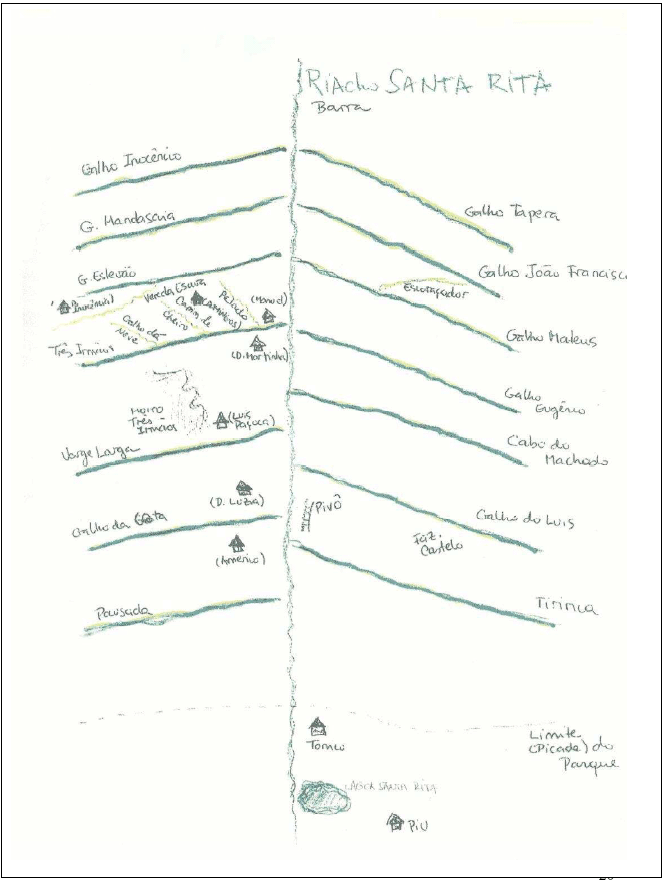
During the research I asked many dwellers of the Park area to draw the place where they lived. Their croquises made possible an interpretation of that space from native representations. Additionally, they brought a better understanding of the delimitations of other localities, as well as kinship and neighbourhood nets. The appendix with a sketch of Santa Rita makes it possible to view representations of the stream, its tributaries, and the houses of the dwellers of the locality.
This perspective allowed us to have a general view over the occupation in the Park area. However, taking Certeau as our guide, to a certain degree this option also disembodies time passing and duration, the rooting itself or dislocation of places. So that the will to see the whole also builds a "theoric simulacrum (…) a situation that has as condition of its own possibility being forgotten and unknown to its practices" (1994: 171). Such idea is related to the two ways of identifying places and to effect spaces pointed out by the author. One way is through maps that, as the croquises used, relate themselves to the 'will of seeing the whole', desire of a totality, suggesting singularity and stability of the represented places. The other way of effecting spaces is done through the itineraries, which have the particularity to specify spaces through the actions or operations of that who walks and narrates the walking.
NARRATING THE PATROL
The research itinerary, especially in Santa Rita, was initially directed and built due to a notion – and a space practice – related to the Park's existence itself and the park guards function: the patrol. The expression "patrol" refers to the formal, programmed and daily itinerary of the park guards, responsible for the inspection6 of specific areas, primarily determined by the orientations of IBAMA and Funatra.
]]> Yet, if this itinerary (patrol) is biased by the presence of the Park and by orientations of administrative offices, it is in fact overlapped to knowledge and former space practices developed by those who lived in the region before the creation of the Conservation Unit, as the park guards themselves7 .I reproduce some of the patrol paths in Santa Rita, where I walked usually accompanied by the park guard responsible for the area, José Luis, and, sometimes, his mother, former dweller of the locality (currently living in the Chapada Gaúcha), his younger brothers, teenagers at that time. There are two intentions: firstly, to narrate the practices and memories brought to mind while going through spatial references that date back to the research, for example, houses or old houses of dwellers, or a lake. It is not a systematic presentation of emic spatial categories. It consists of registering part of this path that was articulated by crossed references, as well as the research itself, and to reflect on how it crosses other paths, effecting diverse spaces.
In Certeau's search for spatial practices, the act of walking is associated to the act of speaking and references are organized for a reading of the "speech of lost steps" – this is the "game of steps that mould spaces and shape places" (1994: 176). Thus, the act of walking, or the pedestrian enunciation – maybe is better to say walker – has three characteristics (thought between the forms used in a system and the ways to use this system). Firstly, the present, or the update of the spatial order, of the possibilities and prohibitions, through which the walker displaces them and himself, using it and inventing others. Secondly, and together with this first one, the discontinuous, that shows itself by selection of the spatial significants, and makes selections on the significants of the spatial language. Lastly, the enunciated aspect of walking, or, the one that makes it also an act of communication, between here and there, for example, which implies the "me" who appropriates the space, and the "other" relative to this me and to his displacement, negatively or positively8 .
From these three characteristics of walking (or from its enunciation), Certeau presents what would be his three modalities, or types of relation with the course: the "alectic" modalities, which gives it a certain value of truth – of the necessary, the impossible or the contingent; the "epistemic" modalities, which gives it a cognitive value – of the correct, of the excluded, of the plausible or of the doubtful; and the "deontic" modalities, related to the value of must-do – of the obligatory, of the prohibited, of the permitted or of the facultative (1994: 179). It is important to emphasize, also, that the modalities are not seen in an inflexible manner, since they are all part of the displacement, transforming in each other, varying according to the path, the moment, the walker.
The use of this theory presents a certain subversion of Certeau's analysis. Especially if we consider that the author theorizes practices that happen in the city, not only totally different from this research but, also, sign of a possible and maybe classical opposition when thinking and defining the hinterland9 and rural spaces. Likewise, the analysis over the pedestrian enunciation brings the steps over the city, its inhabitants steps, immersed in an environment lived and exerted through different criteria and conditions. In the case of my analysis, not only the environment is different. The itinerary, and the observed and interpreted walk are of my own and of those who guided me.
Still, Certeau's perception over the city and its practices is quite adequate to this other space, the hinterland. What makes this position relative is the particularity of its own perspective: seeing the city as an urban space, controlled, administrated, planned and disciplined from particular criteria and standards, what matters to Certeau is essentially the procedures that resist, create and escape the discipline – his analysis focus on the so-called "microbic, singular and plural". And if these are seen and thought in their enunciation capacity, analogous to the "speech act" – it seems coherent to consider here the approximation with a kind of translation between different speech acts from joint and shared steps from those who dwell in the hinterland and those who dwell in the city.
Concerning the types of relation kept with the pathways in Santa Rita, there was one that was biased by my own walking, as a researcher, and others by those who guided me, who knew the way and lived in the region. The truth-value (the necessary, the possible or impossible, the contingent) was probably the same for everybody – I would certainly not question it -, given by the geographic space and by the reading of those who knew it: insurmountable tracks, a more open and easier path, a closed trail and home of anacondas, an angry bull…
The cognitive-value (the correct, the plausible, the doubtful) was generally also indicated by my guides, but often questioned or discussed with me: "can you climb a hill? It must be fast, for it will soon be dark…".
The must-do (obligatory, permitted, facultative) put in contrast my research interests and those of my guides – as a guard and dweller of the place. If his duty, as a park guard, was to take the researcher to all dwellers, there could be one that, due to neighbours relations, caused some conflict and because of that could not be visited all of a sudden with a strange visitor full of questions.
Hence, we were negotiating the must-do, calculating the correct and the plausible, facing the truths of the ways: putting and changing the modalities in the game of steps10 .
]]>PATHWAYS AND ITINERARIES
Great part of the information and data about Santa Rita – from its spatial occupation, families and kinship groups, houses and dwellers etc – was gathered during the first two days in the local, on February 1996 and, through out the research, this data was reviewed and confirmed, or sometimes not. I first went there with two agents from the local IBAMA, and I was allowed to stay in the house of one of the park guards for a few days, José Luis, and his other family members. His house is located in a place commonly known as "Pivot", near the hill, in the right side of the
The itinerary of the 8th of February 1996, for example, was planned to be fast and possible to complete during the morning – for I should go to another place (Onça) in the afternoon – a journey that would take us almost two hours riding horses. Thus, I accepted the park guard's suggestion of visiting, during the morning, the houses nearby Pivot, the Paçoca's houses, from João Teixeira's lineage (see footnote 5).
During the walking, Zé Luis, guard and trail partner indicated and "read" animal tracks or spoke of plants: amesca, pau da terra, embu, pau santo, sapubá/ amigo do lobo, unha d'anta, pau d'óleo, remédio, pimenteira, remédio: the fruit seemed beans, são gonçalo: with a good scent and good for the vertebrae... This kind of interaction and interpretation of plants and animals, which was indicated many times during my research as an activity/duty of the guards when receiving visitors, has truly revealed itself as practice and knowledge of most of the people with whom I walked, including kids.
Following the trails, crossing fences and pieces of log serving as bridges, we arrived at the Paçocas' houses. We visited two houses of two of João Teixeira's sons, good houses for local standards, large and built of buriti and adobe. At this time we passed also through the Santa Rita Lake, next to one these houses. This is a place that suggests "local legends", narratives that, according to Certeau, allow spaces of habitability and legibility, bringing back memories, the local spirits11 .
For, next to this lake, the evoked spirit is that of great depths, and of the great and mighty anacondas, that, according the locals, certainly live there. After hearing this, and being already a little uneasy and paying attention to suspicious movements, I was probably ready to hear the story of Mister Mad Joaquim, who died and was being recounted by Zé Luis. Mad because he entered the lake while hunting tapirs. For he had made the tapir bleed and it ran seeking shelter inside the lake. Mister Mad Joaquim did not hesitate: he entered in the deep and mysterious lake hunting the tapir. And did the anaconda get him? No, he got the tapir.
The lake was a subject that would appear in different occasions, other itineraries and other meetings. Once, in a different moment of the research, at the house of Lady Luzia 'Paçoca', widow of Mister João Teixeira, and among other relatives, we were talking about the place and someone mentioned the secret of the lake – which has never been dry and, even during raining seasons, has never overflowed. In different times, while visiting the house of another of his sons, I was talking to a young man of about 16, dweller of the Buracos12 , who was there in Santa Rita working in the Paçoca's land. At a certain point the Lake once again came into subject – and then I knew I was in front of the grandson of Mister Mad Joaquim. Mateus, about two years before, decided to repeat his grandfather's exploit and dived into the
THE FIRST DAY IN SANTA RITA
]]> One day before the visit to the Paçoca and theReviewing the three characteristics of the "pedestrian enunciation", our walk was heading to a possible present from the spatial point of view and from the "alectic" modality; possible as well in its cognitive value, at least from the park guard's point of view, who was born in the region and knew the details of the place, its paths and what we would find next. However, concerning my own position as a visitor, this could be an inadequate visit in its "deontic" modality, relative to the value of "must-do" in Zé Luis' perspective. As the responsible guard for my tour in that region, he should take me to the dweller's houses so that the research, authorized by the IBAMA, could be completed. Still, by doing this he could put in risk the effectiveness of his own job among the people of the place, as well as their trust on him. Their authorization was also necessary. We then discussed about my presence in that region and, after that, I earned my visa to visit the house of Lady Inocência and her beautiful garden.
At this point, I will make a chronological jump to recount something from the story narrated by Lady Inocência, a few months after this first visit to the Park, to Santa Rita and to her house.
THE CASE OF BRASILIA
During my second visit to Santa Rita – a few months later (July/August 1996), I redid the patrol in the region through which the
In this condition, accompanied by who passes by heading to a wedding of her acquaintances, I could return to the house of Lady Inocência.
A few days later, I wrote in my field diary these moments at her place, and a certain story told by her:
Today, 29. 07 Once again remembering the trip of Lady Inocência to Brasilia , the story she told last night at her house. She went to Brasilia due to health issues, as a great part of those from that region. There she was guided by a relative, an acquaintance who lived at Bsb. The story she told was of fear and despair in the big city, of the feeling of never coming back to her own place. Her gestures, her speech, was as if repeating her dialogues in the situation, asking God's help:
]]> * "We arrived" – the bus – the driver: "this is where you will get downIII…" - the discourse references are her own.In a certain moment they got lost. They decided to ask on someone's house. Lady Inocência, together with her acquaintance, was, she said, very scared. The house was very small, with only room enough for a stove and a bed. The woman who received them was very nice, but was not in any condition of hosting them. (Here she remembered the memory of her father teaching her to feed and host any person who came to her in need). Her relative was protestant, and someone remembers that there was a protestant church nearby, and so he decides to seek them for help, while Lady Inocência was waiting, scared and praying, fearing the little woman's husband who was about to arrive, afraid of what he would say, what he would do, oh, how fearful of him… The man arrived and started to argue with the woman, very angry, speaking loudly, how could she bring strangers inside the house. Fear… But, then God enlightened Lady Inocência, who found courage and said some things to him, maybe what her father taught her, and these were the correct words, for the man heard them and apologised, and everything ended alright, thanks God. Then, the relative of Lady Inocência arrived and they went away and never came back. Field Diary, July/August 96.
The day when this story was narrated – at the second visit to Lady Inocência's house – seemed agitated, a lot of people visiting, passing through towards the wedding next day. But, for a brief moment, she sat on the benches covered with mats of buriti, we talked and changed topics, we silenced. Lady Inocência is a narrator, in the sense of Benjamin13 and of how many others? So, she revives the experience, the moment and the speeches, the images and people with whom she spoke.
And that was the story she told of the only time she ever left her home towards the big city. It was also due to health problems, as it occurs with most of the people of that region. There she had been expected by a relative of hers, cousin or nephew, an acquaintance who lived in Brasilia .
In her narrative, the "this is where you will get down" said by the driver also calls our attention and we can imagine the urban bus driver in Brasilia or in Gama saying, with those words, that it was the place to get out, descend – in a manner of another context, as in the hinterland speech.
That was the very last time Lady Inocência left that place to go to Brasilia , to far away distances and to a big city. Memories of fear, of the feeling of being lost, of the necessity of other people's help – who are also strangers -, of the intervention of God. Her story also describes misplaces of maps, places and itineraries, for it crosses other stories. Her narrative, for instance, brings a series of similarities with other stories told about trips to Brasilia . As Lady Inocência, many there go to Brasilia searching medical services, education or jobs, often effectively migrating. But, it is important to make it clear that the name of the destiny can encompass, often, a much bigger place than the administrative and political limits of the city14 . Brasilia includes, in the view of the dwellers of the Park region, the Guará, the Gama, Taguatinga, Sobradinho, Agrovila and other regions of the Federal District . In this perspective, Brasilia can encompass in its limits a territory that extends until Corumbá of Goiás. To have relatives or acquaintances in Brasilia, having lived or passed through the city, is an image that includes other territories beyond those in the formal and administrative limits of the sign, word and city of Brasilia, being possible that they go further than the limits of the Federal District, being actually in Goiás.
Reflecting upon Lady Inocência's story and using images associated to the 'hinterland' category, taken in movements of largeness or amplitude (as in "the fear of never coming back home"), or in the undifferentiating of Gama/ Guará/ Brasilia – between what can be extremely differentiated, minimum, unexpected – we find again the desertness and emptiness in the misunderstanding and loneliness of the big city. References associated to the "hinterland spaces" (Schettino, 1995) and to the images that also include this name, Brasilia .
But there are many other stories. Brasilia , to this Northwest region of Minas, seems to be the "great capital" of the region, more than any other possible big cities, such as Montes Claros or Belo Horizonte 15 . The expression is used here in its emic sense, where the reference is not to the federal capital, as one could think, not even to its political-administrative link, but, just as the Chapada Gaúca is the capital of those in Santa Rita – the capital, as a city or the closest urban environment, where one should go seeking supplies, goods and services. Just as, in another gradation, Januária could be that to the Northwest of Minas, or Montes Claros to the other side of the São Francisco river.
But now we should go back to the itinerary of the 7th of February – the first visit to Santa Rita.
]]> THE BAMBOOS
While reproducing part of the research itinerary, I reflect also about different meanings attributed to places between diverse individuals that go through these spaces. Here, we can bring back Certeau's perception on the observation of the city, a "literal meaning" relative to spaces, represented in the normative discourse from the geometric space of urbanists and architects. The walking and its enunciation, the "inhabitant rhetoric", the synecdoche and the asyndeton.
The asyndeton is a style that allows the omission of connections, conjunctions and adverbs in a sentence or between sentences, or "when the clauses of a sentence or the words of a clause are written without a coordinating conjunction that could link them" (Cunha 1980: 584). Similarly to the language, the walking also makes possible the selection and fragmentation of the walked route, skipping connections and omitting entire fractions. By its turn, the synecdoche makes it possible for a word with an original meaning as part of the whole to designate this whole. "In the same way, the masonry hut or the slight elevation in the ground is taken as the park in the narrative of a route". The synecdoche refers, thus, to the practice enunciation that "amplifies the detail and minimize the whole" (Certeau 1994: 181).
In the descriptions of a dialogically built itinerary, one can see particular enunciations relative to the space. Some of the previous descriptions brought what, for different individuals, can evoke a lake or a displacement to the big city. Though, of the many points in this route, the most enunciative were the bamboos.
When we were almost reaching the departing place and, now, the arrival point, the Pivot, Zé Luis showed me what, for him, would be a nice spot to make photos. For me, in a first moment, it was nothing more than a lot of bamboos just like others I have seen before, different from the exotic plants of the Cerrado that called my attention. I was running out of films and decided not to make the pictures. The bamboos were then, in that moment, a point to be omitted in the description of the itinerary – the asyndeton. Also revealing a relation with space that is connected to the no-place and to its archetype model in the tourist's trip: an impersonal, fragmented and instantaneous practice16 .
As soon as we arrived back to the Pivot, at dawn, we met Zé Luis' mother, Lady Edite, again. A little after, some of his brothers arrived back from the Village in order to sleep there as well; and they also got visit from one of João Teixeira's son – neighbour and cousin. After that, we were talking gathered inside the house and I started asking about those who lived there. Lady Edite told me of the first one to acquire those lands: the deceased Antônio and Flora. I have heard, so far, some isolated information of the couple's story, but it was Lady Edite who connected them for the first time, offering views of Santa Rita and of the Paçoca through out years and generations. She was also one of the few to enter the subject of landowning, mentioning a document, probably created after the deceased couple's death, when Jacinto and João Teixeira were still quite young.
At one point during this conversation that included all the present ones, we started to talk about the itinerary, or paths I passed through, and visited places again. Zé Luis mentioned then that we had passed by the bambuseae and the frustrated photo session – it was when it was revealed as being more than mere bamboos.
Around the 1970s or beginning of the 1980s, Lady Edite and her children lived in that place, and she herself planted those bamboos. It is important to say that her sons are also Paçoca – she is married to one of Jacinto's sons (see footnote 5), third generation since the deceased Antônio e Flora. For some reason, such as the existence of many snakes in the place, they decided to move and there they left the tapera17 . They built a new house not so far, near the place where the sons of João Teixeira currently live. The new house did not last long, for that group of the Paçoca claimed land invasion and, due to the refusal of Lady Edite to leave the place, they decided to take action. Her narrative describes the day as a tragedy. They destroyed the house and released the animals in front of her and the small children. According to her, two police officers were with the groups that claimed the land, and one of them, realizing the situation – she by herself, with the kids and homeless – refused to take part in the expulsion, what did not stop, however, its accomplishment. Homeless, she slept the first night under the storm and mist, trying to shelter her kids in any possible way. Memory narrated with emotion and sadness. She lived under a tent for months until she was helped by a cousin from Januária, place of her origins. Time passed and they managed to buy land at the Vila dos Gaúchos at last, where the family lives since.
The bamboos told a story. In the itinerary built by José Luis, it revealed beauty to make a photo, perhaps of his own history that could be told and of his mother's struggle. With the narrative of Lady Edite, the bamboos condensates temporalities and becomes an element that is something more, as the synecdoche – "walking figure of the density". It designates the memory of the old house and its narrative. The bamboos become signs of memories, feelings and reflections upon life – and condensate a representation of Santa Rita as a space constructed and deconstructed by kinship links, memory and territoriality.
Apart from this significance, such point in the itinerary was also revealed to be connected to other elements that add to the stories of Santa Rita and put them in new perspectives.
]]>TAPERAS AND KINSHIP
From the group's and its territory point of view, and also of kinship relations, this story was told by an "incorporated relative"18 . Just like other women who marry men from the locality, the narrator also came from Januária. From her origins, one of the biggest cities in the North of Minas, she also brought many memories and a different way of seeing the world – and her new place, Santa Rita.
Lady Edite moved, still young, with her family to a region next to the future Park, whence many there – including her father-in-law, the old Jacinto – say to have their origins, Vargem Bonita19 , Fazenda Larga. She married in the 1960s, when she was 19 and moved to Santa Rita and to the world of the Paçoca.
"… there, by the time I got married, we did not see, we stayed like that.. myself at least, it was when I got married that I arrived there, that I saw it, those people's manners, I went crazy… when the sun rose, the sun entered,… there was a day when I thought the world was going to end… There was a time that I was lost, I said "Oh my God, the world is ending! … my heart was beating fast… (…)
Such loneliness… such loneliness… This peolple who lived inside the wilderness, without a front, without cultivated land… Such strange thing… nothing, nothing could you see… an orange, you could not see not even a papaya, you could see nothing. It was only the house, and what to eat inside the house… (…)
… Nowadays, thanks God I live in a mansion… But, I said: look, I am here in this situation, I am living. But getting used to it, never!… Not because the place was bad, it was the movement… the movement".
Thinking about the predominance of a kinship group in Santa Rita, the Paçoca, this story seems to reinforce the endogamic ideal and the importance of land maintenance inside the family, favouring consanguineous relations – what the bamboos story could also say. It is remarkable the fact that, at that time, the husband of Lady Edite, a "legitimate" Paçoca, son of Mister Jacinto, was far away from his nuclear family, not taking part in the whole episode. If, as the theories of Woortmann (1995) about localities such as Lagoa da Mata (Sergipe) or Olhos d'Água (Goiás) point out, the affinal links are disregarded in relation to the consanguineous in this case, the absence of the husband seemed to extinguish the existing connections, extinguishing also the family right to stay in the local.
Coming back to the bamboos narrative and to the moment of the itinerary when it was told, we were at the Pivot, house of park guard José Luis. There were, besides his mother and brothers, also a cousin, brother of those who had taken part in the expulsion. The story was remembered in front of him, who heard it silently, without questioning it or making any comments. Maybe because he did not agree with it – he did not take part in the episode by that time. Maybe, also, because the main actor in the case, the oldest brother, had long left that locality, living now in another city.
]]> But, apart from the years that passed and the "settled dust", new contexts were formed that allowed the return of the expelled family to the locality. The Grande Sertão Veredas National Park was created and, in its co-management terms, between IBAMA and Funatra, local park guards were hired. Among them, José Luis, who was designated to work in the region of his origins, Santa Rita. Now, as if time had made justice between groups, they came back, but according to new principles, establishing new circumstances.Unfortunately we cannot have a deeper look over this new established relation context here, that brings other names with it, among them the IBAMA. There is, however, another case that includes Santa Rita and supplies a view of this new context.
SANTA RITA, PIVOT AND IBAMA
During the research, I was hosted many times in Santa Rita in the house of Zé Luis, together with his parents and brothers, who, whenever possible, go down from the Chapada Gaúcha to the Central Pivot, where the house is located.
After a while, already working as a guard and living in the region again, Zé Luis moved to this house, built there by gauchosIV and that was so far abandoned due to a displacement process. There was some kind of agreement between the former owners, him and IBAMA, and his new home was settled in Pivot.
That is a rare kind of house in the Park region, made of masonry, with infrastructure for electrical and hydraulic systems, despite the fact that they are not working. On the living room wall, the hands of the man who built the house are marked, the hands of mister Idearte. Gaucho20 , just like the founders of the currently Chapada Gaúcha, who arrived with a project of occupying and nesting southern settlers and brought to the region the landscape of soy plantation. The city of Chapada Gaúcha was created from an occupying project of Rural Minas Foundation, initiated in 1976/1977, PADSA - Projeto de Assentamento e Desenvolvimento da Serra das Araras (Inhabitance and Development Project of the Serra das Araras). Gradually a small urban nucleus was being formed, which was named " Gauchos Village ". In the end of 1995, the Village was emancipated from the city of São Francisco , becoming a city itself and being named Chapada Gaúcha.
For apparently the 'gaucho' Idearte bought part of the lands of the Paçoca, the first to be sold to outsiders. There he built his farm and, with finances from the Bank of Brazil, installed a central irrigation pivot in the area – that became the mark of the landscape, being seen even from the mountain, and also the name of the wider area, as the reader has possibly noted for the place was often mentioned with the term Pivot.
Part of the story of Santa Rita, the Pivot and mister Idearte was told by an agent of IBAMA21 , at PARNA GSV. In his narrative, the family of Idearte lived the issue of their removal from the land and compensation for their losses. When the family left their lands in the Park area, by coercion some say, they also left behind the irrigation project and the central pivot. The debt with the Bank of Brazil, which financed the project, was not cancelled though. With the pivot not working and with no conditions of producing anything, the family could not pay the bank. Moreover, the compensation for losses that the family would receive would not be enough to pay the debt, for the central pivot is a kind of commodity for which the IBAMA does not pay compensations. When this story was told, the family was 'tied' to a debt of almost one million in Brazilian Reais.
Mister Idearte's drama – the investment in the Farm and in the irrigation project, his expulsion and losses due to the Park, the bureaucratic and legal battles that transformed his losses in his and his family's debt – is a new expulsion of the lands of Santa Rita that came to solve the other, the old one of the small family of Lady Edite. Situations initiated by totally different contexts and principles and that, however, mediated by the National Park, took place in the Pivot – starting and arriving point of the described itinerary.
]]> The account of the itinerary in Santa Rita, following the trails of the "patrol", endeavoured to see the place from meetings that happened due to misplacements, and to reveal Santa Rita as a practiced place, created and recreated by memories, events and particular contexts. During the patrol it was possible to see, for instance, places creating 'local legends', such as theBy concluding the description of the walked routes of both researcher and local dwellers together, it was possible to point out contrasts, distances and approaches between different perceptions, between those who create deeper and permanent links as the places, and those who are only passing by, with provisory and relatively impersonal links. Or, the perspective of hikers such as the park guards, who intermediate these two different positions, apart the one with the offices that administrate the conservation unit. The option of preferring the displacement as an analysis unit made it possible also to bring something over the articulation between the traditional context of the locality and the new social-cultural contexts that were imposed, as the expansion of the agricultural frontier in the 1970s and the creation of the National Park starting in 1989. If currently Santa Rita and other localities in the National Park area are scenarios in the process of removal of the dwellers, the 'rhetoric of walking' offered a glimpse of others of its spaces and possible times.
REFERENCES
Augé, Marc. 1994. Não-lugares: Introdução a uma Antropologia da super-modernidade. Campinas: Papirus. [ Links ]
Benjanim, Walter. 1985. "O narrador: considerações sobre a obra de Nikolai Leskov". In Magia e Técnica, Arte e Política: ensaios sobre a literatura e a história da cultura. São Paulo: Brasiliense, pp. 197-221. [ Links ]
Braz, Brasiliano. 1977. São Francisco nos Caminhos da História. Editora Lemi S.A. Belo Horizonte. [ Links ]
Certeau, Michel de. 1994. A invenção do cotidiano: 1. Artes do Fazer. Petrópolis, RJ: Vozes. [ Links ]
CUNHA, Celso Ferreira da. 1980. Gramática da Língua Portuguesa. FENAME, Rio de Janeiro. [ Links ]
Clifford, James. 1997. "Spatial Practices: Fieldwork, Travel and the Disciplining of Anthropology". In Clifford, James. Routes: Travel and Translation in the Late Twentieth Century. Cambridge , Massachussets: Harvard University Press. pp.52-91 [ Links ]
Correia, Cloude de Souza. 2002. Do Carrancismo ao Parque Nacional Grande Sertão Veredas: (des)organização fundiária e territorialidades. Dissertação de Mestrado. DAN-UnB. [ Links ]
Jacinto, Andréa Borghi M. 1998. Afluentes de Memória: Itinerários, Taperas e Histórias no Parque Nacional Grande Sertão Veredas. Dissertação de Mestrado. IFCH - Unicamp. [ Links ]
Labate, Beatriz Caiuby. 1997. "A Experiência do 'Viajante-Turista' na contemporaneidade". Turismo e Meio Ambiente. (org. Maria Tereza D. P. Luchiari). Textos Didáticos. IFCH/ UNICAMP: 31 (1) . [ Links ]
Martins, Saul 1997. Antônio Dó. Belo Horizonte: SESC/MG. [ Links ]
Rosa, Guimarães. 1979. Grande Sertão: Veredas. Rio de Janeiro: Livraria José Olympio Editora. [ Links ]
Schettino, Marco .1995. Espaços do Sertão. Dissertação de Mestrado. DAN- UnB. [ Links ]
Soares, L. 1987. O forte e o fraco, o dentro e o fora. Dissertação de graduação. DAN-UnB. [ Links ]
Valadares , Napoleão. 1982. Os personagens de Grande Sertão: Veredas. Brasília: Ed. Andrequicé. [ Links ]
Vidal e Souza, Candice. 1997. A Pátria Geográfica – Sertão e Litoral no Pensamento Social Brasileiro. Goiânia: Editora da UFG. [ Links ]
Woortmann, Ellen. 1995. Herdeiros, Parentes e Compadres – Colonos do Sul e Sitiantes do Nordeste. São Paulo/Brasília: Hucitec/Edunb. [ Links ]
RECEIVED ON February/26/2003
APPROVED ON April/07/2003
ATTACHMENT – SANTA RITA CROQUI
]]>
Attachment - Click here to enlarge
The croqui shows representations of one of the rivers that flow through the National Park, the Santa Rita, its tributaries and branches, inhabitants' houses and other marks, offering an idea of the connection between geographic dimension and spatial occupation of the territory. The vertical line represents the
I Brazilian Ministry of the Environment's enforcement agency (IBAMA) and Pro-Nature Foundation (T. N.).
II A typical candy of the region (T. N.).
III Desapiar in the original, a regional word that means to dismount, descend.
IV People from the state of Rio Grande do Sul (T. N.).
1 "A place (whichever) is the order according to which elements are distributed in the relations of coexistence (....) A place is thus an instantaneous configuration of positions. It implies an indication of stability. (...) Space always exists when we consider directional, speed quantity and the variable of time. The space is a mixture of mobiles.(...) Space is the effect produced by the operations that guide, circumstance, and make it work in a valid unit of conflictual or of contractual proximities. The space would be to the place as the word when it is spoken, or, when it is perceived in the ambiguity of an effectuation." (Certeau, 1994: 201-202). ]]>
2 In the beginning of the 2000s preparations were taking place to the rearrangement of the owners and land occupiers living in the area. For a more recent analysis of the process see also Correia (2002).
3 At the time of the research, there were no precise data of the number or people living inside the Park boundaries. An estimated number based on the census of 1992/92 made by Funatra pointed 97 families and a number around 470 people. See also Funatra. Environmental Awareness of the Communities of the Region of the GSV National Park – Questionnaire 01: characterization of the communities within the GSV National Park , Brasilia , 1991/92. Correia (2002: 33) analyses the data of the social-economical research done by Funatra between 1997 and 1998, indicating 90 families and a total of 390 people. In this case, the reference material is: Funatra. Grande Sertão Veredas Program. 1998. Social-Economical Research of the Communities Located in the Grande Sertão Veredas National Park . October 1997 to May 1998. It is noticeable, however, that there is a problem of confusion between domestic groups/technical units and families, between terrene categories and of kinship in both data groups.
4 Information gathered on an interview with a Funatra's representative in Brasilia , 1996.
5 The 'deceased Antônio and Flora' had five children. The lineage established by one of them, João Teixeira, prevailed in Santa Rita at the time of my fieldwork. There was also, in a smaller number, descendents from another of his children, Jacinto – as the park guard whom I followed, grandson of mister Jacinto and great-grandson of Antônio and Flora.
6 Probably the most adequate term is "vigilance", since the guards do not effectively have the power to inspect and to fine.
7 The group of park guars is in its majority formed by old dwellers of the current Park area that, for their knowledge of the region, were hired for this job.
8 This characterization is laid on the triple enunciative function of the act of walking in its most elemental level: the appropriation of the topographic system, the spatial realization of the place, and the establishment of relations between differentiated positions. See Certeau (1994: 177-179).
9 See, among others, Vidal and Souza (1997), Schettino (1995).
10 An exercise to understand these modalities is to think of them in contrast to the city and in their contexts. In the first one, instead of the insurmountable track or the better known trail, we could associate to the truth-value an obstructed avenue, condition of possibility or contingency that the pedestrian faces as an obstacle, or an open alternate route as a possible way to his destiny. The cognitive-value, related to the epistemic modality of walking, can put the matter of choosing whether to keep going, at night and by foot, through a faster but desert path, or through longer but more crowded ways, or which bus to take to another place, that will depend on the pedestrian evaluation. Lastly, the must-do value, of the deontic modalities, would make us face the payment of a fee or a fine for prohibited parking.
11 "Due to the possibility that they offer to hide rich silences and challenge stories without words, or by their capacity of creating everywhere cellars and granaries, the local legend (legend: what should be read, but also what can be read) allow exits, ways to exit and to enter and are, thus, habitability spaces. Without doubt the act of walking and travelling supply exits, going and coming back, previously guaranteed by a legendary that is now lacking." In Certeau (1994: p. 188). ]]>
12 Buracos or Vão dos Buracos is a place situated next to the Park limits, currently part of the city of Chapada Gaúcha .
13 In opposition to the modern world and its information domains that allow a immediate verification, Benjamin considers the narration as an "artisanal form of communication", for its patient work, and, overall, for its collective constitution, as a group work, based on the exchange of experiences. His ideals of a narrator are associated to the person who has travelled the world collecting experiences, or the one who has stayed in his place collecting memories and episodes through out his life – which become then his narratives, based on the exchange of experiences with the listener and from a perception of the narrated thing that is recreated in the act of creation. See Benjamin (1985: 197-221).
14 Brasilia , capital of the federal government, is in administrative and politic terms, the area of the Pilot Plan. It is one of the administrative regions of the Federal District, also composed by the so-called satellite-cities, and other administrative regions, such as: Taguatinga, Guará, Núcleo Bandeirante, Riacho Fundo, Recanto das Emas, Samambaia, Santa Maria, Gama, Ceilândia, Brazlândia, Cruzeiro, Paranoá, Sobradinho, Planaltina, and others, in a total of 19 administrative regions. It is important to mention the Surroundings of the FD, which are formed by cities from Minas Gerais and Goiás and are also planned regions.
15 Belo Horizonte is located at a distance of 750 km from the Park, while Brasilia is 350 km from it.
16 Apart from the discussion of the no-place (Augé, 1994), this point brings the reflection upon the trip, and variables such as the research and touristic trips, both common activities in conservation units or indirect use. For more on this topic, see Labate (1997) e Clifford (1997).
17 Tapera, in this context, can mean both the houses of the region, built with buriti wood and adobe, and the place and ruins of an old house.
18 From Soares' study on the community of Olhos d'Água, "This person is, then, a non-relative relative, or, better saying, an incorporated relative, for the fact that he incorporates the role of being and not being relative, and for that carries through his entire existence the stigma of an 'outsider', even after marrying a person of 'within'." Soares (1987: 20) cited by Woortmann. (1995: 253).
19 Apart from the Park dwellers, many inhabitants of the Chapada Gaúcha also came from Vargem Bonita, in the city of Januária . Crossing historical and fictional ways, it is important to mention that such place is indicated as being shelter of the gunman (jagunço) Antônio Dó, and place of the battle between him and his group against the government troops in July 1913. He is a historical figure still well remembered, especially by elders. It was there as well where the character Riobaldo Tatarano claims to have met him: "... Antônio Dó eu conheci, certa vez, na Vargem Bonita, tinha uma feirinha lá, ele se chegou, com uns seus cabras, formaram grupo calados, arredados..." ("...Antônio Dó I met, once, in Vargem Bonita, there was a little fair there, he came himself, with some thugs, quietly formed group, distant…") in Rosa (1979: 129): See more about Antônio Dó in Martins (1997); Braz (1977: 369-409) and Valadares (1982).
20 The reference to the "gauchos" is taken from local acception – and from Minas, including all the settlers that came from the South, whether they are actual gauchos, from the state of Rio Grande do Sul, or from the other southern states, Paraná or Santa Catarina.
21 Interview made in March 1997, in the central office of IBAMA / PARNA GSV, in the Chapada Gaúcha.