A nobreza da República: notas sobre a formação da primeira elite senhorial do Rio de Janeiro (séculos XVI e XVII)
João Fragoso
Translated by Thaddeus Gregory Blanchette
Translation from TOPOI - Revista de História, Rio de Janeiro, n.1, p.45-122, 2000.
The article analyses the making of the early noble elite in Rio de Janeiro as well as its main economic characteristics during the sixteenth and seventeenth centuries. Both centuries were difficult times for Portugal and it's overseas territories. In this scenario, the conquerors used old but efficient strategies rooted in ancine regime Portuguese society: conquest (of men and lands), control of the municipal senate and of the system of boons. This process resulted in a social and economic hierarchy that excluded part of the colonists and gave birth to the plantation economy.
RESUMO
O ARTIGO ANALISA a formação da primeira elite senhorial do Rio de Janeiro e de sua economia (séculos XVI e XVII). Ele parte do pressuposto de que tal formação se daria em um contexto marcado por dificuldades em Portugal e no seu Ultramar. Em meio a este cenário, os conquistadores utilizariam os velhos elementos, porém eficientes, da antiga sociedade lusa: a conquista (de homens e terras), o Senado da Câmara e o sistema de mercês. Como resultado deste processo, teríamos a formação de uma economia de plantation como derivação de uma hierarquia social e econômica que exclui parte dos colonos.
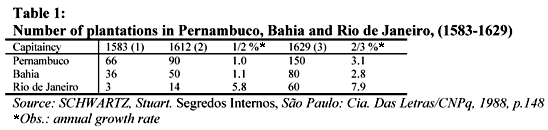
The installation of the plantation economy of Rio de Janeiro occurred under the auspices of fair international economic winds.ii From 1550 on to the end of the century, the price of sugar more than doubled.iii According to Ferlini, this high would be maintained up to the 1630s, with only occasional dips in prices.iv This positive conjuncture perhaps explains the rapid spread of sugar plantations1 throughout Brazil – and particularly in Rio – during the period in question. In 1583, Rio had only three sugar plantations, but by 1612, this number had grown to 14 and 17 years later there would be 60 (see Table 1). If we take into consideration the fact that some 130 sugar mills were operating in 1680,v then the 17 years running from 1612 to 1629 saw the foundation of fully 35% of the plantations which would be operating in the Rio de Janeiro area by the end of the 17th century. If confirmed, these numbers point to the first decades of that century as decisive in the formation of the captaincy's slave-based export economy.
This result can be confirmed by a series of other sources, principally Rheingatz'svi genealogies (which are based upon parish baptismal, wedding and death records), public deeds and land grant proclamations (see Annex 1). By cross-referencing these sources, we can identify the existence of 197 families/genealogies which possessed one or more sugar plantations at some point during the 17th century. 61% of these familys began before 1620. Before we proceed with our analysis, however, we need to briefly look at how the notion of the "noble family"2 has been constructed.
Rheingatz organized his 17th century genealogies beginning with the first colonizing couples of which we have news in the Rio de Janeiro area. When a member of these genealogies – considered via masculine descent – was also a plantation owner, then I have considered the family to be "noble". 197 families/genealogies fit this description. There are also cases in which the female element of the founding couple is, in fact, the daughter or granddaughter of another noble family. As an example of how my classification scheme works, take the couple made up of Miguel Gomes Bravo and Isabel Pedrosa, who arrived in Rio towards the end of the 16th century. Several decades later, in a dowry statement, we find news that Miguel, at some point in his life, was the happy owner of a sugar plantation (see Annex 1). This information means that we classify this family as noble in the first generation of its presence in Rio de Janeiro. One of the couple's six sons was also be a mill owner, while a daughter married João do Couto Carnide, a foreigner in Rio who appears in the registers in 1632 as the owner of yet another sugar mill. According to our criterion, the Gomes Bravo family is thus classified as an extended noble family, as it contains two plantation-owning families. After a few more decades, two of Isabel's granddaughters married people who had no kin in Rio (Pantaleão Duarte Velho and Manuel de Gouveia) but who had also acquired mills. Thus, after three generations, the extended family founded by Manuel and Isabel united four noble families: the Gomes Bravos, the Couto Carnides, the Duarte Velhos and the Gouveias. The last three were united via the feminine line and through this descended from the first.
I utilize the expression extended noble family without meaning to imply any sophisticated anthropological theorization. My use of the term does not necessarily imply, for example, co-residency of several generations of relatives under one roof, endogenous marriage strategies among kin, or relationships of familial solidarity.vii I use this expression mainly to identify the temporal continuity, via descent, of different households and, through this, to perceive the mechanisms through which noble fortunes were made. The extended family concept is thus being used here in an entirely pragmatic fashion in order to explain a situation in which more than a third of all noble families were born of other families of similar status. With this in mind, let us proceed.
Table 2 describes in general terms the 197 17th century noble families with which the present article deals. Of these, 32 are extended and a further 73 linked through feminine decent with the first group. The 92 remaining families will be referred to, from here on in, as simple noble families. When we take into account origins, then, we are in fact dealing with only 124 families and not 197.
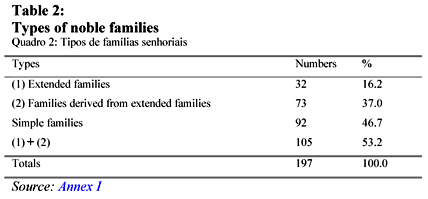
Table 3 shows that 52 of the 124 noble families (both extended and simple) – or 58% - were formed before 1620. This picture changes dramatically, however, when we consider the fact that 27 of these 52 families were extended, giving rise to a further 68 noble families throughout the 17th century. This being the case, simple mathematics shows that 120 noble families (or 61% of the total of 197) were present around Rio de Janeiro before the year 1621.
]]>
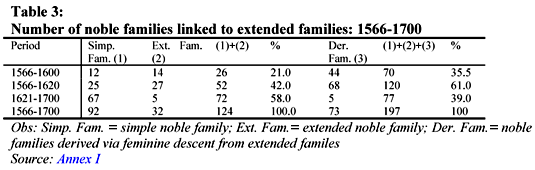
From the data presented by Tables 1 and 3, we can infer that what could be called the primitive accumulation phase of Rio de Janeiro's plantation economy occurred between 1566 and 1620, a period in which the region's economy was not characterized by sugar production nor by African slavery. In 1612, it must be remembered, the region possessed only a dozen sugar mills. Given these facts, we must inquire as to what was the economic situation which allowed for this accumulation. In other words, we must ask who paid the bills.
We have already seen that the winds blowing in the international market were fair for sugar production. This, however, was not enough in and of itself to build the economy of Rio de Janeiro. It is a well known fact that in order to take advantage of opportunities, resources and credit are necessary. And in this sense, the news from Lisbon regarding the Portuguese overseas empire was not good.
Imperial and Atlantic Conjunctures
The initial construction of colonial society in Rio de Janeiro took place in an environment marked by what Vitorino Magalhães Godinho has characterized as a complete structural change in the Portuguese overseas empire. Beginning in the middle of the 16th century, the Lusitanian Empire began to suffer increasingly intense attacks all along it colonial frontiers, from Morocco, to Ormuz, to the Indian peninsula.viii By the end of the century, the State of India's future was none to bright. Aside from the fall-off of profits on the Cape route and Ottoman, Mongol and Iranian Saphavid expansion, the Dutch presence in Portuguese Asia began to increase dramatically after the founding of the Iberian Union.ix
Faced with this situation, in 1548, the Portuguese Crown decided to close its business interests in Antwerp. This marked the beginning of the withdrawal of the state from the economy and the advance the powerful international merchant-bankers, allied with the Portuguese nobility.x
]]> The effects of this change on Portuguese society are easily understood when we remember that, since the last quarter of the 15th century, the foundations of the state rested upon overseas trade. In 1506, 65% of all state receipts came from this source. To tell the truth, all of Portuguese ancine regime society depended, directly or indirectly, upon imperial commerce as the Crown, through various means, passed on part of these overseas profits to the principal noble houses of the realm.xi Given this, it's not at all surprising to discover a certain harmony in the timing of the misadventures of the colonies and the metropolis. Between 1557 and 1607, the Portuguese state's internal debt grew by 250%.xii During the 16th century, the price of flour rose by 800% in the markets of Lisbon, resulting in frequent famines.xiii To top off this series of disasters, from the last decades of the 1500s on, Portugal was racked by recurring explosions of mortality.xivAs I've mentioned above, however, balanced against this bad luck was the good news from the South Atlantic. Aside from the increase in sugar prices, the population of Portuguese America grew from 6,500 people in 1546-48 to 150,000 by the end of the century.xv Though Indian laborers were still the norm on the plantations of Pernambuco and Bahiaxvi, by the last decades of the 1500s the transatlantic slave trade was in full operation. It is estimated that, in the port of Luanda alone, slave exports grew from some 2,600 a year during the period stretching from 1575 to 1587 to over 5,000 annually from 1587 to 1591.xvii
Given these numbers, it's not surprising that during the middle of D. Sebastão's reign discussions were already underway regarding what the overseas empire's primary focus should be: India or the Atlantic (Brazil and Africa). The 1562-63 Cortes already considered "the conquest of Africa to be more just, more convenient than that of India; and the reason was that, this [India] being very distant, it would not bring any profits and with that [Africa] there would be no expenditures and it was close by." In this context, it was perceived that Altanticization would increasingly be imperial policy and that, under the orders of the Desejado, steps would be taken to deepen the Portuguese presence in Angola and America.xviii
Notwithstanding such projects, however, and regardless of the continued decline of the East, Portuguese Asia still contributed 40% of the Crown's income in 1619 while America was responsible for a mere 11%.xix Given this situation, we can see that Brazil had still not taken its place as the empire's chief overseas colony, as would be the case in the 18th century.
Summing up then, even though the structural changes which the Portuguese empire was going through created the basis for the Brazilian sugar boom, the first three decades of the colonial project in Rio de Janeiro were marked by severe metropolitan and imperial military and financial crises. It was in this inauspicious environment that the primitive accumulation which made Rio's sugar economy possible took place and in which 60% of the families of the colony's noble elite were founded (see Table 3). This situation was even more difficult when we take into consideration the origins of the conquistadores whose descendents would be transformed into the finest families in the land, the plantation lords.
Some of these men, such as Jordão Homem da Costa and Belchior Pontes, came from the north of Portugal and from the Atlantic Islands. Others, such as Antônio de Mariz and Antônio Sampaio, passed through São Vicente before arriving in Rio. During the 16th century, demographic pressure, lack of access to land and the consequent recurring crises in subsistence transformed the Entre Douro e Minho region into a land wracked by poverty and characterized by "the flight of the people". This flight was originally towards the Atlantic Islands and later to other parts of the Empire, most particularly Brazil.xx Towards the end of the 1500s, the Madeira and Azores islands were no longer the most prosperous overseas colonies. According to Viera, the first island had begun losing population in the second decade of the 16th century as the local sugarcane producing economy entered into collapse. The second island had been wracked by periodic grain crises from middle of the century on (though these were less intense than those on the island of São Miguel). In other words, both islands began to export their population due to growing poverty.xxi As for São Vicente, we know that the captaincy was not exactly a prime example of wealth and prosperity at the end of the 1500s. It had not yet transformed itself into the "granary of Brazil" in which vast tracts of land would be cultivated by captive Indians.xxii
When talking about the social origins of Rio de Janeiro's conqistadores, one must remember some facts. First of all, the great Portuguese aristocracy believed that their military obligations ended at Morocco. South of that land, the principal agents of the Crown were the lesser nobility. The old fidalgos and great titled aristocracy initially refused to go to India as that land "had been discovered for commerce and trade". This situation only began to change with the increasing militarization of the State of India as a way of securing the Asian commerce routes. Even then, however, the east was mainly the province of the second sons of this aristocracy, those who would be deprived of rights, lands and goods, according to the Portuguese system of inheritance.xxiii For these reasons, it's very unlikely that any Portuguese Grandees came to the region of Guanabara Bay before 1620. The conquistador fidalgos were most likely similar to João Pereira de Souza Botafogo or the Madeira islander, Diogo Lobo Teles. João's origins were in a noble house of Elvas (in southern Portugal) whose goods and rights had been confiscated by royal order. In "disgrace", João left the metropolis, benefiting from Queen Catarina's decree that "criminals who go to conquer the barbarous Indians of Brazil should be left to pass in peace".xxiv Diogo, on the other hand, was the grandson of Vasco Martins Moniz on his mother's side. Moniz had transformed himself into a fidalgo of the King's house through his participation in the campaigns in Africa,xxv becoming a knight at a time when this title was being granted in abundance and was thus losing some of its cachet in the eyes of the kingdom's more elite aristocrats.xxvi
Curiously, it is possible that only São Vicente furnished Rio with conquistadores originating among the social elite. Of the 52 original families of Rio de Janeiro (see Table 3), at least eight came from the Paulistan plateau. Among them we find sons-in-law and sons of the Captains-General of that captaincy, such as Manuel Veloso Espinha, son-in-law of Captain Bras Cubas. Backwoodsmen such as Roque Barreto and André de Leão were also title holders. Originating among some of the "best families" of São Vicente, these men were thus also linked to the searches for precious metals and the trade in natives which were the continuous concerns of that colony.xxvii This fact indicates the possibility that it was the capture of Indians which was a main contributing source of wealth accumulation for the original elite of Rio de Janeiro and/or that the first plantations of the new colony were worked by native slaves. Those eight original families from São Vicente became 48 during the 1600s, fully 25% of the total of that century's elite families. The linkages to the neighboring colony also stretched past 1620: even after that date, we can still find cases marriages between the children of São Vicente's "ministers" and the first families of Rio.
These, then, were the refugees from poverty who founded the "finest families" of Rio de Janeiro: men of the lesser nobility or émigrés from the nobility of a poor neighboring captaincy. However, discovering the origins of these men still does not explain who paid the bill for the founding of the carioca economy.
]]> The first elite of Rio
In a 1959 text which is today considered to be a classic of Brazilian colonial historiography, Celso Furtado claimed that the foundation of the sugar economy could be laid at the feet of the Dutch. According to the author: "A substantial part of the capital needed for the sugar enterprise came from the Low Countries (...) Everything indicates that Flemish capital participated in the financing of productive installations in Brazil and in the importation of slave labor to the colony". Thirty years later, Schwartz wrote that around 1/3rd of Bahia's sugar plantations were the property of old merchant interests. It is not my objective, at this point in time, to verify or eliminate these hypotheses regarding the sugar-producing Northeast. However, one thing has attracted my attention: both authors consider the financing of the first plantations to have been the fruit of merchantile accumulation – commerce, in other words.xxviii
It is tempting to adopt this hypothesis for Rio de Janeiro, being that the city was already known for its commercial connections to the Platte River basin by the beginning of the 17th century. Rio, by that time, had become a region which produced manioc flour and sugarcane brandy, products which were used in trade for the African slaves which were then transshipped to the Platte.xxix
However, before analyzing the hypothesis that the funds needed for the foundation of Rio's plantations came from commerce, we must first briefly discuss another topic: Rio de Janeiro's characterization as a brandy-producing region.xxx This seems to me to be a bit of an exaggeration, though in 1695, a letter to the Rio senate affirms that "the only product which they [the inhabitants of Rio de Janeiro] could use in the purchase of slaves in Angola was the brandy of the land, cachaça".xxxi There are also many indicators that, in addition to cachaça, sugar was the region's main product. One must remember in this context (and as we shall see below) the many heated arguments between merchants and the local elite regarding the price of sugar, as well as the fierce struggles among the local elite for control over the weighing house which measured "the boxes of sugar which embark from here for Portugal". Another letter written at the same time claims that one of the reasons for the lowering of royal tithes in 1657 was a drop in the price of sugar which "is the fruit of the land from which the profits which feed the tithes depend"xxxii. In other words, those who tithed received their main source of income from the sale of sugar. Whether producing sugar or brandy, however, the fact remains that throughout the century we find reports of plantation lords such as Salvador de Correia e Sá e Benevides, who (according to his enemies) had over 700 African slaves working his properties in 1642;xxxiii D. Feliciana de Pina who owned 91 captives in 1656; Pedro Souza Pereira, with 70 slaves in 1673; or João Dique with 90 captives in 1712. These numbers only underline the fact that, throughout the 17th century, a local elite existed at the head of a plantation economy.xxxiv
Returning to the hypothesis that the Platte River-Rio de Janeiro-Angola triangle trade was the origin of Rio's sugar economy, we can confirm this theory by looking at the contracts and legal work on display in the in the books of the first registry of deeds created in 1612-13 for business with the Platte basin. However, while the theory is tempting, we must take some cautions with it, In the first place, we cannot lose from sight the incipient character of the 17th century Rio's mercantile elite and, indeed, the colony's status as an urban nucleus (at least in relation to what the city would grow to be in the early 19th century). We can make some comparisons here. In the two periods running from 1610-13 and 1630-36, 75 deeds of purchase were registered for which we can confirm some sort of cash value. 70% of the values encoded in these deeds were linked to rural stock and property of some sort (cane fields, mills, lands and etc.). This indicates that urban operations – and operations involving mercantile capital in particular (ships, shops, stocks of merchandise and etc.) – had a relatively low degree of representation in these transactions. Centuries later, when Rio had become the principal mercantile center of the South Atlantic, with a strong community of large-scale businessmen, the numbers were different. In ten years, between 1800 and 1816, the four registries of Rio filed 3,562 documents. 37.8% of these dealt in mercantile goods, while a further 29% disposed of urban properties with only 21% in reference to rural properties and goods. It is unnecessary to analyze these numbers further as they speak for themselves.xxxv
Though Rio couldn't be characterized as a typical mercantile city at the beginning of the 17th century, this didn't mean that it had no commerce at all. After all, as a recent doctoral thesis has demonstrated, in 16th and 17th century Portugal, commerce was not the monopoly of a single group, such as the merchants. Besides these, "the nobility, the military, the King's officers and even the clergy – not to mention the captains and crews of ships – were engaged in commerce".xxxvi There is no reason to suspect that things were any different in the overseas empire which, of course, was mercantile in the extreme. As a member of the Overseas Council put it in 1668, those who went to the Conquests went for business.
Looking at Table 4, one sees that aside from merchants, planters, husbandmen and others, the first elite of Rio was descended from people connected to other spheres of public life, most particularly, the administrators of public life themselves. Table 4 shows that 40 families – 1/3rd of those who became plantation owners during the 17th century – were founded by ministers of the King. These were administers of the royal properties, customs officials, captains of infantry, or governors. We don't know, based on current information, if they were also merchants. What is certain, however, is that they were engaged in His Majesty's service and, as such, administered public life in the tropics. We will analyze the significance of the numbers displayed in Table 4 further on.
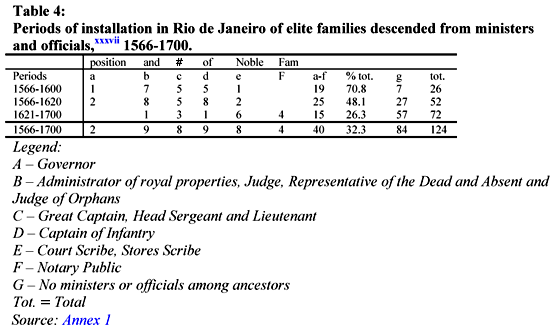
In Table 4, I concerned myself with the original or foundational element of each family, following the same methodology which I used to prepare Table 3. In other words, the extended noble families, or those which showed capacity for generating several families from the same root, were treated in the same way as those families which didn't demonstrate this capacity. Even so, the extended families (even though they contained other plantation owning families) had the same numeric weight as the simple families. Given this, that total of 124 noble families is in reality 197 families and the 40 which descend from public officials is in fact 89. In other words, of the 40 families descended from officials, 24 are "simple" noble families and a further 16 are extended. These, in turn, contain another 49 plantation owning families. Simple mathematics (24+16+49) thus brings us to a total of 89 families whose origins can be traced to a minister or official of the Crown.
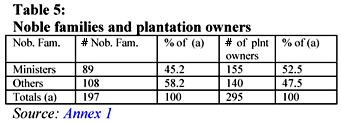
With this information in hand, then, we move on to Table 5. Here, we can verify that no less than 45% of the 197 noble families of the 1600s began with men in His Majesty's service. Aside from this, we can observe that more than half of the 17th century plantation owners were also royal employees, descended from royal employees, or married to their descendants. This means that this type of family was the most capable in reproducing plantation owners in the colony.
Moving on to Table 6, we can see that this type of family is also the most stable over time. In order to determine this, I looked at the number of generations which contained plantation owners within a giving family, measuring from the date of its founding. Between 1565 and 1600, 26 future noble families disembarked in Rio de Janeiro. Of these, more than half would only have one or two future generations of plantation owners up to 1700 and less than a quarter would contain 4 generations of planters. For those families who are not descended from ministers, the results are even more precarious. Of a total of seven families, four only managed to own plantations for one generation and only one managed this mark of distinction for three generations. This is quite different from what happened to those families descended from "King's men". Of these 19 families, more than half would own plantations for more than three generations. In truth, during the period under consideration, these families were the only ones to contain four generations of planters. Considering that we encountered similar results for the entire 17th century, we can affirm that the families which descended from ministers and officials constituted the central nucleus of Rio de Janeiro's noble elite. It was these families who showed the greatest degree of continuous presence, over time, in the planter class.
]]>
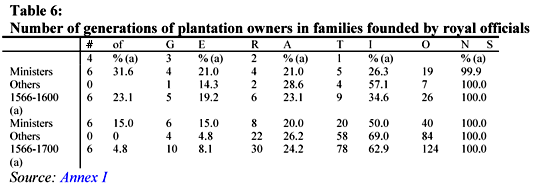
Table 7 shows that half of the 32 extended noble families of Rio originated among the King's men and that these families then produced another 49 noble lineages, or 2/3rds of the 73 families created in this fashion.
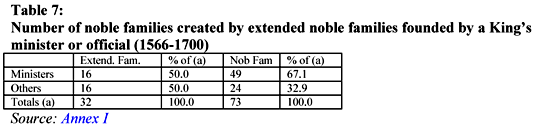
This information is especially relevant when we remember that of the 197 noble families in Rio during the 1600s, 73 – or 37% - were derived from the feminine line of 32 other families (Table 2). We thus have a set of 105 noble families (32+73) in which each was linked by kinship relations to at least one other family. This number, more than half of the 197 noble families of the colony, emphasizes the existence of kinship relations among the elite and also indicates that one of the ways to become a member of this group was to marry the daughters of already established families. Marriage for the outsider groom represented not only the possibility of having access to a dowry, but also of becoming part of the systems of alliances and solidarity networks which were part of elite life in Rio.
Given this, Table 7 indicates that the women who were descended from ministers enjoyed the greatest success among the eligible young men who wished to become planters in the colony. After all, of the 73 cases mentioned above, 49 were marriages involving daughters or granddaughters of royal officials. We can thus infer from this that these officials and their descendants exercised a great deal of control over who was accepted into the elite.
Summing up, then, the noble families descended from royal officials and ministers had the largest number of plantation owners among their members during the 1600s. They also demonstrated the greatest degree of stability over time, the largest capacity for generating other noble families and thus for absorbing outsiders. In my opinion, these traits make these families the principal nucleus of the first noble elite of Rio de Janeiro. Having said this, let us briefly return to Table 3, where we see that between 1566 and 1620, the roots of 120 of the 197 noble families of the 17th century – or 61% - were already established in the colony. In Table 8, we can see that of these 120 families, 73 originated with royal officials. Given this, we are thus able to get a better idea of how the plantation economy of Rio de Janeiro and its controlling elite began and we can better identify the mechanisms through which this society was held together.
]]>
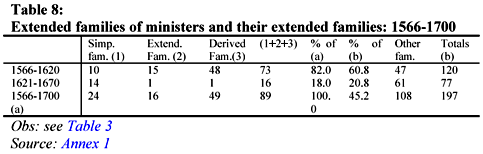
In other words, if it is true that the primitive accumulation (or something similar) necessary to found the plantation economy of Rio de Janeiro took place during the turn of the 16th to the 17th century, it is also true that those who formed the first noble elite of the colony were directly linked to the holders of titles and positions within the colony's public administration (and here we include posts in the city senate as well) and that these gentlemen belonged to certain elite families themselves. The administration of the public welfare, then, was also the administration of the construction of the noble elite of Rio.
We will now look at how everything began and learn a bit more about the families which occupied His Majesty's posts in the colony.
"The city [Rio de Janeiro] thus founded by governor Mem de Sá on the aforementioned hill [in 1565], it was soon ordered that officers and ministers of the militia, justice and the treasury be established there."xxxviii As this note from the pen of Friar Vicente do Salvador shows, one of the first measures taken by Mem de Sá after the conquest Rio de Janeiro was the installation of civil and military administration in order to aid the occupation and colonization of the region.
According to the political-administrative structure of the times, the highest civil and military authority in the captaincy resided in the hands of the governor. Designated by the King, this man had several responsibilities and powers, among which was the distribution of land grants and lesser administrative posts (though confirmation of these was left up to the Crown). In 1608, the power of the Governor of Rio de Janeiro was increased by the creation of the Southern Division. This measure gave Rio greater autonomy from the colonial General Government and placed the captaincies of São Vicente and Espirito Santo under carioca jurisdiction.xxxix After Mem de Sá left office, his nephew, Salvador Correia de Sá was chosen to take his place in 1568. The Correia de Sá does not need further introductions. It is enough to remember that it controlled the post of Governor of Rio de Janeiro (with a few intervals) for 55 years from 1568 to 1700, with six members of the family exercising the prerogatives of this post as either named or interim governors.xl The family also owned 12 plantations during this period, making it one of the few which did so for all of the generations of the 1600s.
Beneath the governor in the captaincy's hierarchy were the ouvidor (judge), the alcaide-mor (high lieutenant) and the provadores da fazenda real (guardians of the royal properties) – all posts whose occupants were named by the King. The first of these gentlemen "administered justice". With the creation of the Southern Division, the ouvidor-geral3 of Rio became superior to all the other ouvidores in the other captaincies of the Division. In 1568, this position was given for a period of three years to Cristovão Monteiro, the son-in-law of Jorge Ferreira Bulhões, the High Captain of São Vicente. At the end of this term of office in 1572, the job passed to Francisco Dias Pinto, the old Captain of Porto Seguro captaincy and, since 1565, the alcaide-mor of Rio de Janeiro, entrusted with the military defenses of the city. From the marriages of the descendants of Jorge Ferreira and Francisco Dias, the extended noble family of the Castilho Pintos was born.xli
Regarding the post of the provedor da fazenda, this was exercised together with that of customs judge. The person who occupied this position was responsible for looking after the property interests of the King in the colony and, in particular, supervised the collection of royal tithes by the customs house.xlii In 1568, these responsibilities were placed in the hands of Antônio de Mariz Loureiro. As in the case of the other gentlemen mentioned above, during the armed struggles for control of Portuguese America, Antônio was knighted fildalgo of the Royal Household. Like other founders of noble families, he occupied several posts in the colonial administration throughout his life.xliii 10 noble families and 18 plantation owners would eventually trace their lineage to the founding couple of Antônio and his wife Isabel.
]]> Subordinated to these ministers were several different types of scribes and accountants and – in the realm of military affairs – captains of fortresses, infantry captains and lieutenants.There were, however, some strategic posts which controlled the keys to what we might call, using an anachronism, social expenditures. I refer here to the positions which allowed access to tax collecting and saving, as well as control over the worldly goods of the captaincy's orphans. Aside from the provedor da fazenda, these posts included the escrivão da fazenda, the almoxarife, the escrivão do almoxarife e alfandega, and the judge of orphans. Among the captaincy's first escrivães da fazenda we find Baltazar da Costa, the son-in-law of the original captain, João Pereira de Souza Botafogo. Apparently, this position soon became something of a family possession. In 1655, Baltazar's son, Francisco da Costa Barros, claimed to have been exercising the prerogatives of the office since 1630.xliv The extended family of the Botafogos also gave birth to three other noble families.
As to the judge of orphans, this position was occupied by Antônio de Mariz in 1584 and, years later, his son, Diogo de Mariz also held the position.xlv After 1644, the office became the "property" of the Telles de Menezes family. The man who occupied this post was responsible for looking after the colony's orphans and, in particular, the "orphan's chest", the strongbox in which all the money, debt receipts and income of the properties inherited from the deceased parents were kept.xlvi
Among the captains of infantry who arrived in Rio de Janeiro with Mem de Sá was Antônio Sampaio.xlvii Together with his spouse, Maria Coelha, he founded a dynasty which would include four generations of plantation owners up to the end of the 16th century.
The examples above illustrate the numbers displayed in Table 4. A significant part of the first elite of Rio de Janeiro was made up of conquistadors who had participated in Mem de Sá's campaigns against the French and Tamoios. Later, these same men would be invested in positions of power as the first military and administrative elite of the captaincy. They would occupy posts which functioned to aid the establishment of the Portuguese presence in the Guanabara Bay region, which is the same thing as saying that they were charged with the establishment of colonial society in Rio de Janeiro. It's worth remembering in this context that the metamorphosis of conquerors into administrators was not exactly a new or uncommon thing in the history of Iberian America. The same process occurred in Mexico with Cortez and in Peru with Pizarro.xlviii
In the case of Rio de Janeiro, this metamorphosis was reinforced by two other simultaneous movements. The first was the early formation of political alliances between these conquistador/ministers via marriage. Antônio de Mariz had 5 children who survived to adulthood: three boys and two girls. All married, four of them to special personages. The eldest, Diogo Mariz, a plantation owner and the provedor da receita (in 1606), wedded Paula de Rangel, the daughter of Julião Rangel, another member of Mem de Sá's expeditionary force and the old Ouvidor da Cidade and escrivão dos órfãos. Aside from this, Paula's brother had been made into the lieutenant of the fortress of Santa Cruz and head of the ship guard in 1620.xlix Julião's extended family included four other noble families. Two of Antônio's other sons married into the families which at one point controlled the provedoria da fazenda real and one of his daughters married the Ouvidor da Cidade, Tomé de Alvarenga, in 1603. One of the granddaughters who sprung from this last marriage qould later become the wife of Manuel Correia, brother of Governor Salvador Correia de Sá. Manuel and Maria would also become the parents of the future governor of the city, Tomé Correia de Alvarenga. Similar events can be confirmed in other extended families.
The second movement referred to above is the fact that while these conquistadors and their children occupied posts in the imperial administration, they were also members of the local senate (senado da câmera), and thus active in another field of the public administration of power. The senate was responsible for the welfare of the Republic4 and this, among other things, meant overseeing the supply of the city (administrating prices and the quality of the goods purchased), price intervention, administering taxes and etc. In other words, it was the senate's responsibility to intervene in the market in the name of the Republic's interests.
Table 9 shows that between 1565 and 1620, out of a total of 107 senate members, 62 – or 60% - were old members of the imperial administrative apparatus. Some men, in fact, held positions in the senate and the imperial administration simultaneously. This was the case, for example, of Crispim da Cunha Tenreiero, Antônio de Mariz's son-in-law. Between 1587 and 1588, this man was simultaneously an officer of the senate and feitor almoxarif da fazenda real. Years later, he was posted as provedor da fazenda real and still later, in the 17th century, was once again elected to the city senate.l
]]>
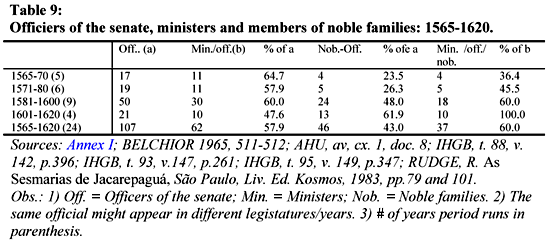
Table 9 illustrates the possibility that the same set of conquistadores circulated between the two highest instances of government in Rio de Janerio: the imperial administration and the local senate. The men who filled the positions of the first were nominated and/or confirmed by Lisbon while those of the second were elected by the people (in this case, "the good gentlemen") of the Conquests. In spite of these differences, however, both governing structures were responsible for managing the business of the republic. Curiously enough, among those people who circulated from one government post to another we find the members of the families who would become sugar plantation owners during the 1600s.
Of the 107 senate officials who I was able to discover for the period from 1565 to 1620, 46 – or 43% - founded noble families (see Table9). More: 37 of these 46 officials were also posted as imperial administrators during the period in question. This means that of the 62 senate officials who were or would become royal administrators, more than half would also found noble families. With these facts in hand, we can begin to perceive that the nucleus of the first noble elite of Rio de Janeiro was generated by a set of individuals who were simultaneously conquistadors, King's men and representatives of the people. This is the case of Antônio de Mariz and João de Barros, for example. Both of these men, at different moments during the second half of the 16th century, occupied the post of provedor da fazenda real, a position which gave them control over the royal tithes and the city's customs house. Simultaneously, they were elected by the "good men" of the city to the senate, a position which obliged them to engage in debate regarding the prices of supplies and freight in colony. It's not difficult to see how such a situation could confer an extraordinary amount of power over the structure and functioning of the colonial economy. This fact is even more striking when we take into consideration the delicate web of kinship relations that these men wove through strategic marriages. The combination of all these circumstances gave them a very comfortable seat of power and a tremendous voice in the colony's affairs and destiny.
However, we must be cautious and not jump to too many conclusions too rapidly. Returning to Tables 5 and 9, we can see that, with the passage of time, the capacity of the King's men for constructing new families without connections to other, older nobility, diminished to a significant degree. Of a total of 40 families (extended and simple) generated by King's men up to 1700, only 15 originated after 1621. It's unnecessary to point out that after that date, new ministers, captains of infantry and etc. still arrived in Rio de Janeiro. These, however, didn't show the same capacity for forming noble "lineages" as their predecessors. We can also see that in this same period, the number of noble families not founded by ministers grew considerably. Between 1621 and 1700, 72 families were formed and 57 of these – or 79% - had no origins in public administration. Consequently, during this last period, such posts apparently lost some of their importance in the production of new noble lineages. Other mechanisms of wealth accumulation – including commerce – began to move to the fore.
From this we can gather that a ministerial position was not enough, on its own, to serve as a base for a noble family. In the case of the noble elite of Rio de Janeiro during the 1600s, other factors were also at work, most particularly certain possibilities opened up by the Conquest itself.li After all, it is one thing to be a representative of the Crown during a period in which colonial society is still being established, in which warfare is constant and in which strong local social groups have yet to be constituted. It is another thing entirely to hold such a post in an already established society which has well-defined sectarian interests and social groups.
In the case of Rio de Janeiro, it is interesting to note that the conquistador/functionaries (and their families) came out of the Conquest able to establish themselves as the nucleus of the local noble elite during the 1600s, as Tables 6 and 8 above demonstrate. Actually, after 1620, the descendants of those functionaries converted themselves into what I call "the nobility of the Republic" through their domination of the senate, their use of the system of Royal Boons and their strategy of using kinship in the formation of client groups. With these tools in hand, they dominated 17th century colonial society.lii
In this sense, the trajectory of Ignácio da Silveira Vilalobos is exemplary. Great-grandson of one of the first colonial families (the extended family of the Pontes), in 1654, he married Paula da Costa, daughter of Francisco da Costa Barros. Paula was also the great-granddaughter of the 16th century captain João de Souza Pereira Botafogo and the great-great-granddaughter of Antônio de Mariz. Ignácio inherited possession of the post of escrivão da fazenda real from his father-in-law.liii Widowed, he married a second time, this time to Francisca de Araújo de Andrade, the ex-wife of Salvador Correia Vasques, brother of Governor Tomé Correia de Alvarenga (1657-1659) and cousin of Slavador Correia de Sá e Benevides. These marriages illustrate the formation of a vast and powerful kinship web formed by three different families, all descended from the conquistadores. During his life, Ignácio would own a sugar plantation and would be several times elected to the city senate.
Ignácio's web of influence would itself be enlarged through contacts with other 17th century personages: the Frazão de Souzas. Pedro de Souza Pereira possessed the post of provedor da fazenda real and juiz da algandega since at least 1644.liv Aside from being a plantation owner, Pedro was also married to Ana Correia (since 1648), the great-granddaughter of Antônio de Mariz and descendent of Salvador de Sá. In this fashion, both Ignácio and Pedro participated in the same "circle of acquaintances" and this linkage would be reinforced in 1688 with the wedding of their "nephews", Maria Barbosa and João do Zouro.
Through this engineering of alliances and matrimonies, the following practical results were obtained: control over what I have termed "the colonial savings" through the offices of the provedor da fazenda real, the escrivão da fazenda and the judge of orphans (a position that was the property of one of Ignácio's uncles, Diogo Lobo Teles). This control was extended and enhanced through proximity to the city's governors (the Correias) and 34 other plantation owners throughout the 17th century, summing the totals of the Pontes, Frazão de Souza and Correia families.
]]> Given all this, our central question still remains: who paid for the installation of the sugar plantation economy which we now know was solidly in the hands of the King's men? In order to finally answer this question, we must go back to where it all started...
The Conquest, royal boons and the formation of an "imperfect market"
With victory achieved and the wounded healed, Cristovão de Barros made knights of some men according to the provisions of El-Rei, as they do in Africa, and distributed captives and lands, saving a good proportion for himself, with which he established a great cattle ranch. Others followed his example and the pastures of that place grew to such an extent that bulls and goods were supplied to the plantations of Bahia and Pernambuco and the butchers were supplied with meat.lv
Thus reads the description written by Friar Vicente de Salvador of the events following Cristovão de Barro's victory against the natives of Cerigipe (Bahia) in 1590-91. Once victorious, the Portuguese captain, following examples in other places in the Overseas Territories, "created" fildalgos and distributed war booty among them: land and captives. With these conquered lands and men, the new knights built cattle ranches. The same medieval sequence of events probably occurred during the 12th century during the Christian Reconquest of the Iberian Peninsula and it also almost certainly occurred around Guanabara Bay during the wars against the French and Tamoios of 1565-67 and 1575.
During the second half of the 16th century, Lisbon's objectives in the Americas were clear: above all, guarantee the effective domination of the new lands against foreign encroachment and native threats. Once this was accomplished, following the "turn to the Atlantic", the next step would be the establishment of a viable plantation economy which would take advantage of the high in sugar prices. Through this strategy, the economic-military retreat from the State of India would be compensated and the financial difficulties of the metropolis would be diminished. Given this, we can thus understand why Governor Antônio Salema (1576-77) ordered a sugar plantation built in Rio de Janeiro with money from the royal coffers,lvi or why the governor of Maranhão was willing to give control of the position of provedor da fazenda real to any man willing to construct two sugar plantations in that colony within six years (Friar Vicente Salvador 1982, 355). However, individual projects like this were not enough by themselves. An entire plantation-based economy needed to be established and many more resources were needed for that than those available for the construction of a handful of plantations. And resources, as we've seen above, were precisely what Portugal didn't have in abundance...
Given this, the chemistry of conquest begins to take on new meaning: it acquires significance as the motor which would drive the construction of the new economy. Conquest furnished the two prime elements necessary for the new economy at low financial cost: land and hands to work it.
It is not, then, without motive that the regulations of Tomé de Souza (1548) and Mem de Sá (1570), both men governors of Brazil, stipulate war against and the domination of Indians as occupying the greater part of Lisbon's list of preoccupations. And it is also thus not surprising to find that in Pernambuco from 1570 to 1583, around 2/3rds of the slave populations of the sugar plantations was made up of Indians.lvii Turning to Rio in the 1500s, in the punitive expedition led by Antônio Salema in 1575 (and which included Cristovão de Barros) against the Tomoios of Cabo Frio, 4,000 captives were made into slaves. In the correspondence maintained between the governor of Rio in the 1630s, Martim de Sá and Lisbon we find passages to the effect that "the people of Brazil cannot make their wealth without these Indians, which are the cure for all ills". During the same period, an anonymous letter from Rio de Janeiro asked for arms and cloth in order to combat enemies and "above all else rescue5 natives".lviii
As conquistadors, the companions of Mem de Sá and Antônio Salema received the biggest land grants. According to Teixeira da Silva, the distribution of land in Rio did not follow demographic pressures and, in truth, the initial land holding pattern of the captaincy seems to have been established independent of demographic growth. One of the reasons for this lies in the State's intention to pay in land for the installation of the colony's bureaucracy. One of the consequences of this measure was land holding pattern which concentrated large acreages in very few hands.lix
]]> However, it must be remembered that lands and workers are not enough to establish a plantation economy. Furthermore, not all the captives belonging to the first generations of plantation owners were Indians. As the century advanced, a growing portion of the slave population was constituted by Africans bought from transatlantic traders – a situation which indicates the expenditure of financial resources. Furthermore, the conquest of Rio de Janeiro did not just mean more land and Indian captives: it also meant royal boons in the form of commercial privileges or in posts in public administration, with their concomitant financial compensations.The boon system originated in the wars of the Reconquest against the Muslims of the Iberian Peninsula in the Low Middle Ages. During the conflicts, it became the custom for the Portuguese King to concede lands and privileges (generally the collecting of royal rights) as compensation for the services given him by his nobles.lx One of the consequences of this practice was the formation in Portugal of an aristocracy that was not made up of large landholders (as was the case in France and England), but of those who had the royal favor – or better yet, of those whose income depended upon tithes or other sources whose confirmation was largely dependent upon the King. Between 1750 and 1792, for example, 30 of the 52 high noble houses of Portugal received over half of their income from resources conceded by the Crown. Through this system, the Crown (re)created a strongly unequal social hierarchy based upon privilege, in effect breathing continuous life into an aristocratic society.lxi
From 1415 on, with the conquest of Ceuta, these practices began to be transmitted to the Overseas Territories. During the Conquests, the Crown routinely granted administrative or military posts (governor, provedor da fazenda, etc.) which could bring commercial privileges, free maritime transport, or suspension of customs fees and taxes, aside from whatever direct income they gave. In Asia, for example, there were the famous "Indian liberties": the right of free sea transportation of private merchandise on Crown vessels.lxii In 1695 in Angola, Governor Henrique Jaques Magalhães asked for the same privileges enjoyed by his predecessors, the right to collect, tax free, 600 "heads" (slaves) and to trade in and ship ivory without interference from government accountants.lxiii Such boons were granted according to the chemical mixture of two criteria: the social position of the supplicant and the importance of the services rendered.
For those of noble origin, the benefits granted in the Overseas Territories included the chance to maintain or increase one's landholdings, income and prestige in the metropolis. Through their trips overseas, fildalgo families accumulated the fortunes through which they instituted or expanded their own holdings. Two examples of this phenomenon are the Albuquerque and Saldanha families, which headed up the governments of India and Angloa/Rio de Janeiro, respectively, and also the case of Duarte Sodré Pereira, the old governor of Pernambuco. It is not at all difficult to see how such movements contributed to the maintenance of the aristocratic social structure in Portugal.lxiv
Grants of overseas posts were not a privileges conceded to the nobility alone, however: they were also extended to other mortals. Old soldiers or commoners could receive posts in the Conquests as a form of payment for their services to the King. And, just as was the case with the fildalgos, these base-born souls also encountered means of turning such appointments to their financial gain.
As Boxer narrates, a soldier who survived the miseries of the military campaigns in the East for several years could petition the King through the viceroyal government of Goa for a pension or recommendation. If the Crown decided that such a soldier was worthy of reward, this generally took the form of a colonial post (fortress captain, say, or escrivão da fazenda real), a concession for a mercantile voyage or perhaps a position as agent in an out-of-the-way trading post. In the majority of cases, these donations were for a term of three years and, because they were frequent, many of their beneficiaries were forced to wait for decades before occupying their post. Under certain circumstances, such royal favors could be donated or even sold to third parties.lxv
In 1607, means of cleaning up and streamlining public finances were discussed in Lisbon. One of the solutions taken under consideration was the sale of judicial scribe posts as well as the positions of notary public and other bureaucratic sinecures. In the first decades of the 17th century, in order to resolve cash flow problems, certain public posts in the State of India were put up for sale, a situation which generated much discontent among the soldiers which served in this part of the Portuguese Empire.lxvi Though determined by the Ordenanças do Reino, such sales of posts – at least in Rio de Janeiro during the 15 and 1600s – did not seem to reach the same level as they did in Spanish America. From the middle of the 16th century on, Madrid began to abandon the boon system and adopted the practice of selling municipal administrative posts and, in 1633, treasury and tax posts.lxvii
One of the first benefits solicited by the conquistadores and their descendents in Rio de Janeiro had to do with war booty. Aside from native captives and lands, these also included the captured goods of European enemies. In 1616, Martim de Sá, alleging his low salary as captain of the city and large expenses in patrolling the colony's southern coast, asked the King for part of the goods taken from captured enemy ships and, to this end, also asked that the King's treasury officials no longer interfere with such captured booty.lxviii
Following examples which occurred in other areas of the Portuguese Empire, Rio de Janeiro would also be granted boons which would directly affect commerce and the economy in the Conquests. In 1653, Salvador Correia de Sá e Benevides sent a letter to the Overseas Council, writing that...
]]> He has in the lands surrounding that city five sugar plantations, 40 corrals of cattle, houses and paid rents, with which he sustains himself in this kingdom (...) and it would not be just for the Alcaide-mor of that city and the person who has the most wealth and goods in it lack for a means to load his sugar (...) He asks YrMajesty to grant him a boon and decree that all the ships which make port in Rio de Janeiro give him 10 percent of what they can carry by common freight which they've brought to other ministers [our emphasis].lxix
The backdrop to this request was the fleet system which had been inaugurated in 1644 and which determined that all shipping to Brazil from Portugal must travel in convoys organized and directed by the Crown.lxx Though this system gave greater protection to the sugar transports during a time of war – and in particular war against the Dutch – it was resisted by the colonists because, among other reasons, of a lack of shipping to transport the colony's produce.lxxi Consequently, the concession of the boon asked for by Salvador meant a clear imbalance among Rio's plantation owners. Such a grant made it plain that not all sugar producers were equal in the market and that Salvador, "the person who has the most wealth and goods" in Rio was special among the planters of the colony.
Years later, the same Salvador asked for new privileges form Lisbon, citing once again the past services of his family to the Crown. This time, the object of the request was market in meat. Given the existence of many husbandmen and the legal obligation these all had to slaughter their livestock in the public slaughterhouse, Salvador asked that he be granted the boon of daily slaughtering 6 to 8 head of livestock from his own corrals.lxxii Once again, his wish would be granted by His Majesty.
Through these examples, we can see that one of the consequences of the expansion of the boon system to the overseas colonies – and in particular to Rio – was the creation of an "imperfect" market. In other words, the market in the Conquests was not regulated by supply and demand alone and the actions of the agents involved in it did not depend solely upon their economic resources. A man who was Governor of Angola and who, consequently, could take slaves out of Luanda without paying taxes, evidently possessed better conditions for making a profit than the average slave trader. The same thing occurred with the Captains of Malacca who, with commercial monopolies conceded by the State, possessed economic advantages beyond the grasp of mere mortals. In these cases and in others, however, the mechanisms which make accumulation in the marketplace possible are conceded through political activity. This becomes even clearer when we remember that the concession of boons – and thus the possibility of acquiring advantages in trade – also obeyed certain social criteria. A fildalgo had a greater chance of becoming a captain of Malacca, for example, than an ordinary, common-born veteran soldier. The system of privileges established different capacities for accumulation among merchants and traders and this fact inevitably gave a special tinge to the colors of the markets of the Overseas Territories – a tinge derived from political advantage. In the final analysis, this phenomenon removed part of the market's capacity for self-regulation, given that said regulation derived in part from non-market social relations which were rooted in the political economy of the Portuguese ancine regime.lxxiii
Turning once again to Rio de Janeiro in the 17th century, it must be emphasized that the effects of the boon system on colonial economy and society would here be more enduring, at least in thesis. Different from other parts of the Overseas Territories, in the city of São Sebastião, the fortunes accumulated through boons were not necessarily transmitted back to Portugal and transformed into metropolitan holdings. Such accumulative practices here resulted in the formation of slave-holding patrimonies and, in particular, plantations. At the same time, we can now confirm that the constitution of an "imperfect market" in Rio de Janeiro was not the result of the boon system alone, but also the fruit of the regular remuneration given to the public administrators and officers.
Unfortunately, we know very little about the first people to be granted administrative posts in Rio de Janeiro, aside from the fact that they were generally the conquistadors of the bay region and that the military and civil functions they exercised gave them the chance to construct and command 16th century colonial society. Very little information has yet come to light, however, as to the duration and nature of the boons they received. In view of this, I have begun from the supposition that most posts were generally granted for three years. However, the temporary nature of the postings was beautifully counterbalanced during the period under study by the possibilities any given individual had for occupying several posts over the course of his life, thus never leaving royal administrative duties entirely behind. Aside from this, the marriage strategies which we've looked at above made it possible for some conquistadores and their associated relatives to be ever present in the administration of public affairs.
Jumping ahead to the middle of the 1600s, we have much more information available as to who was granted what, when and under what terms. Some positions did not receive any salaries or active benefits from the Crown, which meant that they were no direct strain on the royal coffers. This was the case with the legal and corrective posts (with the exception of that of ouvidor), as well as that of judge of orphans. The income of these officials came from "gratuities" paid by the public which they served. The escrivão de notas, got paid out of the contracts and diligences which he prepared.
Meanwhile, other posts existed – such as that of the fazenda real – whose income came from three sources: salaries, gratuities and cash taken as kick-backs out of tax contracts. Between 1640 and 1697, the salary the King paid these ministers and officials was practically frozen. In 1697, a year for which it is possible to construct an idea of how much of these officials' money came from which sources, salaries accounted for only 9.1% of their income. By contrast, gratuities and ship inspections accounted for 78.6% percent of these gentlemen's total intake (2,021$200).lxxiv In other words, His Majesty contributed the much lesser portion of the income of his treasury and customs officials, these being paid principally by commerce and kick-backs from taxes collected. Its worth questioning what this meant for the lives and strategies of the ministers and officials concerned.
Over the 50 year period under consideration, the escrivão da fazenda real e da matricula de guerra received same annual salary: 17$400. With this, according to the prices of 1697, he'd have to save up for five years in order to buy one 25-year old male slave, valued at 85$000. The provedor da fazenda was in a slightly better situation and could make the same purchase with little more than a year's salary spent. This situation changes completely, however, when we consider what these gentlemen received in the form of gratuities and bribes in the customs house. Taken together with the wages of a provedor da fazenda, the monies involved could total more than 800$000, an annual quantity which could permit the purchase of a plantation with ten slaves or – with three years savings – buy half of Francisco Ferreira Drumond's plantaion, sold in 1697 with 12 slaves, 73 bulls, two mills and etc. for 2,400$000.lxxv With this purchase, our meek scribe could seriously think about becoming a member of the restricted club of plantation owners which, at the end of the 17th century, contained only 130 members throughout the captaincy.
Summing up, then, the low and frozen salaries of officials were more than counterbalanced by the bribes and tips they received. These, in turn, were linked to the annual performance of social production and, in the case of the officers in question; they depended upon the movement of ships in and out of the port and in kick-backs from tithes. This, of course, made these posts the source of much intense competition, not due to the salaries that went with them, but due to the monies which His Majesty permitted their holders to extract directly from the colony's socially produced wealth. Given the experience of Rio de Janeiro in the 1600s, what was extracted from the public depended upon circumstance that were not necessarily regulated by law, but by other political and social variables which we will discuss below.
]]> Kicking part of tax receipts back to the officials who raised them was a practice which came to Brazil from the metropolislxxvi and which was thus present in Rio from the beginning. Given this, it is not surprising to find a letter addressed to the municipal senate of Lisbon in 1643, which speaks of the "ancient customs" of the provedor and other officials of the treasury in "charging for the entrance and exit" of ships from the port. In colonial circumstances, these ancient customs assume a more precise meaning when we read, further on in the same letter, that "there is no law which limits what dispatches, embarkations and disembarkations can be charged by the customs house of the aforementioned captaincy".lxxvii In other words, up to 1643, the Royal Treasury had established no clear norms as to what its officials could charge for their services in regulating the city's maritime commerce.Apparently, a similar phenomenon also occurred in another strategic sector of "colonial wealth": the remuneration received by the judge of orphans and his underlings. In a letter from the Rio senate to the King, dated 1651, several abuses of the judge and scribes of orphans were denounced, such as the charging of excessive daily fees for the preparation of post mortem property inventories for those people whose goods resided outside the city. The same letter also reminds the King that Rio de Janeiro, during the period under consideration, was principally a rural establishment and thus most of the captaincy's property was in fact located outside the city limits.lxxviii The fact that the judges of orphans could charge abusive rates for their services suggests that, as of that date, there was as yet no clear norm to regulate the gratuities or kick-backs which these men received. The presence of this same phenomenon in two different areas of the colonial administrations acquires more relevance when we remember some basic facts:
1) During the period under consideration, Rio de Janeiro was engaged in the construction and expansion of an export-orientated economy. The port was thus the principal area in which merchandise circulated, with an expressive percentage of all sales and purchases made in the colony passing through it.
2) In the eyes of the public (both merchants and planters), the men of the fazenda, the judge of orphans and other administrative posts were colonial authority itself and thus needed to be obeyed.
The lack of regulation of the practice of charging gratuities and the like gave the political-administrative elite of the colony the chance to regulate their own income. In truth, this "regulation" depended upon negotiations between this elite and the colonial society in formation – or better yet, depended upon the formation of political alliances within this society.
Given these facts, one shouldn't be surprised by the woeful complaint contained in a letter of 1643: "up to the year 1628, the provedores da fazenda only received moderate gains and rights (...)[charging] 400 reis for the dispatch of a ship and one pataca for the dispatch of a boat. And from 1628 to today, they gain for said dispatch 16 to 20 thousand reis and 12 to 14 patacas for a coastal boat."lxxix Though these numbers might be exaggerated for the period after 1628 and too low for the period before, they still indicate the possibilities that customs and other treasury officials had to appropriate part of the social wealth. Once again, the same observation may be made regarding the Judge of Orphans. A letter of 1651 denounced the fact that in that year, a day's labor by the Judge of orphans cost 4$000 and that of one of his scribes 3$000. Presuming these quantities are correct, with the proceeds from twenty days of labor, a judge could purchase a slave with some degree of professional training.
The picture, however, is still not complete. Aside from the governors, ouvidores and provedores, other public services to the Republic were also paid with kick-backs and gratuities. This was the case of the fortress captains and the notary publics. In 1636, Antônio de Faria received as a boon the position of captain of the fortress of Santa Cruz, one of two fortifications situated at the entrance of Guanabara Bay. In the letter assigning him the post, he was given, along with his salary, "all the gratuities and privileges which come with [the post], and which were enjoyed by your predecessors". Among Antônio's predecessors in this position, we find Gonçalo Correia de Sá and before him, Pedro Gago da Câmara. The first of these two gentlemen was the brother of Martim de Sá and had been a plantation owner since 1610. The second had passed through the municipal senate in 1614 and counted among his children a plantation owner and a marriage into the Pontes family (who controlled the fazenda real and judge of orphans), a situation which repeat itself twice among his grandchildren.lxxx
The other fortress at the bay entrance, São João, had as its captain Duarte Correia Vasqueanes up to 1634 and, before that, João Gomes da Silva. Duarte was a plantaion owner, Martim de Sá's uncle and had served from 1632-33 as the colony's interim governor.lxxxi João himself was the son-in-law of Dogo de Mariz, with whom he owned a sugar factory and, with his father-in-law securely ensconced as provedor da fazenda, like Pedro Gago da Câmara, occupied a seat in the senate in 1614.
We can thus see that among those responsible for the colony's first line of defense, the same pattern discussed above repeated itself, with the posted ministers and officials having kinship connections both to the men of the imperial administration and to the municipal senators. Apparently, the positions of governor, those in the provedoria da fazenda and the juizado de orfãos and – finally – the posts of fortress commander circulated among a group of people who were directly or indirectly related through family ties.
]]> The possibilities available to such captains for money making can be insinuated through cross-referencing these men's biographies with their patents. João Rodrigues Bravo received control over the fortress of São Bento for 5 years, beginning in 1635, with the condition that he build it first out of his own funds. In spite of such expenditures, the royal patent which gave him the position emphasized the fact that he was not to receive a salary, but that he could receive gratuities in function of his labors. Coincidently, João was a merchant and, in 1637, he controlled the dispatching of the captaincy's royal tithes.lxxxii Decades later, the same situation occurred again with other captains of fortresses. Ignácio Francisco de Araújo, captain of the São Sebastião fortress in 1698 appears during the same period as one of those implicated in the irregularities surrounding whaling contracts. Ignácio was linked through marriage to one of the city's most traditional commercial and tithing families. Among his wife's relatives, we find the tax contractors of 1686 and 1698.lxxxiiiThe coincidence between captaincy of the fortresses and involvement in commerce can perhaps be explained by Diogo Couto, a chronicler of the 16th century Portuguese Orient. According to him, the soldiers of India often resorted to "mechanics and vile subtleties in order to obtain money", with fortress captains being as much merchants as military personnel.lxxxiv It would not at all be surprising to find similar things occurring in Rio de Janeiro.
Consequently, what I have termed and "imperfect market" above was not the result of a few royal boons granted to one or another personage in a given, restricted sector of commerce. The predominance of gratuities in the income of the ministers and officials and the probable bribes, kick-backs and profit-sharing received by the captains had the same overall effect: they provided different and better opportunities to these public officials than were available to the rest of mortal humanity when it came to amassing colonial fortunes. Here, however, we must apply another condition. Different from other boons, the quantity of money raked in through "gratuities" and the like was not regulated or fixed by His Majesty, but depended upon political and kinship relations in the Conquests themselves. On the other hand, the same phenomena which gave a great degree of flexibility to gratuity schemes could also serve as a backdrop for other "practices" which these ministers and officials engaged in with regards to the republic.
At the beginning of the 17th century, the Jesuits accused Rio's secular captains of possessing enormous quantities of native slaves. Among the principal men accused were Salvador Correia de Sá and Tomé de Alvarenga, the old governor and ouvidor of the city, respectively. Both men were kin, connected through the marriage of Salvador's brother, Manuel Correia, with on of Tomé's daughters. Years later, in 1645, Francisco Soutomaior recounted the disappearance of an Indian village, formed by then-Governor Martim de Sá at the expense of the royal treasury. The reason for the village's disappearance was the transfer of its inhabitants to "plantations and mills of the same Martim de Sá". Coincidentally, Martim was empowered as the "general administrator of the Indians and villages of this coast" at the time.lxxxv
Also during the first decades of the 17th century, we can read accusations of "thieveries that they practice in these part against the royal treasury" in correspondence with Lisbon. In 1619, Governor Constantino Menelau and the captain of Cabo Frio, Estevão Gomes were accused of illicitly dealing Brazil wood and of misusing royal funds. As a result of these activities, Constantino "bought a plantation to cushion himself".lxxxvi Estevão Gomes, meanwhile, had also coincidently bought a sugar plantation in 1610.
Aside from the governorship, no other post attracted as many accusations as that of provedor da fazenda. From 1639 to 1687, this position was occupied, with few intervals, by members of the Frazão de Souza family – more precisely, by a father and his two sons, Pedro Souza Pereira, Tomé Souza Correia and Pedro Souza Correia. During this 48 year long period, denunciations against father and sons were recurred with monotonous regularity. They were accused of charging excessive taxes over maritime commerce, of illegal activities in acquiring kick-backs from the remittance of royal tithes, of fraudulent contracting in the whaling tax and of shady dealings in the city. During the revolt of 1660-1661, Pedro, the father, would be arrested by the rebels and forty chapters of denunciations would be leveled against him and his management of the provedoria. According to these accusations, from 1645 to 1660, the provedor had made off with part of the royal tithes. More than 15 years later, the city's governor, Mathais da Cunha, would accuse Tomé de Souza Correia of having gained control over the whaling contract through one of his servants, a situation which was prohibited by law, given that the provedor was responsible for auctioning off the tax contracts. That same year, a study by the Overseas Council concluded that the fazenda real of Rio de Janeiro had made little money out of the whaling contract. One of the reasons for this was the rent paid on the whaling factory, a property owned by the Frazão family. One of the owners of the factory, in fact, was none other than Pedro Souza Correia.lxxxvii
But the Frazão Souzas were not the only family to be accused of corruption. Towards the end of the 17th century, a denunciation of irregularities in the whaling contract involved some of the other best families of the land. In a letter sent to Lisbon in 1696, the city's governor, Sebastião de Castro e Caldas, accused the provedor da fazenda, Franciscio de Brito Meireles, and the escrivão da fazenda, plantation owner Ign[acio da Silveira Vilalobos, of having favored another plantation owner, Manuel Correia de Araújo, in the auctioning off of that contract. Francisco and Ignácio were, respectively, Manuel's father-in-law and step-father and Manuel himself was descended from several old governors of the city, such as Tomé Correia de Alvarenga and Salvador Correia de Sá e Benevides. In making the accusation, Sebastião Caldas admitted that hear feared reprisals as, according to him, the men he was denouncing were powerful enemies, "each of them having more than 100 thousand cruzados and they are the principal and most well-related men of this land".lxxxviii
Finally, one of the best opportunities for accumulating wealth which was provided by the Crown's administrative posts can be found related in a letter sent by the senate of Rio de Janeiro to Lisbon in 1669. In that year, Friar Mauro da Assunção, Abbot of the Monastery of São Bento, functioning as a procurator for the city of Rio de Janeiro, sent a letter to Lisbon which:
]]> In order for the situation in Rio de Janeiro to improve, then, certain measures were necessary, among them:...[P]ointed out to the King the causes of the ruin of that city and the remedies which seemed to him to be indicated. [For this procurator,] the auguries of the Conquest lay not in the loss of commerce with Buenos Aires [which implied an end to the access of the silver of the mines of Potosi], nor with the recent poor harvests, but with the ministers of that people. [These were] stealing from Your Highnesses' vassals and stocking up produce and goods which they then sold back in their role as refined merchants for excessive and exorbitant prices.
That the ministers not be allowed to exploit the money of any taxes which might be of Your Majesty's (...) that these ministers not be allowed to make use, in their posts, of the monies of the judge of orphans, of the Provedoria dos defuntos e ausentes; that [the ministers] purchase the debts of some residents in order to collect them; that they don't send their servants to bid for them in auctions and confiscate goods of the residents through the agency of people of their household; that they don't attempt to collect debts extrajudicially through the use of assistants and sergeant... etc.lxxxix
This being the case, then, administrative posts allowed one to engage in the following practices:
1) Create monopolies in the market. We must remember that beginning with the 1640s, all commerce with Portugal was undertaken via the fleet system and thus supervised by the ministers. With monopolies previously established by the metropolis, ministers found room to act as "refined merchants".
2) Ursury. In an inconstant market such as that in colonial Brazil, which was characterized by sharp price fluctuations and unpredictable harvests, by speculation and lack of liquidity, indebtedness was a common condition and goods were often confiscated for payment of debts. In this situation, ministers could use their positions to negotiate debts and conduct confiscations.
3) Appropriation of colonial "savings". As we've seen above, part of the fortunes of the colonial public were deposited in the "orphans' coffer". Another part was stashed away in the strongboxes of the provedoria dos defuntos e ausentes while still more was transferred to the public coffers in the form of royal taxes. These three coffers, then, could be considered as sort of a "bank" which concentrated a significant part of the colonial wealth. In the pre-industrial environment that was 16-17th century Rio de Janeiro, credit was extremely rare and the ministers who had control over these coffers could use them to provide "loans" for themselves out of the colonial savings.
Summing up, then, according to the description offered us by Friar Mauro, the plantation economy of Rio de Janeiro during the 1600s was an "imperfect market" where the economic opportunities open to colonists were quite distributed in an unequal manner. The opportunities were not born out of the monopoly that a handful of colonists exercised over production: they originated in the creative uses certain gentlemen made of the administrative posts to which they were assigned by His Majesty. What we have here is a situation where wealth is made and lost in the market (through monopolies, usury and etc.) according to a politically moderated process. This is then configured as an exclusive process of wealth accumulation, where the elite who controlled the public administration were able to keep other mortals – the public – out.
However, the situation which we have just described does not mean that a ministerial position magically gave one unlimited control and authority over society. This is not what the life experience of certain governors – the principal agent of the King in Rio – would suggest. It's fruitful to remember, in this context, the fears that Governor Sebastião de Castro e Caldas expressed upon denouncing his two subordinates in the provedoria da fazenda, due to the fact that they were members of captaincy's principal families, with many relations. In the same fashion, we can perceive the limits of ministerial power in the reports of Governor Francisco Soutomaior upon his arrival in Rio in 1645. According to him, the city was at that time dominated by "bands" which were "barbarous and uncultured in the administration of the military, treasury and justice". Franciscio concluded that he was only able to assume his post due to the hundred musketeers which had accompanied him to the city.xc
In truth, ministers were only able to exercise that which I have labeled "exclusive accumulation" when, aside from enjoying the privileges of their posts, they were also related to the best families of the land, or were at least very close to one of the city's "bands". Many ministers and officials were descended from the conquistadores and belonged to these families, which configured the Republic's nobility.
]]> Following the examples above in chronological order, we can see that political interference (consisting of the boon and alliance systems) in the economy stretched far beyond the period of the conquest and even beyond that period (up to 1620) which I consider to be the key moment in the foundation of the plantation economy and its controlling elite. Even after this period, the colonial economy continued to be an ancine regime "imperfect market", where privileges forged by politics conditioned the accumulation of wealth. This phenomenon resulted in a situation where the political/administrative posts of the captaincy and, consequently, the political alliances necessary to possess them, were brought into the center of the reproductive mechanisms of the colonial economy of the 1600s. Politics, in other words, made possible the accumulation of wealth and the construction of hegemony, and this situation generated continuous and often bloody conflicts within the ranks of the noble elite of Rio de Janeiro. One of the favored stages for these conflicts was the municipal senate.
The municipal senate and the economy of the Republic
According to its members in 1678, the municipal senate was "the head of the Republic for the common good". As such – and as was the case in pre-industrial Europe – it was this assembly's responsibility to interfere in the vital sectors of the Republic's economy, such as the furnishing of city supplies and even the administration of certain taxes.xci
Among the more constant practices of the senate was the establishment of price ceilings for food items which were considered to be essential. In 1642, "said Senate agreed with said officials that (...) from this day forth, meat would be sold at a penny a pound". 2 years later, a price was set in similar fashion for flour, which could not be sold "for greater than 12 pennies and those who seek to sell it for more will be arrested". Who were these men who determined the price of staple goods and thus interfered in the colonial market?xcii
In Table 10, I present all the councilmen, ordinary judges, and procurators that I have been able to identify for the period stretching between 1567 and 1700. Of the 449 officials thus counted, slightly more than 2/3rds either began or were members of noble families. Consequently, plantation owners were able to interfere in the price of items which were of fundamental importance in the maintenance of their factories and slave stock: the goods which provided basic sustenance to their slaves and employees. But we also can observe that 38.7% of the senate members were conquistadores or their descendants and, of the 289 senate members who were also members of the noble elite, 60.2% were from the period of the Conquest. We can thus see that for a century and a half, the conquistadores and their descendants controlled the "head of the Republic for the common good", a situation which doubtless aided them in the establishment and maintenance of their plantations. In this sense, it is worth remembering that families such as the Marizes or Castilho Pintos had seats in the senate even before they became plantation owners.xciii
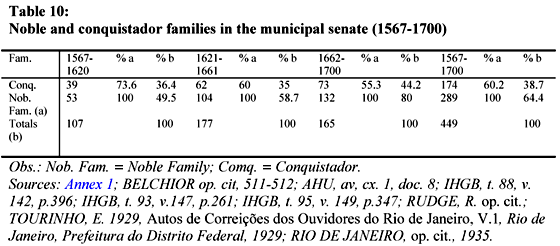
]]> Given these numbers, it is not surprising that the members of the municipal senate labeled themselves, following the example of their counterparts in Portugal, the nobility of the land and the government and it is also not surprising to find, in a provision read in session in 1640, that they determined "that only the most noble people of the land and its government, neither they nor their parents laborers or professionals of the mechanical arts, should be named to official positions".xciv
The elite's benefits were not limited to setting the price of local produce: they also interfered in the importation market as well, even though these were, in principal, part of the colonial monopoly and thus should have been controlled by metropolitan mercantile capital. These products included one of Portugal's most traditional products, wine. Regardless of the colonial pact, in 1642, "the officers of the senate agreed that wine (...) from Lisbon [would be sold] for two cruzados or lower and that of the port of Viana and other parts for two patacas or lower".xcv
The senate also interfered in an even more delicate area where colonial profits were traditionally transferred to the metropolis in modifying the price of sugar and freight. In a meeting in 1642, the city officials described the events which had afflicted the colony and their district:
(...) in this city it was ordered and done among the men of commerce, captains and masters of ships and all others who buy sugars to carry a monopoly to the Kingdom (...) that they would combine in common conformity to not buy said sugars nor receive them in payment of the debts of those (...) who owed them and were obliged to pay (...) unless it was for such a small price that it was not possible to avoid further losses and thus the plantations, lands and mills of the residents would be destroyed.
In response to this situation, the senate's officials and "the other noble persons of the government of this republic" decided to fix the price of sugar and "for said price, creditors would be obliged to take it in exchange for debts".xcvi In this fashion and in spite of the interests of Lisbon and Amsterdam, the colonists – or more exactly, the plantation owners – were able to interfere in the colonial economy through their senate. In this sense, then, the so-called colonial pact was apparently not an all-powerful force in the life of the colony. The prices set by the pact could be negotiated. Towards the end of the 17th century, the senate again demanded to be allowed to continue to interfere in the price of sugar. In a letter dated 1698, municipal officials defended the senate's "ancient" prerogative as forum for the negotiation of sugar prices between businessmen and planters.xcvii
With the foundation of the Companhia Geral de Comércio (the General Commerce Company) in 1649, the relationship between the senate and overseas mercantile capital became tenser. Aside from the privilege of transporting sugar to Portugal, the Company also acquired a monopoly over the supply of cod, flour, wine and olive oil to Brazil, at prices that it could establish itself.xcviii It also managed to prohibit the legal production of sugarcane brandy in the colony, as this product was competing with Portuguese wine. During that same year, the municipal senate of Rio, against the wishes of the Count of Castello Melhor, the General Governor of Brazil, once again set the prices of goods in the market. This time, the prices that were interfered with were those of the four main goods sold by the Company.xcix Two years later, in a letter dated 1651, the Governor of Rio and his senate insisted that the current misery of the people and the marketplace was due to the lack of sugar transports and the blockage of open commerce of the four products in question. The same letter also alleges that the Company's monopoly of flour was senseless; that the colony received all that it needed of this product from São Paulo. Among the senators who signed the letter we find Francisco da Costa Barros and Aleixo Manuel, both members of noble families and descendents of the conquistadores.
In 1654, the senate sent several demands to the metropolis, among them a request for the return of free commerce and an end to the monopolies of the four products in question. In this correspondence the senate reminded the King that "this city, which is looked upon as an invisible point across the entire kingdom, contributed 80 thousand cruzados to the Angolan venture, not as a loan, but as a gift, and also gave much good will and liberal animation to the enterprise, such that they were able to male ready the Armada, which was sent here completely unprepared, and with it and the grace of God, recover that Kingdom".c
As a result of the pressure of the Brazilian colonists and Portuguese small-scale merchants, a royal decree of 1658 abolished the exclusive contract for the supply of wine, cod, flour and olive oil to the colony and, in the following decade, the Company lost a significant part of its strength.ci
Through these events, we can see the capacity which the local noble elite of Rio had to confront metropolitan pressures and impose certain qualifications upon the colonial pact. Aside from this, we can note another, rather unusual, phenomenon: a certain unity of interests among the different segments of this elite. During the struggles of the 1650s, Pedro de Souza Pereira appears alongside members of enemy "bands" such as João de Castilho Pinto and Aleixo Manuel.
]]> The tensions between metropolitan interests and the local elite continued to appear during the following decades. In a letter dated 1678, the municipal senate related to the King that they had ordered the imprisonment of Captain Ignácio da Silveira Soutomaior, as well as the masters, relatives and procurators of the owners of the fleet's ships. The charge was dealing in merchandise disembarked in the port in violation of the senate's established prices. In the same correspondence, the officers of the senate solicited that the establishment of freight prices be left to the senate, seeing as they were "the head of the republic for the common welfare [and worked to] protect the residents of this captaincy against pressures".cii In order to make the intensions of these gentlemen absolutely clear, it is wise to remember three other facts: in 1678, the five members of the senate which I've been able to identify were all members of noble families, while three were descended from the conquistadores and a similar number were owners of plantations themselves. They were thus legislating in their own interest for, as plantation owners, they were, of course, the "residents" most interested in control over freight prices.Aside from giving the colonial elite influence over the prices of sugar and freight, the senate also allowed them to interfere in another delicate sector of the plantation economy's economic reproduction: the Atlantic slave trade. Among the complaints sent to Lisbon in 1669, we find denunciations against slave traders who preferred to send captives to Bahia and Angola instead of Rio de Janeiro. Given this situation, the senate solicited the King to be allowed to send three slave ships to Angola from Rio each year, with this commerce not to be interfered with by the ministers of that African colony. Perhaps more interesting than the request itself was the fact that the senate reserved for itself the right to choose which merchants would have control over this monopoly. This would, of course, give the senate control over said traders. In response, the Overseas Council determined that two ships from Rio could be sent each year.ciii
Yet another area in which the senate interfered in the economy was in the administration of taxes. Up until 1690, at least three different taxes were under their control, all created for the military defense of the colony: the greater wine tax, created in 1641; the lesser wine tax, created in 1656 and the tax on sugarcane brandy, voted in 1661. The senate members received bribes through the administration of these taxes and there were also several accusations of pacts with merchants which resulted in tax evasion.civ
Whether or not such pacts existed, the fact is that the administration of these taxes made it possible for the senate to assume direct control over a portion of the city's wealth as its public treasurer. In 1686, some 16,876$666 were collected in taxes, of which the senate directly oversaw 2,930$000, or 17.4%.cv It is worth noting that in this year, as in others, the provedor da fazenda real and the escrivães da fazenda were all plantation owners, descendants of conquistadores and officials of the city government. As ministers and officers of the treasury, these gentlemen controlled the collection of taxes due the King while also administering taxes due the city as senate members or relatives of senate members. This illustrates, yet again, the possibilities which the descendants of the conquistadores – transformed in plantation owners – had to control the keys of the colonial treasury.
Still other aspects of colonial economic life were under the thumb of the governing men of the land and I'd like to call attention to a final one of these: the goods and sectors of the economy leased out by the senate as money-making ventures. In 1614, "the officers of the senate in said city, understanding themselves as responsible for its common welfare and for that of the merchants and visitors which come to it to load sugar and other merchandise, ordered that there be established in said city a weighing house through which all said merchandise shall pass". The license for this establishment was given to Aleixo Manuel the Younger, "for a period of three nine years, during which time no other person can take any steps without first weighing in it".cvi This contract shows that – as was the case in other ancine regime societies – the senate of Rio de Janeiro controlled and was thus able to contract out certain services which were vital to the functioning of the public economy. In practice, licenses such as the one mentioned above put certain fundamental aspects of the Republic's life in the hands of given groups of citizens. In this specific case, a respectable part of the colony's commerce – including that involving its main export – was obliged to pass through the establishments of Aleixo Manuel. It's not necessary to describe in detail what this could mean in terms of that happy man's self-enrichment...
Aleixo Manuel was a member of the Homem da Costa extended family of conquistadores, a group which had the largest number of members on the city senate over time. In a document from 1645, the High Captain of the fleet of Rio de Janeiro and contractor for tithes, Gaspar Dias de Mesquita, complained about the arrogance of the members of this "band" and affirmed that Aleixo Manueal, in particular, is the "moat well-related man in the land".cvii Among the officers who gave Aleixo control of the weighing house in 1614, we find other "well-related" gentlemen such as the fortress captains João Gomes da Silva and Pedro Gago da Câmara.
In 1635, legal oversight of the city's market and scales (trapiche) was contracted out to the Alcaide Salvador Correia de Sá e Benevides. In this contract, it was stipulated that "there will be no other market or weighing house in the city than these" and that "if the high alcaide wishes to extend this contract over said scales and market at the end of the stipulated time, it will be renewed on the same terms as before". Apparently, Salvador and his heirs decided to renew the contract, at least as far as we can deduce from a note written by the Viscountess of Asseca, dated 1692, in which she protests against the construction of another weighing house, stating that her family is the only one to possess the privilege of weighing sugar in the city, the colony's principal export. In other words, for over 50 years, the Sá were given the opportunity to make profits off of each box of sugar outward bound from the port of Rio.cviii
Some time after the signing of the contract with Salvador Correia de Sá e Benevides, it was decided in senate that first Baltazar de Leitão and later Manuel Ribeiro Pasteleiro could "give to this people all the beef which is necessary for said people's sustenance". In the same fashion as the contracts above, "no other person meat aside from the contractor will be given license nor allowed to cut under the penalties of His Majesty's law which orders all for the benefit of this Republic".cix
Regarding Manuel Ribeiro Pasteleiro, I regrettably know nothing more. That is not the case with Baltazar Leitão, however. Married to Feliciana de Pina, he belonged to the extended family founded by Francisco de Pina, the man who was the provedor da fazenda real during the first decades of the 17th century. Baltazar contracted for the collection of the royal taxes at least twice in his life: the first time in 1637 and the second, together with his son-in-law, plantation owner Manuel Fernandez Franco, in 1649.cx In Baltazar's post mortem inventory, in 1656, he left a sugar plantation with 91 African and 7 Indian slaves. This is one of the few inventories which I have discovered for the 17th century and through it, we can perhaps illustrate the career of a member of Rio de Janeiro's first colonial elite. Baltazar's family was linked to the Royal administration and thus had access to the opportunities that an ancine regime economy reserved for its elite – in this case, the exercise of monopolies over certain key sectors of the Republic's economy such as the supply of meat and the collection of taxes. Such opportunities probably explain the size of Baltazar's slave barracks upon his death. The number of captives which he owned would have transformed him into a leading slave owner at any point in the history of Brazilian history.
The examples presented above suggest that it wasn't only control over positions in the royal administration which permitted the construction of noble fortunes: postions in the municipal senate also allowed for this possibility. We saw, at the beginning of this article, that the majority of 17th century noble families in Rio were founded before 1620 and that these were generally inaugurated by ministers or officers of His Majesty. Later, in Table 10, we observed that 60% of the known officers of the municipal senate for the period between 1565 and 1620 were conquistadores and, at the same time, occupied positions in royal administration. This information indicates that a significant part of the future noble elite had occupied administrative positions in the colony's power structure before becoming owners of sugar plantations. In other words, these posts opened up paths to personal enrichment. Towards the end of the first half of the 1600s, however, this picture began to change. Once the noble plantation-owning elite had been constructed, only a certain few families descended from the conquistadores continued to occupy the strategic posts of the royal administration. This phenomenon, however, was not observed in the municipal senate.
]]> In Table 10, we can clearly see that certain extended noble families descended from the conquistadors were still in the municipal senate at the end of the 17th century. More: the same table verifies that, as time passed, the senate became ever more a forum for the local noble elite, understood here as sugar plantation owners. Up to 1620, a little less than half of the senate's officials were members of the elite. After 1662, however, this quantity had grown to more than 80%. In this same movement, we can also note a growing representation of families founded by conquistadors. During the first period, these made up slightly more than 35% of the municipal officials while during the second, they accounted for around 45%. These numbers demonstrate the existence of a set of families which would persist among the noble elite and which would insist upon controlling vital sectors of the Republic's political structure and, through this, its economy. At the same time, this phenomenon gives objective weight to certain expressions which were very dear to these gentlemen, such as nobility of the land, governors of the Republic and even the first men of the land.
The best families of the land
This was the title, along with nobility or first men of the land, by which the descendents of the conquistadors liked to be called by colonial society. Such expressions, as we well know, were not inventions of the best families of Rio. They can be found in ancine regime Portugal as designating those men who occupied positions as municipal councilors. They are also encountered in Pernambuco in the 1600s as an identifier for the local plantation lords, particularly those who were involved in the struggle against the Dutch and who "exercised honorable posts in the Republic".cxi In both cases, note that nobility of the land appears linked to political power at the municipal level as well as to the best men of the land. However, we must be careful when analyzing such expressions.
To begin with, when we turn to the Philippine Ordinances, we find that there is no clear definition for this designation. According to Cândido Mendes de Almeida, in these laws, "good men" were considered to be "the citizens who had occupied positions in the Municipalities or the government", however, he does not explain how one could determine "who such men were during the creation of a new village". At the same time, according to Gonçalo Monteiro, the juridical notion of nobility in ancine regime Portugal was extremely fluid. This phenomenon was partially a result of the relative fluidity with which noble distinction could be achieved. As a reaction to this, particularly after the Restoration (1640), we find a progressive delimitation of the restricted nucleus of the Grandees (the high aristocracy). Towards the end of the 17th century, the expressions nobility or fidalguia, when used to designate a group, began to be used fundamentally to indicate the titled nobility of the realm. Monteiro claims that the notions of the "first men of the land" and the "nobility of the land" stopped being used as designators for empowered landowners. This occurred because the "Grandees of the land", or – what amounts to the same thing – the oldest and richest houses of a given province, took over the exercise of municipal office. The social and political horizon of such a group was not situated at the province's borders but in the court, in the service of the monarchy.cxii
Apparently, in Rio de Janeiro, the expression nobility of the land was linked to a family's past history in the exercise of political and administrative power in the city and to descent from the conquistadores – the older the history, the nobler the family.cxiii Let's take a look at some examples:
In 1628, one of the members of these families, João Castilho Pinto, was defined by the officers of the senate as "one of the noblest people of the city and its government". In other words, João has able to have a seat in the municipal assembly and, in fact, he was a councilman or ordinary judge on at least three occasions: in 1635, 1645 and 1651. Years later, the then governor of the city, Duarte Correia Vaqueanes, affirmed that João was "one of the noblest people in the city [of Rio], always showing much zeal in the service of Your Majesty". In the same letter, the governor also pointed out that João was "the legitimate grandson of Francisco Dias Pinto, first land-owning Alcaide-mor this city had (...) and the legitimate grandson of Jorge Ferreira Bulhões, captain and ouvidor for 18 years in the captaincy of São Vicente and (...) legitimate son of Manuel de Castilho, who was almoxarife of this city".cxiv Consequently, João was the third generation of a lineage accustomed to power.
In 1643, some officials of the municipal senate justified the concession of hulls of the city fleet to Salvador Correia de Sá e Benevides, by alleging that he was "a fildalgo and alcaide mor of this city whose grandparents, father and relatives colonized, conquered and governed it from the beginning".cxv The confrontation between these two gentlemen is in itself interesting, being that João Castilho Pinto and Salvador Correia de Sá e Benevides were sworn enemies at the beginning of the 1640s. Nevertheless, both were identified at the time in the same way: as belonging to families who had conducted the conquest and who had occupied the command positions of the city for generations – in other words, as nobles.
In 1664, in the midst of disputes within the noble elite, the officials of the senate reminded all and sundry that candidates to the assembly must be "of the principal men of the land and qualified (...) excluding from these all men of mechanical arts and low luck and only admitting to government fildalgo men".cxvi Of the six senators who wrote this statement, two were descended from our old friend Pedro Gago da Câmara (ex-fortress captain and councilman in 1614), one from the conquistador and ex-provedor de fazenda Antônio de Mariz and a fourth belonged to the extended family of the Homem da Costas. Thus, in the year under consideration, an absolute majority of the senate was formed by families which had dominated the city's political scene (with passages through such posts as ministers and paid captains of infantry) since its foundation. Aside from this, the same document shows us that these men were not willing to retire from public life. It is thus not difficult to infer who they understood to be "the principal men of the land".
Given what we've discussed above, we can see that the concept of nobility of the republic had no legal definition. It did not exist, for example, as a superior hierarchical position with rights and responsibilities clearly defined by law, as was the case in European estate-based societies. In truth, in Rio de Janeiro, the "fildalgos" paid taxes just like any other mortal and in the same way. Different from their counterparts in Portugal, they were lords of lands with their own jurisdictional powers. What enabled the elite families of the colony to identify themselves and be identified with the self-acclaimed title of "nobility" was a sentiment which combined at least three ingredients:
]]>- That of being descended from conquistadors, a group of people (or a "race") which, at their own cost, conquered other lands and peoples (native and European enemies).
- That of having exercised political power through republic's posts since the founding of the colony.
- That of feeling superior to other mortal residents of the colony through right of conquest and political power.
This feeling of nobility was reinforced by boons granted by His Majesty, through marriages with people of similar status and – perhaps most importantly – through the continuous recognition given these people and their families through their repeated election to the principal posts of the senate. Here, we must remember that many of the people accused of corruption, whose cases we've touched on above, never suffered any royal punishment, nor any disrespect from colonial society (or at least from some of its sectors). This was the case of Tomé de Souza Correia, accused of corruption by the city's governor in 1676 and later praised by thye senate for his services to the city.cxvii
Here, perhaps, is where we find the smoking pistol: in the appropriation for private ends of the goods and services administered for the public good by the Crown and the senate. The "sentiment" felt by the descendants of the Conquistadors, that they were the rightful rulers of the republic and the social recognition of this quality, justified their appropriation of public goods and services as if these were their rightful property – as something which belonged to the nobility of the republic. This becomes even clearer when we remember that between 1650 and 1700, more than 40% of the colony's land-grant holders were descended (directly or indirectly) from the conquistadors. During the same period, 60% of the region's plantation owners descended from – or were married to women descended from – the same group. In other words, in the second half of the 17th century, membership in the noble elite was passed by descent from or marriage to the granddaughters and great-granddaughters of the first colonists and members of this elite had easier access to the Crown's lands. Summing up then, the concept of nobility of the republic becomes complete when we realize that the members of this category were engaged in appropriating and distributing the material goods of the republic among themselves.
The economy of the common good
To further the good governance of the republic, the municipal senate of Rio de Janeiro conceded monopolies over butchering, sugar weighing and even attempted to provide privileges within the transatlantic slave trade. Before, during and after these economic concessions, the senate counseled the King, also in the common interest, and granted boons to people (or their descendents) who had acted in crucial areas of the Kingdom and the Overseas possession's interests. When His Majesty named a provedor da fazenda or a captain of infantry, he was acting in the name of the commercial interests or military defense of his subjects in the Conquests and, consequently, guaranteeing the welfare of his vassals in the Republic. A similar logic could be used regarding the concession of a boon in the form of commercial privileges. These were given to people whose had preformed services – or whose ancestors had preformed services – in the defense of the Crown's interests and thus in defense of the common welfare.
One aspect of this situation was that both the municipal senate and the Crown (as heads of the Republic) removed from the market and from free competition goods and services which were of the public interest. In other words, intertwining with and interfering in the plantations, commerce and crafts of the resident subjects of the King, we find a series of goods and services which can be labeled as the economy of the common good, or the economy of the republic.
]]> For the objectives of this article, however, the notion of the economy of the common good can only be complete if we consider how it also closed of the appropriation of social surplus as the private reserve of a relative few. The goods and services of the republic were conceded by the senate and/or the King for the use of a few select people and these privileges were exercised in the form of a monopoly or semi-monopoly. Other resident subjects who interfered in such monopolies were punished with the full force of the law. Another aspect of this scenario was the privileges granted over certain sectors of the market: fiscal franchises in commerce or legal guarantees regarding the transportation of merchandise. Only a few people received such boons and those who didn't were subject to the laws of the marketplace. These monopolies created possibilities for the elect to exclusively appropriate the profits of certain segments of social production, or at least to have less competition in accessing these. This created a situation in which "the free population" (understood in the context of a hierarchical ancine regime society) or (what amounts to the same thing) the public of the republic deposited part of their profits into the hands of the elect. It was this public which directly or indirectly sustained the republic's elite.In this fashion, aside form the accumulation of wealth provided by peasant production in Portugal or the slave plantations of the Overseas Territories, there was also another circuit of wealth accumulation, identified with the republic. The wealth producing agency in this circuit was not the planter, craftsman, or merchant but the set of planters, craftsmen and merchants: in other words, the public itself.
Given this, we can better understand certain concepts which I've used above, such as imperfect market or the accumulation of surplus. However, we must be cautious with regards to wider utilizations of the concept of the economy of the common good. As I have employed it here, it refers to the Portuguese ancine regime and it should only be present in societies which have certain distinct economical and social structures, similar to those seen in 17th century Portugal and Rio de Janeiro.
According to A. Hespanha, the boon system reinforced the corporative character of the Portuguese monarchy, a style of monarchy "whose responsibilities basically corresponded to a feudal-corporative benefit structure". In order to see this with more clarity, it is enough to remember that in 1607, the expenses of the Kingdom for pensions given for services rendered to the Crown totaled some 190 contos, a quantity that was considerably greater than the 167 contos of revenue that the state during the same year from the Atlantic empire.cxviii
Gonçalo Monteiro also confirms that in ancine regime Portugal and especially with the House of Bragança we find a Grandee aristocracy whose dominant ethos was service to the monarchy. These nobles did not support themselves with the produce of the land or through private business dealings, but with the pensions and boons gained for services rendered to the republic. According to Monteiro, this was a circular economy based on services, where the court elite monopolized the principle positions in the royal administration, army and colonies. As a reward for their service in these positions, they received new royal concessions which could be accumulated and used to acquire new services, such as the administration of the Crown's wealth or more prestigious postings.cxix
In the Rio de Janeiro region, the distribution of boons and – later – senate concessions among the conquistadors and their descendants allowed for wealth accumulation. This wealth would later be transformed into sugar plantations and would allow for the structuring of the plantation economy itself. The boons and concessions granted reinforced the economic and social inequalities which were present during the creation of colonial society. Aside from the inequalities directly imprinted upon the Conquests through the enslavement of the native population, we find others introduced into the European population through the system of boons. Thus it is in the midst of a highly hierarchal society and a strongly differentiated economy that the production of the resources necessary for the "primitive accumulation" of the plantation economy took place. In other words, it was the colonial public (their farmers, merchants, backwoodsmen, natives, African slaves and etc.) who paid a significant part of the costs for the installation of the sugar plantations, via the social production which was appropriated from them in a process of exclusive accumulation carried out by a conquistador elite.
Once the plantation system had been installed – including sugar fields, cattle corrals and farms for food – the mechanisms of the economy of the common good continued to function. The noble elite's control over politics – or more precisely, over the senate and part of the Royal administration – allowed it to continue to engage in a process of exclusive accumulation. One needs only to remember the tenacity with which the noble families descended from the conquistadors held on to the senate or reflect upon the persistence of the Correia, Ponte and Frazão de Souza families in the royal administration in order to perceive this continuation of this process. As we've seen above, the noble elite of Rio was not noble in the European sense of the word. However, it was able to articulate, in practice and policy, privileges which allowed it to appropriate part of the social wealth and these privileges were passed on from generation to generation. In truth, Rio de Janeiro in the 1600s seems to demonstrate an inversion of Max Weber's maxim that traditional administrators live for and not off of politics. In Rio de Janeiro during the 17th century, administrators lived off of politics and their control of the republic allowed them to appropriate part of their society's production.
The fact that the economy of the common good was based upon politics inevitably generated political disputes. According to Gonçalo Monteiro, the distribution of higher offices and boons – and thus of the instruments which made the accumulation of wealth and social prestige possible – was generally accompanied by conflicts among the Grandees of the Lusitanian aristocracy.cxx Something similar occurred in Rio de Janeiro during the 1600s in the senate elections, the distribution of council privileges and in access to posts in the royal administration. These were all privileged spheres for intra-elite disputes because not all of the old noble families could simultaneously be present in both key areas of colonial power, the Royal administration and the senate.
Some families tended to stay in the first sphere while others gravitated more towards the second. This, however, does not mean that after a certain point, city politics was marked by a struggle between the senate and the Crown's ministers. In reality, the captaincy was transformed into a scenario for intra-elite disputes for control over the republic and, consequently, the goods and services which it managed.
An example of these disputes can be seen in the continuous accusations of interference in senate elections leveled against the ministers of the King (1648, 1655, 1660-61, 1668, 1686, etc. – see AHU ca.). Curiously enough, both the accusers and the accused almost always belonged to the same social group. This was the case during the 1660-61 revolt. The ministers accused in this case belonged to the Correia family (including Pedro de Souza Pereira and members of the Pontes family) and two of the rebellion's leaders, captain Diogo Lobo Pereira and Jorge Ferreira Bulhões were descendants of conquistadores while a third (Jerônimo Bezerra Barbalho) was the son of an ex-governor of the city. This struggle was thus the fruit of disagreements within the local elite.
]]> The background of these rivalries can be inferred from a letter carried by the procurator of the senate – and also the provedor of the dead and absent – João Castilho Pinto to Lisbon in the 1640s. After recounting to the King the abuses of Salvador Correia Sá e Benevides, of the provedor da fazenda Pedro de Souza Pereira and of other customs officials who were absconding with royal properties and taxes, João asked His Majestyto be posted as captain of the fortress of São Sebastião and also as the juiz de balança, a position which had been held by Salvador Correia Sá e Benevides since 1635.cxxi We can thus say that a principal point of friction involved in this disagreement was control over the sugar weighing house, one of the republic's most precious "goods".If it's true that the control over the colony's Royal administration (and its boons) often escaped from the hands of the noble elite (seeing as how nomination to this posts had to come from Lisbon), the same thing did not occur in the senate and as we've seen, in terms of the economy of the common good, this was not a trivial political stage. After all, control of the municipal assembly meant power to interfere in prices, in meat supplies, in the sugar weighing house and etc. This fact allows us to better understand governor Francisco Soutomaior's observation in 1645 that "the elections for the senate are dominated by people from the Corriea's faction [Salvador Correia Sá e Benevides] and from the Manoes [Aleixo Manuel, the Younger], which are two Bands and cliques which create such monstrosities as are prejudicial to the service of God and Your Majesty in this city".cxxii
Furthermore, the frightened observations of Governor Soutomaior present us with an essential component of how domination over the reigns of the republic was exercised: the networks of political alliances (through kinship or client relationships and etc.).
The presence of these networks in the disputes for colonial power can be illustrated by the events from 1642 which resulted in the temporary removal of Salvador Correia Sá e Benevides from the post of governor. Among those who defended Salvador, we find the plantation owner Jorge Fernandes de Fonseca, a member of the Homem da Costa extended family, and Diogo Sá da Rocha, another plantation owner and the old ouvidor-geral and son-in-law to the Rangel family. On the opposite side, we find, once again, the old enemies: Aleixo Manuel and the Pinto Castilhos.
At the same time, the struggles of 1642 illustrate another aspect of these political alliances: their essential fluidity. The two men directly involved in the dispute for governor, Salvador and Duarte Correia Vasqueanes, were uncle and nephew, respectively. Jorge Fernandes da Fonseca and Aleixo Manuel – at this moment on opposite sides of the struggle – were brothers-in law. Alliances could thus not only shift according to the situation, they could also reflect conflicting interests in the same family. This last point does not seem to have been a general rule, however. Everything indicates that close relatives tended to act together and in the same way. Marriage sealed alliances between families. An excellent example of this can be found in the murder of Pedro de Souza Correia. According to contemporary denunciations, the guilty parties were the "Amaraes [a noble family] and their allies, led by Francisco do Amaral. Among the suspects, we find named, alongside Francisco's uncles, cousins and brothers, two of the families sons-in-law who were also plantation owners.cxxiii
An example of how such networks involved themselves in the business of the republic can be found in a narrative by Antônio Mendes de Almeida, in his own words "an outsider and a man with no relations in these lands". According to Antônio, he was deprived of the tax contract of 1686 through the machination of the then provedor da fazenda real Pedro de Souza Correia and "his friends". Antônio claimed that he had been barred from participating in the auction for the contract by maneuvers undertaken by the provedor da fazenda, ouvidor-geral of the city and common judge, Baltazar de Abreu Cardoso. This same person, through the use of one of his servants, then took over the tax contract himself with the aid of Manuel Fernandez Franco, Antônio de Abreu de Lima and Francisco Gomes Ribeiro. This first of these gentlemen acquired the contract and then passed it along to the provedor's servant while the other two nobles served as the commoner's undersigners.cxxiv Let's take a look at who some of these "friends" were. Baltazar was a plantation owner and the grandson of Jorge Fernandes de Fonseca, the same man who had earlier been procurator for Salvador Correia Sá e Benevides. Manuel Fernandez Franco, who we have met above, belonged to the extended family of the Pina and had several times before been a tax contractor. Antônio de Abreu e Lima and Francisco Gomes were also members of the noble elite. The first, with aid from Pedro de Souza Correia, had held the position of judge of orphans and the second was named high captain of Cabo Frio in 1678. In this event, then, we can see that the Frazão de Souza family was shielded by an alliance with no fewer than four other noble families.
One of the mechanisms which generated such alliances was the construction of clienteles. Governors could nominate people, even if only provisionally, to positions within the colony's military and civil administration. The careers of Pedro de Souza Pereira and Diogo Lobo Teles are examples of this. Before becoming owners of the positions of provedor da fazenda and judge of orphans, respectively, they had been captains in the infantry, later named to the captaincy of the fortress of Santiago and the captaincy of the Rio-Lisbon fleet – in both instances by the Correias.cxxv As we've seen, Pedro married a Correia and the same thing occurred with Diogo's nephews. Something similar perhaps happened in the cases of other fortress captains and paid infantry captains. Manuel da Costa Cabral, the captain of the fortress of Santa Cruz in 1669, for example, saw one of his daughters married to Martin Correia de Sá. Alexandre de Castro, paid infantry captain since 1644, had married Felipa de Sá in 1639, another member of Salvador Correia Sá e Benevides' household. Ascenso Gonçalves de Matoso, captain of the fortress of São João and a member of a noble family, also married Serafina Correia de Sá in 1655.
Not entirely without reason, then, were the "Manoeis", Correias and later the Pontes considered to be powerful due to their status as "the most well-related families in the land". Through their clientele networks and marriage strategies, these families were able to widen their spheres of influence.cxxvi
To tell the truth, the importance of these kinship networks in the functioning of the colony's society and economy stretched far beyond what I've termed here as the economy of the common good.cxxvii One only needs to look, for example, at their impact upon the colonial market. Between 1650 and 1669, 1/4th of the sales and purchases of plantations registered by notary publics were conducted between parents (father-in-law/son-in-law, father/son, brother/brother etc.). In looking at these documents we also must take into consideration dowries and the firming up of family alliances. If we compare the values of all the dowries listed for 1665 with those of the total purchases and sales registered by notary publics, we find that the sum of the first amounted to 42% of all property transfers. In this year, then pre-nuptial contracts had approximately the same weight as purely mercantile transference of properties (plantations, houses, lands, etc.) between one family and another.cxxviii
]]> Conclusion: exclusion as original sin.
Summing up, then, the construction of Rio de Janeiro's plantation economy occurred during a favorable moment in terms of sugar prices on the international market, but not, however, moment that was very favorable to Portugal or its empire. From the middle of the 1500s on, the various quadrants of the Overseas Territories came under increasing attack and the Kingdom suffered from recurring food shortages, plagues, an increased public debt and etc. In the midst of this scenario, the formation of Rio de Janeiro's productive structures was conducted according to the tried and true prescription of the Portuguese ancine regime. The key elements of this system were the conquest of lands and men, the system of boons and the municipal senate. Transformed into officers of the King and senators, the conquistadors directed the formation of a new society in the tropics and in this task, they were incredibly successful. Using their official positions, their kinship and clientele networks, the conquistadors and their decedents built plantations and became the first noble elite of the slave-holding and agro-exporting society which formed around Rio de Janeiro. The careers of these men and the economy which they ruled demonstrate some of the key precepts of old Lusitanian society: a profoundly unequal social hierarchy which permits the production –and, via politics, the appropriation – of social wealth.
In turn, in part because the construction of the colonial productive apparatus occurred with the strictures of the ancine regime, this movement simultaneously created a "nobility of the republic" whose basis was political rule and the appropriation of what I have labeled here the economy of the common good. This economy was made up of goods and services under the legal jurisdiction of the municipal senate and the King. Though it was administered by a select few, it was paid for by the colonists at large. Control over this economy, which allowed exclusive accumulation, was decided in political disputes which were supported by vast kinship and clientele networks.
Belonging to the nobility described here – descended from the conquistadors and made up of plantation owners who were also dedicated to commerce – and being able to make use of its typical forms of accumulation was not the only path to wealth and power in the 1600s. After all, as someone has already mentioned, commerce is an antediluvian activity – older than Noah and his arc. It is thus certain that some colonists were able to transform themselves into plantation owners, principally through engaging in commerce. However, even these lucky few had to deal with a market where the municipal senate intervened in the prices and the King's minister's engaged in monopoly trading.
In conclusion, it is also certain that this nobility and its practices – as dominant social phenomena – eventually gave way at some point in colonial history to other types of social relations. After all, by the end of the 18th century, the colony's economic elite (which controlled the slave trade and the economic system's liquidity, among other key sectors) were the large-scale merchants. However, the practice of socially excluding the public (the free population of the colony) continued to exist as one of the keys to the accumulation of wealth.
Documentary sources:
ACRJ - Arquivo Geral da Cidade do Rio de Janeiro (Brasil), Cartório do 1o Ofício de Notas do Rio de Janeiro, 1612 - 1698. Types of legal process (E): CV - purchase and sales; Pro - procuration; H - loans and monies lent; Co - discovery; Q - quit claim; P - advocacy; T - transmission; Per - permutation; Test - will and testament; finance.
AMSB - Arquivo do Mosteiro de São Bento, Rio de Janeiro (Brasil); inventários e testamentos.
AN - Arquivo Nacional, Rio de Janeiro (Brasil),
]]> -Cartório do 1o Ofício de Notas do Rio de Janeiro. Escrituras Públicas: 1610 - 1698.-1680. Correspondência dos Governadores Rio de Janeiro. Provisão Régia. Códice 77, Livro. 10, p. 54.
-1702. Correspondência dos Governadores Rio de Janeiro. Cartas. Códice 77.Livro 13.
AHU - Arquivo Histórico Ultramarino, Lisboa (Portugal).
- Rio de Janeiro: ca - Coleção Castro Almeida; av - Avulsos; Códices 115 and 1279.
- Angola: 1695, Cx. 15, doc. 36
Arquivo da Torre do Tombo (Portugal): Chancelaria de Filipe II, liv. 16; Chancelaria de Filipe III, Doações, liv. 32
Published Sources:
AN 1911. Arquivo Nacional . Publicações, XI, Rio de Janeiro: Arquivo Nacional.
BN, DH, Biblioteca Nacional, Documentos Históricos, vol. 16 to 34, Rio de Janeiro.
Couto, D. s/d, O Soldado Prático, Lisboa: Edições Europa-América
Frei Vicente Salvador. 1982. História do Brasil, Belo Horizonte: Ed. Itatiaia; São Paulo: Ed. da USP
Ordenações Filipinas 1985. Livro 1, Lisboa: Fundação Calouste Gulbenkian, 1985
IHGB – Instituto Histórico Geográfico Brasileiro.
Rio de Janeiro 1935. Diretoria Geral do Patrimônio, Estatística e Arquivo. O Rio de Janeiro no sec. XVII – Acordões e Veranças do Senado e da Câmara, 1635-1650
Tourinho, E. 1929. Autos de Correições dos Ouvidores do Rio de Janeiro, vol.1 (124-1699). Rio de Janeiro: Prefeitura do Distrito Federal.
1 TN: Engenho, the original Portuguese term, indicates an enterprise which did not only plant sugarcane, but also milled and renders it into sugar and other products. An engenho was a self-contained operation for which there is no ready equivalent in the English-speaking world. We have chosen to use the terms plantation and mill as rough translations. ]]>
2 TN: Famílias senhoriais – or "lordly families" – in the original. We have changed this here to "noble families".
3 TN: Many of the titles of the Portuguese colonial bureaucracy simply do not have easy English equivalents. In these cases, we've left the terms in the Portuguese original.
4 TN: "Republic", here, is used in its older, looser sense of a body of common interests, and not as a specific form of government.
5 TN: "Rescue" or "resgate" was used in the sense of "rescuing" Indians from paganism and supposed cannibalism through Christian, civilized enslavement.
i This article is part of a research project financed by CNPq. I would like to thank the following scientific initiation scholarship holders for their aid: Glacia Freitas de Oliveira, Vanusa de Oliveira Martins, Luiz Guilherme Scaldaferri Moreira e André Boucinhas
ii FERLINI, Vera, Terra, Trabalho e Poder, São Paulo, Brasiliense, 1988, p. 60-61.
iii SCHARTZ, Segrêdos Internos, SP, Cia das Letras/CNPq, 1988, p.400.
iv FERLINI, Vera, op. cit., pp.61-61.
v LISBOA, Balthazar. S., Anaes do Rio de Janeiro, t III, Rio de Janeiro, Typ. de seignot-Plancher e C., 1835, p. 295.
vi REINGANTZ, Carlos, Primeiras Famílias do Rio de Janeiro. Rio de Janeiro, Livraria Brasiliana, 1965. ]]>
vii Cf. LEWIN, Linda, Política e Parentela na Paraíba, Rio de Janeiro, Record, 1993.
viii GODINHO, Vitorino, M, Ensaios II, Lisboa, Sá da Costa, 1978, 262-64
ix SUBRAHMANYAM, Sanjay, O império asiático português, 1500-1700, Lisboa, Difel, 1995, pp. 205-6; BETHENCOURT, Francisco & CHAUDHURI, K. (dir.), História da Expanção Portuguesa, vol. 2, Lisboa, Círculo do Livro, 1998, p. 290.
x GODINHO, Vitorino, op. cip., p. 25-27.
xi Cf. GODINHO, Vitorino, op. cip., p. 65-72. There is a vast historiography regarding the heritage of the ancine regime in Portugal and its connections to the overseas colonies. Aside from the works of Godinho see, among other studies, MAGALHÃES, Joaquim. R (coord.), História de Portugal - no Alvorecer da Modernidade, Lisboa, Ed. Estampa, 1993, HESPANHA, Antônio. M. (coord.) História de Portugal - Antigo Regime , Lisboa, Ed. Estampa,1993.
xii MAGALHÃES, Joaquim. R, 'A fazenda', in: MAGALHÃES, Joaquim. R (coord.), op. cit. 93 – 98.
xiii GODINHO, Vitorino M., Introdução a História Econômica, Lisboa ,Horizonte, s/d, p. 171.
xiv RODRIGUES, Teresa, F, 'As estruturas Populacionais', in: MAGALHÃES, Joaquim, R, (coord.). op. cit., pp. 218-22.
xv GODINHO, Vitorino, op. cip., 1978, p.273
xvi SCHWARTZ, Stuart, 'Brasil Colonial: Plantaciones y Periferia, 1580-1750' in: BETHELL, L.(org.), Historia de América Latina, vol. 3, México, Crítica, 1990.p.204. ]]>
xvii GODINHO, Vitorino, op. cip., 1978, p.273.
xviii SALLES LOUREIRO, F. 1986. 'A Alteração das Coordenadas da política de Expansão Portuguesa na segunda Metade do século XVI', in: Actas das Primeiras Jornadas de História Moderna, vol. I, Lisboa, Centro de História da Universidade de Lisboa, pp. 259 - 73.
xix DISNEY, Anthony, R. A Decadência do Império da Pimenta, Lisboa, Edições 70, 1981, 67. 69;GODINHO, Vitorino, op. cip., 1978, p. 69.
xx RODRIGUES, Teresa, F, 'As estruturas Populacionais', in: MAGALHÃES, Joaquim, R. (coord.).op. cit., pp. 197-210.
xxi VIEIRA, Alberto, Portugal y las Islas del Atlántico, Madri, Mapfre, 1992, 133 -203.
xxii MONTEIRO, John. M, Negros da Terra, São Paulo, Cia das Letras, 1994, 57 - 128.
xxiii MAGALHÃES, Joaquim, R, "Mobilidade e cristalização social" in: MAGALHÃES, Joaquim, R, (coord.). op. cit., pp. 503-504; THOMAZ, Luís, De Ceuta a Timor, Lisboa, Difel, 1994, p. 154.
xxiv PAES LEME, Pedro, T., A. ., Nobiliarquia Paulistana Histórica e Genealógica, t. II, Belo Horizonte: Ed. Itatiaia; São Paulo: Ed. da USP, 1980, p. 231.
xxv NORONHA, Henrique, Nobiliario da Ilha da Madeira, Funchal, Biblioteca Nacional, p. 385.
xxvi MATTOSO, J. 1993. 'A socialidade', in: MATTOSO, J., (coord.). História de Portugal - A Monarquia Feudal, Lisboa, Ed. Estampa, 1993, p. 449. ]]>
xxvii Cf Anexo 1 com FRANCO, Francisco, A, C., Dicionário de Bandeirantes e Sertanistas do Brasil, Belo Horizonte: Ed. Itatiaia; São Paulo: Ed. da USP, 1989.
xxviii Furtado, C., Formação econômica do Brasil, São Paulo, Ed. Nacional, 1976, p.11; SCHWARTZ, Stuart, op. cit., 1988, p. 225.
xxix CANABRAVA, Alice, P., O Comércio Português no rio da Prata (1580-1640), Belo Horizonte, Ed. Itatiaia, São Paulo, Ed. da USP, 1984; LOBO, E. L., História do Rio de Janeiro, vol. 1, Rio de Janeiro, IBMEC, 1975, p.50. SALVADOR, José G. Os Cristãos-Novos e o Comércio no Atlântico Meridional, São Paulo, MEC, Ed. Pioneira, 1978, 330-351; MELLO, Carl. O Rio de Janeiro no Brasil Quinhentista, Rio de Janeiro, Giordano, 1996, pp. 185-202.
xxx SCHWARTZ, Stuart, op. cit., 1988, p.146.
xxxi AHU, av, cx. 6, doc. 35
xxxii AHU, av, cx. 3, doc. 122.
xxxiii AHU, av, cx. 2, doc. 24.
xxxiv AMSB, inventátios post mortem: Feliciana de Pina (1656) and Pedro de Soua Pereira (1673); NOVINSKY, Anita, Inquisição, Imprensa Nacional, s/d, p. 132.
xxxv FRAGOSO, João, Homens de grossa aventura: acumulação e hierarquia na praça mercantil do Rio de Janeiro (1790 - 1830), 2ª ed., Rio de Janeiro, Civilização Brasileira, 1998, pp.337-38. The small number of cases for first half of the 17th century is due to the city's small size (probably less than 10,000 inhabitants, including both free and slave - see FRAGOSO, João, 'Hierarquias sociais e formas de acumulação no Rio de Janeiro, século XVII', Colonial Latin American Review, vol 6, #2. 1997) and to the fact that the books for the other notaries of the city, in the Arquivo Nacional, are not available to the public due to their poor condition.
xxxvi PEDREIRA, Jorge M. V., Os Homens de negócio da Praça de Lisboa de Pombal ao Vintismo (1755-1822), Lisboa: Universidade Nova de Lisboa (tese de doutorado), 1995, p.18. ]]>
xxxvii I have considered some noble families as having ministers even though they were not descended from a founding couple with this post. This occured in the cases in which the family in queation was clearly made up, for several generations, by people connected to the royal administration. This was the case of the Belchior da Ponte family, which had captains of infantry, judges of orphans and a desembargador among its members and also that of Pedro de Souza Correia, which contained three Provedores da Fazenda Real.
xxxviii Frei VICENTE SALVADOR, História do Brasil, Belo Horizonte, Ed. Itatiaia, São Paulo, Ed. da USP, 1982, p. 166.
xxxix SALGADO, Graça (org.), Fiscais e Meirinhos Rio de Janeiro, Arquivo Nacional & Nova Fronteira, 1985, p. 55.
xl BELCHIOR, E.O., Conquistadores e Povoadores do Rio de Janeiro. Rio de Janeiro, Livraria Brasiliana editora, 1965, pp. 429-435; COARACY, V., O Rio de Janeiro no século XVII, Rio de Janeiro, ed. José Olympio, 1944, p. XXVI.
xli BELCHIOR, op. cit., 326 – 27 e 368-69; AHU, ca, cx. 3, doc. 440-448.
xlii SALGADO, op. cit.
xliii BELCHIOR, op. cit., 312 – 15.
xliv AHU, av, cx. 3, doc. 84;
xlv ATT, Chancelaria de Filipe II, liv. 16, p. 209; BELCHIOR, op. cit., 312 – 15.
xlvi AHU, ca, cx. 5, doc. 844; Ordenações Filipinas 1985,, L. I, t. LXXXVIII. ]]>
xlvii BELCHIOR, op. cit.,440-41.
xlviii Cf. LOCKHART, John, Spanish Peru, 1532-1560, Madson: Wisconsin Press, p. 1968, p. 11-33; ELLIOTT, John., 'La conquista española y las colonias de América', in: Bethell, L. (org.),op. cit., vol. 1, pp. 155-169; PEÑA, J, Oligarquía y Propiedad en Nueva España, 1550-1624, México: Fundo de Cultura Económico, 1983, pp. 148-149.
xlix BELCHIOR, op. cit., p. 385-87; AHU, códice 115.
l Idem, Ibidem, 1965, 154 - 55
li A pioneering study regarding the linkages between the colonial bureaucracy and elites can be found in SCHWARTZ, Stuart, Burocracia e Sociedade no Brasil Colonial. São Paulo, Ed. Perspectiva, 1979.
lii Apparently, the same thing did not occur among the descendants of the conquistadors of Mexico. With the end of the conquest, they were subsitituted by other segments of society. See ELLIOT, J., Op. cit., p. 25.
liii BN, DH, v. 19, p. 464.
liv AHU, ca, cx. 3, doc. 295. There is a reference that Pedro had occupied the post of provedor da fazenda since 1639 (AHU, ca,cx2, doc229-231), however, the royal grant of the property dates from 1644.
liv Frei VICENTE SALVADOR, op. cit. pp.254-55
lv SERRÃO, Joaquim, V., O Rio de Janeiro no século XVI, Lisboa, Comissão Nacional das Comemorações do IV Centenário do Rio de Janeiro, 1965, p. 115. Frei VICENTE SALVADOR, op. cit. p. 355 ]]>
lvi MENDONÇA, Paulo. K., O Rio de Janeiro da Pacificação, Rio de Janeiro, Secretaria Municipal de Culltura, 1991, 104-5; (SCHWARTZ, op. cit., 1988, p. 46.
lvii BELCHIOR, E., op. cit., p.437-38.
lviii MENDONÇA, P., op. cit. p.102; AHU, av, cx. 1, doc. 24; AHU, av., cx. 1, doc. 25.
lix TEXEIRA da SILVA, Francisco C.,. Morfologia da Escassez, Niterói: Universidade Federal Fluminense, (tese de doutorado inédita), 1990, pp. 321-326.
lx SOBRAL NETO, M. 'A Persistência Senhorial', in: Magalhães, J. R (coord.). op. cit., 1993, p.165
lxi GONÇALO MONTEIRO, Nuno, 'Poder senhorial, estatuto nobiliárquico e aristocracia', in: HESPANHA, A. M. (coord.), op. cit., 1993, pp. 333-370. One of the ways of understanding how boons were distributed by the King is perhaps through the use of the concept of the "economy of the gift", inspired by the work of Marcel Mauss. The act of giving also presupposes receiving and retribution (MAUSS, Marcel, Sociologia e Antropologia, São Paulo: EPU.1974) and in this fashion, social relationships are established whose main charcateristic is dependency and imbalance. In this sense, the privileges conceded by the Crown permitted the establishment of linkages of subordination to the aristocracy and, consequently, the strengthening of royal power. For an application of this concept to the analysis of the Portuguese ancine regime, see Xavier and HESPANHA (XAVIER, A. & HESPANHA, A., . 'As redes de clientelares' in: HESPANHA, A. M. (coord.), op. cit. 1993, 382-386)THOMAZ, Luís, op. cit., p. 430
lxii THOMAZ, Luís, op. cit., p. 430
lxiii AHU, Angola, cx. 15, doc. 36.
lxiv Cf. MAGALHÃES, Joaquim, R., op. cit.,1993, p. 487-507; SILVA, Maria, J., O., Fidalgos-mercadores no século XVIII, Lisboa: Imprensa Nacional, 1992; Rau, Virginia, 'Fortunas ultramarinas e a nobreza portuguesa no século XVII', Estudos sobre a História econômica e social do Antigo Regime, Lisboa, Ed. Presença, 1984; GODINHO, Vitorino, A estrutura da antiga sociedade portuguesa, Lisboa, Arcádia, 1975.
lxv BOXER, C. R., O império colonial português, Lisboa, Edições 70, 1981, p.285 ]]>
lxvi CURTO, D. R. 1993. 'A Formação dos Agentes', in: Magalhães, J. R. (coord.), op. cit., 1993, p. 133; SUBRAHMAYAM, op. cit., p. 221; DISNEY, A, op. cit., p. 81.
lxvii BURKHOLDER, M., 'Burócratas', in: HOBERMAN, L. & SOCOLOLOW, S., Cuidades y sociedad en latinoamérica colonial, México, Fundo de Cultura Económica, 1992, pp. 111-16.
lxviii AHU, av ,cx. 1, doc. 6.
lxix AHU, av, cx. 3, doc. 48 BOXER, C., Salvador de Sá e a luta pelo Brasil e Angola, 1602- 1686, São Paulo, Ed. Nacional, Ed. da Universidade de São Paulo, 1993, pp. 194-204.
lxx BOXER, C., Salvador de Sá e a luta pelo Brasil e Angola, 1602- 1686, São Paulo, Ed. Nacional, Ed. da Universidade de São Paulo, 1993, pp. 194-204.
lxxi AHU, av, cx. 3, doc. 11. AHU, av, cx. 3, doc. 93)
lxxii AHU, av, cx. 3, doc. 93) This "imperfect market", the reality of political interference in the economy is obviously also found in Spanish America. Among others, see: PEÑA, J., op. cit., BURKHOLDER, M, op. cit.
lxxiii This "imperfect market", the reality of political interference in the economy is obviously also found in Spanish America. Among others, see: PEÑA, J., op. cit., BURKHOLDER, M, op. cit. PEÑA, J., op. cit., BURKHOLDER, M, op. cit. AHU, ca, docs. 204, 971-72, 975-77 e 1915.
lxxiv AHU, ca, docs. 204, 971-72, 975-77 e 1915.
lxxv AGRJ, EP., 1697. ]]>
lxxvi HESPANHA, A,M., As vésperas do Leviathan, Coimbra, Liv. Almedina, 1994, pp. 161-224 AHU, ca ,doc. 268.
lxxvii AHU, ca ,doc. 268.
lxxviii AHU, av, cx.1 ,doc. 15.
lxxix AHU, ca, doc. 268.
lxxx BN, DH, vol. 16, p. 153; (AHU, av, cx. 1, doc. 41); AHU, av, cx. 1, doc. 8.
lxxxi AHU, av, cx. 1, doc. 41; REINGANTZ, op. cit., vol. 2, p.277; COARACY, op. cit., xxxvi)
lxxxii ATT, Chancelaria de Filipe III, Doações, liv. 32, p. 278v; AGRJ, EP.,1635, p. 79; AHU, av, cx. 1, doc. 82
lxxxiii AN, Pub. # 11; AHU, ca, doc. 2215; (AN, EP., 1686, p. 20; AN, EP., 1698, p. 83)
lxxxiv COUTO, Diogo, O Soldado Prático, Lisboa, Edições Europa-América, s/d.
lxxxv AHU, av, cx. 2, doc. 57; AHU, av, cx. 1, doc. 47. AHU, av, cx. 1, doc. 15. ]]>
lxxxvi AHU, av, cx. 1, doc. 15.AHU, ca, doc. 229-231 e ca, doc. 1621-22; AHU, av, cx.3, doc. 95; AN, EP, cv., 1650; AHU, ca, doc. 1285-89); AN, EP, arr., 1673
lxxxvii AHU, ca, doc. 229-231 e ca, doc. 1621-22; AHU, av, cx.3, doc. 95; AN, EP, cv., 1650; AHU, ca, doc. 1285-89); AN, EP, arr., 1673 AHU, ca, doc. 2050
lxxxviii AHU, ca, doc. 2050
lxxxix AHU, av, cx. 4, doc. 48 AHU, av, cx. 2, doc. 57.
xc AHU, av, cx. 2, doc. 57
xci . AHU, av, cx. 4, doc. 107.Regarding this topic, among others, see BRAUDEL, F, Os Jogos da Troca, Lisboa, Ed. Cosmos, 1985; POLANIY, Karl, A Grande Transformação, Rio de Janeiro, Ed. Campus,1980; MAGALHÃES, Joaquim. R., O Algarve Econômico, 1600-1773, Lisboa, Estampa, 1988; GONÇALO MONTEIRO, 'O espaço político e social local', in: OLIVEIRA, C. (dir.), História dos Municípios e do Poder Local, Lisboa, Temas e Debates, 1996. For a historiographic overview of the municipal senate in Portuguese America, see BICALHO, Maria, F., A Cidade e o Império: Rio de Janeiro na dinâmica Colonial Portuguesa. Séculos XVII e XVIII, São Paulo: USP (unedited doctoral thesis), 1997; GOUVEA, Maria. F., 'Redes de Poder na América Portuguesa. O Caso da Câmara do Rio de Janeiro em fins do século XVIII e Início do XIX', in: O Município no Mundo Português - seminário internacional, Funchal: Centro de Estudos de História do Atlântico. Sobre um resumo da competência das Câmara portuguesas, segundo as Ordenações Filipinas, no domínio econômico ver HESPANHA, op. cit.,1994, p. 161, nota 104. RIO DE JANEIRO, Diretoria Geral do Patrimônio, Estatística e Arquivo, O Rio de Janeiro no séc. XVII – Acordões e Veranças do Senado e da Câmara, 1635-1650, 1935, p. 55 and 84.
xcii RIO DE JANEIRO, Diretoria Geral do Patrimônio, Estatística e Arquivo, O Rio de Janeiro no séc. XVII – Acordões e Veranças do Senado e da Câmara, 1635-1650, 1935, p. 55 and 84.
xciii Table 10 does not include all families descended from conquistadores.
xciv LISBOA, B., op. cit. , t III, p. 145-146).
xcv RIO DE JANEIRO, op. cit., p. 59. ]]>
Idem, Ibidem, pp. 61-63.
xcvi Idem, Ibidem, pp. 61-63.
AHU, ca, doc. 2123-26.
xcvii AHU, ca, doc. 2123-26.
HANSON, C., Economia e Sociedade no Portugal Barroco, Lisboa, Pub. D. Quixote, 1986, p. 239.
xcviii HANSON, C., Economia e Sociedade no Portugal Barroco, Lisboa, Pub. D. Quixote, 1986, p. 239.
LISBOA, B, op. cit., t III, p. 200
xcix LISBOA, B, op. cit., t III, p. 200
c AHU, av, cx. 3, doc. 11.HANSON, op. cit., p. 239; LISBOA, B, op. cit., t III, p. 218
ci HANSON, op. cit., p. 239; LISBOA, B, op. cit., t III, p. 218 ]]>
cii AHU, av, cx. 4, doc. 107
ciii AHU, av, cx.3, doc. 1103.
civ AHU, RJ., códice 1279; AHU, av, cx. 2, doc. 57
cv AHU, ca, doc. 1571.
cvi AHU, av, cx. 1, doc. 8.
cvii AHU, av, cx. 2, doc. 57.
cviii Rio de Janeiro, op. cit., 1935, p. 8; AHU, ca, doc. 1814-1819
cix Rio de Janeiro, op. cit., 1935, p. 8.
cx Salvador, op. cit., p. 182; AHU, av., cx. 1, doc. 82)
cxi GONÇALO, MONTEIRO, Nuno, in: HESPANHA, A. M. (coord.), op. cit., 1993, pp. 333-370, 1993, p.334; CABRAL de MELLO, , E. 1997, Rubro Veio, Rio de Janeiro: Topbooks 1997, p.167. ]]>
cxii Ordenações Filipinas 1985, liv. 1, t. 67, # 6, p. 155, nota 1; GONÇALO, MONTEIRO, Nuno O Crespúculo dos Grandes (1750-1832), Lisboa, Imprensa Nacional da Casa da Moeda, 1998, pp. 17-32; GONÇALO, MONTEIRO, Nuno 'O espaço político e social local', in: Oliveira, C. (dir.), op. cit., 1996, , pp. 163-164.
cxiii For connections between the notion of the first men of the land and the conquistadors, see BICALHO, op. cit, 1997, 372-374.
cxiv RIO DE JANEIRO, op. cit.; AHU, ca, cx.3, doc. 440-448.
cxv RIO DE JANEIRO, op. cit., p. 77.
cxvi AHU, ca, doc. 974.
cxvii AHU, av, cx4, doc.94; ca, doc 1332-1339.
cxviii HESPANHA,A, 'A Fazenda', in: HESPANHA, A. M. (coord.) op. cit., 1993 p. 225; GODINHO, V, op. cit., 68-69.
cxix GONÇALO, MONTEIRO, Nuno, op. cit., 1998, 227-234 e 503-511.
cxx Idem, Ibidem, pp. 503 –517.
cxxi AHU, av., cx. 6, doc. 8; AHU, ca, cx3, doc. 440-448. ]]>
cxxii AHU, av, cx. 2, doc. 57.
cxxiii AHU, ca, cx. 9,doc. 1670-78.
cxxiv AHU, av, cx. 5, doc. 74.
cxxv AHU, ca, cx. 2, doc. 252-262; AHU, ca, cx. 3, doc. 295.
cxxvi A recent work has called attention to the presence of extensive social power networks which cut across the Portuguese Empire. These networks involved aristocratic families and there clients in the royal nominations for the highest positions in the civil and military administration of the overseas territories (BETHENCOURT, F, 'Configurações do Império', in: BETHENCOURT, F, op. cit. 1998, 283). In Goa, the existence of these networks has already been pointed out by SUBRAHMANYAM, S, op. cit. 326-335). In the case of Rio de Janeiro, it is important to emphasize that Salvador Correia de Sá e Benevides Had a seat on the overseas council in Lisbon and maintained many interests in that city (BOXER, op. cit. 1973). Regarding the Spanish Empire, see PEÑA, J., op. cit., p. 215).
cxxvii Regarding the theme, see METCALF, Alida, 'Fathers and Sons: the ploitics of inheritance in a colonial Brazilian township', in: Hispanic American Review 66(3): 455-84, 1986; NAZZARI, Muriel, Disappearance of dowry, Stanford: Stanford University Press, 1991; e FARIA, Sheila, C., A Colônia em Movimento, Rio de Janeiro, Nova Fronteira, 1998).
cxxviii FRAGOSO, J., op. cit., 1998.
]]>
 ]]>
]]>