Tania Steren
Professor of the Department of Sociology, Federal University of Rio Grande do Sul – UFRGS
Translated by Regina B. Vargas, Master’s candidate, Graduate Program of Sociology, UFRGS
Translation from Sociologias, Porto Alegre, n. 22, dez. 2009.
ABSTRACT
]]> The present article examines the distinct methodological procedures, focusing particularly on research techniques. Both traditional and new strategies used in social research are characterized in the context of the information society. The paper highlights the impact of incorporating new information and communication technologies in bibliographical and documentary research and in fieldwork. In addition, the dichotomy between qualitative and quantitative approaches is challenged, in view of their complementarity and interfaces. The paradigm of complexity shows significant advance from an epistemological perspective, although while operative methodology it stands on its onsets. Therefore, the study discusses the issue of triangulation, conceived as a promising process in the search for a qual/quan approach. Therefore, there is room for an attempt to further explore the characteristics of technical procedures and resources that can be used by researchers who look for developing inquiries involving mixed methods.Key words: Research techniques. Complexity. Triangulation. Qualitative and quantitative research. Mixed research methods.
Starting from backgrounds
Traditional data collection techniques such as observation, questionnaires and interviews are still important tools in empirical research. In On Intellectual Craftsmanship (1980), Wright Mills provides orientations1 on the strategies for producing sociological knowledge that stay as valid as the epistemological, theoretical and methodological precepts in El ofício de sociólogo (BOURDIEU; CHAMBOREDON; PASSERON, 1975). However, new information and communication technologies confront us with the need to appropriately explore their potentialities, for enabling innovations in social research procedures.
The current trend in the field of social research is toward a greater integration between texts, images and sounds. In view of the accelerated changes of information society, flexibility is required in order to find out distinct ways to fulfil the scientific work incorporating new technologies developed in the cyberspace, particularly digital and audiovisual resources. Nevertheless, it is still worth considering Mills' suggestion for pursuing the virtues of the patient and meticulous intellectual craftsman, in order to avoid the "fetishism of method and technique". The author stresses the importance of connecting research data with sound epistemological knowledge and with substantive theoretical-conceptual references.
In his cited book, Mills dealt with the matter of "methodological inhibition", criticizing the exacerbation of the quantitative approach that classifies everything which cannot be demonstrated through numerical data as mere "social philosophy". Paul Lazarsfeld was the major sociologist to propose the transition from "social philosophies" to a "fully organized" social research, in the sense of being validated by the "Scientific Method". Such goal could only be reached through the use of rigorous quantitative research methods and techniques.
Mills, in contrast, challenged the unquestionable and superior character of Lazarsfeld's proposal of an objective, neutral and unbiased science, typical of the positivist referential. The critiques of Moraes and Torres on the positivist method are opportune:
]]> We believe that the positivist methodologies carry the limitation of representing only instants, particular moments, fragments of reality, simplified and concrete situations lived by the subjects, be them researchers or researched individuals. The wealth of lived processes and the internal meanings that lie under observable behaviors are ignored. They are as instant and static photos of processes, which try to show that reality is represented as it is, as a mirror image of itself. And, now, we know it is not true. Such processes are dynamic and multidimensional, and every process of this nature is subject to the unpredictable, the unexpected, the chance and the creative behavior, going beyond the known horizon, thus revealing that the identity of a complex system is always a becoming process (MORAES; TORRES, 2009).2
With regard to quantitativism, from a historical perspective of Latin American sociology, Gino Germani, in Argentina, by the end of the 1960's, followed a position similar to that of Paul Lazarsfeld in the US. According to Blanco (2005, p.36), Germani defended the idea that the social sciences were equivalent to the natural sciences and should work within the same methodological standards: "[he] considered that, in denying the application of the methods of natural sciences to sociological research the speculation was favored to the detriment of scientific research and that the knowledge of social phenomena held rather a philosophical than a scientific character".
In this perspective one may observe the same concern as that held by Durkheim for applying the canons of natural sciences to the sociological knowledge. Michael Löwy (1985) disagrees with such position and, in contrasting positivism and historicism, explains why natural sciences and social sciences are qualitatively distinct as much in their premises as in their methods.
In the first paradigm, a basic assumption is that nature is ruled by eternal, invariable laws which are independent from the will of human beings, and that the social dynamics follow the same canon (social facts are "things" that are external to an individual and that exert coercive power on him, in the Durkheimian definition). In the second paradigm, conversely, social phenomena are products of human actions. Furthermore, the "social body", the society, works differently from the human body and his metabolism; hence the ways to know each of them follow qualitatively distinct scientific procedures and approaches (LÖWY, 1985).
In 1951, Argentine sociologist Alfredo Poviña, first president of ALAS - Asociación Latinoamericana de Sociologia (the Latin American Sociological Association), criticized both the stance of the Marxist "ideological sociology" - the so called "committed sociology" - and the quantitativist sociology of "fatologia" or "quantophrenia" or "purely empiricist instrumental technique" (BLANCO, 2005, p.41). At the same time, in this perspective the subjective dimension was disregarded for being "ideological", in contrast to the positivist "scientific" and "objective" explanation of social reality.
The challenges to positivism and empiricism in social research made by Bourdieu (1975), Thiollent (1980) and Löwy (1985) have consolidated some tenets that served as a guide to the scientific work of several researchers: a) the critique to the supremacy on natural sciences over social sciences; b) the impossibility to produce sociological knowledge without any interference of the subject on the studied object (since any observation is influenced by the perspective of the observer); and c) the consideration that there are epistemological and theoretical determinants which lie under the form data collection techniques are structured.
Critique and rejection of quantitative techniques have lasted during a long period. However, in recent years, one may observe an increasing valuation of the capacity of calculation and accuracy of results stemming from the interconnection of statistics techniques and information technology. Statistics became today an essential tool, which enables the optimization of the scientific knowledge, producing data with a huge capacity for generalization.
Regarding the matter of "neutrality-objectivity of science", we must note that in the sociological literature these two concepts are always worked in connection to each other. However, it would be better to acknowledge the need to analyze each concept individually, thinking that maybe the best way ahead is to assume non-neutrality and yet keep aiming objectivity. This means that the fact of adopting a particular theoretical and political conception not necessarily implies renouncing to build objective knowledge relative to the studied reality (STEREN DOS SANTOS, 1991, p. 41).3
It is worth mentioning that there is not a totally objective social research, one without any kind of interference from either the context or the subjectivity, and that the role of the social scientist is to try to minimize the distortions that may arise at each stage of the inquiry. Scientific procedures become increasingly more relevant to the adequate apprehension of our research object, because they represent the guarantee that the study follows suitable academic standards.4
The process of building the research object enables to take distance from the common sense and to establish the required interconnection between epistemology, methodology, theory and empirical data, in order to the knowledge produced not to be limited to a mere empiricist account of superficial, fragmented, and partial aspects of social reality.
]]>Quantitative or qualitative research? Convergences, divergences and hybridizations
In choosing a research methodology, a first interrogation is whether my data represent either magnitudes or concepts and categories. Do I intend to work with numbers, measuring the reality, or rather with words, developing an approach aimed at understanding the content? Although much has already been debated and written on the dichotomy between quantitative and qualitative research, some considerations on it are worth doing, since the issue has not yet been exhausted. The scientific practice of researchers indicates that most of them aligns with one or another perspective, without noticing the promising possibility of joining both methodological strategies.
No approach works exclusively with statistical techniques or with testimonies. The two kinds of data are not exclusory. The complexity of life in society and the accelerated process of change now require the overcoming of reductionist stances in terms of operation and techniques.
In 1950 and 1960 decades, when methodologies of social research underwent a significant development, there were prejudices regarding the use of statistics, particularly among critical social scientists. The search for quantification in social studies has long been related to the positivist paradigm. Many researchers held the view that only by means of this perspective it would be possible to apply rigorous methods and techniques aimed at empirical confirmation. The quantitative techniques were identified with the North-American sociology abstractly considered to serve dominant interests. Statistics was regarded with suspicion and as an instrument for manipulation and domination. However, the current growing relevance of statistical techniques, resulting from its greater capacity for generalization and accuracy, was already emphasized.
By working with quantitative techniques, we seek to analyze the behavior of variables, either individually or in their relation of either association with or dependence on other variables (when there is causality). Various charts or frequency tables - univariate (with one variable), bivariate (crossing two variables) or multivariate - are plotted in order to identify characteristics or factors that can explain the phenomena under analysis. Data may present distinct measurement levels, enabling to work either with descriptive or with inferential statistics, with probabilities, proportions or correlations between variables.
Amongst the most inflexible quantitativists, most of qualitative studies is considered a simple "exploratory" or "descriptive" study, bearing scarce capacity for generalization. Nevertheless, when this kind of research adopts a high scientific standard, using data collection techniques adequately chosen and tested, and incorporating substantive explanatory theories, the possibility of the qualitative research to be characterized as "exploratory" and to be discredited by quantitativists may be reduced.5
Due to the accelerated development of the ICTs (Information and Communication Technologies), it is possible to perform qualitative researches with greater scientific rigor and explanatory capacity. The loss in terms of quantity is balanced by the gains in depth. Numbers and statistics may not be the most appropriate tools for understanding ideologies and representations. In other words, the mathematical treatment is not always adequate for researches that aim at elucidating in depth motivations and actions. It is quite efficient for drawing a reliable profile of a particular population, characterizing its socioeconomic situation through techniques for measurement and control of variables. Yet, when a broader understanding of the discursive structure of social actors and of their behavior is sought, the qualitative techniques become more appropriate. Researches which make use of this kind of technique have shown increasing accuracy in their methodological procedures.
Researches comprising representative samples and which use statistical techniques have clearly a greater capacity for generalization than qualitative researches, in which the sample is designated "corpus"6, even though it does not mean that these latter can be deemed less important or rigorous.
It is worth to emphasize that among researchers who work with qualitative techniques7 there is also a major concern for making their production scientifically reliable, and that the use of new technologies as, for instance, the CAQDAS (Computer-Aided Qualitative Data Analysis Software)8 has provided substantial advances in the methodological field in the last years.
]]> Researchers who apply qualitative techniques adopt, for the most part, the phenomenological paradigm in their approaches (although qualitative techniques are also used by Marxists, poststructuralists and authors from other schools of thought. The two first paradigms emphasize the dimensions of action and intersubjective interactions. In this sense, social phenomena are analyzed from the subjective perspective of involved social actors. Their reflections and representations are analyzed with basis on their discursive expressions. The content of narratives is classified into categories of analysis that allow reconstructing the perception of reality that is present in the discourse of distinct subjects, their interests, expectations and actions.The accounts, testimonies and institutional documents, individual or of a biographical nature, also allow understanding the historical and socio-political context where research subjects are inserted, considering their particular roles and the social relations in which they take part. The textual analysis within the context is fundamental to perceive its sense and significance.
The combination of qualitative and quantitative techniques in a same research comprises a current trend in social research. Analyzing the relation between both approaches, Rodrigues (2007) emphasizes that they share many aspects:
The quantity factor does not exclude the quality factor. Thus, the number 3, for instance, expresses a quantity and several qualities. To be prime, odd, integer and positive are some of the qualities of number 3. Quantities also express some non-qualities. The same number 3 is not even, is not a fraction, is not a perfect square, is not negative. The cited aspects are examples of intrinsic qualities of quantities [...] the research that resort to numbers is not necessarily excluded from the qualitative condition, as said, in spite of the widespread labels. It is still worth noting that the researches characterized as qualitative are not restricted to the scope of descriptive studies, as opposed to the widespread fallacy related to this. The division of Statistics into descriptive and inferential is classical, besides being basic. The first [type] comprises tables, charts, measures of central tendency and variability that are useful to the description. The inferential statistics largely uses significance tests, tools for verifying the existence of correlations between facts or events, among other instruments (RODRIGUES, 2007, p. 35-36).
The author also distinguishes discursive logic from mathematical logic, both them showing specific communication codes, and explains that: "the grammatical code, as well as the mathematical code, is a set of representations and thus expresses ideas with which propositions and reasoning are elaborated, when associated, forming a stream of ideas" (ibid. 2007, p. 37).
The methodological frameworks incorporate nowadays distinct techniques for data collection and analysis, integrating multiple research strategies. Social phenomena present several dimensions and interfaces and their adequate approach often requires combining subjective aspects with broader structural or contextual determinants. In this way, both macro- and micro-social perspectives can be connected in a complementary mode, and also it is possible to incorporate mixed procedures in the stages of data collection, processing or analysis.
Combining various research techniques enables the development of more accurate and interesting social researches. The multi method design, which mixes Qual and Quan strategies, seems to be more thorough and effective than those accomplished exclusively through one of the two approaches.
From old to new tools in social research
]]> Among the research techniques that we may consider as traditional are the following: observation charts, questionnaires, interviews schedules, photos, videos, official statistics and documentary data.9In the work of social scientists, the survey and review of literature (secondary data) are fundamental at the initial stages of a research, in order to map the "state of the issue" and to adequately demarcate the topic. The documentary research10 (primary data) is one of the oldest techniques in the history of human thought and has experienced a significant development with the digitalization and the online expanded access.
This, however, brings the need to verify if sources are reliable in documentary and bibliographical research, in order to avoid the so called "junk information". Regarding the authenticity of documents, the questions suggested by Tim May (2004) allow improving scientificity of our studies:
Data are genuine? Do they come from a primary or from secondary source? Are they really what they seem to be? Are they authentic copies of the original document? Have they been corrupted or adulterated? Can the authorship be validated? Are the documents dated and localized? Are they accurate records of the described events or processes? Are their authors reliable? (FOSTER apud MAY, 2004, p. 220).
Among the several kinds of documents above mentioned, it is worth examining the photograph, since it is a resource increasingly valued in academic researches, particularly due to its recording capacity and the image treatment enabled by the incorporation of new digital technologies. The analysis of visual data can provide relevant information on the context, the events and the characteristics of the subjects in a certain place, their culture or their class, gender, generation or ethnic habitus.
For example, in a research on family relations in São Paulo city, in the beginning of the 20th century, the research team made use of oral history and photographs as their main research techniques. Researchers conducted interviews with aged people, with the purpose of elucidating the day-to-day of their family life, the parent-children relations, and focusing the issue of the exercise of authority. The research problem was centered on gender relations within and out of home. In what respects to the use of photographs as a technique for construction of sociological knowledge, the following reflections are relevant to note:
Initially, we considered using photographs only as a complementary technique, as a support, a mean for capturing and strenghten aged people's memory, but the richness of the photographs found called our attention for the relevance of the analysis and interpretation of such resources in a sociological research. And, thus, we decided to expand the objectives of the work so that to confer a greater emphasis to the methodology itself, incorporating photographs, as data collecting technique, to the testimonies of the alive members of families of that time. [...] Since the common sense considers photographs as ‘evidences', making those things that seem doubtful to become certain with their presence, and since they represent the highest degree of proximity to the photographed model, there is increased difficulty of communicating the opposed idea, that is, that the photograph would be a partial and particular view of the photographed object which, from a scientific perspective, could only be seen as such. [...] While a creation of the imaginary, the photographic images are able to reveal forms for classifying and apprehending, among other things, the social relations and the ideologies surrounding the subjects who, in some way, contributed to their production. [...] The sociological science has no interest in analyzing a freeze document, which depicts a sole moment in the past, but is rather interested in a record embedded in a time and space context that precedes it and will follow it, besides comprising a socio-cultural implicit context that is present in every photograph. The photographic record represents a fragment of social reality and the researcher's task is to transcend this fragment, i.e., to place this partial view of reality within the context where it was produced and within the perspective that guides the study (CAMPOS, 1999, p. 73; 76-77).
The photographic technique is quite appropriate for studies on family, just like the technique of life history. It can also be used for studying, for instance, the themes of urban or rural violence, of migration or of homeless people, by analyzing either individual or collective trajectories based on images recorded by the own researcher, provided by interviewees or collected from other print or digital sources.
]]> Regarding the issue of photographs as "memory strengthening" resource, Loizos notes that, when conducting an interview, the researcher must be prepared for triggering remembrances in the interviewees, and he offers some examples of researches focused on labor unions and political parties histories. The author also refers that a photograph of a crowd, published in a newspaper, when showed can activate remebrances on details of the event, on individuals who participated in it and their motivations (LOIZOS, 2004, p. 143).In the process of transition from traditional methods and techniques to new forms of data collection and analysis in the context of the information society, Mariño recalls the need to adopt "una posición epistemológica que no esté eclipsada ni por la fascinación tecnológica ni por un pesimismo tecnofóbico" (MARIÑO, 2008)11. Both extreme positions regarding technological innovation are harmful, as much that of researchers who uncritically incorporate all, quickly amassed, novelties, as that of those who absolutely reject them.
On the impact of the current changes in virtual reality and in investigation, Galindo observes that in the "cyber society" the use of instruments and tools is expanding, what creates a favorable environment for the development of scientific research. And he adds: "El espacio social se articula con más y mejores vínculos y conexiones. Las relaciones humanas se complejizan, el tiempo y el espacio de la vida se amplifican, más cosas suceden con más gente involucrada. Muchos perciben y se perciben, muchos interactúan, la información circula, se modifica, se critica, se analiza, se sintetiza" (GALINDO, 2009)12
In these new spheres, original expressions emerge in the theoretical-methodological field, in addition to the traditional concepts of interdisciplinarity or multidisciplinarity: border sciences, inter-sciences, multi-method, multi-methodology, complex data, complexity, meta-analysis, trans-methodology, inter-paradigmatic practices, inter-theoretical bases, multidimensional approach, among others. All them refer to broader aspects of research, in which there is no place for simplicity and reductionism in the collection, processing and analysis of data.
A review of the traditional techniques for data collection is necessary, in order to incorporate the new resources available on the cyberspace, especially those that represent innovations in the methodological field. New forms of recording the human expression are being incorporated to the traditional research techniques and to the textual language, some that come from diverse sources, particularly from the new digital media (video, television, cinema and internet). Indeed, new audiovisual resources have been incorporated in social research: audio and video materials, in various supporting media, obtained from the virtual space or from movie rental services, video libraries, movie libraries, museums of documentation centers.
It is worth recalling that much audiovisual data is produced by the researcher her/himself. In this case, individual or group interviews (focal group13), as well as observational data can be recorded in video, according to the research objectives. The meticulous record, for instance, of the daily life, happenings, work processes, habits and peculiarities of the several social actors are documented by means of digital cameras, thus providing significant information on the social dynamics and structure. Audiovisual resources produce, moreover, greater wealth of data in researches that use the techniques of historical reconstruction, life history and oral history, as is the case of the testimonies of people who are alive and who were victims of the Holocaust, during the Nazi period of World War II.14
The visual sociology emerges from the concern for integrating other languages, besides the textual one, in the way of collecting data, recording and disseminating research outcomes. Just like the oral history technique was challenged when appeared by the traditional history, the visual sociology (as well as the visual anthropology which shows a significant development in the country in the last years) has faced opposition from more traditional social scientists. These latter query the scientificity of audiovisual procedures for possibly lacking scientific rigor and undergoing interferences caused by context and subjectivities.
However, one must consider that the new media and software which integrate images, texts and sounds, have provided greater quality and methodological accuracy to scientific researches. The information networks of the cyberspace have induced changes in the way of performing the scientific work and disseminating the outcomes15. Therefore, the new technological resources produce substantial changes in the way samples are defined and delimited, in the configuration and implementation of data collection techniques and in their processing, as well as in analysis tools which become increasingly more sophisticated.
Technological innovations have substantially contributed to improving quality of social researches. In contrast, it seems that the facility of access to manuscripts on the web environment brings a negative aspect: the increase of various forms of plagiarism through the wrongful use of information16.
In the new virtual context, the field of Library Sciences has changed into Information Science, becoming a knowledge field indispensable to the scientific work. Data bases are organized and made available to researchers with increasing efficiency.
]]> Search tools are more sophisticate and access to information has become an unquestionable right of every citizen. The use of filters make searches easier, allowing to identify the most significant references and to better demarcate the research problem. The Boolean operators AND, OR and NOT, for instance, among other resources, are tools widely available that help to restrict or expand our bibliographical and documentary research.Among the main websites where a survey and compilation can be carried out, it is worth mentioning: the Periodicals Gateway of CAPES - www.periodicos.capes.gov.br ; SCIENTIFIC ELECTRONIC LIBRARY ONLINE - www.scielo.org; SCIENCEDIRECT - www.sciencedirect.com; SCOPUS - www.scopus.com; ISI WEB OF KNOWLEDGE/ WEB OF SCIENCE - www.scientific.thomson.com. By subscribing to this latter website, it is possible to get access to the software EndNote which enables to organize and share bibliographical references. It stores up to 10.000 references in our personal database, allowing remote access to it through internet. It inserts references and automatically formats documents and change format in order to adapt it according to bibliographic styles and requirements of distinct journals and countries.
In these platforms, several types of ALERTS (for search, theme, volume/edition, and citation) can also be created, so that we can get e-mail notifications when new information is included in the system (choosing between monthly, weekly or daily updates). <This means that whenever a new paper on a subject we are researching, or by an author of our preference is published and registered in some bibliographical database, we will receive an alert message.
Another relevant aspect regarding the work of social research is that we may currently observe a more open access to websites of both public and private institutions, social groups and individuals, which contain more transparent information on their respective characteristics and interests. Social actors, both individual and collective, disseminate diversified information that can be used as research sources (e-mail messages, documents, e-mails lists, files, newsletters etc.). Reliable databases offer an increasing volume of information, just like websites specialized in specific themes, research centers or research groups and national or international blogs. Hence, the various websites comprise valuable information sources for researches, enabling a faster access to documents, as well as making available and disseminating scientific publications.
Among its positive aspects, internet has allowed for greater interaction between researchers who use the manifold resources made available by the digital technology either individually or through virtual meetings. The construction of platforms that enable online remote collaboration creates a virtual space for interaction and cooperative work where a research project is placed and participants post and share, via internet, a great deal of text and multimedia research data. The web also facilitates the organization of work teams located in distinct contexts. Works shared between researchers who hold multiple and decentralized perspectives begin to emerge. In this sense, internet has shown a significant impact on the implementation of comparative studies involving distinct countries, regions or localities, both synchronically and diachronically.
The collection of opinions and testimonies via internet is increasingly more frequent. When elaborating our data collection instruments to be applied online (questionnaires or forms, interview schedules, observation schedule, chat conversations or debates etc.) we can improve proximity to our informants by establishing interactive communication processes. In this respect, a digital camera would also allow for a closer contact interviewer-interviewee, that is, observation and dialogue with the respondent.
Furthermore, it is worth noting that, today, specific websites aimed to collecting data for a particular research have been created, presenting detailed information on the purposes of the study. In this way, it is sought to attract more people to respond to the queries formulated by researchers. In this case, it is important to add a headline to the data collection instrument explaining, as clearly as possible, the scope and purposes of the study, for capturing people's willingness to collaborate. Yet, one must be careful with words at the risk of influencing answers.
Online surveys voluntarily responded by individuals or groups, via a website or an electronic address, can be a very productive way for collecting data with low investments both in terms of time and of financial resources. Hair et al (2005) contrasted "e-mail surveys" and "internet surveys" concluding that the first ones were more popular and cheaper. However, they highlight that those made through internet are more flexible and that the response rates seem to be higher due to increased anonymity perception by participants. The authors explain that:
]]> Video conferences, real time information exchange, discussion groups, web communities, relationship websites, social networks and all kind of website that allow users to post messages can be used as data sources for social researches. It is worth keeping in mind, though, that in case of anonymous surveys it will be more difficult to make use of these media and that in case of virtual surveys the kind of sampling and the profile of respondents must be adequately defined to be suitable to the research object.The access to surveys carried out on the WEB is controlled by means of passwords in order to guarantee that only qualified respondents will reply the questionnaires, in compliance with specific orientations. The individuals are contacted and asked to participate, receiving, then, a personal password. Just like in e-mail surveys, those via internet are quick and offer high quality data. Although they are more expensive in view of the costs involved in the development of websites (HAIR et al, 2005, p. 162).
Other relevant matter is privacy invasion, involving either individuals or institutions. In social sciences, just as happens in health sciences, it is usual that, in carrying out an interview, the researcher to sign together with the interviewee the Informed Consent form.17 Such instrument provide a mutual guaranty of respect to ethical principles during the whole research process and, especially, at the presentation of research outcomes. The aim is avoiding the disclosing of information that could be distorted or misinterpreted, keeping respondent people and institutions anonymous, whenever it is possible.
The modern techniques for structuring questionnaires aimed at collecting replies online may, gradually, replace the procedures of traditional research. However, face to face communication seems to the best way to collect data, since the direct dialogue is a major instrument for evaluation of both the suitability of responses to formulated questions and the attitude of the interviewee.
At the stage of data processing and analysis, the mastering of software specially designed for social research as, for instance, SPSS, NVivo or Sphinx18, among others, became unique resources contributing for improving the scientific knowledge about social reality.
On the other hand, it must be pointed out that the communication with people who have no access to IT resources imposes the use of conventional techniques of data collection. The application of research instruments by means of an interviewer or by telephone, and also self-administered questionnaires delivered by hand, mail or fax are tools still necessary given the significant number of people excluded from the digital world in our society. The characteristics of target population determine the choice of the techniques most suitable to each situation.
Complexity, triangulation and mixed methods: multiplicity of outlooks on the research object
In this section, I will present some, more pluralistic, research strategies, focusing operational procedures and methodologies that allow overcoming the traditional qualitative/quantitative dichotomy.
The era of information society brings the need of exploring in depth the themes of complexity, triangulation and mixed methods as promising paths to approach the development of social research.
First, we will focus the method of complexity proposed by Morin:
]]>The method of complexity asks us to think without ever closing the concepts, without ever breaking the closed spheres, in order to re-establish the articulations between that which is disjointed, forcing ourselves to understand the multidimensionality, to think with singularity, locality, temporality, in order to never forget the integrative totalities The totality is, at the same time, truth and non-truth, and complexity is this: the coupling of concepts that fight each other (MORIN, 2000, p. 192)
In what follows, some considerations by Manuel A. Jorge (2006) on science and complexity from a holistic perspective will be presented: "The sciences would have, now, the opportunity to compensate the harms and delusions caused by its reductionist, analytical, quantitative and static strategy before a nature that did not deserve so much indifference. Thanks to the complexity, it would be possible to recover the lost unity of knowledge, the only way of knowing and understanding a reality that becomes mutilated if divided" (JORGE, 2006, p. 24).
Analyzing the paradigm that dominates modern science, Maíra Baumgarten discusses the fragmentation of knowledge into disciplinary compartments and specializations, and queries its adaptation to the characteristics of current society.19
[...] nature and society have ever been complex and today's world is nothing but the expression of such complexity - the problems we face are multidimensional and contradictions amass. The human being, self-alienated from nature (to which notwithstanding is integrated), began to threaten it in a way that is dangerous to his/her own species and to all others as well. We live a process of hybridization between the natural, the human and the artificial (BAUMGARTEN, 2006, p. 23).
The concept of complexity, in Morin's thought, seems to have its origins in the historical-structural method and in dialectics, in which the concrete thought is the synthesis of multiple determinations and can also be related to the concept of totality. It allows the apprehension of the structure, its determinations and the changing process of social phenomena. The knowledge of totality does not mean comprising all its constitutive elements. It rather implies recognizing that any singular element has an explanatory referential in a complex and global dynamics.
In order to understand the reality, it is necessary to make use of the analytical resource, separating its components and then rebuilding the whole. Morin's (1996) theories of complexity teach us that the whole is more than the sum of the parts and that, in order to apprehend its structure and process, it is necessary resorting to interactive and dynamic procedures. On the purpose of making this matter clearer, I present next some reflections by Morin on the parts and the whole in complexity theory:
]]> In operational terms, following the paradigm of complexity, Vasconcelos (2007) presents a kind of variables that, in his understanding, does not fit in traditional classifications: complex multidimensional variables. The author points the multiplicity of aspects involved and proposes working with indices:Complexus means that which is woven together. In fact there is complexity whenever the various elements (economic, political, sociological, psychological, emotional, mythological...) that compose a whole are inseparable, and there is inter-retroactive, interactive, interdependent tissue between the subject of knowledge and its context, the parts and the whole, the whole and the parts, the parts amongst themselves. Complexity is therefore the bond between unity and multiplicity. (MORIN, 1999-2000, p. 38)
Particularly in human, social and health sciences, there are multidimensional complex processes, marked predominantly by qualitative characteristics, but which present also some quantitative dimensions and aspects. Some well-known research and planning institutions have been proposing methodologies for conceptualization and operational evaluative synthesis of these variables, expressing them in the form of numerical indices, in order to confer visibility and comparability to them in the context of evaluations. Some examples are the Human Development Index (HDI), of the United Nations Development Program (UNDP), and the Índice de Condições de Vida, proposed by Fundação João Pinheiro, of Belo Horizonte (VASCONCELOS, 2007, p. 236).
Such a predominantly technical understanding suggests the need to deconstruct a rigorous theoretical/conceptual definition into the distinct dimensions that comprise the main concepts. Thus it will be possible to set characteristics of indicators and indices able to represent the complexity of social life.
Triangulation also furthers the dialogue between the diverse research strategies and the various fields of scientific knowledge, by means of cross analysis of procedures and findings. The concept of triangulation, originated from topography, consists in an effective resource for analyzing the intersections, the various perspectives on a same research problem. A broader view on the subject under analysis and on the various theoretical-methodological perspectives allows expanding the comprehension of the research object or evaluating the findings resulting from the use of distinct data collection techniques.
There are different kinds of triangulation that can be applied for obtaining increased reliability of data and providing a broadened perspective. They are triangulation: between scientific knowledge fields (interdisciplinarity); between specialist researchers from distinct professional areas (located in distinct regions either in a same country or in the global level); between theories, aiming an enhanced capacity of explanation of research data; and also triangulation of techniques, with the purpose of integrating diverse operational strategies into a same research object.
Considering the relevance of triangulation, Denzin and Lincoln (2006) relate this concept to that of qualitative and quantitative research and explain how both techniques are integrated:
After the completion of interviews, triangulation arises as a critical element in the make of social science: ‘adding' one data layer to another in order to build a confirmatory framework. In quantitative analysis, triangulation occurs when multiple items within a same scale measure the same construct20, or when two distinct scales are integrated to measure the same construct. Particularly in psychological research, and sometimes in sociological research, there is a trend to apply qualitative methods in order to supplement quantitative data (DENZIN; LINCOLN, 2006, p. 127).
Triangulation of research techniques is a method that enables to amplify perspectives. In a same study, it is possible, for instance, to integrate documentary research, statistical data collected through a questionnaire and, concomitantly, the content analysis of testimonies collected through interviews. Thus, the multiplicity of techniques may favor a deeper knowledge of the research object and a greater degree of scientificity.
]]> Irrespective of the trend of chosen method being positivist, structuralist, phenomenological, materialist-dialectic, comprehensivist, poststructuralist or following the paradigm of complexity, we can incorporate either quantitative or qualitative techniques, or both strategies in a same study. The juxtaposed techniques, each one representing distinct forms of making the research object operational, can supplement each other. It is worth noting, however, that the triangulation of paradigms or approaching methods does not seem to be adequate, since some eclectic experiences have shown that the knowledge produced can result being a confusing "patchwork". In this same way, Vasconcelos queries the eclecticism of the "simultaneous, linear and indiscriminate use of distinct theories and theoretical and ethical perspectives without taking into account the differences and incompatibilities regarding their historical backgrounds, conceptual and epistemological frameworks, and the ethical, ideological and political implications of each of such perspectives" (VASCONCELOS, 2007, p. 108).Based on this understanding one may ask, for instance: how could the posivist and the Marxist paradigms be joined in a same research? Here, it is worth recalling that the fundamental conceptions of these theories are diametrically opposed. Is it possible to combine the concepts of harmony, integration and equilibrium, typical of the posivist thinking, with those of contradiction and antagonism, basic principles of materialist dialectics?
It must be emphasized that the understanding of the distinct streams of thought and of the methodological perspectives of sociology helps improving the analytical ability and the scientific competence of researchers. However, what is questioned here is the chaotic integration of irreconcilable postulates. It does not mean an unconditional alignment to a single perspective, since, as Mills teaches us, it is important for a researcher to think "in terms of a variety of viewpoints" in order to let her/his mind to "become a moving prism catching light from as many angles as possible" (MILLS, 1980, p.230). Furthermore, it is important to consider "the complexity and multidimensional nature of the physical, biological, human, social and environmental phenomena, which require a pluralistic set of approaching perspectives" (VASCONCELOS, 2007, p. 108).
In fact, the growing complexity of social life requires from researchers a solid epistemological and theoretical background and demands the implementation of multiple research strategies. It is necessary to conceive social reality as an objective-subjective process, as a totality, something close to the so-called multidimensional complexity.
On the other hand, the concern for developing mixed methods is increasingly present in current academic environment. They emerged between the 1960 and 1980 decades, undergoing a significant expansion from the 1990's on. John Creswell tells that their origin goes back to "when Campbell and Fiske used multiple methods for studying the validity of psychological characteristics. They encouraged others to apply their ‘multi-method model' for examining multiple data collecting techniques within a study" (CRESWELL, 2007, p. 32).
In mixed research projects, a connection is set within a same research between quantitative and qualitative procedures. Quantitative data are combined with the qualitative data from observations, interviews or other kind of source. Thus, distinct aspects of the reality are compared in order to reach a better understanding of the characteristics and factors that constitute a particular social phenomenon.
In projects using mixed research methods, the integration between numerical data and textual or audiovisual data in a same study can be developed either concurrently or in sequence (CRESWELL, 2007, p. 218-219). In other words, quan/qual data are either collected concomitantly to the fieldwork or a stage is performed to completion and then the other begins. Creswell suggests some practical guidelines for working with this approach:
- Data Transformation: in concurrent strategies21,the researcher can quantify qualitative data. This involves creating codes and themes qualitatively, then counting the number of times they occur in the text data. [...]. This quantification of qualitative data enables a researcher to compare quantitative results with the qualitative data. Conversely, the researcher may transform quantitative into qualitative data [...].
- Exploring outlier cases: in a sequential model, an analysis of quantitative data in the first phase can yield extreme or outlier cases. Follow-up qualitative interviews with these outlier cases can provide insight about why they diverged from the quantitative sample.
]]> - Instrument development: in a sequential approach, obtain themes and specific statements from participants in an initial qualitative data collection. In the next phase, use these statements as specific items and the themes for scales to create a survey instrument that is grounded in the views of the participants. A third, final phase might be to validate the instrument with large sample representative of a population.- Examine multiple levels: in a concurrent nested model, conduct a survey at one level (e.g. with families) to gather quantitative results about a sample. At the same time, collect qualitative interviews (e.g., with individuals) to explore the phenomenon with specific individuals in families (CRESWELL, 2007, p. 223).
In his work Complexidade e pesquisa interdisciplinar: epistemologia e metodologia operativa, Vasconcelos (2007) notes a deficit of concrete operational formulations in studies with this approach and claims that existing handbooks on research methodology are either out of date or, generally, work with "a rather conventional and homogeneous conception of scientific knowledge". The author adds that "in turn, recent debates on the crisis of scientific paradigms - postmodernism, complexity, interdisciplinarity etc. - still did not yield more operational systematizations respecting the methodological field (VASCONCELOS, 2007, p. 7).
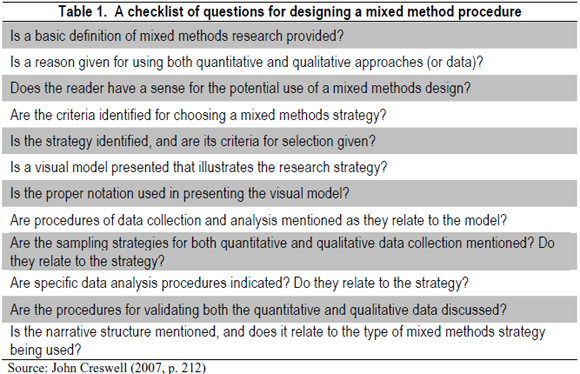
In the same way, Creswell emphasizes that the knowledge about the integration between quantitative and qualitative methods in mixed methods researches is not sufficiently developed: "There is scarce literature thus far for guiding the researcher throughout this process. Furthermore, there is little advice on how the researcher can solve discrepancies between the two kind of data" (CRESWELL, 2007, p.221). Nevertheless, this author presents some important clues in this direction by proposing a list of questions that researchers should ask themselves when working with mixed methods:
All questions here proposed challenge researches to build new research alternatives. Accordingly, it becomes clear that in choosing mixed strategies it is necessary to adequately comply with the criteria, by defining a particular design and establishing its relation with adopted procedures. The definition of the quantitative sample and the qualitative corpus, the data collection, the validation procedures, the mensuration and the analysis of quantitative data, as well as of the narrative structure, require a detailed account of the strategies focused on the peculiarities of the research object.
Starting with the research design, that involves the elaboration of an overall plan for collection and operationalization of data, methods and techniques to be used and their forms of application must then be selected. The multi-methodological strategy enables to integrate the technique of observation with those of interviews and questionnaire, among others. Overlapping procedures enables to analyze the research problem from different angles and dimensions.
In what follows I present a comparative chart of procedures according to three research methodologies, underlining that the mixed method represents a proposal for reconciling the qualitative and the quantitative strategies:
]]>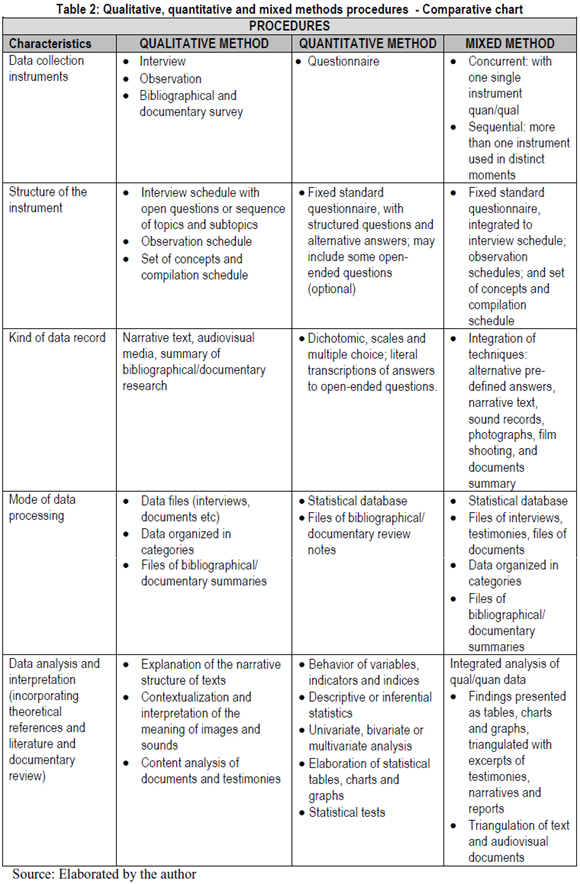
It is worth noting that all procedures can be developed either in virtual or in face-to-face environments, and that it is necessary to consider the positive or negative aspects of chosen strategies in each specific situation.
In the mixed method, the interconnection of distinct information that can be contrasted enables expanding the perspective of the inquiry and deepening data analysis. The complementarity of proceedings creates more favorable conditions for overcoming eventual distortions and errors throughout the research process. In view of the various methodological options, the question arises on the reliability and validation of data, which are directly related to the quality of research22.
In the present days, one may identify as advances in the methodological field a trend towards the use of multiple sources of evidences, a greater transparency with regard to the nature of data, and the explicit statement of the adopted research strategies. The result is a situation more favorable for evaluating whether the findings are consistent with the requirements of scientificity.
Final remarks
In the scientific field, there is currently a trend towards the expansion of interactions between researchers and informants and, hence, the construction of a more collective knowledge. The new information and communication technologies, particularly internet, are creating communication patterns characterized by higher levels of participation and dialogue, which have significant impacts on the work of social scientists. The increased facility of access to sources and data by researches and the expansion of the process of scientific dissemination were also highlighted.
Although social research is still making use of traditional techniques of data collection (observation, questionnaires and interviews), research strategies which incorporate the innovative resources available from the virtual world have been highly valued. Changes in techniques for recording, storing and disseminating information are substantially expanding and modifying researchers' activities.
]]> In data collection, the use of observation and/or interview techniques increasingly includes the new audiovisual and digital resources. New textual forms and symbolic representations on digital environments are deeply changing the ways of perceiving and analyzing the social world. The subjects' representations and conceptions about their own reality, expectations and practices are realized in their oral, textual and body expressions, and the new technologies offer significant capacity for recording and analyzing data.The resource of triangulation and the development of research projects using mixed method appear as relevant operational tools, considering the need for innovating in the traditional techniques for data collection, processing and analysis.
Contention between researchers aligned either to qualitative or to quantitative techniques has been intense, although the current tendency is towards a growing mutual acknowledgement and to integration between both approaches.
The scientificity of research in social sciences tends to increasing improvement by means of the concomitant use of various research techniques integrated in a same study. This is certainly a more effective way for apprehending the reality in a society that steadily grows in complexity.
In this context, we must consider a fundamental factor for the accomplishment of studies with a greater explanatory capacity, considering both the theoretical and methodological dimensions: the incorporation of a critical approach to research problems and to the analysis of their connections with the totality. It is worth further noting the relevance of establishing an adequate relation between research techniques and the conceptual assumptions that determine them. These central questions, learned from the era of intellectual craftsmanship, keep their necessary freshness in the new virtual environments of social research.
References
ANDER-EGG, Ezequiel. Técnicas de investigación social. Buenos Aires: Lúmen, 1995. [ Links ]
BABINI, Dominique; FRAGA, Jorge. Bibliotecas virtuales para las ciencias sociales. Buenos Aires: CLACSO, 2004. [ Links ]
BAUER, Martin W.; GASKELL, George (Orgs). Pesquisa qualitativa com texto, imagem e som: um manual prático. Petrópolis: Vozes, 2004. [ Links ]
BAUER, Martin W.; AARTS, Bas. A construção do corpus: um princípio para a coleta de dados qualitativos. In: BAUER, Martin W.; GASKELL, George (Org). Pesquisa qualitativa com texto, imagem e som: um manual prático. Petrópolis: Vozes, 2004. p. 39-63. [ Links ]
BAUMGARTEN, Maíra. Conhecimento e redes: sociedade, política e inovação. Porto Alegre: Editora da UFRGS, 2005. [ Links ]
___________. Sociedade e conhecimento: ordem, caos e complexidade. SOCIOLOGIAS, Complexidade, Porto Alegre, Programa de Pó-Graduação em Sociologia, ano 8, n.15, p 16-23, jan-jun. 2006. [ Links ]
BLANCO, Alejandro, La Asociación Latinoamericana de Sociología: una historia de sus primeros congresos. SOCIOLOGIAS, Porto Alegre, ano 7, nº 14, p. 22-49, jul-dez 2005. [ Links ]
BOURDIEU, Pierre; CHAMBOREDON, Jean-Claude; PASSERON, Jean-Claude. El ofício de sociólogo. Buenos Aires: Siglo XXI, 1975. [ Links ]
BRUMER, Anita; ROSENFIELD, Cinara L.; HOLZMANN, Lorena; SANTOS, Tania Steren dos. A elaboração de projeto de pesquisa em Ciências Sociais. In: PINTO, Celi R. J.; GUAZZELLI, Cesar A.B. (Org) Ciências Humanas: pesquisa e método. Porto Alegre: Editora da UFRGS, 2008. p. 125-146. [ Links ]
CAMARGO, Aspácia A. O ator, o pesquisador e a história: impasses metodológicos na implantação do CPDOC. In: NUNES, Edson de Oliveira (Org) A aventura sociológica: objetividade, paixão, improviso e método na pesquisa social. Rio de Janeiro: Zahar, 1978. p. 276-304. [ Links ]
CAMPOS, Maria Cristina S. de S. A associação da fotografia aos relatos orais na reconstrução histórico-sociológica da memória familiar. In: LANG, Alice B. da S. G (Org). Reflexões sobre a pesquisa sociológica. São Paulo: CERU, 1999. p. 73-86. [ Links ]
CISNEROS PUEBLA, César A. Análisis cualitativo asistido por computadora. SOCIOLOGIAS, Metodologias informacionais, Porto Alegre, Programa de Pó-Graduação em Sociologia, ano 5, n.9, p. 288-313, jan-jun. 2003. [ Links ]
CRESWELL, John W. Projeto de pesquisa: método qualitativo, quantitativo e misto. Porto Alegre: Artmed, 2007. [ Links ]
DENZIN, Norman K; LINCOLN, Yvonna S. O planejamento da pesquisa qualitativa: teorias e abordagens. Porto Alegre: Artmed, 2006. [ Links ]
FERNÁNDEZ-MOLINA, Juan Carlos. Derecho de autor y bibliotecas digitales: en busca del equilibrio entre intereses contrapuestos. TRANSINFORMAÇÃO, Campinas, v. 20, n 2, p. 123-131, mai-ago 2008. [ Links ]
FLICK, Uwe. Uma introdução à pesquisa qualitativa. Porto Alegre: Bookman, 2004. [ Links ]
GALINDO, Cáceres Luis Jesús. Cibercultura en la investigación: intersubjetividad y producción de conocimiento, Revista Textos de la CiberSociedad, 3. Temática Variada. Available at: http://www.cibersociedad.nethttp://www.cibersociedad.net. Access on: 14 jan. 2009.
]]> GOLDIM, José Roberto. Aspectos éticos relacionados à autoria científica. Available at: http://www.propesq.ufrgs.br/http://www.propesq.ufrgs.br/ . Access on: 12 dez. 2005.GONDIM, Sônia Maria Guedes. Grupos focais como técnica de investigação qualitativa: desafios metodológicos. Available at: www.usp.br/paideia/artigos/24/03.docwww.usp.br/paideia/artigos/24/03.doc. Access on: 10 nov. 2008.
HAIR Jr., Joseph F. et al Fundamentos de métodos de pesquisa em administração. Porto Alegre: Bookman, 2005. [ Links ]
JORGE, Maria Manuel Araújo. O impacto epistemológico das investigações sobre a complexidade. In: Sociedade e conhecimento: ordem, caos e complexidade. SOCIOLOGIAS, Complexidade, Porto Alegre, Programa de Pó-Graduação em Sociologia, ano 8, n.15, p 16-23, jan-jun 2006. [ Links ]
LANG, Alice B. da S. G. Documentos e depoimentos na pesquisa histórico-sociológica. In: LANG, Alice B. da S. G (Org). Reflexões sobre a pesquisa sociológica. São Paulo: CERU, 1999. p. 59-72. [ Links ]
LANGE, Deise F. O impacto da tecnologia digital sobre o direito de autor e conexos. São Leopoldo: Editora da UNISINOS,1996. [ Links ]
]]>LOIZOS, Peter. Vídeo, filme e fotografias como documentos de pesquisa. In: ______ BAUER, Martin W.; GASKELL, George (Org) Pesquisa qualitativa com texto, imagem e som: um manual prático. Petrópolis: Vozes, 2004. p. 137-155. [ Links ]
LÖWY, Michel. Ideologias e ciência social: elementos para uma análise marxista. São Paulo: Cortez, 1985. [ Links ]
MANGABEIRA, Wilma C.; LEE, Raymond M.; FIELDING, Nigel G. Padrões de adoção, modos de uso e representações sobre tecnologia: usuários do CAQDAS no Reino Unido, em meados da década de 90. SOCIOLOGIAS, Metodologias informacionais, Porto Alegre, Programa de Pó-Graduação em Sociologia, ano 3, n.5, p. 20-57, jan-jun 2001. [ Links ]
MARIÑO, Miguel Vicente. Nuevas tecnologías, nuevas oportunidades metodológicas: revisando el papel del diseño metodológico y de las técnicas de investigación en las ciencias sociales contemporáneas. Available at: http://www.cibersociedad.net/congres2006/gts/comunicacio.php?llengua=es&id=948. Access on: 15 out. 2008.
MARTINS, Gilberto de Andrade; THEÓPHILO, Carlos Renato. Metodologia da investigação científica para ciências sociais aplicadas. São Paulo: Atlas, 2007. [ Links ]
MAY, Tim. Pesquisa social: questões, métodos e processos. Porto Alegre: Artmed, 2004. [ Links ]
MILLS, C. Wright. A imaginação sociológica. Rio de Janeiro: Zahar, 1980. [ Links ]
MORAES, Maria C.; DE LA TORRE, S. Pesquisando a partir do pensamento complexo: elementos para uma metodologia de desenvolvimento eco-sistêmico. Available at: http://revistaseletronicas.pucrs.br/ojs/index.php/faced/article/viewFile/440/336. Access on: 3 jan. 2009.
MORIN, Edgar. O problema epistemológico da complexidade. Mira-Sintra - Mem Martins, Ed. Europa-América,1996. [ Links ]
__________. Os sete saberes necessários à educação do futuro. São Paulo: Cortez; UNESCO, 1999/2000. [ Links ]
__________. Ciência com consciência. Rio de Janeiro: Bertrand Brasil, 2000.
RODRIGUES, Rui Martinho. Pesquisa acadêmica: como facilitar o processo de preparação de suas etapas. São Paulo: Atlas, 2007. [ Links ]
SOCIOLOGIAS. Complexidade. Porto Alegre: Programa de Pós-Graduação em Sociologia, ano 8, n.15, jan-jun 2006. [ Links ]
SAUTU, Ruth et al Manual de metodología: construcción del marco teórico, formulación de objetivos y elección de la metodología. Buenos Aires: CLACSO, 2005. [ Links ]
STEREN DOS SANTOS, Tania. Da neutralidade ao compromisso: a construção do conhecimento científico na pesquisa social. Cadernos de Sociologia, Metodologias de pesquisa, Porto Alegre, v.3, n.3, p. 33-53, 1991. [ Links ]
TAVARES DOS SANTOS, José Vicente. As metodologias informacionais: um novo padrão de trabalho científico para as sociologias do século XXI? SOCIOLOGIAS, Metodologias informacionais, Porto Alegre, Programa de Pós-Graduação em Sociologia, ano 3, n.5, p. 16-19, jan-jun. 2001. [ Links ]
TEIXEIRA, Alex N.; BECKER, Fernando. Novas possibilidades da pesquisa qualitativa via sistemas CAQDAS. SOCIOLOGIAS, Metodologias informacionais, Porto Alegre, Programa de Pó-Graduação em Sociologia, ano 3, n.5, p. 9-112, jan-jun 2001.
]]>THIOLLENT, Michel. Crítica metodológica, investigação social e enquete operária. São Paulo: Polis, 1980. [ Links ]
VASCONCELOS, Eduardo Mourão. Complexidade e pesquisa interdisciplinar: epistemologia e metodologia operativa. Petrópolis, RJ: Vozes, 2007. [ Links ]
1 This is a classic work in the field of methodology, published as an appendix in the author's book The Sociological Imagination (1980). In this, the author describes in details how he performs his daily work as a researcher.
2 Document available on internet.
3 Such reflections were developed in my earlier article named Da neutralidade ao compromisso: a construção do conhecimento científico na pesquisa social, in which the positivist and the historical-structural approaches are confronted, and I weave some considerations on the relation subject-object of knowledge, participant observation, and the matters of totality and of methodological alternatives (STEREN DOS SANTOS, 1991).
4 I especially recommend reading two works published by CLACSO - Consejo Latinoamericano de Ciencias Sociales, in Buenos Aires, which offer important contributions in this respect: Bibliotecas virtuales para las ciencias sociales (BABINI; FRAGA, 2004) and Manual de metodologia: construcción del marco teórico, formulación de los objetivos y elección de la metodologia (SAUTU et al, 2005). ]]>