<?xml version="1.0" encoding="ISO-8859-1"?><article xmlns:mml="http://www.w3.org/1998/Math/MathML" xmlns:xlink="http://www.w3.org/1999/xlink" xmlns:xsi="http://www.w3.org/2001/XMLSchema-instance">
<front>
<journal-meta>
<journal-id>1517-4522</journal-id>
<journal-title><![CDATA[Sociologias]]></journal-title>
<abbrev-journal-title><![CDATA[Sociologias]]></abbrev-journal-title>
<issn>1517-4522</issn>
<publisher>
<publisher-name><![CDATA[Programa de Pós-Graduação em Sociologia - UFRGS]]></publisher-name>
</publisher>
</journal-meta>
<article-meta>
<article-id>S1517-45222010000100002</article-id>
<title-group>
<article-title xml:lang="en"><![CDATA[Between neo-corporatists and deliberationists: an interpretation on the paradigms for analysis of participatory forums in Brazil]]></article-title>
<article-title xml:lang="pt"><![CDATA[Entre neocorporativistas e deliberativos: uma interpretação sobre os paradigmas de análise dos fóruns participativos no Brasil]]></article-title>
</title-group>
<contrib-group>
<contrib contrib-type="author">
<name>
<surname><![CDATA[Cortes]]></surname>
<given-names><![CDATA[Soraya Vargas]]></given-names>
</name>
</contrib>
<contrib contrib-type="author">
<name>
<surname><![CDATA[Gugliano]]></surname>
<given-names><![CDATA[Alfredo]]></given-names>
</name>
</contrib>
</contrib-group>
<aff id="A">
<institution><![CDATA[,  ]]></institution>
<addr-line><![CDATA[ ]]></addr-line>
</aff>
<pub-date pub-type="pub">
<day>00</day>
<month>00</month>
<year>2010</year>
</pub-date>
<pub-date pub-type="epub">
<day>00</day>
<month>00</month>
<year>2010</year>
</pub-date>
<volume>5</volume>
<numero>se</numero>
<fpage>00</fpage>
<lpage>00</lpage>
<copyright-statement/>
<copyright-year/>
<self-uri xlink:href="http://socialsciences.scielo.org/scielo.php?script=sci_arttext&amp;pid=S1517-45222010000100002&amp;lng=en&amp;nrm=iso"></self-uri><self-uri xlink:href="http://socialsciences.scielo.org/scielo.php?script=sci_abstract&amp;pid=S1517-45222010000100002&amp;lng=en&amp;nrm=iso"></self-uri><self-uri xlink:href="http://socialsciences.scielo.org/scielo.php?script=sci_pdf&amp;pid=S1517-45222010000100002&amp;lng=en&amp;nrm=iso"></self-uri><abstract abstract-type="short" xml:lang="en"><p><![CDATA[This paper introduces a debate on the main paradigms that usually base the studies concerning proposals for expanding the channels for citizen participation in public policies administration - analyses which examine participatory processes either from the perspective of "neo-corporatist" arrangements or from the view of "deliberative democracy". To this purpose, the article focus on the trajectory of the two main participatory spheres developed in Brazil over the last decades: participatory budgeting and the public policy councils. These participatory bodies were assessed especially through the analysis of four elements: a) institutional relations with governments; b) participants profile; c) scope of decision-making; and d) working dynamics. Based on the analysis of these characteristics, the authors discuss on the capability of two paradigms, neo-corporatism and deliberation, to provide a consistent model for the analysis of dissimilar participatory structures.]]></p></abstract>
<abstract abstract-type="short" xml:lang="pt"><p><![CDATA[Este artigo propõe o debate a respeito dos principais paradigmas a partir dos quais, usualmente, vêm sendo estudadas as propostas de ampliação dos canais de participação dos cidadãos na gestão das políticas públicas, análises que investigam os processos participativos ou desde o prisma dos "arranjos neocorporativos", ou por meio de uma perspectiva baseada na concepção de "democracia deliberativa". Visando este objetivo, o presente texto centra seus interesses na trajetória de duas das principais instâncias participativas que, nas últimas décadas, foram desenvolvidas no Brasil: os orçamentos participativos e os conselhos de políticas públicas. Estas instâncias foram avaliadas levando em consideração, especialmente, quatro elementos a) relações institucionais com os governos; b) perfil dos participantes; c) âmbito decisório e, d) dinâmicas de funcionamento. A partir do estudo destas características, os autores discutem sobre a capacidade dos paradigmas neocorporativo e deliberativo constituírem um modelo analítico consistente para a investigação de estruturas participativas dessemelhantes.]]></p></abstract>
<kwd-group>
<kwd lng="en"><![CDATA[Public Policy Councils]]></kwd>
<kwd lng="en"><![CDATA[Deliberative democracies]]></kwd>
<kwd lng="en"><![CDATA[Participatory budgeting]]></kwd>
<kwd lng="en"><![CDATA[Neo-corporatism]]></kwd>
<kwd lng="pt"><![CDATA[Conselhos de Políticas Públicas]]></kwd>
<kwd lng="pt"><![CDATA[Democracias deliberativas]]></kwd>
<kwd lng="pt"><![CDATA[Orçamentos Participativos]]></kwd>
<kwd lng="pt"><![CDATA[Neocorporativismo]]></kwd>
</kwd-group>
</article-meta>
</front><body><![CDATA[ <p><font face="Verdana, Arial, Helvetica, sans-serif" size="4"><b>Between neo-corporatists    and deliberationists: an interpretation on the paradigms for analysis of participatory  forums in Brazil</b></font></p>     <p>&nbsp;</p>     <p><font face="Verdana, Arial, Helvetica, sans-serif" size="3"><b>Entre neocorporativistas e deliberativos: uma interpreta&ccedil;&atilde;o sobre os paradigmas de an&aacute;lise dos f&oacute;runs participativos no Brasil </b></font></p>     <p>&nbsp;</p>     <p>&nbsp;</p>     <p><font face="Verdana, Arial, Helvetica, sans-serif" size="2"><b>Soraya Vargas    Cortes<sup>I</sup>; Alfredo Gugliano<sup>II</sup></b></font></p>     <p><font face="Verdana, Arial, Helvetica, sans-serif" size="2"><br /> </font></p>     <p><font face="Verdana, Arial, Helvetica, sans-serif" size="2">Translated to English  by Regina Beatriz Vargas &ndash; Master&rsquo;s candidate - PPGS-UFRGS</font><br /> <font face="Verdana, Arial, Helvetica, sans-serif" size="2">Translation from <b><a href="http://www.scielo.br/scielo.php?script=sci_arttext&pid=S1517-45222010000200004&lng=pt&nrm=iso&tlng=pt" target="_blank">Sociologias</a></b><a href="http://www.scielo.br/scielo.php?script=sci_arttext&pid=S1517-45222010000200004&lng=pt&nrm=iso&tlng=pt">,&nbsp; Porto Alegre,&nbsp;v. 12,&nbsp;n. 24,&nbsp;Aug.&nbsp;2010.</a></font></p>     <p>&nbsp;</p>     <p>&nbsp;</p>  <hr size="1" noshade />     ]]></body>
<body><![CDATA[<p><font face="Verdana, Arial, Helvetica, sans-serif" size="2"><b>ABSTRACT</b></font></p>     <p><font face="Verdana, Arial, Helvetica, sans-serif" size="2">This paper introduces    a debate on the main paradigms that usually base the studies concerning proposals    for expanding the channels for citizen participation in public policies administration    - analyses which examine participatory processes either from the perspective    of &quot;neo-corporatist&quot; arrangements or from the view of &quot;deliberative democracy&quot;.    To this purpose, the article focus on the trajectory of the two main participatory    spheres developed in Brazil over the last decades: participatory budgeting and    the public policy councils. These participatory bodies were assessed especially    through the analysis of four elements: a) institutional relations with governments;    b) participants profile; c) scope of decision-making; and d) working dynamics.    Based on the analysis of these characteristics, the authors discuss on the capability    of two paradigms, neo-corporatism and deliberation, to provide a consistent  model for the analysis of dissimilar participatory structures. &nbsp;</font></p>     <p><font face="Verdana, Arial, Helvetica, sans-serif" size="2"><b>Keywords:</b>    Public Policy Councils. Deliberative democracies. Participatory budgeting. Neo-corporatism.  </font></p> <hr size="1" noshade />     <p><font face="Verdana, Arial, Helvetica, sans-serif" size="2"><b>RESUMO</b></font></p>      <p><font face="Verdana, Arial, Helvetica, sans-serif" size="2">Este   artigo prop&otilde;e o debate a respeito dos principais paradigmas a partir   dos quais, usualmente, v&ecirc;m sendo estudadas as propostas de amplia&ccedil;&atilde;o dos   canais de participa&ccedil;&atilde;o dos cidad&atilde;os na gest&atilde;o das pol&iacute;ticas p&uacute;blicas,   an&aacute;lises que investigam os processos participativos ou desde o prisma   dos "arranjos neocorporativos", ou por meio de uma perspectiva baseada   na concep&ccedil;&atilde;o de "democracia deliberativa". Visando este objetivo, o   presente texto centra seus interesses na trajet&oacute;ria de duas das   principais inst&acirc;ncias participativas que, nas &uacute;ltimas d&eacute;cadas, foram   desenvolvidas no Brasil: os or&ccedil;amentos participativos e os conselhos de   pol&iacute;ticas p&uacute;blicas. Estas inst&acirc;ncias foram avaliadas levando em   considera&ccedil;&atilde;o, especialmente, quatro elementos a) rela&ccedil;&otilde;es institucionais   com os governos; b) perfil dos participantes; c) &acirc;mbito decis&oacute;rio e, d)   din&acirc;micas de funcionamento. A partir do estudo destas caracter&iacute;sticas,   os autores discutem sobre a capacidade dos paradigmas neocorporativo e   deliberativo constitu&iacute;rem um modelo anal&iacute;tico consistente para a   investiga&ccedil;&atilde;o de estruturas participativas dessemelhantes.</font></p>     <p><font face="Verdana, Arial, Helvetica, sans-serif" size="2"><b>Palavras-chave:</b> Conselhos de Pol&iacute;ticas P&uacute;blicas. Democracias deliberativas. Or&ccedil;amentos Participativos. Neocorporativismo.</font></p> <hr size="1" noshade />     <p>&nbsp;</p>     <p>&nbsp;</p>     <p><font face="Verdana, Arial, Helvetica, sans-serif" size="3"><b>Introduction</b></font></p>     <p><font face="Verdana, Arial, Helvetica, sans-serif" size="2">This paper discusses    the main participatory institutions for public administration created in Brazil    as of the late 1980's, by examining the distinct analytical models presented    in the literature on this subject. It is aimed to identify the contribution    offered by these models to explain the institutional role that participatory    budgeting and public policy councils play in the context of city and state governments    in the country. It seeks, moreover, to discuss the general characteristics of    such forums, so that to contribute to building middle range theories that allow    locating them within the institutional and political contexts of the country    and, thus, surpassing the so frequent use of case studies for analyzing participatory  experiences. </font></p>     ]]></body>
<body><![CDATA[<p><font face="Verdana, Arial, Helvetica, sans-serif" size="2">The literature    here examined takes those forums as mechanisms for improving democracy in public    administration, and is aimed not only to empirically analyze them, but also    to seek a broad understanding on their institutional role.</font></p>     <p><font face="Verdana, Arial, Helvetica, sans-serif" size="2">As shown by C&ocirc;rtes    (2005), the analysis of participatory institutions can be divided into two major    categories. The first one comprises the works that show skepticism regarding    the capability of participatory forums to favor a more democratic public administration.    The second is formed by researchers who believe in the potential of participatory    mechanisms to foster state democratization.</font></p>     <p><font face="Verdana, Arial, Helvetica, sans-serif" size="2">In the present    work, the analysis of both participatory budgeting and public policy councils    is conducted in the light of the latter interpretive current, the one that is    optimistic regarding the creation of participatory mechanisms, once they would    comprise relevant channels for improving democratic governance at the distinct    levels of public administration.</font></p>     <p><font face="Verdana, Arial, Helvetica, sans-serif" size="2">Although sharing    a positive view of the democratizing effects of participatory experiences, the    distinct interpretations, here examined, on the institutional role of these    forums differ on the nature of such spheres and of the social interests represented    within them. For some, participatory forums comprise a public arena that enables    general interests to be expressed through social movements and civil society    organizations. Conversely, for others, participatory forums would be neo-corporatist    arrangements for representing particular interests, which incorporate demands    through the mobilization of interest groups, i.e. organizations focused on private,    specific claims and not on general demands as the former ones. </font></p>     <p><font face="Verdana, Arial, Helvetica, sans-serif" size="2">Both perspectives    consider that participation has positive impact on the democratization of public    administration. This paper, however, claims that such perspectives bring distinct    contributions to the experiences of participatory budgeting and of public policy    councils, since these forums comprise quite different characteristics. Therefore,    an interpretation on the institutional role of forums may be appropriate for    one kind of experience and not for the other. In order to demonstrate it, the    following characteristics of the two forums are examined: a) institutional relations    with governments; b) profile of the participants; c) issues involved in decision    making; and d) working dynamics.</font></p>     <p><font face="Verdana, Arial, Helvetica, sans-serif" size="2">The article begins    with a brief presentation of the two contrasting views on the institutional    role of participatory forums - seen either as deliberative arenas where common    interests are represented or as neo-corporatist arrangements. It then presents    the outstanding characteristics of the participatory budgeting forums and of    the councils of social policies, seeking to check their adequacy to the interpretation    models previously described.</font></p>     <p><font face="Verdana, Arial, Helvetica, sans-serif" size="2">With this work,    we aim to contribute to the advancement in the analysis of new experiences in    managing public policies in Brazil, through the elaboration of appropriate models    for interpreting the varied participatory practices that have been created in    the last decades. </font></p>     <p>&nbsp;</p>     <p><font face="Verdana, Arial, Helvetica, sans-serif" size="3"><b>The debate on the    institutional role of participatory forums</b></font></p>     <p><font face="Verdana, Arial, Helvetica, sans-serif" size="2">In current debate    about public policies making and implementation, several theoretical currents    rival the construction of a hegemonic interpretive model able to translate most    recent changes produced within state structures (Faria, 2003; Muller &amp; Surel,    2002; Souza, 2006). In what respects to experiences of social participation    in public administration, authors inspired by two distinct ways for analysis    of political participation - the deliberative and the neo-corporatist - have    sought to understand the institutional role of participatory forums created,  since the late 1980s, markedly in Brazil. </font></p>     ]]></body>
<body><![CDATA[<p><font face="Verdana, Arial, Helvetica, sans-serif" size="2">The most influent    analytical approach to Brazilian participatory processes throughout the 1990s    is inspired by theories which have their focus on the concept of deliberative    democracy, a precious term not only to analysts as also to the advocates of    such experiences. </font></p>     <p><font face="Verdana, Arial, Helvetica, sans-serif" size="2">The foundation    for the debate on the deliberationist approach is Habermas' work and his defense    of the public sphere as an arena of discussions and negotiation involving the    State and the civil society.  Public sphere is neither an institution nor an    organization; it is rather a communicational network - Habermas even refers    to it as a communicational structure - in which the social action is produced    through dialogue (Habermas, 1997). </font></p>     <p><font face="Verdana, Arial, Helvetica, sans-serif" size="2">The idea of deliberative    democracy, in connection with the previous concept, is based on the assumption    that the process of public deliberation is central to democracy. In this conception,    the democratic opinion formation, enabled by communicative processes, would    represent the best way to influence the discursive rationalization of decision    making by a government (Habermas, 1997).</font></p>     <p><font face="Verdana, Arial, Helvetica, sans-serif" size="2">Furthering his    project of renewing the theory of democracy, Habermas suggests that the concept    of deliberative democracy is developed by overriding the republican and liberal    perspectives of analysis. To clarify such characterization, this author emphasizes    that his conception of democracy ascribes a stronger emphasis to the democratic    process than that put by the liberal approach, though it is not so radical as    in the republican view. </font></p>     <p><font face="Verdana, Arial, Helvetica, sans-serif" size="2">Therefore, the    renowned German theorist strives to rescue some tenets of liberal and republican    theories in order to improve his conception of democratic political system.    From the liberal perspective, maybe one of the most important issues of the    Habermasian rescue is the need to establish limits in the articulation between    State and Society, i.e., to prevent any prospect of insurrection from the processes    of public debate in order to guarantee legitimacy to elected political representatives.    In turn, from the republican approach, what comes up is the possibility of constituting    a public sphere that allows interconnecting, within a same political arena,    representatives of civil society and of political society, thus expanding a    model of governmental administration that is based, almost exclusively, on parliamentary    representation.</font></p>     <p><font face="Verdana, Arial, Helvetica, sans-serif" size="2">Based on this complex    articulation, Habermas produces his discursive political theory aiming a distinct    object, the development of autonomous public spheres of civil society where    communicative rationality can be enhanced, thus strengthening solidarity as    an alternative for social integration and regulation (Habermas, 1995).</font></p>     <p><font face="Verdana, Arial, Helvetica, sans-serif" size="2">As other theorists    approached the debate on deliberative democracy, the conceptions elaborated    by Habermas underwent a process of criticism and, sometimes, were radicalized.    For summarizing the unfinished dispute, it is possible to claim that  the center    of divergence would lay exactly on the characterization  of the dimensions of    popular sovereignty that could be aspired from the perspective of the public    sphere and, consequently, on the controversy involving the need to complement    discursive arenas by means of effective spheres for popular deliberation<a href="#_ftn2" name="_ftnref2"><sup>1</sup></a>.    </font></p>     <p><font face="Verdana, Arial, Helvetica, sans-serif" size="2">The internal debate    expresses the vitality of this approach and the significant number of scholars    and political activists that adhere to it (DAGNINO, 2002; EVANS, 2003; FEDOZZI,    1997; FUNG; WRIGHT, 2001; GOHN, 2001; GUGLIANO, 2008; JACOBI, 2002; NAVARRO;    GODINHO, 2002; AVRITZER, 2000)<a href="#_ftn3" name="_ftnref3"><sup>2</sup></a> These authors can be grouped since    they share the view that, existing together with the traditional mechanisms    for political participation of representative democracies, such forums can bring    about extensive deliberation and constitute new ways of collective exercise    of political power. Yet, they consider that such forums could be indicating    the constitution of a new kind of democracy in comparison to the traditional    forms of representative democracy.</font></p>     <p><font face="Verdana, Arial, Helvetica, sans-serif" size="2">Considering a wide    universe of authors, the studies of Avritzer (2000) and Santos (1999) stand    out among those which more consistently examined the potentialities of participatory    bodies, particularly, participatory budgeting experiences. While Avritzer claims    that self-organization of civil society and participatory forums can interconnect    to constitute a radical variant of deliberative democracy, Santos calls the    attention to the possibilities of <i>reinventing democracy</i> through a project    in which both the State and the civil society would renew their social roles.    </font></p>     <p><font face="Verdana, Arial, Helvetica, sans-serif" size="2">Although not all    authors fully adopt a theoretical framework inspired in the work of Habermas    and centered in the characterization of deliberative democracy, it is possible    to identify the influence of this approach in some of the seminal works of the    group (AVRITZER, 1997; COSTA, 1997, 1999). From this perspective, the social    movements that entered Latin American political arenas and participatory forums    comprised groups for thematization of general concerns in the ambit of the public    sphere, therefore contrasting with corporate groups - labor unions, political    parties - which advocated for particular interests (COSTA, 1994; COSTA, 1997).    </font></p>     ]]></body>
<body><![CDATA[<p><font face="Verdana, Arial, Helvetica, sans-serif" size="2">The participation    of social movements in Latin American democratization processes have brought    to the agenda a new form of relationship between State and society, a fact that    entailed the introduction of experimentalism in the sphere of the State (GUGLIANO,    2008; SANTOS; AVRITZER, 2002). The belief in the inevitability of representation    in complex societies with huge populations was under challenge in view of increasing    diversity - ethnic, cultural and of concerns - involved in contemporary political    arrangements. The articulation between representative and deliberative democracy    could offer promising responses in defense of subaltern interests and identities    and the success of participatory experiences would be related to the &quot;capabilities    of social actors to translate information and practices from the social level    to the administrative level&quot; (SANTOS; AVRITZER, 2002, p. 54).</font></p>     <p><font face="Verdana, Arial, Helvetica, sans-serif" size="2">In turn, the approach    that ascribes neo-corporatist features to participatory forums is inspired in    a review of studies on this subject, especially on the formulations developed    by Schmitter (1974). According to this author, the main characteristic of modern    state corporatism is the association between interest groups and ruling sectors    of the State. Corporatism would be a system in which the State allows the formation    of a set of bodies representing social interests, which would count on the participation    of particular organizations, either created or licensed by the State, and which    would hold the monopoly of such representation. </font></p>     <p><font face="Verdana, Arial, Helvetica, sans-serif" size="2">Within this arrangement,    state officials would hold some control on the appointment of leaderships and    selection of claims to be put on the discussion agendas of corporatist bodies.    Concurrently, the leaderships would reinforce their authority within the organizations    they represent as a result of the prestige acquired through the fulfillment    of their demands. </font></p>     <p><font face="Verdana, Arial, Helvetica, sans-serif" size="2">There was a trend,    since the creation of the concept of state neo-corporatism, to direct such concept    especially to the study of the State's guiding action in the relations between    capital and labor, and also to consensual solutions of conflicts involving interests    of the economic market and of state regulation (ALMEIDA, 1998; KELLER, 1998;    OFFE, 1992). However, the neo-corporatist approach was gradually extended to    the whole set of public policies, particularly in terms of an analytical alternative    to pluralism<a href="#_ftn4" name="_ftnref4"><sup>3</sup></a> (RIVERA, 1995;    LIJPHART, 2000).</font></p>     <p><font face="Verdana, Arial, Helvetica, sans-serif" size="2">The use of the    concept of neo-corporatist groups or neo-corporatist forms of representing interests,    combined to the use of Hirschmanian concepts of &quot;voice&quot; and &quot;exit&quot;, offers elements    for making generalizations on the institutional and political conditions that    led to the constitution of the forums and that explain, at least partially,    their working. The concept of &quot;voice&quot;, arising from Hirschman's (1970) work,    represents a relevant analytical tool for examining the relation between participation    and public administration, to the extent that it establishes a connection between    the freedom of members to influence the behavior of an organization - e.g.,    a government, an area of public policy - and the degree of efficiency in the    operation of such organization. According to Hirschman, there would be three    ways to solve processes that involve conflict of interest: the &quot;exit&quot;, a typical    market mechanism through which the citizen gives up either buying or using a    good or service; or even withdraws from membership in an organization; the &quot;voice&quot;,    as a political mechanism that enables to protest, to oppose, to express preferences,    to exert influence; and &quot;loyalty&quot;, behavior adopted by those who are willing    to hand over one's own preferences in favor of certain fidelity commitments.</font></p>     <p><font face="Verdana, Arial, Helvetica, sans-serif" size="2">As a consequence,    participatory forums  could comprise neo-corporatist &quot;intermediary organizations&quot;    in the sense attributed to the term by Streeck and Kenworthy (2003, p. 15-17),    that is, institutions not only recognized as also, often, seed by the own governments,    which exert strong influence over them aiming at intermediating interests between    the various social actors. Nevertheless, participatory forums would ultimately    remain free to deny cooperating with governments, although contributing to solve    organizational problems.</font></p>     <p><font face="Verdana, Arial, Helvetica, sans-serif" size="2">The participation,    in the forums, of representatives from distinct interest groups, regarded as    intermediary organizations, may not mean a state &quot;licensing&quot; to the associations    - or labor unions - as is the case in state corporatism, though undoubtedly    it has the character of &quot;recognition&quot; and, thus, of legitimation of such representatives    before the members of their respective associations as occurs in neo-corporatism    or social corporatism. In this way, representatives are regarded as leaders    able to influence policies. Still more, representatives may frequently commit    themselves to favor the compliance with decisions or may even undertake the    responsibility for implementation of policies together with their organizations.<a href="#_ftn5" name="_ftnref5"><sup>4</sup></a>    </font></p>     <p><font face="Verdana, Arial, Helvetica, sans-serif" size="2">The interpretation    of participatory forums as neo-corporatist units gathers a smaller number of    authors (BOSCHI, 1999; SCHMIDT, 2001, SANTOS, 2001). In general, social scientists    who emphasize the neo-corporatist element in participatory processes tend toward    identifying such bodies as complementary forms of representative democracy,    stressing their potential for improving both governance and accountability.    These authors do not make the case for modes of participatory democracy as opposed    to representative democracy. Moreover, many such studies show a trend to consider    that the participant advocates private interests while resident of a particular    region or beneficiarie of certain public policies. </font></p>     <p><font face="Verdana, Arial, Helvetica, sans-serif" size="2">One of the pioneers    in such analytical perspective was Boschi (1999), who claimed that councils    of public policy and social rights often constitute neo-corporatist units in    which different interests would be represented under the supervision of either    public institutions or sound local associations. New forms of coordination between    traditional decision making processes of public administration and the representation    of social concerns could be settled in such forums. There would be a trend to    set a balance between efforts towards autonomy by decision makers and towards    approach and penetration by client groups. Such balance may help to understand    the underlying conditions of policies formulation, and also to change paths    of existing public policies. </font></p>     <p><font face="Verdana, Arial, Helvetica, sans-serif" size="2">Schmidt (2001)    also regards Brazilian participatory forums as having a neo-corporatist character,    and underlies what he calls positive and negative consequences of such forums    for the advancement of democratization. According to this author, participatory    mechanisms mean a way for delegation of State responsibilities to social organizations    that implies a shared responsibility for the process.</font></p>     ]]></body>
<body><![CDATA[<p><font face="Verdana, Arial, Helvetica, sans-serif" size="2">Santos (2001),    in turn, calls our attention to the assumption that, in Brazil, although the    bureaucratic decision making arena has not experienced changes during the democratic    period, strategic actors who were previously excluded would have been integrated    through participatory forums of social and environmental areas (Santos, 2001).    For this author, as from the administrations of Fernando Henrique Cardoso (1995-2002),    a twofold pattern of relationship with social actors was established, with the    decisions regarding economic policy being made in a context of bureaucratic    isolation. And, in the ambit of social and environmental policies, &quot;decision    making structures comprising the institutionalized participation of groups affected    by such policies&quot; were built (SANTOS, 2001, p. 746). She claims that, in contexts    of developing countries, with markedly unequal socioeconomic structures, forms    for interest representation such as the neo-corporatist could open decision    making opportunities for the social groups without the means to get appropriate    representation in the pluralist sphere (Santos, 2001, p.756). </font></p>     <p><font face="Verdana, Arial, Helvetica, sans-serif" size="2">In this section,    we could note that studies that regard Brazilian participatory forums as mechanisms    which promote democratization of public administration can be classified in    two groups. Despite some divergences, both consider that the institutional design    of these forums favors the emergence of a new kind of decision making process    which may either encompass common interests, as in the view of supporters of    deliberative-democratic theories, or include new groups of sectional interests,    according to backers of the neo-corporatist theses.</font></p>     <p><font face="Verdana, Arial, Helvetica, sans-serif" size="2">However, we must    yet examine the institutional characteristics of both kinds of forums in order    to identify what interests could be represented in them. Furthermore, it is    necessary to verify whether they play a relevant role in the broad process of    political decision making by governments or whether they make decisions solely    on secondary matters of the agendas; i.e., if the decisions deal with macro-political    dynamics or rather handle sectoral concerns. </font></p>     <p>&nbsp;</p>     <p><font face="Verdana, Arial, Helvetica, sans-serif" size="3"><b>The institutional    role of Brazilian participatory forums: participatory budgeting and public policy    councils</b></font></p>     <p><font face="Verdana, Arial, Helvetica, sans-serif" size="2">These two kinds    of forums above indicated present similar backgrounds: the participatory experiences    of the 1970s and 1980s (CASTRO, 1988; COSTA, 1997; FERREIRA, 1991; SOUZA, 2001,    p. 161-163). Municipal governments in the states of S&atilde;o Paulo, Santa Catarina,    Minas Gerais and Rio Grande do Sul created councils and community centers, and    developed ways for public consultation in the areas of health services, urban  development, environmental policies and in budgeting processes<a href="#_ftn6" name="_ftnref6"><sup>5</sup></a>. </font></p>     <p><font face="Verdana, Arial, Helvetica, sans-serif" size="2">Participatory budgeting    became well known especially because of the experiences in the cities of Porto    Alegre and Belo Horizonte which started respectively in 1989 and in 1993. Both    experiences began with the election of the Workers Party (PT - <i>Partido dos    Trabalhadores</i>) candidate and remain working until the present, even after    the defeat, in 2004, in Porto Alegre, of the left coalition responsible for    establishing the participatory budgeting. Yet, besides these two cities, participatory    tests have been attempted for debates on public budgeting in cities like Lages,    SC(1976- 1981); Vila Velha, GO (1983- 1986); and in Pelotas, RS (1984-1985),    to mention only a few examples (Gugliano et al., 2008). </font></p>     <p><font face="Verdana, Arial, Helvetica, sans-serif" size="2">Since 1990, participatory    budgeting experiences have spread all over the country. Instituto P&Oacute;LIS considers    that, between 1989 and 2004, at least 261 cities of 23 Brazilian states have    created processes involving people's participation in decisions on budget allocation    (POLIS, 2006). In 2005, 16 out of 31 cities of the metropolitan region of Porto    Alegre counted on participatory mechanisms involving municipal public budgeting    (C&ocirc;rtes, 2005). In 2007, the Brazilian Network of Participatory Budgeting was    created, gathering 42 municipalities (RBOP, 2010). There are also some experiences    of participatory budgeting at state level as in Rio Grande do Sul, Pernambuco,    Acre and Par&aacute; (C&ocirc;rtes, 2003; Lubambo; Coelho, 2005; Governo do Estado do Par&aacute;,    2010).  </font></p>     <p><font face="Verdana, Arial, Helvetica, sans-serif" size="2">Each of these has    its own characteristics. There are huge differences regarding scope, size of    population and territorial range, as also great discrepancies in terms of political    culture and politico-institutional traditions within each locality involved.    Nevertheless, it is possible to identify some elements in their institutional    designs that are recurrent enough as to be considered participatory budgeting.    </font></p>     <p><font face="Verdana, Arial, Helvetica, sans-serif" size="2">The first of such    elements regards to the responsibility for the creation of participatory budgeting    forums. The Brazilian Constitution establishes that the elaboration of budget    proposals is exclusively incumbent upon the Executive Branch (Brasil, 1988,    art. 165). Therefore, all participatory budgeting processes must be an initiative    of governmental authorities. It implies a strong influence of government's officials    upon the whole process, since the lack of a national regulation - something    similar to the constitutional principles that guide the dissemination of public    policy councils - makes the existence of the process in itself dependent on    the Executive Branch. </font></p>     ]]></body>
<body><![CDATA[<p><font face="Verdana, Arial, Helvetica, sans-serif" size="2">Other three features    shared by those experiences refer to: a) the kind of participants involved;    b) the most frequent issues that comprise the discussion agendas; and c) the    most recurrent and general aspects of their workings and dynamics. Potential    participants are all voting-age citizens of the city or the state<a href="#_ftn7" name="_ftnref7"><sup>6</sup></a>,    though, according to Dias (2002) and Silva (2001), most of those engaged come    from the poorer neighborhoods of the cities. The decisions deal mostly with    allocation of capital expenditure and, sometimes, of current expenditure. Yet,    the proportion of budget resources under discussion may be quite different in    each case (MARQUETTI, 2008).</font></p>     <p><font face="Verdana, Arial, Helvetica, sans-serif" size="2">The participatory    budgeting dynamics of working is directly dependent upon the political will    of government officials. Nevertheless, in practice, this definition is the outcome    of an agreement involving the initial proposal of government officials and those    of the representatives of civil society. Once established the forums of participatory    budgeting, their working rules allow participants themselves to redefine the    norms that guide their work. When a consensus is reached, the discussion agenda    and the activities timetable become public information. Thus, both potential    participants and those who effectively take part in the budgeting activities    may plan their participation and follow resulting decisions.</font></p>     <p><font face="Verdana, Arial, Helvetica, sans-serif" size="2">The forums may    combine mechanisms for direct and indirect participation. Direct participation    occurs, primarily, at the levels of either neighborhoods or thematic issues    in the case of municipal processes; or at the levels of districts and cities    in case of state participatory budgeting. As to the indirect participation,    it refers particularly to the election of delegates and representatives in broader    forums for coordination of the participatory processes at distinct levels. In    Porto Alegre, for instance, direct participation occurs during regional and    thematic general meetings, and indirect participation is observed in forums    of delegates and in the council of participatory budgeting. In a similar way,    state participatory processes can also combine direct spheres of participation,    e.g. the general meetings in cities or districts, with indirect forms. Such    blending of participatory practices has been applied in several instances such    as in participatory budgeting in Rio Grande do Sul (1999-2002).  </font></p>     <p><font face="Verdana, Arial, Helvetica, sans-serif" size="2">Budget is discussed    at public meetings, at district level when dealing with municipal processes,    or in the ambit of cities for state processes. These meetings generally gather    activists from social movements, residents from distinct regions of the city,    government representatives and politicians. They seek to establish priorities    and elect delegates who will take part in the higher levels of decision making.    Delegates from all districts and regions deal on priorities and later check    if the priorities agreed are being carried out. Very often such delegates attend    to specific forums where the policies debated at the general meetings are improved,    and are also responsible for the election of representatives for the process    main coordinating body - the Participatory Budgeting Council.</font></p>     <p><font face="Verdana, Arial, Helvetica, sans-serif" size="2">Although being    in place some election processes open either to delegates or even to all voting    citizens in the relevant region (potential participants), a distinctive characteristic    of participatory budgeting in comparison to other modes of participation in    public budgeting is the right to voice. Participants may express their preferences    during the meetings that are planned to set expenditure priorities.</font></p>     <p><font face="Verdana, Arial, Helvetica, sans-serif" size="2">Therefore, considering    the relations established between participatory budgeting experiences, it is    possible to claim that they comprise arenas where issues of public interest    are discussed. Thus, it appears appropriate, the perspective that describes    these forums as bodies which comprise the public sphere and through which common    interests are thematized by social actors who translate practices and information    from the social context to the political-administrative level. </font></p>     <p><font face="Verdana, Arial, Helvetica, sans-serif" size="2">In most of the    cases, participatory budgeting is open to all citizens, although the regular    participants are generally activists of urban social movements. According to    this same perspective, in view of their peculiar organizational patterns and    their embeddedness in the social fabric, social movements are able to supersede    the traditional corporatist model in which interest groups bring private demands    to the public arenas.</font></p>     <p><font face="Verdana, Arial, Helvetica, sans-serif" size="2">On the grounds    of constitutional precepts, the creation of participatory budgeting forums relies    on the political will of the Executive Branch. Thus these forums' working rules    result, generally, from a governmental decision. In such case, are the decision    makers themselves who establish that citizens must participate in the design    of budget proposal and who define the institutional structure of the participatory    process to be implemented.</font></p>     <p><font face="Verdana, Arial, Helvetica, sans-serif" size="2">However, the scope    of control by government officials is limited by the public character of the    budgeting discussion arenas and by the role attributed to government representatives    in the working rules defined by consensus. In Porto Alegre, in addition to this    context there was a view that an autonomous institution of civil society was    emerging and that, therefore, its working rules should only be set through its    internal channels of deliberation. The paradigm established in Porto Alegre    has been followed in other municipal participatory processes, in which working    rules are voted on a yearly basis at the participatory budgeting council, or    at general meetings. </font></p>     <p><font face="Verdana, Arial, Helvetica, sans-serif" size="2">In this way, once    the working rules are the outcome of a consensus, it is indeed possible for    social actors to transfer practices and information from the social sphere to    the political-administrative one. Although decisions made refer only to a limited    share of the budget, they impact every area in the public administration by    promoting consensus through processes in which the interest groups must consider    the demands of other participants.</font></p>     ]]></body>
<body><![CDATA[<p><font face="Verdana, Arial, Helvetica, sans-serif" size="2">However, given    their poorly institutionalized character in comparison to public policy councils,    these forums become more vulnerable to political changes in the Executive Branch    and, thus, are less liable to become a generalized mechanism for public administration    in the country. Paradoxically, the same institutional freedom - in the sense    that it allows to set its own working rules - that offers to decision makers    a unique opportunity to make experiments within the governmental sphere (SANTOS;    AVRITZER, 2002, p.54), ends up by being the <i>Achilles' heel</i> when it is    necessary to guarantee the continuity of participatory processes in the face    of  change of ruling party in the relevant governmental sphere.</font></p>     <p><font face="Verdana, Arial, Helvetica, sans-serif" size="2">The other variety    of forum examined here - the public policy councils - has its roots in the areas    of education and social security. The first municipal councils of education    were established in the 19th century (WERLE, 1998). In the area of social security    there were representatives of workers from administrative associated bodies    such as the Retirement and Pensions Saving Funds and Institutes, created in    the 1920 and 1930 decades (MALLOY, 1977). </font></p>     <p><font face="Verdana, Arial, Helvetica, sans-serif" size="2">In the Brazilian    case, the health councils, created in 1990 by Law no. 8142/90 (BRASIL, 1990),    became the paradigm which inspired the creation of councils in other areas of    public policies. This legislation established that health councils should be    constituted at the federal, state and municipal levels of government. Their    fast dissemination is related to the process of decentralization of health care    promoted by the federal government. The positive inducement to the creation    of these forums rested on the requisite of their existence, among other conditions,    for federal financial resources to be transferred to sub-national levels  of    public administration (C&Ocirc;RTES, 1995). In 2001, 98% of Brazilian municipalities    - i.e., 5,426 out of 5,506 cities - and, from 2005 on, all cities in the country,    counted on a health council (MINIST&Eacute;RIO DE SA&Uacute;DE, 2006). </font></p>     <p><font face="Verdana, Arial, Helvetica, sans-serif" size="2">Although not so    disseminated as the health councils, by the end of the last century and the    beginning of the 2000s, public policy councils were created in almost every    area (BULH&Otilde;ES, 2002; CARVALHO, 1998; CORTES, 1995; DAGNINO, 2002; RAICHELES,    2000; SANTOS JUNIOR, 2001; TATAGIBA, 2002). There are councils in the areas    of income and employment, social security, rural development, social protection,    education, environment, urban planning, public security, drug control among    others. There are councils which deal with the guarantee of the rights of children,    of black people, of indigenous people, of women, of handicap people, aged people    etc.</font></p>     <p><font face="Verdana, Arial, Helvetica, sans-serif" size="2">Differences between    these councils are more prominent than those between the several forms of participatory    budgeting. Divergences are mainly associated to the institutional framework    of each public policy area; to political culture and traditions of each region    or city; to the positions of municipal and state government officials; and to    the existence, in each area of public policy, of a policy community concerned    with strengthening alliances or coalition which may influence decision making    in governmental policy.</font></p>     <p><font face="Verdana, Arial, Helvetica, sans-serif" size="2">In despite of this,    the institutional design of these forums shows a common base. During the last    decade, processes for decentralization of financial resources and responsibilities    from the federal government level to sub-national ones were in place for most    areas of social policies. This was the case in the areas of health care, social    protection, income and employment support, elementary education and rural development    among others. </font></p>     <p><font face="Verdana, Arial, Helvetica, sans-serif" size="2">A set of legal    rules - such as the Constitution of 1988, constitutional amendments and federal    laws - and administrative acts - both by the ministries and by the councils    themselves - created participatory forums and defined who should participate    in them. The new Constitution, for instance, established the &quot;participation    of the population&quot; in the area of social protection and &quot;of community&quot; in the    health care system (BRASIL, 1988, art. 204/II; art. 198/III). The laws that    regulate the organization of the health care and social protection systems (BRASIL,    1993, Lei 8.742; BRASIL, 1990,<i> </i>Lei 8.142) established that the councils    should be created at the federal, state and municipal levels of public administration.</font></p>     <p><font face="Verdana, Arial, Helvetica, sans-serif" size="2">The participants    of these councils have also been defined either by law or by administrative    acts. In the health care area, half of the councils' members is comprised by    representatives of users of the health care services, the other half is comprised    by representatives of governmental bodies, health professional associations    and services provider institutions (BRASIL, 1990, Lei 8.142). As to the area    of social protection, half of the counselors is formed by governmental representatives    and the other half by members of civil society organizations representing beneficiaries    of social services, professionals of the relevant area and services provider    institutions (BRASIL, 1993, Lei 8.742). In the area of employment and labor,    the councils have a tripartite structure, being composed by representatives    of government, employers and employees (CODEFAT, 1995, Act nº 80). So, these    forums are constituted by representatives of government and of civil society    and the participant social groups have direct concern in the particular area    of public policy. </font></p>     <p><font face="Verdana, Arial, Helvetica, sans-serif" size="2">As we may see,    several characteristics of these forums contrast with those of participatory    budgeting. These latter are open to all citizens and even their regular participants,    social movements activists, may have interest in distinct areas of public policy,    whereas the councils gather participants specialized in particular areas.</font></p>     <p><font face="Verdana, Arial, Helvetica, sans-serif" size="2">Another remarkable    difference is that the councils are highly institutionalized while participatory    budgeting forums are not. The councils make part of the administrative structure    of the public policy departments to which they are linked. Such high level of    institutionalization is expressed in the variances in the content of agendas    and in the distinct forms of decision that councils can make in each area of    public policy. For example, while in the area of labor and employment they make    decisions on the kinds of courses for professional qualification that will be    funded with public resources, in the area of social protection they define which    private service provider institutions will be apt, in compliance with legal    criteria, to receive public resources. The councils' agendas, that is, the matters    on which they hold power to make decisions, and their institutional role are    shaped by previously set norms and by the needs resulting from the institutional    characteristics of each area.</font></p>     ]]></body>
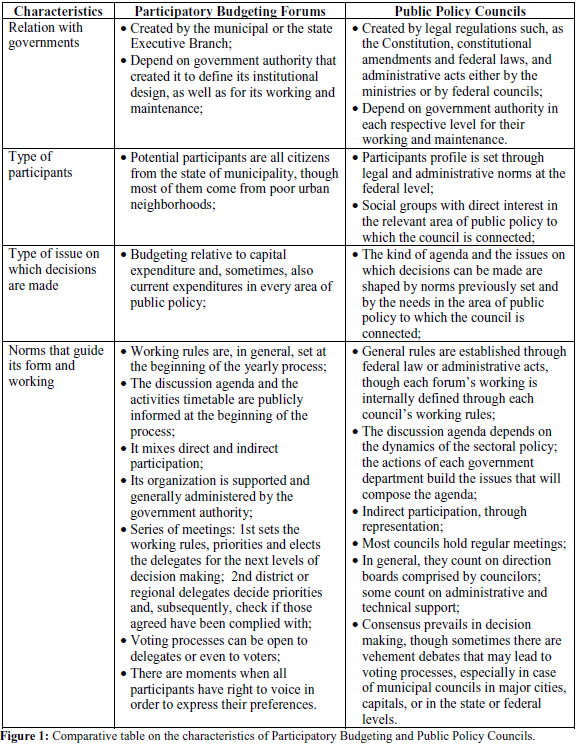
<body><![CDATA[<p><font face="Verdana, Arial, Helvetica, sans-serif" size="2">The general working    dynamics of the councils are also set by either legal or administrative rules.    Even if their specification is defined by consensus or, as in many cases, is    imposed by government officials, the general structure - in what respects, for    instance, to the sort of participants or the attributions of the forum in the    area - is not open to debate. Furthermore, by contrast with the working dynamics    of participatory budgeting, whose matters for decision making are defined at    the beginning of the yearly process, for the councils, the agenda is permanently    open to new policies, programs or actions  proposed by the government authorities.    </font></p>     <p><font face="Verdana, Arial, Helvetica, sans-serif" size="2">Unlike the participatory    budgeting forums, which combine mechanisms of direct and representative democracy,    councils are comprised exclusively by representatives. Direct participation    is only possible in some cities where district councils were created, although    these latter hold no institutional attribution as defined by the national legal    and administrative regulation. Participants of the councils at the federal,    state and municipal levels are either elected or indicated by organizations    or population sector they represent; or, also, appointed by government authorities    in cities where political elites hold the control over virtually all aspects    of the municipal political dynamics. </font></p>     <p><font face="Verdana, Arial, Helvetica, sans-serif" size="2">Most councils use    to hold regular meetings, although some studies have shown that, in several    cases, they do not hold public meetings (CORTES, 2005; IBGE, 2004). This happens    when municipal authorities formally institute the councils with the sole purpose    of complying with the law for obtaining federal financial resources. </font></p>     <p><font face="Verdana, Arial, Helvetica, sans-serif" size="2">The council has    generally a board of directors, usually elected by members according to its    working rules. Even when governmental authorities do not administer the forum,    they have a strong influence over the elaboration of its agendas. On the other    hand, government authorities can either make available or withdraw the infrastructure    that enables the good workings of the councils. Some of these forums count on    technical and administrative support of municipal, state and federal authorities.    Health municipal councils, for instance, usually receive this kind of support,    unlike the councils of elementary education which do not (C&Ocirc;RTES, 2005). As    to decision making process, even though decisions are frequently carried out    by consensus, in many cases the discussions lead to voting processes. This is    observed particularly in larger cities, especially capitals, and in state and    federal councils as well.</font></p>     <p><font face="Verdana, Arial, Helvetica, sans-serif" size="2">Hence, in spite    of existing differences in the workings of councils from distinct areas of public    policies, and even within a same area, particularly at municipal level, some    common characteristics allow for their analysis. Thus, the interpretations that    describe the Brazilian participatory experiences as neo-corporatist units through    which distinct interests are represented can be said to be the most appropriate    for understanding the institutional role of the public policy councils.</font></p>     <p><font face="Verdana, Arial, Helvetica, sans-serif" size="2">Within these institutional    spheres, concerns that previously had no chance to be expressed are posited    before public authorities who must - somehow - to find responses to new forms    of social demands. These are forums highly institutionalized, organized and    regulated by both legal and administrative rules set in each area of public    policy, and their participants represent groups that advocate particular interests    in these areas. The <a href="#fig1">table</a> below is a summary of the analysis carried out in    this section. </font></p>     <p><a name="fig1"></a></p>     <p>&nbsp;</p>     <p align="center"><img src="/img/revistas/s_soc/v5nse/a02fig1.jpg" /></p>     <p>&nbsp;</p>     ]]></body>
<body><![CDATA[<p><font face="Verdana, Arial, Helvetica, sans-serif" size="3"><b>Final remarks</b></font></p>     <p><font face="Verdana, Arial, Helvetica, sans-serif" size="2">The present article    examined two currents of interpretation of the institutional role of participatory    forums, which consider such experiences as advancements in the forms of governance    and public administration. It sought furthermore to verify the appropriateness    of such currents to the analysis of the participatory mechanisms most disseminated    in Brazil, namely: participatory budgeting and public policy councils. Some    of those studies argue that the Brazilian participatory experiences comprise    public arenas in which common interests are expressed, brought forth by social    movements. Another current of interpretation considers that these forums are    neo-corporatist mechanisms representing particular concerns that had never before  been publicly claimed in the presence of the governments.  </font></p>     <p><font face="Verdana, Arial, Helvetica, sans-serif" size="2">Through the analysis    of both forms of participatory forums, we suggested that the first current of    studies is best suitable for understanding participatory budgeting forums and    the second one, for the public policy councils. This can be explained by the    specific characteristics of each mechanism.</font></p>     <p><font face="Verdana, Arial, Helvetica, sans-serif" size="2">With regard to    participatory budgeting, it is noticeable the constitution of a public sphere    with relatively small limits to access and in which citizens may discuss and    deliberate about problems in the community with some autonomy in relation to    governments. Deliberations produced in this way are referred to the State with    expectations that they get to be implemented within a reasonable timeframe.    It is known that, in practice, the dynamics of participatory budgeting is not    so virtuous, since governmental participation does not take place symmetrically    in relation to the position of civil society representatives, but from a hierarchically    higher stance, based on a differentiated access to power resources. However,    this fact does not change its character of a deliberative institution with relative    autonomy with regard to governments, a sphere for incorporation of demands and    proposals by distinct actors from civil society, who transfer practices and    information from the social sphere to that governmental.</font></p>     <p><font face="Verdana, Arial, Helvetica, sans-serif" size="2">Surprisingly, the    relative autonomy in the constitution of institutional designs and working rules    - which allows ways of action and information to be passed from civil society    to governments - depends almost exclusively on a government initiative. This    occurs because there is no legal framework to base the existence of participatory    budgeting, since the elaboration of budget proposals is constitutionally defined    as a prerogative of the Executive Branch. Even so, the lack of legal regulation    does not prevent the establishment of <i>de facto</i> rules, which can institutionalize    the forum, since the political environment allows that. This seems to be the    case of Porto Alegre, where governments from distinct political parties have    maintained Participatory Budgeting working.</font></p>     <p><font face="Verdana, Arial, Helvetica, sans-serif" size="2">As to the public    policy councils, the opposite is observed: the general features that describe    their institutional roles in the various areas of public policy, the participants    to be admitted and, especially, the very existence of these forums, are defined    by law. The access to them is not granted to all citizens. Only representatives    of the organizations appointed, generally, by law, or by administrative act    of the municipal or state Executive Branch, may be considered as full members,    with right to voice and vote. The discussions agenda is sectoral, and generally    undergoes strong influence by the working dynamics of the area of public policy    to which the council is connected. Nevertheless, these forums allow demands    from public policies beneficiaries to interact with the State, thus opposing    the trend towards autonomy by government authorities. Thus, they represent a    novelty in the form as decisions about such policies are made in Brazil.</font></p>     <p><font face="Verdana, Arial, Helvetica, sans-serif" size="2">As their institutional    designs are defined through the legal and administrative frameworks of the various    areas of public policies, the chance for the organization of working dynamics    to be modified by participants themselves is lesser. Consequently, even if their    autonomy in relation to governments is small, it is greater than that that prevails    in the participatory budgeting. The reason is that the legal and administrative    regulations, which support their existence and shape their forms of working,    entail high political costs for those who do not comply with them - lawsuit    by the Attorney General Office, loss of federal financial resources, etc. </font></p>     <p><font face="Verdana, Arial, Helvetica, sans-serif" size="2">Undoubtedly the    institutionalization of the council puts limits for bringing practices and information    from civil society inside of it, by establishing that participants from society    shall represent interest groups from each area of public policy. This is an    aspect that works more fluently in the case of participatory budgeting. Nevertheless,    it is precisely this characteristic that prevents the governments to dissolve    the councils and that helps to explain why, currently, these bodies are disseminated    throughout all municipalities in the country, while the participatory budgeting    exist only in some hundreds of cities.</font></p>     <p><font face="Verdana, Arial, Helvetica, sans-serif" size="2">Finally, we want    to emphasize that much research work still has to be done on the Brazilian participatory    budgeting forums and their distinct analytical paradigms. With the present paper,    we intended to foster controversy on these matters, in view of the need for    strengthening the debate on new experiences for citizens' inclusion in public    administration.</font></p>     <p>&nbsp;</p>     ]]></body>
<body><![CDATA[<p><font face="Verdana, Arial, Helvetica, sans-serif" size="3"><b>References</b></font></p>     <!-- ref --><p><font face="Verdana, Arial, Helvetica, sans-serif" size="2">ALMEIDA, Maria    Herminia Tavares. Sindicatos em tempo de reformas.<b>S&atilde;o Paulo em Perspectiva</b>,    v. 12, n. 1, 1998, p. 3-9.    </font></p>     <!-- ref --><p><font face="Verdana, Arial, Helvetica, sans-serif" size="2">AVRITZER, L. Um    desenho institucional para o novo associativismo, <b>Lua Nova</b>, n. 39, 1997,    p. 149-151.    </font></p>     <!-- ref --><p><font face="Verdana, Arial, Helvetica, sans-serif" size="2">______. Teoria    democr&aacute;tica e delibera&ccedil;&atilde;o p&uacute;blica. <b>Lua Nova</b>, n. 50, 2000, p. 25-46.    </font></p>     <!-- ref --><p><font face="Verdana, Arial, Helvetica, sans-serif" size="2">AZEVEDO, S&eacute;rgio;    ABRANCHES, M. Conselhos Setoriais o caso da Regi&atilde;o Metropolitana de Belo Horizonte.    <b>Cadernos Metr&oacute;pole</b>, n. 7, 2002, p. 41-71.    </font></p>     <!-- ref --><p><font face="Verdana, Arial, Helvetica, sans-serif" size="2">BAKER, Gideon.    <b>Civil society and republican democracy</b>. Paper for Political Studies Association-UK<i>    </i>Annual Conference, 10-13 April, London, 2000.    </font></p>     <!-- ref --><p><font face="Verdana, Arial, Helvetica, sans-serif" size="2">BONFIM, Washington    L.S.; FERNANDES, A.S.A.; <b>Teorias Democr&aacute;ticas Contempor&acirc;neas e o caso Brasileiro    P&oacute;s-Constitui&ccedil;&atilde;o de 1988</b>. Paper presented at XXVIII Encontro Anual da ANPOCS.    ST23. Caxambu,  2004.    </font></p>     <p><font face="Verdana, Arial, Helvetica, sans-serif" size="2">BOSCHI, Renato    Raul. Decentralization, clientelism, and social capital in urban governing:    comparing Belo Horizonte and Salvador.<i> </i><b>Dados</b>. [on line], v. 42,    n. 4, 1999, p. 655-690. Available at: &lt;<a href="http://www.scielo.br/scielo.php?script=sci_arttext&pid=S0011-52581999000400002&lng=en&%20nrm=iso" target="_blank">http://www.scielo.br/scielo.php?script=sci_arttext&amp;pid=S0011-52581999000400002&amp;lng=en&amp;    nrm=iso</a>&gt;. ISSN 0011-5258.</font></p>     <!-- ref --><p><font face="Verdana, Arial, Helvetica, sans-serif" size="2">BRASIL. Assembl&eacute;ia    Nacional Constituinte, <b>Constitui&ccedil;&atilde;o da Rep&uacute;blica Federativa do Brasil de    05 de Outubro de 1988</b>.    </font></p>     <p><font face="Verdana, Arial, Helvetica, sans-serif" size="2">BRASIL. Congresso    Nacional, Lei 8.142 de 28 de Dezembro de 1990 - On the participation of the    community in the administration of the Unified Health System (SUS - Sistema    &Uacute;nico de Sa&uacute;de) and on intergovernmental transfers of financial resources in    the area of health,  1990.</font></p>     <p><font face="Verdana, Arial, Helvetica, sans-serif" size="2">BRASIL. Congresso    Nacional, Lei 8.742 de 7 de Dezembro de 1993 - On the organization of the social    protection, 1993.</font></p>     <!-- ref --><p><font face="Verdana, Arial, Helvetica, sans-serif" size="2">BULH&Otilde;ES, M.G.P.    Plano Nacional de Qualifica&ccedil;&atilde;o do Trabalhador no Rio Grande do Sul/Brasil: avan&ccedil;os    e limites na participa&ccedil;&atilde;o de atores governamentais e n&atilde;o governamentais. In:    MILANI, C.; ARTURI, C.; SOLIN&Iacute;S, G. (Eds.). <b>Democracia e governan&ccedil;a mundial</b>:    que regula&ccedil;&otilde;es para o s&eacute;culo XXI?<i> </i>Porto Alegre: UFRGS/UNESCO, 2002, p.    137-165.    </font></p>     ]]></body>
<body><![CDATA[<!-- ref --><p><font face="Verdana, Arial, Helvetica, sans-serif" size="2">CARVALHO, A.I.    Conselhos de sa&uacute;de, participa&ccedil;&atilde;o social e reforma do Estado. <b>Ci&ecirc;ncia &amp;    Sa&uacute;de Coletiva</b>, v. 3, n. 1, 1998, p. 23-25.    </font></p>     <!-- ref --><p><font face="Verdana, Arial, Helvetica, sans-serif" size="2">CASTRO, M. Helena    G. de. Equipamentos sociais e pol&iacute;tica local no p&oacute;s-64: dois estudos de caso.    <b>Espa&ccedil;o e Debates</b>, n. 24, 1988, p. 67-74.    </font><font face="Verdana, Arial, Helvetica, sans-serif" size="2"> </font></p>     <p><font face="Verdana, Arial, Helvetica, sans-serif" size="2">CODEFAT. Resolu&ccedil;&atilde;o    nº 80, de 19 de abril de 1995. Altera a Resolu&ccedil;&atilde;o nº 63, de 28 de julho de 1994,    sets criteria for the recognition, by CODEFAT, of employment commisions constituted    at the municipal, state and federal levels, in the ambit of the public system    of  employmenT, 1995.</font><font face="Verdana, Arial, Helvetica, sans-serif" size="2"> </font></p>     <!-- ref --><p><font face="Verdana, Arial, Helvetica, sans-serif" size="2">CORTES, Soraya    M. V. F&oacute;runs participat&oacute;rios na &aacute;rea de sa&uacute;de: Teorias do estado, participantes    e modalidades de participa&ccedil;&atilde;o. <b>Revista Sa&uacute;de em Debate</b>, n. 49-50, 1995,    p. 73-79.    </font></p>     <!-- ref --><p><font face="Verdana, Arial, Helvetica, sans-serif" size="2">CORTES, Soraya    M. V. Arcabou&ccedil;o hist&oacute;rico-institucional e a conforma&ccedil;&atilde;o de conselhos municipais    de pol&iacute;ticas p&uacute;blicas. <b>Educar em Revista</b>, n. 25, 2005, p. 143-174.    </font></p>     <!-- ref --><p><font face="Verdana, Arial, Helvetica, sans-serif" size="2">CORTES, Soraya    M. V. F&oacute;runs participativos e governan&ccedil;a: uma sistematiza&ccedil;&atilde;o das contribui&ccedil;&otilde;es    da literatura In: LUBAMBO, Catia; Coelho, Denilson B.; Melo, Marcus A. (Orgs.),    <b>Desenho Institucional e Participa&ccedil;&atilde;o Pol&iacute;tica</b>: experi&ecirc;ncia no Brasil    contempor&acirc;neo. Petr&oacute;polis: Vozes, v. 1, 2005, p. 13-32.    </font></p>     <!-- ref --><p><font face="Verdana, Arial, Helvetica, sans-serif" size="2">CORTES, Soraya    M. V. <b>Or&ccedil;amento Participativo e Conselhos Municipais de Pol&iacute;ticas P&uacute;blicas    e de Direitos na Regi&atilde;o Metropolitana de Porto Alegre (RMPA)</b>. Relat&oacute;rio    de Pesquisa, Porto Alegre, 2005.    </font></p>     <!-- ref --><p><font face="Verdana, Arial, Helvetica, sans-serif" size="2">COSTA, Sergio.    La esfera p&uacute;blica y su mediaciones entre cultura y pol&iacute;tica: el caso de Brasil.    <b>Metapol&iacute;tica</b>, n. 9, 1999, p. 95-107.    </font><font face="Verdana, Arial, Helvetica, sans-serif" size="2"> </font></p>     <p><font face="Verdana, Arial, Helvetica, sans-serif" size="2">COSTA, Sergio.    Movimentos sociais, democratiza&ccedil;&atilde;o e a constru&ccedil;&atilde;o de esferas p&uacute;blicas locais.    <b>Revista Brasileira de Ci&ecirc;ncias Sociais</b> [online]. Fev. 1997, v. 12, n.    35. [online]. Fev. 1997, v.12, n. 35. Available at: &lt;<a href="http://www.scielo.br/scielo.php?script=sciarttext&amp;pid=S0102-690919970003%2000008&amp;lng=%20en&amp;nrm=iso" target="_blank">http://www.scielo.br/scielo.php?script=sciarttext&amp;pid=S0102-69091997000300008&amp;lng=en&amp;nrm=iso</a>&gt;. ISSN 0102-6909.</font></p>     <!-- ref --><p><font face="Verdana, Arial, Helvetica, sans-serif" size="2">DAGNINO, E. Sociedade    civil e espa&ccedil;os p&uacute;blicos no Brasil. In: DAGNINO, E. (Ed.). <b>Sociedade civil    e espa&ccedil;os p&uacute;blicos no Brasil</b>. S&atilde;o Paulo: Paz e Terra. 2002, p. 9-15.    </font><font face="Verdana, Arial, Helvetica, sans-serif" size="2"><i>&nbsp;</i></font></p>     <!-- ref --><p><font face="Verdana, Arial, Helvetica, sans-serif" size="2">DIAS, Marcia R.    Entre a representa&ccedil;&atilde;o e a participa&ccedil;&atilde;o pol&iacute;tica: o debate acerca da institucionaliza&ccedil;&atilde;o    do or&ccedil;amento participativo em Porto Alegre. In: MILANI, C.; ARTURI, C.; SOLIN&Iacute;S,    G. (Eds.). <b>Democracia e governan&ccedil;a mundial</b>: que regula&ccedil;&otilde;es para o s&eacute;culo    XXI?.<i> </i>Porto Alegre, UFRGS/UNESCO, 2002, p. 204-230.    </font></p>     ]]></body>
<body><![CDATA[<!-- ref --><p><font face="Verdana, Arial, Helvetica, sans-serif" size="2">EVANS, Peter. Al&eacute;m    da ‘Monocultura Institucional': institui&ccedil;&otilde;es, capacidades e o desenvolvimento    deliberativo.<i> </i><b>Sociologias</b>, jan./jun., n. 9, p. 20-63, 2003.    </font></p>     <p><font face="Verdana, Arial, Helvetica, sans-serif" size="2">FARIA, Claudia    Feres. Democracia deliberativa: Habermas, Cohen e Bohman. <b>Lua Nova</b>, n.    50, 2000, p. 25-46.</font></p>     <!-- ref --><p><font face="Verdana, Arial, Helvetica, sans-serif" size="2">FARIA, Carlos Pimenta.    Id&eacute;ias, conhecimento e pol&iacute;ticas p&uacute;blicas: um invent&aacute;rio sucinto das principais    vertentes anal&iacute;ticas recentes. <b>Revista Brasileira de Ci&ecirc;ncias Sociais</b>,    v. 18, n. 51, 2003, p. 21-29.    </font></p>     <!-- ref --><p><font face="Verdana, Arial, Helvetica, sans-serif" size="2">FEDOZZI, Luciano.    <b>Or&ccedil;amento Participativo</b> - Reflex&otilde;es sobre a experi&ecirc;ncia de Porto Alegre.    Porto Alegre: Tomo Editorial, 1997.    </font></p>     <!-- ref --><p><font face="Verdana, Arial, Helvetica, sans-serif" size="2">FERREIRA, Ana Luiza    S. S. <b>Lages</b>: um jeito de governar. S&atilde;o Paulo: Instituto Polis, 1991.    </font><font face="Verdana, Arial, Helvetica, sans-serif" size="2"> </font></p>     <!-- ref --><p><font face="Verdana, Arial, Helvetica, sans-serif" size="2">FIORINA, Morris    P. A dark side of civic engagement. In: SKOCPOL, Theda; FIORINA, Morris P. (Eds.).    <b>Civic engagement in American democracy</b>. Washington: Brookings/Sage, 1999,    p. 395-425.    </font><font face="Verdana, Arial, Helvetica, sans-serif" size="2"> </font></p>     <!-- ref --><p><font face="Verdana, Arial, Helvetica, sans-serif" size="2">FUNG, Archon; WRIGHT,    Erik O. Deepening democracy: innovations in empowered participatory governance.    <b>Politics &amp; Society</b>, March, v. 29, n. 1, 2001, p. 5-41.    </font><font face="Verdana, Arial, Helvetica, sans-serif" size="2"> </font></p>     <!-- ref --><p><font face="Verdana, Arial, Helvetica, sans-serif" size="2">GOHN, Maria da    G. <b>Conselhos gestores e participa&ccedil;&atilde;o pol&iacute;tica</b>. S&atilde;o Paulo: Cortez, 2001.    </font></p>     <!-- ref --><p><font face="Verdana, Arial, Helvetica, sans-serif" size="2">GUGLIANO, Alfredo    Alejandro. Mirando hacia el sur. Trayectorias de las democracias participativas    em Am&eacute;rica Latina. <b>Sistema</b>, n. 203-204, mayo, 2008 p. 149-170.    </font></p>     <!-- ref --><p><font face="Verdana, Arial, Helvetica, sans-serif" size="2">GUGLIANO, Alfredo    Alejandro; LOECK, Robson;    ORSATO, Andr&eacute;ia; PEREIRA, Andr&eacute; Luis.    Processos Participativos e Estrat&eacute;gias de Redistribui&ccedil;&atilde;o: resgatando o Or&ccedil;amento    Participativo em Pelotas (1984-1985). In: MARQUETTI, Adalmir; PIRES, Roberto;    CAMPOS, Geraldo Adriano G. de. (Orgs.). <b>Democracia Participativa e Redistribui&ccedil;&atilde;o</b>.    An&aacute;lise de experi&ecirc;ncias de or&ccedil;amento participativo. S&atilde;o Paulo: Xam&atilde;, 2008.    </font></p>     <!-- ref --><p><font face="Verdana, Arial, Helvetica, sans-serif" size="2">HABERMAS, J&uuml;rgen.    <b>Direito e Democracia</b>: entre facticidade e validade. v. 2. Rio de Janeiro:    Tempo Brasileiro, 1997.    </font><font face="Verdana, Arial, Helvetica, sans-serif" size="2"> </font></p>     <!-- ref --><p><font face="Verdana, Arial, Helvetica, sans-serif" size="2">HABERMAS, J&uuml;rgen.    Tr&ecirc;s modelos normativos de democracia. <b>Lua Nova</b>, n. 36, 1995, p. 39-54.    </font><font face="Verdana, Arial, Helvetica, sans-serif" size="2"> </font></p>     <p><font face="Verdana, Arial, Helvetica, sans-serif" size="2">IBGE. Perfil dos    munic&iacute;pios brasileiros - Gest&atilde;o p&uacute;blica 2001. IBGE. [on line]. Available at:    &lt;<a href="http://www.ibge.gov.br/home/estatistica/economia/perfilmunic/2001/default.shtm" target="_blank">http://www.ibge.gov.br/home/estatistica/economia/perfilmunic/2001/default.shtm</a>&gt;.</font></p>     <!-- ref --><p><font face="Verdana, Arial, Helvetica, sans-serif" size="2">KELLER, Wilma.    Neo-corporativismo e trabalho: a experi&ecirc;ncia brasileira recente. <b>S&atilde;o Paulo    em Perspectiva</b>, v. 9, n. 4, 1998, p. 73-83.    </font></p>     <!-- ref --><p><font face="Verdana, Arial, Helvetica, sans-serif" size="2">LAVALLE, Adri&aacute;n    G. Sem pena nem gl&oacute;ria: o debate sobre a sociedade civil nos anos 1990. <b>Novos    Estudos Cebrap</b>, n. 66, 2003, p. 91-109.    </font></p>     <!-- ref --><p><font face="Verdana, Arial, Helvetica, sans-serif" size="2">LIPJHART, Arend.    <b>Modelos de democracia, formas de gobierno y resultados em 36 pa&iacute;ses</b>.    Barcelona: Ariel, 2000.    </font><font face="Verdana, Arial, Helvetica, sans-serif" size="2"> </font></p>     ]]></body>
<body><![CDATA[<!-- ref --><p><font face="Verdana, Arial, Helvetica, sans-serif" size="2">LUBAMBO, C&aacute;tia;    COELHO, Denilson B. Governo e sociedade civil aprendem: o que revela a experi&ecirc;ncia    recente de Participa&ccedil;&atilde;o em Pernambuco? In: LUBAMBO, C&aacute;tia; COELHO, Denilson    B.; MELO, M. (Eds.). <b>Desenho Institucional e Participa&ccedil;&atilde;o Pol&iacute;tica</b>. Experi&ecirc;ncias    do Brasil contempor&acirc;neo. S&atilde;o Paulo: Vozes, 2005.    </font></p>     <!-- ref --><p><font face="Verdana, Arial, Helvetica, sans-serif" size="2">MARQUETTI, Adalmir    Antonio. Experi&ecirc;ncias de Or&ccedil;amento Participativo no Brasil: uma proposta de    classifica&ccedil;&atilde;o. In: DAGNINO, Evelina; TATAGIBA, Luciana. (Orgs.). Democracia,    Sociedade Civil e Participa&ccedil;&atilde;o. Chapec&oacute;: Argos Editora Universit&aacute;ria, 2007.    </font></p>     <!-- ref --><p><font face="Verdana, Arial, Helvetica, sans-serif" size="2">MALLOY, James M.    Social security policy and working class in twentieth-century Brazil. <b>Journal    of Interamerican Studies and World Affairs</b>, n. 19, v. 1, 1977, p. 35-59.    </font></p>     <p><font face="Verdana, Arial, Helvetica, sans-serif" size="2">MINIST&Eacute;RIO DA SA&Uacute;DE.    Perfil dos conselhos municipais de sa&uacute;de. [on line]. Available at: &lt;<a href="http://portal.saude.gov.br/portal /saude/pesquisaconselhos.pdf" target="_blank">http://portal.saude.gov.br/portal/saude/pesquisaconselhos.pdf</a>&gt;. 2006</font></p>     <!-- ref --><p><font face="Verdana, Arial, Helvetica, sans-serif" size="2">MULLER, Pierre;    SUREL, Yves. <b>L'analyse des politiques publiques</b>. Paris: Montchrestien,    2002.    </font></p>     <!-- ref --><p><font face="Verdana, Arial, Helvetica, sans-serif" size="2">NAVARRO, Renato    G.; GODINHO, Maria Helena L. Movimentos sociais (populares), conselhos municipal    e &oacute;rg&atilde;o gestor. <b>Cadernos Metr&oacute;pole</b>. n. 7, 2002, p. 73-92.    </font></p>     <!-- ref --><p><font face="Verdana, Arial, Helvetica, sans-serif" size="2">OFFE, Claus. <b>Partidos    pol&iacute;ticos y nuevos movimientos sociales</b>. Madri: Sistema, 1992.    </font></p>     <!-- ref --><p><font face="Verdana, Arial, Helvetica, sans-serif" size="2">PINTO, Celi R.    J. Espa&ccedil;os deliberativos e a quest&atilde;o da representa&ccedil;&atilde;o. <b>Revista Brasileira    de Ci&ecirc;ncias Sociais</b>, v. 19, n. 54, 2004, p. 97-113.    </font></p>     <p><font face="Verdana, Arial, Helvetica, sans-serif" size="2">P&Oacute;LIS. Levantamento    das Cidades Brasileiras que Realizaram o Or&ccedil;amento Participativo (1989 - 2004).    <b>P&oacute;lis</b> [on line]. Available at: &lt;<a href="http://www.polis.org.br/download/239.pdf" target="_blank">http://www.polis.org.br/download/239.pdf</a>&gt;.    2006.</font><font face="Verdana, Arial, Helvetica, sans-serif" size="2"> </font></p>     <!-- ref --><p><font face="Verdana, Arial, Helvetica, sans-serif" size="2">PORTA, Donatella    della. Deliberation in Movement: Why and How to Study Deliberative Democracy    and Social Movements. <b>Acta Politica</b>, n. 40, 2005, p. 336-350.    </font><font face="Verdana, Arial, Helvetica, sans-serif" size="2"><em> </em></font></p>     <!-- ref --><p><font face="Verdana, Arial, Helvetica, sans-serif" size="2">PRZEWORSKI,    Adam.<b> </b><em>Democracia y Representaci&oacute;n</em>. <b>Revista del CLAD</b>,    n. 10, feb., 1998, p. 9-44.    </font></p>     ]]></body>
<body><![CDATA[<p><font face="Verdana, Arial, Helvetica, sans-serif" size="2">GOVERNO DO ESTADO    DO PAR&Aacute;. Available at: &lt;<a href="http://www.pa.gov.br/noticia_interna.asp?id_ver=4811" target="_blank">http://www.pa.gov.br/noticia_interna.asp?id_ver=4811</a>&gt;.    2010.</font></p>     <!-- ref --><p><font face="Verdana, Arial, Helvetica, sans-serif" size="2">RAICHELES, R. <b>Esfera    p&uacute;blica e conselhos de assist&ecirc;ncia social</b>. Caminhos da constru&ccedil;&atilde;o democr&aacute;tica.    S&atilde;o Paulo: Cortez, 2000.    </font></p>     <p><font face="Verdana, Arial, Helvetica, sans-serif" size="2">REDE BRASILEIRA    DE OR&Ccedil;AMENTO PARTICIPATIVO. Available at: &lt;<a href="http://www.pbh.gov.br/redebrasileiraop/html/historico.htm" target="_blank">http://www.pbh.gov.br/redebrasileiraop/html/historico.htm</a>&gt;.    2010.</font></p>     <!-- ref --><p><font face="Verdana, Arial, Helvetica, sans-serif" size="2">SANTOS Jr, O.A.    <b>Democracia e governo local</b>. Rio de Janeiro: Revan/FASE, 2001.    </font></p>     <!-- ref --><p><font face="Verdana, Arial, Helvetica, sans-serif" size="2">SANTOS, Boaventura    de S.; AVRITZER, L. Introdu&ccedil;&atilde;o: para ampliar o c&acirc;none democr&aacute;tico. In: SANTOS,    B. S. (Ed.). <b>Democratizar a democracia</b>. Os caminhos da democracia participativa.    Rio de Janeiro, Civiliza&ccedil;&atilde;o Brasileira.  2002, p. 39-82.    </font><font face="Verdana, Arial, Helvetica, sans-serif" size="2"> </font></p>     <!-- ref --><p><font face="Verdana, Arial, Helvetica, sans-serif" size="2">SANTOS, Boaventura    de Sousa. Reinventar a democracia: entre o pr&eacute;-contratualismo e o p&oacute;s-contratualismo.    In: OLIVEIRA, Francisco; PAOLI, Maria C&eacute;lia. (Orgs.) <b>Os sentidos da democracia</b>.    Petr&oacute;polis, Vozes, 1999.    </font></p>     ]]></body>
<body><![CDATA[<p><font face="Verdana, Arial, Helvetica, sans-serif" size="2">SANTOS, Maria Helena    de Castro. Which Democracy?: A Conceptual View from the Developing Countries    Perspectives.<i> </i><b>Dados</b>. [on line], v. 44, n. 4, 2001, p. 729-771.    Available at: &lt;<a href="http://www.scielo.br/scielo.php?script=sci_arttext&pid=S0011-52582001000400003&lng=en&nrm=iso" target="_blank">http://www.scielo.br/scielo.php?script=sci_arttext&amp;pid=S0011-52582001000400003&amp;lng=en&amp;nrm=iso</a>&gt;. ISSN 0011-5258.</font></p>     <!-- ref --><p><font face="Verdana, Arial, Helvetica, sans-serif" size="2">SCHMITTER, Philippe    C. Still the Century of Corporatism? <b>Review of Politics</b>, v. 36, n. 1,    1974, p. 85-131.    </font></p>     <!-- ref --><p><font face="Verdana, Arial, Helvetica, sans-serif" size="2">SCHMIDT, Ben&iacute;cio    Viero. O Estado, a nova esquerda e o neo-corporativismo. <b>Cadernos CRH</b>,    n. 35, jul./dez., 2001, p. 85-105.    </font></p>     <!-- ref --><p><font face="Verdana, Arial, Helvetica, sans-serif" size="2">SCHNEIDER, Aaron;    GOLDFRANK, B. Budget and ballots in Brazil: participatory budgeting from the    city to the state. <b>IDS</b>, Working Paper n. 149, Brighton, Institute of    Development Studies, 2002.    </font></p>     <!-- ref --><p><font face="Verdana, Arial, Helvetica, sans-serif" size="2">SOLE, Carlota.    El debate corporativismo-neo-corporativismo. <b>Revista Espa&ntilde;ola de Investigaciones    Sociol&oacute;gicas</b>, v. 26, n. 84, 1984, p. 9-27.    </font></p>     <!-- ref --><p><font face="Verdana, Arial, Helvetica, sans-serif" size="2">SOUZA, Celina.    Pol&iacute;ticas P&uacute;blicas: uma revis&atilde;o de literatura. <b>Sociologias</b>, v. 8, n.    16, jul./dez., 2006, p. 20-45.    </font><font face="Verdana, Arial, Helvetica, sans-serif" size="2"> </font></p>     <!-- ref --><p><font face="Verdana, Arial, Helvetica, sans-serif" size="2">SILVA, Marcelo    K. <b>Constru&ccedil;&atilde;o da &quot;participa&ccedil;&atilde;o popular&quot;</b>. An&aacute;lise comparativa de processos    de participa&ccedil;&atilde;o social na discuss&atilde;o p&uacute;blica do or&ccedil;amento em munic&iacute;pios da Regi&atilde;o    Metropolitana de Porto Alegre/RS.<i> </i>Tese doutorado, Universidade Federal    do Rio Grande do Sul, 2001.    </font></p>     <!-- ref --><p><font face="Verdana, Arial, Helvetica, sans-serif" size="2">SKOCPOL, Theda.    Advocates without members: The recent transformation of American civic life.    In: SKOCPOL, Theda; FIORINA, Morris P. (Eds.). <b>Civic engagement in American    democracy</b>. Washington, Brookings/Sage, 1999, p. 461-509.    </font><font face="Verdana, Arial, Helvetica, sans-serif" size="2"> </font></p>     <!-- ref --><p><font face="Verdana, Arial, Helvetica, sans-serif" size="2">SOUZA, Celina.    Participatory budgeting in Brazilian cities: limits and possibilities in building    democratic institutions. <b>Environment &amp; Urbanization</b>, v. 13, n. 1,    2001, p. 159-184.    </font></p>     <!-- ref --><p><font face="Verdana, Arial, Helvetica, sans-serif" size="2">TATAGIBA, L. Os    conselhos gestores e a democratiza&ccedil;&atilde;o das pol&iacute;ticas p&uacute;blicas no Brasil. In:    DAGNINO, E. (Ed.). <b>Sociedade civil e espa&ccedil;os p&uacute;blicos no Brasil</b>. S&atilde;o    Paulo: Paz e Terra, 2002, p. 47-103.    </font></p>     <!-- ref --><p><font face="Verdana, Arial, Helvetica, sans-serif" size="2">WERLE, Fl&aacute;via.    O.C. Conselhos Municipais de educa&ccedil;&atilde;o: estudo gen&eacute;tico hist&oacute;rico. <b>Cadernos    de Pesquisa</b>, n. 103, 1998, p. 123-135.    </font></p>     <p>&nbsp;</p>     <p>&nbsp;</p>     <p><font face="Verdana, Arial, Helvetica, sans-serif" size="2"><a href="#_ftnref2" name="_ftn2"><sup>1</sup></a>    An interesting analysis on some of the main perspectives on the concept of deliberative    democracy is developed by Faria (2000).</font><br />   <font face="Verdana, Arial, Helvetica, sans-serif" size="2"><a href="#_ftnref3" name="_ftn3"><sup>2</sup></a>    Although this research line has been quite influent during the 1980s in Brazil,    several critical analyses have emphasized the limits of their theoretical-conceptual    tools for analyzing the nature of the State and the civil society, as well as    of participatory forums (BAKER, 2000; BONFIM; FERNANDES, 2004; LAVALLE, 2003;    SILVA, 2004).</font><br />   <font face="Verdana, Arial, Helvetica, sans-serif" size="2"><a href="#_ftnref4" name="_ftn4"><sup>3</sup></a>    Pluralism is taken here as a theoretical current which emphasizes the autonomy    of interest groups in the dynamics of definition of governmental public policies.</font><br />   <font face="Verdana, Arial, Helvetica, sans-serif" size="2"><a href="#_ftnref5" name="_ftn5"><sup>4</sup></a>    For more on this topic, see also the concept of &quot;welfare corporatism&quot; used by    Mishra (1984) and Williamson (1989),  in which the debate is focused on professionals    and other producers of goods and services in the scope of the Welfare State.</font><br />   <font face="Verdana, Arial, Helvetica, sans-serif" size="2"><a href="#_ftnref6" name="_ftn6"><sup>5</sup></a>    Such experiences have been well documented by Instituto P&Oacute;LIS, which produced    a significant corpus of researches that analyze various experiences of participation    (SOUZA, 2001, p. 163).</font><br />   <font face="Verdana, Arial, Helvetica, sans-serif" size="2"><a href="#_ftnref7" name="_ftn7"><sup>6</sup></a> Studies have shown a striking discrepancy between the cities and    the states in what respects to capabilities for organizing the forums, level    of political activism, educational attainment and gender of participants (SOUZA,    2001; WAMPLER, 2000; NAVARRO, 1997; SILVA, 2001).</font></p>      ]]></body><back>
<ref-list>
<ref id="B1">
<nlm-citation citation-type="journal">
<person-group person-group-type="author">
<name>
<surname><![CDATA[ALMEIDA]]></surname>
<given-names><![CDATA[Maria Herminia Tavares]]></given-names>
</name>
</person-group>
<article-title xml:lang="pt"><![CDATA[Sindicatos em tempo de reformas]]></article-title>
<source><![CDATA[São Paulo em Perspectiva]]></source>
<year>1998</year>
<volume>12</volume>
<numero>1</numero>
<issue>1</issue>
<page-range>3-9</page-range></nlm-citation>
</ref>
<ref id="B2">
<nlm-citation citation-type="journal">
<person-group person-group-type="author">
<name>
<surname><![CDATA[AVRITZER]]></surname>
<given-names><![CDATA[L]]></given-names>
</name>
</person-group>
<article-title xml:lang="pt"><![CDATA[Um desenho institucional para o novo associativismo]]></article-title>
<source><![CDATA[Lua Nova]]></source>
<year>1997</year>
<numero>39</numero>
<issue>39</issue>
<page-range>149-151</page-range></nlm-citation>
</ref>
<ref id="B3">
<nlm-citation citation-type="journal">
<person-group person-group-type="author">
<name>
<surname><![CDATA[AVRITZER]]></surname>
<given-names><![CDATA[L]]></given-names>
</name>
</person-group>
<article-title xml:lang="pt"><![CDATA[Teoria democrática e deliberação pública]]></article-title>
<source><![CDATA[Lua Nova]]></source>
<year>2000</year>
<numero>50</numero>
<issue>50</issue>
<page-range>25-46</page-range></nlm-citation>
</ref>
<ref id="B4">
<nlm-citation citation-type="journal">
<person-group person-group-type="author">
<name>
<surname><![CDATA[AZEVEDO]]></surname>
<given-names><![CDATA[Sérgio]]></given-names>
</name>
<name>
<surname><![CDATA[ABRANCHES]]></surname>
<given-names><![CDATA[M]]></given-names>
</name>
</person-group>
<article-title xml:lang="pt"><![CDATA[Conselhos Setoriais o caso da Região Metropolitana de Belo Horizonte]]></article-title>
<source><![CDATA[Cadernos Metrópole]]></source>
<year>2002</year>
<numero>7</numero>
<issue>7</issue>
<page-range>41-71</page-range></nlm-citation>
</ref>
<ref id="B5">
<nlm-citation citation-type="confpro">
<person-group person-group-type="author">
<name>
<surname><![CDATA[BAKER]]></surname>
<given-names><![CDATA[Gideon]]></given-names>
</name>
</person-group>
<source><![CDATA[Civil society and republican democracy]]></source>
<year></year>
<conf-name><![CDATA[ Political Studies Association-UK Annual Conference, 10-13 April]]></conf-name>
<conf-date>2000</conf-date>
<conf-loc>London </conf-loc>
</nlm-citation>
</ref>
<ref id="B6">
<nlm-citation citation-type="confpro">
<person-group person-group-type="author">
<name>
<surname><![CDATA[BONFIM]]></surname>
<given-names><![CDATA[Washington L.S]]></given-names>
</name>
<name>
<surname><![CDATA[FERNANDES]]></surname>
<given-names><![CDATA[A.S.A]]></given-names>
</name>
</person-group>
<source><![CDATA[Teorias Democráticas Contemporâneas e o caso Brasileiro Pós-Constituição de 1988]]></source>
<year></year>
<conf-name><![CDATA[XXVIII Encontro Anual da ANPOCS. ST23]]></conf-name>
<conf-date>2004</conf-date>
<conf-loc>Caxambu </conf-loc>
</nlm-citation>
</ref>
<ref id="B7">
<nlm-citation citation-type="journal">
<person-group person-group-type="author">
<name>
<surname><![CDATA[BOSCHI]]></surname>
<given-names><![CDATA[Renato Raul]]></given-names>
</name>
</person-group>
<article-title xml:lang="en"><![CDATA[Decentralization, clientelism, and social capital in urban governing: comparing Belo Horizonte and Salvador]]></article-title>
<source><![CDATA[Dados]]></source>
<year>1999</year>
<volume>42</volume>
<numero>4</numero>
<issue>4</issue>
<page-range>655-690</page-range></nlm-citation>
</ref>
<ref id="B8">
<nlm-citation citation-type="">
<collab>BRASIL^dAssembléia Nacional Constituinte</collab>
<source><![CDATA[Constituição da República Federativa do Brasil de 05 de Outubro de 1988]]></source>
<year></year>
</nlm-citation>
</ref>
<ref id="B9">
<nlm-citation citation-type="">
<collab>BRASIL^dCongresso Nacional</collab>
<source><![CDATA[Lei 8.142 de 28 de Dezembro de 1990: Dispõe sobre a participação da comunidade na gestão do Sistema Único de Saúde - SUS e sobre as transferências intergovernamentais de recursos financeiros na área de saúde e dá outras providências]]></source>
<year>1990</year>
</nlm-citation>
</ref>
<ref id="B10">
<nlm-citation citation-type="">
<collab>BRASIL^dCongresso Nacional</collab>
<source><![CDATA[Lei 8.742 de 7 de Dezembro de 1993: Dispõe sobre a organização da assistência social e dá outras providências]]></source>
<year>1993</year>
</nlm-citation>
</ref>
<ref id="B11">
<nlm-citation citation-type="book">
<person-group person-group-type="author">
<name>
<surname><![CDATA[BULHÕES]]></surname>
<given-names><![CDATA[M.G.P]]></given-names>
</name>
</person-group>
<article-title xml:lang="pt"><![CDATA[Plano Nacional de Qualificação do Trabalhador no Rio Grande do Sul/Brasil: avanços e limites na participação de atores governamentais e não governamentais]]></article-title>
<person-group person-group-type="editor">
<name>
<surname><![CDATA[MILANI]]></surname>
<given-names><![CDATA[C]]></given-names>
</name>
<name>
<surname><![CDATA[ARTURI]]></surname>
<given-names><![CDATA[C]]></given-names>
</name>
<name>
<surname><![CDATA[SOLINÍS]]></surname>
<given-names><![CDATA[G]]></given-names>
</name>
</person-group>
<source><![CDATA[Democracia e governança mundial: que regulações para o século XXI?]]></source>
<year>2002</year>
<page-range>137-165</page-range><publisher-loc><![CDATA[Porto Alegre ]]></publisher-loc>
<publisher-name><![CDATA[UFRGSUNESCO]]></publisher-name>
</nlm-citation>
</ref>
<ref id="B12">
<nlm-citation citation-type="journal">
<person-group person-group-type="author">
<name>
<surname><![CDATA[CARVALHO]]></surname>
<given-names><![CDATA[A.I]]></given-names>
</name>
</person-group>
<article-title xml:lang="pt"><![CDATA[Conselhos de saúde, participação social e reforma do Estado]]></article-title>
<source><![CDATA[Ciência & Saúde Coletiva]]></source>
<year>1998</year>
<volume>3</volume>
<numero>1</numero>
<issue>1</issue>
<page-range>23-25</page-range></nlm-citation>
</ref>
<ref id="B13">
<nlm-citation citation-type="journal">
<person-group person-group-type="author">
<name>
<surname><![CDATA[CASTRO]]></surname>
<given-names><![CDATA[M. Helena G. de]]></given-names>
</name>
</person-group>
<article-title xml:lang="pt"><![CDATA[Equipamentos sociais e política local no pós-64: dois estudos de caso]]></article-title>
<source><![CDATA[Espaço e Debates]]></source>
<year>1988</year>
<numero>24</numero>
<issue>24</issue>
<page-range>67-74</page-range></nlm-citation>
</ref>
<ref id="B14">
<nlm-citation citation-type="">
<collab>CODEFAT</collab>
<source><![CDATA[Resolução nº 80, de 19 de abril de 1995: Altera a Resolução nº 63, de 28 de julho de 1994, que estabelece critérios para reconhecimento, pelo CODE-FAT, de comissões de emprego constituídas em nível Estadual, do Distrito Federal e municipal, no âmbito do sistema público de emprego]]></source>
<year>1995</year>
</nlm-citation>
</ref>
<ref id="B15">
<nlm-citation citation-type="journal">
<person-group person-group-type="author">
<name>
<surname><![CDATA[CORTES]]></surname>
<given-names><![CDATA[Soraya M. V]]></given-names>
</name>
</person-group>
<article-title xml:lang="pt"><![CDATA[Fóruns participatórios na área de saúde: Teorias do estado, participantes e modalidades de participação]]></article-title>
<source><![CDATA[Revista Saúde em Debate]]></source>
<year>1995</year>
<numero>4950</numero>
<issue>4950</issue>
<page-range>73-79</page-range></nlm-citation>
</ref>
<ref id="B16">
<nlm-citation citation-type="journal">
<person-group person-group-type="author">
<name>
<surname><![CDATA[CORTES]]></surname>
<given-names><![CDATA[Soraya M. V]]></given-names>
</name>
</person-group>
<article-title xml:lang="pt"><![CDATA[Arcabouço histórico-institucional e a conformação de conselhos municipais de políticas públicas]]></article-title>
<source><![CDATA[Educar em Revista]]></source>
<year>2005</year>
<numero>25</numero>
<issue>25</issue>
<page-range>143-174</page-range></nlm-citation>
</ref>
<ref id="B17">
<nlm-citation citation-type="book">
<person-group person-group-type="author">
<name>
<surname><![CDATA[CORTES]]></surname>
<given-names><![CDATA[Soraya M. V]]></given-names>
</name>
</person-group>
<article-title xml:lang="pt"><![CDATA[Fóruns participativos e governança: uma sistematização das contribuições da literatura]]></article-title>
<person-group person-group-type="editor">
<name>
<surname><![CDATA[LUBAMBO]]></surname>
<given-names><![CDATA[Catia]]></given-names>
</name>
<name>
<surname><![CDATA[Coelho]]></surname>
<given-names><![CDATA[Denilson B]]></given-names>
</name>
<name>
<surname><![CDATA[Melo]]></surname>
<given-names><![CDATA[Marcus A]]></given-names>
</name>
</person-group>
<source><![CDATA[Desenho Institucional e Participação Política: experiência no Brasil contemporâneo]]></source>
<year>2005</year>
<volume>1</volume>
<page-range>13-32</page-range><publisher-loc><![CDATA[Petrópolis ]]></publisher-loc>
<publisher-name><![CDATA[Vozes]]></publisher-name>
</nlm-citation>
</ref>
<ref id="B18">
<nlm-citation citation-type="">
<person-group person-group-type="author">
<name>
<surname><![CDATA[CORTES]]></surname>
<given-names><![CDATA[Soraya M. V]]></given-names>
</name>
</person-group>
<source><![CDATA[Orçamento Participativo e Conselhos Municipais de Políticas Públicas e de Direitos na Região Metropolitana de Porto Alegre (RMPA): Relatório de Pesquisa]]></source>
<year>2005</year>
<publisher-loc><![CDATA[Porto Alegre ]]></publisher-loc>
</nlm-citation>
</ref>
<ref id="B19">
<nlm-citation citation-type="journal">
<person-group person-group-type="author">
<name>
<surname><![CDATA[COSTA]]></surname>
<given-names><![CDATA[Sergio]]></given-names>
</name>
</person-group>
<article-title xml:lang="es"><![CDATA[La esfera pública y su mediaciones entre cultura y política: el caso de Brasil]]></article-title>
<source><![CDATA[Metapolítica]]></source>
<year>1999</year>
<numero>9</numero>
<issue>9</issue>
<page-range>95-107</page-range></nlm-citation>
</ref>
<ref id="B20">
<nlm-citation citation-type="journal">
<person-group person-group-type="author">
<name>
<surname><![CDATA[COSTA]]></surname>
<given-names><![CDATA[Sergio]]></given-names>
</name>
</person-group>
<article-title xml:lang="pt"><![CDATA[Movimentos sociais, democratização e a construção de esferas públicas locais]]></article-title>
<source><![CDATA[Revista Brasileira de Ciências Sociais]]></source>
<year>Fev.</year>
<month> 1</month>
<day>99</day>
<volume>12</volume>
<numero>35</numero>
<issue>35</issue>
</nlm-citation>
</ref>
<ref id="B21">
<nlm-citation citation-type="book">
<person-group person-group-type="author">
<name>
<surname><![CDATA[DAGNINO]]></surname>
<given-names><![CDATA[E]]></given-names>
</name>
</person-group>
<article-title xml:lang="pt"><![CDATA[Sociedade civil e espaços públicos no Brasil]]></article-title>
<person-group person-group-type="editor">
<name>
<surname><![CDATA[DAGNINO]]></surname>
<given-names><![CDATA[E]]></given-names>
</name>
</person-group>
<source><![CDATA[Sociedade civil e espaços públicos no Brasil]]></source>
<year>2002</year>
<page-range>9-15</page-range><publisher-loc><![CDATA[São Paulo ]]></publisher-loc>
<publisher-name><![CDATA[Paz e Terra]]></publisher-name>
</nlm-citation>
</ref>
<ref id="B22">
<nlm-citation citation-type="book">
<person-group person-group-type="author">
<name>
<surname><![CDATA[DIAS]]></surname>
<given-names><![CDATA[Marcia R]]></given-names>
</name>
</person-group>
<article-title xml:lang="pt"><![CDATA[Entre a representação e a participação política: o debate acerca da institucionalização do orçamento participativo em Porto Alegre]]></article-title>
<person-group person-group-type="editor">
<name>
<surname><![CDATA[MILANI]]></surname>
<given-names><![CDATA[C]]></given-names>
</name>
<name>
<surname><![CDATA[ARTURI]]></surname>
<given-names><![CDATA[C]]></given-names>
</name>
<name>
<surname><![CDATA[SOLINÍS]]></surname>
<given-names><![CDATA[G]]></given-names>
</name>
</person-group>
<source><![CDATA[Democracia e governança mundial: que regulações para o século XXI?]]></source>
<year>2002</year>
<page-range>204-230</page-range><publisher-loc><![CDATA[Porto Alegre ]]></publisher-loc>
<publisher-name><![CDATA[UFRGSUNESCO]]></publisher-name>
</nlm-citation>
</ref>
<ref id="B23">
<nlm-citation citation-type="journal">
<person-group person-group-type="author">
<name>
<surname><![CDATA[EVANS]]></surname>
<given-names><![CDATA[Peter]]></given-names>
</name>
</person-group>
<article-title xml:lang="pt"><![CDATA[Além da 'Monocultura Institucional': instituições, capacidades e o desenvolvimento deliberativo]]></article-title>
<source><![CDATA[Sociologias]]></source>
<year>2003</year>
<numero>9</numero>
<issue>9</issue>
<page-range>20-63</page-range></nlm-citation>
</ref>
<ref id="B24">
<nlm-citation citation-type="journal">
<person-group person-group-type="author">
<name>
<surname><![CDATA[FARIA]]></surname>
<given-names><![CDATA[Carlos Pimenta]]></given-names>
</name>
</person-group>
<article-title xml:lang="pt"><![CDATA[Idéias, conhecimento e políticas públicas: um inventário sucinto das principais vertentes analíticas recentes]]></article-title>
<source><![CDATA[Revista Brasileira de Ciências Sociais]]></source>
<year>2003</year>
<volume>18</volume>
<numero>51</numero>
<issue>51</issue>
<page-range>21-29</page-range></nlm-citation>
</ref>
<ref id="B25">
<nlm-citation citation-type="journal">
<person-group person-group-type="author">
<name>
<surname><![CDATA[FARIA]]></surname>
<given-names><![CDATA[Claudia Feres]]></given-names>
</name>
</person-group>
<article-title xml:lang="pt"><![CDATA[Democracia deliberativa: Habermas, Cohen e Bohman]]></article-title>
<source><![CDATA[Lua Nova]]></source>
<year>2000</year>
<numero>50</numero>
<issue>50</issue>
<page-range>25-46</page-range></nlm-citation>
</ref>
<ref id="B26">
<nlm-citation citation-type="book">
<person-group person-group-type="author">
<name>
<surname><![CDATA[FEDOZZI]]></surname>
<given-names><![CDATA[Luciano]]></given-names>
</name>
</person-group>
<source><![CDATA[Orçamento Participativo: Reflexões sobre a experiência de Porto Alegre]]></source>
<year>1997</year>
<publisher-loc><![CDATA[Porto Alegre ]]></publisher-loc>
<publisher-name><![CDATA[Tomo Editorial]]></publisher-name>
</nlm-citation>
</ref>
<ref id="B27">
<nlm-citation citation-type="book">
<person-group person-group-type="author">
<name>
<surname><![CDATA[FERREIRA]]></surname>
<given-names><![CDATA[Ana Luiza S. S]]></given-names>
</name>
</person-group>
<source><![CDATA[Lages: um jeito de governar]]></source>
<year>1991</year>
<publisher-loc><![CDATA[São Paulo ]]></publisher-loc>
<publisher-name><![CDATA[Instituto Polis]]></publisher-name>
</nlm-citation>
</ref>
<ref id="B28">
<nlm-citation citation-type="book">
<person-group person-group-type="author">
<name>
<surname><![CDATA[FIORINA]]></surname>
<given-names><![CDATA[Morris P]]></given-names>
</name>
</person-group>
<article-title xml:lang="en"><![CDATA[A dark side of civic engagement]]></article-title>
<person-group person-group-type="editor">
<name>
<surname><![CDATA[SKOCPOL]]></surname>
<given-names><![CDATA[Theda]]></given-names>
</name>
<name>
<surname><![CDATA[FIO-RINA]]></surname>
<given-names><![CDATA[Morris P]]></given-names>
</name>
</person-group>
<source><![CDATA[Civic engagement in American democracy]]></source>
<year>1999</year>
<page-range>395-425</page-range><publisher-loc><![CDATA[Washington ]]></publisher-loc>
<publisher-name><![CDATA[BrookingsSage]]></publisher-name>
</nlm-citation>
</ref>
<ref id="B29">
<nlm-citation citation-type="journal">
<person-group person-group-type="author">
<name>
<surname><![CDATA[FUNG]]></surname>
<given-names><![CDATA[Archon]]></given-names>
</name>
<name>
<surname><![CDATA[WRIGHT]]></surname>
<given-names><![CDATA[Erik O]]></given-names>
</name>
</person-group>
<article-title xml:lang="en"><![CDATA[Deepening democracy: innovations in empowered participatory governance]]></article-title>
<source><![CDATA[Politics & Society]]></source>
<year>2001</year>
<volume>29</volume>
<numero>1</numero>
<issue>1</issue>
<page-range>5-41</page-range></nlm-citation>
</ref>
<ref id="B30">
<nlm-citation citation-type="book">
<person-group person-group-type="author">
<name>
<surname><![CDATA[GOHN]]></surname>
<given-names><![CDATA[Maria da G]]></given-names>
</name>
</person-group>
<source><![CDATA[Conselhos gestores e participação política]]></source>
<year>2001</year>
<publisher-loc><![CDATA[São Paulo ]]></publisher-loc>
<publisher-name><![CDATA[Cortez]]></publisher-name>
</nlm-citation>
</ref>
<ref id="B31">
<nlm-citation citation-type="journal">
<person-group person-group-type="author">
<name>
<surname><![CDATA[GUGLIANO]]></surname>
<given-names><![CDATA[Alfredo Alejandro]]></given-names>
</name>
</person-group>
<article-title xml:lang="es"><![CDATA[Mirando hacia el sur: Trayectorias de las democracias participativas em América Latina]]></article-title>
<source><![CDATA[Sistema]]></source>
<year>2008</year>
<numero>203-204</numero>
<issue>203-204</issue>
<page-range>149-170</page-range></nlm-citation>
</ref>
<ref id="B32">
<nlm-citation citation-type="book">
<person-group person-group-type="author">
<name>
<surname><![CDATA[GUGLIANO]]></surname>
<given-names><![CDATA[Alfredo Alejandro]]></given-names>
</name>
<name>
<surname><![CDATA[LOECK]]></surname>
<given-names><![CDATA[Robson]]></given-names>
</name>
<name>
<surname><![CDATA[ORSATO]]></surname>
<given-names><![CDATA[Andréia]]></given-names>
</name>
<name>
<surname><![CDATA[PEREIRA]]></surname>
<given-names><![CDATA[André Luis]]></given-names>
</name>
</person-group>
<article-title xml:lang="pt"><![CDATA[Processos Participativos e Estratégias de Redistribuição: resgatando o Orçamento Participativo em Pelotas (1984-1985)]]></article-title>
<person-group person-group-type="editor">
<name>
<surname><![CDATA[MARQUETTI]]></surname>
<given-names><![CDATA[Adalmir]]></given-names>
</name>
<name>
<surname><![CDATA[PIRES]]></surname>
<given-names><![CDATA[Roberto]]></given-names>
</name>
<name>
<surname><![CDATA[CAMPOS]]></surname>
<given-names><![CDATA[Geraldo Adriano G. de]]></given-names>
</name>
</person-group>
<source><![CDATA[Democracia Participativa e Redistribuição: Análise de experiências de orçamento participativo]]></source>
<year>2008</year>
<publisher-loc><![CDATA[São Paulo ]]></publisher-loc>
<publisher-name><![CDATA[Xamã]]></publisher-name>
</nlm-citation>
</ref>
<ref id="B33">
<nlm-citation citation-type="book">
<person-group person-group-type="author">
<name>
<surname><![CDATA[HABERMAS]]></surname>
<given-names><![CDATA[Jürgen]]></given-names>
</name>
</person-group>
<source><![CDATA[Direito e Democracia: entre facticidade e validade]]></source>
<year>1997</year>
<volume>2</volume>
<publisher-loc><![CDATA[Rio de Janeiro ]]></publisher-loc>
<publisher-name><![CDATA[Tempo Brasileiro]]></publisher-name>
</nlm-citation>
</ref>
<ref id="B34">
<nlm-citation citation-type="journal">
<person-group person-group-type="author">
<name>
<surname><![CDATA[HABERMAS]]></surname>
<given-names><![CDATA[Jürgen]]></given-names>
</name>
</person-group>
<article-title xml:lang="pt"><![CDATA[Três modelos normativos de democracia]]></article-title>
<source><![CDATA[Lua Nova]]></source>
<year>1995</year>
<numero>36</numero>
<issue>36</issue>
<page-range>39-54</page-range></nlm-citation>
</ref>
<ref id="B35">
<nlm-citation citation-type="">
<collab>IBGE</collab>
<source><![CDATA[Perfil dos municípios brasileiros: Gestão pública 2001. IBGE]]></source>
<year></year>
</nlm-citation>
</ref>
<ref id="B36">
<nlm-citation citation-type="journal">
<person-group person-group-type="author">
<name>
<surname><![CDATA[KELLER]]></surname>
<given-names><![CDATA[Wilma]]></given-names>
</name>
</person-group>
<article-title xml:lang="pt"><![CDATA[Neo-corporativismo e trabalho: a experiência brasileira recente]]></article-title>
<source><![CDATA[São Paulo em Perspectiva]]></source>
<year>1998</year>
<volume>9</volume>
<numero>4</numero>
<issue>4</issue>
<page-range>73-83</page-range></nlm-citation>
</ref>
<ref id="B37">
<nlm-citation citation-type="journal">
<person-group person-group-type="author">
<name>
<surname><![CDATA[LAVALLE]]></surname>
<given-names><![CDATA[Adrián G]]></given-names>
</name>
</person-group>
<article-title xml:lang="pt"><![CDATA[Sem pena nem glória: o debate sobre a sociedade civil nos anos 1990]]></article-title>
<source><![CDATA[Novos Estudos Cebrap]]></source>
<year>2003</year>
<numero>66</numero>
<issue>66</issue>
<page-range>91-109</page-range></nlm-citation>
</ref>
<ref id="B38">
<nlm-citation citation-type="book">
<person-group person-group-type="author">
<name>
<surname><![CDATA[LIPJHART]]></surname>
<given-names><![CDATA[Arend]]></given-names>
</name>
</person-group>
<source><![CDATA[Modelos de democracia, formas de gobierno y resultados em 36 países]]></source>
<year>2000</year>
<publisher-loc><![CDATA[Barcelona ]]></publisher-loc>
<publisher-name><![CDATA[Ariel]]></publisher-name>
</nlm-citation>
</ref>
<ref id="B39">
<nlm-citation citation-type="book">
<person-group person-group-type="author">
<name>
<surname><![CDATA[LUBAMBO]]></surname>
<given-names><![CDATA[Cátia]]></given-names>
</name>
<name>
<surname><![CDATA[COELHO]]></surname>
<given-names><![CDATA[Denilson B]]></given-names>
</name>
</person-group>
<article-title xml:lang="pt"><![CDATA[Governo e sociedade civil aprendem: o que revela a experiência recente de Participação em Pernambuco?]]></article-title>
<person-group person-group-type="editor">
<name>
<surname><![CDATA[LUBAMBO]]></surname>
<given-names><![CDATA[Cátia]]></given-names>
</name>
<name>
<surname><![CDATA[COELHO]]></surname>
<given-names><![CDATA[Denilson B]]></given-names>
</name>
<name>
<surname><![CDATA[MELO]]></surname>
<given-names><![CDATA[M]]></given-names>
</name>
</person-group>
<source><![CDATA[Desenho Institucional e Participação Política: Experiências do Brasil contemporâneo]]></source>
<year>2005</year>
<publisher-loc><![CDATA[São Paulo ]]></publisher-loc>
<publisher-name><![CDATA[Vozes]]></publisher-name>
</nlm-citation>
</ref>
<ref id="B40">
<nlm-citation citation-type="book">
<person-group person-group-type="author">
<name>
<surname><![CDATA[MARQUETTI]]></surname>
<given-names><![CDATA[Adalmir Antonio]]></given-names>
</name>
</person-group>
<article-title xml:lang="pt"><![CDATA[Experiências de Orçamento Participativo no Brasil: uma proposta de classificação]]></article-title>
<person-group person-group-type="editor">
<name>
<surname><![CDATA[DAGNINO]]></surname>
<given-names><![CDATA[Evelina]]></given-names>
</name>
<name>
<surname><![CDATA[TATAGIBA]]></surname>
<given-names><![CDATA[Luciana]]></given-names>
</name>
</person-group>
<source><![CDATA[Democracia, Sociedade Civil e Participação]]></source>
<year>2007</year>
<publisher-loc><![CDATA[Chapecó ]]></publisher-loc>
<publisher-name><![CDATA[Argos Editora Universitária]]></publisher-name>
</nlm-citation>
</ref>
<ref id="B41">
<nlm-citation citation-type="journal">
<person-group person-group-type="author">
<name>
<surname><![CDATA[MALLOY]]></surname>
<given-names><![CDATA[James M]]></given-names>
</name>
</person-group>
<article-title xml:lang="en"><![CDATA[Social security policy and working class in twentieth-century Brazil]]></article-title>
<source><![CDATA[Journal of Interamerican Studies and World Affairs]]></source>
<year>1977</year>
<volume>1</volume>
<numero>19</numero>
<issue>19</issue>
<page-range>35-59</page-range></nlm-citation>
</ref>
<ref id="B42">
<nlm-citation citation-type="">
<collab>MINISTÉRIO DA SAÚDE</collab>
<source><![CDATA[Perfil dos conselhos municipais de saúde]]></source>
<year>2006</year>
</nlm-citation>
</ref>
<ref id="B43">
<nlm-citation citation-type="book">
<person-group person-group-type="author">
<name>
<surname><![CDATA[MULLER]]></surname>
<given-names><![CDATA[Pierre]]></given-names>
</name>
<name>
<surname><![CDATA[SUREL]]></surname>
<given-names><![CDATA[Yves]]></given-names>
</name>
</person-group>
<source><![CDATA[L'analyse des politiques publiques]]></source>
<year>2002</year>
<publisher-loc><![CDATA[Paris ]]></publisher-loc>
<publisher-name><![CDATA[Montchrestien]]></publisher-name>
</nlm-citation>
</ref>
<ref id="B44">
<nlm-citation citation-type="journal">
<person-group person-group-type="author">
<name>
<surname><![CDATA[NAVARRO]]></surname>
<given-names><![CDATA[Renato G]]></given-names>
</name>
<name>
<surname><![CDATA[GODINHO]]></surname>
<given-names><![CDATA[Maria Helena L]]></given-names>
</name>
</person-group>
<article-title xml:lang="pt"><![CDATA[Movimentos sociais (populares), conselhos municipal e órgão gestor]]></article-title>
<source><![CDATA[Cadernos Metrópole]]></source>
<year>2002</year>
<numero>7</numero>
<issue>7</issue>
<page-range>73-92</page-range></nlm-citation>
</ref>
<ref id="B45">
<nlm-citation citation-type="book">
<person-group person-group-type="author">
<name>
<surname><![CDATA[OFFE]]></surname>
<given-names><![CDATA[Claus]]></given-names>
</name>
</person-group>
<source><![CDATA[Partidos políticos y nuevos movimientos sociales]]></source>
<year>1992</year>
<publisher-loc><![CDATA[Madri ]]></publisher-loc>
<publisher-name><![CDATA[Sistema]]></publisher-name>
</nlm-citation>
</ref>
<ref id="B46">
<nlm-citation citation-type="journal">
<person-group person-group-type="author">
<name>
<surname><![CDATA[PINTO]]></surname>
<given-names><![CDATA[Celi R. J]]></given-names>
</name>
</person-group>
<article-title xml:lang="pt"><![CDATA[Espaços deliberativos e a questão da representação]]></article-title>
<source><![CDATA[Revista Brasileira de Ciências Sociais]]></source>
<year>2004</year>
<volume>19</volume>
<numero>54</numero>
<issue>54</issue>
<page-range>97-113</page-range></nlm-citation>
</ref>
<ref id="B47">
<nlm-citation citation-type="book">
<collab>PÓLIS</collab>
<source><![CDATA[Levantamento das Cidades Brasileiras que Realizaram o Orçamento Participativo (1989 - 2004)]]></source>
<year>2006</year>
<publisher-name><![CDATA[Pólis]]></publisher-name>
</nlm-citation>
</ref>
<ref id="B48">
<nlm-citation citation-type="journal">
<person-group person-group-type="author">
<name>
<surname><![CDATA[PORTA]]></surname>
<given-names><![CDATA[Donatella della]]></given-names>
</name>
</person-group>
<article-title xml:lang="en"><![CDATA[Deliberation in Movement: Why and How to Study Deliberative Democracy and Social Movements]]></article-title>
<source><![CDATA[Acta Politica]]></source>
<year>2005</year>
<numero>40</numero>
<issue>40</issue>
<page-range>336-350</page-range></nlm-citation>
</ref>
<ref id="B49">
<nlm-citation citation-type="journal">
<person-group person-group-type="author">
<name>
<surname><![CDATA[PRZEWORSKI]]></surname>
<given-names><![CDATA[Adam]]></given-names>
</name>
</person-group>
<article-title xml:lang="es"><![CDATA[Democracia y Representación]]></article-title>
<source><![CDATA[Revista del CLAD]]></source>
<year>1998</year>
<numero>10</numero>
<issue>10</issue>
<page-range>9-44</page-range></nlm-citation>
</ref>
<ref id="B50">
<nlm-citation citation-type="">
<collab>PARÁ</collab>
<source><![CDATA[]]></source>
<year>2010</year>
</nlm-citation>
</ref>
<ref id="B51">
<nlm-citation citation-type="book">
<person-group person-group-type="author">
<name>
<surname><![CDATA[RAICHELES]]></surname>
<given-names><![CDATA[R]]></given-names>
</name>
</person-group>
<source><![CDATA[Esfera pública e conselhos de assistência social: Caminhos da construção democrática]]></source>
<year>2000</year>
<publisher-loc><![CDATA[São Paulo ]]></publisher-loc>
<publisher-name><![CDATA[Cortez]]></publisher-name>
</nlm-citation>
</ref>
<ref id="B52">
<nlm-citation citation-type="">
<collab>REDE BRASILEIRA DE ORÇAMENTO PARTICIPATIVO</collab>
<source><![CDATA[]]></source>
<year>2010</year>
</nlm-citation>
</ref>
<ref id="B53">
<nlm-citation citation-type="book">
<person-group person-group-type="author">
<name>
<surname><![CDATA[SANTOS]]></surname>
<given-names><![CDATA[Jr, O.A]]></given-names>
</name>
</person-group>
<source><![CDATA[Democracia e governo local]]></source>
<year>2001</year>
<publisher-loc><![CDATA[Rio de Janeiro ]]></publisher-loc>
<publisher-name><![CDATA[RevanFASE]]></publisher-name>
</nlm-citation>
</ref>
<ref id="B54">
<nlm-citation citation-type="book">
<person-group person-group-type="author">
<name>
<surname><![CDATA[SANTOS]]></surname>
<given-names><![CDATA[Boaventura de S]]></given-names>
</name>
<name>
<surname><![CDATA[AVRITZER]]></surname>
<given-names><![CDATA[L]]></given-names>
</name>
</person-group>
<article-title xml:lang="pt"><![CDATA[Introdução: para ampliar o cânone democrático]]></article-title>
<person-group person-group-type="editor">
<name>
<surname><![CDATA[SANTOS]]></surname>
<given-names><![CDATA[B. S]]></given-names>
</name>
</person-group>
<source><![CDATA[Democratizar a democracia: Os caminhos da democracia participativa]]></source>
<year>2002</year>
<page-range>39-82</page-range><publisher-loc><![CDATA[Rio de Janeiro ]]></publisher-loc>
<publisher-name><![CDATA[Civilização Brasileira]]></publisher-name>
</nlm-citation>
</ref>
<ref id="B55">
<nlm-citation citation-type="book">
<person-group person-group-type="author">
<name>
<surname><![CDATA[SANTOS]]></surname>
<given-names><![CDATA[Boaventura de Sousa]]></given-names>
</name>
</person-group>
<article-title xml:lang="pt"><![CDATA[Reinventar a democracia: entre o pré-contratualismo e o pós-contratualismo]]></article-title>
<person-group person-group-type="editor">
<name>
<surname><![CDATA[OLIVEIRA]]></surname>
<given-names><![CDATA[Francisco]]></given-names>
</name>
<name>
<surname><![CDATA[PAOLI]]></surname>
<given-names><![CDATA[Maria Célia]]></given-names>
</name>
</person-group>
<source><![CDATA[Os sentidos da democracia]]></source>
<year>1999</year>
<publisher-loc><![CDATA[Petrópolis ]]></publisher-loc>
<publisher-name><![CDATA[Vozes]]></publisher-name>
</nlm-citation>
</ref>
<ref id="B56">
<nlm-citation citation-type="journal">
<person-group person-group-type="author">
<name>
<surname><![CDATA[SANTOS]]></surname>
<given-names><![CDATA[Maria Helena de Castro]]></given-names>
</name>
</person-group>
<article-title xml:lang="en"><![CDATA[Which Democracy?: A Conceptual View from the Developing Countries Perspectives]]></article-title>
<source><![CDATA[Dados]]></source>
<year>2001</year>
<volume>44</volume>
<numero>4</numero>
<issue>4</issue>
<page-range>729-771</page-range></nlm-citation>
</ref>
<ref id="B57">
<nlm-citation citation-type="journal">
<person-group person-group-type="author">
<name>
<surname><![CDATA[SCHMITTER]]></surname>
<given-names><![CDATA[Philippe C]]></given-names>
</name>
</person-group>
<article-title xml:lang="en"><![CDATA[Still the Century of Corporatism?]]></article-title>
<source><![CDATA[Review of Politics]]></source>
<year>1974</year>
<volume>36</volume>
<numero>1</numero>
<issue>1</issue>
<page-range>85-131</page-range></nlm-citation>
</ref>
<ref id="B58">
<nlm-citation citation-type="journal">
<person-group person-group-type="author">
<name>
<surname><![CDATA[SCHMIDT]]></surname>
<given-names><![CDATA[Benício Viero]]></given-names>
</name>
</person-group>
<article-title xml:lang="pt"><![CDATA[O Estado, a nova esquerda e o neo-corporativismo]]></article-title>
<source><![CDATA[Cadernos CRH]]></source>
<year>2001</year>
<numero>35</numero>
<issue>35</issue>
<page-range>85-105</page-range></nlm-citation>
</ref>
<ref id="B59">
<nlm-citation citation-type="journal">
<person-group person-group-type="author">
<name>
<surname><![CDATA[SCHNEIDER]]></surname>
<given-names><![CDATA[Aaron]]></given-names>
</name>
<name>
<surname><![CDATA[GOLDFRANK]]></surname>
<given-names><![CDATA[B]]></given-names>
</name>
</person-group>
<article-title xml:lang="en"><![CDATA[Budget and ballots in Brazil: participatory budgeting from the city to the state]]></article-title>
<source><![CDATA[IDS, Working Paper]]></source>
<year>2002</year>
<numero>149</numero>
<issue>149</issue>
<publisher-loc><![CDATA[Brighton ]]></publisher-loc>
<publisher-name><![CDATA[Institute of Development Studies]]></publisher-name>
</nlm-citation>
</ref>
<ref id="B60">
<nlm-citation citation-type="journal">
<person-group person-group-type="author">
<name>
<surname><![CDATA[SOLE]]></surname>
<given-names><![CDATA[Carlota]]></given-names>
</name>
</person-group>
<article-title xml:lang="es"><![CDATA[El debate corporativismo-neo-corporativismo]]></article-title>
<source><![CDATA[Revista Española de Investigaciones Sociológicas]]></source>
<year>1984</year>
<volume>26</volume>
<numero>84</numero>
<issue>84</issue>
<page-range>9-27</page-range></nlm-citation>
</ref>
<ref id="B61">
<nlm-citation citation-type="journal">
<person-group person-group-type="author">
<name>
<surname><![CDATA[SOUZA]]></surname>
<given-names><![CDATA[Celina]]></given-names>
</name>
</person-group>
<article-title xml:lang="pt"><![CDATA[Políticas Públicas: uma revisão de literatura]]></article-title>
<source><![CDATA[Sociologias]]></source>
<year>2006</year>
<volume>8</volume>
<numero>16</numero>
<issue>16</issue>
<page-range>20-45</page-range></nlm-citation>
</ref>
<ref id="B62">
<nlm-citation citation-type="">
<person-group person-group-type="author">
<name>
<surname><![CDATA[SILVA]]></surname>
<given-names><![CDATA[Marcelo K]]></given-names>
</name>
</person-group>
<source><![CDATA[Construção da "participação popular": Análise comparativa de processos de participação social na discussão pública do orçamento em municípios da Região Metropolitana de Porto Alegre/RS]]></source>
<year></year>
</nlm-citation>
</ref>
<ref id="B63">
<nlm-citation citation-type="book">
<person-group person-group-type="author">
<name>
<surname><![CDATA[SKOCPOL]]></surname>
<given-names><![CDATA[Theda]]></given-names>
</name>
</person-group>
<article-title xml:lang="en"><![CDATA[Advocates without members: The recent transformation of American civic life]]></article-title>
<person-group person-group-type="editor">
<name>
<surname><![CDATA[SKOCPOL]]></surname>
<given-names><![CDATA[Theda]]></given-names>
</name>
<name>
<surname><![CDATA[FIORINA]]></surname>
<given-names><![CDATA[Morris P]]></given-names>
</name>
</person-group>
<source><![CDATA[Civic engagement in American democracy]]></source>
<year>1999</year>
<page-range>461-509</page-range><publisher-loc><![CDATA[Washington ]]></publisher-loc>
<publisher-name><![CDATA[BrookingsSage]]></publisher-name>
</nlm-citation>
</ref>
<ref id="B64">
<nlm-citation citation-type="journal">
<person-group person-group-type="author">
<name>
<surname><![CDATA[SOUZA]]></surname>
<given-names><![CDATA[Celina]]></given-names>
</name>
</person-group>
<article-title xml:lang="en"><![CDATA[Participatory budgeting in Brazilian cities: limits and possibilities in building democratic institutions]]></article-title>
<source><![CDATA[Environment & Urbanization]]></source>
<year>2001</year>
<volume>13</volume>
<numero>1</numero>
<issue>1</issue>
<page-range>159-184</page-range></nlm-citation>
</ref>
<ref id="B65">
<nlm-citation citation-type="book">
<person-group person-group-type="author">
<name>
<surname><![CDATA[TATAGIBA]]></surname>
<given-names><![CDATA[L]]></given-names>
</name>
</person-group>
<article-title xml:lang="pt"><![CDATA[Os conselhos gestores e a democratização das políticas públicas no Brasil]]></article-title>
<person-group person-group-type="editor">
<name>
<surname><![CDATA[DAGNINO]]></surname>
<given-names><![CDATA[E]]></given-names>
</name>
</person-group>
<source><![CDATA[Sociedade civil e espaços públicos no Brasil]]></source>
<year>2002</year>
<page-range>47-103</page-range><publisher-loc><![CDATA[São Paulo ]]></publisher-loc>
<publisher-name><![CDATA[Paz e Terra]]></publisher-name>
</nlm-citation>
</ref>
<ref id="B66">
<nlm-citation citation-type="journal">
<person-group person-group-type="author">
<name>
<surname><![CDATA[WERLE]]></surname>
<given-names><![CDATA[Flávia. O.C]]></given-names>
</name>
</person-group>
<article-title xml:lang="pt"><![CDATA[Conselhos Municipais de educação: estudo genético histórico]]></article-title>
<source><![CDATA[Cadernos de Pesquisa]]></source>
<year>1998</year>
<numero>103</numero>
<issue>103</issue>
<page-range>123-135</page-range></nlm-citation>
</ref>
</ref-list>
</back>
</article>
